Next MBA Cohort Starts Monday, July 6th, 2026

Review Pricing and Join the Cohort

CTO Academy Logo
Log In

Category: ISMW

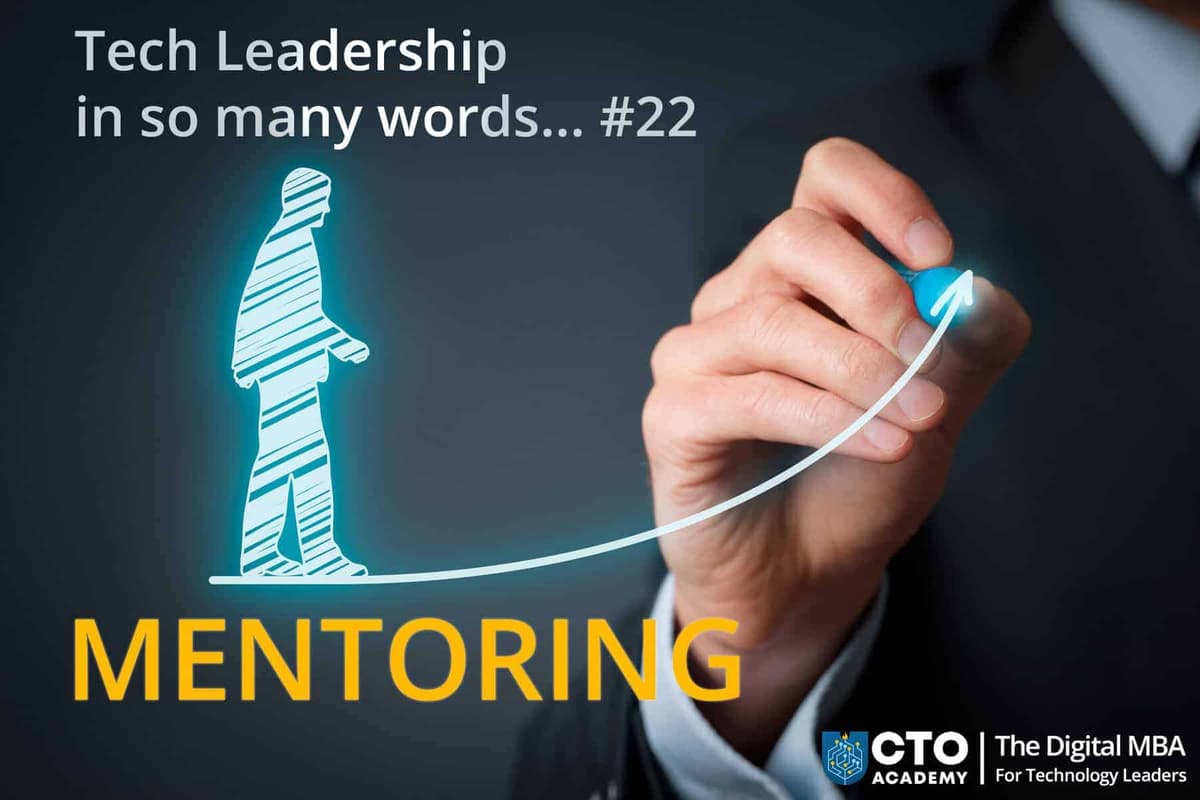
  • Tech Leadership in So Many Words #22 – Mentoring

    Tech Leadership in So Many Words #22 – Mentoring

    In the digital era, mentoring transcends traditional boundaries, emerging as a keystone for growth and innovation within the tech industry. It’s a symbiotic relationship where experience meets fresh perspectives, fostering an environment where mentor and mentee thrive.

    Mentoring is an important element of the learning journey – as both mentor and mentee. As you’re emerging in your career, it’s a powerful resource to lean into. As you give back in your career, it’s a fullfilling gift to provide.

    Andrew Weaver, CTO Academy

    Mentoring in tech is not just about navigating the complexities of coding or system architecture. It’s about understanding the ecosystem, predicting technological trends and manoeuvring through the dynamics of tech teams and projects. It significantly reduces the learning curve for emerging tech talents, thus offering them a roadmap to navigate challenges and seize career opportunities.

    This journey offers mentors a unique chance to refine leadership skills, stay connected with the evolving landscape and gain fresh insights from the newer generation of tech enthusiasts. It’s an opportunity to contribute to the industry’s future by shaping its upcoming leaders.

    Here’s how tech leaders can foster a Mentoring culture:

    • Initiate Formal Programs: Establish structured Mentoring programs that match mentors and mentees based on skills, interests and career goals.
    • Encourage Reverse Mentoring: Embrace skills exchange between generations, allowing younger employees to mentor seniors in, for instance, emerging technologies and new trends.
    • Facilitate Knowledge Sharing: Organise regular meetups, workshops and talks that encourage sharing experiences, challenges and successes.

    Mentoring is about building bridges. It’s about connecting wisdom with ambition and experience with innovation. In the tech industry, these connections are invaluable. They are accelerating personal and professional growth, ultimately driving the industry forward.

  • Tech Leadership, In So Many Words – #21 Knowledge

    Tech Leadership, In So Many Words – #21 Knowledge

    For the modern CTO, knowledge generally comes wrapped in three forms …

    Technical

    This is often about building a T-shaped skill set, with a general awareness of different technologies, alongside a deep understanding of at least one.

    This helps you to sharpen your BS antenna about what does and doesn’t “feel” right. 

    Domain

    An understanding of the business and the space, particularly around how it makes money. Things can go wrong without it.

    Forgetting the customer, failing to spot a changing business landscape and/or not understanding business processes and relationships have been the end of many senior executives (and their businesses).

    Leadership

    Core to the success of any CTO is an understanding of and comfort with the soft skills you need to motivate, negotiate and thrive as a senior executive. 

    Weakness in any of these three areas of knowledge will make your journey to becoming an effective technology leader just that little bit harder.

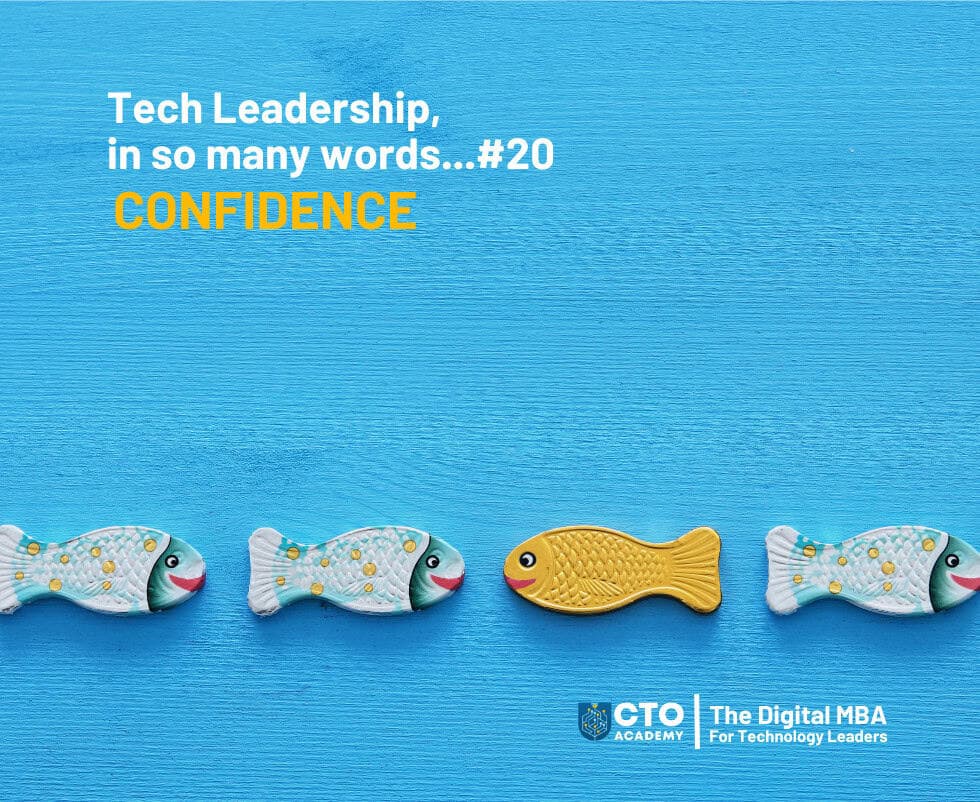
  • Tech Leadership in So Many Words…#20 Confidence

    Tech Leadership in So Many Words…#20 Confidence

    I’ve been asked to write a short piece on the impact of confidence in leadership.

    1st, how do I keep it short?

    2nd, which angle do I start with for this many tentacled topic?

    Because whether we talk about true confidence, projection, self-doubt and/or the ever present Imposter syndrome, how we deal with these issues will likely have a greater impact on what we achieve in our career, business, sport, life as most other factors.

    And one of the key challenges we all have to face is building our own sense of self-confidence while managing what we perceive as the confidence and swagger of others, much of which we know is BS.

    For we live in an era where Confident incompetence is en vogue and the ability to project confidence, however unmerited, often supersedes other basic qualifications for some very serious jobs, often with disastrous consequences.

    It stalks the corridors of political power, blocks talent in large-scale organisations and permeates a start-up world where the projection of confidence attracts investment while covering up a multitude of sins.

    The “fake it ’till you make it” job description requires you to express supreme confidence (whatever the background truth) in …

    … your product
    … your numbers
    … yourself
    … your incompetence

    Some make a virtue of a certain kind of narcissism where the “hustle” gets them to the top whilst the rest of us have to wrestle with imposter syndrome and natural self-doubt.

    By contrast, true confidence has a look all of its own and has been the subject of detailed research, particularly within business and sport. The impact of gender differences and stereotyping is a whole field on its own. But stripping it all back to basics, I lean on my old friend Socrates

    He believed that we should find confidence in our own beliefs and not be too swayed by others. 

    That thinking logically about your life directly correlates to becoming more assured and independent while less conformist and less hamstrung by what others think.

    The essence of self-confidence.

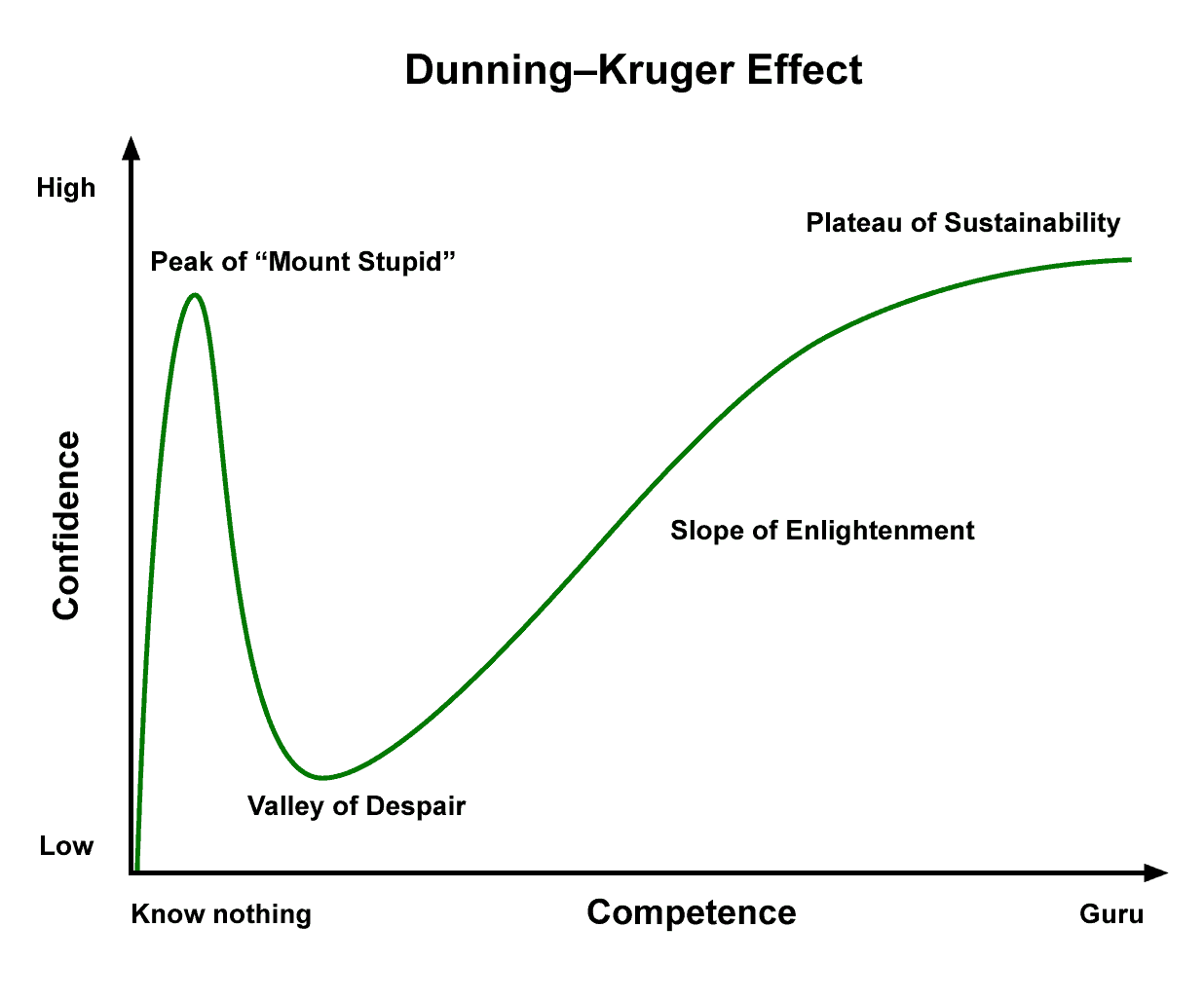
    Dunning–Kruger Effect - Confidence vs. Competence
    Source: Wikipedia

    To be a confident leader and one who can bring others with you, you don’t need to know everything or even project that you know everything.

    You need to get your happiness from within and lead from that core principle. 

    From there the rest flows…

    You gain confidence and judgment about when to say yes, and when to say no.

    You understand the importance of listening more than you speak.

    You’re not afraid to admit you’re wrong or celebrate other people when they are right.

    You build the courage to take risks and importantly the respect to bring others with you.

    And importantly, you’ll be able to spot and comfortably negotiate the confident incompetents.

  • Tech Leadership in So Many Words…#19 No

    Tech Leadership in So Many Words…#19 No

    My biggest flaw as an entrepreneur was a lack of judgment about when to say yes (a natural inclination) and when to say no (suffering from FOMO).

    The uncertainty of start-up life meant that I wanted to keep all options open as long as possible which of course, proved completely counter productive as it diluted the narrow focus I needed for any kind of success.

    The importance of judging how and when to say no is equally important in managerial and leadership roles because a key challenge we have as developing leaders is how to manage the people-pleaser element that doesn’t want to upset others or let them down, alongside that fear of missing out.

    NO might be the smallest word we use, but it’s often the most important one to master.

    As you grow into a strategic role within your organisation, the importance of time management, delegation and learning when to say no increases exponentially.

    So what stops us from saying NO?

    Often, it’s as simple as not knowing how to do it.

    What’s the best way to tell people you don’t have the time, or it’s not a good idea or frankly, you just don’t want to do it?

    One key consideration is not just saying no, but to explain why you’re saying no — what is the context behind your decision.

    It helps if you’re working in a psychologically safe environment where mutual trust allows the team to feel comfortable about stating their capacity and ring-fencing their priorities.

    Another key area is managing the iterative feedback loop with stakeholders where you’re under pressure to say yes but at the risk of trying to be all things to all people, an anxiety compounded by the power dynamic of a paying client?

    The key is taking time to digest what you’re being asked and avoid rushing into a yes.

    How do you say NO and mean it?

    I leave you with six bullet points:

    1. Learn how to say no politely. Be direct and stick to facts in your answer.

    2. If an opportunity or meeting presents itself, before saying yes, ask yourself how much time it will require and whether the potential outcome is worth it.

    3. Manage your energy. Understand the rhythms of your day; block out time when you’re most productive and protect it.

    4. Prioritise, Prioritise, Prioritise… damn those “to-do” lists, but they are essential.

    5. Protect your team. Say no on their behalf to ensure they’re not working over capacity.

    6. Provide a role model that empowers others in the team to learn the art of saying no.

    “When you say ‘yes’ to others, make sure you are not saying ‘no’ to yourself”

    Paolo Coelho
  • Tech Leadership in so Many Words…#18 Team

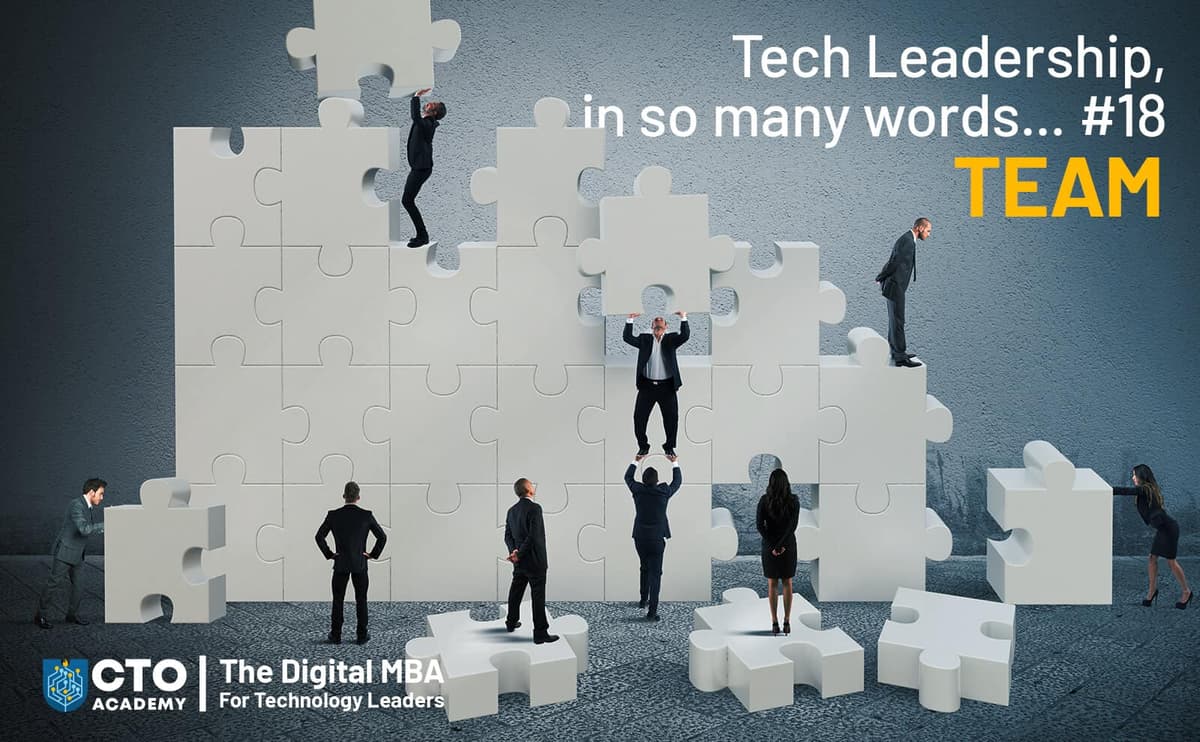
    Tech Leadership in so Many Words…#18 Team

    There’s a reason why the shelves of your local bookstore are heaving under the weight of so many management books.

    It’s because managing people is tough and would be a lot easier if it wasn’t for the people.

    But clearly it’s a prerequisite for anyone with leadership ambitions so the question is this:

    How to most effectively transform a disparate group of individuals into a high-performance team capable of achieving a common goal?

    Every management guru has to create their unique perspective but most tend to agree on the following;

    It’s about culture and that culture often depends on you. 

    Hire for fit as well as expertise.
    Do they bring the right energy, commitment, values to the team?
    And follow the hiring maxim …”If there’s any doubt, there is no doubt”

    Create an environment of psychological safety and creative empowerment.

    Be supportive and accessible — your door should always be open

    And before we close, an article on management would be incomplete without at least one motivational cliche so here goes…. ‘There’s No i In Team‘.

    Individual egos shouldn’t be allowed to dominate the conversation, including yours and beware the superstar who has become more disruptive than irreplaceable.

    Finally… the simplest but most overlooked management technique of them all. Learn to say “thank you” more often.

    I’m talking specifically to you because I know that you can do this more.
    We all can.

    Gratitude goes a long way to making people feel valued and it costs you nothing.

    ‘I’m not the smartest fellow in the world, but I sure can pick smart colleagues”
    – Franklin D Roosevelt


    BTW, here’s a smattering of those management books you might already have or should think about acquiring;

    Want to find out more about CTO Academy and our Technology Leadership Courses, including lectures and discussions focused around Team Building, Dynamics and Culture?

    Visit the CTO Academy Website and in particular our executive leadership course, The Digital MBA for Technology Leaders winning rave reviews from technology leaders around the world.

  • Tech Leadership in so Many Words…#17 Perfection

    Tech Leadership in so Many Words…#17 Perfection

    “Perfect is the enemy of good” – Voltaire

    I am not and never have been a perfectionist, something of a mixed blessing in the past.

    Some start-up projects went out too soon, were half-baked from the start and met with the underwhelming results they deserved. 

    Whilst other projects went out too soon, but hit the ground running as a result of early market validation and iterations.

    What was consistent across all was that the MVPs were never pretty and all were far from perfect.

    But perfectionism is an issue for many and a crippling one for some.

    It also stimulated the launch of CTO Academy because I’d seen more than one start-up where a tech co-founder couldn’t let the product go until it was “market ready”.

    Meanwhile, the market had moved so quickly that a once-innovative product was already off the pace as a combination of overthinking and over-engineering killed an opportunity at birth.

    Those from a technical background are often most vulnerable to this failing as a default, perfectionist instinct can sometimes suffocate their ability to make an impact.

    Effective technology leaders understand the balance required between making a product that you can be proud of and needing to get it out of the door asap and let the market tell you what’s good, bad and superfluous about those features you’re currently poring over.

    In other words, it might be a product that is far from perfect and potentially even embarrassing, but let the market be the judge.

    How do you manage out this instinct?

    You probably never will so a few simple suggestions from our collective experience:

    • Apply the 80/20 rule… and get it out there.
    • Don’t drive the team to despair… overt demands for perfection can have the opposite effect so understand how to define “good enough”
    • Become a lifelong learner rather than a perfectionist… enjoy the process rather than just pushing for the ideal end product.

    Voltaire knew a thing or two about life including the fact that ultimately, perfectionism is very inefficient.

  • Tech Leadership In So Many Words … #16 Health

    Tech Leadership In So Many Words … #16 Health

    ‘As long as you’ve got your health, you’ve got everything’

    A mantra that’s easy to say,
    but when you’re in deep as a senior leader,
    not always easy to follow.

    We become so hyper focused on managing the demands incumbent with leadership,
    alongside our own expectations and ambitions,
    that sometimes we fail to focus on the fundamentals of looking after ourselves.

    Before you know it ….

    Bad habits become ingrained and your wellbeing, physical and mental, starts to suffer with an impact on your ability to be fully effective at work and present at home. 

    And it’s those around you who will often spot the signs first.

    But you probably know all this, right?
    You’re aware of feeling overworked and overstressed. 
    Caught in the hamster wheel that’s become your normality.

    So what to do about it?

    How to manage others you see falling into the same cycle because we don’t need studies to tell us that people who feel mentally and physically healthy, are going to be more productive at work and supportive of each other.

    Those leaders who prioritise and accommodate team wellbeing are not only showing the basic humanity needed in those roles but are likely creating a competitive advantage at the same time.

    The Power of Marginal Gains

    The power of marginal gains was popularised in a sporting context by Dave Brailsford, former performance director of British Cycling.

    Brailsford believed that if you make a 1% improvement in a range of tiny areas then the long term benefits can be extraordinary.

    He looked at improving often overlooked aspects to build a cumulative edge against competitors;

    • He had the training room floor painted pristine white so they could spot any dust that might impair performance
    • Seats were redesigned for extra comfort and stability
    • Massage gels were tested for better muscle recovery 
    • They found better pillows for improved sleep
      And the list goes on

    So the question to ask yourself and your team,
    particularly if you see no obvious way to ease up the pressure of your day job ….

    What small steps and marginal gains can you implement today,
    That will create a significant cumulative impact around improved health tomorrow?

    • Walk the stairs rather than catch the lift
    • Use a fitness tracker (targeting a certain number of steps per day)
    • Listen to a meditation app at the end of each day (get some perspective)
    • Schedule more regular calls with the friends who make you laugh
    • Commit to building better sleep patterns into your lifestyle
      And the list goes on

    Remember also, that you are not alone if feeling overwhelmed at work.

    Many of us are or have been.

    So make sure that you’re maintaining a sense of perspective around you.
    I keep good friends close and regularly tune in and tune out with my favourite comedians.

    Help yourself by cultivating a team culture where vulnerabilities can be discussed
    and where laughter and humour pervade.

    Nothing is that serious, or at least nothing should be that serious.

    Tons of advice out there how to improve in these areas – a few of the ones we like …

    1. The philosophy of sans ecran …”without a screen”. Go tech-free for 24 hours during the weekend.
    2. Create one day per week that is free of meetings for people to catch up, reflect and learn
    3. Enable flexible working that works for the individual, as well as the organisation
    4. Get to properly know each other and bring a different social topic to regular meetings
    5. If working within a remote team, encourage separation of private vs working time, not being available outside that persons standard hours i.e. add an email signature that explicitly states your timezone/working schedule

    And the list goes on but the bottom line is this …

    Keep an eye on your health and start making those marginal gains today.

    ‘The first wealth is health’ — Ralph Waldo Emerson

    Want to find out more about CTO Academy and our Technology Leadership Courses, including lectures that look at time management and mental health at work?

    Visit the CTO Academy Website and in particular our executive leadership course, The Digital MBA for Technology Leaders that is winning rave reviews from global technology leaders

  • Tech Leadership In So Many Words… #15 Humility

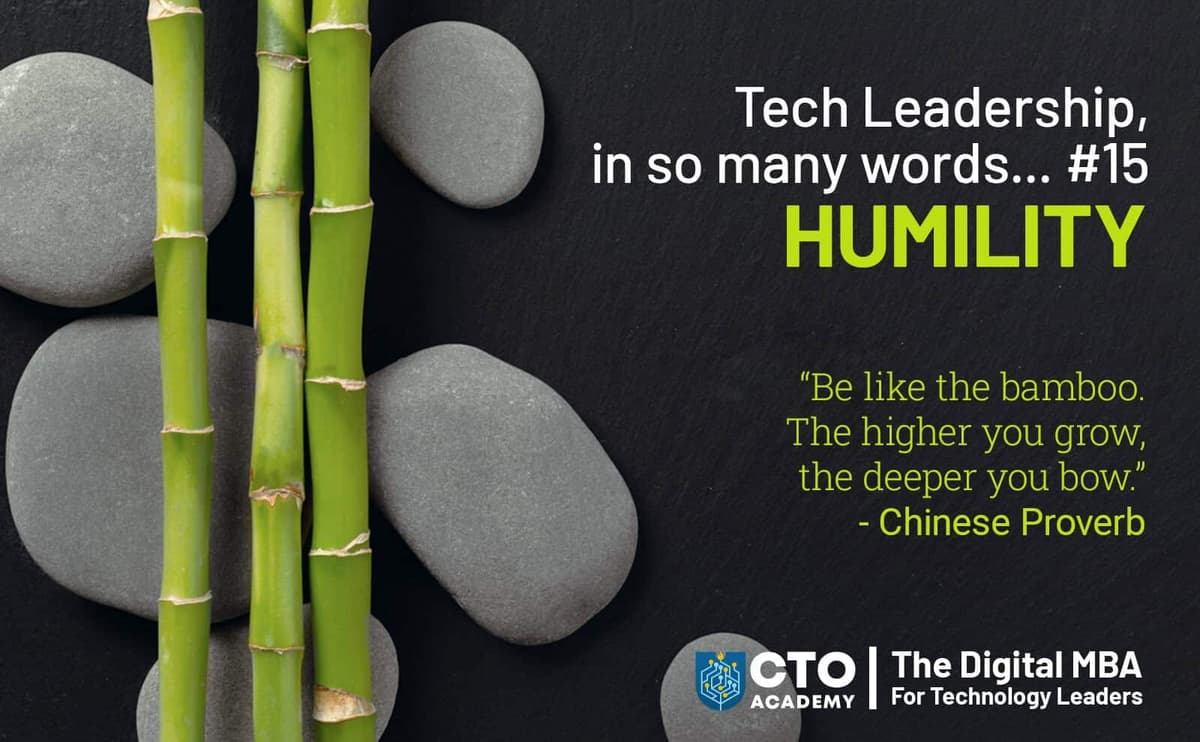
    Tech Leadership In So Many Words… #15 Humility

    Life is a long lesson in humility”

    J M Barrie

    Having reached a senior tech leadership role, you have the right to feel a sense of pride in your achievements.

    But leadership requires many things from you, not least a quality that’s the opposite of pride – humility.

    Humility requires you to leave your ego at the door, something your team will appreciate enormously because we’ve all experienced the top-down, transactional boss who leads by a mixture of job title and ego, normally of the inflated variety.

    So here’s a leading question for those of you on this leadership journey from a technical background…

    Is it more challenging to leave that ego in check when you’ve always been a star of the show?

    Does that perfectionist in you manifest itself into a struggle to delegate, trust and ditch that aforementioned ego?

    You may be coming from a background where acknowledging there are things you don’t know is a sign of weakness, not strength.

    But always needing to win an argument and being right does not make for great leadership. They will almost always become pyrrhic victories where your short-term sense of importance equals an attritional long-term impact on those around you. 

    Humility is critical to effective leadership

    tech leadership humility

    It means not trying to bluff your way out of difficult situations you’re facing for the first time, but honestly admitting a deficit in your knowledge, and that despite your seniority you remain eager to learn and grow.

    It’s OK to ask for help, from peers, mentors or coaches. To lean on the expertise of others when you need it. 

    A smart leader will be failure-tolerant and will shape a team culture with a similar approach. The team will discuss vulnerabilities without fear.

    Where psychological safety is a prominent element of the organization and not just something that’s nice to have.

    You should be comfortable putting your hand up as a leader and admitting any stumbles rather than covering them up or shifting the blame, thus potentially encouraging the same approach from your team. 

    Recognising your own fallibility allows you to accept colleagues’ mistakes with empathy and create an environment where failure is not fatal but another part of the journey to ultimate success. 

    What’s often worse is when the egotistical and insecure leader needs to claim credit for the achievements of others.

    Those others will quickly jump ship.

    Humbly acknowledging colleagues’ triumphs, and praising generously and sincerely will strengthen team relationships. It will also inspire members to take initiative and responsibility.

    By practising humility, you will have even more to be proud of.

    Want to learn more about CTO Academy and our Technology Leadership Courses, including lectures and discussions on Humility in Leadership?

    1. Explore the resources on our website.

    2. Take a look at our executive leadership course, The Digital MBA for Technology Leaders. It is continuously winning rave reviews from technology leaders around the world. And with a good reason too.

  • Tech Leadership In So Many Words … #14 Motivation

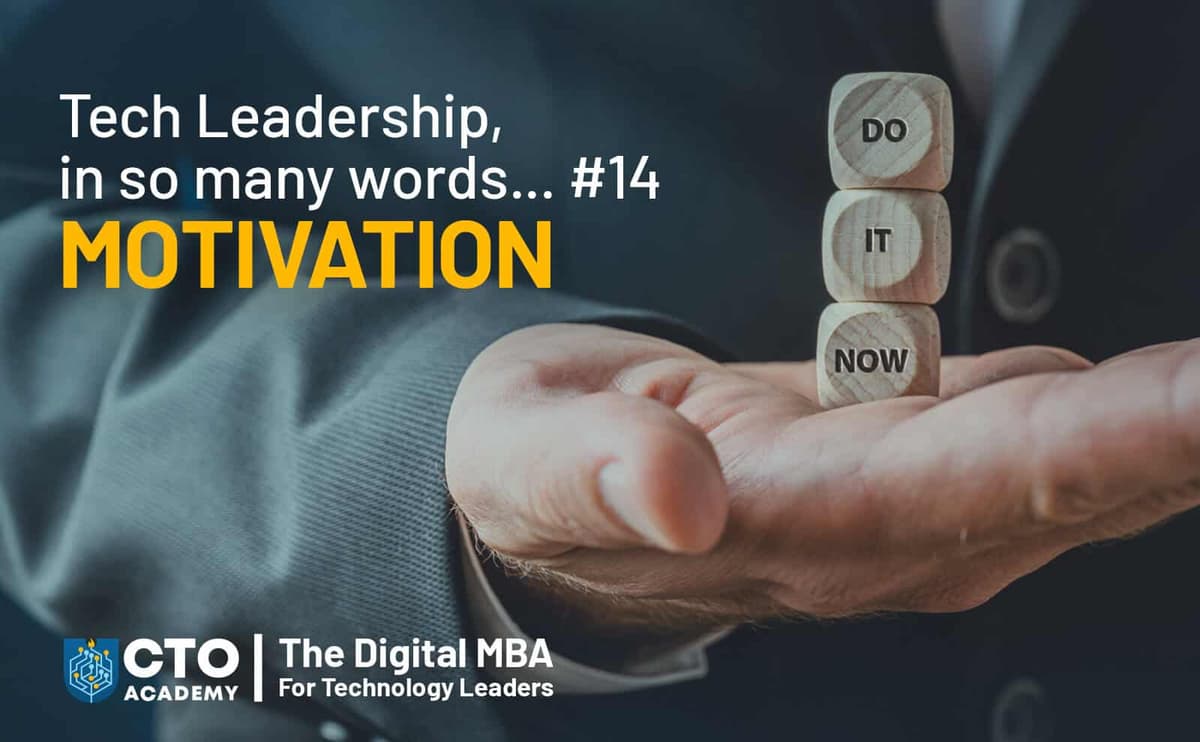
    Tech Leadership In So Many Words … #14 Motivation

    When you’re a leader, motivation is a two-sided coin.

    One side is Personal Motivation and what’s driving you.
    The other is Team Motivation and what’s driving them.
    The two being inextricably linked means we need to start with self. 

    What is your reason for doing what you’re doing?

    Are you being driven by an intrinsic motivation where your actions are spurred by internal rather than superficial rewards?

    Or are you drifting on an autopilot that is impacting (and not in a positive way) your performance and your leadership?

    Being honest with yourself about these questions will inform much of what’s going on around you …

    Your personal impact and achievements
    Your ability to lead and bring people with you
    Your overall contentment with the world

    Here is my truth.

    I was once employed and handsomely rewarded in a senior leadership role.
    Great colleagues, easy lifestyle, relatively few worries.
    Bored as hell.

    I hadn’t aligned any of my core values with my day job.
    I had zero intrinsic motivation and it was beginning to show.
    One day I woke up and had that honest discussion with myself.
    I quit.

    The most effective leaders are those whose career motivation is aligned with their core values.

    Leadership comes more naturally when the individual finds a flow between their role and their values.

    But how do you know what those core values are?
    Few people ever drill down deep enough to discover the principles that matter most to them. 

    It requires careful reflection, objective analysis via coach or close friend, and some of that aforementioned honest questioning.

    And of course it’s not just about the job or the company.
    It’s about whether your career is on the right trajectory.

    We work with global tech leaders to build their leadership skills but sometimes, it’s just not the right fit. Leadership is not something they fit. Tough decisions need to be made.

    If you’re at the start of the journey then one essential question you need to ask … why do you want to become a leader?

    Ideally the answer should be that you have no choice.
    You simply cannot not be a leader.

    Your instinct to lead is so strong that it’s part of who you are.
    To lead, inspire, change, motivate and impact on others and the surroundings around you.
    If you don’t feel you have that instinct, your other motivations may not matter. 

    But of course being a leader also means that you now have to take into account and understand the motivation and ambition of others particularly those working closest to you, your team.

    You will be highly fortunate and unusual if these always align with your own.

    So a critical element of leadership is to understand and have the capacity to learn about what drives your colleagues and from there, to provide them with the opportunities to progress in their own careers — giving individuals the autonomy and training to thrive.

    No room for fixed mindset and/or defensive leadership in 2023.

    Support of this kind will increase employees’ motivation to work towards that common goal and have a significant impact on your ability to inspire and retain.

    Your ability to listen, willingness to encourage discussion and capacity to display sincere interest and enthusiasm, will create an environment and culture that allows your team, with all its different motivations, to operate at its full potential.

    And remember — however strong your desire to succeed in your career, it is important not to be overwhelmed by it. The same goes for individuals in your team.

    Ambition should always be balanced with a wider and holistic approach to a quality of life. 

    The core value of life and relationships outside work should never be forgotten.

    Want to find out more about CTO Academy and our Technology Leadership Courses, including lectures and discussions that look at Motivation and …. How To Discover Those Core Values

    Visit the CTO Academy Website and in particular our executive leadership course, The Digital MBA for Technology Leaders winning rave reviews from technology leaders around the world.

  • Tech Leadership In So Many Words … #13 Change

    Tech Leadership In So Many Words … #13 Change

    If there’s one constant in our lives, it’s change.

    That much is stating the obvious.

    So let’s move on and take a helicopter view of three key areas of change you will have to negotiate in your journey as a technology leader

    Personal

    There is no c-suite career path that requires a sharper handbrake turn of skills than that of the CTO.

    Whereas the CEO, CMO, CFO will be on a compounding skills trajectory throughout their career to the top, the CTO must make the fundamental transition from a technical background into the more hybrid, business-fluent skill set needed in modern organizations.

    It’s why those who achieve this transition are in such high demand.

    But it involves some fundamental and often challenging changes in mindset as you switch your focus away from the technical and across to the people.

    People

    So here’s a dichotomy…

    The world of technology tends to attract people comfortable with innovation. But we remain creatures of habit who like our comfort zones and are not always prepared to follow significant change in other areas, particularly if the benefits are not clear to us.

    As a technology leader you’ll be making decisions and changes that directly affect the people around you.

    So you need to be the owner and agent of that change, capable of bringing people with you and inspiring them to move outside their own comfort zones, whether related to working procedures, roles or targets.

    But resistance to change is a common response so you need to build an understanding of how to encourage team buy-in;

    1. Communicate clearly about the changes being made and why they’re needed 

    2. Establish a clear timeline for how change is going to be implemented

    3. Put training and support in place for the employees affected

    4. Continue the support, and seek feedback to keep everyone on board once change has been made

    Technology

    The most obvious element of change affecting us all is the ever-increasing pace of technological advance … anyone heard about this game-changer they call ChatGPT?

    To keep on top of this dynamic world, you must create a breathing space by stepping back from the day-to-day tasks.

    You need to learn to delegate.
    You have to learn to trust.

    If not, you won’t have time to understand how the changes taking place might affect your organization, nor will you gain the insight and knowledge to judge what is hype vs likely reality.

    And it’s this “value add” your organization is relying on you to provide.

    “To improve is to change; to be perfect is to change often” — Winston Churchill

    Want to find out more about CTO Academy and our Technology Leadership Courses, including lectures and discussions that look at the role of Change in your Professional Growth?

    Visit the CTO Academy Website and in particular our accredited executive leadership course, The Digital MBA for Technology Leaders that is winning rave reviews from technology leaders around the world.