Next MBA Cohort Starts Monday, July 6th, 2026

Review Pricing and Join the Cohort

CTO Academy Logo
Log In

Category: CTO Career

  • Chief Product & Technology Officer (CPTO) Role and Responsibilities

    Chief Product & Technology Officer (CPTO) Role and Responsibilities

    What if a product team and its CPO advocate one technology stack, but the engineering team and its CTO another? What if the lines between product and technology are completely blurred, like in organizations that offer purely tech-based products? The solution to both predicaments is often a new breed of leader: the Chief Product and Technology Officer (CPTO).

    The CPTO role responds to the growing need for seamless integration between product vision and technological execution. It is at the intersection of strategy, innovation, technology, and leadership and has a single goal: to ensure that technology investments fuel the product roadmap and business goals.

    TL;DR

    • CPTO = one exec accountable for both product outcomes and technology execution (roadmap + architecture + delivery).
    • Best fit when product and tech decisions are inseparable (SaaS/AI platforms) or when you need faster alignment (startups, transformations).
    • If you’re deciding between roles, use the CPTO vs CTO vs CPO comparison plus the “who owns what” decision-rights table (roadmap, architecture, reliability, security, etc.).
    • To make the role work in practice, implement the CPTO operating system: weekly tradeoffs, shared cadences, a decision log, and explicit delegation/guardrails.
    • Measure success with a single CPTO scorecard balancing product outcomes, delivery performance, reliability, security, and cost efficiency.
    • Watch for common failure modes (bottlenecking, feature-factory output, misaligned clocks, underinvesting in security) and apply the fixes early.

    [Article last updated on February 25, 2026. Updates include: two comparison tables (CPTO vs CTO vs CPO, plus decision ownership), expanded practical sections on organizational design, operating cadence, decision rights, and a CPTO KPI scorecard. It now also includes a clear list of common failure modes with fixes, so you can diagnose issues and apply improvements immediately.]

    Table of Contents

    Currently, over a dozen CPTO Jobs are posted on the JobLeads platform alone, with an average salary of $220,000. Additional Chief Product & Technology Officer jobs are also posted on Indeed.com

    This article explains the CPTO role: meaning, job description, responsibilities, required skills, challenges, and potential impact on your career trajectory. It also examines when this combined role makes sense for an organization.
    Get the IT Career Path Roadmap (Free PDF)

    Want more than scattered ideas? Get our IT Career Path Roadmap PDF – an 8-step framework to map your next roles, sharpen your skills, and build a layoff-resilient tech leadership career. Fill in the form and we’ll send you the PDF version so you can download it, annotate it, and use it as a living plan for your next career moves.

    Downloading the ebook does not automatically subscribe you to our bi-weekly Technology Leadership Newsletter.

    CPTO Job Description, Responsibilities, Required Skills, and Impact

    As we said, a CPTO is a technology leader who blends technical expertise with an understanding of product strategy and market needs. They lead cross-functional teams, including engineers, product managers, and designers, to create innovative and successful products. 

    We can see how this process unravels just by looking into the responsibilities of a Chief Product Technology Officer. 

    Responsibilities
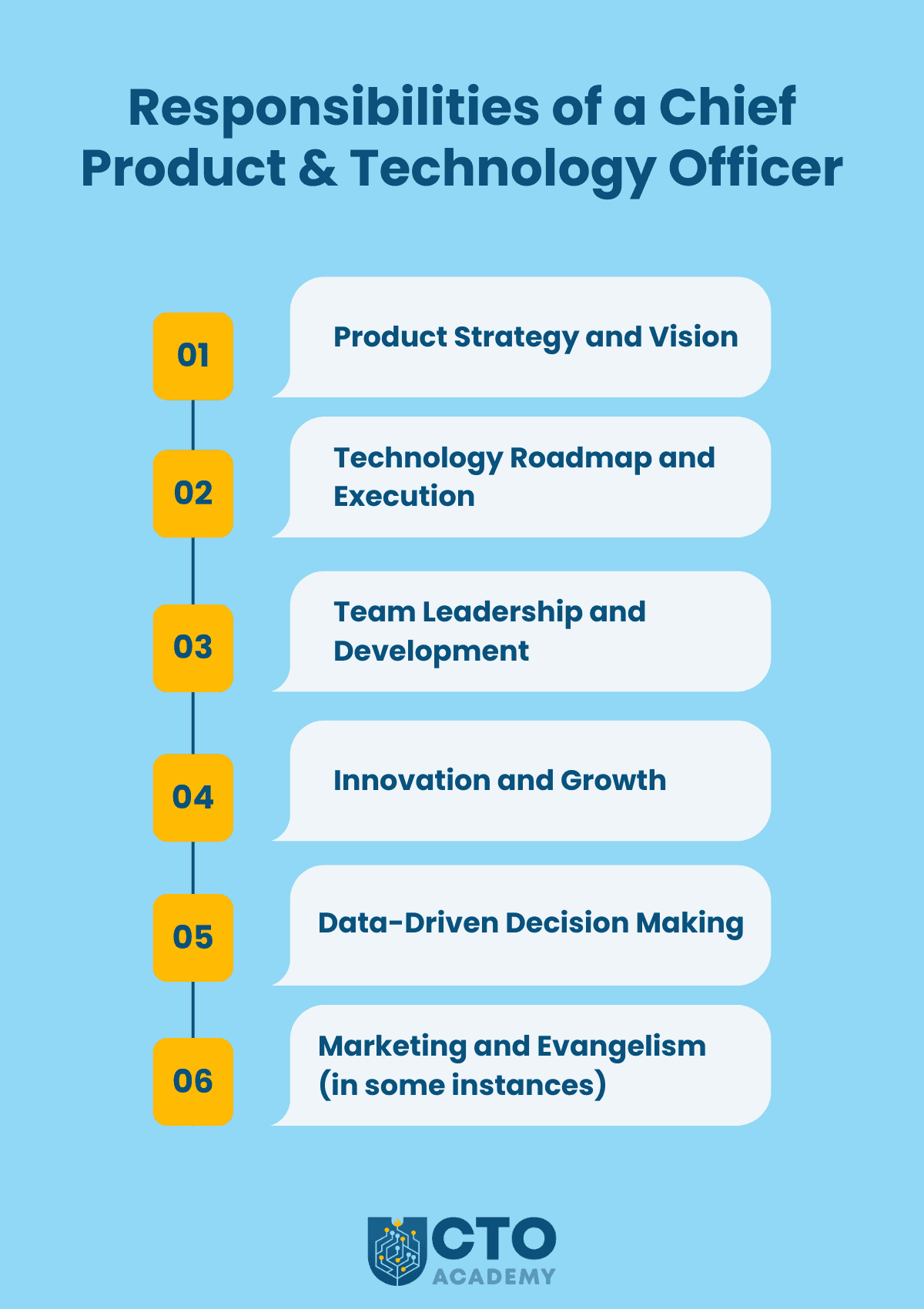
    List of responsibilities of a CPTO - infographic presentation
    Universal responsibilities of a CPTO (Chief Product & Technology Officer)

    1. Product Strategy and Vision

    • Defines the overall product strategy
    • Ensures the strategy aligns with the company’s business goals and market opportunities. 
    • Owns the product roadmap
    • Prioritises features
    • Guides the product development lifecycle.

    2. Technology Roadmap and Execution

    • Leads the development and execution of the technology roadmap
    • Ensures the roadmap a) supports the product strategy and b) enables efficient product development (eg, technology selection, architecture design, and infrastructure management).

    3. Team Leadership and Development

    • Leads and mentors cross-functional teams of engineers, product managers, designers, and data scientists.
    • Builds and fosters a collaborative and high-performing culture.

    4. Innovation and Growth

    • Drives innovation by exploring new technologies, identifying emerging trends, and fostering a culture of experimentation. 
    • Leads new product ideas and guides their development from concept to launch.

    5. Data-Driven Decision Making

    • Leverages data and analytics to inform product and technology decisions, track progress, and measure success. 
    • Promotes a data-driven culture across the organization.

    6. Marketing and Evangelism (in some instances)

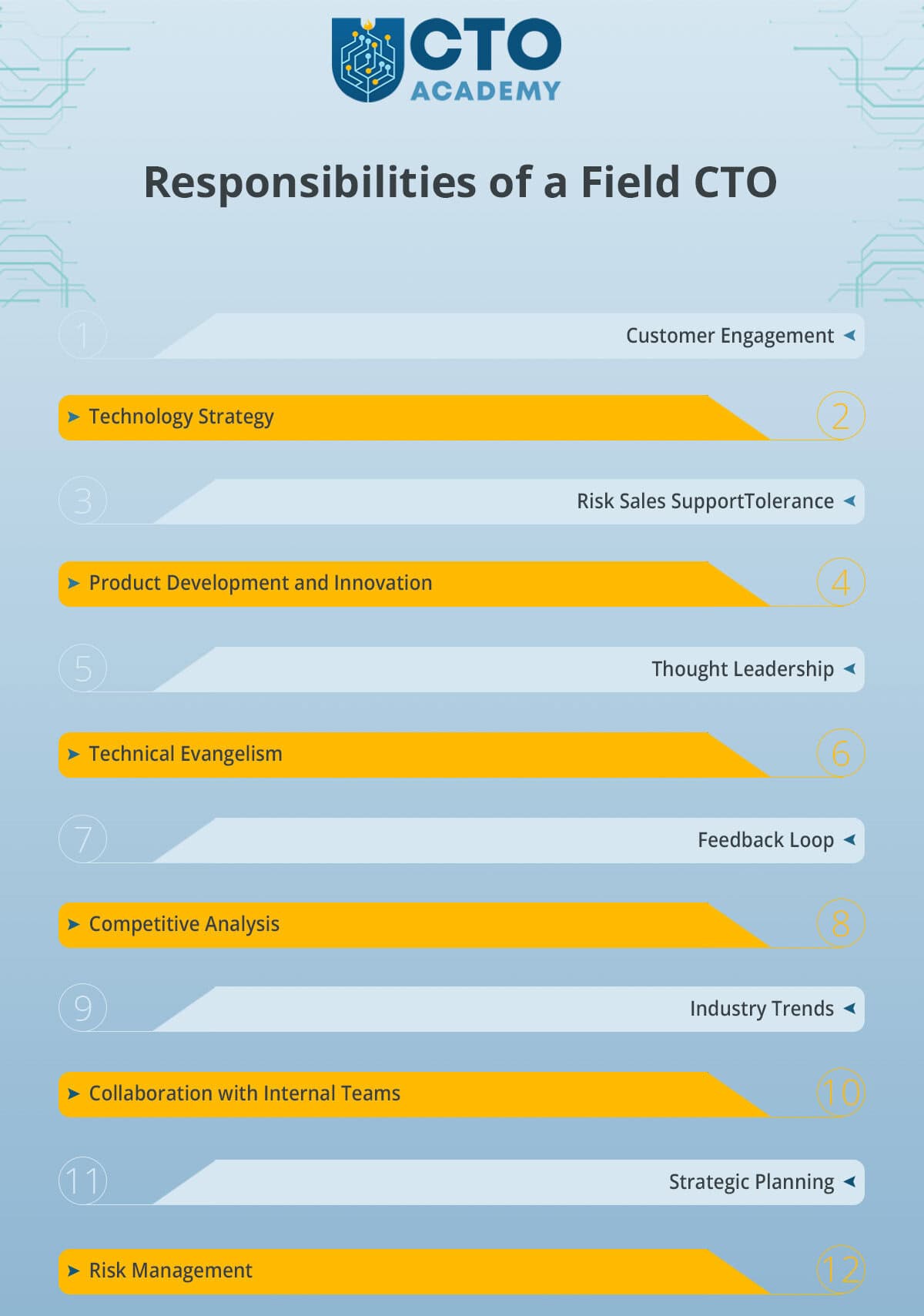
    In SaaS-based companies, for example, the CPTO often acts as the head of the Product department; therefore, playing a lead role in marketing the product. In that capacity, the CPTO becomes the lead evangelist for the product. The role then also involves meeting and interacting directly with current and prospective consumers to relay the value and benefits while getting feedback and assessing their reception and experience with the product, much like the Field CTO role.

    Skills and Expertise

    • Technical Proficiency
    • Product Management Expertise (end-to-end, including delivery and customer support)
    • Leadership and Communication
    • Business Acumen
    • Data Analysis and Interpretation

    Organisational Impact

    1. Improved alignment between product and technology teams.
    2. Enhanced decision-making through joint product and technology perspectives.
    3. Faster innovation cycles.
    4. Increased collaboration.

    When It Makes Sense to Have CPTO Instead of the Traditional Tech Leadership Duo

    Distinguishing Responsibilities

    The CTO (Chief Technology Officer) primarily focuses on the technical side of the business (ie, infrastructure, security, architecture, and the engineering team’s execution). In other words, the CTO’s job is to ensure the technology stack is robust, scalable, and aligned with industry best practices.

    The CPO (Chief Product Officer), on the other hand, converges the customer and the product vision. The CPO understands user needs, market trends, and the competitive landscape. Based on these factors, the CPO defines the product roadmap, prioritises features, and ensures the product delivers value to users while achieving business goals.

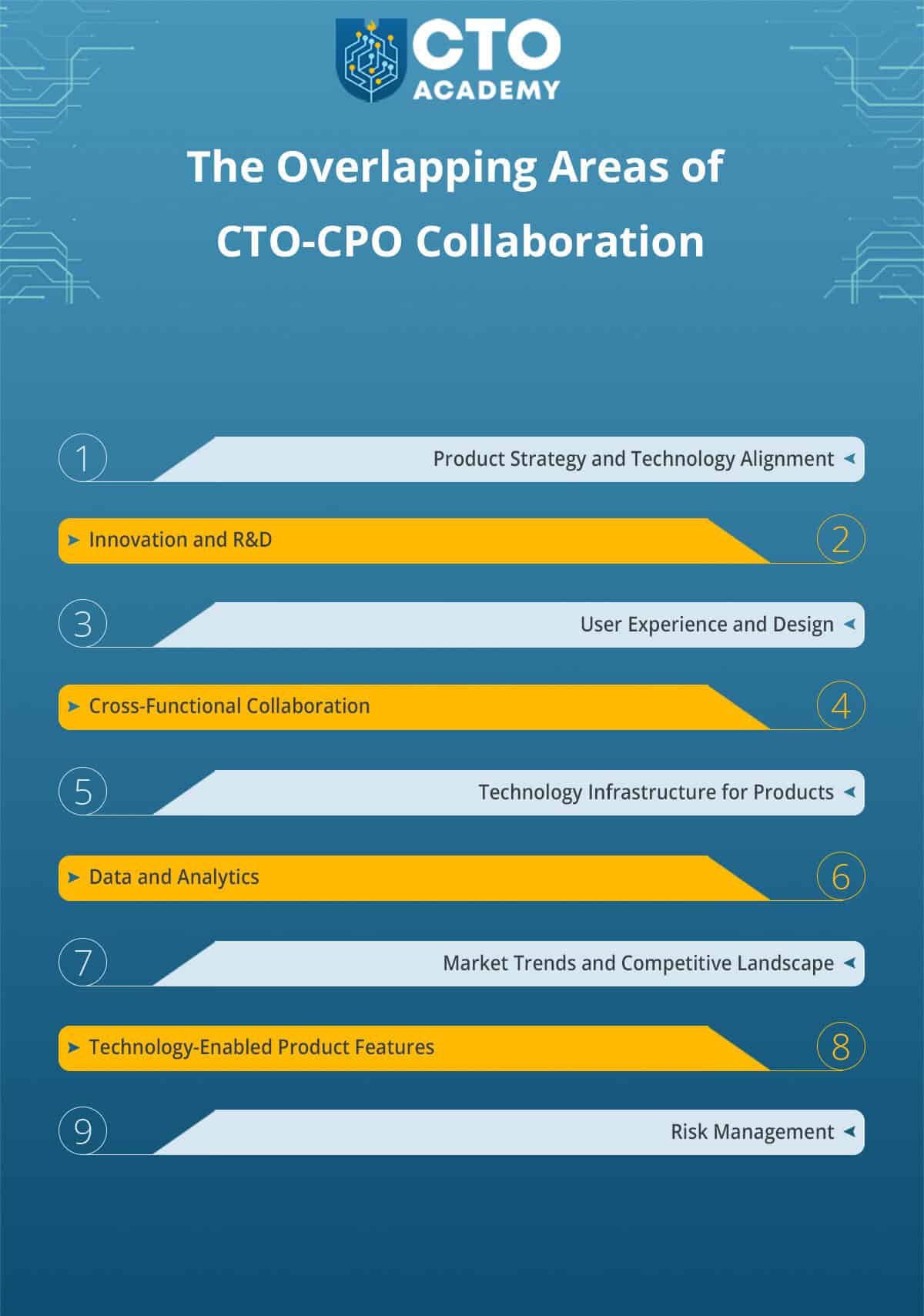
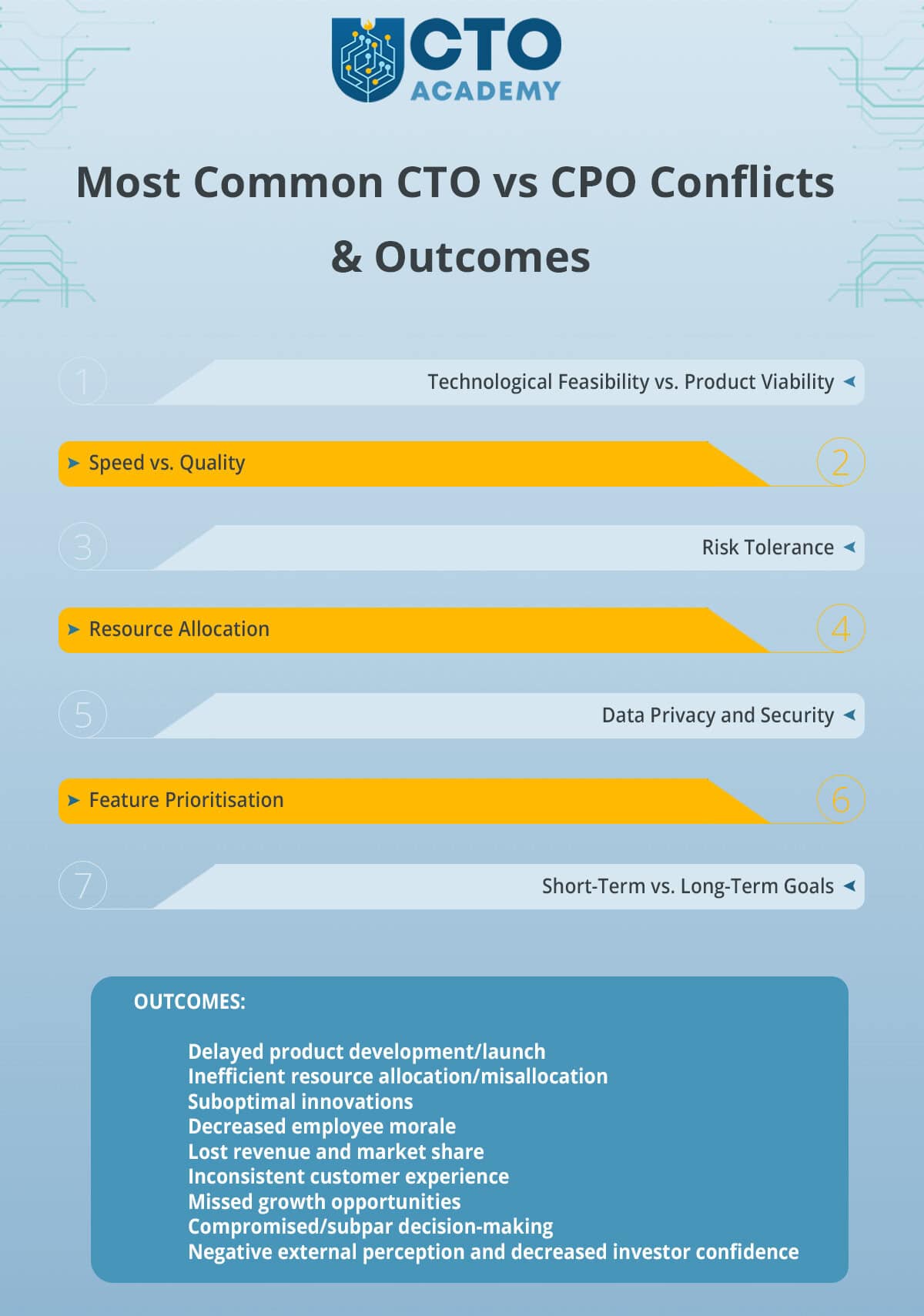
    [For more in-depth disambiguation between CTO and CPO roles, read our primer on CTO/CPO differences, friction, and transformative collaboration.]

    But in some instances, these two roles merge into a CPTO (Chief Product and Technology Officer) who bridges the gap between product vision and technological execution. However, this is only possible if the CPTO possesses a strong understanding of both domains because the underlying purpose of the role is to achieve a perfect alignment between the product roadmap and the technology strategy.

    TABLE 1: CPTO-CTO-CPO comparison table

    DimensionCPTO (Chief Product & Technology Officer)CTO (Chief Technology Officer)CPO (Chief Product Officer)
    Primary accountabilityOne throat to choke for both product outcomes and technology executionTechnology strategy + engineering execution (how the product is built and run)Product strategy + outcomes (what to build and why)
    Core mandateAlign product bets with tech realities; optimize for value and feasibilityBuild scalable, secure, reliable tech capabilities that enable the businessMaximize customer value and business impact through product direction
    Typical decisions ownedPrioritization tradeoffs across discovery/delivery; sequencing across product + platform; build vs buy; architecture direction aligned to roadmapArchitecture, platform choices, engineering org model, delivery systems, reliability/security postureProblem selection, roadmap themes, positioning, packaging inputs, experimentation strategy
    KPI focusBalanced scorecard: growth/retention + delivery speed + quality/reliability + costDelivery performance, system reliability, security, tech productivity, platform healthAdoption, activation, retention, NPS/CSAT, revenue expansion, roadmap impact
    What “success” looks likeFaster, cleaner decisions; fewer handoffs; roadmap that ships and scalesPredictable delivery with high quality; resilient systems; strong engineering cultureClear product strategy; evidence-based prioritization; measurable customer and business outcomes
    Main internal interfacesCEO, COO/CRO, Sales/CS, Eng, Product, Design, Data/AICEO/COO, Eng, Security, IT/Infra, Data/AICEO/CRO, Sales/Marketing, CS, Product, Design, Research
    Typical scope of orgProduct + Engineering (often Design and Data depending on org)Engineering + Platform/Infra + Security (sometimes Data/AI)Product + Design + Research (sometimes Data/Analytics)
    Where the role spends timePortfolio tradeoffs, roadmap + architecture alignment, org design/cadences, stakeholder alignmentTechnical direction, engineering systems, platform investment, risk & resilienceCustomer discovery, product strategy, roadmap, GTM alignment, outcome measurement
    Common failure modeBecomes a bottleneck or over-weights one side (tech or product)Builds tech excellence disconnected from market/customer prioritiesDrives roadmap without feasibility/operational constraints → delivery friction
    Best fit contextsProduct-tech coupling is high; need speed/alignment; single product/platform focusComplex tech stack, reliability/security needs, scale demandsCompetitive product strategy needed; multi-segment markets; strong GTM/product motion
    “Split roles” triggerMultiple product lines, heavy compliance, large org scale → separate CPO + CTOIf product strategy is unclear or weak → need stronger product leadershipProduct + Engineering (often Design and Data, depending on org)

    A faster way to think about it is decision ownership.

    TABLE 2: Who owns what

    AreaCPTOCTOCPO
    RoadmapOwnsCo-ownsOwns
    ArchitectureCo-ownsOwnsInfluences
    Reliability (SLOs/uptime)Co-ownsOwnsInfluences
    Pricing & PackagingInfluencesInfluencesCo-owns
    Data/AI (strategy + platform + product use)Co-ownsCo-ownsCo-owns
    SecurityCo-ownsOwnsInfluences
    • Ownership varies by company size and maturity; this shows the most common pattern.
    • Co-owns = accountable through shared KPIs/decision rights, even if execution is delegated.

    When a CPTO Role Makes Sense?

    Resource-Constrained Environments 

    We are primarily referring to start-ups and smaller companies that require streamlined decision-making and reduced friction between product and technology teams. 

    A good example is our own CTO, Jason Noble, who, for all intents and purposes, acted (and partially still acts) as the Chief Product & Technology Officer even though it wasn’t his formal role. But during the start-up phase and some time afterwards, his involvement checked all the boxes of the CPTO role. 

    Product-Led Organisations 

    That is, companies where technology is inseparable from the product (e.g., SaaS, gaming, AI-driven platforms…). As our next example demonstrates, these companies largely benefit from CPTO’s holistic approach to product development.

    DataCamp leverages Gen AI to help engineers move forward when they hit a snag, but that’s also the origin of a contentious choice. The DataCamp engineering team preferred to use the newest LLMs available from OpenAI. The product team, on the other hand, wanted to wait until the models became available from Azure. 

    Eduardo Oliveira, DataCamp’s Chief Product and Technology Officer, made a decision: The smaller clients could use the faster, newer models, while the bigger companies had the default options of Azure and Microsoft, with an option to use a newer model from OpenAI.

    Now imagine a common scenario with CTO and CPO backing their teams. It would take a while before these two find a common ground. This way, however, the decision was instant and, more importantly, flexible and based on mutual satisfaction.   

    Digital Transformations

    When companies are undergoing significant digital shifts, a CPTO can lead the way by ensuring technology serves the evolving product strategy.

    Agile Environments

    Companies that prioritise agility and rapid iteration often benefit from a CPTO’s ability to quickly align product and technology decisions.

    When Separate Roles Make More Sense

    • Complex organisational structures.
    • Diverse product portfolios.
    • Highly specialised technology.
    • In instances where the product and technology roadmaps have limited overlap or require very different skill sets.
    • Organizations operating in heavily regulated industries (eg, finance, healthcare, or any other that requires high levels of compliance and security).

    Organizational Design: Who Reports to a CPTO (and when to split the role again)

    A CPTO works best when product and technology are tightly coupled, and the organization benefits from a single prioritization and execution system. To make the role sustainable, define reporting lines, shared interfaces, and “split triggers” early, before scale turns alignment into overload.

    Typical reporting lines to a CPTO

    In many companies, the CPTO owns an integrated “build organization” that includes:

    • Product Management (PMs, Group PMs, Product Ops, where applicable)
    • Engineering (Engineering Managers, Tech Leads, QA/Quality Engineering)
    • Design (Product Design, UX Research, sometimes via a Design Director)
    • Data/AI (varies by company):
      • If data/AI is core to the product: Data Engineering/ML Platform/Applied ML often sits under CPTO or is co-led with a Head of Data/AI.
      • If data is enterprise-wide, it may sit under COO/CIO with strong dotted-line alignment to CPTO.

    Common dotted-line partners (usually not direct reports):

    • Security (CISO/Head of Security)
    • IT/Corporate systems
    • Revenue org leaders (CRO, Sales, Customer Success) for roadmap alignment and customer feedback loops

    Remember:

    The goal isn’t “CPTO owns everything.” The goal is one decision system for product bets, technical feasibility, and delivery capacity.

    Two practical patterns that work well

    Pattern A: Integrated Product + Engineering (most common)

    • Product and Engineering report directly to CPTO.
    • Design and Data/AI either report to CPTO or are tightly partnered with clear shared metrics.

    Pattern B: Platform + Product Lines

    • CPTO oversees Product + Engineering, with an explicit split between:
      • Product-line teams (customer-facing outcomes).
      • Platform teams (reliability, developer experience, shared services).
    • This pattern reduces roadmap friction and prevents platform work from being perpetually deprioritized.

    “Split triggers”: when it’s time to separate CPO and CTO again

    Even if the CPTO model works initially, scaling can create a natural need to split roles. Consider separating CPO and CTO when you see one or more of the following:

    • Multiple product lines/markets with conflicting strategies and GTM needs.
    • High regulatory burden (finance, health, critical infrastructure), where security/risk leadership becomes a full-time executive focus.
    • Rapid headcount growth (coordination cost rises; leadership bandwidth becomes the constraint).
    • Deep technical specialization required (e.g., heavy infra/platform, complex AI/ML, embedded/hardware).
    • Reliability is existential (availability, latency, safety, compliance) and requires dedicated executive attention.
    • M&A or multi-platform integration where architecture complexity dominates.

    Rule of thumb:

    If the CPTO is spending most weeks making either product strategy calls or technology risk calls—and the other area is consistently under-served—it’s time to split.

    If you keep the CPTO role at scale, reduce overload with explicit structure

    • Appoint strong “second-in-command” leaders: VP Product and VP Engineering (or equivalents).
    • Make platform/reliability/security investment non-negotiable via capacity allocation.
    • Keep a single scorecard, but assign clear owners per metric category.
    • Protect focus time: fewer meetings, more decision clarity, more delegation.

    Operating Model: How a CPTO Runs the Organization

    A CPTO’s job is to turn strategy into a repeatable decision-and-delivery system—where product bets, technical direction, and execution capacity stay aligned week after week (not just at quarterly planning).

    The CPTO Operating System (the “minimum viable” version)

    Most high-performing CPTOs rely on a small set of cadences + artifacts + decision rights:

    Cadences

    • Weekly: Prioritization & tradeoffs (60–90 min)
      One meeting to resolve the hard calls: what ships, what slips, what gets staffed, and what is blocked by dependencies.
    • Weekly or biweekly: Product discovery review (45–60 min)
      Validate problem selection, experiment design, and learning velocity (not feature status).
    • Biweekly: Delivery/execution review (45–60 min)
      Focus on flow: blockers, scope creep, cross-team dependencies, and time-to-value.
    • Monthly: Architecture & platform review (60–90 min)
      A lightweight forum to prevent “architecture by Slack” and align platform investment with roadmap needs.
    • Quarterly: Planning + capacity allocation (half-day to 2 days)
      Agree on themes, measurable outcomes, and an explicit capacity split (e.g., product bets vs platform vs risk reduction).

    Core artifacts (keep these simple and public)

    • Outcome roadmap (themes + measurable outcomes, not just features).
    • Tech roadmap (platform investments tied to business outcomes).
    • Decision log (what we decided, why, and what we’ll revisit).
    • Capacity model (who is working on what and what gets deprioritized).
    • Scorecard (a small set of KPIs spanning product outcomes + delivery health + reliability/security).

    Decision Rights: What the CPTO Decides vs Delegates

    The CPTO should own the decision framework, but avoid becoming the bottleneck.

    CPTO should personally own:

    • Portfolio-level prioritization (product bets vs platform vs risk work).
    • Roadmap sequencing when tech constraints and customer value collide.
    • Build vs buy tradeoffs with clear evaluation criteria.
    • Cross-org dependencies and “who decides” conflicts.
    • Hiring/structure decisions for Product + Engineering leadership.

    CPTO should delegate (but stay accountable through metrics):

    • Technical implementation details (to engineering leadership).
    • Day-to-day delivery execution (to EMs/TPMs).
    • Specific domain roadmaps (to PMs/Group PMs and tech leads).

    If everything requires CPTO approval, the org will slow down. A strong CPTO builds a system where teams can decide quickly inside clear guardrails.

    A Practical Template for Fast Alignment (use this in every meeting)

    When tradeoffs appear, resolve them with the same set of questions:

    1. What outcome are we optimizing for? (customer value + business impact)
    2. What’s the constraint? (reliability, security, time, cost, dependencies)
    3. What’s the smallest bet that proves/disproves the hypothesis?
    4. What are we explicitly NOT doing this cycle? (make deprioritization visible)

    If unsure how to create it, use this decision-making framework template.

    First 30 Days: What a New CPTO Should Implement

    • Publish a single shared roadmap view (outcomes + delivery milestones).
    • Establish a weekly tradeoff cadence and a decision log.
    • Define capacity allocation (what % goes to roadmap vs platform vs risk).
    • Align on scorecard metrics across Product + Engineering.
    • Clarify decision rights (who owns what, what escalates).

    CPTO KPIs

    A CPTO is accountable for results (product impact) and the system that produces results (delivery capability, reliability, security, and cost).

    The simplest way to manage that tension is a single scorecard that Product and Engineering review together. But the scorecard must balance product outcomes and engineering health.

    1) Product outcomes (are we creating value?)

    • Adoption & activation: % of users reaching “aha” moments, onboarding completion, and feature adoption.
    • Retention & engagement: churn/retention, DAU/MAU (or equivalent engagement signals).
    • Customer value: NPS/CSAT, support ticket trends, and time-to-value.
    • Business impact: revenue growth/expansion (where relevant), conversion rate, and ARPA/ARR impact per initiative.

    2) Delivery performance (can we ship predictably?)

    • Lead time: idea → shipped (or PR → production, depending on level).
    • Throughput: meaningful releases per period (avoid vanity “number of tickets”).
    • Predictability: planned vs delivered (variance), roadmap stability.
    • Quality: escaped defects, rollback rate, and incident rate linked to recent changes.

    3) Reliability & operational excellence (can customers trust it?)

    • SLO attainment: uptime, latency, error rate, and availability by critical user journey.
    • MTTR: mean time to restore (how fast you recover).
    • Change failure rate: how often deployments cause incidents.
    • Operational load: on-call burden, toil percentage.

    4) Security & risk (are we reducing exposure?)

    • Critical vulnerabilities: time-to-patch, open critical/high findings.
    • Security posture: compliance controls coverage, audit outcomes (where relevant).
    • Access hygiene: privileged access reviews, MFA coverage, secrets rotation cadence.
    • Data risk: incidents, data classification coverage, model/data governance maturity (if AI).

    5) Cost & efficiency (is the platform sustainable?)

    • Infrastructure cost per customer/per transaction.
    • Cloud spend variance: forecast vs actual; unit economics trends.
    • Engineering efficiency: % time in feature work vs toil; rework rate.
    • Platform leverage: reuse rate, internal developer satisfaction (DX), build times.

    How to Use the Scorecard (without turning it into bureaucracy)

    • Review Product outcomes + Delivery + Reliability weekly/biweekly (keep it short).
    • Review Security + Cost at least monthly, or whenever risk/spend spikes.
    • Tie the major initiatives to one primary outcome metric and one guardrail metric (e.g., activation ↑ while error rate stays within SLO).

    The CPTO’s job isn’t to maximize every metric. It’s to make tradeoffs explicit and keep the organization aligned on what matters this quarter.

    Quick-starter Set of metrics (if you want the minimum viable version)

    If you need to start simple, pick 8–10 metrics total:

    • Activation, retention, NPS/CSAT (or support volume trend).
    • Lead time, predictability variance, and escaped defects.
    • SLO attainment and MTTR.
    • Critical vulnerability time-to-patch.
    • Infra cost per customer/transaction.

    Charting a Career Roadmap

    The CPTO role is a relatively new addition to the tech leadership landscape, and the path to this position may not be as clearly defined as traditional roles like CTO or CPO. However, with the right blend of skills, experience, and strategic planning, you can successfully navigate your way to this position. Let’s see what you need to do if you are a CTO, CPO, or Tech Lead.

    CTO-to-CPTO

    • Expand your focus beyond technology to encompass product strategy, user experience, and market analysis. 
    • Seek opportunities to collaborate closely with product teams.
    • Contribute to product roadmaps.
    • Develop a deeper understanding of the customer.

    CPO-to-CPTO

    • Strengthen your technical foundation by immersing yourself in the technology that powers your products. 
    • Gain a solid understanding of software development principles, architectural patterns, and emerging technologies. 
    • Collaborate closely with engineering teams and actively participate in technical discussions.

    Senior Engineers/Tech Leads-to-CPTO

    • Develop your leadership skills by taking on larger projects, mentoring junior engineers, and actively contributing to strategic decisions. 
    • Seek opportunities to lead cross-functional initiatives.
    • Demonstrate your ability to bridge the gap between technology and product.

    Developing Essential Skills

    How to Answer the Challenges of the Role?

    The CPTO role requires a broad understanding of both product and technology. Therefore, focus on developing a strong foundation in both areas while leveraging your team’s expertise for deeper dives.

    Another challenge is aligning product and technology teams. This requires strong communication, collaboration, and leadership, but above all, a culture of shared ownership and accountability

    Speaking of team alignment, what about conflicting priorities? 

    We all know that balancing the demands of product development with the complexities of technology management can be really challenging, don’t we? 

    To solve this problem, you must establish a very clear and adaptable decision-making framework. In other words, base all decisions on a strong framework that provides consistent guidance while allowing for flexibility when needed. (get the decision-making framework template here)

    However, even that won’t help if you fail to develop strong prioritisation skills. Perfecting your prioritisation skills plays a pretty much pivotal role because, as a CPTO, you are constantly balancing between product development and technology initiatives. That’s why our Digital MBA for Technology Leaders involves different aspects of prioritisation within their broader topics, offering insights that help technology leaders improve their prioritisation skills.

    Let’s now briefly explain the most common failure modes so you can better understand the challenges of the role.

    Digital MBA for Technology Leaders by CTO Academy - leaderboard banner

    Common CPTO Failure Modes (and how to fix them)

    Combining Product and Technology leadership creates speed and alignment, but it also creates predictable failure modes. Use the list below as a diagnostic: if you recognize the symptom, apply the fix immediately.

    1) The CPTO becomes the bottleneck

    Symptom: Everything requires CPTO approval. Decisions queue up. Teams wait, momentum slows, and “alignment” turns into paralysis.

    Fix:

    • Define decision rights and guardrails.
    • Push decisions down with clear escalation rules (e.g., “Only cross-team tradeoffs, major spend, or security exceptions escalate”).
    • Create a lightweight decision log so teams learn how decisions are made.

    Quick test: If you’re in more than one meeting where you’re approving the same type of decision, that decision should be delegated.

    2) Over-indexing on technology excellence at the expense of customer value

    Symptom: Beautiful architecture, slow impact. Platform work crowds out outcomes, and customers don’t feel progress.

    Fix:

    • Tie platform investments to explicit product outcomes and pick one primary outcome metric + one guardrail per initiative.
    • Use a capacity split (e.g., bets vs platform vs risk reduction), so tradeoffs are transparent.

    3) Over-indexing on product demand at the expense of feasibility and reliability

    Symptom: Roadmaps churn, teams thrash, reliability declines, and delivery becomes reactive.

    Fix:

    • Make feasibility a first-class input: enforce “definition of ready” for bets (dependencies, risk, security, performance).
    • Reserve capacity for reliability and tech debt.
    • Protect SLOs as non-negotiable guardrails.

    4) Feature factory mode (shipping output, not learning)

    Symptom: Lots of activity, unclear impact. Roadmaps are feature lists; experiments are rare; success is “we shipped it.”

    Fix:

    • Switch the roadmap to outcomes + hypotheses.
    • Require evidence checkpoints: problem validation, experiment plan, and post-launch measurement.
    • Reward teams for learning velocity and measurable impact.

    5) Product and Engineering run on different clocks

    Symptom: Discovery moves fast, delivery moves slow (or the reverse). Plans don’t sync; handoffs cause rework.

    Fix:

    • Implement a shared operating cadence: weekly tradeoffs, biweekly discovery review, execution review, and a monthly architecture/platform review.
    • Align on the same scorecard and define shared definitions of “done.”

    6) “Shadow priorities” from stakeholders

    Symptom: Sales escalations and exec asks continuously override plans; teams constantly pivot.

    Fix:

    • Create a single intake and prioritization process with visible tradeoffs.
    • Use a simple rule: “If it’s urgent, we decide what it displaces.”
    • Make deprioritization public.

    7) Under-investing in security and risk until it becomes a crisis

    Symptom: Security is treated as a checklist; vulnerabilities pile up; incidents surprise the org.

    Fix:

    • Put security on the scorecard (time-to-patch, critical findings, control coverage).
    • Establish clear exception handling (who can accept risk, for how long, with what compensating controls).

    Conclusion

    The role is in demand, with many open positions and competitive salaries. However, it does require a specific blend of technical proficiency, product management expertise, leadership, communication, business acumen, prioritization, and data analysis skills.

    On the other hand, if you successfully bridge the almost inevitable gap between product vision and technology execution, it will most certainly lead to improved alignment between product strategy and technology investments, enhanced decision-making, faster innovation, and increased collaboration within an organisation.

    Therefore, whether you’re a CTO seeking to expand your influence, a CPO looking to deepen your technical expertise, or a senior engineer with aspirations of leading at a higher level, the CPTO path presents a compelling opportunity in technology and product development.

    Frequently Asked Questions (FAQ)

    What is a CPTO (Chief Product & Technology Officer)?

    A CPTO is an executive who owns both product outcomes and technology execution. The role exists to ensure product strategy, roadmap priorities, architecture decisions, and delivery capacity are aligned under one decision-making system, reducing friction and improving speed.

    What does a CPTO do day to day?

    A CPTO runs the operating system that keeps product bets and execution aligned: setting priorities, resolving tradeoffs, removing dependencies, and keeping teams focused on measurable outcomes. Practically, that means maintaining a shared roadmap view, reviewing discovery and delivery flow, and ensuring platform, reliability, and security work don’t get deprioritized.

    How is a CPTO different from a CTO?

    A CTO primarily owns technology strategy and engineering execution: architecture, platform choices, reliability, security posture, and how engineering operates.
    A CPTO owns those responsibilities and product outcomes, meaning they also lead product strategy/roadmap decisions and balance customer value against technical feasibility, risk, and cost.

    How is a CPTO different from a CPO?

    A CPO primarily owns product strategy and outcomes: customer needs, market fit, roadmap themes, prioritization, and product impact metrics.
    A CPTO owns those responsibilities and technology execution, ensuring roadmaps can ship predictably and scale sustainably.

    When does it make sense to have a CPTO instead of separate CTO + CPO roles?

    A CPTO model works best when product and technology decisions are inseparable (common in SaaS, gaming, and AI-driven platforms), when speed and alignment are critical, and when an organization benefits from a single leader resolving tradeoffs across product bets, platform investment, reliability, and security.

    When is combining the roles a bad idea?

    It’s often a poor fit in complex organizational structures, diverse product portfolios, highly specialized technology environments, or heavily regulated industries where security, compliance, and risk require dedicated executive focus. It can also fail when leadership bandwidth becomes the constraint as the organization scales.

    What does a CPTO typically “own,” vs “co-own,” vs “influence”?

    Most commonly: CPTO owns the roadmap alongside the CPO’s domain ownership, co-owns architecture, reliability, data/AI strategy, and security outcomes with the CTO (or equivalent leaders), and influences pricing/packaging decisions with commercial and product leaders. In practice, “co-own” means shared KPIs and explicit decision rights.

    What teams usually report to a CPTO?

    In many organizations, Product and Engineering report to the CPTO, and sometimes Design and Data/AI (especially when AI is core to the product). Security and IT often remain separate executive functions but partner through dotted-line alignment and shared metrics.

    What are the most important KPIs for a CPTO?

    A CPTO scorecard should balance product outcomes (adoption, retention, customer value, business impact) with delivery performance (lead time, predictability, quality), reliability (SLO attainment, MTTR, change failure rate), security/risk (time-to-patch, critical findings, posture), and cost efficiency (unit economics like infra cost per customer/transaction).

    What are the most common CPTO failure modes?

    The big ones are becoming a bottleneck, over-indexing on technology excellence at the expense of customer value, over-indexing on product demand at the expense of feasibility/reliability, drifting into “feature factory” output, running product and engineering on different cadences, allowing stakeholder “shadow priorities,” and under-investing in security until it becomes a crisis.

    What should a new CPTO do in the first 30–90 days?

    Start by establishing one shared roadmap view (outcomes + milestones), a weekly tradeoff cadence, and a lightweight decision log. Then define capacity allocation (roadmap vs platform vs risk), align Product and Engineering on a single scorecard, and clarify decision rights so teams can move fast without escalating everything.

    What background makes the best CPTO (CTO vs CPO vs engineering leader)?

    Strong CPTOs can come from either side, but they must develop credibility in both. CTOs moving into CPTO typically need to deepen customer and product strategy skills; CPOs moving into CPTO need a stronger technical foundation and comfort with architecture, reliability, and security tradeoffs; senior engineering leaders need broader product strategy exposure and cross-functional leadership experience.

  • Mastering the CTO Interview Questions

    Mastering the CTO Interview Questions

    This article dives deep into the CTO interview questions. It is a summary of a live session with Richard Weaver, an expert recruiter who started his HR career in the late 1980s, placing over 1000 candidates into roles in organisations of all shapes and sizes.

    The purpose of this guide is to show both perspectives: the interviewer’s and the interviewee’s to better understand how to interview for a CTO role on one hand and how to prepare as a candidate on the other. 

    Matching the right talent with the right opportunity is crucial for any business leader. — Jim Collins, Good to Great

    One of the first things we must understand is why we interview in the first place. 

    To better grasp the subject, we will go through some common interview formats to show you how to best prepare for the interview; again, on both sides of the table.   

    Some questions we are going to answer are:

    • How to structure interviews?
    • What do we want to get out of them?
    • How do we prepare?
    • How to answer questions?
    • What to expect?

    The True Purpose of a CTO Job Interview

    The main purpose is to predict the candidate’s future performance; in other words, trying to assess if a candidate is a good match through several methods.

    One of the methods is assessing interpersonal skills or the so-called soft skills (eg, leadership style, communication, critical thinking…). Hence, it is about examining a behavioural skill set. For example, how do people behave in certain situations? Are those behaviours desirable in the context of our company? It’s basically an attempt to assess whether or not a candidate is a good fit from a cultural or behavioural perspective.

    The other is assessing hard skills. Can they read and write code? Can they deal with difficult personal situations? Do they know how to give feedback?

    Another important thing an interviewer likes to assess is the candidate’s long-term thinking capabilities. That is, they want to see if the candidate is going to be successful 2, 3, 4 or 5 years from now. Is the candidate able to look further and think long-term? Can the candidate apply what he or she has learned so far?

    SELF QUESTION: You possess a lot of experience, but can you leverage that experience in the context of the company you are applying to?

    The last thing on the list is what motivates the candidate. The organisation is eager to learn answers to the following questions:

    • Are they here for the long run?
    • What is it that they want to get out of a job?
    • What is it that motivates them?
    • What is it that gives them fun?
    • Finally, do we have a match here?

    CTO Interview Questions

    Today’s interviews delve into the candidate’s strategic thinking, leadership style and adaptability. They are more about understanding how they navigate challenges and integrate within the company’s ethos.

    Functional Interviews

    Functional interviews enable organisations to assess the functional skills (hard skills) for a particular role. But before drafting the questions, the company must define four things:

    1. What problems are we trying to solve?
    2. What skills are we looking for?
    3. What does success look like?
    4. What does failure look like?

    The questions are based on these criteria and corresponding data points that are, effectively, success or failure indicators. Furthermore, they must be relevant to the context of the role.

    Questions are then broken down into categories. An engineering role, for example, could have questions relative to the architecture and coding skills. A leadership role, on the other hand, could look into organisational and problem-solving skills. 

    But since these are all hard skills, the most optimal approach is to challenge a candidate with a concrete problem and ask the candidate to solve it. That’s also the signal that you are in a functional interview setting. 

    TIP: Listen carefully to the questions to grasp the context. You don’t want to answer a technical question with an organisational answer and vice versa.

    As a candidate, the one thing you can expect during functional interviewing questions is problems designed to scale. This method allows probing of different characteristics of a candidate. For example, the initial question on cybersecurity in a start-up can scale to how would you handle that same problem with 1,000 engineers. 

    Behavioural Interviews

    Behavioural interviews determine and analyse the behavioural tendencies of a candidate.

    If you think about your job and an average day at work, it’s more important to think about how we do things rather than what we do. It sounds philosophical, but it hides the reason why an otherwise skilful employee just doesn’t function inside the collective and that reason is: opposing behavioural tendencies.

    The common approach is to discuss experiences and then understand the context while keeping in mind that those tendencies can be extrapolated in the future. In simple words, if a person tends to behave a certain way, that person will most likely exhibit similar behaviour in the future. 

    TIP FOR INTERVIEWERS: 

    STEP 1: Define the problems your engineers face daily. 

    STEP 2: Now design your questions around those problems. 

    STEP 3: Design the answers as well to predefine specific points you want your candidates to bring up.

    How to Make Sure You Get Honest Answers?

    Combine open-ended questions and use probing. That way, you can quickly assess that something doesn’t really add up either because they are serving you fiction or not telling the complete truth. 

    Additionally, don’t be afraid to inform candidates about the types of questions you will ask to give them time to prepare. Remember, the interview is not about tricking or surprising people but about generating data points that can help you make an informed decision about the candidate’s fitness. 

    How to Prepare for the Interview

    Tips for Hiring Managers

    • Be completely clear about the areas you want to cover.
    • Write down the criteria that you’re looking for. 
    • Don’t try to evaluate the candidate during the interview; the interview is here to record the data.
    • Create a script with three questions you can ask in an hour with timestamps. 
    • Leave enough space under each question for notes.
    • Take as many notes as possible.
    • Don’t feel bound by current technology stacks; they come and go.
    • When designing functional interviews, focus on interchangeability and the candidate’s ability to pick up new things quickly.
    • To assess the seniority of a candidate, measure the impact of a past project/solution (was it on the team, department or company level?) and the level of autonomy.
    • As you go through the interview, make sure you have a way of checking if previous interviewers had questions.
    • Don’t waste time going over a candidate’s CV; read it before the interview.
    • Turn off all notifications to prevent distractions.
    • Follow up with the candidate regardless of your decision.

    Tips for Candidates

    • Expect live code testing or other technical challenge. This can happen during the video interview. They simply want to see if you worked with software.
    • Preparation for the interview is not just about understanding the company but also about demonstrating your strategic prowess. With collected insights, you can seamlessly align your technological vision with the company’s goals and showcase your ability to lead with precision.
    • Detailed research highlights your genuine interest and positions you as a candidate who comprehends the challenges and opportunities unique to that organisation.
    • Research the company’s history, mission and core values.
    • When possible, familiarise yourself with the company’s technology stack.
    • Get familiar with products or services.
    • Understand the target market.
    • Explore regulations, trends, challenges and opportunities of that specific industry.
    • Pay close attention to recent achievements, partnerships or challenges they’ve faced.
    • Familiarise yourself with the company’s main competitors.
    • Get a sense of the company’s culture.
    • Use the job description as a roadmap. Understand responsibilities, qualifications and expectations. 
    • Identify key members of the leadership team with a particular focus on peers and superiors.
    • Identify the company’s primary challenges and opportunities.
    • Define how your skills and experience contribute to addressing those challenges or seizing opportunities. 
    • Prepare questions:
      • About the role
      • Team
      • Company’s plans

    How to Answer Functional CTO Interview Questions

    TIP: Adopt a structured approach that goes beyond your technical expertise and start by actively listening to the question and understanding its core components.

    Let’s take, for example, a query about implementing a new cybersecurity framework within a company.

    1. Begin by outlining your strategy.
      1. Emphasise the need to conduct a comprehensive assessment of existing security protocols and identify potential vulnerabilities. 
      2. Highlight the importance of aligning the new framework with industry best practices and compliance standards.
    2. Discuss real-world examples from your past.
    3. Share how, in a previous role, you’ve revamped a security infrastructure.
      1. Detail the challenges you faced and the steps taken to overcome them.
    4. Emphasise your role in leading the team, implementing new policies and ensuring seamless transition while minimising disruptions.
      1. Detail the outcomes of your actions.
      2. Quantify the improvements (eg, reduced security breaches or enhanced protection of sensitive data).
      3. Discuss how your approach bolstered security while seamlessly integrated with the company’s operations.
    5. Mention your tendency to foster a culture of security awareness amongst all employees.
    6. Relate your responses to the company’s context.
      1. That is, talk about how your proposed framework aligns with the company’s goals, mitigates specific risks they might face and ensures future scalability and adaptability in the rapidly evolving cybersecurity landscape.

    In summary, addressing a functional question involves:

    • Structuring your response
    • Drawing from your experience
    • Quantifying the outcomes 
    • Aligning your strategy with the company’s objectives.

    It’s about showcasing not just technical proficiency, but also your ability to apply that knowledge to solve real-world challenges and drive positive outcomes for the organisation.

    How to Answer Behavioural Questions

    Behavioural interviews focus on your experiences and actions to predict how you might behave in the future. For example, the question that begins with ‘Tell me about the time when you…’ indicates a behavioural interview question.

    An Example of “Behaviour”

    A company has determined that successful employees when feeling stuck, reach out to people around them to solve the problem rather than just banging their heads through the wall. This has been identified as a behaviour

    In such a scenario, you can expect a query to describe a situation where you got stuck on a project and explain how you dealt with it. During your presentation, expect additional open-ended questions because they are trying to establish the context and thought process. 

    One of the criteria here can be whether candidates have carefully considered if it’s something they can solve by themselves or if they need help with it. This is the moment where data points come into play:

    • Careful consideration (ie, thought process) = SUCCESS
    • Too quick on calling for help (bouncing problems) = FAILURE
    • Stubbornly pursuing the lost cause (took too long to solve the problem) = FAILURE
    • Have a process in place to quickly brief the team = SUCCESS

    (The last bullet point may be a criterium on its own.) 

    Use the STAR method to structure your answers (Situation-Task-Action-Result).

    1. Situation: I was working with two senior managers when we found out that X happened.
    2. Task: I was trying to accomplish XYZ.
    3. Action: We utilised the XYZ framework to solve the problem. (Here, distinguish actions you owned vs those you collaborated with others.)
    4. Result: We improved the deployment time by 24%. (Here, elaborate on how your actions contributed to the solution.)

    TIP: If you can draw a clear line between the task and the action, that always helps.

    Remember, the end state here does not always have to be a success. More often than not, we find ourselves in situations where the context has changed and our actions did not yield the desired results. So make sure you point that out if that’s the case with your example.

    Additional Q&As

    Q: What kind of functional skills can one showcase if the intent is to transition from individual contributor to leadership roles?

    A: Organisational skills. That is, demonstrate situations where you’ve brought a group of people together, managed a project by breaking it into chunks and assigned each chunk while being on top of everything.

    Q: How do you show that you will fit without previous experience in a managerial role?

    A: Point to concrete situations where somebody had a problem and came to you. You took them under your wing and you helped them grow. In other words, you coached more junior employees.

    Conclusion

    The CTO interview process is a complex dance between assessing technical prowess and understanding the individual behind the skills. It’s about finding someone who not only possesses the necessary hard skills to navigate the technical landscape but also exhibits the soft skills and leadership qualities to inspire a team and align with the company’s vision.  

    Both interviewers and interviewees must approach the process with careful preparation and a genuine desire to understand the other’s perspective. By embracing transparency and focusing on open communication, both parties can ensure a successful outcome –  a match that fosters innovation, growth and a shared vision for the future. 

  • Year In a Worklife of a Scale-up Chief Technology Officer

    Year In a Worklife of a Scale-up Chief Technology Officer

    Recently, we had Emily Castles, CTO at a scaling start-up, Boundless, joining us for her fourth CTO Shadowing session. She reflected on their journey over the past year and, by doing that, provided an exclusive look into the challenges of a scale-up Chief Technology Officer who has to recover from severe financial cuts and consequent team losses.

    Rebuilding the Teams

    A year before, the financial cuts at Boundless affected product and tech teams. The product team especially suffered and was reduced to virtually nothing. At that point, of the original eight team members (a full development team with a product manager), only she and one other developer remained.

    Having finally recovered from a period of downsizing and uncertainty, Emily focused initially on rebuilding the teams. 

    Now, the common scenario in start-ups is that employees have to cover areas outside their imminent scope of work. Emily quickly realised that, due to the specific nature of their products, they also needed a dedicated customer support person to offload work from HR and Payroll. With that addition, things finally got moving again. 

    Measuring Success in a Changing Landscape

    As the company scales, the CTO requires more concrete metrics to measure success. In Emily’s case, they’ve implemented a company scorecard to track key performance indicators (KPIs) and gain a clearer picture of the company’s health.

    The key metrics they were monitoring at this stage were:

    • Velocity
    • Customer engagement
    • Customer incidents

    Of course, it took a while before they got in a position to actually measure success. It is just one of the realities of being a CTO in a scaling start-up. Security, data protection and onboarding new (big) customers were priorities. So at that point, measures of success were qualitative. 

    However, after implementing a company scorecard, they ended up with 15 metrics, measuring success and accountability weekly with a 13-week testing period. 

    Her immediate challenge was to define product metrics. One of them was the velocity measure. In Emily’s experience, this was the best place to start even though it’s not the best tool for measuring productivity. 

    The second one was the service-specific customer engagement metric; in other words, it is custom-made for the type of services Boundless is offering, and it should resolve the issue they had in the past where they didn’t really know if people were using people or products to solve the problem. Its purpose is, therefore, to measure the number of operations happening on a customer level while interacting with the product.

    The final metric, this time from a project perspective, was customer incidents.  

    Besides measuring CSAT and NPS, Emily required insight into operational mistakes (eg, mistakes in payroll, a signed contract that has to be undone and redefined, bugs, etc.). The purpose was to immediately identify glitches in the system and improve the product/service. 

    You never know whether the thing that you’re about to measure is going to be right until you go and do it.  — Emily Castles, Boundless CTO

    As a scale-up CTO, you must always acknowledge the challenges of maintaining a culture of honesty and transparency as the company grows and the SLT becomes further removed from day-to-day operations. The emphasis must therefore be on open communication and public feedback channels to ensure visibility into potential issues. In practice, this means that if there’s a security incident (eg, breach) or anything like that, there should never be any kind of admonishment. You don’t want people sweeping problems under the carpet, after all, do you? 

    Third-Party Integrations and Outsourcing

    The immediate goal Emily is trying to achieve is eliminating the need to enter every information twice. Customers are putting a lot of data in their own systems, and then they have to put it into the Boundless systems as well. Granted, the company has various ways to pull data from one system to another but integrating with third-party HRIS systems seems like the best solution. So it has been a priority, but she’s struggled to identify the most critical problem to solve to decide which of the available solutions would be optimal.

    Another thing she’s currently evaluating is whether to use a unified API or integrate directly with individual providers. After all, the company plans to grow and a unified API might impose certain limits. 

    Emily is also considering outsourcing some aspects of the project, but she wants to keep core development work in-house while allowing external developers to work on the edges of the project.

    Operational Expenditures and Internal Tooling

    While operational expenditures haven’t been a major focus due to the company’s funding stage and relatively low operating costs, as the CTO, she is increasingly looking for ways to streamline internal operations and reduce the need for additional headcount. 

    As a part of that effort, she’s exploring no-code/low-code platforms like Retool and Microsoft Power Platform to build custom tools for internal teams.

    Quarterly Retrospectives and Looking Ahead

    Emily found the quarterly retrospectives with colleagues to be a valuable exercise, providing a structured opportunity for reflection and feedback. They also appreciated the external perspective and different language used in these sessions compared to internal meetings.

    Looking ahead, she is focused on continuing to scale the company’s operations and product development efforts while maintaining a strong culture of transparency and collaboration. She is also excited to explore new technologies and approaches to streamline internal workflows and improve efficiency.

    In the original shadowing session with Emily Castles, we explored the challenges and considerations of a CTO in a scaling start-up. It detailed topics such as:

    • Rebuilding and managing a development team
    • Implementing metrics and scorecards to measure success
    • Integrating with third-party systems and potential outsourcing
    • Managing operational expenditures and exploring internal tooling solutions
    • The value of retrospectives and external feedback

    As always during these sessions, attendees had the opportunity to ask questions and share knowledge and experience. So if you haven’t already, sign up for CTO Academy Membership to not only draw from the experience of seasoned technology leaders in different industries but to offer your own unique perspective. 

    Key Takeaways

    • Building and maintaining a strong team is crucial for success. Emily emphasised hiring and retaining skilled developers and a product manager to drive product development.
    • Metrics and transparency are essential for effective scaling. As the company grows, implementing clear metrics and maintaining open communication channels become increasingly important for monitoring progress and identifying potential issues.
    • Exploring new technologies and approaches can streamline operations. In Emily’s case, it involves investigating no-code/low-code platforms and other tools to improve internal workflows and efficiency.
  • Your First 90 Days in a CTO Role

    Your First 90 Days in a CTO Role

    Many tech leaders will start a new senior position, whether as a promotion or a new job at a new company. I know how daunting it is to take a new position. You can do as much research as you like, but there will always be surprises. On the bright side, you do have those first 90 days. During that time, there are seven key areas that you must focus on. 

    Why 90 days or three months?

    It’s a honeymoon phase during which you can still blame it on your predecessor (unless he’s your boss). 

    In my experience, these are the seven areas you should pay attention to.

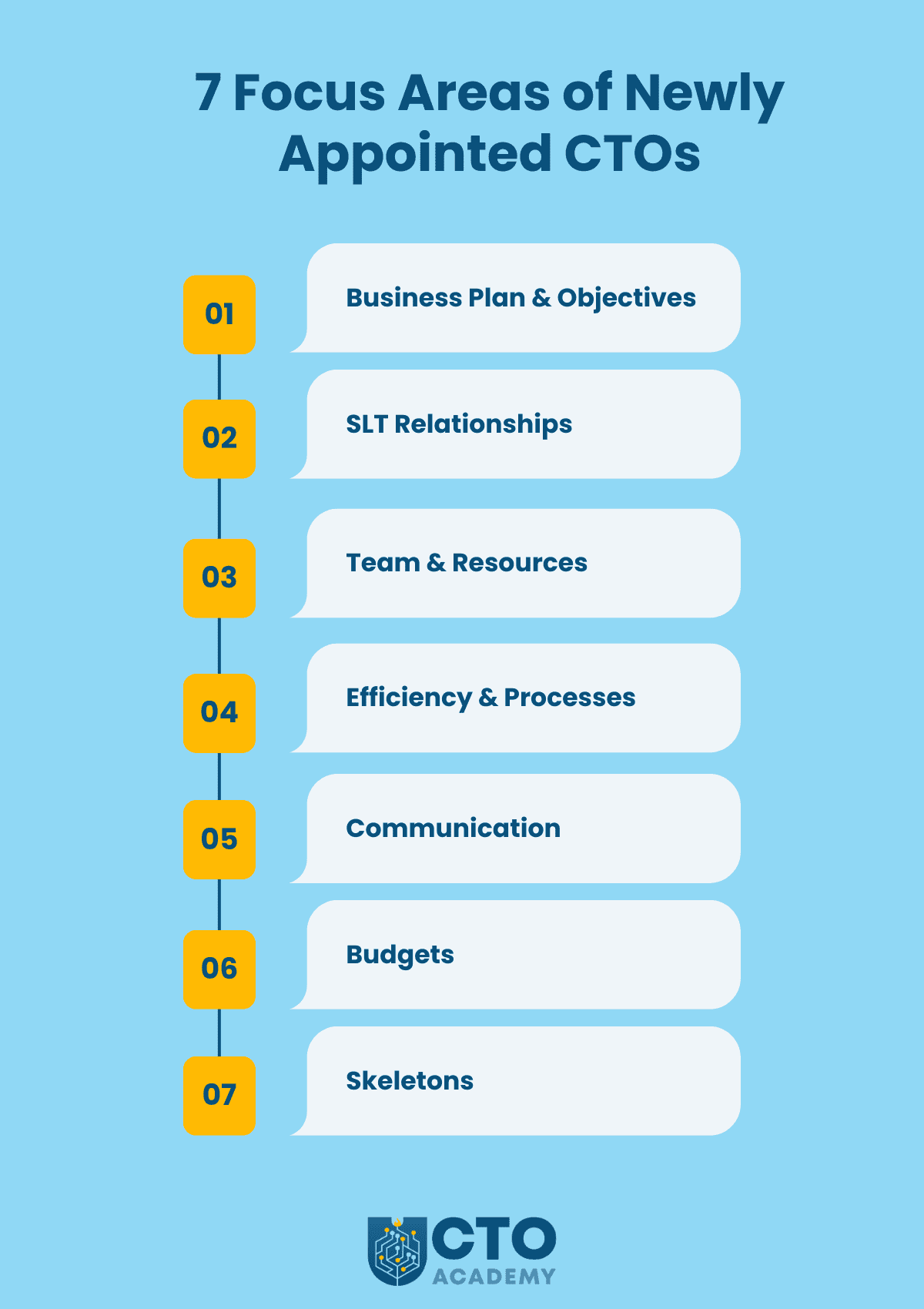
    7 Focus Areas of Newly Appointed CTOs

    7 focus areas of newly appointed Chief Technology Officers - infographic summary
    Focus areas of the first 90 days in the role of a Chief Technology Officer

    1. Business Plan and Objectives

    The subject of an optimal strategy when joining a new company is covered in detail throughout our Digital MBA for Technology Leaders. Drawing from those lectures, you must first understand the company’s objectives and business plan.

    4 Main Elements of BPs and Objectives in General

    1. Vision (WHY)
    2. Mission (WHAT)
    3. Target (WHO)
    4. Strategy (HOW)

    In other words, the vision is the why, the target is the who, the mission is the what, and the strategy is the how. 

    Now, if the business strategy is not yet formalised, you’ll have to work out what each of these four is through implication. Furthermore, it would be best if you suggested to the CEO and SLT that a session be held to discuss and agree on all the points. 

    The main thing here is to align the strategy with tech. And here are two vivid examples of misalignment. 

    One of our lecturers took over a CTO  position in a company, only to find out that the plans weren’t aligned. The business plan was assuming the legacy of on-prem licensing, whilst the tech team was still building a SaaS platform. In another example, a CTO approached the COO asking for the business plan. However, there wasn’t one except the vague goal to make more money.  

    What do you do in such a situation as a newly appointed Chief Technology Officer?

    You must prioritise the requirements of alignment and work out the action plan

    2. Senior Leadership Team (SLT) Relationships

    The first thing you should do in this matter is to get to know your colleagues. In other words, make an effort to understand their individual priorities and comprehension of the business strategy. The latter is quite important because, as you’ll learn, each of them will give you a different answer. This, in turn, will give you a good overview of how well they are coordinated. 

    If discrepancies indicate a complete lack of alignment, initiate a quiet chat with the CEO because, one way or another, you must improve C-level communication. Why? It’s the only way to truly understand their perception of tech and subsequent priorities. 

    You may also find yourself in a situation where your SLT colleagues voice where your priorities should be. Feel free to disagree, but, at the same time, use that to build a better picture of what is required to support the business.

    3. Team and Resources

    The first step is finding the organisational chart of your department. Create one if necessary, simply to work out the composition of the teams. 

    Often, the team structure is based on historical circumstances, which may no longer be relevant to the work in progress and plans in general. So get to know your direct reports and team members. Learn their strengths and weaknesses to better understand the areas they need support with. Once you feel comfortable enough, take that org chart and confirm/update roles and responsibilities. 

    Whilst you are learning your team, contemplate the following few questions:

    1. Do you have the optimal skills across the team, or do people try to work on stuff they are not good at? 
    2. Is the team overstretched and, consequently, overworked/exhausted? There are three strategies you may pull if that’s the case:
      1. Culture change
      2. Setting (more) realistic expectations
      3. Hiring
    3. Do they feel they’re being fairly paid (may point to a morale issue)? While you are checking their remuneration packages, check if there’s a proper career review process in place. 
    4. Do you have enough people in the right place to deliver the strategy? If not, start planning and working out the change.
    5. Is there anyone leaving soon? You might find yourself in a situation similar to mine, where both of my lead developers leave at the end of my first week in the bank. In that scenario, make the effort to convince them to stay for a little longer as I did. 
    6. Is anyone rejoining (eg, maternity/paternity leave, sabbaticals, and similar)?
    7. Is there deadwood (common in larger, predominantly public organizations)? If so, remove it immediately and re-route the resources. These folks are notorious for their resistance to change, and you really don’t want that, do you?
    8. Another thing to look for when it comes to team management of an inherited team is diversity. In other words, does the team reflect a healthy mixture of a wider society? If not, put in motion the hiring plan. 

    4. Efficiency and Processes

    Is the output meeting your expectations? What is your gut feeling telling you? Are you getting a return on your investments? Is there something you must improve right away?

    Do processes exist, are they correct, and are they being followed? 

    One of my friends joined a large company a few years ago and inherited a fairly large team. They were sending one release to the testing team every couple of days. He thought the cadence was far too slow, so he decided to get his hands dirty just to understand what was happening within the CI/CD. It turned out that it was a terrible implementation, but no one had bothered to fix it, as the expectations had been set. He immediately changed things around, and they were building tens of releases every day for testing. 

    The bottom line is that if the processes aren’t working for you, you’ll need to fix them. However, that won’t come without pushback. So you’ll need your team leads to not only drive but also own the change. 

    5. Communication

    There are two types of communication I’m referring to here: within the tech team and to the wider company. 

    You see, there might be some false beliefs caused by bad communication. This is commonly caused by teams that are using Slack private channels to discuss tickets, which, consequently, makes it difficult for others to understand the decision-making process.  

    The only way you’re going to solve this is to move discussions to tickets directly – without exception. It is something that I mandate on all my projects. 

    Additionally, analyse Slack plugins and remove unnecessary ones because they produce a lot of messages that quickly turn into noise and distraction. For example, I have ten workspaces in my Slack, and I’m simply forced to mute a lot of channels just to focus on the work at hand. 

    What I’m trying to say here is that Slack is a great tool, but do mind the correct usage of any tool at your disposal.

    6. Budgets

    Budget can often be foisted upon you with minimal input from you and your team. If this is the case, figure out the flexibility and calculate whether or not you are within, over, or under the budget at the precise point. 

    Here’s a wild story from the public sector that vividly depicts such a problem. A friend of mine joined the team and found out that the budget was significantly underspent. However, if she did not spend it all, the following year’s budget would be cut, and she would therefore have significant problems going forward. So she decided to spend the existing budget by buying a new computer for everyone involved in the project. This simple solution solved her budget problem, and she quickly gained respect across the organisation.    

    Therefore, if you find issues that require expenditure to fix them, you need to understand the budget.

    7. Skeletons in the Closet

    The question you need to ask yourself is: Are these (inevitable) skeletons relevant?

    One of our Global CTO Community members quickly realised that he was taking the CTO role in a company that was, effectively, an understaffed and disorganised mess. He spent a lot of time with the CEO trying to work out how they were going to get out of that mess. The problem was that the CEO was open and honest, but not technical, and the skeletons in this case were the code repositories.

    Long story short, someone put more than one product into the same repository. Naturally, everyone assumed there were only two, but it turned out there were three. The skeleton that was serious and relevant was that for one of their products. They did not have ownership of the repository. The real owner, an ex-employee, kept saying he would hand it over, but it dragged on and on and caused a significant problem for the company. 

    So how do you find such skeletons? 

    If something doesn’t make sense, then dig. You need to listen and watch for changes in body language, voice tone, or vagueness. It is the latter that I use the most often. If something is vague, they either don’t understand it or they’re trying to cover something up.    

    Ask questions such as: ‘What does that mean?’ or ‘Why is that process in place?’

    By pre-qualifying, you are disarming them. Ultimately, you are going to create a plan and a roadmap, which you may keep to yourself, but should be made up of immediate, medium- and long-term recommendations.

    In Summary

    Immediate recommendations are a high priority. And those that are severe, you should have already actioned. 

    Once you have a plan, you can implement solutions using all the relevant skills and tools (explained elsewhere in the course). However, if after 90 days, you’re still struggling to understand the business processes or people, then maybe this is not the right fit for you. 

    To sum up, having a concrete plan within these first 90 days gives you a good foundation to become a successful tech leader in your organisation. Remember: business plan and objectives, SLT relationships, team and resources, efficiency and processes, communication, budgets, and skeletons. These are your immediate focus areas.  

    Get the IT Career Path Roadmap (Free PDF)

    Want more than scattered ideas? Get our IT Career Path Roadmap PDF – an 8-step framework to map your next roles, sharpen your skills, and build a layoff-resilient tech leadership career. Fill in the form and we’ll send you the PDF version so you can download it, annotate it, and use it as a living plan for your next career moves.

    Downloading the ebook does not automatically subscribe you to our bi-weekly Technology Leadership Newsletter.

  • CTO Bonus Structure Overview w/ Influencing Factors

    CTO Bonus Structure Overview w/ Influencing Factors

    The CTO bonus structure varies significantly depending on the company size, industry and overall compensation philosophy. However, several common elements and factors typically influence it.

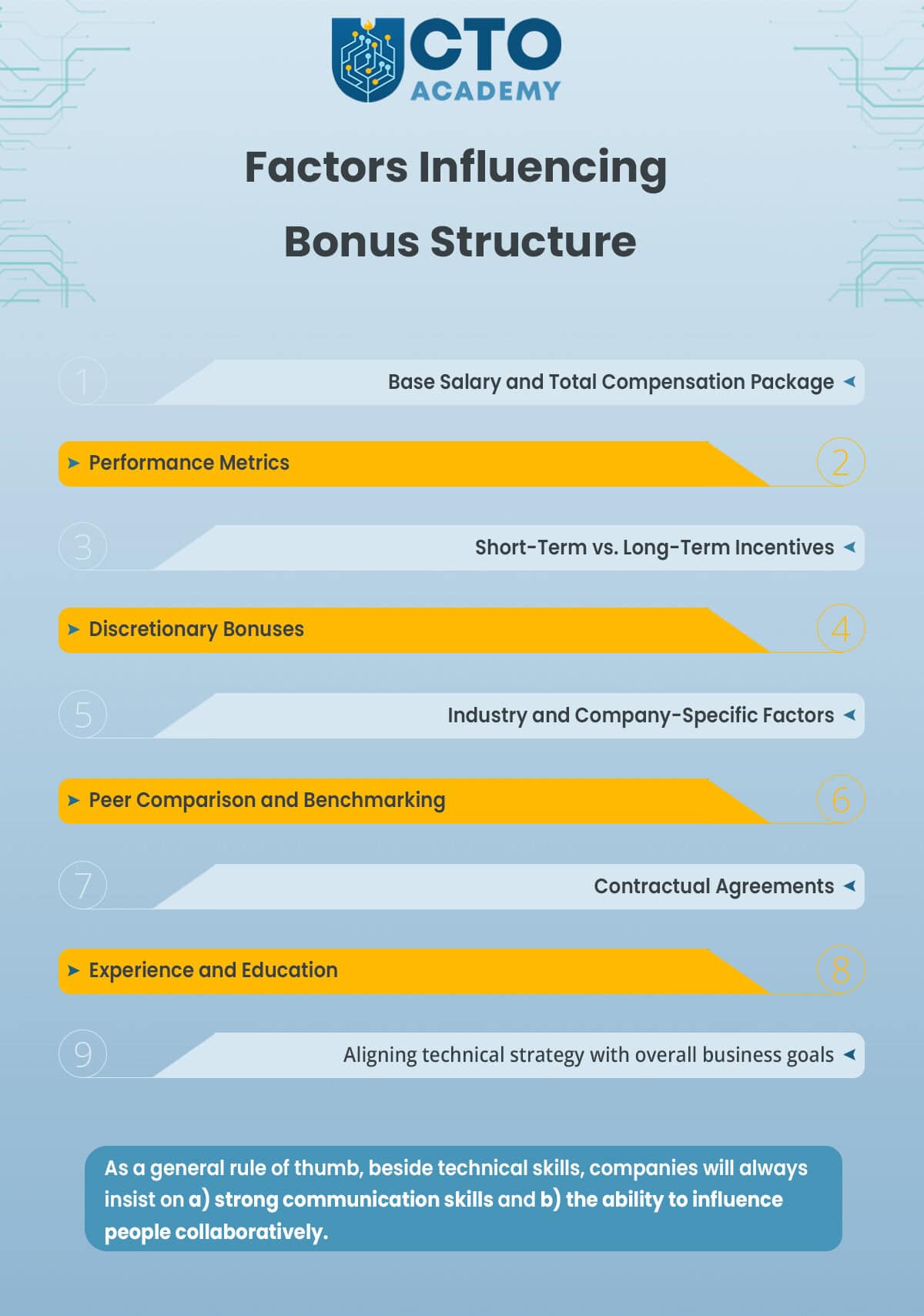
    Influencing factors

    Factors that influence a CTO bonus structure - infographic summary
    click to download/enlarge

    1. Base Salary and Total Compensation Package

    Read more about the Salary vs. Equity vs. Time aka ‘The Start-Up Conundrum’

    2. Performance Metrics

    A performance bonus is often tied to specific performance metrics, which can be both quantitative and qualitative. Common performance metrics include:

    • Revenue growth
    • Profitability
    • Technology milestones
    • Innovation
    • Cost management
    • Team performance
    • Customer satisfaction

    3. Short-Term vs. Long-Term Incentives

    • Short-Term Incentives (STIs)– Most commonly, annual bonuses based on the mentioned performance metrics.
    • Long-Term Incentives (LTIs) – Stock options, RSUs or other equity-based compensation that vest over several years, aligning the CTO’s interests with long-term company performance.

    4. Discretionary Bonuses

    In some cases, part of the CTO’s bonus might be discretionary, based on the board’s or CEO’s assessment of their overall contribution to the company.

    5. Industry and Company-Specific Factors

    • Start-ups Lower base salaries but higher equity stakes.
    • Large Corporations – Higher base salaries and more structured bonus plans.
    • Industry – The technology sector, for example, might offer different incentives than other industries like healthcare, finance or manufacturing.

    6. Peer Comparison and Benchmarking

    Companies often benchmark their CTO compensation packages against industry standards to remain competitive and attract top talent. They use surveys and reports from compensation consulting firms to get insights into typical CTO bonus structures in similar roles.

    7. Contractual Agreements

    The specific details of a bonus structure are often outlined in their employment contract, including clauses on bonus eligibility, performance reviews and other conditions.

    8. Experience and Education

    Let’s use one of the recently published jobs for the role of Chief Technology Officer to see what requirements companies usually have. In this case, we are talking about a fast-growing business with further expansion plans. However, to expand, they first need to invest in IT infrastructure and technology.

    In their own words, “The company needs a refresh of the technology stack and build a fit-for-purpose IT function that enables the growth of the business with the ability to leverage the overhead base.”

    This is how this company envisions the future CTO:

    TECHNICAL & BUSINESS SKILLS:

    • Experienced technology leader with proven ERP/Technology implementation capabilities and strong project management skills.
    • Candidate should have experience implementing a range of systems as well as field service software experience.
    • Proven integration capability when multiple software solutions are chosen
    • Experience in the development of the long-term technology strategy.
    • Track record in building a fit-for-purpose technology.

    MANAGEMENT (SOFT) SKILLS:

    • Strong communication skills and ability to influence people collaboratively.
    • Ability to work with the business to mentor and coach relevant individuals.

    This is where the right CTO program makes all the difference.

    Example of a CTO Bonus Structure

    • Base Salary: Ł100,000
    • Annual Bonus: 20% of base salary (ie, Ł20,000), based on achieving set performance targets.
    • Equity Compensation: Stock options worth Ł100,000, vesting over four years.
    • Performance Metrics: Revenue growth, successful delivery of technology milestones, exceptional team performance, improved customer satisfaction…

    Common Types of CTO Bonuses

    Performance-based bonuses

    Performance-based bonuses are usually paid annually. They tie the pay to specific metrics (eg, revenue growth, product development milestones, successful technological implementations…)

    This bonus can add 2.5 to 7.5% to the base salary. A Chief Technology Officer in a Fortune 500 company with a base salary of $500,000 could expect to receive a performance-based bonus of $12,500 to $37,500. If, however, the CTO’s performance is exceptional, they could receive a bonus of up to $50,000.

    Equity-based bonuses

    An equity-based bonus is, effectively, an ownership stake in the company. It is common in start-ups and private companies. The incentive lies in future growth because with growth comes an increase in the company’s valuation which turns the equity into a source of wealth.

    An example we also mentioned in the article comparing CTO salaries in the US and UK is Andy Bechtolsheim, a co-founder and former CTO of Sun Microsystems. Just two years after the IPO, the company reached $1 billion in sales. Since Bechtolsheim had an equity-based bonus, he immediately capitalised on the company’s increasing value.

    Retention Bonuses

    A retention bonus encourages a Chief Technology Officer to stay with the company for a certain period. You can expect this type of bonus if a company is undergoing a transition or facing challenges.

    Examples of conditions:

    • If the CTO stays with the company for a defined period (eg, 3 or 5 years).
    • If they meet certain performance goals (eg, increasing the company’s market capitalisation or revenue).
    • If the Chief Technology Officer helps the company to acquire or retain a key customer or partner.
    • If the Chief Technology Officer helps develop or launch a new product or service.
    • If the CTO helps to improve security or compliance posture.

    Conclusion

    The bonus structure should always be designed to reward performance, incentivise innovation and align a CTO’s goals with the company’s strategic objectives.

    But, in the end, each company tailors the structure to fit its specific needs and industry standards.

    Finally, it depends on the stage and financial capabilities of the business.

    Nonetheless, you should always keep in mind the following:

    The more management and soft skills you add to your technical capabilities, the higher your value is in the market.

  • Beyond Technical Expertise: Mastering the Art of Tech Leadership

    Beyond Technical Expertise: Mastering the Art of Tech Leadership

    The primary request for any senior tech leadership role is leading a strong team that consistently delivers groundbreaking innovations and achieves measurable results. That means you don’t merely manage a tech team; you must have the vision to lead it.

    Why vision instead of just management?

    Strong leaders provide a compelling vision and roadmap, improving team focus and motivation. Combined with a culture of trust and open communication, it creates a high level of psychological safety for the team. In turn, such a team is more open to risk-taking, innovation and honest discussion of challenges.

    Why is this important to your organisation and, more importantly, you?

    Technology leadership is essentially about aligning tech with business goals, unlike other senior leadership roles. When technical initiatives are converged with broader business objectives, they drive innovation and bottom-line results. In other words, perfect alignment gives a company a competitive advantage and subsequent long-term growth.

    The other reason why organisations require effective leadership is because it lowers risks, resolves conflicts and helps teams anticipate challenges, increasing the likelihood of delivering projects on time and within budget.

    Finally, let’s not forget that talented tech professionals want to work for inspiring leaders in thriving environments (ie, attraction and retention of talent – check!).

    But what’s in it for you?

    Career advancement for a starter. As a rule of thumb, tech leaders command higher salaries due to greater responsibility. This translates into more influence within the organisation.

    Also, moving from managing tasks to leading people and driving impactful projects creates a greater sense of purpose and achievement

    Effective tech leaders gain visibility and often interact with high-level stakeholders across the business, expanding their professional network.

    However, it all begins with building high-performance tech teams because, at the end of the day, leaders are only as good as their teams.

    Building and Managing High-Performance Tech Teams: A Quick Guide

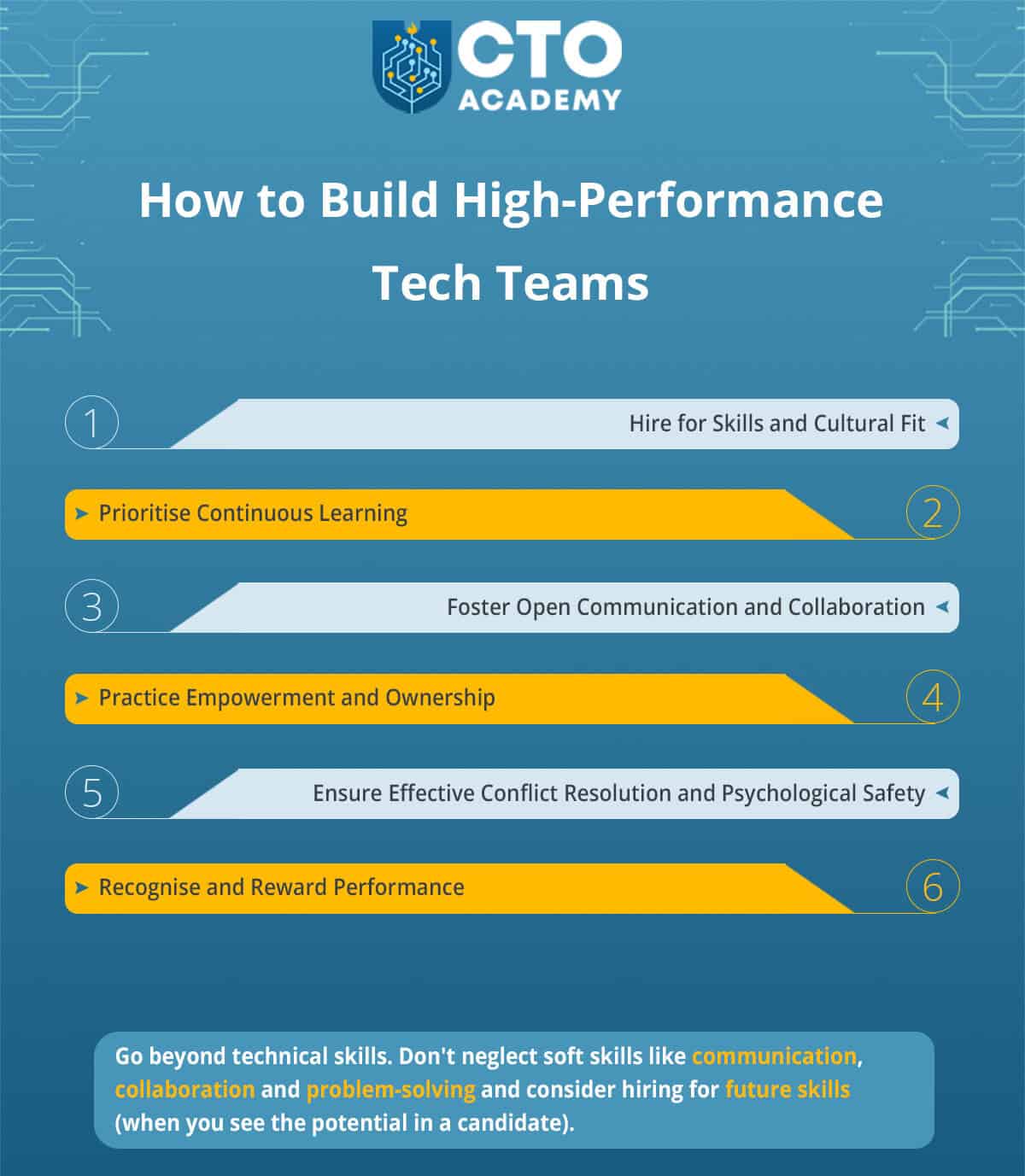
    How to build high-performance tech teams - the list of actions

    High-performance tech teams are the key to unlocking innovation, achieving project goals and staying ahead of the curve. Here’s how to build one from scratch:

    1. Hire for Skills and Cultural Fit

    • Go beyond technical skills. Granted, technical expertise is a must, but don’t neglect soft skills like communication, collaboration and problem-solving. Also, consider hiring for future skills (when you see the potential in a candidate).
    • Assess cultural fit. In other words, look for individuals who align with your company values, are team players and are most likely to thrive in your work environment.
    • Diversity matters; therefore, build a team with diverse perspectives, backgrounds and experiences. This leads to richer discussions, more creative solutions and a stronger team dynamic.

    2. Prioritise Continuous Learning

    • Invest in team development. Provide opportunities to expand their skill sets through workshops, online courses, conferences or hackathons. Encourage knowledge sharing within the team.
    • Embrace a growth mindset. It is a culture that values learning from mistakes and adapting to new technologies.
    • Lead by example. In other words, demonstrate your commitment to ongoing learning by actively seeking new knowledge and skills.

    3. Foster Open Communication and Collaboration

    • Create safe spaces for feedback. This means making team members comfortable about expressing ideas, concerns and, more importantly, constructive criticism because where everybody thinks the same, nobody’s thinking.
    • Use collaboration platforms to facilitate communication, knowledge sharing and project updates, but minimise silos and 1:1 conversations. Consider implementing a dedicated ticket policy (provides a precise historical overview!).
    • Celebrate team wins and acknowledge the collective effort.

    4. Empowerment and Ownership

    • Delegate meaningful work that allows team members to utilise their strengths and learn new skills.
    • Give team members the freedom to make decisions and push them outside their comfort zones within defined parameters.
    • Recognise and reward ownership (ie, acknowledge individuals who take ownership of their work and go that extra mile).

    5. Conflict Resolution and Psychological Safety

    • Address conflict constructively by developing clear processes for addressing disagreements and resolving conflicts fairly and respectfully.
    • Focus on solutions, not blame.
    • Create a dynamic work environment where team members feel safe to take risks, experiment and admit mistakes without fear of retribution.

    6. Recognise and Reward Performance

    • Implement transparent systems for recognising exceptional performance, promotions or bonuses (a seasoned CTO explains CTO KPIs with templates and tracking procedures).
    • Publicly acknowledge outstanding work and offer individual praise for effort and achievements.
    • Tailor rewards to preferences. Here, you need to understand individual needs and offer rewards beyond just financial incentives (eg, flexible work arrangements, learning opportunities…).

    Building a high-performance tech team is an ongoing process, not a one-time event. That process includes continuous learning, open communication and empowerment. In time, you’ll create an environment where talented individuals can thrive.

    Remember, a motivated and engaged team is the cornerstone of any successful tech venture. And such a team is your engine through an array of different roles.

    Key Roles of Senior Tech Leaders

    1. Setting technology strategy
    2. Communicating with the senior leadership team and stakeholders
    3. Managing technology budgets
    4. Overseeing technology projects
    5. Building and developing strong teams
    6. Innovation management
    7. Change management

    (For a detailed insight into the roles and responsibilities of Chief Technology Officers in different business sizes, read this guide.)

    As you can imagine, these roles require a unique blend of technical knowledge, business acumen, leadership skills and a commitment to ongoing learning.

    Which brings us back to one of the key roles of tech leadership: setting technology strategy to align tech with the company’s mission and objectives.

    While technical prowess is important in this process, several core leadership skills truly propel you forward.

    Core Tech Leadership Skills

    1. Strategic Thinking

    Or, in other words, seeing the big picture, understanding long-term trends and aligning technology investments with the organisation’s overall mission and goals. This prevents short-sighted tech decisions that waste resources or don’t contribute to overall success.

    Proper strategic thinking avoids reactive tech and ensures solutions serve an overarching purpose (eg, a CTO who aligns an AI initiative with improving customer service, not just for the sake of cutting-edge tech).

    2. Problem-Solving

    Since tech is full of unexpected roadblocks, as a tech leader, you must create structured approaches to identify root causes, generate creative solutions and make well-informed decisions.

    A good example is a project manager who facilitates a root cause analysis instead of just blaming developers for a delay.

    3. Communication

    To be able to articulate often complex technical concepts in clear, accessible language for both technical and non-technical stakeholders, you’ll need to switch from just listening to active listening and adapt your communication styles.

    Clear communication is essential for fostering collaboration, avoiding misunderstandings, inspiring teams and building trust in a leader’s vision.

    4. Team Building

    Tech is made by people, and the best ideas arise with a strong team dynamic. For a tech leader, this means attracting top talent, creating an inclusive culture, fostering collaboration, resolving conflicts and motivating individuals to work towards a common goal.

    Strong teams simply produce better results, are more resilient to challenges and are more likely to innovate.

    5. Adaptability

    Tech environments are rarely static. Leaders must often adjust plans, learn new skills and guide their teams through uncertain terrain. Because, at any moment, the company strategy can change (eg, a Black Swan event) and as a leader, you are expected to pivot these strategies while remaining agile.

    6. Ethical and Data-Driven Decision-Making

    Take a moment to answer these three questions:

    1. What are the broader societal implications of our technology?
    2. Are we prioritising fairness, transparency, privacy concerns and user well-being alongside business goals?
    3. Is my recent decision based on accurately interpreted data or gut feeling?

    Ethical decision-making builds trust with consumers and employees, avoids potential harm and positions the organisation as a responsible leader in the industry.

    Of course, these are just the most prominent from the list of skills technology leaders must possess to do their jobs effectively. Our free tech leadership book, “90 Things You Need to Know to Become a CTO” expands on critical areas of tech leadership through 9 logical sections. It is a rich resource that will come extremely handy on your journey so take a moment and download it before you continue.


    Quick Skill Assessment Workshop

    It’s simple and requires nothing but objective self-assessment.

    STEP 1: Write down the core skills we explained and rank yourself (1-5) on each skill.

    STEP 2: Objectively reflect on strengths and areas with the most growth potential.

    STEP 3: Self-discussion

    • Which of these skills do you believe are the toughest to master?
    • Are there any we haven’t mentioned that you think are vital?
    • If there are, what are they (write them down under the ones we explained)?

    STEP 4: Challenge

    • Pick one ‘growth’ skill and commit to one specific action to improve it in the next month.

    To gauge and benchmark your current strengths and weaknesses against the hundreds of global tech leaders who’ve already completed the process, complete our Skills Assessment.


    Path to Improvement

    Natural talent is a start, but deliberate growth is key.

    Common sense tells us that continuous development (personal and professional) is one of the key components of technological leadership in business.

    But what are the most effective strategies considering our busy daily schedules? We can’t exactly commit to traditional university programs, can we? So what’s the optimal approach to this problem?

    Before we lay down the strategies, think about this: we cannot improve what we do not acknowledge.

    Let that soak for a moment…

    Continuous Development Strategies

    1. Peer Mentorship that includes peer sessions and development.
    2. Targeted tech leadership programs and future leaders courses.
    3. Observing strong technical leadership examples (ie, shadowing tech leaders in practice).
    4. Seeking out challenging experiences and deliberate practice in weaker skill areas.

    The Dynamic Leader Principle

    These skills compound – it’s about the interplay between them that leads to exceptional leadership outcomes.

    The analogy is a well-tuned orchestra. Each instrument, no matter how good it sounds on its own, is nowhere near as effective as when it plays its part at just the right moment with the rest of the orchestra. When perfectly combined, the outcome is pure excellence.

    However, it is, essentially, a conductor that transforms this collection of instruments into a well-tuned orchestra. That’s why you need someone with experience by your side, especially at the beginning of your CTO career. We are talking about structured programs, Q&As with field experts and CTO shadowing.

    A Structured Path to Tech Leadership

    While self-directed learning is valuable, a comprehensive program provides a focused framework, expert guidance and a supportive community.

    “One of the best parts was getting to meet and talk with other people in the course. Whether it was networking sessions or just group discussions, it was comforting to see that others face similar challenges. Sharing ideas and experiences with a diverse group really broadened my perspective and was incredibly valuable.”

    Dallas Goldswain

    The path Dallas and over 440 tech leaders have taken so far leads you through all 9 areas of your future career:

    1. Leadership and Teambuilding
    2. Business Fundamentals
    3. Technology Strategy and Business Goals
    4. Personal Development
    5. Product Development
    6. Information Management
    7. Finance and Funding
    8. Data Science and Analytics
    9. Digital Trends and Innovation

    The outcome here is gaining the tools to a) lead with confidence, b) make optimal strategic tech decisions and c) inspire your teams to achieve their best. And if you briefly check here, you’ll quickly realise the promise is delivered. 

    This was a quick introduction to tech leadership where we covered the fundamentals – the what and the why. What comes next is exciting, empowering and, most importantly, educating because it explains the how of everything. You will get the necessary knowledge and tools to put your leadership skills into action.

  • Field CTO Job Description w/ Salary Breakdown & Career Prospects

    Field CTO Job Description w/ Salary Breakdown & Career Prospects

    In this post, we explain the relatively new Field CTO role and how it differs from a more traditional Chief Technology Officer role. We will see how a Field CTO job description determines the type of person suitable for the job. We will take a look at the job prospects and, of course, the average salary.

    First things first…

    What is a Field CTO?

    A Field CTO is a high-ranking executive role that is becoming ever more popular in tech companies (IT, software or telecommunications industries). Their primary responsibility is bridging the gap between technology and business strategy while also engaging directly with customers and partners. In other words, the focus is on developing an innovative approach to dealing with customers’ problems. This is not something a traditional CTO usually does, at least not to such an extent.

    In fact, Confluent’s FCTO, Kai Waehner, claims that there is less than 10% overlap between FCTOs and the more traditional technical leaders in day-to-day tasks. He also defines the Field CTO as a trusted and well-known advisor for the product and technology that the employer sells to make customers successful around the world. Translated, that means frequent communication with customers, which, by itself, can be challenging for most existing and soon-to-be technical leaders. Because, as you will learn, FCTOs are becoming the public spokespersons of choice for their companies.

    Key Aspects of the Field CTO Role

    The FCTO must possess business acumen and a deep understanding of the market. The reason is simple: the primary focus is on customers’ problems and innovation. As an FCTO, you want to map all the challenges into the vendor’s product portfolio.

    Forward-operating aspects of the role

    Another element that largely differs from the traditional role is technical evangelism. You will be directly responsible for (actively) promoting your company’s technology solutions. To put it bluntly, you will evangelise them to customers, partners and the broader industry. This involves articulating the value and benefits of the company’s offerings. Not exactly an ideal job for someone who’s struggling with open communication, is it?

    So, unlike our traditional CTO who is mostly inside-oriented, an FCTO frequently engages with customers to a) better understand their technology needs, and b) identify opportunities. It is the only way to perfectly align the company’s products or services with customer requirements. Naturally, this often involves building and maintaining strong relationships with key customers and partners.

    Inside-oriented roles

    With such a deep understanding of customers’ needs, FCTOs often collaborate with the sales and marketing teams to help them understand the technical aspects of the company’s products or services. They may even participate in sales meetings, provide technical expertise during customer presentations and assist in closing deals. That involvement, however, doesn’t extend to active selling.

    FCTOs of technology companies, due to the nature of their involvement, hold an important role in merger and acquisition processes.

    Since they act as a bridge between the engineering and business teams, FCTOs work closely with in-house CTOs and engineering teams on product development. They are there to provide valuable input into the development of new products or services. Additionally, they help prioritise development efforts. This, in turn, ensures that products align with market needs and technological trends.

    What makes the FCTO such a valuable addition to the development process is the feedback loop they gather from customers in the field. That Information and data is relayed to the internal teams responsible for product development and improvements. This helps the company to stay responsive to market demands.

    Many Field CTOs are seen as industry thought leaders. They may write articles, speak at conferences and represent their company in public forums to showcase their expertise and vision in the technology domain.

    It’s clear that a Field Chief Technology Officer plays a pivotal role in aligning technology with business goals, fostering customer relationships and driving innovation. However, we must note that the specific responsibilities and influence of an FCTO can vary depending on the company’s size, industry and strategic objectives.

    Get the IT Career Path Roadmap (Free PDF)

    Want more than scattered ideas? Get our IT Career Path Roadmap PDF – an 8-step framework to map your next roles, sharpen your skills, and build a layoff-resilient tech leadership career. Fill in the form and we’ll send you the PDF version so you can download it, annotate it, and use it as a living plan for your next career moves.

    Downloading the ebook does not automatically subscribe you to our bi-weekly Technology Leadership Newsletter.

    What is the Difference Between a Field CTO and a Part-Time or In-House CTO?

    The roles differ primarily in terms of responsibilities, level of engagement and the nature of their employment. Here are some key distinctions:

    Field Chief Technology Officer (Field CTO)

    Engagement Level: FCTOs often have a broader role that involves customer engagement, technology strategy, market evangelism and thought leadership.

    Customer Interaction: They actively engage with customers, partners and the broader industry to understand market needs, build relationships and represent the company’s technology vision.

    Responsibilities: FCTOs are less involved in the day-to-day technical operations of the company. They are, however, instrumental in aligning technology with business goals, shaping the technology strategy and ensuring that the company’s offerings really do meet market demands.

    Full-time position: They may hold a full-time position in the company but may spend a significant amount of time externally, interacting with customers and industry stakeholders. In fact, some jobs can involve remote working.

    Part-Time CTO

    Engagement Level: Part-time CTOs have a reduced level of engagement compared to full-time CTOs. They are typically engaged on a part-time or consulting basis.

    Responsibilities: These may include providing technical guidance, reviewing technical decisions and offering strategic input. However, they may not be deeply involved in day-to-day operations or product development.

    Flexibility: Part-time CTOs are often hired for their expertise on specific projects or to address particular technical challenges. Their engagement can be flexible and tailored to the company’s needs.

    In-House, Full-Time CTO

    Engagement Level: In-house, full-time CTOs are deeply embedded within the company and are responsible for the overall technology direction and management.

    Responsibilities: They have a wide range of responsibilities, including overseeing technical teams, product development, infrastructure management, budgeting and developing technical strategy.

    Commitment: In-house CTOs are committed to the company on a full-time basis and are responsible for the day-to-day technical operations. They are often part of the senior executive team. However, in start-ups and smaller organisations, they have a more hands-on role.

    In summary, the key differences revolve around the level of engagement, the scope of responsibilities, and the nature of the employment arrangement. Field CTOs are more externally focused, part-time CTOs offer flexibility for specific needs, and in-house, full-time CTOs are deeply involved in the company’s technical operations and strategy. The choice between these roles depends on the company’s size, goals and resource availability.

    What are the responsibilities of a Field CTO?

    Responsibilities of a Field CTO - infographic summary
    (click to enlarge/download)

    The responsibilities of an FCTO vary depending on the organisation and its specific needs. However, the role generally encompasses a combination of the following responsibilities (this is, effectively, a summary of everything we discussed so far and, quite often, from the job requirements on job boards):

    1. Customer Engagement

    • Build and maintain strong relationships with key customers and partners.
    • Act as a trusted advisor to customers, understanding their technology needs and providing solutions.

    2. Technology Strategy

    • Define and execute the company’s technology strategy in alignment with business goals.
    • Identify emerging technologies and assess their potential impact on the business.

    3. Sales Support

    • Collaborate with the sales and marketing teams to provide technical expertise during customer presentations and assist in closing deals.
    • Help sales teams understand and communicate the technical aspects of the company’s products or services.

    4. Product Development and Innovation

    • Provide input into the development of new products or services to ensure they align with market needs and technological trends.
    • Serve as a bridge between the engineering and business teams, helping prioritise development efforts.

    5. Thought Leadership

    • Act as an industry thought leader by writing articles, giving presentations and representing the company in public forums.
    • Showcase expertise and vision in the technology domain to enhance the company’s reputation.

    6. Technical Evangelism

    • Promote the company’s technology solutions to customers, partners and the broader industry.
    • Articulate the value and benefits of the company’s offerings.

    7. Feedback Loop

    • Gather feedback from customers and the field, and relay this information to internal teams responsible for product development and improvement.
    • Ensure that the company stays responsive to market demands and customer feedback.

    8. Competitive Analysis

    • Monitor the competitive landscape, assess the strengths and weaknesses of rival companies’ technology offerings and provide insights to inform the company’s strategy.

    9. Industry Trends

    • Stay up-to-date with industry trends and technological advancements, and assess their potential impact on the business.

    10. Collaboration with Internal Teams

    • Work closely with various internal departments, including engineering, product management and executive leadership, to align technology initiatives with overall company goals.

    11. Strategic Planning

    • Contribute to the development of long-term technology and innovation strategies for the company.
    • Ensure that technology investments align with the company’s growth and profitability objectives.

    12. Risk Management

    • Assess and mitigate technical risks associated with the company’s products or services.
    • Ensure compliance with industry regulations and best practices.

    As you can see, some of the responsibilities are universal; that is, closely similar to those of a traditional CTO. The specific responsibilities, however, extend beyond technical matters to encompass business strategy and customer relationships. In fact, some Field CTOs aren’t even coding-savvy. But they do know how to best navigate code developers to get exactly what the market demands.

    What skills and experience are required to be a Field CTO?

    In a nutshell, the role requires a combination of technical expertise, leadership skills, business acumen and a deep understanding of the industry, just like every other CTO. But there are the skills and experience particularly required for this role:

    Education and Skill Set Qualifications

    • Bachelor’s Degree in Computer Science, Management Information Systems and/or Business Administration (ideally custom-tailored for technology leaders) or ~10+ years of IT sales or solution architecture experience.
    • 5-10 years of industry-related experience and 5+ years of experience in a role similar to CTO, CIO, VP/Dir of Engineering, Operations or Product Development.
    • 10+ years of architecture experience building, consulting or implementing technology for the relevant industry.
    • Knowledgeable in the challenges impacting the relevant industry and the application of industry-specific use cases.
    • A broad range of experience with technical and design direction that may also include large-scale database and/or data warehouse technology, ETL, analytics and public cloud technologies.
    • Familiarity with data providers and data aggregators.
    • Understanding of industry-specific concepts and applications.
    • The ability to travel to customer sites, industry events and other related events as required (in some instances, over 30% of time FCTOs spend travelling or working outside of the company’s premises!)

    Required Experience

    • Demonstrated ability to conduct conversations and quickly establish credibility with C-level individuals and other business executives where selling solutions are the focus (ie, outstanding presentation skills to both technical and executive audiences).
    • Work experience in a client environment, ideally in a leadership capacity.
    • Strong interpersonal and presentation skills including consulting skills.
    • Strong oral and written communication skills.

    As always, it is important to note that the specific requirements for an FCTO can vary depending on the company, its industry and its strategic goals. In some cases, soft skills and industry-specific knowledge may be just as important as technical expertise. Successful Field CTOs are well-rounded individuals who can bridge the gap between technology and business, providing valuable leadership and insights to drive the company’s success.

    What are the career prospects for Field CTOs?

    We know that FCTOs play a crucial role in the technological needs of an organisation. Consequently, the number of Field CTO jobs has slowly increased over the last few quarters.

    For instance, Honeycomb, a company that offers a software debugging tool as a service, appointed an FCTO only a year ago. As Field CTO, Liz Fong-Jones will work with the executive teams on the company’s strategic customers while continuing to bring cutting-edge technologies into the Honeycomb fold.

    Just like a traditional role, the FCTO position provides substantial benefits. We are talking about:

    • Top salary possibilities
    • Equity or shareholder offerings
    • Leadership opportunities
    • Reputation development
    • Recognition and enterprise-level goal achievement.

    In terms of career progression, FCTOs can look forward to roles in higher executive management or opportunities in consulting or entrepreneurship. They can also transition into specialised roles within the tech industry depending on their areas of expertise. It’s important to note that the specifics can vary based on individual career goals and market trends.

    What is the salary range for Field CTOs?

    The average Field CTO salary is $189,711 per year. However, this can vary based on factors such as location, company size and individual experience.

    For example, Snowflake offers an estimated base salary between $150,000 – $234,600, plus entry into Snowflake’s bonus and equity plan.

    The successful candidate’s starting salary is usually determined by skills, experience and location. FCTOs are frequently offered competitive benefits packages, which commonly include:

    • Medical, dental, vision, life, and disability insurance along with a 401(k) retirement plan
    • Flexible spending and health savings account
    • Paid holidays and time off
    • Parental leave, etc.

    What are some of the biggest challenges and opportunities facing Field CTOs today?

    Challenges:

    • Technological Changes (ie, the rapid pace of technological evolution that requires high levels of adaptability).
    • A shortage of IT Professionals (creates a challenge in managing day-to-day operations).
    • Strategic Role (requires balancing the strategic role and daily operations).

    Opportunities:

    • Operational Possibilities (technology is now much more embedded in day-to-day life, thus providing more business opportunities which, in turn, creates a wider array of operational possibilities for FCTOs).
    • Digital Transformation (still a dominant force, with its growth predicted to reach $3.4 trillion by 2026).
    • Technical Vision (ie, the opportunity to architect a technical strategy that seamlessly aligns with business objectives).

    Conclusion

    The future for any type of technology leader is becoming increasingly challenging as we have explained in our recent post about what lies ahead for leadership in the technology sector.

    Field CTOs, as a relatively new role in the world of technology leadership, have yet to discover what bumps may be awaiting them down the road.

    That’s why here at CTO Academy, we are continuously working to identify both challenges and opportunities and to educate and inform our members. Our Global Community of Tech Leaders is actively involved in daily discussions and problem-solving, helping each other in their day-to-day operations. All members have a unique opportunity to shadow seasoned CTOs and learn from them during live sessions and Expert Q&As.

    A long time ago, we became aware that the only way to successfully overcome the hurdles is a peer-powered trust of brains and cumulative experience. Existing and future Field CTOs can greatly benefit from such a community because it removes much of the unknown from the equation. Because if you don’t know that the obstacle exists, you will inevitably trip over.

  • IT Manager: Role, Responsibilities, Skills and Average Salary

    IT Manager: Role, Responsibilities, Skills and Average Salary

    An IT Manager (a.k.a Information Technology Manager) oversees and manages IT operations, systems, and infrastructure. Additionally, they serve as a connection between technology strategies and the broader goals of the organisation.

    As such, they a) ensure the efficient, secure operation of IT resources and b) nurture the overarching objectives of the business.

    TL;DR

    • An IT Manager (Information Technology Manager) keeps the organisation’s technology running reliably, securely, and cost-effectively—while translating leadership strategy into execution across operations, projects, people, and vendors. v2-IT Manager-Role_Responsibili…
    • In practice, the role spans seven core areas: planning & alignment, team leadership, budgeting, project delivery, IT operations/ITSM (incl. SLAs), security & risk (incl. DR), and vendor/stakeholder management. v2-IT Manager-Role_Responsibili…
    • High-performing IT Managers run IT like a service and track outcomes using metrics such as uptime, MTTR/MTTA, SLA compliance, change success rate, patch/vulnerability SLAs, CSAT, and cost per user/ticket. v2-IT Manager-Role_Responsibili…
    • Salary varies by market and scope. In the US, this article cites $101K–$157K (median total ~$125,550). In the UK, it cites ~£42,500 average so far (with some London listings at £55,000+).

    [Last updated: February 25, 2026 — Expanded the article with an at-a-glance role snapshot, a detailed responsibilities matrix (including KPIs and common tools/processes), and a dedicated IT Manager KPI framework to clarify how success is measured in real organisations. It now also contains refreshed salary framing by including both US and UK reference points and ensures the FAQ reflects the updated structure.]

    Common Types of IT Managers

    • Infrastructure Manager
    • Operations Manager
    • Security Manager
    • Project Manager
    • Application Development Manager
    • Service Manager

    Depending on the organisation’s size, industry and specific requirements, it’s common to have a mix of these roles or even additional positions to meet the technology needs.

    Get the IT Career Path Roadmap (Free PDF)

    Want more than scattered ideas? Get our IT Career Path Roadmap PDF – an 8-step framework to map your next roles, sharpen your skills, and build a layoff-resilient tech leadership career. Fill in the form and we’ll send you the PDF version so you can download it, annotate it, and use it as a living plan for your next career moves.

    Downloading the ebook does not automatically subscribe you to our bi-weekly Technology Leadership Newsletter.

    IT Manager (IT Management): Quick Definition & Role Snapshot

    An IT Manager leads the day-to-day delivery of technology services for a company. The role blends hands-on operational ownership (reliability, support, security, and delivery) with planning and prioritisation (roadmaps, budgets, vendors) to ensure IT enables business outcomes—not bottlenecks them.

    What an IT Manager typically owns

    • IT operations and support (service desk, incident response, SLAs)
    • Infrastructure and core systems reliability (network, devices, cloud/on-prem)
    • Security hygiene and risk management (patching, access control, DR readiness)
    • Project delivery (scoping, vendor selection, rollout, adoption)
    • Budgeting and vendor management (contracts, renewals, cost control)
    • Team leadership (hiring, coaching, performance, process improvement)

    Who they work with

    • Reports to: often an IT Director, CIO, CTO, COO, or CEO (varies by company size)
    • Partners with: department heads (Finance, HR, Sales, Ops), Security/Compliance, and vendors/MSPs

    Typical scope (varies by organization)

    • Team: 1–15+ IT staff (or oversight of an MSP + internal stakeholders)
    • Environment: endpoints + identity + network + apps + cloud services
    • Accountability: uptime, service quality, security posture, and delivery timelines

    What this role is not (in most companies)

    • Not primarily a hands-on SysAdmin role (though smaller companies may combine both)
    • Not an executive strategy role like a CTO/CIO (IT Managers execute and operationalise strategy)

    If you’re hiring for this role

    Look for someone who can translate business needs into a practical roadmap, run reliable operations, manage risk, and lead people, without losing the ability to dive into technical decisions when needed.

    The Key Responsibilities of an IT Manager

    The IT Manager typically holds a mid-level managerial position and is responsible for the day-to-day management of the IT department.

    Their role is more operational and tactical than that of a Chief Technology Officer, for example. IT Managers directly oversee IT operations. They are involved in day-to-day project management and team leadership while ensuring the reliability and security of IT systems.

    They work closely with their teams to implement the strategies and decisions set forth by the CTO and senior management. Therefore, IT Managers are responsible for executing the plans and projects that align with the broader technology strategy.

    The IT Manager also plays a critical role in optimising the use of resources. It’s their job to ensure that they are allocated effectively so that they can meet the organisation’s technology goals.

    (Depending on the size and structure of an organisation, all of these responsibilities may fall under the CTO umbrella (eg, a start-up company). But as we scale up, we can have a CTO directly overseeing several IT Managers (eg, a cluster of subsidiaries or different IT departments) or a Group CTO overseeing a number of CTOs that oversee several IT Managers.)

    The Overview of Common Responsibilities of an IT Manager with Breakdown

    Common responsibilities of an IT Manager - infographic overview
    Common responsibilities of the IT Manager

    TABLE 1: IT Manager responsibilities matrix

    Responsibility areaWhat it includes (examples)“What good looks like” (KPIs)Common tools / processes
    Strategic planning & alignmentTranslate business goals into an IT roadmap; assess gaps; choose solutions; define priorities and timelinesRoadmap delivered on time; reduced tech debt; stakeholder satisfaction; measurable business impactRoadmapping, RACI, stakeholder reviews, architecture notes, vendor scoring
    Team leadership & developmentLead, coach, hire, and retain IT staff; assign ownership; set standards; run 1:1s and performance cyclesReduced escalations; improved response times; higher team retention; clear ownership and documentation coverageTeam rituals (standups/1:1s), skills matrix, on-call rotation, runbooks
    Budgeting & cost optimisationBuild budgets; forecast spend; manage renewals; optimise licenses/cloud; justify investmentsSpend variance within target; reduced waste; predictable renewals; improved cost per user/ticketBudget tracking, contract calendar, license audits, vendor negotiation
    Project managementPlan and execute implementations/upgrades/migrations; manage scope, risks, timelines, and adoptionOn-time/on-budget delivery; adoption targets met; low change failure rateProject plans, RAID logs, change control, stakeholder comms, post-mortems
    IT operations & support (ITSM)Run service desk; manage incidents/requests; define SLAs; handle escalations; maintain asset inventorySLA compliance; lower MTTR; fewer repeat incidents; higher CSAT; stable ticket volumeITIL/ITSM, ticketing, SLAs, knowledge base, CMDB/asset management
    Security & risk managementAccess controls; patch/vulnerability management; backups; DR readiness; security awarenessPatch/vuln SLAs met; reduced security incidents; successful DR tests; backup restore successIAM policies, least privilege, vulnerability scanning, DR/BCP runbooks
    Vendor & stakeholder managementManage MSPs/SaaS vendors; run reviews; enforce SLAs; align stakeholders and expectationsVendor SLA adherence; fewer outages; improved delivery cadence; clear accountabilityQBRs, SLA reviews, escalation paths, contract and compliance checks

    Tip:

    In smaller companies, one IT Manager may own all areas; in larger organisations, responsibilities often split across specialised IT managers (e.g., Infrastructure, Operations, Security, Applications, Service Delivery).

    IT Manager KPIs (How success is measured and “what good looks like”)

    While the day-to-day can feel reactive, high-performing IT Managers run IT like a service: measurable, predictable, and continuously improving. These are the most common metrics used to evaluate performance:

    Reliability & incident response

    • Uptime/availability for critical systems (email, identity, network, core apps)
    • Mean Time to Acknowledge (MTTA) and Mean Time to Restore (MTTR)
    • Incident volume and repeat-incident rate (problem management effectiveness)
    • On-call health (after-hours load, escalation frequency)

    Service delivery & support quality

    • SLA compliance (response and resolution times by ticket priority)
    • Ticket backlog and average age of open tickets
    • First-contact resolution rate and escalation rate
    • User satisfaction (CSAT) and qualitative feedback trends

    Change & project delivery

    • Change success rate (and change failure rate)
    • Deployment/rollout completion vs plan (milestones hit, scope controlled)
    • Time-to-deliver for common requests (e.g., onboarding, access changes)
    • Adoption and outcomes for major launches (usage, training completion, reduced manual work)

    Security & risk management

    • Patch compliance and vulnerability remediation within SLA
    • Phishing simulation results/security training completion
    • Access governance hygiene (least privilege, timely offboarding, MFA coverage)
    • Backup/restore success and disaster recovery test results

    Cost control & vendor performance

    • Budget variance and spend predictability (licenses, cloud, contracts)
    • Cost per user / per device / per ticket (trend over time)
    • Vendor SLA adherence and escalation outcomes
    • License utilisation and waste reduction (unused seats, overlapping tools)

    Rule of thumb:

    A strong IT Manager improves stability, speed, and security at the same time—while keeping costs predictable and stakeholders informed.

    Let’s now break down responsibilities and explain them in more detail.

    1. Strategic Planning and Alignment

    Identification of technology needs

    • Collaborating with department heads.
    • Participating in discussions to understand the specific requirements of different departments.

    Technology roadmapping

    • Creating a technology roadmap that outlines the strategic direction for IT initiatives (short-term and long-term goals, technology investments and project timelines that align with the organisation’s growth plans).

    Vendor selection

    • Evaluating vendors, hardware and software options, taking into account factors like cost, compatibility and support.
    • Making recommendations to senior management based on these evaluations.

    2. Team Leadership and Development

    Team supervision

    • Assigning tasks, setting priorities and overseeing daily operations.
    • Ensuring that team members have the tools and resources needed to perform their tasks effectively.

    Professional development

    • Investing in the professional growth of their team members by identifying training opportunities, certifications and skill-building activities.
    • Encouraging team members to stay up-to-date with industry trends.

    3. Budgeting and Resource Management

    Budget allocation

    • Managing the IT budget and allocating resources for various projects and operational needs.
    • Balancing the allocation of funds to support current operations, ongoing maintenance and strategic initiatives.

    Cost optimisation

    • Evaluating costs and seeking opportunities to optimise spending (ongoing task!).
    • Renegotiating vendor contracts, identifying areas for cost savings and ensuring that IT expenses align with the budget.

    4. Project Management

    Prioritisation

    • Ensuring the alignment with the organisation’s goals and available resources.

    Oversight

    • Managing the full project lifecycle
    • Defining scopes
    • Creating project plans
    • Allocating resources
    • Regular monitoring of progress
    • Budget tracking
    • Communication with stakeholders

    5. IT Operations and Support

    • Daily maintenance and troubleshooting of IT systems.
    • Setting and monitoring Service Level Agreements (SLAs) for IT support to ensure timely response and issue resolution and maintain high service availability.

    6. Security and Risk Management

    • Implementing and managing security measures to protect the organisation’s IT systems and data (eg. establishing security policies, ensuring firewall and antivirus protection, monitoring for potential threats…)
    • Performing regular risk assessments and implementing disaster recovery plans.

    7. Vendor and Stakeholder Management

    • Maintaining relationships with technology vendors and service providers (includes negotiating contracts, reviewing performance, making recommendations for vendor selection or changes etc.).
    • Collaborating with department heads and senior management and gathering feedback.

    As we can see, a technology manager is a sort of an architect of an organisation’s technological success on one hand, but also a guardian of the IT infrastructure on the other. They also have to employ their managerial skills to ensure that employees execute their duties and, thus, achieve the goals.

    In the absence of an adept IT manager, an organisation is left exposed to an array of issues, including system downtime, security breaches and scalability limitations, all of which affect the organisation’s bottom line.

    Now let’s dig deeper into the most important – project management. We want to see HOW exactly they manage a new project that the CTO or the Board threw on their desk from scratch. It will also show the mesh of different responsibilities we explained earlier.

    CASE STUDY: Setting the Stage for a New Project

    They begin with…

    Strategic Planning and Alignment

    The first thing to do in this initial stage is to:

    1. Identify the organisation’s technology needs

    They start by initiating discussions with department heads, managers and key stakeholders across the organisation. These conversations are essential in this process. IT Managers actively listen to concerns, challenges and goals that different departments have.

    Once they take all the notes, the next step is to assess and evaluate the technology stack and infrastructure. This includes examining existing software, hardware and network systems. You want to know the capacity, performance and, of course, security of current systems. In other words, you want to ensure that you have the necessary infrastructure to support the new product.

    Once you get a good view of the environment, you should give yourself some time to assess those small parts of the entire infrastructure. Therefore, you must perform regular technology audits. Why? Because you want to identify areas where systems might be outdated, inefficient or not meeting new business requirements. As an IT Manager, you are going to use these audits to pinpoint technology gaps.

    2. Now we start creating a technology roadmap

    After the initial discussions and technology assessments, IT Managers gather feedback and input from their IT team members. Team members often have valuable insights into the organisation’s technology needs and can provide recommendations. They, after all, work in trenches and, thus, know exactly what they need to make things happen.

    Once we have all the necessary information, it’s time to see if and where the new product fits in short- and long-term planning.

    As a rule of thumb, we want to prioritise projects based on their alignment with business objectives and the available resources. For instance, short-term goals may include immediate technology updates, while long-term goals may encompass larger projects or technology transformations. As an IT Manager, you need to know how will the new product development affect the current state of affairs.

    Most importantly, you need to figure out if it will pay off at the end of the road. Hence, the

    3. Cost-Benefit Analysis

    IT Managers must conduct cost-benefit analyses for each planned technology initiative. They consider factors such as potential return on investment, impact on operational efficiency and alignment with strategic goals. This analysis is crucial in decision-making.

    More often than not, over-optimistic prognoses that are not based on realistic projections, lead to failure. You must, therefore, educate yourself in these matters if finances are not your forte.

    For the sake of our argument, let’s say that the numbers clearly indicate profitability. It’s time to push the project into the next stage. Remember, all this time, the CTO is breathing behind your neck, pushing you to speed things up because the CEO is putting an immense amount of pressure to get the MVP out asap.

    4. Vendor Evaluation and Selection

    There are four logical steps in this stage. It all starts with market research.

    One of the IT Manager’s jobs is to identify potential vendors and technology solutions. You want to explore all available options, of course, but they do have to meet the organisation’s specific needs.

    Once you narrow down the list, it’s time to send RFPs (Requests for Proposals). Keep in mind that these documents must specify the organisation’s requirements and expectations. The more thorough you are, the more accurate response you’ll get. That is to say, if you send only a general inquiry or fail to mention some specific and/or important request or context, don’t expect well-structured and precise proposals.

    Once you receive all proposals, it’s time to arrange events for vendor demos and presentations. It is the only viable way to evaluate the functionality, user-friendliness and suitability of a product or service. You should also invite key stakeholders and members of the IT team to participate in these evaluations.

    Now comes the evaluation of those proposals. So what you should have in place even before presentations is evaluation criteria and some sort of scoring system. For example, consider factors such as cost, features, support and compatibility with the existing technology stack.

    At the end of the day, this is just another ready-to-go project on your list of priorities. And that’s where things get tricky and really challenging.

    Setting Priorities

    If you have five projects, how do you decide the dynamics? Which gets the highest priority?

    Again, there are three (to four, depending on how you look at it) logical steps.

    1. Align project priorities with the organisation’s strategic goals

    So the first order of business is to consult your company’s “Book of Goals”. Naturally, you want to start with those projects that will have the most significant impact on achieving those goals.

    To do that efficiently, you should gather feedback on project priorities from department heads and managers. This collaborative approach ensures that the selected projects align with the needs and objectives of each department.

    But there’s the question of resource allocation. This means that you must:

    2. Reassess available resources

    Having goals is great, but if the budget is stretched, you need to reevaluate everything (ie, finances, personnel, time…). It is the only way to determine which projects can be realistically executed within the given constraints.

    Still, you have to ensure that the gain always outweighs the risk. Hence, the final step:

    3. Risk assessment

    IT Managers assess the risks associated with each project. They consider factors such as potential disruptions to existing systems, cybersecurity risks and the likelihood of successful implementation.

    These analyses are as thorough as possible and include a detailed assessment of every possible scenario. In Module 3 of our Digital MBA for Technology Leaders, for example, Ricardo Alanis, Head of Data Science at Nowport, goes into detail on risk and resiliency. The lecture leans on several others throughout modules that guide CTOs through high-level project management. Definitely something every aspiring IT Manager should consider as a part of a future executive education and subsequent career growth.

    You can see where all the complexity is coming from and why not everyone is cut out to work as an IT Manager, at least not a successful one. And here is a vivid presentation of day-to-day challenges:

    If you have, for instance, projects: A, B, C, D and E, you must run each against:

    • Strategic goals
    • Departmental needs and objectives
    • Available resources (internal and external)
    • Viability
    • Risk

    So let’s say that A, C, D and E projects perfectly align with the company’s strategic goals. But after you consult department heads, E simply drops off. So A, C and D make the initial cut.

    All three are viable meaning that you can develop an MVP of each using the available technology stack and third-party resources (vendors’ solutions). But, you can’t work on all three simultaneously due to budgetary and/or personnel constraints. If, however, you choose smart, you could, potentially, run two parallel projects but with one that has the highest-priority tag attached to it.

    There are two ways to figure out which project should have the highest priority

    The easier way is to simply sort all three based on the level of risk they are carrying and pick the two with the lowest risk score (the “safest” being assigned as the highest priority project). But consider this: as a rule of thumb, “safest” is also “least profitable” or “slowest”.

    Hence, the harder way. Take a calculated risk and choose the one that would most benefit the company. Hit it with the “HIGHEST PRIORITY” stamp and bring the “safest” one to the fold also.

    This way, you will not: a) appear as someone who hesitates or plays safe (which is not exactly a characteristic of an executive of any kind!) while, at the same time, b) overstretch your team and cause burnouts.

    Which brings us to the next logical question.

    What Makes a Good IT Manager?

    Information technology management requires a perfect blend of six skill sets:

    1. Technical skills
    2. Management skills
    3. Soft skills
    4. Operation management
    5. Marketing management
    6. Sales management

    While marketing and sales management skills can be rudimentary, technical skills must be at the highest level possible. We are talking about the whole package here as you will soon find out.

    Technical skills

    • Exceptional technical proficiency
    • Infrastructure and systems management
    • A strong grasp of cybersecurity principles and best practices
    • Knowledge of software development practices, programming languages and application lifecycle management
    • Familiarity with cloud platforms
    • Understanding of data management and analytics
    • Experience with networking concepts, protocols and technologies
    • Understanding of IT service management frameworks (eg, ITIL)
    • Knowledge of virtualisation technologies and containerisation platforms
    • Familiarity with various operating systems
    • Proficiency in managing hardware components and end-user devices
    • At least basic scripting skills

    The same goes for management and soft skills. This is a skill set that is forged through experience above anything else because the list is quite challenging for some.

    Management and soft skills

    • Strong leadership skills, strategic thinking abilities and emotional intelligence
    • Clear and effective communication skills
    • Strong problem-solving and decision-making skills
    • Adaptability
    • Effective team and project management
    • Conflict resolution and negotiation skills
    • Efficient time management skills

    Operational skills

    And then come operational skills. They involve the day-to-day activities such as:

    • IT Operations Management
      • Monitoring system performance.
      • Managing system updates and patches.
      • Implementing and enforcing IT policies and procedures.
    • Incident Response and Problem Resolution
      • Creating and implementing incident response plans.
      • Conducting root cause analysis.
      • Coordinating with support teams for issue resolution.
    • Service Level Management
    • Capacity Planning
      • Monitoring resource utilisation.
      • Forecasting capacity needs.
      • Planning for scalability.
    • Change Management
      • Developing and enforcing change management processes.
      • Communicating changes to relevant stakeholders.
      • Mitigating risks associated with changes.
    • Vendor Management
      • Selecting and evaluating vendors.
      • Negotiating contracts.
      • Ensuring vendor performance meets expectations.
    • IT Asset Management
      • Conducting regular asset audits.
      • Managing hardware and software inventories.
      • Optimising asset utilisation.
    • Documentation and Reporting
      • Documenting IT processes and procedures.
      • Creating regular reports on system performance, incidents and changes.
    • Compliance and Security Management
      • Implementing and enforcing security policies.
      • Conducting compliance audits.
      • Responding to security incidents.
    • Disaster Recovery Planning
      • Creating and testing disaster recovery plans.
      • Identifying critical systems and data for recovery.
    • User Support and Helpdesk Management
      • Managing support staff.
      • Ensuring timely resolution of user issues.
      • Implementing self-service options.
    • Time Management and Prioritisation
      • Prioritising tasks based on urgency and importance.
      • Balancing operational demands with strategic initiatives.

    The ability to balance operational efficiency with long-term strategic goals is key to success in this role.

    Sales and marketing skills

    Now, regardless of what you might think, sales and marketing skills are necessary because a good IT manager should have a customer-centric mindset. It’s irrelevant whether their “customers” are internal employees or external clients. One way or another, they need to understand and meet the needs of end-users. And that is only possible if you know how marketing and sales work.

    Of course, the ideal candidate will also have at least a bachelor’s degree in computer science plus a high-level leadership education (ie, a master’s degree in technology leadership).

    To Whom Do IT Managers Report?

    Reporting largely depends on the size of an organisation, industry and strategic goals. In other words, it depends on the structure of the company. That said, IT managers can report to either of the following executives:

    The Average Salary of an IT Manager

    In the US, IT managers make between $101K and $157K. The base salary ranges from $94K to $143K while bonuses add between $7K and $14K. Hence, the annual median total pay is around $125,550 while the average for 2023 is $115,944.

    In the UK, on the other hand, the average annual salary so far was approx. Ł42,500 (based on 152 reports). However, available job listings indicate that this might change for the better. For example, several London-based companies are currently offering permanent positions with a minimum of Ł55,000.

    Key Takeaways

    • An IT Manager is the operational leader of IT delivery, responsible for keeping systems stable and secure while executing strategy day-to-day.
    • The job is best understood as a portfolio of responsibilities, not a single function: operations, projects, security, people leadership, budgeting, and vendors all sit under the umbrella.
    • The “how” matters: successful IT Managers use structured decision-making—needs discovery, environment assessment, roadmapping, cost-benefit analysis, vendor evaluation, prioritisation, and risk assessment.
    • Great IT Managers measure outcomes, not activity, using KPIs across reliability, service delivery, change/project delivery, security, and cost control.
    • The role demands a hybrid skill set: deep technical breadth + strong leadership/communication + operational discipline (ITSM, incident/change/capacity management).
    • Career-wise, the role often serves as a launchpad toward IT Director and ultimately CTO, as scope expands from execution into higher-level ownership and strategy.
    • Compensation depends heavily on region and scope.

    Conclusion

    Becoming and working as an IT manager is undoubtedly challenging, but is also rewarding because it sets the stage for the next step on a career path and that’s the role of a Chief Technology Officer. It’s the crown of years of effort, hardship, experience and personal development.

    And the best route to that executive role is direct access to other CTOs, their experience and perspectives. Having such a peer advisory group by your side at all times not only makes your job and life easier but also speeds up career growth.

    Think about it; why walk alone in the darkness trying to find your way out of the woods when you have a ten-thousand-strong global community of technology leaders to guide you?

    Frequently Asked Questions (FAQ)

    What is an IT Manager?

    An IT Manager oversees and manages IT operations, systems, and infrastructure, and connects technology execution to broader organisational goals.

    What are the main responsibilities of an IT Manager?

    Common responsibility areas include strategic planning and alignment, leading and developing the IT team, budgeting and resource management, project management, IT operations and support, security and risk management, and vendor/stakeholder management.

    Is the IT Manager role more strategic or operational?

    It’s typically more operational and tactical than executive roles (e.g., CTO). IT Managers translate strategy into execution and ensure daily reliability and delivery.

    What does “strategic planning and alignment” mean for an IT Manager?

    It usually includes identifying technology needs with stakeholders, creating an IT roadmap (priorities, timelines, investments), and evaluating/selecting vendors and solutions that fit business goals and constraints.

    How does an IT Manager manage projects from scratch?

    They generally start by clarifying business needs, assessing the current environment and gaps, building a roadmap, running cost-benefit analysis, evaluating vendors (RFPs/demos/scoring), and then prioritising work based on strategic fit, resources, viability, and risk.

    What skills make a good IT Manager?

    A strong IT Manager combines technical breadth (infrastructure, cybersecurity, cloud, networking, ITSM), leadership and communication (team management, decision-making, conflict resolution), and operational discipline (incident response, change management, capacity planning, compliance, documentation).

    Why are “sales and marketing skills” mentioned for IT Managers?

    Because effective IT management often requires a customer-centric mindset—understanding and meeting the needs of end users, whether they’re internal teams or external clients.

    Who does an IT Manager report to?

    It depends on company structure, but IT Managers commonly report to leaders such as the CIO, CTO, COO, CEO, or an IT Director.

    What is the average salary for an IT Manager?

    In the US, the article cites a broad range (roughly $101K–$157K), with a cited median total pay of around $125,550 and an average (for 2023, as referenced) of around $115,944.

    What’s the next career step after IT Manager?

    The role often sets the foundation for more senior leadership paths (e.g., IT Director and, eventually, CTO), especially as scope expands from operations into strategy, ownership, and business impact.

    What are the common types of IT Managers?

    Depending on organisation size and needs, common variants include Infrastructure Manager, Operations Manager, Security Manager, Project Manager, Application Development Manager, and Service Manager.

  • CTO Salary Range in the US and UK: A Comparative Analysis

    CTO Salary Range in the US and UK: A Comparative Analysis

    In this blog post, we explore the CTO salary range; separately for the United States and the United Kingdom. We are examining variations and influencing factors across public and private companies as well as start-ups, fast-growth firms and large enterprises. Additionally, we’ll look into the most common bonus structures of a Chief Technology Officer position.

    And, don’t worry; we’re going to keep this short and straightforward.

    NOTE: All the figures are based on the reports of the people who reportedly are or have been working as Chief Technology Officers. We are, however, talking about hundreds of reports after all so they must be close to the real numbers.

    CTO Salary Range in the US Public and Private Companies

    United States

    Let’s start with analysing the highest-paying sectors this year. This could easily influence your decision if you are looking for a Chief Technology Officer job.

    The highest-paying sectors (averages)

    • Telecommunication: $183,468 (Salary.com)
    • Finance: $181,902 (Salary.com)
    • Consulting: $179,349 (Salary.com)
    • Technology: $178,725 (Salary.com)
    • Healthcare: $174,983 (Salary.com)
    • Media: $174,858 (ZipRecruiter)
    • Software: $174,503 (Indeed)
    • Professional: $174,343 (Salary.com)
    • Education: $173,938 (Salary.com)
    • Government: $173,668 (Salary.com)
    • Manufacturing: $173,543 (Salary.com)
    • Retail: $172,843 (Salary.com)
    • Real Estate: $171,843 (ZipRecruiter)
    • Logistics: $171,658 (Indeed)

    Now, let’s check the averages separately for private and public companies in the US.

    Private companies

    CTO salary range in US-based private companies - low, mid, high, averages summary
    (click to enlarge/download)

    Start-ups

    • Low: $150,000
    • Mid: $200,000
    • High: $300,000

    Average salary: $225,000 (with bonus); $190,000 (without bonus)

    Fast-growth companies

    • Low: $200,000
    • Mid: $250,000
    • High: $350,000

    Average: $275,000 (with bonus); $240,000 (without bonus)

    Large enterprises

    • Low: $250,000
    • Mid: $300,000
    • High: $400,000

    Average: $325,000 (with bonus); $290,000 (without bonus)

    Public Companies

    Start-ups

    • Low: $150,000
    • Mid: $200,000
    • High: $300,000

    Average: $225,000 (with bonus); $190,000 (without bonus)

    Fast-growth companies

    • Low: $200,000
    • Mid: $250,000
    • High: $350,000

    Average: $275,000 (with bonus); $240,000 (without bonus)

    Large enterprises

    • Low: $250,000
    • Mid: $300,000
    • High: $400,000

    Average: $325,000 (with bonus); $290,000 (without bonus)

    Sources: Salary.com, Payscale, Indeed

    United Kingdom

    The highest-paying sectors

    The highest-paying sector for Chief Technology Officers (CTOs) in the UK is software, with an average salary of £174,503. The lowest-paying industry is retail, with an average of £172,843.

    According to Glassdoor, these are the highest payers:

    1. Software: £174,503
    2. Financial services: £174,407
    3. Professional: £174,343
    4. Consulting: £174,133
    5. Education: £173,938
    6. Technology: £173,827
    7. Media: £173,742
    8. Government: £173,668
    9. Manufacturing: £173,543
    10. Retail: £172,843

    Differences are almost insignificant. Let’s now break down these averages to private and public businesses and government institutions.

    Private Companies

    CTO salary range in UK-based private companies - low, mid, high, averages summary
    (click to enlarge/download)

    Start-ups

    • Low: £68,000
    • Mid: £100,000
    • High: £186,000

    Average: £125,000 (with bonus); £100,000 (without bonus)

    Fast-growth companies

    • Low: £100,000
    • Mid: £150,000
    • High: £250,000

    Average: £175,000 (with bonus); £150,000 (without bonus)

    Large enterprises

    • Low: £150,000
    • Mid: £200,000
    • High: £300,000

    Average: £225,000 (with bonus); £200,000 (without bonus)

    If we now compare public companies, we will see the same ranges – just like it’s the case with US companies.

    Public Companies

    Start-ups

    • Low: £68,000
    • Mid: £100,000
    • High: £186,000

    Average: £125,000 (with bonus); £100,000 (without bonus)

    Fast-growth companies

    • Low: £100,000
    • Mid: £150,000
    • High: £250,000

    Average: £175,000 (with bonus); £150,000 (without bonus)

    Large enterprises

    • Low: £150,000
    • Mid: £200,000
    • High: £300,000

    Average: £225,000 (with bonus); £200,000 (without bonus)

    Sources: Salary.com, Payscale, Indeed, Glassdoor CTO salary

    And in case you’ve been wondering…

    The Average CTO Salary in Fortune 500 Companies

    Salary.com cites $512,800 while the query on Glassdoor returns $465,109. Somewhere within the mid-range are Payscale and Indeed with $492,276 and $487,514 respectively.

    Looking for more? Okay, here it comes…

    The average CTO Salary at Google

    The salary of a Chief Technology Officer at Google varies depending on the experience, skills and location. According to Glassdoor, the average base salary is $350,000. However, the total package can be much higher, in some instances reaching well over $500K by some estimates.

    What about those bonuses that can double the salary? What types are most commonly available to Chief Technology Officers?

    Common CTO Bonus Structures

    Bonuses play a crucial role in remuneration, reflecting performance, achievements and contributions. They come in several forms:

    Performance-based bonuses

    Performance-based bonuses, typically paid annually, tie the CTO’s pay to specific metrics, such as revenue growth, product development milestones or successful technological implementations.

    On average this bonus can add to the base salary up to 2.5-7.5%. It can, however, go as high as 15% in some instances. For example, a Chief Technology Officer in a Fortune 500 company with a base salary of $500,000 could expect to receive a performance-based bonus of $12,500 to $37,500. If the CTO’s performance is exceptional, they could receive a bonus of up to $50,000.

    Equity-based bonuses

    An equity-based bonus, often seen in start-ups and private companies, grants a Chief Technology Officer ownership stake in the company. As the company grows and its valuation increases, the CTO’s equity can become a substantial source of wealth.

    A good example is Andy Bechtolsheim, a co-founder of Sun Microsystems and a former CTO of the company. From the IPO in 1986, the company reached $1 billion in sales by 1988. Along with the base salary, Bechtolsheim also had an equity-based bonus. After the IPO, as the company’s value was increasing, so was Bechtolsheim’s equity value.

    Retention Bonuses

    A retention bonus encourages a Chief Technology Officer to stay with the company for a certain period. These bonuses are particularly prevalent in situations where a company is undergoing a transition or facing challenges.

    Here’s a couple of examples of conditions attached to retention bonuses:

    • If the CTO stays with the company for a certain period; eg, 3 or 5 years.
    • If the Chief Technology Officer meets certain performance goals, such as increasing the company’s market capitalisation or revenue.
    • If the Chief Technology Officer helps the company to acquire or retain a key customer or partner.
    • If the Chief Technology Officer helps the company to develop or launch a new product or service.
    • If the CTO helps the company to improve its security or compliance posture.

    Factors Influencing the CTO Salary Range

    Several factors influence the salary ranges for CTOs. Some, like the size of a company, industry and geographic location we already saw. But there are also two additional ones that can affect the pay regardless of these three. They are:

    • Technical expertise and experience
    • Market demand

    In other words, an experienced Chief Technology Officer working in a company that has a product with high market demand can make more regardless of the company’s size and location.

    Conclusion

    These salary insights help you understand the factors that influence remuneration and the intricacies of common bonus structures. You should now be able to add missing elements to your decision-making process and, ultimately, decide where you see yourself in the future. This is particularly important if you’re stepping into the CTO shoes from a software engineering position. Now you know the difference between your median pay as a software engineer and what you can expect in the executive role.

    CTO Academy is here to help you better understand how to become a CTO who enjoys all the financial benefits of this top executive role. After all, the salary is primarily determined by your efficacy and not that much by the location or the size of the company. If nothing else, highly skilled CTOs can always search for something better.

  • CTO vs CPO: Differences, Friction and Transformative Collaboration

    CTO vs CPO: Differences, Friction and Transformative Collaboration

    Chief Technology Officers (CTOs) and Chief Product Officers (CPOs) are at the heart of most growing companies. Two distinct but closely connected roles that converge technology and innovation.

    When successful, this synergy becomes a critical success factor harmonising innovation and excellence.

    In this blog post, we explore both roles and where they intersect. Most importantly, we explore the strategies that help foster effective collaboration and resolve some of the inevitable conflicts that can block growth.

    The evolving role of the CTOs and CPOs

    Both roles have evolved beyond their traditional definitions.

    Gone are the days when CTOs focused solely on technical infrastructure and CPOs on product development.

    Technology is no longer a support function and cost centre; it’s an integral driver of the business and product innovation.

    Similarly, products are not standalone entities; they are intricate amalgamations of technology, design and user-centricity.

    The CTO once confined to managing IT and technical operations, is now expected to wield expertise as a strategic visionary entrusted with aligning technological advancements with business goals, identifying opportunities to leverage emerging technologies and integrating tech-driven solutions into product offerings.

    Concurrently, the role of the CPO has expanded far beyond managing product development cycles. They’re now the architects of user experience, weaving together technology and design to craft compelling products. The CPO brings a customer-centric lens to product ideation, collaborating closely with the CTO to understand the possibilities that technology can unlock and, ultimately, align these possibilities with market demand.

    1. Understanding CTO and CPO Roles

    It is important to acknowledge that the Chief Product Officer (CPO) is typically not considered an integral part of the CTO office. They can closely collaborate and even share goals, but they usually belong to separate departments within an organisation.

    While there can be some overlap in responsibilities, they generally have distinct focuses and areas of expertise.

    The Focus and Responsibilities of the Chief Technology Officer

    The CTO is primarily responsible for the technology vision, strategy and execution within the company. They are focused on aligning technology initiatives with the organisation’s business goals, ensuring that the technology infrastructure and solutions support growth and innovation. CTOs are also at the forefront of digital transformation.

    Learn more about the responsibilities of CTOs in start-ups and fast-growth companies.

    Besides managing the development team and exploring the impact of new technologies, the CTO is also responsible for defining the technical roadmap for the company, outlining the technology stack, architecture and frameworks that will be used in product development. They make decisions about technology investments, partnerships, and vendor relationships.

    Learn more about the role of a CTO in different business sizes.

    The Role of the Chief Product Officer

    The CPO is primarily responsible for product vision, strategy, development and management. They focus on creating and improving products that meet customer needs and align with market trends. During the process, the CPO works closely with cross-functional teams, including design, engineering, marketing and sales, to bring products from concept to market.

    Unlike product managers who work in trenches managing specific products, CPOs hold a high-level strategic role overseeing the entire strategy and portfolio.

    While we are on the subject of managers, it’s worth noting that the most common career path to the CPO role starts in the product team where those who demonstrate high interest and impressive leadership skills, get promoted to product management positions.

    (The Chief Product Officer is also involved in product marketing, working closely with the Chief Marketing Officer.)

    The Overlapping Areas of Collaboration Between CTOs and CPOs

    There are several areas where responsibilities can overlap due to the interconnected nature of technology and product development.

    The List of The Overlapping Areas of CTO-CPO Collaboration
    (click to enlarge/download)

    1. Product Strategy and Technology Alignment

    The CTO’s insight into current and emerging technologies can help shape the CPO’s product roadmap and ensure that product ideas are feasible from a technical standpoint.

    2. Innovation and R&D

    While the CTO might focus on technological innovation, the CPO seeks to introduce innovative products that meet customer needs and stand out in the market.

    3. User Experience and Design

    The CPO conducts product analysis to create products that provide excellent user experiences. At the same time, the CTO ensures that the technology supports the design requirements and performance expectations.

    4. Cross-Functional Collaboration

    Both roles require collaboration with various departments, such as engineering, design, marketing and sales. They work together to bridge the gap between technical feasibility and market demand.

    5. Technology Infrastructure for Products

    The CTO oversees the technology infrastructure that supports product development, deployment and scalability. This infrastructure is crucial for ensuring that products can be efficiently built, tested and delivered.

    6. Data and Analytics

    The CPO may use data to inform product decisions, while the CTO might leverage data to optimise technology solutions and systems.

    7. Market Trends and Competitive Landscape

    The CTO’s knowledge of emerging technologies and trends can provide valuable insights for the CPO to develop products that stay ahead of the competition and address changing market demands.

    8. Technology-Enabled Product Features

    In some cases, the CTO might collaborate with the CPO to develop technology-enabled features that enhance the value of the product.

    9. Risk Management

    Both roles are involved in risk management related to their respective areas. The CTO might assess technical risks, such as security vulnerabilities, while the CPO considers risks related to product-market fit and adoption. Often, the risk identified by the CTO can affect the product and vice versa.

    While overlapping obviously exists, it is important to recognise that the CTO and CPO roles have different primary focuses. Nonetheless, successful collaboration between these roles is crucial for a company’s overall success, as it helps align technology and product strategies to deliver innovative and market-leading solutions.

    Benefits of Collaborative Leadership

    Collaboration between CTOs and CPOs goes beyond the alignment of roles; it unlocks a spectrum of advantages that fuel innovation and elevate product development.

    Improved product-market fit

    Collaboration bridges the gap between technological possibilities and customer expectations. The integration of cutting-edge technology with keen insights into market demands ensures that products resonate with users. This alignment boosts the chances of achieving a seamless product-market fit, increasing customer satisfaction and loyalty.

    Innovative technology integration

    Effective collaboration between CTOs and CPOs yields innovative breakthroughs. CTOs bring their technical acumen to the table, proposing solutions that push the boundaries of what’s feasible. When these solutions are integrated into product design under the guidance of CPOs, the result is a transformative product that differentiates the company from its competitors.

    Faster Time-to-Market

    The collaborative partnership expedites the product development lifecycle. As CTOs and CPOs align their strategies, decisions are made more efficiently, reducing delays. Technological feasibility and market alignment are considered simultaneously, allowing products to be brought to market quickly.

    The main advantage of faster time-to-market is the company’s ability to capitalise on emerging opportunities.

    Combining CTO and CPO to Enhance the Overall Product Development

    CTOs and CPOs should collaborate in these four crucial areas:

    1. Product Strategy
    2. Innovation
    3. User Experience
    4. Data Analytics

    Collaboration in these areas results in holistic product development.

    When the CTO and CPO align technology and product roadmaps, they effectively merge technological insights with user needs. This convergence empowers them to create well-rounded products and ensures that technology-driven innovations align with market demands. They achieve this by successfully integrating technological advancements and customer requirements.

    Combined with robust technology, this user-centric design creates a seamless user experience, thus enhancing user satisfaction. However, without close collaboration in this area, it would be nearly impossible to effectively balance tech capabilities and user satisfaction.

    Finally, analytics-driven strategies lead to informed, impactful choices.

    Overall, collaboration elevates product quality, resonates with customers and drives competitive advantage.

    Practical Steps for Effective Collaboration

    In a nutshell, there are only five steps CTOs and CPOs must follow:

    1. Establish regular communication channels.
    2. Align on shared goals and objectives.
    3. Understand and respect each other’s roles.
    4. Involve each other in the decision-making process.
    5. Foster cross-functional teamwork.

    Examples of Successful Collaboration

    Apple

    Apple’s success is largely attributed to the harmonious collaboration between its CTO and CPO. The seamless integration of hardware, software and user experience in products like the iPhone exemplifies the synergy that drives innovation and captures market share.

    Amazon

    Amazon’s Kindle, a revolutionary e-reader, showcases collaborative leadership. The CTO’s technological insights combined with the CPO’s understanding of readers’ needs resulted in a product that transformed the publishing industry.

    Tesla

    The CTO’s expertise in electric propulsion coupled with the CPO’s emphasis on sleek design and user experience have redefined the automobile industry.

    These and other examples prove that the symbiotic collaboration between CTOs and CPOs not only gives companies a strong competitive edge but can also reshape industries and revolutionise market landscapes. And the catalyst of that success is simply the alignment of technological innovation and customer-centric product development.

    Then again, when two stratagems of such calibre collaborate, conflicts become inevitable.

    CTO vs CPO: Navigating Conflict Resolution

    The lists of the most common CTO vs CPO conflicts and their outcomes
    (click to enlarge/download)

    Collaboration between Chief Technology Officers and Chief Product Officers isn’t without its challenges. Differing priorities and perspectives can lead to conflicts that, if not managed effectively, hinder the collective success of the organisation. Understanding these common conflicts that may arise is the first step toward constructive resolution.

    Conflict #1: Technological Feasibility vs. Product Viability

    CTOs often prioritise technological feasibility, aiming to implement cutting-edge solutions. In contrast, CPOs emphasise products that resonate with customers. Disagreements can occur when CTOs propose innovative features that CPOs deem unnecessary or complicated.

    Conflict #2: Speed vs. Quality

    CTOs may push for rapid technology deployment, seeking a competitive edge. Conversely, CPOs emphasise product quality and user experience, advocating for thorough testing and refinement. The conflict lies in finding the right balance between speed and excellence.

    Conflict #3: Risk Tolerance

    CTOs may be more willing to take calculated risks in adopting new technologies. CPOs, on the other hand, prioritise minimising risks to protect the user experience and brand reputation. This difference can lead to debates over embracing untested technologies.

    Conflict #4: Resource Allocation

    Conflicts arise when allocating resources like budget and manpower. CTOs may advocate for technology investments, while CPOs advocate for product development. Balancing these allocations requires compromise to ensure both sides’ objectives are met.

    Conflict #5: Data Privacy and Security

    CTOs focus on robust data privacy and security measures to protect user information. CPOs, concerned with user experience, may push for smoother user interactions that require data sharing. Balancing these priorities without compromising security can lead to friction.

    Conflict #6: Feature Prioritisation

    CPOs prioritise features aligned with market demands, while CTOs prioritise those that showcase technical prowess. Disagreements can arise when deciding which features have the advantage in product development.

    Conflict #7: Short-Term vs. Long-Term Goals

    CTOs might favour long-term technical infrastructure, while CPOs focus on short-term product releases. Balancing these goals can lead to discussions on how to invest resources for both immediate and future gains.

    How do these conflicts affect the company?

    Once the synergy gets disrupted, the fallouts can lead to several negative outcomes:

    • Delayed product development/launch due to delays in decision-making since there’s no consensus on critical matters.
    • Inefficient resource allocation/misallocation.
    • Misaligned priorities between technology and product strategies can lead to products that don’t effectively leverage technological capabilities or satisfy customer needs.
    • Suboptimal innovations due to hindered exploration and integration of innovative technologies into products.
    • Decreased employee morale caused by conflicts at the executive level.
    • Lost revenue and market share due to misalignment of technology and product strategies.
    • Inconsistent customer experience due to lack of collaboration between product and technology teams, leading to customer dissatisfaction and decreased loyalty.
    • Missed growth opportunities due to lack of agility in responding to market changes.
    • Compromised/subpar decision-making, caused by leaders focusing on personal disagreements rather than objective analysis.
    • Negative external perception and decreased investor confidence (if conflicts become public or widely known within the industry).

    Step-by-Step Guide to CTO vs CPO Conflict Resolution

    Resolving conflicts effectively between a CTO and a CPO requires a combination of communication, collaboration and a commitment to finding common ground. Here’s a step-by-step guide on how they can address conflicts and work towards productive solutions:

    Step #1: Acknowledge the conflict and its impact on the organisation.

    Step #2: Create a safe space for open and honest communication.

    Step #3: Both the CTO and CPO should actively listen to each other’s viewpoints to understand each other’s underlying concerns.

    Step #4: Define the root cause.

    Step #5: Remind each other of the shared goals and objectives.

    Step #6: Seek compromise.

    Step #7: Use objective data and evidence to support arguments and decisions.

    Step #8: Brainstorm possible solutions while encouraging creativity and openness to different ideas.

    Step #9: Assess the potential consequences of each solution.

    Step #10: If feasible, test the proposed solution on a small scale before implementing it organisation-wide.

    Step #11: Document the agreed-upon solution and outline the steps that will be taken to implement it.

    Step #12: Monitor progress.

    Step #13: If conflicts persist, consider involving a neutral third party, such as a higher-level executive or an external mediator.

    Case Study: Collaborative Product Innovation

    While the iPhone was the brainchild of Steve Jobs, it was the collaboration between the CTO, Tony Fadell, and the CPO, Jonathan Ive, that brought this now iconic product to life.

    Fadell was responsible for the technical aspects, such as the hardware design and the operating system. Ive, on the other hand, was responsible for the user interface and the design. The two of them worked closely together to create a product that was both technically advanced and user-friendly. It is a prime example of how successful collaboration between the CTO and CPO can lead to a successful product.

    Now, let’s see the inner workings of this collaboration.

    CASE STUDY: The company is planning to develop a new mobile app that incorporates cutting-edge features and technologies. The CTO and CPO need to collaborate to ensure the successful development and launch of the app.

    STEP 1: Early Involvement and Ideation

    → The CPO shares the initial concept of the app with the CTO, highlighting the features and user experience they envision.

    → The CTO provides insights into the feasibility of implementing certain technologies, ensuring that the proposed features are technically achievable.

    STEP 2: Technology Evaluation

    → The CTO researches emerging technologies to determine their potential impact on the app’s functionality and user experience.

    → The CTO presents their findings to the CPO, explaining the benefits and challenges associated with each technology.

    STEP 3: Collaborative Feature Planning

    → The CPO and CTO work together to prioritise features based on technical feasibility, user demand and market trends.

    → They identify opportunities to incorporate innovative technologies that enhance the app’s value proposition.

    STEP 4: Design and Development Phase

    → The CPO’s design team collaborates with the CTO’s engineering team to ensure that the technical implementation aligns with the intended user experience.

    → The CTO’s team guides optimising app performance and integrating the chosen technologies seamlessly.

    STEP 5: Regular Check-Ins

    → The CTO and CPO schedule regular check-ins to discuss progress, address any technical challenges and ensure that the development is on track.

    → They review user feedback and make necessary adjustments to the design and technology based on real-world testing.

    STEP 6: UX Optimisation

    → The CPO gathers user feedback regarding the app’s usability and features.

    → The CTO’s team works on optimising the app’s performance and addressing any technical issues reported by users.

    STEP 7: Launch and Post-Launch Activities

    → The CPO oversees the marketing and launch strategy, ensuring that the app’s technological innovations are effectively communicated to potential users.

    → The CTO ensures that the app’s infrastructure can handle the expected user load during launch and beyond.

    STEP 8: Continuous Improvement

    → After the app’s launch, the CPO and CTO collaborate to gather user data and feedback.

    → They analyse this data to make informed decisions about updates, enhancements and the integration of new technologies in future versions of the app.

    Throughout this process, the CTO and CPO work closely together to align technical capabilities with product goals. Their collaboration ensures that the app is not only innovative from a technological standpoint but also meets the needs and expectations of users in the market.

    Future Trends and Conclusion

    The convergence of artificial intelligence, data analytics and emerging technologies has transformed how products are conceptualised, developed and delivered to consumers. This shift necessitates the close partnership of CTOs and CPOs, as the seamless integration of technology and user-centric design becomes the hallmark of success.

    In an era where adaptability is key, collaboration has emerged as a potent catalyst for innovation. As technology continues to disrupt industries, the convergence of CTOs and CPOs acts as an engine propelling organisations through an inherently chaotic environment, ensuring they remain agile and relevant.

    The future belongs to those who recognise that this particular collaboration is not just a choice, but an imperative for success.