
Next MBA Cohort Starts Monday, July 6th, 2026

Review Pricing and Join the Cohort

CTO Academy Logo
Log In

Category: CTO Career

  • What is a Chief Technology Officer (CTO) of a Company?

    What is a Chief Technology Officer (CTO) of a Company?

    In a general sense, a chief technology officer is a technical leadership role involving many variables: business goals, corporate strategy, team management, technical vision, enterprise systems, and related tasks. But what is a CTO in a nutshell? What is the key responsibility?

    Without a doubt, a primary responsibility is delivering a technical strategy that is aligned with wider business goals.

    The effective CTO is in high demand as companies of all sizes have major tech functions and are becoming increasingly digitalized.

    So, what it’s really like up there at the CTO summit? What fundamental changes occur when you move from the technical to the managerial? What issues cross the desk of a tech leader on any typical day?

    Maybe you’re aspiring to become a CTO but unsure about the realities of life at the top. Maybe you’re already there but want to dig deeper into the role.

    Wherever you are, let us lead you through (almost) everything you wanted to know about being a CTO.

    Chief technology officer job description, roles and responsibilities

    • Technical strategy and strategic thinking
    • Advising on technology trends
    • Building and managing development teams
    • Providing technical leadership
    • Operational management
    • Customer relations, often acting as a middleman while delivering technical services to the target market
    • Representing the tech team in the C-suite
    • Working closely with the marketing and sales teams while being in direct communication with the CEO
    • Understanding the technological needs to drive company growth
    • Technology management

    What is a CTO of a company?

    Chief technology officer surveys his office

    A chief technology officer could be described as the poster boy or girl for the technology side of a business.

    Now, you may be wondering about that statement and where the CIO fits in.

    CTO vs CIO

    The very simplistic definition of their respective roles is that the CIO tends to be internally facing and the CTO tends to be externally focused with executive responsibility for the technology, team, and product.

    The CTO’s job is to be the in-house futurologist with an understanding of technology trends and how they might impact the wider business strategy.

    A deep understanding of tech is a given for any CTO, but traditionally that might have been the only expectation. Yet in recent times the role has become much more customer-focused and involves a significant broadening of the skill set.

    Coming out from behind the keyboard requires parking some of technical skills. Or, at the very least, placing them on an equal footing with the leadership and management skills you will need to become an effective tech leader. And that’s not always an easy move for technologists who are experts at coding but may not always have a natural aptitude for the managerial.

    So, what are the key new skills you will need?

    Successful tech leaders are able to master a range of softer skills such as empathy (absolutely vital according to the tech leaders we interview), emotional intelligence, continuous reasoning, and a coaching mindset.

    You also need to become an influential people manager and understand that ‘other people’s problems’ are no longer ‘other people’s problems’. If the people are your team, their problems are now your problems too — and you need to manage them.

    Communication is crucial and a failure to communicate effectively is often cited as the reason why some tech leaders fail to achieve the impact they want.

    In particular, the ability to communicate with clarity and precision to non-technologist stakeholders, be they colleagues, investors, customers or even the CEO, has become key to success.

    What are the common traits of a successful CTO?

    As we said, CTOs have to master an array of softer skills that will enable them to bridge the gap between the technical and the non-technical, between the tech team and the market.

    What is a CTO’s responsibility in stakeholder relations?

    Chief technology officers and the tech team are increasingly expected (and if they’re a half-decent team, they should be demanding) to speak directly to the customer and to liaise with the customer’s own technical team.

    They have to be open-minded or, in other words, willing to learn about and try new ideas and certainly not be fixed on one particular technology. A good tech leader, therefore, must create space to learn and predict market developments and absorb input from team members.

    The CTO needs to mould the team into a customer-centric operation, prioritising what the market wants ahead of what they think is cool and fun to build. Ultimately, the customer remains the most important stakeholder. Product development should be driven by a validated, lean, start-up learning process and not by the tech leader or what the star performers want to create.

    We get that Steve Jobs could build without validation, but, hey, that’s not the norm because, as a leader, you must be focused on customer-driven product development.

    Of the many skills Jobs mastered, one of the most notable was communication — at least his external comms were pretty effective. Alas, many CTOs struggle to master or even recognize the importance of clear communication.

    Another familiar tripwire is delegation

    The ability to delegate is essential to help the team grow and learn. But it’s critical for the leader to create sufficient free time to read, understand and focus. We are talking about focusing on the high-value areas of the business that have an impact and make a difference.

    Strategy, team building and tech planning become the priority, away from the weeds that the tech leader might instinctively be more comfortable with.

    Delegation is one of the core leadership skills, required to:

    • Create sufficient headspace.
    • Avoid that sinking feeling of trying to cope with too much, too often.

    An average day in the life of a Chief Technology Officer

    The obvious answer here… ‘there’s no average day’, particularly when working within a fast-moving environment.

    There is also a vast difference between the CTO role in a start-up vs a large organisation. The former is often bogged down with fire-fighting while the latter has to deal with stakeholders and corporate politics.

    So we asked CTO Academy Co-Founder Jason Noble to give us some insight into what an average day might look like from his recent experience leading fast-growing start-ups.

    Here’s his daily routine:

    1. Hop on the train into central London and alongside my fellow start-up techies, open up the latest copy of ‘Wired’. OK, to be honest, I’m not that hip and don’t view that as a priority. Usually, I’m catching up on relevant tech articles I’ve forwarded to the Kindle!

    2. Once in the office the day generally starts with catching up with the operations team, checking up with systems, and making sure everything is ticking over OK.

    Next up, find out if any releases are due today and if there are any problems which need the input of the chief technology officer.

    3. Liaise with customer services. This is a really important element of the modern CTO schedule. Customers are the number one priority — even for the tech team — so it’s important for the chief technology officer to keep an ear to the ground for market feedback.

    4. Meet with the CEO. You want a close relationship with the boss — it will make your life a lot easier. Most days will feature some contact with the CEO and being pulled into occasional meetings where your technology insight is needed.

    With more complicated technologies and/or high-value sales, there could be close liaison with the sales team and you might even be brought into the sales process itself.

    An average day for the CTO can involve interactions with many of the other departments and executives. Alongside this, you need to create sufficient slack to deal with the curve balls that often emerge, particularly in early-stage companies.

    The CEO is often as much of a challenge as the customer. Changes in specification, strategy and timeline are also regular spanners that can impact that nice tidy schedule you started the day with.

    5. At some point in each day I try to create some space for thinking time. The CTO role involves decision-making and strategy, both of which need detailed consideration, research and argument. Good time management is, therefore, critical for any successful CTO and carving out some me-time is vital.

    Bags of other stuff emerge, but these have been the key elements in my recent CTO roles.

    A chief technology officer’s relationship with the CEO

    We’ve already alluded to the fact that your most important relationship as CTO will often be with your CEO. It can also be the most fraught as CEOs and CTOs are typically very different types of characters and have followed very different career paths.

    Of course, it’s not entirely right to categorize any CEO as typical because they are by their nature supremely individual, but you’ll often find that they are very creative and visionary. They are also quite often unrealistic. We’re not talking Steve Jobs here, but most CEOs will want things done yesterday and will probably not have a strong technology background.

    It’s therefore an essential relationship for the chief technology officer to understand and manage. In other words, you need to comprehend the character to decipher the message. For instance, if last-minute curveballs are thrown at you, then it’s important to establish a turnaround compromise.

    Always build in elasticity so you can take on eleventh-hour issues and absorb the CEO’s idiosyncratic tendencies!

    The key issues that cross a CTO’s radar
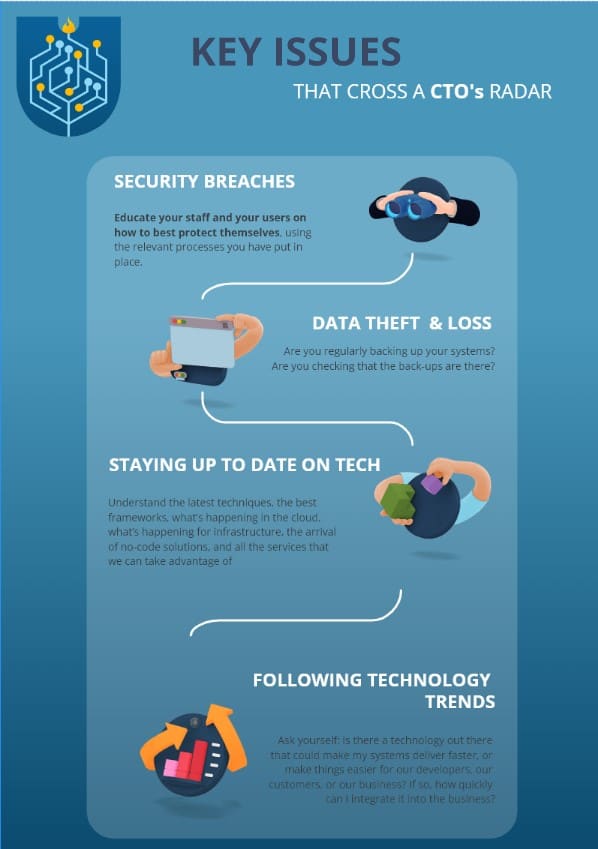
    Key issues that impact a chief technology officer
    4 key issues of every CTO

    Ten years ago cyber security was some way down the list of CTO priorities, but increasingly, today it’s amongst the most prominent. Security breaches, whether internal or external, are a constant threat. As a CTO, you must make sure you have processes in place to deal with them.

    Security breaches

    That said, it’s virtually impossible to stop a breach because of the movement of technology. What makes it even harder is that a lot of breaches are made through social engineering.

    Your priority should be to educate your staff and your users on how to best protect themselves, using the relevant processes you have put in place.

    A recent case I personally experienced was where a developer accidentally leaked an API key that gave users unauthorized access to systems. The security measures we had installed immediately picked up the problem and shut it down.

    All the API keys were changed and we quickly confirmed that nobody had used that particular API key whilst it was in the wild for a few minutes. There was no panic because processes were in place.

    Data theft and loss

    Another issue that might cross your radar is data theft. This can be malicious, with somebody hacking in a security breach. Or it could be something as innocent as a user with an API key that knows how to breach the limitation and get more information. Having tracking mechanisms and automatic stops in place will prevent that.

    Data loss is another important issue so do ask yourself occasionally:

    • Are you regularly backing up your systems?
    • Are you checking that the backups are there?

    It’s something that very few people actually do, though they often say they do.

    Staying up to date on the tech

    Even though I’ve got a few years under my belt as a CTO (maybe because I have a few years under my belt) I always want to be up to date on tech, both generally and within my immediate area of expertise. I need to understand what’s going on.

    I also need to understand:

    • The latest techniques
    • The best frameworks
    • What’s happening in the cloud
    • What’s happening to infrastructure
    • The arrival of no-code solutions and all the services that we can take advantage of to make our product faster, smoother and better for customers.

    This leads me to consider on a regular basis whether I’m using the right tech. In other words, am I building a system on the correct frameworks and languages to meet the requirements of the customer? Quite often I come across projects where they’ve built a generic web system, let’s say in PHP, that falls short of what the user needs.

    Staying abreast of technology trends

    One of the reasons you need to delegate is to create a sufficient amount of time for you to understand longer-term strategies and technological innovation.

    If you’re behind the laptop and micromanaging your team, you will struggle to create the headspace to gain insights into technology around the corner and how it may impact your company and sector. You must be up to date with the latest technology and avoid being too internal. That’s for the CIO when your company gets big enough to have both positions!

    The CTO has to constantly ask, is there a technology out there that could make my systems deliver faster, or make things easier for our developers, our customers or our business? If so, how quickly can I integrate it into the business?

    You need to set aside some time to identify the latest trends in technology and differentiate between hype and reality. This enables you to make an educated decision on whether to incorporate new technologies, rather than jumping on a headline or bandwagon.

    Are you using the right technology?

    The CTO must ensure that the company is using the right frameworks and back-end servers to support it.

    For example, as a database grows, you may find that relational databases aren’t the right architecture to use. Hence, you may move up to a data warehouse, or maybe an OLAP cube or Elasticsearch.

    There are always too many options and countless choices. You may not be an expert in a particular piece of tech, but you need the space to understand what benefits it could provide.

    In addition, maintain your professional development in terms of your leadership and management skills. Here at CTO Academy, we recommend carving out time for short online courses and 1:1 coaching… well, we would say that wouldn’t we!

    Missing deadlines

    Another common issue is missing deadlines, even though they can happen for a myriad of other reasons.

    The causes for delays can be:

    • Incomplete specifications
    • Not fully understanding as a business what is required from a build.
    • The people needed in the development process may not be available when you want them.

    You must communicate — very clearly — the deadlines that you believe you can achieve. This should provide the basis for the decisions made by the rest of the business. It will also ensure that the sales and marketing team aren’t over-promising on specifications and timelines.

    It’s especially the case if you use third-party suppliers. They may be suppliers who are reliant on your software or who give you software. For those suppliers that provide you with software, you need to understand their development processes and their reliability.

    I’ve had dealings with suppliers where the quality of their data was subjective at best. And, which is far worse, their delivery was intermittent.

    Being flexible

    Another area that causes significant conflict is sales team deadlines.

    These are often driven by challenging targets and attached bonuses. It’s not uncommon for salespeople to make promises to clients that are unattainable or put a significant strain on the technology team.

    The sales team wants to close the deal. So they might say that certain functionality is going to be available immediately or ahead of what is realistic. That’s why you, as a chief technology officer, must have regular conversations with the sales team. You want to ensure they’re not over-committing your team and, thus, prevent disappointing the customer.

    But you also don’t want to be the person who always says, ‘No, it can’t be done’. So, stay flexible and try to accommodate the needs of the salespeople. Because it’s them who help bring in the customers the business needs.

    Over-reliance on individuals

    A very common problem for CTOs in businesses large and small is a reliance on one or two individuals who dominate stand-ups and retain critical elements of knowledge about the software.

    Because of this imbalance of power, those individuals might also become difficult and disruptive. However, you can’t just get rid of them because they have the knowledge you depend on.

    This is one of the trickier management tasks you can face, so you need to employ the right preventative strategy.

    The best plan is to double up. In other words, ensure:

    a) knowledge sharing, and

    b) that nobody becomes too important and has too much power or influence.

    The way you manage disruptive team members will define your success as CTO.

    What is a CTO salary?

    A recent report by Reed provides insight into the expected earnings for London-based tech leaders in 2023.

    According to the report, those working in companies with fewer than 1,000 employees should earn £96,080 per annum plus a 12% bonus in the private sector. In the public sector, on the other hand,we are talking about £75,950 with a 27.90% pension addition.

    However, in the United States, the figures are somewhat different. For instance, heads of tech roles in US-based companies of a similar size are likely to earn an average salary of $170,000 in 2023 or $74.00 per hour.

    For more detailed information, use our salary calculator to see the averages across major world cities.

    What is a CTO job outlook?

    Trends and estimates are showing clear increase in demand for all types of contracts (eg fractional CTO jobs, full- and part-time, interim). Don’t forget that there are still a relatively large number of organizations that are undergoing digital transformation. Additionally, new tech start-ups are emerging on daily basis.

    They are all, eventually, looking for CTOs —the role that is quickly becoming crucial to success.

    Conclusion

    Becoming an effective chief technology officer is probably the number one target for most CTO Academy members. And it doesn’t matter if you’re en route to the top or already there.

    We’ve created a slightly light-hearted look at CTO life but tried to focus on the key changes that take place when arriving in a senior role and what should and shouldn’t be part of your workload.

    It’s often a high-pressure role and the technology almost always stops with the CTO — a level of responsibility that some thrive on while others prefer to keep a lower profile.

    What is crucial is that you understand the leadership skills needed to be effective, work towards improving those skills and discard or outsource the rest.


  • How we manage the CEO: CTO Dynamic

    How we manage the CEO: CTO Dynamic

    Inspiration for this article arrived via feedback from one of our CTO mentees, who is grappling with the CEO relationship and what he described as a ‘volcanic chief executive’.

    Most Sunday nights he receives an email from the CEO delivering a barrage of expletive-led criticisms of the senior management team.

    An extract below [expletives removed for those with a sensitive disposition];

    “I’ve not received any board reports and have to spend every Sunday night chasing them up. I am perceived as incompetent by my investors because of you which is not only a disaster for me, but will soon be a disaster for you lot.  Pull your socks up or ____ off”

    Not sure which Business School he attended but assume he missed the “personal communications” lecture.

    It’s clearly an extreme example but as a technology leader who is (becomes) part of the senior leadership team you will be working with and handling a range of very different characters and often the contrast of personalities is at its sharpest with the Chief Technology Officer vs. Chief Executive Officer dynamic.

    Even during the best of times, it can be a delicate relationship to manage, particularly if your CEO is a non-techie.

    Check also the “11 Things a CTO Should Never Say to a CEO”

    So how is it for you?
    How do you (should you) manage the relationship, particularly if it’s becoming confrontational and just receiving basic communication like a board agenda manage to increase your stress and ruin your day?

    We put these questions to our own CEO:CTO combination here at CTO Academy, Andrew Weaver and Jason Noble who will admit to being a classic example of two very different characters having to forge a successful working relationship.

    We asked them to take a hard look at how they manage this business-critical dynamic;

    What’s your history of working together?

    Jason: We met briefly through an earlier start-up we were working on. Though we didn’t have much direct contact with that project we did bond over football, and the 80s music and it’s always a good starting point for a successful business relationship, to already have a social one.

    Andrew: We decided early that we liked the cut of each other’s gib and when we found ourselves exiting other projects at the same time, we discussed our “new ideas” and what we might like to work on together. Jason had been playing around with the brand name of CTO Academy and so we decided to roll out an initial pilot, as much to make sure we enjoyed working together as to test the market appetite.

    Does it help to know someone before going into business together?

    JN: It’s definitely a bonus and particularly with a CEO:CTO dynamic where the personalities are often very different. Having got to know each other across a couple of earlier projects we felt confident and comfortable about the strengths, weaknesses and synergies.

    AW: Absolutely, though it doesn’t mean you are guaranteed sunlit meadows and company success but finding the right co-founder can be very challenging and you don’t know how you might react together when the heat is on so it’s useful to have some experience of working with them before.

    So far, so good though not without some battles around our different styles and vision for growing the company and what processes are required, when to apply the 80/20 rule – often a crucial calculation when deciding how and where to use your limited start-up resources.

    Where do you see the biggest differences and how do you manage them?

    AW: I’m definitely the one fizzing and energised by a constant stream of new ideas, angles and directions. Not all of them are viable or sensible.  It’s particularly important when an early-stage company is rapidly iterating that you avoid running after too many different ideas. Focus is crucial, not always a strong point of mine.

    Where it works particularly well is that Jason brings a necessary calmness and reflection to my decision-making process, often making me think more than twice about a particular direction of travel.

    Equally, I’ve helped Jason move outside his comfort zone with this project, whether that’s presenting, communicating etc. He’s got so much great experience and a genuine appetite to help other tech professionals, but presenting has never been a strength. I’ve enjoyed working with him in understanding how we can help and support each other in building out our mutual skill sets to the benefit of the wider project.

    JN: Andrew is far better than many CEOs I’ve met where literally, you wake up one morning and everything has changed. But he did have a tendency to start firing off new ideas and suggestions, without letting previous changes settle down. After some initial battles about finding a balance and allowing the business model to emerge, we’ve found a balance that works. 

    That said our comfort zones are in very different places and mine was certainly never in front of a camera or speaking to large audiences. I’ve had to force myself to get out there and communicate, in a way that seems irritatingly natural to him but anathema to me.

    Easier as co-founders than the ‘CEO as boss’ scenario?

    JN: Yes, the dynamic here is about genuine collaboration and value creation plus I’m not really operating in a strict CTO role at the moment as I tend to handle other areas of the business such as coaching. 

    We certainly operate as equals and that’s not always the dynamic when working with a CEO. 

    Whilst there is no proven or definitive approach to this relationship, sharing the journey helps ameliorate some of the classic tensions of working with the CEO as a boss.

    When working as a subordinate you want a leader who is on your side, has sufficient emotional intelligence and empathy to listen and not be driving every decision from the top down. Life is too short to spend your working day walking on eggshells and probably the number one skill of any effective leader – CTO and CEO – is that of empathy. Fail to give good people respect and autonomy and they will leave.

    As co-founders, we both have a direct influence on value creation and driving the bottom line which definitely drives greater co-operation and diplomacy.

    What do you look for in a CEO, Jas?

    Particularly in the early-stage companies I’ve worked with, I’ve seen too many CEOs who flit between the latest great idea, often without giving the earlier one chance to settle. I understand the ‘move-fast-and-break-things’ but there are CEOs out there who adopt the extreme version,

    In reality, it’s not an easy job so I look to work with someone who can have the vision and be decisive but is also consistent and capable of holding their hand up and communicating when things might (and often do) go wrong.

    A 2017 HBR survey reported that among CEOs who were fired over issues related to decision-making, only one-third lost their jobs because they’d made bad calls; the rest were ousted for being indecisive.

    Andrew is rarely indecisive, indeed sometimes he is too proactive and my biggest challenge in the early days was making sure he was effective with his (and our) time management.

    Another big issue I’ve suffered from in the past is with defensive CEOs who failed to leave their ego at the door. Often they suffer from a fixed mindset that is protecting themselves rather the benefiting the entire company.

    I know from the coaching and mentoring calls that I’ve done that this can be a regular issue, that many of you have been at the behest of CEOs and those in other senior executive roles where the emphasis is about them, too focused on financial performance and metrics that trigger their bonus whilst ignoring other key factors about what makes a business and a working relationship successful.

    What do you look for in a CTO, Andrew?

    Someone who understands the other side of the CEO role and in particular, understands the intersection between the technology and the business – something we focus on within our leadership courses at CTO Academy.

    Ideally, someone who can combine the technical with the practical and doesn’t get stuck in the weeds, particularly during the early days when momentum is everything. A startup CTO in particular needs to learn and become comfortable with the inevitable trade-offs that come with the territory and not someone who hangs on for the perfect solution. Going back to the 80/20 rule, they need to accept it won’t always be absolutely right as long as it’s effective.

    I need them to be commercial and agile.
    Don’t be building products with all the gizmos, that the market doesn’t want and/or hasn’t validated.

    How do you manage remote working together?

    AW: We were lucky when Covid arrived that we were already a 100% remote team. I’m in Madrid, Jason is in London and the rest of our team is distributed around the world – Brazil, USA, Argentina, Namibia.

    I’m an early morning person and had a bad habit of flooding Jason’s email inbox every morning which could overwhelm his schedule so we slowly developed a more orderly process in terms of our internal reporting and task allocation. We use Nifty to project manage tasks more effectively and regular check-ins that help to prioritise.

    We’ve also discovered the power of actually meeting in person so we arrange regular in-person get-togethers which from our experience, can be enormously productive in aligning on strategy and bigger ticket items.

    JN: Yes, I often woke up to a ridiculous inbox which as a big process person meant I had to train Andrew early about how to communicate in a way that didn’t overwhelm the rest of the team.

    AW: I wasn’t always great with the process, tended to throw ideas out as they emerged and some training was required in particular on how to manage online communications.

    But we’ve adapted well. We do our best to manage an efficient process, keep meetings to a minimum and ensure we don’t overwhelm each other or the team, and maintain lots of outside interests and wider quality of life.

    And this is an important point in terms of the cultural guard rails that we are building within CTO Academy as our remote team grows around the world.

    We share the same perspective around a work/life balance and instil that in our teams with flexibility embedded into how we work and the autonomy that gives others.

    Leadership comes from the top and those guard rails are tough to shift once the company gets any kind of momentum so learn how to work well together in the senior leadership team and the principles and values that you want to flow down through the company as it grows and scales.

    Have you found the Yin, to each other’s Yang?

    AW: I’m not sure who is the Yin or who is the Yang, but so far so good.

    More About CTO Academy

    CTO Academy delivers online leadership courses, coaching and community support to technology leaders around the world.

    Find out more here.

    “CTO Academy helped transform my career. Their courses are concise and the 1:1 coaching helped me with the process, hiring strategy and how to have clarity with key decisions” – Julie Otieno, CTO, Nairobi

  • 9 Reasons Why Great Engineers, Can Become Terrible CTOs

    9 Reasons Why Great Engineers, Can Become Terrible CTOs

    When founders and CEOs are building a fast growth business the search for talent is endless and critical.
    As most companies are tech companies these days it stands to reason that the search for tech talent and those with leadership skills is particularly challenging.
    One of the main challenges for the technologists career path is that they’re having to learn a completely different skill set when they move into a leadership role, they’re having to shift from technical skills to more general business skills.

    (more…)

  • Diary of an Accidental CTO, Part 2

    Diary of an Accidental CTO, Part 2

    Mostafa Khattab is CTO at Wakecap Technologies in Dubai.

    He has agreed to share his thoughts with CTO Academy about his experience of being an “An Accidental CTO” … aka someone who arrived in the CTO role ahead of schedule and is grappling with new challenges and very steep learning curve.

    For those who missed Diary of an Accidental CTO, Part 1 you can start here but for the rest, please read on …

    “Having introduced some context in Part 1 to my current role and the accelerated shift into my current CTO role, I want to use Part 2 to walk you through some of the technical mistakes I made during my own learning curve, how I would try to avoid doing them again in the future and maybe help someone else who lands in a similar situation …

    After my sudden promotion in a fast growing technology startup, I was unsure about many aspects of the role. About what should I do, how I should do it, and also how I recognise whether what I was doing was correct, best practice etc. I felt at times like a rabbit in the headlights.

    Re-Inventing The Wheel

    People always says never build it from scratch, but when you are in charge of building something that will hopefully stay around for a long period of time, the idea of building your product from scratch allowing you to be in full control is an attractive one.

    Unfortunately, people always say it because it’s largely true. Building something from scratch is not a good idea at all, unless you are building a core product that’s going to be executing better and quicker than anything else. How many of us can say that in an early stage start up?

    My recommendation is definitely find something that’s already out in the market and straight off the shelf. Customise it for your needs, use it even if with some limitations and kick start from there. The world has shifted even in the last few years where you can always find quite robust kit off the shelf. Re-inventing the wheel is not good use of your limited time.

    One more thing to point out here are the internal applications.

    If you are about to build an internal application, don’t invest time on it, try to find other ready systems that give you an immediate application. Don’t invest time during the early days building an internal system and dashboard, when your focus must be on customer needs and validation.

    Is it the right technology stack?

    Choosing one technology stack for building the technology is one of the traps Startup CTOs can fall into, especially during early days with limited resources.

    Usually a Startup has a core business and/or module that other stuff is built around. The issue I find is that engineers often use the same technology for building the core everywhere else, all over other products and features. This nominated technology stack might be the best for the core, but is it the best for everything else? You need to be certain of that, before jumping into one stack with both feet.

    Let’s say you are a data aggregation startup, where your core business is about getting data from different sources and producing insights from this data for your customers. You and your team decide to use NodeJs to aggregate the data and save it to your data lake using nodejs.

    Great, good choice!

    Now your customers ask you to build a dashboard for them to access your data and ask for too many other features on the dashboard. Now you really need to think twice before proceeding with NodeJs. 

    Using NodeJs for a complex dashboard may sound convenient but take care and avoiding reinventing that wheel again. It might be easier and faster using a framework like PHP Laravel and have everything ready with a framework that has most of the built-in features you need to build in your NodeJs dashboard.

    Testing

    With low budget and fast growth I fell into in the trap of losing the quality of the software. Testing is not only a position, but also a mindset, losing this mindset will bite you in the ass in the near future.

    Testing is more important than any other part of your technology stack, this is probably my big learn from these recent experiences. Any other issue in the development process can be solved but a lack of testing and doing it late can come with a very high cost later.

    Software Testing is particularly important during the early days, and most other times, because it saves money. It saves your system from malicious attacks that might seriously slow you down and potentially ruin your startup.

    Testing guarantees better software quality and more satisfaction. Take care of it, and make it a high priority from day one.

    Thank you for reading and I hope some of this resonates. Part 3 will look into leadership and some key learning points from my experiences.

    Mostafa Khattab, July 2020

  • Diary of an Accidental CTO: A Definition

    Diary of an Accidental CTO: A Definition

    Mostafa Khattab is CTO at Wakecap Technologies in Dubai.

    He has kindly agreed to blog for CTO Academy about his experience of being what we call an “An Accidental CTO” i.e. someone who arrived in the CTO role ahead of schedule and is grappling with new challenges and very steep learning curve.

    Mostafa will be posting regularly with a birds eye view of what it feels like to be at the sharp end of a fast growing start up.In this series, I am going to write my experience of becoming ahead of schedule CTO.

    “I wanted to start writing a blog about the challenges faced by young tech leaders who join early stage startups and as mentioned, suddenly become an accidental CTO.

    From my perspective I struggled jumping directly from senior developer to CTO, especially during a time of growth where absolutely everything was running a full speed. The business, the tech challenges and the fundamental change in my role to become a technology leader.

    These are my thoughts on what it looks like at the coal face. The types of challenge you might not anticipate in advance, well at least I didn’t see them all. Hope you enjoy.

    Building Your Team

    I have been working with teams for many years but the challenge now was very different. Rather than being part of the team, now I had to start building one. Figuring out the skills we need but working that out not on the basis of “like to have” but working within a tight budget actually, a very tight budget, this was about laser focus on what is the priority now. Everything else has to wait.

    My dream of rapidly building an in-house high performing team and working on employee branding and cohesion, was very hard giving the budget constraints into account.

    Best option for a tight budget is recruiting a remote team but that comes with its own challenges and often hidden management costs. Hiring a remote team brings with it different management challenges when trying to build an effective team. You need in particular in finding the right alignment and communication, when we don’t have the regular and direct human contact from my previous working experiences.

    It’s always challenging to compare hiring a remote team or start building on-site team, the remote team fits more in the budget but the management is challenging, the on-site team is easier to manage but I had to sacrifice some skills and experience to get good enough junior engineers on-site.

    From Team Player to Tech Leader

    Of course I was (am) excited about being in a CTO role. Feels great and I love being able to impact directly on the company and the team we’re building. But I didn’t realise maybe as much as I should have that it’s good to have great technical skills and perform well on those terms with your startup, but watch out because the skill set is about to shift dramatically when stepping into that leadership role.

    Instead of producing something, you have to inspire people and create an environment that enables them to produce that thing with better quality than yours. 

    The main challenge I encountered was how to delegate, trust and get people accountable for what they are working on. You can’t sit behind your screen anymore (even though you are some days tempted to do that) but instead you need to start thinking differently, taking the initiative and leading the team. You need to expand awareness about yourself and also develop an understanding about your team members. Understand your own strengths and weaknesses but also build an ability that allows you to dive deeper into the skills and challenges for your employees.

    Communication!

    Communication is one of the key issues faced by tech gurus landing into technology leadership positions, a challenge magnified if working within a multi-culture team for the first time.

    You need to clearly and effectively communicate with your team members, you need to cross the language and culture borders and become a good listener. Listening is not always an easy skill but it’s crucial to encourage your team to speak up and make them feel comfortable about being heard.

    If the company formal language is not your (or their) mother tongue then you need to create even more safe space to invest time in listening to team members and making sure everyone is communicating effectively.

    Stress

    If you can’t handle the stress, don’t continue please!

    The burdens of being a leader can be overwhelming. You need to understand how and where those stresses might be impacting you and your performance. Check for the root of stress and lead your team to handle stress, to not be afraid to ask for help and don’t over work which so often leads to burnout.

    Agility

    You need to setup the processes so that you can effectively handle the technology management. As an Accidental CTO you will almost certainly need to learn these new skills quickly so they help managing the often complex processes and systems of your company.

    You need to start managing work through ticketing, have a full understanding of code repositories and branch strategy and don’t forget the Quality testing and control. Plan for the CI/CD, prepare well for on-boarding sessions to save time in the future, and understand how to report to the upper-level management.

    So these were the main challenges I faced in my new role. Next blog post will look at some of the mistakes made”

    Mostafa Khattab, July 2020

  • Professional Growth : Why It Pays To Be Intentional

    Professional Growth : Why It Pays To Be Intentional

    What is Professional Growth?

    The definition of professional growth will be different things for different people but it certainly means more than certificates on the wall.

    Performance Expert Bill Eckstrom “it’s the development or better use of talents and skills that lead to improved outcomes. This development can take place in many different places – on the job or [in] off-the-job environments. 

    On the job can be the result of experiential learning, coaching relationships, classroom, etc. However, too often people view professional growth as something that is only on the job, but it is not. For example, one of our executive leaders became a certified yoga instructor, and we have all benefited from her growth. She is more calm under fire, she has taught us more patience, and she is a better overall coach”.

    What is a Professional Growth Plan? 

    There is the intentional and the unintentional plan.
    One happens to you, the other is dictated by you.

    The professional growth plan should start with understanding where you are now, where you want to go and how to get there.

    It should be a mixture of the personal and the professional and to be most effective, it should start with the finish in mind.

    A crucial first step is to understand your own career purpose, what drives you and motivates you and what role(s) do you aspire to achieve in the future. What career path will enable you to achieve your optimal working experience?

    Once you have an understanding of what you want the future to look like, you can start to reverse engineer the steps required.

    Without this self awareness your career can head off into various rabbits hole as you increase the potential of taking the wrong roles, at the wrong time and with the wrong people.

    Some or all of that combination, will not make you a happy bunny.

    If you’re not focused on that ultimate career road map then you also risk the possibility of missing the professional growth opportunities that emerge through your career and which can provide you with the stepping stones required for executing your life and career plan. 

    Strategies For Professional Growth and Advancement?

    • Long Term Goals: Understanding your long term purpose, timeline, ambition and breaking them down into small chunks of time. Create accessible short term targets, as you build towards achieving those lifetime goals in the long term. 
    • Set Out Your Key Criteria: What does your optimal experience look like? What is a non-negotiable in terms of the lifestyle you want, the role that will stimulate you, the career you want to achieve? 
    • Build Experience and Reputation: Much of our success in business is down to a concept called Know. Like. Trust.  Do people know, like and trust you? You need to manage your personal brand, like you would manage the corporate one. 
    • Join Relevant Associations and Networks: Which ones can help you grow and burnish your market reputation? What are merely talking shops and which ones can bring real insight and value to your professional growth strategies? 
    • Find Professional Training and Courses: You should never stop growing and learning and with so many online options available, you can drill down into the niche expertise required to help bridge any skills gaps and complement your specific professional growth plan. 
    • Find A Coach or Mentor: Someone experienced you can lean on, get advice, maybe some guidance. Often it’s about having someone you respect who can act as a sounding board and help you to both build and execute that career road map. 
    • Don’t Be Afraid To Ask What You Need : Good Employers Will Want To Help: there is a famous saying that “what’s worse than a good employee training and leaving? A bad employee not training and staying” – be confident in asking your employer for the training, tools and support to make the most out of your talent. 
    • Focus On Intentional Actions: What steps each day will get you to where you want to be? 
    • Read And Lead: Professional growth is turbo charged when you read about what others have done to achieve success.

    CTO Academy & Professional Growth Planning

    CTO Academy is the only platform in the world that provides tech leaders with bespoke eLearning plans focused around the development of their management and softer skills. Our video course content and mentoring, allied to career development arm, means we provide a unique end-to-end service.

    Our courses have been ranked as one of the best CTO courses in the world and we’re compared with leading global institutions when it comes to effective training and value for money.

  • What is a VP of Engineering?

    What is a VP of Engineering?

    The VP of Engineering is a senior executive who manages development teams and is responsible for the technical strategy and execution of the company’s products or services.

    In other words, a Vice President of Engineering is responsible for:

    • Ensuring that design requirements are met.
    • Overseeing the consistency of user experiences.
    • Managing a team of engineers and developers.

    If the CTO knows the destination then a VP is identifying the route.

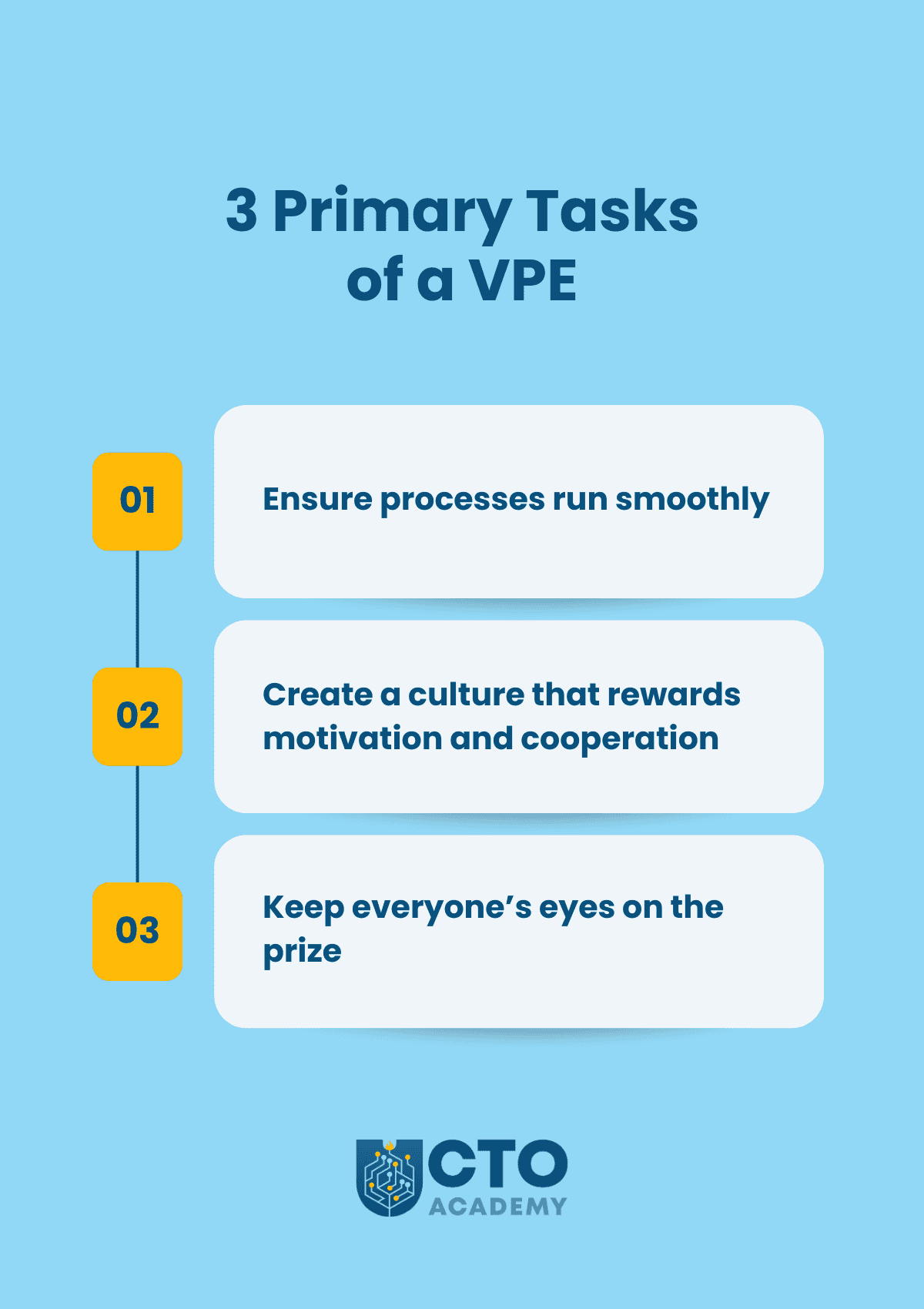
    3 Primary Tasks of a VP of Engineering

    3 primary tasks of a VP of Engineering - infographic summary

    A VPE has three primary tasks:

    1. Ensure that all processes run smoothly.
    2. Create a culture that rewards motivation and cooperation.
    3. Keep everyone’s eyes on the prize.

    To make all of this happen, the VP of engineering needs to focus on who is doing the work and how they are doing it. Let’s now explain these tasks in more detail.

    VP of Engineering Job Description

    While the core responsibilities of a VP of Engineering remain consistent across different company stages, there are notable differences in emphasis and focus between start-ups and fast-growing companies.

    The following table best sums it up:

    FeatureVP of Engineering in Start-UpsVP of Engineering in Fast-Growing Companies
    Primary FocusBuilding foundations, hands-on involvementScaling the organisation, delegation, strategic focus
    Team SizeSmall, close-knit teamLarger, potentially distributed teams
    ResourcesLimited, requiring resourcefulnessMore resources available, but efficient allocation remains crucial
    Decision-MakingMore centralised, often made by the VP directlyMore decentralised, empowering engineering managers
    Technical DirectionMore fluid, adaptable to changeMore defined, but still needs to maintain agility

    In essence:

    • Start-up VP of Engineering: A builder and innovator, laying the groundwork for future growth.
    • Fast-growing company VPE: A scaling expert and leader, driving efficiency and alignment as the company expands.

    Both roles require a unique blend of technical expertise, leadership skills and business acumen, but the emphasis shifts as the company evolves.

    We’ll now explain responsibilities in more detail, separately for start-ups and fast-growing companies.

    VP of Engineering in Start-ups

    The emphasis is on building foundations. Hence, the VP of Engineering in a start-up focuses on these three areas:

    • Establishing the core engineering team.
    • Creating the culture.
    • Designing processes from the ground up (ie, defining the initial tech stack, setting up development workflows and implementing quality assurance practices).

    As you can expect, in start-ups, VPEs have more hands-on involvement with coding, architecture and technical decision-making due to smaller team size and limited resources.

    Limited budgets and resources demand creative problem-solving and efficient resource allocation.  This often requires pivoting which means that the VP of Engineering must be highly adaptable and able to adjust the technical direction quickly in response to changing market needs and/or immediate state of funds.

    And as we move to the next stage of the company’s development, things change.

    VPE In Fast-Growing Companies

    In this stage, the VPEs play a more significant role in aligning the technical roadmap with the company’s evolving business goals and long-term vision. The focus, therefore, shifts towards scaling the engineering organisation, processes and infrastructure to accommodate rapid growth. This usually includes:

    • Hiring and onboarding new engineers.
    • Implementing more robust systems.
    • Optimising for efficiency.  

    And since the team grows, the Vice President of Engineering needs to delegate effectively, empower engineering managers and foster a culture of ownership and accountability.

    The Challenge of Remaining Agile During Scaling

    While scaling is crucial, the VPE must preserve the company’s agility and, thus, the ability to innovate quickly in a competitive landscape. Here is a quick guide to do this job effectively:

    1. Modularise the architecture:

    • Break down the monolithic architecture into smaller, independent services (microservices). This allows teams to work autonomously, deploy updates frequently and reduce dependencies.
    • Implement clear APIs and contracts between services to ensure seamless communication and integration.

    2. Empower autonomous teams:

    • Organise engineers into small, cross-functional teams with end-to-end ownership of specific product areas or services.
    • Give these teams the autonomy to make decisions, choose their tools and deploy their code independently.
    • Foster a culture of trust and accountability within each team.

    3. Streamline processes:

    4. Invest in the right infrastructure:

    • Adopt cloud-native technologies and infrastructure (AWS, Azure, GCP) to enable scalability, flexibility and rapid provisioning of resources.
    • Implement robust monitoring and observability tools to detect and resolve issues quickly.
    • Embrace DevOps practices to automate infrastructure management and streamline deployments.

    5. Foster a culture of learning and experimentation:

    • Encourage engineers to experiment with new technologies, share knowledge and learn from failures.
    • Promote a growth mindset and create a safe space for taking risks.
    • Dedicate time for hackathons, innovation sprints and continuous learning initiatives.

    6. Prioritise communication and collaboration:

    • Establish clear communication channels and encourage transparent information sharing across teams.
    • Use collaboration tools (Slack, Microsoft Teams) to facilitate real-time communication and knowledge sharing.
    • Foster a culture of open feedback and continuous improvement.

    7. Hire for agility:

    • Look for adaptable engineers who have a growth mindset and are comfortable with ambiguity.
    • Prioritise problem-solving skills, collaboration abilities and a passion for learning.
    • Build a diverse team with a variety of perspectives and experiences.

    These seven strategies will ensure agility and responsiveness even in times of rapid growth (a unicorn effect).

    Differences Between VP of Engineering and Chief Technology Officer Roles

    The VP of Engineering and the Chief Technology Officer (CTO) have distinct focuses and responsibilities. Here’s a breakdown of their key differences:

    Chief Technology Officer (CTO)

    • Sets the overall technological vision and strategy for the company, aligning it with business goals.
    • Represents the company’s technology vision to external stakeholders (investors, customers, partners).
    • Focuses on long-term innovation, emerging technologies and research and development.
    • Concerned with the strategic impact of technology on the company’s growth and competitive advantage.

    VP of Engineering

    • Responsible for the day-to-day operations of the engineering department, ensuring efficient project execution.
    • Manages and leads engineering teams, oversees project delivery and ensures quality standards.
    • Focuses on optimising engineering processes, resource allocation and team performance.
    • Tackles technical challenges, removes roadblocks and ensures projects are delivered on time and within budget.

    In summary, we can say that the CTO is a visionary with an outward focus who drives innovation by thinking about the bigger picture. The VP of Engineering, on the other hand, is an execution expert with an inward focus that demonstrates superior problem-solving skills and operational excellence.

    And here is the good analogy that best describes these differences.

    Imagine a car company. The CTO is like the chief designer, envisioning the future of automobiles, researching new technologies and shaping the overall brand identity. The VP of Engineering is like the head of manufacturing, ensuring that the cars are built efficiently, meet quality standards and are delivered to customers on time.

    Key Differences Summarised:

    FeatureCTOVP of Engineering
    FocusStrategic vision and innovationOperational execution and delivery
    OrientationExternal and future-facingInternal and present-focused
    ResponsibilitySetting technology directionBuilding and managing engineering teams
    MetricsMarket leadership, innovation impactProject delivery, engineering efficiency

    Reporting Structure

    In many organisations, the VP of Engineering reports to the CTO. This structure allows for clear alignment between the technical vision and its execution. However, in some cases, both roles may report directly to the CEO, especially in smaller companies.

    Ultimately, the specific responsibilities and relationship between the CTO and VP of Engineering can vary depending on the company’s size, structure and industry.

    VP of Engineering Salary

    The average salary for a Vice President of Engineering in the United States varies depending on the source and factors such as experience, location and company size. Here are some recent figures:

    In the UK, figures are somewhat different:

    These figures should give you a good idea of what to expect for this role in the UK. And you can search for VP Engineering jobs by visiting any of these links, of course.

    Conclusion

    Becoming a great VP of Engineering is a journey that requires a unique blend of technical expertise, leadership acumen and strategic thinking. It’s about more than just writing code; it’s about building and empowering high-performing teams, driving innovation and aligning technology with business goals.

    And here’s a handy roadmap to that role:

    1. Master Your Craft:

    • Develop deep technical expertise.
    • Gain hands-on experience.
    • Stay curious and keep learning.

    2. Cultivate Leadership Skills:

    • Embrace a growth mindset.
    • Develop strong communication skills.
    • Build a collaborative culture.
    • Become a mentor and coach.

    3. Embrace Strategic Thinking:

    • Understand the business context.
    • Develop a product mindset.
    • Think long-term.

    4. Build Your Network:

    • Connect with other engineers.
    • Engage with the broader tech community.
    • Build relationships with stakeholders.

    5. Seek Opportunities for Growth:

    • Take on leadership roles.
    • Seek out challenging assignments.
    • Embrace continuous learning.

    We work with people in this role from around the world, helping them build the leadership skills and confidence to progress their career to the most senior roles including CTO.

    If you’d like more information about what it takes to become a VP of Engineering, get in touch with us.

  • Non Traditional Route to CTO

    Non Traditional Route to CTO

    Not every tech leader follows a traditionally tech led career.

    As most companies are now technical companies roles like the CMO can sometimes have a bigger tech budget than the CTO and it’s more possible than before to achieve senior tech roles via non traditional routes, though it’s highly unusual.

    What does happen quite often is that being an effective CTO doesn’t mean you are necessarily the person with the best technical skills in an organisation.

    A CTO has many responsibilities and tasks, he/she wears many hats and that is the reason why for example, being the best at coding is not of primary importance.

    A CTO should be aware of technology trends and have the skill to use the trends in the favor of a product that is being developed in a company. More important are the soft skills that define the highly effective tech leaders – communication, collaboration, empathy, EQ, critical thinking. capacity to learn and adapt.

    When we are talking technical skills, his/her knowledge shouldn’t be limited to only one side of the product (e.g. back-end). A CTO should have knowledge in the full-stack range in order to make the right decision about the product as a whole – to choose the architecture, the appropriate technologies while keeping in mind the growth and the scalability of a product, to put it simply, to have a clear vision of a product. But he/she certainly doesn’t have to be the best full-stack developer in the company.

    If you’d like to find out more about the route into tech leadership, visit the CTO Academy website.

  • From Senior Developer to Senior Tech Leader

    From Senior Developer to Senior Tech Leader

    Many of us have travelled the journey from junior developer to senior developer to tech leader. We know and understand where you’re coming from and where you want to go. It’s why we launched CTO Academy, to make it easier to negotiate that journey from the technical to the managerial. But let’s dive deeper into what that journey looks like.

    If you’re an ambitious software developer then next step can be tech lead.

    A tech lead can mean different things: a team lead (with no direct reports), or a manager. For example, an engineering manager is a person responsible for the team and its projects which means they are also responsible for peoples’ careers, business growth, deliverables, deadlines, culture, code standards, technical debt, and more.

    If you’re a developer, it may not be clear how to get from where you are to a technical leadership position. If your goal is to become a manager soon, you will need to ask yourself why you want this role. Make sure those senior roles are aligned to your core skills and ultimate purpose. What are your core values and what type of role and company will be matched with them? Really important to clarify these fundamentals early in your career to avoid travelling down the wrong path.

    It is important to be honest about what drives you — is it writing code and architecting software or helping others to get better results, negotiating deadlines with stakeholders, and convincing your business team that code refactoring is not a waste of time? Your answers to these questions should help you determine which path is more appropriate for your desired outcomes.

    If you’re still convinced a technical leadership path is right for you, then you have some work ahead of you. Consider working with your manager or a mentor to have them help you in areas where you are less familiar. Here is an outline of ten key areas of focus:

    Stepping up. A true leader can lead without the title or authority. Anyone with a fancy title and enough authority given by the organization chart can give orders. But that’s not what leadership is — it is about what you do.

    Therefore, you should start small. Take on more responsibilities during difficult projects. Help your peers by providing feedback in pull requests. Volunteer to present on the project updates. Propose improvements to your team or product workflow. Mentor a colleague.

    There are enough opportunities that people either don’t want to see or don’t have enough expertise or confidence to take on. Determine what your colleagues are struggling with, and then step up and do them.

    Ownership. When taking on responsibilities, be accountable for everything you do or don’t do. A leader takes responsibility and avoids blaming others for mistakes, missing deadlines, or bugs.

    Rather than complaining about a bug someone introduced, just help them fix it and explain how to avoid it in the future. Coming up with excuses doesn’t help anyone. Take the time to deliver what you committed to. If necessary, negotiate a better deadline with your manager. Run a project like your own business and actually care about it.

    Recently, one of the tech leads on my team pulled the latest master branch. They saw a big drop in unit test coverage. Rather than complaining, he added missing test coverage. And then presented how to properly check for the coverage and how to write a unit test for complex features. He offered to help if anyone needs it without blaming anyone. The team appreciated that.

    Relationships (or politics). Sometimes people misinterpret relationships and call them “politics”. They are the same things. If you don’t want to deal with “politics” then perhaps think again if you want to get into leadership in the first place.

    Building meaningful relationships is one of the responsibilities of engineering managers. Management is making things happen through other people. Start building good relationships with other engineering managers. They are your future peers.

    There are a few ways to do this, such as presenting at tech talks, doing workshops, and mentoring developers outside of your team. Engineering managers will appreciate the relationships you build through these tasks.

    Technical expertise. An engineering manager should be an engineer first. They must have a strong software engineering background and hands-on experience. Becoming one of the strongest engineers on the team is a requirement. A manager who can’t code or doesn’t understand the technical details can’t take part in technical discussions. Once you become a manager, you should always keep your skills sharp enough to be competent at higher level architecture.

    Mentorship. Any “really good developer” on the team who’s not a team player is more harmful than helpful. If you’re technically strong, then you should be helping others to get to your level. Pair programming, code reviews, presentations, open source or inner source projects are all great examples of how to get started in mentoring others.

    It is rare for someone to come to you and ask you to mentor them. Yet, by branding yourself “the expert” and proactively doing the things mentioned above, people will naturally start coming to you for advice. By helping others you build meaningful relationships and gain people’s respect. Hopefully, they do the same in return and mentor others as well.

    Project management. Delivering projects on time is one of the core responsibilities of any leader. If, as a developer, you’re constantly missing deadlines and underestimating tasks, others can’t trust you. You have to be organized and be on top of your tasks.

    We all know estimating software projects is hard as there is a lot of uncertainty. However, with the right process, it’s not impossible. Constantly communicate the progress and expectations of the project with your manager or stakeholders.

    For example, my team is doing a weekly status report, where the project tech leads have an opportunity to communicate the progress, mention any blockers or raise a major concern of not delivering on time.

    Communication. Communicating clearly and concisely is a very important characteristic of any leader. If you can’t explain clearly what you want from your team, then you have failed as a leader before any work even begins.

    Communication comes in many forms, including verbal, written and even body language. Always work on improving all of your communication skills.

    My team missed a few deadlines because I failed to communicate the requirements clearly and on-time. There were few instances where the lack of communication created confusion on the team who was supposed to do what. I learned that relying on project managers or business stakeholders to explain the project details isn’t working. An engineering manager has to understand the project and then explain it and sell it to the team. And motivate them to want to work on it.

    Managing up. Manage your manager (and sometimes their manager). This means constantly communicating with them and managing expectations. Managers rarely like surprises, good or bad. Establish trusting relationships with your manager. Be the go-to person for important and high profile projects, and actually get them done on time and on budget. Then more projects will follow and you can repeat the process.

    Conflict and crises. Production issues happen, no matter how many unit or integration tests you have. Yes, you want to minimize the number of bugs your projects have. What matters more is how you handle production issues. A person who starts panicking under pressure is immediately disqualified as a leader in the eyes of others. The team and other managers want to see a calm person who has everything under control, even in the most stressful situations.

    A tech lead I used to work with was always calm. There was no conflict or pressure that could make him snap. At least nobody saw him stressed out. When it came to handling a production issue at 3 am, he didn’t disappoint. The issue was fixed in minutes and he showed up to work as if nothing happened.

    Another tech lead got so stressed out with the deadline he called in sick on the day we were supposed to launch the feature. He was so anxious, it made everyone else around him uncomfortable to work with him.

    Even though these are 2 complete opposites, you can guess which one was more successful as a tech lead.

    Vision. For everything they are responsible for, a leader should understand “why”. They are also responsible for ensuring everyone else understands “why” they are working on a project. A leader must explain (often many times) why the project is happening, why the specific people are working on it and how this project fits into the “big picture”. A team has to believe in what they do, only then can they can be effective.

    CTO Academy work with ambitious developers around the world, helping them build the skills and execute the career roadmap that help them achieve the career and reward they want and deserve. If you’d like more information then visit the CTO Academy website.

  • Managing the career transition from techie to team lead

    Managing the career transition from techie to team lead

    The CTO Academy community is not only growing and facilitating the career transition of thousands of tech leaders within the UK, it’s also gone global with customers and contributors from every corner of the world – Guatemala to Sydney, Bangalore to Sao Paulo.

    But despite a myriad of different countries, companies, roles and responsibilities there are consistent challenges when it comes to leadership and management.

    (more…)