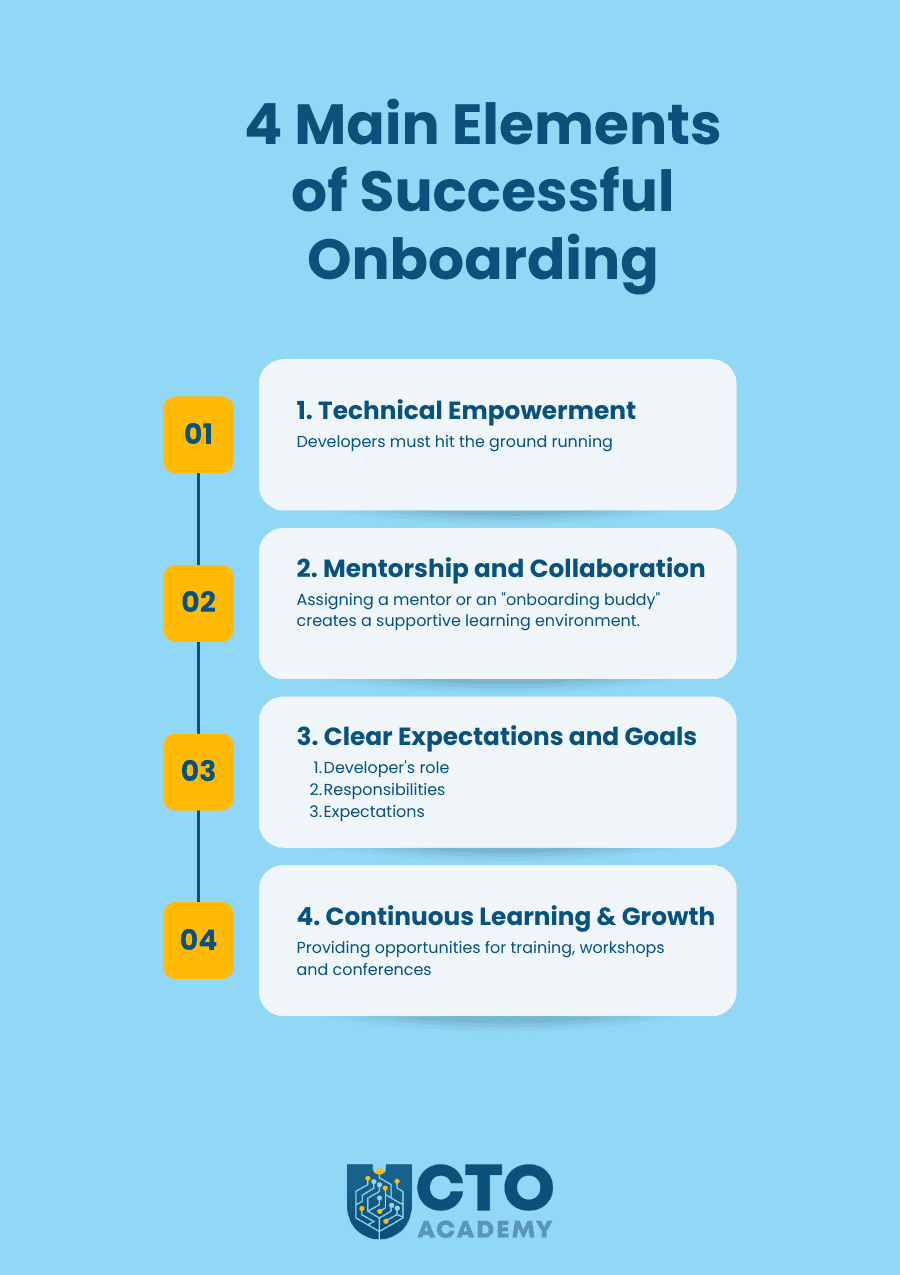
When onboarding developers, you must always consider these four elements: technical empowerment, mentorship and collaboration, clear expectations and goals and continuous learning and growth. So think twice before delegating the entire process to HR without your direct supervision.
That said, before we lay down the onboarding program, we should quickly go over these elements and the common challenges associated with the entire process. As you are well aware, a good software engineer is not your everyday employee. They are mostly introverts with extremely high expectations on one hand and extremely low patience thresholds on the other.
So…
4 Main Elements of Successful Onboarding
(click to enlarge/download)
1. Technical Empowerment
Remember this: developers must hit the ground running.
In other words, they must have:
A development environment set up.
Access to necessary tools and code repositories.
Clear guidance on project structures and coding standards.
This creates a sense of competence and productivity right from the start, thus ensuring a positive onboarding experience.
2. Mentorship and Collaboration
Assigning a mentor or an “onboarding buddy” creates a supportive learning environment.
The mentor/buddy should therefore:
Answer questions
Provide context
Help navigate the company culture
Additionally, the mentor should further encourage collaboration with the development team through code reviews, pair programming and open communication. This, in turn, builds relationships and accelerates learning.
3. Clear Expectations and Goals
For a more effective onboarding, you first want to define three things here:
Developer’s role
Responsibilities
Expectations
Next, you must set achievable goals and provide regular feedback to help software developers understand how their work contributes to the team’s success. This practice provides a sense of purpose.
4. Continuous Learning and Growth
The onboarding process should be seen as a launch pad for ongoing development.
Therefore, providing opportunities for training, workshops and conferences shows a commitment to the developer’s growth and empowers them to expand their skills and stay current.
The developer onboarding checklist that we provide here is based on these four elements but, at the same time, it also answers common challenges.
Common Challenges of the Onboarding Process
As a CTO, you will inevitably face a challenge or two during the entire developer onboarding process. Time, knowledge, culture and communication issues will arise and exponentially grow in a remote work environment. Here are a few proven practices that address these challenges.
Time Constraints
Developer onboarding is often time-consuming because it requires significant effort from the new hire and existing team members. Your job is to balance the need for thorough onboarding while being under pressure to get new developers to contribute quickly.
The simplest solution is assigning small, manageable tasks early on. It enables developers to contribute quickly while getting familiar with the codebase and company practices.
Knowledge Gaps
Even experienced developers might have gaps in their knowledge of company-specific technologies, processes or codebases. Ensuring they get up to speed without overwhelming them or slowing down their progress can be tricky.
A combination of codebase walkthroughs, training, workshops and mentorship should fill any knowledge gaps and, subsequently, accelerate the learning process.
Cultural Integration
Integrating new developers into the company culture and team dynamics is often completely overlooked or in the best-case scenario takes too long. Fostering a sense of belonging and helping them navigate the social aspects of the workplace is crucial for their long-term success.
This is where team lunches, social events and a designated mentor come into play. Combined, these activities help new developers integrate into the company culture and build relationships faster.
Communication Challenges
Clear communication is vital during onboarding, but misunderstandings or misaligned expectations can always arise. It is, therefore, essential to establish open lines of communication and provide regular feedback to avoid any confusion or frustration.
We are talking about regular check-ins and clear expectations to ensure everyone is on the same page. In other words, if you feel somebody failed to understand what you were saying at the meeting, explain one more time.
Remote Onboarding
Onboarding remote developers presents unique challenges, such as building rapport and establishing strong working relationships without face-to-face interactions.
Remote onboarding often requires additional effort to ensure new hires feel connected and engaged. This most commonly includes frequent virtual meetings, screen-sharing tools and collaboration platforms to ensure effective communication and knowledge transfer in a remote setting.
However, don’t go overboard with this. Software engineers who opt-in for remote contracts do that for a reason. They work best when distractions are reduced to a bare minimum. So if you insist on daily virtual check-ins, it might backfire.
(This is one of the reasons our Digital MBA for Technology Leaders heavily focuses on soft skills along with technical and business ones.)
Scaling Onboarding
As your company grows and you hire more developers, scaling the onboarding process efficiently while maintaining its quality and effectiveness can be a challenge.
The only solution here is to continuously refine and replicate the structured approach we will now outline.
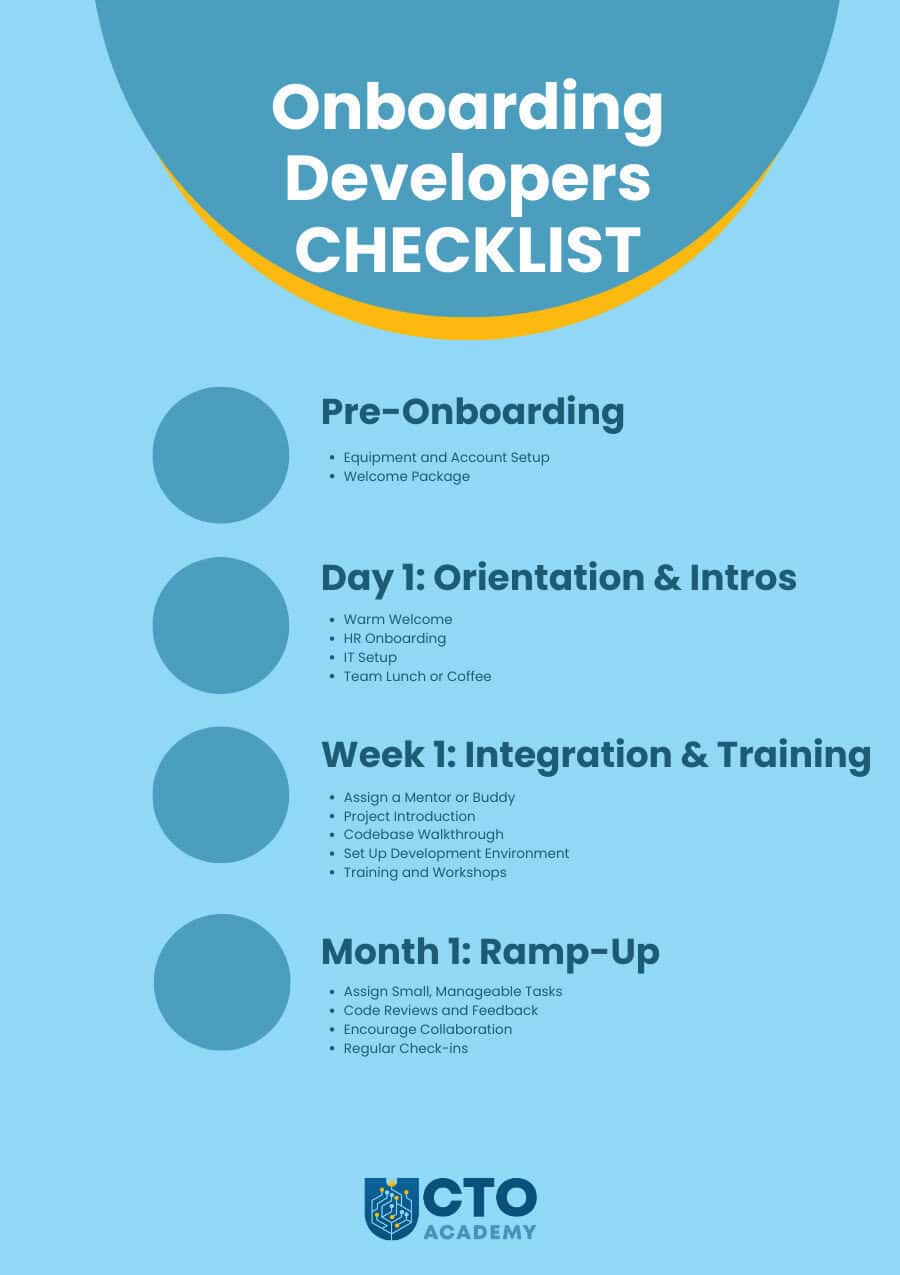
Developer Onboarding Checklist
Pre-Onboarding (Before Day 1)
Equipment and Account Setup:
Ensure the new hire’s workstation, laptop or any necessary hardware is ready.
Set up accounts for email, code repositories, project management tools, communication platforms and other relevant systems.
Provide necessary access keys, software licenses or security tokens.
Welcome Package:
Send a welcome email with essential information, such as their start date, time, location, dress code, parking information and who they should report to on their first day.
Include a company handbook or any onboarding documents they can review beforehand.
Consider sending a small welcome gift or company swag.
Day 1: Orientation and Introductions
Warm Welcome:
Greet the new developer personally and show them around the office.
Introduce them to their team members and key personnel from other departments they’ll interact with.
HR Onboarding:
Complete any necessary paperwork and formalities.
Provide an overview of company policies, benefits, and culture.
IT Setup:
Help them set up their computer, install the necessary software and connect to the network.
Ensure they have access to all the tools and resources they need.
Team Lunch or Coffee:
Arrange a casual team lunch or coffee break to help them get to know their colleagues in a relaxed setting.
Week 1: Project Integration and Training
Assign a Mentor or Buddy:
Pair them with an experienced developer who can answer questions, provide guidance and help them navigate the company culture.
Project Introduction:
Introduce them to the project(s) they will be working on.
Provide context, explain the goals and introduce the team members involved.
Codebase Walkthrough:
Give them a tour of the codebase, explaining the structure, coding standards and any important architectural decisions.
Set Up Development Environment:
Help them set up their local development environment, ensuring they can build and run the project.
Training and Workshops:
Provide training on any company-specific technologies, tools or processes they need to be familiar with.
Consider offering workshops or online courses to help them upskill or fill any knowledge gaps.
Month 1: Ramp-Up and Contribution
Assign Small, Manageable Tasks:
Start with small, well-defined tasks to help them get familiar with the codebase and build confidence.
Code Reviews and Feedback:
Conduct regular code reviews to ensure code quality and provide constructive feedback.
Encourage Collaboration:
Encourage them to participate in team meetings, brainstorming sessions and pair programming activities.
Regular Check-ins:
Schedule regular one-on-one meetings with their manager or mentor to discuss progress, address concerns and provide support.
Click to enlarge/download
Ongoing: Continuous Learning and Development
Performance Reviews:
Conduct regular performance reviews to provide feedback, set goals and discuss career development.
Learning Opportunities:
Encourage and support ongoing learning and development through conferences, workshops, online courses and mentorship programs.
Promote a Culture of Feedback:
Create an environment where feedback is given and received openly and constructively.
Additional Tips for a Successful Developer Onboarding
Clear Communication:
Ensure clear and open communication throughout the onboarding process.
Encourage questions and provide prompt answers.
Documentation:
Provide clear documentation on processes, coding standards and company-specific information.
Social Integration:
Organize team-building activities and social events to help new hires feel welcome and connected.
Feedback and Iteration:
Regularly seek feedback from new hires about the onboarding process and make improvements as needed.
Remember, the onboarding process is an ongoing journey, not just a one-time event. You must, therefore, continuously invest in your developers’ growth and development. It is the only way to create a positive and productive work environment where you can all thrive.
An important part of each module in our Digital MBA for Technology Leaders is a discussion panel where a group of experienced tech leaders dive deep into critical problems of senior technology management. Here, we are bringing you a summary with key points on the subject of Tech Strategy and its alignment with the company’s business goals.
Is Tech Strategy a Common Weakness in Companies?
It sure seems like there’s often a big misalignment.
There’s a challenge with technology leaders understanding the business strategy and being able to translate that into what their team and their function need to do.
Because of that, we get misdirection. The tech goes on one tangent while the business is on a different one and the alignment is not happening. The tech strategy or product strategy is simply not aligned with the business.
How to solve misalignment?
Technology leaders and other members of the management team need to have compassion for technology and each other and understand all the pros and cons.
In the majority of strategy documents, technology doesn’t deliver on what strategy needs to be.
Strategy is supposed to focus our minds and say, these are the critical few things that we’re going to put all our energies against.
More importantly, these are things we’re not going to do.
It is rare to see tech strategies that say we are not going to do this or that. As a result, lows of focus bled out doing wild goose chase stuff, which technology is particularly great at.
It’s great at burning time and money on things that will not move the business needle at all.
And the other part is that technology strategy is often something that seems to be communicated upward to the board.
However, there are a lot of Staff Managers, Senior Engineers, Heads of Development and even VPs of Engineering who have no idea what the technology strategy was that was presented to the board last week.
As a result, alignment is not just happening.
Whose fault is it?
Is it the fault of the technology leader?
Well, there are different types of leaders. Some that manage upwards, some that manage downwards and some that don’t manage at all.
So it depends on the specific context. The general opinion is that the one who pays your wages and who are you most afraid of (ie, who generates your anxiety) is probably going to show where your focus should be.
Consequently, a lot of leaders just create things.
And it is often too difficult to cross the chasm, like trying to explain it to people who are doing the day-to-day job.
You’re running systems or you’re integrating systems, trying to get the relevance of what’s happening in the board room and that strategy and translate that into something relevant for those people.
It’s time-consuming and hard.
That’s why a lot of people just give up and say, you know what, I’m going to protect my teams from this nonsense and I’m just going to do a document.
It’ll keep the owners happy.
It’ll keep the board happy.
And we’ll just carry on.
The problem is that you’ll find yourself in a pickle sooner or later when a senior leader goes, “Hey, hang on a second. Didn’t you say you were doing all this stuff? I was just talking to somebody in the hallway and this doesn’t seem to be happening.”
Therefore,
A strategy needs to be communicated at multiple levels and be reinterpreted on every level.
There could also be monetary incentives to understand the tech strategy of the company and to figure out how it interacts with some departments.
In other words, to improve the way we communicate tech strategy to individual departments (ie, how it affects them, why it’s important for them), there could be a monetary incentive attached to that, depending on the organisation, the structure or the product.
A lot of things are going to depend on that.
One of the main issues is that Chief Technology Officers and tech leaders in general aren’t being allowed or just aren’t on boards of companies, which is affecting the strategy coming from the top down. Consequently, communication is failing from the bottom up and from the top down.
Here’s an example of this.
An outfit that was a retail bricks and mortar was moving online to e-commerce and it was a sort of bolt home, so to speak. It was one of the larger players in that particular industry.
But there was some serious competition, particularly one company which was founded by people who have technical backgrounds.
The latter put technology front and centre in their strategy and are now the largest in the industry, in the United Kingdom. Just because they use the technology correctly.
It does not matter that some of them were technologists. They simply embraced technology and made it work.
Younger generations aren’t quite as afraid of technology as older ones. That’s the positive side.
The negative side, on the other hand, is that we’re still going down alleys, promising stuff that may or may not deliver anything, particularly things like Blockchain or Metaverse.
We’re chucking all this stuff in and it’s just going to ruin our reputation again.
Because we’re just trying to make sure that technology works and we deliver all the business.
How can emerging tech leaders make a difference?
There is a kind of negative feedback here about what’s going wrong. We’ve got these emerging tech leaders, some of whom are already in senior positions.
So where and how can they make a difference?
How can they change the dynamic of what is going wrong in these various scenarios?
For a starter, make sure your voice is heard while spending time understanding the business.
In other words, don’t do tech for tech’s sake.
It is okay to buy something.
It is okay to knock something up and give it a go.
It doesn’t need to be perfect.
But it needs alignment with what your business is trying to do rather than the latest fad.
If you can then communicate that well in all directions and spend the time communicating it, it’s as simple as that in terms of getting it right.
Some of us tend to over-index on communicating the tech strategy and going over it again and again with teams or peers, believing that we’ve done something wrong. We think that we should’ve been doing something fancy. But it worked and it helped with alignment.
So that’s the area where tech leaders need to spend their time.
How different levels of tech leaders might be able to have an impact?
Not every tech leader is on the Board of Directors.
So the question is, if they’re not on the board or they’re not able to have a direct voice in that strategy meeting, how do they make themselves heard?
In essence, it’s a campaign trail so you probably need a running mate. On top of that, you need to do an awful lot of video conferencing with people to get the point across, making sure everybody understands your tech strategy.
That way, they feel like they have an input.
Hence, it’s about the human field.
Strategy is as much about this as it is about numeric. You do need numeric and you do need it short, you need it punchy, you need it simple, but you also need to have that human thing going on.
There are other potential stakeholders — operations especially — where technology is a super leverage point for them.
So the other point is that simplicity is the key.
There are so many strategy decks, which are war garble, just pages of PowerPoint.
Here’s a concrete example.
There is this company in the holiday sector that owns holiday parks.
There’s a huge amount of increased uptime, reduced cloud costs, and all these typical things that we’d see in their tech strategy, but there’s one thing missing that can bind that business together. And that would be reducing queues.
You see, holidaymakers hate going to holiday parks and standing in line for ages.
This is where this particular company can utilise technology as a key leverage point.
Unfortunately, that idea is regarded as an operational problem which doesn’t make much sense. Instead, there should be a technical strategy strand that says we are going to reduce queues.
And how are we going to do that?
We’re going to produce booking systems that enable people to schedule the park’s tools and features online while, at the same time, allowing us to check people in and deal with their requests and, thus, reduce failure in, for example, discounts.
So it makes it tangible and real for people.
Now, not every business is fortunate enough to house such a physical context, but if you can get something short and sweet and say, boom, this is in strategy, then it also enables you to say that’s not in strategy.
And that’s the critical thing because your job half the time is to go around saying, “Why are you doing that again?”
Managing inevitable anxiety
For a lot of people, it brings anxiety when they need to go and speak with their CTO. It makes them nervous. They automatically assume that this is a person who knows everything and we have no idea how to talk about it.
So how in the world are you possibly going to go toe to toe with them when it comes to tech strategy?
The root of that anxiety is simple: you don’t know how to confront your lack of knowledge about a particular situation.
On the other hand, for a lot of tech leaders, it is difficult to communicate to “lower” levels because it sounds condescending.
So how are they supposed to speak on a level that another person is going to understand?
It comes down to the ability to communicate things in a way that anyone can understand.
In other words, keep it simple!
Keep the flow simple and explain things in an easy-to-understand way. Two or three sentences at a fifth-grade level.
That way, non-technical stakeholders can understand what you’re doing and what your strategy is.
For example, if you’re in operations and you want to optimise a flow when an order comes in from your Shopify store, there is no reason your tech leader should be the one setting it up on Zapier when you can do it yourself.
When you have these different flows that you can work with, why shouldn’t you be trying to figure them out yourself, subsequently improving yourself and your career?
Dealing with the sense of loneliness
Being in a top leadership position often feels like you are alone. Hence, you need people to help you get forward. But to get them on the same path, you must give them the needed confidence.
The more confidence technology leaders have in what they’re doing, the easier it becomes.
You see, part of the problem of any communication is not necessarily knowing what the other side is thinking or what you think they’re the experts in. Often, they’re not the experts at all. After all, everyone rises to the level of their incompetence.
The first thing is to understand the business.
The next thing is to understand does anything else has to do with the strategy, whether it’s a tech strategy, marketing strategy or sales strategy.
If it doesn’t, there are some communication issues. In that case, you simply stand up and start talking about that.
In other words, you get that confidence through exposure and practice.
This applies to all levels of technology leaders.
Our role, wherever we are, is supporting those people and bringing them along with us.
Even if you’re not a CTO, but you have teammates reporting to you, bring them along so that everybody understands the tech strategy.
If you bring people in, they generally have better ideas.
Let’s say, for example, that you’re trying to work this damn thing out and somebody comes up with something brilliant. Some technology you’ve never heard of that solves the whole thing straight away. Someone was confident enough to propose such a solution.
The bottom line is that it’s about getting the confidence. You’re on a journey and bringing people with you will drive the technology in the business.
So there are three steps you need to take:
Bring people with you.
Talk to them about it.
Help them understand how it relates to them.
As Kent Beck said in his book about extreme programming, pick all the things that don’t work for you and stop doing them. Take the things that do work for you and turn them up to 100.
That’s how you become effective in communicating the tech strategy.
A word of advice
Sometimes it’s just not worth integrating something in your stack or trying to do something too complicated, just because it seems like fun and should be done because it’s complicated.
So before you engage in something like that, ask yourself this:
Are we wasting time on something that could be simplified?
Because, if it’s simple, it will be much easier to communicate it to a non-technical stakeholder.
A recent survey of 260 global CTOs found that 91% identified tech debt as a ‘major concern’ whilst issues such as cybersecurity, employee turnover and budget restraints registered less.
In this article, we take a deep dive into tech debt with contributions from five senior technology leaders across the CTO Academy community. They will provide their perspective on the problem and potential mitigation strategies towards the solution.
Last week, we had to put some external code on our website.
The new website manager put it directly into the template so it would load on every page. However, we have other external code on our website which is inserted via Google Tag Manager. So I insisted the new manager move the code from the template to GTM (with a bit of grumbling!).
If he had not moved the code to GTM immediately, it would have become technical debt. In other words, something which was simple to fix on the spot would become more challenging in a week as one would have to refresh one’s memory as to the problem.
How many of these simple examples does it take? 10? 50? How many before we end up with substantial technical debt on our hands making the website difficult to manage?
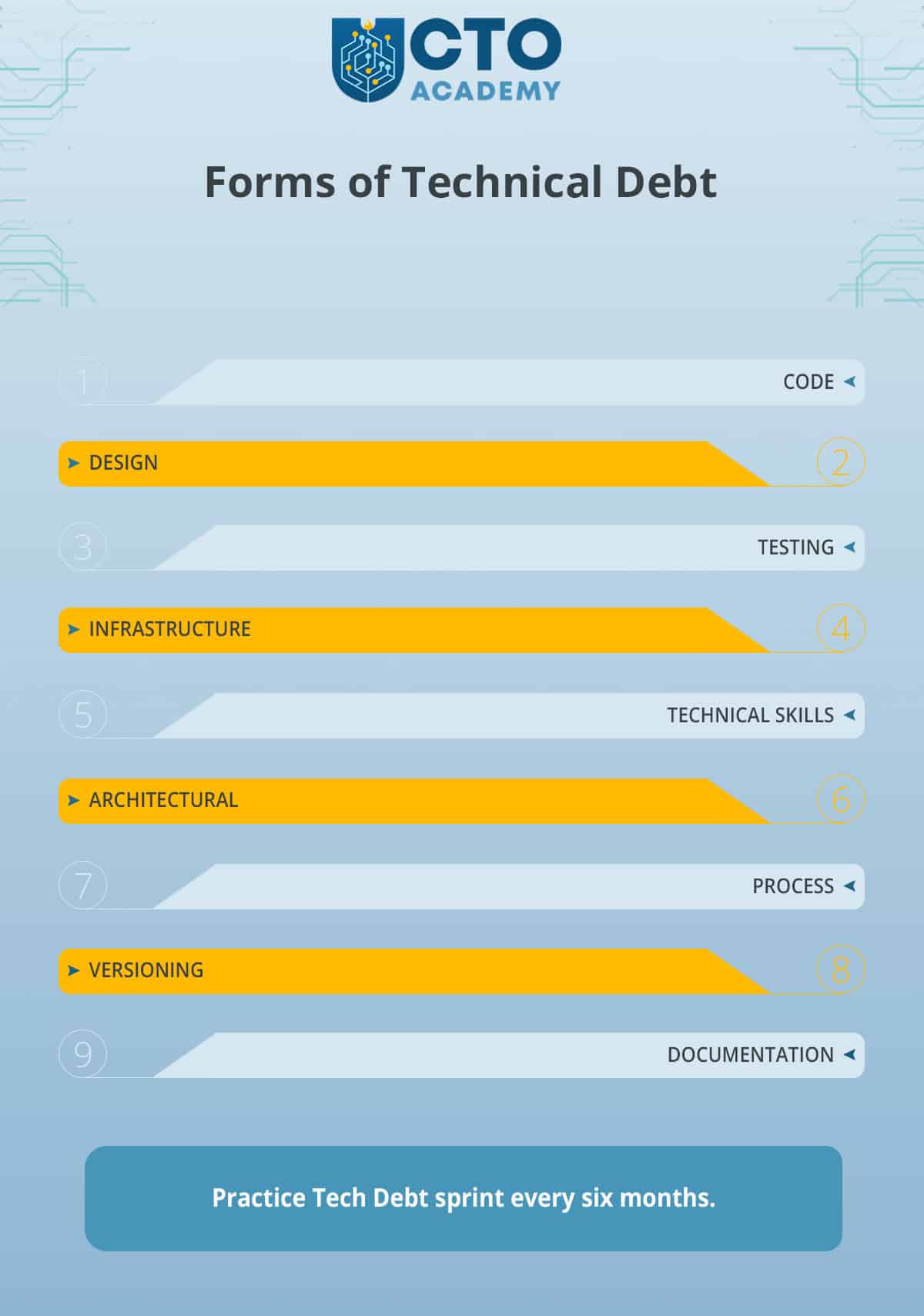
Let me open this discussion by detailing various forms of technical debt.
Forms of Technical Debt
(click to expand/download)
Code Debt
When code is not properly written or structured, often due to rushing to meet deadlines, we have a code debt. It can lead to a codebase that is difficult to read, maintain or extend. Examples include duplications, large classes or methods and lack of modularisation.
Design Debt
It arises when a software design is flawed or becomes outdated. Design debt manifests in systems that are hard to scale or modify. Poor design choices, such as not following design patterns appropriately or over-engineering, contribute to this debt.
Testing Debt
Skipping or rushing testing phases can lead to insufficient test coverage or ignored failing tests. This debt increases the risk of bugs and failures in production.
Infrastructure Debt
When the development or production environments are not properly set up or maintained, we end up with infrastructure debt. This can include using outdated tools or platforms, inadequate server capacity or lack of automation.
Dependency Debt
Comes from relying on outdated or unsuitable third-party libraries and tools, leading to security vulnerabilities, compatibility issues and limitations in functionality or performance.
Technical Skills Debt
This form of debt arises when the team lacks the necessary skills or knowledge to work efficiently with the current technology stack or to implement best practices. This often leads to suboptimal solutions and increased maintenance work.
Architectural Debt
It is similar to design debt but at a higher level. Architectural debt involves issues with the overall structure and interaction of different parts of the system, leading to difficulties in scaling, integrating new features or adapting to new requirements.
Process Debt
Process debt is generally caused by inefficient or outdated development processes. Examples include lack of agile practices, poor communication between team members or inadequate project management.
Versioning Debt
When software components are not kept up to date, versioning debt leads to compatibility issues, security vulnerabilities and increased effort required for future updates.
Documentation Debt
Insufficient or outdated documentation makes it harder for new team members to understand the system and for existing members to remember why certain decisions were made. Unfortunately, most technical documents go out of date the moment they’re written.
I have always been conscious of technical debt and tried to keep it to a minimum during my career. Code must be well maintained, systems kept up to date (including operating systems) and redundant systems/code removed. Finally, I make sure there is a sprint every six months allowing teams to tidy up so that it never builds up to something unmanageable.
When discussing technical debt, especially with non-technical leaders, I always ensure that we have a shared understanding of what we mean by ‘debt’ — ie, we take some shortcut today that we have to repay at some point in the future.
The cost of not repaying that debt results in ‘interest payments’ which translates to either software or infrastructure that is harder to work with and, therefore, costs the business more to deliver every new feature.
Every project has some technical debt, but not all technical debt is equal.
For example, you may have a particularly unruly module in your codebase that is a real pain to work with. But if it hardly ever gets touched, then the effort to refactor it may far outstrip any potential benefit you expect to receive from paying down that debt.
Therefore, understanding the impact of the debt on your teams’ productivity (and happiness) is essential. I’ve always encouraged teams to maintain a list of their worst bugbears which should be prioritised based on two factors:
How much it is impacting the team’s ability to deliver features
How much effort will it take to remediate
Allowing some time either in each sprint or setting aside a whole sprint every few months to tackle these issues will help keep technical debt under control.
I mentioned happiness above, and while it might at first sound odd to talk about developer happiness when discussing technical debt, many developers need to know three things.
First, you take technical debt seriously.
Second, you care about quality.
And, ultimately, third, you listen to and trust them to make recommendations that affect the thing they do every day in service of your business.
Ignoring technical debt for too long can lead to a negative spiral where new features take longer and longer to deliver. Consequently, team members, feeling frustrated and ignored, start looking around for new roles. Often, the strongest team members leave first, causing a sort of ‘brain drain’ on the rest of the team. This inevitably results in further slow-downs, and so on.
Good people won’t stick around for long if they feel that tech debt is something we’ll tackle ‘one day when there is more time’. In other words, a quieter day is not coming, so start putting time aside now. It’s sound economics and it will also make your team happier.
Forecasting and managing specific debt is critical
“A definite rigour can be applied.”
Ken Kolchier, CTO of Trade Technologies, specialising in optimising engineering organisations
With Jason having identified categories of tech debt to look for, we are in a position to assess any one of them for priority, cost to remedy and cost to leave alone.
Tech debt will, by necessity, always exist and accumulate. In software, we make directional decisions about where to add complexity to account for likely change, and where to implement stability and opinionated design.
Regardless of the type of debt, business forecasting the cost of handling or not handling specific debt can be critical to prioritising the right things. Forecasting and managing this area can sometimes be more art than science, but there is definite rigour that can be applied.
Most of us are well aware that tech debt stems from not designing enough adaptability in a highly changing area. On the other hand, coding too much flexibility in a slow-changing area is, de facto, tech debt in its own right. That is, whenever we might need to change that code, the complexity of pre-designed adaptability adds friction and possible instability.
When assessing code or design debt, typical (and atypical) codebase analytics involve scanning with tools such as Sonarqube, JetBrains Qodana, NDepend and others. Additional insight might be gained from other data, such as crunching numbers from the git log to map hotspots in the code to levels of debt.
Typical metrics that help forecast ROI
Lines of code
Total complexity (cyclomatic complexity)
Number of files with large complexity
Duplicated blocks/lines of code
Code issues/smells
Test coverage
Hotspot files and number of changed lines
Jira metrics about task duration in the area
Team estimation of friction ratio
The hotspot metrics are not only a factor to include in calculations but can also help us quickly decide when ROI simply isn’t there, and to stop analysing.
The team – and we as technical leaders – might feel a certain area is riddled with tech debt and needs to be addressed. Yet, if the system is stable and working in that section and the code is rarely touched, it shouldn’t rise as a priority.
For most metrics, we can get fairly good ballpark numbers about the cost of change or how many team hours are required to add test coverage to one line of code; fix one duplicate block or simplify one largely complex file.
We can apply these numbers to the debt metrics we’ve gathered, quantifying how much it would cost to remedy it in the specific component we’re analysing. But do make sure to include all the various factors — complexity, code issues and test coverage. This helps to reach a balanced assessment as code that is low in complexity and also low in test coverage might not be prioritised, as the impact of any tech debt is easily navigated later.
Along with the cost to address the debt, we need the other side of the coin —
How much does it cost NOT to fix it?
Granted, gathering this information can take some finesse. However, we can start with a solid analysis of how long our tickets or tasks take to complete in the code area in question. Survey the team to guesstimate how much faster those tickets might be completed if the debt were removed.
We can now easily generate a cost/benefit analysis, calculating the current cost of the friction by the following formula:
How much time would be saved per ticket x The dollar cost of our team completing one ticket x The average number of tickets in a given cycle
And then compare that to the previously gathered cost to remedy.
Combine this with priority based on hotspots, and we have a well-rounded picture.
Other areas such as testing debt can be analysed similarly. We can track the difference between bugs that are ‘escapes’ (bugs in newly changed code) versus bugs in legacy areas of the code and prioritise them accordingly.
Applying this kind of rigour not only helps us and the business make good decisions, but our teams can respond to it as well. We’re simply helping them see quantified, engineer-type numbers around what is usually a very fuzzy answer to a fuzzy question.
The necessity for strategic handling
“It needs strategic handling”.
Sid Mustafa, Fractional CTO and founder of Phoenix Consulting
In my tenure across diverse software engineering roles, I’ve encountered technical debt in various forms. It’s a nuanced challenge that needs strategic handling and I believe it is neither good nor bad.
For instance, at one company I worked at, we faced tech debt as a consequence of a lack of organisation, planning and prioritisation. The business was operating as a feature factory.
To improve the state of affairs, we had to judiciously decide if and when to incur this debt for agility. Additionally, we had to decide when to allocate resources for its reduction.
At another company, rebuilding the codebase demanded a delicate balance between rapid development and long-term sustainability.
Here, technical debt was a strategic choice and an important consideration for maintaining a robust, scalable product.
Using tools to reduce the team’s cognitive load
In addition to these strategies, we also employed a tool called Stepsize in our IDE. This tool significantly streamlined our technical debt management process. Stepsize allowed us to log technical debt more naturally as we worked, embedding the process into our daily development activities without causing significant disruption or context switching.
By tagging technical debt items with impact and priority labels directly within our development environment, we reduced the cognitive load on the team. This approach enabled us to handle mundane tasks efficiently while maintaining a comprehensive and prioritised log of our technical debt.
The integration of Stepsize into our workflow was a game-changer, allowing for a more fluid and less intrusive method of tracking and managing technical debt, ultimately contributing to our team’s increased productivity and focus.
After implementing a robust prioritisation and planning process to manage technical debt, we observed a 20% increase in deployment frequency and a 15% reduction in the time taken to transition from code commit to production.
However, after integrating the Stepsize, we observed a 75% reduction in the time developers spent on identifying and logging technical debt.
It was also central to the decreased cognitive load on the team when working around TD and significantly improved DevEx.
Technical debt extends beyond code; it permeates the wider business, impacting architecture, product features and customer/team satisfaction. To effectively manage it, a structured approach is essential. This includes:
Defining
Logging
Monitoring
Quantifying
Risk assessing and
Prioritising technical debt
By doing so, we can use it strategically to accelerate development without falling into an unrecoverable debt spiral.
Moreover, the categorisation of technical debt is crucial for efficient management. Utilising frameworks like the technical debt quadrant or the 13 distinct types identified by the Software Engineering Institute — architecture, build, code, defect, design, documentation, infrastructure, people, process, requirement, service, test automation and test debt — provides a clear structure for prioritisation and handling.
Most Common Causes of Technical Debt
“Name it, visualise it, prioritise it”.
Pawel Slotorsz, DevOps Manager at Hard Rock Digital, Poland
In my view, the term tech debt refers to the lack of ability of an organisation or team to adapt and respond quickly to changes, challenges and opportunities in the rapidly evolving IT landscape.
I have encountered tech debt in all projects that I have participated in and observed it from a distance in other teams.
Jason has provided some very good examples, and my experience has been very similar. But let me add my take on the most common causes of tech debt which recur from company to company and project to project.
An organisation decides to buy or lease a third-party codebase or platform to speed up the delivery of the product or service. Although feature- and market-wise the organisation compares several options and picks the best solution, they accept the fact that, for example, the tech stack will not fit into current modern tech architecture; eg, cloud-native, Kubernetes, serverless, development frameworks or others.
The solution to the problem is designed from scratch
In the above case, most of the time, the tech debt is created literally from the moment the engineers write the first line of code and the code is pushed to the repository. This happens because it is impossible to predict all the consequences of using a particular solution. It is also connected to a lack of skills in the engineering team.
Alternatively, engineers will often manage the issue by repeating a previous fix to a similar problem. Why? “Because”, they say, “it’s always been done this way”.
The aim is to free up teams or individuals and speed up delivery. But the inevitable outcome is tech debt. If that debt is not properly managed, it will decrease productivity, increase maintenance costs, reduce software quality and, ultimately, bring about the failure of the project.
So how can we deal with it?
Start by acknowledging that tech debt is there. Name it, visualise it and prioritise it.
This can be done in several ways. I’ve done it via a risk register, backlog refinement, proof of concepts and R&D.
The first two can answer questions such as:
Is this tech debt? If so, is it a risk I can live with?
Does it create a block?
Does it need immediate attention?
R&D provides the opportunity to research solutions, innovate or learn from others.
Therefore:
1) Allocate a percentage of your time and money to:
Constantly monitor tech debt and
Learn how to prioritise different areas of debt.
In some cases, you’ll need a strike group — a team for whom dealing with the most urgent areas of debt will be a priority.
2) Measure the following:
How often bugs are introduced into the codebase/product
The number of incidents or outages
How much time is spent on dealing with code debt
3) Determine whether too much or not enough of your workforce is dedicated to dealing with tech debt problems and whether allocating those resources is blocking the business from operating efficiently. Remember, it’s always about proper balance. The time and effort needed to deal with technical debt won’t be constant.
4) Resist the use of fancy tech when there is no use case or business value for it. And always learn from other teams, organisations and people in your network about how they manage the problem.
What are your thoughts?
It’s a challenge most of you are dealing with so I hope we’ve helped provide some answers.
Thanks to everyone who contributed to this article.
What are your experiences with tech debt?
Do you agree/disagree with the problems and solutions raised here? Let us know.
In this post, we explain the relatively new Field CTO role and how it differs from a more traditional Chief Technology Officer role. We will see how a Field CTO job description determines the type of person suitable for the job. We will take a look at the job prospects and, of course, the average salary.
First things first…
What is a Field CTO?
A Field CTO is a high-ranking executive role that is becoming ever more popular in tech companies (IT, software or telecommunications industries). Their primary responsibility is bridging the gap between technology and business strategy while also engaging directly with customers and partners. In other words, the focus is on developing an innovative approach to dealing with customers’ problems. This is not something a traditional CTO usually does, at least not to such an extent.
The FCTO must possess business acumen and a deep understanding of the market. The reason is simple: the primary focus is on customers’ problems and innovation. As an FCTO, you want to map all the challenges into the vendor’s product portfolio.
Forward-operating aspects of the role
Another element that largely differs from the traditional role is technical evangelism. You will be directly responsible for (actively) promoting your company’s technology solutions. To put it bluntly, you will evangelise them to customers, partners and the broader industry. This involves articulating the value and benefits of the company’s offerings. Not exactly an ideal job for someone who’s struggling with open communication, is it?
So, unlike our traditional CTO who is mostly inside-oriented, an FCTO frequently engages with customers to a) better understand their technology needs, and b) identify opportunities. It is the only way to perfectly align the company’s products or services with customer requirements. Naturally, this often involves building and maintaining strong relationships with key customers and partners.
Inside-oriented roles
With such a deep understanding of customers’ needs, FCTOs often collaborate with the sales and marketing teams to help them understand the technical aspects of the company’s products or services. They may even participate in sales meetings, provide technical expertise during customer presentations and assist in closing deals. That involvement, however, doesn’t extend to active selling.
FCTOs of technology companies, due to the nature of their involvement, hold an important role in merger and acquisition processes.
Since they act as a bridge between the engineering and business teams, FCTOs work closely with in-house CTOs and engineering teams on product development. They are there to provide valuable input into the development of new products or services. Additionally, they help prioritise development efforts. This, in turn, ensures that products align with market needs and technological trends.
What makes the FCTO such a valuable addition to the development process is the feedback loop they gather from customers in the field. That Information and data is relayed to the internal teams responsible for product development and improvements. This helps the company to stay responsive to market demands.
Many Field CTOs are seen as industry thought leaders. They may write articles, speak at conferences and represent their company in public forums to showcase their expertise and vision in the technology domain.
It’s clear that a Field Chief Technology Officer plays a pivotal role in aligning technology with business goals, fostering customer relationships and driving innovation. However, we must note that the specific responsibilities and influence of an FCTO can vary depending on the company’s size, industry and strategic objectives.
Get the IT Career Path Roadmap (Free PDF)
Want more than scattered ideas? Get our IT Career Path Roadmap PDF – an 8-step framework to map your next roles, sharpen your skills, and build a layoff-resilient tech leadership career. Fill in the form and we’ll send you the PDF version so you can download it, annotate it, and use it as a living plan for your next career moves.
What is the Difference Between a Field CTO and a Part-Time or In-House CTO?
The roles differ primarily in terms of responsibilities, level of engagement and the nature of their employment. Here are some key distinctions:
Field Chief Technology Officer (Field CTO)
Engagement Level: FCTOs often have a broader role that involves customer engagement, technology strategy, market evangelism and thought leadership.
Customer Interaction: They actively engage with customers, partners and the broader industry to understand market needs, build relationships and represent the company’s technology vision.
Responsibilities: FCTOs are less involved in the day-to-day technical operations of the company. They are, however, instrumental in aligning technology with business goals, shaping the technology strategy and ensuring that the company’s offerings really do meet market demands.
Full-time position: They may hold a full-time position in the company but may spend a significant amount of time externally, interacting with customers and industry stakeholders. In fact, some jobs can involve remote working.
Part-Time CTO
Engagement Level:Part-time CTOs have a reduced level of engagement compared to full-time CTOs. They are typically engaged on a part-time or consulting basis.
Responsibilities: These may include providing technical guidance, reviewing technical decisions and offering strategic input. However, they may not be deeply involved in day-to-day operations or product development.
Flexibility: Part-time CTOs are often hired for their expertise on specific projects or to address particular technical challenges. Their engagement can be flexible and tailored to the company’s needs.
In-House, Full-Time CTO
Engagement Level: In-house, full-time CTOs are deeply embedded within the company and are responsible for the overall technology direction and management.
Responsibilities: They have a wide range of responsibilities, including overseeing technical teams, product development, infrastructure management, budgeting and developing technical strategy.
Commitment: In-house CTOs are committed to the company on a full-time basis and are responsible for the day-to-day technical operations. They are often part of the senior executive team. However, in start-ups and smaller organisations, they have a more hands-on role.
In summary, the key differences revolve around the level of engagement, the scope of responsibilities, and the nature of the employment arrangement. Field CTOs are more externally focused, part-time CTOs offer flexibility for specific needs, and in-house, full-time CTOs are deeply involved in the company’s technical operations and strategy. The choice between these roles depends on the company’s size, goals and resource availability.
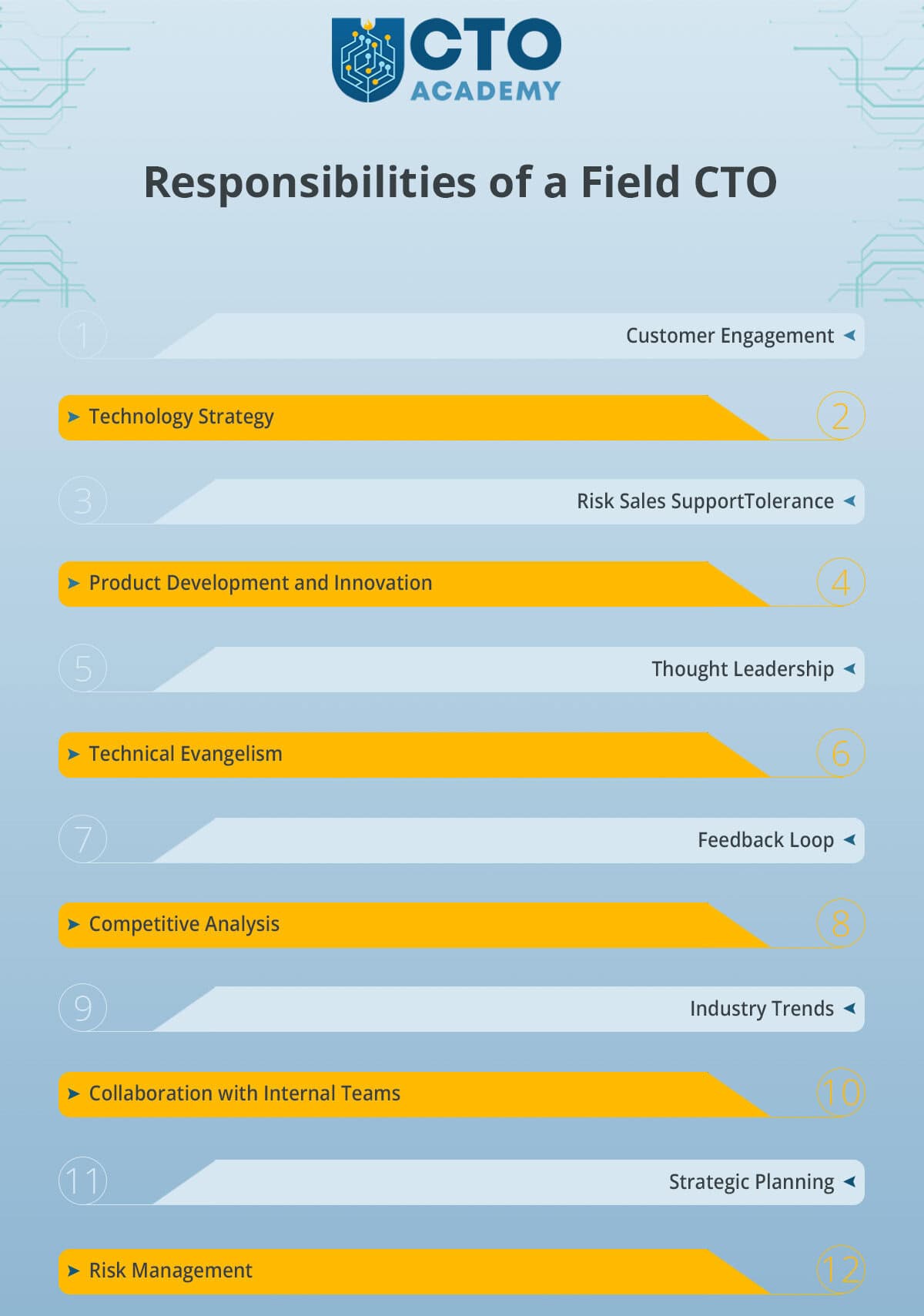
What are the responsibilities of a Field CTO?
(click to enlarge/download)
The responsibilities of an FCTO vary depending on the organisation and its specific needs. However, the role generally encompasses a combination of the following responsibilities (this is, effectively, a summary of everything we discussed so far and, quite often, from the job requirements on job boards):
1. Customer Engagement
Build and maintain strong relationships with key customers and partners.
Act as a trusted advisor to customers, understanding their technology needs and providing solutions.
2. Technology Strategy
Define and execute the company’s technology strategy in alignment with business goals.
Identify emerging technologies and assess their potential impact on the business.
3. Sales Support
Collaborate with the sales and marketing teams to provide technical expertise during customer presentations and assist in closing deals.
Help sales teams understand and communicate the technical aspects of the company’s products or services.
4. Product Development and Innovation
Provide input into the development of new products or services to ensure they align with market needs and technological trends.
Serve as a bridge between the engineering and business teams, helping prioritise development efforts.
5. Thought Leadership
Act as an industry thought leader by writing articles, giving presentations and representing the company in public forums.
Showcase expertise and vision in the technology domain to enhance the company’s reputation.
6. Technical Evangelism
Promote the company’s technology solutions to customers, partners and the broader industry.
Articulate the value and benefits of the company’s offerings.
7. Feedback Loop
Gather feedback from customers and the field, and relay this information to internal teams responsible for product development and improvement.
Ensure that the company stays responsive to market demands and customer feedback.
8. Competitive Analysis
Monitor the competitive landscape, assess the strengths and weaknesses of rival companies’ technology offerings and provide insights to inform the company’s strategy.
9. Industry Trends
Stay up-to-date with industry trends and technological advancements, and assess their potential impact on the business.
10. Collaboration with Internal Teams
Work closely with various internal departments, including engineering, product management and executive leadership, to align technology initiatives with overall company goals.
11. Strategic Planning
Contribute to the development of long-term technology and innovation strategies for the company.
Ensure that technology investments align with the company’s growth and profitability objectives.
12. Risk Management
Assess and mitigate technical risks associated with the company’s products or services.
Ensure compliance with industry regulations and best practices.
As you can see, some of the responsibilities are universal; that is, closely similar to those of a traditional CTO. The specific responsibilities, however, extend beyond technical matters to encompass business strategy and customer relationships. In fact, some Field CTOs aren’t even coding-savvy. But they do know how to best navigate code developers to get exactly what the market demands.
What skills and experience are required to be a Field CTO?
5-10 years of industry-related experience and 5+ years of experience in a role similar to CTO, CIO, VP/Dir of Engineering, Operations or Product Development.
10+ years of architecture experience building, consulting or implementing technology for the relevant industry.
Knowledgeable in the challenges impacting the relevant industry and the application of industry-specific use cases.
A broad range of experience with technical and design direction that may also include large-scale database and/or data warehouse technology, ETL, analytics and public cloud technologies.
Familiarity with data providers and data aggregators.
Understanding of industry-specific concepts and applications.
The ability to travel to customer sites, industry events and other related events as required (in some instances, over 30% of time FCTOs spend travelling or working outside of the company’s premises!)
Required Experience
Demonstrated ability to conduct conversations and quickly establish credibility with C-level individuals and other business executives where selling solutions are the focus (ie, outstanding presentation skills to both technical and executive audiences).
Work experience in a client environment, ideally in a leadership capacity.
Strong interpersonal and presentation skills including consulting skills.
Strong oral and written communication skills.
As always, it is important to note that the specific requirements for an FCTO can vary depending on the company, its industry and its strategic goals. In some cases, soft skills and industry-specific knowledge may be just as important as technical expertise. Successful Field CTOs are well-rounded individuals who can bridge the gap between technology and business, providing valuable leadership and insights to drive the company’s success.
What are the career prospects for Field CTOs?
We know that FCTOs play a crucial role in the technological needs of an organisation. Consequently, the number of Field CTO jobs has slowly increased over the last few quarters.
Just like a traditional role, the FCTO position provides substantial benefits. We are talking about:
Top salary possibilities
Equity or shareholder offerings
Leadership opportunities
Reputation development
Recognition and enterprise-level goal achievement.
In terms of career progression, FCTOs can look forward to roles in higher executive management or opportunities in consulting or entrepreneurship. They can also transition into specialised roles within the tech industry depending on their areas of expertise. It’s important to note that the specifics can vary based on individual career goals and market trends.
The successful candidate’s starting salary is usually determined by skills, experience and location. FCTOs are frequently offered competitive benefits packages, which commonly include:
Medical, dental, vision, life, and disability insurance along with a 401(k) retirement plan
Flexible spending and health savings account
Paid holidays and time off
Parental leave, etc.
What are some of the biggest challenges and opportunities facing Field CTOs today?
Challenges:
Technological Changes (ie, the rapid pace of technological evolution that requires high levels of adaptability).
A shortage of IT Professionals (creates a challenge in managing day-to-day operations).
Strategic Role (requires balancing the strategic role and daily operations).
Opportunities:
Operational Possibilities (technology is now much more embedded in day-to-day life, thus providing more business opportunities which, in turn, creates a wider array of operational possibilities for FCTOs).
Field CTOs, as a relatively new role in the world of technology leadership, have yet to discover what bumps may be awaiting them down the road.
That’s why here at CTO Academy, we are continuously working to identify both challenges and opportunities and to educate and inform our members. Our Global Community of Tech Leaders is actively involved in daily discussions and problem-solving, helping each other in their day-to-day operations. All members have a unique opportunity to shadow seasoned CTOs and learn from them during live sessions and Expert Q&As.
A long time ago, we became aware that the only way to successfully overcome the hurdles is a peer-powered trust of brains and cumulative experience. Existing and future Field CTOs can greatly benefit from such a community because it removes much of the unknown from the equation. Because if you don’t know that the obstacle exists, you will inevitably trip over.
In this post, we explain a CTO job description on four levels of engagement: start-up, fast-growth company, enterprise and, finally, a Group Chief Technology Officer. You will learn responsibilities on each level, understand desired qualifications and, ultimately, find out what kind of salary you can expect considering the size of your company and industry.
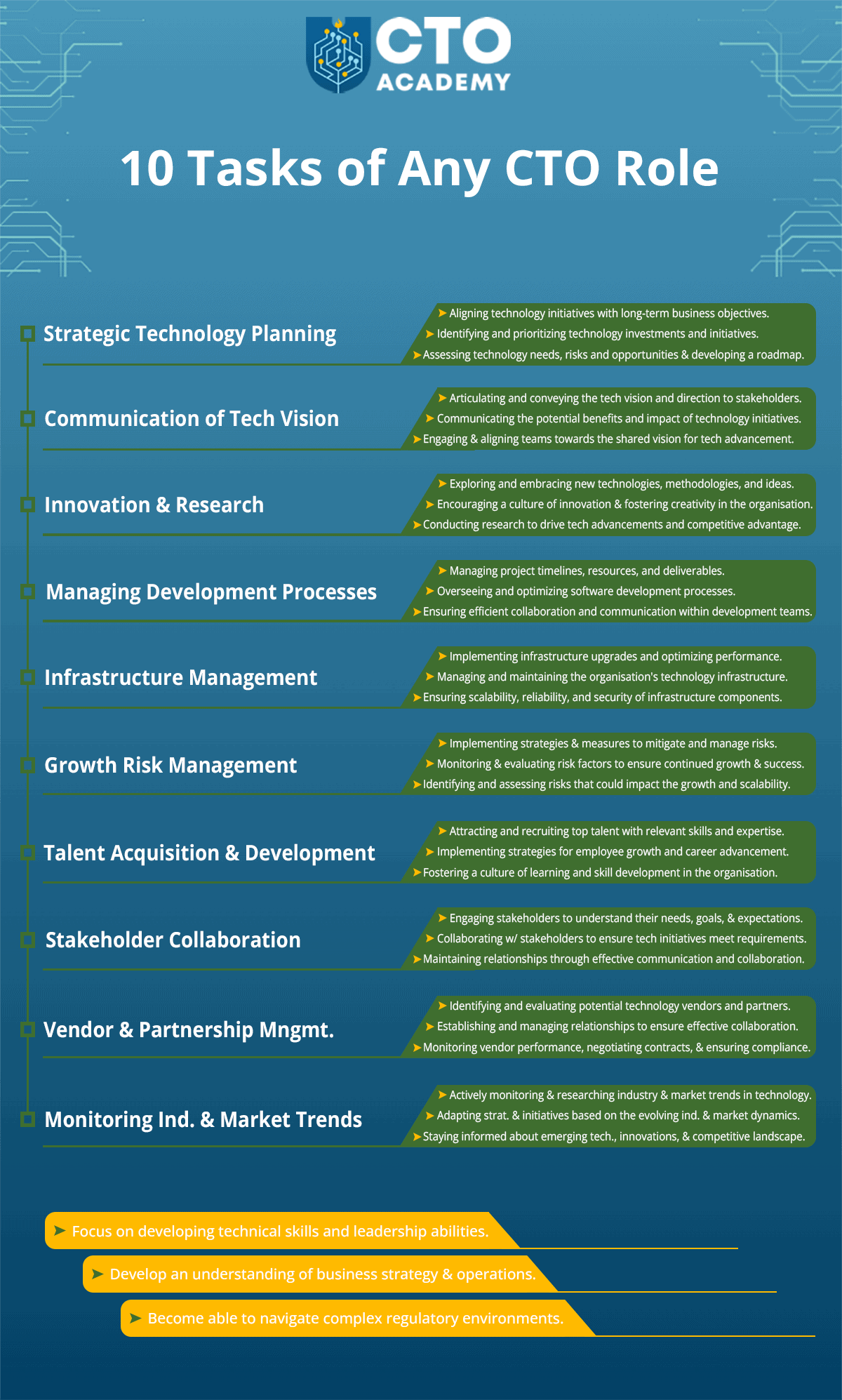
Universal CTO Job Description and Related Responsibilities
Strategic technology planning
Aligning technology initiatives with long-term business objectives.
Identifying and prioritising technology investments and initiatives that support the organisation’s strategic goals.
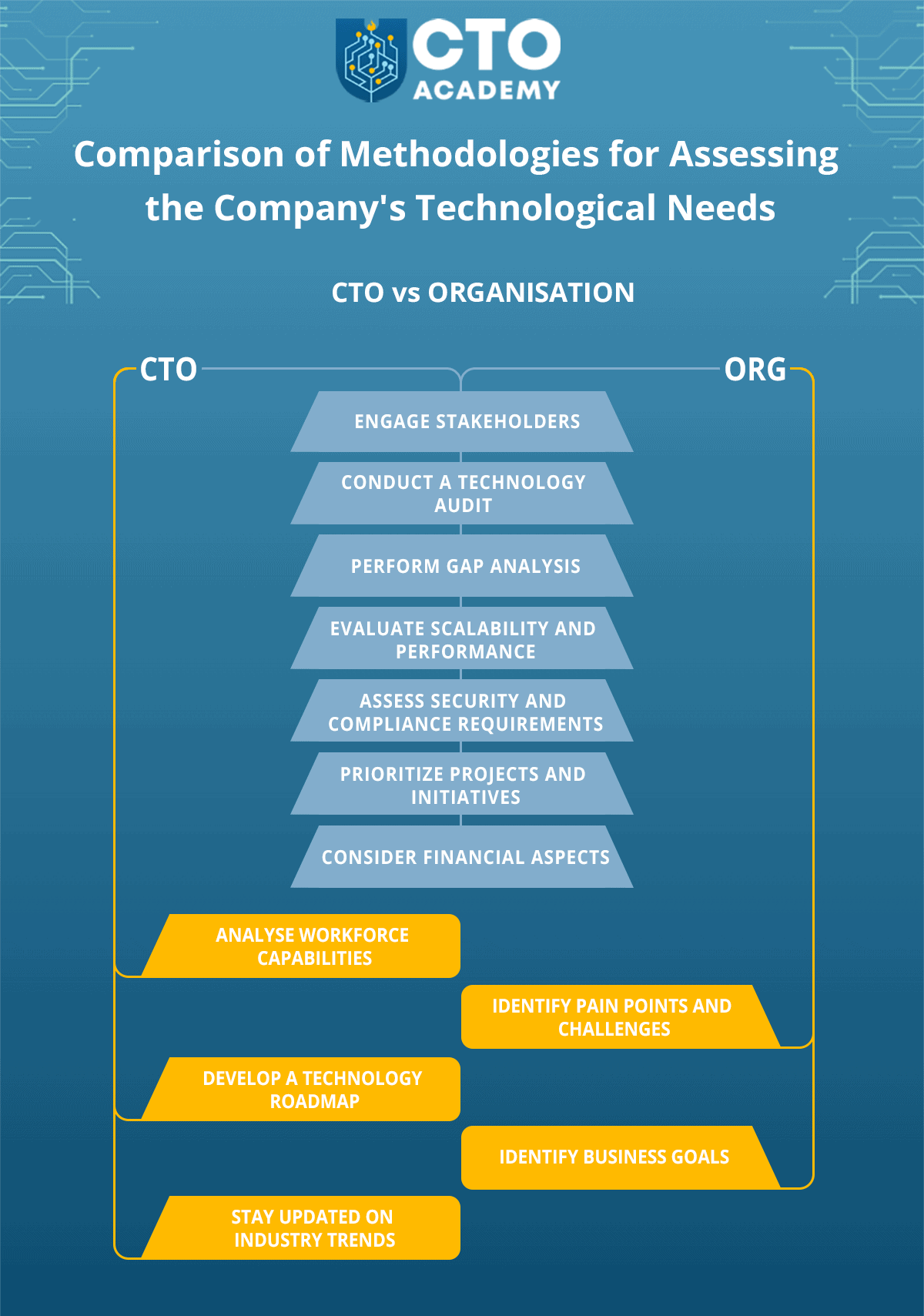
Assessing current and future technology needs, evaluating risks and opportunities and developing a roadmap for implementing technology solutions.
Communication of tech vision
Articulating and conveying the technological vision and direction to stakeholders.
Communicating the potential benefits and impact of technology initiatives.
Engaging and aligning teams towards the shared vision for technology advancement.
Innovation and research
Exploring new technologies, methodologies and ideas.
Conducting research to drive technological advancements and competitive advantage.
Encouraging a culture of innovation and creativity.
Managing development processes
Overseeing and optimising software development processes.
Managing project timelines, resources and deliverables.
Ensuring efficient collaboration and communication within development teams.
Infrastructure management
Managing and maintaining the organisation’s technology infrastructure.
Ensuring scalability, reliability and security of infrastructure components.
Implementing infrastructure upgrades and optimising performance.
Growth risk management
Identifying and assessing risks that could impact the growth and scalability of the business.
Developing strategies and implementing measures to mitigate and manage those risks.
Monitoring and evaluating risk factors regularly to ensure continued growth and success.
Talent acquisition and development
Attracting and recruiting top talent with relevant skills and expertise.
Developing and implementing strategies for employee growth and career advancement.
Fostering a culture of continuous learning and skill development.
Stakeholder collaboration
Engaging with key stakeholders to understand their needs, goals and expectations.
Collaborating and aligning with stakeholders to ensure technology initiatives meet their requirements.
Building and maintaining strong relationships with stakeholders through effective communication and collaboration.
Vendor and partnership management
Identifying and evaluating potential vendors and partners for technology-related products or services.
Establishing and managing relationships with vendors and partners to ensure effective collaboration.
Monitoring vendor performance, negotiating contracts and ensuring compliance with agreed-upon terms and deliverables.
Monitoring industry and market trends
Staying informed about emerging technologies, innovations and competitive landscape.
Adapting strategies and initiatives based on the evolving industry and market dynamics.
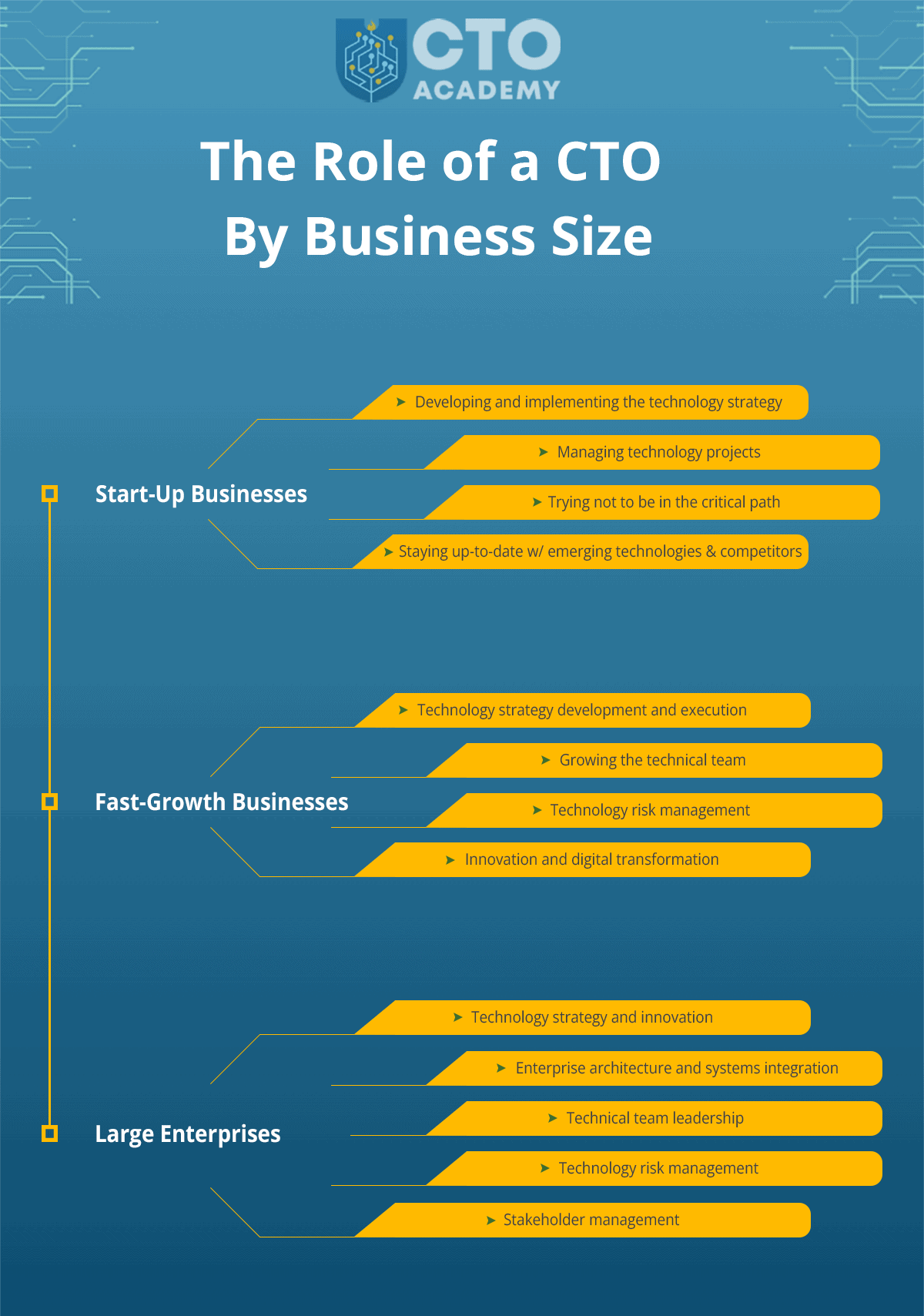
When we consider stages of development, we can then see some distinct differences in daily duties and responsibilities between a startup CTO and, for instance, technology leaders in fast-growth companies.
The Chief Technology Officer in start-up companies typically focuses on the early-stage strategic and technical aspects of technology. Their role involves overseeing the development and implementation of technology solutions aligned with the company’s goals.
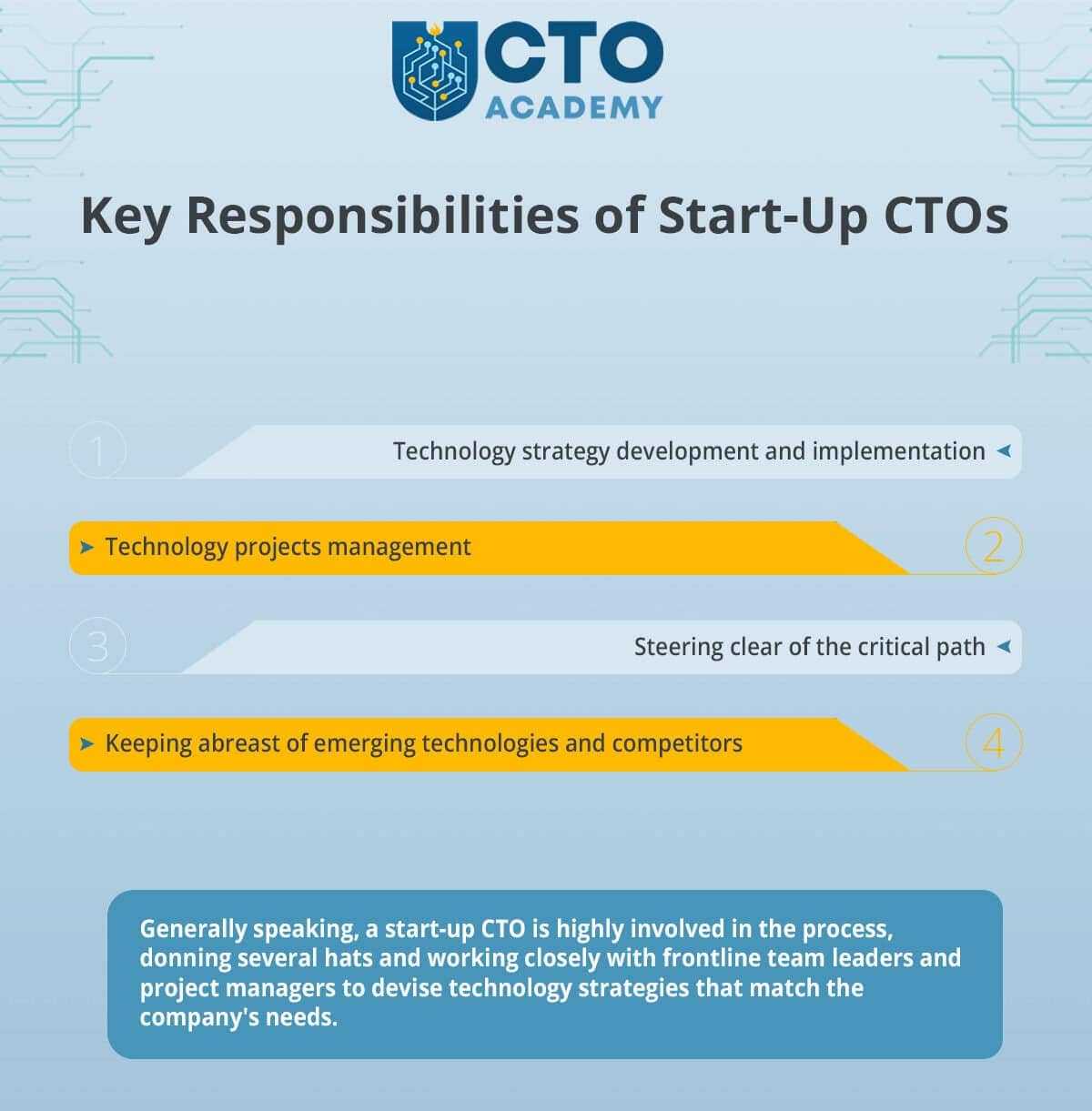
It’s worth mentioning that the responsibilities of a Chief Technology Officer in a start-up may vary based on its scale, configuration and field. Nevertheless, generally speaking, a CTO is highly involved in the process, donning several hats and working closely with frontline team leaders and project managers to devise technology strategies that match the company’s needs.
Key Responsibilities in Start-Ups
Technology strategy development and implementation
This means that CTOs must have a thorough understanding of the company’s current and future technology needs to create and implement a technology roadmap that aligns with the business strategy.
Technology projects management
The Chief Technology Officer manages the technology team to guarantee timely, budget-friendly and quality project delivery.
Steering clear of the critical path
Start-up CTOs often remain involved in development. They must avoid being in the critical path to have time for other responsibilities.
Keeping abreast of emerging technologies and competitors
Start-ups in competitive markets require CTOs to stay updated on emerging technologies and their potential impact.
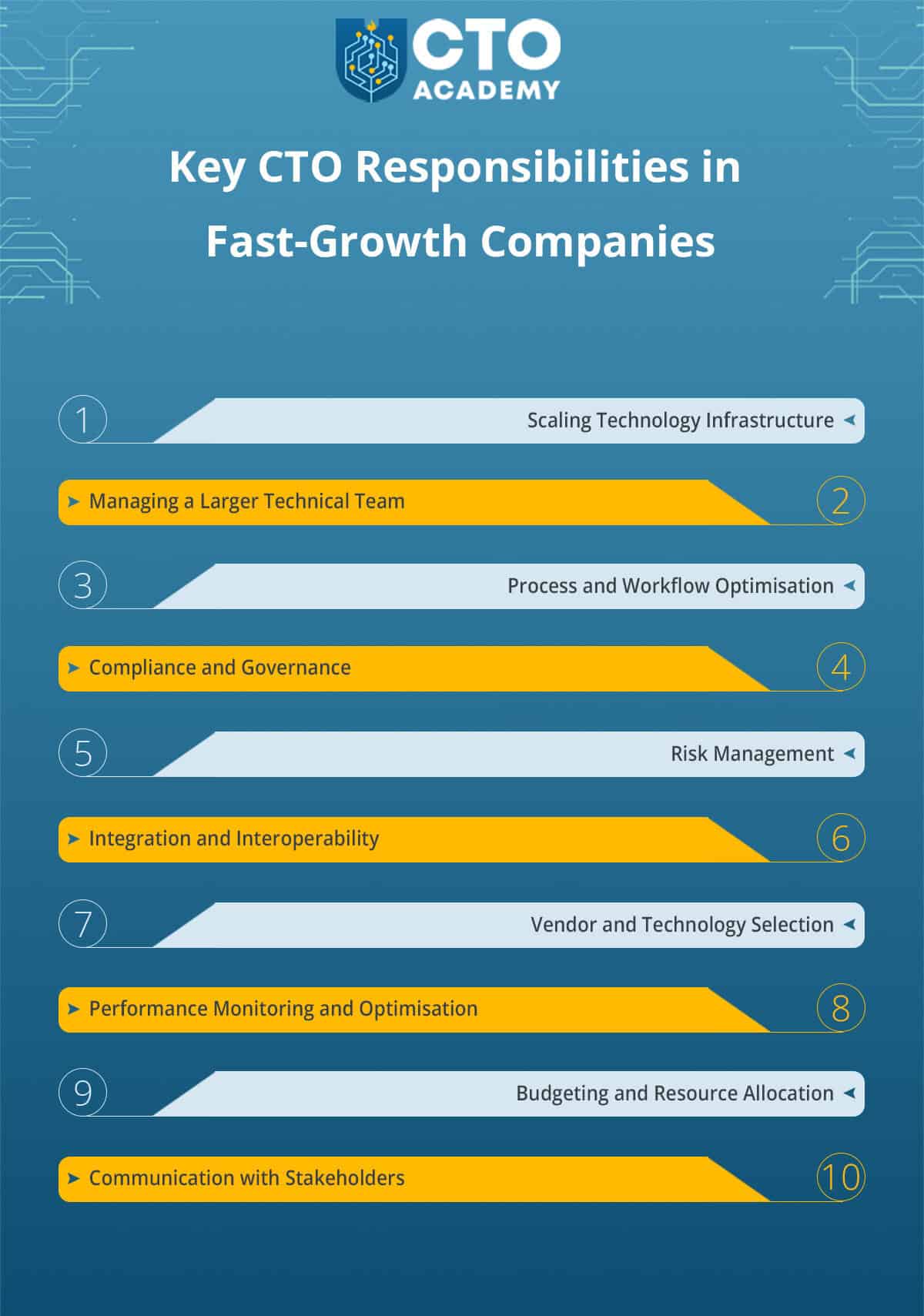
CTO Role in Fast-Growth Businesses
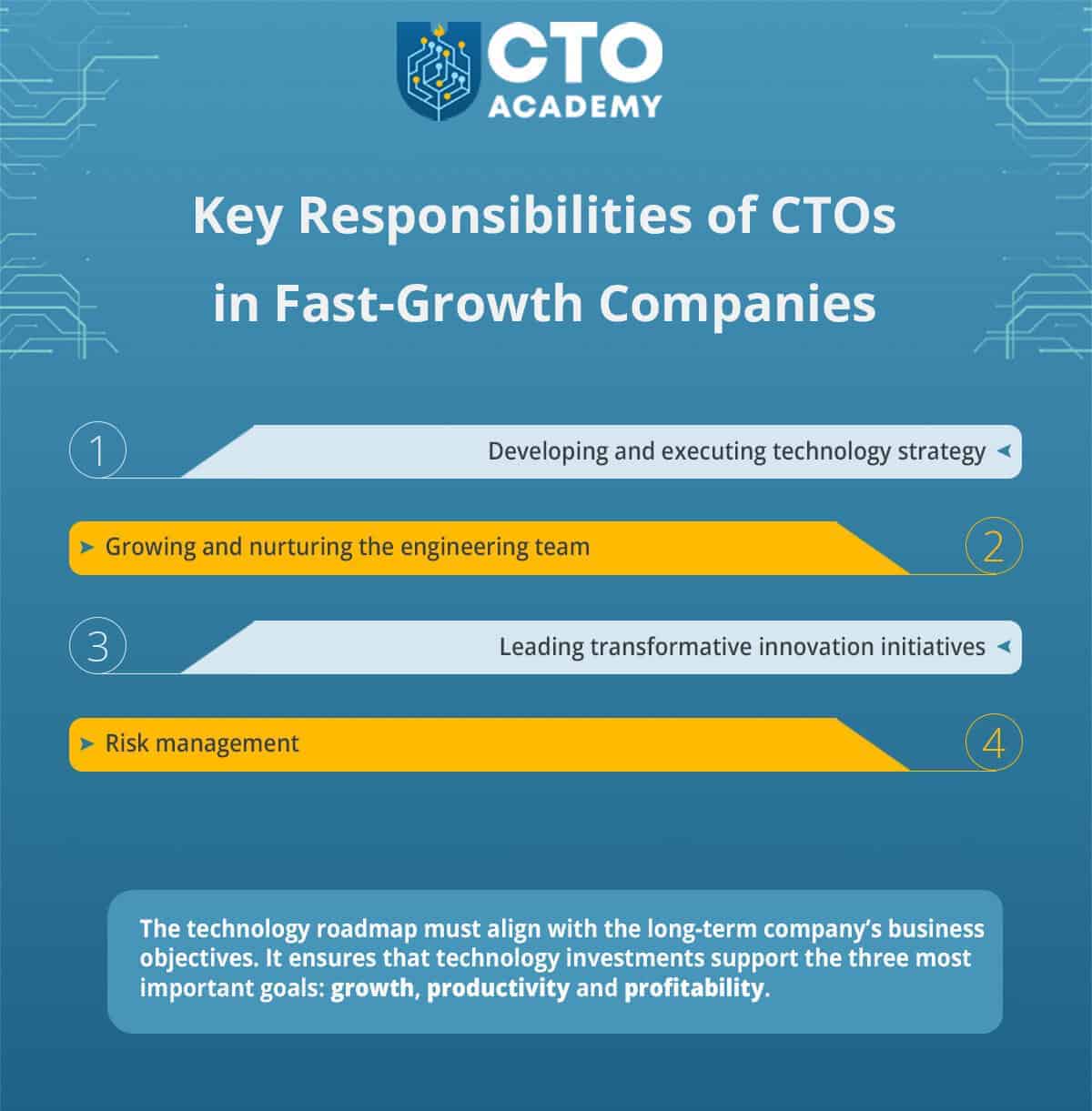
click to enlarge/download
The job description expands and now includes a combination of operational and strategic elements. Job requirements become more complex as the needs and challenges of the organisation constantly evolve.
Technology leadership in fast-growth businesses involves, among other things:
Developing and executing the (expanded) technology roadmap
Managing the technology development and growing infrastructure
Overseeing software development (with less of a hands-on approach)
Fostering innovation
Collaborating with other business units to ensure technology solutions meet the company’s needs.
Key Responsibilities
Developing and executing technology strategy
This technology roadmap must align with the long-term company’s business objectives. It ensures that technology investments support the three most important goals: growth, productivity and profitability.
While this was partially on a side plate during the early start-up stage, at this point of the company’s development curve, CTOs must place particular focus on these three goals namely to avoid generating excessive technical debt. Previously, the bulk of funding went directly into product development, especially in a tech startup. The CTO’s key responsibility was to get that MVP and, ultimately, a market-fitted product out asap with little regard toward spending. Now, things are different. Profitability comes first and last. The future progress now predominantly depends on the efficacy of the engineering team. And it’s not just about the output.
Remember: productivity + profitability = growth. Make no mistake; the CEO will be on your case all the time, pushing the deadlines and asking for the impossible while, at the same time, demanding cost-effectiveness. Only a high-performance culture can deliver on those requests. (Refer to the above link to see how it’s best done.)
But that same team, no matter how productive it is, will always wait for the initiative that comes from the leader. It is basic human nature and the sole reason why we still heavily rely on effective leadership to build virtually anything.
That request rests on an advanced technical vision and requires high-level strategic thinking because the CTO is solely responsible for the development of new products, features or services. This implies the implementation of new technologies or processes after leveraging data and analytics to improve both problem-solving skills and decision-making processes.
However, none of the new technologies come without risks and it is the CTO’s job to mitigate them.
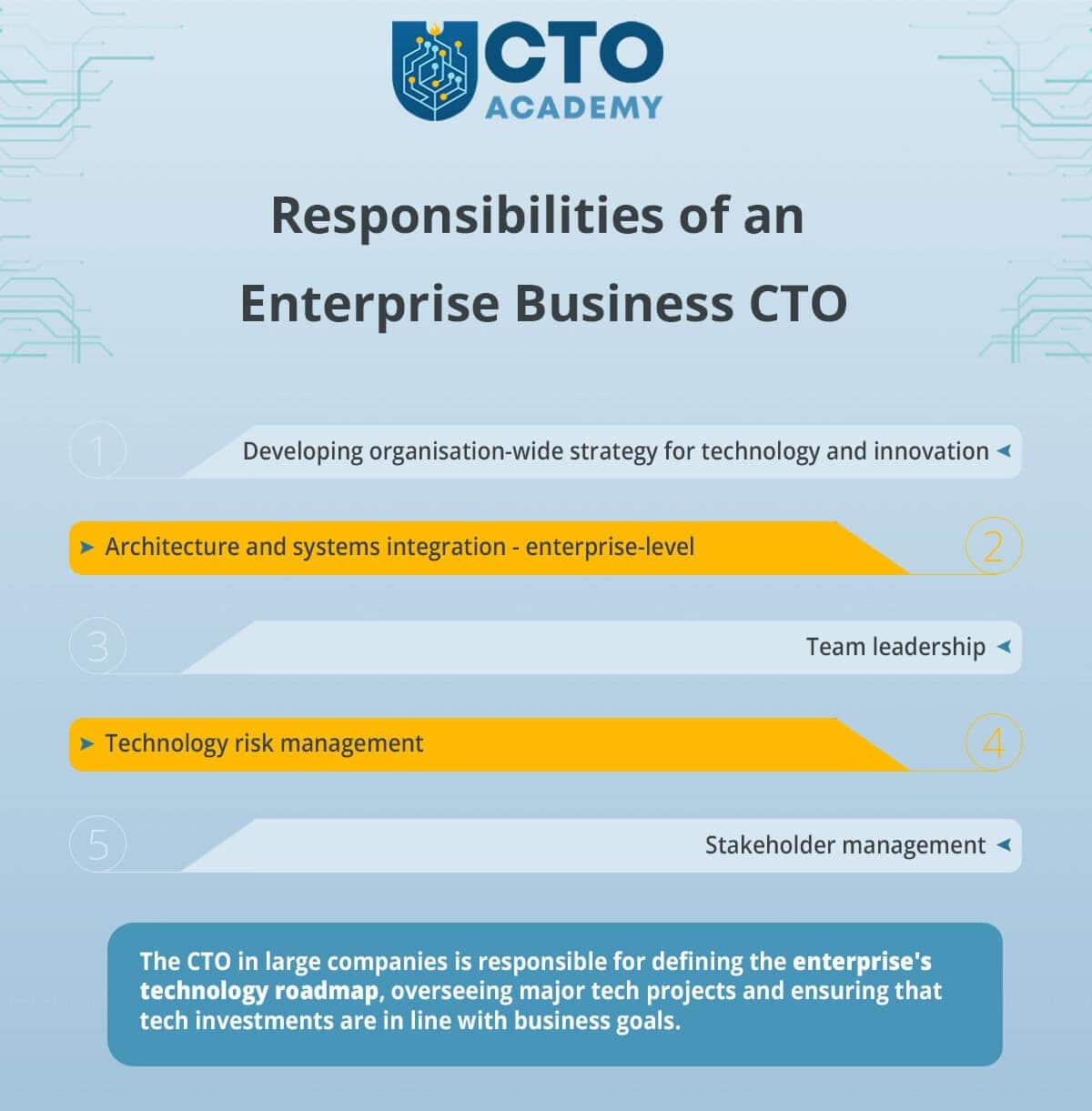
The CTO in large companies is responsible for defining the enterprise’s technology roadmap, overseeing major tech projects and ensuring that tech investments are in line with business goals. This is a multifaceted and demanding position that requires managing multiple technology teams while navigating complex business and regulatory landscapes.
Key Responsibilities of an Enterprise CTO
Developing an organisation-wide strategy for technology and innovation
As an enterprise CTO, it is important to create and execute a technology plan that supports the overall goals of the entire organisation. This involves recognising new technologies and advancements that can help the business expand and gain a competitive edge on a larger scale, which may not be feasible for smaller or rapidly growing companies.
Architecture and systems integration – enterprise-level
The CTO oversees the design and implementation of the enterprise architecture, ensuring that systems and applications are integrated and optimised for performance and scalability across the entire organisation.
Team leadership
In large enterprises, the CTO is managing and motivating multiple technology teams to deliver on strategic objectives. The primary responsibility is, therefore, to ensure that the teams have the needed resources and support. Enterprise CTOs must also develop talent management strategies to attract, develop and retain top technology talent; only in this instance, on a much greater scale.
Technology risk management
Similar to the previous two development stages, here, we are talking about cybersecurity threats, regulatory compliance, and data privacy. In this instance, however, it requires the development and implementation of robust risk management plans to mitigate potential threats and ensure business continuity.
The major difference and also a challenge is the number and size of the departments. In the start-up stage, there were most likely 2-3 departments and a single team of engineers. It was relatively easy to control activities. Once in a fast-growth stage, these numbers increased a bit, but it was still simple to manage risks and even respond to the threat almost immediately. A large company is a different kind of beast where a threat can creep in through any of the hundreds of backdoors and remain undetected. Managing 250+ employees is just not the same as managing 20 to 50.
Stakeholder management
A large enterprise CTO works closely with senior executives, business leaders of different companies and technology vendors. The job here is to ensure that technology investments support the business objectives.
Eventually, if everything goes according to the plan, the organisation will outgrow a single vertical. This is where the Group CTO comes into play.
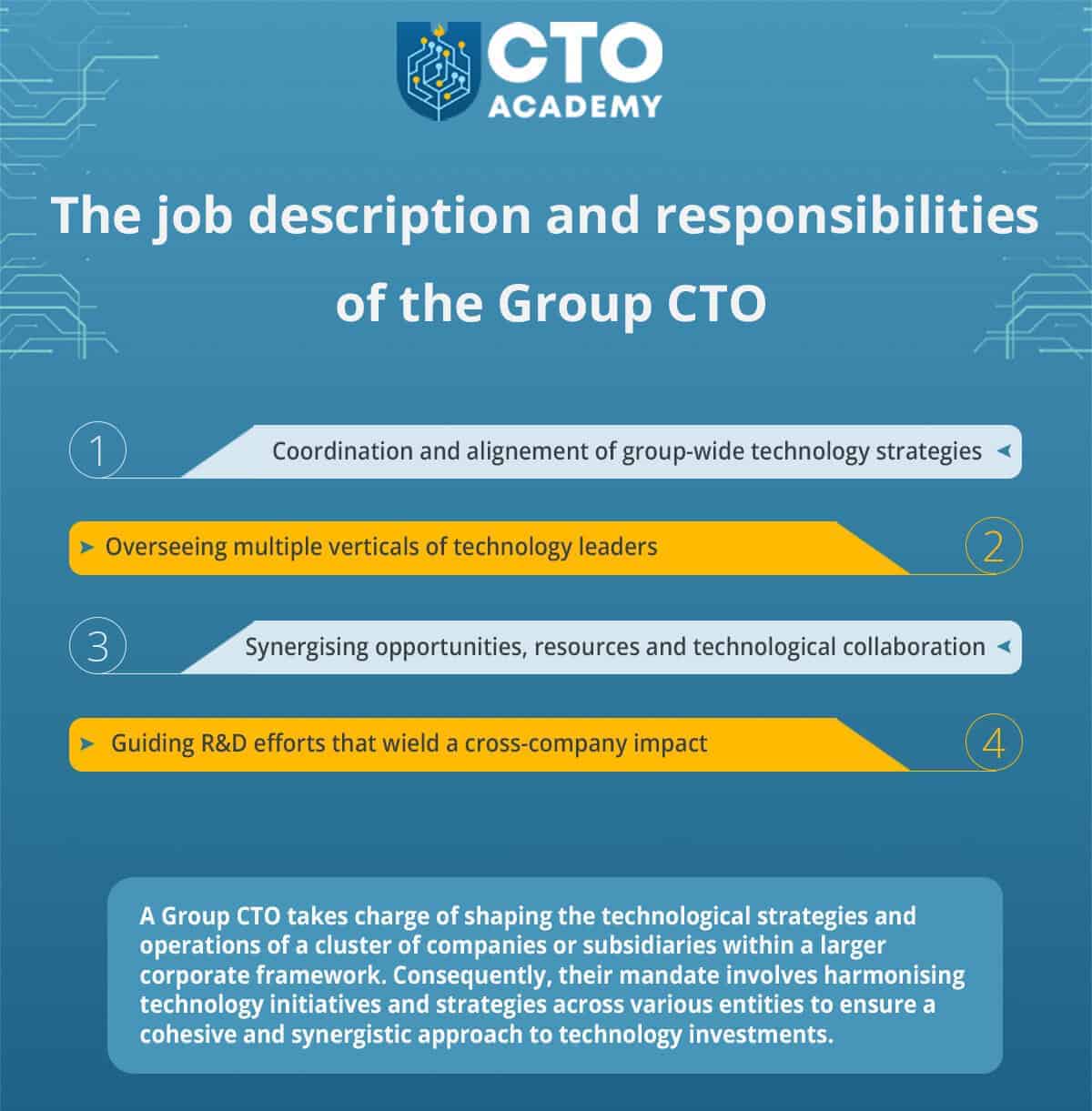
The job description and responsibilities of the Group CTO
(click to enlarge/download)
A Group Chief Technology Officer (GCTO) assumes a more extensive role, primarily focused on coordinating and aligning technology strategies across multiple companies within a corporate group. In essence, this entails overseeing numerous technology leaders, although there are discernible differences.
One of the most apparent distinctions lies in the scope of responsibilities
A Group CTO takes charge of shaping the technological strategies and operations of a cluster of companies or subsidiaries within a larger corporate framework. Consequently, their mandate involves harmonising technology initiatives and strategies across various entities to ensure a cohesive and synergistic approach to technology investments.
In practical terms, this implies that the GCTO must orchestrate technology endeavours and strategies across multiple companies. They are tasked with identifying opportunities for synergy, shared resources and technological collaboration among different business units.
This principle extends to matters of innovation and research and development (R&D). GCTOs often possess a broader perspective on technological innovation that transcends the boundaries of individual companies. In other words, they can guide R&D efforts that wield a cross-company impact.
Now that we know what responsibilities lie ahead, the real question is what exactly are the requirements for this senior executive position? More importantly, how does the hiring process work?
Required Technical and Management Skills for the Role of a CTO
In your opinion, which is more important: technical skills or soft skills?
The truth is, they are equally important and when you check the list of desired qualifications and experience requirements, you’ll understand why.
Let’s start with the usual job interview questions you can expect:
What is your experience with the industry?
What is your experience with the specific technology needs?
What is your leadership and communication style?
What are you going to do on Day 1?
TIP: Address each of these questions in your application, even if they weren’t explicitly asked.
Onboarding is usually a straightforward process that unfolds in six steps:
Clearly defined expectations, goals, key performance indicators, and deliverables will be established by the company.
Regular check-in meetings will be scheduled to monitor progress, address challenges, and provide feedback.
You will have access to essential resources, tools and information, including relevant data and company policies, as a default provision.
It is expected that you align with the company’s values and culture to contribute to a shared sense of purpose and vision.
To gain an understanding of the company’s unique perspective, introduce yourself to the broader context. Review its history and get a good grasp of its goals and values.
These figures, however, are relative and subject to constant change. They predominantly depend on the a) industry/sector, and b) the size and the development stage of the company.
How To Obtain the Necessary Knowledge and Qualifications For the Job?
Becoming a CTO is a multifaceted approach since this role demands a deep understanding of technology trends, strong business acumen and distinctive leadership skills.
Besides a strong educational foundation in computer science, engineering or a related field, gaining hands-on experience in various technical roles is crucial. It’s what gives you the practical knowledge needed to navigate complex technological challenges.
CTOs must also cultivate soft skills, such as communication, strategic thinking and team management. They are, after all, responsible for aligning technology initiatives with organisational goals and leading diverse teams of professionals.
Ultimately, the journey to becoming a CTO involves a combination of education, real-world experience and ongoing self-improvement. It’s a role that demands not only technical expertise but also the ability to innovate, adapt and drive technological excellence.
Academy’s Digital MBA for Technology Leaders presents a certain fast lane to that goal simply because we first built the course our members requested and only then formed the faculty it needed.
It is designed as a blended online learning experience that combines 220 high-impact micro lectures spread across 9 modules, monthly live sessions and, even more importantly, support from the global community of technology leaders.
Once you graduate, your technical capabilities will perfectly align with your newly obtained leadership skills and strong business acumen.
Since its launch in 2022, over 350 existing and future technology leaders from 45 countries joined the course. This is their experience with it.
Alternatively, you might consider opting in for our Membership Program and gain immediate access to:
In this post, Jason Noble, Academy’s Chief Technology Officer, explains the design of highly relevant CTO KPIs and shows you how to a) track them and, more importantly, b) use them to improve performance.
Now, the odds are that you’re either a CTO in a start-up or fast-growing company or soon to become one. That implies a more hands-on approach. So the key performance metrics such as CSAT, Churn rate, CLTV, and similar are, perhaps, not exactly your primary interest. We will, however, briefly explain some of those also.
But first, let’s focus on your primary issue at this point and that is getting those KPIs that are most relevant to your organisation at its current stage of development.
Key CTO KPIs in Start-Ups and Fast-Growth Companies
Productivity is best measured if we frame the metrics inside the Cost-Quality-Time Triangle. Any change in the development process will have an impact on one of these factors.
But first, word of caution. If you apply KPIs to the technology team’s output, you must understand their potential impact. You can easily affect morale and, consequently, decrease productivity.
That said, you should use these metrics as tools for growth and learning only. They are not meant to serve any kind of repressive purpose (eg, trying to get more done with fewer people).
As a rule of thumb, KPIs for technology teams will revolve around one of the three corners of the triangle. Hence, by focusing on one segment, you use the metric to focus on and improve that specific area. As a result, you are not overstressing remaining factors while allowing the team to improve rather than destabilise outputs.
1. TIME
1.1 Story issues/questions reduction
What you, ultimately, want to see is a decreasing number of issues and/or questions during the sprint. Raised issues affect the speed and might indicate that you need to redefine the story.
1.2 Bug-fixing/development time ratio
FORMULA: The percentage of time spent on bug fixing versus development time.
This KPI allows the CTO to monitor the ratio and prevent a negative impact on output. For instance, when engineers are too focused on the output speed, they might neglect basic principles and rush the code test, falsely believing that it helps ship the code much faster.
1.3 Story cycle time
It is, basically, the time it takes to close a story once you open it.
If you find this metric rising, it could be either due to blockers that arise during the sprint or because there are too many open stories. The simplest fix is to apply the work-in-progress limit. This speeds up the cycle time of individual stories and, therefore, improves the overall workflow.
1.4 The average time of the story’s blocked status
If you suspect this to be longer than optimal, check for possible communication breakdown and/or improve the story.
Development teams will not worry about the time taken to build or deploy code as this happens automatically. This is true but as a leader, you need to consider if your engineers idle for too long due to over-complicated deployments into an environment.
So do try to assess how much of their productive day is being lost or wasted whilst waiting. If you find such fluctuations, look at the reasons for the slowdowns and see how they can be improved.
2. COST
2.1 Cost per story point per week
FORMULA: Developer cost divided by the story points.
Often, the easiest way to increase the team’s velocity will be to increase the number of resources in the team developers, testers, devops etc. This will allow more work to flow, but it will inevitably incur additional costs.
As a technical leader, it is your job to balance the team output versus the cost and this KPI will give you a benchmark so you can recognise the tipping point.
2.2 The percentage of non-used features
FORMULA: Percentage of features used in production x Number of days after release.
By tracking this metric, you will learn how to improve your prioritisation process.
The logic behind it is simple: the fewer deployed but not used features mean that the overall cost of product development goes down.
2.3 Throughput per sprint
In other words, how much work is actually being done? Naturally, you want to monitor this specific metric over time.
2.4 Average compile time
Time spent on compiling is, essentially, a wasted engineering time. Therefore, see how you can improve the build process either by having optimal resources or special tools. Also, ensure that you maintain a lean compile and deployment cycle.
3. QUALITY
In other words, quality engineering metrics.
3.1 Bug fixes per sprint
FORMULA: Average number of bug fixes per sprint.
To build up your quality more efficiently, you should address any code that undergoes multiple testing and bug-fixing cycles. This will not only affect your delivery speed but also the overall quality of your team’s work.
3.2 Incidents per deployment period
FORMULA: The number of incidents in live per deployment time period.
Tracking incidents, especially P1s and P2s, and being able to track them back to the deployment is a key way of creating good quality feedback loops.
3.3 Codebase coverage
If you measure the code executed via automation tests and get 100%, it may give you a false sense of confidence that your code is completely tested. There is a high probability that too much effort has been put into the testing automation for the return on investment.
You must, therefore, find the correct success measure for your business considering its current state of growth.
HINT: over 90% is generally considered as good.
Backlog Monitoring
If you see your backlog growing, you either need to hire more developers or improve the efficiency of your team. That, of course, assumes that the backlog is free of trash.
Use your CTO dashboard to visualise the backlog like in this example:
Additional CTO KPIs and Metrics
1. Customer Satisfaction (CSAT) – Measures customer satisfaction with technology products/services. This KPI is more used by enterprise or Group CTOs.
2. Churn Rate – Measures customer attrition rate over a specific period. It is commonly used in conjunction with a Net Promoter Score that measures customers’ loyalty to the company. For tech-oriented companies, these scores can indirectly show how well the market adopts the technology. Low scores, therefore, may indicate the need for change.
3. System Uptime, Load Time and Reliability – Measures the operational efficiency which is fundamental for user trust.
4. Time-to-Market – Measures the speed at which new technology products or updates are brought to market, which is critical for competitiveness and responsiveness to market demands.
5. Technical Debt – Managing technical debt is essential for long-term sustainability and maintaining development agility.
6. Scalability – Assessing the ability to handle increased load or demand is crucial for accommodating business growth and maintaining performance.
7. Release Frequency and Lead Time – Measures development and deployment efficiency, allowing for quicker responses to market needs.
8. Technology ROI (Return on Investment) – Measures the financial impact of technology investments, providing insights into cost-effectiveness.
When used correctly, all these KPIs guide strategic decisions, inform improvements and ensure that technology initiatives align with organisational goals. So be careful with any rollout to avoid affecting team morale. Instead, use metrics to help your developers improve their skills.
CTO responsibilities stem from their pivotal role in today’s rapidly evolving technological landscape. Chief Technology Officers, as the top executives, hold the reins of the organisation’s technical vision, strategy and execution.
What is the primary responsibility of the CTO?
The Chief Technology Officer leads the development and execution of the company’s technical strategy. Hence, the CTO is responsible for:
Aligning the organisation’s technological vision with its business goals.
Ensuring that the technology infrastructure, systems and processes support the company’s overall objectives.
In this article, we will specifically focus on CTO responsibilities in start-ups and fast-growth companies. These two environments impact the responsibilities by altering the scale, complexity and scope of a CTO role. For instance, a start-up CTO focuses on building the technology foundation and driving innovation to get products market fit. In a fast-growth company, on the other hand, leaders must scale and optimise the technology infrastructure to support rapid expansion and ongoing success.
Comparative overview of general responsibilities
START-UP
FAST-GROWTH COMPANY
Technology Strategy Product Development Technical Leadership Technology Stack Team Building and Management Infrastructure and Security Innovation and Research Collaboration with Other Departments Budgeting and Resource Allocation Vendor and Partner Management
Scaling Technology Infrastructure Managing a Larger Technical Team Process and Workflow Optimisation Compliance and Governance Risk Management Integration and Interoperability Vendor and Technology Selection Performance Monitoring and Optimisation Budgeting and Resource Allocation Communication with Stakeholders
In start-ups, the CTO’s responsibilities are centred on leveraging technology to drive innovation, efficiency and growth while keeping a keen eye on the company’s long-term vision and objectives.
Translated to real life, this means that a CTO in a start-up company has a more hands-on role since the team is still relatively small. At the same time, the expectations are unrealistic and budget-limited. So to get that product market fit as we mentioned earlier, a CTO is called into frequent firefighting.
These fires ignite unexpectedly in different hotspots and require a prompt and effective response. Here, we are going to list the most common challenges so you can get a better sense of the actual situation in start-ups.
Number one, scaling challenges. Often, rapid growth can strain the technology infrastructure, causing performance bottlenecks. To solve this, start-up CTOs opt for scalable architecture, leverage cloud services and implement caching and load balancing.
Then, the inevitable resource constraints. Budget limitations can hinder technology investments, affecting development speed. To effectively fight this common fire, you should:
Prioritise essential features
Consider open-source tools
Optimise resource usage for cost-effectiveness
However, these measures often have limited impact because rapid scaling and accompanying constraints can easily cause technical debt accumulation.
You see, time constraints can lead to shortcuts. As we all know, shortcuts are notorious for their ability to accumulate technical debt. That’s why you need to: plan for regular refactoring, automate testing and allocate time for code quality maintenance.
On top of this, the constant pressure to get the MVP out asap. has one additional serious consequence – product quality issues. It happens because quick iterations lead to bugs and unstable releases. You can fight this fire (to some extent) by implementing robust testing practices, adopting continuous integration and establishing a rigorous QA process. But if you are managing a small team, all these countermeasures will have a limited effect. It is almost an unsolvable problem and the main reason why start-up CTOs must have a literal hands-on approach.
Another problem with rapid development is security vulnerabilities. It is increasingly easy to overlook security measures and unwittingly expose the product to risks. That’s why it is imperative to integrate security practices from the start, conduct regular audits and prioritise user data protection.
And then, all of a sudden, the market can shift, causing an immediate change of priorities. To pivot when necessary, you must stay flexible (ie, embrace Agile) and maintain open communication.
All this time, the CTO must stay on top of technical support and maintenance. Unfortunately, this can divert focus from product development.
There are three measures that you can implement to prevent this diversion. One is to establish efficient support channels. A second is to use monitoring tools to identify issues early on. Both, however, demand the allocation of dedicated resources for maintenance. Do you see the problem? If the team is small, who is going to be responsible? The logical solution is the third measure, outsourcing. But can your start-up afford $100/h professional support times five or even 10?
To, at least, minimise these outbreaks, the CTO must:
Timely define the technological vision.
Lead and manage an engineering team efficiently.
Organise the right technology stack and create an optimal architecture.
Foster innovation.
Oversee product development with hawk eyes.
1.1 Defining the Technological Vision (the process)
(click to enlarge/download)
Commonly, it is a four-stage process that develops in 10 consecutive steps. The process ensures the perfect alignment of the vision and business objectives.
Stage 1 – Intel gathering
Step 1
The CTO starts by overviewing the company’s short-term and long-term business objectives, growth targets and market positioning to align the technological vision with the overall strategy.
Step 2
To do so, the CTO engages with the executive team, product managers and other stakeholders to gather insights, understand pain points and identify technology gaps.
Step 3
The final step at this stage is to evaluate the existing technology infrastructure, systems and processes to identify strengths, weaknesses and areas for improvement. This assessment helps in setting the baseline for the technological vision.
Stage 2 – Roadmapping
Step 4
From evaluation, a Chief Technology Officer moves to identify opportunities and challenges by analysing market trends, emerging technologies and industry disruptors.
Step 5
Based on the gathered insights, the CTO outlines the key technological pillars that will drive the company’s growth. These pillars could include scalability, security, user experience, data analytics or other business-relevant factors.
Step 6
Now comes a detailed roadmap outlining the steps and milestones required to achieve the technological vision. Here, it is necessary to prioritise initiatives based on impact and feasibility while considering resource constraints and timeframes. It is a start-up after all which means that time is short and money is still pretty much scarce.
Stage 3 – Execution
Step 7
What a CTO needs to effectively execute the vision is to foster a culture of innovation within the engineering team and the broader organisation. The only way to do so effectively is to encourage experimentation and risk-taking while promoting continuous learning to stay ahead in this dynamic market.
Step 8
To be perfectly sure that the vision aligns with the goals, the CTO must effectively communicate the technological vision to all stakeholders. This is the reason why highly efficient CTOs always encourage feedback and input from team members. It allows them to refine the vision further.
Stage 4 – Reviews and measurements
Step 9
As the software teams move to development, it is the start-up CTO responsibility to regularly review progress and adjust the technological vision as needed. They must consider market changes, customer feedback and internal developments while, at the same time, remaining agile and adaptable to seize new opportunities.
Step 10
Finally, as CTOs in start-ups, we must measure success. That means, a) defining key performance indicators (KPIs) that align with the technological vision, and b) tracking progress against these metrics. What we want to ultimately achieve is to measure the impact of technology initiatives on the company’s growth and success.
This is how a start-up Chief Technology Officer can establish a clear technological vision that serves as a roadmap for the company’s future success. The alignment of technology with business goals ensures that every technical decision contributes to the overall mission and drives the company toward sustainable growth and innovation.
But for any of that to happen, the CTO must place special emphasis on the team building initiatives.
In a start-up environment, providing technical leadership to the engineering team sets the direction for technology development, fosters a culture of innovation and ensures the efficient execution of projects.
The expert CTO’s guidance empowers the team to:
Make informed decisions.
Maintain product quality.
Adapt swiftly to evolving challenges.
(click to enlarge/download)
The key phrase here is soft skills — encapsulating several critical responsibilities in building and managing a skilled and motivated technical team in a start-up company:
1. Talent Acquisition – identifying skill gaps, conducting interviews and ensuring the right people are brought on board.
2. Team Development – providing mentorship and guidance to nurture the team’s professional growth while encouraging continuous learning and skill development to foster a high-performing and adaptable team.
3. Goal Setting – collaborating with team members to set clear goals and expectations while ensuring that each team member understands their role in achieving the company’s technological vision.
4. Collaboration and Communication – promoting a collaborative work environment where ideas and knowledge are shared freely while ensuring that the team is aligned with business objectives and works cohesively through effective communication.
5. Performance Management – establishing performance metrics and conducting regular evaluations (identification of strengths and areas for improvement) while providing constructive feedback.
6. Empowerment and Autonomy – trusting the team members to take ownership of but also accountability for their projects and decisions (combined, it leads to improved motivation!).
7. Conflict Resolution – addressing conflicts and challenges within the team promptly and constructively to facilitate a healthy work environment and, thus, maintain productivity and morale.
8. Diversity and Inclusion – ensuring diversity and inclusion within the team to foster creativity, innovation and different perspectives (a diverse workforce contributes to a well-rounded and adaptable team).
9. Retention and Recognition – implementing strategies to retain top talent by recognising achievements and contributions
When team members feel valued and appreciated, it is easier to build an engaging workplace.
10. Succession Planning – identifying potential leaders and developing a succession plan to ensure the team’s long-term stability and growth.
These 10 responsibilities are a template for building cohesive, skilled and motivated technical teams that drive innovation and meet technical challenges regardless of the company’s size.
Everything that is and everything that will be relies solely on the effectiveness of the engineering team. You can have the best technology stack and architecture, but without the team, it’s like having a chassis without the engine.
1.3 Technology Stack and Architecture:
Selecting the right technology stack and architecture forms the foundation upon which the entire technical infrastructure is built. The choices a CTO makes can greatly influence the start-up’s scalability, performance, development speed and cost-effectiveness.
These selections can affect how well the product adjusts to evolving market needs and advancements in technology. A strategic choice, therefore, enables seamless integration of components and efficient maintenance, ensuring that the start-up is positioned for growth and innovation while minimising technical roadblocks.
So before making technology decisions for a tech start-up, CTOs should consider the following factors:
1. Scalability
Consider how well the chosen technology can handle increased user demand and data volume as the start-up grows.
Evaluate whether the technology stack and architecture can be easily scaled horizontally or vertically to accommodate future expansion.
2. Development Speed
Assess how quickly the technology stack allows developers to build, iterate and deploy new features or products.
Choose technologies with robust libraries, frameworks and tools that accelerate development without sacrificing quality.
3. Cost
Calculate the overall cost of implementing and maintaining the technology stack, including licensing fees, infrastructure costs and development efforts.
Strive to balance cost-effectiveness with the long-term benefits the chosen technologies offer.
Many cloud providers subsidise costs for the first year or two but once finished, costs can be significant.
4. Compatibility and Integration
Ensure that the technology stack can seamlessly integrate with existing systems and third-party services.
Evaluate how well the chosen technologies can communicate and share data with other components of the ecosystem.
5. Performance
Test the performance of the technology stack under different conditions, including peak load scenarios.
Choose technologies that deliver optimal speed and responsiveness to provide an excellent user experience.
6. Flexibility and Adaptability
Consider how easily the chosen technologies can adapt to changing requirements, market trends and technological advancements.
Prioritise solutions that allow for flexibility and future-proofing the start-up’s technical infrastructure.
7. Community and Support
Evaluate the size and activity of the technology’s developer community. A strong community often translates to better support, updates and resources.
Consider the availability of documentation, tutorials and online forums for troubleshooting and learning.
8. Security
Examine the security features and best practices provided by the technology stack to protect user data and sensitive information.
Address potential vulnerabilities and ensure compliance with industry security standards.
9. Talent Pool
Assess the availability of skilled developers and engineers experienced in the chosen technology stack and assist with the hiring process. Keep in mind that a technology stack with a larger talent pool can make recruitment and team-building much easier.
10. Longevity
Consider the technology’s track record and how well it has been adopted in the industry.
Avoid adopting technologies that may become obsolete quickly or lack long-term community support.
By carefully evaluating each aspect, the start-up CTO can choose a technology stack that aligns with the goals and supports the company’s growth trajectory and market position. The choices will also have a profound impact on the development process and innovation.
The collaboration between the CTO, product managers and engineering team is crucial for driving innovation in a start-up’s products. It is an intricate process that relies on careful planning on one hand and experimentation on the other.
It starts with ideation and conceptualisation. The product managers and CTOs collaborate to brainstorm ideas and concepts for new features or products. The CTO is here to bring technical insights to the discussions, helping to assess the feasibility and technical implications of different ideas.
Product managers then gather input from customers, market trends and stakeholders to prioritise features and enhancements. The CTO provides technical input on the feasibility, complexity and potential impact of different prioritisation options.
Once the priorities are set, the CTO and engineering team work together to create technical roadmaps that outline the implementation plan for new features or products. These roadmaps incorporate considerations such as architecture design, technology choices and development timelines.
The development team now dives deep into Agile. Guided by the technical roadmap, they iterate on building and refining the product. Frequent collaboration between the CTO, product managers and developers during sprint planning, reviews and retrospectives ensures alignment and rapid progress.
But it doesn’t come without problems.
When challenges or technical hurdles arise during development, the CTO must closely collaborate with the engineering team on problem-solving to find creative solutions. They work together to ensure that technical limitations don’t compromise the product’s overall vision and user experience.
To make these problem-solving sessions more effective, the CTO may initiate innovation workshops where cross-functional teams brainstorm and prototype innovative solutions. Engineers contribute their technical expertise, while product managers provide insights into user needs and market trends.
At this point, we have our MVP.
Product managers now gather user feedback on existing features or prototypes, which is then shared with the CTO and development team. This feedback loop guides refinements and improvements, ensuring the final product aligns with user expectations.
Once the product is launched, the CTO collaborates with product managers to monitor performance and user engagement metrics. Together, they analyse data to identify areas for optimisation and enhancement, driving iterative improvement.
The success of these implementations (improvements) is fueled by the continuous learning practice. The CTO provides developers with opportunities to experiment with new technologies and techniques. It is this learning through trial and error that ultimately contributes to ongoing innovation and the ability to adapt to evolving market demands.
As you can see, the CTO, product managers and engineering teams collectively contribute their expertise to create innovative, user-centric products that meet market demands and position the start-up for growth and success.
How a start-up chief technology officer fosters such a culture
The CTO sets the tone by demonstrating a commitment to learning, experimentation and embracing new technologies. In other words, they lead by example so that their actions can inspire the team to adopt a similar iterative mindset.
At the same time, leaders must create a supportive environment that encourages open and transparent communication. Team members should feel comfortable sharing ideas, suggestions and even failures without fear of criticism. With established feedback loops where team members provide honest input on experiments and improvements, the environment creates a sense of collective refinement.
Without such an environment, organising innovation workshops and hackathons is futile. The dysfunctional team cannot effectively brainstorm, prototype and experiment with new concepts.
Encouraging a “fail fast, learn fast” mentality promotes quick experimentation and learning from failures rather than dwelling on them.
Assuming that we managed to create such an environment, we need to allow engineers to dedicate a portion of their work time to exploring new technologies, tools or approaches. This, in turn, fosters a sense of ownership and curiosity. Combined with the metrics and data-driven decision-making, the process helps team members objectively assess the outcomes of their experiments and improvements.
But curiosity without learning has its limits. That’s why providing resources for continuous learning, such as training, courses and conferences is critical. The CTO role here is to empower the team to stay up-to-date with industry trends and advancements.
At the same time, the technology leader should foster collaboration across different teams and departments to encourage the exchange of ideas and perspectives. Subsequently, this leads to innovative and, more importantly, effective solutions.
And such solutions must be recognised and celebrated. We are talking about both small and big wins that come as a result of experimentation. Such practice reinforces the value of continuous improvement and encourages others to join the effort.
This culture of continuous improvement and experimentation ensures that the company remains agile, adaptable and innovative and, thus, at the forefront of technological advancements and market trends.
2. Key CTO Responsibilities in Fast-Growth Businesses
(click to enlarge/download)
A fast-growing business is a different kind of beast. A good example is the trading platform Robinhood.
Founded in 2013, Robinhood disrupted the traditional brokerage industry by offering commission-free trading through a mobile app. The platform’s simplicity and accessibility attracted a younger audience and democratised access to financial markets. But then it began to grow. Fast.
By 2021, the crypto engineering team quadrupled and the plan was to double the size of the group in the next year to improve the trade flow systems. So Robinhood’s board appointed a new CTO to oversee this process.
Before this appointment, the technology leadership was in the hands of the founders. But at some point, it became clear that they could no longer handle the growing responsibility.
Because as the business is scaling, so does the technology infrastructure.
2.1 Scaling Technology Infrastructure
Scaling the infrastructure to accommodate rapid growth presents several formidable challenges.
User demand surge, for instance, can cause performance bottlenecks, affecting application speed and responsiveness, and potentially leading to a poor user experience. Experienced CTOs solve performance bottlenecks by:
Identifying specific areas of code causing bottlenecks through performance profiling tools.
Refining database queries to minimise unnecessary or slow operations.
Implementing caching mechanisms to store frequently accessed data and reduce database load.
Scaling by adding more servers to distribute the workload and improve response times (horizontal scaling).
When a company scales, it is commonly transitioning from a “slap it together” architecture to a distributed, scalable one. This process requires careful planning to ensure seamless communication and data synchronisation. Some of the proven ways to address scalability architecture are:
Breaking down applications into smaller, independent microservices for easier scaling and maintenance (not the most favourable option for some CTOs though).
Using container technologies like Docker for consistent deployment across various environments.
Implementing load balancers to distribute traffic evenly among multiple servers or instances.
Leveraging cloud services to automatically adjust resources based on traffic patterns to handle varying loads.
As our environment grows, so do datasets. It’s the CTO’s job to ensure efficient data storage, retrieval and management strategies to maintain performance and prevent data loss. The three most common ways to tackle this problem are:
Partitioning or dividing large datasets into smaller partitions for faster retrieval and improved performance.
Archiving; ie, moving older or less frequently accessed data to archival storage to optimise the database’s performance.
Compression, to reduce storage space and improve data retrieval speed.
Rapid growth also dictates demand fluctuation. So allocating resources effectively across various components becomes a daily struggle. This is where operational management skills come into play because it is a Chief Technology Officer’s responsibility to solve this problem either by implementing monitoring tools and using automation or, at the very least, historical data and predictive analysis to forecast the needs and allocate accordingly.
All of this can lead to shortcuts or inefficient solutions that accumulate technical debt. It is in every technology leader’s job description to prevent this from happening or at least keep it on acceptable levels. To do so, seasoned CTOs employ an array of methods such as:
Enforcing regular code reviews to identify and address inefficient or non-scalable code.
Allocating time for planned refactoring to improve code quality and eliminate accumulated debt.
Documenting code, architecture and decisions to make future enhancements and maintenance easier.
Implementing automated testing to catch issues early, thus reducing the risk of introducing more debt.
Prioritising small, incremental improvements to avoid overwhelming the development team.
Evaluating the impact of addressing debt versus business priorities to make informed decisions.
Other notable challenges
Availability and Reliability
Solutions:
Implementing redundancy across servers, databases and critical components to ensure failover capabilities.
Designing applications as distributed systems to mitigate single points of failure.
Setting up robust monitoring systems with alerts to detect and respond to downtime or performance issues.
Developing comprehensive disaster recovery plans to restore systems quickly in case of failures.
Security Concerns
You can address them with:
Regular audits to identify vulnerabilities and weaknesses in the system.
Security protocols (encryption, access controls, etc) to protect sensitive data.
Employee training to educate the team about security best practices and potential threats.
Cost Management
Actions:
Continuously monitoring and optimising cloud resources to eliminate unnecessary expenses.
Adjusting resource allocations to match actual usage patterns, hence avoiding over-provisioning.
Implementing tools to track and analyse costs, thus ensuring transparency and informed decision-making.
Negotiating with technology vendors for better pricing and more favourable contract terms.
Complexity
Proven actions to address the inevitable growing complexity of operations are:
Designing systems with clear module boundaries to improve maintainability.
Creating comprehensive documentation to help teams understand system components and interactions.
Enforcing coding standards and best practices to ensure consistency and ease of understanding.
This is what you can do as part of an overall effort to implement such a shift:
Articulate a clear vision of the company’s growth trajectory and the role of technology in achieving it.
Ensure alignment among C-suite executives and leadership on the need for cultural evolution.
Develop a comprehensive communication plan to convey the reasons, benefits and roadmap of the shift.
Start engagement initiatives by organising workshops and cross-functional meetings to engage employees and gather input.
Implement training programs to equip teams with the skills needed for the fast-growth phase.
Empower teams to take ownership, experiment and contribute to the evolving culture.
Establish mechanisms for ongoing feedback and adaptation to refine the cultural shift.
Integration Challenges
Practical solutions:
Prioritising the use of standardised APIs to facilitate smooth communication between different systems.
Designing integrations with scalability in mind, thus ensuring they can handle increased data flow and system interactions (eg, implementing Infrastructure as Code to automate the provisioning and management of resources).
Implementing data mapping and transformation processes to ensure data consistency and accuracy between systems.
Communicating changes resulting from integrations and providing training and support to help teams adapt to new workflows.
As you can see, overcoming these challenges demands strategic thinking, robust planning, impeccable project management, ongoing monitoring, adaptability and some formidable technical skills. It is the only way to ensure a smooth scaling process and position the start-up for continued success.
Therefore, to accommodate increased user demand and data volumes, implement scalable architecture, optimise database performance and leverage cloud resources. Also, conduct regular monitoring, load testing and capacity planning.
All these measures will, ultimately, prevent any bottlenecks or issues that could arise as the user base and data grow.
To ensure efficient collaboration, swift product iterations and timely releases, the CTO must optimise development processes. This is done by streamlining tasks, automating repetitive processes and maintaining code quality. The purpose of this is to ensure that the team can adapt to increased demands while delivering high-quality products, sustaining the start-up’s momentum and competitive edge.
There is an array of methodologies that assist with these processes, but the two most notable are Agile and DevOps.
Agile promotes iterative development and collaboration. DevOps, on the other hand, bridges development and operations, enabling seamless and rapid deployment. It does so by promoting continuous integration and continuous delivery (CI/CD) pipelines, automating testing, deployment and monitoring. This accelerates releases, reduces errors and enhances overall software quality.
Error management is particularly important when we are attempting to integrate security throughout the development cycle (ie, secure coding practices, regular vulnerability assessments and automated security checks) to proactively identify and address all security concerns.
The success of that integration largely depends on the CTO’s ability to standardise version control by using, for example, Git to ensure proper code management, collaboration and version tracking. What we want to ultimately achieve is to minimise conflicts, simplify code reviews and support a smooth development workflow.
Some CTOs utilise a microservices architecture to enable teams to work on isolated components independently. It enables faster development, testing and deployment since they work with smaller units.
By implementing these methodologies and practices, the CTO ensures a streamlined, efficient and collaborative development and deployment process. This, ultimately, enables the now fast-growing company to respond rapidly to market changes, deliver high-quality products and maintain a competitive edge in the fast-growth environment.
2.3 Risk Management and Security
If not managed effectively, rapid expansion creates an environment prone to cybersecurity threats. As the attack surface expands with new systems and users, there’s less time for comprehensive security measures. This vulnerability makes fast-growing companies attractive targets.
CTO roles and responsibilities in this segment of operations consist of implementing and executing robust security measures such as:
Risk Assessment
Incident Response Planning
Disaster Recovery Planning
Monitoring and Detection
Security Frameworks Implementation
Security Policies Development
Infrastructure Security Measures Implementation
Penetration Testing
Vendor Security
Regular Audits
Stakeholder Communication
Employee Training
The CTO’s strategic leadership is vital in establishing a strong security posture and disaster recovery capability that safeguards the business, its assets and its reputation in the face of evolving cyber threats.
2.4 Communication and Alignment with Stakeholders
Effective communication with C-level executives, investors and board members ensures alignment on technology strategies, investment decisions and risk management. Transparent communication fosters trust, enables informed decision-making and empowers stakeholders to support growth and innovation.
As you can clearly see, the problem but also the goal here is to ensure the alignment between the technology strategy and the overall business strategy.
To achieve this goal, the CTO must therefore:
Understand business goals (ie, the company’s short-term and long-term business objectives, market positioning and growth targets).
Collaborate and regularly communicate with other C-level executives.
Rely on data and metrics to demonstrate how technology efforts contribute to revenue growth, customer satisfaction and operational efficiency.
Create mechanisms for continuous feedback and adjustment.
Translate technical concepts (ie, present technology strategies in a way that resonates with non-technical stakeholders).
Anticipate potential challenges or opportunities and align technology plans accordingly.
Ensure that technology projects are prioritised based on their alignment with business goals and the potential value they deliver.
By meticulously integrating technology strategies with broader business objectives, the CTO ensures that the company’s technological investments and innovations directly support its overall growth and competitive success.
Conclusion
For the longest time, it wasn’t entirely clear what the responsibilities of a Chief Technology Officer were in start-ups and fast-growth companies. Today, however, we know that effective CTO leadership ignites technological innovation, subsequently propelling companies to unprecedented growth.
By aligning technology with business goals, fostering agility and driving strategic advancements, the CTO’s influence shapes a resilient and visionary trajectory.
The path, however, is anything but easy and it is the main reason why even existing CTOs frequently enrol in digital MBA programs for technology leaders.
As is obvious by now, it is a major struggle to move from start-up to fast growth. There is no switch that will enable you to step away from the coalface mentality and immediately start providing definitive leadership. Because when your company transforms into a fast-growing business, they are expecting you to bring in the structure via processes and people and to effectively deal with tech debt. They also need you to implement proper strategies and roadmaps. And unlike before when the CEO was responsible for managing investors, now you, as the CTO of the fast-growth company, must get used to a more formal reporting to those investors.
Overnight, you must forget about Slack, getting your hands dirty or deliberating between a dozen cheap or open-source solutions to get around budget constraints. You are now behind the wheels of a serious vehicle with many more eyes assessing your every move.
It is no wonder that some CTOs struggle to make this transition and this is where programmes such as the digital MBA can help.
Being actively tutored by seasoned professionals is, arguably, the only way to amplify your tech prowess for imminent leadership challenges. Because, by uniting strategic business acumen with technological excellence, these programs sculpt leaders who mastermind innovation, navigate complexities and drive growth. In other words, they transform them from ambitious technologists into high-impact technology leaders who are not only aware of their responsibilities but are also entirely capable of executing them.
In short, a Digital MBA for Technology Leaders is teaching you the ‘how’ of every single action, practice, strategy or methodology. For example, how to best ‘evaluate whether the technology stack and architecture can be easily scaled horizontally or vertically to accommodate future expansion’ so you can select the right technology stack and architecture.
The significance of your role and responsibilities as the CTO in a start-up or fast-growth organisation cannot be overstated, particularly in tech companies that heavily depend on the effectiveness of technology leadership. It is your job as the CTO to put the company on a growth trajectory and keep it there. But no pressure…
Summary of the key responsibilities of a CTO in start-up and fast-growth business environments:
Generally speaking, the role of a chief technology officer involves strategic management and execution of technology initiatives within an organization. It is, therefore, pivotal in shaping and implementing the technology roadmap while aligning it with the company’s overall goals and vision.
What enables tech leaders to drive innovation, oversee development and infrastructure, ensure data security and foster a culture of technological advancement is not only a deep understanding of emerging technologies and their potential impact but also the people they lead.
(To see what a day in the life of a CTO looks like, check this post.)
10 tasks that are common for any CTO role (click to download)
4 main CTO roles
Technology Strategy
This role involves formulating and executing a company’s technology strategy to support its overall business objectives by:
Developing and implementing strategic plans for technology development, adoption and application.
Identifying emerging technologies and assessing their potential impact on the business.
Establishing technology standards and guidelines to ensure consistency and compatibility across systems.
Fostering collaboration between technology and business teams to align technology initiatives with organisational goals.
Evaluating and prioritising technology investments based on their potential value and return on investment.
Innovation Management
As a rule of thumb, the chief technology officer oversees the management of innovation within the company, driving the exploration and adoption of new technologies and practices.
However, success depends on the effectiveness of these five activities:
Identifying opportunities for innovation and technological advancements within the organization.
Fostering a culture of creativity and continuous improvement.
Collaborating with research and development teams to identify and implement new technologies.
Facilitating cross-functional collaboration and knowledge sharing to encourage innovative ideas.
Evaluating and implementing innovation management processes to streamline idea generation and implementation.
Development Oversight
This CTO role focuses on managing the company’s technology development and infrastructure. The job is to ensure that it meets business requirements along with reliability, scalability and security.
To achieve this, chief technology officers:
Develop and maintain technology strategy and roadmap.
Oversee the design, deployment and maintenance of the development.
Implement robust development processes.
Stay informed about industry best practices and emerging technologies.
Talent Acquisition & Leadership
As we are waging a full-blown war for talent, chief technology officers are now also responsible for:
Recruiting and hiring skilled technology professionals aligned with the company’s needs.
Providing mentorship and professional development opportunities for technology teams.
Fostering a positive and inclusive work environment that encourages collaboration and innovation.
Identifying and addressing skills gaps through training and development initiatives.
Establishing career progression frameworks and performance evaluation processes for technology teams. (see https://sfia-online.org/en)
What is the role of a chief technology officer considering the size of a company?
Job description, average salary and responsibilities certainly differ depending on the company’s size. So let’s take a quick view of some of these basic differences.
The role of a chief technology officer considering the size of a business (click to download)
CTO job in start-up businesses
Chief technology officer typically focuses on the strategic and technical aspects of technology. Their role involves overseeing the development and implementation of technology solutions aligned with the company’s goals. The chief technical officer is, therefore, responsible for identifying emerging technologies, managing the technology infrastructure and driving innovation within the organisation.
That being said, in start-up businesses, the role of a CTO may vary depending on the company’s size, structure and industry. But generally speaking, their role often involves a hands-on approach. Plus, they wear multiple hats and work closely with low-level team leaders and project managers to deliver technology solutions that meet the business’s needs.
Some of the key responsibilities in start-up businesses include:
Developing and implementing the technology strategy
This implies a deep understanding of the company’s current technology landscape and future needs because CTOs should be able to develop and implement a technology roadmap that aligns with the business strategy.
Managing technology projects
As the leader of the technology team, the CTO oversees the delivery of technology projects, ensuring that they are completed on time, within budget and meet quality standards.
Trying not to be on the critical path
Most start-up CTOs are still hands-on with the development. They need to be careful not to be in the critical path otherwise they will not have time to oversee everything else under their remit.
Staying up-to-date with emerging technologies and competitors
Start-up businesses often operate in highly competitive markets. Hence, the CTO should stay abreast of emerging technologies and assess their potential impact on the business.
In fast-growth businesses
Here, duties expand to include a combination of strategic and operational responsibilities. The role is significantly more complex than in start-up businesses, as the organisation’s needs and challenges rapidly evolve.
Tech leaders are, therefore, responsible for developing and executing the technology roadmap, managing the technology development and growing infrastructure, overseeing software development and fostering innovation within the organisation. They also closely collaborate with other business units to ensure technology solutions meet the company’s needs. This, in turn, enables the company to scale and grow efficiently.
Key responsibilities include
Technology strategy development and execution
The CTO develops and executes a technology roadmap that aligns with the company’s business objectives, ensuring that technology investments support growth, productivity and profitability.
Growing the technical team
A tech leader is responsible for recruiting, managing and retaining top technology talent to ensure that the company has the skills it needs to grow. In other words, leading and motivating the technology team and developing a high-performance culture that fosters creativity, collaboration, and continuous learning.
Technology risk management
In fast-growth businesses, CTOs have to ensure that technology investments are scalable with the growing demands of the business. So one part of their job is to develop more structured plans to mitigate technology-related risks and ensure business continuity.
Innovation and digital transformation
The CTO identifies new opportunities and innovative solutions that can transform the business and keep it ahead of the competition. This may involve developing new products or services, implementing new technologies or processes, or leveraging data and analytics to improve decision-making.
Finally, in large enterprises
In large enterprises, the chief technology officer plays a crucial role in shaping the organization’s technology strategy, managing large-scale technology initiatives and ensuring that technology investments support business objectives. As you can imagine, the role is complex and challenging, as they are responsible for managing multiple technology teams and navigating complex business and regulatory environments.
Key responsibilities:
Technology strategy and innovation
CTOs develop and implement a comprehensive technology strategy that aligns with the organization’s overall business objectives. This includes identifying emerging technologies and innovation opportunities that can drive growth and competitive advantage on a much greater scale than is the case with small and fast-growth businesses.
Enterprise architecture and systems integration
The CTO oversees the design and implementation of the enterprise architecture, ensuring that systems and applications are integrated and optimized for performance and scalability.
Technical team leadership
Unlike small and fast-growth companies where a tech leader is leading a team, in large enterprises, the CTO is managing and motivating multiple technology teams, ensuring that they have the resources and support they need to deliver on strategic objectives. They must also develop talent management strategies to attract, develop and retain top technology talent.
Technology risk management
Here, we discuss cybersecurity threats, regulatory compliance, and data privacy. That implies the development and implementation of risk management plans to mitigate potential threats and ensure business continuity.
Stakeholder management
As a CTO in a large enterprise, you work closely with senior executives, business leaders and technology vendors to ensure that technology investments support the organization’s overall business objectives.
CTO plays a critical role in large enterprises, leading technology strategy, managing complex initiatives and ensuring that technology investments support business growth and profitability.
Aspiring CTOs should, therefore, focus on developing strong technical and leadership skills, business acumen and the ability to navigate complex business environments.
How CTOs and organisations assess technology needs?
Some methodologies are common while some are individual (click to download)
Summary
When we consider everything we’ve talked about so far, we come down to 10 common tasks regardless of the size of the organisation or its structure:
Strategic technology planning
Communication of tech vision
Innovation and research
Managing development processes
Infrastructure management
Growth risk management
Talent acquisition and development
Stakeholder collaboration
Vendor and partnership management
Monitoring industry and market trends
It’s clear then that aspiring tech leaders who are currently working as software developers, product managers, or low-level team leaders should focus on developing their technical skills and leadership abilities. They should also develop an understanding of business strategy and operations, as well as the ability to navigate complex regulatory environments.
It is, after all, a challenge to manage large-scale technology initiatives, balance technical and business priorities and adapt to rapidly changing technologies and business environments.
Conclusion
Considering the job outlook with a steady 16% upward trend until 2031, it is vital for aspiring tech leaders to further improve their management skills. The job market today requires sharp CTO skills that go beyond mere product development and low-level team leading.
The role of a chief technology officer expands with every new technology we introduce to the market. That’s the reason why employers are searching for an array of backgrounds to cover the growing needs.
Hence, to remain competitive in the job market over the next five years, consider these few universal requirements:
6 universal requirements of a CTO role
A strong educational foundation; i.e., a bachelor’s or master’s degree in computer science, engineering, or a related field.
Tendencies for continuous learning and staying up-to-date with the latest technological advancements proven by certifications and courses.
A demonstration of strong leadership and strategic thinking abilities; in other words, excellent communication and interpersonal skills to effectively collaborate with cross-functional teams, executives, and stakeholders.
Experience in managing technology teams and driving innovation.
An in-depth understanding of emerging technologies such as artificial intelligence, cloud computing, cybersecurity, and data analytics. Ideally, you should be able to present a proven track record of successfully implementing transformative technology initiatives, driving digital transformation, and mitigating technology-related risks.
Staying attuned to industry trends, networking with peers, and actively participating in professional communities.
So, by demonstrating adaptability, agility and a forward-thinking mindset and by combining a strong technical foundation, leadership skills and a commitment to continuous learning, you can position yourself competitively in the job market today and in the near future.
And we as a community of technology leaders are here to help you on that journey. The first thing we would like to recommend is that you download our free e-book, “90 Things You Need to Know to Become an Effective CTO” as the initial step.
Alternatively, you might want to use our Tech Leadership Assessment tool to benchmark your strengths and weaknesses against the hundreds of global tech leaders.
It’s a question answered by CTO Academy leadership coach Owen Evans – though please note before reading, this article is written from the perspective of a software product company, it’s also applicable to hardware but could be wrong for other types of CTO roles.
What a CTO does is often ill defined and sometimes misunderstood, we can be lots of different things to lots of different people.
Add early stage into that mix and you have a nebulous, ever changing role at a nebulous, ever changing organisation. It’s enough to get to the most seasoned of us as the questions mount up.
What am I supposed to achieve?
What am I supposed to do?
What should my goals be?
Unfortunately most answers to these questions are “it depends” but let’s look at some key pillars to being a great startup CTO.
Startup CTOs are highly unlikely to be career CTO’s, few of them have done an MBA and come from another corporate environment.
They usually fall into one of the following categories;
Founder: they were the founder of the group who knew some code and built the first version of the product, they’ve started hiring the team and they generally come from a background of individual contributor jobs where they’ve been cutting code
Early stage hire: much like the above, but often someone who was in a management or leadership role at another organisation, as the team was getting started there was an identified need for someone to manage a team of engineers and
Seasoned CTO/Exec: Much more unusual and if you’re in this category, apologies but this article isn’t really aimed at you ….
By far the most normal route into the Startup CTO role is from an engineering (software/hardware) and is usually the person who developed most of version 1 of the product.
It’s what you make it
Startups are companies that change all the time, the rapid rate of experimentation, delivery and change are what make them such an amazingly exciting, rewarding and downright frustrating place to work.
Just when you think you’ve got a handle on your work everything shifts or grows or changes and you have to battle to learn to swim again in what has suddenly become your new normal.
Leadership roles at startups are therefore more nebulous than in other companies with the truth being that often these roles are a hybrid between contributor and manager. You’re resource poor (usually) and time poor (definitely) so the most strategic thing is often to write the prototype for feature x or maintain the project for y, but this is by a large distance the least important part of your role now.
First and foremost you’re a leader of part of the organisation and as such your core goal is to lead people to row in the right direction.
Vision and Direction
One of the hardest things around startups is the uncertainty of everything or in the words of Eric Reis from The Lean Start Up … “A startup is a human institution designed to deliver a new product or service under conditions of extreme uncertainty”
You’re confident you have a good idea/product/vision but you can’t be certain, you’re still finding your product-market-fit and working hard to prove out the viability of the company. This fills teams with a baseline level of angst.
Your role as a Startup CTO is to translate the vision and mission of the company to the technical members of your organisation. You need to make sure the strategy of what they’re working on is clear.
They need to know the why for what they’re working on. It’s a crucial element of keeping people motivated to stay the course, identify pitfalls of the current approach, find novel and pragmatic solutions to customer and technical problems and to be committed to building a culture that works for you and your company.
This is one of the hardest things for heads down types (as a lot of engineers are) to get a handle on.
It requires constant communication, constant rallying and a strong connection to the business outcome and vision.
You need to get a handle on the company as a whole, you can’t ignore customers/sales/finances/operations as they’re all reflections that allow you to convey a strong mission to your team.
You have to build scalable talent pipelines, you have to think about the longer game and beyond when you can just attract the friends of friends.
Hiring people who you can learn from will make you better at your job and founders who struggle with this concept, face bigger challenges than those who embrace it.
It’s part of the startup CTO to be a hiring brand ambassador and set the hiring guard rails for your company to grow and thrive.
Good hiring brands take years to build and so you want to start early on talking about what you’re creating, the culture and environment you want and speak to people outside of your own company a lot.
Making decisions
If you’ve succeeded on the hiring pipeline you’re probably filling the org with very good people, who are capable of solving problems and thinking up creative solutions.
The other thing that tends to grow is the number of decisions where there are more than one viable option, where none of the options is obviously worse than the other.
Some of the strongest value of the CTO role is to be able to take accountability for a decision and just make it.
You’re unlikely to regret the decision more than you regret the time wasted thinking on the decision. You can also free your team from the angst of having to make a call with incomplete information, or just with no clear best option.
Accountability and Autonomy
Despite the power of being a decision maker you should use it wisely.
One of your core roles is to make sure you’re building a scalable organisation, and growing talent within the organisation to take accountability but also have autonomy to make their own decisions. You don’t want every decision to have to be made at the top level, you want to empower the great people you hired to get the most out of their role.
That means you need to set clear boundaries of where their remit starts and ends, you need to set clear guidance of what good looks like, you need to be clear on objectives (which comes back to the vision and mission so it’s all reinforcing)
Delivery and measurement
A product startup that’s not shipping features isn’t really learning from their market/customer and as such is probably not progressing as well as it should.
Everything is about learning and proof so a core part of everyone’s role at a startup is to help deliver, experiments and full features need to ship fast, you need to make pragmatic calls to make sure you’re not over baking the technology solutions before you’ve really learned how customers will actually use them.
You also need to be thinking about measuring everything that gets shipped to be able to answer those questions. In this way a startups CTO is heavily product focused too.
Strategic Planning
Strategic planning is lastly on the list for a reason, it’s not the thing you’ll spend a lot of your day doing (well actually it’ll be infused into everything) but your role is to align technology strategy to the goals of the business.
In this way your strategic planning is more around “what are we not going to solve yet” and being clear on the risks you’ve opted to take on as the technology leader.
“Oh we won’t need to scale that for a few years, so lets just build it into the monolith, it’ll be fine for now” vs “Oh that will open up a massive security vulnerability tomorrow so we should fix it now”
These key things are all part of the CTO remit, it’ll be up to you how much focus you put on any of them over others.
A few things that aren’t listed here are:
Know all the technology: you have a team use them
Spend all your day writing code: you’re not an individual contributor anymore
But I’m not doing anything!
The biggest struggles I’ve seen Startup CTOs cope with is the move from the technical to the managerial. For them to acknowledge and adjust to the fact their job is no longer about writing code, pushing release, shipping code to production.
You’re not getting the endorphin hit of a pull request to guide you that you’re doing valuable work.
Your feedback loops are elongated to weeks or months rather than hours as your work takes a longer term and more strategic view.
It can be tough to deal with, it can make you question your value to the organisation.
But believe me because I know from personal experience and from those I coach, if you nail most of the issues above then you’re helping to build a strong performing organisation and at the same time, learning at such a rate that you’re becoming a highly effective and highly valuable CTO.
In a general sense, a chief technology officer is a technical leadership role involving many variables: business goals, corporate strategy, team management, technical vision, enterprise systems, and related tasks. But what is a CTO in a nutshell? What is the key responsibility?
Without a doubt, a primary responsibility is delivering a technical strategy that is aligned with wider business goals.
The effective CTO is in high demand as companies of all sizes have major tech functions and are becoming increasingly digitalized.
Maybe you’re aspiring to become a CTO but unsure about the realities of life at the top. Maybe you’re already there but want to dig deeper into the role.
Wherever you are, let us lead you through (almost) everything you wanted to know about being a CTO.
Chief technology officer job description, roles and responsibilities
Technical strategy and strategic thinking
Advising on technology trends
Building and managing development teams
Providing technical leadership
Operational management
Customer relations, often acting as a middleman while delivering technical services to the target market
Representing the tech team in the C-suite
Working closely with the marketing and sales teams while being in direct communication with the CEO
Understanding the technological needs to drive company growth
Technology management
What is a CTO of a company?
A chief technology officer could be described as the poster boy or girl for the technology side of a business.
Now, you may be wondering about that statement and where the CIO fits in.
CTO vs CIO
The very simplistic definition of their respective roles is that the CIO tends to be internally facing and the CTO tends to be externally focused with executive responsibility for the technology, team, and product.
The CTO’s job is to be the in-house futurologist with an understanding of technology trends and how they might impact the wider business strategy.
A deep understanding of tech is a given for any CTO, but traditionally that might have been the only expectation. Yet in recent times the role has become much more customer-focused and involves a significant broadening of the skill set.
Coming out from behind the keyboard requires parking some of technical skills. Or, at the very least, placing them on an equal footing with the leadership and management skills you will need to become an effective tech leader. And that’s not always an easy move for technologists who are experts at coding but may not always have a natural aptitude for the managerial.
So, what are the key new skills you will need?
Successful tech leaders are able to master a range of softer skills such as empathy (absolutely vital according to the tech leaders we interview), emotional intelligence, continuous reasoning, and a coaching mindset.
You also need to become an influential people manager and understand that ‘other people’s problems’ are no longer ‘other people’s problems’. If the people are your team, their problems are now your problems too — and you need to manage them.
Communication is crucial and a failure to communicate effectively is often cited as the reason why some tech leaders fail to achieve the impact they want.
In particular, the ability to communicate with clarity and precision to non-technologist stakeholders, be they colleagues, investors, customers or even the CEO, has become key to success.
What are the common traits of a successful CTO?
As we said, CTOs have to master an array of softer skills that will enable them to bridge the gap between the technical and the non-technical, between the tech team and the market.
What is a CTO’s responsibility in stakeholder relations?
Chief technology officers and the tech team are increasingly expected (and if they’re a half-decent team, they should be demanding) to speak directly to the customer and to liaise with the customer’s own technical team.
They have to be open-minded or, in other words, willing to learn about and try new ideas and certainly not be fixed on one particular technology. A good tech leader, therefore, must create space to learn and predict market developments and absorb input from team members.
The CTO needs to mould the team into a customer-centric operation, prioritising what the market wants ahead of what they think is cool and fun to build. Ultimately, the customer remains the most important stakeholder. Product development should be driven by a validated, lean, start-up learning process and not by the tech leader or what the star performers want to create.
We get that Steve Jobs could build without validation, but, hey, that’s not the norm because, as a leader, you must be focused on customer-driven product development.
Of the many skills Jobs mastered, one of the most notable was communication — at least his external comms were pretty effective. Alas, many CTOs struggle to master or even recognize the importance of clear communication.
Another familiar tripwire is delegation
The ability to delegate is essential to help the team grow and learn. But it’s critical for the leader to create sufficient free time to read, understand and focus. We are talking about focusing on the high-value areas of the business that have an impact and make a difference.
Strategy, team building and tech planning become the priority, away from the weeds that the tech leader might instinctively be more comfortable with.
Delegation is one of the core leadership skills, required to:
Create sufficient headspace.
Avoid that sinking feeling of trying to cope with too much, too often.
An average day in the life of a Chief Technology Officer
The obvious answer here… ‘there’s no average day’, particularly when working within a fast-moving environment.
There is also a vast difference between the CTO role in a start-up vs a large organisation. The former is often bogged down with fire-fighting while the latter has to deal with stakeholders and corporate politics.
So we asked CTO Academy Co-Founder Jason Noble to give us some insight into what an average day might look like from his recent experience leading fast-growing start-ups.
Here’s his daily routine:
1. Hop on the train into central London and alongside my fellow start-up techies, open up the latest copy of ‘Wired’. OK, to be honest, I’m not that hip and don’t view that as a priority. Usually, I’m catching up on relevant tech articles I’ve forwarded to the Kindle!
2. Once in the office the day generally starts with catching up with the operations team, checking up with systems, and making sure everything is ticking over OK.
Next up, find out if any releases are due today and if there are any problems which need the input of the chief technology officer.
3. Liaise with customer services. This is a really important element of the modern CTO schedule. Customers are the number one priority — even for the tech team — so it’s important for the chief technology officer to keep an ear to the ground for market feedback.
4. Meet with the CEO. You want a close relationship with the boss — it will make your life a lot easier. Most days will feature some contact with the CEO and being pulled into occasional meetings where your technology insight is needed.
With more complicated technologies and/or high-value sales, there could be close liaison with the sales team and you might even be brought into the sales process itself.
An average day for the CTO can involve interactions with many of the other departments and executives. Alongside this, you need to create sufficient slack to deal with the curve balls that often emerge, particularly in early-stage companies.
The CEO is often as much of a challenge as the customer. Changes in specification, strategy and timeline are also regular spanners that can impact that nice tidy schedule you started the day with.
5. At some point in each day I try to create some space for thinking time. The CTO role involves decision-making and strategy, both of which need detailed consideration, research and argument. Good time management is, therefore, critical for any successful CTO and carving out some me-time is vital.
Bags of other stuff emerge, but these have been the key elements in my recent CTO roles.
A chief technology officer’s relationship with the CEO
We’ve already alluded to the fact that your most important relationship as CTO will often be with your CEO. It can also be the most fraught as CEOs and CTOs are typically very different types of characters and have followed very different career paths.
Of course, it’s not entirely right to categorize any CEO as typical because they are by their nature supremely individual, but you’ll often find that they are very creative and visionary. They are also quite often unrealistic. We’re not talking Steve Jobs here, but most CEOs will want things done yesterday and will probably not have a strong technology background.
It’s therefore an essential relationship for the chief technology officer to understand and manage. In other words, you need to comprehend the character to decipher the message. For instance, if last-minute curveballs are thrown at you, then it’s important to establish a turnaround compromise.
Always build in elasticity so you can take on eleventh-hour issues and absorb the CEO’s idiosyncratic tendencies!
The key issues that cross a CTO’s radar
4 key issues of every CTO
Ten years ago cyber security was some way down the list of CTO priorities, but increasingly, today it’s amongst the most prominent. Security breaches, whether internal or external, are a constant threat. As a CTO, you must make sure you have processes in place to deal with them.
Security breaches
That said, it’s virtually impossible to stop a breach because of the movement of technology. What makes it even harder is that a lot of breaches are made through social engineering.
Your priority should be to educate your staff and your users on how to best protect themselves, using the relevant processes you have put in place.
A recent case I personally experienced was where a developer accidentally leaked an API key that gave users unauthorized access to systems. The security measures we had installed immediately picked up the problem and shut it down.
All the API keys were changed and we quickly confirmed that nobody had used that particular API key whilst it was in the wild for a few minutes. There was no panic because processes were in place.
Data theft and loss
Another issue that might cross your radar is data theft. This can be malicious, with somebody hacking in a security breach. Or it could be something as innocent as a user with an API key that knows how to breach the limitation and get more information. Having tracking mechanisms and automatic stops in place will prevent that.
Data loss is another important issue so do ask yourself occasionally:
Are you regularly backing up your systems?
Are you checking that the backups are there?
It’s something that very few people actually do, though they often say they do.
Staying up to date on the tech
Even though I’ve got a few years under my belt as a CTO (maybe because I have a few years under my belt) I always want to be up to date on tech, both generally and within my immediate area of expertise. I need to understand what’s going on.
I also need to understand:
The latest techniques
The best frameworks
What’s happening in the cloud
What’s happening to infrastructure
The arrival of no-code solutions and all the services that we can take advantage of to make our product faster, smoother and better for customers.
This leads me to consider on a regular basis whether I’m using the right tech. In other words, am I building a system on the correct frameworks and languages to meet the requirements of the customer? Quite often I come across projects where they’ve built a generic web system, let’s say in PHP, that falls short of what the user needs.
Staying abreast of technology trends
One of the reasons you need to delegate is to create a sufficient amount of time for you to understand longer-term strategies and technological innovation.
If you’re behind the laptop and micromanaging your team, you will struggle to create the headspace to gain insights into technology around the corner and how it may impact your company and sector. You must be up to date with the latest technology and avoid being too internal. That’s for the CIO when your company gets big enough to have both positions!
The CTO has to constantly ask, is there a technology out there that could make my systems deliver faster, or make things easier for our developers, our customers or our business? If so, how quickly can I integrate it into the business?
You need to set aside some time to identify the latest trends in technology and differentiate between hype and reality. This enables you to make an educated decision on whether to incorporate new technologies, rather than jumping on a headline or bandwagon.
Are you using the right technology?
The CTO must ensure that the company is using the right frameworks and back-end servers to support it.
For example, as a database grows, you may find that relational databases aren’t the right architecture to use. Hence, you may move up to a data warehouse, or maybe an OLAP cube or Elasticsearch.
There are always too many options and countless choices. You may not be an expert in a particular piece of tech, but you need the space to understand what benefits it could provide.
In addition, maintain your professional development in terms of your leadership and management skills. Here at CTO Academy, we recommend carving out time for short online courses and 1:1 coaching… well, we would say that wouldn’t we!
Missing deadlines
Another common issue is missing deadlines, even though they can happen for a myriad of other reasons.
The causes for delays can be:
Incomplete specifications
Not fully understanding as a business what is required from a build.
The people needed in the development process may not be available when you want them.
You must communicate — very clearly — the deadlines that you believe you can achieve. This should provide the basis for the decisions made by the rest of the business. It will also ensure that the sales and marketing team aren’t over-promising on specifications and timelines.
It’s especially the case if you use third-party suppliers. They may be suppliers who are reliant on your software or who give you software. For those suppliers that provide you with software, you need to understand their development processes and their reliability.
I’ve had dealings with suppliers where the quality of their data was subjective at best. And, which is far worse, their delivery was intermittent.
Being flexible
Another area that causes significant conflict is sales team deadlines.
These are often driven by challenging targets and attached bonuses. It’s not uncommon for salespeople to make promises to clients that are unattainable or put a significant strain on the technology team.
The sales team wants to close the deal. So they might say that certain functionality is going to be available immediately or ahead of what is realistic. That’s why you, as a chief technology officer, must have regular conversations with the sales team. You want to ensure they’re not over-committing your team and, thus, prevent disappointing the customer.
But you also don’t want to be the person who always says, ‘No, it can’t be done’. So, stay flexible and try to accommodate the needs of the salespeople. Because it’s them who help bring in the customers the business needs.
Over-reliance on individuals
A very common problem for CTOs in businesses large and small is a reliance on one or two individuals who dominate stand-ups and retain critical elements of knowledge about the software.
Because of this imbalance of power, those individuals might also become difficult and disruptive. However, you can’t just get rid of them because they have the knowledge you depend on.
This is one of the trickier management tasks you can face, so you need to employ the right preventative strategy.
The best plan is to double up. In other words, ensure:
a) knowledge sharing, and
b) that nobody becomes too important and has too much power or influence.
The way you manage disruptive team members will define your success as CTO.
What is a CTO salary?
A recent report by Reed provides insight into the expected earnings for London-based tech leaders in 2023.
According to the report, those working in companies with fewer than 1,000 employees should earn £96,080 per annum plus a 12% bonus in the private sector. In the public sector, on the other hand,we are talking about £75,950 with a 27.90% pension addition.
For more detailed information, use our salary calculator to see the averages across major world cities.
What is a CTO job outlook?
Trends and estimates are showing clear increase in demand for all types of contracts (eg fractional CTO jobs, full- and part-time, interim). Don’t forget that there are still a relatively large number of organizations that are undergoing digital transformation. Additionally, new tech start-ups are emerging on daily basis.
They are all, eventually, looking for CTOs —the role that is quickly becoming crucial to success.
Conclusion
Becoming an effective chief technology officer is probably the number one target for most CTO Academy members. And it doesn’t matter if you’re en route to the top or already there.
We’ve created a slightly light-hearted look at CTO life but tried to focus on the key changes that take place when arriving in a senior role and what should and shouldn’t be part of your workload.
It’s often a high-pressure role and the technology almost always stops with the CTO — a level of responsibility that some thrive on while others prefer to keep a lower profile.
What is crucial is that you understand the leadership skills needed to be effective, work towards improving those skills and discard or outsource the rest.