Next MBA Cohort Starts Monday, July 6th, 2026

Review Pricing and Join the Cohort

CTO Academy Logo
Log In

Category: Artificial Intelligence (AI & ML)

  • Will LLMs Render Low-Code/No-Code Initiatives Obsolete?

    Will LLMs Render Low-Code/No-Code Initiatives Obsolete?

    The shadow of LLMs looms over every low-code/no-code initiative. We are witnessing ongoing debates about the future of software development paradigms, particularly the viability of low-code/no-code (LCNC) platforms. Major issues like:

    can definitely act as a deterrence. A 2024 MITRE Corporation study, for instance, found that 42% of enterprise LCNC projects encounter scalability challenges when integrating with legacy systems.

    On the other hand, the revolution of LLMs is advancing at unprecedented speed in every segment. 

    If you haven’t so far, we strongly suggest that you watch Eric Schmidt’s take on the AI revolution.

    It’s no wonder then that some argue LLMs will render LCNC obsolete. However, some evidence suggests that a more nuanced relationship is possible. This report synthesises findings from academic research, industry predictions, and developer communities to analyse the trajectory of the potential transformation and its impact on existing LCNC providers. 
    AI Integration Playbook for Tech Leaders - mockup-CTO Academy

    Download the AI Integration Blueprint

    Move beyond pilots and integrate Gen AI into core systems, without losing control of cost, security, or compliance. Get the practical roadmap tech leaders use to modernize infrastructure, prioritize the right use cases, and set governance that scales.

    Downloading the blueprint does not automatically subscribe you to our bi-weekly Technology Leadership Newsletter.

    The Current State of Low-Code/No-Code Ecosystems

    A transformational capability of low-code/no-code platforms is that they have made it possible for non-technical users to build applications, shifting software development beyond traditional coding. Gartner, for example, predicts that 70% of new enterprise applications will leverage these tools by the end of 2025

    This large-scale adoption is mostly driven by the demand for rapid prototyping and addressing developer shortages. Major platforms like Appian and OutSystems now incorporate AI-assisted features, with drag-and-drop interfaces. This implementation is reducing traditional coding requirements by 60-80% for common business workflows.

    However, limitations persist. Proprietary architectures in tools like Bubble.io create vendor lock-in, while complex logic implementation often requires JavaScript extensions. 

    LLMs’ Capabilities in Reshaping Development Workflows

    Modern LLMs demonstrate unprecedented code-generation abilities, handling tasks from address normalisation (reducing 50 lines of heuristic code to a single API call) to legacy system documentation

    These capabilities enable new development paradigms. For instance, at Twilio, AI-assisted coding reduced prototype creation time for customer service applications from two weeks to three days. However, LLMs still struggle with system-level architecture. A 2024 Stanford study found that only 32% of generated web applications passed full integration testing without human intervention

    What Makes LCNC Solutions Persist Then?

    There are three major reasons:
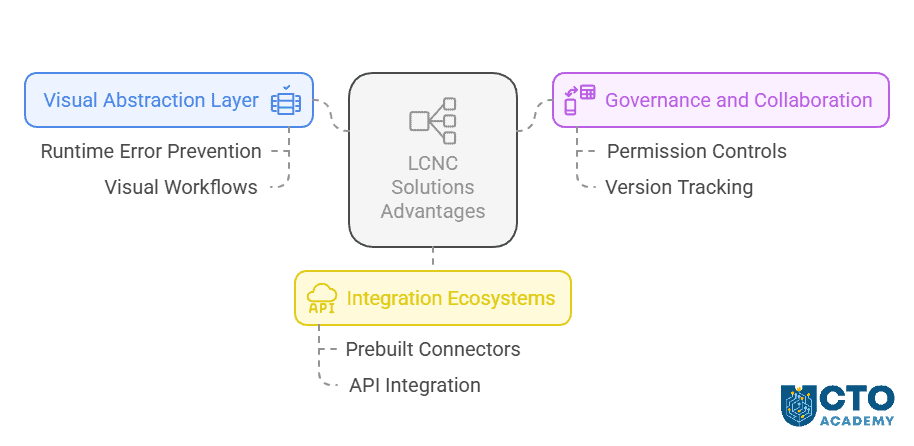
    3 reasons that Makes LCNC Solutions Persist over LLM - visual mind map

    1. Visual Abstraction Layer

    LCNC platforms provide constrained environments that prevent runtime errors through visual workflows. For example, Appian’s process modeller reduces logic errors by 54% compared to manual coding. This is particularly important for compliance-heavy industries like healthcare and finance.

    2. Governance and Collaboration

    Enterprise LCNC solutions offer granular permission controls and version tracking missing in raw LLM outputs. ServiceNow’s AI Builder shows a 92% adoption rate for audit-compliant workflow modifications versus 37% for direct LLM implementations.

    3. Integration Ecosystems

    Platforms like Zapier maintain prebuilt connectors to 5,000+ APIs versus GPT-4’s ability to generate custom integrations requiring security reviews. For common SaaS workflows, LCNC reduces integration time from 40 hours to under 2 hours.

    Factors That Prevent Obsolescence of LCNC Solutions

    While LLMs disrupt generic LCNC tools, at least three factors prevent full replacement:

    1. Cognitive load reduction
    2. Compliance requirements
    3. Error surface management

    Visual interfaces remain superior for spatial reasoning tasks because clearly defined areas of controls with obvious visual boundaries are key for users to build spatial memory. Since LCNCs allow users to develop apps in a closely similar matter to drafting a flowchart, that means users can rely on spatial memory to navigate complex processes or information structures, reducing the cognitive effort required to understand and interact with the drag-and-drop element

    Furthermore, several sources indicate that LCNC solutions generally present fewer challenges for complying with data protection regulations like GDPR and CCPA than LLMs.

    Finally, in some instances, LCNC’s constrained environments are noted to produce 78% fewer runtime exceptions than open-ended LLM outputs

    When you take a step back and look at the bigger picture, you can clearly see convergence potential. Let’s see if that is a viable scenario and what has to happen for it to materialise.

    Coexistence Through Integration and Mutual Evolution

    Businesses should select LCNC solutions with built-in LLM integration or a roadmap for future adoption. Additionally, business users (ie, non-technical staff) should be trained in prompt engineering to maximize the potential of AI-enhanced tools. 

    However, businesses must modernise their governance frameworks to ensure quality and compliance. This can be done through the implementation of AI review boards that assess the accuracy, security and ethical implications of an AI-generated code.

    When it comes to professionals, they should not only be proficient in LCNC platforms but also understand how to fine-tune LLMs for industry-specific applications. In addition, developers should consider:

    • Mastering system architecture design to be able to design scalable and efficient integration patterns. 
    • Learning how to validate and refine LLM outputs to ensure reliable high-performing AI-driven applications.

    Assuming that all of the aforementioned is realised, we can project the possible convergence path. 

    The Estimated Convergence Outlook (2025-2030)
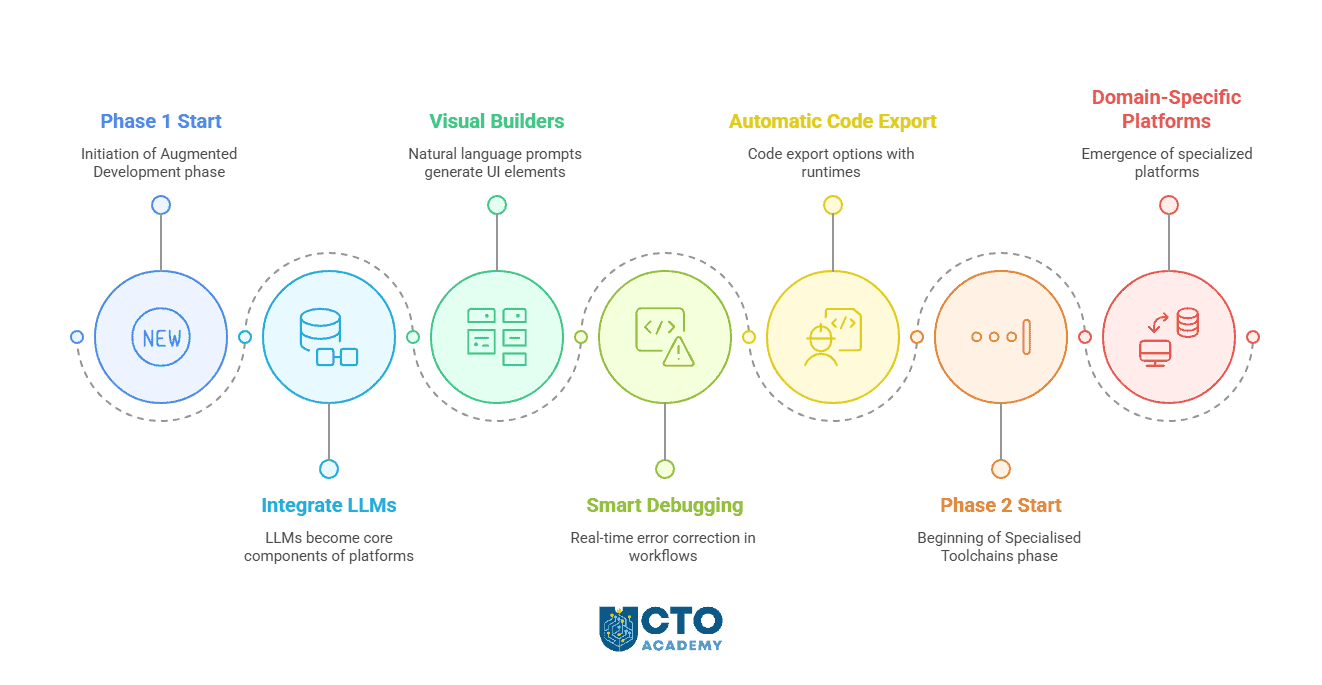
    Estimated evolution of LCNC industry-2025-2030 roadmap- visual mind map

    Phase 1: Augmented Development (2025-2027)

    LCNC platforms should integrate LLMs as first-class components, namely:

    • Visual builders that accept natural language prompts to generate custom UI elements and therefore enable AI-assisted component generation.
    • Smart debugging through real-time error correction within workflow designers.
    • Automatic code export options alongside platform-specific runtimes.

    Platforms like Appsmith, Mendix, Appian and Microsoft Power Platform have already incorporated advanced AI features such as AI-assisted development, intelligent automation and built-in LLM integrations. Users now have access to AI-powered code suggestions, automated testing and predictive analytics – functionalities that significantly accelerate the development process. However, it is still a far cry from what’s not only possible but expected. 

    Phase 2 (Possible Future Direction): Specialised Toolchains (2028-2030)

    In our view — and mind you, this is only an extrapolation based on current trends and general industry knowledge — we can expect the emergence of domain-specific platforms such as:

    • HIPAA-compliant LCNC environments with embedded LLMs trained on FHIR standards in the healthcare industry.
    • IIoT-focused tools that combine visual PLC programming with AI-generated optimisation code in manufacturing.
    • Audit-trailed AI builders for regulatory-approved algorithm development in fintech.

    So, rather than serving as generic automation tools, these next-generation platforms should and could act as intelligent co-developers, embedding regulatory, operational and domain expertise into their core functionalities.

    Conclusion

    So the capital questions are:

    1. Will the rapid development of Large Language Models mark the demise of the Low-Code/No-Code industry?
    2. Who will — and how — survive the onslaught?
    3. Is there an unforeseen threat to already established LCNC providers?

    The one thing that LLMs don’t possess is visual builders or interfaces and dashboards suitable for software development and deployment (eg, drag & drop functionalities). It is on the top of the list for the so-called, citizen developers or utilisation by non-technical users. So the answer to the first question is most likely, no. Convergence is the more likely scenario.

    However, that doesn’t mean that LCNC SMBs should sleep easy now. Their problem stems from initiatives of industrial behemoths like Microsoft. Its Power Platform which already converges LCNC and LLM engines is the real threat. Even companies like Lucidworks, Pegasystems and Flowise that have already launched similar solutions have low odds of success in competition against Microsoft. The only way they’ll survive is either through a merger or going niche while enabling commercially available tiers for start-ups. It’s highly unlikely that Microsoft will scale below enterprise-level use. 

    What about pure LCNC providers such as Bubble, Glide or Appy Pie?

    The window for successful transformation is narrowing. The odds are that LCNC companies that fail to become LLM-convergent by 2027 face a high probability of acquisition or obsolescence by 2030. 

    The future belongs to platforms that can hybridise LCNC’s structural governance with LLM’s cognitive fluidity, creating what we might as well term “Liquid Development Architectures.” 

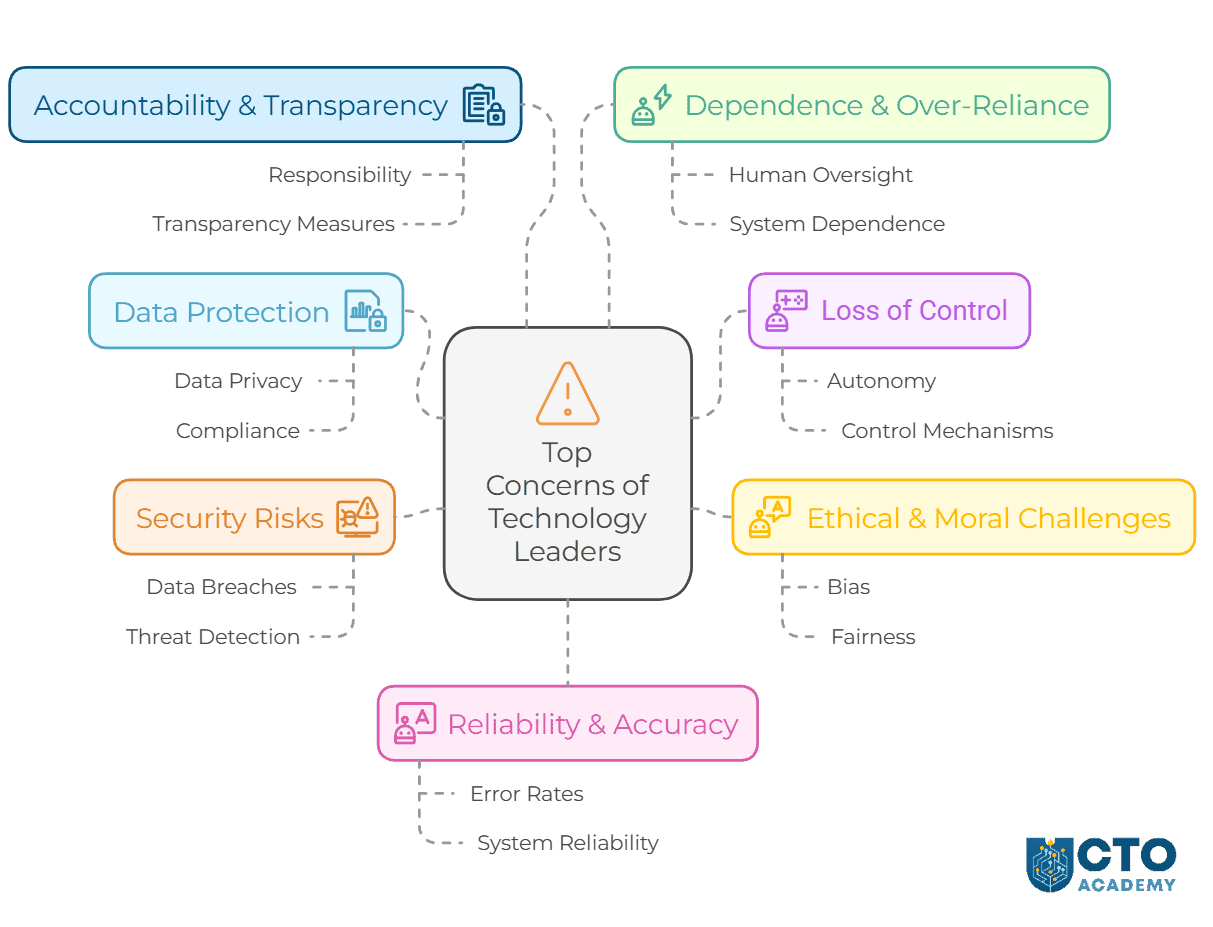
  • Top 7 Concerns of Technology Leaders That Implemented Agentic AI

    Top 7 Concerns of Technology Leaders That Implemented Agentic AI

    Artificial Intelligence is evolving beyond narrow, task-specific applications into agentic AI—systems capable of making autonomous decisions, adapting to dynamic environments and taking independent actions to achieve goals. This paradigm shift presents unprecedented opportunities for automation, efficiency and innovation. However, as organisations move toward deploying AI agents in critical operations, technology leaders must address several fundamental concerns.

    For CTOs and tech executives in general, the question is no longer whether to implement agentic AI but how to do so responsibly and securely. The risks of unchecked autonomy, biased decision-making and unpredictable behaviour demand a structured approach to AI governance, validation and human oversight. 

    This article explores the core challenges of agentic AI, backed by real-world case studies, and outlines the best mitigation strategies to ensure safe, accountable and effective AI deployment.

    7 Concerns of Technology Leaders That Implemented Agentic AI - visual presentation

    1. Data Protection

    In 2023, Samsung engineers inadvertently leaked confidential company code by using ChatGPT to optimise their programming scripts. The AI model retained sensitive trade secrets, which could have been accessed by OpenAI or other users, highlighting the risks of AI-enabled data leaks.

    When users share data with AI chatbots, it is stored on the servers of companies like OpenAI, Microsoft and Google—often without a straightforward way to access or delete it. This raises concerns about sensitive information being shared with chatbots like ChatGPT that could unintentionally become accessible to other users.

    By default, ChatGPT saves chat history and uses conversations to improve its models. While users can manually disable this feature, it’s unclear whether the setting applies to past conversations retroactively or if it’s working at all because it is virtually impossible to audit data that OpenAI and other providers use to train their models. 

    Technology leaders face a dilemma here: We either act in good faith and use products or ban the use of Gen AI tools as Samsung did. If we do use those products, we must accept three possibilities:

    1. Employees may input confidential information into AI without realising it could be stored or used for future model training.
    2. Even with data governance policies in place to prevent sensitive data from being shared with external AI services, history taught us that providers often ignore those rules because data is a commodity.
    3. Due to a lack of visibility and access control, a company’s secrets could be exposed without a clear way to delete or retract them.

    This is what we can do to at least minimise exposure:

    • Use role-based access controls (RBAC) to limit data access to only necessary personnel or AI modules.
    • Implement access controls and encryption at all levels to prevent AI from having unrestricted access to sensitive data.
    • Instead of centralising all user data, AI can learn from noise-injected distributed datasets without exposing raw information. This prevents raw data exposure but does not affect AI capabilities. 
    • Train AI models in secure environments with masked or anonymised data (synthetic data instead of real user information w/ Zero Trust architectures).
    • Ensure that AI-driven data processing aligns with compliance requirements (requires AI explainability functionality).

    That’s, unfortunately, the reality because we have limited control over data protection when using a third-party SaaS. But what can we do to prevent Agentic AI systems from acting erratically?

    2. Loss of Control

    Agentic AI systems and AI in general could act unpredictably. Often, this refers to pursuing objectives misaligned with our intentions. This concern is even more emphasised in high-stakes scenarios because we entrust a complex code with the “black box” feature to make decisions on our behalf. 

    The malfunctioning can cause an array of implications. For example:

    • Risk of harmful outcomes.
    • Inability to intervene effectively.
    • Potential cascading failures.

    On March 18, 2018, an Uber self-driving test vehicle in Tempe, Arizona, struck and killed a pedestrian, Elaine Herzberg. This was the first recorded fatality involving a fully autonomous vehicle, raising serious concerns about loss of control in AI-driven systems. The vehicle’s onboard AI was designed to detect and react to obstacles autonomously, but a failure in decision-making and override mechanisms led to a tragic accident.

    The AI incorrectly classified the pedestrian as an unknown object rather than a human, delaying its response. To make things worse, Uber had disabled the vehicle’s built-in emergency braking system, relying entirely on AI-driven decision-making. However, the system was tuned to reduce false positives, meaning it hesitated before deciding to stop which turned out to be a fatal miscalculation.

    A human safety driver was present but not paying attention at the critical moment, as AI was expected to handle the situation. The software did eventually order the car to brake 1.3 seconds before the collision but it was too late.

    This incident just goes to show that blind reliance on Agentic AI — programmed by humans — can have devastating outcomes. 

    Mitigation Strategies for Loss of Control in Agentic AI

    1. Goal Alignment and Robust Objective Design

    • Ensure AI systems have clearly defined objectives that align with human values and intentions. 
    • Use techniques such as reward modelling to guide the system’s behaviour toward desired outcomes.
    • Regularly test the system in diverse scenarios to ensure its objectives remain aligned.

    A good example is OpenAI’s approach with reinforcement learning from human feedback (RLHF). This method uses active human guidance to shape the system’s behaviour, ensuring that its autonomous decisions align with human intentions.

    2. Control Mechanisms and Fail-Safes

    • Build robust mechanisms for human oversight, such as kill switches, manual overrides or adjustable autonomy levels.
    • Ensure that all systems have multiple layers of control to ensure humans can intervene and regain control if the AI behaves unexpectedly.

    In autonomous vehicle development, for example, companies like Tesla include manual steering wheel overrides, allowing drivers to take control when necessary.

    3. Explainability and Transparency

    • Incorporate explainability into the AI design, ensuring the system’s decision-making process can be understood and monitored.
    • Use techniques like decision trees or attention maps to provide insights into how and why decisions are made.

    IBM’s Watson Health, for example, uses explainable AI to assist doctors in diagnosing diseases by showing the reasoning behind its recommendations. The approach builds trust in its outputs because users have more control over the AI.

    4. Iterative Testing and Simulation

    • Test AI systems extensively in simulated and real-world environments to identify and mitigate potential risks before deployment.
    • Use adversarial testing to expose vulnerabilities and create mitigation strategies for unforeseen behaviours.

    A good example here is DeepMind’s AlphaGo which was tested in millions of simulated games. The extensive training allowed researchers to fine-tune its behaviour and prevent erratic strategies.

    As much as it can be difficult sometimes, following industry standards and regulatory frameworks ensures the safe development and deployment of agentic AI. That said, both developers and end users should continuously work with policymakers and standards organisations to enforce safety protocols and regular audits. 

    And the prerequisite for that is monitoring and updating; in other words, deploying systems with continuous monitoring capabilities to detect and address deviations from expected behaviour. For example, AWS and Azure allow developers to update and retrain deployed models to maintain performance and control.

    3. Ethical and Moral Challenges

    Agentic AI systems face ethical dilemmas, such as deciding whose safety to prioritise or whether to follow instructions that conflict with moral principles. Decisions may not align with societal values, leading to public backlash or regulatory scrutiny.

    In 2016, Facebook experienced this backlash when the company faced criticism after its News Feed algorithm inadvertently promoted fake news and divisive content, raising concerns about the ethical implications of its design. It was a blatant example of a total lack of oversight of the algorithm’s impact on public discourse and a complete absence of ethical considerations. The algorithm simply prioritised engagement over truth. 

    To mitigate this, Facebook implemented fact-checking partnerships with third-party organisations to address misinformation and started conducting regular ethical reviews to identify and mitigate unintended harms. Additional tools were developed to prioritise high-quality information and limit the spread of harmful content. 

    Mitigation Strategies

    1. Embedding Ethical Frameworks

    Google’s AI Principles explicitly prohibit building AI systems that cause harm or reinforce bias, ensuring ethical guardrails. They collaborated with ethicists, domain experts and diverse stakeholders to define moral principles and embed them into the AI’s decision-making algorithms.

    2. Value Alignment through Human-Centric Design

    As we already said, OpenAI employed RLHF for ChatGPT, which involves training the model to align its responses with user-defined ethical standards. It is a proven approach to ensure AI systems reflect human values. It is done through regular feedback from diverse groups of users because it’s imperative to have an AI system that reflects a broad range of perspectives. 

    3. Ethical Audits and Impact Assessments

    Microsoft’s AI, Ethics, and Effects in Engineering and Research (Aether) committee regularly reviews the company’s AI projects for ethical risks. The committee conducts regular ethical audits and AI impact assessments (AIIAs) to evaluate the social, environmental and moral implications of AI deployments. This is the practice that can be utilised by every organisation simply by establishing independent review boards to assess ethical risks and provide actionable recommendations.

    4. Bias Mitigation

    Already mentioned IBM’s Watson Health faced criticism for recommending different cancer treatments based on biased training data. The company addressed this by revising datasets and involving clinicians in the training process. In other words, to eliminate bias from the algorithms:

    • Use diverse high-quality datasets.
    • Implement fairness-aware machine learning techniques.
    • Validate results against known benchmarks.

    5. Transparent and Explainable AI

    Similar to IBM’s example, DARPA’s Explainable AI (XAI) program focuses on developing systems that justify their decisions, enabling users to identify ethical concerns. These systems utilise tools like LIME (Local Interpretable Model-agnostic Explanations) to make AI decisions interpretable and assess their ethical soundness.

    6. Scenario Testing and Simulations

    Autonomous vehicle companies like Waymo conduct ethical scenario testing to evaluate how their systems handle life-critical situations, that is, whom to prioritise in a potential collision. They do that in simulated environments to explore how they respond to ethical dilemmas before deployment. These simulations mimic real-world ethical conflicts and analyse the system’s decision-making process.

    4. Security Risks

    Agentic AI systems can be manipulated, hacked or even weaponised, with autonomous decision-making amplifying their destructive potential. We all saw that ChatGPT-powered gun on YouTube, didn’t we?

    In 2020, the SolarWinds cyberattack demonstrated the risks associated with compromised AI supply chains. Malicious actors injected malware into the Orion software platform, impacting thousands of clients, including government agencies.

    This case demonstrated a serious lack of robust monitoring in the software update process and insufficient measures to detect and prevent supply chain attacks. To mitigate this and reestablish trust, the company had to implement code-signing practices and enhanced monitoring tools while partnering with security agencies and third-party audits. 

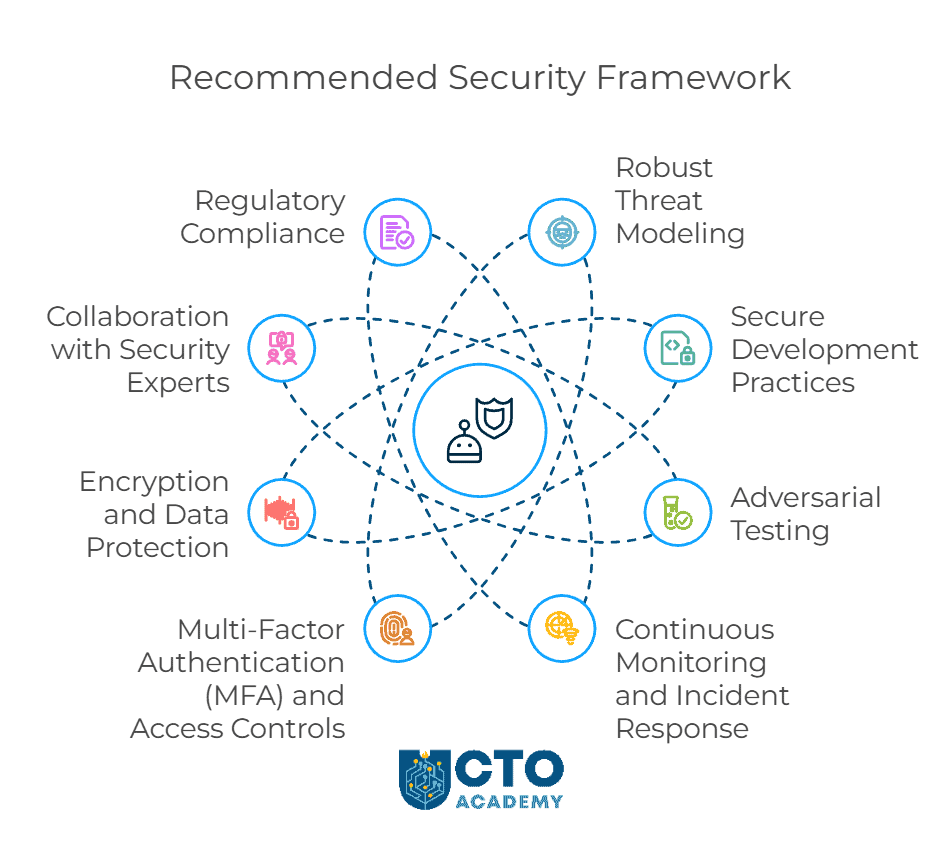
    Mitigation Strategies for Security Risks in Agentic AI

    8 Mitigation Strategies for Security Risks in Agentic AI - visual presentation
    (click to enlarge/download)

    1. Robust Threat Modeling

    We must identify potential threats specific to the AI system and its deployment environment, including adversarial attacks and data poisoning. To achieve that, we can use comprehensive threat modelling techniques, such as STRIDE (Spoofing, Tampering, Repudiation, Information disclosure, Denial of service, Elevation of privilege), to evaluate risks and develop countermeasures. 

    Google DeepMind, for instance, employs advanced threat modelling for AI systems to assess and mitigate vulnerabilities.

    2. Secure Development Practices

    OpenAI adopted secure development practices to minimise risks in GPT-based models, including API rate-limiting to prevent misuse. They employ techniques such as differential privacy and secure multiparty computation to protect sensitive data used in AI training and deployment.

    3. Adversarial Testing

    Tesla tests its autonomous vehicle systems against adversarial inputs, such as altered road signs, to ensure the AI behaves correctly in manipulated environments. They use adversarial examples to evaluate how the system reacts to maliciously crafted inputs. These simulations of real-world attacks have two goals:

    • Test the AI system’s resilience.
    • Identify vulnerabilities.

    4. Continuous Monitoring and Incident Response

    By default, AI systems should integrate robust monitoring and alert mechanisms, enabling swift responses to potential security threats. They detect anomalies and security breaches that are sent to dedicated incident response teams that utilise protocols to address security incidents as they occur.

    5. Multi-Factor Authentication (MFA) and Access Controls

    Back to basic cybersecurity – limit access to AI systems and their underlying infrastructure using strong authentication methods and role-based access controls. Zero-trust policies are still the best first line of defence. 

    The additional mitigation strategies are: 

    • Encryption and Data Protection
    • Collaboration with Security Experts
    • Regulatory Compliance

    5. Accountability and Transparency

    It’s often difficult to understand or explain the decisions made by complex AI systems, creating a “black box” problem. This causes challenges in assigning responsibility for errors or harm and complicates regulatory compliance and legal proceedings.

    The COMPAS (Correctional Offender Management Profiling for Alternative Sanctions) AI system was used in US courts to predict the likelihood of criminal reoffending. However, an investigative report found that COMPAS was biased against African Americans and lacked transparency in its decision-making. The report identified three major problems:

    • Judges and lawyers could not understand how COMPAS reached its conclusions.
    • The AI disproportionately predicted higher recidivism rates for Black defendants.
    • The system operated as a “black box,” with no independent review.

    Based on this case, AI models in legal decision-making now require:

    1. Transparent documentation
    2. AI tools used in courts must pass fairness assessments before deployment and
    3. Most importantly, many jurisdictions banned fully automated risk assessments without human review.

    So by implementing explainability, auditing, human oversight, regulatory compliance and stakeholder engagement, AI systems can become more accountable and transparent

    6. Dependence and Over-Reliance

    Tesla’s Autopilot system, an advanced driver-assistance AI, has been involved in multiple fatal accidents where drivers over-relied on AI and disengaged from driving responsibilities. Despite the manufacturer’s warning, drivers believed the system was fully autonomous and even ignored alerts prompting them to keep their hands on the wheel. 

    The problem was that the Autopilot did not always escalate warnings forcefully in the events when drivers became unresponsive. 

    To solve this issue, Tesla now requires drivers to periodically touch the steering wheel to ensure engagement. The system was also updated to activate more aggressive visual and auditory warnings if the driver fails to take control.

    But there is another underlying problem. Over-reliance on agentic AI can lead to the erosion of critical human skills caused by blind trust in automated systems. This can easily lead to system-wide failures when AI malfunctions that can even turn deadly. 

    AI should assist rather than replace human decision-makers, especially in high-risk sectors. Human operators must maintain their expertise and should not entirely rely on or become dependent on AI. For example, after the Air France Flight 447 crash in 2009, where pilots failed to react properly when autopilot disengaged, airlines introduced mandatory manual flying hours to prevent skill degradation. The same thing could happen to software development and software evolution if we fail to timely address this problem.

    To sum up, to prevent dependence and over-reliance on agentic AI, organisations should:

    • Maintain human oversight and decision authority.
    • Train workers to retain manual skills.
    • Implement AI uncertainty indicators.
    • Create manual override and fail-safe systems.
    • Use hybrid human-AI decision-making models.
    • Ensure AI explainability and transparency.
    • Follow regulatory best practices.

    7. Reliability and Accuracy

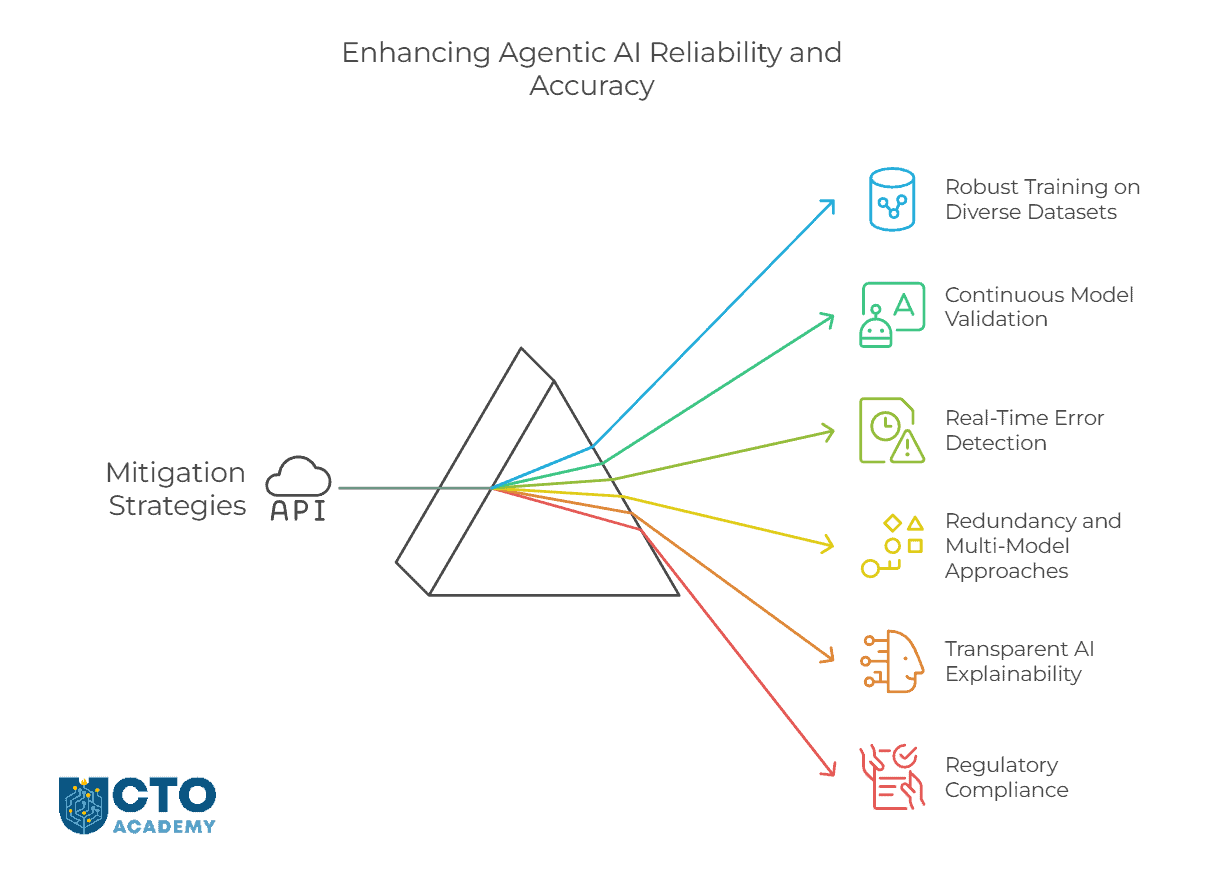
    Mitigation Strategies for Reliability and Accuracy in Agentic AI - visual presentation
    (click to enlarge/download)

    Agentic AI systems may fail to make consistent, accurate decisions in dynamic, uncertain or adversarial environments. Consequently, they may cause catastrophic errors in critical domains. 

    Regardless, AI-powered chatbots are increasingly used for medical symptom analysis for example. However, AI lacks real-world clinical experience, hallucinates, can fail to identify rare conditions and has no self-checking mechanism. In other words, most LLMs we use daily do not verify their own answers before outputting query results.

    Let’s use case studies and real-world examples to see how to improve accuracy so we can rely more on Agentic AI.

    Google’s Med-PaLM 2, for instance, initially struggled with accuracy due to biased training data. The company was forced to improve reliability by training on diverse multi-institutional datasets

    Uber’s self-driving car fatally struck a pedestrian in 2018 due to poor real-world validation. Waymo, by contrast, conducted millions of real-world and simulated test miles, reducing failure rates before public deployment. Waymo proved that AI models must undergo rigorous validation and real-world scenario testing before deployment.

    IBM Watson for Oncology initially provided incorrect treatment recommendations due to limited training data. The company introduced real-time physician feedback loops, allowing the model to improve through expert corrections. AI could now detect errors and self-correct in real time thanks to feedback loops and improved confidence scoring.

    Another way to improve the decision accuracy of Agentic AI is to use multiple AI models. It’s called ensemble learning where multiple models provide independent predictions and vote on final decisions while using backup rule-based systems for high-risk decisions. The best example is NASA’s Mars Rover AI Navigation which uses redundant AI models to cross-validate terrain analysis before making navigation decisions. This prevents mission-critical failures caused by single-model inaccuracies.

    Arguably the best approach to developing a reliable and accurate Agentic AI is to force the AI to explain its decisions and flag uncertain predictions for human review. This can be done by incorporating XAI techniques and implementing confidence thresholds that trigger human intervention for low-confidence results. For example, Healthcare AI (DeepMind’s Kidney Disease Prediction) flagged high-risk cases with explainability reports, allowing doctors to verify predictions before acting.

    The bottom line is that AI should never operate autonomously in critical situations. In other words, deploy AI as decision support rather than an autonomous agent and mandate manual approval for AI-generated recommendations in high-risk industries. It brings us back to the Boeing 737 MAX MCAS incident where a faulty AI-driven flight stabilisation system overrode pilot inputs, leading to fatal crashes.

    The Key Takeaways

    To improve reliability and accuracy, organisations should:

    • Train AI on high-quality unbiased datasets.
    • Conduct real-world testing and validation.
    • Implement real-time error detection and self-correction.
    • Use redundancy (multi-model AI systems) to cross-verify decisions.
    • Apply explainability techniques (XAI) to flag uncertain predictions.
    • Ensure regulatory compliance and third-party auditing.
    • Require human oversight in critical decision-making.

    Conclusion

    Agentic AI presents immense opportunities but also introduces critical risks such as:

    • Loss of control
    • Ethical dilemmas
    • Security threats
    • Lack of transparency
    • Over-reliance
    • Accuracy failures. 

    To mitigate these, technology leaders must prioritise human oversight, robust security measures and explainability while enforcing strict governance frameworks. 

    AI should be an assistive tool, not an autonomous decision-maker in high-risk domains. In other words, human expertise remains central.

    Success in deploying agentic AI hinges on continuous validation, adversarial testing, regulatory alignment and adaptive learning models. Organisations that proactively address these challenges will drive trustworthy, resilient and high-impact AI adoption, positioning themselves as industry leaders in safe and scalable AI innovation.

  • The AI Debate – How Is It For You?

    The AI Debate – How Is It For You?

    No matter how hard you might try, you simply can’t avoid it; AI is everywhere and is here to stay.

    But what’s the view of today’s technology leaders about tomorrow’s reality?
    How will it impact their role as they face ever-increasing expectations around the how, where and when of implementing an AI strategy?

    Because it seems that every day brings fresh claims, courses and newly minted experts on the topic and it’s multiple variants with a mixture of the utopian, dystopian and much else in between.

    In one corner, it will elevate humanity to as yet unthinkable levels of freedom and potential.

    In the other, warnings about the complete destruction of the human race by AI-powered autonomous robots and weaponised state machines.

    AI Integration Playbook for Tech Leaders - mockup-CTO Academy

    Download the AI Integration Blueprint

    Move beyond pilots and integrate Gen AI into core systems, without losing control of cost, security, or compliance. Get the practical roadmap tech leaders use to modernize infrastructure, prioritize the right use cases, and set governance that scales.

    Downloading the blueprint does not automatically subscribe you to our bi-weekly Technology Leadership Newsletter.

    Where do you sit on the about benefits vs. dangers?

    There have emerged the modern-day Oppenheimers such as Dr Geoffrey Hinton who want to squeeze the genie back into the bottle as they warn about the existential risk posed by the creation of true digital intelligence.

    In stark contrast to the unfolding nightmare described by Dr Hinton, we have Marc Andreessen, software engineer, entrepreneur and famous venture capitalist who is firmly on the utopian side of the argument.

    In an article which announced his optimistic take, “Why AI Will Save the World”, he predicts that AI can ‘make everything we care about better’, with education, healthcare, government, productivity, the arts and sciences all immeasurably improved.

    Naysayers are dismissed as either naive ideologues or self-interested opportunists. 

    Public statements about the dangers of AI are stoking ‘an irrational moral panic’, he says.

    Andreessen’s view challenges AI critics such as the aforementioned Dr Hinton and also tech heavyweights like Elon Musk and Steve Wozniak who in March 2023 signed an open letter calling for a six-month pause in AI development.

    Now, not so long ago it was Andreessen Horowitz which hyped the shattered cryptocurrency bubble in which they had a significant vested interest. But leaving aside that cynical take on his utopian vision for AI, Andreessen has a strong track record in the prediction game and the article is a worthy and uplifting contribution to the frenzied debate.

    But is he likely to be more correct than the naysayers?

    How do Tech Leaders cut through the noise?

    AI concept developed by generative AI

    More importantly, how do you make the right decisions for your organisation, particularly if you have an increasingly anxious CEO breathing down your neck because ‘we don’t want to miss out on the opportunity’?

    Here at CTO Academy, it’s a regular topic of concern at almost every one of our live debates and community discussions.

    Our own co-founder and CTO lecturer and coach, Jason Noble, acknowledges that ‘there’s a lot of hype’. He also points out that the opinions of many prominent figures are at risk of being seen as ‘self-promoting’.

    Jason’s main concern centres on deskilling. He warns that if basic tasks are devolved to AI, essential skills will be lost.

    ‘This makes me nervous — if low-value jobs disappear, how will people then gain the core skills needed to fill the higher-value jobs?’

    For Jason, the development of AI must be accompanied by a revolution in education, with a particular emphasis on the importance of critical thinking. 

    ‘In the future, we’ll need problem solvers and engineers, so we need a fundamental change in the educational system around teaching people how to think.’

    The Role of Regulation

    AI regulations and upcoming laws

    One of the biggest areas of contention in the AI debate is the role, if any, of regulation. More specifically, the introduction of laws at national and international levels to control the development and application of AI.

    Jason is clear on this point, ‘It is very difficult to regulate innovation and many laws become outdated before they are even ratified. However, the current process of releasing AI algorithms without extensive testing is concerning. Regulating the impact of AI would make companies think twice about releasing, but not necessarily slowing innovation. Only a handful of companies have the budget to run the massive server farms and thus could be regulated.’

    (Which, in defence of Andreessen, is the only note of caution in his otherwise ebullient perspective.) 

    Where are the Dangers for Tech Leaders?

    A human-machine hybrid concept art rendered by generative AI

    Jason also warns that the uncontrolled availability of AI software poses a danger for CTOs. 

    ‘As software becomes more of a commodity, the management will become harder and, like departments creating shadow IT, non-tech departments will become shadow software developers which opens the debate on compliance, security and maintenance.’

    He also points out that ‘it is unrealistic to rely on self-regulation. Computer scientists ask if we can solve a problem, not should we. There’s little morality involved.’ 

    Given these reservations, you might be surprised to find that Jason is actually an optimist about AI.

    ‘With all the caveats mentioned before, overall, I am optimistic about its potential within society and within our roles as tech leaders. Though I also believe we have bigger problems — debt and crashing economies and the environment — AI might help us address some of these issues, particularly on the environment and economic growth which has been particularly slow in many OECD countries.’

    Someone who is firmly and without hesitation in the Andreessen camp is Kiran Palla, based in Chicago.

    Alongside being a member of CTO Academy, Kiran is a CIO/CTO, a US Federal Government executive with the Department of Treasury and a Forbes and Harvard Advisory Council Member.

    He is also heavily involved in discussions on the impact of AI, particularly in the publishing industry, and advises the US government on the issue.

    His unequivocal opinion?

    ‘It will result in utopia.’

    Utopia concept art by generative AI

    Expressing his personal view, Kiran predicts that ‘there will be a lot of positive effects of the AI revolution in our lifetime — great advancements in medicine, disaster management, public health and [combating] the climate crisis’. 

    During the last three to four months I have attended at least 20 or 30 sessions and roundtables. The first question is always about AI. It’s like there is a fear of missing out. All the major players are integrating generative AI into their products. So, it’s going in a positive direction.

    ‘Yes, there will be a lot of stress and there will be a lot of negative views in the beginning, but I think the temperature is already starting to lower.’ 

    In Kiran’s view, the areas that will benefit will include healthcare — ‘surprisingly, because healthcare usually lags behind, because of [regulations around] privacy and patient information’ — the financial sector, manufacturing, marketing and the space industry. 

    But we need rational optimists in this debate and Kiran acknowledges the downsides.

    Risks and Concerns

    His number one concern?

    Fake data, faking information… it could be anything, a fake Wall Street report for example. With fake data like that, it can bring companies down. There is also a lot of fear that personal reputations can be targeted.’

    Number two and three are risks to privacy and bias.

    ‘A lot of HR policies will be impacted by unwanted bias,’ he says.

    And finally reliability. ‘The data is not clean, it is not validated that much, and large language models are already generating a lot of outputs that are not reliable.’ 

    It seems we’re all in agreement that regulation is pointless. 

    ‘You can regulate. Italy banned ChatGPT right away, and a couple of European countries came in and then everybody started to ban ChatGPT. But how long can you do that? You let development go for more than a decade and all of a sudden you want to put [in] some controls and regulations.’

    An early example?

    ‘Microsoft and OpenAI shocked the world with the power of large language models in March. Everybody started learning, including myself. I’m familiar with it but I said OK, let me dig deeper into it. And surprisingly, there were already large language model optimisers available, already in place, like LangChain. This is a model that works against large language models, optimising their performance. So how are you going to regulate it? There is no way.’ 

    The CTO challenges ahead

    Rubik's cube concept by generative AI

    Kiran foresees particular challenges ahead for CTOs.

    Simply keeping pace with developments is paramount given that CTOs will have to guide their colleagues through the fast-changing AI landscape. 

    ‘For CTOs, the biggest challenge is learning. It’s not like at C-level, [where] you can just oversee [the change]. There is no such thing anymore. You’ve got to learn because your engineers need upskilling, your architects need upskilling. 

    You can no longer ask an engineer for input. Your engineers will be fumbling. You have got to provide the input, the learning [and] the leadership. Your own hands-on involvement is critical, otherwise, you’re going to be outdated. I myself am learning every day.’

    We have to communicate a clear vision but the task is daunting

    ‘CTOs must provide a clear roadmap to AI adoption, complete with training and mentoring provision. Technical adoption is going to be the biggest challenge,’ he says. 

    ‘With regulation, with [the risks of] bias, fake data, how can you even provide a roadmap? There are challenges with [working out] a clear roadmap, challenges with a product roadmap, challenges with adoption, challenges with strategy — that is going to be the biggest.

    ‘I can’t stress enough — every day is a challenge,’ he says.

    Challenging it may be, but for Dallas Goldswain down in Johannesburg, there are a few downsides to the rapid development of AI.

    ‘I am not worried at all,’ says Dallas, who is head of engineering at consumer intelligence platform ProQuo AI, ‘I think it will only [adversely] affect people who are not willing to change and adapt, but that goes for all new tech. Using AI as a 2IC both as a leader and engineer will add value to getting the little things done quicker. 

    ‘For code, I feel there is a long way to go, but for writing, getting skeletons for articles, reports, processes etc, I think it’s great.’

    The economic potential of generative AI

    In July 2023, McKinsey published “The Economic Potential of Generative AI: The Next Productivity Frontier Report”. It contained some key insights on generative AI and work productivity which are worth listing here:

    – Half of the work activities to be automated with then-existing technologies.

    – Technology performance is most likely to match or even surpass human performance quicker due to generative AI. 

    – The potential work hours that can be automated have risen from about 50% to 60-70% due to generative AI advancements, especially in natural language processing.

    – Adoption scenarios have accelerated due to generative AI, with a potential shift of 50% in work activities occurring approximately a decade earlier than previous estimates.

    – Automation adoption will likely be quicker in developed countries with higher wages, as the cost-benefit analysis will tilt in favour of automation sooner.

    – Generative AI will mainly affect knowledge work, especially decision-making, collaboration and application of expertise.

    – Its natural language capabilities mean it can automate activities that require understanding and using language, thereby transforming occupations like education and technology.

    – Contrary to previous automation technologies that majorly affected low-skill workers, generative AI will make an impact on more educated workers, challenging the current educational credential system.

    – Generative AI could aid in countering declining global economic growth, compensating for slowing employment growth.

    – From 2023 to 2040, generative AI could boost global productivity growth by 0.2 to 3.3% annually, based on the rate of adoption.

    The Impact on CTOs

    Alex Velinov, CTO at Tag Digital in Glasgow and another CTO Academy member, comments that this report raises many issues, not least the need for education reform, as noted by Jason earlier.

    Alex says, ‘Most jobs we currently recognise will be automated or taken over by AI. However, a new set of roles will emerge, particularly related to managing and programming AI systems.’

    ‘We need to equip the next generation with transferable soft skills that are valuable across all professions, such as critical thinking, creativity, and empathy.’

    Alex acknowledges the challenge CTOs face in keeping up with the rapid changes in AI development.

    ‘How to stay on top of everything really depends on where your passion is. The first step is identifying what you genuinely love to do.’

    He further elaborates on that by saying, ‘For those in the tech industry or skilled professions, it’s crucial to learn about AI and its applications in your domain. Stay updated on new trends and tools, and be proactive rather than waiting for direction from employers.’

    ‘If your current job doesn’t align with your passion, now is a prime time to pivot towards skill-based careers like plumbing, electrical work or landscape design, and pursue what you truly desire.’

    Who will govern AI?

    Another emerging issue facing CTOs and their organisations is AI governance. According to Gartner Peer Community Data, the three biggest challenges are:

    1. Lack of skills
    2. Lack of clarity about business impact
    3. Production-first mentality

    The report cites other interesting themes as well around fragmented technologies, poor collaboration and a lack of underlying data governance.

    For a final view, we reached out to our CEO here at CTO Academy, Andrew Weaver, to take the temperature of the debate within our wider tech leadership community.

    Andrew says, ‘I host live debate sessions each month with our community of tech leaders from around the world. There is definitely some anxiety about the uncertainty ahead because no one can predict the direction of travel. But most of our members are by nature excited and intrigued with the potential of new technologies and how they can adapt to existing models.’

    ‘The biggest pressure we see is less about the technology and more about the expectations. Suddenly, every CEO and board is demanding an AI strategy, even if AI is not yet central to their model. Because of this, the expectations and the pressure on tech leaders have just ramped up.’

    ‘As is ever the case with tech leadership, it’s less about the management of the technology and more about the management of the people.’

    2 key parts of the AI debate

    To sum up, there seem to be two key parts to the AI debate. This is particularly true from our perspective as technology leaders. After all, it is we who must grapple with the uncertain direction of travel.

    First, the effect of AI on society.

    There are many potential gains, including greater efficiencies, especially in healthcare. But there are going to be some unwanted effects as well. For example, the manipulation of people through fake news and videos. Or, to a much greater extent, revenge porn and security breaches by impersonation.

    Second, the effect of AI on businesses.

    It will change the core of the software development process, making it more accessible but harder to control, secure and maintain. There is pressure on CTOs to ‘include AI in their products’ for investment and fund-raising. This can muddy the waters and set different expectations of what is possible. Hence, we need to teach the next generation of engineers differently. If we don’t, their skills could be obsolete as they enter the workforce.

    Putting one’s head in the sand is not an option.

    The more we understand how AI can affect society and businesses in good and bad ways, the more we can educate our colleagues, friends and families to prevent us from sleepwalking into dystopia but to embrace the use of AI for the greater good.