Next MBA Cohort Starts Monday, July 6th, 2026

Review Pricing and Join the Cohort

CTO Academy Logo
Log In

Category: Chief Technology Office

  • Chief Technology Officer in the AI Era: Role, Responsibilities, Skills, and Leadership Priorities

    Chief Technology Officer in the AI Era: Role, Responsibilities, Skills, and Leadership Priorities

    A Chief Technology Officer is the senior technology leader responsible for connecting technical capability with business direction.

    In some organizations, the CTO owns product architecture, engineering strategy, platform decisions, and innovation. In others, the role is focused on technology transformation, data, infrastructure, security, or AI adoption. The exact shape depends on the organization’s size, stage, and business model.

    What has changed is the level of visibility.

    The CTO is no longer judged only on technical depth or delivery performance. The role now carries broader responsibility for how technology creates value, manages risk, supports growth, and shapes the organization’s future capability.

    AI has made that responsibility more urgent

    Executive teams are asking where AI can improve productivity, where it can create new products or services, where it introduces risk, and how it should be governed. Those questions require strategic judgment, commercial awareness, leadership confidence, and the ability to explain complex trade-offs clearly.

    This guide explains what a Chief Technology Officer does, how the role compares with CIO, VP of Engineering, and Head of Engineering, how AI is changing CTO responsibilities, and what skills modern technology leaders need to build CTO readiness.

    TL;DR

    • The CTO role now sits closer to business strategy than traditional technical management.
    • A modern CTO connects architecture, engineering capability, product direction, security, data, AI, and commercial priorities.
    • The difference between CTO, CIO, VP of Engineering, and Head of Engineering usually comes down to scope: future direction, internal systems, execution, and team delivery.
    • AI has increased the pressure on CTOs to guide adoption, manage risk, set guardrails, and turn experimentation into useful outcomes.
    • CTO readiness requires strategic judgment, executive communication, commercial awareness, governance, and leadership range.
    • The next step for many current and aspiring CTOs is to identify their capability gaps and build a deliberate development path.

    What is a Chief Technology Officer?

    A Chief Technology Officer, or CTO, is the senior leader responsible for shaping how an organization uses technology to achieve its goals.

    The role sits at the intersection of technology, business strategy, product direction, and organizational capability. As a CTO, you are expected to understand the technical landscape deeply enough to make sound decisions, but the role is not limited to technical expertise. The CTO must also decide which technology investments matter, which risks need attention, and how technical choices affect customers, teams, revenue, resilience, and long-term competitiveness.

    The CTO role varies from one organization to another
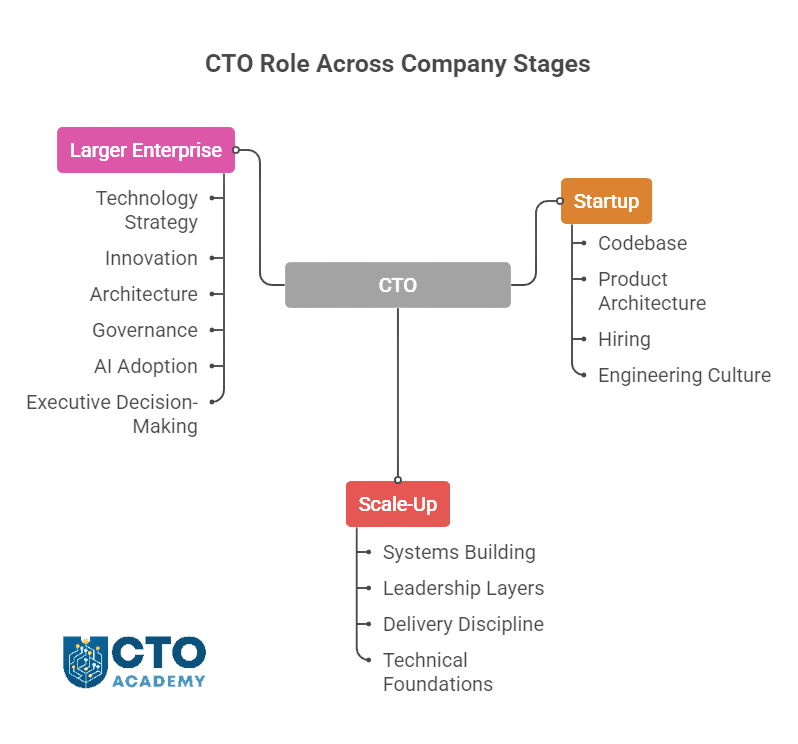
    The Chief Technology Officer role varies from one organization to another - visual presentation of different responsibilities across different growth stages.png
    As the organization matures and expands, so does the scope of the Chief Technology Officer role

    In a startup, the CTO may still be close to the codebase, product architecture, hiring, and early engineering culture.

    In a scale-up, the role often shifts toward building systems, leadership layers, delivery discipline, and technical foundations that can support growth.

    In a larger enterprise, the CTO may focus more on technology strategy, innovation, architecture, governance, AI adoption, and executive-level decision-making.

    Learn more about the differences in the scope of responsibilities depending on the size of the business

    The common thread is accountability for technology direction

    A CTO helps the organization answer questions such as:

    • What technology capabilities do we need to build?
    • Which systems should we modernize, replace, or protect?
    • How should engineering, product, data, security, and operations work together?
    • Where can emerging technologies such as AI create practical value?
    • What technical risks could limit growth or damage trust?
    • How do we turn business priorities into realistic technology decisions?

    In other words, they help technical teams understand business priorities, and executive teams understand the consequences of technology choices.

    In the AI era, CTOs are expected to explain what AI can and cannot do, where it belongs in the organization, how it should be governed, and what capabilities teams need to use it responsibly.

    What Does a CTO Actually Own?

    First and foremost, there has to be clear senior accountability for the technology decisions that shape the org’s future capability.

    A CTO may own any or all of the following areas directly or strongly influence them through collaboration.

    Table 1: CTO ownership

    CTO responsibilityIn practice
    Technology strategyDefining how technology supports business goals, growth priorities, operational needs, and long-term competitiveness.
    Architecture and technical directionMaking decisions about systems, platforms, scalability, interoperability, technical debt, and future flexibility.
    Engineering capabilityBuilding the structures, standards, leadership habits, and technical culture that help teams deliver reliably.
    Product and platform decisionsWorking with product and business leaders to decide what should be built, bought, integrated, improved, or retired.
    AI adoption and integrationIdentifying practical AI use cases, assessing risks, choosing tools, and integrating AI into workflows, products, and systems.
    Data and infrastructure readinessEnsuring the organization has the data foundations, infrastructure, cloud capability, and operational maturity needed to support modern technology priorities.
    Security and resilienceMaking sure systems are reliable, secure, compliant, observable, recoverable, and trusted by customers and stakeholders.
    Vendor and build-versus-buy decisionsDeciding when to build internally, when to buy, when to partner, and how to manage dependency on external platforms or suppliers.
    Executive communicationTranslating technical choices into business consequences so CEOs, boards, investors, and senior teams can make informed decisions.
    Innovation and experimentationEvaluating emerging technologies, deciding where to experiment, and turning useful learning into practical adoption.
    Technology risk and governanceCreating decision-making frameworks for technology investment, AI use, security, compliance, resilience, and operational risk.

    This is how it works in practice

    In smaller organizations, one CTO may cover most of these responsibilities directly. In larger ones, many of them will be shared with CIOs, CISOs, product leaders, data leaders, enterprise architects, and engineering executives.

    The CTO’s value lies in connecting those moving parts into a coherent technology direction.

    CTO vs CIO vs VP of Engineering vs Head of Engineering

    The simplest way to understand the difference is to look at the primary focus of each role.

    The CTO owns future-facing technology direction, the CIO owns internal technology operations, the VP of Engineering owns engineering execution, and the Head of Engineering usually owns day-to-day team delivery.

    Table 2: Primary focus and responsibilities of different roles

    RolePrimary focusTypical responsibilities
    CTOTechnology strategy and future capabilityArchitecture, innovation, AI strategy, technical direction, product-facing technology, and executive advice.
    CIOInternal technology and enterprise systemsIT operations, enterprise software, data systems, compliance, service delivery, and corporate technology services.
    VP of EngineeringEngineering executionDelivery, team structure, engineering processes, quality, hiring, performance, and engineering management.
    Head of EngineeringEngineering leadership and managementTeam performance, sprint delivery, technical standards, people management, and day-to-day delivery discipline.

    By default, the CTO is the role most closely associated with future-facing technology decisions. That can include:

    • Product architecture
    • Platform strategy
    • Emerging technology evaluation
    • AI adoption
    • Technical risk
    • The explanation of technology choices to the board or executive team

    CIO vs CTO

    Recently, the CIO and CTO roles have been coming closer together and sharing a lot of similar responsibilities. But as a rule of thumb, the CIO is typically more focused on the internal technology estate. This may include enterprise systems, workplace technology, IT operations, data platforms, procurement, compliance, and service management.

    In larger enterprises, the CTO and CIO work closely together: the CIO ensures the org runs reliably, while the CTO helps decide how technology should evolve.

    VP of Engineering vs CTO

    The VP of Engineering is usually responsible for turning technical direction into delivery. This role often owns engineering structure, hiring plans, delivery processes, quality standards, team performance, and execution rhythm. A strong VP of Engineering helps ensure the organization can build and ship reliably.

    Head of Engineering vs CTO

    The Head of Engineering role is usually more delivery and team-management focused, although the title varies widely. In smaller companies, the Head of Engineering may be the most senior engineering leader. In larger ones, the role may sit below a VP of Engineering and focus on a specific product area, platform, function, or team group.

    Donning several hats at once

    In early-stage companies, one person may cover several of these responsibilities. A founder CTO might act as CTO, VP of Engineering, architect, hiring lead, and product partner at the same time.

    CTO Academy is a great example of that. Jason Noble, the co-founder and CTO, was even engaged as the COO at one point. The reason was simple: he designed the systems and most of the operations, so to maintain the momentum and stay agile, it was simpler to assume that role also than to train somebody else during those early stages.

    Unlike startups, in larger organizations, the boundaries are usually clearer, though the CTO still needs to collaborate closely with CIO, product, security, data, and commercial leaders.

    For leaders comparing their next development step, this distinction matters. Moving from Head of Engineering or VP of Engineering toward CTO usually requires a shift from delivery leadership into broader strategic judgment, executive communication, commercial awareness, and technology leadership at the organizational level. This is where structured development through specialized CTO Programs can help clarify the path.

    How the CTO Role Has Changed

    In the past, many CTOs were judged mainly on technical oversight: keeping systems running, guiding architecture, supporting delivery, and ensuring engineering teams had the tools and standards they needed. While those responsibilities still matter, they are no longer enough.

    Modern CTOs are expected to connect technology decisions to business outcomes.

    They need to understand how platforms, data, security, AI, engineering capability, and operating models affect growth, resilience, customer experience, and competitive position.

    Table 3: Traditional vs modern CTO role

    Traditional CTO emphasisModern CTO emphasis
    Systems and infrastructurePlatforms, data, AI, security, and scalability.
    Technical deliveryBusiness-aligned technology strategy.
    Tool selectionOperating model and capability building.
    Architecture decisionsDecisions about speed, resilience, cost, integration, and future flexibility.
    Engineering supervisionCross-functional executive leadership.
    Innovation experimentsMeasurable transformation and adoption.
    Technical reportingBoard-level risk and opportunity communication.
    Generic digital transformationAI-enabled change linked to practical business outcomes.

    This shift has changed how CTOs spend their time

    The role is less about being the final technical authority on every decision and more about creating the conditions for better decisions across the organization.

    A modern CTO:

    1. Helps teams move quickly without creating uncontrolled risk.
    2. Supports innovation without encouraging disconnected experiments.
    3. Modernizes systems without breaking operational reliability.
    4. Explains technical trade-offs in language that boards, CEOs, investors, and commercial leaders can act on.

    AI has radically accelerated this change. It has made technology leadership more visible because AI decisions affect product strategy, data quality, security, customer trust, workforce capability, and business performance. That’s why the CTO is increasingly expected to help separate useful adoption from noise and turn emerging technology into governed, measurable progress.

    For many existing and aspiring technology leaders, this is the point where the next stage of development becomes less about adding more technical depth and more about building executive range: strategy, communication, commercial judgment, organizational design, and leadership under uncertainty.

    Why AI Has Made the CTO Role More Visible

    AI has pushed technology leadership closer to the center of business strategy.

    Boards and executive teams are pushing for AI adoption. Their questions rarely have purely technical answers, but they do require technical judgment. That is why the CTO has become more visible.

    AI is not just a tooling decision. It affects data, workflows, security, governance, teams, customer experience, productivity, and business models. A poorly chosen AI tool can create risk without creating value. A promising AI use case can fail because the data is not ready, the workflow is unclear, or the organization has not decided who is accountable. A useful pilot can remain stuck as an experiment if it is never integrated into core systems or measured against business outcomes.

    The CTO’s role is to help move beyond AI enthusiasm and into practical adoption

    That means asking:

    • Where can AI create measurable value for customers, teams, or operations?
    • Which use cases are worth testing now, and which should wait?
    • What data, infrastructure, security, and integration work is needed first?
    • Which AI tools should be bought, built, customized, or avoided?
    • What guardrails are needed around privacy, compliance, accuracy, bias, and human oversight?
    • How should teams be trained to use AI responsibly?
    • How will success be measured beyond novelty or short-term productivity gains?

    This is where the CTO becomes a translator between ambition and execution.

    The CEO may want speed. The board may want assurance. Product teams may want experimentation. Engineering teams may worry about complexity, reliability, and technical debt. Legal, security, and compliance teams may see new forms of exposure. The CTO needs to connect those perspectives into a clear path forward. They help to decide where AI should be embedded, where it should be controlled, and, more importantly, where it should not be used at all.

    This is also why AI leadership has become a development priority for technology leaders. Technical fluency matters, but it is not enough. CTOs need the executive range to assess risk, prioritize investment, influence stakeholders, govern adoption, and explain trade-offs in business terms.

    It is a practical guide for integrating AI into core systems without compromising security, control, or leadership accountability.

    What Skills Should the Modern CTO Possess

    While technical judgment remains essential, it now sits inside a wider leadership skill set. This is one of the biggest shifts for senior technology leaders because many reach the point where technical knowledge is no longer the main constraint. The harder challenge is deciding what matters, influencing people who do not think like engineers, and making technology choices that support the business without creating avoidable risk.

    Table 4: Modern CTO skill stack

    Skill areaPurpose
    Technical judgmentUnderstanding trade-offs, architecture, scalability, reliability, technical debt, and technical risk.
    Systems thinkingKnowing how platforms, teams, workflows, data, security, vendors, and customer experience affect one another.
    Strategic thinkingTechnology choices need to support business priorities, not just technical preferences.
    Product and customer awarenessUnderstanding how technology decisions affect users, customers, product direction, and market position.
    AI fluencyUnderstanding AI capabilities, limitations, risks, integration demands, and realistic use cases.
    Commercial awarenessInvestment decisions need to connect to value, cost, growth, efficiency, and competitive advantage.
    Security and risk awarenessRecognizing where technology creates operational, reputational, compliance, or customer trust risks.
    CommunicationExplaining technical complexity to non-technical stakeholders without oversimplifying the consequences.
    Executive influenceShaping decisions with CEOs, boards, investors, product leaders, finance teams, and commercial stakeholders.
    Team leadershipBuilding confidence, alignment, standards, and capability across engineering and technology teams.
    Change leadershipLeading transformation across systems, teams, behaviors, workflows, and operating models.
    Strategic prioritizationDeciding what to pursue, what to delay, what to stop, and what risks the organization is willing to accept.
    GovernanceAI, security, data, architecture, vendor, and platform decisions need clear accountability and decision-making discipline.

    The balance of these skills changes as the role becomes more senior. Earlier in a technology career, credibility often comes from technical depth and delivery. At the CTO level, credibility comes from judgment: knowing which technical issues matter most, how they affect the business, and how to bring people with different priorities into a shared decision.

    AI has made that skill stack more demanding

    CTOs now need enough technical fluency to challenge hype, enough commercial understanding to prioritize valuable use cases, enough governance discipline to manage risk, and enough leadership range to help teams change how they work.

    For aspiring CTOs, this can be a useful way to assess readiness. The question is not simply “Am I technical enough?” It is also “Can I influence strategy, communicate trade-offs, lead through uncertainty, and connect technology decisions to business value?”

    The best way to assess where you are right now is to benchmark your skill set against those who were in your shoes until most recently.

    Use it to identify your strengths, gaps, and development priorities as a current or aspiring technology leader.

    AI Leadership Responsibilities for Chief Technology Officers

    CTO must decide where AI fits, how it should be used, what risks need to be controlled, and how adoption will create measurable value.

    That responsibility usually falls across five connected areas: strategy, integration, governance, risk, and adoption.

    AI Strategy

    The CTO should help define how AI supports the organization’s business goals.

    This means moving beyond general enthusiasm and identifying where AI can improve products, customer experience, operational efficiency, decision-making, engineering productivity, or internal workflows.

    The CTO does not need to own every business case, but they should help test whether proposed AI initiatives are technically realistic, commercially useful, and aligned with the priorities.

    Useful questions include:

    • Which AI use cases are most likely to create measurable value?
    • Which opportunities depend on better data, systems, or process maturity?
    • Which experiments are worth running now?
    • Which ideas are interesting, but not yet ready for investment?
    • How will AI priorities connect to product, operations, customer, and revenue goals?

    Without this strategic filter, AI activity can become scattered. Teams may experiment in different directions, vendors may shape the agenda, and the organization may confuse visible activity with real progress.

    AI Integration

    The CTO is responsible for making sure AI can work inside the orgs’ existing technology environment.

    AI tools rarely create value in isolation. They need to connect with data, workflows, platforms, APIs, security controls, customer journeys, and operational processes. A promising AI use case can easily fail if it cannot access reliable data, fit into existing systems, or support the way teams actually work.

    The CTO needs to consider the following factors:

    • Where AI should sit in the architecture
    • How models and tools will connect to existing systems
    • What data is required, and whether it is trustworthy
    • How outputs will be checked, monitored, or reviewed
    • How AI-enabled workflows will affect teams and customers
    • What technical debt or infrastructure constraints need to be addressed

    This is where AI moves from experiment to implementation. The CTO’s job is to avoid isolated pilots and build the technical foundations needed for repeatable adoption.

    For a detailed context, go to Tech Leaders Guide to AI Integration

    Learn how to reconcile innovation, infrastructure, and security.

    AI Governance

    AI decisions need clear accountability.

    The CTO must establish how AI use cases are approved, reviewed, monitored, and controlled. This is done by ensuring that the organization knows who is responsible for decisions that affect data, security, customer experience, employees, compliance, and brand trust.

    Good AI governance should, therefore, make the following points very clear:

    • Who can approve AI tools and use cases
    • What data can and cannot be used
    • When human review is required
    • How AI outputs should be tested
    • How vendors are assessed
    • How risks are escalated
    • How performance and unintended consequences are monitored

    Governance is especially important as AI adoption spreads across departments. Without clear guardrails, different teams may adopt tools independently, expose sensitive data, duplicate costs, or create inconsistent customer and employee experiences.

    AI Risk

    AI creates new forms of technology and business risk. The CTO ensures that the organization understands those risks without unnecessary lag in useful progress.

    Key areas include security, privacy, compliance, bias, reliability, explainability, intellectual property, vendor dependency, and operational resilience.

    Some risks are purely technical. Others, on the other hand, are organizational. However, many sit between technology, legal, security, HR, product, and customer-facing teams.

    The CTO should answer questions such as:

    • What happens if an AI system produces inaccurate or misleading output?
    • What data is being shared, stored, or used for model training?
    • Which AI decisions need human oversight?
    • How do we prevent sensitive information from being exposed?
    • What happens if a vendor changes pricing, access, performance, or terms?
    • How do we test AI systems before they affect customers or critical processes?

    The goal is not to block AI adoption but to make adoption safe, clear, and controlled enough to be trusted.

    AI Adoption

    AI leadership also requires preparing people to work differently.

    The CTO has a mandate to help teams understand how AI should be used, where it can support their work, and where judgment still matters. This includes engineering teams, product teams, operations, customer support, data teams, and senior leadership.

    Adoption depends on far more than just tool access. Teams need guidance, examples, training, workflows, and confidence, especially non-tech teams. They also need to understand the limits of AI, including when outputs need to be checked and when automation is inappropriate.

    The CTO should help create the conditions for responsible adoption by:

    • Supporting practical training
    • Encouraging useful experimentation
    • Sharing/controlling approved tools and patterns
    • Defining acceptable use
    • Building feedback loops
    • Measuring impact
    • Helping managers adapt workflows
    • Reinforcing where human judgment remains essential

    Effective CTOs treat AI adoption as an organizational capability, not a one-off project.

    Learn how to redesign your organization for human-AI collaboration.

    A playbook for turning AI ambition into secure, governed, and commercially useful implementation and moving from assistants to autonomous workflows.

    Common Types of CTO Roles

    There is no single version of the CTO role. The title can mean different things depending on the orgs’ size, stage, sector, product model, and leadership structure.

    This is why two CTOs can have the same title but very different working weeks, as we often hear during weekly expert sessions and inside the Community discussions. One may be close to product architecture and engineering delivery. Another may spend most of their time with the board, regulators, enterprise customers, or transformation teams. Another may focus almost entirely on AI, data, platforms, and operating model change.

    The most useful way to understand the variation is to look at the type of CTO role the organization needs.

    Table 5: Types of CTOs w/ typical focus

    CTO typeTypical focus
    Startup CTOBuilding the first technical foundation, product architecture, and engineering team.
    Scale-up CTOCreating systems, processes, leadership capacity, and technical foundations that can support growth.
    Enterprise CTOAligning complex technology estates with business strategy, governance, security, and long-term transformation. May also be a Group CTO, managing several verticals.
    Product-led CTO (CPTO)Connecting product direction, customer needs, architecture, engineering delivery, and technical differentiation.
    Platform or infrastructure CTOOwning infrastructure, platforms, reliability, scalability, cloud strategy, and developer productivity.
    Transformation CTOLeading modernization, cloud migration, data strategy, AI adoption, or operating model change.
    Fractional CTOProviding senior technology leadership on a fraction of a project/scope for a fraction of the time.
    AI-focused CTOLeading AI strategy, integration, governance, platform choices, and organizational capability building.

    These types are by no means fixed categories. In practice, CTO roles often combine several of them. A scale-up CTO may also be product-led. An enterprise CTO may also be responsible for transformation. A fractional CTO may be brought in specifically to support AI adoption, architecture decisions, or technical due diligence.

    If you are interested in learning more about different types of CTO contracts, go here.

    The important point is context

    A strong CTO in one environment may not be the right fit for another. The skills needed to build a technical team from scratch are not identical to the skills needed to modernize a legacy enterprise estate, govern AI adoption, or advise a board on technology risk.

    For aspiring CTOs, this distinction is useful because it helps clarify the type of role you are preparing for. For organizations, it helps define what kind of technology leadership is actually needed. A hiring brief that simply says “CTO” is rarely enough. The better question is: what technology challenge does this CTO need to lead?

    Leaders comparing different development routes can use resources such as IT Career Path Mapping, CTO Programs Reviews, or explore the Fractional CTO route to think more clearly about which capabilities they need to strengthen next.

    First 90 Days as a CTO

    The first 90 days are not just about proving technical authority. They are about understanding the organization, building trust, identifying constraints, and deciding where technology leadership can create the most immediate value.

    A new CTO needs to learn before they prescribe. That means getting close to the business context, not just the technology estate:

    • What is the organization trying to achieve?
    • Where is growth being blocked?
    • Which systems are fragile?
    • Where are teams moving too slowly?
    • What risks are already visible?
    • What expectations does the CEO, board, or executive team have for the role?

    In the first 90 days, a CTO should, therefore, focus on:

    • Understanding the business model, strategic priorities, and commercial pressures
    • Assessing people, systems, architecture, delivery performance, and technology risk
    • Building relationships with executive peers, product leaders, engineering teams, data, security, finance, and operations
    • Identifying technical debt, delivery constraints, capability gaps, and organizational bottlenecks
    • Clarifying expectations with the CEO, board, founder, or executive sponsor
    • Finding early credibility-building wins without rushing into cosmetic change
    • Creating a realistic technology leadership agenda for the next stage

    The biggest mistake is to arrive with a fixed answer before understanding the context.

    A CTO who moves too quickly can damage trust, misread the organization, or solve the wrong problem. A CTO who moves too slowly can lose momentum and allow existing risks to deepen.

    The goal is to build enough understanding to make better decisions

    By the end of the first 90 days, the CTO should be able to explain where technology is supporting the business, where it is constraining progress, which risks require attention, and what priorities should shape the next phase of leadership.

    How to Build CTO Readiness

    Technical problems often have boundaries. Executive leadership problems rarely do. A CTO may need to make decisions with incomplete information, balance competing priorities, defend investment choices, manage risk, and explain why the best technical answer is not always the best organizational answer.

    Table 6: The list of connected capabilities that assess CTO readiness

    Readiness areaPractical impact
    Strategic thinkingUnderstanding how technology choices support growth, resilience, customer value, and competitive position.
    Business and finance understandingReading commercial context, investment trade-offs, budgets, margins, cost structures, and value creation.
    AI and technology fluencyKnowing where emerging technologies can create value, where they introduce risk, and what foundations are needed for adoption.
    Executive communicationExplaining technical trade-offs clearly to CEOs, boards, investors, and non-technical stakeholders.
    Decision-making under uncertaintyMaking informed choices when the data is incomplete, the risks are uneven, and the answer is not obvious.
    Stakeholder managementBuilding trust across product, engineering, data, security, finance, operations, commercial teams, and executive leadership.
    Team leadershipCreating the standards, structures, culture, and leadership capacity that help teams perform.
    Governance and riskEstablishing clear decision-making around architecture, AI, security, data, vendors, compliance, and operational resilience.
    Personal leadership maturityDeveloping self-awareness, resilience, confidence, and the ability to lead through pressure and ambiguity.

    The CTO has to move between levels: deep enough to understand consequences, broad enough to guide direction.

    For aspiring CTOs, the development path often starts by identifying which gaps matter most. Some leaders need stronger commercial confidence. Some need more experience influencing senior stakeholders. Others need to improve strategic prioritization, AI governance, or organizational leadership. The answer often depends on the role they want, the organization they serve, and the risks they are expected to manage.

    This is where structured development helps because the CTO role is not learned through technical experience alone. It requires exposure to strategy, finance, leadership, innovation, communication, and decision-making in complex environments.

    Identify your strengths, gaps, and development priorities before deciding your next step.

    The CTO role changes with context. A new CTO, an aspiring CTO, an engineering leader preparing for executive responsibility, and an experienced technology leader responding to AI will not all need the same next step.

    Use these resources to continue from the area most relevant to your current challenge.

    Table 7: The list of relevant resources for CTOs

    ResourceWho it is forNext step
    First 90 Days as CTOFor new CTOs who need to establish credibility, assess the organization, and set clear leadership priorities.Read the guide
    AI Integration PlaybookFor technology leaders responsible for turning AI ambition into practical, secure, and governed implementation.Read the playbook
    CTO Skills AssessmentFor aspiring and current CTOs who want to identify strengths, gaps, and development priorities.Assess your readiness
    Digital MBA for Technology LeadersFor technology leaders who want structured development across strategy, leadership, business, and AI-era decision-making.Explore the program
    CTO Programs ReviewsFor leaders comparing CTO courses, technology leadership programs, and executive education options.Compare CTO programs

    Frequently Asked Questions (FAQ)

    What does CTO stand for?

    CTO stands for Chief Technology Officer. It is a senior leadership role responsible for technology direction, technical capability, and the connection between technology decisions and business goals.

    What does a Chief Technology Officer do?

    A Chief Technology Officer leads technology strategy and helps align technical decisions with business priorities. Depending on the organization, a CTO may be responsible for architecture, engineering capability, product technology, AI adoption, innovation, security, governance, vendor decisions, and executive communication.

    Is a CTO higher than a VP of Engineering?

    Usually, yes. A CTO is typically more strategic and executive-facing, while a VP of Engineering is usually more focused on engineering execution, delivery, team performance, process, and quality.
    In smaller companies, however, the distinction can be less formal. One person may cover both roles, or the VP of Engineering may operate with responsibilities that look similar to a CTO role.

    What is the difference between a CTO and a CIO?

    A CTO usually focuses on technology strategy, product technology, innovation, architecture, future capability, and emerging technologies such as AI.
    A CIO usually focuses on internal technology systems, enterprise applications, IT operations, data infrastructure, compliance, service delivery, and corporate technology services.
    The two roles often work closely together, especially in larger organizations where technology strategy and internal systems need to be aligned.

    What skills does a CTO need?

    A CTO needs technical judgment, strategic thinking, business awareness, communication, leadership, AI fluency, security awareness, and the ability to manage trade-offs.
    As the role becomes more senior, the CTO also needs stronger executive influence, commercial understanding, governance discipline, team leadership, and decision-making under uncertainty.

    How has AI changed the CTO role?

    AI has made the CTO role more visible because organizations need senior technology leadership to assess use cases, manage risk, integrate tools, govern data, and explain AI’s business impact.
    AI is not only a technical issue. It affects workflows, products, customer experience, security, privacy, compliance, workforce capability, and operating models. The CTO helps the organization decide where AI can create value and how it should be adopted responsibly.

    How do you become a CTO?

    Most CTOs build experience across engineering, architecture, product, leadership, strategy, and executive communication.
    The path often starts with technical credibility, then expands into team leadership, delivery ownership, stakeholder management, business understanding, and strategic decision-making. Structured leadership development can help technical leaders prepare for the broader responsibilities of the role.

    Key Takeaways

    The CTO role is no longer defined by technical seniority alone, but by the quality of judgment a leader brings to business-critical technology decisions.

    AI has raised the stakes because technology choices now affect more than systems and delivery. They shape how organizations compete, manage risk, build capability, and earn trust.

    So, for current and aspiring CTOs, the real question is not simply whether they understand the technology. It is whether they can turn technical understanding into strategy, influence, governance, and measurable business value.

    That shift rarely happens by accident. Even if it does, the gaps it creates are too large to overcome. The optimal path requires deliberate development across leadership, commercial thinking, communication, AI readiness, and executive decision-making.

    The practical next step is to identify which capability gap is limiting your progress now: commercial confidence, AI governance, executive communication, strategic prioritization, or leadership range.

  • Addressing Pivotal Challenges in Organisational Working Practices

    Addressing Pivotal Challenges in Organisational Working Practices

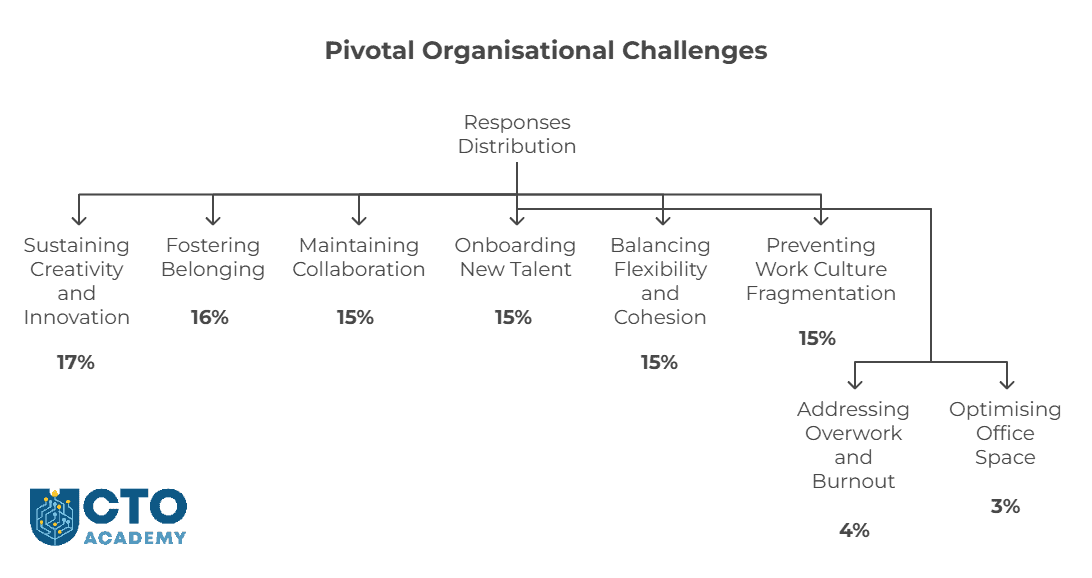
    Recently, we surveyed technology leaders and engineers to explore the key difficulties organisations face regarding contemporary work arrangements. The study presented participants with a list of potential challenges and recorded the frequency with which each was identified. 

    Pivotal organisational challenges survey - responses distribution

    As you can see, sustaining creativity and innovation was most frequently selected, closely followed by fostering a sense of belonging

    Maintaining effective collaboration, onboarding new talent, balancing flexibility with cohesion and preventing work culture fragmentation are also high up in the focus. 

    In contrast, addressing overwork and optimising office space were noted far less often. Nonetheless, to some, they are pivotal. 

    This article provides immediately applicable solutions to these challenges, offering technology leaders the practical tools to navigate workplace complexities effectively.

    1. Sustaining Creativity and Innovation

    Challenge: In a hybrid or remote environment, fostering creativity and innovation can be difficult due to reduced spontaneous interactions and isolated workflows.

    In 1968, Dr. Spencer Silver, a chemist at 3M, was attempting to create a super-strong adhesive for use in aircraft construction. Instead, he accidentally created a weak, pressure-sensitive adhesive that could be peeled away easily without leaving a residue. At first, this invention seemed like a failure – after all, who would want a glue that doesn’t stick properly?

    It wasn’t until 1974 that his colleague, Art Fry, came up with the idea of using the adhesive to create bookmarks that wouldn’t fall out of his hymnal. This spark of creativity led to the development of the Post-it Note.

    Would Fry even find out about Silver’s invention if they worked remotely and had isolated workflows? 

    Yes, the first action step is to synchronise workflows. In-house, hybrid or fully remote; it doesn’t matter as long as the workflows are synced. 

    But there’s another problem – it’s not always people’s fault they are not creative and innovative. 

    Get ready to face the hard truth about your leadership style and/or organisation’s culture in general. 

    There was a study that explored the problems of lack of creativity and innovation conducted by Francesca Gino. Gino surveyed 3,000 employees across various industries and companies, revealing that:

    • Only 24% of employees reported feeling curious in their jobs regularly.
    • Approximately 70% said they face barriers to asking more questions at work.

    In other words, leaders might believe they allow creativity and entice curiosity, but their team members certainly don’t feel that way. 

    This leads us to the most interesting thing in the study and that’s the list of 3 key innovation/creativity blockers:

    1. Leaders often believe that encouraging curiosity will lead to a costly mess and make the company harder to manage.
    2. There’s a concern that allowing employees to explore their interests would lead to more disagreements and slow down decision-making processes.
    3. Despite listing creativity as a goal, people frequently reject creative ideas when actually presented with them.

    Hence, the

    Immediate Solutions

    There are a few important takeaways from this study and general practice that should mitigate the problem of lack of creativity and innovation:

    1. Create an environment where employees feel safe to ask questions, explore and share new ideas without fear of ridicule or punishment. 
    2. Understand that exploration doesn’t always produce immediately useful information but often yields better long-term solutions that require many mini-solutions in between to work. 
    3. While some structure is necessary, allow for flexibility in exploring new ideas and approaches.
    4. Implement recognition systems that reward not just successful outcomes, but also the process of exploration and learning.

    However, not all people are creative (and innovative) by default. In fact, only a handful are. So what is the simplest method to entice creativity in otherwise uncreative individuals?

    This may sound counterintuitive, but setting strict limits can be your ace in the hole. 

    Constraints, when approached with the right mindset, can be a catalyst for creativity rather than an obstacle. 

    In 1960, Bennett Cerf, the founder of Random House, bet the famous Dr. Seuss $50 that he couldn’t write an entertaining children’s book using only 50 unique words. This challenge came after Dr. Seuss had already successfully written “The Cat in the Hat” using a limited vocabulary of 236 words from a list of 348 words that first-graders should know.

    The result?

    Dr. Seuss accepted the challenge and produced “Green Eggs and Ham,” which became:

    • His best-selling book
    • The fourth best-selling children’s hardcover book of all time
    • A book that has sold over 200 million copies worldwide
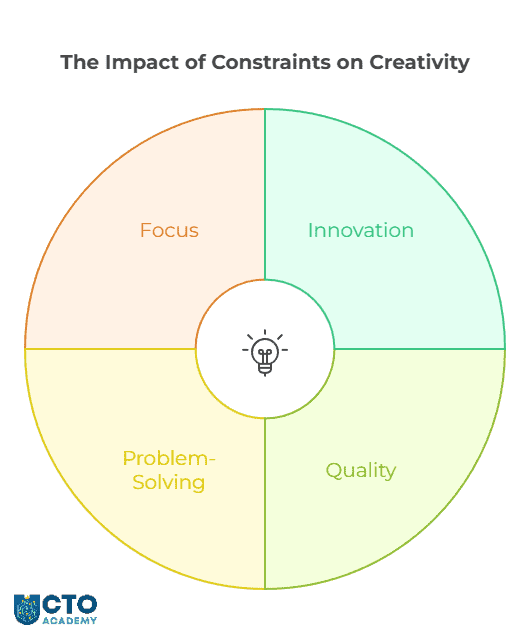
    The impact of constraints on creativity - visual presentation-mind map
    1. Creativity thrives under limitations: Rather than stifling creativity, the 50-word constraint forced Dr. Seuss to be more innovative in his storytelling.
    2. Quality over quantity: Despite the limited vocabulary, the book became a masterpiece of children’s literature.
    3. Problem-solving skills: The constraint required Dr. Seuss to approach the writing process differently, enhancing his problem-solving abilities.
    4. Focus and efficiency: The word limit forced Dr. Seuss to be concise and focused in his storytelling.

    In business, limited resources often lead to innovative solutions while time constraints can increase productivity and focus. 

    2. Fostering a Strong Sense of Belonging

    Challenge: Employees, especially those working remotely, often struggle with feeling disconnected from the company culture and their colleagues.

    Take it from someone who’s been working remotely for the last 11 years – this is a tough nugget to break. It will take a hard personal investment to create a sense of belonging. Nonetheless, it is achievable. 

    Now, the widely used solutions are:

    • Virtual Team-building Activities
    • Regular Check-ins
    • Weekly Team Meetings
    • Monthly Team Meetings
    • Recognition Programs
    • Company-wide Rituals

    Make no mistake; all of them work, but only if you a) give a team member a true sense of purpose and b) hold them accountable.

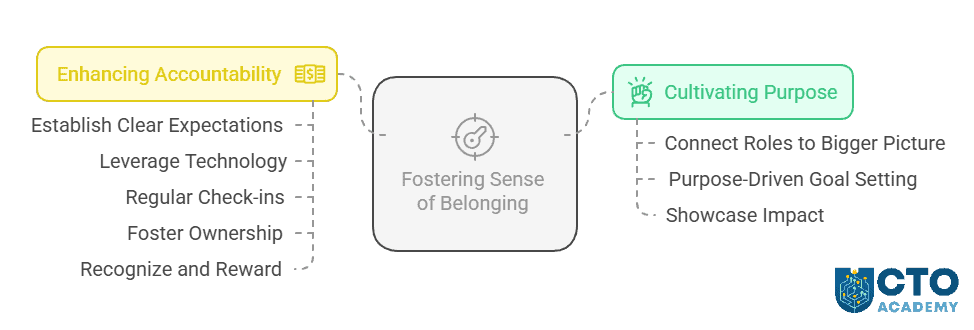
    Consider a complex, interconnected machine – a sophisticated network of gears, levers and circuits. This machine, let’s call it “Synergy”, represents a tech organisation operating in a remote environment. Its smooth functioning depends entirely on the coordinated effort of its individual components – the remote tech teams or members.

    The organisation’s leaders, the “Master Engineers”, understand that simply providing the blueprints isn’t enough. They need to instil a sense of purpose and accountability within each team, each member, each cog in the Synergy machine. It is an eight-step process. 

    Step 1: Ensuring Seamless Operation

    To cultivate purpose, the Master Engineers ensure every team member understands their critical role in the machine’s overall operation. They explain how even the smallest line of code contributes to the larger function, and how each bug fix prevents a catastrophic system failure.

    Step 2: Directing Personal Growth into Synergy’s Progress

    They also work with each team to set “precision-engineered” goals – targets that align not only with Synergy’s overall performance metrics but also with individual career trajectories. A junior developer might aim to master a new coding language, while a senior architect might focus on designing a more efficient data flow.

    Step 3: Reinforcing the Significance of Individual Contributions

    Regularly, the Master Engineers showcase the impact of each team’s work – how a new feature improved user experience and how a security patch prevented a data breach. In other words, they demonstrate real-world consequences.

    Step 4: Laying the Groundwork for Responsibility

    To enhance accountability, the Master Engineers establish clear “performance parameters” – specific, measurable outcomes for each team and project. These defined expectations might include code quality metrics, sprint completion rates or client satisfaction scores.

    Step 5: Encouraging Self-regulation and Peer Oversight

    Synergy is equipped with a sophisticated “monitoring system” – a suite of project management tools and performance dashboards that provide real-time visibility into the machine’s operation.

    Step 6: Ensuring Alignment

    The Master Engineers also conduct regular “calibration sessions” – one-on-one and team meetings to discuss progress, address challenges and performance deviations and refine goals.

    Step 7: Fostering a Culture of Ownership

    They empower team members to take initiative in problem-solving and decision-making. 

    (QUOTE)When individuals feel responsible for their part of the machine, they’re more likely to hold themselves accountable for the results.

    Step 8: Reinforcing the Value of Accountability

    Finally, the Master Engineers recognise and reward exceptional performance – publicly acknowledging teams and members that consistently exceed expectations and demonstrate strong ownership.

    The outcome?

    An environment where each team member feels deeply connected to their purpose and takes genuine ownership of their responsibilities. Such a combination not only drives performance but also ensures long-term stability and success. 

    Fostering Sense of Belonging - visual mind map of a process

    3. Maintaining Effective Collaboration

    Challenge: Coordinating efforts across distributed teams can result in inefficiencies, miscommunications and delays.

    The problem is that managers stick to the paradigm of the office environment, completely ignoring the fact that their teams operate from living rooms, bedrooms and basements of their homes. And homes have an opposite paradigm

    Traditional office environments are structured for face-to-face interactions, spontaneous conversations and immediate feedback. Homes, on the other hand, are designed for personal life and privacy, creating a fundamental paradigm shift.

    Moreover, office environments rely heavily on non-verbal cues, body language and spontaneous exchanges, which are largely absent in remote settings.

    Immediate Solutions:

    • When using collab platforms like Nifty, enforce ‘tasking’ instead of messaging for even the smallest and simplest of tasks – without exceptions. In other words, the “Can you check that update” message transforms into the “Check the XYZ Update” task. 
    • Ensure clarity in task ownership and deadlines.
    • Create and enforce the use of priority tags in tasks (eg, High Priority, Medium Priority, Low Priority)
    • Maintain an immutable team meeting schedule (to create a sense of expectation and, eventually, a loop of habit).
    • Set clear agendas and outcomes for every type of meeting.
    • During meetings, entice transparency and proactive updates to avoid misunderstandings.
    • Create a centralised knowledge base by developing and maintaining a repository of processes, procedures and frequently used resources.
    • Whenever possible, use visual project roadmaps that detail timelines, milestones and responsibilities. 

    4. Onboarding and Developing New Talent

    Challenge: Remote and hybrid setups make it harder for new employees to integrate quickly and build meaningful workplace relationships.

    In our experience — and we are a fully remote team — two practices stick out when onboarding a new team member: mentorship pairing and weekly touchpoints with the new hire. And we are certainly not the only company that finds these two methods crucial

    If you can put together an extremely precise onboarding program, even better.

    That’s basically all you can do besides providing access to the centralised knowledge base and training programs. If it sticks, fine. If not, repost the job ad. Some people are simply not a team material and there’s nothing you can do about it.  

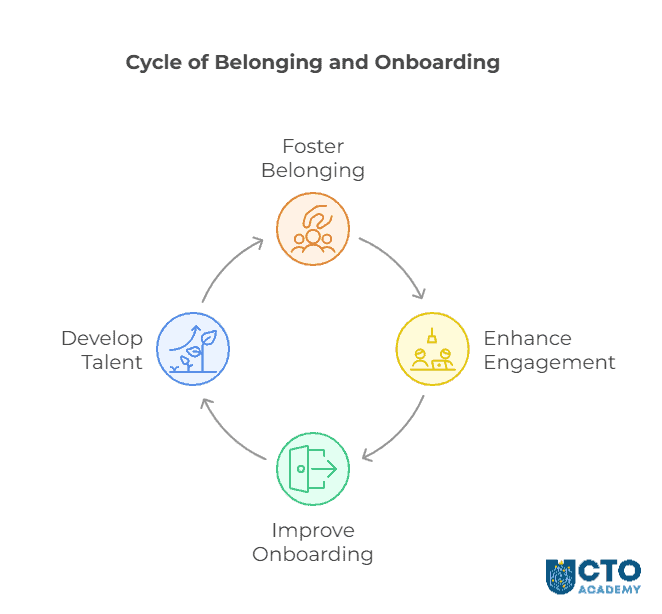
    Here’s the thing. Onboarding and developing a new talent is directly related to and dependent on a sense of belonging. So by focusing on #2 (Fostering a Sense of Belonging), you will effectively address #4 (Onboarding). 

    Cycle of Belonging and Onboarding - the mind map of causal relationship

    Belonging is a key factor because a sense of belonging is crucial for new employees to feel engaged, confident and committed to their organisation.

    5. Balancing Flexibility with Organisational Cohesion

    Challenge: The push for flexible work arrangements can sometimes undermine organisational unity and alignment with company goals.

    We are back to the shifting paradigm where an employee constantly changes between home and office. The first thing you need to do is to create a shared digital workspace – and use it. It doesn’t matter if a part of the team is in the office; they still must use that workspace as long as even a single member is remote.

    What happens is that team members who work from the office, tend to disregard the fact that some of them are missing. In their minds, that person is on leave or has a day off. It’s simply part of that common office paradigm we mentioned earlier.

    Additional Solutions:

    • Define clear policies (guidelines) that balance autonomy with necessary in-office collaboration.
    • Establish overlapping work hours for synchronous communication.
    • If in any way possible, schedule physical meet-ups to reinforce team spirit.
    • Create an internal knowledge base to ensure consistency in workflows and processes.
    • Prioritise accountability by all means. 
    • If you manage distributed teams, involve all team members in defining and refining the team’s vision and goals.

    6. Preventing Fragmentation of Work Culture

    Challenge: A dispersed workforce can lead to fragmented cultures, where different teams develop disconnected subcultures.

    Immediate Solutions

    Several experienced leaders have successfully addressed this issue through innovative approaches and strategic initiatives: 

    Automatic Created a Unified Digital Culture

    Automattic, the parent company of WordPress.com, provides an efficient example of maintaining a cohesive culture in a fully distributed workforce. Their leadership team adopted a “write early, write often” strategy to foster transparency and collaboration. 

    By encouraging team members to share updates and feedback in shared documents, they created a virtual environment that mimics the organic interactions of a physical office. 

    This approach proved highly effective, with 73% of Automattic employees reporting feeling more connected in their remote setting than in traditional office environments.

    IBM Leveraged Technology for Team Building

    IBM’s leadership team faced similar challenges when shifting to a remote-first strategy in 2020. Initially, they observed a major decrease in employee engagement compared to in-person work. To combat this, IBM’s leaders implemented three innovative solutions:

    1. Regular virtual town halls to maintain open communication.
    2. Social hours to foster informal connections.
    3. Integration of virtual reality (VR) in leadership training programs.

    The use of VR in particular yielded impressive results, with IBM reporting a 60% increase in the retention of leadership skills among participants. VR enables leaders to experience high-pressure decision-making scenarios in a safe simulated environment.

    Tariq Implemented Cross-Cultural Understanding

    Tariq, a young leader in a global firm, successfully addressed cultural fragmentation in his 68-person division spanning 27 countries and 18 languages. His approach included:

    1. Introducing a unifying team motto: “We are different yet one”.
    2. Creating opportunities for employees to share their cultures.
    3. Implementing a zero-tolerance policy for cultural insensitivity.

    These initiatives helped bridge cultural divides and rebuild team cohesion, demonstrating the importance of acknowledging and celebrating diversity while fostering unity.

    We Emphasise Shared Purpose

    CTO Academy leaders consistently remind team members of their common purpose and how their work contributes to overall company goals. During weekly team calls, for instance, a CEO reviews the group’s performance relative to company objectives. This practice helps maintain focus and unity, especially when team members are geographically dispersed like we are.

    Personal Connection and Recognition

    A manager based in Dallas, Texas, inherited a large team in India following an acquisition. To prevent cultural fragmentation, he:

    1. Involved remote employees in important decisions.
    2. Maintained frequent contact to discuss ongoing projects.
    3. Personally called team members to give them their birthdays off.

    These personal touches significantly improved team cohesion and morale, highlighting the importance of individual recognition in maintaining a unified culture.

    The Key Takeaways:

    • Leverage technology to improve communication and capitalise on diversity while emphasising unity.  
    • Maintain personal connections across geographical boundaries.

    7. Addressing Employee Overwork and Burnout

    Challenge: The blurred boundaries between work and home life in remote and hybrid setups have led to increased burnout rates.

    If this is the prevalent issue in your organisation, you need to take a big step back and reorganise your processes. There is something in your operations that disturbs the balance.

    Immediate Solutions:

    1. Set Boundaries on After-hours Communication

    In Germany, for example, contacting employees after hours is generally prohibited, with exceptions for emergencies and specific roles. The aim of this measure is to:

    The decision is based on extensive research that, among other things, clearly proved that:

    1. Constant availability for work-related matters can lead to increased stress and mental health issues.
    2. Genuine mental breaks from work improve overall productivity and employee well-being.
    3. Limiting after-hours contact allows for better sleep patterns and recovery time, which are crucial for maintaining good health and job performance.
    4. Prohibiting contact after hours reduces stress-induced mental illnesses.

    2. Encourage Time-off

    Actively promoting and tracking employee vacations to ensure they take breaks can be somewhat challenging when managing distributed teams. In our experience, the best approach is to utilise your central digital workspace. 

    Our COO, for instance, has implemented a time-off calendar where team members easily schedule their time off in Nifty after manager approval. This provides immediate visibility for the entire team, showing who’s out and for how long. It simplifies tracking and helps with processes because a team member can’t receive a task with a deadline that doesn’t take the time off into account. 

    3. Implement No-meeting Days

    These are basically dedicated days for deep work without interruptions.

    4. Provide Mental Health Resources

    In a fast-paced environment, burnout is inevitable. One approach is to provide comprehensive mental health resources such as counselling services, webinars or self-help materials. They should be:

    • Easily accessible
    • Encouraged
    • Utilised
    • Confidential

    This will enable you to identify and manage stress and burnout early on.

    8. Optimising and Adapting Office Space

    Challenge: With hybrid work models, many companies struggle to justify office expenses while ensuring the space remains functional.

    It’s amazing how some technology companies underutilise technology, namely smart space management systems. For example:

    • Real-time desk and room booking systems to prevent scheduling conflicts and maximize space usage.
    • Occupancy sensors to provide data on space utilisation, helping manage office density and optimise layouts.
    • All-in-one platforms like Microsoft Places and Gable for comprehensive workspace management, offering features such as AI-driven work schedule optimisation and access to flexible workspaces.

    The point is to rethink the organisation of the office space because clearly something is off. Maybe you have collaboration hubs but no quiet thinking bunkers where an employee can retreat to contemplate the problem without distractions. Perhaps it’s overcrowded or oversaturated with unnecessary equipment and simple re-arrangement could go a long way. 

    This is where technology or a good old professional interior designer helps. 

    Now, you may have also heard of ‘hot desking’ otherwise known as ‘hoteling’. If you are thinking about implementing such an option, consider these factors:

    • Loss of personalisation
    • Psychological discomfort
    • Reduced productivity
    • Weakened social structures
    • Decreased job satisfaction
    • Sense of belonging

    That’s the less discussed outcome of booking desks and spaces practice. As a species, we are wired to grow attached to our personal spaces and the office desk is no exception. Drop us anywhere and we’ll transform a hole in a rock into a cosy and warm place with a personal signature. 

    Just for fun, imagine a bunch of kids storming into a room filled with cool toys – day after day.   

    Conclusion

    So to sum up:

    1. Creativity and innovation can be fostered through synchronised workflows, a safe environment for exploration and perhaps setting strict limits to encourage creative problem-solving.
    2. Giving team members a true sense of purpose and holding them accountable can help them feel strongly connected.
    3. Effective collaboration can be maintained by enforcing tasking instead of messaging, ensuring clarity in task ownership and deadlines and creating a centralised knowledge base.
    4. Onboarding and developing new talent can be effectively addressed by focusing on fostering a sense of belonging.
    5. Balancing flexibility with organisational cohesion requires creating a shared digital workspace, defining clear policies and establishing overlapping work hours for synchronous communication.
    6. Leveraging technology, maintaining personal connections across geographical boundaries, and emphasising shared purpose can prevent the fragmentation of work culture.
    7. Addressing employee overwork and burnout requires setting boundaries on after-hours communication, encouraging time off, implementing no-meeting days and providing mental health resources.
    8. Finally, optimising and adapting office space can be done by using smart space management systems and rethinking the organisation of the office space. 
  • Your First 90 Days in a CTO Role

    Your First 90 Days in a CTO Role

    Many tech leaders will start a new senior position, whether as a promotion or a new job at a new company. I know how daunting it is to take a new position. You can do as much research as you like, but there will always be surprises. On the bright side, you do have those first 90 days. During that time, there are seven key areas that you must focus on. 

    Why 90 days or three months?

    It’s a honeymoon phase during which you can still blame it on your predecessor (unless he’s your boss). 

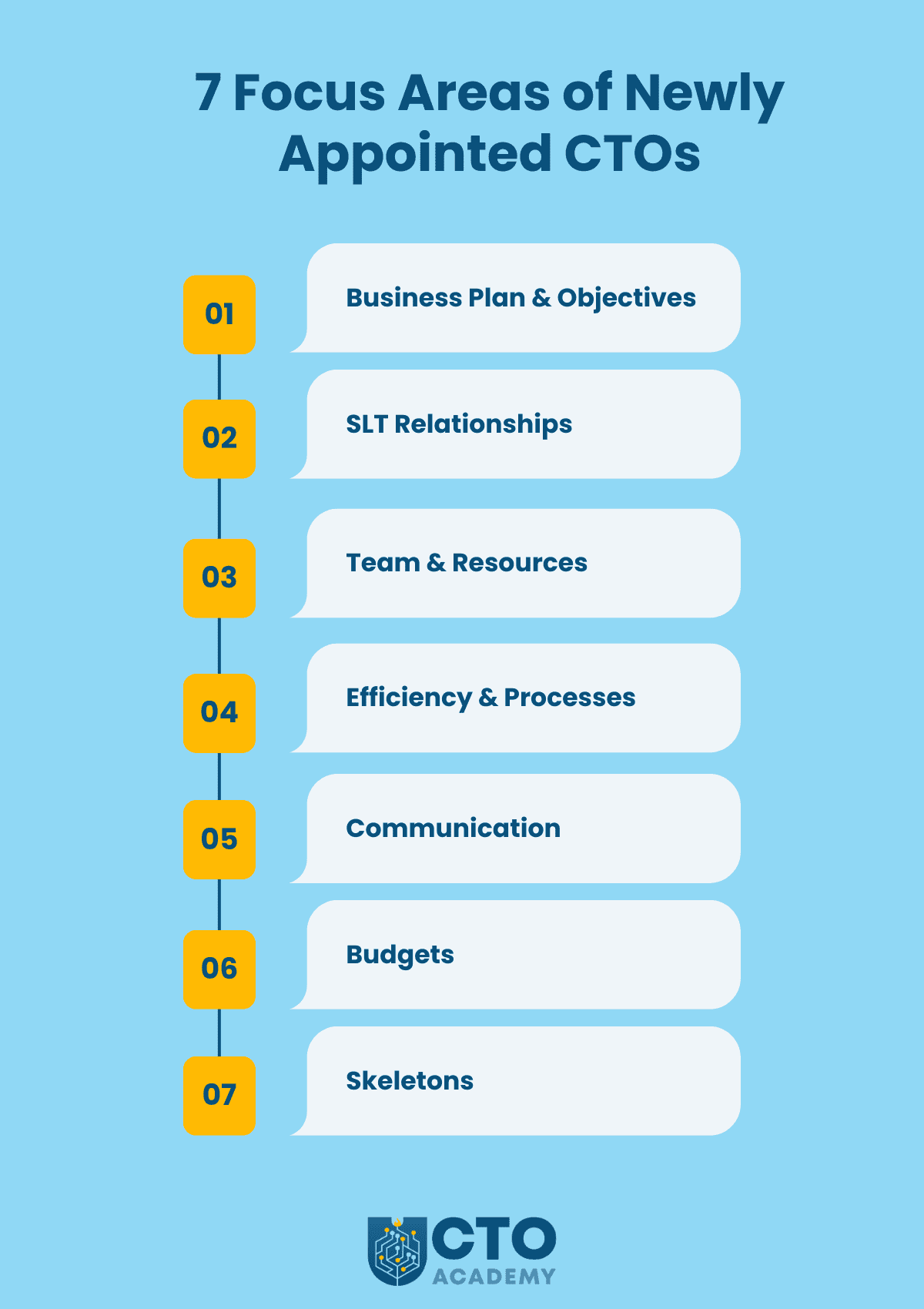
    In my experience, these are the seven areas you should pay attention to.

    7 Focus Areas of Newly Appointed CTOs

    7 focus areas of newly appointed Chief Technology Officers - infographic summary
    Focus areas of the first 90 days in the role of a Chief Technology Officer

    1. Business Plan and Objectives

    The subject of an optimal strategy when joining a new company is covered in detail throughout our Digital MBA for Technology Leaders. Drawing from those lectures, you must first understand the company’s objectives and business plan.

    4 Main Elements of BPs and Objectives in General

    1. Vision (WHY)
    2. Mission (WHAT)
    3. Target (WHO)
    4. Strategy (HOW)

    In other words, the vision is the why, the target is the who, the mission is the what, and the strategy is the how. 

    Now, if the business strategy is not yet formalised, you’ll have to work out what each of these four is through implication. Furthermore, it would be best if you suggested to the CEO and SLT that a session be held to discuss and agree on all the points. 

    The main thing here is to align the strategy with tech. And here are two vivid examples of misalignment. 

    One of our lecturers took over a CTO  position in a company, only to find out that the plans weren’t aligned. The business plan was assuming the legacy of on-prem licensing, whilst the tech team was still building a SaaS platform. In another example, a CTO approached the COO asking for the business plan. However, there wasn’t one except the vague goal to make more money.  

    What do you do in such a situation as a newly appointed Chief Technology Officer?

    You must prioritise the requirements of alignment and work out the action plan

    2. Senior Leadership Team (SLT) Relationships

    The first thing you should do in this matter is to get to know your colleagues. In other words, make an effort to understand their individual priorities and comprehension of the business strategy. The latter is quite important because, as you’ll learn, each of them will give you a different answer. This, in turn, will give you a good overview of how well they are coordinated. 

    If discrepancies indicate a complete lack of alignment, initiate a quiet chat with the CEO because, one way or another, you must improve C-level communication. Why? It’s the only way to truly understand their perception of tech and subsequent priorities. 

    You may also find yourself in a situation where your SLT colleagues voice where your priorities should be. Feel free to disagree, but, at the same time, use that to build a better picture of what is required to support the business.

    3. Team and Resources

    The first step is finding the organisational chart of your department. Create one if necessary, simply to work out the composition of the teams. 

    Often, the team structure is based on historical circumstances, which may no longer be relevant to the work in progress and plans in general. So get to know your direct reports and team members. Learn their strengths and weaknesses to better understand the areas they need support with. Once you feel comfortable enough, take that org chart and confirm/update roles and responsibilities. 

    Whilst you are learning your team, contemplate the following few questions:

    1. Do you have the optimal skills across the team, or do people try to work on stuff they are not good at? 
    2. Is the team overstretched and, consequently, overworked/exhausted? There are three strategies you may pull if that’s the case:
      1. Culture change
      2. Setting (more) realistic expectations
      3. Hiring
    3. Do they feel they’re being fairly paid (may point to a morale issue)? While you are checking their remuneration packages, check if there’s a proper career review process in place. 
    4. Do you have enough people in the right place to deliver the strategy? If not, start planning and working out the change.
    5. Is there anyone leaving soon? You might find yourself in a situation similar to mine, where both of my lead developers leave at the end of my first week in the bank. In that scenario, make the effort to convince them to stay for a little longer as I did. 
    6. Is anyone rejoining (eg, maternity/paternity leave, sabbaticals, and similar)?
    7. Is there deadwood (common in larger, predominantly public organizations)? If so, remove it immediately and re-route the resources. These folks are notorious for their resistance to change, and you really don’t want that, do you?
    8. Another thing to look for when it comes to team management of an inherited team is diversity. In other words, does the team reflect a healthy mixture of a wider society? If not, put in motion the hiring plan. 

    4. Efficiency and Processes

    Is the output meeting your expectations? What is your gut feeling telling you? Are you getting a return on your investments? Is there something you must improve right away?

    Do processes exist, are they correct, and are they being followed? 

    One of my friends joined a large company a few years ago and inherited a fairly large team. They were sending one release to the testing team every couple of days. He thought the cadence was far too slow, so he decided to get his hands dirty just to understand what was happening within the CI/CD. It turned out that it was a terrible implementation, but no one had bothered to fix it, as the expectations had been set. He immediately changed things around, and they were building tens of releases every day for testing. 

    The bottom line is that if the processes aren’t working for you, you’ll need to fix them. However, that won’t come without pushback. So you’ll need your team leads to not only drive but also own the change. 

    5. Communication

    There are two types of communication I’m referring to here: within the tech team and to the wider company. 

    You see, there might be some false beliefs caused by bad communication. This is commonly caused by teams that are using Slack private channels to discuss tickets, which, consequently, makes it difficult for others to understand the decision-making process.  

    The only way you’re going to solve this is to move discussions to tickets directly – without exception. It is something that I mandate on all my projects. 

    Additionally, analyse Slack plugins and remove unnecessary ones because they produce a lot of messages that quickly turn into noise and distraction. For example, I have ten workspaces in my Slack, and I’m simply forced to mute a lot of channels just to focus on the work at hand. 

    What I’m trying to say here is that Slack is a great tool, but do mind the correct usage of any tool at your disposal.

    6. Budgets

    Budget can often be foisted upon you with minimal input from you and your team. If this is the case, figure out the flexibility and calculate whether or not you are within, over, or under the budget at the precise point. 

    Here’s a wild story from the public sector that vividly depicts such a problem. A friend of mine joined the team and found out that the budget was significantly underspent. However, if she did not spend it all, the following year’s budget would be cut, and she would therefore have significant problems going forward. So she decided to spend the existing budget by buying a new computer for everyone involved in the project. This simple solution solved her budget problem, and she quickly gained respect across the organisation.    

    Therefore, if you find issues that require expenditure to fix them, you need to understand the budget.

    7. Skeletons in the Closet

    The question you need to ask yourself is: Are these (inevitable) skeletons relevant?

    One of our Global CTO Community members quickly realised that he was taking the CTO role in a company that was, effectively, an understaffed and disorganised mess. He spent a lot of time with the CEO trying to work out how they were going to get out of that mess. The problem was that the CEO was open and honest, but not technical, and the skeletons in this case were the code repositories.

    Long story short, someone put more than one product into the same repository. Naturally, everyone assumed there were only two, but it turned out there were three. The skeleton that was serious and relevant was that for one of their products. They did not have ownership of the repository. The real owner, an ex-employee, kept saying he would hand it over, but it dragged on and on and caused a significant problem for the company. 

    So how do you find such skeletons? 

    If something doesn’t make sense, then dig. You need to listen and watch for changes in body language, voice tone, or vagueness. It is the latter that I use the most often. If something is vague, they either don’t understand it or they’re trying to cover something up.    

    Ask questions such as: ‘What does that mean?’ or ‘Why is that process in place?’

    By pre-qualifying, you are disarming them. Ultimately, you are going to create a plan and a roadmap, which you may keep to yourself, but should be made up of immediate, medium- and long-term recommendations.

    In Summary

    Immediate recommendations are a high priority. And those that are severe, you should have already actioned. 

    Once you have a plan, you can implement solutions using all the relevant skills and tools (explained elsewhere in the course). However, if after 90 days, you’re still struggling to understand the business processes or people, then maybe this is not the right fit for you. 

    To sum up, having a concrete plan within these first 90 days gives you a good foundation to become a successful tech leader in your organisation. Remember: business plan and objectives, SLT relationships, team and resources, efficiency and processes, communication, budgets, and skeletons. These are your immediate focus areas.  

    Get the IT Career Path Roadmap (Free PDF)

    Want more than scattered ideas? Get our IT Career Path Roadmap PDF – an 8-step framework to map your next roles, sharpen your skills, and build a layoff-resilient tech leadership career. Fill in the form and we’ll send you the PDF version so you can download it, annotate it, and use it as a living plan for your next career moves.

    Downloading the ebook does not automatically subscribe you to our bi-weekly Technology Leadership Newsletter.

  • Building an Effective Chief Technology Office on Different Business Scales

    Building an Effective Chief Technology Office on Different Business Scales

    It is now common for a team leader or project manager to find themselves placed in the CTO’s shoes at a moment’s notice. Often, this brand-new executive is forced to form a Chief Technology Office out of thin air and without any help. This is the challenge facing what we call the accidental CTO.

    At the same time, existing CTOs can suddenly end up as Group CTOs after a merger or as a result of rapid expansion. 

    While both instances present an excellent career jump, it does not come without predicaments — especially for those with no real experience in high-level executive roles (eg, IT directors, Deputy CTOs or Fractional CTOs).

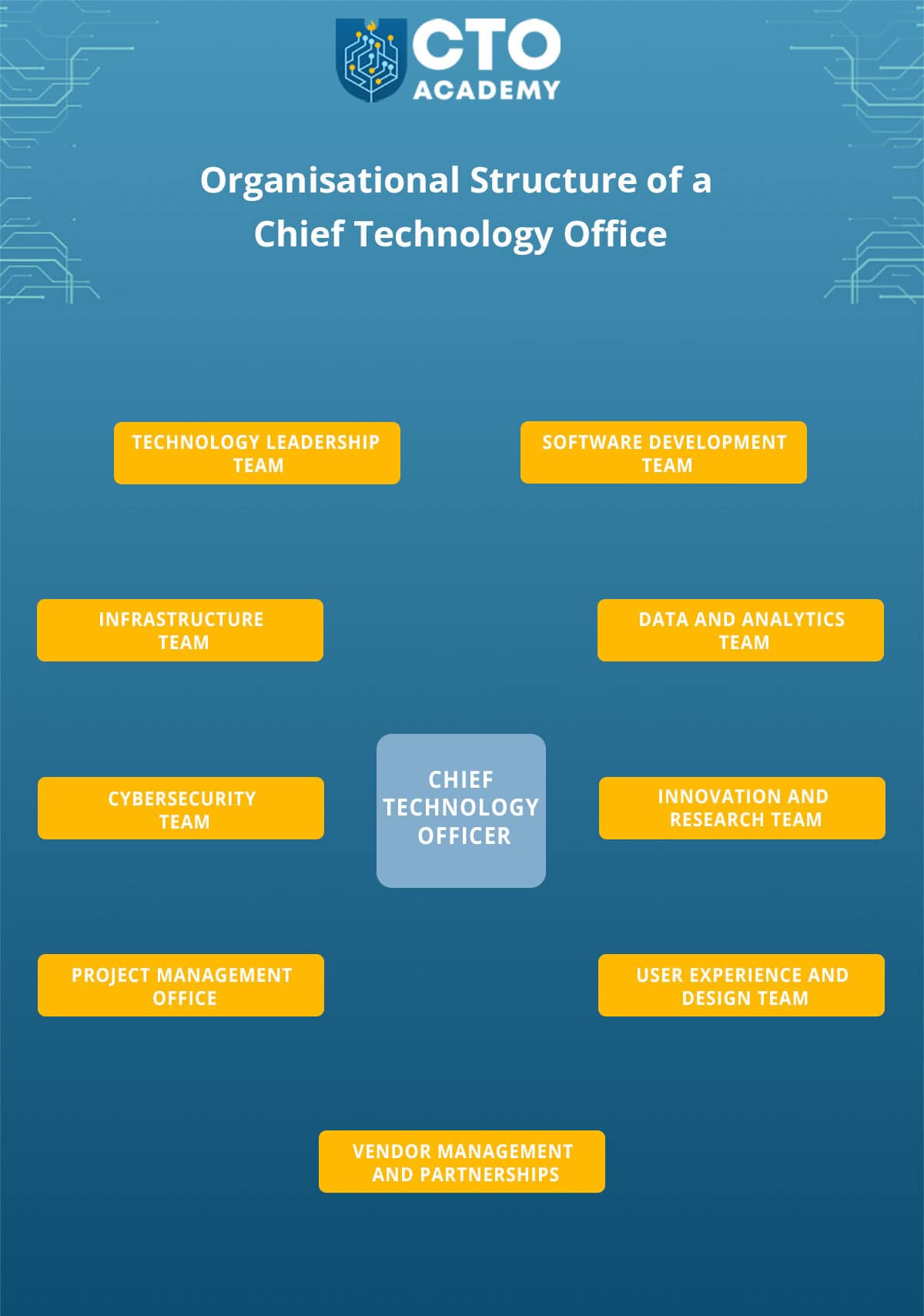
    To assist with the transition, we have created a detailed insight into the organisational structure of the Technology Office with individual roles, critical responsibilities, hierarchies and reporting schemes. It is a handy cheat sheet that will a) save you much time, and b) prevent serious mistakes. 

    You will also see an example of a typical Group Chief Technology Office with a brief overview of the GCTO’s role and responsibilities.

    Additionally, this article lists and provides solutions to the most common challenges of the CTO role and the Office itself while briefly explaining the necessary skills required for the position of a Chief Technology Officer.

    TABLE OF CONTENTS:

    1. Understanding the Chief Technology Office

    1.1 Defining the Office

    In a nutshell, the Office oversees all aspects of technology within an organisation. Led by the Chief Technology Officer, a vital member of the executive team, it plays a pivotal role in shaping the company’s technological vision, driving innovation and ensuring that technology aligns with the overall business strategy.

    Let’s examine that role in more detail.

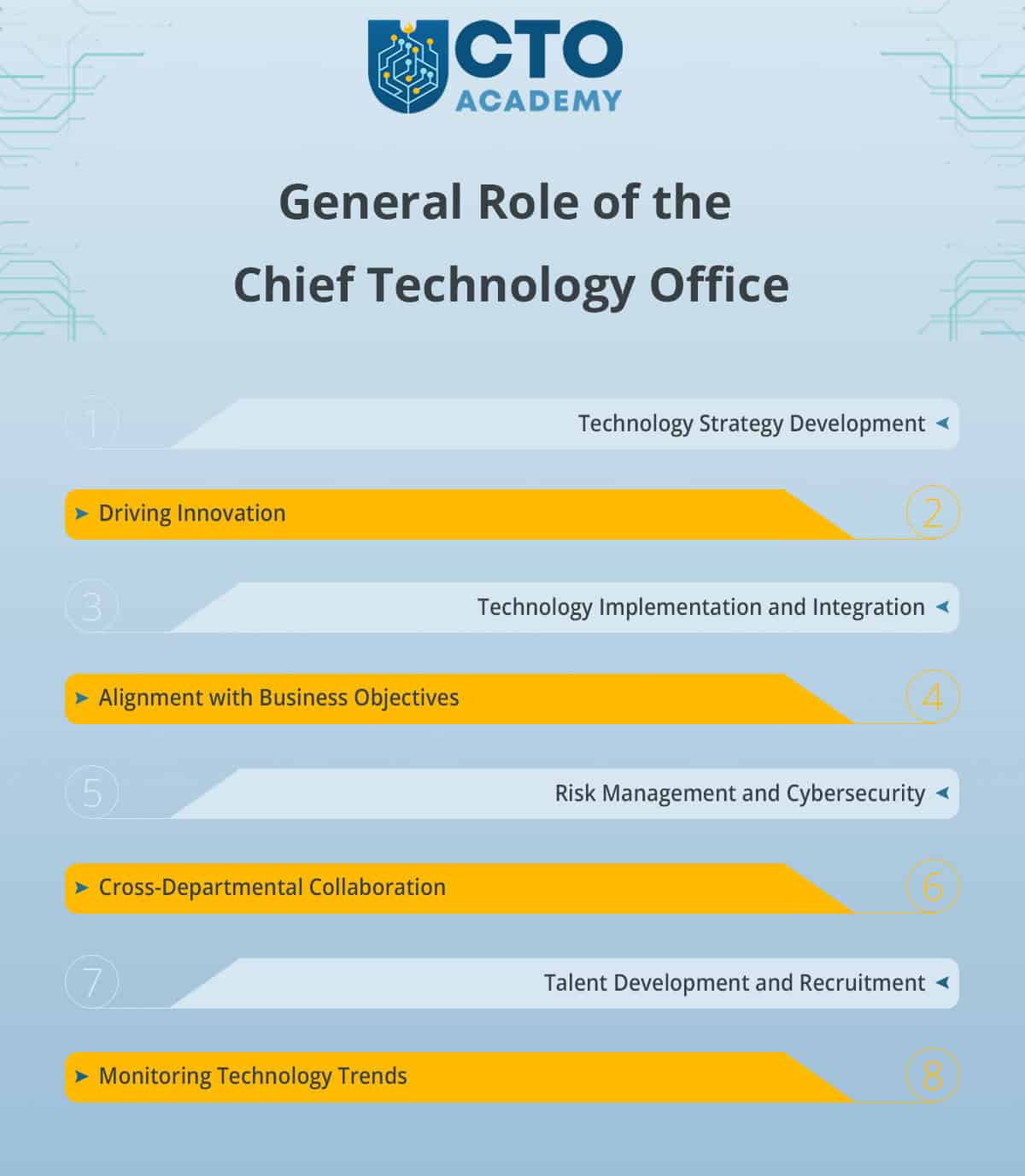
    1.1.1 The General Role of the Office

    General Role of the Chief Technology Office - list of responsibilities
    (click to enlarge/download)

    #1 – Technology Strategy Development

    The Office has a responsibility to formulate a visionary technology strategy that aligns with the organisation’s short- and long-term goals. This is done by:

    • Identifying emerging technologies.
    • Evaluating their potential impact.
    • Charting a path for technology adoption and implementation.

    #2 – Driving Innovation

    Many of humanity’s greatest advancements have been the result of mistakes. These errors are frequently the result of creative experimentation. And that’s exactly how technology officers and the Office itself drive innovations.

    #3 – Technology Implementation and Integration

    There are three essential elements of a successful implementation and integration of new technology:

    1. Effective project management.
    2. Collaboration with cross-functional teams.
    3. Addressing technical challenges.

    #4 – Alignment with Business Objectives

    Or, in other words, the necessity to understand the needs of different departments and stakeholders. It is a prerequisite for the successful tailoring of technology solutions to support their specific goals.

    #5 – Risk Management and Cybersecurity

    The Office safeguards the organisation’s digital assets, customer data and intellectual property from potential threats and breaches.

    #6 – Cross-Departmental Collaboration

    To ensure that technology enhances overall business operations and contributes to the company’s growth, the Office collaborates with other departments (eg, marketing, product development, finance and operations).

    #7 – Talent Development and Recruitment

    The main responsibilities in this segment are:

    1. Attracting top technology talent.
    2. Providing opportunities for professional growth.
    3. Fostering a positive work culture that motivates the team to excel.

    #8 – Monitoring Technology Trends

    The job of the Office is to continuously assess how emerging technologies can be leveraged to gain a competitive advantage and drive innovation.

    In summary, the Chief Technology Office is a dynamic and multifaceted environment that combines technical expertise with a strategic vision. By spearheading technology initiatives and ensuring their alignment with business goals, the Office contributes significantly to the growth and success of the companies in the ever-evolving digital landscape.

    1.2 The Impactful Role of a Chief Technology Office in Start-ups and Fast-Growth Companies

    The most distinct challenge for the Office is most certainly rapid scaling and growth.

    Start-ups and fast-growth companies experience exponential growth, requiring the CTO to rapidly scale the technology infrastructure and systems to meet increasing demands.

    But here lies the opportunity as well. The Chief Technology Officer can drive technological innovation to create scalable solutions that support the company’s growth trajectory by leveraging cloud services, automation and agile development practices.

    Still, start-ups and fast-growing companies are notorious for their limited resources and budget constraints. This makes balancing technological aspirations with financial realities quite challenging.

    But it also acts as an incentive for the Office to invest time in the exploration of cost-effective technologies, open-source solutions and strategic partnerships. Because somewhere in that mesh lies the solution that can, ultimately, enable the Office to optimise resources and deliver high-value outcomes.

    This exploration, since it is happening in such a fast-paced environment, requires agile decision-making on the one hand and the thoughtful consideration of long-term implications on the other. In other words, the Chief Technology Officer and the Office itself must always balance the need for rapid action against the potential long-term negative impact of their decisions.

    To address these two challenges, the CTO must work out the agile decision-making processes. These, in turn, will empower teams to make informed choices while maintaining alignment with the company’s vision and strategy.

    And with everything so well synchronised, attracting and retaining top talent becomes that much easier. 

    Let’s not forget that the competition for skilled technology professionals is fierce. Start-ups must often compete with larger, established companies for talent. But if the Office succeeds in the creation of a compelling company culture that fosters innovation and offers professional growth opportunities, it will attract top talent motivated by the start-up’s mission alone. Lately, this is becoming a more significant factor than salaries and bonuses.

    Another important role of the Office is risk management and cybersecurity. This is even more emphasised in start-ups because they often tend to underestimate the importance of robust cybersecurity measures. As such, they are vulnerable to data breaches and security threats.

    To tackle this problem, CTOs implement and enforce proactive security protocols, conducting risk assessments and prioritising data protection. This is necessary to safeguard the company’s reputation and customer trust.

    Cybersecurity can come with significant costs, and so too can managing technical debt.

    Quick iterations and product launches may lead to accumulating technical debt, resulting in maintenance challenges and reduced development speed over time.

    Common measures to minimise the debt and, thus, ensure long-term product stability and sustainability, are:

    • Implementing sound development practices.
    • Allocating time for refactoring.
    • Prioritising reduction of technical debt.

    Often, this may be further facilitated by adopting emerging technologies.

    This, however, requires careful evaluation because, in the end, AI, blockchain, IoT and similar ETs must also align with the company’s unique needs.

    The role of the Office here is to design and lead pilot projects to find out if these technologies and their possible applications can potentially enhance products or services and, ultimately, give a competitive advantage in the market.

    After all, isn’t it the job of the Office in any start-up to constantly balance short-term vs. long-term technological vision? Can there be hidden opportunities in emerging technologies that we do not yet see?

    Here’s the problem. As a rule of thumb, start-ups often focus on immediate priorities, possibly overlooking the importance of a coherent long-term technology vision.

    The CTO must, therefore, strike a balance between short-term goals and a visionary approach, ensuring technology decisions align with the company’s future aspirations. And that balancing act directly influences the company’s outlook and future directions. So we can say that, at some level, the CTO and the Office pave the way for the company’s future.

    But…

    What happens when a start-up eventually evolves into a fast-growth company?

    In this common scenario, cultural shifts and organisational changes can be disruptive to existing workflows and employee dynamics. Consequently, cultural adaptation and change management quickly rise on the list of responsibilities.

    The Chief Technology Office of a company suddenly becomes instrumental in three major areas of change management:

    1. Driving a culture of innovation and continuous learning.
    2. Encouraging adaptability.
    3. Embracing change to foster a positive work environment.

    Fast-growth companies have one additional challenge that suddenly becomes elevated and that’s the ability to navigate regulatory compliance.

    Module 2 of our Digital MBA for Technology Leaders, for instance, delivers a series of comprehensive lectures that explain compliance challenges and their individual solutions in practice. That’s how intricate and complex this role of the Office truly is. Almost an entire module is dedicated to helping CTOs navigate regulatory compliance.

    Because, as start-ups grow, they may face complex regulatory requirements in various industries, necessitating adherence to sometimes far-reaching compliance standards.

    The Office and its Chief Technology Officer must, therefore, collaborate with legal and compliance teams to ensure the technology infrastructure and products meet industry-specific regulations and standards.

    This only proves the underlying importance of cross-departmental collaboration and effective relationships. But it also goes to show how critical it is for the CTO to balance innovation and regulations.

    Being at the forefront of the company’s technological advancement, the Chief Technology Office often spearheads the crossing into the white space of the innovation landscape. A good example is Chris Gaudreau, CTO of Gordian; the company that is, under his technology lead, effectively redefining the entire industry.

    Gordian’s technology and data solutions enable public and private owners to effectively manage their budgets and tackle maintenance backlogs. This leads to quicker repairs of schools, resulting in safer environments for students. Healthcare facilities can remain updated, providing affordable and quality care. Workspaces such as offices, factories and warehouses can also be modernised, promoting productivity for workers.

    All thanks to the Chief Technology Office which is ensuring the company’s leading position by adding top technological advancements as part of their three-fabric strategy.

    Back to Table of Contents

    2. Organisational Structure of the Chief Technology Office and the Group CTO Office

    2.1 Building the CTO Office: Teams and Departments

    The organisational structure of the Office can vary depending on the size of the company, its industry and specific technological needs. As a general rule of thumb, the CTO Office should be designed to effectively manage and drive technology-related initiatives within the organisation.

    An example of a typical organisational structure, featuring key teams and their respective functions

    Organisational Structure of a Chief Technology Office - schematic presentation
    (click to enlarge/download)

    1. Chief Technology Officer (CTO)

    Resides at the top of the organisational structure and is responsible for providing strategic leadership, setting the technological vision and ensuring technology initiatives align with the company’s business goals. CTOs report directly to the CEO or other top executives and may be part of the company’s board of directors.

    Get a detailed overview of the Role of CTO in Different Business Sizes.

    2. Technology Leadership Team

    In fast-growth companies, the CTO may be supported by a team of technology leaders who directly manage specific functional areas of the CTO Office; for example, the VP of Engineering or IT Director.

    3. Software Development Team

    The job description here is to design, develop and maintain software applications that cater to the company’s needs. The Dev Team(s) works closely with other departments to understand requirements and deliver software solutions that align with business objectives (eg, customer service, marketing, sales, etc).

    4. Infrastructure Team

    Responsible for the management of the company’s hardware and software infrastructure, including servers, networks and cloud services. Their primary focus is on ensuring the stability, security and scalability of the company’s IT infrastructure.

    5. Data and Analytics Team

    Managing data assets, conducting data analysis and providing data-driven insights to support decision-making across the organisation. They may also work on data governance and data security.

    6. Cybersecurity Team

    Safeguarding the company’s digital assets from potential threats and breaches. They implement security measures, conduct security audits and educate employees about best practices for data protection.

    7. Innovation and Research Team

    Researching emerging technologies, evaluating their potential applications and conducting experiments and prototypes to drive innovation. They collaborate with other teams to explore new possibilities for technological advancement.

    8. Project Management Office

    Oversees the planning, execution and monitoring of technology-related projects. The PMO ensures that projects are delivered on time, within budget and meet the specified quality standards.

    9. User Experience and Design Team

    Responsible for enhancing the user experience of the company’s digital products and services. They work closely with software development and innovation teams to create user-friendly and visually appealing interfaces.

    10. Vendor Management and Partnerships

    Manages relationships with technology vendors and strategic partners. They evaluate potential vendors, negotiate contracts and ensure that partnerships align with the company’s technology roadmap.

    Note that the actual organisational structure of the CTO Office may vary from one company to another, and some companies may have additional teams or functions depending on their specific technological requirements and business goals. Additionally, in smaller start-ups, the CTO Office might be leaner, with the CTO directly overseeing multiple teams or functions.

    But what about conglomerates or large companies with multiple verticals each responsible for an individual project/product? 

    2.1.1 A Group CTO role and responsibilities

    A Group Chief Technology Office has a more encompassing role that commonly involves coordinating and aligning technology strategies across multiple companies within a group. In a nutshell, this means that the Group CTO oversees several technology leaders. The role is similar, but, as you can imagine, there are differences.

    The obvious one is the scope of responsibilities.  A Group CTO oversees the technological strategy and operations of a group of companies or subsidiaries within a larger corporate structure. As such, they are responsible for aligning technology initiatives and strategies across multiple entities, ensuring that technology investments are coherent and synergistic. 

    In practical terms, this means that the Group CTO is responsible for coordinating technology efforts and strategies across multiple companies. They need to identify opportunities for synergy, shared resources and technology collaboration among multiple business units 

    The same applies to innovation and R&D. Group CTOs might have a broader perspective on technological innovation that spans the entire group. In other words, they can guide R&D efforts that have a cross-company impact. 

    You can see an example of the Group CTO job requirements here.

    A typical organisational structure of a Group CTO Office

    1. Group Chief Technology Officer

    The GCTO sits at the top of the technology leadership hierarchy and is responsible for overseeing the technology strategies, innovation and operations of the entire group. They report to the CEO, President, or another highest-level executive.

    2. Technology Leadership Team

    • Business Unit CTOs – Report to the Group CTO and are responsible for aligning technology initiatives with the specific needs of their respective units.
    • Group Technology Strategy Head – Focuses on formulating and refining the overarching technology strategy for the entire group. They collaborate closely with business unit CTOs and the Group CTO to ensure alignment with group-level goals.

    3. Group Technology Council

    This council includes key technology leaders from each business unit or subsidiary. It meets regularly to discuss group-wide technology strategies, share best practices and address cross-company technology challenges.

    4. Innovation and Research Labs

    The group might establish innovation labs or centres of excellence that focus on exploring emerging technologies, conducting research and developing prototypes or proofs of concept with cross-company impact.

    5. Centralised Functions

    • Technology Architecture Team – Defines and manages technology architecture standards and guidelines across the group, ensuring consistency and interoperability.
    • Vendor and Partnership Management – A centralised team might manage relationships with technology vendors, negotiate contracts and assess partnerships for their relevance to the entire group.

    6. Support Functions

    • Project Management Office (PMO) – A centralised PMO could oversee technology project management processes, ensuring that projects are aligned with the group’s technology strategy and are executed efficiently.
    • Data Governance and Compliance – The team that ensures that data handling practices across the group adhere to regulations and standards.

    7. Technology Advisory Board

    Comprising of technology experts, executives and possibly external advisors, this board might provide strategic guidance to the Group CTO and assist in making technology-related decisions.

    It’s important to note, however, that this is what a common structure of the GCTO Office may look like. The specific roles and organisation can vary widely based on the nature of the conglomerate and its subsidiaries. 

    The structure is, therefore, always designed to facilitate effective communication, collaboration and alignment of technology strategies while supporting the unique goals and challenges of each business unit within the group.

    2.2 Reporting Hierarchies and Responsibilities

    2.2.1 Reporting hierarchies of the Chief Technology Office

    In a typical scenario, the reporting hierarchy of these departments looks like this:

    • The CTO reports directly to the CEO, COO (Chief Operating Officer) or directly to the company’s board of directors, depending on the organisation’s structure.
    • If there is a Group CTO, all the CTOs of the group report to the GCTO.
    • The leaders of the different functional areas within the CTO office (effectively deputies), such as the heads of Development, Infrastructure, Data and Analytics, Cybersecurity, Innovation and Research, etc, report directly to the CTO.
    • Teams report to their heads.

    2.2.2 Responsibilities and decision-making authority of the CTO

    As the top technology leader, the CTO plays a critical role in shaping the company’s technological vision and driving innovation. Their responsibilities and decision-making authority can be broadly categorised into the following areas:

    1. Strategy Development
    2. Innovation
    3. Investments and Budgeting
    4. Implementation and Integration
    5. Risk Management and Cybersecurity
    6. Vendor and Technology Partner Selection
    7. Talent Acquisition and Team Management
    8. Cross-Functional Collaboration
    9. Technology Governance and Compliance
    10. Technology Roadmap and Vision
    11. Evaluation of Technical Partnerships and Alliances
    12. Technology Evaluation and Assessment

    The decisions made by the CTO have a profound impact on the organisation’s technological landscape and its ability to adapt and thrive in a rapidly changing digital world.

    Back to Table of Contents

    3. Functions and Responsibilities of the Chief Technology Office

    3.1 Developing a Visionary Technology Strategy

    This process involves thorough analysis, strategic planning and continuous evaluation to ensure that technology initiatives drive the company’s success. It can be divided into 12 steps:

    1. Understanding Business Goals and Objectives (ie, identifying the strategic priorities that technology should support).

    2. Assessing the Current Technology Landscape (ie, identifying strengths, weaknesses and areas requiring improvement in the existing technology infrastructure).

    3. Identifying Technology Trends and Innovations

    4. Aligning Technology Initiatives with Business Objectives

    5. Setting Long-Term Vision and Goals

    6. Developing Actionable Roadmap

    • Outlining the steps and projects necessary to achieve the technology vision and goals.
    • Prioritising initiatives based on their potential impact, resource requirements and timeframes.

    7. Engaging with Technology Stakeholders

    • Understanding their challenges.
    • Involving them in the process.

    8. Addressing Risks and Challenges (associated with technology adoption and implementation).

    9. Resource Allocation and Budgeting

    10. Continuous Monitoring and Evaluation

    11. Communicating the Technology Strategy

    • Effectively communicating the technology strategy to all stakeholders.
    • Ensuring that it is well-understood and embraced throughout the organisation.
    • Demonstrating the alignment between technology initiatives and the company’s overall success.

    12. Practising Iterative and Agile Approach

    This process enables organisations to formulate a forward-thinking and perfectly aligning technology strategy. It is necessary to create an environment of innovation, growth and sustained success in the technology landscape.

    How to anticipate future technology trends?

    It comes down to using a combination of strategic foresight, continuous learning and proactive engagement with the technology landscape. It is an iterative process that, in reality, never stops.

    First, the Office conducts in-depth research and analysis of industry trends, customer demands and emerging technologies. The goal here is to identify potential opportunities and challenges.

    Now comes the so-called technology scouting where the teams effectively hunt out emerging technologies and innovations. They do so by attending conferences and seminars and by engaging with technology vendors. But the best opportunities often hide in the start-up landscape.

    That’s why networking and collaboration are of vital interest. By fostering collaborations with industry peers, academia and research institutions, the Office gains insights into cutting-edge developments and best practices.

    This also helps to stay updated with reports and insights from technology research firms, think tanks and industry publications.

    Still, the only way for the Office and its CTO to know what the company truly needs is to maintain high levels of cross-departmental and cross-functional collaboration. For example, a Sales Team might radically improve its efficacy if the existing PaaS is replaced with a more practical upcoming solution. And that solution is often a flagship product of some relatively unknown start-up. As such, it needs thorough research and testing because start-ups are notorious for launching half-baked products.

    How do you test such a product? 

    You organise hackathons and innovation challenges that will encourage employees to ideate and experiment with new technologies.

    But if they experiment and fail to share the outcomes for one reason or another, it’s all in vain. That’s why successful CTOs promote fully open and completely inclusive internal knowledge-sharing sessions where team members can share insights and discuss potential technological advancements but also acknowledge accidents and mistakes.

    If you doubt this approach, consider the number of NASA’s failed launches before they managed to put the man on the Moon. If they weren’t allowed to experiment and crash things, the only walk Neil Armstrong would have taken would have been in his local park.

    And just like NASA, every Chief Technology Office seeks advice and guidance from external technology consultants or subject matter experts. It’s a proven way to gain fresh and objective perspectives because the Office can easily fall into singular reasoning. And where everybody thinks the same, nobody’s really thinking.

    All this research and experimentation builds a necessary foundation for developing pilot projects and prototypes. It’s the only sure way to test and evaluate the feasibility and potential impact of new technologies.

    The last and probably most important element of this entire process is continuous training and professional development. That’s why successful CTOs relentlessly encourage all team members to participate in workshops, webinars and courses to stay updated with the latest industry trends.

    This is the common process the Office uses to:

    • Proactively anticipate future trends.
    • Enable the organisation to make informed strategic decisions.
    • Maintain a competitive edge in the ever-evolving technology landscape.

    3.2 Navigating Technology Implementation Challenges

    3.2.1 Overcoming hurdles in implementing new technologies and systems in fast-paced environments

    Examples of strategic approaches and best practices:

    1. Thorough Planning and Roadmapping – Outlines the steps, resources and timelines.

    2. Agile Methodology – Enables quick adaptation to changing requirements and continuous improvement of the technology implementation processes.

    3. Cross-Functional Collaboration – Ensures technology solutions meet their specific needs and align with overall objectives.

    4. Clear Communication – To foster understanding, cooperation and collective problem-solving.

    5. Addressing Resistance to Change

    • Identifying potential resistance to new technologies and addressing it proactively.
    • Educating employees about the benefits of the new systems.
    • Offering training and support during the transition.

    6. Pilot Projects and Prototyping – To validate the feasibility and potential benefits of the new technologies before full-scale deployment.

    7. Risk Mitigation Strategies – To address unexpected issues.

    8. Prioritise User Experience – To enhance adoption rates and minimise disruptions during the transition.

    9. Performance Metrics and Evaluation

    • Establishing performance metrics to evaluate the success of technology implementation.
    • Continuously monitoring performance and gathering feedback to make data-driven improvements.

    10. Celebrate Successes – To boost morale and encourage future innovation.

    The key phrase here is adaptive mindset. Because if the mindset is adaptive, it is also proactive which means that there is no limbo.

    3.2.2 Examples of successful strategies for achieving seamless technology integration

    1. Thorough Planning and Assessment

    • Conduct a comprehensive assessment of the existing technology infrastructure and systems to identify potential integration challenges.
    • Develop a detailed integration plan that outlines specific goals, milestones and resource requirements.

    2. Clear Definition of Objectives

    • Define the objectives and expected outcomes of the technology integration.
    • Ensure alignment with the company’s overall business strategy to maximise the impact of the integration.

    3. Cross-Functional Collaboration

    4. Open Communication and Change Management

    5. Testing and Validation

    • Conduct extensive testing of the integrated systems to identify and resolve potential issues before full deployment.
    • Validate data integrity and ensure compatibility with existing processes.

    6. Incremental Implementation – ie, phased approach for easier management of risks and course corrections if needed.

    7. Data Migration and Integration

    • Develop a robust data migration strategy to ensure the seamless transfer of data from legacy systems to the new integrated platform.
    • Pay close attention to data mapping, validation and data security.

    8. Training and Support

    9. Performance Monitoring and Optimisation

    • Continuously monitor the performance of the integrated systems post-implementation.
    • Analyse data, gather feedback and make iterative improvements to optimise the integration’s efficiency.

    10. Vendor Collaboration

    • Ensure clear communication, well-defined roles and a shared commitment to achieving successful integration.

    11. Contingency Planning

    12. Post-Integration Review

    • Conduct a post-integration review to assess the success of the integration and gather lessons learned for future projects.
    • Use feedback to continuously improve integration processes.

    A well-executed integration enhances the company’s ability to leverage technology effectively and adapt to evolving market demands.

    3.3 Aligning Technology with Rapid Business Growth

    There are three primary objectives here:

    1. Enable the organisation to seize market opportunities.
    2. Streamline its operations.
    3. Help enhance customer experiences.

    To meet these objectives, the Office must scale the technology infrastructure to cater to the expanding business needs. This is achieved through an array of practical approaches:

    • Cloud Migration
    • Horizontal Scaling
    • Microservices Architecture
    • Automated Provisioning and Orchestration
    • Containerisation
    • Elastic Storage Solutions
    • Content Delivery Networks (CDNs)
    • Monitoring and Performance Optimisation
    • Outsourcing and Managed Services
    • Proactive Capacity Planning
    • Resilient Architecture Design
    • Collaborative Decision-Making

    3.4 Practical Ways of Managing Different Departments in Start-Ups and Fast-Growth Companies

    In start-ups and fast-growth companies, the CTO Office must adopt practical strategies to manage verticals effectively. It is more of a hands-on approach to management and here are a few examples:

    • Software Development
      • Implementing agile practices like Scrum or Kanban to facilitate iterative development, quick feedback loops and adaptive planning.
      • Setting up automated CI/CD pipelines to streamline code integration, testing and deployment, ensuring faster and more reliable releases.
      • Enforcing coding standards, conducting regular code reviews and prioritising code quality to prevent technical debt and maintain a high level of consistency.
    • Infrastructure
      • Leveraging cloud platforms (e.g., AWS, Azure, Google Cloud) to scale infrastructure dynamically, reducing the need for extensive upfront investment.
      • Implementing Infrastructure as Code (IaC) to automate infrastructure provisioning, making it efficient and repeatable.
      • Active monitoring to track system performance, set up alerts and address issues promptly, ensuring high availability.
    • Compliance and Security
      • Working closely with legal and compliance teams to understand relevant regulations and translate them into technical requirements.
      • Ensuring sensitive data is encrypted both at rest and in transit to maintain security and regulatory compliance.
      • Implementing role-based access control (RBAC) and multi-factor authentication (MFA) to prevent unauthorised access.
    • Talent Acquisition and Retention
      • Creating clear career growth paths within the teams, allowing employees to see their potential advancement and development opportunities.
      • Offering training and workshops to enhance skill sets, encourage continuous learning and keep team members engaged.
      • Recognising and rewarding exceptional performance through promotions, bonuses or other incentives, thus boosting morale.
    • Budget Constraints
      • Allocating resources based on strategic goals and prioritising initiatives that have the most impact on the company’s growth.
      • Exploring and implementing cost-effective solutions like open-source tools and technologies that provide value without high licensing costs.
      • Monitoring (and optimising) cloud resource usage to avoid unnecessary expenses and maintain cost efficiency.
    • Communication and Alignment
      • Conducting regular cross-functional meetings to ensure departments are aligned with business goals and that they share progress updates.
      • Creating clear and understandable technology roadmaps that align with the company’s vision, facilitating communication of priorities across the organisation.
      • Translating tech to business, helping non-technical stakeholders understand the impact of technology decisions on business outcomes.
    • Technological Innovation
      • Dedicating time for innovation through innovation labs or hackathons to allow teams to explore new ideas and technologies.
      • Collaborating with other start-ups, research institutions and industry partners to stay ahead of emerging trends and technologies.
      • Encouraging the development of PoCs (Proof of Concepts) to validate the feasibility and potential impact of innovative ideas before full implementation.

    Back to Table of Contents

    4. Interactions and Collaboration with Other Departments

    4.1 Driving Cross-Functional Innovation

    When Nike decided to engage customers directly in 2017, they quickly realised that they must create an Apple-like ecosystem; especially during the pandemic when it became obvious that the company needed a larger footprint in the digital landscape.

    Up until then, 80% of their profit was coming through wholesale channels. But now they had a different objective on their mind: enhance the e-commerce strategy to transform online retail into a strong revenue-generating channel.

    For that to happen, Nike had to harness the power of technology to develop applications that expanded the company’s services. By using these apps, users gained access to a wide range of training programs but, more importantly, became part of Nike’s now thriving community.

    This shift in perspective quickly transformed the company from merely a retailer to a brand that fosters a healthy lifestyle, offering top-notch apparel and footwear tailored for sports enthusiasts.

    Was it a successful transformation in terms of revenues?

    Currently, e-commerce sales account for approximately 43% of Nike’s total revenue. However, the company anticipates this figure to rise to 50% by the year’s end.

    This achievement primarily stems from the company’s profound understanding of customer needs beyond traditional shopping behaviours. However, it was only after they managed to seamlessly integrate business technology that they successfully established a direct and personalised connection with their audience. Even the understanding of customer needs came as a result of data gathering and organisation.

    So how did Nike’s Technology Office achieve this success?

    In short, through fully inclusive cross-functional collaboration. As we have repeatedly stated, the CTO Office maintains open and transparent communication with other departments to understand their pain points, challenges and technological needs.

    Once they gather the intel, they conduct workshops and brainstorming sessions that involve employees from different departments. This collaborative environment encourages idea-sharing and sparks innovative solutions.

    From there, the Office moves to organise innovation challenges and hackathons where employees from various departments form teams to address specific business problems using technology.

    These are complemented by regular innovation forums or knowledge-sharing sessions where technology experts present emerging trends and advancements relevant to different departments.

    To avoid confusion and ensure accurate information flow, the Office identifies and empowers the so-called innovation ambassadors within each department. These individuals champion technology-driven ideas, acting as liaisons between their departments and the CTO Office.

    As the situation heats up, the Office initiates joint pilot projects that again involve multiple departments. These projects offer an opportunity to experiment with new technologies and assess their potential benefits across the organisation. At the same time, the CTO Office encourages departments to adopt agile methodologies and experimentation.

    Now comes the necessary feedback and iterative improvement to foster a culture of continuous learning and adaptation to evolving business needs.

    But to enable, for example, the Sales Team to seamlessly integrate the new technology into their processes, the CTO Office must also provide technology training to employees outside the technology department. This helps enhance their digital literacy and ability to leverage technology effectively. During the process, they also learn to use data and analytics to drive decision-making when attempting to identify new opportunities and optimise existing processes.

    For any of this to happen, the Office must first develop a detailed resource allocation and support plan and practices. This may include funding, access to technology expertise and necessary infrastructure.

    And when a spark of inspiration doodled on some napkin turns into a viable business idea or MVP, we must recognise and celebrate these successful technology-driven ideas and projects, either through internal awards or public acknowledgement. Celebrating successes reinforces the value of innovation.

    It is a collaboration that inevitably creates an environment that values innovation, encourages technology-driven ideas and one where employees across the organisation actively contribute to the company’s technological advancement and growth.

    And just like in the Nike example, bit by bit, iteration by iteration, they become part of a thriving community. Pretty soon, the customers join in.

    What was once a struggling start-up, it’s now a fast-growth business all thanks to the efforts of the Chief Technology Office.

    4.2 Maximising Resources and Budgets

    Collaboration between the CTO, finance and operations teams is crucial to optimise technology investments and utilise resources efficiently. Here’s how this collaboration can take place:

    1. Strategic Alignment – Collaboration with finance and operations to understand the company’s financial goals and operational needs and ensure that technology investments are directly tied to business objectives.

    2. Budget Planning and Allocation – Working with the finance team to develop the technology budget and allocate resources effectively (involves discussing upcoming projects and prioritising initiatives based on their potential impact on operations and financial returns).

    3. Cost-Benefit Analysis – Together with finance, the CTO conducts cost-benefit analyses for technology investments (helps in identifying projects that deliver the highest value to the company while optimising costs).

    4. ROI Assessment – The Office and finance team evaluate whether the expected benefits were achieved and use these insights to inform future investment decisions.

    5. Risk Management – Collaboration with operations and finance helps identify potential risks associated with technology initiatives to expose operational vulnerabilities.

    6. Business Case Development – Used when proposing new technology projects together with finance (outlines the expected benefits, costs and potential risks).

    7. Lifecycle Cost Analysis – The CTO and finance team consider the entire lifecycle cost of technology solutions, including implementation, maintenance and upgrades to ensure long-term cost-effectiveness and sustainability.

    8. Resource Optimisation – Together with operations, the CTO assesses the utilisation of technology resources to identify opportunities for consolidation, virtualisation or automation.

    9. Negotiating Vendor Contracts – Working with finance to secure favourable terms and ensure cost efficiency.

    10. Operational Efficiency – Understanding operational workflows in collaboration with the operations team.

    11. Reporting and Accountability – To finance and operations teams.

    12. Long-Term Technology Roadmap – Involves close collaboration with finance and operations teams.

    By actively fostering robust collaboration among the CTO, finance and operations teams, the organisation guarantees optimised technology investments, efficient resource utilisation and substantial contributions of technology initiatives to the company’s success and growth.

    But there is one additional dimension in the entire effort to maximise budgets and resources and that’s the cost-effective approach to technology procurement and implementation. It involves intelligent decision-making, resource optimisation and, most of all, strategic planning.

    4.2.1 Cost-effective approaches to technology procurement and implementation

    The first thing to do is to conduct a thorough evaluation of technology vendors, considering factors like reputation, capabilities and pricing. The point is to (re)negotiate contracts to secure the best terms, including discounts and favourable payment schedules.

    In some scenarios, exploring open-source software options can also provide cost-effective alternatives to commercial solutions.

    Open-source or commercial, both require leveraging cloud services and SaaS solutions to avoid upfront infrastructure costs. Cloud providers, for instance, often offer scalable and pay-per-use models. It is a practical way to optimise resource utilisation.

    When choosing technologies, the CTO always considers scalability because scalable solutions allow for incremental growth without significant additional investments.

    The Office will also consider leasing technology equipment or exploring financing options rather than making large upfront purchases. This approach spreads costs over time, making it more manageable.

    For complex products, a good strategy is a modular implementation that focuses on high-priority features and delivers them incrementally. This allows for quicker returns on investment and ongoing improvements based on user feedback.

    While existing solutions undergo continuous evaluation and optimisation, to evaluate the feasibility and potential benefits of new technologies before full implementation, the Office conducts proof of concept. This allows the CTO to reduce the risk of investing in solutions that may not meet business needs.

    All of this requires the implementation of effective asset management practices to track hardware and software assets, thus, reducing the risk of unnecessary purchases while ensuring optimal utilisation.

    Let’s not forget internal resource utilisation; for example, maximising the expertise of existing IT teams and retraining employees where necessary. Internal teams can be cost-efficient for maintenance and support. At the same time, they can reduce reliance on external support if combined with training and knowledge transfer that equips employees with the skills needed to operate and maintain new technology solutions effectively.

    Finally, the Chief Technology Office will place much emphasis on security and compliance awareness. By prioritising these two instances, the CTO avoids costly breaches or penalties.

    As a general rule of thumb, implementing robust security measures from the start is more cost-effective than dealing with security incidents later.

    By incorporating these cost-effective approaches, organisations can procure and implement technology solutions in a financially prudent manner, optimising the use of resources and maximising the value derived from technology investments.

    4.3 Cultivating a High-Performing Technology Team

    The Chief Technology Office plays a vital role in talent acquisition, development and retention within the technology department. CTOs, as leaders, are directly responsible for defining the department’s talent strategy, identifying the skills and expertise needed to achieve technology objectives and attracting top-notch professionals.

    To do that, the CTO collaborates with HR and conducts interviews to ensure the right cultural fit and technical proficiency.

    Once talents are onboard, the CTO oversees their development through mentorship, training and professional growth opportunities.

    By creating a conducive and innovative work environment, the Office fosters a culture that encourages learning and creativity, increasing employee satisfaction and retention. Additionally, the CTO ensures competitive compensation packages and career advancement prospects, making the technology department an attractive place for talented individuals to thrive and contribute to the company’s success.

    4.3.1 Strategies for building a cohesive and motivated technology team in a competitive job market

    To build such a team, the Office should:

    • Articulate a compelling vision and purpose for the team, emphasising the impact of their work on the organisation and society.
    • Offer competitive salary packages, benefits and perks to attract top tech talent.
    • Provide opportunities for skill development, certifications, and attending industry events to demonstrate a commitment to employee growth.
    • Foster a culture that values collaboration, diversity and open communication to create a positive and inclusive work environment.
    • Acknowledge and reward team members’ achievements and contributions to boost motivation and morale.
    • Assign challenging and meaningful projects that allow team members to showcase their skills and make an impact.
    • If applicable, offer flexible work arrangements and remote work options to accommodate diverse lifestyles.
    • Organise team-building events and activities to strengthen relationships and trust among team members.
    • Encourage regular feedback and involve team members in decision-making processes to increase engagement and ownership.
    • Provide a clear career progression roadmap to demonstrate opportunities for growth and advancement within the organisation.

    Back to Table of Contents

    5. Becoming a Successful Technology Leader

    5.1 Essential Skills and Qualifications

    • Strong technical expertise and hands-on experience in relevant technologies.
    • Leadership and management skills to guide and inspire technology teams.
    • Strategic vision and the ability to align technology with business objectives.
    • Excellent communication and collaboration skills to work with cross-functional teams.
    • Problem-solving and decision-making capabilities to address complex technology challenges.
    • Knowledge of emerging technologies and industry trends to drive innovation.
    • Business acumen and understanding of financial aspects to manage budgets and investments.
    • Adaptability and resilience in a fast-paced and ever-changing technology landscape.
    • Strong project management skills to oversee technology initiatives.
    • Commitment to fostering a culture of innovation and continuous learning.
    • Strong ethical standards and a focus on data security and privacy.

    For a more in-depth overview of essential CTO skills and qualifications refer to this article that explains what makes a good CTO – from the perspective of experienced and successful technology leaders and their CEOs.

    5.2 Navigating Challenges as a CTO

    5.2.1 Common challenges faced by technology leaders in start-ups and fast-growth companies

    • Limited resources and budgets.
    • Rapid scaling and infrastructure challenges.
    • Attracting and retaining top technology talent.
    • Managing technical debt and maintainability.
    • Balancing innovation and stability.
    • Market and technology uncertainty.
    • Ensuring cybersecurity and compliance.
    • Establishing efficient processes and best practices.
    • Communicating with non-technical stakeholders.
    • Integrating legacy systems with new technologies.
    • Managing vendor relationships and support.
    • Identifying and managing potential risks.

    5.2.2 Essential strategies for overcoming these challenges

    Limited resources and budgets:

    • Prioritise technology initiatives based on their impact on the business.
    • Leverage open-source solutions.
    • Consider cloud-based services to minimise upfront costs.

    Rapid scaling and infrastructure challenges:

    • Embrace scalable cloud infrastructure.
    • Adopt microservices architecture.
    • Continuously monitor and optimise performance to handle increased demands.

    Attracting and retaining top technology talent:

    • Cultivate an attractive company culture.
    • Offer competitive compensation packages.
    • Provide professional growth opportunities.
    • Promote a meaningful vision for the company’s future.

    Managing technical debt and maintainability:

    • Plan for regular maintenance and refactoring.
    • Allocate time for technical debt reduction.
    • Invest in tools and processes that promote code quality.

    Balancing innovation and stability:

    • Create separate teams or timeframes for innovation projects.
    • Maintain stable systems for critical operations.

    Market and technology uncertainty

    • Stay agile and adaptable.
    • Conduct market research.
    • Build a flexible technology architecture that can accommodate changes and evolving trends.

    Ensuring cybersecurity and compliance:

    • Invest in robust security measures.
    • Stay updated on compliance requirements.
    • Conduct regular security audits and assessments.

    Establishing efficient processes and best practices:

    • Implement agile methodologies.
    • Foster a culture of continuous improvement.
    • Conduct regular retrospectives to optimise processes.

    Communicating with non-technical stakeholders:

    • Use clear and concise language.
    • Provide meaningful examples.
    • Relate technology initiatives to business outcomes.

    Integrating legacy systems with new technologies:

    • Plan for gradual integration.
    • Utilise APIs and middleware.
    • Consider phased migration to minimise disruptions.

    Managing vendor relationships and support:

    • Establish clear expectations in vendor contracts.
    • Maintain open communication.
    • Regularly assess vendor performance.

    Identifying and managing potential risks:

    • Conduct risk assessments regularly
    • Develop contingency plans
    • Proactively address potential vulnerabilities to minimise the impact of risks.

    Back to Table of Contents

    Conclusion

    To build a highly efficient Chief Technology Office that drives innovation, supports growth and positions the company for sustained success in the dynamic landscape of start-ups and fast-growth companies, you must:

    • Strategically align technology initiatives with the company’s overall business strategy.
    • Attract and retain top tech talent.
    • Optimise resources.
    • Foster innovation and agility.
    • Prioritise cybersecurity and compliance.
    • Cultivate strong vendor relationships.
    • Communicate effectively with stakeholders.
    • Proactively manage risks.
    • Implement scalable infrastructure.
    • Focus on customer needs.
    • Continuously iterate and improve technology solutions.

    It is not an easy job because none of this takes the so-called unknown unknowns into account (eg, the recent pandemic or any other black swan event).

    To prepare you for any possible scenario, CTO Academy has created a robust Digital MBA for Technology Leaders that consists of no fewer than 220 micro lectures delivered by tech and business leaders that are spread over nine strategic modules focused on your growth as a technology leader.

    It has only one goal: to prepare you for what lies ahead and help you navigate the complexity of the Chief Technology Office.

  • What is a Chief Technology Officer (CTO) of a Company?

    What is a Chief Technology Officer (CTO) of a Company?

    In a general sense, a chief technology officer is a technical leadership role involving many variables: business goals, corporate strategy, team management, technical vision, enterprise systems, and related tasks. But what is a CTO in a nutshell? What is the key responsibility?

    Without a doubt, a primary responsibility is delivering a technical strategy that is aligned with wider business goals.

    The effective CTO is in high demand as companies of all sizes have major tech functions and are becoming increasingly digitalized.

    So, what it’s really like up there at the CTO summit? What fundamental changes occur when you move from the technical to the managerial? What issues cross the desk of a tech leader on any typical day?

    Maybe you’re aspiring to become a CTO but unsure about the realities of life at the top. Maybe you’re already there but want to dig deeper into the role.

    Wherever you are, let us lead you through (almost) everything you wanted to know about being a CTO.

    Chief technology officer job description, roles and responsibilities

    • Technical strategy and strategic thinking
    • Advising on technology trends
    • Building and managing development teams
    • Providing technical leadership
    • Operational management
    • Customer relations, often acting as a middleman while delivering technical services to the target market
    • Representing the tech team in the C-suite
    • Working closely with the marketing and sales teams while being in direct communication with the CEO
    • Understanding the technological needs to drive company growth
    • Technology management

    What is a CTO of a company?

    Chief technology officer surveys his office

    A chief technology officer could be described as the poster boy or girl for the technology side of a business.

    Now, you may be wondering about that statement and where the CIO fits in.

    CTO vs CIO

    The very simplistic definition of their respective roles is that the CIO tends to be internally facing and the CTO tends to be externally focused with executive responsibility for the technology, team, and product.

    The CTO’s job is to be the in-house futurologist with an understanding of technology trends and how they might impact the wider business strategy.

    A deep understanding of tech is a given for any CTO, but traditionally that might have been the only expectation. Yet in recent times the role has become much more customer-focused and involves a significant broadening of the skill set.

    Coming out from behind the keyboard requires parking some of technical skills. Or, at the very least, placing them on an equal footing with the leadership and management skills you will need to become an effective tech leader. And that’s not always an easy move for technologists who are experts at coding but may not always have a natural aptitude for the managerial.

    So, what are the key new skills you will need?

    Successful tech leaders are able to master a range of softer skills such as empathy (absolutely vital according to the tech leaders we interview), emotional intelligence, continuous reasoning, and a coaching mindset.

    You also need to become an influential people manager and understand that ‘other people’s problems’ are no longer ‘other people’s problems’. If the people are your team, their problems are now your problems too — and you need to manage them.

    Communication is crucial and a failure to communicate effectively is often cited as the reason why some tech leaders fail to achieve the impact they want.

    In particular, the ability to communicate with clarity and precision to non-technologist stakeholders, be they colleagues, investors, customers or even the CEO, has become key to success.

    What are the common traits of a successful CTO?

    As we said, CTOs have to master an array of softer skills that will enable them to bridge the gap between the technical and the non-technical, between the tech team and the market.

    What is a CTO’s responsibility in stakeholder relations?

    Chief technology officers and the tech team are increasingly expected (and if they’re a half-decent team, they should be demanding) to speak directly to the customer and to liaise with the customer’s own technical team.

    They have to be open-minded or, in other words, willing to learn about and try new ideas and certainly not be fixed on one particular technology. A good tech leader, therefore, must create space to learn and predict market developments and absorb input from team members.

    The CTO needs to mould the team into a customer-centric operation, prioritising what the market wants ahead of what they think is cool and fun to build. Ultimately, the customer remains the most important stakeholder. Product development should be driven by a validated, lean, start-up learning process and not by the tech leader or what the star performers want to create.

    We get that Steve Jobs could build without validation, but, hey, that’s not the norm because, as a leader, you must be focused on customer-driven product development.

    Of the many skills Jobs mastered, one of the most notable was communication — at least his external comms were pretty effective. Alas, many CTOs struggle to master or even recognize the importance of clear communication.

    Another familiar tripwire is delegation

    The ability to delegate is essential to help the team grow and learn. But it’s critical for the leader to create sufficient free time to read, understand and focus. We are talking about focusing on the high-value areas of the business that have an impact and make a difference.

    Strategy, team building and tech planning become the priority, away from the weeds that the tech leader might instinctively be more comfortable with.

    Delegation is one of the core leadership skills, required to:

    • Create sufficient headspace.
    • Avoid that sinking feeling of trying to cope with too much, too often.

    An average day in the life of a Chief Technology Officer

    The obvious answer here… ‘there’s no average day’, particularly when working within a fast-moving environment.

    There is also a vast difference between the CTO role in a start-up vs a large organisation. The former is often bogged down with fire-fighting while the latter has to deal with stakeholders and corporate politics.

    So we asked CTO Academy Co-Founder Jason Noble to give us some insight into what an average day might look like from his recent experience leading fast-growing start-ups.

    Here’s his daily routine:

    1. Hop on the train into central London and alongside my fellow start-up techies, open up the latest copy of ‘Wired’. OK, to be honest, I’m not that hip and don’t view that as a priority. Usually, I’m catching up on relevant tech articles I’ve forwarded to the Kindle!

    2. Once in the office the day generally starts with catching up with the operations team, checking up with systems, and making sure everything is ticking over OK.

    Next up, find out if any releases are due today and if there are any problems which need the input of the chief technology officer.

    3. Liaise with customer services. This is a really important element of the modern CTO schedule. Customers are the number one priority — even for the tech team — so it’s important for the chief technology officer to keep an ear to the ground for market feedback.

    4. Meet with the CEO. You want a close relationship with the boss — it will make your life a lot easier. Most days will feature some contact with the CEO and being pulled into occasional meetings where your technology insight is needed.

    With more complicated technologies and/or high-value sales, there could be close liaison with the sales team and you might even be brought into the sales process itself.

    An average day for the CTO can involve interactions with many of the other departments and executives. Alongside this, you need to create sufficient slack to deal with the curve balls that often emerge, particularly in early-stage companies.

    The CEO is often as much of a challenge as the customer. Changes in specification, strategy and timeline are also regular spanners that can impact that nice tidy schedule you started the day with.

    5. At some point in each day I try to create some space for thinking time. The CTO role involves decision-making and strategy, both of which need detailed consideration, research and argument. Good time management is, therefore, critical for any successful CTO and carving out some me-time is vital.

    Bags of other stuff emerge, but these have been the key elements in my recent CTO roles.

    A chief technology officer’s relationship with the CEO

    We’ve already alluded to the fact that your most important relationship as CTO will often be with your CEO. It can also be the most fraught as CEOs and CTOs are typically very different types of characters and have followed very different career paths.

    Of course, it’s not entirely right to categorize any CEO as typical because they are by their nature supremely individual, but you’ll often find that they are very creative and visionary. They are also quite often unrealistic. We’re not talking Steve Jobs here, but most CEOs will want things done yesterday and will probably not have a strong technology background.

    It’s therefore an essential relationship for the chief technology officer to understand and manage. In other words, you need to comprehend the character to decipher the message. For instance, if last-minute curveballs are thrown at you, then it’s important to establish a turnaround compromise.

    Always build in elasticity so you can take on eleventh-hour issues and absorb the CEO’s idiosyncratic tendencies!

    The key issues that cross a CTO’s radar

    Key issues that impact a chief technology officer
    4 key issues of every CTO

    Ten years ago cyber security was some way down the list of CTO priorities, but increasingly, today it’s amongst the most prominent. Security breaches, whether internal or external, are a constant threat. As a CTO, you must make sure you have processes in place to deal with them.

    Security breaches

    That said, it’s virtually impossible to stop a breach because of the movement of technology. What makes it even harder is that a lot of breaches are made through social engineering.

    Your priority should be to educate your staff and your users on how to best protect themselves, using the relevant processes you have put in place.

    A recent case I personally experienced was where a developer accidentally leaked an API key that gave users unauthorized access to systems. The security measures we had installed immediately picked up the problem and shut it down.

    All the API keys were changed and we quickly confirmed that nobody had used that particular API key whilst it was in the wild for a few minutes. There was no panic because processes were in place.

    Data theft and loss

    Another issue that might cross your radar is data theft. This can be malicious, with somebody hacking in a security breach. Or it could be something as innocent as a user with an API key that knows how to breach the limitation and get more information. Having tracking mechanisms and automatic stops in place will prevent that.

    Data loss is another important issue so do ask yourself occasionally:

    • Are you regularly backing up your systems?
    • Are you checking that the backups are there?

    It’s something that very few people actually do, though they often say they do.

    Staying up to date on the tech

    Even though I’ve got a few years under my belt as a CTO (maybe because I have a few years under my belt) I always want to be up to date on tech, both generally and within my immediate area of expertise. I need to understand what’s going on.

    I also need to understand:

    • The latest techniques
    • The best frameworks
    • What’s happening in the cloud
    • What’s happening to infrastructure
    • The arrival of no-code solutions and all the services that we can take advantage of to make our product faster, smoother and better for customers.

    This leads me to consider on a regular basis whether I’m using the right tech. In other words, am I building a system on the correct frameworks and languages to meet the requirements of the customer? Quite often I come across projects where they’ve built a generic web system, let’s say in PHP, that falls short of what the user needs.

    Staying abreast of technology trends

    One of the reasons you need to delegate is to create a sufficient amount of time for you to understand longer-term strategies and technological innovation.

    If you’re behind the laptop and micromanaging your team, you will struggle to create the headspace to gain insights into technology around the corner and how it may impact your company and sector. You must be up to date with the latest technology and avoid being too internal. That’s for the CIO when your company gets big enough to have both positions!

    The CTO has to constantly ask, is there a technology out there that could make my systems deliver faster, or make things easier for our developers, our customers or our business? If so, how quickly can I integrate it into the business?

    You need to set aside some time to identify the latest trends in technology and differentiate between hype and reality. This enables you to make an educated decision on whether to incorporate new technologies, rather than jumping on a headline or bandwagon.

    Are you using the right technology?

    The CTO must ensure that the company is using the right frameworks and back-end servers to support it.

    For example, as a database grows, you may find that relational databases aren’t the right architecture to use. Hence, you may move up to a data warehouse, or maybe an OLAP cube or Elasticsearch.

    There are always too many options and countless choices. You may not be an expert in a particular piece of tech, but you need the space to understand what benefits it could provide.

    In addition, maintain your professional development in terms of your leadership and management skills. Here at CTO Academy, we recommend carving out time for short online courses and 1:1 coaching… well, we would say that wouldn’t we!

    Missing deadlines

    Another common issue is missing deadlines, even though they can happen for a myriad of other reasons.

    The causes for delays can be:

    • Incomplete specifications
    • Not fully understanding as a business what is required from a build.
    • The people needed in the development process may not be available when you want them.

    You must communicate — very clearly — the deadlines that you believe you can achieve. This should provide the basis for the decisions made by the rest of the business. It will also ensure that the sales and marketing team aren’t over-promising on specifications and timelines.

    It’s especially the case if you use third-party suppliers. They may be suppliers who are reliant on your software or who give you software. For those suppliers that provide you with software, you need to understand their development processes and their reliability.

    I’ve had dealings with suppliers where the quality of their data was subjective at best. And, which is far worse, their delivery was intermittent.

    Being flexible

    Another area that causes significant conflict is sales team deadlines.

    These are often driven by challenging targets and attached bonuses. It’s not uncommon for salespeople to make promises to clients that are unattainable or put a significant strain on the technology team.

    The sales team wants to close the deal. So they might say that certain functionality is going to be available immediately or ahead of what is realistic. That’s why you, as a chief technology officer, must have regular conversations with the sales team. You want to ensure they’re not over-committing your team and, thus, prevent disappointing the customer.

    But you also don’t want to be the person who always says, ‘No, it can’t be done’. So, stay flexible and try to accommodate the needs of the salespeople. Because it’s them who help bring in the customers the business needs.

    Over-reliance on individuals

    A very common problem for CTOs in businesses large and small is a reliance on one or two individuals who dominate stand-ups and retain critical elements of knowledge about the software.

    Because of this imbalance of power, those individuals might also become difficult and disruptive. However, you can’t just get rid of them because they have the knowledge you depend on.

    This is one of the trickier management tasks you can face, so you need to employ the right preventative strategy.

    The best plan is to double up. In other words, ensure:

    a) knowledge sharing, and

    b) that nobody becomes too important and has too much power or influence.

    The way you manage disruptive team members will define your success as CTO.

    What is a CTO salary?

    A recent report by Reed provides insight into the expected earnings for London-based tech leaders in 2023.

    According to the report, those working in companies with fewer than 1,000 employees should earn £96,080 per annum plus a 12% bonus in the private sector. In the public sector, on the other hand,we are talking about £75,950 with a 27.90% pension addition.

    However, in the United States, the figures are somewhat different. For instance, heads of tech roles in US-based companies of a similar size are likely to earn an average salary of $170,000 in 2023 or $74.00 per hour.

    For more detailed information, use our salary calculator to see the averages across major world cities.

    What is a CTO job outlook?

    Trends and estimates are showing clear increase in demand for all types of contracts (eg fractional CTO jobs, full- and part-time, interim). Don’t forget that there are still a relatively large number of organizations that are undergoing digital transformation. Additionally, new tech start-ups are emerging on daily basis.

    They are all, eventually, looking for CTOs —the role that is quickly becoming crucial to success.

    Conclusion

    Becoming an effective chief technology officer is probably the number one target for most CTO Academy members. And it doesn’t matter if you’re en route to the top or already there.

    We’ve created a slightly light-hearted look at CTO life but tried to focus on the key changes that take place when arriving in a senior role and what should and shouldn’t be part of your workload.

    It’s often a high-pressure role and the technology almost always stops with the CTO — a level of responsibility that some thrive on while others prefer to keep a lower profile.

    What is crucial is that you understand the leadership skills needed to be effective, work towards improving those skills and discard or outsource the rest.