Next MBA Cohort Starts Monday, July 6th, 2026

Review Pricing and Join the Cohort

CTO Academy Logo
Log In

Category: Technology Leadership Education

  • In-Demand Tech MBA Specialisations (Based on the US & UK Job Market Trends)

    In-Demand Tech MBA Specialisations (Based on the US & UK Job Market Trends)

    There are two ways to choose the Tech MBA specialisation: popularity among tech professionals (personal preferences) and real market demand. This guide focuses on the latter because putting yourself on the wrong career path doesn’t make sense.

    Now, what exactly drives such a growing demand for specialised tech leaders?

    The convergence of business and technology in the modern workforce is driven by digital transformation, automation and data-driven decision-making. Businesses now rely on emerging technologies such as AI, cloud computing, cybersecurity and big data. 

    This shift has created a growing demand for professionals who can bridge the gap between technical expertise and business strategy, making Tech MBAs and hybrid skill sets more valuable than ever

    For instance, it is estimated that out of 2,2 million tech-related jobs in the US and UK markets, 30-40% either benefit from a Tech MBA or require one. This estimation is based on the total number of jobs that require a technology leadership program certificate. 

    Here is the breakdown to get a better view of the market trends:  

    1. Technology Leadership Roles
    2. Product Management
    3. Technology Consulting
      • IT Consultants
      • Digital Transformation Specialists
    4. Business Intelligence and Analytics
      • Data Science Managers
      • Business Intelligence Directors
    5. AI and Machine Learning Strategy
      • AI Project Managers
      • Machine Learning Strategy Leads
    6. Technology Sales and Business Development
      • Enterprise Software Sales Managers
      • AI Sales Specialists

    These roles require a perfect blend of technical skills and business acumen. And only a Tech MBA provides such a mix. 

    A Tech MBA bridges technical expertise and managerial decision-making by equipping professionals with advanced technological knowledge and business acumen. In other words, it helps tech-savvy individuals develop leadership, strategic thinking and financial management skills. 

    Why Does It Matter?

    One of the key requests of a technology leadership role is aligning innovation and technology with business objectives. In some industries, technology leaders are hired specifically to drive digital transformation—a process closely aligned with business objectives. In both instances, however, Boards expect tech managers to help them make data-driven decisions. So if you don’t possess the necessary business acumen, you can’t possibly know what data to fetch in the first place let alone translate them into actionable insights. 

    That said, there are two key questions you must ask yourself now:

    1. Should I pursue a Tech MBA?

    and

    1. Which specialisation aligns best with my career goals?

    You shouldn’t pursue it if you don’t aim for a technology leadership role. However, if you do, the answer is simple: Yes, you should. And here’s why. 

    Why a Tech MBA? 
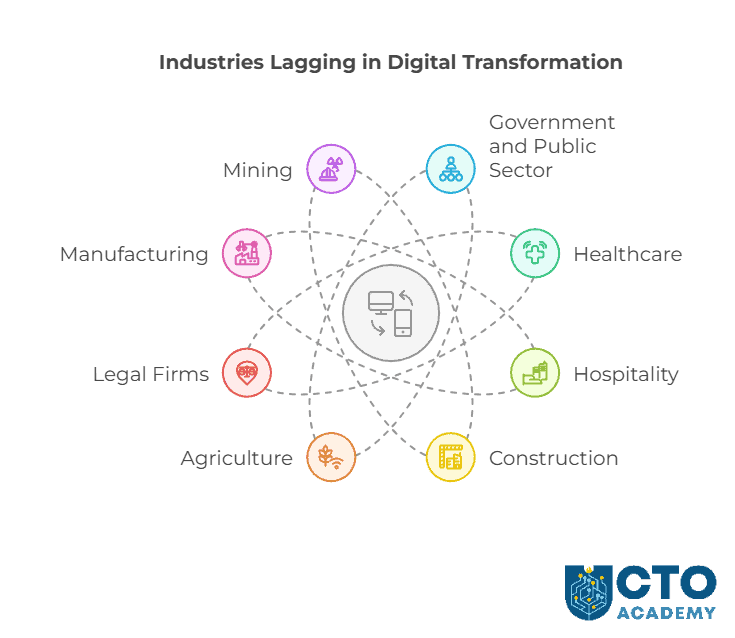
    Industries lagging in digital transformation looking for specific Tech MBA specialisation.

    When we analysed the job market, it immediately became clear that there is a rising need for leaders who can navigate digital transformation. There are still entire industries that haven’t even started the process but are desperate to get the ball rolling. 

    Here’s a list of the key laggards:

    1. Government and Public Sector
    2. Healthcare
    3. Hospitality
    4. Construction
    5. Agriculture
    6. Legal Firms
    7. Manufacturing
    8. Mining

    These industries are struggling with digital adoption for various reasons:

    But should you decide to pursue a tech leadership career in these industries, this is what you can expect as key challenges (and the underlying reason for the rising demand as well as slow adoption rate):

    • Fragmented ecosystems and complex project structures
    • Low R&D investment
    • Cultural resistance to change
    • Workforce demographics and skills gaps
    • Financial constraints, especially for small to medium-sized businesses
    • Legacy systems and processes
    • Risk-averse organisational cultures

    And that’s just digital transformation. 
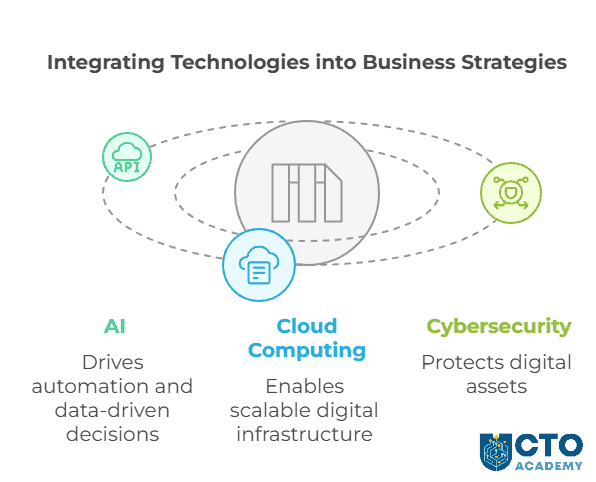
    Integration of technologies into business strategies - visual mind map

    The rapid growth of AI, cloud computing and cybersecurity is reshaping industries and creating a strong demand for leaders who can integrate these technologies into business strategies. 

    1. AI is driving automation and data-driven decision-making.
    2. Cloud computing enables scalable digital infrastructure.
    3. Cybersecurity is critical for protecting digital assets. 

    As companies invest heavily in these areas, they require Tech MBA graduates who can oversee technology adoption, manage risk and align innovation with business objectives. 

    Here are some stats to get a better sense of what is going on in the AI sector alone:

    Therefore, if you are an:

    • Engineer and/or developer seeking a leadership role
    • IT professional transitioning into strategy and management
    • Entrepreneur aiming to launch a tech start-up

    You should definitely consider a Tech MBA.

    Also, there is one other largely overlooked reason to pursue a Tech MBA

    Top In-Demand Tech MBA Specialisations and Career Opportunities

    This section will break down the leading specialisations and the roles they prepare graduates for.

    Technology Leadership

    Right now, there are well over 13,000 job ads on Glassdoor and Indeed alone for Chief Technology Officer, IT Director, Head of IT and VP of Engineering roles worldwide. Besides a strong technical background, candidates must also know their way around the:

    • Specific industry/niche 
    • Strategic technology planning
    • Communication of tech vision (to non-technical stakeholders)
    • Innovation and research
    • Managing development processes
    • Infrastructure management
    • Growth risk management
    • Talent acquisition and development
    • Stakeholder collaboration
    • Vendor and partnership management

    This guide explains the tech leader’s role, responsibilities and qualifications in businesses of different sizes.

    To the best of our knowledge, only one Tech MBA is specifically designed for well-rounded technology leaders—unlike programs focused more on AI/ML, innovation and finances. It is also well-suited for technology leaders looking to drive digital transformation and upgrades.

    The faculty, in this case, consists of active senior leaders (CTOs, Group CTOs, VPs of Engineering, IT Directors, Heads of IT, CEOs, CIOs, Entrepreneurs, Fintech and Big Data tech executives and similar). Judging by the Trustpilot reviews, it delivers. 

    Artificial Intelligence and Machine Learning

    There are 331,000 active job ads in the US and UK seeking technology leaders specialised in AI and/or ML. In the UK, for example, the salary range for AI Engineers is between £70,000 to £120,000 with some sources reporting up to £170,000 for top roles.

    The core skills the companies are looking for are:

    • AI strategy and ethics
    • Machine learning applications for business
    • AI product management

    Possible career paths (ranked by the demand on the job market):

    • AI Strategy Consultant
    • Machine Learning Manager
    • AI Product Manager

    The top 3 Tech MBA programs with AI/ML leadership specialisations are:

    1. MIT Sloan School of Management (US) (not exactly an MBA, but earns you an MIT Sloan certificate in AI and ML anyway) 
    2. Northwestern University – Kellogg School of Management (US)
    3. University of California, Berkeley – Haas School of Business (US)

    These programs stand out for their comprehensive AI/ML curricula and emphasis on developing leadership skills in the context of emerging technologies.

    Data Analytics and Business Intelligence

    Data-driven decision-making is now standard practice and businesses need professionals who can extract insights from data. To be effective in that role, you must possess these core skills:

    • Advanced analytics and big data management
    • Predictive modelling for business strategy
    • Data governance and compliance

    In terms of potential career paths, we are talking about:

    • Chief Data Officers
    • Business Intelligence Directors
    • Data Strategy Consultants

    The top three choices here are:

    1. MIT Sloan School of Management (US)
    2. Carnegie Mellon University – Tepper School of Business (US)
    3. Duke University – Fuqua School of Business (US)

    Cybersecurity Leadership

    Cybersecurity job postings in the US alone are projected to grow by 33% from 2023 to 2033. One of the drives, besides the obvious threats, is rising regulatory pressure on businesses to manage digital security. Salaries for cybersecurity specialists range from £50,000 to £100,000 in the UK for example.

    That’s the reason why three core in-demand skills are:

    This means that you can pursue these roles:

    • Chief Information Security Officer (CISO)
    • Cyber Risk Manager
    • Security Compliance Director

    If this is where you see yourself in the near future, then maybe you should consider one of these three programs:

    1. Florida Institute of Technology – MBA in Cybersecurity
    2. James Madison University – MBA with Information Security Concentration
    3. Baylor University – MBA in Cyber Security

    Cloud Computing and Digital Infrastructure

    Businesses are migrating infrastructure to cloud platforms at an accelerated rate. Some estimates are that cloud computing is expected to be a $1.24 trillion market by 2028. The process requires leaders with developed skills in:

    • Cloud architecture strategy
    • Managing hybrid and multi-cloud environments
    • Cloud financial management (FinOps)

    With the Tech MBA certificate in your pocket, it is going to be that much easier to land a job as a Cloud Strategy Consultant, Digital Transformation Director or Cloud Architect. If you are aiming for a Cloud Architect role, for example, you can expect anywhere between £80,000 to £120,000

    The type of program that you should consider if you want to focus solely on cloud computing and infrastructure is, for example, EU Business School – MBA in Cloud Computing.

    Product Management and Technology Innovation

    Companies prioritise digital innovation to stay competitive. It explains the constant need for tech-savvy product managers capable of aligning technology with business objectives. The core skills they are looking for are:

    • Agile product development methodologies
    • User experience (UX) research and design
    • Digital business modelling

    This can take you on a career path to any of the following roles:

    The recommended Tech MBA in product management is the CTO Academy’s Digital MBA for Technology Leaders. The curriculum covers the entire life cycle and lectures are delivered by senior leaders with extensive experience in innovation, development and business applications.

    How to Choose the Right Specialisation

    Start by assessing personal strengths and interests. 

    Do you prefer strategic decision-making or technical problem-solving? 

    Or are you more interested in security, data or innovation?

    What about industry? Is it fintech, healthcare, e-commerce, etc?

    Do you prefer on-campus programs, online or hybrid? 

    What is the budget? Are you self-financing or you can get your company to pay for it?

    Refer to this guide for the list of the main considerations when choosing a Tech MBA program

    Career Impact of a Tech MBA

    It is a major step because you’re transitioning from a purely technical role to an executive position where soft skills are equally important as technical. The first thing that will change is your salary.

    Tech MBA graduates earn 20-40% more in leadership roles. According to Prodigy Finance, for instance, MBA graduates often experience a 50% to 100% increase in their pre-MBA salaries, underscoring the substantial financial benefits of the degree. Research.com, on the other hand, reports that MBA graduates entering technology roles have reported median base salaries of $140,354 from the University of Washington and over $180,000 from Stanford, with specialized roles drawing average salaries ranging from around $120,000 to upwards of $270,000.

    But the key benefits of a Tech MBA for career growth extend far beyond income. The horizon expands and as a graduate, you become perfectly capable of integrating your technical knowledge with business skills. This is crucial for navigating both the technological landscape and the broader business environment. It opens various roles such as Product Management, Data Analytics, Digital Transformation Consulting and AI Strategy for instance. 

    You will also develop critical leadership skills essential for managing teams and driving organisational change.

    For a detailed overview of the career impact of a Tech MBA, refer to this guide. 

    However, arguably the most important benefit is networking and industry connections. Take CTO Academy’s Digital MBA for Technology Leaders for example. 9 CTOs, 1 Group CTO, 1 Group CIO, 3 VPs of Engineering, 13 CEOs/CIOs/COOs and 13 Senior Leaders as subject experts deliver lectures. During the course, these same lecturers often participate in live online sessions (eg, Peer-to-Peer, CTO Shadowing, etc.) where you can directly engage them. 

    Moreover, on a dedicated Slack for members, there is the #jobs-offered channel, for instance, where members and CTO Academy moderators regularly post interesting jobs. So it’s basically a tight-knit community where it’s easy to get not only endorsement but 24/7 assistance in daily operations from fellow tech leaders who have been in that same predicament and know how to best handle it. 

    In your future career, this can easily turn out to be your most valuable wildcard, remember that. 

    However, if you have additional questions and/or want to make sure that the Tech MBA is a good fit for your career, Book a Discovery Call and explore your options with our CEO, Andrew Weaver.

  • The Impact of Tech MBA Programs on Career Advancement

    The Impact of Tech MBA Programs on Career Advancement

    Technology professionals aspiring to senior leadership roles often contemplate the necessity of a master’s in technology leadership. It can be time-consuming and quite expensive so it’s only natural to weigh your options. However, you can’t make an informed decision without all the relevant information. That’s why we focused this article on career advancements enabled by technology leadership programs. 

    As you will soon learn, with only a few exceptions, some tangible career progression to C-suite roles in technology is nearly impossible without a Tech MBA. The reason is simple: a Tech MBA, as a specialised Master of Business Administration (MBA) program, integrates business management principles with technology-focused education. In other words, these programs are designed to prepare professionals for leadership roles in tech-driven industries. Without them, technology leaders face severe challenges in critical business operations and on their projected career paths. 

    Common Challenges CTOs Face Without an MBA

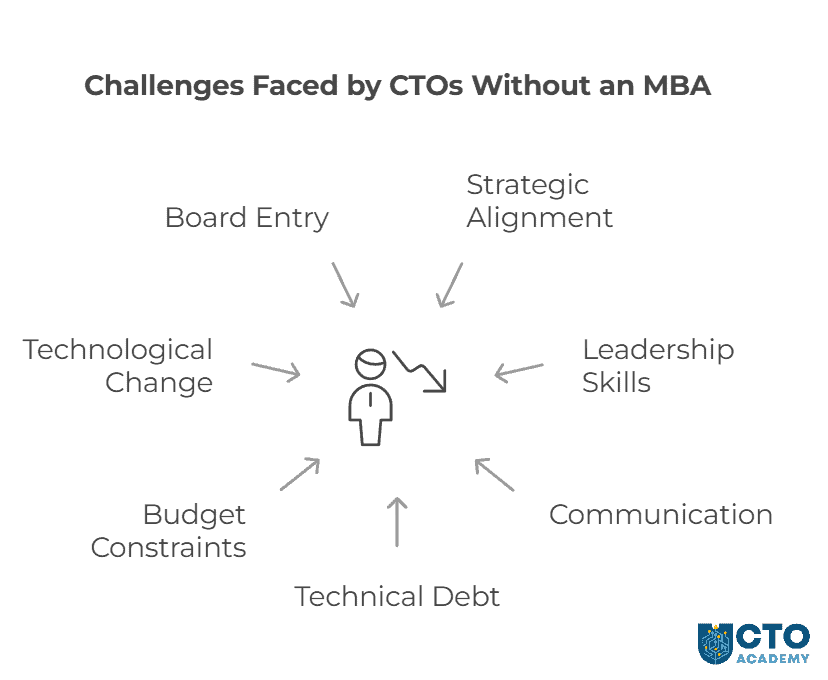
    Challenges faced by CTOs without an MBA - visual presentation of key points

    1. Difficulty in Strategic Alignment  

    CTOs often find it challenging to align technology initiatives with broader business goals. Without understanding business strategy, you may struggle to communicate how technology can drive value and support organisational objectives. This will inevitably lead to misaligned priorities and ineffective tech investments which could make your contract duration extremely short.

    2. Limited Leadership and Management Skills  

    We can safely assume that you come from strong technical backgrounds and may lack formal training in leadership and management. This can result in a reluctance to delegate responsibilities or manage teams effectively, leading to bottlenecks in decision-making and project execution. The “I’ll do it myself” syndrome can hinder team autonomy and scalability, as you become too involved in day-to-day operations instead of focusing on strategic oversight.

    3. Poor Cross-Departmental Communication  

    Without critical MBA modules, you are most likely to struggle with cross-departmental communication. This will result in isolation within the tech team. Consequently, that can prevent you from understanding other departments’ needs and objectives, leading to a disconnect between tech initiatives and overall company goals. After all, effective collaboration is essential for ensuring that technology supports the entire organisation.

    4. Challenges in Managing Technical Debt  

    Managing technical debt—accumulated suboptimal code or outdated systems—can be particularly daunting for CTOs lacking business acumen. They may prioritise immediate technical fixes over long-term strategic improvements, which can stifle innovation and increase operational risks. Understanding the financial implications of technical decisions is crucial for effective management. 

    Did you know, for example, that technical debt consumes between 23% and 42% of developers’ time in start-ups? Imagine your team’s output if you manage to keep it in the lowest point of that range. 

    That’s why in Module 5 (Product Development), Week 20 (Delivery), our Digital MBA for Technology Leaders has a dedicated lecture on Technical Debt within the context of software engineering. Students learn from different scenarios where development teams deliberately take shortcuts to achieve near-term objectives, acknowledging that these decisions will have to be repaid later. From taking shortcuts to shifts in paradigm, quantifying, outdated dependencies, security vulnerabilities and operational inefficiencies, it covers every detail of technical debt.

    5. Navigating Budget Constraints  

    Without an MBA’s financial training, you may find it difficult to manage budgets effectively. In other words, you might struggle to prioritise projects based on business value and risk, which is essential for maximising the impact of IT investments under budget constraints. 

    To give you a clue about how important and complex this subject is for technology leaders, there are 18 lectures in the Finances & Funding Module of our Tech MBA directly related to budgeting.

    6. Keeping Pace with Technological Change 

    Every relevant Tech MBA program contains a module with strategic foresight and market analysis, skills that are vital for evaluating new technologies and their potential business impact. Without this training, CTOs may miss opportunities to leverage advancements that could benefit their organisations. 

    It’s one thing to know how to code the app, but knowing which app to code and when is a different kind of game.

    7. Entering a Board of Directors

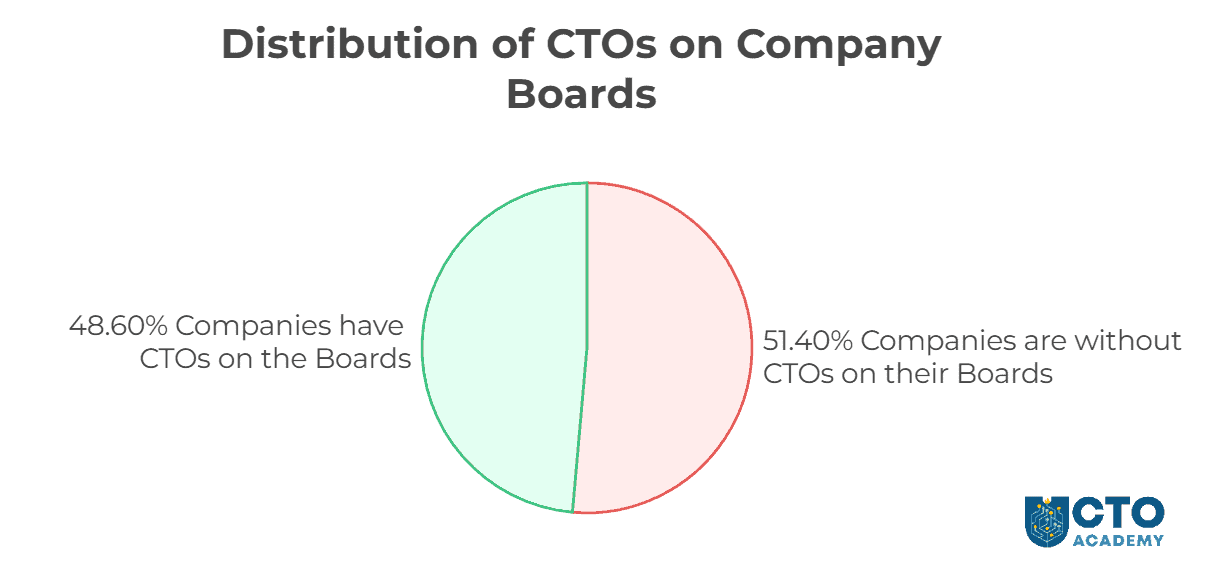
    Sitting on the Board often marks the final step on your career path. For many, this is a confirmation of personal and professional success. However, it’s not that easy to get onto one. In one of our most recent surveys, 51.4% of all respondents (we sent out the survey to over 9,000 senior engineers and technology leaders) claimed that there is no CTO on the Board of their company. 

    Distribution of CTOs in Company Boards chart - results of survey sent to 9,000 senior technology leaders and engineers

    It seems completely illogical to not have a Chief Technology Officer on the Board in any company as it is either creating or consuming tech, but that’s the reality. And that unfortunate reality that we are trying to change from Day One here at CTO Academy is caused by two factors:

    1. Lack of business acumen, common for people with strong technical background.
    2. Inability to convey complex technical solutions to non-technical stakeholders.

    Take any Board in any company and there will be 0 to a maximum of 1 member who truly understands our sometimes complex and hard-to-understand technical jargon. Executives responsible for finances, marketing, HR, logistics and even CEOs will have a really hard time translating, “Containerised microservices architecture leveraging Kubernetes orchestration with CI/CD pipelines for automated deployment and horizontal scalability” to something they understand without your help. And let’s face it, nobody wants to come across as ignorant. The best way to prevent that is to avoid the situation altogether. But that doesn’t change the fact that you must revamp your tech stack because if you don’t, you’ll come across as incapable.

    Chief Technology Officers and other senior tech leaders with Tech MBAs in their pockets would pitch their Boards saying, “We break a big application into small, independent parts (microservices) and put them in lightweight portable software packages (containers). A system called Kubernetes helps manage and balance these parts efficiently across different computers. We also use automated processes (CI/CD pipelines) to update and deploy changes quickly without manual effort.”

    But how do you know which technology to add to your stack and how to best utilise it if you don’t have strong business acumen? Remember our #1 challenge, aligning technology initiatives with overarching business goals? If you don’t know what the best utility for the job is, not even the most advanced rhetorical skills will help you. That’s the reason why most Boards still don’t perceive technology leaders as equal partners in the process. 

    As you can see, while technical expertise is crucial for a CTO role, the absence of an MBA can lead to significant challenges in several critical areas. These challenges alone highlight the importance of integrating both technical skills and business acumen for effective leadership in technology-driven organisations.

    Now, let’s turn our attention to the benefits of technology leadership programs. 

    Key Benefits of a Tech MBA for Career Growth

    1. Bridging Technical and Business Skills

    • Tech MBA programs focus on integrating technical knowledge with essential business skills. This dual expertise is crucial for CTOs, who must navigate both the technological landscape and the broader business environment. 
    • Courses typically cover areas such as financial management, strategic decision-making and innovation, enabling graduates to translate complex technical concepts into actionable business strategies.

    2. Higher Earning Potential

    • Tech MBAs typically lead to high-paying roles, as graduates are well-equipped to bridge the gap between business and technology.
    • Industries such as AI, cloud computing, fintech and cybersecurity offer competitive salaries to Tech MBA graduates.

    3. Leadership & Management Opportunities

    4. Expanding Career Horizons

    • Graduates can transition into various roles, including Product Management, Data Analytics, Digital Transformation Consulting and AI Strategy.
    • Companies across industries (not just tech) value Tech MBA graduates for digital transformation initiatives. The reason is simple: professionals equipped with both technical expertise and business insight are better positioned to adapt and lead.

    5. Networking & Industry Connections

    6. Entrepreneurial & Start-up Opportunities

    • Many Tech MBAs are designed for aspiring entrepreneurs, offering specialised courses in venture capital, digital business models and start-up growth.
    • Access to incubators and accelerators can help graduates launch their own tech ventures.

    Career Paths & Job Roles After a Tech MBA

    Here are some career paths that Tech MBA graduates commonly pursue:

    RoleAverage Salary (USD)Key Responsibilities
    Chief Technology Officer$170,000 – $300,000Oversees the technological direction of the company, ensuring that technology strategies align with business goals
    Product Manager$120,000 – $160,000Leads product strategy, development and market fit
    Data Scientist$110,000 – $150,000Analyses big data to drive business decisions
    Tech Consultant$100,000 – $140,000Advises companies on digital transformation and IT strategies
    Software Engineering Manager$130,000 – $180,000Manages development teams and oversees technical projects
    AI/ML Specialist$130,000 – $170,000Implements AI-driven solutions for businesses
    Start-up FounderVariesCreates and scales technology-driven businesses

    Note, please, that salaries vary based on experience, industry and location.

    Read also: How to Choose the Most Optimal Tech MBA Program

    Industry Demand for Tech MBA Graduates

    The demand for tech-savvy business leaders is rising. One of the important drives is digital transformation where companies across industries are investing in AI, automation and cloud computing. Naturally, they require tech leaders equipped with both technical and business acumen. 

    Growing threats increase demand for executives with security expertise to build and manage their cybersecurity and risk management initiatives. Often, these companies seek leaders who can integrate AI/ML into business strategies beyond security-related tasks. 

    Finally, let’s not forget the ever-growing fintech ecosystem with financial institutions always on the lookout for tech-driven executives keen to and capable of innovating banking solutions. 

    Best Tech MBA Programs (Globally Recognised)

    Some of the top-ranked Tech MBA programs include:

    Is a Tech MBA Worth It?

    A Tech MBA is worthwhile if:

    • You aim for leadership roles in tech.
    • You want to transition into high-paying high-demand tech sectors.
    • You’re interested in AI, fintech or digital transformation.
    • You plan to launch a tech start-up.

    To be perfectly clear, it may not be necessary if you already have strong technical skills and only need short-term specialised courses (eg, certifications in AI, cloud computing or data science).

    Conclusion

    A Tech MBA significantly enhances career prospects by blending business acumen with technical expertise. It opens doors to leadership roles, higher salaries and a strong professional network. Therefore, if you’re looking to advance in the technology-driven business world, a Tech MBA will most likely be a game-changer.

    Now, take a few minutes and explore a technology leadership program custom-tailored for future Chief Technology Officers with a faculty of 40 senior executives teaching immediately applicable solutions and conveying real-world experience. It will give you a better overview of what to focus on in your search for the most optimal master’s in technology leadership. 

  • How to Choose the Best Online MBA in Technology Management for Your Career

    How to Choose the Best Online MBA in Technology Management for Your Career

    An online MBA in Technology Management can equip you with the skills and knowledge to thrive in your leadership role. However, a multitude of available programs makes that choice complex and overwhelming. This article provides a comprehensive overview of online tech MBAs, highlighting key considerations to help you make an informed decision and propel your career.

    As you will see, only one online MBA program is delivered by seasoned technology leaders with a curriculum immediately applicable to daily operations. 

    5 Main Categories of Online MBA in Technology Management w/ Examples and Use Cases

    General Technology Management MBAs

    General tech management MBAs provide a broad understanding of technology’s role in business. They usually cover IT strategy, innovation management, data analytics and cybersecurity.

    These general programs are ideal for professionals seeking versatile skills applicable across various tech-related roles; for example, mid-career technology managers, aspiring technology executives, tech entrepreneurs, tech consultants and tech professionals looking for a career change. However, remember that this is more of an introduction to various subjects than a deep dive. 

    Examples include: Northwestern University – Kellogg School of Management, University of California, Berkeley – Haas School of Business and University of Pennsylvania – Wharton School

    Specialised Technology Management MBAs

    Here, we have five major subcategories:

    1. Information Systems
    2. Cybersecurity Management
    3. Data Analytics
    4. Digital Transformations
    5. Project Management

    MBA in Information Systems dives deep into designing, implementing and managing information systems within organisations. It is best suited for technology professionals who want to combine their technical skills with business acumen to take on leadership roles. For example, IT managers and directors, systems analysts, data analysts/scientists and software developers looking to transition to management roles. 

    Examples include: the University of Maryland – Robert H. Smith School of Business (MBA in Information Systems) and the University of Southern California – Marshall School of Business (MBA in Technology and Operational Management).

    Cybersecurity MBA focuses on protecting information assets, managing cyber risks and developing security strategies. You would want to opt in for this type of MBA if you see yourself leading security teams or consulting businesses (you need to learn a thing or two about business strategy and management in general after all). 

    Some examples are: James Madison University (MBA in Information Security) and Bellevue University (MBA in Cyber Security). 

    MBA in Data Analytics emphasises using data to drive business strategy, make informed decisions and gain a competitive edge. You should consider these kinds of programs if you work with data and want to enhance your business acumen to take on more strategic roles within your organisation.

    Examples: Louisiana State University Shreveport (Online MBA in Data Analytics), University of North Carolina – Chapel Hill (Kenan-Flagler – Online MBA with a Concentration in Business Analytics) and Arizona State University (Carey).

    Digital Transformation MBAs equip leaders with skills and knowledge that enable them to navigate digital disruptions and leverage technology for organisational growth and innovation. Choose this if you are:

    • Overseeing digital projects and wanting to gain a deeper understanding of business strategies to drive digital innovation.
    • Responsible for managing IT departments and want to lead digital transformation efforts within your organisation.
    • Focused on optimising business processes and want to leverage digital technologies to improve efficiency and effectiveness.
    • CDO (Chief Digital Officer).
    • Responsible for developing and managing digital products and services and need to understand both technology and business strategies.
    • Aiming to provide consulting services in digital transformation. 

    The most notable program is the Quantic School of Business and Indiana University – Kelley School of Business (Online MBA with a Concentration in Technology).

    The last on the list, and as its name suggests, an MBA in Project Management helps improve necessary skills for effective leadership and management of technology projects to ensure successful implementation and delivery. Therefore, if you are on the path to the CPO or CPTO role, this is the type of MBA you should consider.

    Example programs: Fayetteville State University – College of Business and Economics (Online MBA in Project Management) and London School of Business and Finance (Online MBA in Project Management).

    Industry-Specific Technology Management MBAs

    • MBA in Healthcare Technology Management focuses on the use of technology in healthcare delivery, administration and patient care. Examples include Southern New Hampshire University, US (Online MBA in Health Care Management) and University of York, UK (Online MBA Healthcare Management)
    • MBA in Financial Technology (FinTech) explores the intersection of finance and technology, covering areas like blockchain, mobile payments and online lending. Most notable examples include St. John’s University, US (M.B.A. in FinTech) and MLA College (University of Plymouth), UK.
    • MBA in Supply Chain and Logistics Technology emphasises the use of technology to optimise supply chain operations, improve efficiency and reduce costs. These types of programs are offered by the University of South Carolina Aiken, US (Online MBA in Supply Chain Management) and the University of Sunderland, UK (Online MBA with Supply Chain Management) among others. 

    Dual-Degree Programs

    • MBA/MS in Computer Science combines business acumen with advanced technical expertise in computer science. Therefore, if you aim to take on leadership roles in tech-driven industries (eg, as a Technology Manager, Product Manager or Data Scientist), this is for you. Some examples include: the University of Southern California, US (Online MBA/Master of Science in Computer Science) and the University of Edinburgh, UK (Online MBA/MSc in Computer Science).
    • MBA/MS in Engineering integrates business management skills with engineering knowledge for leadership roles in technology-driven industries. So if you see yourself in leadership or managerial roles within engineering and technology-driven industries (eg, as an Engineering Manager, Product Manager, Operations Manager or Project Manager), you should consider enrolling in this type of programme. Probably the most renowned program is the one provided by the Massachusetts Institute of Technology (MIT) – Online MBA/Master of Science in Engineering. In the UK, the University of Sunderland offers a similar program – Online MSc Engineering with Management. 

    Specialised CTO Programs

    These Online MBAs in Technology Management are specifically designed to equip current and aspiring CTOs with the skills and knowledge needed to excel in this role. 

    Curriculums commonly address technology vision and strategy, technology architecture and infrastructure, digital transformation and innovation, technology governance and compliance and overall business management.

    The most notable examples in this category are: CTO Academy, Berkeley, Wharton and Cambridge.

    Now, what separates CTO Academy from the other three — except for being more affordable and accessible — is that the program (Digital MBA for Technology Leaders) focuses more on practical skills and immediate application. All you need to do to confirm this is to review the faculty

    Digital MBA for Technology Leaders by CTO Academy - Tech MBA by CTO Academy

    At CTO Academy, the list of lecturers includes 9 CTOs, 1 Group CTO, 1 Group CIO, 3 VPs of Engineering, 13 CEOs/CIOs/COOs and 13 Senior Leaders as subject experts. That’s a total of 40 lecturers delivering 220 micro-lectures – all currently active in their roles. 

    Berkeley, Wharton and Cambridge have 7-9 professors delivering all the lectures with only less than five cumulatively with at least some sort of leadership experience – predominantly in institutions.

    And that’s an important factor to consider when choosing the best online MBA in Technology Management for your career. Once in the CTO role, you will not have much manoeuvring space. So having a faculty teaching everyday challenges does come in handy; especially when combined with an active community of technology leaders answering every question within a few minutes. For example, #burning-issue-needs-a-call or #ask-the-community channels on the CTO Academy Global Community’s Slack that is accessible to MBA graduates and members.  

    Main Considerations When Choosing an Online MBA in Technology Management

    1. Define Your Career Goals

    Self-Assessment:

    • What are your current career aspirations? (eg, CTO, Product Manager, Data Scientist, Entrepreneur)
    • What are your long-term career goals?
    • What are your strengths and weaknesses?
    • What are your interests within the technology field? (eg, AI, cybersecurity, fintech)

    Industry Research:

    • Research the current trends and demands within your desired industry.
    • Identify the skills and knowledge required for success in your target roles.

    2. Evaluate Program Factors

    Curriculum:

    • Does the program offer specialisations that align with your career goals? (eg, CTO role specifically, AI, FinTech, Cybersecurity)
    • Are the core business modules (finance, marketing, operations, data analytics) relevant to the technology industry?
    • Does the curriculum cover the latest technologies and industry trends (e.g., AI, cloud computing, blockchain)?

    Faculty:

    • Does the faculty possess relevant industry experience and credentials?
    • Do they emphasise practical application, real-world case studies and industry connections?

    Technology and Learning Platform:

    • Is the online learning platform easy to navigate and use?
    • Does the program effectively utilise technology for interactive/immersive learning?

    Flexibility and Support:

    • Does the MBA program offer flexible scheduling options to accommodate your work and personal commitments?
    • Does the online MBA program provide career counselling, job placement assistance and networking opportunities?

    3. Consider Your Budget and Financial Aid

    4. Program Accreditation and Reputation:

    • Ensure the program is accredited by reputable bodies (eg, AACSB, AMBA, CPDUK).
    • Research program rankings from reputable sources (eg, Trustpilot).
    • Investigate the strength and reputation of the program’s alumni network.

    Conclusion

    Selecting the optimal online MBA in Technology Management is an investment in your professional future. By carefully considering your career aspirations, evaluating program features, assessing ROI from the financial and career perspectives and choosing between practice and academia, you can zoom in on just the right online MBA in technology management

  • One Important Yet Overlooked Benefit of a Tech MBA

    One Important Yet Overlooked Benefit of a Tech MBA

    When contemplating career paths, people can question the necessity of undertaking a specialised educational programs such as a Tech MBA, that is until they face two challenges.

    The First Challenge

    At CTO Academy, we coined the term ‘Accidental CTO‘ to describe an accelerated path to the Chief Technology Officer role.

    This tends to be someone typically working within an early-stage, fast-growing company who has been fast-tracked into a CTO role, due to a combination of their technical expertise and the rapid growth of the company. 

    These individuals may not have initially planned to become CTOs (or at least not so quickly) but they find themselves in that role due to the aforementioned combination of skills and company needs. 

    One of the members from our Global Community and one of our Tech MBA graduates, Mostafa Khattab, when CTO at Dubai-based Wakeup Technologies, published a series of blogs about his experience.

    He recalled …

    “I struggled to jump directly from senior developer to CTO, especially during a time of growth where absolutely everything was running at full speed. The business, the tech challenges and the fundamental change in my role are the challenges you cannot anticipate in advance. I, for one, didn’t see them all.”

    Reality kicked in when Mostafa realised he was responsible for everything on the tech side of the business and everyone in the technical teams.

    Realisation triggered stress, fatigue and anxiety to the point where he began questioning his ability to deliver what was expected of him. He instinctively knew that something had to change and he had to be at the forefront of that initiative. Which is where finding a community of peers with many similar experiences is crucial.

    “Working with CTO Academy has been just the fresh start I needed. I was shocked that someone out there could feel my pain. It wasn’t just me. I wasn’t alone in all of this. These growing pains were very familiar and shared by other tech leaders around the world. It was like a dream to find someone with extensive experience to help me out. I have been working with them for nearly a year and I cannot recommend it more highly. You cannot take this all on your own shoulders, particularly if, like me, you become a CTO ahead of schedule.”

    Mostafa’s story as an Accidental CTO is not uncommon within our community and is one of the challenges that can accelerate the need to ramp up your need for a Tech MBA style course.

    The Second Challenge

    For most people landing a CTO role means the obvious obstacle of the job interview.

    In our deep-dive guide on mastering the CTO interview questions, we revealed the true purpose of these interviews. In a nutshell, the company searching for the Chief Technology Officer initially wants to learn a few important things about the candidate:

    • Predict the candidate’s future performance
    • Assess interpersonal skills or the so-called soft skills
    • Asses hard (technical) skills
    • Candidate’s long-term thinking capabilities
    • Motivation

    To get the information, they commonly use functional and behavioural interview questions based on predefined criteria. Interviewers use success/failure data points to assess whether or not the candidate is the right choice for the role. 

    Now, this is where it gets challenging. 

    You are tech-savvy without question. Your hard or technical skills are excellent and you have experience with an array of technologies, frameworks and tools. But how good is your business acumen? 

    You see, in technology leadership, there are three distinct roles

    1. Tech Leads
    2. Technical Leaders
    3. Chief Technology Officers 

    Only one of these requires extensive experience in business administration. Hence, only one provides enough knowledge to answer inevitable questions about business fundamentals, business goals and, finally, finance and funding. 

    Let me explain.

    Tech Leads provide technical guidance to their team members and have more hands-on responsibilities. Technical Leaders, on the other hand, oversee the technical direction of a larger team or even multiple projects. They are responsible for the overall technical strategy and architecture decisions. 

    Unlike these two roles, a Chief Technology Officer is a C-suite executive who reports directly to the CEO. They are a part of the strategic decision-making team responsible for aligning technology with business goals, managing budgets and finances in general, evaluating and implementing new technologies, managing IT infrastructure and ensuring the security and compliance of all technical systems. These responsibilities may span the entire organisation and involve multiple technical departments.

    Now, if you haven’t worked as a CTO and haven’t gone through a Tech MBA, how difficult do you think it is going to be to go through the CTO job interview successfully?

    CTO Academy is dedicated to supporting experts like you by providing the resources and training they need to excel in their roles. One of the most prominent is definitely our Digital MBA for Technology Leaders. A 4.9 Trustpilot rating clearly speaks about the career impact the program has on existing and future CTOs. Take a few moments and familiarise yourself with the Tech MBA that solves this second challenge.

    Learn more about our Digital MBA for Technology Leaders and its positive impact on the careers of technology professionals.

  • Look Inside The Digital MBA for Technology Leaders

    Look Inside The Digital MBA for Technology Leaders

    Our primary job with The Digital MBA for Technology Leaders is to help you extract as much value, learning, insight and long-term connections as possible so that the course creates a legacy of benefits that will follow you throughout your career.

    The engine that’s driving the course material is our core mission and that is to empower technology leaders to achieve the careers they want and help them create products that can possibly change the world.

    About The Digital MBA for Technology Leaders

    The course itself is the culmination of two to three years of market research, customer validation and frankly, just getting in front of as many tech leaders as we could.

    We estimated probably 400 one-to-one conversations or coaching sessions that have taken place just with Jason and I alone for us to understand exactly where and what help you need to enhance your skill set, build your confidence and achieve the career impact you want.

    The course has been directly shaped by those conversations and by our nuanced understanding of the market.

    Content and Delivery Method Overview

    The Digital MBA for Technology Leaders is delivered through nine sequential modules released at a pace of one module each month.

    Each module has exactly the same shape: 25 lectures — high-impact micro-content — released in weekly packages throughout the month, and concluding with a discussion panel.

    The panel is the place where I’m joined by members of the faculty to pick out their key takeaways from each module. It is designed to act as a tutorial for you to reflect and review.

    At the end of each module, there’s a live group session facilitated by one of our leadership coaches. Discuss, debate, maybe even challenge some of the points that have been made in these 25 lectures. We are all on a constant learning path and we really love to hear those contrasting views.

    Each module concludes with a self-assessment that helps you cement that learning experience and move towards the certificate of completion at the end of the course.

    Expert Faculty

    A really powerful part of our Digital MBA for Technology Leaders and CTO Academy respectively is the global and growing faculty that we’re building. We’ve got the whole C-suite represented: CTO, CEO, CIO, CDO, CPO, CISO…

    I might’ve missed a couple of COs there but we have psychologists, data scientists, professional leadership coaches, award-winning authors, investors, chairmen, successful entrepreneurs, keynote speakers, you name it.

    To give you an example, in Module 1, from the business world, we’ve got Julian Costley. Julian is an experienced entrepreneur, a CEO and NED investor. Most recently, he bought a publishing company called Bite-Sized Books in the UK. He’s worked all over the world and since exiting a market-leading online stockbroking firm called E-Trades back in 2000, he’s invested in 26 companies around the world, sits on multiple boards and is a mentor to the MBA program at London Business School.

    Specifically, Julian will be looking at how to be effective at executive level, what the CEO and investors are looking for from their CTOs and senior tech teams, how to design remuneration packages and much more.

    From tech and academia, we have Professor Sally Eaves, a Global Strategy Advisor, CTO, CIO and CEO, who works across the intersection of technology, education and social impact change. She is a speaker and author with a particular passion for emerging and sustainable tech. Sally is heavily involved across the course and as someone working with a range of cutting-edge start-ups, she’s helping us curate much of the module that looks at Digital Trends and Innovation.

    We’re joined by leadership experts like Andrew Bryant, an award-winning global executive coach, a TEDx speaker and Amazon best-selling author who wrote the book on Self-Leadership amongst others. He’s on the Women in Leadership Faculty at Singapore Management University and the Leadership Faculty for IE University in Madrid.

    Andrew delivers a great lecture on self-leadership, but he’s also involved in wider leadership debates and discussion panels about what really matters to be truly effective in senior roles.

    In addition, we’re joined by operational tech leaders from around the world to deliver lectures, talks and panel discussions around aspects of tech leadership that they specialise and have a passion for. You will learn from real-life problems that these CTOs face in day-to-day operations.

    Whether that’s Santiago in Montevideo on his recent experiences of closing a $60 million Series B round, or my colleague at CTO Academy, Sanjay, who is also a Group CTO and one of our senior leadership coaches, who dives into tech strategy and how to make sure it’s aligned with business goals.

    That unparalleled range of experiences, expertise and disciplines is available to you throughout the course.

    Our Own Contribution

    But let’s not forget the mighty contribution from our team here at CTO Academy. We are able to bring not only our own leadership experience to the table, but also the insights that we’ve gleaned from those hundreds of one-to-one meetings and interviews with tech leaders around the world.

    We are constantly learning and growing as people in an organisation, so we’re constantly adding to this course as a result. And every update we make is immediately available to you – even after you graduate.  

    How It Begins?

    Now, one of the first things that happen once you enrol is you being introduced to your cohort.

    It is an opportunity to discover the range of roles, sectors and locations included within your particular group. There’s a huge amount of talent contained within that group alone and the end-of-month cohort sessions give you a direct opportunity to discuss, debate and network.

    Community Membership

    We have a very active and growing global community of tech leaders debating different issues around tech leadership. If you haven’t already joined it, go here to learn more details about CTO Academy Membership and what it brings to you.

    You’ll also be receiving an automatic invitation to our monthly live webinars where a variety of exceptional speakers will be delivering their thoughts across a variety of topics.

    All of these webinars — and all live sessions within the course itself — are recorded and added to your course material because we know that real life and time zones might preclude you from attending everything we offer. Nonetheless, we really want to make sure you have access to all of that material.

    Let’s not forget drop-in sessions where you can ask questions and watch out for future networking events and meetings, both online and offline.

    Key Touch Points

    CTO Academy also provides you with two key touch points within our organisation.

    Your Personal Course Manager, who will be overseeing your engagement with the course, the cohort and the wider community. He or she is available throughout the duration of this course, so really just reach out with any questions.

    You’ll also be contacted by our Customer Success Team. They are here to ensure the process and the customer experience is meeting and hopefully exceeding your expectations. They’ll be checking in throughout the course.

    I want to conclude by stating that we are absolutely passionate about this course. We’re passionate about what we do. We want it to set you up for the rest of your career. But we also really want to hear from you with any questions and queries, feedback and potential criticisms. Tell us what you think. How can we improve? What would you like to see added or removed? Whatever comes to your mind, simply reach out. We are always happy and eager to hear from you.  

    Before you do, learn more about our Digital MBA for Technology Leaders.

  • “The Digital MBA for Technology Leaders” Shortlisted for Prestigious Learning Technologies Award

    “The Digital MBA for Technology Leaders” Shortlisted for Prestigious Learning Technologies Award

    CTO Academy is thrilled to announce that its flagship program, The Digital MBA for Technology Leaders, has been shortlisted for the Best Online Distance Learning Programme in the Learning Technologies Awards 2024. This prestigious recognition highlights the program’s exceptional quality and impact with empowering technology leaders around the world.

    Andrew Weaver, CEO & co-founder, expressed his delight at the nomination: “We are incredibly honored to be shortlisted for this prestigious award. It is a testament to the hard work and dedication of our team to make sure this course delivers exceptional value and is a learning experience that our members carry with them through their professional life.”

    Jason Noble, CTO & co-founder, emphasized the importance of continuous learning for senior technology leaders: “In the fast-paced world of technology, learning and training are not just beneficial, they are essential for success and even more so as the upskilling of a senior technology team becomes a strategic competitive advantage. This course provides technology leaders with the knowledge and skills they need to navigate complex challenges, make informed decisions, and lead their teams and organisations with confidence.”

    The Digital MBA for Technology Leaders launched in 2022 as a comprehensive and cost effective online program designed to equip senior technology executives with the strategic business acumen and leadership skills needed to thrive in today’s rapidly evolving digital landscape. The program’s innovative curriculum, world-class faculty, and vibrant community of learners have garnered widespread acclaim.

    The Learning Technologies Awards celebrate outstanding achievements in the field of learning and development. The winners will be announced at a gala ceremony in London on November 13, 2024.

    About CTO Academy

    CTO Academy is a global community and learning platform dedicated to empowering technology leaders. We have worked with customers in 100+ countries and established ourselves as a leading global provider of executive education for technology leaders.

    Through cost effective innovative programs, world-class faculty, weekly live sessions plus a vibrant and supportive community, CTO Academy equips senior technology executives with the skills and knowledge they need to thrive in the digital age.

  • “The Digital MBA for Technology Leaders” Receives Professional Development Certification

    “The Digital MBA for Technology Leaders” Receives Professional Development Certification

    The Digital MBA for Technology Leaders is an executive leadership course delivered by CTO Academy for technology leaders around the world.

    We are pleased to announce that the course has now been formally recognized and certified by the Continuing Professional Development Certification Service (CPDUK) as “conforming to continuing professional development principles”, recognizing both the high standard of professional training and exceptional value being delivered by this course to technology leaders seeking to advance their careers.

    This course is a comprehensive program designed to provide technology leaders with the critical business skills and knowledge needed to thrive in today’s digital economy. It covers a range of topics, including leadership, team building, strategic planning, personal development, information management, digital trends and many more all tailored specifically to the needs of technical leaders.

    Since the course was launched in January 2022 hundreds of tech leaders have signed up with >4,000 lecture ratings subsequently posted at an average of 4.8*

    We are thrilled to receive this certification from the CPDUK,” said Andrew Weaver, CEO of CTO Academy. “Our mission is to deliver practical and accessible insight to ambitious technologists wanting to bridge any skills gaps they have between the technology and the business. This recognition is testament to the quality of our program and the impact it’s having on the careers of our global participants“.

    CPDUK certification is widely recognized as a mark of excellence in the field of professional development. It assures learners that the course they are taking meets rigorous standards for quality and relevance, and that they will receive recognized credits for their participation.

    The Digital MBA for Technology Leaders is available online and is a blended learning experience that combines high impact micro lectures with live debate sessions and a global community of peers.

    At the conclusion of this course participants receive a certificate of completion with CPDUK accreditation that can be used to earn continuing professional development (CPD) credits.

    We know from the personal feedback received, the reviews being posted and our growing number of graduates that this course is a game-changer for the professional development of technical professionals and the impact it’s having for the individuals taking the course, and the organisations they work for” added Jason Noble, CTO of CTO Academy. “Certification from CPDUK just reinforces the benefits of joining CTO Academy with our commitment to providing high quality, high impact and practical leadership support for participants to achieve their goals.

    Find out more by visiting The Digital MBA for Technology Leaders and check out the reviews being added by recent graduates.

    CTO Academy is so much more ….

    CTO Academy is a leading provider of professional development and leadership courses for technical professionals.

    We help technologists to bridge any skills gap between the technology and the business but also to provide them with the support, insight and best practice as they negotiate ever changing demands on their role.

    Because our wider mission is to provide a professional growth ecosystem that helps them achieve the career impact they want, and the strategic competitive advantage their organisations need.

    Contact:
    Andrew Weaver
    [email protected]

  • CTO Academy Launches Scholarship Programme in Partnership with Women Who Code

    CTO Academy Launches Scholarship Programme in Partnership with Women Who Code

    September 2022

    CTO Academy is on a mission to empower global technology leaders by helping them combine their technical capabilities with high impact leadership skills.

    Embedded within this mission is a commitment to support greater diversity and balance within senior technology leadership teams.

    Women Who Code is an international nonprofit dedicated to inspiring women to excel in technology careers. WWCode is building a world where diverse women and historically excluded people thrive at every level.

    So it was a natural fit for collaboration that saw the recent launch of the CTO Academy Scholarship Program with a limited number of places each year being made available on CTO Academy’s executive leadership course The Digital MBA for Technology Leaders to WWCode members identified as having the potential to make a real impact in senior leadership roles.

    The program was formally launched in June 2022 with the award of two scholarships to Bianca Glasner, Head of Engineering at Findologic in Austria and Tina Hang, Senior Software Engineer at Parent Square in California.

    Bianca commented:

    “I was looking for a course to further improve my Leadership skills and position myself as a Technology Leader. When I saw the collaboration between WWCode and CTO Academy I was excited to apply as I saw the Digital MBA curriculum was definitely a good fit for me.

    I am really enjoying the course and see real benefits to learn more about Leadership, developing a product and making the right technology decisions.

    I know I’m going to get a lot out of the course not only for me but also for my team”

    Alaina Percival, CEO and Co-Founder of Women Who Code said:
    “Providing paths to technical education for diverse women is one of the core ways that Women Who Code works towards our mission to empower diverse women in technology careers. We’re proud to be partnering with CTO Academy to provide these valuable scholarship opportunities to our members.”

    Andrew Weaver, CEO at CTO Academy further added:
    “CTO Academy is focused making technology leadership training both accessible and practical so we’re excited to be working with Women Who Code and helping talented tech leaders like Bianca and Tina accelerate their career and the impact they can make within for their organisations”

    You can find out more about CTO Academy and our leadership courses here.

    For more about Women Who Code and their mission visit here

  • How Does CTO Academy Compare With The Berkeley CTO Program?

    How Does CTO Academy Compare With The Berkeley CTO Program?

    Why would you choose a CTO Program?

    Historically and still commonly mistaken as a purely technical role, the chief technology officer (CTO) has come to play a crucial part in the c-suite ensemble by playing critical roles in business strategy, organizational structure, and culture.

    It makes sense since whole industries are becoming increasingly automated and rely more and more on tech – making tech leadership crucial. 

    The CTO still needs to focus on using technology as an enabler for value generation. However, what’s equally important to technology in the modern role is a focus on the people and the process, two skills that make such a difference at the senior level.

    So these are the most crucial skills for effective CTOs to master and achieve the impact and success they want in their career.

    It’s for these reasons that special programs and course providers like CTO Academy are able to provide executive leadership programs specifically for technology leaders needing to develop these skills.

    At the end of the day, success in senior technology roles is rarely about the tech, it’s almost always about the people and the process.

    Finding the best CTO program for your needs

    What options are available for a senior technology leader wanting an executive-level leadership course?

    Generic leadership and business programs such as the traditional MBA are not nuanced enough to deliver the specialist training needed for the modern CTO or tech leader.

    The market is moving towards specialist programs which is why CTO Academy, now in 97 countries, are often compared with the Berkeley CTO Program as buyers consider the best executive education programs for their HIPO tech leaders.

    So we thought it useful to provide you with a comparison between (Executive Level) The Digital MBA for Technology Leaders from CTO Academy with the Berkeley CTO Program. We will highlight the key differences and create an overview for you to judge what program is the best option for you, or your colleagues.

    Our aim is to provide a comparison of the two chief technology officer (CTO) programs to enable you to judge the best options at this stage of your career. 

    Key Differences Between the Two Executive Education Programs for CTOs

    The main differences between these two CTO programs are depth, impact, cost, and longevity (aka prestige.)

    Depth of the CTO Programs

    Both courses provide an extensive range of lectures and supporting material relevant to different elements of the CTO role.

    The main CTO Program from CTO Academy, The Digital MBA, is designed to provide those already in senior technology roles to enhance their existing technical skills across areas like leadership, strategy, personal development, business fundamentals, as well as data, and analytics, information management, and digital trends. We focus on the CTO role as a hybrid leader bridging the technical and the commercial leader, with a 360 business perspective covering both.

    The Berkeley CTO Program is a high-level, academic-driven course with a curriculum based on systems, technology, and digital transformation.

    CTO Academy tends to be more broadly focused on building up those soft skills so crucial for CTOs at a senior level.

    Most CTO Academy lecturers work in senior tech and business roles which enables them to deliver an up-to-date, hands-on experience to the lectures alongside all of the supporting materials, case studies, and frameworks whereas the Berkeley Lecturers, whilst hugely impressive, have been drawn into their CTO program from different faculty within the organization.

    Impact and Applicability

    At CTO Academy, we focus on high-impact, micro-content, and a learning experience that fits alongside busy working schedules and can be immediately applicable for day-to-day operational challenges, as well as long-term career growth.

    The Berkeley CTO program delivers high-level, expert insight, though not always immediately applicable.

    Cost and Value

    You might suggest the comments above are subjective but what’s clearly available as a direct comparison is the significant difference in cost between the CTO programs on offer between our organizations.

    The full Berkeley CTO Program is approx. $30,000 (+ costs for attending campus sessions).
    The recently launched online version is available for $7,500.

    This compares to similar programs in the UK with Cambridge (Judge Business School) CTO Program coming in at $20,000 – though they sometimes offer an early bird discount.

    By comparison, the CTO Academy Digital MBA for Technology Leaders is priced at [ifso id=”259822″].

    And even if you strip away the huge price differential you might find the CTO Academy course – with 234 high micro-lectures, live cohort sessions, and a dynamic global community – delivers a significant punch when it comes to value.

    Hey, we can’t beat Berkeley for prestige being a recently launched startup, but we believe that’s the only comparable where we’re unable to compete.

    Prestige sure comes with a heavy price tag. 

    A Visual Overview of the Different CTO Programs

    At CTO Academy we are 100% online and alongside the course material we provide slack groups, online forums, group and private coaching – aimed at any level of role and focused on driving that individual to the next stage of their career. 

    The Berkeley CTO Program is an impressive presence in the executive education market for technology leaders.

    Other Executive Education Programs to Consider

    Whilst we believe that CTO Academy is now the market leader for technology leadership training, we’re happy to be compared with Berkeley or indeed any other options.

    As mentioned above Cambridge offer a comparable CTO program, as does Stanford ad Wharton – indeed, many CTO Academy members have been on these courses and given us some of the comparisons we’ve shared in this article.

    MOOC (Massive Open Online Course) like Linkedin Learning, Udemy, and Coursera cover elements of tech leadership but are more generalist and quite lightweight within this niche.

    Localized Courses and Meet-Ups: There also exists more localized networking, mentoring, and support organizations that you can find to help build your network and knowledge base.

    Conclusion

    No one doubts the quality of the Berkeley CTO Program and the faculty who deliver it. We are in awe of their experience and expertise. But that comes with a price tag and often a lack of immediate applicability versus the more dynamic, CTO-led courses delivered by CTO Academy.

    We not only provide a broad and deep perspective on what’s needed to succeed in senior technology roles but with coaching and a community that supports each member to achieve their goals and receive the best ROI for their investment of money and time.

    We might not have the Berkeley branding or prestige, but we pack a mighty punch for a recent entry in the market and you shouldn’t be buying one, without comparing it with the others.

  • The CTO and The MBA … a history of coming together!

    The CTO and The MBA … a history of coming together!

    [Since writing this article, we have launched “The Digital MBA for Technology Leaders” which aims to help tech leaders bridge that critical gap between the technology and the business]

    “The MBA has attracted some mixed press in recent years …. so how relevant is it for the modern technology leader?

    The traditional MBA emerged as the USA industrialised and a rapidly expanding economy grew thirsty for leaders and managers with a deeper breadth of knowledge about business.

    And whilst a traditional MBA was historically of little interest to the Chief Technology Officer that changed as the world became ever more consumed by automation and tech leaders needed to start broadening their skill set from the technical to the commercial. 

    (more…)