Next MBA Cohort Starts Monday, July 6th, 2026

Review Pricing and Join the Cohort

CTO Academy Logo
Log In

Category: Tech MBA

  • Are You Barking at the Wrong Tree?

    Are You Barking at the Wrong Tree?

    Technology leaders need AI judgment, not AI courses.

    What we picked up in this last year or so is that many technology leaders are barking at the wrong tree, operating as developers rather than leaders. The pressure of AI integration is so high that they have forgotten what they’ve been paid for. 

    This is especially true for aspiring tech leaders who are now trying to figure out whether they should go strategic or more tactical. Unfortunately, they often choose the latter and end up with that familiar “Open-for-work” badge on their LinkedIn profile image.

    AI-induced career uncertainty is causing anxiety, making many aspiring technology leaders less convinced that executive leadership development is the fastest route to career security. The irony is that the market still needs business-fluent technology leaders. Deloitte’s 2026 Global Technology Leadership Study describes a shift from technology leaders being judged by operational stability to being judged by enterprise-wide value, measurable business outcomes, and AI-enabled business impact.

    80% of more than 600 US technology leaders say their roles and responsibilities have greatly expanded to meet business objectives.

    Deloitte’s 2025 Tech Exec Survey

    Which means that a technology leader:

    • Must still possess a good grasp of business concepts, business growth mechanisms, and finances.
    • Still needs to efficiently lead teams.
    • And, most importantly, still needs to deliver on a (perfectly aligned) technology strategy. 

    According to Deloitte, the new mandate for technology leadership is a move “from uptime to outcomes,” while McKinsey argues that CIOs are becoming strategy architects who shape the future of the business through AI, data, and operating-model change.

    What Caused the Current Dissonance Then?

    During the tech boom, senior technologists could see a clear path upward: manager → head of engineering → VP engineering → CTO. Companies were hiring, teams were growing, and leadership education felt like an accelerator.

    Now, the path feels less linear. Companies want fewer leaders, more business accountability, more AI leverage, better cost control, and faster evidence of impact. Senior engineers came to the impression that broad leadership development doesn’t matter anymore. Instead of pursuing leadership programs that actually prep them for the role, they are enrolling in developer programs. 

    There is nothing wrong with understanding certain aspects of new technologies, but if pushed too far, a person can lose sight of what matters. 

    Take the correlation between CTO Academy’s Digital MBA for Technology Leaders and AI Integration Playbook as an example. 

    The MBA is strategic. 

    The Playbook is tactical. 

    Both deliver exactly what a technology leader needs. The former further strengthens the multidisciplinary skillset required to lead at an executive level. The latter provides a simple insight into the underlying principles of integration. 

    But…and this is a big but…the playbook is designed to assist leaders when they are pressured by CEOs and boards to implement or even switch core business assets to AI in any way they can. It doesn’t teach you where the implementation fits into broader business goals. It doesn’t show you where AI can improve operations, accelerate delivery, reduce risk, create new capabilities, and support measurable business outcomes. 

    That’s the part covered in the Digital MBA.

    In other words, just because you know how to set up agentic orchestration or AI workflow, it doesn’t mean you should do it. 

    The following graphic best represents this statement:
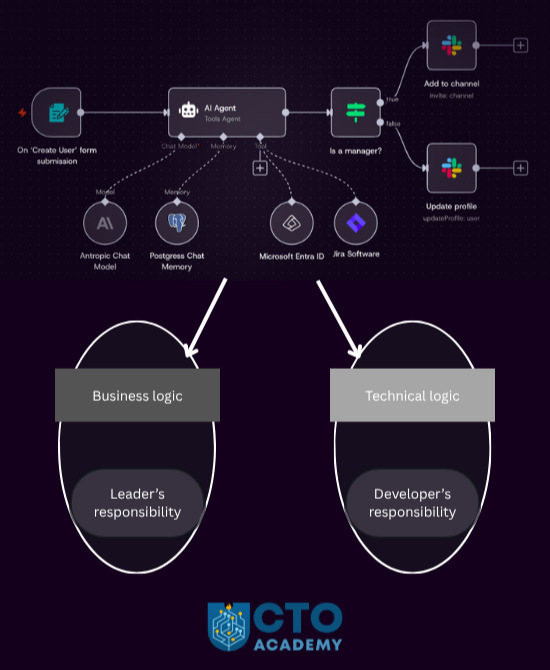
    2 Logics of AI Workflows - visual presentation
    Two logics of AI workflows and agentic orchestrations: business logic and technical logic. The former is a leader’s responsibility, while the latter is owned by developers.

    If you are really manually setting up workflows and orchestrations, you are not leading; you are micromanaging. In other words, you are wasting everyone’s time and money. 

    This should be a responsibility of a junior developer who can do this at 4 am after an entire night out with eyes closed. 

    But the junior dev can’t do this unless you provide the blueprint. 

    That blueprint is the key because it answers two critical questions:

    1. Why are we doing this (to what end)?
    2. Is this only a solution looking for a problem?

    Here’s an example:

    “We should automate reporting.”

    Why? Which part? For whom? What will we get out of it? It simply isn’t clear enough to guide the initiative. Nonetheless, that’s the most common request coming from the CEO or board.

    And this is where a technology leader comes in. The job is to:

    1. Identify the user.
    2. Describe the friction.
    3. Explain the costs in both time and money dimensions.
    4. Define success.
    5. Create a measurable test of that success.

    As you can see, we are not even near the actual workflow or orchestration design.

    The Critical Problem

    Most aspiring technology leaders are not short of AI awareness. They are short of translation ability.

    In other words, they can see the tool, the demo, and how quickly a workflow can be assembled. But they cannot always translate that into a business case strong enough to survive scrutiny from the CEO, CFO, board, customers, legal, security, operations, and the team that has to maintain it six months later.

    That is not an AI problem.

    That is a leadership problem.

    And it is exactly why a dedicated AI course can be the wrong answer.

    An AI course can show you what the technology can do. It may teach you the vocabulary, the common tools, the architecture patterns, the risks, the current direction of travel. Useful, yes, but a technology leader is not paid to know that AI exists.

    A technology leader is paid to decide where it creates value, where it introduces risk, where it changes operating models, where it saves money, where it wastes money, and where it becomes a distraction dressed up as innovation.

    That distinction matters more than people think it does, because the board does not usually ask a clean technical question. They do not say:

    “Can we safely introduce an AI-assisted reporting workflow with clearly defined data ownership, permission boundaries, operational accountability, and measurable productivity gains?”

    Instead, what you get is simply:

    “Can we use AI for reporting?”

    Or, even more common:

    “Why are we not using AI here?”

    Or:

    “Our competitors are doing more with AI. What are we doing?”

    That question lands on the desk of the technology leader. And the wrong response is to immediately open a workflow builder.

    The right response is to slow the conversation down just enough to make it useful.

    This is where the executive-level technology education becomes more relevant than a narrow AI module.

    Strategic Executive-Level Education vs. Tactical AI Course/Module 

    Take Module 3 of the Digital MBA for Technology Leaders. It covers tech strategy and business goals. Seasoned practitioners teach leaders to connect technology activity to business strategy rather than treating implementation as the strategy itself.

    That module includes lectures such as “What is the Business Strategy and Goals?”, “Where Tech Drives Strategic Competitive Advantage”, “CTO Input into Business Strategy”, “Unpacking Measurement Tools (SMART, OKR, KPI)”, “How to Appraise the Business Drivers”, and “Communicating Roadmap Across Organization.”

    That is the actual work behind a good AI decision.

    It’s not the prompt, the agent, the workflow, or the decision.

    If the CEO asks for AI reporting, the leader trained in this way does not start with the model, but with the business driver. If nobody can answer that, then AI is not yet a solution. It is a symbol. And symbols make terrible roadmaps.

    The next problem is ownership

    AI initiatives often fail because nobody has defined where business responsibility ends and technical responsibility begins. A developer can build the workflow, but a developer should not be left to decide whether the workflow represents the right business process, the right data definition, the right risk appetite, or the right success measure.

    That is a leader’s responsibility.

    This is where modules that cover the business become important. Lectures such as “What Matters for the CEO and Investors,” “Current Business Position & Market Analysis,” “Building and Cementing Value in a Business,” “The Business Model Canvas,” “Strategic Thinking with AI,” and “What Is a Value Proposition?” develop the commercial judgement needed to decide whether an AI initiative deserves attention in the first place.

    Because “we can automate this” is not the same as “this matters.” In practice, this means any or all of the following statements:

    • A technically impressive AI project can still be strategically irrelevant.
    • A faster report that nobody uses is not a transformation.
    • A chatbot that creates more support tickets than it resolves is not innovation.
    • A dashboard that makes bad data easier to consume is not progress.
    • A workflow that saves two hours but introduces a compliance risk is not efficiency.

    This is the part aspiring leaders often miss when they chase AI courses as career insurance. They assume the risk is not knowing enough about AI. In reality, the greater risk is being unable to govern AI inside a living business.

    That requires product thinking.

    The necessity of product thinking

    Substance in product development matters because many AI initiatives should be treated less like technology experiments and more like product hypotheses. “Defining Your Product Hypothesis,” “Managing Stakeholders,” “Working With Cross Functional Teams,” “Cost/Quality/Speed Triangle,” “Technical Debt,” “Who Should Code,” and “Modern Approaches to Quality & Testing” are not abstract leadership topics. They are the operating discipline behind AI adoption.

    In other words, before a workflow is built, someone has to define the hypothesis, and that someone is a technology leader.

    For example:

    “If we automate the first draft of monthly board reporting for the finance and operations teams, we believe we can reduce manual preparation time by 40% without reducing accuracy or increasing compliance risk.”

    Now we have something to test. We have a: 

    • User.
    • Process.
    • Measurable gain.
    • Constraint.
    • Reason to proceed.

    That is leadership.

    Think of it this way. The AI course might help someone build a prototype. The executive leadership program, on the other hand, helps you decide whether the prototype should exist, how it should be tested, who should own it, what risk it creates, and how it connects to business outcomes.

    The harder question

    Then comes the harder question: what information is the AI actually using?

    This is where most executive AI conversations become dangerously shallow. People talk about models, agents, prompts, and automation. Far fewer talk about data quality, access control, deletion, reporting lines, system ownership, auditability, and business continuity.

    Yet these are the issues that decide whether AI can be used safely at scale.

    This is not separate from AI. It is the foundation beneath AI.

    If a company has unclear data ownership, weak access control, poor documentation, messy SaaS sprawl, inconsistent reporting, and no real view of operational risk, then AI will not magically create clarity. It will just amplify the mess.

    A leader needs to know that before implementation starts. However, it is easy to miss that without broader leadership knowledge and perspective. As practice shows, leaders often learn about pre-existing issues only after the first incident or after the board asks why sensitive information appeared in the wrong place, or, which is even more common, after a team builds a tool nobody can maintain.

    This is also why the financial side matters.

    The financial side of business

    AI adoption is now often sold internally as inevitable. But inevitability is not a budget. Someone still has to justify spending, compare priorities, manage trade-offs, and explain expected return. A deep understanding of financial mechanisms inside the business becomes really important when AI moves from experiment to operating cost. Because if things go south, it’s the tech leader who takes the hit.

    Even pilot projects generate technical debt and financial business expense.

    A leader who cannot speak finance will struggle to defend the right AI investment or kill the wrong one.

    That second part is just as important because the market is full of AI projects that should never have been approved. Not because the technology was bad, but because the business case was lazy, the costs were vague, the risks were underestimated, the benefits were assumed, the ongoing maintenance was ignored, and the operational change was treated as someone else’s problem.

    A strong technology leader protects the company from that by introducing the necessary level of discipline and making it useful.

    Then, of course, there is data, because as a rule of thumb, an AI strategy is impossible without a data strategy.

    Being a CTO doesn’t mean becoming a data scientist. It means understanding enough to ask better questions, something taught by technology leadership programs. Students learn the right leadership questions that determine whether AI becomes a credible business capability or another layer of noise and, ultimately, a liability.

    The Digital MBA, for instance, includes AI-specific content. Lectures such as “Lessons from Building a Customer GenAI Agent,” “Context Coding,” “Embracing Transformative Opportunities with AI,” and “Building Internal Tools with AI: From Idea to Working Software” go deep into the subject from a practical standpoint because of the challenges these topics present. But the important point is that AI appears in context throughout the entire course, and that is how leaders should learn it.

    It shouldn’t be a standalone obsession, a panic purchase, or a new identity because AI belongs inside business strategy, product development, finance, data, operations, information management, security, culture, and executive communication. That is where it has to work.

    So the core message for anyone trying to move from senior technologist to executive technology leader is this:

    You do not need to become the person who manually wires every AI workflow together.

    You need to become the person who knows which workflows deserve to exist.

    In other words, you need to know how to: 

    1. Connect workflows and agentic orchestrations to strategic goals.
    2. Measure their value.
    3. Manage their risk.
    4. Explain them to non-technical stakeholders.

    You also need to know when to say yes, when to say no, and when to say: “Not until we understand the problem properly.”

    That is not developer training.

    It is executive training.

    And the current AI moment has made this distinction more important, not less.

    Companies are under pressure to act. Boards want AI plans. CEOs want productivity gains. Investors want efficiency. Teams want clarity. Customers want better experiences. Regulators want accountability. Nobody wants to be left behind.

    In that environment, the weakest technology leaders will chase tools.

    Only the strongest will create judgment.

    They will know how to turn vague executive pressure into a clear business problem. They will know how to separate useful automation from novelty. And they will know how to build the case, protect the organization, align the teams, and measure the outcome.

    That is the actual career security.

    Not being the person who knows the newest AI platform, but being the person trusted to decide how the organization should use it.

    So no, the absence of a dedicated AI module in technology leadership programs is not the weakness people think it is, because these programs are not trying to produce AI developers.

    They are designed to produce technology leaders who can use AI responsibly, commercially, operationally, and strategically.

    That is the bigger need.

    And it is the need that will still exist when the tools change again.
  • When Technical Leadership Stopped Being Enough

    When Technical Leadership Stopped Being Enough

    From the outside, nothing was obviously wrong.

    The title, responsibility, years of experience…everything was there. On paper, this was already a successful technology leader: someone trusted to make decisions, lead teams, solve difficult problems, and carry the weight that comes with seniority. There was no dramatic failure, no public collapse of confidence, no single moment where everything stopped making sense.

    But somewhere along the way, the role had changed.

    Or maybe it is more accurate to say that the role had expanded. What once felt primarily technical had become something broader, heavier, and less easy to define. The conversations were no longer just about architecture, delivery, tooling, or performance. More and more, they were about trade-offs. About influence, business value…priorities that were not purely technical, but still landed in technology leadership’s hands. About speaking to executives, product leaders, boards, peers, and stakeholders who were not interested in the technical elegance of a solution unless it could be translated into impact.

    That was the point at which a quiet discomfort began to set in for many of the graduates of CTO Academy’s Digital MBA for Technology Leaders. Not because they were failing. Quite the opposite. They were already doing the job. But the next level of leadership was beginning to demand something more than technical judgment alone, and they could feel it.

    “It’s rarely about tech.”
    Bianca Glasner, Head of Engineering, Austria

    Again and again, in the graduate reflections, what emerges is not a story of deficiency but a story of range: a growing awareness that technical competence, on its own, was no longer enough for the kind of leader they wanted to become.

    Bianca Glasner, a Head of Engineering and Firmware Lead from Austria, captures that tension in one line that stayed with her: “It’s rarely about tech.” What caught her attention was that the program did not treat technology leadership as pure engineering or as generic leadership training, but as a whole role with many interlocking parts. It reinforces what Manasa Kotha, an Engineering Manager from the US, said, “The program teaches you what leaders are supposed to do in certain situations and how to facilitate or help others in reaching their own potential while you discover yourself.”

    That matters, because by the time someone becomes a CTO, a Head of Engineering, or a senior technology leader on the path toward those roles, the challenge is rarely a lack of knowledge in the narrow sense. More often, it is that the job has outgrown the boundaries of their earlier training. Nobody teaches you, at the start of a technical career, how to think across the full shape of the role later on. Nobody sits you down and explains how to move from being the person with answers in one domain to being the person who has to hold ambiguity across many. Nobody really tells you how much leadership at that level is about reading context, shaping conversations, creating clarity, helping others perform better, and making decisions that are as much human and commercial as they are technical.

    So the tension does not announce itself loudly. It shows up more quietly than that.

    It shows up in meetings where you realize you understand the technical dimension perfectly well, but wish you had a stronger grasp of the business conversation unfolding around it. It shows up in moments when you know what should happen, but feel you could be more effective in how you frame it to executives or non-technical peers. It shows up in the distance between being a strong operational leader and becoming a more complete strategic one. It shows up when the next stage of your career begins to depend less on how well you can solve technical problems yourself and more on how well you can guide a business through them.

    For graduates, that was often the real reason for enrolling. Not to gather another certificate. Not to decorate a CV. And definitely not to pursue ambition for its own sake. They enrolled because something had become impossible to ignore: staying the same, even while remaining competent, no longer felt enough.

    Byron Rode, a CTO from South Africa, describes the effect of the program in a way that reveals the problem it solved. He says he likely would have reached the same endpoint eventually, even without the course, but it would have taken much longer, with more failure and error along the way. The Digital MBA helped him get where he is in his career faster, especially in areas where he had historically struggled: delegation, cross-departmental work, and the crucial skill of speaking non-tech to non-technical people.

    That idea of acceleration is important. It suggests that the program did not give people an entirely new personality or hand them a transformation they had not earned. It did something more credible than that. It shortened the distance between the leader they were becoming and the leader they needed to be.

    The question, then, was why this route, and not another one.

    Because there were other routes. There are always other routes. Traditional MBAs, short leadership courses, scattered books, podcasts, online classes, frameworks picked up over time, advice from peers, trial and error inside the role itself. Senior technology leaders are not short of information. What they are often short of is something else: a learning environment that feels genuinely designed for the complexity of their work.

    That is one of the clearest themes in the graduate reflections. The appeal of CTO Academy was not simply that it offered content. It was that it seemed to understand the reality of the person consuming it.

    “It is crafted for working professionals, blending business with technology.”
    Matthew Miller, IT Manager, Canada

    Matthew Miller, an IT Manager from Canada, points first to the structure of the program: a curriculum crafted for working professionals, blending business with technology, flexible across time zones, and built around community.

    Others talk about lectures that are easily digestible rather than overwhelming, practical modules that reflect real life, and the ability to apply what they are learning directly in their day-to-day roles. Rather than abstract leadership talk, the course seemed to offer something more grounded: insight that could be used immediately, then revisited later as needed.

    That distinction matters more than it first appears to. At this level of leadership, it is not enough for learning to be interesting. It has to be usable. It has to survive contact with a calendar already filled by other people. And more importantly, it has to fit around a job that does not pause politely so personal development can happen in isolation. The graduates frequently mention bite-sized, 100% online lectures that can be taken between meetings or during lunch, not because convenience is the whole story, but because practicality is inseparable from credibility. Senior leaders do not need to be persuaded that learning is good. They need to believe that the learning will fit inside real life rather than asking them to step outside it. Even the humor in Kasey McCurdy’s remark points to that sense of genuine engagement: “I always hated when those pesky meetings got in the way of me joining a CTO Academy expert session.”

    But convenience alone does not create meaning. What gave the experience its weight was what began happening once the course was underway.

    This is where the story becomes more interesting, because the shift described by graduates was not immediate and not theatrical. It did not sound like a single revelation. It sounded like a series of internal adjustments that, over time, became impossible to miss.

    At first, the program seems to have given people language for things they were already doing instinctively, without always knowing how to name them. Kevin Golding, a UK-based Field Technologist, describes that dynamic with unusual clarity, “As a leader,” he says, “You are often doing things without fully knowing that you are doing them, or without understanding why you are doing them at all. The course helped put those actions in perspective: what to do, when to do it, why it matters, and what else should be added to the plan to make leadership more effective.”

    There is a deep relief in that kind of recognition. Not because it flatters the leader, but because it turns instinct into awareness. It takes things that were half-formed and makes them more deliberate.

    Then something broader begins to happen. The role itself starts to look different.

    Leadership stops feeling like a string of urgent reactions and starts coming into focus as a system. Decisions are no longer just about immediate execution but about what kind of organization you are shaping, what kind of conversations you are enabling, what signals you are sending, what habits you are reinforcing, and how technology actually participates in the direction of the business. A module here sharpens one area. Another challenges an assumption. Another expands the frame. Gradually, a fuller picture forms.

    The most interesting part of the graduate reflections is that they do not merely talk about learning topics. They talk about becoming different in how they reason. That is subtler, and more powerful. They describe changes in how they speak to executives, how they work across departments, how they delegate, how they understand their own value, how they approach leadership dilemmas, and how they carry themselves in more senior spaces. This is not the language of “I picked up a few useful tools.” It is the language of identity slowly reorganizing itself around a larger role.

    “The course helped me recognize further value in what I do and what I bring to the table.”
    Stephen Morris, Fractional CTO, UK

    Stephen Morris, a Fractional CTO based in the UK, puts it beautifully. The course, he says, helped him recognize further value in what he brings to the table, while also allowing him to identify his weak areas. More than that, it gave him the perspective of a whole role that nobody had told him about at the beginning. That matters because once you understand the whole shape of a role, you stop feeling like you have wandered into spaces you do not belong in. You start to feel, in his words, more confident as a board member or aspiring board member, because now you know the answers. And even if you knew them before, you are more able to recognize your own value and be trusted in that recognition.

    That is not a small change. It is one of the hardest things to acquire in leadership: not just skill, but self-possession. Not just the ability to do the work, but the internal authority to stand in rooms that once felt slightly beyond reach and know that you belong there.

    Kasey McCurdy, Head of Engineering in the US, describes another side of that development. The course changed the way he spoke to product teams and to the executives he reported to. It helped him take on more of the executive functions and really own them.

    That phrase is worth lingering on: really own them. Not imitate them, not observe them from the outside, not perform them uncertainly, but own them. Because there is a difference between being adjacent to executive responsibility and feeling capable of inhabiting it fully.

    This is the real middle of the story. Not the modules themselves, but the accumulation of internal upgrades they triggered.

    A broader lens.
    A clearer vocabulary.
    Better judgment.
    More confidence in ambiguity.
    A stronger ability to translate.
    A more natural executive posture.
    A less fragmented understanding of what the role asks of you.

    And all of this happened while the leaders were still inside their jobs, still facing their normal pressures, still carrying the same responsibilities. Which may be why the learning seems to have landed so deeply. It was not taking place in an abstract future. It was colliding, week by week, with the real situations these people already had to navigate.

    Running alongside this intellectual and professional change was something else that graduates repeatedly return to: community.

    “It’s more than just a great course. It’s also about being a part of a network.”
    Byron Rode, CTO, South Africa

    This might sound secondary from the outside, but in the graduate reflections, it clearly is not. Again and again, what emerges is how isolating senior leadership can feel, and how meaningful it is to find a network that understands the role from the inside.

    Byron Rode says that, as a CTO, you rely on a network or community, especially if you are outside your usual realm, as in the case of an accidental CTO. Stephen Morris describes the community as a different type of support network: a place where you can reach out with specific technical questions or with leadership challenges, and where the people around you understand the peculiar difficulties of what you do. Matt Miller emphasizes that the curriculum itself is built around and for the community. And Kasey McCurdy perhaps captures the emotional truth of it most directly: when he faces a dilemma, he knows there are others in the world dealing with the same thing, and many of them are part of this community — some going through it now, others already through to the other side and eager to help.

    That completely changes the feel of the experience. It means the leader is not just studying alone. They are being accompanied. Their questions are not signs of weakness but part of a shared professional reality. Their dilemmas are not private failures but familiar patterns others can recognize and help untangle — whether that is working through a board-level disagreement, or finding a way to move a legacy team past resistance to change. For people in senior roles, that kind of support is not ornamental. It is often the difference between learning something intellectually and having the confidence to live it out.

    By the end of the experience, the outcomes graduates describe are striking precisely because they are not exaggerated.

    They do not read like miracle stories. They read like something more convincing: a noticeable shift in pace, confidence, and scope.

    For some, the main difference was speed. They arrived at stronger decisions faster, with less wasted motion. For others, the biggest change was language — being able to speak more effectively to product leaders, executives, boards, and non-technical stakeholders. For others still, the shift was more personal: recognizing their value more clearly, understanding where they were weak without shame, and feeling more grounded in the full role they were stepping into.

    Across the reflections, the pattern is consistent. These leaders did not emerge as entirely different people. They emerged as more complete versions of themselves: faster where they had been hesitant, broader where they had been narrowed, more confident where they had once felt slightly unsteady, more able to translate, align, influence, and lead across the business rather than only within technology.

    That is why this story lands where it does.

    Not in the territory of obvious reinvention, and not in the flat language of professional development. It lands somewhere truer than that. In the recognition that there comes a point in a leadership career when experience alone is no longer enough to unlock the next stage. When what is needed is not more hustle, not more technical depth, not another handful of fragmented ideas, but a more coherent way of seeing the role. A more integrated kind of growth. A structure for becoming the leader the job has already started asking you to be.

    For the graduates, that appears to be what the program provided. Not an escape from the work, but a better way to meet it. Not a dramatic identity transplant, but a steady strengthening of judgment, confidence, and range. Not a promise that everything would change overnight, but something perhaps more valuable than that: the feeling that they were no longer trying to grow into the next version of themselves by instinct alone.

    And perhaps that is the most persuasive thing in all of this. These were not people looking to become someone else. They were already accomplished. Already trusted. Already carrying real weight.

    They simply reached the point where technical leadership, on its own, was no longer enough.

    And they decided to grow into the full shape of the role.

    Hear the stories in their own words.

  • Employer-Funded MBA (Part 2): The IT Director Promotion Business Case (ROI Calculator + Pitch Kit)

    Employer-Funded MBA (Part 2): The IT Director Promotion Business Case (ROI Calculator + Pitch Kit)

    Turn IT Director Readiness Gaps into a Funded Upskilling Plan.

    Most employer-funding requests fail because they’re framed as “education.” But the IT Director or CTO role isn’t awarded for effort, potential, or seniority. It’s awarded for building a system that delivers reliability, a secure posture, cost control, service levels, and predictable delivery.

    So in Part 2, we’ll do what sponsors actually approve: convert your IT Director or CTO readiness gaps into a 90–180-day delivery plan, attach a conservative ROI model, and hand you a copy-and-paste pitch kit you can use in a real funding conversation.

    Don’t ask your employer to fund learning. Ask them to fund a director-ready operating system you’ll ship back into the business.

    What Changes in Part 2 (and why it works)

    In Part 1, we focused on timing, objections, and negotiation tactics for employer funding. Part 2 is the promised sequel: the ROI calculator + the pitch kit—tailored to a specific, sponsor-friendly outcome:

    “Fund this because it closes my IT Director readiness gaps with deliverables you can adopt in the next 90–180 days.”

    Get the IT Career Path Roadmap (Free PDF)

    Want more than scattered ideas? Get our IT Career Path Roadmap PDF – an 8-step framework to map your next roles, sharpen your skills, and build a layoff-resilient tech leadership career. Fill in the form and we’ll send you the PDF version so you can download it, annotate it, and use it as a living plan for your next career moves.

    Downloading the ebook does not automatically subscribe you to our bi-weekly Technology Leadership Newsletter.

    Step 1: Pick “Fundable Gaps” from the IT Director Readiness Scorecard

    Go to the IT Director Role Readiness Scorecard, score yourself honestly, and pick:

    • Your lowest 2–3 signals (these become your funding justification)
    • One signal you’re already strong at (this becomes your credibility anchor)

    The rule: choose gaps that can be turned into artifacts—things your employer can review, adopt, and re-use.

    Gap → Deliverable Mapping (Table 1)

    Mapping methodology: Readiness gap (signal) → Fundable deliverable (artifact you ship) → Proof the business cares about

    Readiness gap (signal)Fundable deliverable (artifact you ship)Proof the business cares aboutDigital MBA modules that build this
    Risk-based prioritizationTop-5 risk register + mitigation plan + monthly cadenceFewer surprises, clearer trade-offsM3: Technology Strategy & Business Goals
    M6: Information Management
    M8: Data Science & Analytics
    Financial disciplineBudget narrative + cost drivers + forecast disciplineSpend predictability, variance explainedM7: Finance & Funding
    M2: Business Fundamentals
    M3: Technology Strategy & Business Goals
    Service model clarityService catalog + SLAs/SLOs + reportingService levels visible, ownership clearM5: Product Development
    M3: Technology Strategy & Business Goals
    M8: Data Science & Analytics
    Change governanceChange policy + rollback standard + change failure metricsSafer releases, reduced operational riskM5: Product Development
    M6: Information Management
    M3: Technology Strategy & Business Goals
    Incident leadershipPostmortem system + MTTR plan + recurring-issue eliminationIncidents become learning, not dramaM6: Information Management
    M5: Product Development
    M1: Leadership & Team Building

    “The CTO Academy’s MBA curriculum doesn’t just teach concepts — it equips you to produce director-level operating artifacts: risk cadence, funding narrative, service model clarity, governance controls, and measurable outcomes.

    Jason Noble, CTO

    Step 2: Turn Gaps into a 90–180 Day Delivery Plan

    For each gap you selected, define five things. This is what makes your request “fundable.”

    • Business problem: describe it in exec language (risk, cost, predictability, service levels)
    • Deliverable: name the artifact you will ship
    • Metric: how improvement will be measured
    • Cadence: who reviews it, how often
    • Timeline: what ships in 30/60/90 (or 45/90/180)

    If your plan doesn’t produce a deliverable that someone can adopt, it’s not sponsor-ready yet.

    Step 3: The ROI Calculator (simple, conservative, sponsor-friendly)

    Finance doesn’t need perfect numbers. They need transparent assumptions and conservative ranges. The goal is to show that one meaningful improvement can pay back the investment.

    ROI Calculator (copy/paste)

    ROI CALCULATOR — EMPLOYER-FUNDED IT DIRECTOR UPSKILLING PLAN

    A) Program cost

    • Tuition/program cost: $ ______
    • Time cost (optional): ______ hours x blended rate $ ______ = ______
    • Total investment: $ ______

    B) Benefit buckets (pick 1–3 only)

    1. Incident cost reduction
    • Major incidents per quarter: ______
    • Cost per major incident (downtime + recovery + stakeholder time): $ ______
    • Conservative reduction (10–30%): ______
    • Annual value estimate: $ ______
    1. Vendor/license waste reduction
    • Annual vendor + license spend (your scope): $ ______
    • Conservative savings (2–8%): ______
    • Annual value estimate: $ ______
    1. Delivery predictability/slippage reduction
    • Delay cost proxy (missed launches, overtime, rework): $ ______ /year
    • Conservative improvement (5–15%): ______
    • Annual value estimate: $ ______
    1. Attrition avoidance (retention ROI)
    • Replacement cost proxy (recruiting + ramp + lost productivity): $ ______
    • Probability reduction (low/medium/high): ______
    • Annual value estimate: $ ______

    C) ROI summary

    • Total annual value (conservative): $ ______
    • ROI ratio: annual value ÷ total investment = ______
    • Payback period: total investment ÷ monthly value = ______ months

    Sponsor line:
    “I’m using conservative ranges. If we only get one improvement—incident cost reduction or vendor optimization—the investment pays back within X months.”

    See also: How to Expense Your MBA Course →

    Step 4: The Pitch Kit (copy/paste templates)

    Everything below is designed to be used exactly as-is. Keep it business-first. Keep it deliverable-led. Keep it measurable.

    Template #1: One-page business case

    TITLE: Employer-Funded MBA Business Case — IT Director Readiness Delivery Plan
    OWNER: [Your name]
    ROLE TARGET: IT Director (scope: [teams/systems/services])

    1. Why this matters now

    • Our environment is pushing harder on reliability, security posture, cost control, service levels, and predictability.
    • The IT Director role is accountable for building the operating model that makes those outcomes repeatable.
    • This funding request is for a structured delivery program that produces operational artifacts we can adopt immediately.

    2. Current gaps (based on IT Director readiness signals)

    Top 2–3 gaps I’m addressing:

    • [Gap #1] — impact today: [1 sentence on risk/cost/delivery pain]
    • [Gap #2] — impact today: [1 sentence]
    • [Gap #3] — impact today: [1 sentence]

    Credibility anchor (what I already do well):

    • [Strength] — evidence: [metric/result/example]

    3. What the company gets (deliverables, not “learning”)

    Within 90–180 days, I will deliver:

    Deliverable A: [Name]

    • What it is: [risk register/service catalog/budget narrative/change policy/postmortem system]
    • Why it matters: [tie to risk/cost/availability]
    • Owner + cadence: [who reviews it, how often]
    • Success metric: [MTTR/forecast accuracy/SLA reporting/risk burndown]

    Deliverable B: [Name]

    • What it is: ______
    • Why it matters: ______
    • Owner + cadence: ______
    • Success metric: ______

    Deliverable C (optional): [Name]

    • What it is: ______
    • Why it matters: ______
    • Owner + cadence: ______
    • Success metric: ______

    4. Investment request

    • Tuition: $ ______
    • Time plan: [e.g., 4–6 hours/week outside core hours + 1 block/month]
    • Support requested: [budget approval/L&D process/manager sponsorship]

    5. ROI estimate (conservative)

    • Benefit buckets included: [Incident reduction/Vendor optimization/Predictability/Retention]
    • Estimated annual value (conservative range): $ ______
    • Payback period estimate: ______ months

    6. Risk controls (to avoid “education theatre”)

    • Monthly checkpoint (30 min) to review deliverables shipped
    • Artifacts stored in a shared location and adopted into operating practice
    • Success metrics reviewed quarterly with [name/team]

    7. Decision requested

    Approval to fund the program and sponsor the delivery plan, starting: [date]

    Template #2: Email to your manager

    SUBJECT: Funding request: IT Director readiness delivery plan (ROI + artifacts included)

    Hi [Manager Name],

    I’m putting together a practical plan to close a few IT Director readiness gaps—specifically [gap #1], [gap #2], and [gap #3]—by delivering concrete operating artifacts the team can adopt over the next 90–180 days.

    Rather than framing this as “education,” I’m proposing an employer-funded program that will produce measurable outputs such as:

    • [Deliverable A] (e.g., risk register + cadence)
    • [Deliverable B] (e.g., service catalog + SLAs/SLOs + reporting)
    • [Deliverable C] (e.g., budget narrative + forecast discipline)

    I’ve attached a one-page business case with:

    • Deliverables + timelines
    • Conservative ROI assumptions (payback estimate included)
    • Governance checkpoints to ensure we convert learning into operational improvements

    Could we book 30 minutes next week to review and decide whether to move forward?

    Thanks,
    [Your Name]

    Template #3: Email to HR/L&D (formal process)

    SUBJECT: Request for employer-funded leadership program tied to operational deliverables

    Hi [Name/Team],

    I’m submitting a request for employer funding for a leadership program aligned with my progression toward an IT Director role.

    This isn’t a general training request. It is a delivery plan to produce specific artifacts that strengthen our operating model in the next 90–180 days, including:

    • [Deliverable A]
    • [Deliverable B]
    • [Deliverable C]

    I have a one-page business case outlining:

    • Business impact and success metrics
    • Manager sponsorship plan
    • Conservative ROI assumptions and payback estimate

    Please let me know the required steps and documentation to proceed.

    Best,
    [Your Name]

    Template #4: 30-minute meeting agenda + talk track

    MEETING GOAL

    Align on whether the company will fund the program as an operational delivery initiative, not a personal development expense.

    AGENDA (30 min)

    1. (3 min) Context: why this matters now
    2. (7 min) The readiness gaps I’m targeting (and why they matter to the business)
    3. (10 min) Deliverables I will ship in 90–180 days
    4. (5 min) ROI assumptions + funding request
    5. (5 min) Risks, checkpoints, and decision

    TALK TRACK (use verbatim)

    1. Context (3 min)

    “Thanks for making time. I’m aiming for the IT Director scope, and the job is fundamentally about building a system that produces repeatable outcomes—availability, security posture, predictable delivery, and disciplined spend.

    I’m not asking you to fund learning. I’m asking you to fund a delivery plan that improves our operating model.”

    2. Gaps (7 min)

    “I’ve assessed myself against IT Director signals. My top gaps are:

    • [Gap #1], which shows up today as [concrete issue]
    • [Gap #2], which shows up today as [concrete issue]
    • [Gap #3], which shows up today as [concrete issue]

    I also want to anchor what I already do well: [Strength], and the evidence is [metric/result].”

    3. Deliverables (10 min)

    “Here’s what the company gets within 90–180 days:

    • Deliverable A: [Name]. Value: [business value]. Reviewed: [cadence] with [stakeholders]. Metric: [metric].
    • Deliverable B: [Name]. Value: [business value]. Reviewed: [cadence]. Metric: [metric].
    • Deliverable C (optional): [Name]. Value: [business value]. Reviewed: [cadence]. Metric: [metric].

    These are shared artifacts the team can operate with—not knowledge that sits in my head.”

    4. ROI + ask (5 min)

    “I’ve used conservative ranges. If we only capture one benefit—reducing major incident cost or optimizing vendor spend—the payback period is approximately [X] months.

    The investment request is:

    • Tuition: $ ______
    • Support: [approval + sponsorship + process]
    • Time plan: [your plan]”

    5. Risk controls + decision (5 min)

    “To avoid this turning into education theatre, I’m proposing:

    • A 30-minute monthly checkpoint with you
    • Quarterly review of success metrics
    • Adoption of the artifacts into team operating practices

    If this sounds reasonable, my ask today is approval to proceed with funding and start date.”

    Objections You’ll Hear (and the clean responses)

    “We don’t have a budget.”

    “Understood. If we can’t do the full amount, can we explore a split (L&D + department), reimbursement after milestones, or quarterly payments tied to deliverables shipped?”

    “What if you leave?”

    “That’s exactly why the deliverables are designed as reusable operating artifacts—risk cadence, service reporting, governance standards. This improves the system regardless of individual retention.”

    “Why not a cheaper course?”

    “We can absolutely evaluate alternatives. The requirement is that the program produces these deliverables on a structured timeline and upgrades director-level signals: finance, governance, risk prioritization, and executive alignment.”

    Your Next Move

    Start with clarity, then move to funding:

    Want the Structured Path (and the fastest conversion to “director proof”)?

    If your lowest signals are finance, governance, risk, and executive alignment, a structured program compresses the time it takes to build the artifacts that earn trust.

    Learn more about the CTO Academy’s structured program that produces deliverables on a structured timeline:

    Learn more

    Additional resources:


    Related Internal Links

  • How to Secure Funding for an MBA in Tech Management

    How to Secure Funding for an MBA in Tech Management

    Did you know that nearly half of U.S. employers offer tuition assistance, and among those that do, four out of five already support an MBA in tech management? For (future) CTOs and senior engineering leaders, that implies building a compelling business case

    In ~7 minutes, you’ll learn: (1) why CFOs green-light MBAs even in tight budgets, (2) how to turn modules into deliverables that hit your OKRs, and (3) the best months to ask based on your fiscal year.

    TL;DR

    • Why companies pay: Sponsorship reduces hiring risk, improves retention/internal mobility, and closes tech-capability gaps—so CFOs fund it even in lean years.
    • Make it business, not school: Treat each MBA module as a work artifact tied to a measurable OKR (e.g., unit-economics model, reliability playbook, AI use-case brief).
    • Ask at the right time: Submit your proposal 60–90 days before budget lock, and align it with L&D resets and performance-review cycles.
    • What to bring: a 5-year ROI snapshot (NPV, payback), a Module→Business-Win table, and a delivery plan with blackout dates/coverage.
    • What’s next: Part 2 adds the ROI calculator + pitch kit; Part 3 covers negotiation scripts and deal structures. 

    Why Companies Pay for MBAs (and Why Tech Is Different)

    When budgets are tight, smart CFOs fund what retains talent, reduces hiring risk, and builds capabilities they can’t buy fast enough. The stats prove that employer-funded education checks all three boxes. 

    At Cigna, for instance, a rigorous study of its tuition program showed a 129% ROI from avoided talent costs:

    • Participants were 10% more likely to be promoted.
    • 8% more likely to be retained.
    • 7.5% more likely to move internally

    Internal Mobility as the Retention Engine

    LinkedIn’s data shows employees stay ~41% longer at companies with high internal hiring because people can see a path without leaving

    How does that stat tie to the MBA in Tech Management? Well, it formalizes cross-functional skills (strategy, finance, product, ops) that make those internal moves viable. 

    Tech Talent Shortages and AI Drive

    Bain reports 44% of executives say lack of in-house expertise is slowing AI adoption, with AI-skills demand growing 21% annually and shortages expected through 2027. McKinsey similarly finds that only 16% of executives feel comfortable with their current tech talent, and 60% cite scarcity as a top inhibitor. 

    Gartner’s CIO research shows leaders are responding by upping upskilling/reskilling plans and expanding IT headcount despite market noise. 

    These are all clear signals that education spending is a talent strategy, not a perk.

    What This Means for You

    Frame the MBA as a retention and capability play, then prove it with internal-mobility outcomes and a simple ROI. That’s the language CFOs and CHROs already use. For a deeper dive on structuring that ROI case (and when sponsorship pays for itself), see CTO Academy’s MBA ROI explainer.

    Mapping MBA Deliverables to Your Org’s 3-Year Roadmap

    Treat the MBA as a portfolio of work artifacts your execs would fund anyway—each tied to a measurable OKR. The goal is to present the narrative in which each module yields a deliverable your exec team would fund anyway (business case, migration plan, pricing experiment, etc.). The important thing to remember here is that it has to be tied directly to a measurable OKR.

    Fast 5-step Mapping

    1. Pull the 3-year outcomes (ARR (Annual Recurring Revenue), margin, reliability, AI adoption, risk posture).
    2. Select 4–6 company OKRs you can move (one owner per OKR).
    3. Map MBA modules to artifacts that advance those OKRs.
    4. Time modules to quarters when the organization makes related decisions (budgeting, roadmap commits, vendor renewals).
    5. Define acceptance & metrics (who signs off, how it’s measured, by when).

    Module-to-Business Mapping (example OKRs for quick scan)

    MBA ModuleDeliverable you’ll shipExample OKR/Metric it moves
    Digital Strategy3-year platform strategy with trade-offs≥20% of new ARR from a new SKU by Q4 FY26
    Managerial Finance for Tech LeadersUnit economics model + CFO-ready business caseReduce infra COGS (Cost of Goods Sold) per active user 15% YoY
    Product Mgmt & Customer DiscoveryAdoption experiment plan + discovery insightsIncrease WAU (Weekly Active Users) for Feature X +15% within 90 days
    Data & AI for LeadersAI use-case shortlist + model feasibility briefImprove sales forecast MAPE (Mean Absolute Percentage Error) −20%; lead-score AUC >0.75
    Operations/DevOpsReliability playbook (SLOs, error budgets)MTTR (Mean Time to Recovery) <30 min, change-fail <10%, 99.95% SLO met
    Platform/Cloud ArchitectureCloud cost optimization roadmapIdle resource cost −25%; savings-plan coverage 80%
    Cybersecurity & RiskTop risks register + remediation planCritical vulns remediated ≤14 days; ISO audit passed
    Org Design & LeadershipCapability map + hiring/upskilling planRegrettable attrition <8%; 2 cross-functional promos
    Negotiation & Stakeholder InfluenceVendor consolidation + contract playbookSaaS footprint −20%; $500k annualised savings
    GTM (Go-To-Market strategy) for Tech LeadersSolution-engineering assets (ROIs, ref arch)Enterprise sales cycle −15%; POC-to-close +10%

    Pro tip: co-supervise each artifact with the exec who owns the metric (e.g., CFO for unit economics, COO for reliability, CISO for risk). Each signature adds fuel to sponsorship.

    Quarter-by-quarter example (Staff Engineer → Director)

    • Year 1, H1: Digital Strategy → draft platform strategy; Product Mgmt → validate adoption levers.
    • Year 1, H2: Finance → unit-economics model; DevOps → SLO/error-budget framework piloted.
    • Year 2, H1: Cloud Architecture → cost-reduction roadmap; Security → remediate top-5 risks.
    • Year 2, H2: Data/AI → forecasting uplift; Negotiation → vendor renewals locked at lower TCO.
    • Year 3: Scale wins; convert artifacts into a director-level operating plan; measure OKR outcomes quarterly.

    One-page “module brief” (paste into your proposal)

    • Business problem: Which OKR and why now?
    • Hypothesis & scope: What the module deliverables will change.
    • Outputs: Named artifacts + links (deck, model, runbook).
    • Success metric: Exact target & timeframe.
    • Stakeholders & sign-off: Name the approver.
    • Risks & dependencies: What could block delivery?

    This makes your MBA feel less like time away and more like a structured, low-risk way to hit the plan, which is exactly what sponsors want to buy.

    Timing the Ask: Budget Cycles, L&D Windows & Head-Count Plans

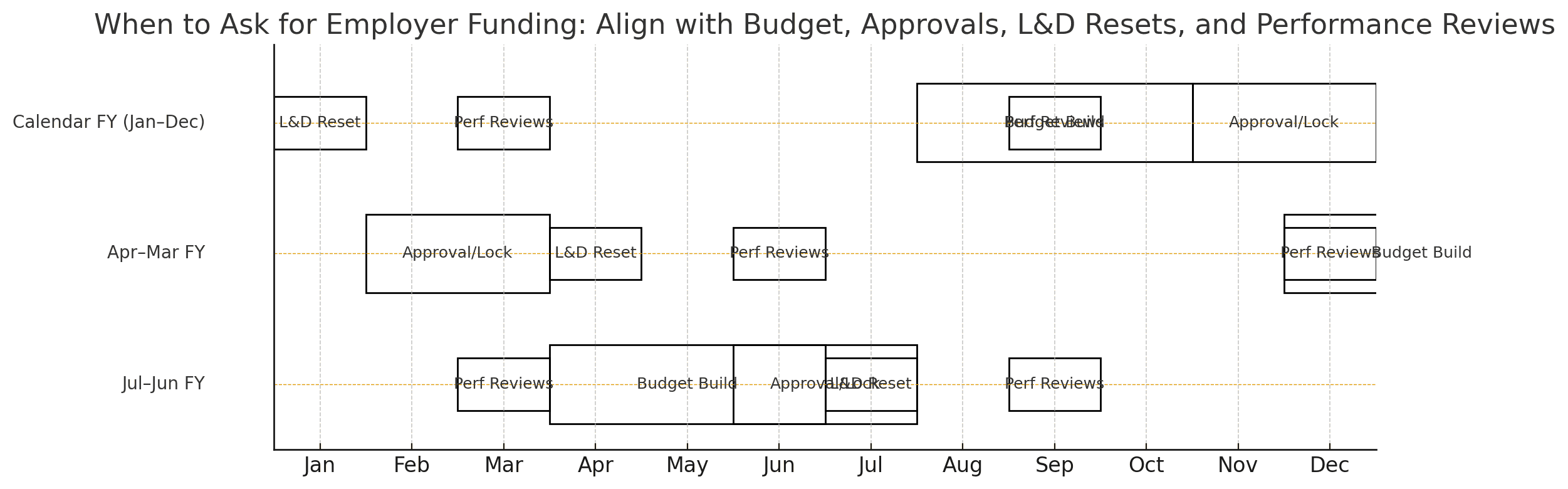
    Visual table of fiscal timing windows for employer sponsorship (PNG) of MBA in tech management
    Visual cheat-sheet: Click to download the fiscal timing windows for employer sponsorship (PNG)

    When is the best time to ask?

    Ask before budgets lock and when retention is on the agenda. In other words, match your ask to your company’s fiscal calendar.

    Now, most companies fall into three fiscal patterns. Use these rules of thumb to land in the “yes” window:

    Where the “yes” lives (by fiscal year)

    Calendar FY (Jan–Dec)

    • Budget build: Aug–Oct → Ask in Jun–Aug so your line item enters the AOP (Annual Operating Plan).
    • Approvals/lock: Nov–Dec → If you missed the AOP, pitch as a mid-year reallocation with a start next FY.
    • L&D resets: Jan → Tap fresh tuition allowances early.
    • Performance reviews: Mar and Sep → Tie to retention and promotion planning.

    Apr–Mar FY (common in UK/Europe/APAC)

    • Budget build: Dec–Feb → Ask in Sep–Nov.
    • Approvals/lock: Feb–Mar → Late? Use carry-forward or professional-development balances to bridge until April.
    • L&D resets: Apr.
    • Performance reviews: Jun and Dec.

    Jul–Jun FY

    • Budget build: Mar–May → Ask in Dec–Feb.
    • Approvals/lock: May–Jun.
    • L&D resets: Jul.
    • Performance reviews: Feb/Mar and Aug/Sep.

    Five timing tactics that raise approval odds

    1. Back-solve from the budget: submit 60–90 days before the plan is finalized so Finance can create a cost center and spread payments across years.
    2. Ride retention moments: put the proposal on the agenda for performance reviews, stay interviews, or promotion boards, when managers already have a budget for retention.
    3. Avoid freeze zones: don’t ask at the end-of-quarter or end-of-month crunch, or during organizational reshuffles when budget owners change. If a reorg is imminent, line up the new approver first.
    4. Stage the start: if the AOP window is closed, propose pilot funding now (e.g., first module) with the remainder coded into next FY’s L&D.
    5. Pre-wire dissent: meet the CFO’s Financial Planning & Analysis partner and HR business partner one-to-one the week before the formal ask; incorporate their feedback so the decision meeting is a rubber-stamp.

    What to put on the calendar invite (so your sponsor shows up)

    • Subject: “Retention + Capability Investment: Tech MBA Sponsorship Proposal (15 min)”
    • Attachments: 1-slide ROI summary, your Module-to-Business Win table, and program details.
    • Decision request: “Approval for 50–75% sponsorship, with a 12-month retention clause and delivery guardrails.”

    PRO TIP: Use the PNG above in your deck as a quick explainer for why you’re asking now, and tailor the highlighted window to your company’s fiscal year.

    Objection-handling Scripts (use verbatim or tweak)

    Let’s quickly run through a couple of scenarios that might at first seem like you ran into a wall. 

    1) “It’s too expensive.”

    You: “Compared to replacing a senior engineer/director, the fully-loaded attrition cost is typically 50–200% of salary. Sponsoring {X%} costs {amount/year}, spread over {N} years, with a payback in Year {Y} (see ROI). It’s the lower-risk retention investment, and the deliverables map directly to our {OKR}.”

    2) “We can’t afford the time away from delivery.”

    You: “I’m capping study at {h/week} outside critical windows, with blackout dates during releases and no exams while on-call. Coverage is pre-agreed with {names}. Every module outputs a work artifact we already need, so you’re buying delivery, not time off.”

    3) “We’ll need claw-backs if you leave.”

    You: “Agree. I’m proposing a {12–18}-month pro-rated retention clause post-completion, plus grade ≥ {threshold}. If performance or delivery slips, funding pauses. That protects the company and keeps incentives aligned.”

    4) “This sets a precedent.” (fairness)

    You: “Let’s treat this as a pilot sponsorship aligned to L&D policy: role relevance, module-to-OKR mapping, retention clause, and performance guardrails. I’ll document the process so HR can reuse the template.”

    5) “Is this program credible?”

    You: “It’s an accredited MBA in Tech Management with assessment tied to real business outcomes. I’m attaching accreditation details and two employer references; we can add a 90-day review checkpoint.”

    As you could see, there is a response to any objection or excuse. You just need to think business-first. Let’s now explain the six most prominent negotiation tactics you can deploy to lock the funding.

    Negotiation Tactics for Senior Technologists

    Your goal isn’t a single price; it’s a package that balances cost, delivery, and retention. Use anchors tied to real business costs, present multiple equivalent offers (MESOs), and trade concessions, not favors.

    T1: Anchor tuition to recruitment/attrition costs

    • Open with the business baseline, not the program price. Typical fully-loaded replacement cost for senior engineers/managers runs ~50–200% of salary (recruiting fees, sign-on, ramp, lost throughput).
    • Translate sponsorship into risk-reduction. For example, “Sponsoring $14k across two years is <10% of replacing this role and keeps delivery knowledge in-house.”
    • Annualize the ask (e.g., “$7k/year vs. ~$140k+ risk on attrition and ramp.”)
    • Use your ROI sheet as proof. Lead with 5-year NPV, payback year, and 50/75/100% sensitivity models.

    Stay tuned for an upcoming tutorial on how to calculate and build your ROI in under 20 minutes.

    Sample wording (CFO/FP&A):

    “To benchmark the spend: replacing a Staff-Engineer-to-Director track typically costs ~1.0–1.5× salary all-in. This proposal is $7k/year over two years with a payback in Year 4. We also add a pro-rated retention clause, which directly lowers our attrition risk.”

    T2: Present MESO offers

    What is MESO?

    MESO stands for “Multiple Equivalent Simultaneous Offers.” It is a tactic where you present several different proposals at once, each equally acceptable to you, so you can learn the other side’s priorities while preserving your own value.

    Offer three sponsorable packages so Finance chooses how to say yes. Remember, you win with any of them.

    PackageCompany paysYou coverGuardrailsRetention
    A. Standard50% tuitionBooks/exams8h/week cap; release blackout12-month pro-rated
    B. Value75% tuitionTravel/timeQuarterly OKR deliverables sign-off18-month pro-rated
    C. Pilot→Full100% first module, 50–75% remainder next FY90-day review gate; grade ≥ B+18-month pro-rated from completion

    Sample wording:

    “I’ve prepared three options. Each ties funding to measurable outcomes and retention. I’m comfortable with any of them; which fits the budget best?”

    T3: Trade-offs: retention clause vs. schedule flexibility

    Tie every concession to a reciprocal give.

    • Longer retention ↔ Higher sponsorship: “If we extend retention from 12 to 18 months, can we move from 50% to 75% company coverage?”
    • Part-time workload protection ↔ Blackout calendar: “I’ll cap study at 8h/week and avoid release windows; in exchange, could we confirm 75% sponsorship?”
    • Pilot milestone ↔ 100% of module 1: “If the first module hits the OKR deliverable and grade ≥ B+, we auto-approve 75% for the remaining modules.”

    Sample wording (CHRO/HRBP):

    “To address fairness and delivery, I’ll adopt an 18-month pro-rated retention clause and a blackout calendar for launch weeks. In return, can we confirm 75% sponsorship across the program with a 90-day performance checkpoint?”

    T4: Frame delivery as insured, not interrupted

    • Guardrails you propose: study-hour cap, release/peak blackout dates, on-call exclusion, coverage plan by name, grade threshold with pause/exit if performance slips.
    • Convert modules to business artifacts (from the previous section) to show the company is buying outcomes, not time off.

    Sample wording (CTO/Manager):

    “No impact on critical delivery: I’ll study outside blackout windows, keep an 8h/week cap, and hand off on-call during exam weeks. Each module produces artifacts we’ve already committed to (unit economics deck, SLO rollout), reviewed in our QBR.”

    T5: Use numbers that invite agreement

    • Per-paycheck framing: “At 75% sponsorship on $20k tuition, that’s ~$96 per paycheck over two fiscal years.”
    • Budget coding: “Split across L&D and capability development; first module in this FY, remainder in next FY’s AOP.”
    • Cost avoidance line: “One prevented resignation covers this program several times over.”

    T6: Close with a decision script (and deadlines)

    Meeting close:

    “Given the ROI and guardrails, my recommendation is Package B (75%) with an 18-month pro-rated retention clause and quarterly OKR reviews. If we can align today, I’ll enroll for the {start date} intake and send HR the signed terms.”

    If you hit resistance on price:

    “Happy to proceed at Package A (50%) if we include the pilot→full path after the first 90-day review. That keeps risk low and lets us scale funding only once outcomes are proven.”

    If timing is the blocker:

    “Let’s fund the first module this FY and pre-allocate the remainder in next year’s L&D. I’ll schedule the review gate for 60 days in.”

    Quick checklist before you negotiate

    • ROI calculator screenshot (NPV, payback, sensitivity)
    • Three MESO packages printed on one slide
    • Guardrails calendar (blackouts, exam weeks, on-call plan)
    • Draft retention clause (pro-rated, exceptions on layoff/role elimination)
    • Module-to-Business Win table with named executive owners

    Stay tuned for Parts 2 & 3, where you’ll get a simple ROI calculator and a ready-to-use pitch kit (email + 5-slide deck), deal-structure menu, and stakeholder matrix to make the case with your leaders. If this is something of your interest, consider subscribing to our Technology Leadership Newsletter so you don’t miss the next two parts.

    Key Takeaways (Conclusion)

    • Stage if timing is tight. Propose “pilot module now, remainder next FY” so Finance can spread costs and de-risk the decision. 
    • Lead with outcomes, not education. Position the MBA as a retention + capability investment that advances the company’s OKRs. 
    • Convert modules into artifacts. Ship CFO-ready business cases, reliability playbooks, AI feasibility briefs, etc. One artifact per module, with an exec owner.
    • Time your ask to the fiscal calendar. Aim 60–90 days before AOP lock; ride L&D resets and performance-review moments when retention is on the agenda. 
    • Bring decision-grade evidence. ROI snapshot (NPV, payback, sensitivity), short payment schedule, and a delivery guardrails plan (study-hour cap, blackout windows, on-call exclusions).
    • Co-supervise with owners. Secure written sign-off from the CFO/COO/CISO counterparts tied to each metric because each signature boosts approval odds.

    Frequently Asked Questions (FAQ)

    How much sponsorship should I ask for: 50%, 75%, or 100%?

    Start with 75% as your anchor if the Module-to-Business table shows a clear OKR impact and you offer a pro-rated retention clause. Include a fallback 50% option and a pilot-now, remainder-next-FY path to make “yes” easy.

    When’s the best time to ask?

    60–90 days before budget lock for your company’s fiscal year. Also align with L&D resets and performance-review cycles so your proposal lands during retention and planning moments.

    What if my company doesn’t have a formal tuition policy?

    Pitch it as a retention-and-capability pilot: tie funding to OKR-linked deliverables, include guardrails (study-hour cap, blackout dates, grade threshold), and propose a 12–18-month pro-rated retention clause. Finance can stage payments across fiscal years.

    Won’t study time hurt delivery?

    Your plan should ensure delivery: cap study hours, define release blackout windows, exclude on-call weeks from exams, name coverage owners, and tie each module to artifacts the org already needs, so the business is buying outcomes, not time off.

  • Trusted MBA for Technical Professionals – The Fast‑Track to Strategic Tech Leadership

    Trusted MBA for Technical Professionals – The Fast‑Track to Strategic Tech Leadership

    You’ve shipped code, optimized pipelines, and managed entire sprints, but the moment the conversation shifts from epics to EBITDA, the room tilts. Stakeholders stop asking how and start asking why:

    “Show me the commercial upside.”
    “Model the cash‑flow impact.”
    “Defend the margin assumptions.”

    Suddenly, the dialect of algorithms seems parochial in comparison to the colloquial of valuation. You recognise every acronym on the whiteboard except the ones that drive the share price. That dissonance isn’t personal—it’s systemic:

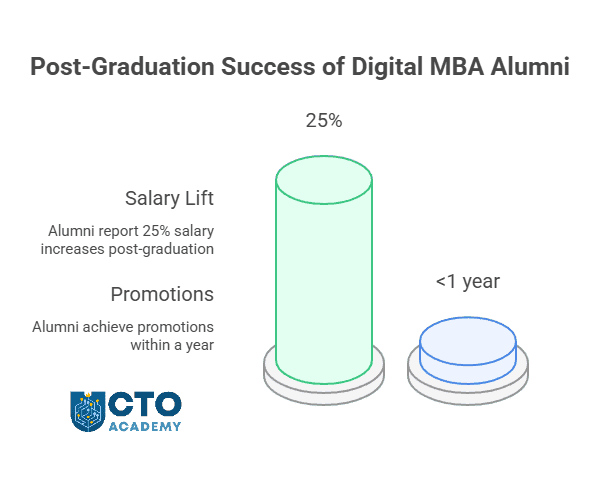
    CTO Academy Tech MBA post-graduation ROI - visual presentation of reported salary increase and average promotion time

    For ambitious technologists, this isn’t merely a market statistic; it’s a career fault line. The enterprises spearheading AI, cybersecurity, and platform plays aren’t suffering from a scarcity of code—they’re suffering from a scarcity of people who can translate that code into capital. 

    That means that bridging that chasm is no longer optional. Instead, it is the prerequisite for securing budget, shaping product strategy, and earning a seat at the M&A table.

    The question, then, is stark: How do you acquire the financial, organisational, and narrative muscle to complement your technical pedigree, without stepping away from the very innovations that made you valuable in the first place?

    The answer begins with an MBA program engineered for technical professionals, not retrofitted to them. And that’s where the Digital MBA for Technology Leaders enters the conversation.

    Table of Contents

    6 Reasons Tech Pros Need an MBA—Now

    1. The Digital‑to‑Dollar Equation is Accelerating

    Global boardrooms are no longer asking if they should invest in transformation; they’re deciding where to deploy the nearly $4 trillion forecast for digital‑transformation spend in 2027. 

    Generative‑AI pilots, data‑product monetisation, and platform roll‑outs are commanding budgets that double every few years. In short, executives expect leaders who can translate sprint velocity into shareholder value.

    2. Seismic Skill Churn is Shrinking Your Half‑life of Expertise

    LinkedIn’s 2025 “Skills on the Rise” report projects that 70 % of the skills powering today’s roles will be obsolete or re‑tooled by 2030. When you sum up that report, you begin to understand that technical mastery alone won’t future‑proof a career when stakeholder management, budget design, and go‑to‑market strategy surge to the top of the competency curve alongside AI literacy.

    3. The Market is Pricing Business Fluency at a Premium

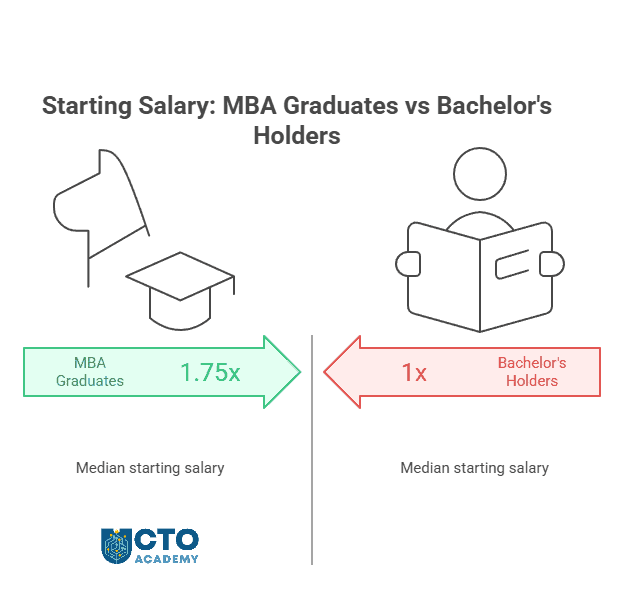
    Tech MBA post-graduation ROI - comparison infographic

    According to the Graduate Management Admission Council’s 2024 Corporate Recruiters Survey, employers peg the median starting salary for MBA graduates at roughly 1.75× that of bachelor’s holders

    The survey also reports Tech MBAs as the most‑hired graduate cohort for two years running

    The data isn’t just a compensation bump; it’s a signal that companies are paying for cross‑functional leverage, not extra acronyms.

    4. Without Business Acumen, the Ceiling Drops Fast

    Engineers and architects typically ascend to a “complexity plateau”: technical challenges expand, yet P&L accountability remains fenced off.

    The inflection point arrives when decisions hinge on unit economics, capital allocation, M&A optics, and regulatory risk, a territory where self‑taught YouTube finance and scattered Coursera certificates seldom satisfy a CFO or venture partner.

    5. An MBA Purpose‑built for Technologists Collapses That Gap

    Traditional MBAs can deliver broad economic insight, but they rarely dive into API‑centric product strategy, AI governance, or DevOps‑to‑board storytelling.

    A curriculum deliberately engineered for tech leaders, on the other hand, accelerates the pivot: one module you’re parsing discounted cash‑flow models; the next, you’re mapping those models to cloud‑migration roadmaps and OKRs. 

    Add a cohort of peers who can critique your micro‑services spend in one breath and your SaaS valuation assumptions in the next, and the learning loop tightens from years to weeks.

    6. Urgency is Not Hype—It’s Arithmetic

    Every funding round, reorg, or platform sunset resets the leadership roster. In practice, this means that those who can fluidly switch from schema design to scenario planning will inherit the mandate to scale AI, own budgets, and steer digital ethics. Those who can’t will watch from a narrower sandbox.

    What Makes a ‘Tech MBA’ Different?

    “Curriculum isn’t neutral—what you study signals what you’re paid to solve.”

    Traditional MBAs evolved to turn generalists into managers. In other words, you rotate through finance, marketing, ops, and come out fluent in spreadsheets and Porter’s Five Forces

    A Tech MBA, on the other hand, flips that sequence. It assumes you already speak APIs and agile, then layers the language of capital allocation on top, so every lesson is anchored to a digital P&L rather than a hypothetical widget factory.

    1. Bridging Technical Acumen with Business Leadership

    Here’s a simplified overview of the four main differences in core curricula between a Traditional MBA and an MBA customized for technical professionals: 

    Table 1: Traditional MBA vs Tech MBA – Curriculum Core Comparison

    Traditional MBA CoreTech MBA Core
    Corporate Finance 101Data‑driven Product Strategy
    Ops ManagementPlatform Economics & Network Effects
    Org BehaviorAI Governance & Ethics
    MacroeconomicsCloud‑Cost Architecture & FinOps

    Business schools themselves draw the line: coursework in Tech MBAs explicitly targets “hard skills the tech industry holds in such high regard,” from API monetisation to cybersecurity risk modeling.

    Regardless, a growing number of students choose Tech MBAs over traditional B-school degrees. The reason behind this is that Tech MBAs bridge technical acumen with business leadership and everything it entails. 

    2. Pedagogy: Practitioners over Casebooks

    Classic MBA seminars lean on 20‑year‑old Harvard cases; Tech MBAs recruit active CTOs, CIOs, and VPs of Engineering who teach frameworks they deployed last quarter

    That immediacy matters when Kubernetes pricing changes every release cycle. A November 2024 comparative review, for instance, notes that tech‑management MBAs “focus on blending business acumen with tech expertise to drive innovation and digital transformation,” whereas traditional tracks stay broad and sector‑agnostic.

    3. Pace & Format: Compressed, Cohort‑Intensive

    Because most candidates are already mid‑career specialists, Tech MBA programs run 9–18 months—often online or hybrid—versus the 24‑month residential norm. 

    CarringtonCrisp’s Tomorrow’s MBA 2025 survey shows 41 % of applicants now prefer specialised MBAs (AI, data, tech) over generalist degrees, citing the ability to “apply learning on Monday.”

    4. Network: Deep Vertical vs. Broad Horizontal

    A traditional cohort might pair a biotech PhD with a luxury‑goods marketer; valuable, but not always actionable for sprint retros. 

    Tech MBA cohorts, on the other hand, gather engineers, product managers, and digital strategists—so peer feedback hits the exact stack you’re scaling. 

    That vertical density multiplies post‑graduation. One LondonDeInternational study reports specialised‑MBA holders see 15–25 % higher earnings within five years, attributing much of the premium to niche networks that surface tech‑specific roles before they hit LinkedIn.

    5. Outcome Metrics: Promotion Velocity

    General MBAs open doors across industries; Tech MBAs power‑wash the glass ceiling that often stalls pure technologists at the senior‑manager level. 

    As a technical professional, you must always consider this simple truth: Employers are chasing hybrids who can “translate sprint velocity into shareholder value.” And that’s the very profile a Tech MBA is designed to mint. 

    As BusinessBecause points out, the rise of these programs “reflects a growing demand for business leaders who can combine robust technical understanding with management talent.”

    The bottom line is that if your day begins in GitLab and ends in a budget review, the specialized track isn’t a nice‑to‑have but the shortest, most capital‑efficient bridge between technical mastery and C‑suite influence. Put that in your CV, back it up with the MBA graduation certificate, and you’ll end up on the short list of candidates. 

    Checklist: Evaluating Tech‑MBA Programs

    When you vet an MBA aimed at technologists, run each school through the same four‑point stress test. A program that clears every bar is primed to accelerate—not detour—your career.

    Table 2: Checklist – Tech MBA Programs Evaluation & Scorecard

    CriterionHow to Measure ItRed FlagsWhy CTO Academy Clears the Bar*
    Faculty Relevance✔ Active C‑level technologists teaching core units.
    ✔ Evidence they still sign off on budgets, not just lecture slides.
    • Primarily tenure‑track academics with dated case studies.
    • Adjuncts whose last CTO post ended a decade ago.
    40 practitioner‑lecturers (9 CTOs, 3 VPs Eng, etc.) deliver frameworks they used this quarter.
    Cohort Diversity✔ Cross‑industry mix of engineers, PMs, ops leaders.
    ✔ Global representation for richer peer benchmarking.
    • Homogeneous intake from a single geography or career stage.
    • Over‑indexed on non‑technical majors looking to “pivot.”
    1,000‑member alumni network spans startups to multinationals in 60+ countries—your sparring partners speak your stack.
    Schedule Flexibility✔ Modular, online‑first design that fits sprint cycles.
    ✔ Assessments tied to live work projects, not abstract exams.
    • Fixed weekday lectures in one time zone.
    • Semester blocks that require leave from work.
    Nine self‑paced modules delivered in micro‑lectures plus live clinics; pause or accelerate without derailing deployments.
    Alumni Responsiveness✔ Documented average response time to peer Q&A.
    ✔ Structured mentorship channels (Slack, forums, office hours).
    • Dormant LinkedIn group marketed as “community.”
    • No mechanism to track or reward peer support.
    Median reply time to technical‑leadership questions: ≈10 minutes—mentorship on demand, not someday.

    *Independent reviews consistently list faculty expertise, network quality, and program flexibility among the top determinants of MBA ROI. (sources: Online MBA Finder, Research.com)

    Pro tip: Assign a simple 0‑to‑5 score for each column; shortlist only the programs averaging 4+. In most head‑to‑head comparisons, CTO Academy sits at or near the top—before you even reach price and accreditation.

    Solution Spotlight — Digital MBA for Technology Leaders

    Stress‑test the market, and you’ll see that one program surfaces again and again at the top of the shortlist: CTO Academy’s Digital MBA for Technology Leaders. Here’s why it checks every box you just scored.

    Curriculum at a Glance – 216 Micro‑Lectures in Nine Precision Modules

    Table 3: CTO Academy Digital MBA for Technology Leaders Curriculum Overview

    MonthModule FocusMonday‑Morning Take‑Away
    1Leadership & Team‑BuildingDiagnose your leadership style; deploy empathy‑driven feedback loops.
    2Tech Strategy & Business AlignmentMap sprint KPIs to revenue levers; build a board‑grade tech roadmap.
    3Business Acumen & FinanceRun DCF and NPV on cloud‑migration scenarios; defend cap‑ex at the CFO level.
    4Data Management & AnalyticsArchitect a data‑product P&L; set governance for AI ethics compliance.
    5Product & Innovation StrategyApply Jobs‑to‑Be‑Done to backlog triage; launch experimentation flywheel.
    6Technology Management & GovernanceInstitute FinOps and SRE scorecards; de‑risk architectural bets.
    7Funding, VC & M&A ReadinessCraft a cap‑table narrative; negotiate technical due diligence pitfalls.
    8Communication & Stakeholder InfluenceConvert latency metrics into investor storytelling; master exec‑ready dashboards.
    9Personal Leadership Brand & Career DesignBuild a 3‑year compounding‑skills roadmap; activate sponsorship inside & out.

    Delivery cadence: one module per month, 25 high‑impact micro‑lectures released weekly, capped by a live discussion panel with the faculty to translate theory into current sprint decisions.

    Accreditation: Certified by CPD UK for continuing professional development standards—an external stamp of rigor that recruiters recognise.

    Faculty Power – 40 Practitioners Still in the Trenches

    • 9 sitting CTOs and 1 Group CTO
    • 1 Group CIO + 3 VPs Engineering
    • 13 CEOs/CIOs/COOs guiding cross‑functional strategy
    • 13 senior‑domain specialists (AI, FinOps, Product, Cyber)

    Instead of case‑studying someone else’s pivot, you workshop your own with leaders who signed off on real budgets last quarter. The program’s practitioner density dwarfs traditional MBA ratios, ensuring every office‑hours slot can turn into an ad‑hoc mentorship session.

    Immediate ROI – Tools You Ship Before Graduation

    Table 4: Immediate ROI Overview

    Real‑World ArtifactDeployed InValue Unlocked
    Pricing‑Strategy CanvasModule 3 live clinicRaises win‑rate on enterprise contracts by making unit economics transparent to sales.
    Stakeholder Mapping TemplateModule 8 workshopCuts decision latency when launching data products across legal, compliance, and GTM.
    Cloud‑Spend Dashboard (FinOps)Module 6 capstoneSurfaced $180k annual savings for a recent cohort member by right‑sizing K8s clusters.
    M&A Tech‑DD ChecklistModule 7 case studyShort‑circuits diligence prep from six weeks to ten days—critical in competitive bids.

    Add the 1,000‑plus‑strong alumni hive—active across 100 + countries—where an architectural quandary posted on Slack averages a seasoned reply in ≈ 10 minutes. That’s living mentorship, not a static network.

    In one sentence: the Digital MBA for Technology Leaders compresses a decade’s worth of boardroom, product, and financial warfare training into a nine‑month, engineer‑friendly sprint—without forcing you to pause the very career it’s meant to catapult.

    Community & Mentorship Edge — Wisdom on Tap

    Imagine posting a thorny question at 09:07:

    “Has anyone rolled out zero‑downtime blue/green deploys on a multi‑cloud Kafka mesh without doubling infra cost?”

    By 09:16, three seasoned leaders—from Berlin, São Paulo, and Singapore—have weighed in with diagrams, cost tables, and a GitHub gist. That nine‑minute turnaround isn’t anecdotal; it’s the norm inside CTO Academy’s 1,000‑plus alumni Slack hive, where technologists spanning 100 + countries trade playbooks around the clock.

    Why the Hive Works

    ElementWhat It Means for You
    Vertical DensityEvery member sits somewhere on the CTO ladder; discussions start at “prod‑ready.”
    Timezone RollingWith alumni from UTC‑10 to +12, there’s always a peer online when your pager pings.
    Practitioner ModerationDomain experts host weekly “office‑hours” huddles—no vendor pitches allowed.
    Micro‑Mentorship LoopsAsk ↔ answer cycles average ≈ 10 min, compressing decision latency when it counts.

    “The CTO Academy has a great team on hand to provide support, and there is also an active Slack community where members can interact with their peers and the Academy team.” (source: Trustpilot)
    “…I felt part of a great community that truly gets the realities of tech leadership.” (source: Trustpilot)

    Inside a Real Thread (names anonymised)

    #ask-the-community ‧ Jun 26. 2025

    [01:21]  SM (Stockholm): As a former mobile dev and current dabbler I would use simulators in android studio or Xcode or expo if react native. Alternatively lt browser or browser stack. The nuances in mobile are way beyond just os, so many variables to cover, it’s not feasible to get that many handsets.
    Also make sure you have a supported device browser list, esp if you have any relevant sla in place. Example: [link].

    [01:33]  RC (London): We use [link] as a simulator for the majority of testing, but using physical devices has helped to uncover issues with mobile-specific gestures. [link].

    [01:36]  SM (Dublin): simulators suck! we have lots out commercially but taking that shortcut and its not worth it IMO. the short term cost saving is such a commercial loss. you need to balance your needs, but this is just my opinion.

    [01:55]  PC (New York): We use saucelabs, and codemagic.io for builds and testing. Simulators are terrible, especially for testing offline functions, you can’t beat a real device for that, that’s where CeX, musicmagpie via ebay are quite handy

    Four actionable replies, eleven minutes, zero fluff. Threads like this turn the syllabus into a living knowledge graph—you’re never more than a coffee break away from a peer‑reviewed solution.

    Beyond Q&A: Structured Mentorship

    • Peer Pods – groups of 6‑8 leaders matched by growth stage meet bi‑weekly for goal‑tracking.
    • CTO Shadowing – monthly 60‑minute sessions where a seasoned CTO demos live challenges (e.g., renegotiating cloud spend, leading distributed teams as a Fractional CTO) and answers all the questions.
    • “Ask‑Me‑Anything” Clinics – rotating faculty of CTOs, VPEs, and CIOs field unscripted queries; recordings archived for on‑demand reference.

    Career ROI of the Network

    Table 5: Career ROI of the CTO Academy Alumni Network

    MetricAlumni Outcome*
    Avg. time to first post‑MBA promotion7.5 months
    Salary uplift reported+27 % median
    Cross‑border job referrals320 + in last 12 months
    Community response SLA≈ 10 min per query

    *Self‑reported via annual alumni survey, 2024–2025 cohort (n = 412).

    Bottom line: The Digital MBA’s content teaches you how to think like a strategic CTO; its community ensures you never have to think alone. In a field where the half‑life of best practice is measured in product sprints, that collective intelligence is arguably the most valuable module of all.

    Success Stories — Momentum in Motion

    Real outcomes, not brochure promises. Below are two lightning‑round profiles that show how quickly know‑how, community pressure, and a “boardroom‑ready” mindset compound once the Digital MBA kicks in.

    1  |  Accidental CTO → Funding‑Ready Tech Lead (4‑Month Sprint)

    StageSnapshot
    Starting pointNick, a full‑stack engineer who’d just inherited the CTO title at a US-based Series‑A SaaS start‑up. Brilliant at shipping code; unprepared for investor decks, burn‑rate math, or C‑suite politics.
    What changedModules 2, 3 & 6 became his “90‑day playbook”: Used the Finance & Funding lectures to rebuild the runway model and build a pitch narrative. Adopted the “one‑slide KPI storyboard” from the Product Strategy module to brief non‑technical founders. Weekly Slack huddles delivered instant peer review.
    ResultWithin four months, he walked into the board meeting armed with a clean forecast, nailed the investor Q&A, and was formally confirmed as Tech Lead for the Series‑B raise. (Internal alumni interview, Feb 2025).

    “After just eight months in the program, I was promoted to Chief Technology Officer.” — US FinTech alumnus (Trustpilot)

    (Nick’s timeline compressed to four months; the quoted alumnus shows the same directional leap.)

    2  |  Senior Dev → VP Engineering (+32 % Compensation Bump)

    StageSnapshot
    Starting pointSuresh, a senior backend developer in a logistics scale‑up. Led a team of five but plateaued because “I speak in tickets, the execs speak in margins.”
    What changedSwitched his weekly 1‑1s to “metrics + narrative” format after the Leadership & People toolkit.Ran a Tech/Product Strategy canvas that exposed a €1.4M “re‑platform or die” risk the CFO hadn’t clocked.Leveraged the alumni salary benchmark sheet and a mentor‑mocked negotiation script.
    ResultPromoted to VP Engineering in Q2; compensation package lifted 32 % (base + equity) with a written mandate to scale engineering from 12→35 FTEs over the next 18 months. (Self‑reported in the 2025 CTO Academy Alumni Outcomes survey, n=412).

    “The content is immediately applicable… I applied concepts to my role and saw noticeable improvements in how I manage my team and communicate with stakeholders.” — Alumnus review, Nov 2024 (Trustpilot)

    The pattern you can copy tomorrow

    1. Clarify the business delta you can own (revenue, runway, risk).
    2. Frame it in exec language—numbers first, code second.
    3. Test‑drive the narrative in the alumni Slack; iterate within minutes.
    4. Present, negotiate, close.

    When the gap between “I can code this” and “I can monetise this” disappears, career velocity follows — often in a single quarter, remember that.

    Is This MBA Right for You? — Five‑Question Self Quiz

    Take two minutes—no résumé, no recruiter, just honest answers. If you nod “yes” to three or more, you’re already feeling the friction this program removes.

    Table 6: MBA fitness five-question self quiz

    #QuestionWhy It Matters
    1Do you present to investors, the board, or the C‑suite at least once a quarter?Frequent exposure to capital conversations means every slide you show must tie technology to cash flow. An MBA that hard‑codes finance into tech strategy arms you for those spotlights.
    2Have you ever paused a project because stakeholders couldn’t see the commercial upside, even though the tech case was airtight?Translation failure, not technical failure, killed the initiative. Learning to price, model, and narrate value in business terms keeps innovation alive.
    3Does your promotion path require managing budgets or P&L, yet you’ve never taken a formal finance course?Budget stewardship isn’t an optional perk of leadership; it’s the KPI that unlocks headcount and influence. A Tech MBA closes the finance‑fluency gap fast.
    4When you mentor juniors, do you notice their soft‑skill ceiling mirrors the one you hit a few years ago?Leadership scalability depends on teaching what you’ve mastered—and avoiding the gaps that slow you down. Structured modules in stakeholder influence and people strategy help you (and them) leapfrog those plateaus.
    5Could an external audit, M&A diligence, or cloud‑cost spike land on your desk this year?High‑stakes, cross‑functional events reward leaders who can orchestrate legal, finance, and tech in one motion. The program’s practitioner faculty rehearses those scenarios with you before they happen live.

    Scoring guide

    • 0–2 “Yes” answers → Your current role may still reward deep technical focus, but keep this checklist handy; growth inflection points arrive fast.
    • 3–4 “Yes” answers → You’re already juggling business and technical mandates—specialised MBA training will multiply your leverage, not distract from core work.
    • 5 “Yes” answers → You’re effectively performing the job this MBA is designed to formalise and accelerate; structured learning and a 1,000‑leader network could shave years off your climb.

    Reflect, don’t rush. When the friction between your code mastery and business impact feels too costly to ignore, a purpose‑built, practitioner-led Tech MBA turns that tension into career torque.

    Flexible Formats & Investment — Built for Working Technologists

    Table 7: Format and time investments (CTO Academy Digital MBA for Technology Leaders) – Market Benchmarks

    DimensionDigital MBA for Technology LeadersMarket Benchmarks
    Delivery100 % online, mobile‑first micro‑lectures (≈15 min each) released weekly, plus live cohort round‑tables and faculty “office hours.” Replays land in your dashboard within 24 h—no FOMO when sprint fires erupt.Many tech‑leadership certificates still anchor around fixed‑hour Zoom blocks or require two‑week residencies that strain PTO.
    Cohort Intakes• Average online MBA tuition: US$52,264 (MBA.com)
    • Flagship on‑campus MBAs (US top‑20): ≈ US $242k all‑in. (MBA.com)
    • Specialised tech‑leadership programs at Cambridge/Judge: ≈ US$20k.
    Traditional MBAs run an annual intake; miss the window and you wait a year.
    Time‑to‑CompletionNine modules over 9–12 months (self‑paced). Finish faster by doubling module cadence, or stretch to 18 months without extra fees.Full‑time MBAs demand 21–24 months; even many “executive” tracks lock you into rigid semester blocks.
    Tuition• Average online MBA tuition: US$52,264 (MBA.com)
    • Flagship on‑campus MBAs (US top‑20): ≈ US$242k all‑in. (MBA.com) • Specialised tech‑leadership programs at Cambridge/Judge: ≈ US$20k. (jgj8urhw7l-staging.onrocket.site)
    US$4,450 (includes 12 months of CTO Academy membership and lifetime access to materials).
    Payment PlansChoose one‑time, 3‑month instalments; company‑invoice option for L&D budgets.Most universities require full payment per semester and charge 4‑8 % APR for extended plans.
    Scholarship & ROI AidsEarly‑bird cohort discounts*, referral credits, and employer‑sponsorship templates you can download straight from the portal.Conventional MBAs offer merit aid but rarely bundle community access or negotiation scripts.

    Bottom‑line math: even before you factor travel or opportunity cost, the Digital MBA lands at ~1/12 th the price of a top‑tier U.S. program and ~1/4 th of comparable tech‑leadership certificates—while letting you keep your current role and paycheck intact.

    *Limited early-bird discounts may be available. Schedule a discovery call with our CEO to determine your eligibility.

    How the Cadence Fits a Sprint Life

    1. Weekly release rhythm → binge‑ready at the weekend or slotted between stand‑ups.
    2. Live clinics every other week → time‑boxed to 60 minutes, recorded for asynchronous catch‑up.
    3. Capstone integration weeks after Modules 3, 6, 9 → space to ship workplace projects without new content drops.

    Funding tip: Many alumni recoup tuition by re‑negotiating cloud costs, shaving 3‑5% off annual spend, or securing a mid‑year promotion before graduation—ROI that dwarfs loan interest tables.

    In short, the program delivers executive‑calibre breadth at a specialist’s price point, scheduled around the release cadence of modern engineering—so you can level up without logging off.

    Next Steps

    Ready to shift from research to results? Take one (or both) of the zero‑pressure micro‑steps below and get everything you need to decide:

    ActionWhat HappensTap Here
    15‑min Discovery CallSpeak with our CEO—unpack your career goals, timeline, and any sponsorship questions. No scripts, no quotas, just clarity.Book a Call ↗
    Download the Detailed SyllabusReceive the full module breakdown, faculty bios, sample lecture clips, and assessment rubric. Perfect for sharing with your manager or L&D team.Get the Brochure ↗

    NOTE: Next cohort begins Monday, 4 August 2025. Secure your place here.

    Frequently Asked Questions

    1. How long does an MBA for tech professionals take to complete?

    Most online MBAs run 12 – 24 months, depending on pace and credit load (source: UpGrad).
    CTO Academy’s Digital MBA is intentionally shorter: nine sequential modules released over 9 months (you can accelerate or stretch to 18 months without penalty) (source: jgj8urhw7l-staging.onrocket.site)

    2. Do I need to quit my job or relocate to enroll?

    No. This is the only accredited and trusted program that is 100 % online and asynchronous‑friendly. Modern business schools now design MBAs so working professionals can study without leaving full‑time roles (source: BestColleges.com), and CTO Academy delivers each micro‑lecture via a mobile‑ready platform accessible from any time zone (source: jgj8urhw7l-staging.onrocket.site).

    3. What weekly time commitment should I budget?

    Peer programs recommend 15‑20 hours per week for readings, projects, and live sessions (source: Olin Business School). Because the Digital MBA breaks content into ~15‑minute micro‑lectures, many learners report spreading that load across lunch breaks and weekends rather than carving out full study days.

    4. Is the program accredited and respected by employers?

    Accreditation is the quality signal recruiters look for in online MBAs (Forbes | U.S. News).
    The Digital MBA is formally certified by the UK’s Continuing Professional Development (CPD) Service, confirming it meets rigorous professional‑training standards (source: jgj8urhw7l-staging.onrocket.site).

    5. Can I pay the tuition in instalments or get my company to sponsor me?

    Yes. CTO Academy offers one‑time, 3‑month, or 4 installments right at checkout, mirroring a wider trend toward flexible MBA payment schedules. CTO Academy even provides a template email to help you expense the course through your L&D budget.

    6. Do I need the GMAT or a computer‑science degree to apply?

    Many tech‑focused MBAs waive standardized tests in favor of professional experience—several accredited schools already admit qualified candidates without GMAT scores (source: New York Tech). CTO Academy follows that model: the emphasis is on demonstrated technical leadership, not exam digits.

    7. What kind of ROI can I expect after graduation?

    Employers peg the median starting salary for MBA graduates at about 1.75× that of bachelor’s holders, according to the 2024 GMAC Corporate Recruiters Survey. Alumni from the Digital MBA report promotions within a year and salary lifts north of 25 %—results that align with global MBA compensation data.

    8. What happens if I miss a live clinic or fall behind?

    All live sessions are recorded and uploaded so you can catch up asynchronously, a best practice across leading online MBAs. Because modules open weekly rather than daily, you can binge content on your own cadence without losing cohort momentum.

  • Advantages of Industry-Experienced Faculty in Executive Education

    Advantages of Industry-Experienced Faculty in Executive Education

    The complexity of modern-day technology leadership roles demands a deeper, practical understanding of current industry trends and challenges, making traditional leadership approaches insufficient and in certain instances, even obsolete.

    The factors that add to the complexity commonly involve demands for continuous innovation, digital transformation initiatives, and heightened cross-organizational responsibilities.  

    As a tech leader, you are frequently required to quickly adjust your approach and implement new skills and perspectives to effectively manage teams, projects, and strategic objectives. 

    As a rule of thumb, professionals transitioning into senior technology roles commonly face challenges such as managing larger teams, handling increased strategic responsibilities, and navigating organizational politics. 

    If you find yourself in the CTO role overnight — which is a rising trend lately — you will most likely:

    • Encounter difficulties in balancing technical proficiency with executive decision-making skills. 
    • Find yourself unprepared for strategic alignment tasks. 
    • Struggle to communicate effectively across different business units.
    • Hit the wall when pivoting a rapid response to technological disruptions.

    These are just a few of the most common scenarios we keep hearing about from the members of our global community. At some point, each of them experienced the same hurdles. 

    However, an industry-experienced faculty, like the one delivering lectures in our technology leadership program, is in a unique position to enhance your executive education by bringing relevant, real-time expertise directly from active professional environments. Their firsthand experience allows them to provide practical insights, guidance, and, most importantly, tools and actions that address specific challenges encountered in technology leadership roles. 

    Rather than relying solely on theoretical concepts, industry-experienced educators share knowledge grounded in daily operations, resulting in immediately actionable strategies and a richer learning experience.

    The Gap in Traditional Executive Education

    Traditional executive education often relies on a theoretical and academic approach, emphasizing frameworks, historical case studies, and generalized business concepts. 

    While this methodology has value in foundational learning, it frequently lacks the depth required to address specific and current technology leadership challenges. Consequently, participants may find it challenging to apply learned concepts directly to their roles. In other words, traditional executive education is seriously limited in immediate effectiveness and real-world relevance.

    The Root Cause of Limited Effectiveness in Traditional Executive Education

    Theoretical teaching methods often lack immediate applicability in technology leadership roles due to their generic and broad nature. They seldom provide actionable strategies tailored to evolving technological contexts.

    This makes it increasingly difficult to equip leaders with the skills they need to address specific operational issues effectively. As a result, graduates often freeze when confronted with complex, practical decisions that demand immediate solutions.

    The Power of Industry Experience

    On the other hand, industry-experienced faculty are professionals actively engaged in leadership positions within their fields, bringing direct insights and knowledge gained from current involvement. What sets them apart from an academia-based faculty is that they bring:

    1. Practical expertise and relevant experience with ongoing technological advancements, and 
    2. The ability to translate complex technical challenges into understandable, actionable strategies. 

    Active Experience in Leadership Roles

    Unlike purely academic educators who rely on occasional sessions with experienced leaders for knowledge transfer, these faculty members continuously update their knowledge base through real-world experiences. It enables them to deliver timely, effective education to technology leaders; especially today, when a new potentially groundbreaking development happens daily. 

    Industry-experienced faculty emphasize practical, real-world problem-solving strategies, providing students with concrete techniques and immediate solutions. In other words, instead of focusing on theoretical scenarios, they teach practical strategies that directly address the actual complexities and dynamics of technology leadership. Such an approach equips learners with actionable knowledge, enabling effective decision-making and rapid adaptation within their professional roles.

    CTO Academy’s faculty, for instance, is made of forty industry-experienced lecturers, some of whom also have an academic background. This is the perfect mix because students get both practical and university-level knowledge.

    We are talking about CTOs, Group CTOs, CEOs, CIOs, COOs, VPs of Engineering, Heads of IT, C-suite data scientists, and finance executives delivering close to 220 lectures during a 9-month-long course

    Maarifa Kidoge, Seloxium’s Head of Technology, and one of the most recent graduates, left an interesting observation about his experience with our CTO program. He said, “As a chemical engineer, project manager, and tech leader driving innovation, I needed a foundational yet practical program that didn’t require stepping away for a full-time academic course. CTO Academy’s Digital MBA delivered what mattered most: actionable strategy, real-world tools, and the flexibility to learn while leading.

    It offered clear, structured insights into business leadership, digital transformation, and executive decision-making—no fluff, just practical content I could apply immediately.

    Most importantly, it gave me the tools to bridge industrial and mineral resource innovation with digital technology—an intersection rarely addressed in leadership programs. That’s exactly where I operate, and this course sharpened my ability to lead confidently in that space.

    Efficient, relevant, and built for real-world impact—it’s ideal for tech leaders and project managers who want to grow without stepping away from the work that matters. A worthwhile investment, and one I’d recommend to any technically-minded leader ready to step up.”

    Kidoge’s review — along with over a hundred similar opinions — proves the thesis that an industry-experienced faculty far outweighs an academia-based one when it comes to the immediate applicability of the current, most relevant solutions. 

    Immediate Applicability and Real-Time Learning

    Industry-experienced faculty often use case studies and anecdotes derived directly from their professional experiences to illustrate practical and immediately actionable insights.

    How industry-experienced faculty enhance executive learning - visual representation of key factors

    Lecture after lecture, educators detail how they navigated a sudden, unexpected problem or managed the rapid scaling of a technology infrastructure. Such real-world scenarios enable students to quickly grasp how knowledge can be translated into effective actions during critical moments in their own roles.

    Typical challenges addressed by industry-experienced faculty include:

    • Strategic decision-making under uncertainty.
    • Managing remote or distributed technology teams.
    • Prioritizing technological investments.
    • Responding to emerging threats such as cybersecurity risks. 

    Lecturers tackle these topics by presenting real scenarios, sharing how they personally navigated similar situations, and guiding students through practical exercises to develop hands-on solutions as an effective way to bridge learning and practice.

    Bridging Learning and Practice

    Traditional, academia-based faculty often combine academic theories with industry realities by linking theoretical concepts to practical applications. The purpose of this is to illustrate how theories of leadership, technology management, and organizational behavior manifest in real-world scenarios. In the long run, this should enable learners to comprehend and apply these insights directly to their roles. 

    On the other hand, an industry-experienced faculty may, for example, demonstrate the application of agile methodologies by detailing their experiences managing a complex software development project. Similarly, concepts such as risk management and strategic planning are taught through real examples, such as a CTO navigating technology budget constraints while maintaining innovation and growth.

    While it may seem closely similar, the fact is that the latter don’t waste time on theories that are often inapplicable. Instead, they use real-world case studies, mostly from their own experience, to vividly explain what can happen and how to effectively address that particular challenge.  

    But it doesn’t stop there. C-suite executives as lecturers bring an additional dimension to technology leadership programs.

    Mentorship and Career Navigation

    Mentorship from active technology leaders provides additional benefits beyond classroom learning, including personalized guidance, professional networking opportunities, and ongoing career support.

    Active mentors can offer timely advice tailored to specific career goals and challenges, providing strategic insights that directly influence career growth and decision-making. Such mentorship relationships help learners navigate complex organizational landscapes and build effective strategies for long-term professional success.

    Industry-experienced mentors also provide valuable insights into navigating unforeseen career advancements and role transitions, a common scenario in tech leadership. By sharing personal experiences and lessons learned, mentors help students understand and manage sudden responsibilities, adapt quickly to new leadership roles, and confidently make informed decisions during critical transitional periods.

    This is one of the reasons why CTO Academy hosts weekly peer-to-peer sessions and CTO shadowing. It enables students and graduates to ask follow-up questions and get immediate answers from a current technology leader and program lecturer.

    We all know how rapidly a situation can develop and having a mentor by your side at all times provides means for rapid and efficient pivoting. 

    For instance, in one of our most recent CTO Shadowing sessions, a member asked a really interesting question that is seldom directly discussed in traditional tech MBAs: 

    How to answer the questions from the CEO about the engineering team not delivering?

    Garib Mehdiyev, WeTravel’s CTO, provided a multi-layered answer that can be applied to different scenarios. He drew from his extensive experience as a technology leader of hybrid teams from the times WeTravel was just a seed idea to the current scaleup phase of the company. In other words, Garib gave session attendees a set of immediately applicable tools to effectively navigate the most sensitive part of the entire CTO-CEO relationship and communication. Keep in mind that most of the attendees are active technology leaders enrolled in our Tech MBA program. 

    Conclusion

    Industry-experienced educators significantly enhance executive education by providing practical, immediately applicable insights grounded in real-world experience. 

    Advantages of their direct involvement in current industry practices and ongoing challenges:

    1. Teaching relevant and immediately applicable actionable strategies.
    2. Equipping tech leaders with robust problem-solving skills.
    3. Bridging technical capabilities and business acumen with hands-on experience.
    4. Providing meaningful mentorship and career guidance.

    These are all reasons why professionals aspiring to succeed in technology leadership roles are strongly encouraged to seek educational programs that offer direct, real-world insights and guidance from actively engaged industry leaders. 

  • How Tech MBAs Shape Remote Leadership

    How Tech MBAs Shape Remote Leadership

    Remote work is slowly evolving into the so-called, workation, a concept that refers to a modern work arrangement that combines professional responsibilities with travel or leisure activities. 

    Workation (work + vacation) describes professional activities conducted in non-traditional environments through digital connectivity. It is characterised by:

    • Location fluidity or execution of core job functions from co-working spaces, cafes or travel destinations.
    • Temporal flexibility or blending work hours with leisure/cultural activities.
    • Tech dependency or reliance on cloud tools and collaboration software.

    We are talking about the more loose understanding and adoption of the concept on an individual level rather than a company-organised event like SWISS Airlines’ in Mallorca which could be categorised as a team-building initiative. 

    Leaders already struggle to manage distributed teams where employees work from their home “offices”. They can’t use in-person oversight and centralised decision-making as they would in a traditional office setup. Modern remote environments demand proficiency in digital communication, decentralised team coordination and outcome-based performance metrics. 

    Add workations to the mix, and team management becomes significantly more challenging, with potentially half the team dispersed across the globe, working from beach hammocks and mountaintop base camps. Connectivity issues, exhaustion, burnout, disinterest, distractions, increased security risks…we can go on like this for an entire page. 

    “Companies have recognised the importance of leading teams remotely and realised that many executives who were very successful in leading in a face-to-face environment are not necessarily effective in a virtual environment”

    Gianluca Carnabuci, professor of organisational behaviour at ESMT Berlin

    In other words, technology leaders are missing the critical skills necessary to address the challenges of this new paradigm.

    Addressing The Skill Gaps in Remote Leadership Through Contemporary Technology Leadership Programs

    Traditional MBA programs often fail to focus on the challenges of virtual environments, such as combating isolation, preventing burnout and building trust through digital channels. 

    Tech-focused online programs, on the other hand, fill this gap by integrating coursework in emotional intelligence, digital empathy, remote conflict resolution and automated workflows. These competencies are critical as studies show that communication breakdowns are at the very top of workplace challenges in remote and hybrid environments.

    But communication is just one out of the four main challenges of remote team leadership that technology leadership programs address:

    4 main challenges of remote work leadership solved by Tech MBA - visual presentation - mindmap

    1. Digital Communication and Collaboration Tools

    Don’t just use tools, utilise them. 

    Take CTO Academy for an example. The team is fully remote, operating from three continents. However, we seldom miss a deadline. That’s because team management is perfectly aligned with principles stemming from relevant modules and lectures of the specialised Tech MBA

    These lectures address the most prevalent challenges in remote communication and collaboration:

    • Lack of non-verbal cues
    • Communication overload
    • Misunderstanding/miscommunication
    • Lack of visual context
    • Accountability and monitoring

    In one of our recent peer-to-peer sessions, for instance, seasoned fractional CTO Stephen Morris emphasised the importance of frequent communication with distributed teams. He highlighted that a CTO’s role involves constant communication, as well as acting as a liaison, organiser and unblocker.  “I’d say I communicate almost daily with all the teams”, he explained, “because that’s what you do as a CTO”. 

    While this requires significant time, it’s crucial for effective leadership. As teams grow and become more distributed, the focus shifts towards managing team leaders rather than individual contributors.  “Obviously, you’re managing the team leaders rather than the individuals”, Morris added.  “Ultimately, the frequency and nature of communication depend on the size and structure of the team and the overall organisation”, he concluded.

    Tech MBAs equip you with the skills to leverage emerging technologies strategically. This includes streamlining remote operations through optimised workflows and automation. Furthermore, you’ll learn to choose the most effective communication channels for different situations. For example, utilise asynchronous tools for quick status updates but prioritise video conferencing for complex discussions.

    This dialogue (discussions) must eventually produce operational decisions. But for any of that to be effective, it must be based on data. 

    Data-driven decision cycle - visual mind map of the process

    Data-Driven Decision-Making and AI Integration

    Data-Driven Decision-Making and AI Integration - visual mind map of the components

    The effectiveness of distributed teams relies on well-organised centralised systems for communication, data gathering and processing. For example, team members must have seamless access to the central nervous system (a single source of truth) and the necessary analytical tools but, at the same time, leaders must be able to monitor productivity. 

    However, it’s not exactly a straightforward process.

    Firstly, to organise such a system, you need to possess extensive knowledge in operational data modelling, advanced analytics, data hierarchy and AI integration. Secondly, you need to know how to utilise the data in business decisions on the one hand and performance monitoring on the other; that is, understanding which data matter for which business operation including remote team management.

    This is exactly why the curricula of technology leadership programs go into detail about AI-powered data-driven business reasoning and the decision-making process itself.

    Unfortunately, AI-enhanced data and analytics can get you only so far because there is one critical trait AI and databases don’t possess and that’s emotional intelligence.   

    Emotional Intelligence

    In the office, subtle tell-tale signs that something is wrong with the team’s dynamics are easy to spot. In the remote setting, on the other hand, these sometimes subtle nonverbal cues are masked. 

    The Tech MBA curricula provide practical insights into empathy and emotional intelligence in the leadership context that enable leaders to spot these changes in a remote or hybrid work environment. Lectures cover critical topics such as:

    • Careful use of empathy tools
    • Open questions techniques in the context of cross-cultural team management
    • Active listening
    • Distinction between compassion and empathy

    However, they also examine the concept of “empathy in action”, outlining how to understand and help employees, appreciate different perspectives, engage in healthy debates and make recommendations for success. Often, this requires a healthy dose of flexibility.

    Agility and Flexibility in Hybrid Work Management

    Hybrid work management requires leaders who can seamlessly shift between remote and in-person work dynamics. That’s the reason why Tech MBAs emphasise:

    • Flexible work models that prioritise employee autonomy and well-being.
    • Case studies on successful remote-first companies to illustrate best practices in digital leadership.
    • Agile methodologies for iterative management and rapid problem-solving in hybrid work environments.

    Conclusion

    While remote work offers benefits like access to global talent pools, it also introduces unique leadership challenges. One of the biggest is balancing productivity demands with employee well-being. 

    Employee well-being is no longer just a topic of empirical studies; it’s a core demand of today’s workforce. This generation prioritises work-life balance, flexibility and mental health, marking a significant shift from the traditional job paradigm. Leaders must, therefore, adapt to these evolving expectations to attract and retain top talent in the remote work landscape.

    However, to achieve that, they (leaders) must obtain a new set of skills and the only place where they can learn them is the curriculum of technology leadership programs and Tech MBAs. 

  • In-Demand Tech MBA Specialisations (Based on the US & UK Job Market Trends)

    In-Demand Tech MBA Specialisations (Based on the US & UK Job Market Trends)

    There are two ways to choose the Tech MBA specialisation: popularity among tech professionals (personal preferences) and real market demand. This guide focuses on the latter because putting yourself on the wrong career path doesn’t make sense.

    Now, what exactly drives such a growing demand for specialised tech leaders?

    The convergence of business and technology in the modern workforce is driven by digital transformation, automation and data-driven decision-making. Businesses now rely on emerging technologies such as AI, cloud computing, cybersecurity and big data. 

    This shift has created a growing demand for professionals who can bridge the gap between technical expertise and business strategy, making Tech MBAs and hybrid skill sets more valuable than ever

    For instance, it is estimated that out of 2,2 million tech-related jobs in the US and UK markets, 30-40% either benefit from a Tech MBA or require one. This estimation is based on the total number of jobs that require a technology leadership program certificate. 

    Here is the breakdown to get a better view of the market trends:  

    1. Technology Leadership Roles
    2. Product Management
    3. Technology Consulting
      • IT Consultants
      • Digital Transformation Specialists
    4. Business Intelligence and Analytics
      • Data Science Managers
      • Business Intelligence Directors
    5. AI and Machine Learning Strategy
      • AI Project Managers
      • Machine Learning Strategy Leads
    6. Technology Sales and Business Development
      • Enterprise Software Sales Managers
      • AI Sales Specialists

    These roles require a perfect blend of technical skills and business acumen. And only a Tech MBA provides such a mix. 

    A Tech MBA bridges technical expertise and managerial decision-making by equipping professionals with advanced technological knowledge and business acumen. In other words, it helps tech-savvy individuals develop leadership, strategic thinking and financial management skills. 

    Why Does It Matter?

    One of the key requests of a technology leadership role is aligning innovation and technology with business objectives. In some industries, technology leaders are hired specifically to drive digital transformation—a process closely aligned with business objectives. In both instances, however, Boards expect tech managers to help them make data-driven decisions. So if you don’t possess the necessary business acumen, you can’t possibly know what data to fetch in the first place let alone translate them into actionable insights. 

    That said, there are two key questions you must ask yourself now:

    1. Should I pursue a Tech MBA?

    and

    1. Which specialisation aligns best with my career goals?

    You shouldn’t pursue it if you don’t aim for a technology leadership role. However, if you do, the answer is simple: Yes, you should. And here’s why. 

    Why a Tech MBA? 

    Industries lagging in digital transformation looking for specific Tech MBA specialisation.

    When we analysed the job market, it immediately became clear that there is a rising need for leaders who can navigate digital transformation. There are still entire industries that haven’t even started the process but are desperate to get the ball rolling. 

    Here’s a list of the key laggards:

    1. Government and Public Sector
    2. Healthcare
    3. Hospitality
    4. Construction
    5. Agriculture
    6. Legal Firms
    7. Manufacturing
    8. Mining

    These industries are struggling with digital adoption for various reasons:

    But should you decide to pursue a tech leadership career in these industries, this is what you can expect as key challenges (and the underlying reason for the rising demand as well as slow adoption rate):

    • Fragmented ecosystems and complex project structures
    • Low R&D investment
    • Cultural resistance to change
    • Workforce demographics and skills gaps
    • Financial constraints, especially for small to medium-sized businesses
    • Legacy systems and processes
    • Risk-averse organisational cultures

    And that’s just digital transformation. 

    Integration of technologies into business strategies - visual mind map

    The rapid growth of AI, cloud computing and cybersecurity is reshaping industries and creating a strong demand for leaders who can integrate these technologies into business strategies. 

    1. AI is driving automation and data-driven decision-making.
    2. Cloud computing enables scalable digital infrastructure.
    3. Cybersecurity is critical for protecting digital assets. 

    As companies invest heavily in these areas, they require Tech MBA graduates who can oversee technology adoption, manage risk and align innovation with business objectives. 

    Here are some stats to get a better sense of what is going on in the AI sector alone:

    Therefore, if you are an:

    • Engineer and/or developer seeking a leadership role
    • IT professional transitioning into strategy and management
    • Entrepreneur aiming to launch a tech start-up

    You should definitely consider a Tech MBA.

    Also, there is one other largely overlooked reason to pursue a Tech MBA

    Top In-Demand Tech MBA Specialisations and Career Opportunities

    This section will break down the leading specialisations and the roles they prepare graduates for.

    Technology Leadership

    Right now, there are well over 13,000 job ads on Glassdoor and Indeed alone for Chief Technology Officer, IT Director, Head of IT and VP of Engineering roles worldwide. Besides a strong technical background, candidates must also know their way around the:

    • Specific industry/niche 
    • Strategic technology planning
    • Communication of tech vision (to non-technical stakeholders)
    • Innovation and research
    • Managing development processes
    • Infrastructure management
    • Growth risk management
    • Talent acquisition and development
    • Stakeholder collaboration
    • Vendor and partnership management

    This guide explains the tech leader’s role, responsibilities and qualifications in businesses of different sizes.

    To the best of our knowledge, only one Tech MBA is specifically designed for well-rounded technology leaders—unlike programs focused more on AI/ML, innovation and finances. It is also well-suited for technology leaders looking to drive digital transformation and upgrades.

    The faculty, in this case, consists of active senior leaders (CTOs, Group CTOs, VPs of Engineering, IT Directors, Heads of IT, CEOs, CIOs, Entrepreneurs, Fintech and Big Data tech executives and similar). Judging by the Trustpilot reviews, it delivers. 

    Artificial Intelligence and Machine Learning

    There are 331,000 active job ads in the US and UK seeking technology leaders specialised in AI and/or ML. In the UK, for example, the salary range for AI Engineers is between £70,000 to £120,000 with some sources reporting up to £170,000 for top roles.

    The core skills the companies are looking for are:

    • AI strategy and ethics
    • Machine learning applications for business
    • AI product management

    Possible career paths (ranked by the demand on the job market):

    • AI Strategy Consultant
    • Machine Learning Manager
    • AI Product Manager

    The top 3 Tech MBA programs with AI/ML leadership specialisations are:

    1. MIT Sloan School of Management (US) (not exactly an MBA, but earns you an MIT Sloan certificate in AI and ML anyway) 
    2. Northwestern University – Kellogg School of Management (US)
    3. University of California, Berkeley – Haas School of Business (US)

    These programs stand out for their comprehensive AI/ML curricula and emphasis on developing leadership skills in the context of emerging technologies.

    Data Analytics and Business Intelligence

    Data-driven decision-making is now standard practice and businesses need professionals who can extract insights from data. To be effective in that role, you must possess these core skills:

    • Advanced analytics and big data management
    • Predictive modelling for business strategy
    • Data governance and compliance

    In terms of potential career paths, we are talking about:

    • Chief Data Officers
    • Business Intelligence Directors
    • Data Strategy Consultants

    The top three choices here are:

    1. MIT Sloan School of Management (US)
    2. Carnegie Mellon University – Tepper School of Business (US)
    3. Duke University – Fuqua School of Business (US)

    Cybersecurity Leadership

    Cybersecurity job postings in the US alone are projected to grow by 33% from 2023 to 2033. One of the drives, besides the obvious threats, is rising regulatory pressure on businesses to manage digital security. Salaries for cybersecurity specialists range from £50,000 to £100,000 in the UK for example.

    That’s the reason why three core in-demand skills are:

    This means that you can pursue these roles:

    • Chief Information Security Officer (CISO)
    • Cyber Risk Manager
    • Security Compliance Director

    If this is where you see yourself in the near future, then maybe you should consider one of these three programs:

    1. Florida Institute of Technology – MBA in Cybersecurity
    2. James Madison University – MBA with Information Security Concentration
    3. Baylor University – MBA in Cyber Security

    Cloud Computing and Digital Infrastructure

    Businesses are migrating infrastructure to cloud platforms at an accelerated rate. Some estimates are that cloud computing is expected to be a $1.24 trillion market by 2028. The process requires leaders with developed skills in:

    • Cloud architecture strategy
    • Managing hybrid and multi-cloud environments
    • Cloud financial management (FinOps)

    With the Tech MBA certificate in your pocket, it is going to be that much easier to land a job as a Cloud Strategy Consultant, Digital Transformation Director or Cloud Architect. If you are aiming for a Cloud Architect role, for example, you can expect anywhere between £80,000 to £120,000

    The type of program that you should consider if you want to focus solely on cloud computing and infrastructure is, for example, EU Business School – MBA in Cloud Computing.

    Product Management and Technology Innovation

    Companies prioritise digital innovation to stay competitive. It explains the constant need for tech-savvy product managers capable of aligning technology with business objectives. The core skills they are looking for are:

    • Agile product development methodologies
    • User experience (UX) research and design
    • Digital business modelling

    This can take you on a career path to any of the following roles:

    The recommended Tech MBA in product management is the CTO Academy’s Digital MBA for Technology Leaders. The curriculum covers the entire life cycle and lectures are delivered by senior leaders with extensive experience in innovation, development and business applications.

    How to Choose the Right Specialisation

    Start by assessing personal strengths and interests. 

    Do you prefer strategic decision-making or technical problem-solving? 

    Or are you more interested in security, data or innovation?

    What about industry? Is it fintech, healthcare, e-commerce, etc?

    Do you prefer on-campus programs, online or hybrid? 

    What is the budget? Are you self-financing or you can get your company to pay for it?

    Refer to this guide for the list of the main considerations when choosing a Tech MBA program

    Career Impact of a Tech MBA

    It is a major step because you’re transitioning from a purely technical role to an executive position where soft skills are equally important as technical. The first thing that will change is your salary.

    Tech MBA graduates earn 20-40% more in leadership roles. According to Prodigy Finance, for instance, MBA graduates often experience a 50% to 100% increase in their pre-MBA salaries, underscoring the substantial financial benefits of the degree. Research.com, on the other hand, reports that MBA graduates entering technology roles have reported median base salaries of $140,354 from the University of Washington and over $180,000 from Stanford, with specialized roles drawing average salaries ranging from around $120,000 to upwards of $270,000.

    But the key benefits of a Tech MBA for career growth extend far beyond income. The horizon expands and as a graduate, you become perfectly capable of integrating your technical knowledge with business skills. This is crucial for navigating both the technological landscape and the broader business environment. It opens various roles such as Product Management, Data Analytics, Digital Transformation Consulting and AI Strategy for instance. 

    You will also develop critical leadership skills essential for managing teams and driving organisational change.

    For a detailed overview of the career impact of a Tech MBA, refer to this guide. 

    However, arguably the most important benefit is networking and industry connections. Take CTO Academy’s Digital MBA for Technology Leaders for example. 9 CTOs, 1 Group CTO, 1 Group CIO, 3 VPs of Engineering, 13 CEOs/CIOs/COOs and 13 Senior Leaders as subject experts deliver lectures. During the course, these same lecturers often participate in live online sessions (eg, Peer-to-Peer, CTO Shadowing, etc.) where you can directly engage them. 

    Moreover, on a dedicated Slack for members, there is the #jobs-offered channel, for instance, where members and CTO Academy moderators regularly post interesting jobs. So it’s basically a tight-knit community where it’s easy to get not only endorsement but 24/7 assistance in daily operations from fellow tech leaders who have been in that same predicament and know how to best handle it. 

    In your future career, this can easily turn out to be your most valuable wildcard, remember that. 

    However, if you have additional questions and/or want to make sure that the Tech MBA is a good fit for your career, Book a Discovery Call and explore your options with our CEO, Andrew Weaver.

  • The Impact of Tech MBA Programs on Career Advancement

    The Impact of Tech MBA Programs on Career Advancement

    Technology professionals aspiring to senior leadership roles often contemplate the necessity of a master’s in technology leadership. It can be time-consuming and quite expensive so it’s only natural to weigh your options. However, you can’t make an informed decision without all the relevant information. That’s why we focused this article on career advancements enabled by technology leadership programs. 

    As you will soon learn, with only a few exceptions, some tangible career progression to C-suite roles in technology is nearly impossible without a Tech MBA. The reason is simple: a Tech MBA, as a specialised Master of Business Administration (MBA) program, integrates business management principles with technology-focused education. In other words, these programs are designed to prepare professionals for leadership roles in tech-driven industries. Without them, technology leaders face severe challenges in critical business operations and on their projected career paths. 

    Common Challenges CTOs Face Without an MBA

    Challenges faced by CTOs without an MBA - visual presentation of key points

    1. Difficulty in Strategic Alignment  

    CTOs often find it challenging to align technology initiatives with broader business goals. Without understanding business strategy, you may struggle to communicate how technology can drive value and support organisational objectives. This will inevitably lead to misaligned priorities and ineffective tech investments which could make your contract duration extremely short.

    2. Limited Leadership and Management Skills  

    We can safely assume that you come from strong technical backgrounds and may lack formal training in leadership and management. This can result in a reluctance to delegate responsibilities or manage teams effectively, leading to bottlenecks in decision-making and project execution. The “I’ll do it myself” syndrome can hinder team autonomy and scalability, as you become too involved in day-to-day operations instead of focusing on strategic oversight.

    3. Poor Cross-Departmental Communication  

    Without critical MBA modules, you are most likely to struggle with cross-departmental communication. This will result in isolation within the tech team. Consequently, that can prevent you from understanding other departments’ needs and objectives, leading to a disconnect between tech initiatives and overall company goals. After all, effective collaboration is essential for ensuring that technology supports the entire organisation.

    4. Challenges in Managing Technical Debt  

    Managing technical debt—accumulated suboptimal code or outdated systems—can be particularly daunting for CTOs lacking business acumen. They may prioritise immediate technical fixes over long-term strategic improvements, which can stifle innovation and increase operational risks. Understanding the financial implications of technical decisions is crucial for effective management. 

    Did you know, for example, that technical debt consumes between 23% and 42% of developers’ time in start-ups? Imagine your team’s output if you manage to keep it in the lowest point of that range. 

    That’s why in Module 5 (Product Development), Week 20 (Delivery), our Digital MBA for Technology Leaders has a dedicated lecture on Technical Debt within the context of software engineering. Students learn from different scenarios where development teams deliberately take shortcuts to achieve near-term objectives, acknowledging that these decisions will have to be repaid later. From taking shortcuts to shifts in paradigm, quantifying, outdated dependencies, security vulnerabilities and operational inefficiencies, it covers every detail of technical debt.

    5. Navigating Budget Constraints  

    Without an MBA’s financial training, you may find it difficult to manage budgets effectively. In other words, you might struggle to prioritise projects based on business value and risk, which is essential for maximising the impact of IT investments under budget constraints. 

    To give you a clue about how important and complex this subject is for technology leaders, there are 18 lectures in the Finances & Funding Module of our Tech MBA directly related to budgeting.

    6. Keeping Pace with Technological Change 

    Every relevant Tech MBA program contains a module with strategic foresight and market analysis, skills that are vital for evaluating new technologies and their potential business impact. Without this training, CTOs may miss opportunities to leverage advancements that could benefit their organisations. 

    It’s one thing to know how to code the app, but knowing which app to code and when is a different kind of game.

    7. Entering a Board of Directors

    Sitting on the Board often marks the final step on your career path. For many, this is a confirmation of personal and professional success. However, it’s not that easy to get onto one. In one of our most recent surveys, 51.4% of all respondents (we sent out the survey to over 9,000 senior engineers and technology leaders) claimed that there is no CTO on the Board of their company. 

    Distribution of CTOs in Company Boards chart - results of survey sent to 9,000 senior technology leaders and engineers

    It seems completely illogical to not have a Chief Technology Officer on the Board in any company as it is either creating or consuming tech, but that’s the reality. And that unfortunate reality that we are trying to change from Day One here at CTO Academy is caused by two factors:

    1. Lack of business acumen, common for people with strong technical background.
    2. Inability to convey complex technical solutions to non-technical stakeholders.

    Take any Board in any company and there will be 0 to a maximum of 1 member who truly understands our sometimes complex and hard-to-understand technical jargon. Executives responsible for finances, marketing, HR, logistics and even CEOs will have a really hard time translating, “Containerised microservices architecture leveraging Kubernetes orchestration with CI/CD pipelines for automated deployment and horizontal scalability” to something they understand without your help. And let’s face it, nobody wants to come across as ignorant. The best way to prevent that is to avoid the situation altogether. But that doesn’t change the fact that you must revamp your tech stack because if you don’t, you’ll come across as incapable.

    Chief Technology Officers and other senior tech leaders with Tech MBAs in their pockets would pitch their Boards saying, “We break a big application into small, independent parts (microservices) and put them in lightweight portable software packages (containers). A system called Kubernetes helps manage and balance these parts efficiently across different computers. We also use automated processes (CI/CD pipelines) to update and deploy changes quickly without manual effort.”

    But how do you know which technology to add to your stack and how to best utilise it if you don’t have strong business acumen? Remember our #1 challenge, aligning technology initiatives with overarching business goals? If you don’t know what the best utility for the job is, not even the most advanced rhetorical skills will help you. That’s the reason why most Boards still don’t perceive technology leaders as equal partners in the process. 

    As you can see, while technical expertise is crucial for a CTO role, the absence of an MBA can lead to significant challenges in several critical areas. These challenges alone highlight the importance of integrating both technical skills and business acumen for effective leadership in technology-driven organisations.

    Now, let’s turn our attention to the benefits of technology leadership programs. 

    Key Benefits of a Tech MBA for Career Growth

    1. Bridging Technical and Business Skills

    • Tech MBA programs focus on integrating technical knowledge with essential business skills. This dual expertise is crucial for CTOs, who must navigate both the technological landscape and the broader business environment. 
    • Courses typically cover areas such as financial management, strategic decision-making and innovation, enabling graduates to translate complex technical concepts into actionable business strategies.

    2. Higher Earning Potential

    • Tech MBAs typically lead to high-paying roles, as graduates are well-equipped to bridge the gap between business and technology.
    • Industries such as AI, cloud computing, fintech and cybersecurity offer competitive salaries to Tech MBA graduates.

    3. Leadership & Management Opportunities

    4. Expanding Career Horizons

    • Graduates can transition into various roles, including Product Management, Data Analytics, Digital Transformation Consulting and AI Strategy.
    • Companies across industries (not just tech) value Tech MBA graduates for digital transformation initiatives. The reason is simple: professionals equipped with both technical expertise and business insight are better positioned to adapt and lead.

    5. Networking & Industry Connections

    6. Entrepreneurial & Start-up Opportunities

    • Many Tech MBAs are designed for aspiring entrepreneurs, offering specialised courses in venture capital, digital business models and start-up growth.
    • Access to incubators and accelerators can help graduates launch their own tech ventures.

    Career Paths & Job Roles After a Tech MBA

    Here are some career paths that Tech MBA graduates commonly pursue:

    RoleAverage Salary (USD)Key Responsibilities
    Chief Technology Officer$170,000 – $300,000Oversees the technological direction of the company, ensuring that technology strategies align with business goals
    Product Manager$120,000 – $160,000Leads product strategy, development and market fit
    Data Scientist$110,000 – $150,000Analyses big data to drive business decisions
    Tech Consultant$100,000 – $140,000Advises companies on digital transformation and IT strategies
    Software Engineering Manager$130,000 – $180,000Manages development teams and oversees technical projects
    AI/ML Specialist$130,000 – $170,000Implements AI-driven solutions for businesses
    Start-up FounderVariesCreates and scales technology-driven businesses

    Note, please, that salaries vary based on experience, industry and location.

    Read also: How to Choose the Most Optimal Tech MBA Program

    Industry Demand for Tech MBA Graduates

    The demand for tech-savvy business leaders is rising. One of the important drives is digital transformation where companies across industries are investing in AI, automation and cloud computing. Naturally, they require tech leaders equipped with both technical and business acumen. 

    Growing threats increase demand for executives with security expertise to build and manage their cybersecurity and risk management initiatives. Often, these companies seek leaders who can integrate AI/ML into business strategies beyond security-related tasks. 

    Finally, let’s not forget the ever-growing fintech ecosystem with financial institutions always on the lookout for tech-driven executives keen to and capable of innovating banking solutions. 

    Best Tech MBA Programs (Globally Recognised)

    Some of the top-ranked Tech MBA programs include:

    Is a Tech MBA Worth It?

    A Tech MBA is worthwhile if:

    • You aim for leadership roles in tech.
    • You want to transition into high-paying high-demand tech sectors.
    • You’re interested in AI, fintech or digital transformation.
    • You plan to launch a tech start-up.

    To be perfectly clear, it may not be necessary if you already have strong technical skills and only need short-term specialised courses (eg, certifications in AI, cloud computing or data science).

    Conclusion

    A Tech MBA significantly enhances career prospects by blending business acumen with technical expertise. It opens doors to leadership roles, higher salaries and a strong professional network. Therefore, if you’re looking to advance in the technology-driven business world, a Tech MBA will most likely be a game-changer.

    Now, take a few minutes and explore a technology leadership program custom-tailored for future Chief Technology Officers with a faculty of 40 senior executives teaching immediately applicable solutions and conveying real-world experience. It will give you a better overview of what to focus on in your search for the most optimal master’s in technology leadership. 

  • “The Digital MBA for Technology Leaders” Shortlisted for Prestigious Learning Technologies Award

    “The Digital MBA for Technology Leaders” Shortlisted for Prestigious Learning Technologies Award

    CTO Academy is thrilled to announce that its flagship program, The Digital MBA for Technology Leaders, has been shortlisted for the Best Online Distance Learning Programme in the Learning Technologies Awards 2024. This prestigious recognition highlights the program’s exceptional quality and impact with empowering technology leaders around the world.

    Andrew Weaver, CEO & co-founder, expressed his delight at the nomination: “We are incredibly honored to be shortlisted for this prestigious award. It is a testament to the hard work and dedication of our team to make sure this course delivers exceptional value and is a learning experience that our members carry with them through their professional life.”

    Jason Noble, CTO & co-founder, emphasized the importance of continuous learning for senior technology leaders: “In the fast-paced world of technology, learning and training are not just beneficial, they are essential for success and even more so as the upskilling of a senior technology team becomes a strategic competitive advantage. This course provides technology leaders with the knowledge and skills they need to navigate complex challenges, make informed decisions, and lead their teams and organisations with confidence.”

    The Digital MBA for Technology Leaders launched in 2022 as a comprehensive and cost effective online program designed to equip senior technology executives with the strategic business acumen and leadership skills needed to thrive in today’s rapidly evolving digital landscape. The program’s innovative curriculum, world-class faculty, and vibrant community of learners have garnered widespread acclaim.

    The Learning Technologies Awards celebrate outstanding achievements in the field of learning and development. The winners will be announced at a gala ceremony in London on November 13, 2024.

    About CTO Academy

    CTO Academy is a global community and learning platform dedicated to empowering technology leaders. We have worked with customers in 100+ countries and established ourselves as a leading global provider of executive education for technology leaders.

    Through cost effective innovative programs, world-class faculty, weekly live sessions plus a vibrant and supportive community, CTO Academy equips senior technology executives with the skills and knowledge they need to thrive in the digital age.