
Next MBA Cohort Starts Monday, July 6th, 2026

Review Pricing and Join the Cohort

CTO Academy Logo
Log In

Category: Technology Leadership

  • Nurture Your Future Leaders, Ahead Of Schedule

    Nurture Your Future Leaders, Ahead Of Schedule

    “There is so much fascination with technology innovation, but so much fear when it comes to management innovation. There are however many companies openly admitting that they have no competitive advantage in what they produce and sell. They find it in the way they lead and manage” – Bjarte Bogsnes

    ______________________________________________________________________

    Identifying and nurturing the future leaders in your organisation should always be high on a tech leaders priority list.

    It’s not only the fact that good leadership is a competitive advantage but also, building effective leadership capabilities around you is a win:win as your need to delegate must be balanced with your need to delegate with confidence.

    But there has been a flaw in the traditional model of leadership and management skills training in that it’s often received too late by the recipient.

    Well, what does that mean?

    It’s often the case, particularly with fast growth companies, that people can be accelerated into management and leadership roles before they or their company have triggered any leadership training … which is akin to taking your driving test a few years after you’ve started driving. Any bad habits acquired through a lack of training, mentoring, guidance are likely to be ingrained and difficult to shift.

    Often this delay in preparedness is because leadership and softer skills are not always deemed to be the training priority, particularly for developers and engineers where the focus is clearly dominated by technical training (and fire fighting).

    We know from discussions with ambitious technologists that some CEOs and senior executives remain stuck in a past of viewing tech as a cost centre, and not the driving heart of a business. This leads to a blindness about the professional development requirements for those in or heading towards senior technology roles.

    We regularly chat with tech leaders around the world frustrated by the lack of vision shown by their CEO or line manager about the need and impact of leadership training. 
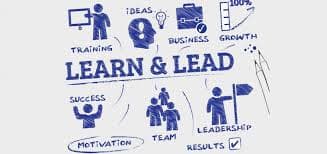
    Leadership : There is a lot too it …

    Then CEOs complain about the lack of business-fluency and leadership instinct from their senior tech team.

    There is also an issue with some organisations (and their talented employees) suffering from the Peter Principle where certain managers only stop being promoted when they reach the level of their own incompetence. 

    If you’ve worked below someone like that, you will know the impact they can have on employee morale and wider company performance. They will also defensively block attempts from those more talented to improve and progress within the organisation.

    The Great Training Robbery

    Harvard Business Review explored some of these issues in a study
    ”Why leadership training fails and what to do about it” …

    “Three-quarters of the nearly 1,500 senior managers at 50 organizations interviewed were dissatisfied with their companies’ learning and development function. Only one in four reported that it was critical to achieving business outcomes. Decades’ worth of studies show why it isn’t working, but, sadly, that understanding has not made its way into most companies.”

    They found that the benefits of training had the most impact when championed by senior leaders, a top down approach that helps motivate people to learn and change; creates the conditions for them to apply what they’ve studied; fosters immediate improvements in individual and organizational effectiveness; and puts in place a system and culture that helps sustain the learning. 

    One of the major challenges with traditional corporate training and still now with e-Learning, is engagement and application, making sure an individual can apply the learning gained to their immediate working environment.

    If the organisation doesn’t support an individual to implement on a daily basis what they have learned, then after 2-3 days they will regress back to their old habits. There is also evidence that employees also struggle to implement new habits when their own superiors are not living what had been taught. 

    The “Do as I say, not do as I do” doctrine of corporate leadership …

    The HBR article found that companies consistently struggle with ..

    (1) unclear direction on strategy and values, which often leads to conflicting priorities; 

    (2) senior executives who don’t work as a team and haven’t committed to a new direction or acknowledged necessary changes in their own behavior; 

    (3) a top-down or laissez-faire style by the leader prevents honest conversation about problems; 

    (4) a lack of coordination due to poor organizational design; 

    (5) inadequate leadership time and attention given to talent issues; and 

    (6) employees’ fear of telling the senior team about obstacles to the organization’s effectiveness.

    Barriers to progress they describe as “Silent Killers”.

    What Attributes Do Successful Leaders Need?

    We’ve been running a series of online interviews with tech leaders around the world, primarily focused on how they`ve been managing and leading through the pandemic but also looking more widely into what they see as key attributes for successful tech leaders …

    “Authenticity, humanity and empathy” – Marcin Floryan, Spotify

    “Empathy, an eye for talent, interest & an aptitude for technology and how, when it’s applied with flair and creativity it almost always acts as a force for good. Anyone can read books but you need genuine empathy for the people around you. The ability to build teams is also critical. The cult of personality that builds up around some people is ultimately in the medium or long term quite destructive.” – Colin McQuade, Barclays International

    “Part of our job is to speak the language of the business and be an advocate for the technology on the board where maybe not everyone else is from a technology background. But technology has become as important as an understanding of finance or marketing or sales and not every CFO or CEO comes from that digital background. So it’s important that we speak the language of everyone else and champion technology at that level and make sure we do put technology at the heart of the business” – Ben Jones, Growth from Knowledge

    “I’m careful to make sure that I’m working with all the different team members at the different levels of engagement that they require and that I’m demonstrating through my actions that I have their best interests at heart while I do my best to marry their interests with the interests of the business. And if I do those 3 things, as well as I can, in relation to how I work with my team, that makes me a successful leader from the point of view of my team. Then from the point of view of my leaders it’s really just about transparency and visibility as well as accuracy and detail” – Jerome Pimmel, AWS

    “I think these have changed. If it used to be; having a strong vision, hiring the right team, picking the right toolset. Nowadays it’s more about; building the right ecosystem of partners, having the right platform to enable innovation. Those are the two things that senior tech leaders really need to focus on these days” – Tim Hooley, Red Hat Europe

    “I’d say the key are human characteristics of creativity, risk taking, innovation and putting people first” – Shilpa Shah, Deloitte

    Looking more widely at corporate leadership and Jacob Morgan is an author and leadership expert who wrote about a book called “The Future Leader : 9 Skills and Mindsets to Succeed in the Next Decade”.

    Main thesis of the book is to look at whether current leaders are ready for the future and how well they are practising skills and mindset. 

    Spoiler alert … His conclusion is not positive with a key observation from hundreds of interviews that leaders think they’re good at being leaders whilst their direct reports say they’re not. The book focuses on skills and mindsets a successful leader needs in their toolkit, namely … 

    MindsetSkills
    Humility and VulnerabilityAbility to motivate, engage and inspire
    CuriosityTo be a futurist
    Embrace diversityTech savvy
    Think big pictureCoach people
    Growth mindsetEmotional Intelligence
    Lifelong learnerEmpathy and Self Awareness

    What matters in modern leadership training?

    A recent Global Leadership study found that only 14% of CEOs feel they have the leadership talent they need to execute their business strategies and that companies who develop high-potential leaders earlier are 4.2x more likely to financially outperform ones that don’t. 

    Clearly it’s not just good for you that your future leaders receive effective leadership training in good time, it needs to be a strategic imperative for the wider business.  

    So what are the important factors you need to include in a modern leadership training strategy?

    1.     Ability to identify high flyers

    How do you identify and nurture future talent?

    This article looks at 12 ways to identify future leaders and talks about having the right assessments tools, moving potential ahead of performance, identifying coaching skills, pulse surveys, job rotation and more.

    Consider how your company currently identifies future leaders, is it based on instinct and something more methodical?

    2. One Size Does Not Fit All

    Trying to shoehorn your high flyers into an off-the-shelf solution or expensive executive program is likely to create mixed results because, quite simply, everyone is different.

    The future of leadership training will be nuanced and personalised. It will need to identify the strengths and weaknesses of an individual and create a programme that delivers the optimal impact for that individual, whilst remaining aligned with the corporate strategy,

    3.     Timing is Everything

    Where is that employee on their personal career and learning journey? Analysis of individual need and timing is crucial for achieving the best impact. 

    You need to invest time and resources in the right people, at the right time and a combination of surveys, interviews and assessments should form an integral part of the training process and help you both narrow the focus and desired outcome.

    4.     Make It Relevant

    One of the most demoralising and costly types of training is the failure we mentioned earlier of them losing what they have learnt within 2-3 days of returning to work. A failure to embed any new skills into their immediate daily activities.

    Those initial assessments should help shape not only the training required but also how to maximise the impact and legacy.

    The MBA is a classic example of an intense learning programme where the skills are rarely used within the immediate working environment. Many students, particularly those who take the full time MBA, come roaring out of business school ready to apply their new strategic nous to the world only to find it takes years for them to be in a position to implement what they’ve learned. 

    Another issue with many executive leadership courses is they’re often taught by academics and consultants without recent ‘coalface’ experience which, in a fast moving world is not ideal.

    You want to avoid that feeling of …. “Great course, but where do I go now?”

    5.     Agree Target Outcomes

    Whatever is learnt, embedded and enjoyed it needs to be attached to clear target outcomes, ideally something that can be measured.

    Aside from the obvious measurements of career progression and increased salary etc. there needs to be a more nuanced understanding that the learning process has delivered a real impact, be that behavioural, performance, knowledge capital.

    CTO Academy uses a regular skills assessment to measure ongoing progress, each new assessment layered on top of previous versions so progress (or otherwise) can become very visual.  

    Psychometric assessments, surveys, 360 reviews can all play a part.

    6. Culture and Autonomy

    Ultimately one of the best learning environments is the one you create around the team as the leader yourself. 

    Is it an environment where trust is given, autonomy provided and mistakes can be made?

    Do you provide future leaders with the confidence to ask questions, challenge the status quo, learn from the day to day? 

    That will go back to you and your own leadership skills. 

    Your own approach and application of the mindset and skills identified earlier as being key to becoming an effective leader.

    _____________________________________________________________________________

    CTO Academy Leadership Training Programmes

    CTO Academy help tech leaders and managers around the world to develop their leadership and soft skills.

    Our executive leadership program is The Digital MBA for Technology Leaders.

    Our emerging leaders program is The Future Leaders Course.

    We also offer our CTO Academy Membership package (included free with The Digital MBA)

    Or get in touch with me direct via [email protected]

  • How to build trust with an inherited team

    How to build trust with an inherited team

    Moving into a new company or new role with an established team can be a challenge. Amplify that challenge if you’re taking over from a popular predecessor.

    How do you start building trust and managing the star performer(s)?

    You’re inheriting a team, potentially hand picked and who’ve long since been through the forming, storming, norming, performing phases.

    What’s more, those handover documents might tell you the correct buttons to press, but are always void of what really matters, the personal stories, the personal interactions and nuances. 

    It Gets Worse when you discover an annoying Mister Know-It-All, who just happens to be the key talent, central to the project but far from a team player.

    Been here for 5+ years, knows the system A to Z and his body language (let’s face it, it’s normally a he) lets you know it. 

    He has a following and is clearly an obstacle for you to achieve an effective team. 

    In these situations there is a tendency to head off in one of two directions;

    1. Assert your authority, unleash your fangs and try to impose yourself quickly with swift and potentially brutal changes; 

    2. Artificially engage in early bonhomie, jaunty banter and work on building trust and common purpose by being their pal.

    From our experience, whilst both can clearly work they’re rarely recipes in isolation for building team productivity and ultimately team satisfaction.

    In the short term you probably need to roll with it, particularly if key individuals are performing, even if the whole team and other direct reports are not.  

    And whilst the star performer might be creating an unpleasant atmosphere and enjoys pointing fingers, culture is often driven from the top and the toxicity might be about past management styles rather than an inability to bring change with new and creative thinking. 

    A few important items from our collective experience of similar; 

    Empty Your Cup and Re-Learn How To Lead

    There may be fault on your side.
    What worked before might not work here and to begin with, even if you arrive with a reputation you don’t have to know everything.

    First steps towards gaining your subordinate’s respect should be simple, stay humble. 

    Let them know you are approachable, open to conversations and suggestions particularly during these early days.

    Be open about your own strengths and weaknesses. Articulate your personal history, your personal stories.

    Let them be aware if/where you have limited knowledge and know that you’re keen as mustard to learn from their expertise.

    The superstar might just need his approach realigning, maybe he needs your team management skills to help give him more support.  Leverage on his experience and connections, without becoming as reliant as others might have been.

    Don’t Dismiss What They’ve Historically Achieved : Avoid the Brian Clough Scenario

    They are probably feeling a lot of what you are feeling … anxiety, uncertainty and potentially insecurity. These are important items and issues to recognise because people don’t like change.

    Some of them have been in the company for a while and will have a natural tendency to protect what the company has achieved, even if you believe they have under performed or failed to realise their full potential. 

    Brian Clough was a famous UK manager in the 1970’s. He was recruited by the most successful club at the time (Leeds United) to take over from a very famous predecessor (Don Revie). Clough decided on the first morning to assert his authority and show his fangs. He told the players to throw their medals in the bin because everything they had won so far had been achieved by cheating.

    The star performers didn’t take kindly to these suggested steps.

    Brian Clough, despite his expensive arrival and previous success, was removed from his post by play power after 44 days.

    One on One : Communication is Key

    Have an open discussion at the start, try to find some common interests and explain your strategic visions and the challenge ahead. Get some early buy-in.

    But an essential element of any successful team is building close working relationships based on getting to know each other and communicating with individuals openly and regularly.

    This bedding in process should be powered by communication, one to one meetings and consistency of your wider message. You can’t create an effective, cohesive group without it.

    These need to be instituted asap and with all team members. Get to know them as people, their strengths and weaknesses, ambitions and concerns.

    These sessions are informal and often more about the personal, non work issues that play such a key role in binding together teams and people.

    What they’ve done during the weekend, hobbies, football teams, families, getting a temperature check on how they’re doing with their work.

    Cats need autonomy. So do techies

    Cats are independent, they mind their own business, they seek attention only when needed and if you bug them during their time, you get scratches and bites.

    Remind you of leading tech teams? Tech leadership means dealing with group members who are often happiest when given the freedom to self-organise. For one thing, writing codes require a lot of mental focus. Any distraction or discomfort can derail them from their focus.

    The leadership style of some is akin to the helicopter parent as they micromanage their teams.

    That’s not healthy for you, let alone your team and particularly if they’re bringing the expertise you can’t. You need to give them space to flourish, particularly as a recent arrival needing time to shape the workplace environment.

    Monitor what they need to do and what needs to get done. Understand their impediments and help them achieve their optimal work experience become a servant leader.

    Give Them The Limelight

    Give them the limelight. Let them shine!

    If there’s one strategy for getting your team’s trust is putting them in places where they will grow and be recognised, not only by you but by the top management and clients. 

    This is a great way to build trust and showcase your leadership skills.

    From your one on ones, you can quickly understand their strengths.

    Give them mini projects within the team that will enhance their profile, and build their skills. 

    Spot the high flyers and encourage them to enroll on learning courses and/or give them appropriate platforms during milestone meetings and presentations to show off their expertise.

    Take time to understand the dynamics, release any latent potential and try to drive the desired results you want.

    If change doesn’t come, the star performer doesn’t become the team player, or your approach at the personal level hits a dead end … might be time to assert your authority and show your fangs.

    WANT TO IMPROVE YOUR TECH LEADERSHIP SKILLS?

    CTO Academy has been Ranked #2 Best CTO Course in the World. We provide online management skills training, mentoring and career development advice for tech leaders and managers around the world. Membership starts from just $49 per month, more details available here.

    “The skill set CTOs and IT Managers now require are a world away from what was needed in the past. I find the CTO Academy training modules to be highly valuable resources, providing broad-based business skills and awareness essential for success in the modern workplace.” – Eli Oshorov, Sydney

  • What is a Chief Technology Officer (CTO) of a Company?

    What is a Chief Technology Officer (CTO) of a Company?

    In a general sense, a chief technology officer is a technical leadership role involving many variables: business goals, corporate strategy, team management, technical vision, enterprise systems, and related tasks. But what is a CTO in a nutshell? What is the key responsibility?

    Without a doubt, a primary responsibility is delivering a technical strategy that is aligned with wider business goals.

    The effective CTO is in high demand as companies of all sizes have major tech functions and are becoming increasingly digitalized.

    So, what it’s really like up there at the CTO summit? What fundamental changes occur when you move from the technical to the managerial? What issues cross the desk of a tech leader on any typical day?

    Maybe you’re aspiring to become a CTO but unsure about the realities of life at the top. Maybe you’re already there but want to dig deeper into the role.

    Wherever you are, let us lead you through (almost) everything you wanted to know about being a CTO.

    Chief technology officer job description, roles and responsibilities

    • Technical strategy and strategic thinking
    • Advising on technology trends
    • Building and managing development teams
    • Providing technical leadership
    • Operational management
    • Customer relations, often acting as a middleman while delivering technical services to the target market
    • Representing the tech team in the C-suite
    • Working closely with the marketing and sales teams while being in direct communication with the CEO
    • Understanding the technological needs to drive company growth
    • Technology management

    What is a CTO of a company?

    Chief technology officer surveys his office

    A chief technology officer could be described as the poster boy or girl for the technology side of a business.

    Now, you may be wondering about that statement and where the CIO fits in.

    CTO vs CIO

    The very simplistic definition of their respective roles is that the CIO tends to be internally facing and the CTO tends to be externally focused with executive responsibility for the technology, team, and product.

    The CTO’s job is to be the in-house futurologist with an understanding of technology trends and how they might impact the wider business strategy.

    A deep understanding of tech is a given for any CTO, but traditionally that might have been the only expectation. Yet in recent times the role has become much more customer-focused and involves a significant broadening of the skill set.

    Coming out from behind the keyboard requires parking some of technical skills. Or, at the very least, placing them on an equal footing with the leadership and management skills you will need to become an effective tech leader. And that’s not always an easy move for technologists who are experts at coding but may not always have a natural aptitude for the managerial.

    So, what are the key new skills you will need?

    Successful tech leaders are able to master a range of softer skills such as empathy (absolutely vital according to the tech leaders we interview), emotional intelligence, continuous reasoning, and a coaching mindset.

    You also need to become an influential people manager and understand that ‘other people’s problems’ are no longer ‘other people’s problems’. If the people are your team, their problems are now your problems too — and you need to manage them.

    Communication is crucial and a failure to communicate effectively is often cited as the reason why some tech leaders fail to achieve the impact they want.

    In particular, the ability to communicate with clarity and precision to non-technologist stakeholders, be they colleagues, investors, customers or even the CEO, has become key to success.

    What are the common traits of a successful CTO?

    As we said, CTOs have to master an array of softer skills that will enable them to bridge the gap between the technical and the non-technical, between the tech team and the market.

    What is a CTO’s responsibility in stakeholder relations?

    Chief technology officers and the tech team are increasingly expected (and if they’re a half-decent team, they should be demanding) to speak directly to the customer and to liaise with the customer’s own technical team.

    They have to be open-minded or, in other words, willing to learn about and try new ideas and certainly not be fixed on one particular technology. A good tech leader, therefore, must create space to learn and predict market developments and absorb input from team members.

    The CTO needs to mould the team into a customer-centric operation, prioritising what the market wants ahead of what they think is cool and fun to build. Ultimately, the customer remains the most important stakeholder. Product development should be driven by a validated, lean, start-up learning process and not by the tech leader or what the star performers want to create.

    We get that Steve Jobs could build without validation, but, hey, that’s not the norm because, as a leader, you must be focused on customer-driven product development.

    Of the many skills Jobs mastered, one of the most notable was communication — at least his external comms were pretty effective. Alas, many CTOs struggle to master or even recognize the importance of clear communication.

    Another familiar tripwire is delegation

    The ability to delegate is essential to help the team grow and learn. But it’s critical for the leader to create sufficient free time to read, understand and focus. We are talking about focusing on the high-value areas of the business that have an impact and make a difference.

    Strategy, team building and tech planning become the priority, away from the weeds that the tech leader might instinctively be more comfortable with.

    Delegation is one of the core leadership skills, required to:

    • Create sufficient headspace.
    • Avoid that sinking feeling of trying to cope with too much, too often.

    An average day in the life of a Chief Technology Officer

    The obvious answer here… ‘there’s no average day’, particularly when working within a fast-moving environment.

    There is also a vast difference between the CTO role in a start-up vs a large organisation. The former is often bogged down with fire-fighting while the latter has to deal with stakeholders and corporate politics.

    So we asked CTO Academy Co-Founder Jason Noble to give us some insight into what an average day might look like from his recent experience leading fast-growing start-ups.

    Here’s his daily routine:

    1. Hop on the train into central London and alongside my fellow start-up techies, open up the latest copy of ‘Wired’. OK, to be honest, I’m not that hip and don’t view that as a priority. Usually, I’m catching up on relevant tech articles I’ve forwarded to the Kindle!

    2. Once in the office the day generally starts with catching up with the operations team, checking up with systems, and making sure everything is ticking over OK.

    Next up, find out if any releases are due today and if there are any problems which need the input of the chief technology officer.

    3. Liaise with customer services. This is a really important element of the modern CTO schedule. Customers are the number one priority — even for the tech team — so it’s important for the chief technology officer to keep an ear to the ground for market feedback.

    4. Meet with the CEO. You want a close relationship with the boss — it will make your life a lot easier. Most days will feature some contact with the CEO and being pulled into occasional meetings where your technology insight is needed.

    With more complicated technologies and/or high-value sales, there could be close liaison with the sales team and you might even be brought into the sales process itself.

    An average day for the CTO can involve interactions with many of the other departments and executives. Alongside this, you need to create sufficient slack to deal with the curve balls that often emerge, particularly in early-stage companies.

    The CEO is often as much of a challenge as the customer. Changes in specification, strategy and timeline are also regular spanners that can impact that nice tidy schedule you started the day with.

    5. At some point in each day I try to create some space for thinking time. The CTO role involves decision-making and strategy, both of which need detailed consideration, research and argument. Good time management is, therefore, critical for any successful CTO and carving out some me-time is vital.

    Bags of other stuff emerge, but these have been the key elements in my recent CTO roles.

    A chief technology officer’s relationship with the CEO

    We’ve already alluded to the fact that your most important relationship as CTO will often be with your CEO. It can also be the most fraught as CEOs and CTOs are typically very different types of characters and have followed very different career paths.

    Of course, it’s not entirely right to categorize any CEO as typical because they are by their nature supremely individual, but you’ll often find that they are very creative and visionary. They are also quite often unrealistic. We’re not talking Steve Jobs here, but most CEOs will want things done yesterday and will probably not have a strong technology background.

    It’s therefore an essential relationship for the chief technology officer to understand and manage. In other words, you need to comprehend the character to decipher the message. For instance, if last-minute curveballs are thrown at you, then it’s important to establish a turnaround compromise.

    Always build in elasticity so you can take on eleventh-hour issues and absorb the CEO’s idiosyncratic tendencies!

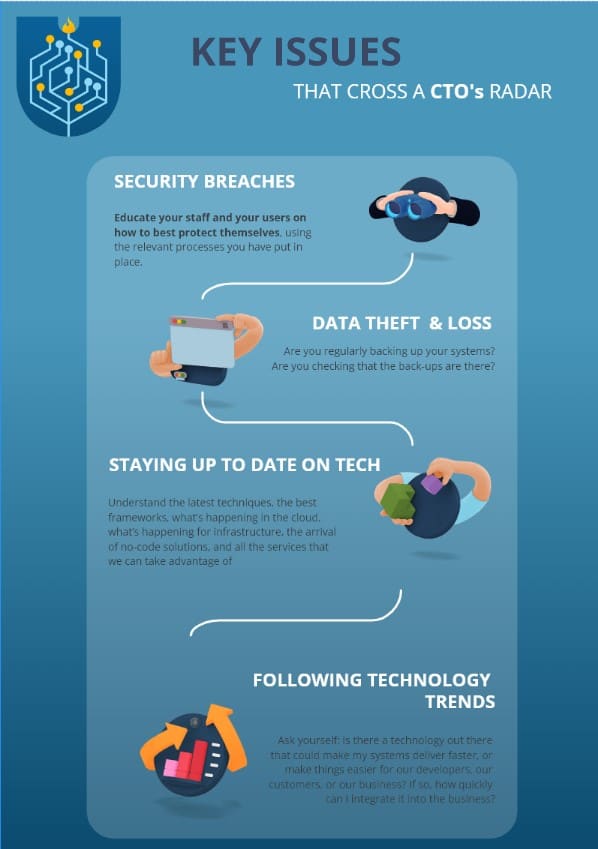
    The key issues that cross a CTO’s radar

    Key issues that impact a chief technology officer
    4 key issues of every CTO

    Ten years ago cyber security was some way down the list of CTO priorities, but increasingly, today it’s amongst the most prominent. Security breaches, whether internal or external, are a constant threat. As a CTO, you must make sure you have processes in place to deal with them.

    Security breaches

    That said, it’s virtually impossible to stop a breach because of the movement of technology. What makes it even harder is that a lot of breaches are made through social engineering.

    Your priority should be to educate your staff and your users on how to best protect themselves, using the relevant processes you have put in place.

    A recent case I personally experienced was where a developer accidentally leaked an API key that gave users unauthorized access to systems. The security measures we had installed immediately picked up the problem and shut it down.

    All the API keys were changed and we quickly confirmed that nobody had used that particular API key whilst it was in the wild for a few minutes. There was no panic because processes were in place.

    Data theft and loss

    Another issue that might cross your radar is data theft. This can be malicious, with somebody hacking in a security breach. Or it could be something as innocent as a user with an API key that knows how to breach the limitation and get more information. Having tracking mechanisms and automatic stops in place will prevent that.

    Data loss is another important issue so do ask yourself occasionally:

    • Are you regularly backing up your systems?
    • Are you checking that the backups are there?

    It’s something that very few people actually do, though they often say they do.

    Staying up to date on the tech

    Even though I’ve got a few years under my belt as a CTO (maybe because I have a few years under my belt) I always want to be up to date on tech, both generally and within my immediate area of expertise. I need to understand what’s going on.

    I also need to understand:

    • The latest techniques
    • The best frameworks
    • What’s happening in the cloud
    • What’s happening to infrastructure
    • The arrival of no-code solutions and all the services that we can take advantage of to make our product faster, smoother and better for customers.

    This leads me to consider on a regular basis whether I’m using the right tech. In other words, am I building a system on the correct frameworks and languages to meet the requirements of the customer? Quite often I come across projects where they’ve built a generic web system, let’s say in PHP, that falls short of what the user needs.

    Staying abreast of technology trends

    One of the reasons you need to delegate is to create a sufficient amount of time for you to understand longer-term strategies and technological innovation.

    If you’re behind the laptop and micromanaging your team, you will struggle to create the headspace to gain insights into technology around the corner and how it may impact your company and sector. You must be up to date with the latest technology and avoid being too internal. That’s for the CIO when your company gets big enough to have both positions!

    The CTO has to constantly ask, is there a technology out there that could make my systems deliver faster, or make things easier for our developers, our customers or our business? If so, how quickly can I integrate it into the business?

    You need to set aside some time to identify the latest trends in technology and differentiate between hype and reality. This enables you to make an educated decision on whether to incorporate new technologies, rather than jumping on a headline or bandwagon.

    Are you using the right technology?

    The CTO must ensure that the company is using the right frameworks and back-end servers to support it.

    For example, as a database grows, you may find that relational databases aren’t the right architecture to use. Hence, you may move up to a data warehouse, or maybe an OLAP cube or Elasticsearch.

    There are always too many options and countless choices. You may not be an expert in a particular piece of tech, but you need the space to understand what benefits it could provide.

    In addition, maintain your professional development in terms of your leadership and management skills. Here at CTO Academy, we recommend carving out time for short online courses and 1:1 coaching… well, we would say that wouldn’t we!

    Missing deadlines

    Another common issue is missing deadlines, even though they can happen for a myriad of other reasons.

    The causes for delays can be:

    • Incomplete specifications
    • Not fully understanding as a business what is required from a build.
    • The people needed in the development process may not be available when you want them.

    You must communicate — very clearly — the deadlines that you believe you can achieve. This should provide the basis for the decisions made by the rest of the business. It will also ensure that the sales and marketing team aren’t over-promising on specifications and timelines.

    It’s especially the case if you use third-party suppliers. They may be suppliers who are reliant on your software or who give you software. For those suppliers that provide you with software, you need to understand their development processes and their reliability.

    I’ve had dealings with suppliers where the quality of their data was subjective at best. And, which is far worse, their delivery was intermittent.

    Being flexible

    Another area that causes significant conflict is sales team deadlines.

    These are often driven by challenging targets and attached bonuses. It’s not uncommon for salespeople to make promises to clients that are unattainable or put a significant strain on the technology team.

    The sales team wants to close the deal. So they might say that certain functionality is going to be available immediately or ahead of what is realistic. That’s why you, as a chief technology officer, must have regular conversations with the sales team. You want to ensure they’re not over-committing your team and, thus, prevent disappointing the customer.

    But you also don’t want to be the person who always says, ‘No, it can’t be done’. So, stay flexible and try to accommodate the needs of the salespeople. Because it’s them who help bring in the customers the business needs.

    Over-reliance on individuals

    A very common problem for CTOs in businesses large and small is a reliance on one or two individuals who dominate stand-ups and retain critical elements of knowledge about the software.

    Because of this imbalance of power, those individuals might also become difficult and disruptive. However, you can’t just get rid of them because they have the knowledge you depend on.

    This is one of the trickier management tasks you can face, so you need to employ the right preventative strategy.

    The best plan is to double up. In other words, ensure:

    a) knowledge sharing, and

    b) that nobody becomes too important and has too much power or influence.

    The way you manage disruptive team members will define your success as CTO.

    What is a CTO salary?

    A recent report by Reed provides insight into the expected earnings for London-based tech leaders in 2023.

    According to the report, those working in companies with fewer than 1,000 employees should earn £96,080 per annum plus a 12% bonus in the private sector. In the public sector, on the other hand,we are talking about £75,950 with a 27.90% pension addition.

    However, in the United States, the figures are somewhat different. For instance, heads of tech roles in US-based companies of a similar size are likely to earn an average salary of $170,000 in 2023 or $74.00 per hour.

    For more detailed information, use our salary calculator to see the averages across major world cities.

    What is a CTO job outlook?

    Trends and estimates are showing clear increase in demand for all types of contracts (eg fractional CTO jobs, full- and part-time, interim). Don’t forget that there are still a relatively large number of organizations that are undergoing digital transformation. Additionally, new tech start-ups are emerging on daily basis.

    They are all, eventually, looking for CTOs —the role that is quickly becoming crucial to success.

    Conclusion

    Becoming an effective chief technology officer is probably the number one target for most CTO Academy members. And it doesn’t matter if you’re en route to the top or already there.

    We’ve created a slightly light-hearted look at CTO life but tried to focus on the key changes that take place when arriving in a senior role and what should and shouldn’t be part of your workload.

    It’s often a high-pressure role and the technology almost always stops with the CTO — a level of responsibility that some thrive on while others prefer to keep a lower profile.

    What is crucial is that you understand the leadership skills needed to be effective, work towards improving those skills and discard or outsource the rest.

  • Confidence in Leadership : What is it good for?

    Confidence in Leadership : What is it good for?

    Confidence plays an integral role in many of our daily interactions particularly at work, and whilst it’s not something covered by business schools it should be in an era when style is often the bluff for a lack of substance.

    I know how different levels of confidence have impacted some of my career and life decisions, where a lack of it has taken me down the wrong path, where a lack of positive feedback caused negative thoughts to crowd out otherwise positive affirmations.

    I could display an assertive approach but under the surface I was making key decisions based on an implicit lack of confidence so that I took on the safe role where I could easily excel, rather than the challenge one that might lead to a richer and deeper sense of both achievement and purpose.

    It slowed down my growth as a leader when caught in a fixed mindset that focused on short term gain, not long term purpose driven and a wider sense of satisfaction.

    There can be a vicious cycle at play for people who suffer from a lack of confidence and/or have a high expectation of failure which leads directly to an impact on performance and career.

    Research shows that when people are put in situations where they subconsciously expect or are expected to fail, their performance plummets. They turn into different people, their heads literally shut down and they end up confirming the expectations.

    When they expect or are expected to win, their performance shoots back up.

    As a manager or leader, you not only have to grapple with these issues when assessing performance but you also need to manage the issue of confidence over competence, when recruiting and team building.

    Dangers of Confidence

    Good news is that this is a well researched field.

    Tomas Chamorro-Premuzic, is a professor of business psychology at University College London and author of a book called, Confidence: Overcoming Low Self-Esteem, Insecurity and Self Doubt 

    During an HBR article he was interviewed about the dangers of confidence and commented;

    “Confident people tend to be more charismatic, extroverted, and socially skilled which in most cultures are highly desirable features. We also tend to equate confidence with competence. So we automatically assume that confident people are also more able-skilled or talented.

    In reality, however, there is a very big difference between confidence and competence. Competent people are generally confident, but confident people are generally not competent. They are just good at hiding their incompetence and their insecurities mostly because they are self-deceived themselves, so they generally think that they are much better than they actually are”

    So if we’re sometimes at risk of being deceived by confidence, how do you tell the difference between bullshit and someone who’s actually competent? How does this impact you as a tech leader and also your assessment of others, when recruiting and team building because confidence is often a method or path people take when assessing candidates.

    In reality this mostly leads to inaccurate evaluations of people’s competence because the correlation between confidence and competence is very low and because it often acts as a detractor.

    For example, most people who interview really, really well if you didn’t have evidence or information on their actual talent or competence, you would assume that they’re great. But in reality, they’re just charming the interviewers during that session. So we tend to rely on confident signs, but our goal is always to understand how competent somebody is, whether that’s a prospective employee, whether that’s a prospective partner, a colleague, a friend, somebody you engage within a business transaction.

    So you need to understand that the goal is to know how competent others are. We don’t really care how confident they are.

    It doesn’t help that our time poor, social media culture has created an army of so called influencers, coaches, online gurus, with their soundbite quotes, memes and quick fix advice. Style over substance, confidence over competence is a regular but unattractive addition to the modern CV. You need to have the antennae to weed them out of the process asap.

    I know of one individual (and there are many out there) with little obvious experience or success as an entrepreneur, has re-invented himself as a “business coach to high achieving entrepreneurs” with the standard accoutrements of podcast, keynote speaking engagements and of course, the best selling book.

    Maybe you can coach the best footballers in the world without ever having scored a goal at the Nou Camp but it’s good to know you can at least lace up your boots correctly.

    Within the start up world confidence ahead of competence is common, and unhealthy. The ‘fake it till you make it’ mantra might be necessary for early stage survival and traction but can have a negative mental health impact when founders spend too much time portraying a false reality to themselves, as well as the world.

    But as it’s a culture that can create confidence tricksters who walk away with $1.7bn then it’s going to generate wannabe copycats with the capacity to ignore thousands of redundancies and endless losses as they chase that illusory overnight success.

    In the corporate world, many suffer from the incompetent but confident self-promoter, who strategically climbs the corporate ladder until something called the peter principle kicks in, where an individuals career stops at the level of his or her incompetence.

    Key ingredients behind high achievers and great leaders is not the aforementioned superficial confidence but instead, competence, humility and authenticity.

    Tomas Chamorro-Premuzic again ….

    “It’s a well-known fact that humility or modesty is the key ingredient of great leadership. So until we stop making decisions on the basis of confidence rather than competence, we will keep having arrogant, impulsive, narcissistic people in charge.

    Also we will keep making it hard for women who are usually both more humble and competent than men in these domains, from rising to the top.

    So once we accept this, all we need to do is focus on assessing actual talent instead of getting distracted by people’s confidence and then we will actually see humility as an important added bonus. So once you know that somebody’s good at something, if they are humble that’s an extra asset, as opposed to a career killer, as humility and modesty can be a career killer for many people”

    We conclude this article with a few thoughts on building confidence … whether for yourself or those around you!

    A Few Thoughts On Building Confidence

    1. Understand Yourself & Be Authentic

    Don’t be what anyone else wants or thinks you should be. It’s only when you have a strong sense of yourself and your purpose and how to play to your strengths that true competence, confidence and positive thinking emerge.

    2. Surround Yourself With Great People

    Whether you believe in the theory that you’re the average of the five people you spend the most time with surrounding yourself with positive, can-do people who believe in you, will spike your self-esteem.

    Many people have the innate ability to do well but are downtrodden by those around them and/or the stereotyping and expectations of what’s expected of them. Close friendships take time and care but when I reflect on mine I can see so much I admire and love about those close to me people and how their friendship has impacted and improved my historic issues with confidence and self-esteem.

    3. Become Competent

    Unless you’re Mozart (genius) or a finalist in the X-Factor (something else), there are no short cuts to being good at something.

    It comes down to hard work around topics like focus, preparation, practice and application.

    Give yourself sufficient space to learn and grow into competence. Not only does it allow you to speak with authority but it also allows you to weed out the BS in others.

    Always schedule and prepare well. Get organised, focus on the priorities, manage your time properly.

    Give yourself the space to flourish. These are leadership skills 1.0 that you need to embed into your skill set.

    4. Build Your Ability To Empathise and Empower

    To become a great manager and leader you need to learn the art of empathy and to manage with compassion.

    You also need to enable others to become the best they can be and maybe outshine you.

    You should not be protecting your empire, a curse of so many managers in the corporate world, you should be inspiring and encouraging others to perform at their peak. How amazing will that be for you, your business and the people around you?

    5. Think Long Term

    A curse and blockage for many aspects of western culture is short termism.

    Whether it’s the short political cycles or jumping from one job to another, we can all be impacted by a lack of longer term vision.

    I was certainly motivated by the wrong things (cash and a good time) during early parts of my career rather than focus on what would make me happy and finding my true purpose.

    A book that advanced my thinking around this subject is Flow, Psychology of Optimal Experience. and the principles of which have definitively shaped my later years.A book that has stayed with me for years.

    6. Adopt Amor Fati … “a love of fate”‘

    Stop regretting past decisions.

    You made those decisions based on who you were at the time and the influences that were then shaping your decision-making process. If you were back in that place again you would make the same decision because that’s who you were then.

    Instead, adopt what Nietzsche called his formula for human greatness … that one wants nothing to be different, not forward, not backward, not in all eternity. Not merely bear what is necessary, still less conceal it but love it.

    An extension of this from that old Stoic, Epictetus … “Do not seek for things to happen the way you want them to; rather, wish that what happens happen the way it happens: then you will be happy”

    Learn from everything, grow from the experience.

    7. Set Small Goals, Change Habits Slowly

    Everyday I see on social media quotes from James Clear and his Atomic Habits ‘ but there’s a reason for his popularity because they include many principles you should consider adopting.

    Set yourself large targets but small goals.

    The aggregation of marginal gains is a mantra that recently enabled the Great Britain cycling team to achieve greatness.

    It can work the same for you and your ambition to achieve great things.

    Building good habits and slow changes into your life should lead you towards remarkable transformations and achievements, that you would never have thought possible at the start.

    8. Be Grateful, Express Gratitude Constantly

    The power of gratitude is infectious. Get used to giving it.

    So many wonderful people are willing to give you time, insight, help and no matter how humble they might be, they will love your gratitude and might even consider giving you more in the future.

    Gratitude works both ways, giving is important and leaves you with a glow inside. Think about the ripple impact every time you smile or say thank you to someone, the recipient is more likely to go forth and take your positivity into other corners of their world.

    Having an impact, being grateful, empowering others is an intoxicating brew that makes your dent on the world feel just a little more substantial. It all builds up your sense of who you are and what you can contribute.

    9. Activity, Exercise, Wellness

    We can all become so absorbed in work and life and stuff that we forget to clear the diary for some “me time”.

    Good mental and physical health is so important yet so often neglected. It’s particularly neglected if you’re suffering from self-esteem issues and feeling bad about yourself. Instead of reaching for positive stimuli, you’re reaching for that packet of chocolate biscuits.

    No matter how busy or committed you are to the business, family, boss always ring-fence time for yourself and what makes you feel positive and stimulated. Exercise, Walks, People, Books.

    Don’t slink back into bad habits, fix your stare on targets and positive me time.

    Personal Development and Mindset is something we care about deeply at CTO Academy, as we see a lack of attention on both subjects as fundamental to the blockages some of our clients are facing with their career.

    We provide lectures on the subjects within our course material.

    [Article written by Andrew Weaver, very humble Co-Founder of CTO Academy]

    More About CTO Academy

    CTO Academy has been Ranked #2 Best CTO Course in the World, only the Berkeley CTO program at $33,000 per person is ahead of us …

    We provide online management skills training, coaching and career development advice for tech leaders and managers around the world. Membership starts from just $39 per month.

    “The skill set CTOs and IT Managers now require are a world away from what was needed in the past. I find the CTO Academy training modules to be highly valuable resources, providing broad-based business skills and awareness essential for success in the modern workplace.” – Eli Oshorov, Sydney

  • 9 Reasons Why Great Engineers, Can Become Terrible CTOs

    9 Reasons Why Great Engineers, Can Become Terrible CTOs

    When founders and CEOs are building a fast growth business the search for talent is endless and critical.
    As most companies are tech companies these days it stands to reason that the search for tech talent and those with leadership skills is particularly challenging.
    One of the main challenges for the technologists career path is that they’re having to learn a completely different skill set when they move into a leadership role, they’re having to shift from technical skills to more general business skills.

    (more…)

  • Guide To Communicating With Non-Technical Customers

    Guide To Communicating With Non-Technical Customers

    Some combinations just don’t work ….

    Mango and Peanut Butter;

    AOL and Time Warner;

    And historically, technologists and customers.

    But how times have changed.

    Mango will never go with peanut butter but modern tech leaders do now play a central role in the customer engagement process and helping convert potential clients.

    This article unpacks what a techie needs to understand when communicating with non-technical customers.

    Some Context

    Historically the CTO and tech team might have been allowed to stay out of view, without need or indeed interest in seeing let alone conversing with the customer. Certainly no need to be proactive, leave that active listening stuff for sales and marketing.

    How times have changed. How the client relationship has changed.

    Today’s tech leaders are often needed (and should be demanding) to be in the front line, understanding and embedding customer needs, priorities and business needs within the DNA of the product.

    And of course they should. The process of validated learning (most famously advocated within the Lean Startup methodology) is now business critical for companies and products to survive, let alone prosper.

    Where it might have been the case that for techie and customer ‘ne’er the twain shall meet’, now it’s an important element of any senior techie job description to discover the customer and market reaction.

    That said, it’s not always a comfortable arrangement.

    Technical people are great at the technical, but when communicating to non-technical customers who might not know their HTML from API and CSS, the techie is never at ease.

    Here are some top tips for communicating to non-technical customers:

    1. Assume they know nothing

    From a technical perspective, this is an important assumption when heading into a meeting with unknown customers.

    Don’t under estimate how many senior people have limited technical knowledge, even if they’re leading a technical product.

    Preparation is always key. If you know who you’re meeting then you should be reviewing their linkedin profile, understanding who they are and what they will view as relevant information.

    Get access to internal CRM files and review previous communications with that customer. What do they tell you about the history of this relationship and, the technical know-how of their key people?

    2. Language is important

    If it’s not a technical audience then try to ensure you’re not peppering the conversation with lots of technical jargon. If having to spell everything out in detail is daunting, and you really don’t know the technical expertise of who you’re meeting, think about preparing a product/jargon cheat sheet.

    It’s also important to find a balance between delivering sufficient levels of detail to get the message across and, running the risk of meandering off into a technical cul-de-sac. Presentations should be focused on key issues the customer wants to know. They should be driven by brevity, clarity and providing the customer with plenty of opportunities to ask questions.

    3. You care about process, They care about impact

    Really important but often overlooked contrast between the technical and non-technical.

    The former are fascinated by process.

    The latter by deliverables and business impact.

    Whilst you probably find excitement in explaining the process roadmap, they generally want to see only the point of arrival.

    Talking about network infrastructures and the multiple languages you’ve worked on through your career, is going to be of little interest to most senior executives and time poor customers.

    Talk about what your product can do, rather than focusing on how it works.

    What’s the ROI, security, customer experience?

    Why is it a step up from previous versions or products?

    Why will it change what really matters to the customer, value add and sales.

    4. Be imaginative, Think like the customer

    All of this comes down to communication. To reading people and pitching your knowledge at the right level.

    You need to become imaginative and adaptable about how you communicate. What chimes with one person, will be white noise to another. Whereas an email is sufficient for one customer, a detailed presentation will be required with the other.

    You cannot be all things to all people, but you can adapt your message to ensure you don’t leave anyone behind.

    Another useful skill is to get into the shoes of that customer and try to think ahead about what matters to them, what simple question might lead them/you naturally into other topics. If like a good chess player, you can start to see a few moves ahead, you can box off any concerns, often in advance of them being asked.

    Takeaway of Top Tips : Follow these and you might just keep those non-techies on board

    • Prepare properly on the people you’re about to meet
    • Don’t arrive with assumptions
    • Minimise the use of technical terms and acronyms
    • Think ahead to potential questions
    • Care about impact, not process
    • Be concise, Remain adaptable

    WANT TO IMPROVE YOUR COMMUNICATION SKILLS?

    Join CTO Academy where courses in Personal Development and Leadership cover issues like these and more.

    Find out more about joining CTO Academy.

    “The skill set CTOs and IT Managers now require are a world away from what was needed just a few years ago. I have found the CTO Academy training modules to be highly valuable resources, providing broad-based business skills and awareness that are essential for succeeding in the modern workplace.”

    Eli Oshorov, Sydney

  • Leadership Lesson 1 : Find Your Purpose

    Leadership Lesson 1 : Find Your Purpose

    “You will earn the respect of all men, if you begin by earning the respect of yourself” Musonia Rufus

    To become a truly effective leader there is a crucial 1st step you need to take. You need to first understand yourself. 

    This might sound like a case of stating the obvious but, it’s remarkable how many people work through parts or all of their career without understanding or recognising their core motivations, strengths and weaknesses. Without having a real purpose, a genuine fire.

    I should know, I was one of them. For a large chunk of my early career I was utterly short term(ist), pursuing immediate riches or challenges. Focused on the wrong motivations and what I thought defined success, or at least my perception of how other people defined my success. Money, materialism, the 1990s version of insta-tastic, which was essentially telling (rather than showing) everyone what a glamorous life I had.

    It took me time to grasp this nettle and it was a particular book that prompted my handbrake turn.

    Reading Flow, The Psychology of Optimal Experience led me to understand the need for clarifying my purpose and getting to the core of my values.

    Aligning them with my goals and targets has indeed created greater flow in both my professional and personal life. It also gives me deeper levels of resilience when I know the tougher times and challenges are part of that journey.

    Today I chase a longer term purpose, roles that are about enjoying the experience and the people, products that deliver real value and a sense that we are building something with integrity and longevity.

    Whether it’s building something of real utility at CTO Academy, helping future entrepreneurs through a start up accelerator or encouraging people to take adventures, my core values are aligned with a longer term plan as well as my everyday work.

    But if you’re unaware of personal motivations and/or you don’t have a focus and purpose in life, then you’re potentially making career and life decisions based on what you think you need, rather than what you know you need. 

    Without understanding myself in this way I found myself in roles, companies and with people that didn’t align with me or my core motivations. It impacted significantly on my ability to find that optimal career path, to lead others and ultimately to find happiness and personal fulfilment in what I was doing each day.

    Lack of self-awareness can also damage your true potential, particularly as a leader. If your role and tasks don’t align with who you are, it can show in your performance and in front of direct reports and employees, making it more difficult for them to follow.

    It’s only when you understand who you are, not who the world thinks you are, that you’re ready to effectively lead. Knowing who you are, requires an accurate understanding of your strengths, weaknesses, values, beliefs, motivations, and desires. Developing these personal insights provides the foundation of all successful leaders.

    It’s not always easy or comfortable drilling into your core values. It’s why in the CTO Academy eBook, “96 Tips On How To Become An Effective CTO” we include right at the beginning with Tip Number 1, a section about needing to know yourself and including a test that helps our users drill down to their core values. As I say, it’s not always a comfortable process and it’s often a surprising one.

    Great leaders want to make a difference, and they challenge themselves to grow. The give themselves time to reflect, re-evaluate and learn.

    Most of the leaders we work with at CTO Academy are focused around impact. Impact for their business and impact for their team. They’re on a constant journey of ongoing personal and professional development. They have a growth mindset that wants to understand more about themselves and how they can improve.

    How can I become more effective as a tech leader and have a greater impact on the people and business around me? How can I lead and motivate my team so they enjoy working here?
    How can I help them to fulfil their potential, with long term benefits for them, short term benefits for us?

    Leadership comes with challenges, uncertainty, expectations, responsibility. But those leaders who understand more about who they are and where they want to go, are better placed to absorb and deal with the pressures.

    They have achieved a positive energy that comes with finding your purpose, and your flow. Their authenticity and values make it easier to buy-in to their vision and follow their example.

    CTO Academy : We cover leadership, personal development and mindset within our range of management skills courses. For more information visit our website.

  • Lockdown Learnings From Global Tech Leaders

    Lockdown Learnings From Global Tech Leaders

    In April 2020, in the midst of this global lockdown of ours, we decided to reach out to our network of global tech leaders and to conduct a series of interviews to find out how they were coping with lockdown, where they saw future challenges and some reflections on their careers to date.

    The series has since snowballed.

    At the time of writing we’ve chatted with 10 tech leaders and many more are in the pipeline indeed, the series is going to extended.

    What’s been consistently positive is their willingness to talk openly about the personal as well as the professional. The challenges, changes, successes and failures.

    You can watch highlights of all the interviews here but in the meantime, this article plucks out some of the key ‘learnings’ from our opening batch of chats.

    What are some of the challenges you’re facing during lockdown?

    “Getting information that isn’t through official, structured channels, but just finding things out almost by accident, through just interacting with people. And that’s both what’s going on, but also how people are doing” – Marcin

    “It’s staying connected with our customers and our people making it still feel like we’re one joined-up company while we’re all sat at home in front of video screens” – Ben

    “Finding creative ways of getting in front of customers and making those meetings meaningful” – Tim

    What are you learning about yourself?

    “that office distractions are actually how I do my job, that in all those little moments of conversations, asking questions here and there, giving people small challenges, suggestions. That’s how a lot of the work that I do ends up getting done” – Marcin

    “Look after my health. Not taking things for granted life before” – Colin

    “How much a commute takes out of someone. I’ve suddenly got an extra 28 hours in my week and using that time productively. I used to think I did but actually the stress and distraction of a train or car journey or the tube in london or jumping on a plane every couple of weeks. I underestimated how much that takes a physical and mental toll” – Ben

    “that you get a lot done remotely. It’s going to lead to a lot of changes about how we work” – Jerome

    “learning that learning a new language (german) is not as daunting as i thought” – Tim

    “I’m finding it hard to switch off but I’ve had some valuable tips not to spend all day on back-to-back video calls, not getting enough exercise, staying hydrated, moving around” – Shilpa

    What are the key attributes of a successful tech leader?

    “Authenticity, humanity and empathy” – Marcin

    “Empathy, an eye for talent, interest & an aptitude for technology and how, when it’s applied with flair and creativity it almost always acts as a force for good. Anyone can read books but you need genuine empathy for the people around you. The ability to build teams is also critical. The cult of personality that builds up around some people is ultimately in the medium or long term quite destructive.” – Colin

    “Part of our job is to speak the language of the business and be an advocate for the technology on the board where maybe not everyone else is from a technology background. But technology has become as important as an understanding of finance or marketing or sales and not every CFO or CEO comes from that digital background. So it’s important that we speak the language of everyone else and champion technology at that level and make sure we do put technology at the heart of the business” – Ben

    “I’m careful to make sure that I’m working with all the different team members at the different levels of engagement that they require and that I’m demonstrating through my actions that I have their best interests at heart while I do my best to marry their interests with the interests of the business. And if I do those 3 things, as well as I can, in relation to how I work with my team, that makes me a successful leader from the point of view of my team. Then from the point of view of my leaders it’s really just about transparency and visibility as well as accuracy and detail” – Jerome

    “I think these have changed. If it used to be; having a strong vision, hiring the right team, picking the right toolset. Nowadays it’s more about; building the right ecosystem of partners, having the right platform to enable innovation. Those are the two things that senior tech leaders really need to focus on these days” – Tim

    “I’d say the key are human characteristics of creativity, risk taking, innovation and putting people first” – Shilpa

    How do you try to influence people?

    “I’m a big believer that doing the right thing will always trump short term expediency and I think throughout my career there’s been loads of examples of where the easy thing to do would be to compromise rather than to continue and fight on for what the right thing is” – Colin

    “If it’s my peers hopefully they can respect the fact that you’ve been there and you can speak their language which is generally the language of a developer or scrum master or a Q/A. But then if you are speaking to an ops person you should be speaking in their terms so the role of the CTO is sometimes the one of a chameleon you’ve got to change your style and language slightly to kind of suit the audience” – Ben

    “In the end, it’s all about demonstrating that you’ve really got control of the situation, you know what course you’re charting, you know more or less how long it’s going to take you to get there. When your leadership and yourself are confident in that, that’s where the influence derives because having demonstrated that they can place trust in you” – Jerome

    “To do a lot of research, look at both sides of the argument and try to nudge people in the right direction” – Tim

    “Always about inspiring people to make the benefits and value thay their customers will experience and enjoy” – Shilpa

    How do you make tough decisions?

    “Getting those few people who I know are experienced and knowledgeable in those domains and say, you know, here is the decision. “What would you suggest?” and then using all that knowledge to build out a good picture of where to go” – Marcin

    “Take on board a wide range of views. I’m interested in listening to the super detail orientated individuals and I’m interested in listening to people who are driven by intuition. I like to look at data, I’m not obsessed by it as too often decisions have been taken purely on data that have been completely wrong. I like to look at experience in past events, my own experience, the institutional experience, experience of others around me, how things have worked in the past and sometimes I rely solely on intuition and gut feel. I mean the idea is not to get every decision bang on, the idea for me is to get most decisions right, be right a lot and then be prepared to roll back and change tact if the data changes or outcome change or what ever” – Colin

    “Having the right people around you. I always hire people that are better than me at their job, and I may have done their job at some point, but my role is now different to that  and so I think having an environment where it’s not hierarchical where there’s the freedom to be challenged and surrounding yourself with  people who don’t always think, look exactly the same is very important, so you get that multi faceted view of any situation. Also just be willing to change your mind and when new data points come in, be willing to say “well actually I called that wrong and actually now we’re heading in this direction” – Ben

    “Any of those one-way door decisions, the ones that are the hardest to make, in that situation really what I found is, making sure you’ve turned over every rock that there is to be turned over, because under the gaze of scrutiny you can’t be seen not to do that, and then when you’ve done that you know the right thing to do is to make the best case and see if that works with everybody. I think in the end you have to all agree with those situations, that you’re making a decision collectively as a group” – Jerome

    “I use a mixture of some formal analysis. I use weighted factor analysis quite a lot as a formal method but I also have a bit of gut feeling and try to marry the two things together” -Tim

    “I like to use data for most decisions. Where I have a lack of time it’s gut and instinct. Also the power of the crowd so I consult with family, other leaders etc.” – Shilpa

    What’s the biggest challenge faced by tech teams after lockdown?

    “How are we going to use the experience going forward? Are we able to learn something from what has happened around how we communicate, how we share information, how we plan together, how we interact? Maybe there are some processes that we could tweak here and there, that weren’t obviously broken before but can be improved. So I think that the challenge is really to use this opportunity that we had of learning about the world around us” – Marcin

    “How you get your momentum back, get your productivity back to where it needs to be . Also the pastoral care of our teams, because I think there will be a lot of people working away feeling quite isolated, quite alone and I think we to think about that” – Colin

    “This is a real opportunity rather than a challenge, There will be more openness to remote working. I think it will open up far more opportunities for that sort of workforce. It will be our opportunity to bring those people in, we will be talking about development teams that aren’t offshore but they certainly may be geographically dispersed and I think this will give us the opportunity to do that we’ve proven that we can do it. I think technology will lead the way in that and that the rest of the business world has kind of caught up with perhaps how some of the technologists work already” – Ben

    “The absence of that social component will persist, I think, or at least it will be completely altered for a time. I think that will be very hard because people are going to want to let life carry on as normal but it’s not going to be possible for it to play out quite that way” – Jerome

    “I think that innovation is so important right now and innovation often happens in those informal moments between meetings, at the tea point, over dinner, over coffee and obviously we’re not doing any of those things now so my fear is that those sparks of innovation that happen informally with people in teams or colleagues, just won’t happen as much” – Tim

    “I look at it as an opportunity. We have been forced to change the way we work very quickly so we need to take forward the good learnings and practices that have come out of this situation” – Shilpa

    What’s the first thing you plan to do after lockdown?

    “It feels like it’s gonna be a huge party where we can really you know, I’m pretty sure that I’m going to go on a hug a few colleagues that, I haven’t been in touch with, but really getting back into that more direct interactions and making the most of being able to be around with more people again” – Marcin

    “I’m going to walk half a mile up the road and see my son and daughter-in-law and grandchildren” – Colin

    “I miss seeing my team and my friends. Going down the pub” – Ben

    “Just want normal life to return” – Jerome

    “I’ve a very strong urge to go to a football match, I don’t really know why it is because I don’t go to football more than a couple times a year but I’ve got a very strong urge to go and see Arsenal, probably get beaten” – Tim

    “Hug all the people I haven’t been able to hug” – Shilpa

  • The Art Of Giving Feedback

    The Art Of Giving Feedback

    Giving constructive feedback to the people you manage is often one of the more uncomfortable tasks you face as a tech leader and yet it’s one of the most important leadership skills to get right.  

    Pitch it badly and you could be suffering some severe consequences.
    Too soft and you might not get the change required. Too severe and the impact could be very negative with that individual and the wider team. 

    But if you learn to give feedback effectively, you not only avoid the drama but you can create a really powerful communication loop about how individual performances can be improved and the team more effective.

    Whilst giving feedback is often a daunting and uncomfortable challenge for managers, studies show that most employees want this. 

    A 2014 “positive” and “corrective” feedback assessment by Jack Zenger and Joseph Folkman revealed that more than 50% of respondents want to receive feedback. When addressed properly, it was seen as effective in as much as 90% of cases in improving the performance.

    Moreover, those employees who favored receiving feedback also rated their managers highest for being professional and straightforward in their reviews. The point here is that most employees want to know what they can do to improve their performance but people are human and the way you deliver the feedback is so important.

    Most people faced with the feedback dilemma go with the soft option, rather than face the tough questions or they focus their time and energy on those they have a positive rapport with and who might be viewed as top performers or easier colleagues.

    The challenge is to play a fair hand with everyone and provide all members of your team with an effective platform for constructive feedback.

    When to Give Feedback

    Providing feedback is not merely a hoop to jump through when the time for performance reviews rolls around. It should be an ongoing process woven into the fabric of everyday work. 

    That’s not to say that every behavior warrants input or response. Feedback is most likely to have a positive, lasting effect when its focus is on behavior that the recipient is able to change and its delivery is well-timed.

    Offering feedback can be most useful in the following instances:

    • When good work, successful projects, and resourceful behavior deserve to be recognized.
    • When the likelihood of improving a person’s skills is high because the opportunity to use those skills again is imminent.
    • When the person is already expecting feedback, either because a feedback session was scheduled in advance or because she knows that you observed the behavior.
    • When a problem cannot be ignored, because the person’s behavior is negatively affecting a colleague, the team, or the organization.

    In other cases, feedback can be detrimental to the situation. Avoid giving feedback in these circumstances:

    • When you do not have all the information about a given incident.
    • When the only feedback you can offer concerns factors that the recipient cannot easily change or control.
    • When the person who needs the feedback appears to be highly emotional or especially vulnerable immediately after a difficult event.
    • When you do not have the time or the patience to deliver the feedback in a calm and thorough manner.
    • When the feedback is based on your personal preference, not a need for more effective behavior.
    • When you have not yet formulated a possible solution to help the feedback recipient move forward.

    Bear in mind that when you give positive feedback frequently, your negative feedback, when it is warranted, will seem more credible and less threatening. Offering input only when problems arise may cause people to see you as unappreciative or petty.

    Perceptions of pettiness are especially likely if the feedback recipient doubts your motives. Before you deliver feedback, be honest with yourself about why you want to give it. Sometimes you may be reacting to your own needs and preferences, not what is best for the team or organization.

    Overcome your Fear of Giving Feedback

    Even if you know that giving feedback is valuable, you might still be hesitant to do it. Some reasons for resistance include:

    • You worry that giving feedback will make the employee dislike you, or that it will strain your relationship.
    • You assume that the other person cannot handle the feedback.
    • You recall or know of previous instances when the recipient resisted feedback or didn’t act on it.
    • You feel that the person is already too stuck in his ways and that the feedback won’t be helpful.
    • You fear an awkward or even volatile situation.

    Fearing the worst will only close you off from productive conversations. Realizing that these hurdles are often self-constructed will help you clear them. 

    Giving feedback on a regular basis will help you get used to having these types of conversations. Understanding the most effective way to prepare and handle a feedback discussion will help you overcome some of the issues that are holding you back.

    Remember: Not only is giving feedback worth the risk of straining relationships, but it is also essential to the health of the organization.

    Radical Candor

    A really popular book and now described as a ‘global phenomenon’ according to its accompanying website is called Radical Candor

    It’s a book which provides actionable insights about how to manage, lead and provide feedback to high performing teams.

    The book lays out a framework that divides management styles into four categories;

    Obnoxious Aggression : The boss who will challenge and criticize but does not genuinely care about employees or outcomes. Praise feels insincere and criticism isn’t delivered respectfully or kindly.

    Ruinous Empathy: The boss who genuinely cares but does not challenge their employees to improve. This person offers vague but sincere “surface level” praise and either offers no criticism or sugar coated and unclear (read useless) criticism.

    Manipulative Insincerity: The boss who neither cares nor challenges. Offers non-specific praise that comes across as fake and offers criticism that is neither constructive nor kind.

    Radical Candor: The magic style … a healthy mix of genuine praise and constructive criticism that is delivered kindly and respectfully.

    Radical Candor

    CTO Academy Leadership Courses

    Here at CTO Academy we provide courses and lectures which look at how you can improve your communication and feedback skills. Find out more here.

  • You Call It Mentoring, I Call It Coaching

    You Call It Mentoring, I Call It Coaching

    “You like potato and I like potahto, You like tomato and I like tomahto

    Potato, potahto, tomato, tomahto, Let’s call the whole thing off”

    – Ira / George Gershwin

    When CTO Academy started in 2018 we were in classic lean start up mode.

    We thought we had a good idea but were not sure what the product should look like or even whether the market would be interested.

    So we launched an MVP and started to build a product on the basis of market validation.

    We started with some initial management lectures, pushed them out behind a quickfire adwords campaign and received sufficient market encouragement to start building the product from there.

    One of the demands we started picking up from some of our tech leaders was a requirement for more hands on encouragement, guidance and insight.  

    Requests ranged from needing help with process, to team building or just a sense check that they were doing the right thing and so we launched a mentoring service in 2019 but in truth, there was an ongoing internal debate within our team about nomenclature and what is the difference between mentoring and coaching? 

    What Are The Differences?

    Well there are lots of online articles clamouring to explain the difference.

    General consensus appears to be that whilst a mentor/mentee relationship is often long term and open-ended, some of them spanning decades, the coaching dynamic is more formal and used to address very specific issues and targets. Once that challenge has been addressed, both parties generally move on from a coaching relationship.

    How Do You Spot The Difference?

    From our experience mentoring and coaching, at least in the traditional sense and as explained above, often blur into each other.

    We’ve been asked to go into situations where and address an immediate problem which requires ‘coaching’ but the relationship then develops into a more hands off, longer term need focused around bedding in process or helping them map out and execute a career road map. 

    Those definition purists might suggest we’ve moved into mentoring territory?

    What’s The Same Between Both?

    Traditionally the mentoring relationship was an internal one. 

    An experienced member of the company, helps mentor a more junior colleague.

    Coaching is generally seen as a more commercial relationship though there has been some devaluation of the term ‘coach’ due to the amount of people describing themselves as ‘business coaches’ but with wafer thin credentials.

    They’ve got the book, the podcast and keynote speaking gigs, but little coalface experience.

    But in reality what we provide here at CTO Academy is a hybrid of both and most of those looking for advice don’t really care. What they care about is the process adds value and delivers outcomes.

    If you’re in need of external help – whether described as mentoring or coaching – follow some of the following principles;

    1. What do you need from the process? Why are you seeking external guidance? How can someone provide value to you? 
    2. Go into any session(s) fully prepared with what you’d like to achieve. Don’t try to achieve anything too conceptual, arrive into session(s) with a specific question, perhaps broken down in parts.
    3. What is the right fit for you and how do you find that person? What is the criteria that matters – expertise, sector, CV, age, culture? Matchmaking and finding the right fit is such a key part of a successful relationship.
    4. You’re likely to be drilling into quite personal and sensitive issues so it’s important to feel comfortable and probably to like the person you’re working with. 
    5. We’ve seen some talk of 5-10 years being the ideal age gap but In our experience it’s irrelevant. What matters is the fit and the attitude. One of our experts is in his 60’s but hugely popular with younger members because he mixes deep experience with insatiable curiosity and a genuine interest in following up.
    6. Make sure whoever you work with is prepared to set clear targets and outcomes from the relationship.You might only want a sounding board and someone to help provide reassurance about key decisions but generally the best relationships work on the basis of agreeing outcomes from any package of sessions.
    7. As the process develops be sure to ask yourself clear questions about the benefits …

    Does talking to them help me reflect differently on my role and/or career?
    Are you receiving genuine insight?

    Do you step away from the calls feeling you’ve used that time well?

    Do they inspire you to think more deeply?

    Do they provide you with actionable advice?

    Are they good at sticking to arrangement or always moving dates?

    Do they relate well to who and where you are?

    These are the kinds of questions you should be asking yourself after each session and certainly the types of question we ask during any follow up feedback and/or exit surveys.

    Let’s Not Agree on Coatering

    We adapt our service to what an individual requires.

    Whilst we launched with a ‘mentoring’ service it soon became clear from feedback and benchmarking that our interactions and input were better described as ‘coaching’.

    There was a brief moment during our internal debate on nomenclature when someone suggested that, just as brunch has emerged as a describer of that moment between breakfast and lunch, we should consider launching a “Coatering” service.

    That idea and its nominator, were quickly run out of town. Coaching will do for us.

    Book A Discovery Session with CTO Academy

    If you’re interested in finding out more about the CTO Academy coaching/mentoring sessions, you can book a FREE discovery session and chat with one of our experienced CTOs. Book your session here.

    Further Reading

    Tons of articles out there explaining the difference between mentoring and coaching.

    This is one of the more interesting, a study of 100 mentor/mentee relationships.

    https://firstround.com/review/we-studied-100-mentor-mentee-matches-heres-what-makes-mentorship-work