Next MBA Cohort Starts Monday, July 6th, 2026

Review Pricing and Join the Cohort

CTO Academy Logo
Log In

Category: Technology Leadership

  • No-One Ever Told Me …. It Gets Lonely At The Top

    No-One Ever Told Me …. It Gets Lonely At The Top

    What is your expectation of an effective leader?

    Confident. Knowledgeable. Charismatic. Good Orator. Natural Leader. Inspiring. Expert.

    You will find some or maybe all of those characteristics – even if superficially – within many leaders but how about lonely and/or isolated? (more…)

  • Forget Tech Change, It’s Culture Change That Matters Now

    Forget Tech Change, It’s Culture Change That Matters Now

    Managing change has always been at the core of a technology leader’s job description but whereas 10-15 years ago the focus was on tech change, today it’s more likely to be people and culture change that a tech leader has to deal with.

    But culture change has become something of an industry myth for business psychologists: we hear of its existence, but very few experience it delivered in real life. We know a friend of a friend has achieved it, but we’ve rarely seen it with our own eyes.

    I’m not being flippant because the truth is that the overwhelming majority of organisational change projects fail whilst most of those that succeed do so because they don’t complete the entire change project only parts of it, more often than not changing its original goals during the process.

    So what are the primary reasons behind this appalling success rate?

    A key problem is that openness to change needs to be at the core of those leading the programme but it’s a personality trait where some people are genetically predisposed to finding it easier to try out new experiences, while others struggle. Organisations as a sum, are the ones that struggle.

    In nature, all living systems present a function we call homeostasis, and that is their tendency to maintain their internal, physical, and chemical conditions at steady, despite environmental changes. 

    Organizations act like living systems as well. The concept of homeostasis means that the organizational system seeks to maintain its customary structure and functioning over time, demonstrating a strong tendency to resist change. 

    Put simply: Change is hard. Very hard.

    For tech leaders in particular, culture change is much harder than tech change itself. It requires tons of energy and still might fail. 

    So why even bother?

    Change is inevitable in life, and particularly in the modern work environment.

    Refusing change is like refusing life itself. 

    Society changes, technology changes, people change. Organizations that fail to accommodate external change into their internal reality are doomed to die, like all living creatures that don’t adapt. 

    What works today, won’t necessarily be working tomorrow and to quote Charles Darwin: “It is not the strongest of the species that survives, nor the most intelligent that survives. It is the one that is most adaptable to change”.

    So what are the common factors that lead to culture change failure, what goes wrong?

    1. Leaders don’t communicate the vision clearly.

    Everyone knows that something is happening, but no one really knows what that is. Why are we changing? What forces us to change? Why is this change so urgent and vital? If you can’t answer these questions to your team-members, how do you expect them to commit?

    1. Arrogance.

    When it comes to successful organizations, the hardest part when it comes to culture change is understanding the need for the change per se. How do you tell someone who’s making millions that they’re doing something wrong? Leaders of successful organizations more than often claim that they want culture change, but when the process actually starts, they don’t follow through with it, since, deep inside, they believe no matter what challenge appears in the future they will be able to address it on the spot. 

    1. Failure to take into account people’s insecurity.

    Have we made clear how change is going to affect everyone in the organization? Is everyone in the position to cope with it? Will they still have a role in the new reality? Are they able to succeed in this role, or do they need extra training and coaching? Leaving people with unanswered questions on their future after the change will only make them sabotage it, actively or passively. 

    1. Management is weak.

    Nothing affects change more than a manager who has the title but not the people. An influential leader will inspire others to follow them but a weak manager, particularly one who hasn’t earned the respect of their team, is a manager who will put the organization in danger, especially during the process of an existential culture change programme like a merge or buyout. 

    1. Underestimate conflicting interests and multiple agendas.

    Every time we earn something, someone else is losing it. In this life, resources are usually limited. Change needs to be actively organized and promoted because although someone/ some people will benefit from the current state, it might not be the optimum state for a majority or the organization itself. Conflict should be anticipated and evaluated upfront, otherwise if no preparation has been made, when it occurs it could have a dramatic impact on the change we’re trying to apply  and even force it to stop.

    1. Start planning for the future without accurately mapping the present.

    How can you plan a change for tomorrow if you haven’t defined where you are today? Are you sure that you know your culture today? All the elements of it? When deciding where you want to go, are you confident that you have defined the exact spot you’re starting from, and if you were to ask everyone implicated in the change process would they all give the same answer?

    People have the tendency to leave what is hard for later. Imagine someone who constantly steps on a box and instead of putting on the extra energy to climb it and leave it behind, they keep kicking it forward, again and again, facing the same obstacle in their way all the time. When it comes to culture change, every step forward is a different box that has to be addressed and dealt with immediately otherwise the boxes will at some point create a wall that won’t be able to surpass, forcing the change to stop.

    Change is always happening with or without us.

    The question for the modern tech leader is whether they want to play a pro-active active role in managing the people that need to drive through that change, or stick to managing the tech change and let others make the key decisions around them.

  • Build Yourself A Personal Firewall

    Build Yourself A Personal Firewall

    It’s not only computer systems that need a firewall but also for anyone in a leadership position.

    In some cases, we need a firewall, load balance, and anything else to help free up our resources and let us focus our energy and time on the things that really matter to us and the business.

    “The key is not to prioritise your schedule, but to schedule your priorities”  Stephen Covey

    I am fortunate in my career to work with some great technology leaders, whether in my own organization, or those I support around the globe.  

    We have all had the same problem of being a bottleneck in our team at some point.  Sometimes we are just too close to see it and need someone to remind us to stop and put in layers to protect ourselves. We also need to allow others to take over and grow allowing the team and systems around us to grow at a faster rate without us being the bottleneck.

    A common issue I see is being ‘the only one’ that knows a certain platform, or a bit of code in a legacy part of the product, or how to work with a library that went out of support 5 years ago. 

    This list of challenges (or excuses) is endless. I call it the Brent Syndrome (reference to The Phoenix Project by Gene Kim, George Spafford, and Kevin Behr).  

    The issue we have when we are the bottleneck is that we think it’s quicker if we get that bit of work done and  move on.  

    The reality is by doing this, we are creating a rod for our own backs as this work will never leave us and the system, that is our team, will never evolve without us always being there!  This is probably the biggest growth mistake we can make as leaders, and I see as a leadership coach.

    So how to solve this?

    First, and arguably the hardest step, you need to realize you are doing it!  

    I say this because earlier on in my career I never spotted when that was me.  

    However, I was lucky to be in a good management team or had a coach guiding me to stop(!) and do something about it.

    You now know you have a problem, how do you go about solving it?

    1. Understand the immediate issues, and put in a fix now!  Don’t delay.  Quite often we all try to do the best for the long term, however, if you are in this situation you are probably also very time-poor as well.  Therefore come up with a way so you remove yourself from being the bottleneck in this current situation.  Normally this will mean pairing up with someone and showing them what you do. This will take you longer, but unless it’s life or death, you must do this immediately.
    1. Create a list of where you are the knowledge bottleneck.  My suggestion is to start a list and over a week/month fill this in.  I am never able just to sit and write the long list, but over a week your subconscious self will help you make it 10x longer than you originally thought. You must be very honest with what is on that list.  It does not matter if you don’t have the skills in the business for you to stop doing something, write it down!
    1. For every item in the list name your firewall.  This firewall is the person/team that is going to intercept the request before it gets to you.  Once they intercept it, they will try and deal with the request.  

    As this is the case, it means that person needs to get some form of training or knowledge transfer on that request.  This means you will have to figure how that training is going to take place.  Will it be you, external support, etc.  

    Solving this type of issue is a really good use of your time, so get this bit correct as this will ultimately allow you and your teams to scale.  

    In my experience I would also suggest that if this item is important to your business then use the ‘load balancer’ technique, as it suggests, have multiple people trained up and dealing with this type of issue.  Remember, this will cost you (your time, energy or budget), and that cost will be significant, but you have to trust in the process and go with it.  

    Over a 3-6 month period, you will find that the firewall and load balancers are handling all the requests and you have released your capacity to do the things you should be doing, the real added value part required of you as a technology leader.

    1. Start a cadence of knowledge transfer sessions with the wider team.  This could be for the items that you are a bottleneck for, but my recommendation is to do this with everyone and everything.  Get the team to take it in turns and present something different once a week.  

    Keep the sessions short and sharp.  

    Ensure there is output from each session, so this could be creating a wiki article, updating code comments, etc.  The key is to make sure that knowledge goes into the ‘system’ and not into someone else’s head!  

    By doing this, not only will you remove yourself from being the bottleneck, but you will be helping and training those in your team to avoid the same problem.

    So the question you might now be asking yourself.

    How do I know if I am being the bottleneck?  

    The truth is, we typically know when this is happening it’s just that we don’t  like to admit it.  

    This is where a member of your management team or a coach really helps.  If these are not available and you want to do a check, then my standard technique is to create a diary. 

    Create a one week diary of the things you are working on.  You don’t need to go into lots of detail, but put in broad areas that will help you identify where you are spending your week.  Eg internal meetings, emails/slack, coding (new product), coding (bugs) client meetings, etc.  

    Use a tally and mark down your time in 30 minute intervals.  

    The results will quickly answer the question for you.

    To conclude – Key things to remember when building your own personal firewall;

    1. Your time is important so make sure it is being used on the most important thing for your business;
    2. Ensure you are not the bottleneck in your team, systems or processes;
    3. Immediately fix wherever you discover you are the bottleneck;
    4. Put in a system for knowledge sharing so that no one person becomes a similar blocker and the philosophy is consistent across the team.

    About the Author

    Sanjay Mistry is an experienced COO/CTO and also one of the longest serving leadership coaches at CTO Academy, working with technology leaders around the world. He is also one of our tribe leaders, facilitating experienced CTOs through our 3 and 12 month group coaching programmes.

    About CTO Academy

    CTO Academy provide leadership courses, masterclass series, coaching and career development to tech leaders from around the world.

  • Are you a Thermostat or a Thermometer?

    Are you a Thermostat or a Thermometer?

    My dad is a retired electrical engineer, and I inherited the “engineer” gene from him. 

    He tells the story that when I was a young boy he caught me standing on a chair with a screwdriver in hand, taking apart the thermostat which controlled heating in our home. I was apparently very curious to know how a thermostat (or any device) worked…

    Some years later and as an experienced CTO and now, leadership coach, I’d like to explain the difference between thermostats and thermometers and more importantly for the context of this audience, how it applies to leadership and the teams we lead.

    First, An Explanation …

    A thermometer is a device that measures temperature and provides a means of reporting this temperature in a meaningful way.

    A thermostat is a device that likewise measures temperature but then performs actions so that the temperature is maintained near a desired level.

    A thermometer is primarily acted upon and just reports the temperature, while a thermostat’s primary function is to act upon the measured temperature and adjust it to the desired level.

    Now, How It Connects To Leadership 

    As humans, we are blessed with the capacity and power of independent action.

    We are agents to act and not merely objects to be acted upon.

    You can likely identify those on your team who are more like a thermometer, those who are more like thermostats, and those who flip flop between thermometer and thermostat, depending on the circumstance.

    While there is clear value in a thermometer, I value a thermostat more.

    As a CTO, I value members of the team who keep me informed of all significant developments in my domain in a timely fashion, whether it be good news or bad news.

    However, members of the team who go beyond just keeping me informed and who proactively act to solve issues are valued even more.

    While most engineers (and technical team members) inherently like to fix technical issues, they are not always naturally adept at independently resolving issues outside the technical domain or issues they consider to be outside their control.

    As a technical leader, it is your responsibility to help your team members become thermostats instead of thermometers.

    You have likely achieved your role as leader in part due to being more thermostat than thermometer.

    If you are a new CTO or technical leader, you may still be adjusting to your new role and understanding what authority your role has.

    As a result, you may sometimes fall back into thermometer mode, diligently keeping the CEO or your manager informed of significant issues, but not feeling comfortable with taking independent action without prior approval from the CEO or your manager.

    In order to more effectively help your team become thermostats, it is helpful to understand the circumstances that cause you to behave more like a thermometer than a thermostat as they are often the same as those of your direct reports.

    As a leader you need to know what goes on in your domain and be informed by your direct reports of all significant developments.

    Likewise, your own manager needs to know what goes on in his or her domain and be informed of all significant developments.

    But, if you primarily just inform (report temperature) without taking independent action to resolve issues (change the temperature), you are more like a thermometer than a thermostat.

    You have likely heard of the old rule of “don’t bring up a problem unless you have a solution.” – which is essentially stating that you should be a thermostat, not a thermometer.

    Note that a thermostat which significantly delays taking action after knowing the temperature is not at the desired level, is not a very good thermostat.

    It’s important to timely report all significant problems to your manager even if you don’t know the cause or have a solution to the problem, but you should have a plan of action already in progress.

    I prefer to restate that old rule as “don’t bring up a problem unless you have a proposed solution or a plan of action.”

    In my experience a common reason for team members and leaders to be thermometers is the perception that an issue is outside of their control, not part of their responsibilities, or above their pay grade.

    While this may be somewhat true, it is rarely 100% true.

    I recently read an article that referenced the concept of 15% Solutions. It promotes a focus on what each person has the freedom and resources to do now, rather than what they cannot change.

    15% Solutions shows that “there is no reason to wait around, feel powerless, or fearful.” Regardless of the situation we have the ability to be agents to act and not just be an object to be acted upon, even if our own actions amount to just 15% of a solution.

    In Summary …

    We each have the capacity and power of independent action. 

    We each have the capacity to be thermostats that primarily act, and not merely be thermometers that are acted upon

    As technical leaders, it is our responsibility to create more thermostats in our teams. 

    As we build teams with a “thermostat attitude” and lead by example with our own “thermostat attitude,” our individual 15% Solutions become 100% team solutions. 

    A team full of thermostat members is much more effective than a team with just a thermostat leader.

    Author

    Article written by Jim Mortensen, Fractional CTO/COO, Experienced Leadership Coach including CTO Academy Members based around the world.

  • What does a Startup CTO do anyway?

    What does a Startup CTO do anyway?

    It’s a question answered by CTO Academy leadership coach Owen Evans – though please note before reading, this article is written from the perspective of a software product company, it’s also applicable to hardware but could be wrong for other types of CTO roles.

    What a CTO does is often ill defined and sometimes misunderstood, we can be lots of different things to lots of different people.

    Add early stage into that mix and you have a nebulous, ever changing role at a nebulous, ever changing organisation. It’s enough to get to the most seasoned of us as the questions mount up.

    What am I supposed to achieve?

    What am I supposed to do?

    What should my goals be?

    Unfortunately most answers to these questions are “it depends” but let’s look at some key pillars to being a great startup CTO.

    The typical CTO growth curve looks like this:

    Startup CTO Backgrounds

    Startup CTOs are highly unlikely to be career CTO’s, few of them have done an MBA and come from another corporate environment.

    They usually fall into one of the following categories;

    • Founder: they were the founder of the group who knew some code and built the first version of the product, they’ve started hiring the team and they generally come from a background of individual contributor jobs where they’ve been cutting code
    • Early stage hire: much like the above, but often someone who was in a management or leadership role at another organisation, as the team was getting started there was an identified need for someone to manage a team of engineers and
    • Seasoned CTO/Exec: Much more unusual and if you’re in this category, apologies but this article isn’t really aimed at you ….

    By far the most normal route into the Startup CTO role is from an engineering (software/hardware) and is usually the person who developed most of version 1 of the product.

    It’s what you make it

    Startups are companies that change all the time, the rapid rate of experimentation, delivery and change are what make them such an amazingly exciting, rewarding and downright frustrating place to work.

    Just when you think you’ve got a handle on your work everything shifts or grows or changes and you have to battle to learn to swim again in what has suddenly become your new normal.

    Leadership roles at startups are therefore more nebulous than in other companies with the truth being that often these roles are a hybrid between contributor and manager. You’re resource poor (usually) and time poor (definitely) so the most strategic thing is often to write the prototype for feature x or maintain the project for y, but this is by a large distance the least important part of your role now.

    First and foremost you’re a leader of part of the organisation and as such your core goal is to lead people to row in the right direction.

    Vision and Direction

    One of the hardest things around startups is the uncertainty of everything or in the words of Eric Reis from The Lean Start Up … “A startup is a human institution designed to deliver a new product or service under conditions of extreme uncertainty”

    You’re confident you have a good idea/product/vision but you can’t be certain, you’re still finding your product-market-fit and working hard to prove out the viability of the company. This fills teams with a baseline level of angst.

    Your role as a Startup CTO is to translate the vision and mission of the company to the technical members of your organisation. You need to make sure the strategy of what they’re working on is clear.

    They need to know the why for what they’re working on. It’s a crucial element of keeping people motivated to stay the course, identify pitfalls of the current approach, find novel and pragmatic solutions to customer and technical problems and to be committed to building a culture that works for you and your company.

    This is one of the hardest things for heads down types (as a lot of engineers are) to get a handle on.

    It requires constant communication, constant rallying and a strong connection to the business outcome and vision.

    You need to get a handle on the company as a whole, you can’t ignore customers/sales/finances/operations as they’re all reflections that allow you to convey a strong mission to your team.

    If you haven’t read it already the go to book on this is called The Five Dysfunctions of a Team.

    Hiring and talent

    You have to build scalable talent pipelines, you have to think about the longer game and beyond when you can just attract the friends of friends.

    Hiring people who you can learn from will make you better at your job and founders who struggle with this concept, face bigger challenges than those who embrace it.

    It’s part of the startup CTO to be a hiring brand ambassador and set the hiring guard rails for your company to grow and thrive.

    Good hiring brands take years to build and so you want to start early on talking about what you’re creating, the culture and environment you want and speak to people outside of your own company a lot.

    Making decisions

    If you’ve succeeded on the hiring pipeline you’re probably filling the org with very good people, who are capable of solving problems and thinking up creative solutions.

    The other thing that tends to grow is the number of decisions where there are more than one viable option, where none of the options is obviously worse than the other.

    Some of the strongest value of the CTO role is to be able to take accountability for a decision and just make it.

    You’re unlikely to regret the decision more than you regret the time wasted thinking on the decision. You can also free your team from the angst of having to make a call with incomplete information, or just with no clear best option.

    Accountability and Autonomy

    Despite the power of being a decision maker you should use it wisely.

    One of your core roles is to make sure you’re building a scalable organisation, and growing talent within the organisation to take accountability but also have autonomy to make their own decisions. You don’t want every decision to have to be made at the top level, you want to empower the great people you hired to get the most out of their role.

    That means you need to set clear boundaries of where their remit starts and ends, you need to set clear guidance of what good looks like, you need to be clear on objectives (which comes back to the vision and mission so it’s all reinforcing)

    Delivery and measurement

    A product startup that’s not shipping features isn’t really learning from their market/customer and as such is probably not progressing as well as it should.

    Everything is about learning and proof so a core part of everyone’s role at a startup is to help deliver, experiments and full features need to ship fast, you need to make pragmatic calls to make sure you’re not over baking the technology solutions before you’ve really learned how customers will actually use them.

    You also need to be thinking about measuring everything that gets shipped to be able to answer those questions. In this way a startups CTO is heavily product focused too.

    Strategic Planning

    Strategic planning is lastly on the list for a reason, it’s not the thing you’ll spend a lot of your day doing (well actually it’ll be infused into everything) but your role is to align technology strategy to the goals of the business.

    In this way your strategic planning is more around “what are we not going to solve yet” and being clear on the risks you’ve opted to take on as the technology leader.

    “Oh we won’t need to scale that for a few years, so lets just build it into the monolith, it’ll be fine for now” vs “Oh that will open up a massive security vulnerability tomorrow so we should fix it now”

    These key things are all part of the CTO remit, it’ll be up to you how much focus you put on any of them over others.

    A few things that aren’t listed here are:

    • Know all the technology: you have a team use them
    • Spend all your day writing code: you’re not an individual contributor anymore

    But I’m not doing anything!

    The biggest struggles I’ve seen Startup CTOs cope with is the move from the technical to the managerial. For them to acknowledge and adjust to the fact their job is no longer about writing code, pushing release, shipping code to production.

    You’re not getting the endorphin hit of a pull request to guide you that you’re doing valuable work.

    Your feedback loops are elongated to weeks or months rather than hours as your work takes a longer term and more strategic view.

    It can be tough to deal with, it can make you question your value to the organisation.

    But believe me because I know from personal experience and from those I coach, if you nail most of the issues above then you’re helping to build a strong performing organisation and at the same time, learning at such a rate that you’re becoming a highly effective and highly valuable CTO.

  • Creativity : It’s What Makes Us Shine

    Creativity : It’s What Makes Us Shine

    It was around 12 months ago that our lives changed and everything we knew before, got challenged.

    Schools closed, tourism collapsed, people died. We all stayed in, but only some of us stayed safe.

    Now with the vaccination starting to spread around the world, slowly but progressively we’ll go back not to normal, but to a normal. A new normal. We’ll also start returning to the office and reflecting.

    At first it was difficult for everyone but as humans do, somehow we adapted. Some people have even managed to thrive during confinement, creating new businesses and discovering new hobbies.

    After that original shock of confinement what made some evolve but others shrink?

    One can say resilience and of course, resilience is often a key factor in helping you stay sane, healthy and adjust. But resilience alone won’t make you shine.

    What other factors can help an individual move forward and make progress during hardships and even help them to grow and develop, even when locked inside the house with little more than your own thoughts?

    The key to thinking outside of the box, isn’t being smarter, but realising that there is no box to begin with. Thought has no limits, there is no wrong answer, there are just answers that work or do not work at this particular moment. 

    And so it’s that most interesting of human traits, the characteristic that turned us from primitive beings to sophisticated space–conquering creatures that has helped so many people emerge from this crisis and it is called creativity. 

    Most of the time, stress comes from our inability to solve a problem or deal with a challenging situation. We might find ourselves tangled in a scenario with no obvious path to take, with no choice that works for us.

    But what role in this scenario for creativity and when are people most creative?

    Now contrary to common belief, creativity doesn’t correlate positively with intelligence. The relationship between the two variables is what we call curvilinear, which means that as intelligence increases, so does creativity, but only up to a certain point, after which, as the one continues to increase, the other decreases. That’s not hard to imagine, especially if we think how rigid smart people can be or how creative children usually are.

    Another false belief is the alleged relationship between creativity and happiness. 

    Runco found in 2007 that while both positive and negative feelings are able to trigger creativity, the positive ones are more reliable. Moreover, the relationship of creativity and happiness works both ways.

    This means that while creative people might experience more positive feelings, being in a good mood also makes you more creative and according to the creativity researcher Dr. Shelley Carson: “Increases in positive mood broaden attention and allow us to see more possible solutions to creative problems.” 

    Life satisfaction and happiness are usually accompanied with a lot of other positive effects in a person’s life, like balance and stamina. However, creativity isn’t necessarily one of them.

    If you are creative, being happier can also make you more creative but both positive and negative attributes can work equally as creativity stimulants and that is probably how important artists like Virginia Woolf and Vincent Van Gogh, with extremely abusive and challenging backgrounds managed to create incredible art anyway. 

    Brian Bates, a famous psychologist from Sussex university, came to the conclusion that even after years of research on creativity (Berkeley University of California alone produced several studies during the 70’s) we basically learned nothing.

    According to Bates, the particular nature of this soft skill called Creativity, can’t be easily understood or explained. The reason for that is that no important other trait, habit, or condition has been correlated with statistical significance with creativity. The mechanism that allows one person to be creative can not be explained with a cause–effect relationship, the same way we could say that eating an orange increases the Vitamin C in our blood. 

    Further research in 2017 showed that creativity is a distinct mental state and spontaneous processing capacity is better nurtured through formal institutional training than informal. That means that people who are educated are significantly more creative than people less educated, suggesting that training is in fact able to awake our imagination. Therefore, we do know today that creativity is in fact trainable and therefore we can improve.

    While we don’t know exactly what factors trigger creativity, we know that there are several conditions where it’s easier for creativity to manifest itself.

    For example, while creativity is not a core characteristic we are born with (like introversion and extraversion), it is influenced by the childhood we experience. The opportunities we have to explore, the activities we participate in, the incentives we are given, are all important factors that can help with creativity’s manifestation. 

    For positive psychology on the other hand, creativity is a modus operandi, a way of acting. You train yourself into doubting the status quo and then new solutions arise. If your standard approach wasn’t an option anymore, what would you do?

    Getting back out there and trying to continue life from where it was paused, is of course going to be challenging. No one can tell you that it’s going to be easy. We all have changed so much. 

    Henry Ford used to say that if you think something is possible, you are right. If you think that it is not possible, you are right again. The boundaries we set are our mind’s prison, to which we are the ones holding the key. So how about some creativity practice?

    Article written by CTO Academy Coach and Organisational Psychologist, Zoe Fragou

  • How Our Hiring Strategy Changed, When We Went For Growth

    How Our Hiring Strategy Changed, When We Went For Growth

    Back in 2012, I started a two-man agency in Manchester with aspirations of becoming the goto company for helping SMEs achieve digital transformation.

    We had to start with the basics which meant websites, apps, print … yep, you name it, we probably had a tender for it at some point.

    We were soon given the green light on multiple projects and within a week we were hiring and had become employers, expanding the team slowly and organically. When opportunities came in, we would assess the skills needed and recruit to win.

    Naturally, we created a core set of skills within the agency and tried to align our resources with future work and by 2018 we were ten people, landing projects in PIM, eCommerce and a few entrepreneurs with exciting app ideas.

    That’s how we met Will, a young quantity surveyor working in the rail industry. He had a potential game-changer of an app idea.

    After a few months of prototyping and some passionate pitches to Angel investor groups, Will landed a sizable round of funding. There was a natural fit for us to continue working on what we’d built together, so we combined forces.

    With myself as CTO, Will as MD, and a core set of employees, we pivoted to become a fully-fledged SaaS platform.

    We were practically a new business with investor money in the bank and able to hire new people with a clear focus on growth. This time though our hiring focus had changed, with skill sets and hiring out of necessity were no longer the priority.

    We now felt that we wanted people who could fit in, click with others and were genuinely excited by the problem we were solving. Hiring had taken on a very different dynamic and it felt like our recruitment strategy was starting again from scratch.

    For lots of reasons the past couple of years has been very enlightening for me and not least in the area of recruiting for growth with a very clear focus on the type of people we wanted to hire.

    So I wanted to write an article with my personal experience of what really matters when you’re making those early hires …

    1. Check Your Responsibilities.

    As a first time employer, you’ll have new responsibilities. Whether employees report to you directly or not, you should always be aware of your duties as part of the senior management team. I know the CTO Academy community is global so different countries will have different resources to help but here in the UK, an excellent place to start is the government website. Read more here: https://www.gov.uk/get-ready-to-employ-someone.

    On the other hand, this is the opportunity to relinquish (partially) some of the responsibilities youhave daily. But from personal experience I know it’s one of the most challenging things to cometo terms with throughout your career. This is your baby. You have a vision of perfection; it could be related to the tech stack, the code quality, or a different business area entirely. Nobody will be able to reach the standard you probably hold yourself, at least straight away.

    In The Alliance – managing talent in the networked age, authors Reid Hoffman, Ben Casnocha, and Chris Yeh refer to hiring as a tour of duty. It is a declaration of trust and a call to arms with a clear set of objectives and expectations. I recommend giving this book a read, as your expectations of a new hire are likely to be unrealistic. For example, you and other founders will be working crazy hours because this business is your life right now; you are all in until the end. Non-founding members may be passionate about your vision and excited about the company. Still, at the same time, it’s just a job, and they will probably move on.

    Unclear expectations can be problematic. For instance, a vague or broad job description doesn’t give an employee any meaningful direction. It could result in the wrong person being hired or hiring someone at the wrong time, costing the business more in the long term. In rowing, this error in timing is known as catching a crab; a rower’s oar can become stuck in the water and acts as a brake, slowing the boat down. A severe crab can eject a rower or even capsize the boat – direction and timing are equally important.

    To be clear about what you expect from a new employee, write a job description as if it were a reflection of their first year. Work backwards through the year to set SMART objectives (Specific, Measurable, Achievable, Relevant, Timely) along the way. If the results don’t align with your company’s goals, then it could be that the job’s scope is too broad or you’re hiring too early.

    2. Company values and culture.

    A well-defined set of values underpinning your business culture and strategy will help motivate people. Having an immutable set of expectations around the way everyone communicates and behaves will ensure you can effectively deal with problems for the difficult times ahead. You should always be able to look at core values and ask, “Does this situation align with them?”.

    Being a CTO, one of your goals is to create a functional team of professionals. This doesn’t necessarily mean hiring based on skills; I’ve seen some of the most senior-level engineers crippled by their attitude toward one another. A functional team is a diverse group of people whose greatest competencies are professionalism, respect, and a growth mindset. Their skill sets all differ, as will their career and walk in life.

    Your challenge is finding them and creating an environment that upholds company values and meets its objectives. You also need to defend their time and inspire them to be creative without the prospect of being blamed for getting something wrong or thinking outside of the box.

    New businesses are chaotic as there are just too many things to do. There are also many unknowns. Sometimes, the only way forward is to try, hack it, get all hands on deck. I emphasise the word “sometimes” because all the time isn’t sustainable; you need a rhythm.

    “Creativity, progress, and impact do not yield to brute force.”- from It doesn’t have to be crazy at work by Jason Fried and David Heinemeier Hansson.

    If you ensure that your values and culture support knowledge sharing and continuous process improvement, you can let the team get on with it. To quote our ops director on his perception of Agile, “its process, practice, practice, practice, process, practice, practice …”

    3. Finding and Interviewing candidates

    My advice for finding candidates is that unless you have time to burn, then use a recruiter. Finding one is pretty straightforward; just go to your email or LinkedIn inbox. If by some miracle you’ve avoided detection, you can always do a quick search for one.

    When using recruiters, check the terms and negotiate; working with them exclusively, for instance, can yield better rates and better quality CVs sent through. If you want to use multiple for better coverage, any more than three on the same role is a bit much. There’s only a finite number of candidates out there, and recruiters can speak to a lot in a day. Whatever your approach, keep them all informed.

    Before interviewing

    Reading CVs can be monotonous; this is where recruiters are helpful. Walking them through your job description and setting expectations will save many hours. The best recruiters in my experience are those that a) actually send you quality CVs b) send snippets of their conversationswith candidates c) act as ambassadors to your company.

    When checking a CV, I look for mentions of achievements or responsibilities at each company, the dates and length of time between roles and mentions of activities/hobbies outside of work. You can quickly build up several questions based on a few key bullet points.

    Over the past year, I’ve had applications claiming more experience than on the CV. I’ve even hadtechnologies listed that didn’t exist at the time of their employment. Checking dates, I would say,is essential.

    During interviews

    “Why does your company exist?”.

    “Where do you see the company in two years?”.

    “Why should I come to work for you?”

    All three are reasonable and valid questions from a candidate. I’ve never had the last one asked directly, though it’s kind of the elephant in the room being a small business.

    For this reason, I start interviews with a candidate friendly elevator pitch and talk briefly about my company’s aspirations. By setting some context, I find that I address the questions above, encouraging a more engaging interview. In the past year, I’ve discovered that pitching first has taken the edge off any nerves candidates have had from coming into a video call with strangers.

    If working with a new recruiter, interviews can reveal how much of an ambassador of your company they are. In the past, I have asked candidates how much recruiters have told them about the role before pitching.

    As an aside, if you’re conducting interviews by video conference, stick to a maximum of two people from your side; any more can be overwhelming no matter how friendly you might be.

    Keeping the interview as a casual conversation can be a challenge at times. Asking open questions such as “What do you think about X?” instead of “Can you do Y?” generally helps the conversation flow.

    Questions I like to ask engineering candidates focus on problem-solving, conflict resolution, being a team player, thirst for learning, root cause analysis vs kicking the can, and willingness to fight fires.

    I always ask why a candidate has chosen to move on from their previous role in the first interviews. You can tell a lot about a person’s integrity, personal objectives and character from their response. Bad-mouthing a previous employer, for example, is a red flag for me.

    After the interview

    Straight after an interview is the best time to reflect and make a decision. My only advice here is to go with your gut. Typically if I come out of an interview and don’t think, “Yes, I’ll hire this person or take them to the next stage”, then I don’t dwell on it. It’s no.

    I always aim to give feedback within the same working day, then if the answer is no, everyone can swiftly move on. Giving constructive feedback, however, is a must. Think about the person on the receiving end and their perception of your company after. Even if that person was rude and the worst candidate you had ever encountered, you still have a chance to offer some value to them.

    If all goes well and you find the ideal employee, congratulations! Send an offer letter and an employment contract to them. Confirm their start date and check their references. If there is a negotiation on their employment package, remuneration, career development spend, holidays, and working hours are all cards, you can play. Be sure to check the impact on your business before promising anything.

    4. Onboarding and 1:1s

    Onboarding can be more than just a tick box exercise of introductions, tools and training. An excellent way to bring someone new to the business and keep them motivated is to create a 90-day plan and schedule regular 1:1s. By setting objectives in their first few days, your employee will know their path instead of getting lost in day-to-day tasks. The first few goals can be low hanging fruit like “Read the employee handbook” to get them started; after that, create more challenging objectives.

    By week two or three, they should have a grasp of the day to day and be progressing through the tasks and/or objectives you’ve set them. At this stage, using output as a performance indicator is probably not the best idea. Instead, I would opt for performance review through their approach towork, learning, and professional relationships with others.

    Over the years, I’ve had 1:1 meetings as walking sessions over coffee or en-route to lunch. Getting away from the office is excellent for keeping it casual. It’s essential to get feedback during this time and learn as much as possible about what problems people are having operationally and look mostly forward rather than backward.

    More recently, Sanjay at the CTO academy has helped me structure weekly 1:1s. A lot of emphasis is now placed on objective setting, wins, losses and learnings. Whenever an employee comes to me with a loss, we’ll try to figure out what we’ve learned from the loss together and turn it into a win for them.

    Mixing in peer 1:1s can also help establish better working relationships, providing timely feedback between colleagues. I found this very valuable for working out how an entirely new role fits into the engineering team.

    Final Thoughts

    In conclusion, hiring new colleagues is an opportunity to grow your business objectively, rather than through numbers alone.

    Finding a skillset is easy; you can quickly extend your team’s capabilities through contracting or freelancers.

    However, attitudes and behaviours are the seeds of something much bigger, and you can reap the benefits by creating the right environment, setting expectations, and supporting the growth of individuals in the team.

    Article written by Paul Clegg, CTO at Raildiary in Manchester.
  • Effective Hiring for Technical Talent

    Effective Hiring for Technical Talent

    Whether we like it or not, part of being a technical leader is mastering the time-consuming, and sometimes painful recruiting and hiring process. 

    To be successful as a technical leader you need an exceptional technical team but the good news as a leader, is that you own the responsibility to build and grow that team. 

    While some companies have developed good processes for hiring technical teams, startup and small/mid-size companies often lack well-defined hiring strategies or use processes that aren’t effective for assessing technical hires. 

    We have all made hiring mistakes that proved costly and painful so I view it as business critical for technical leaders to establish and implement an effective hiring process for building high performance technical teams. 

    Earlier in my career as a senior software engineer, I was hired by the Peter Norton Computing Group, recently acquired by Symantec. 

    They had the largest concentration of technical talent that I had seen up to that point in my career so I found it exciting to work with a group of such experienced technical talent and strong motivation, something of a “dream team”. 

    While one of my childhood nicknames in elementary school was “the brain,” I was far from the smartest person in the room at Peter Norton. It was sufficient enough for my ego to believe that, in a small meeting, I might be a close second.

    As a result of that experience I learned a few things about the technical teams I wanted to be a part of:

    • I preferred working with other senior software engineers over entry-level engineers.
    • I enjoyed working with other highly self-motivated people.
    • I loved working with very intelligent and talented people and teams.
    • I felt great satisfaction with the success in the marketplace that exceptional teams produce.

    Hiring for Talent

    It also led me to a philosophy about hiring for technical teams. 

    Fundamentally, when hiring software engineers and all other things being equal, I value talent (i.e., innate ability) over skill (i.e., learned ability). 

    Borrowing from the Agile Manifesto, while there is value in skills, I value talent more.

    As a technical leader, I’ve discovered and adopted 2 tools that I have found useful in hiring for technical talent:

    1. “Firing Squad” Technical Interview
    2. Aptitude Assessment Test

    “Firing Squad” Technical Interview

    As part of their hiring process the Peter Norton Group used a panel interview called the “firing squad”.

    This was not your typical subjective panel interview, which I’ve never really liked. 

    The firing squad technical interview is different in that it is purely technical in content and more objective than the typical panel interview.

    As I grew into becoming a technical leader and eventually CTO, I incorporated the firing squad technical interview into my own hiring process and found it to be effective in helping select intelligent and talented individuals. 

    Let me explain the process and objectives as it relates to interviewing technical candidates. 

    Suggested Process

    • Hiring manager and selected technical staff (usually 3-4 developers) meet together with the candidate.
    • Participating technical staff should have previously reviewed the candidate’s resume and have a good idea of the type of person we’re looking to hire.
    • Participating technical staff should have a broad representation of technical skill sets, so that they can effectively drill down on all relevant technical areas.
    • The candidate is informed that we’re going to ask questions of a technical nature to get a better feel for his/her technical strengths and weaknesses. They will be told it’s ok to respond with “I don’t know,” venture a guess (e.g., “I’m not sure, but I would think…”), or think through the question and problem out loud.
    • Participating technical staff will ask technical questions, starting at a high level and then drill down on the specific topic until the topic is exhausted. Here is an example of a drill down into one specific topic:

    “Your Resume mentions that you have some experience with SQL. Would you tell us more about your work in this area?”

    “Can you give us an example of an SQL query?”

    “Ok, so it sounds like you’re familiar with SQL queries. Can you explain what a Join is?”

    “How about a Left Outer Join?”

    “Ok, so if a row from the first/left table doesn’t have a match, does it show up in the result?”

    • Asking general computer science questions can be useful in assessing the candidate’s technical capability (e.g., “what is inheritance?”), however, it is generally not beneficial to do research to come up with questions and answers. The collective knowledge of the interviewing team should be sufficient to assess the relevant technical capability of the candidate.
    • Move from topic to topic until running out of time or exhausting relevant topics.
    • After the candidate has left, each team member shares their thoughts and opinions of the candidate (i.e., what they liked/disliked).

    Target Objectives

    • How much of the candidate’s resume is fluff vs. real (e.g., did they just work on a project that used JavaScript or did they write JavaScript code, and how proficient are they?). 
    • Insight into how the candidate thinks (i.e., we’re not just hiring for skills, we’re hiring for talent).
    • Insight into the personality of the candidate and how they interact with others.
    • How the candidate responds under pressure.
    • Opportunity for the candidate to get to know members of our team and give them a feel for our personalities and how we interact with each other. The candidate is evaluating fit from their perspective as well.

    Special Notes

    The firing squad technical interview is an unfair match-up by design. 

    No candidate comes out with a perfect score. 

    A key objective is to go beyond assessing the candidate’s learned skills and see how they think (i.e., innate ability). 

    The idea is NOT to beat up the candidate. Once it is clear the candidate is unable to effectively drill down further on a certain topic, move on to another topic rather than continue to ask questions they are unable to address. 

    In practice the firing squad takes more time with a more knowledgeable and more talented candidate.

    IMPORTANT: Remember that while we have a need to assess the technical capability of the candidate, we want to do this in a professional and friendly manner. If we decide to hire the candidate, we don’t want them to decline because they think we are jerks.

    Aptitude Assessment Test

    Later in my career, I was introduced to an additional tool – an aptitude assessment test. 

    There are numerous aptitude assessment tests out there, but the one I’ve used is oriented toward software engineers. 

    The test describes a simple hypothetical computer language, and then asks multiple choice questions related to this hypothetical language. 

    The 20 questions on the timed test gradually introduce additional syntax, semantics, operators, etc. for this hypothetical language, and subsequent questions build upon prior information provided about the language. 

    While prior experience with computer languages would likely be advantageous, it is not required as the test itself provides everything needed to answer the questions. Which makes sense, since it is an aptitude test, not a skills or knowledge test.

    Before using the aptitude assessment test with candidates, I wanted a better feel for what the scores might mean. I took the test myself and invited other members of our technical team to take it if they wanted to. The test scores from internal team members were very closely aligned with my own personal experience of their talent. 

    The person I considered to be the most talented member of the technical team achieved a perfect score. We also had a contractor working for us who was a retired military helicopter pilot, and more recently a retired database administrator (DBA) from a U.S. National Laboratory. His background and work experience were non-traditional for a software engineer, but I knew him to be very intelligent, talented, and an excellent problem solver. 

    He scored higher than many of the more traditional software engineers on our technical team, which I found consistent with his observed job performance. 

    Interestingly, he later told me that the military had pilot candidates take a similar aptitude assessment test to screen their helicopter pilots. 

    One aberration to the internal test results was a talented member of the team who scored lower than I expected, but I believe his higher anxiety personality likely made him a poor test taker. Whatever the reason, it’s important to note that a single metric can’t definitively determine future performance.

    Summary

    The firing squad technical interview and aptitude assessment test are just two ways to help gauge technical talent. 

    The extremely intelligent and talented team member who got a perfect score on the aptitude assessment test also went through our firing squad technical interview about 8 years previously. He had just recently graduated from a college of computer science and had some intern experience. We were looking for a Java developer, but his experience was primarily with C#. 

    On paper, he was an unremarkable candidate – a wild card candidate that I tend to bring in for interviews. Despite his minimal real-world software engineering experience, he worked through the technical questions and problems, often with educated guesses. 

    We observed his thought process as he figured out answers on-the-fly and correlated his C# knowledge to Java-specific questions. He knocked that interview out of the park and impressed us. 

    Despite some reservations from team members that he lacked Java experience, we hired for talent that day and found a “diamond in the rough.” He was one of the best hires I ever made.

    Interviewing and hiring for technical teams is a challenge, made harder by the fact that resumes often lie. 

    The firing squad technical interview and aptitude assessment test are not silver bullets, nor are they the end-all-be-all in assessing candidates. You also need to consider other traditional factors when hiring for our technical teams, such as cultural fit. 

    Hiring for exceptional talent helps build exceptional teams.

    The firing squad technical interview and aptitude assessment test are useful tools to have in the toolbox for building high performing technical teams.

    CTO Academy provides leadership courses and coaching for technology leaders around the world.

  • Managing The Negative Team Member

    Managing The Negative Team Member

    It’s a remarkable human foible that we can spot the 1 negative person in 100 smiling faces. 

    Anyone who has performed on stage or delivered a presentation will recognise the sensation of spotting that face in the crowd who looks far from impressed or engaged with what you’re saying.

    It’s the same in a business environment and particularly during this Zoom era where you immediately spot the individual with the negative body language, lack of engagement, constant fidgeting. 

    I recently presented to 80 people and just one individual caught my eye and cast doubt in my mind, as he performed every negative body movement known to man.

    It’s no different when presenting to a team where the negative body language of an individual can have an impact on how you perform and deflect a significant proportion of your energy and focus away from other positive responses. 

    But it’s also a potential signal of a deeper and more destructive presence in your team with an individual who has nothing positive to say, irritates colleagues, and makes the working environment difficult for everyone.

    How do you respond to this behavior? 

    What feedback should you be giving? 

    How do you mitigate the damage someone like this can inflict?
    How do you differentiate between someone just being awkward or downright toxic?

    And there is a clear difference between the two because the toxic individual is likely to be spreading that negativity around the team and organisation as “There’s a pattern of de-energizing, frustrating or putting down teammates,” says Christine Porath, author of Mastering Civility: A Manifesto for the Workplace

    Hopefully you can spot someone with a toxic attitude before you hire them but attitudes can change and for lots of reasons they might have recently become a nuisance, started rejecting good ideas, putting down bad ones, generally pushing back against everything and everyone.

    You might have inherited them when taking on the job and their attitude has been entrenched within the team dynamic for some time. 

    The nuclear option is of course to fire them and rid yourself of the problem as soon as possible. Some people just can’t be changed.

    Whilst the firing option might be superficially attractive you clearly need to explore more positive responses both in terms of the individual involved but also what signals your response will be giving other members of the team. 

    Here are some steps you might want to consider when handling the negative team member

    It’s Your Job To Find Out More

    You need to take a closer look at the behavior and try to understand what might be causing it.

    What is the source of their unhappiness?

    Nobody wants to spend their days at work being miserable and it’s your job as their manager to show sufficient empathy and understanding about what else might be impacting them at work.

    Struggles outside of work?
    Frustrated with colleagues or with a lack of opportunity?

    Can you meet with them privately and explore the real issues behind the negativity? Can you offer them coaching or even counselling, if the issues are more deep seated.

    Manage people with compassion and you will generally get to the bottom of the issue and you could turn a toxic colleague into a deeply loyal one.

    Double Check It’s Not You

    You need to check your own biases first and understand if your managerial style and decision making is playing any role in their behaviour, particularly if their behaviour has changed whilst working with you and your team.
    Could you be the cause of their discontent?

    “A lot of times people will say someone’s negative, but my first question is, “So what does that mean?” – Stacey Gordon, Career Coach at The Muse, “It could be that they’re behaving in a certain way that you may not approve of, but that doesn’t necessarily mean that they’re a destructive or bad employee. It just means that you haven’t properly defined standards with your team”

    You also need to reflect on how you react to their behaviour and that you’re not making a bad problem worse. 

    We’ve all been there as managers as a combination of exasperation and stress leads to us becoming negative in response.  

    Time For Some Constructive Criticism?

    Often they might be unaware of their impact on others or even the negative bubble they’ve got themselves into, particularly if the source of their troubles are external.

    Delivering feedback is always challenging, particularly with difficult team members, so make sure it’s very specific about the issues that concern you.

    You need to be able to deliver direct and honest feedback, within the framework of trying to help them, as well as you and your colleagues.

    Situations like this are why it’s crucial to build a culture of trust and communication within your team, where critical conversations are handled skillfully and can take place without making a bad situation worse.

    Don’t go hard with the negative, try to address this from a personal development perspective of understanding any issues and creating a measurable and clearly defined plan for them to engage again. 

    Talk Them Through The Impact

    Obviously there can be situations where they are totally unresponsive to any gestures of empathy and constructive feedback.

    You might need to alert them to what they could lose if this behaviour continues, this is not just about the immediate impact on their state of mind and team culture, but short term misbehaviour can have long term consequences and it’s the potential losses that sometimes stimulate changes in behaviour.

    What really matters to them now, or in the past?
    What could they be losing if they continue like this?

    Regularly Check-In

    If you can move forward positively then it’s important to maintain open channels of communication and for this not to be a one-off, short term fire fighting exercise.

    It’s a huge drain on your time and distraction for the team to deal with these situations so you need to be clear about an ongoing programme of support that includes regular check-ins and time set aside to measure progress.

    Where Necessary, Take Action

    Alas there are limits to what you can offer and how much you can spend trying to manage this individual into a more positive space and not everyone will be capable or willing to change.

    Research indicates that a small minority of people actually enjoy the power and disruption this kind of behaviour can bring.

    If you have tried to help but they’re unwilling to change, act swiftly because every day their toxicity leaks into the team, is a day of diminished harmony, performance and potential loss of your star performers.

    Who wants to spend their working day with Mr Grumpy?

    Prepare For The Worst, Record Everything

    If you do act swiftly and in particular if you decide to fire this individual, make sure you have recorded everything.

    Most employment tribunal cases here in the UK are not lost because of the managerial decision made by the company, they are lost because the managers failed to follow the correct process.

    If the relationship has moved into awkward mode then you need to be documenting clearly what has taken place and what steps you took to help.

    You need to understand clearly your firing procedure and the employment legislation in your jurisdiction, to ensure you follow the correct process. This should be mapped out in a company manual and if not, add it now.

    You need to establish a pattern of behaviour, the steps you too to address it and a detailed note of meetings, conversations, formal complaints that took place with this individual.

    Protect yourself and your company against the risk of future litigation.

    Start To Remove The Toxicity

    In the meantime if they fail to change but have to remain, try to create space between them and the rest of your team. People having to work closely with a toxic team member are more likely to develop negative working habits also, either because of it or as a defensive mechanism against it.

    You might need to create physical space or re-allocate them to different projects.

    With the current WFH situations, it’s physically easier to create that space and reduce the number of clashes between this individual and team members, minimising the cognitive loss as a result.

    Potentially other team members require help and coaching in how they can manage this individual, you certainly don’t want them getting a sense your time is being overly absorbed with managing the negativity.

    Don’t Let Them Pull You In

    Which leads me to conclude with the simple point that you have to manage yourself and your own time through these situations.

    It’s very easy to be drawn into their negative orbit and be distracted from what else matters and your own peace of mind.

    I return back to that moment on stage when you spot the individual with folded arms, focus instead on the vast majority of the audience who are wildly applauding and supportive.

    Surround yourself with positive people, energy and situations that give you a positive charge – exercise, great food, good sleep. Staying healthy and proactive is crucial for your state of mind and you never know, might inspire that toxic colleague to step up or step out.

    CTO Academy Leadership Skills Programmes

    Visit our courses and coaching pages to find out more about our leadership training and how to become more effective technology leader.

  • Active Listening When Managing A Team

    Active Listening When Managing A Team

    For today’s article, the author actively listened to all her tech-coachees when they told her they don’t know how to actively listen to their own team members. 

    However, they usually listen to her, which can only mean that active listening is not a skill, but most probably a matter of motivation: you are capable of listening to what you want to hear or insulate from whatever you don’t.

    The problem is that more often you need to listen to things even if you are not in the mood too, because they might be important or they might be coming from a significant source. But even if that wasn’t the case, you wouldn’t really know it, since you didn’t really listen, did you?

    Active listening is very different to hearing and it is what differentiates an effective leader from an average manager. While the first is always present in the moment, the other is usually not. 

    So before sharing some tips that will help you become a better listener, first we need to look at typical listening mistakes during a discussion. 

    1. You get distracted

    At one point during the conversation, you start thinking about a bug in your code, or the film that you saw, or what you did last weekend. However, if you don’t suffer from ADHD (which in any case is very rare in adults), it means that you can self- regulate and actively choose to stay in the conversation. 

    1. You start thinking of your answer before the other person has finished talking

    This is also very common. You choose one of the first points made by the other person and mentally start creating your response, losing all the following points being made that could differentiate your eventual response anyway. 

    1. You think you know what the other person is going to say, therefore, you interrupt them 

    You are so sure you know the other person (or every person), that you have pre- decided on their behalf what they’re going to say, and you interrupt them so you can answer upfront and save time. Even if you are right 9 out of 10 times, this tenth time it’s bluntly rude and not the approach a collaborative leader would take. 

    1. You come to conclusions too soon 

    Let’s say that someone is telling you a story. Too soon in the conversation, based on your instinct/ knowledge of the person/ what usually happens, you come to specific conclusions concerning who’s to blame, who’s the victim, what is the motive here etc. At that point, you stop processing all the data given, leading the other person towards your opinion of what happened, instead of actually trying to understand what is being said. 

    1. You judge

    Virginia Johnson (the famous sexologist) was once asked how she feels when she hears weird things from her patients. Her answer was: “when a patient gets in my office and tells me he’s in love with a whale, I ask them how the whale feels about it”. 

    For a small person, a small problem is a big problem. You have the right not to engage, or you have the right to actively listen and try to help. The right you don’t have, is make the other person feel bad for sharing something with you. 

    Now that we’ve highlighted some of the common mistakes, let’s look at how you can improve, shall we?

    The key, like I’ve already mentioned, is motivation: how much do you want to actually communicate with the other person? If you are serious about becoming a more active listener, the following tips are a good start:

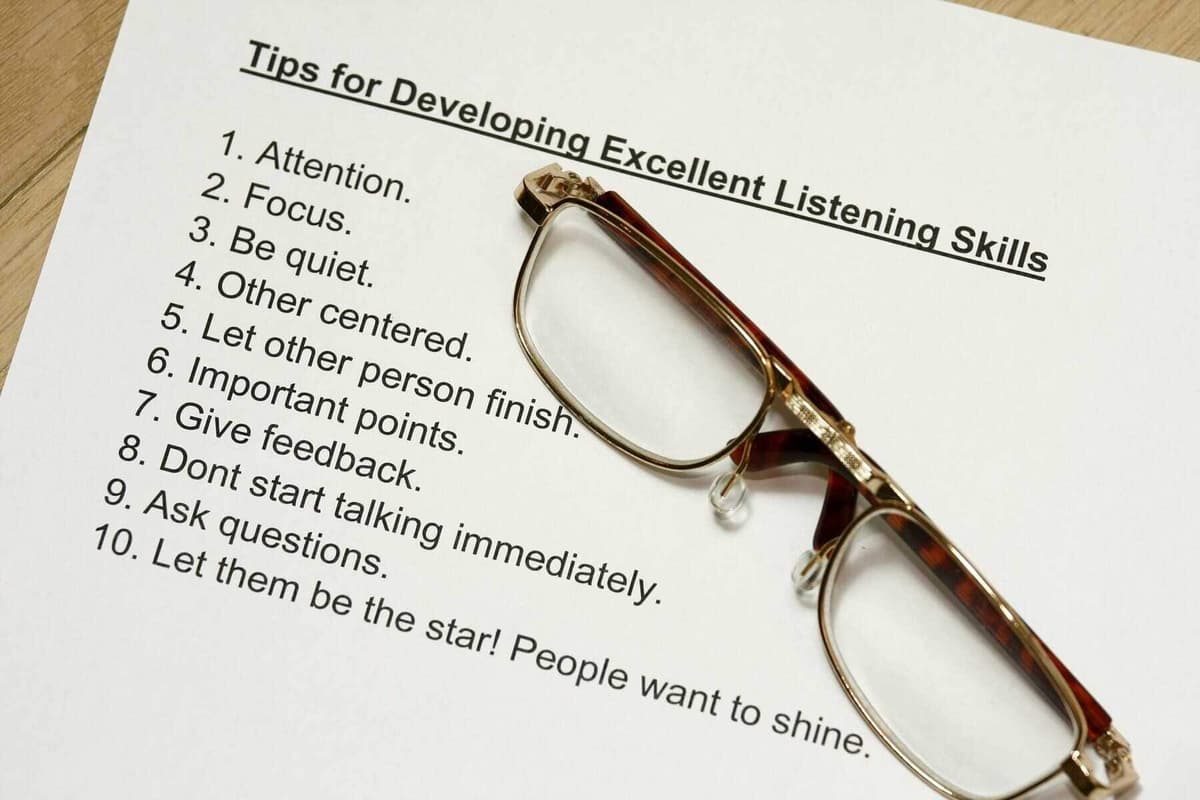
    • Show empathy: Try to put yourself in the other person’s shoes while you are talking to them. How would you feel? Do you understand what they’re going through? Connect emotionally with what is being discussed, instead of trying to process it logically. 
    • Ask questions: Engage. The more questions you ask, the more focused you stay and the more details you acquire about what is being discussed. 
    • Never interrupt: It is the most impolite thing and the most problematic in a communication as well. Let the other person fully complete their thoughts and then start answering. If you believe the other person needs to improve their communication and perhaps make it more concise, then deal with that in a feedback environment separately.
    • It’s ok to ask for some time: Telling someone “I can’t talk right now, I apologize, but my head is on something else, can we please discuss in a while?”, is not a bad thing. It shows self-awareness, respect, and confidence. If you are not in a mood because you are distracted, it is better to acknowledge it and reschedule than start a discussion that might lead to the other person feeling disrespected or undervalued. 
    • Not every conversation is about feedback: The fact that someone is talking to you, does not necessarily mean that you need to answer something back. Sometimes, you just need to listen carefully, without expressing an opinion afterwards. People talk for many reasons: get something off their chest, give information, interact. Not sharing your thoughts can be a very active decision, instead of a passive behavior. Also, not everything needs to be addressed on the spot. If you don’t feel ready to give an answer because you need more time to actively process what you’ve listened to, you can always say: “I need some time to think about it and I will let you know how I see it”.

    Last but not least, I still haven’t mentioned the reasons for being an active listener. 

    The obvious part is it’s the right thing to do, the best for business, the best for your team and your employees/ colleagues whose voices need to be heard. 

    The least obvious part is that it’s the easiest way for self-growth. You can learn from everyone. Every single person has at least one thing to share with you that you didn’t already know about. 

    Instead of focusing on what you do know, try searching for the elements that you don’t. Each person is a unique world with perspectives you can’t second guess or even imagine. 

    Embrace this fact, connect, and you will live more than one life. 

    Isn’t this an extraordinary possibility?