
Next MBA Cohort Starts Monday, July 6th, 2026

Review Pricing and Join the Cohort

CTO Academy Logo
Log In

Category: Technology Leadership

  • Top 10 things to look at to get remote working, working.

    Top 10 things to look at to get remote working, working.

    We’re lucky at CTO Academy to work with tech leadership coaches around the world and this week we’ve got a great article from Owen Evans based down in New Zealand which looks into what can go wrong with remote working, and how to make it right.

    “A lot of us have spent 2020 adapting to the new normal and a lot of us have found remote working for the first time. I’ve been there for a few years and worked in organisations that have embraced remote first mentality before it was cool required by a pandemic. Here are the top ten things my teams work on when working remotely ….

    1.Learn to write

    One of the core competencies of teams working well remotely is being able to write well and persuasively. You need to rely on ideas and information purchasing through the organisation without relying on cooler chats and coffees, or serendipitous meetings.

    But the amazing positive from the whole organisation writing things down to communicate is there’s a great breadcrumb style trail of how decisions got made. Everything is easily recorded and archivable as it’s already in written form.

    Get used to how to get ideas from genesis to development in a written form, work on brainstorming in the open, writing down half formed ideas and opening them up to collaboration.

    2.Embrace Asynchronous Decisions

    This leads from good written communication, but when you’re remote working you can’t always be 100% cognisant of all the distractions everyone else is going through. As such communication should be on a more asynchronous nature. Ask yourself if you need an answer to that question now, or just need an answer. Do you have other tasks you can work on while you wait, is the urgency you feel just your own psyche playing out. If you can embrace asynchronous decision making you can open yourself to moving many things forward at once, including more diversity in decision making (a lot of people need more thought than you might realise to make a good case for their thoughts on decisions and as such get crowded out of realtime, meeting based, decisions)

    3.Set clear goals

    Clarity of goal making is one thing that sets productive teams apart from those that aren’t. with remote working you can’t rely on a carrot and stick mentality and force people to align to certain work, you have to be clear about what good looks like for their own output so they can make decisions themselves.

    Team owned OKRs work well (as long as the team gets to make them and buy into them themselves) and invest in data driven dashboards. Also make sure there’s someone accountable for setting and reviewing goals for the team (in an engineering team this should be a primary function of the engineering manager)

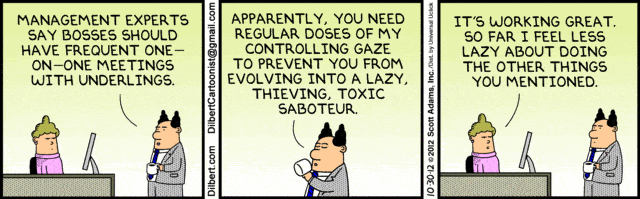
    4.1 on 1 meetings for growth

    Remote work can feel disconnected from an organisation. You need to work hard to reconnect individuals to a whole. It’s also a reinforcer for the idea that you need to repeat a message 4 times to ensure everyone’s heard it. Make sure your managers are empowered and trained in good 1 on 1 practice, that they’ve understood how to grow teams and team members and are able to convey messages from their own managers to their team.

    5.Repeat the message

    This is stated above but worthy of it’s own point. If you’ve read the seminal parable “five dysfunctions of a team” you’ll know that your primary team is not the team you manage but the team of fellow managers around the organisation. Your role is to help disseminate information to the team you manage alongside this group. Repeat messages many times. Lean on tools like All Hands to get a core message across to a wider organisation without it having to be in realtime. Repeat, repeat, repeat.

    6.Agenda is key to a productive meeting

    On top of 1 on 1s remote work tends to overload people with meetings when a company first switches to remote work, if you haven’t embraced asynchronous decisions yet you end up overly worrying about check ins and catch ups on projects, you fill people’s calendars with Zoom meetings and burn everyone out.

    Instead you should set the challenge that if you can’t set a meeting agenda then the meeting shouldn’t happen. You should default to shorter time and add follow ups if they’re needed (they rarely are). Embrace optional attendants and make it clear your letting them know the meeting is happening but not expecting them there. People will burn out if you let them or inundate them with meetings so stop it.

    7.Remote working is not working from home

    OK so the pandemic is slightly different, but usually remote working is not actually working from home. I vary my schedule to make sure I can work from Cafe’s or co-working spaces or the beach (it’s summer here is a write this so I’m looking longingly at the sea). The real reward for good remote working is that it can be “work from anywhere”. The only caveat to that I have is that time zones are still hard, and I don’t have a fix for that sorry.

    8.Be OK with not being OK

    It’s important to allow people to bring themselves to work, their real selves. Remote working breaks down a bunch of the usual barriers to work vs home life and it can be a real struggle for some. You also don’t get all the social queues that people might be struggling unless you give them space to make sure it’s ok to express it. As such you should model this vulnerability from the top. I try and coach CTOs or mangers to occasionally admit when they’re lacking motivation and be ok with it. Admit that the sun is shining and they want to go get an ice cream, or they have kids that just need them for a couple of hours and so need to check out. If you don’t admit this from the top down, no one will feel safe to express these things

    9.Celebrate the wins

    Sometimes you don’t get to celebrate or see the wins as well as you would in an office, you don’t see a cake turn up or donuts or everyone wearing silly hats. I make sure I take time for frivolity and celebration within the teams I manage, silly hat Friday’s, making sure people take time out to have a dinner if the team has done well, enjoy a well earned break if the team has been crunching through a project a bit. It’s more important than ever to celebrate every win you get as a team as it can help break the isolation

    10.Trust the process

    Getting a team used to all these things takes time, there are going to be road bumps along the way. Trust your team, trust in those who you’ve hired to do a job, trust that you’ve got this. It’ll take time to be smooth but the payoff is amazing”

    CTO Academy Leadership Coaching

    If you’re interested in finding out more about CTO Academy leadership skills training and indeed, about getting coaching from Owen and the team, have a look at our website.
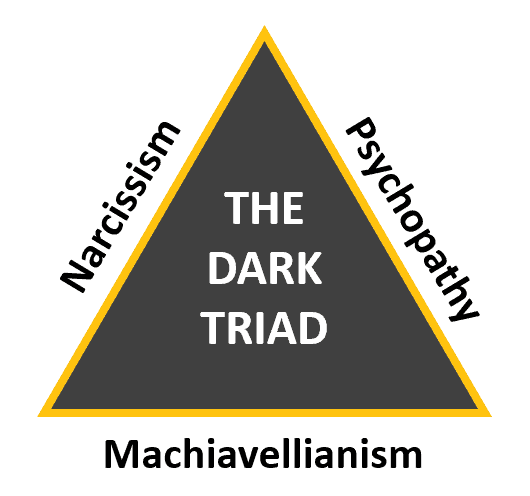
  • What type of leader are you – Emotionally Intelligent or a Dark Triad?

    What type of leader are you – Emotionally Intelligent or a Dark Triad?

    Emotional intelligence (“EQ”) in the workspace is a leadership topic and conversation that become particularly hot in recent years but which some technology leaders struggle with. 

    (more…)
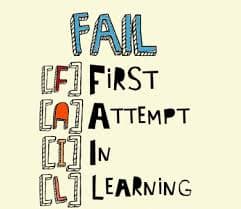
  • Learning To Learn From Failure … as an Experienced CTO

    Learning To Learn From Failure … as an Experienced CTO

    “Success is stumbling from failure to failure without any loss of enthusiasm” – Winston Churchill

    People who’ve made it to the top in their business, sport or career always seem to make success “relatively” straight forward when of course we all know – or at least those who tread a similar path will know – that’s it been far from easy to get there.

    Whether you believe in Gladwell’s 10,000 hour rule or not, we know that success in any discipline is generally a mixture of talent, mindset, application and luck.

    But perhaps the one consistent theme that runs through the story of all successful people is their ability to address failure as a learning channel and fundamental to helping you grow the skill set and the instinct to be a success in your chosen path, even if it might not feel like it at the time.

    I was reminded of this at home recently when introduced for the first time in my life to the skipping rope!

    Getting hit on the head by my Jump rope

    Like many others one of my new year resolutions in 2023 was to stay fit and part of that plan included my first attempt at using a skipping or jump rope!  

    “How hard would that be?” said I as I pressed “buy now” on Amazon. 
    Oh dear, I could not have been more wrong.  

    My first few attempts were not only a complete fail but almost always an embarrassing fail.

    I was quickly thinking about returning the rope until my 12 year old son picks up the rope and goes straight into a boxers skip as if it were the most natural thing in the world (how many of us suffer similar humbling experiences with our kids?)

    That’s all the motivation I needed to persevere.  

    Fast forward and I was still absolutely terrible but each time I failed the rope hit my feet, legs or quite often, the back of my head, I felt more determined not to give up, to keep persevering and to watch another 2 hours of YouTube videos on skipping technique. 

    So what??

    Well this experience inspired this article.  

    As the rope hit my head for what felt the Nth time this morning and I let out a small scream of frustration whilst resetting the rope again, I released that learning to jump rope has a lot of synergies to my life at work as a CTO.  

    My working environment is (and TBH always has been) about constantly absorbing failures and learning from them… so instead of the rope hitting my head it might be some code failing a unit test for the fifth time, or a document you have spent all week writing being ripped to shreds by your executive team mates.   

    What do we, as leaders, do in these times of failure; we stop, take stock of the feedback and quickly adapt based on the learning. As technology  leaders we have got to a place in our careers where we can do much of this naturally and instinctively, and therefore quickly.  We have found our own tools that allow us to remember the context of what we were trying to do, pick apart the feedback (be it from the unit test or the redline/comments in the doc) and then translate that into change or adaptation of what we were trying to do.  

    If you’re like me then you still let out a small scream when something hits the buffers, but I have trained myself, through experience, where I can negotiate those negative emotions and small setbacks, transforming them into the energy and processes to move on with what I was trying to do.  

    And hopefully muscle memory retains that experience and feedback for next time (though I do recommend sometimes making a note of particular incidents and solutions) to help you avoid or minimise the risk of something similar happening again. The British cycling team once achieved huge global success but making tiny adjustments and improvements they called ‘The Aggregation of Marginal Gains’ – a philosophy I aspire to achieving with my performance and that of my team. 

    Personally I love a working environment which uses feedback loops and the ability to learn from mistakes and self improve.  I get a huge kick out of it now.  

    I have also been very fortunate in my career to have great leaders and mentors who provided me the feedback and philosophy to take the hits but continue to move forward.  

    The effective coaches never shied away from telling me the hard truths and to adopt the growth mindset.  

    From past COO’s, CFO’s, NED’s to members of my past and current team, I have got to a place where I try to learn from everyone and everything around me.

    Our responsibility as leaders

    This then takes me to the role and responsibility we have as tech leaders or managers.  

    If what I’ve said is important to you (and hopefully it is) and you find yourself talking to your teams about “failing fast”, “failing forward”, “resilience” etc.  It is your job to provide the systems, process and tools to enable your team with the feedback loops and confidence to learn and improve. 

    It doesn’t really matter how big or mature your team may be, as a leader and manager of people we need to set them up to win.  This means that when they fail, we need to be there to help them get up, dusted off and in a position to move on.  

    In very early start-ups when you can feel the breath of your colleague in the chair next to you this can be as simple as an arm around the shoulder and a quick round of pair programming.  

    But there should be learning for you as well because when things do fail you may need to look at putting in more formal steps to help guide the process

    Culture is Key

    Create an environment and a culture where everyone feels safe to fail.  Now you have probably heard or read this hundreds of times, but what does it mean?  

    Simply make sure your team knows that it’s OK to fail.  

    Make sure they truly understand they are not going to get fired or a 10 minute rendition from the urban dictionary flying at them.  

    Re-enforce to the team that failing is OK as long as it’s followed up with transparency, honesty and learning  

    Culture starts at the top so you need to lead by example. Be open with the team when you fail and what kind of remedy and process you use to learn from it.

    I will often publicly detail my failures in our Tech team meeting.  I go through my errors and what I did about it.  

    This didn’t happen overnight. I used to think this would show me to be a weak leader but it’s actually the opposite and the team has always appreciated this element of my leadership. 

    This is most evident when you get the team putting their hands up on mistakes and watching their teammates swarm the issue… no better feeling as a manager than seeing that swarm.

    I also make a point to raise the other failures happening around the business.  I will talk to my team about situations that are happening that they may not be aware of and then show them what as a business we are doing (or did) to address a particular issue. I believe it is super important that your team has visibility of what’s happening elsewhere in the business, particularly if it could have a direct impact on their work and career.

    Everything Needs Process

    Like every techie I love process and these are 3 simple steps to help support a culture of how to manage the learning process from setbacks;

    1. Pull the Andon cord (https://www.sixsigmadaily.com/what-is-an-andon-cord/).  Create a virtual Andon cord.  Make it OK for the team to stop everyone working and get the help and support they need.  This could be as simple as a message in your team Slack or Teams channel, or a quick phone call to your manager, but raise the issue and get others to go and support the person that needs help
    1. Review incidents and have an incident process.  For many start-ups you will think this is overkill. But by having a very simple process that allows incidents to be managed and communicated will mean your team have a support system to fix an issue and it will mean that management have a way of getting updates on an issue, without sitting on top of the engineer that is trying to fix something
    1. Use the 5 whys process after an issue has occurred (https://buffer.com/resources/5-whys-process/).  It does not matter if the issue was a failure in production, or a problem with a process that creates lots of manual work, running an open and honest 5 whys session will always help you discover some of the underlying issues.  I love this process and I am a huge champion of it, but that does not mean I want to fix everything that we uncover.  Typically at the end of the a 5 whys session, we only look to ‘fix’ 30-40% of what we discover.  This may not sound a lot, but the difference it makes and the ongoing gains you get is huge.

    Final thoughts   

    Building the culture and resilience where it is OK to fail for you and your team is hard and it takes time.  

    Failing is essentially a real time training that helps you become more resilient and effective as a team, but like all training it’s an ongoing process and you will have many ups and downs as a leader to understand the nuances of how, when and where the manage failure.

    From my experience the key takeaways …

    1. Be open about failures
    2. Put in systems and process to be the framework as failures occur
    3. Be the support system for your team to learn and move forward
    4. Find your own support system, so you can better help your team
    5. Find a coach for you and key employees, who can provide a sounding board for how to manage this process.

    Next for me, is to watch another 2 hours of YouTube videos on jump rope ?

    Original Article Written by Sanjay Mistry, CTO and Leadership Coach

  • Negotiation : The Importance of Character and Consistency

    Negotiation : The Importance of Character and Consistency

    Arthur Schopenhauer was a German philosopher who in 1831 wrote The Art of Being Right and was then accused by public opinion of creating a guide of manipulative tricks. 

    How could a philosopher, a man dedicated by default to finding and honoring the one objective truth redact a book that trains the reader into twisting it towards their benefit?

    But to understand Schopenhauer’s mindset, we need to define why we sometimes feel the need to be right to begin with and how that approach impacts negatively when dealing with negotiation.

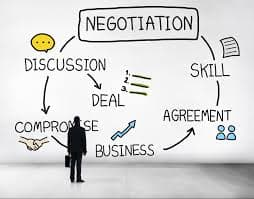
    And so much of life is about negotiation. Every time you ask someone for something, or someone asks something from you, you enter a negotiation field and you become a Player yourself

    As a tech leader you’re particularly immersed in the negotiation field on a daily basis and often with a wide range of stakeholders …

    1. The CEO around priorities, budgets, the tech queue;
    2. Your direct reports either through individual or group negotiations;
    3. Suppliers where you’re looking to find agreement around architecture or price negotiation;
    4. Partners integrating into your platform when they want a change to your stack!

    … and the list goes on with closing deals, salary negotiations, hiring strategies etc.

    The reality of life and leadership is that we need other people’s things, and they want ours. 

    But the resources for happiness are limited and every time you gain something, there is a risk that someone else is losing out so life can sometimes feel like a constant fight and why mastering the art of negotiation can impact you at home, work and beyond. 

    The truth is that Schopenhauer never aimed to create a manual on manipulation. As a nihilist he was deeply cynical with an astute understanding about the flexible morals of human nature. 

    The reason he wrote The Art of Being Right is that he wanted people to recognize the tactics used in a negotiation scenario. If you don’t view the world as a battlefield that doesn’t necessarily mean that you are a better or worse person but it does mean that you are a less prepared one. 

    I use the phrase Battlefield not in a ‘bullet-exchange’ sense but in a ‘benefit-conflicting’ one. 

    According to Schopenhauer, if you aren’t ready to be assertive enough the least you can do is to recognize other people’s violative assertiveness and revoke it. That truth isn’t really important if you can’t persuade anyone about it. Is it really true if no one believes it? 

    Sometimes you might find yourself pursuing the Machiavellian principle of ‘the end justifies the means‘. 

    It’s easy to say: ‘no I would never use a manipulative tactic on someone just to get my way!’, but the problem with that approach is you can be confident that some negotiating parties are considering doing exactly that.

    So when you enter that negotiation be aware that those who succeed are armed upfront with a variety of weapons. The weapons can be abstract like status, beauty, intelligence, and humor or extremely concrete like money, hierarchy, expertise. 

    In addition to this you need to be well armed with one key ingredient in particular, and that’s preparation. Understanding the background, character and likely motivation of the person sitting opposite is a key factor when arming yourself to face a key negotiation.

    And during a negotiation process there will likely be obstacles you need to negotiate, both objective and subjective.  

    First common mistake in negotiation is to underestimate the abstract weapons.

    In psychology, there are mind tactics called defense mechanisms that help us manage our inner conflict or stress about something or someone. A rather immature defense mechanism, but still quite popular, is called “splitting” and it’s when you either find something absolutely perfect or absolutely awful. 

    Like when someone is your friend, everything about this person is amazing but if it’s your enemy, everything is bad or indifferent. 

    It is quite usual that during negotiations we use splitting to weaken the stress our opponent causes us, thinking he/she is unworthy. But it’s never black or white. We are all grey in the complex sense of strengths and weaknesses. 

    You are a product of your gifts multiplied with your challenges, divided with the defense mechanisms you use to handle your anxiety and so is your opponent. 

    If you feel smart and sharp but the other guy seems dull and slow, that doesn’t mean you shouldn’t be afraid. It means you should be hyper afraid because he made it this far, sitting across that negotiating table with hidden skills that you might not have recognized, which could make them particularly dangerous.  

    Second common mistake is that we tend to confuse subjective with objective obstacles

    …meaning, we either quit too fast or never let go of situations when we should. 

    Having huge faith in your powers or no faith at all is equally damaging and all extremes lead to new extremes. 

    When you’re not sure how to act, always go for temperateness, it’s the safest bet in the long run.

    To conclude with two key questions …

    1.How to make sure this negotiation is ethical?

    In general, we all have a moral compass that shows us when our boundaries have been violated or when we have violated someone else’s boundaries. 

    Even when we comfortably operate in the grey zones a person can still be morally flexible without losing touch with their moral compass, as long as it exists and it’s constituted by specific, unbreakable values. 

    When you are needed to do something controversial, always ask yourself: 

    What’s the bigger picture here? 

    Is that bigger picture consistent with my deeper, core values? 

    And for the more skeptical reader …

    2. Why should we care?

    We should care because in an interdependent world the art of negotiation is key to success and should not be seen through the prism of “me winning = the other side losing”.

    Taking a position-based stance in negotiations might lead to short term success but is it a pyrrhic victory that harms a long term relationship? 

    If you trick or bully your way to a win then it’s unlikely that opponent will want to repeat the experience and the relationship is likely to be a one off transaction only.

    Ultimately the core to successful negotiation skills is to understand the importance of reaching a win-win solution where both sides walk away feeling they have achieved some success.

    This is as true in politics as it is in business. 

    Jane Mansbridge, Adams Professor of Political Leadership and Democratic Values and former president of the American Political Science Association explained “where our growing interdependence is producing an exponentially growing number of situations that require regulation. To regulate efficiently and with legitimacy, we need to come as close as possible to agreement. That agreement usually requires negotiation.” 

    Successful executives understand the importance of reaching a win-win negotiation because when both sides are satisfied with their agreement, the odds of a long-lasting and successful business partnership are much higher. 

    But having the integrity to maintain consistency during both a position-based and interest-based negotiation is what sets you apart and builds your character and personal brand. 

    Whilst character can not guarantee that you always get the best result it gains you respect and trust which in the long run are two of the most crucial virtues around which to build your career, become an effective technology leader and importantly, a balanced human being.

    You can learn more about Negotiation by signing up to our CTO Leadership Courses.

    Also watch out for our future masterclass series to include a much deeper dive into the Art of Negotiation.

  • What Has 2020 Taught Us About Building Resilience In Teams?

    What Has 2020 Taught Us About Building Resilience In Teams?

    2020: I don’t think anyone will say that was quite the year they expected during December 2019. I live in New Zealand so I specifically remember sitting outside on my lawn with the family, in the sun, talking about all we’d achieve over the course of a year and none of them included:

    (more…)
  • Positive Psychology VS Toxic Positivity

    Positive Psychology VS Toxic Positivity

    People have always been wondering what happiness is.
    Is it fulfilling your dreams and goals?
    Is it being free to decide for yourself?
    Is it the constant emotion of cheerfulness and perkiness?

    According to the Oxford dictionary, happiness is:

    • a) The state of feeling or showing pleasure
    • b) The state of being satisfied that something is good or right

    Is it so simple though? And if it’ s so simple, what’s holding us back?

    Despite the many riches and opportunities of the modern world, there are of course many challenges and sometimes these can feel overwhelming.

    We’ve had a lot to deal with recently so it’s no great surprise that increasing numbers of us suffer from anxiety and feelings of emptiness and sadness.

    The financial crisis of the previous years, the pandemic, the war, the general social and political instability are of course circumstantial factors that contribute. Even social media have played a significant role in the depression and alcoholism rates’ increase in the last years (Brunborg & Andreas, 2019).

    On the other side, the very same years another strong movement started evolving, that of positive psychology.

    The general concept of positive psychology could be narrowed down to the motto ‘always look on the bright side’, always searching for the opportunity hiding in the crisis. If something has been bad for you, think of how you can turn it into a positive experience instead. Being optimistic is of course not only healthy, but also a skill contained in the Emotional Intelligence skill set. Therefore, by default, being optimistic could never mean ignoring your negative emotions and acting positive no matter what is going on. It means that you are able to recognise your emotions, embrace them and manage them towards a more positive angle, as a result of your values- driven approach in life and your general self- awareness.

    However, many are those who exploited this approach, maximized the theory and pulled the basic principles so much to their edges, that we now can talk of a toxic positivity movement instead. This trend is upcoming, powerful, and extremely dangerous for our mental and emotional health, especially during corona times.

    For example: do any of the following mottos ring a bell?

    – Don’t get depression! Be productive! You are in charge of your life! You can do everything!

    These are just a few of the mottos you’ve been hearing and reading everywhere during the last months. One can say they’ re inspirational, but the truth is that they’ re much more than that. They take away all context factors and leave you alone with your personal responsibility. But luck isn’t zero sum. The society we live in, isn’t zero sum. When you are made to believe that you hold all the power, you have total control, how are you going to feel once something turns out wrong, even if you had done everything right? Let’ s take as example the confinement. The concept that quarantine is almost like paid leave and therefore you should make the most out of it, managed to produce more guilty- full people than the corona itself. Guilty people who always feel that they aren’t doing enough, they could be doing more. At one point, after all these webinars, zoom, online gym classes, teams- meetings, I bet you started feeling like it’s your fault for not having learnt mandarin during quarantine. The time was there, what did you do to waste it? Why were you tired or demotivated? Since you have all the control, all the power, why weren’t you business as usual?

    The truth is that the pandemic is a universal crisis with incalculable yet effects on the humankind. It’ s stressful and harsh. There are people during the confinement that are not able to visit their parents. People that have not seen their friends for months. People who lost their jobs, people who lost people.  All of us are wondering, when are things going back to normal, but no one knows. And that agony, that constant fight or flight mode, is confusing and requires energy. Energy to get up and wear clothes, even if you’ re going nowhere. Energy to stay realistically optimistic and to figure out a strategy to survive with minimum casualties at all levels. Energy to keep healthy, not only physically but also mentally. And that’ s why you didn’t learn mandarin. And that’s why you have nothing to feel bad about. The bar was raised to an abnormal level, no man could ever reach, without paying the repercussions afterwards, with breakdowns – burnout – post quarantine minor depression episodes.

    No matter what we do, the amount of happiness can never match the amount of sadness we will experience. Firstly, the biggest joy one can have, for example the day of their marriage, can never match the intensity and the depth of the greatest sadness one can experience, like losing a child. Secondly, most of the biggest joys in life come alongside with great pain, like the miracle of birth. We are only able to experience the joy of this event, after it has finished, never simultaneously. So how can some people be happy, even though there is no obvious reason to? How can some people identify with Milan Kundera, and embrace the unbearable lightness of their existence, even laugh at it, in a world that makes more sense to be viewed in a cynical perspective? The truth is that more and more scientists have concluded that happiness is mostly a matter of choice (Schwartz, B. & Ward, A., 2002). Every time we wake up, we need to take the active choice of turning towards the light instead of the darkness, stand for health instead of illness, make the painful difficult decision to stand up from the bed, and live the best possible futile life we can, partly contributing to reduce the other people’s lives’ futility, hoping that they will do the same for us too. To quote BoJack Horseman: ‘in this terrifying world, all we have are the connections that we make’.

    Life is already hard and challenging for all of us. There’s  no reason for us to be hard and challenging on ourselves and one another as well.

  • 11 Steps To Make 1-2-1’s More Effective

    11 Steps To Make 1-2-1’s More Effective

    ‘We have two ears and one mouth,
    so that we can listen twice as much as we speak’ 
    – Epictetus

    One consistent question that emerges during our coaching sessions with tech leaders from around the world, “How can I be more effective when conducting 1:1´s with my team?”

    Elizabeth Grace Saunders, author of How to Invest Your Time Like Money says …

    “One-on-ones are one of the most important productivity tools you have as a manager.  They are where you can ask strategic questions such as, are we focused on the right things? And from a rapport point of view, they are how you show employees that you value them and care about them.”

    Tips From CTO Academy Coaches

    Starting with the advice provided above by Epictetus, we asked our coaching network for some deeper insight on what makes an effective 1:1 session for tech leaders;

    1 How To Start Well

    Like everything else in life, first impressions count and how you start your 1:1’s will help shape how successful they turn out.

    The key to starting any session is to make your DR realise it’s about them, not about you or the company but them.

    Keep it simple and open with something like … “tell me what’s important for you at the moment?” or “tell me your wins, losses and what you’ve learnt from each?”A couple of our coaches mentioned being inspired by Bill Campbell (Trillion-Dollar Coach) in starting each session very personally. Ask how they are doing and make notes of key personal information that will help prompt you to follow up during one of the following sessions … “one of my DR’s mentioned that his son had a passing out ceremony in 2 months so I kept a note and mentioned it as the start of a following session. Without that note I probably would have forgotten to mention it but that I did, had a big impact”

    2 Have Genuine Interest In Other People

    Conducting truly effective sessions with your DR’s needs cognitive agility but it’s fundamentally about people and having a genuine desire to help individuals in your team to articulate and negotiate short term concerns, as part of a long term plan.

    It’s about helping them develop and grow for the business, for their role and most importantly, for themselves.

    3 Be Consistent and Reliable

    Fix a routine to avoid the sessions being seen as ad-hoc and squeezed into the few gaps in your diary. 

    A fixed schedule helps all parties prepare properly and avoid easy excuses for cancellation.

    And whatever you do, avoid that last minute cancellation not least because it will give the impression you have more important things to do. Whilst it might be one of multiple sessions for you this week, it’s potentially the most important one for the person sitting opposite. Never overlook that fact.  

    Remember also that building good relationships doesn’t happen overnight, it’s about building trust and small steps leading to large gains.

     In sporting parlance, it’s the aggregation of marginal gains.

    4 Agendas and Actions Plans

    By stating clear actions plans at the end of each session, you’re creating an agenda and a momentum for the next one. It also helps provide structure and avoids a meandering conversation.

    Liaise in advance about the key points and priorities.

    A rushed and poorly scheduled meeting can lead to important issues being missed and frustration about the effectiveness and point of that meeting.

    And whilst you provide the structure, the reporting tools, the targets (maybe based around OKRs, KPIs etc.) it’s important to provide them with the autonomy of owning the core agenda.

    If you are worried about them owning the agenda then have another look at your recruitment policy because you need to be building a team of experts who demand autonomy. 

    “We hire people to tell us what to do, not the other way round” – Steve Jobs

    5 Be Present

    This moment matters to the other person. They might have spent a significant amount of time preparing and potentially worrying about this session. 

    So you need to be present throughout.

    Avoid arriving distracted, fiddling with your mobile, finishing other calls or tasks.

    Give that person in front of you 100% of your time and make them the only one in the world that matters to you at that precise moment.

    If something else is genuinely impacting on your focus then be honest and admit it, maybe offer them the opportunity of delay or cancellation. 

    6 Their Place in The Big Picture

    The level of detail you dive into will be dictated by the relationship and the regularity but it’s important to differentiate these sessions from your standard conversations or the annual appraisal. 

    It should be primarily about helping them focus on their growth and development. Try to avoid it being too much about the micro and the day-to-day.

     “One agenda item I have with each DR is to ask ‘what escalation do you have for me and how can I support you to win?” – Sanjay Mistry, CTO Academy Coach

    It’s also useful encouraging them to set up a process where in advance of the sessions they start detailing the key issues or problems they need to raise, to go through in their own mind any road blocks so the session can quickly dive deep and be as effective as possible.

    7 Build Culture of Transparency

    An effective 1:1 isn’t just about that private session in isolation, it should be part of a wider culture of open, supportive and collaborative communication within the company.

    If they arrive at each session with that wider culture and confidence behind them, then you’re onto an early winner.

    8 Feedback: Get It, Don’t Give it

    It’s also not really the time or place to be giving them too much feedback, though channels and opportunities need to be created to do so. Feedback is generally best given after a specific event or situation and shouldn’t be stored up until some time later when details can be lost and it might be turned into a more attritional conversation.

    If feedback is to be exchanged, then it should only be one way and that’s in your direction. Feedback about the role, the tasks, the company, your leadership. This is why it’s important they lead the agenda and that you have a culture of openness and confidence in providing constructive feedback.

    If in any doubt about the impact of radical transparency, I recommend you read No Rules Rules about the leadership culture and performance impact at Netflix.

    Read that book and you’ll never think of feedback in the same way again.

    9 How Often and How Long?

    This clearly comes down to your individual demands and requirements so we plugged into some external expertise for guidance around this topic ….

    I recommend no less than a weekly 1:1 with every report for thirty minutes, and more time if needed. Even if you sit next to someone and see him every day. 1:1s let you discuss topics that may never come up otherwise” – Julie Zhuo, VP of Product Design at Facebook and author of The Making of a Manager.

    Sticking with the facebook crowd, Mark Zuckerberg and Sheryl Sandberd have publicly stated they meet twice per week

    We’ve had this tradition where every week we start the week and end the week just meeting one-on-one together and reflect on everything that’s going on, giving each other feedback” said Zukerberg.

    We always know that we’re going to talk things through and we’re going to get on the same page. And when we’re not on the same page, we’re going to keep talking it through,” said Sandberg. “I do one-on-ones with the people working on my team, Mark does one-on-ones, and it reverses down. I think it’s helped the company a lot.”

    Andy Gove, formerly of Intel and credited with being a key voice in the art of good management argued that the skill of creating and maintaining a business could be summed up in a single word: “managing.” And that’s precisely what frequent one-on-ones with your team empower you to do.

    Gove says that a minimum of one hour is required because “anything less in my experience tends to make the subordinate confine himself to simple things that can be handled quickly. They must feel that there is enough time to broach and get into thorny issues”.

    What is equally important as the duration of each session, is to try and build downtime around the meeting schedule that enables you to prepare and absorb effectively.

    10 Celebrate Wins, However Small

    How much have we needed to celebrate every small win in 2020 but it’s a principle you need to take into these 1:1 sessions.

    Make sure you spot and acknowledge their achievements and particularly when set against the longer term objectives you’re both heading towards.

    Use that celebration to help reflect on their journey, potentially for both of you because most effective relationships are about the benefits of mutual learning.

    11 How To End Well

    With A Smile.
    With An Action Plan.

    With A Confirmation Of Next Meeting.

    Putting Our Words Into Action

    We Conclude With An Action Plan and 11 Steps Towards Effective 1:1 Sessions

    1. How to start well
    2. Have genuine interest in other people
    3. Be consistent and reliable
    4. Prepare agendas and action plans
    5. Be present
    6. What’s their place in the big picture
    7. Build corporate culture of transparency
    8. Feedback : Get but don’t give
    9. How often and how long?
    10. Celebrate wins, however small
    11. How to end well
  • Movember, Men’s Health & Man Management

    Movember, Men’s Health & Man Management

    As Movember Ends, Mental Health Issues Remain

    Empathy in leadership is one of the key attributes for a successful tech leader and the COVID crisis has brought the need for compassionate management to the fore as we grapple with the unique challenges of working through a pandemic.

    As Movember draws to a close for another year we look at the issue of Men’s Mental Health, how to spot when someone is suffering and how to manage both yourself and your team through an individual’s personal crisis.

    The History of Movember

    It’s become something of an annual tradition. As the December advent calendars start going up, those November moustaches start coming down. 

    But to those unfamiliar with this hirsute phenomenon, a brief history …. 

    “Movember” is held every year in November as men around the world grow conspicuous moustaches in recognition of a movement created to help raise awareness of men’s health issues. 

    It emerged in Australia 20 years ago, initially as a localised and fun way to raise money and awareness of issues such as prostate cancer, testicular cancer and men’s suicide. 

    Since then it has become a global movement with the moustache as its driving symbol and the Movember Foundation that has since emerged has raised nearly $1 billion, funding over 1,200 projects around the world.

    “Movember” has since been listed as one of the world’s top 100 NGOs.

    Men’s Mental Health

    So the Movember moustache has come a long way in a short time, because it needed too.

    Before then men’s mental health in particular was a topic that lived in the shadows.

    “Men and women both experience depression but their symptoms can be very different. Because men who are depressed may appear to be angry or aggressive instead of sad, their families, friends, and even their doctors may not always recognize the anger or aggression as depression symptoms In addition, men are less likely than women to recognize, talk about, and seek treatment for depression. Yet depression affects a large number of men” – National Institute of Mental Health, UK

    This movement is part of a recent shift in society that is enabling a more open conversation about issues that men are not instinctively comfortable talking about. 

    Society and peer pressure has shaped many of us not to show signs of weakness and not to recognise or seek help when we need it. 

    Even those who have diagnosed mental health issues often remain uncomfortable discussing it with anyone else.  A trip to the pharmacy can bring anxiety, let alone talking openly with someone even if they’re a professional.

    This leads to an inevitable build up of pressure for the individual whilst those around him are often unaware that something is wrong and getting worse, because men don’t always show signs you might associate with mental health issues such as depression, sadness and hopelessness.

    Instead it can emerge in the form of anger and aggression or unhealthy coping mechanisms that those close to the individual might not see or be aware of.

    One of the primary messages we need to get across in these situations is that Depression can’t be sweated out by force of will. 

    My father came from a war generation here in the UK where illness was ignored. I suffered from chronic hay fever as a boy which was treated dismissively by my father as something that fresh air would drive out of me. Oh how I loved those summer walks in those lush Cornish hay meadows!  He certainly had a limited facility or empathy for anyone suffering from mental health challenges. Alas, that approach is still prevalent today amongst men in particular.

    But depression is not a sign of weakness and it can affect anyone regardless of age, race or ethnicity.

    What causes depression and how can you help?

    According to the National Institute of Mental Health, it’s often a combination of factors. 

    Family history can play a part whilst the fluctuations of daily life, such as financial stress, work pressure, difficult relationships and illness are examples of different triggers. 

    What is clear and consistent is that individuals need help to emerge from such episodes and it’s crucial that society in general, as well as those closest to the individual involved, provide clear signals that it’s OK to ask for help and they provide signposts for where to seek it. We need to minmise the risk of that individual trying to cope with it all themselves and the tragic consequences that can follow, particularly with men who in the US die by suicide at rates almost 4x higher than women.

    That said, whilst Movember is about advocating awareness of men’s mental health it’s clearly an issue that affects both genders.

    As a manager and as a human being you need to understand how depression can manifest itself and how to create a safe space and environment for individuals to raise the issue with confidence that it will be handled openly and proactively.

    Look for changes in behaviour and potential symptoms of poor mental health;

    1. If you think someone is struggling then offer the support you can and recommend they seek professional help
    2. Don’t underestimate how depression can become overwhelming and isolating for the individual 
    3. Reassure them they are not alone
    Mental Health Leadership [Particularly in a Pandemic]

    Add to this mix a pandemic and the need for sensitive management and awareness has only increased.  One survey conducted at the start of this crisis (March – April 2020) found that the mental health of almost 42% of respondents had declined since the outbreak began so given the time that has passed since then, we can only imagine the impact this is having on short term mental health and the risk of longer term issues.

    In truth, workplace mental health was becoming a more public issue before the pandemic and many companies had improved their support mechanisms dramatically though often as a result of pressures from employees, rather than a pro-active, senior management led focus.

    But there are an increasing number of organisations and consultancies like Sanctus here in London, who focus on helping organisations and individuals manage these situations and who can help you understand how to put mental health care of those around you as a priority of the working environment you’re creating. 

    Sometimes the key of how to lead is as much about you and how you as a leader react and communicate around these issues.

    You should be comfortable showing your own vulnerabilities and truths. Be willing to open up about challenges you have faced or are facing. Normalising mental health challenges and acknowledging that we all struggle at times, can be a hugely liberating signal that removes the stigma for others to do the same. 

    We talk a lot at CTO Academy about culture and how it’s shaped from the start and from the top of a company therefore, the conversation might need to start with you and the resources your company makes available and how you encourage people to access them.

    Biotech firm Roche Genentech were involved in a very proactive internal campaign with videos from senior leaders talking about mental health in a campaign called #Let’sTalk.  They empowered a network of employees, training them to help build awareness and become “mental health champions”. They also support their employees’ physical and mental health by encouraging use of digital health tools such as Headspace (meditation and mindfulness app) where after an initial trial they conducted reviews that confirmed people who used the app felt more content and happier at home and work. They have since given all 14,000 employees free access to the app.

    They introduced other services such as Doctor on Demand, recording a significant reduction in days lost to illness due to more people accessing care through this telemedicine solution, and Sleepio a sleep improvement app that uses cognitive behavioral therapy to alleviate insomnia. 

    Too little or poor sleep has enormous health impacts with 10x greater risk of depression, 60% higher risk of obesity and 11 lost days of productivity.

    What the recent #WFH environment has created is more honesty and openness about how our personal lives intersect with our business ones.

    Whereas beforehand a video of children interrupting a live TV interview was such a novelty that it went viral and attracted 41 million views, now it’s just part of a standard Zoom conference call.

    This dramatic shift in working behaviours has given us no choice but to be more transparent about our lives and lifestyle away from work. Whilst Zoom has its social limitations it might have started moving us towards a more honest relationship with each other, though the human condition is such that we’re as likely to snap straight back into pre-COVID work/life barriers.

    As the world returns to some kind of operational normality in 2021 you should avoid paying lip service to mental health support but instead start to embody an attitude that encourages healthy behaviour across the company. Give your team and your colleagues licence to be open about self-care and mental health and not treat work as a boiler room environment of deadlines and targets.

    Create an environment where people can talk about these issues, switch off, take a walk, access a meditation app, book a therapy session.

    Build a buddy system and regular check-ins but again, don’t set it up and ignore it. Book regular check-ins with colleagues and listen though alas, the art of listening is a woefully under developed skill amongst many tech leaders.

    An HBR article on How Managers Can Support Employees Mental Health quotes a study conducted between Harvard, Qualtrics and SAP where “nearly 40% of global employees said that no one at their company had asked them if they were doing OK”

    They go on to report that a 2019 Mental Health at Work Report found the most commonly desired workplace mental health resources were a more open and accepting culture, clearer information about where to go or whom to ask for support, and training.

    Now is the time, as we recalibrate towards a post COVID future, for you to focus on how and where you can improve your own leadership skills in this area and more widely, how your organisation creates an environment that supports people through these important issues.

    Key takeaways to consider;

    – How you can lead by example

    – Create an environment where people can be open and talk about it publically

    – Providing access to external support and apps

    – Invest in training and awareness

    – Modify policies and practices

    – Measure impact and progress

    Making a Difference

    We place such importance around the issue of mental health for tech leaders that we include Mindset & Wellness within our management skills courses. 

    We have also written about it in previous blogs including Managing with Compassion.

    COVID has likely concertinaed 5-10 years of change into 6-9 months of this pandemic. It’s also made many of us reflect on where we are, who we are and how we live our lives.

    If managing your mental health and that of your team wasn’t a priority before it must be now, and as a leader and manager you need to double down on what’s required to maintain a mentally healthy workplace culture for yourself and your team, and well in advance of being reminded about it all over again next Movember.

    Andrew Weaver

    Co-Founder, CTO Academy

  • 10 Black Friday (& Cyber Monday) Tips For The CTO

    10 Black Friday (& Cyber Monday) Tips For The CTO

    If you are involved in online retail whether B2C or B2B then there are certain times of the year when your systems are pushed to their limit. A few years ago, I was involved in an e-commerce outfit that had about 10k live SKUs and the main times in the year for promotion were Black Friday/Cyber Monday, Valentine’s, Halloween, Christmas Holiday Season and other seasonal promotions.

    • 2019 Black Friday was the biggest yet, Google tracked a 7.1% increase in sales volume, a 16.5% increase in sales value and a 3.1% increase in footfall – with the majority of the growth tracked online. (found.co.uk)
    • Ometria reported the number of on-site visits from Black Friday to Cyber Monday in recent years was 150% higher than in an average 4-day period on sites. (rapidspike.com)
    • 40% of customers will leave a site that doesn’t load in 3 seconds, is your site at risk of losing customers? (rapidspike.com)

    This year is going to be even busier online due to the restrictions on buying in-store.

    Our promotions were planned meticulously due to the number of items on sale but it was mainly a Marketing Strategy on the product side of the business.

    From a technical perspective, these are some of the lessons that we learnt.

    1. Test your server load capacity

    We were running hosted Magento with a distributed MySQL backend and limited caching due to the dynamic of the website. On normal days, it would operate seamlessly but when it was stress tested the system would have indeterministic errors. Our testing was more rigorous than the experts managing the installation. (It turns out that the MySQL distribution settings were not correct.)

    Lesson: We did not take our supplier’s word for reliability and tested ourselves. This prevented any real-world issues for customers.

    2. Coupons, Vouchers and Discounts codes are working correctly

    Make sure that someone is checking that codes are working and that they give the right discount. We had a code set up that was supposed to give 10% off but turned out it gave 90% off. There were a few red faces in the office!

    3. Ability to support enquiries

    Your potential customers may have questions in the process of buying. You need to make sure that you handle them efficiently so that the customer will have the confidence to buy. On top of our website, we used different channels including Amazon and a few on eBay. We rolled out 2000 products over a weekend without taking into account the queries from customers. Monday was spent answering the questions by the whole team.

    4. Distribution Capability

    From your warehouse to your delivery partners, you need to make sure that the technology is in place to support them with the increase in demand. This might be as simple as getting extra staff in to help with packing in the warehouse.

    5. Efficient Returns Process

    A pain for reporting is that your sales can be an overestimate of reality if you have a reasonable amount of returns. This is more prevalent in the fashion B2C. To keep your customers coming back, you need to have an efficient process but watch out for those customers who are abusing the system.

    6. Unlisted stock

    Stock sitting in a warehouse will not sell if it is not on the website! This may seem obvious but I had to change our processes so that new items were added quickly as we had a batch of items sitting in the warehouse for days.

    7. Escalation procedures

    “Everyone has a plan until they are punched in the mouth.” At the busy times when something goes wrong, your escalation processes need to kick in. If they don’t exist, you don’t even have a plan. Hope for the best, plan for the worst.

    8. Extra staff

    The company may take on extra staff over busy periods and you need to make sure that onboarding and security protocols are followed. It is very tempting to bypass in busy times but they are there to protect your brand and customers’ data.

    9. Freeze non critical releases

    Stating the obvious but do not update any live systems before a busy period unless it is critical. Work can still carry on but plan to release when things have quietened down.

    10. Personal life

    Warn your loved ones that your work may need you over the busy period. Get your colleagues to do the same.

    Your ecommerce traffic will be driven by digital marketing, ad clicks and the deals. If you have estimated the number of shoppers correctly, then you should have a stress free period with 100% uptime.

  • Webinar: The Future of Work & Tech Leadership

    Webinar: The Future of Work & Tech Leadership

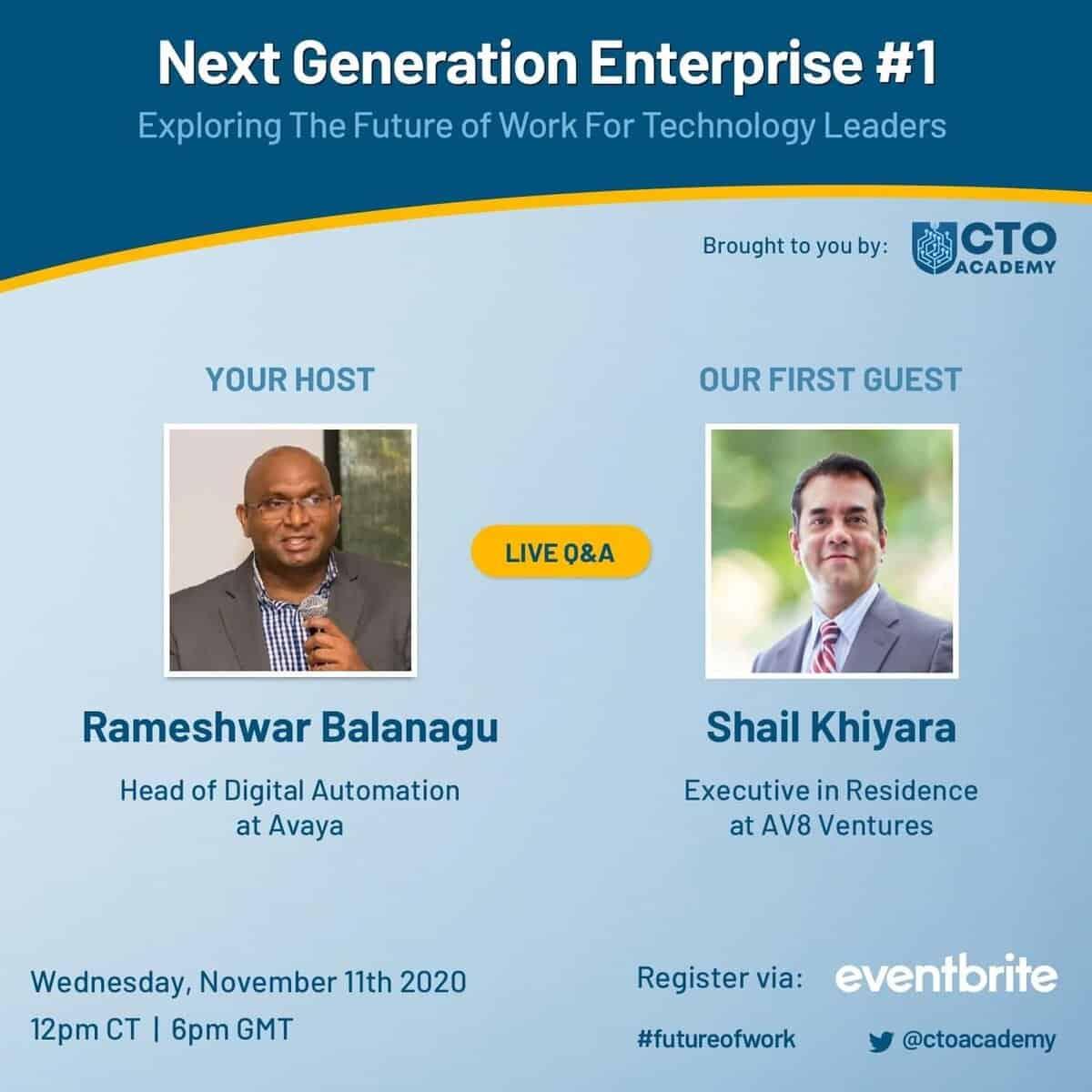
    This Weds (11th November 2020) we launch the first of what we hope will be a series of live webinar interviews looking at Next Generation Enterprise and more specifically, what will the future of work look like for technology leaders around the world.

    Next Generation Enterprise

    As tech leaders and managers we are accustomed to dealing with change as a constant, it comes with the territory.

    But even the most visionary amongst us are dealing with an ever faster pace of disruptive change, much of it recently super charged due to COVID.

    Next Generation Enterprise is a live webinar Q&A hosted by CTO Academy that will explore The Future of Work For Technology Leaders.

    We will be inviting experienced guests from in and around the tech world to explore what the future of work could look like and how tech leaders might need to adapt.

    We are particularly excited by the 1st guest on Weds.

    Our wonderful host Rameshwar Balanagu will be joined by Shail Khiyara.

    Shail is executive in Residence at AV8 Ventures and research fellow at HFS Research in Silicon Valley. He is also a board member at IQPC, an Artificial intelligence & Intelligent Automation Network with more than one million members & runs a prominent automation customer only group Vocal (Voice of the Customer in the Automation Landscape).

    He has 20 years of C-suite experience CMO roles & Chief Customer Office and fantastic insight about the often merging worlds of the CMO and CTO.

    You can also follow the discussion with @ctoacademy and #futureofwork

    Event takes place this Wednesday 11th November 2020 (Midday CT / 6pm GMT).

    You can register here.