Next MBA Cohort Starts Monday, July 6th, 2026

Review Pricing and Join the Cohort

CTO Academy Logo
Log In

Category: Technology Leadership

  • Building an Effective Chief Technology Office on Different Business Scales

    Building an Effective Chief Technology Office on Different Business Scales

    It is now common for a team leader or project manager to find themselves placed in the CTO’s shoes at a moment’s notice. Often, this brand-new executive is forced to form a Chief Technology Office out of thin air and without any help. This is the challenge facing what we call the accidental CTO.

    At the same time, existing CTOs can suddenly end up as Group CTOs after a merger or as a result of rapid expansion. 

    While both instances present an excellent career jump, it does not come without predicaments — especially for those with no real experience in high-level executive roles (eg, IT directors, Deputy CTOs or Fractional CTOs).

    To assist with the transition, we have created a detailed insight into the organisational structure of the Technology Office with individual roles, critical responsibilities, hierarchies and reporting schemes. It is a handy cheat sheet that will a) save you much time, and b) prevent serious mistakes. 

    You will also see an example of a typical Group Chief Technology Office with a brief overview of the GCTO’s role and responsibilities.

    Additionally, this article lists and provides solutions to the most common challenges of the CTO role and the Office itself while briefly explaining the necessary skills required for the position of a Chief Technology Officer.

    TABLE OF CONTENTS:

    1. Understanding the Chief Technology Office

    1.1 Defining the Office

    In a nutshell, the Office oversees all aspects of technology within an organisation. Led by the Chief Technology Officer, a vital member of the executive team, it plays a pivotal role in shaping the company’s technological vision, driving innovation and ensuring that technology aligns with the overall business strategy.

    Let’s examine that role in more detail.

    1.1.1 The General Role of the Office
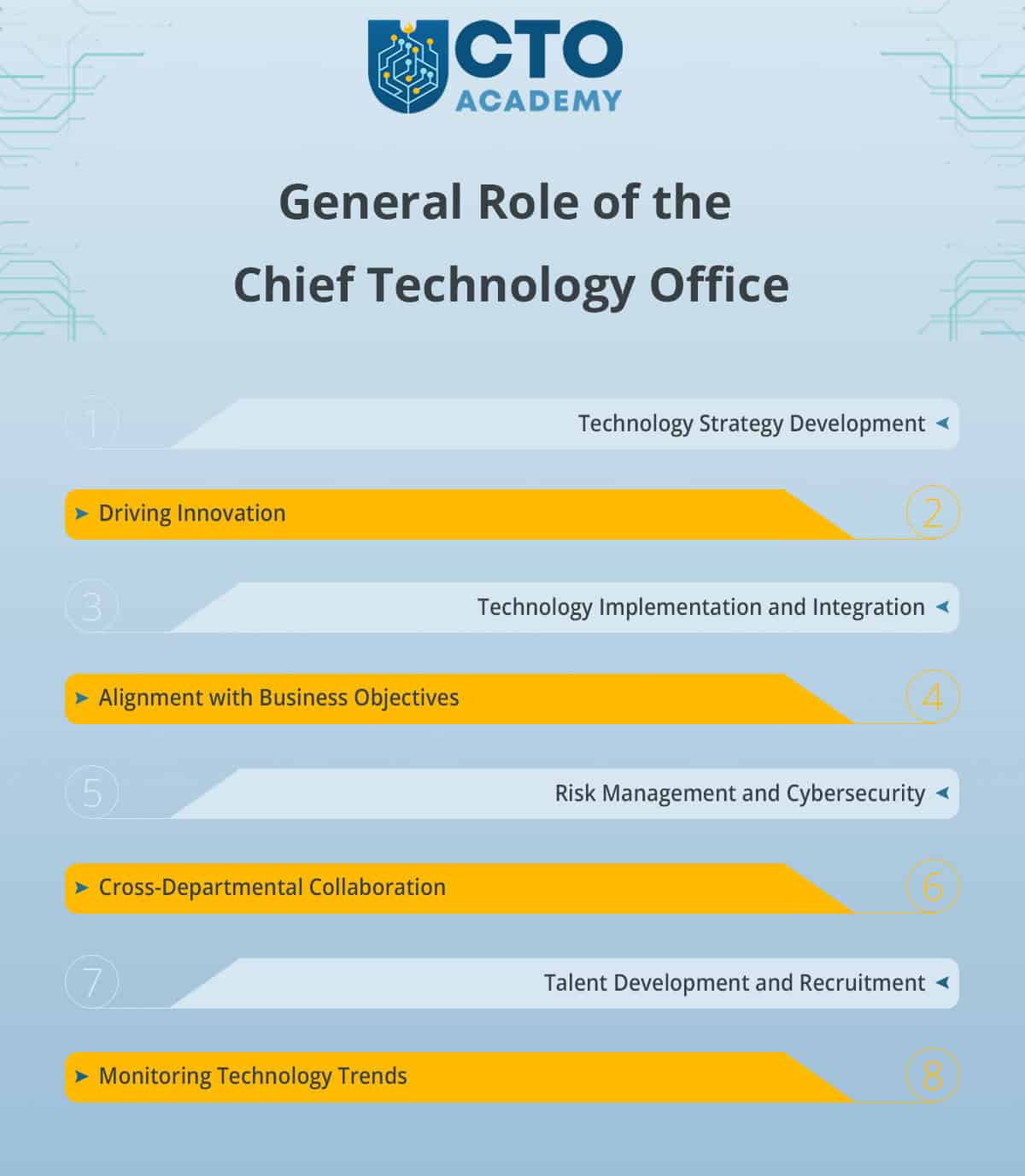
    General Role of the Chief Technology Office - list of responsibilities
    (click to enlarge/download)

    #1 – Technology Strategy Development

    The Office has a responsibility to formulate a visionary technology strategy that aligns with the organisation’s short- and long-term goals. This is done by:

    • Identifying emerging technologies.
    • Evaluating their potential impact.
    • Charting a path for technology adoption and implementation.

    #2 – Driving Innovation

    Many of humanity’s greatest advancements have been the result of mistakes. These errors are frequently the result of creative experimentation. And that’s exactly how technology officers and the Office itself drive innovations.

    #3 – Technology Implementation and Integration

    There are three essential elements of a successful implementation and integration of new technology:

    1. Effective project management.
    2. Collaboration with cross-functional teams.
    3. Addressing technical challenges.

    #4 – Alignment with Business Objectives

    Or, in other words, the necessity to understand the needs of different departments and stakeholders. It is a prerequisite for the successful tailoring of technology solutions to support their specific goals.

    #5 – Risk Management and Cybersecurity

    The Office safeguards the organisation’s digital assets, customer data and intellectual property from potential threats and breaches.

    #6 – Cross-Departmental Collaboration

    To ensure that technology enhances overall business operations and contributes to the company’s growth, the Office collaborates with other departments (eg, marketing, product development, finance and operations).

    #7 – Talent Development and Recruitment

    The main responsibilities in this segment are:

    1. Attracting top technology talent.
    2. Providing opportunities for professional growth.
    3. Fostering a positive work culture that motivates the team to excel.

    #8 – Monitoring Technology Trends

    The job of the Office is to continuously assess how emerging technologies can be leveraged to gain a competitive advantage and drive innovation.

    In summary, the Chief Technology Office is a dynamic and multifaceted environment that combines technical expertise with a strategic vision. By spearheading technology initiatives and ensuring their alignment with business goals, the Office contributes significantly to the growth and success of the companies in the ever-evolving digital landscape.

    1.2 The Impactful Role of a Chief Technology Office in Start-ups and Fast-Growth Companies

    The most distinct challenge for the Office is most certainly rapid scaling and growth.

    Start-ups and fast-growth companies experience exponential growth, requiring the CTO to rapidly scale the technology infrastructure and systems to meet increasing demands.

    But here lies the opportunity as well. The Chief Technology Officer can drive technological innovation to create scalable solutions that support the company’s growth trajectory by leveraging cloud services, automation and agile development practices.

    Still, start-ups and fast-growing companies are notorious for their limited resources and budget constraints. This makes balancing technological aspirations with financial realities quite challenging.

    But it also acts as an incentive for the Office to invest time in the exploration of cost-effective technologies, open-source solutions and strategic partnerships. Because somewhere in that mesh lies the solution that can, ultimately, enable the Office to optimise resources and deliver high-value outcomes.

    This exploration, since it is happening in such a fast-paced environment, requires agile decision-making on the one hand and the thoughtful consideration of long-term implications on the other. In other words, the Chief Technology Officer and the Office itself must always balance the need for rapid action against the potential long-term negative impact of their decisions.

    To address these two challenges, the CTO must work out the agile decision-making processes. These, in turn, will empower teams to make informed choices while maintaining alignment with the company’s vision and strategy.

    And with everything so well synchronised, attracting and retaining top talent becomes that much easier. 

    Let’s not forget that the competition for skilled technology professionals is fierce. Start-ups must often compete with larger, established companies for talent. But if the Office succeeds in the creation of a compelling company culture that fosters innovation and offers professional growth opportunities, it will attract top talent motivated by the start-up’s mission alone. Lately, this is becoming a more significant factor than salaries and bonuses.

    Another important role of the Office is risk management and cybersecurity. This is even more emphasised in start-ups because they often tend to underestimate the importance of robust cybersecurity measures. As such, they are vulnerable to data breaches and security threats.

    To tackle this problem, CTOs implement and enforce proactive security protocols, conducting risk assessments and prioritising data protection. This is necessary to safeguard the company’s reputation and customer trust.

    Cybersecurity can come with significant costs, and so too can managing technical debt.

    Quick iterations and product launches may lead to accumulating technical debt, resulting in maintenance challenges and reduced development speed over time.

    Common measures to minimise the debt and, thus, ensure long-term product stability and sustainability, are:

    • Implementing sound development practices.
    • Allocating time for refactoring.
    • Prioritising reduction of technical debt.

    Often, this may be further facilitated by adopting emerging technologies.

    This, however, requires careful evaluation because, in the end, AI, blockchain, IoT and similar ETs must also align with the company’s unique needs.

    The role of the Office here is to design and lead pilot projects to find out if these technologies and their possible applications can potentially enhance products or services and, ultimately, give a competitive advantage in the market.

    After all, isn’t it the job of the Office in any start-up to constantly balance short-term vs. long-term technological vision? Can there be hidden opportunities in emerging technologies that we do not yet see?

    Here’s the problem. As a rule of thumb, start-ups often focus on immediate priorities, possibly overlooking the importance of a coherent long-term technology vision.

    The CTO must, therefore, strike a balance between short-term goals and a visionary approach, ensuring technology decisions align with the company’s future aspirations. And that balancing act directly influences the company’s outlook and future directions. So we can say that, at some level, the CTO and the Office pave the way for the company’s future.

    But…

    What happens when a start-up eventually evolves into a fast-growth company?

    In this common scenario, cultural shifts and organisational changes can be disruptive to existing workflows and employee dynamics. Consequently, cultural adaptation and change management quickly rise on the list of responsibilities.

    The Chief Technology Office of a company suddenly becomes instrumental in three major areas of change management:

    1. Driving a culture of innovation and continuous learning.
    2. Encouraging adaptability.
    3. Embracing change to foster a positive work environment.

    Fast-growth companies have one additional challenge that suddenly becomes elevated and that’s the ability to navigate regulatory compliance.

    Module 2 of our Digital MBA for Technology Leaders, for instance, delivers a series of comprehensive lectures that explain compliance challenges and their individual solutions in practice. That’s how intricate and complex this role of the Office truly is. Almost an entire module is dedicated to helping CTOs navigate regulatory compliance.

    Because, as start-ups grow, they may face complex regulatory requirements in various industries, necessitating adherence to sometimes far-reaching compliance standards.

    The Office and its Chief Technology Officer must, therefore, collaborate with legal and compliance teams to ensure the technology infrastructure and products meet industry-specific regulations and standards.

    This only proves the underlying importance of cross-departmental collaboration and effective relationships. But it also goes to show how critical it is for the CTO to balance innovation and regulations.

    Being at the forefront of the company’s technological advancement, the Chief Technology Office often spearheads the crossing into the white space of the innovation landscape. A good example is Chris Gaudreau, CTO of Gordian; the company that is, under his technology lead, effectively redefining the entire industry.

    Gordian’s technology and data solutions enable public and private owners to effectively manage their budgets and tackle maintenance backlogs. This leads to quicker repairs of schools, resulting in safer environments for students. Healthcare facilities can remain updated, providing affordable and quality care. Workspaces such as offices, factories and warehouses can also be modernised, promoting productivity for workers.

    All thanks to the Chief Technology Office which is ensuring the company’s leading position by adding top technological advancements as part of their three-fabric strategy.

    Back to Table of Contents

    2. Organisational Structure of the Chief Technology Office and the Group CTO Office

    2.1 Building the CTO Office: Teams and Departments

    The organisational structure of the Office can vary depending on the size of the company, its industry and specific technological needs. As a general rule of thumb, the CTO Office should be designed to effectively manage and drive technology-related initiatives within the organisation.

    An example of a typical organisational structure, featuring key teams and their respective functions
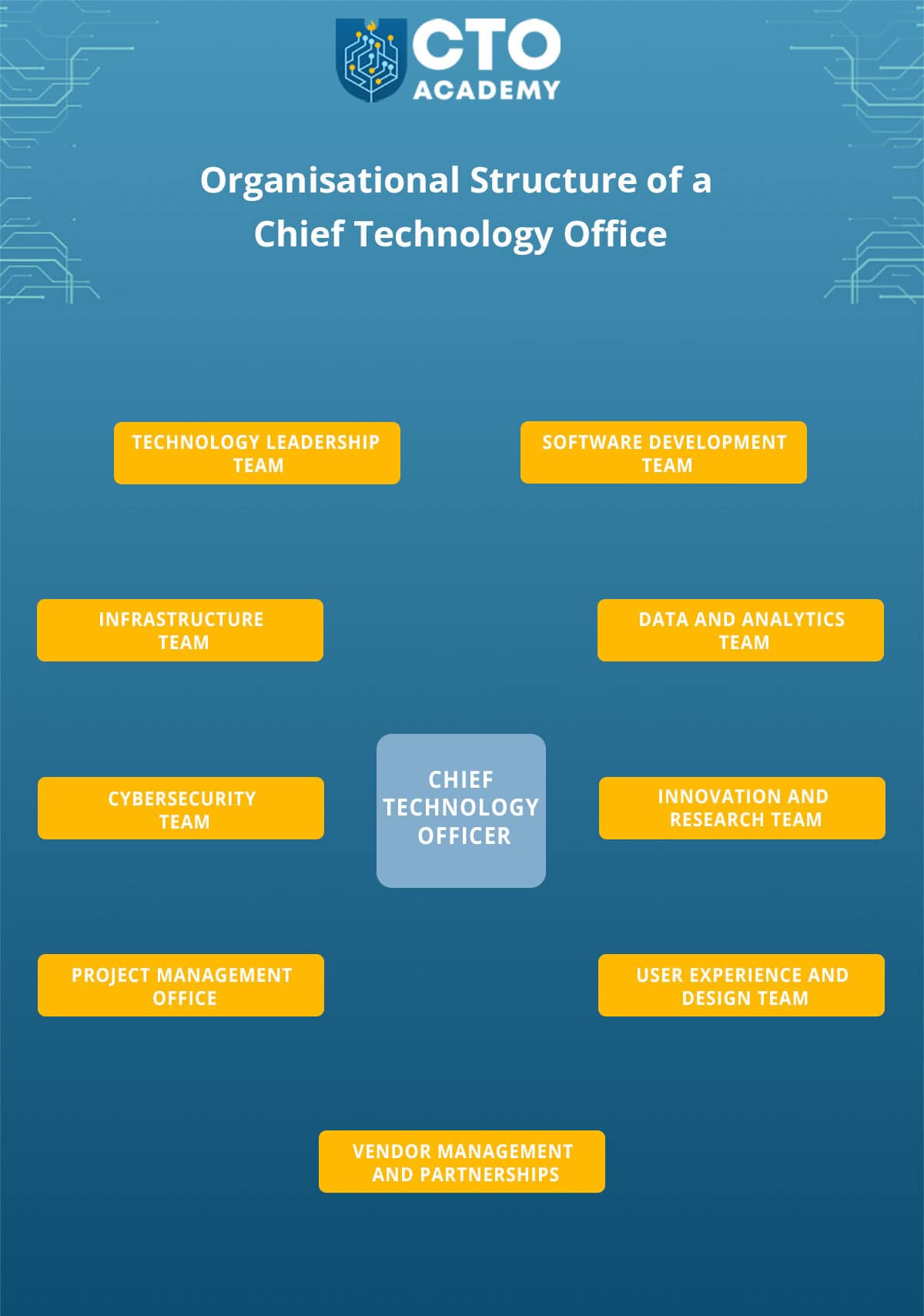
    Organisational Structure of a Chief Technology Office - schematic presentation
    (click to enlarge/download)

    1. Chief Technology Officer (CTO)

    Resides at the top of the organisational structure and is responsible for providing strategic leadership, setting the technological vision and ensuring technology initiatives align with the company’s business goals. CTOs report directly to the CEO or other top executives and may be part of the company’s board of directors.

    Get a detailed overview of the Role of CTO in Different Business Sizes.

    2. Technology Leadership Team

    In fast-growth companies, the CTO may be supported by a team of technology leaders who directly manage specific functional areas of the CTO Office; for example, the VP of Engineering or IT Director.

    3. Software Development Team

    The job description here is to design, develop and maintain software applications that cater to the company’s needs. The Dev Team(s) works closely with other departments to understand requirements and deliver software solutions that align with business objectives (eg, customer service, marketing, sales, etc).

    4. Infrastructure Team

    Responsible for the management of the company’s hardware and software infrastructure, including servers, networks and cloud services. Their primary focus is on ensuring the stability, security and scalability of the company’s IT infrastructure.

    5. Data and Analytics Team

    Managing data assets, conducting data analysis and providing data-driven insights to support decision-making across the organisation. They may also work on data governance and data security.

    6. Cybersecurity Team

    Safeguarding the company’s digital assets from potential threats and breaches. They implement security measures, conduct security audits and educate employees about best practices for data protection.

    7. Innovation and Research Team

    Researching emerging technologies, evaluating their potential applications and conducting experiments and prototypes to drive innovation. They collaborate with other teams to explore new possibilities for technological advancement.

    8. Project Management Office

    Oversees the planning, execution and monitoring of technology-related projects. The PMO ensures that projects are delivered on time, within budget and meet the specified quality standards.

    9. User Experience and Design Team

    Responsible for enhancing the user experience of the company’s digital products and services. They work closely with software development and innovation teams to create user-friendly and visually appealing interfaces.

    10. Vendor Management and Partnerships

    Manages relationships with technology vendors and strategic partners. They evaluate potential vendors, negotiate contracts and ensure that partnerships align with the company’s technology roadmap.

    Note that the actual organisational structure of the CTO Office may vary from one company to another, and some companies may have additional teams or functions depending on their specific technological requirements and business goals. Additionally, in smaller start-ups, the CTO Office might be leaner, with the CTO directly overseeing multiple teams or functions.

    But what about conglomerates or large companies with multiple verticals each responsible for an individual project/product? 

    2.1.1 A Group CTO role and responsibilities

    A Group Chief Technology Office has a more encompassing role that commonly involves coordinating and aligning technology strategies across multiple companies within a group. In a nutshell, this means that the Group CTO oversees several technology leaders. The role is similar, but, as you can imagine, there are differences.

    The obvious one is the scope of responsibilities.  A Group CTO oversees the technological strategy and operations of a group of companies or subsidiaries within a larger corporate structure. As such, they are responsible for aligning technology initiatives and strategies across multiple entities, ensuring that technology investments are coherent and synergistic. 

    In practical terms, this means that the Group CTO is responsible for coordinating technology efforts and strategies across multiple companies. They need to identify opportunities for synergy, shared resources and technology collaboration among multiple business units 

    The same applies to innovation and R&D. Group CTOs might have a broader perspective on technological innovation that spans the entire group. In other words, they can guide R&D efforts that have a cross-company impact. 

    You can see an example of the Group CTO job requirements here.

    A typical organisational structure of a Group CTO Office

    1. Group Chief Technology Officer

    The GCTO sits at the top of the technology leadership hierarchy and is responsible for overseeing the technology strategies, innovation and operations of the entire group. They report to the CEO, President, or another highest-level executive.

    2. Technology Leadership Team

    • Business Unit CTOs – Report to the Group CTO and are responsible for aligning technology initiatives with the specific needs of their respective units.
    • Group Technology Strategy Head – Focuses on formulating and refining the overarching technology strategy for the entire group. They collaborate closely with business unit CTOs and the Group CTO to ensure alignment with group-level goals.

    3. Group Technology Council

    This council includes key technology leaders from each business unit or subsidiary. It meets regularly to discuss group-wide technology strategies, share best practices and address cross-company technology challenges.

    4. Innovation and Research Labs

    The group might establish innovation labs or centres of excellence that focus on exploring emerging technologies, conducting research and developing prototypes or proofs of concept with cross-company impact.

    5. Centralised Functions

    • Technology Architecture Team – Defines and manages technology architecture standards and guidelines across the group, ensuring consistency and interoperability.
    • Vendor and Partnership Management – A centralised team might manage relationships with technology vendors, negotiate contracts and assess partnerships for their relevance to the entire group.

    6. Support Functions

    • Project Management Office (PMO) – A centralised PMO could oversee technology project management processes, ensuring that projects are aligned with the group’s technology strategy and are executed efficiently.
    • Data Governance and Compliance – The team that ensures that data handling practices across the group adhere to regulations and standards.

    7. Technology Advisory Board

    Comprising of technology experts, executives and possibly external advisors, this board might provide strategic guidance to the Group CTO and assist in making technology-related decisions.

    It’s important to note, however, that this is what a common structure of the GCTO Office may look like. The specific roles and organisation can vary widely based on the nature of the conglomerate and its subsidiaries. 

    The structure is, therefore, always designed to facilitate effective communication, collaboration and alignment of technology strategies while supporting the unique goals and challenges of each business unit within the group.

    2.2 Reporting Hierarchies and Responsibilities

    2.2.1 Reporting hierarchies of the Chief Technology Office

    In a typical scenario, the reporting hierarchy of these departments looks like this:

    • The CTO reports directly to the CEO, COO (Chief Operating Officer) or directly to the company’s board of directors, depending on the organisation’s structure.
    • If there is a Group CTO, all the CTOs of the group report to the GCTO.
    • The leaders of the different functional areas within the CTO office (effectively deputies), such as the heads of Development, Infrastructure, Data and Analytics, Cybersecurity, Innovation and Research, etc, report directly to the CTO.
    • Teams report to their heads.

    2.2.2 Responsibilities and decision-making authority of the CTO

    As the top technology leader, the CTO plays a critical role in shaping the company’s technological vision and driving innovation. Their responsibilities and decision-making authority can be broadly categorised into the following areas:

    1. Strategy Development
    2. Innovation
    3. Investments and Budgeting
    4. Implementation and Integration
    5. Risk Management and Cybersecurity
    6. Vendor and Technology Partner Selection
    7. Talent Acquisition and Team Management
    8. Cross-Functional Collaboration
    9. Technology Governance and Compliance
    10. Technology Roadmap and Vision
    11. Evaluation of Technical Partnerships and Alliances
    12. Technology Evaluation and Assessment

    The decisions made by the CTO have a profound impact on the organisation’s technological landscape and its ability to adapt and thrive in a rapidly changing digital world.

    Back to Table of Contents

    3. Functions and Responsibilities of the Chief Technology Office

    3.1 Developing a Visionary Technology Strategy

    This process involves thorough analysis, strategic planning and continuous evaluation to ensure that technology initiatives drive the company’s success. It can be divided into 12 steps:

    1. Understanding Business Goals and Objectives (ie, identifying the strategic priorities that technology should support).

    2. Assessing the Current Technology Landscape (ie, identifying strengths, weaknesses and areas requiring improvement in the existing technology infrastructure).

    3. Identifying Technology Trends and Innovations

    4. Aligning Technology Initiatives with Business Objectives

    5. Setting Long-Term Vision and Goals

    6. Developing Actionable Roadmap

    • Outlining the steps and projects necessary to achieve the technology vision and goals.
    • Prioritising initiatives based on their potential impact, resource requirements and timeframes.

    7. Engaging with Technology Stakeholders

    • Understanding their challenges.
    • Involving them in the process.

    8. Addressing Risks and Challenges (associated with technology adoption and implementation).

    9. Resource Allocation and Budgeting

    10. Continuous Monitoring and Evaluation

    11. Communicating the Technology Strategy

    • Effectively communicating the technology strategy to all stakeholders.
    • Ensuring that it is well-understood and embraced throughout the organisation.
    • Demonstrating the alignment between technology initiatives and the company’s overall success.

    12. Practising Iterative and Agile Approach

    This process enables organisations to formulate a forward-thinking and perfectly aligning technology strategy. It is necessary to create an environment of innovation, growth and sustained success in the technology landscape.

    How to anticipate future technology trends?

    It comes down to using a combination of strategic foresight, continuous learning and proactive engagement with the technology landscape. It is an iterative process that, in reality, never stops.

    First, the Office conducts in-depth research and analysis of industry trends, customer demands and emerging technologies. The goal here is to identify potential opportunities and challenges.

    Now comes the so-called technology scouting where the teams effectively hunt out emerging technologies and innovations. They do so by attending conferences and seminars and by engaging with technology vendors. But the best opportunities often hide in the start-up landscape.

    That’s why networking and collaboration are of vital interest. By fostering collaborations with industry peers, academia and research institutions, the Office gains insights into cutting-edge developments and best practices.

    This also helps to stay updated with reports and insights from technology research firms, think tanks and industry publications.

    Still, the only way for the Office and its CTO to know what the company truly needs is to maintain high levels of cross-departmental and cross-functional collaboration. For example, a Sales Team might radically improve its efficacy if the existing PaaS is replaced with a more practical upcoming solution. And that solution is often a flagship product of some relatively unknown start-up. As such, it needs thorough research and testing because start-ups are notorious for launching half-baked products.

    How do you test such a product? 

    You organise hackathons and innovation challenges that will encourage employees to ideate and experiment with new technologies.

    But if they experiment and fail to share the outcomes for one reason or another, it’s all in vain. That’s why successful CTOs promote fully open and completely inclusive internal knowledge-sharing sessions where team members can share insights and discuss potential technological advancements but also acknowledge accidents and mistakes.

    If you doubt this approach, consider the number of NASA’s failed launches before they managed to put the man on the Moon. If they weren’t allowed to experiment and crash things, the only walk Neil Armstrong would have taken would have been in his local park.

    And just like NASA, every Chief Technology Office seeks advice and guidance from external technology consultants or subject matter experts. It’s a proven way to gain fresh and objective perspectives because the Office can easily fall into singular reasoning. And where everybody thinks the same, nobody’s really thinking.

    All this research and experimentation builds a necessary foundation for developing pilot projects and prototypes. It’s the only sure way to test and evaluate the feasibility and potential impact of new technologies.

    The last and probably most important element of this entire process is continuous training and professional development. That’s why successful CTOs relentlessly encourage all team members to participate in workshops, webinars and courses to stay updated with the latest industry trends.

    This is the common process the Office uses to:

    • Proactively anticipate future trends.
    • Enable the organisation to make informed strategic decisions.
    • Maintain a competitive edge in the ever-evolving technology landscape.

    3.2 Navigating Technology Implementation Challenges

    3.2.1 Overcoming hurdles in implementing new technologies and systems in fast-paced environments

    Examples of strategic approaches and best practices:

    1. Thorough Planning and Roadmapping – Outlines the steps, resources and timelines.

    2. Agile Methodology – Enables quick adaptation to changing requirements and continuous improvement of the technology implementation processes.

    3. Cross-Functional Collaboration – Ensures technology solutions meet their specific needs and align with overall objectives.

    4. Clear Communication – To foster understanding, cooperation and collective problem-solving.

    5. Addressing Resistance to Change

    • Identifying potential resistance to new technologies and addressing it proactively.
    • Educating employees about the benefits of the new systems.
    • Offering training and support during the transition.

    6. Pilot Projects and Prototyping – To validate the feasibility and potential benefits of the new technologies before full-scale deployment.

    7. Risk Mitigation Strategies – To address unexpected issues.

    8. Prioritise User Experience – To enhance adoption rates and minimise disruptions during the transition.

    9. Performance Metrics and Evaluation

    • Establishing performance metrics to evaluate the success of technology implementation.
    • Continuously monitoring performance and gathering feedback to make data-driven improvements.

    10. Celebrate Successes – To boost morale and encourage future innovation.

    The key phrase here is adaptive mindset. Because if the mindset is adaptive, it is also proactive which means that there is no limbo.

    3.2.2 Examples of successful strategies for achieving seamless technology integration

    1. Thorough Planning and Assessment

    • Conduct a comprehensive assessment of the existing technology infrastructure and systems to identify potential integration challenges.
    • Develop a detailed integration plan that outlines specific goals, milestones and resource requirements.

    2. Clear Definition of Objectives

    • Define the objectives and expected outcomes of the technology integration.
    • Ensure alignment with the company’s overall business strategy to maximise the impact of the integration.

    3. Cross-Functional Collaboration

    4. Open Communication and Change Management

    5. Testing and Validation

    • Conduct extensive testing of the integrated systems to identify and resolve potential issues before full deployment.
    • Validate data integrity and ensure compatibility with existing processes.

    6. Incremental Implementation – ie, phased approach for easier management of risks and course corrections if needed.

    7. Data Migration and Integration

    • Develop a robust data migration strategy to ensure the seamless transfer of data from legacy systems to the new integrated platform.
    • Pay close attention to data mapping, validation and data security.

    8. Training and Support

    9. Performance Monitoring and Optimisation

    • Continuously monitor the performance of the integrated systems post-implementation.
    • Analyse data, gather feedback and make iterative improvements to optimise the integration’s efficiency.

    10. Vendor Collaboration

    • Ensure clear communication, well-defined roles and a shared commitment to achieving successful integration.

    11. Contingency Planning

    12. Post-Integration Review

    • Conduct a post-integration review to assess the success of the integration and gather lessons learned for future projects.
    • Use feedback to continuously improve integration processes.

    A well-executed integration enhances the company’s ability to leverage technology effectively and adapt to evolving market demands.

    3.3 Aligning Technology with Rapid Business Growth

    There are three primary objectives here:

    1. Enable the organisation to seize market opportunities.
    2. Streamline its operations.
    3. Help enhance customer experiences.

    To meet these objectives, the Office must scale the technology infrastructure to cater to the expanding business needs. This is achieved through an array of practical approaches:

    • Cloud Migration
    • Horizontal Scaling
    • Microservices Architecture
    • Automated Provisioning and Orchestration
    • Containerisation
    • Elastic Storage Solutions
    • Content Delivery Networks (CDNs)
    • Monitoring and Performance Optimisation
    • Outsourcing and Managed Services
    • Proactive Capacity Planning
    • Resilient Architecture Design
    • Collaborative Decision-Making

    3.4 Practical Ways of Managing Different Departments in Start-Ups and Fast-Growth Companies

    In start-ups and fast-growth companies, the CTO Office must adopt practical strategies to manage verticals effectively. It is more of a hands-on approach to management and here are a few examples:

    • Software Development
      • Implementing agile practices like Scrum or Kanban to facilitate iterative development, quick feedback loops and adaptive planning.
      • Setting up automated CI/CD pipelines to streamline code integration, testing and deployment, ensuring faster and more reliable releases.
      • Enforcing coding standards, conducting regular code reviews and prioritising code quality to prevent technical debt and maintain a high level of consistency.
    • Infrastructure
      • Leveraging cloud platforms (e.g., AWS, Azure, Google Cloud) to scale infrastructure dynamically, reducing the need for extensive upfront investment.
      • Implementing Infrastructure as Code (IaC) to automate infrastructure provisioning, making it efficient and repeatable.
      • Active monitoring to track system performance, set up alerts and address issues promptly, ensuring high availability.
    • Compliance and Security
      • Working closely with legal and compliance teams to understand relevant regulations and translate them into technical requirements.
      • Ensuring sensitive data is encrypted both at rest and in transit to maintain security and regulatory compliance.
      • Implementing role-based access control (RBAC) and multi-factor authentication (MFA) to prevent unauthorised access.
    • Talent Acquisition and Retention
      • Creating clear career growth paths within the teams, allowing employees to see their potential advancement and development opportunities.
      • Offering training and workshops to enhance skill sets, encourage continuous learning and keep team members engaged.
      • Recognising and rewarding exceptional performance through promotions, bonuses or other incentives, thus boosting morale.
    • Budget Constraints
      • Allocating resources based on strategic goals and prioritising initiatives that have the most impact on the company’s growth.
      • Exploring and implementing cost-effective solutions like open-source tools and technologies that provide value without high licensing costs.
      • Monitoring (and optimising) cloud resource usage to avoid unnecessary expenses and maintain cost efficiency.
    • Communication and Alignment
      • Conducting regular cross-functional meetings to ensure departments are aligned with business goals and that they share progress updates.
      • Creating clear and understandable technology roadmaps that align with the company’s vision, facilitating communication of priorities across the organisation.
      • Translating tech to business, helping non-technical stakeholders understand the impact of technology decisions on business outcomes.
    • Technological Innovation
      • Dedicating time for innovation through innovation labs or hackathons to allow teams to explore new ideas and technologies.
      • Collaborating with other start-ups, research institutions and industry partners to stay ahead of emerging trends and technologies.
      • Encouraging the development of PoCs (Proof of Concepts) to validate the feasibility and potential impact of innovative ideas before full implementation.

    Back to Table of Contents

    4. Interactions and Collaboration with Other Departments

    4.1 Driving Cross-Functional Innovation

    When Nike decided to engage customers directly in 2017, they quickly realised that they must create an Apple-like ecosystem; especially during the pandemic when it became obvious that the company needed a larger footprint in the digital landscape.

    Up until then, 80% of their profit was coming through wholesale channels. But now they had a different objective on their mind: enhance the e-commerce strategy to transform online retail into a strong revenue-generating channel.

    For that to happen, Nike had to harness the power of technology to develop applications that expanded the company’s services. By using these apps, users gained access to a wide range of training programs but, more importantly, became part of Nike’s now thriving community.

    This shift in perspective quickly transformed the company from merely a retailer to a brand that fosters a healthy lifestyle, offering top-notch apparel and footwear tailored for sports enthusiasts.

    Was it a successful transformation in terms of revenues?

    Currently, e-commerce sales account for approximately 43% of Nike’s total revenue. However, the company anticipates this figure to rise to 50% by the year’s end.

    This achievement primarily stems from the company’s profound understanding of customer needs beyond traditional shopping behaviours. However, it was only after they managed to seamlessly integrate business technology that they successfully established a direct and personalised connection with their audience. Even the understanding of customer needs came as a result of data gathering and organisation.

    So how did Nike’s Technology Office achieve this success?

    In short, through fully inclusive cross-functional collaboration. As we have repeatedly stated, the CTO Office maintains open and transparent communication with other departments to understand their pain points, challenges and technological needs.

    Once they gather the intel, they conduct workshops and brainstorming sessions that involve employees from different departments. This collaborative environment encourages idea-sharing and sparks innovative solutions.

    From there, the Office moves to organise innovation challenges and hackathons where employees from various departments form teams to address specific business problems using technology.

    These are complemented by regular innovation forums or knowledge-sharing sessions where technology experts present emerging trends and advancements relevant to different departments.

    To avoid confusion and ensure accurate information flow, the Office identifies and empowers the so-called innovation ambassadors within each department. These individuals champion technology-driven ideas, acting as liaisons between their departments and the CTO Office.

    As the situation heats up, the Office initiates joint pilot projects that again involve multiple departments. These projects offer an opportunity to experiment with new technologies and assess their potential benefits across the organisation. At the same time, the CTO Office encourages departments to adopt agile methodologies and experimentation.

    Now comes the necessary feedback and iterative improvement to foster a culture of continuous learning and adaptation to evolving business needs.

    But to enable, for example, the Sales Team to seamlessly integrate the new technology into their processes, the CTO Office must also provide technology training to employees outside the technology department. This helps enhance their digital literacy and ability to leverage technology effectively. During the process, they also learn to use data and analytics to drive decision-making when attempting to identify new opportunities and optimise existing processes.

    For any of this to happen, the Office must first develop a detailed resource allocation and support plan and practices. This may include funding, access to technology expertise and necessary infrastructure.

    And when a spark of inspiration doodled on some napkin turns into a viable business idea or MVP, we must recognise and celebrate these successful technology-driven ideas and projects, either through internal awards or public acknowledgement. Celebrating successes reinforces the value of innovation.

    It is a collaboration that inevitably creates an environment that values innovation, encourages technology-driven ideas and one where employees across the organisation actively contribute to the company’s technological advancement and growth.

    And just like in the Nike example, bit by bit, iteration by iteration, they become part of a thriving community. Pretty soon, the customers join in.

    What was once a struggling start-up, it’s now a fast-growth business all thanks to the efforts of the Chief Technology Office.

    4.2 Maximising Resources and Budgets

    Collaboration between the CTO, finance and operations teams is crucial to optimise technology investments and utilise resources efficiently. Here’s how this collaboration can take place:

    1. Strategic Alignment – Collaboration with finance and operations to understand the company’s financial goals and operational needs and ensure that technology investments are directly tied to business objectives.

    2. Budget Planning and Allocation – Working with the finance team to develop the technology budget and allocate resources effectively (involves discussing upcoming projects and prioritising initiatives based on their potential impact on operations and financial returns).

    3. Cost-Benefit Analysis – Together with finance, the CTO conducts cost-benefit analyses for technology investments (helps in identifying projects that deliver the highest value to the company while optimising costs).

    4. ROI Assessment – The Office and finance team evaluate whether the expected benefits were achieved and use these insights to inform future investment decisions.

    5. Risk Management – Collaboration with operations and finance helps identify potential risks associated with technology initiatives to expose operational vulnerabilities.

    6. Business Case Development – Used when proposing new technology projects together with finance (outlines the expected benefits, costs and potential risks).

    7. Lifecycle Cost Analysis – The CTO and finance team consider the entire lifecycle cost of technology solutions, including implementation, maintenance and upgrades to ensure long-term cost-effectiveness and sustainability.

    8. Resource Optimisation – Together with operations, the CTO assesses the utilisation of technology resources to identify opportunities for consolidation, virtualisation or automation.

    9. Negotiating Vendor Contracts – Working with finance to secure favourable terms and ensure cost efficiency.

    10. Operational Efficiency – Understanding operational workflows in collaboration with the operations team.

    11. Reporting and Accountability – To finance and operations teams.

    12. Long-Term Technology Roadmap – Involves close collaboration with finance and operations teams.

    By actively fostering robust collaboration among the CTO, finance and operations teams, the organisation guarantees optimised technology investments, efficient resource utilisation and substantial contributions of technology initiatives to the company’s success and growth.

    But there is one additional dimension in the entire effort to maximise budgets and resources and that’s the cost-effective approach to technology procurement and implementation. It involves intelligent decision-making, resource optimisation and, most of all, strategic planning.

    4.2.1 Cost-effective approaches to technology procurement and implementation

    The first thing to do is to conduct a thorough evaluation of technology vendors, considering factors like reputation, capabilities and pricing. The point is to (re)negotiate contracts to secure the best terms, including discounts and favourable payment schedules.

    In some scenarios, exploring open-source software options can also provide cost-effective alternatives to commercial solutions.

    Open-source or commercial, both require leveraging cloud services and SaaS solutions to avoid upfront infrastructure costs. Cloud providers, for instance, often offer scalable and pay-per-use models. It is a practical way to optimise resource utilisation.

    When choosing technologies, the CTO always considers scalability because scalable solutions allow for incremental growth without significant additional investments.

    The Office will also consider leasing technology equipment or exploring financing options rather than making large upfront purchases. This approach spreads costs over time, making it more manageable.

    For complex products, a good strategy is a modular implementation that focuses on high-priority features and delivers them incrementally. This allows for quicker returns on investment and ongoing improvements based on user feedback.

    While existing solutions undergo continuous evaluation and optimisation, to evaluate the feasibility and potential benefits of new technologies before full implementation, the Office conducts proof of concept. This allows the CTO to reduce the risk of investing in solutions that may not meet business needs.

    All of this requires the implementation of effective asset management practices to track hardware and software assets, thus, reducing the risk of unnecessary purchases while ensuring optimal utilisation.

    Let’s not forget internal resource utilisation; for example, maximising the expertise of existing IT teams and retraining employees where necessary. Internal teams can be cost-efficient for maintenance and support. At the same time, they can reduce reliance on external support if combined with training and knowledge transfer that equips employees with the skills needed to operate and maintain new technology solutions effectively.

    Finally, the Chief Technology Office will place much emphasis on security and compliance awareness. By prioritising these two instances, the CTO avoids costly breaches or penalties.

    As a general rule of thumb, implementing robust security measures from the start is more cost-effective than dealing with security incidents later.

    By incorporating these cost-effective approaches, organisations can procure and implement technology solutions in a financially prudent manner, optimising the use of resources and maximising the value derived from technology investments.

    4.3 Cultivating a High-Performing Technology Team

    The Chief Technology Office plays a vital role in talent acquisition, development and retention within the technology department. CTOs, as leaders, are directly responsible for defining the department’s talent strategy, identifying the skills and expertise needed to achieve technology objectives and attracting top-notch professionals.

    To do that, the CTO collaborates with HR and conducts interviews to ensure the right cultural fit and technical proficiency.

    Once talents are onboard, the CTO oversees their development through mentorship, training and professional growth opportunities.

    By creating a conducive and innovative work environment, the Office fosters a culture that encourages learning and creativity, increasing employee satisfaction and retention. Additionally, the CTO ensures competitive compensation packages and career advancement prospects, making the technology department an attractive place for talented individuals to thrive and contribute to the company’s success.

    4.3.1 Strategies for building a cohesive and motivated technology team in a competitive job market

    To build such a team, the Office should:

    • Articulate a compelling vision and purpose for the team, emphasising the impact of their work on the organisation and society.
    • Offer competitive salary packages, benefits and perks to attract top tech talent.
    • Provide opportunities for skill development, certifications, and attending industry events to demonstrate a commitment to employee growth.
    • Foster a culture that values collaboration, diversity and open communication to create a positive and inclusive work environment.
    • Acknowledge and reward team members’ achievements and contributions to boost motivation and morale.
    • Assign challenging and meaningful projects that allow team members to showcase their skills and make an impact.
    • If applicable, offer flexible work arrangements and remote work options to accommodate diverse lifestyles.
    • Organise team-building events and activities to strengthen relationships and trust among team members.
    • Encourage regular feedback and involve team members in decision-making processes to increase engagement and ownership.
    • Provide a clear career progression roadmap to demonstrate opportunities for growth and advancement within the organisation.

    Back to Table of Contents

    5. Becoming a Successful Technology Leader

    5.1 Essential Skills and Qualifications

    • Strong technical expertise and hands-on experience in relevant technologies.
    • Leadership and management skills to guide and inspire technology teams.
    • Strategic vision and the ability to align technology with business objectives.
    • Excellent communication and collaboration skills to work with cross-functional teams.
    • Problem-solving and decision-making capabilities to address complex technology challenges.
    • Knowledge of emerging technologies and industry trends to drive innovation.
    • Business acumen and understanding of financial aspects to manage budgets and investments.
    • Adaptability and resilience in a fast-paced and ever-changing technology landscape.
    • Strong project management skills to oversee technology initiatives.
    • Commitment to fostering a culture of innovation and continuous learning.
    • Strong ethical standards and a focus on data security and privacy.

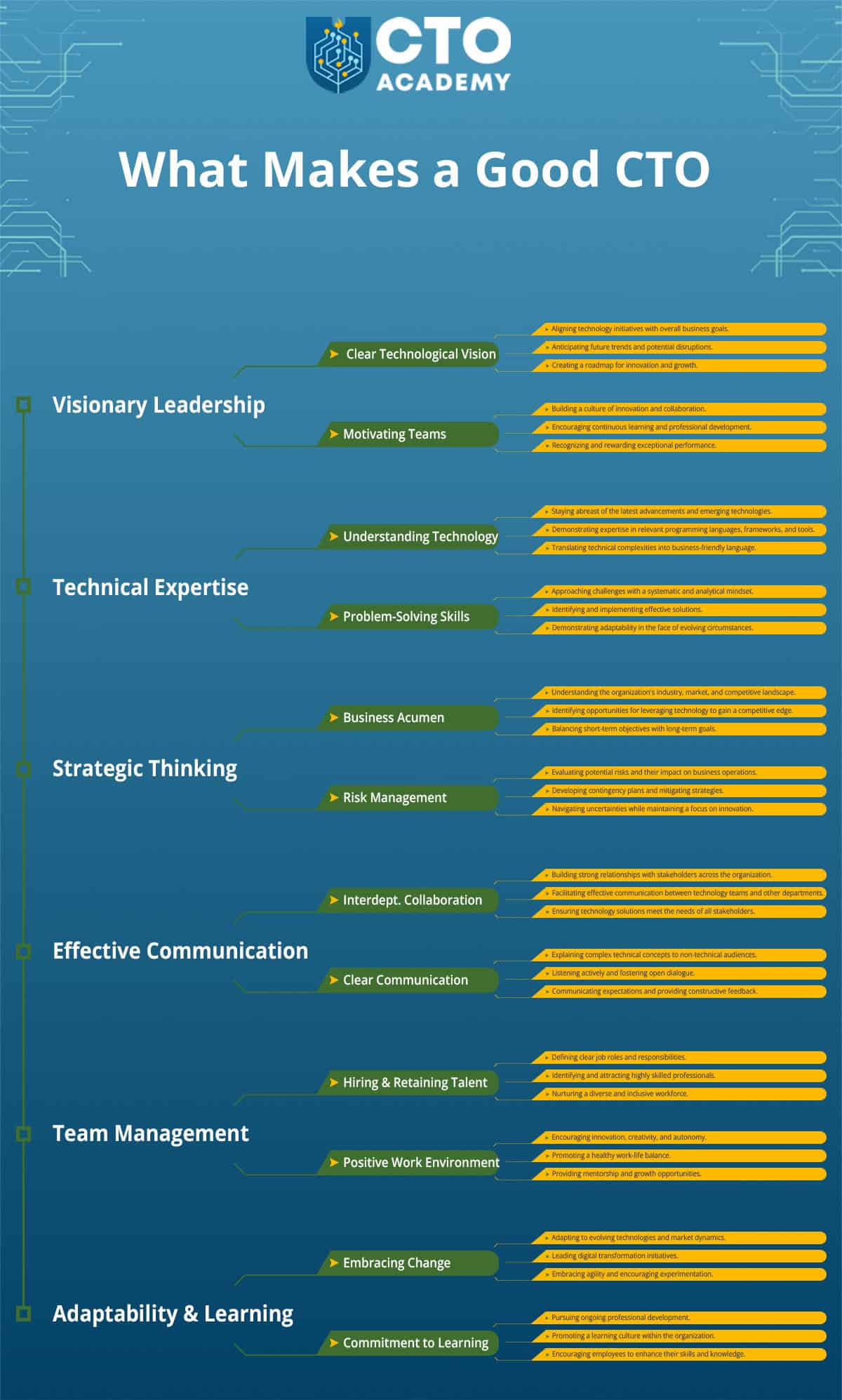
    For a more in-depth overview of essential CTO skills and qualifications refer to this article that explains what makes a good CTO – from the perspective of experienced and successful technology leaders and their CEOs.

    5.2 Navigating Challenges as a CTO

    5.2.1 Common challenges faced by technology leaders in start-ups and fast-growth companies

    • Limited resources and budgets.
    • Rapid scaling and infrastructure challenges.
    • Attracting and retaining top technology talent.
    • Managing technical debt and maintainability.
    • Balancing innovation and stability.
    • Market and technology uncertainty.
    • Ensuring cybersecurity and compliance.
    • Establishing efficient processes and best practices.
    • Communicating with non-technical stakeholders.
    • Integrating legacy systems with new technologies.
    • Managing vendor relationships and support.
    • Identifying and managing potential risks.

    5.2.2 Essential strategies for overcoming these challenges

    Limited resources and budgets:

    • Prioritise technology initiatives based on their impact on the business.
    • Leverage open-source solutions.
    • Consider cloud-based services to minimise upfront costs.

    Rapid scaling and infrastructure challenges:

    • Embrace scalable cloud infrastructure.
    • Adopt microservices architecture.
    • Continuously monitor and optimise performance to handle increased demands.

    Attracting and retaining top technology talent:

    • Cultivate an attractive company culture.
    • Offer competitive compensation packages.
    • Provide professional growth opportunities.
    • Promote a meaningful vision for the company’s future.

    Managing technical debt and maintainability:

    • Plan for regular maintenance and refactoring.
    • Allocate time for technical debt reduction.
    • Invest in tools and processes that promote code quality.

    Balancing innovation and stability:

    • Create separate teams or timeframes for innovation projects.
    • Maintain stable systems for critical operations.

    Market and technology uncertainty

    • Stay agile and adaptable.
    • Conduct market research.
    • Build a flexible technology architecture that can accommodate changes and evolving trends.

    Ensuring cybersecurity and compliance:

    • Invest in robust security measures.
    • Stay updated on compliance requirements.
    • Conduct regular security audits and assessments.

    Establishing efficient processes and best practices:

    • Implement agile methodologies.
    • Foster a culture of continuous improvement.
    • Conduct regular retrospectives to optimise processes.

    Communicating with non-technical stakeholders:

    • Use clear and concise language.
    • Provide meaningful examples.
    • Relate technology initiatives to business outcomes.

    Integrating legacy systems with new technologies:

    • Plan for gradual integration.
    • Utilise APIs and middleware.
    • Consider phased migration to minimise disruptions.

    Managing vendor relationships and support:

    • Establish clear expectations in vendor contracts.
    • Maintain open communication.
    • Regularly assess vendor performance.

    Identifying and managing potential risks:

    • Conduct risk assessments regularly
    • Develop contingency plans
    • Proactively address potential vulnerabilities to minimise the impact of risks.

    Back to Table of Contents

    Conclusion

    To build a highly efficient Chief Technology Office that drives innovation, supports growth and positions the company for sustained success in the dynamic landscape of start-ups and fast-growth companies, you must:

    • Strategically align technology initiatives with the company’s overall business strategy.
    • Attract and retain top tech talent.
    • Optimise resources.
    • Foster innovation and agility.
    • Prioritise cybersecurity and compliance.
    • Cultivate strong vendor relationships.
    • Communicate effectively with stakeholders.
    • Proactively manage risks.
    • Implement scalable infrastructure.
    • Focus on customer needs.
    • Continuously iterate and improve technology solutions.

    It is not an easy job because none of this takes the so-called unknown unknowns into account (eg, the recent pandemic or any other black swan event).

    To prepare you for any possible scenario, CTO Academy has created a robust Digital MBA for Technology Leaders that consists of no fewer than 220 micro lectures delivered by tech and business leaders that are spread over nine strategic modules focused on your growth as a technology leader.

    It has only one goal: to prepare you for what lies ahead and help you navigate the complexity of the Chief Technology Office.

  • Tech Leadership in So Many Words…#19 No

    Tech Leadership in So Many Words…#19 No

    My biggest flaw as an entrepreneur was a lack of judgment about when to say yes (a natural inclination) and when to say no (suffering from FOMO).

    The uncertainty of start-up life meant that I wanted to keep all options open as long as possible which of course, proved completely counter productive as it diluted the narrow focus I needed for any kind of success.

    The importance of judging how and when to say no is equally important in managerial and leadership roles because a key challenge we have as developing leaders is how to manage the people-pleaser element that doesn’t want to upset others or let them down, alongside that fear of missing out.

    NO might be the smallest word we use, but it’s often the most important one to master.

    As you grow into a strategic role within your organisation, the importance of time management, delegation and learning when to say no increases exponentially.

    So what stops us from saying NO?

    Often, it’s as simple as not knowing how to do it.

    What’s the best way to tell people you don’t have the time, or it’s not a good idea or frankly, you just don’t want to do it?

    One key consideration is not just saying no, but to explain why you’re saying no — what is the context behind your decision.

    It helps if you’re working in a psychologically safe environment where mutual trust allows the team to feel comfortable about stating their capacity and ring-fencing their priorities.

    Another key area is managing the iterative feedback loop with stakeholders where you’re under pressure to say yes but at the risk of trying to be all things to all people, an anxiety compounded by the power dynamic of a paying client?

    The key is taking time to digest what you’re being asked and avoid rushing into a yes.

    How do you say NO and mean it?

    I leave you with six bullet points:

    1. Learn how to say no politely. Be direct and stick to facts in your answer.

    2. If an opportunity or meeting presents itself, before saying yes, ask yourself how much time it will require and whether the potential outcome is worth it.

    3. Manage your energy. Understand the rhythms of your day; block out time when you’re most productive and protect it.

    4. Prioritise, Prioritise, Prioritise… damn those “to-do” lists, but they are essential.

    5. Protect your team. Say no on their behalf to ensure they’re not working over capacity.

    6. Provide a role model that empowers others in the team to learn the art of saying no.

    “When you say ‘yes’ to others, make sure you are not saying ‘no’ to yourself”

    Paolo Coelho
  • CTO Responsibilities in Start-Ups and Fast-Growth Businesses

    CTO Responsibilities in Start-Ups and Fast-Growth Businesses

    CTO responsibilities stem from their pivotal role in today’s rapidly evolving technological landscape. Chief Technology Officers, as the top executives, hold the reins of the organisation’s technical vision, strategy and execution.

    What is the primary responsibility of the CTO?

    The Chief Technology Officer leads the development and execution of the company’s technical strategy. Hence, the CTO is responsible for:

    1. Aligning the organisation’s technological vision with its business goals.
    2. Ensuring that the technology infrastructure, systems and processes support the company’s overall objectives.

    In this article, we will specifically focus on CTO responsibilities in start-ups and fast-growth companies. These two environments impact the responsibilities by altering the scale, complexity and scope of a CTO role. For instance, a start-up CTO focuses on building the technology foundation and driving innovation to get products market fit. In a fast-growth company, on the other hand, leaders must scale and optimise the technology infrastructure to support rapid expansion and ongoing success.

    Comparative overview of general responsibilities

    START-UPFAST-GROWTH COMPANY
    Technology Strategy
    Product Development
    Technical Leadership
    Technology Stack
    Team Building and Management
    Infrastructure and Security
    Innovation and Research
    Collaboration with Other Departments
    Budgeting and Resource Allocation
    Vendor and Partner Management
    Scaling Technology Infrastructure
    Managing a Larger Technical Team
    Process and Workflow Optimisation
    Compliance and Governance
    Risk Management
    Integration and Interoperability
    Vendor and Technology Selection
    Performance Monitoring and Optimisation
    Budgeting and Resource Allocation
    Communication with Stakeholders

    1. Key CTO Responsibilities in Start-Ups

    In start-ups, the CTO’s responsibilities are centred on leveraging technology to drive innovation, efficiency and growth while keeping a keen eye on the company’s long-term vision and objectives.

    Translated to real life, this means that a CTO in a start-up company has a more hands-on role since the team is still relatively small. At the same time, the expectations are unrealistic and budget-limited. So to get that product market fit as we mentioned earlier, a CTO is called into frequent firefighting.  

    These fires ignite unexpectedly in different hotspots and require a prompt and effective response. Here, we are going to list the most common challenges so you can get a better sense of the actual situation in start-ups. 

    Number one, scaling challenges. Often, rapid growth can strain the technology infrastructure, causing performance bottlenecks. To solve this, start-up CTOs opt for scalable architecture, leverage cloud services and implement caching and load balancing.

    Then, the inevitable resource constraints. Budget limitations can hinder technology investments, affecting development speed. To effectively fight this common fire, you should: 

    • Prioritise essential features
    • Consider open-source tools
    • Optimise resource usage for cost-effectiveness

    However, these measures often have limited impact because rapid scaling and accompanying constraints can easily cause technical debt accumulation

    You see, time constraints can lead to shortcuts. As we all know, shortcuts are notorious for their ability to accumulate technical debt. That’s why you need to: plan for regular refactoring, automate testing and allocate time for code quality maintenance.

    On top of this, the constant pressure to get the MVP out asap. has one additional serious consequence – product quality issues. It happens because quick iterations lead to bugs and unstable releases. You can fight this fire (to some extent) by implementing robust testing practices, adopting continuous integration and establishing a rigorous QA process. But if you are managing a small team, all these countermeasures will have a limited effect. It is almost an unsolvable problem and the main reason why start-up CTOs must have a literal hands-on approach. 

    Another problem with rapid development is security vulnerabilities. It is increasingly easy to overlook security measures and unwittingly expose the product to risks. That’s why it is imperative to integrate security practices from the start, conduct regular audits and prioritise user data protection.

    And then, all of a sudden, the market can shift, causing an immediate change of priorities. To pivot when necessary, you must stay flexible (ie, embrace Agile) and maintain open communication. 

    All this time, the CTO must stay on top of technical support and maintenance. Unfortunately, this can divert focus from product development. 

    There are three measures that you can implement to prevent this diversion. One is to establish efficient support channels. A second is to use monitoring tools to identify issues early on. Both, however, demand the allocation of dedicated resources for maintenance. Do you see the problem? If the team is small, who is going to be responsible? The logical solution is the third measure, outsourcing. But can your start-up afford $100/h professional support times five or even 10? 

    To, at least, minimise these outbreaks, the CTO must:

    • Timely define the technological vision.
    • Lead and manage an engineering team efficiently.
    • Organise the right technology stack and create an optimal architecture.
    • Foster innovation.
    • Oversee product development with hawk eyes.

    1.1 Defining the Technological Vision (the process)

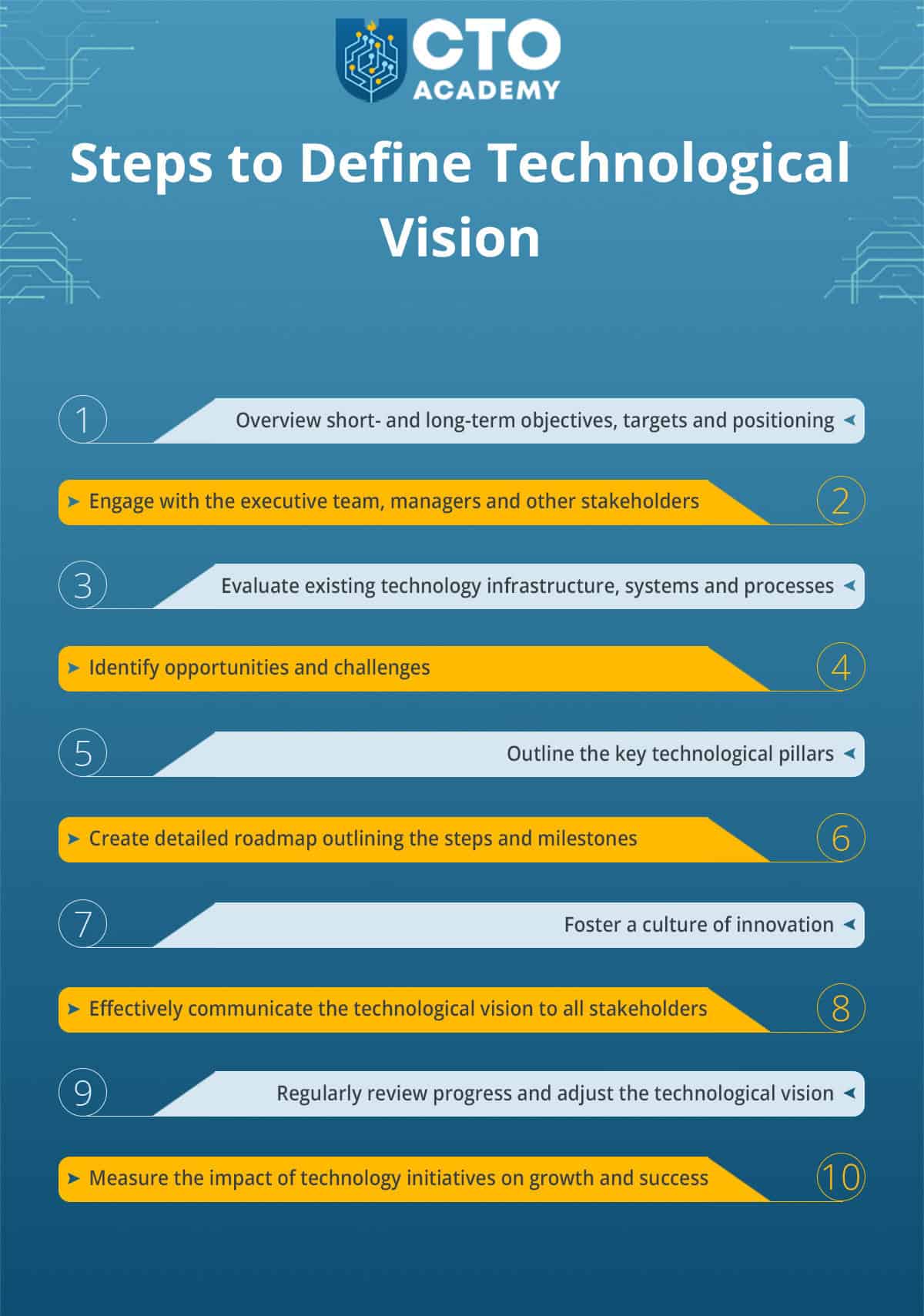
    10 steps to define technological vision - the list
    (click to enlarge/download)

    Commonly, it is a four-stage process that develops in 10 consecutive steps. The process ensures the perfect alignment of the vision and business objectives.

    Stage 1 – Intel gathering

    Step 1

    The CTO starts by overviewing the company’s short-term and long-term business objectives, growth targets and market positioning to align the technological vision with the overall strategy.

    Step 2

    To do so, the CTO engages with the executive team, product managers and other stakeholders to gather insights, understand pain points and identify technology gaps.

    Step 3

    The final step at this stage is to evaluate the existing technology infrastructure, systems and processes to identify strengths, weaknesses and areas for improvement. This assessment helps in setting the baseline for the technological vision.

    Stage 2 – Roadmapping

    Step 4

    From evaluation, a Chief Technology Officer moves to identify opportunities and challenges by analysing market trends, emerging technologies and industry disruptors.

    Step 5

    Based on the gathered insights, the CTO outlines the key technological pillars that will drive the company’s growth. These pillars could include scalability, security, user experience, data analytics or other business-relevant factors.

    Step 6

    Now comes a detailed roadmap outlining the steps and milestones required to achieve the technological vision. Here, it is necessary to prioritise initiatives based on impact and feasibility while considering resource constraints and timeframes. It is a start-up after all which means that time is short and money is still pretty much scarce.

    Stage 3 – Execution

    Step 7

    What a CTO needs to effectively execute the vision is to foster a culture of innovation within the engineering team and the broader organisation. The only way to do so effectively is to encourage experimentation and risk-taking while promoting continuous learning to stay ahead in this dynamic market.

    Step 8

    To be perfectly sure that the vision aligns with the goals, the CTO must effectively communicate the technological vision to all stakeholders. This is the reason why highly efficient CTOs always encourage feedback and input from team members. It allows them to refine the vision further.

    Stage 4 – Reviews and measurements

    Step 9

    As the software teams move to development, it is the start-up CTO responsibility to regularly review progress and adjust the technological vision as needed. They must consider market changes, customer feedback and internal developments while, at the same time, remaining agile and adaptable to seize new opportunities.

    Step 10

    Finally, as CTOs in start-ups, we must measure success. That means, a) defining key performance indicators (KPIs) that align with the technological vision, and b) tracking progress against these metrics. What we want to ultimately achieve is to measure the impact of technology initiatives on the company’s growth and success.

    This is how a start-up Chief Technology Officer can establish a clear technological vision that serves as a roadmap for the company’s future success. The alignment of technology with business goals ensures that every technical decision contributes to the overall mission and drives the company toward sustainable growth and innovation.

    But for any of that to happen, the CTO must place special emphasis on the team building initiatives.

    Back to Table of Contents

    1.2 Technical Leadership and Team Building

    In a start-up environment, providing technical leadership to the engineering team sets the direction for technology development, fosters a culture of innovation and ensures the efficient execution of projects.

    The expert CTO’s guidance empowers the team to:

    • Make informed decisions.
    • Maintain product quality.
    • Adapt swiftly to evolving challenges.
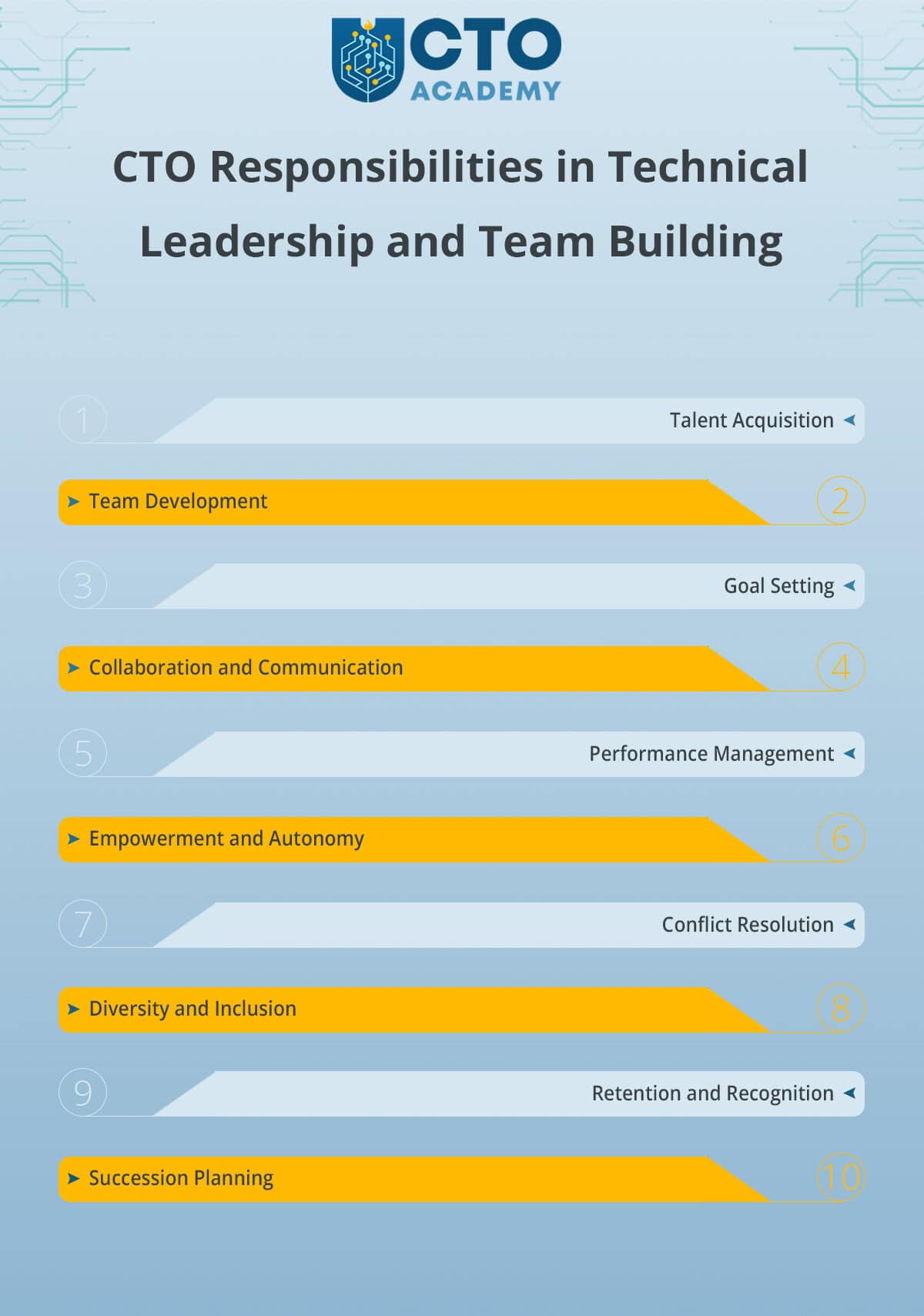
    CTO responsibilities in technical leadership and team building - the list
    (click to enlarge/download)

    The key phrase here is soft skills — encapsulating several critical responsibilities in building and managing a skilled and motivated technical team in a start-up company:

    1. Talent Acquisition – identifying skill gaps, conducting interviews and ensuring the right people are brought on board.

    2. Team Development – providing mentorship and guidance to nurture the team’s professional growth while encouraging continuous learning and skill development to foster a high-performing and adaptable team.

    3. Goal Setting – collaborating with team members to set clear goals and expectations while ensuring that each team member understands their role in achieving the company’s technological vision.

    4. Collaboration and Communication – promoting a collaborative work environment where ideas and knowledge are shared freely while ensuring that the team is aligned with business objectives and works cohesively through effective communication.

    5. Performance Management – establishing performance metrics and conducting regular evaluations (identification of strengths and areas for improvement) while providing constructive feedback.

    6. Empowerment and Autonomy – trusting the team members to take ownership of but also accountability for their projects and decisions (combined, it leads to improved motivation!).

    7. Conflict Resolution – addressing conflicts and challenges within the team promptly and constructively to facilitate a healthy work environment and, thus, maintain productivity and morale.

    8. Diversity and Inclusion – ensuring diversity and inclusion within the team to foster creativity, innovation and different perspectives (a diverse workforce contributes to a well-rounded and adaptable team).

    9. Retention and Recognition – implementing strategies to retain top talent by recognising achievements and contributions

    When team members feel valued and appreciated, it is easier to build an engaging workplace.

    10. Succession Planning – identifying potential leaders and developing a succession plan to ensure the team’s long-term stability and growth.

    These 10 responsibilities are a template for building cohesive, skilled and motivated technical teams that drive innovation and meet technical challenges regardless of the company’s size.

    Everything that is and everything that will be relies solely on the effectiveness of the engineering team. You can have the best technology stack and architecture, but without the team, it’s like having a chassis without the engine.

    1.3 Technology Stack and Architecture:

    Selecting the right technology stack and architecture forms the foundation upon which the entire technical infrastructure is built. The choices a CTO makes can greatly influence the start-up’s scalability, performance, development speed and cost-effectiveness.

    These selections can affect how well the product adjusts to evolving market needs and advancements in technology. A strategic choice, therefore, enables seamless integration of components and efficient maintenance, ensuring that the start-up is positioned for growth and innovation while minimising technical roadblocks.

    So before making technology decisions for a tech start-up, CTOs should consider the following factors:

    1. Scalability

    • Consider how well the chosen technology can handle increased user demand and data volume as the start-up grows.
    • Evaluate whether the technology stack and architecture can be easily scaled horizontally or vertically to accommodate future expansion.

    2. Development Speed

    • Assess how quickly the technology stack allows developers to build, iterate and deploy new features or products.
    • Choose technologies with robust libraries, frameworks and tools that accelerate development without sacrificing quality.

    3. Cost

    • Calculate the overall cost of implementing and maintaining the technology stack, including licensing fees, infrastructure costs and development efforts.
    • Strive to balance cost-effectiveness with the long-term benefits the chosen technologies offer.
    • Many cloud providers subsidise costs for the first year or two but once finished, costs can be significant.

    4. Compatibility and Integration

    • Ensure that the technology stack can seamlessly integrate with existing systems and third-party services.
    • Evaluate how well the chosen technologies can communicate and share data with other components of the ecosystem.

    5. Performance

    • Test the performance of the technology stack under different conditions, including peak load scenarios.
    • Choose technologies that deliver optimal speed and responsiveness to provide an excellent user experience.

    6. Flexibility and Adaptability

    • Consider how easily the chosen technologies can adapt to changing requirements, market trends and technological advancements.
    • Prioritise solutions that allow for flexibility and future-proofing the start-up’s technical infrastructure.

    7. Community and Support

    • Evaluate the size and activity of the technology’s developer community. A strong community often translates to better support, updates and resources.
    • Consider the availability of documentation, tutorials and online forums for troubleshooting and learning.

    8. Security

    • Examine the security features and best practices provided by the technology stack to protect user data and sensitive information.
    • Address potential vulnerabilities and ensure compliance with industry security standards.

    9. Talent Pool

    • Assess the availability of skilled developers and engineers experienced in the chosen technology stack and assist with the hiring process. Keep in mind that a technology stack with a larger talent pool can make recruitment and team-building much easier.

    10. Longevity

    • Consider the technology’s track record and how well it has been adopted in the industry.
    • Avoid adopting technologies that may become obsolete quickly or lack long-term community support.

    By carefully evaluating each aspect, the start-up CTO can choose a technology stack that aligns with the goals and supports the company’s growth trajectory and market position. The choices will also have a profound impact on the development process and innovation.

    Back to Table of Contents

    1.4 Product Development and Innovation

    The collaboration between the CTO, product managers and engineering team is crucial for driving innovation in a start-up’s products. It is an intricate process that relies on careful planning on one hand and experimentation on the other.

    It starts with ideation and conceptualisation. The product managers and CTOs collaborate to brainstorm ideas and concepts for new features or products. The CTO is here to bring technical insights to the discussions, helping to assess the feasibility and technical implications of different ideas.

    Product managers then gather input from customers, market trends and stakeholders to prioritise features and enhancements. The CTO provides technical input on the feasibility, complexity and potential impact of different prioritisation options.

    Once the priorities are set, the CTO and engineering team work together to create technical roadmaps that outline the implementation plan for new features or products. These roadmaps incorporate considerations such as architecture design, technology choices and development timelines.

    The development team now dives deep into Agile. Guided by the technical roadmap, they iterate on building and refining the product. Frequent collaboration between the CTO, product managers and developers during sprint planning, reviews and retrospectives ensures alignment and rapid progress.

    But it doesn’t come without problems.

    When challenges or technical hurdles arise during development, the CTO must closely collaborate with the engineering team on problem-solving to find creative solutions. They work together to ensure that technical limitations don’t compromise the product’s overall vision and user experience.

    To make these problem-solving sessions more effective, the CTO may initiate innovation workshops where cross-functional teams brainstorm and prototype innovative solutions. Engineers contribute their technical expertise, while product managers provide insights into user needs and market trends.

    At this point, we have our MVP. 

    Product managers now gather user feedback on existing features or prototypes, which is then shared with the CTO and development team. This feedback loop guides refinements and improvements, ensuring the final product aligns with user expectations.

    Once the product is launched, the CTO collaborates with product managers to monitor performance and user engagement metrics. Together, they analyse data to identify areas for optimisation and enhancement, driving iterative improvement.

    The success of these implementations (improvements) is fueled by the continuous learning practice. The CTO provides developers with opportunities to experiment with new technologies and techniques. It is this learning through trial and error that ultimately contributes to ongoing innovation and the ability to adapt to evolving market demands.

    As you can see, the CTO, product managers and engineering teams collectively contribute their expertise to create innovative, user-centric products that meet market demands and position the start-up for growth and success.

    How a start-up chief technology officer fosters such a culture

    The CTO sets the tone by demonstrating a commitment to learning, experimentation and embracing new technologies. In other words, they lead by example so that their actions can inspire the team to adopt a similar iterative mindset.

    At the same time, leaders must create a supportive environment that encourages open and transparent communication. Team members should feel comfortable sharing ideas, suggestions and even failures without fear of criticism. With established feedback loops where team members provide honest input on experiments and improvements, the environment creates a sense of collective refinement.

    Without such an environment, organising innovation workshops and hackathons is futile. The dysfunctional team cannot effectively brainstorm, prototype and experiment with new concepts.

    Encouraging a “fail fast, learn fast” mentality promotes quick experimentation and learning from failures rather than dwelling on them.

    Assuming that we managed to create such an environment, we need to allow engineers to dedicate a portion of their work time to exploring new technologies, tools or approaches. This, in turn, fosters a sense of ownership and curiosity. Combined with the metrics and data-driven decision-making, the process helps team members objectively assess the outcomes of their experiments and improvements.

    But curiosity without learning has its limits. That’s why providing resources for continuous learning, such as training, courses and conferences is critical. The CTO role here is to empower the team to stay up-to-date with industry trends and advancements.

    At the same time, the technology leader should foster collaboration across different teams and departments to encourage the exchange of ideas and perspectives. Subsequently, this leads to innovative and, more importantly, effective solutions.

    And such solutions must be recognised and celebrated. We are talking about both small and big wins that come as a result of experimentation. Such practice reinforces the value of continuous improvement and encourages others to join the effort.

    This culture of continuous improvement and experimentation ensures that the company remains agile, adaptable and innovative and, thus, at the forefront of technological advancements and market trends.

    2. Key CTO Responsibilities in Fast-Growth Businesses

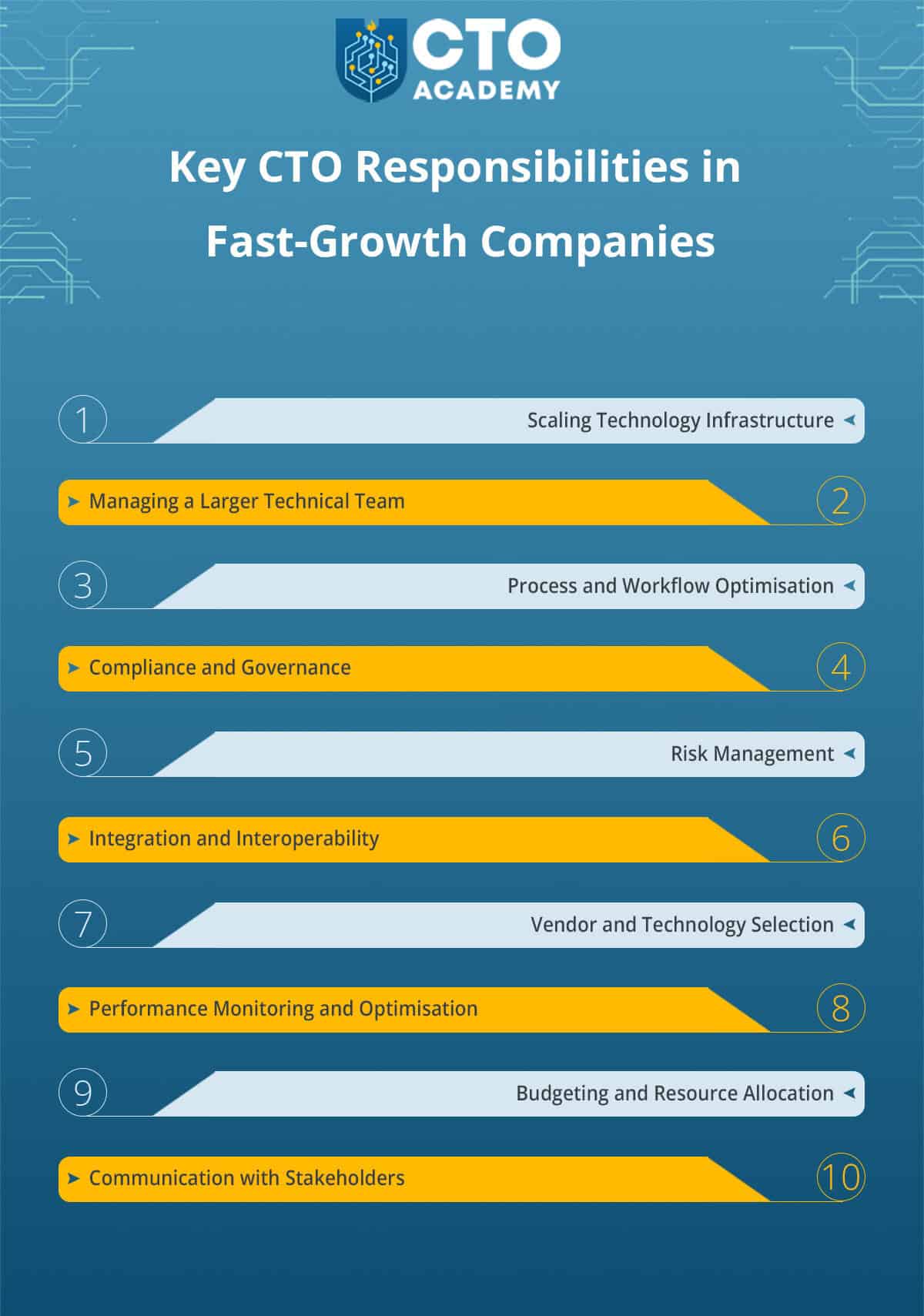
    List of key CTO responsibilities in fast-growth companies
    (click to enlarge/download)

    A fast-growing business is a different kind of beast. A good example is the trading platform Robinhood.

    Founded in 2013, Robinhood disrupted the traditional brokerage industry by offering commission-free trading through a mobile app. The platform’s simplicity and accessibility attracted a younger audience and democratised access to financial markets. But then it began to grow. Fast.

    By 2021, the crypto engineering team quadrupled and the plan was to double the size of the group in the next year to improve the trade flow systems. So Robinhood’s board appointed a new CTO to oversee this process.

    Before this appointment, the technology leadership was in the hands of the founders. But at some point, it became clear that they could no longer handle the growing responsibility.

    Because as the business is scaling, so does the technology infrastructure.

    2.1 Scaling Technology Infrastructure

    Scaling the infrastructure to accommodate rapid growth presents several formidable challenges.

    User demand surge, for instance, can cause performance bottlenecks, affecting application speed and responsiveness, and potentially leading to a poor user experience. Experienced CTOs solve performance bottlenecks by:

    • Identifying specific areas of code causing bottlenecks through performance profiling tools.
    • Refining database queries to minimise unnecessary or slow operations.
    • Implementing caching mechanisms to store frequently accessed data and reduce database load.
    • Scaling by adding more servers to distribute the workload and improve response times (horizontal scaling).

    When a company scales, it is commonly transitioning from a “slap it together” architecture to a distributed, scalable one. This process requires careful planning to ensure seamless communication and data synchronisation. Some of the proven ways to address scalability architecture are:

    • Breaking down applications into smaller, independent microservices for easier scaling and maintenance (not the most favourable option for some CTOs though).
    • Using container technologies like Docker for consistent deployment across various environments.
    • Implementing load balancers to distribute traffic evenly among multiple servers or instances.
    • Leveraging cloud services to automatically adjust resources based on traffic patterns to handle varying loads.

    As our environment grows, so do datasets. It’s the CTO’s job to ensure efficient data storage, retrieval and management strategies to maintain performance and prevent data loss. The three most common ways to tackle this problem are:

    1. Partitioning or dividing large datasets into smaller partitions for faster retrieval and improved performance.
    2. Archiving; ie, moving older or less frequently accessed data to archival storage to optimise the database’s performance.
    3. Compression, to reduce storage space and improve data retrieval speed.

    Rapid growth also dictates demand fluctuation. So allocating resources effectively across various components becomes a daily struggle. This is where operational management skills come into play because it is a Chief Technology Officer’s responsibility to solve this problem either by implementing monitoring tools and using automation or, at the very least, historical data and predictive analysis to forecast the needs and allocate accordingly.

    All of this can lead to shortcuts or inefficient solutions that accumulate technical debt. It is in every technology leader’s job description to prevent this from happening or at least keep it on acceptable levels. To do so, seasoned CTOs employ an array of methods such as:

    • Enforcing regular code reviews to identify and address inefficient or non-scalable code.
    • Allocating time for planned refactoring to improve code quality and eliminate accumulated debt.
    • Documenting code, architecture and decisions to make future enhancements and maintenance easier.
    • Implementing automated testing to catch issues early, thus reducing the risk of introducing more debt.
    • Prioritising small, incremental improvements to avoid overwhelming the development team.
    • Evaluating the impact of addressing debt versus business priorities to make informed decisions.

    Other notable challenges

    Availability and Reliability

    Solutions:

    • Implementing redundancy across servers, databases and critical components to ensure failover capabilities.
    • Designing applications as distributed systems to mitigate single points of failure.
    • Setting up robust monitoring systems with alerts to detect and respond to downtime or performance issues.
    • Developing comprehensive disaster recovery plans to restore systems quickly in case of failures.

    Security Concerns

    You can address them with:

    • Regular audits to identify vulnerabilities and weaknesses in the system.
    • Security protocols (encryption, access controls, etc) to protect sensitive data.
    • Employee training to educate the team about security best practices and potential threats.

    Cost Management

    Actions:

    • Continuously monitoring and optimising cloud resources to eliminate unnecessary expenses.
    • Adjusting resource allocations to match actual usage patterns, hence avoiding over-provisioning.
    • Implementing tools to track and analyse costs, thus ensuring transparency and informed decision-making.
    • Negotiating with technology vendors for better pricing and more favourable contract terms.

    Complexity

    Proven actions to address the inevitable growing complexity of operations are:

    • Designing systems with clear module boundaries to improve maintainability.
    • Creating comprehensive documentation to help teams understand system components and interactions.
    • Enforcing coding standards and best practices to ensure consistency and ease of understanding.

    Cultural Shift

    There is a direct correlation between the cultural shift and the ability of a start-up company to transform into a fast-growing business. Without one, we cannot have the other. And it is in the CTO job description to ensure this transition so your company doesn’t get stuck in a twilight zone.

    This is what you can do as part of an overall effort to implement such a shift:

    • Articulate a clear vision of the company’s growth trajectory and the role of technology in achieving it.
    • Ensure alignment among C-suite executives and leadership on the need for cultural evolution.
    • Develop a comprehensive communication plan to convey the reasons, benefits and roadmap of the shift.
    • Start engagement initiatives by organising workshops and cross-functional meetings to engage employees and gather input.
    • Implement training programs to equip teams with the skills needed for the fast-growth phase.
    • Empower teams to take ownership, experiment and contribute to the evolving culture.
    • Establish mechanisms for ongoing feedback and adaptation to refine the cultural shift.

    Integration Challenges

    Practical solutions:

    • Prioritising the use of standardised APIs to facilitate smooth communication between different systems.
    • Designing integrations with scalability in mind, thus ensuring they can handle increased data flow and system interactions (eg, implementing Infrastructure as Code to automate the provisioning and management of resources).
    • Implementing data mapping and transformation processes to ensure data consistency and accuracy between systems.
    • Communicating changes resulting from integrations and providing training and support to help teams adapt to new workflows.

    As you can see, overcoming these challenges demands strategic thinking, robust planning, impeccable project management, ongoing monitoring, adaptability and some formidable technical skills. It is the only way to ensure a smooth scaling process and position the start-up for continued success.

    Therefore, to accommodate increased user demand and data volumes, implement scalable architecture, optimise database performance and leverage cloud resources. Also, conduct regular monitoring, load testing and capacity planning.

    All these measures will, ultimately, prevent any bottlenecks or issues that could arise as the user base and data grow.

    Back to Table of Contents

    2.2 Process Optimisation and Workflow Management

    To ensure efficient collaboration, swift product iterations and timely releases, the CTO must optimise development processes. This is done by streamlining tasks, automating repetitive processes and maintaining code quality. The purpose of this is to ensure that the team can adapt to increased demands while delivering high-quality products, sustaining the start-up’s momentum and competitive edge.

    There is an array of methodologies that assist with these processes, but the two most notable are Agile and DevOps.

    Agile promotes iterative development and collaboration. DevOps, on the other hand, bridges development and operations, enabling seamless and rapid deployment. It does so by promoting continuous integration and continuous delivery (CI/CD) pipelines, automating testing, deployment and monitoring. This accelerates releases, reduces errors and enhances overall software quality.

    Error management is particularly important when we are attempting to integrate security throughout the development cycle (ie, secure coding practices, regular vulnerability assessments and automated security checks) to proactively identify and address all security concerns.

    The success of that integration largely depends on the CTO’s ability to standardise version control by using, for example, Git to ensure proper code management, collaboration and version tracking. What we want to ultimately achieve is to minimise conflicts, simplify code reviews and support a smooth development workflow.

    Some CTOs utilise a microservices architecture to enable teams to work on isolated components independently. It enables faster development, testing and deployment since they work with smaller units.

    By implementing these methodologies and practices, the CTO ensures a streamlined, efficient and collaborative development and deployment process. This, ultimately, enables the now fast-growing company to respond rapidly to market changes, deliver high-quality products and maintain a competitive edge in the fast-growth environment.

    2.3 Risk Management and Security

    If not managed effectively, rapid expansion creates an environment prone to cybersecurity threats. As the attack surface expands with new systems and users, there’s less time for comprehensive security measures. This vulnerability makes fast-growing companies attractive targets.

    CTO roles and responsibilities in this segment of operations consist of implementing and executing robust security measures such as:

    • Risk Assessment
    • Incident Response Planning
    • Disaster Recovery Planning
    • Monitoring and Detection
    • Security Frameworks Implementation
    • Security Policies Development
    • Infrastructure Security Measures Implementation
    • Penetration Testing
    • Vendor Security
    • Regular Audits
    • Stakeholder Communication
    • Employee Training

    The CTO’s strategic leadership is vital in establishing a strong security posture and disaster recovery capability that safeguards the business, its assets and its reputation in the face of evolving cyber threats.

    2.4 Communication and Alignment with Stakeholders

    Effective communication with C-level executives, investors and board members ensures alignment on technology strategies, investment decisions and risk management. Transparent communication fosters trust, enables informed decision-making and empowers stakeholders to support growth and innovation.

    As you can clearly see, the problem but also the goal here is to ensure the alignment between the technology strategy and the overall business strategy.

    To achieve this goal, the CTO must therefore:

    • Understand business goals (ie, the company’s short-term and long-term business objectives, market positioning and growth targets).
    • Collaborate and regularly communicate with other C-level executives.
    • Rely on data and metrics to demonstrate how technology efforts contribute to revenue growth, customer satisfaction and operational efficiency.
    • Create mechanisms for continuous feedback and adjustment.
    • Translate technical concepts (ie, present technology strategies in a way that resonates with non-technical stakeholders).
    • Anticipate potential challenges or opportunities and align technology plans accordingly.
    • Ensure that technology projects are prioritised based on their alignment with business goals and the potential value they deliver.

    By meticulously integrating technology strategies with broader business objectives, the CTO ensures that the company’s technological investments and innovations directly support its overall growth and competitive success.

    Conclusion

    For the longest time, it wasn’t entirely clear what the responsibilities of a Chief Technology Officer were in start-ups and fast-growth companies. Today, however, we know that effective CTO leadership ignites technological innovation, subsequently propelling companies to unprecedented growth.

    By aligning technology with business goals, fostering agility and driving strategic advancements, the CTO’s influence shapes a resilient and visionary trajectory.

    The path, however, is anything but easy and it is the main reason why even existing CTOs frequently enrol in digital MBA programs for technology leaders.

    As is obvious by now, it is a major struggle to move from start-up to fast growth. There is no switch that will enable you to step away from the coalface mentality and immediately start providing definitive leadership. Because when your company transforms into a fast-growing business, they are expecting you to bring in the structure via processes and people and to effectively deal with tech debt. They also need you to implement proper strategies and roadmaps. And unlike before when the CEO was responsible for managing investors, now you, as the CTO of the fast-growth company, must get used to a more formal reporting to those investors. 

    Overnight, you must forget about Slack, getting your hands dirty or deliberating between a dozen cheap or open-source solutions to get around budget constraints. You are now behind the wheels of a serious vehicle with many more eyes assessing your every move.

    It is no wonder that some CTOs struggle to make this transition and this is where programmes such as the digital MBA can help.

    Being actively tutored by seasoned professionals is, arguably, the only way to amplify your tech prowess for imminent leadership challenges. Because, by uniting strategic business acumen with technological excellence, these programs sculpt leaders who mastermind innovation, navigate complexities and drive growth. In other words, they transform them from ambitious technologists into high-impact technology leaders who are not only aware of their responsibilities but are also entirely capable of executing them. 

    In short, a Digital MBA for Technology Leaders is teaching you the ‘how’ of every single action, practice, strategy or methodology. For example, how to best ‘evaluate whether the technology stack and architecture can be easily scaled horizontally or vertically to accommodate future expansion’ so you can select the right technology stack and architecture.

    The significance of your role and responsibilities as the CTO in a start-up or fast-growth organisation cannot be overstated, particularly in tech companies that heavily depend on the effectiveness of technology leadership. It is your job as the CTO to put the company on a growth trajectory and keep it there. But no pressure…

    Summary of the key responsibilities of a CTO in start-up and fast-growth business environments:

    In a start-up:

    • Visionary Leadership
    • Hands-on Coding
    • Team Building
    • Product Innovation
    • Resource Management
    • Rapid Prototyping
    • Risk Management
    • Technical Direction

    In a fast-growth business:

    • Strategic Planning
    • Scalable Infrastructure
    • Process Optimisation
    • Security Measures
    • Stakeholder Communication
    • Risk Mitigation
    • Innovation Scaling
    • Collaboration
  • Interim CTO: Responsibilities, Onboarding and Power Transfer Process

    Interim CTO: Responsibilities, Onboarding and Power Transfer Process

    An Interim CTO is a temporary executive responsible for overseeing and guiding the company’s technology strategy and operations during a transitional period. Companies hire interim CTOs on a short-term basis, either due to a sudden departure of the previous CTO, a planned leadership change or while searching for a full-time CTO.

    (Don’t mistake an Interim Chief Technology Officer for a Fractional CTO. A Fractional CTO works for a fraction of the time and cost and just on the part of the project. In other words, they work side by side with the in-house CTO to assist on certain projects or their fractions.)

    The Primary Responsibilities of an Interim CTO

    The list of primary responsibilities of an Interim CTO (infographic summary)
    (click to enlarge/download)
    1. Providing strategic direction and vision for the company’s technology initiatives while ensuring alignment with business goals during the transition period.

      (This, however, may not be possible as they could be in for:
      a) Keeping business as normal so no changes
      b) Firefighting – no strategic direction required
      c) Leave until a permanent CTO comes in)

    2. Offering expertise in various technology domains and advising the company on the best use of technology to achieve its objectives.
    3. Overseeing the technology team, ensuring their productivity and providing guidance and support to maintain smooth operations.
    4. Monitoring ongoing technology projects and ensuring they stay on track, on time and within budget.
    5. Assessing the company’s existing technology infrastructure, systems and processes to identify areas for improvement.
    6. Assisting in the hiring process when necessary for permanent technology leadership positions.
    7. Interacting with other executives, stakeholders and board members to provide updates on the technology department’s progress and challenges.
    8. Identifying potential technology-related risks and implementing measures to mitigate them.

    Interim CTOs must, therefore, possess extensive experience in technology leadership roles and have all the necessary skills to step into the position quickly and effectively. Their role is vital in maintaining continuity and ensuring the organisation’s technology operations run smoothly while the company searches for a suitable permanent chief technology officer.

    How Onboarding Process Works

    List of Interim CTO onboarding process steps
    (click to enlarge/download)

    Step #1: Pre-onboarding preparation

    Before the Interim CTO starts their role, HR and the hiring manager coordinate to ensure all necessary paperwork, contracts and confidentiality agreements are in place.

    IT and facilities teams set up the Interim CTO’s workspace, providing them with the necessary tools, equipment and access to company systems.

    Step #2: Introducing an Interim CTO to key stakeholders

    The Interim CTO should be introduced to key stakeholders, including the CEO, executive team, department heads and other relevant personnel. This, subsequently, helps establish rapport, clarify expectations and provide an overview of the organisation’s structure and culture.

    Step #3: Technology infrastructure and documentation access

    The company enables access to documentation and information related to the technology infrastructure, systems and, more importantly, ongoing projects.

    Reviewing this documentation provides insights into the existing technology setup, thus making it possible for a new technology leader to identify potential areas for improvement.

    Step #4: Team introductions

    The only way to understand the roles, strengths and concerns of the team is to meet them individually. This, in turn, builds a positive working relationship which is essential for collaboration and effective leadership. 

    Step #5: Understanding current projects and initiatives

    The company briefs the new CTO on all ongoing technology projects and initiatives. These briefs must include objectives, progress and challenges. This will allow a newly appointed interim executive to align the efforts with immediate goals.

    Step #6: Assessment of technology processes

    The ICTO must assess existing technology processes and workflows to identify any bottlenecks or inefficiencies. This is a prerequisite for the formulation of strategies for streamlining operations.

    Step #7: Identifying key issues and risks

    Companies often seek a remote interim CTO when they require a technology expert to swiftly stabilise their technological environment. 

    To achieve that goal, the temporary chief technology officer will work closely with the team to identify critical technology issues, security risks or compliance concerns requiring immediate attention.

    Step #8: Goal setting and strategy formulation

    The goals and strategy formulation are based on the organisation’s objectives and challenges. This, of course, requires close collaboration with the executive team because the strategy must align with the company’s overall business objectives.

    Step #9: Development of the communication plan

    The aim here is to develop a practical communication plan to ensure regular updates with the CEO, the rest of the executive team and other stakeholders. This can be done by the newly appointed temporary CTO alone or as a collaboration between all stakeholders.

    Step #10: Performance metrics and reporting

    Fast-growth companies may lack the necessary experience in tracking performance or setting up the metrics for this particular position.

    Always keep in mind that, in some instances, the fast-growing company was a startup only a few months ago.

    Hence, it’s a CTO’s job to work with an organisation to define performance metrics and reporting requirements; otherwise, it would be virtually impossible for the organisation to track progress and, most importantly, measure the impact of technology initiatives.

    Step #11: Regular review meetings

    To effectively define and tackle challenges, it is essential to regularly convene with the team and engage in discussions regarding their progress.

    Step #12: Knowledge transfer plan (if applicable)

    If there is a plan to hire a permanent CTO, a knowledge transfer plan must be implemented to facilitate a smooth transition.

    To sum up, the onboarding process should be structured, comprehensive and, more importantly, focused on aligning the individual with the organisation’s goals while addressing immediate technology challenges.

    No company is perfect and people and process issues will arise from this onboarding. The interim CTO will have to decide, if and when, to resolve these issues and, at least, highlight them to the CEO.

    The Duration of an Interim CTO Position in Fast-Growth Companies

    The duration can vary depending on:

    • Specific needs of the company
    • The scope of the technology projects
    • The availability of suitable candidates for a permanent CTO role.

    On average, an Interim CTO position can last anywhere from 6 to 12 months in such companies. But this is relative and depends on a series of factors such as:

    • Recruitment Process. The duration of the search for a permanent CTO can affect the length of the Interim CTO’s role. If it takes longer to find the right candidate, the Interim CTO may need to stay in the position for an extended period.
    • Onboarding and Transition. The time required to onboard a new permanent CTO and facilitate a smooth transition of responsibilities can impact the interim tenure. In other words, if the onboarding process takes longer, the Interim CTO may need to stay in the role until the new CTO is fully integrated.
    • Performance and Results. When interim CTOs demonstrate exceptional performance and deliver significant results during their tenure, companies may consider extending their contract or offering them the permanent CTO position.
    • Business Conditions. The overall business environment and the company’s growth trajectory play a significant role. For example, if the company continues to experience rapid growth and expansion, the Interim CTO’s role may be extended to address new technology challenges.

    As you can see, the actual duration of the interim contract depends on the unique circumstances and requirements of an organisation. Additionally, it may easily evolve into a permanent position.

    But if that doesn’t happen, there’s one further instance you must prepare for.

    The Process of Power Transfer to the New Permanent CTO

    Knowledge Transfer and Documentation

    It is in your best interest to jump-start the new CTO, so to speak, because word travels fast and covers long distances—both good and bad.

    Therefore:

    • Document all critical information related to the company’s technology infrastructure, ongoing projects, systems and processes. This documentation will serve as a reference guide for the incoming CTO.
    • Arrange the so-called knowledge transfer meetings to share insights, challenges and best practices with the new CTO.

    Status and Project Updates

    • Provide comprehensive status updates on all ongoing technology projects, highlighting their progress, challenges and timelines. These updates will help the new CTO quickly get up to speed with the technology landscape and any potential issues that need attention.

    Team Introductions and Transition

    • Introduce the new CTO to the technology team members to facilitate a smooth transition of leadership.
    • During this introduction, discuss individual roles, responsibilities and team dynamics to help the new CTO integrate seamlessly.

    Stakeholder Engagement

    • Introduce the new CTO to key stakeholders (eg, other executives, department heads and board members).

    Understanding the expectations and priorities of various stakeholders will help the new CTO align technology strategies with overall business goals – just as it helped you.

    Establishing Relationships and Communication Channels

    • Facilitate initial meetings between the new CTO and other department heads to establish open lines of communication.
    • Regular communication channels should be set up to ensure ongoing collaboration and feedback between the new CTO and other departments.

    Handover of Responsibilities

    • The ICTO formally hands over specific responsibilities, such as project ownership, vendor relationships and budgetary control to the new CTO. It is a detailed process that ensures nothing falls through the cracks during the transition.

    Support and Availability

    • The ICTO should remain available for a defined period after the new CTO assumes the position. This is a common practice because the new CTO often requires some additional guidance and support.

    This type of support has proved itself instrumental in addressing unexpected challenges and fostering a successful transition.

    Assessment and Feedback

    • Both the Interim and the new CTO conduct periodic assessments of the transition process to identify areas of improvement.
    • Gathering feedback from team members and stakeholders also provides valuable insights for refining the transition approach.

    Key Points

    1. Temporary Leadership Role – a short-term contract, typically during leadership transitions, planned absences or while searching for a permanent CTO.
    2. Experienced Professionals – interim CTOs are commonly seasoned technology leaders with extensive expertise in various domains.
    3. Strategic Direction – providing strategic direction for technology initiatives and aligning them with the organisation’s business objectives.
    4. Project Oversight – overseeing ongoing technology projects, ensuring they stay on track and deliver results.
    5. Team Management – fostering collaboration and ensuring productivity.
    6. Knowledge Transfer – documenting critical information and facilitating knowledge transfer to the incoming permanent CTO, when applicable.
    7. Communication and Stakeholder Engagement – effective communication and collaboration with key stakeholders, including other executives and department heads.
    8. Risk Management – identifying potential technology-related risks and working to mitigate them to ensure smooth operations.
    9. Tenure Duration – can vary, but on average, it is often between 6 to 12 months in fast-growth companies.

    The next step…

  • Practical Solutions to Common Challenges of a Remote CTO Position

    Practical Solutions to Common Challenges of a Remote CTO Position

    Since the Remote CTO works from a different location than the company’s headquarters, a set of challenges arises for the Chief Technology Officer and the employer. In this article, we are: a) examining the most critical challenges and, more importantly, b) providing practical solutions.

    So if you are new to the role and still struggling to facilitate seamless relationships, processes and operations, this is the guide for you.

    If you want to learn about different CTO jobs, read “What is a Fractional CTO and How Do You Become One.

    Problems That Stem From Differences Between a Remote CTO and an In-House Position

    Primary problems of a Remote CTO position summary
    (click to enlarge/download)

    The differences between the two arise from the:

    • Physical presence
    • Communication methods
    • Availability
    • Depth of involvement in day-to-day operations
    • Company culture

    #1 – Physical Presence

    As remote CTOs operate outside the company’s physical location, they are at a disadvantage compared to the in-house tech leader. Physical absence can allow problems to escalate as they may not be picked up quickly.

    #2 – Communication and Collaboration

    In contrast to a traditional form of employment, remote work relies exclusively on digital communication tools. As we all know, they can cause frequent issues as a major part of communication is body language which we pick up subconsciously.

    The problem is that when you are not able to see the whole body and general attitude around the office, you can miss clues that something is not right.

    #3 – Availability and Flexibility

    An in-house chief technology officer is immediately accessible for urgent matters, team meetings or on-site support. Remote CTOs, on the other hand, may have limited availability for synchronous collaboration.

    #4 – Company Culture and Integration

    An in-house chief technical officer can immerse more effectively in the company culture, build relationships with employees and gain a deeper understanding of the dynamics.

    Since the remote CTO doesn’t have such a good overview of the work environment, internal processes and team interactions, it is harder for them to understand and integrate into the company culture.

    On the bright side, many companies have moved to a hybrid culture, so there is now more acceptance that culture and integration can take longer than previously.

    #5 – Level of Operational Involvement

    A traditional CTO often has a more hands-on approach (ie, actively participating in the execution of the company’s technology roadmap and day-to-day operations).

    Due to their physical absence, a remote chief technology officer commonly has a more strategic focus. They provide guidance, advise on technology decisions and oversee projects. But to do any of that, they must rely on the internal team or external partners for operational execution.

    Top Challenges for a Remote CTO (and Their Respective Solutions)

    Integration into Company Processes

    Whether you are a software engineer, technical project manager, engineering manager or product manager, there is a good chance that you’ll face some universal challenges. And these challenges can seriously undermine the integration process.

    For instance…

    Social Overload

    Are you feeling overwhelmed by constant social interaction and engagement? Is this sensation emphasised in a remote setting?

    What can you do to prevent the overload?

    1. Set boundaries – set clear boundaries around social interactions and allocate specific time slots for social engagement. Make sure that a) everyone’s aware of them, and b) respects them.
    2. Schedule breaks – use them for quiet, solitary activities that help you relax and regain energy.
    3. Plan social interactions – schedule specific times for meetings, team discussions or informal chats, instead of being constantly available.
    4. Limit the pressure of immediate interaction – leverage communication tools to strike a balance between engagement and solitude.

    Remote Relationship Building

    Are you experiencing difficulties initiating conversations or forming connections? Does a remote environment heighten this problem?

    Here are a few tips to meet this challenge:

    1. Initiate and prioritise one-on-one conversations with team members and key stakeholders.
    2. Practise active listening during virtual meetings and conversations:
      • a) Give your full attention to the speaker.
      • b) Ask thoughtful questions.
      • c) Show genuine interest in ideas and experiences.
    3. Open up and share personal insights or experiences with your colleagues when appropriate.
    4. Participate in team-building activities.
    5. Use non-work communication channels to connect with colleagues on a more personal level.
    6. When possible, opt for video calls instead of solely relying on audio calls (visual cues and facial expressions help build rapport and enhance communication).
    7. Engage in small talk and use icebreakers at the beginning of meetings or virtual gatherings to create a relaxed atmosphere.
    8. Offer support and assistance to colleagues when they need help or face challenges.

    Speaking up in Meetings

    Are you feeling anxious about voicing your ideas, thoughts or concerns in virtual meetings to, let’s face it, strangers?

    To reduce the anxiety and become more self-confident, try these methods:

    1. Prepare in advance (ie., review the agenda, gather your thoughts and consider/anticipate potential discussion points).
    2. Share thoughts in writing (to articulate your points more effectively).
    3. Practise active listening (focus on understanding others’ perspectives and ideas, and ask clarifying questions).
    4. Use messaging features (share your input or questions through the chat function).
    5. Do follow-ups (if you find it challenging to express your thoughts during a meeting).
    6. Practise pacing and timing (ie, observe the flow of conversations and find opportunities to time and pace your contributions effectively instead of speaking up immediately in every meeting).
    7. Request agenda items in advance.
    8. Gradually increase participation.
    9. Make sure outcome actions are clearly stated at the end of the meeting.

    Being Overlooked or Undervalued

    This fear can stem from concerns about not having the same level of visibility and opportunities for recognition in a remote setting where physical presence is reduced.

    Here are some actions that help:

    1. Proactively share accomplishments (ie, highlight the impact of your work and the value you bring to the organisation through regular updates).
    2. Seek feedback from time to time (from colleagues, superiors and team members).
    3. Cultivate relationships with key decision-makers.
    4. Don’t shy away from advocating for yourself and your ideas.
    5. Look for opportunities to position yourself as a thought leader in your field.
    6. Build strong relationships with colleagues and team members through collaboration and support (to create a network of allies).
    7. Share your insights, expertise and knowledge with the broader team and organisation.

    Communication and Collaboration Challenges

    Challenges:

    • Must rely on digital tools.
    • Different time zones.
    • Language barriers.
    • Technical issues with communication platforms.

    How Do Remote CTOs Address These Challenges?

    #1 – Digital tools (communication)

    • Identification and implementation of reliable communication and collaboration tools (requires experience and deep knowledge of appropriate SaaS).
    • Having clear guidelines and instructions on using these tools (check to see if everyone is comfortable and proficient in their usage).
    • Creating and nurturing a culture of open and transparent communication (ie, encouraging team members to actively participate and share their thoughts).
    • Maintaining regular (virtual) team meetings.
    • Encouraging asynchronous communication (eg, project management tools, shared document repositories, task-tracking systems etc).

    #2 – Different time zones (distributed team collaboration)

    • Establishing shared working hours and/or overlap periods.
    • Communicating availability and response times to team members.
    • Leveraging time zone conversion tools and scheduling applications to streamline meeting coordination.
    • Documenting important discussions and decisions for team members who may not be available during synchronous communication.

    #3 – Language barriers

    • Encouraging open and inclusive communication.
    • Recognising (and respecting) language differences.
    • Utilising translation tools or services.
    • Providing multilingual resources (eg, documentation, guides etc.).
    • Active listening and asking for clarification (if any language-related misunderstandings arise).

    #4 – Technical issues with communication platforms

    • Troubleshooting and addressing technical issues.
    • Establishing alternative communication channels and backup tools (in case of platform failures).
    • Maintaining a list of technical support contacts or resources (for quick access and response).
    • Conducting periodic tests and rehearsals.

    Building Relationships and Company Culture

    Challenges:

    • Limited face-to-face interaction.
    • Building trust and rapport.
    • Maintaining a cohesive company culture.
    • Communication and collaboration barriers.
    • Fostering employee engagement and motivation.

    Address These Challenges with These Measures/Actions

    #1 – Limited face-to-face interaction

    • Schedule regular team catch-ups and one-on-one video calls to simulate face-to-face interaction and build personal connections.
    • Foster virtual socialisation for team members to socialise and get to know each other on a personal level (eg, virtual coffee breaks, team-building activities etc).
    • Plan occasional in-person meet-ups when feasible and safe.
    • Utilise visual communication tools and non-verbal cues.
    • Encourage open communication channels for team members to freely engage in informal conversations.

    #2 – Building trust and rapport

    • Set clear expectations to ensure that everyone’s on the same page (ie, clearly communicate expectations, goals and responsibilities).
    • Attentively engage with team members to understand their concerns and provide useful and thoughtful responses.
    • Be reliable and responsive (ie, consistently follow through on commitments, respond promptly to inquiries and requests and demonstrate reliability).
    • Encourage transparency.
    • Recognise and appreciate contributions.

    #3 – Maintaining a cohesive company culture

    • Clearly articulate the company’s core values and ensure they are communicated regularly to remote team members (to establish a shared company culture).
    • Encourage virtual team-building activities such as virtual exercises, games or challenges (to promote collaboration, foster a sense of belonging and reinforce the company culture).
    • Share success stories (to strengthen the sense of unified company culture).
    • Establish virtual rituals such as virtual team lunches or monthly all-hands meetings (to bring the team together and reinforce the company culture).
    • Provide opportunities for cross-team collaboration (to facilitate cross-pollination of ideas and strengthen connections across the organisation).

    # 4 – Communication and collaboration barriers

    • Establish clear communication guidelines (ie, define communication norms, preferred channels and response expectations).
    • Foster an inclusive environment (ie, ensure everyone has an equal opportunity to contribute).
    • Leverage collaborative tools.
    • Promote asynchronous communication (accommodate different time zones to enable effective collaboration across distributed teams).
    • Provide training and resources.

    # 5 – Fostering employee engagement and motivation

    • Regular check-ins and feedback.
    • Recognise and celebrate individual and team achievements.
    • Encourage autonomy and ownership of their work.
    • Provide professional development opportunities (eg, skill development, training and career growth).
    • Foster a positive and supportive virtual work environment (eg, encourage positivity, celebrate diversity, maintain regular communication etc).

    Limited Physical Presence

    Challenges (beyond already explained trust-building):

    • Technical infrastructure and connectivity.
    • Onboarding and training.
    • Performance evaluation and feedback.
    • Managing work-life balance.

    Active Measures to Address These Issues

    # 1 – Technical infrastructure and connectivity

    • Provide hardware and connectivity support.
    • Conduct regular technical check-ins.
    • Encourage redundancy and backup plans.
    • Leverage cloud-based tools and services.
    • Stay updated on technology advancements.

    # 2 – Onboarding and training

    • Develop comprehensive onboarding plans (ie, create well-structured onboarding plans; include clear documentation, video tutorials and virtual sessions).
    • Assign mentors (ie, experienced colleagues who provide guidance, answer questions and help new team members integrate into the team remotely).
    • Leverage virtual training platforms (create interactive modules, assessments and progress tracking).
    • Encourage team members to share their expertise (eg, online workshops, webinars or brown bag sessions).
    • Offer continuous learning opportunities (eg., online courses, certifications, access to relevant resources etc).

    #3 – Performance evaluation and feedback

    • Set clear performance metrics.
    • Outline what success looks like.
    • Schedule regular feedback sessions (ie, periodic one-on-one sessions).
    • Employ performance-tracking tools (for both individual and team performance monitoring). This needs to be done very carefully to prevent disquiet over too much oversight.
    • Encourage a culture of continuous feedback.
    • Create a supportive environment for growth and improvement.
    • Publicly acknowledge and reward individual and team achievements.

    #4 – Managing work-life balance

    • Promote the establishment of clear boundaries between work and personal life for all remote team members.
    • Provide guidance on remote work best practices.
    • Set realistic expectations, respect boundaries and encourage team members to prioritise self-care and personal time.
    • Allow flexible work schedules (when feasible).
    • Support employee well-being initiatives (ie, provide access to resources, mental health support if necessary and virtual wellness activities).
    • Lead by example.

    Managing Time Zones and Availability

    Challenges:

    • Scheduling and coordination.
    • Communication gaps.
    • Reduced overlap for collaboration.
    • Availability for emergencies.

    Solutions

    #1- Scheduling and coordination

    • Allow individual calendars to be viewable so that availability is public.
    • Use scheduling tools that automatically convert meeting times to local time zones.
    • Establish designated meeting times that overlap as much as possible.
    • Encourage proactive communication and provide advance notice of meetings and events.
    • Consider rotating meeting times periodically to spread the inconvenience of early or late meetings.

    #2 – Communication gaps

    • Foster a culture of clear and concise communication (ie, emphasise the importance of providing context and proactive information sharing).
    • Leverage asynchronous communication tools.
    • Document important discussions, decisions and action items (to ensure seamless access at a later time).
    • Encourage team members to:
      • a) Set clear expectations regarding response times. 
      • b) Clearly communicate their availability.
    • Create a central platform for sharing updates and progress.

    #3 – Reduced overlap for collaboration

    • Identify and prioritise key collaborative activities that require real-time participation
    • Schedule these activities during overlapping hours whenever possible.
    • Leverage project management tools and shared workspaces (to enable team members to contribute and access project information asynchronously).
    • Implement effective task management systems and clearly define:
      • a) Responsibilities 
      • b) Deadlines 
      • c) Dependencies
    • Use video conferencing and screen-sharing tools for important discussions or collaborative sessions (even if they occur during non-standard working hours for some team members!).
    • Encourage regular and proactive communication within the team (to ensure that everyone stays aligned, even if direct collaboration is limited).

    #4 – Availability for emergencies

    • Establish a clear protocol or escalation process for emergencies.
    • Ensure that at least one team member is available to address urgent matters.
    • Implement a shared on-call or rotating availability schedule (to spread the responsibility among team members).
    • Ensure that critical documentation, contact information and access credentials are readily available and accessible to authorised team members at all times.
    • Use emergency communication channels to quickly alert and gather team members when necessary.
    • Conduct periodic reviews and updates of emergency response procedures to ensure their effectiveness and relevance.

    Conclusion

    To thrive in your Remote CTO role:

    1. Embrace clear communication channels.
    2. Build relationships through one-on-one interactions.
    3. Leverage technology to bridge the gap.
    4. Establish boundaries.
    5. Practise self-care.
    6. Actively contribute to meetings.
    7. Seek recognition.
    8. Share accomplishments.
    9. Advocate for yourself.
    10. Foster a sense of connection through virtual social activities.
    11. Find ways to engage beyond just work tasks.
    The list of 11 steps to thrive in your Remote CTO role
    (click to enlarge/download)

    Every transition and integration into a new environment is hard. To help you on that journey, CTO Academy brings you a free and extensive e-book “90 Things You Need to Know to Become an Effective CTO“.

    Built on experience, it is packed with valuable insights about the CTO role. A good part of it details the integration process into a new organisation for technology leaders. Enjoy!

  • Tech Leadership in so Many Words…#18 Team

    Tech Leadership in so Many Words…#18 Team

    There’s a reason why the shelves of your local bookstore are heaving under the weight of so many management books.

    It’s because managing people is tough and would be a lot easier if it wasn’t for the people.

    But clearly it’s a prerequisite for anyone with leadership ambitions so the question is this:

    How to most effectively transform a disparate group of individuals into a high-performance team capable of achieving a common goal?

    Every management guru has to create their unique perspective but most tend to agree on the following;

    It’s about culture and that culture often depends on you. 

    Hire for fit as well as expertise.
    Do they bring the right energy, commitment, values to the team?
    And follow the hiring maxim …”If there’s any doubt, there is no doubt”

    Create an environment of psychological safety and creative empowerment.

    Be supportive and accessible — your door should always be open

    And before we close, an article on management would be incomplete without at least one motivational cliche so here goes…. ‘There’s No i In Team‘.

    Individual egos shouldn’t be allowed to dominate the conversation, including yours and beware the superstar who has become more disruptive than irreplaceable.

    Finally… the simplest but most overlooked management technique of them all. Learn to say “thank you” more often.

    I’m talking specifically to you because I know that you can do this more.
    We all can.

    Gratitude goes a long way to making people feel valued and it costs you nothing.

    ‘I’m not the smartest fellow in the world, but I sure can pick smart colleagues”
    – Franklin D Roosevelt


    BTW, here’s a smattering of those management books you might already have or should think about acquiring;

    Want to find out more about CTO Academy and our Technology Leadership Courses, including lectures and discussions focused around Team Building, Dynamics and Culture?

    Visit the CTO Academy Website and in particular our executive leadership course, The Digital MBA for Technology Leaders winning rave reviews from technology leaders around the world.

  • The Path to Becoming an Exceptional IT Director: A Comprehensive Guide for Aspiring Technology Leaders

    The Path to Becoming an Exceptional IT Director: A Comprehensive Guide for Aspiring Technology Leaders

    An IT director is a senior-level executive overseeing the technology infrastructure, systems and operations. Sometimes called a director of technology, this type of tech leader plays a crucial role in ensuring that the organisation’s technology supports its strategic objectives and provides efficient solutions for the business.

    Generally speaking, the job requires a balance between strategic thinking, technical expertise, leadership and effective communication. All of this is necessary to drive technology initiatives and support the organisation’s success.

    This guide, therefore, provides aspiring technology leaders, such as software engineers, with valuable insights into the responsibilities, skills, experience and knowledge necessary to embark on a successful journey towards this influential role.


    Make no mistake; you will need this cheat sheet because as a director of information systems, you not only oversee the strategic direction and management of technology, but you also play a pivotal role in driving innovation, ensuring operational efficiency and aligning technology with business goals.

    So first, let’s explain the most common misconception.

    Is the IT Director the same as the Head of IT Department?

    Most commonly, no. The head of the IT dept typically refers to the individual who is specifically responsible for managing and leading the IT department. Their focus is primarily on the operational aspects of the department, such as infrastructure management, systems administration, software development and user support. They work under the guidance of the IT director and are responsible for executing the IT strategy and ensuring the smooth operation of IT services.

    The IT director, on the other hand, is a leadership position that encompasses broader responsibilities beyond just managing the IT department. This role typically involves overseeing the strategic planning, technology vision and overall management of technology within the organisation — including the IT department.

    Understanding the Significance of the IT Director Role

    As stated earlier, you hold a pivotal position at the intersection of technology and business strategy. Your job description involves shaping the organisation’s technology vision, driving innovation and ensuring that technology initiatives align with business goals. By overseeing the management of IT infrastructure, projects and teams, you have the power to optimise operations, enhance cybersecurity and enable digital transformation.

    What’s perhaps even more important to understand is that the role is not just about technical expertise; it’s about being a strategic leader who can harness the power of technology to drive organisational success.

    1. The Role of an IT Director

    From strategic planning to team management, budgeting to project oversight, an IT director plays a pivotal role in shaping the organisation’s technology vision and ensuring the alignment of technology initiatives with business objectives. So in this section, we will delve into the diverse responsibilities that define the role of an IT director, providing valuable insights for aspiring leaders seeking to make a significant impact within the technology landscape.

    1.1. Defining the Responsibilities of an IT Director Role

    Responsibilities of an IT Director role summary
    (click to enlarge/download)

    Strategic Planning and Technology Vision

    • Developing a long-term roadmap for technology initiatives that align with the organisation’s overall business strategy.
    • Identifying emerging technologies, assessing their potential impact and formulating strategies to leverage them effectively.
    • Understanding of the organisation’s goals and objectives to define a clear vision for technology implementation, innovation and digital transformation. This drives growth, enhances operational efficiency and helps maintain a competitive edge.

    Team Management and Leadership

    • Overseeing and guiding the IT department’s personnel; ie, fostering a collaborative and productive work environment.
    • Providing direction, setting performance goals and empowering team members to achieve their full potential.
    • Effective communication, mentorship and resource allocation.
    • Ensuring the availability of skilled professionals, promoting teamwork and maximising productivity to deliver successful technology outcomes.

    Budgeting and Resource Allocation

    • Managing the financial aspects of the IT department, including creating and overseeing the IT budget, ensuring cost-effectiveness and allocating resources efficiently.
    • Prioritising investments, evaluating vendor contracts and optimising IT spending while considering the organisation’s strategic objectives.
    • Ensuring that technology initiatives are adequately funded, aligned with business needs and that they deliver value to the organisation — all while maintaining financial stability.

    Systems and Infrastructure Oversight

    • Ensuring the smooth operation and reliability of the organisation’s technology infrastructure.
    • Overseeing the design, implementation and maintenance of systems, networks, servers and software.
    • Ensuring optimal performance, scalability and security of the infrastructure (while staying updated with technological advancements).
    • Identifying areas for improvement.
    • Implementing strategies to enhance the organisation’s overall technological capabilities.

    Security and Compliance Assurance

    • Implementing and maintaining robust security measures to protect the organisation’s information assets from cyber threats.
    • Ensuring compliance with relevant regulations and industry standards.
    • Developing security policies and procedures.
    • Conducting risk assessments, and establishing incident response plans.
    • Overseeing security awareness training and staying updated on the latest security trends to proactively address potential vulnerabilities and mitigate risks to the organisation’s data and systems.

    Project Management and Delivery

    • Overseeing the planning, execution and successful completion of technology projects.
    • Defining project objectives, creating project plans, assigning tasks and monitoring progress to ensure projects are delivered on time and within budget.
    • Coordinating with stakeholders, managing resources, and mitigating risks to achieve project goals.
    • Employing effective project management methodologies to ensure the smooth implementation of technology initiatives, innovation and organisational growth.

    Vendor Management and Relationship Building

    • Selecting and managing technology vendors, negotiating contracts and maintaining strong relationships with them.
    • Ensuring that vendor solutions align with the organisation’s needs, budget and quality standards.
    • Overseeing vendor performance, resolving issues and facilitating effective communication.
    • Fostering collaborative relationships with vendors to:
      • a) Maximise the value derived from vendor partnerships
      • b) Promote innovation
      • c) Ensure the delivery of high-quality technology solutions to support organisational objectives.

    User Support and Service Excellence

    • Ensuring end-users receive prompt and effective technical assistance, troubleshooting and problem resolution.
    • Establishing and maintaining user support processes, overseeing the help desk function, and monitoring customer satisfaction.
    • Provide exceptional service, improving user experience and continuously enhancing support procedures.
    • Prioritising user needs and delivering high-quality support to:
      • a) Foster a positive technology environment
      • b) Increase productivity
      • c) Strengthen the organisation’s overall technological capabilities.

    1.2. How to Obtain the Necessary Knowledge and Experience to Fulfil These Responsibilities

    We recommend adopting a holistic approach. It involves a combination of formal education (ie, a relevant degree in technology, computer science, information systems or business administration), professional certifications (eg., ITIL, PMP, CISSP, CISM or technology leadership courses), hands-on experience, continuous learning and mentorship opportunities.

    For instance, pursuing a relevant degree in technology or business provides a solid foundation, while industry-recognized certifications validate expertise in specific areas.

    It is also important to gain practical experience through internships, projects and progressively challenging roles.

    Now, let’s see what kind of skills, experience and knowledge you require for the job.

    Back to Table of Contents

    2. Essential Skills, Experience and Knowledge

    Essential skills, experience and knowledge of an IT Director summary
    (click to enlarge/download)

    Beyond technical expertise, this role demands a blend of leadership, communication and strategic thinking abilities. This section, therefore, focuses on the key competencies that enable IT directors to effectively navigate the complex landscape of technology leadership. From technical proficiency and business acumen to project and risk management skills, we will explore the essential qualities that aspiring IT Directors should cultivate.

    2.1. Technical Proficiency

    Broad Understanding of IT Systems and Infrastructure

    You must possess comprehensive knowledge of networks, hardware, software, databases and cloud computing. This will allow you to:

    • Make informed decisions.
    • Oversee system performance.
    • Identify improvement opportunities.
    • Ensure effective integration and compatibility among different technology components.

    Only then you can effectively lead and guide technology initiatives, ensuring their alignment with the organisation’s goals and objectives.

    Proficiency in Emerging Technologies

    This includes artificial intelligence, machine learning, blockchain, cybersecurity, cloud computing and data analytics.

    TIP: Some of the good sources of up-to-date information on emerging tech are definitely TechRadar, Gartner and Tech Brew.

    By being well-versed in emerging technologies, you can:

    • Identify opportunities to leverage these innovations for strategic advantage.
    • Drive digital transformation initiatives.
    • Ensure the organisation remains competitive in an evolving technological landscape.
    • Make informed decisions regarding the adoption and implementation of cutting-edge technologies that align with business goals.

    Knowledge of Software Development Life Cycle (SDLC)

    In other words, understanding the structured process of developing software applications. This encompasses familiarity with various stages of the SDLC, including requirements gathering, design, development, testing, deployment and maintenance.

    It allows you to:

    • Effectively oversee software development projects.
    • Collaborate with development teams.
    • Manage project timelines.
    • Ensure the delivery of high-quality software solutions.
    • Identify potential risks.
    • Optimise development processes.
    • Align software development efforts with organisational objectives.

    Cybersecurity and Data Protection Expertise

    This refers to possessing in-depth knowledge and skills related to safeguarding digital assets from threats and ensuring data confidentiality, integrity and availability.

    More specifically, it entails:

    • Understanding security frameworks.
    • Conducting risk assessments.
    • Implementing security measures.
    • Staying updated on emerging threats and industry best practices.

    This, in turn, will allow you to effectively mitigate risks, proactively address security vulnerabilities and maintain a secure technology environment that safeguards sensitive information from unauthorised access, breaches and data loss.

    2.2. Business and Industry Acumen

    Understanding of Organisational Objectives and Alignment

    • Comprehending the goals, values, and strategic direction of the organisation.
    • Aligning technology initiatives with objectives to drive business success.
    • Understanding the industry, market trends and competitive landscape to make informed decisions about technology investments; hence, to better prioritise projects that deliver value and support the organisation’s overall strategic objectives.

    Industry Knowledge and Awareness of Technology Trends

    • Staying informed about the latest advancements and trends within the industry and how they impact technology landscapes.
    • Understanding industry-specific challenges, emerging technologies and market dynamics.
    • Anticipating industry shifts.
    • Identifying opportunities for innovation.
    • Strategically aligning technology initiatives with industry trends (to gain a competitive edge and drive organisational success).

    Financial and Budgetary Understanding

    In other words, comprehending financial principles and budgetary processes relevant to technology initiatives. This is important because you want to ensure that technology initiatives contribute to the organisation’s profitability and long-term financial sustainability and not become a heavy overload that can sink the ship.

    This predominantly includes the following:

    • Managing budgets, tracking expenses and making informed decisions regarding resource allocation and cost optimisation.
    • Understanding financial statements, financial forecasting and return on investment (ROI) analysis to effectively align technology investments with financial goals.

    Regulatory Compliance and Legal Considerations

    Technology operations are governed by relevant laws, regulations and industry standards. So one of the responsibilities is to mitigate potential legal and reputational risks.

    The IT director must:

    • Ensure data privacy, protection and ethical use of technology.
    • Manage risks associated with legal and compliance requirements.
    • Stay updated on changing regulations, assess their impact on technology initiatives and implement measures to ensure compliance.

    2.3. Leadership and Communication

    Strategic Thinking and Business Acumen

    It comes down to the ability to analyse the broader business landscape, identify opportunities and align technology initiatives with organisational goals.

    Requirements:

    • Understanding the organisation’s strategic objectives.
    • Making informed decisions.
    • Effectively communicating the value of technology solutions to stakeholders.

    Gains:

    • Drive innovation.
    • Foster collaboration between technical and business teams.
    • Ensure that technology initiatives contribute to the overall success and growth of the organisation.

    Team Leadership and Collaboration

    This involves effectively leading and managing teams, fostering a collaborative work environment and empowering team members to achieve their full potential.

    You do all of that by:

    • Setting clear goals.
    • Providing guidance and support.
    • Promoting open communication.
    • Fostering a culture of trust and teamwork.

    Keep in mind that one of your primary responsibilities as an IT director is to create a system that drives innovation, enhances productivity and creates a cohesive and high-performing team that delivers successful technology outcomes. That’s the backbone of everything.

    Translated, it means that your #1 focus is on the team because, without a well-performing cohesive team, you can forget about success.

    Effective Communication and Stakeholder Management

    Effective communication and stakeholder management facilitate collaboration, build trust and ensure alignment between technology initiatives and stakeholder needs.

    That said, how do you effectively advocate for technology solutions and influence decision-making to drive successful outcomes? In other words, how do you convey ideas, information and expectations clearly and concisely?

    The following will help::

    1. Active listening.
    2. Learning how to articulate complex technical concepts to non-technical stakeholders.
    3. Fostering strong relationships with various stakeholders.

    Change Management and Adaptability

    One of your jobs as IT director is to foster a culture of resilience, facilitate smooth transitions and ensure that the organisation can effectively respond to evolving technology landscapes and business needs.

    You need to do the following:

    • Embrace a flexible mindset.
    • Navigate and guide teams through organisational changes.
    • Effectively communicate those changes.
    • Efficiently address resistance.
    • Support individuals in adapting to new technologies and processes.

    2.4. Project and Risk Management

    Project Planning, Execution and Monitoring

    To be able to mitigate risks, address issues promptly and ensure successful project outcomes, you have to:

    • Effectively plan project objectives.
    • Allocate resources.
    • Create realistic timelines.
    • Oversee project execution.
    • Coordinate tasks.
    • Monitor progress (to ensure milestones are achieved and deliverables are met).

    Risk Identification and Mitigation

    By effectively managing risks, the IT director increases project success rates and safeguards the organisation’s investments in technology initiatives. This depends on the highly efficient execution of the following tasks:

    • Identification of potential risks that may impact project success.
    • Implementation of strategies to minimise the impact of the risks.
    • Risk assessments, potential threats analyses and continuous development of mitigation plans.
    • Active risks monitoring throughout the project lifecycle and taking proactive measures to address them.
    • Ensuring appropriate risk mitigation strategies are in place to protect project timelines, budgets and deliverables.

    This is, by and large, the single most severe challenge for any IT leader. Tim Plumridge, Head of IT, breaks down risk analysis in a dedicated lecture in Module 6 – Information Management of our Digital MBA for Technology Leaders. As you can imagine, mitigating risks is at the very top of the list of duties for every IT director. So having a straightforward formula like the one Tim provides in the lecture comes in extremely handy.

    Vendor Selection and Contract Negotiation

    One of the responsibilities of an IT director is to maximise the value derived from vendor partnerships, minimise contractual risks and ensure successful project outcomes.

    This is done through a series of steps, most notably:

    • Identifying and choosing the most suitable vendors for technology projects.
    • Negotiating contractual agreements and terms to ensure alignment with project requirements and mitigating potential risks.
    • Conducting vendor assessments.
    • Evaluating proposals (ie, considering factors such as expertise, reputation and cost.

    The list is long. The responsibilities are many. In some instances, failure can result in catastrophic consequences. All of that is a compelling argument for additional professional education before applying for the position of IT director.

    But what is the job outlook? What are the trends in the US and the UK?

    Back to Table of Contents

    3. Job Outlook for IT Directors

    3.1. U.S. Job Outlook

    Current Demand and Growth

    The US Bureau of Labor Statistics reports that employment of tech leaders, including IT directors, is projected to grow by 16 per cent from 2021 to 2031. That is a significantly faster rate than the average for all occupations.

    On average, about 48,500 openings for technology leaders are projected each year, over the decade.

    Emerging Technology Landscape

    According to the World Economic Forum, 97 million new roles may emerge by 2025. These roles will be more adapted to the new division of labour between humans, machines and algorithms. Roles already growing in demand include:

    • Data analysts and scientists
    • AI and machine learning specialists
    • Robotics engineers
    • Software and application developers
    • Digital transformation specialists

    It’s logical to assume that the emerging tech landscape will require an army of IT directors to lead these newly formed teams.

    Impact of Digital Transformation

    As digital technologies continue to reshape industries, many companies are pursuing large-scale change efforts to capture the benefits of these trends or simply to keep up with competitors. According to a McKinsey Global Survey on digital transformations, more than eight in 10 respondents say their organisations have undertaken such efforts in the past five years.

    The success rate of digital transformations is low, with only 16 per cent of respondents saying their organisations’ digital transformations have successfully improved performance and also equipped them to sustain changes in the long term. This presents an opportunity for IT directors to play a crucial role in leading effective digital transformations within their organisations.

    Industry-Specific Opportunities

    Some notable industry sectors that often offer significant opportunities for IT directors include:

    1. Healthcare (currently undergoing digital transformation, focusing on electronic health records, telemedicine, healthcare analytics and cybersecurity).
    2. Financial Services (the sector that relies heavily on technology for services such as mobile banking, digital payments, blockchain and cybersecurity).
    3. E-commerce and Retail (the rapid growth of online shopping and the need for robust e-commerce platforms, supply chain management systems and data analytics).
    4. Technology and Software Development
    5. Manufacturing and Industrial Sectors (as industries embrace automation, robotics and the Internet of Things, they need qualified employees to implement and manage technology infrastructure and systems).
    6. Government and Public Sector (require IT Directors to manage large-scale IT projects, enhance cybersecurity measures and implement digital transformation initiatives for improved citizen services).

    3.2. U.K. Job Outlook

    Current Demand

    Tech employment in the UK reached 2,043,622 workers in 2022, which is a 1% increase over the previous year. The projected increase in 2023 is almost 1%.

    A Tech Nation report claims that there’s been a huge push to encourage talent to enter the industry. There were over two million vacancies in 2021.

    The demand for IT directors will only grow.

    Technology Sector Growth

    A press release from the Department for Digital, Culture, Media & Sport, states that the UK tech sector achieved its best year ever in 2021, with more VC investment, more unicorns, more jobs and more future corns. There has been a 50 per cent rise in overall UK tech jobs advertised in 2021 compared to 2020’s figures, with vacancies hitting 160,887 in November 2021.

    Emphasis on Cybersecurity

    The Cyber Security Skills in the UK Labour Market 2022 report explores the nature and extent of cyber security skills gaps (people lacking appropriate skills) and skills shortages (a lack of people available to work in cyber security job roles) in the UK. According to the findings, there is a serious issue with skill gaps in critical technology areas.

    How does that impact the job outlook?

    The existence of skills gaps and shortages should have a positive impact on the job outlook for IT director roles. Since companies must address these issues, there may be an increased demand for IT directors, particularly for those specialised in cybersecurity.

    Influence of Brexit on Hiring Trends

    The impact of Brexit can be both a challenge and an opportunity. On the one hand, changes in immigration policies may create more competition for talent. On the other, there’s an opportunity for aspiring IT directors to showcase their skills and expertise.

    Strategies to attract and retain skilled IT professionals will include more competitive compensation packages and career advancement opportunities.

    Additionally, the evolving business landscape may provide tech leaders with a chance to make significant contributions and drive innovation.

    Skill Requirements and Market Competition

    The demand for highly skilled directors of information technologies remains competitive, as organisations are making every effort to attract and retain top talent. Aspiring IT directors who possess a potent combination of technical proficiency, leadership skills and industry-specific knowledge enjoy far better odds in the job market. Additionally, they can count on greater opportunities for career advancement.

    Back to Table of Contents

    4. Conclusion: The Making of an Exceptional IT Director

    The success of IT directors lies in their ability to align technology with business objectives, lead teams effectively, communicate with stakeholders, adapt to change and stay updated on industry trends.

    The job requires a combination of technical expertise, leadership abilities, strategic thinking and business acumen.

    To sum up, if you want to be an exceptional director of IT, the following  10 skills and qualities are indispensable:

    1. Leadership – to inspire and motivate teams, make strategic decisions and drive change.
    2. Strategic Thinking – to align technology initiatives with business objectives to achieve goals.
    3. Technical Proficiency – for effective decision-making and guidance to technical teams.
    4. Business Acumen – to make informed decisions and drive value through technology.
    5. Communication Skills – to effectively convey complex technical concepts, collaborate with stakeholders and build strong relationships.
    6. Team Management – to lead and manage teams, foster a collaborative work environment and empower team members to achieve their full potential.
    7. Project Management – to ensure successful project outcomes within budget and timeline constraints.
    8. Risk Management – to ensure the protection of assets and achievement of objectives.
    9. Vendor Management – to select and manage technology vendors, negotiate contracts and maintain strong vendor relationships.
    10. Adaptability – to embrace change, navigate complex technology landscapes and stay updated on emerging trends and advancements.

    Hence, to unlock your full potential, keep investing in continuous learning and personal growth.

    Our Digital MBA for Technology Leaders, for instance, is tailored specifically for IT professionals and equips you with the business acumen, leadership skills and technical expertise needed to excel in your new role. It enables you to stay ahead of the curve, drive innovation and shape your future as a technology leader.

    Take a few moments to explore this unique executive program, which features over 5,500 individual lecture reviews from technology leaders around the world.

  • What is a Deputy CTO and How to Become One

    What is a Deputy CTO and How to Become One

    A deputy CTO is a senior executive responsible for assisting the Chief Technology Officer in managing and implementing technology strategies.

    It is a common denominator among an array of executive roles, such as Head of Engineering, VP of Development, Chief Technology Architect, CDO, CISO and similar positions, effectively describing a second-in-command, the first being the CTO, of course.

    What is a deputy CTO job description?

    Deputy CTO job description summary
    (click to enlarge/download)

    While responsibilities vary depending on the organization, generally speaking, a deputy chief::

    • Oversees the technology department
    • Drives innovation
    • Develops technology policies 
    • Manages technology-related projects

    So what differentiates a deputy from a full-time technology leader?

    The primary difference lies in their level of authority and responsibility.

    A deputy, as the name suggests, typically serves as the second-in-command and assists in carrying out the chief’s vision and goals. Deputies may have direct oversight of specific areas or projects within the technology department. It is an inward-looking role that works with the team on build, delivery and process. The CTO role, on the other hand, is outward-looking, customer- and stakeholder-facing and more strategic.

    (Don’t mistake a deputy CTO for an interim CTO. As we briefly explained in the article on fractional CTOs, an interim CTO is a temporary position. A company will hire an interim tech leader when there is a vacancy in the CTO role or during a transitional period.)

    Is it more common for a software engineer to progress to the role of a deputy or directly to a full-time CTO?

    As a rule of thumb, it is generally more common to progress to the deputy role rather than directly becoming a full-time tech leader.

    Alex Gaynor, a software resilience engineer, for example, recently became a deputy CTO in the US. Federal Trading Commission’s newly formed Office of Technology.

    The deputy CTO role often serves as a stepping stone to the full-time CTO position.

    The reason for this is simple. The full-time CTO position typically requires a much broader set of skills and experience beyond technical expertise alone. It often involves strategic planning, business acumen, leadership abilities and a deep understanding of how technology aligns with the organisation’s overall goals.

    While software engineers possess strong technical skills, they have to develop and demonstrate proficiency in these other areas before being considered for a full-time role.

    By starting as a software engineer and progressing to a deputy role, you have the opportunity to gain leadership experience, expand your knowledge beyond technical domains and develop the necessary skills to take on the responsibilities of a full-time technology leader. Subsequently, this progression allows you to prove your capabilities, build a track record of successful technology leadership and gain the trust and support of the organisation.

    There can be exceptions, of course. Software engineers with outstanding leadership abilities and extensive industry experience, who have gone through certified CTO training programs, may be considered directly for full-time CTO positions.

    How common is the deputy role in start-ups and fast-growth companies?

    It depends on the size, organisational structure and specific needs of the company.

    In smaller start-ups, for example, where resources may be limited and the technology team is relatively small, the role may not be as common. Instead, it’s the CTO or a small leadership team that directly oversees the technology department. In other words, the CTO assumes a more hands-on role, managing both strategic and operational aspects of technology.

    However…

    As start-ups and fast-growing companies scale, their technology needs become more complex. Hence, the demand for additional leadership support.

    Some start-ups may therefore introduce the deputy position (as mentioned above, this might fall under another job title) to assist the CTO in managing the expanding technology initiatives, overseeing multiple teams or projects and aligning technology strategy with business goals. Most commonly, the deputy helps bridge the gap between the CTO and the rest of the technology organisation.

    The prevalence of this job position in start-up and fast-growth companies can also depend on the industry and the company’s focus on technology. Technology-intensive companies, for instance, such as those in the software development, AI or cybersecurity sectors, may be more likely to assign a deputy to their technology leaders. An additional pair of capable hands may simply be necessary to handle the growing technical complexities.

    Moving from the software engineering position to the deputy role

    Path to the Deputy CTO role summary
    (click to enlarge/download)

    This transition typically requires a combination of technical expertise, leadership skills and strategic thinking abilities. Assuming that you are equipped with all of those, this is the path you should be walking if you are currently employed as a software engineer but with eyes on a leadership role:

    #1 – Keep honing your technical skills

    In other words, stay updated with the latest technologies, programming languages and frameworks relevant to your field. Your immediate aim is to become an expert in your area of specialisation and gain hands-on experience in a variety of technology projects. This is also known as a T-shaped skillset; broad across tech, but expert in one or two areas.

    Why?

    As we explained in our most recent post on what makes a good technology leader, you do not want to end up in a situation where you must rely on people under you or a third-party consultant to solve some technical problem.

    #2 – Gain some leadership experience

    Seek opportunities to take on leadership responsibilities within your team or organisation. This could involve mentoring junior team members, leading small projects or coordinating cross-functional teams.

    The point is to demonstrate the ability to guide and motivate others, communicate effectively and solve complex technical challenges.

    #3 – Keep expanding your knowledge base beyond the technical part of the product

    In other words, develop a broader understanding of technology beyond your specific domain and its impact on society, target market, industry and the company. You can achieve that by staying informed about industry trends, emerging technologies and best practices.

    In turn, this knowledge will help you contribute to strategic technology decision-making – a key thing the board expects from you!

    As a leader, you must perceive the product through both the customer’s and the company’s prisms. The product stops being just a skilful convergence of parts and lines of code. Instead, it becomes a foundation of long-term strategic and tactical decisions that directly impact the well-being of the company.

    #4 – Acquire business and management skills

    Again, seek opportunities to gain exposure to business operations, financial planning, project management and team management. Collaborate with colleagues from different departments and learn how technology aligns with overall business objectives.

    Remember, the higher you climb up the corporate ladder, the less time you will be spending on coding.

    #5 – Seek additional education and certifications

    Can you drive a car without a license?

    Advanced education or certifications that complement your technical expertise put you in front of the competition. This could include a Digital MBA for Technology Leaders or, at the very least, some lighter relevant technology management programs.

    These qualifications enhance your credibility and provide a broader perspective on technology leadership — two things you’ll need in the job interview, by the way.

    #6 – Demonstrate a high level of strategic thinking whenever there’s a chance

    First, start thinking beyond day-to-day technical tasks and focus on understanding the strategic goals of your organisation.

    Then, look for opportunities to contribute ideas that align technology initiatives with the overall business strategy. For example, propose innovative solutions, identify cost-saving measures or — and this could be a deal-maker — improve efficiency through technology.

    #7 – Seek progressive roles and responsibilities

    Once you gain experience and demonstrate leadership capabilities, aim for roles with increasing responsibility and visibility. This might involve moving into managerial positions, such as a development team lead or technology project manager.

    You can do that by actively seeking opportunities to:

    • Lead larger projects
    • Collaborate with cross-functional teams
    • Make decisions that impact technology direction

    #8 – Network, network, network and then network some more

    In other words, build strong and, more importantly, relevant relationships. Conferences, associations and online communities such as ours here at CTO Academy that gather technology leaders from all over the world, can provide valuable connections, mentorship opportunities and insights into industry trends.

    Building relationships within your organisation is also important because it helps you gain visibility and open doors to new opportunities.

    #9 – Express interest and actively pursue opportunities

    What separates a leader from a follower is that the leader always takes initiative.

    Once you have built a strong foundation of technical expertise, leadership skills and business acumen, express your interest in a deputy role to your superiors or human resources department. Alternatively, consider applying for positions externally. If possible, search for those that align with your career aspirations.

    What do you stand to gain in this position?

    How does the role of a deputy prepare you for the ultimate step – to become a full-time tech leader?

    1. Collaborative leadership experience — The role often involves close collaboration with other C-suite executives, which enables you to develop the ability to work effectively across different departments and bridge the gap between technology and other areas of the organisation.
    2. Exposure to strategic planning and road mapping — Provides a deep understanding of the importance of aligning technology initiatives with the company’s vision, anticipating future needs and building scalable technology infrastructure.
    3. Change management and transformation practice — This can include implementing new systems, processes or methodologies, such as Agile or DevOps, and ensuring smooth adoption and integration across teams.
    4. Risk management and compliance processes — Gaining insight and, thus, developing a thorough understanding of cybersecurity, data privacy and regulatory requirements in the industry. Additionally, you become knowledgeable about risk mitigation strategies, implementing security measures and building a culture of compliance within the technology department.
    5. Vendor and stakeholder management — This enables you to develop skills in building strategic partnerships, leveraging external expertise and ensuring effective collaboration between internal and external teams.
    6. Executive communication and reporting — Presenting complex technical information clearly and concisely to C-level executives and board members (eg, technology initiatives, progress and challenges to gain support and resources for strategic initiatives).

    And this is just a glimpse into the additional knowledge and skills you will acquire as a second-in-command. And since you’ll start demonstrating the expanded responsibilities, strategic focus and cross-functional collaboration skills, the board will soon start considering you for a full-time CTO role.

    Now, let’s assume that you are a team leader who used to work as a software engineer in that same team and now there’s an opening for the role of a deputy and you want the job. How should you proceed?

    What is your best course of action to beat the competition and get that job?

    To increase your chances, here are some steps you can take:

    1. Understand the role 
      1. Gain a comprehensive understanding of the responsibilities and expectations in the context of your organisation (and industry). 
      2. Identify the specific skills, qualifications and experiences desired for the position.
    2. Self-assess -— Evaluate your skills, experiences and strengths that align with the role. Gauge your technical expertise, leadership abilities, strategic thinking and business acumen to identify areas where you may need to develop further and create a plan to address any gaps.
    3. Demonstrate leadership skills and tendencies
    4. Expand your knowledge — Broaden your understanding of technology leadership by seeking out learning opportunities such as online courses and certifications. CTO Academy, for instance, is home to an introductory course to some of the leadership skills and mindset required in senior technology roles. Nine modules with >100 micro lectures enable you to understand more about the role and responsibilities of a modern CTO.
    5. Network and seek support
      1. Build relationships with key stakeholders who can support your candidacy. 
      2. Don’t be afraid to seek their advice and, by all means, ask for their support or recommendations.
    6. Communicate your interest
      1. Express your interest in the deputy CTO position to your superiors or the appropriate decision-makers within your organisation. 
      2. Request a meeting or set up a conversation to discuss your aspirations. 
      3. Explain why you believe you are well-suited for the role by articulating your vision for the technology department and how you can contribute to the organisation’s success.
    7. Showcase your achievements
      1. Prepare a compelling case that highlights your achievements, both as a software engineer and as a team leader. 
      2. Quantify your impact by highlighting successful projects, cost savings, process improvements or other tangible results. 
      3. Emphasise how your contributions have demonstrated your ability to handle the responsibilities of a deputy tech leader.
    8. Continuously invest in your professional development — We are talking business strategy, project management and leadership training. This shows your commitment to growth and your dedication to being a well-rounded technology leader.
    9. Prepare for interviews
      1. Anticipate potential questions. 
      2. Practise articulating your technical expertise, leadership style, strategic thinking and ability to align technology initiatives with business objectives. 
      3. Prepare examples that demonstrate your problem-solving abilities, adaptability and communication skills.
    10. Differentiate yourself
      1. Using our Skills Assessment Test, identify unique strengths or experiences that set you apart from other candidates. It will help you gauge and benchmark your current strengths and weaknesses against the hundreds of global tech leaders who’ve already completed the process. 
      2. Highlight any domain expertise, industry knowledge or specific accomplishments that make you uniquely qualified for the job.

    Conclusion

    Remember, competition for leadership positions can be fierce. It’s, therefore, important to present yourself as a well-rounded candidate. Showcase both technical expertise and strong leadership qualities.

    If your job title is Head of Engineering, VP of Development, Chief Technology Architect, CDO, CISO or similar, then effectively you are deputy CTO and your next step could well be CTO.

    Here, at CTO Academy, we have a nuanced understanding of the challenges faced by senior technology leaders. And we also understand how coaching can play a crucial role in negotiating immediate challenges and executing that long-term career roadmap.

    So, before you leave, take a look at our Digital MBA for Technology Leaders. The 360º business course, built specifically for technology leaders who want to align their technical capabilities with high-impact leadership skills. It is a certified program that has helped transform the careers of hundreds of global tech leaders so far. It may easily be a couple of minutes that change your life and put your career on a certain growth trajectory. 

  • Tech Leadership in so Many Words…#17 Perfection

    Tech Leadership in so Many Words…#17 Perfection

    “Perfect is the enemy of good” – Voltaire

    I am not and never have been a perfectionist, something of a mixed blessing in the past.

    Some start-up projects went out too soon, were half-baked from the start and met with the underwhelming results they deserved. 

    Whilst other projects went out too soon, but hit the ground running as a result of early market validation and iterations.

    What was consistent across all was that the MVPs were never pretty and all were far from perfect.

    But perfectionism is an issue for many and a crippling one for some.

    It also stimulated the launch of CTO Academy because I’d seen more than one start-up where a tech co-founder couldn’t let the product go until it was “market ready”.

    Meanwhile, the market had moved so quickly that a once-innovative product was already off the pace as a combination of overthinking and over-engineering killed an opportunity at birth.

    Those from a technical background are often most vulnerable to this failing as a default, perfectionist instinct can sometimes suffocate their ability to make an impact.

    Effective technology leaders understand the balance required between making a product that you can be proud of and needing to get it out of the door asap and let the market tell you what’s good, bad and superfluous about those features you’re currently poring over.

    In other words, it might be a product that is far from perfect and potentially even embarrassing, but let the market be the judge.

    How do you manage out this instinct?

    You probably never will so a few simple suggestions from our collective experience:

    • Apply the 80/20 rule… and get it out there.
    • Don’t drive the team to despair… overt demands for perfection can have the opposite effect so understand how to define “good enough”
    • Become a lifelong learner rather than a perfectionist… enjoy the process rather than just pushing for the ideal end product.

    Voltaire knew a thing or two about life including the fact that ultimately, perfectionism is very inefficient.

  • What Makes a Good CTO: Essential Qualities for Technology Leaders

    What Makes a Good CTO: Essential Qualities for Technology Leaders

    A skilled CTO not only possesses technical expertise but also demonstrates exceptional leadership abilities and a strategic mindset. In this blog post, you will learn what makes a good CTO – from the perspective of experienced and successful technology leaders and their CEOs.

    What makes a good CTO - summary infographic
    What makes a good CTO summary (click to enlarge/download)

    1. Visionary Leadership

    Setting a Clear Technological Vision

    In other words:

    • Aligning technology initiatives with overall business goals.
    • Anticipating future trends and potential disruptions.
    • Creating a roadmap for innovation and growth.

    That said, there are two serious challenges that can arise when trying to establish a clear technological vision.

    #1: Balancing Short-Term Needs with Long-Term Goals

    How do you strike the right balance between short-term needs and long-term goals when setting a technological vision?

    While addressing immediate operational requirements is important, it is equally crucial to consider the organisation’s long-term objectives and the potential impact of technological decisions.

    This challenge involves evaluating trade-offs, considering scalability and anticipating future needs. All of this is critical to ensure the technological vision remains relevant and, more importantly, aligned with the organisation’s strategic direction.

    #2: Navigating Complexity and Uncertainty of the Tech Landscape

    One of the most important leadership skills of any CTO is making informed decisions regarding technology adoption, innovation and resource allocation.

    To make such a decision, you must assess the risks associated with implementing new technologies, consider the potential impact on existing systems and processes, and evaluate the feasibility and compatibility of various options.

    However, external factors such as market trends, regulatory changes and customer demands add to this complexity and uncertainty, making it challenging to set a clear technological vision.

    How do you address these challenges?

    It requires a proactive approach, strategic thinking and collaboration with key organisational stakeholders. In other words, chief technology officers need to continuously gather market intelligence, leverage industry networks and foster an environment that encourages experimentation and innovation.

    Hence, by staying informed, maintaining a long-term perspective and embracing flexibility, a great CTO can overcome these challenges and establish a clear technological vision that drives organisational success.

    Inspiring and Motivating Teams

    In short:

    • Building a culture of innovation and collaboration.
    • Encouraging continuous learning and professional development.
    • Recognizing and rewarding exceptional performance.

    Sounds simple enough, doesn’t it? I mean, inspiring and motivating teams is a crucial aspect of effective leadership and team management. Everybody knows that.

    But what you might be unaware of are challenges that often arise when trying to achieve this. Moreover, you might not know how to address them. What makes a good CTO is exactly that – knowing how to address the challenge when it emerges.

    You must, for example, manage diverse skill sets and perspectives.

    As you know, tech teams typically consist of individuals with diverse skill sets, backgrounds and perspectives. This diversity can lead to challenges in aligning team members towards a common vision and fostering collaboration. Moreover, different team members may have varying levels of motivation and engagement.

    So how do you deal with this?

    You start with promoting a culture of inclusivity and respect, valuing and appreciating each team member’s contributions.

    Then, you create a strategy of providing opportunities for professional growth and development, tailored to individual interests and aspirations.

    Finally, you keep encouraging cross-functional collaboration and knowledge sharing. You want to do this to leverage diverse perspectives and foster a sense of unity within the team. Because where everybody thinks the same, nobody’s thinking.

    What about inevitable burnout and dealing with workload pressures?

    How do you deal with that elephant?

    We all felt it. We all struggled with it. Long hours, tight deadlines and high expectations can easily affect morale and motivation.

    And this right here is what separates excellent CTOs from mediocre ones. The former are aware that the only way they’ll do their job successfully is by having a lean team that handles pressure with ease.

    So how do they ensure such a high level of resistance to the plague of engineering teams?

    They start by promoting optimal work-life balance. This means encouraging employees to take regular breaks and recharge. And that implies constant monitoring of every team member!

    To keep everybody highly motivated, they practice recognising and rewarding team members’ efforts and achievements. In other words, praise them to activate the serotonin activation. High activation of this hormone in the brain is what makes you proud of yourself!

    But none of it would work if there were no effective workload management strategies, such as resource allocation and prioritisation. This is what prevents burnout and ensures a sustainable work environment.

    And when you successfully address all the aforementioned challenges, you still need to

    Foster innovation and boost creativity.

    To some CTOs, this is a severe obstacle and it can bring the whole organisation to a standstill.

    Luckily, there are a few things you can do.

    First and foremost, you should strive to create a culture that encourages experimentation and risk-taking. In such a culture, failure is an opportunity for learning and not a reason to fire someone.

    Then you need to provide a safe and supportive environment for sharing ideas and constructive feedback. In other words, everybody has a say and everybody can challenge the idea or concept!

    But to even get those concepts and ideas, you must allocate dedicated time and resources for innovation projects, hackathons or research and development initiatives. This will stimulate creativity and foster a spirit of innovation within the team.

    (Technology trends and proper time management come to mind, don’t they?)

    Additionally, a great CTO recognizes the importance of

    Effective communication and transparency.

    To be as efficient as possible, team members must understand the purpose and significance of their work. Thus, there has to be clarity on goals, expectations and progress.

    Regular communication, such as team meetings, one-on-one sessions and progress updates, enable the CTO to address any concerns or challenges promptly and maintain an open dialogue. In turn, that same CTO has a team that is famous for its productivity, innovation and overall team satisfaction (like our CTO, Jason, here at the Academy, for instance :).

    2. Technical Expertise

    Deep Understanding of Technology

    That is:

    • Staying abreast of the latest advancements and emerging technologies.
    • Demonstrating expertise in relevant programming languages, frameworks and tools.
    • Translating technical complexities into business-friendly language.

    While the first bullet point is somewhat of a common sense, you might be wondering why is demonstrating expertise so important when everybody’s saying that technical leaders need soft skills more than they need technical skills. Why is software development skill, for instance, suddenly on the list?

    It’s simple. If you want to build leadership charisma, you do not want to rely on people under you or some third-party consultant for technical expertise. One way or another, you must obtain/possess the knowledge of the full stack of the technology you are working with.

    You also want to be constantly aware of every available tool so you wouldn’t waste the company’s money and team time on something that’s already built.

    The third bullet point is tricky. You see, one of the management skills of every CTO is the ability to translate the often complicated tech jargon to a non-technical stakeholder or customer.

    Take board meetings for instance. There are people in there who simply don’t know what, for example, Schnorr Signature is. You can’t exactly draw a diagram on the whiteboard, but you can say that you’ve chosen the simplest yet most effective encryption model that is also light and highly reliable.

    Problem-Solving Skills

    This means:

    • Approaching challenges with a systematic and analytical mindset.
    • Identifying and implementing effective solutions.
    • Demonstrating adaptability in the face of evolving circumstances.

    Is there a way for you to further sharpen your problem-solving skills? Or to develop adaptability in this constantly evolving industry?

    This problem can be compartmentalised into three individual groups, each with its own respective action steps:

    #1: Continuous Learning and Professional Development

    • Attend industry conferences, seminars and workshops to stay updated on emerging trends and technologies.
    • Pursue relevant certifications or advanced degrees to deepen technical knowledge and problem-solving abilities.
    • Engage in self-study through books, online courses or tutorials focused on problem-solving techniques and methodologies.

    #2: Embrace Collaborative Problem-Solving

    • Encourage cross-functional collaboration; in other words, bring together individuals with diverse perspectives and expertise to tackle complex problems.
    • Implement brainstorming sessions or design thinking workshops to promote creative problem-solving and generate innovative ideas.
    • Facilitate effective communication channels and create an environment where individuals feel comfortable sharing their insights and perspectives.

    Collaborative problem-solving allows you to leverage the collective intelligence of your teams and, thus, generate well-rounded solutions to complex challenges.

    #3: Practicing Structured Problem-Solving Methodologies

    1. The “5 Whys” technique. It involves repeatedly asking “why” to uncover the root cause of a problem.
    2. The PDCA (Plan-Do-Check-Act) cycle. It is a problem-solving framework that emphasises iterative improvement and learning.
    3. Six Sigma or Lean methodologies. These provide a data-driven approach to problem-solving and process improvement.

    But the most important thing to remember is that problem-solving skills are honed through practical application.

    3. Strategic Thinking

    Business Acumen

    • Understanding the organisation’s industry, market and competitive landscape.
    • Identifying opportunities for leveraging technology to gain a competitive edge.

    While you can learn about the industry and market relatively easily, identifying opportunities, on the other hand, can be a much tougher nugget.

    So here are a few key steps you can take to identify these opportunities:

    #1: Stay Abreast of the Technological Landscape

    • Regularly monitor industry publications, research papers and technology news sources.
    • Participate in relevant conferences, seminars and webinars.
    • Engage with professional networks and communities to share insights and learn from peers.

    #2: Conduct Market and Competitor Analysis

    • Conduct market research to understand customer needs, industry trends and market dynamics.
    • Assess the competitive landscape to identify gaps and areas where technology can differentiate the organisation.
    • Analyse the technological strategies and initiatives of competitors to identify potential opportunities or areas for improvement.

    #3: Collaborate with Business Stakeholders

    • Engage with business leaders, executives and other key stakeholders to understand their goals and challenges.
    • Participate in strategic planning sessions to align technology initiatives with the business strategy.
    • Seek input and feedback from stakeholders to identify pain points and areas where technology can provide solutions.

    #4: Foster Innovation and Ideation

    • Create an environment where employees are encouraged to share ideas and explore innovative solutions.
    • Implement mechanisms such as innovation labs, hackathons or idea-generation sessions to foster creative thinking.
    • Provide resources and support for employees to prototype and test new ideas.

    #5: Leverage Data and Analytics

    You do this by:

    • Implementing robust data analytics capabilities (to gain insights into customer behaviour, market trends and operational efficiency).
    • Using predictive analytics and machine learning algorithms (to identify patterns and anticipate future opportunities).
    • Applying business intelligence tools (to analyse data and identify areas where technology can drive improvements or innovation).

    In the end, don’t forget to continually assess and refine the technology strategy to align with changing market dynamics and organisational goals. Because tomorrow will inevitably bring something new.

    Risk Management

    The CTO role, be it a startup CTO or a tech leader in a fast-growing organisation, involves risk management. And that part of the role comes down to:

    • Evaluating potential risks and their impact on business operations.
    • Developing contingency plans and mitigating strategies.
    • Navigating uncertainties while maintaining a focus on innovation.

    Now, while you may have experience with the first two, what about the last one? How do you balance risk management with innovation?

    Here are three proven strategies:

    1. Conducting risk assessments to identify potential challenges and develop mitigation strategies.
    2. Establishing clear risk tolerance levels and guidelines to guide decision-making.
    3. Encouraging calculated risk-taking by assessing potential benefits against potential risks.

    Additionally, you should embrace agile approaches, foster experimentation, stay informed about technological trends and promote collaboration and open communication. That’s how you balance the two.

    4. Effective Communication

    There’s already a lot of talk about communication so we’ll keep this part short and to the point. It comes down to two main categories:

    #1: Interdepartmental Collaboration or Organisational

    • Building strong relationships with stakeholders across the organisation.
    • Facilitating effective communication between technology teams and other departments.
    • Ensuring technology solutions meet the needs of all stakeholders.

    #2: Clear and Concise Communication or Interpersonal

    • Explaining complex technical concepts to non-technical audiences.
    • Listening actively and fostering open dialogue.
    • Communicating expectations and providing constructive feedback.

    Moving on to

    5. Team Building and Management

    One of your responsibilities as a technology leader is ensuring that your teams are highly productive, adaptive and, more importantly, resilient. There are two things you need to pay special attention to to keep them on such a level:

    #1: Hiring and Retaining Top Talent

    The first job is to define job roles and responsibilities. The former helps you search for the right type of talent and the latter helps that talent understand his or her purpose.

    Then you need to create a stimulating environment that will attract highly skilled professionals. Lately, this is done by nurturing a diverse and, most importantly, inclusive workforce/culture. You see, money, while bearing much importance in the decision-making process, is often not the decisive argument. Sometimes, a positive atmosphere and an incentivising environment mean much more.

    Hence, the second thing.

    #2: Cultivating a Positive Work Environment

    In other words:

    • Encouraging innovation, creativity and autonomy.
    • Promoting a healthy work-life balance.
    • Providing mentorship and growth opportunities.

    6. Adaptability and Continuous Learning

    What Makes a Good CTO is the Ability to Embrace Change

    The high level of adaptability is best seen in tech leaders who are:

    • Adapting to evolving technologies and market dynamics timely and with ease
    • Leading digital transformation initiatives
    • Embracing agility and
    • Encouraging experimentation

    Experimentation in particular is pivotal for adaptability because it fosters innovation, facilitates learning and insight generation, mitigates risks, promotes agility and adaptability and drives continuous improvement. Hence, by embracing experimentation as a core practice, CTOs can navigate uncertainties, respond effectively to evolving technologies and market dynamics and position their organisations for long-term success.

    And the Commitment to Learning

    This spans beyond the CTO and involves a wider organisation. You want everybody on the mission of:

    • Pursuing ongoing professional development and
    • Promoting a learning culture within the organisation

    The best way to achieve this is to encourage employees to enhance their skills and knowledge. In other words, everybody learns and develops, not just you!

    Conclusion

    As you can see, being a successful chief technology officer requires a unique blend of technical expertise, strategic thinking, leadership abilities and effective communication skills. By embodying the qualities discussed in this blog post, technology leaders can drive innovation, foster collaboration and navigate the complex landscape of modern business.

    Whether you are an existing CTO or aspire to become one, cultivating these qualities will position you as an influential force in shaping the future of technology-driven organisations.

    With our guidance, you will excel in every aspect of your professional and personal life. Over 7,500 individual lecture ratings of our Digital MBA for Technology Leaders and the average rating of 4.7/5 serve as proof.