
Next MBA Cohort Starts Monday, July 6th, 2026

Review Pricing and Join the Cohort

CTO Academy Logo
Log In

Category: Technology Leadership

  • Part-Time CTO in Today’s Business Landscape: Role & Expectations

    Part-Time CTO in Today’s Business Landscape: Role & Expectations

    A part-time CTO is a technology expert who works on a part-time or consulting basis for a company. The aim is to develop and implement the company’s technology strategy and oversee all aspects of its technology operations and product development.

    A part-time tech executive can bring the same expertise and guidance to a company as a full-time one but at a fraction of the cost.

    They typically work with smaller companies or startups that don’t have the budget or need a full-time position but still require technical guidance and expertise.

    Lately, however, the term part-time is deprecated and instead, fractional CTO is more commonly in use.

    Difference between a part-time, full-time, interim and virtual CTO

    Part-time/fractional: Can have the same scope of work and responsibilities as the full-time tech leader or be hired for just a fraction of them but works temporarily either way.

    Interim: A transitional technical leadership role; for example, when a CTO is on leave, the position becomes vacant or during a crisis and significant changes. An interim CTO is usually engaged over a defined period.

    Virtual: A technology executive who provides CTO-level expertise and guidance to businesses remotely. A virtual CTO can be engaged on a part-time or fractional basis. Most commonly, a company hires a virtual CTO when there is someone in a CTO role but requires coaching from a more experienced tech executive. The coaching role may extend to other employees as well.

    Learn more about fractional CTO services, and the role and responsibilities of fractional CTOs.

    The advantages of part-time chief technology officers with industry-specific expertise

    • Firstly, they bring deep knowledge of the industry’s technological landscape, allowing them to identify relevant solutions and stay abreast of emerging trends.
    • Their specialized experience enables them to understand industry-specific challenges and tailor technology strategies accordingly.
    • Their established network and understanding of industry best practices provide valuable insights and connections.
    • Their focused expertise helps optimize technology investments, drive innovation, and navigate regulatory compliance.

    Overall, a part-time CTO with industry-specific expertise brings targeted insights, customized solutions, and a competitive edge to businesses, enabling them to leverage technology effectively and achieve their industry-specific goals.

    When do companies look for part-time CTOs and how do they vet the candidates?

    One of the main advantages for companies is cost savings, as part-time tech executives are typically less expensive than their full-time counterparts. (Though not necessarily on a per-hour costing.) Additionally, they can bring fresh perspectives and outside expertise to a business, helping to identify and implement innovative technology solutions.

    However, the number one concern is that a part-time CTO may not have the same level of commitment or investment in the business as a full-time one. This could result in a lack of strategic planning or a lack of focus on long-term goals. At the same time, communication and coordination can be more challenging.

    Therefore, when applying for this role, make sure to remove all of those doubts.

    How do companies search for the right person for the part-time CTO position?

    Their first step is usually identifying the specific skills and expertise that the business requires. To do so, they consider the technology challenges they are facing and the goals they want to achieve.

    Once they have a clear idea of what they need, they start searching by leveraging their network, seeking referrals, and using online platforms and job boards.

    The most common job interview questions:

    1. Experience with the industry
    2. Experience with the specific technology needs
    3. Your availability
    4. Your leadership and communication style
    5. What are you going to do on Day 1?

    What they want to ensure is that a candidate aligns with the company’s values and culture. That being said, it can turn into a major advantage if you do your due diligence BEFORE you even apply just to see if you fit in.

    TIP: in your application, address each of the aforementioned five questions.

    Once a company filters out the most optimal candidate; say you, for instance, you’ll start compensation negotiation but also learn about their expectations and deliverables.

    To help you gain the role but also know that it is the right role for you, offer a couple of free hours to work with them – this can save a lot of heartache later.

    What could those expectations and deliverables be for startups?
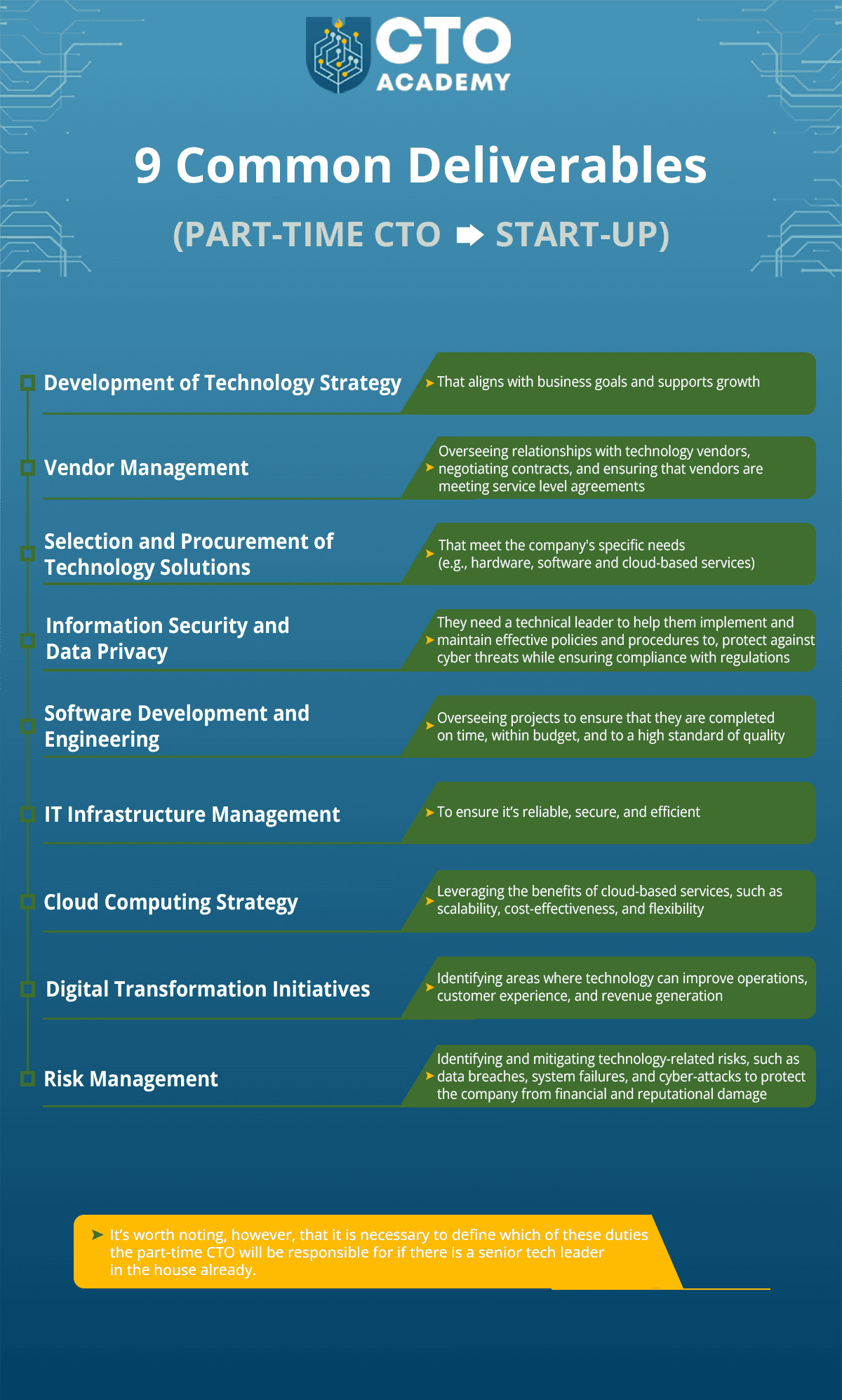
    Part-time CTO 9 common deliverables to a start-up company
    (click to enlarge/download)

    No company is perfect and almost certainly there will be some fires to put out, from realigning the roadmap, sorting out difficult team members and fixing quality issues to repairing relationships with the rest of the business.

    1. Development of Technology Strategy (that aligns with business goals and supports growth).

    2. Vendor Management (or overseeing relationships with technology vendors, negotiating contracts, and ensuring that vendors are meeting service level agreements).

    3. Selection and Procurement of Technology Solutions that meet the company’s specific needs (e.g., hardware, software and cloud-based services).

    4. Information Security and Data Privacy (i.e., they need a technical leader to help them implement and maintain effective policies and procedures to, ultimately, protect against cyber threats while ensuring compliance with regulations).

    5. Software Development and Engineering (i.e., overseeing projects to ensure that they are completed on time, within budget, and to a high standard of quality).

    6. IT Infrastructure Management (to ensure it’s reliable, secure, and efficient).

    7. Cloud Computing Strategy (e.g., leveraging the benefits of cloud-based services, such as scalability, cost-effectiveness, and flexibility).

    8. Digital Transformation Initiatives (e.g., identifying areas where technology can improve operations, customer experience, and revenue generation).

    9. Risk Management (i.e., identifying and mitigating technology-related risks, such as data breaches, system failures, and cyber-attacks to protect the company from financial and reputational damage).

    It’s worth noting, however, that it is necessary to define which of these duties the part-time CTO will be responsible for if there is a senior tech leader in the house already. For instance, an experienced part-time CTO could take over commercial topics while coaching the in-house CTO who takes care of everything else related to the role.

    What is expected of a part-time CTO in digital transformation initiatives?

    You will collaborate with stakeholders to assess the current technology landscape, identify areas for improvement, and develop a comprehensive digital strategy.

    The company will expect you to:

    • Lead the implementation of digital solutions.
    • Oversee technological changes.
    • Ensure alignment with business objectives.

    Some of the goals and responsibilities they may set before you are:

    • Driving innovation.
    • Enhancing operational efficiency.
    • Enabling the organisation to adapt to the evolving digital landscape.

    In the end, what they ultimately want is to foster growth and competitiveness in the digital era. And that’s where a chief technology officer steps in.

    Common misconceptions about a part-time CTO (that you must resolve)

    • Lacks commitment or dedication to the company’s success.
    • May not have sufficient knowledge or expertise to handle complex technology challenges.
    • May struggle to integrate into the existing team or culture.

    To properly address these concerns:

    • Establish open lines of communication.
    • Use case studies of your past work to prove your professionalism and ability to bring fresh perspectives and diverse experiences.
    • Prove that you are familiar with the company, its values and its goals.

    How will they measure your success?

    The methodology may include any of the following:

    1. Goals (that align with your responsibilities and the overall business objective).

    2. KPIs (e.g., cost savings, revenue growth, customer satisfaction, technology adoption rates or project success rates).

    3. Project Outcomes Evaluation (e.g., project completion within budget and timeline, achieved objectives and overall impact on the business).

    4. Performance Reviews (i.e., evaluation of contributions, skills and alignment with company goals followed by constructive feedback on areas that need improvement).

    5. Technology Advancement Assessment (e.g., evaluation of the implementation of new technologies or processes and assessment of their effectiveness in improving efficiency, productivity, or innovation).

    6. Stakeholder Satisfaction (e.g., feedback from executive leadership, team members or clients).

    7. Cost-Efficiency Analyses (e.g., reduction in technology-related expenses, improved resource allocation or increased ROI in technology initiatives).

    8. Team Dynamics Monitoring (e.g., the effectiveness of communication, leadership and mentoring capabilities).

    9. Industry Recognition Review (e.g., awards, speaking engagements or thought leadership contributions).

    10. Feedback Request (i.e., self-assessment of impact, challenges and recommendations for improvement).

    How to negotiate compensation

    At the moment, the head of tech in the United States receives around $170,000 or $74.00/hour. In the UK, on the other hand, the average salary is £96,080 plus a 12% bonus in the private sector or £75,950 and a 27,90% pension addition in the public one.

    To effectively negotiate a satisfying compensation, follow these steps:

    1. Define Role and Responsibilities (i.e., clearly outline the specific role, responsibilities and deliverables to ensure a shared understanding of the scope of work).

    2. Research Market Rates (i.e., conduct thorough research to understand the market rates for CTOs with similar expertise and experience).

    3. Consider Compensation Structure (i.e., determine whether the compensation will be based on an hourly rate, a monthly retainer or project-based fees).

    4. Discuss Time Commitment (i.e., agree on the number of hours or days per week that you will dedicate to the business; clarify flexibility and availability for urgent matters or strategic planning sessions).

    5. Discuss Payment Terms (i.e., define the payment frequency and any milestones or benchmarks that trigger compensation; in other words, establish a clear understanding of invoicing and payment processes).

    6. Consider Equity or Performance-Based Incentives.

    7. Discuss Growth Opportunities (i.e., potential opportunity to transition to a full-time role or take on additional responsibilities as the company expands).

    How does an onboarding process work?

    The company will set specific expectations and goals, as well as key performance indicators and deliverables.

    The next thing is to schedule regular check-ins to review progress, discuss challenges and provide feedback.

    By default, you should have access to the resources, tools and information, including relevant data and company policies.

    The company will also expect that you align with its values and culture so that you can join the overall effort of promoting a sense of shared purpose and vision. Hence, to understand the company’s unique perspective, introduce yourself with the context and background information about its history, goals and values.

    They should also go through a so-called, transition plan with you that commonly includes a knowledge transfer plan and transition of responsibilities to other team members. This is for the moment you leave the company. If they don’t have a plan (e.g., start-up), feel free to make it. It will only add to your credibility and rapport-building process.

    How do you transition from a part-time to a full-time contract or in-house technology team?
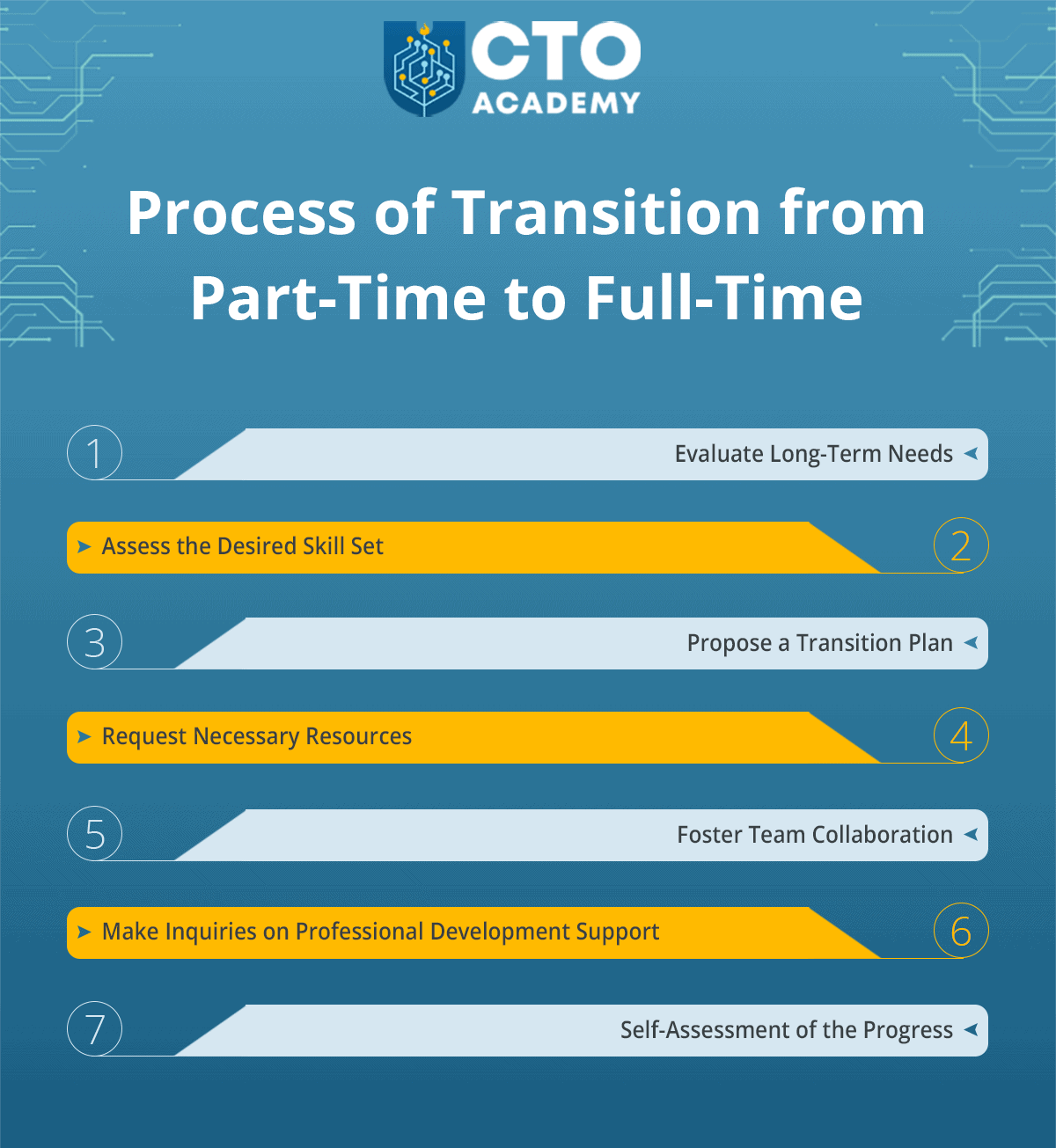
    The process of transition from a part-time to a full-time CTO contract
    (click to enlarge/download)

    If you feel that the only way to ensure continuity, expertise and the company’s ability to address the evolving technology needs is to transition to a full-time role, follow these steps:

    1. Evaluate Long-Term Needs

    Assess the company’s growth trajectory, technological requirements, and the evolving role of technology in the business to determine if transitioning to a full-time contract or building an in-house team makes sense.

    2. Assess the Desired Skill Set

    Identify the specific skills, expertise, and leadership qualities the company is expecting from a full-time CTO.

    3. Propose a Transition Plan

    Collaborate with the CEO to develop a transition plan that ensures a smooth handover of responsibilities, knowledge transfer and seamless integration.

    4. Request Necessary Resources

    (Budget, infrastructure and support systems, to thrive in your new full-time role.)

    5. Foster Team Collaboration

    Maintain collaboration and communication with a team and other departments to foster integration, knowledge sharing and alignment with overall business goals.

    6. Make Inquiries on Professional Development Support

    See what opportunities for professional development, training and upskilling the company provides. Feel free to suggest resources if there aren’t any.

    7. Self-Assessment of the Progress

    Evaluate the effectiveness and impact of the transition. Make necessary adjustments to fine-tune your performance.

    How to position yourself to gain a competitive edge?

    With the increasing demand for technical expertise, you now have a valuable opportunity to offer your expertise and leadership to businesses seeking flexible technology guidance. By showcasing your industry-specific knowledge, strategic mindset, and ability to drive technological advancements, you can position yourself as a sought-after professional in the evolving landscape of part-time technology leadership.

    If, on the other hand, you have identified gaps in critical leadership skills, the best course of action is to seek mentorship. In other words, find experienced technology leaders who can act as mentors and provide guidance. Their insights and advice can help develop the necessary leadership skills.

    Also, take advantage of professional development opportunities, such as workshops and courses or certifications, focused on leadership development. These programs provide the knowledge and tools to enhance leadership capabilities.

    Finally, engage in networking activities within the technology industry. Building connections with other professionals can lead to valuable insights, shared experiences, and potential mentorship opportunities.

    And we as a community of technology leaders are here to help you on that journey. The first step we recommend is to download our free e-book, “90 Things You Need to Know to Become an Effective CTO”.

    60+ pages of personal insight and coalface experience from CTOs and entrepreneurs. As Brian Cline, a CTO from Canada, testifies, “This book is spectacular and not the typical marketing fluff you normally get as a lead magnet!”

    Enjoy!
  • Role of a Chief Technology Officer in Different Business Sizes

    Role of a Chief Technology Officer in Different Business Sizes

    Generally speaking, the role of a chief technology officer involves strategic management and execution of technology initiatives within an organization. It is, therefore, pivotal in shaping and implementing the technology roadmap while aligning it with the company’s overall goals and vision.

    What enables tech leaders to drive innovation, oversee development and infrastructure, ensure data security and foster a culture of technological advancement is not only a deep understanding of emerging technologies and their potential impact but also the people they lead.

    (To see what a day in the life of a CTO looks like, check this post.)

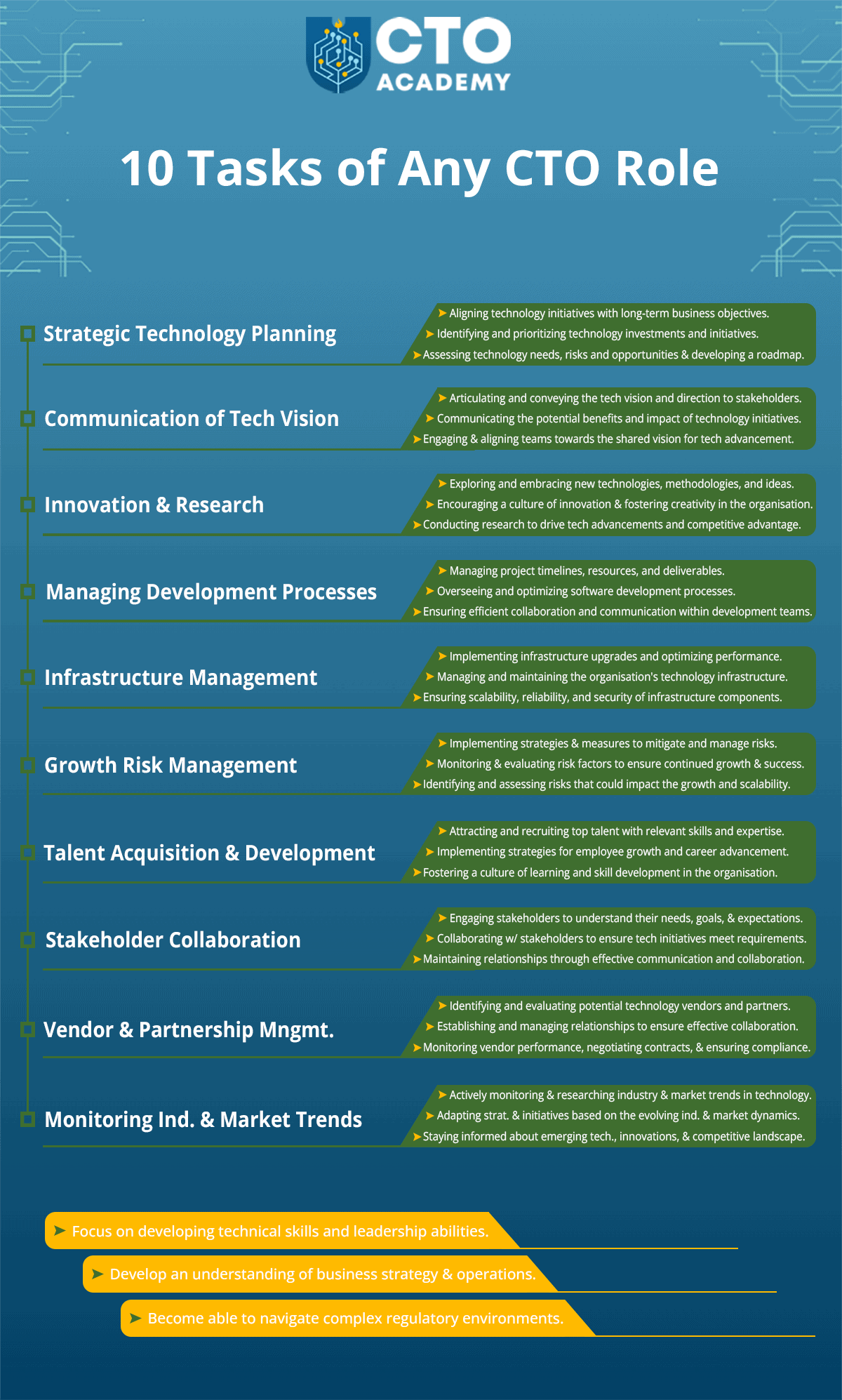
    Infographic summary of 10 tasks of any CTO role
    10 tasks that are common for any CTO role (click to download)

    4 main CTO roles

    Technology Strategy

    This role involves formulating and executing a company’s technology strategy to support its overall business objectives by:

    • Developing and implementing strategic plans for technology development, adoption and application.
    • Identifying emerging technologies and assessing their potential impact on the business.
    • Establishing technology standards and guidelines to ensure consistency and compatibility across systems.
    • Fostering collaboration between technology and business teams to align technology initiatives with organisational goals.
    • Evaluating and prioritising technology investments based on their potential value and return on investment.

    Innovation Management

    As a rule of thumb, the chief technology officer oversees the management of innovation within the company, driving the exploration and adoption of new technologies and practices.

    However, success depends on the effectiveness of these five activities:

    1. Identifying opportunities for innovation and technological advancements within the organization.
    2. Fostering a culture of creativity and continuous improvement.
    3. Collaborating with research and development teams to identify and implement new technologies.
    4. Facilitating cross-functional collaboration and knowledge sharing to encourage innovative ideas.
    5. Evaluating and implementing innovation management processes to streamline idea generation and implementation.

    Development Oversight

    This CTO role focuses on managing the company’s technology development and infrastructure. The job is to ensure that it meets business requirements along with reliability, scalability and security.

    To achieve this, chief technology officers:

    • Develop and maintain technology strategy and roadmap.
    • Oversee the design, deployment and maintenance of the development.
    • Implement robust development processes.
    • Stay informed about industry best practices and emerging technologies.

    Talent Acquisition & Leadership

    As we are waging a full-blown war for talent, chief technology officers are now also responsible for:

    • Recruiting and hiring skilled technology professionals aligned with the company’s needs.
    • Providing mentorship and professional development opportunities for technology teams.
    • Fostering a positive and inclusive work environment that encourages collaboration and innovation.
    • Identifying and addressing skills gaps through training and development initiatives.
    • Establishing career progression frameworks and performance evaluation processes for technology teams. (see https://sfia-online.org/en)

    What is the role of a chief technology officer considering the size of a company?

    Job description, average salary and responsibilities certainly differ depending on the company’s size. So let’s take a quick view of some of these basic differences.

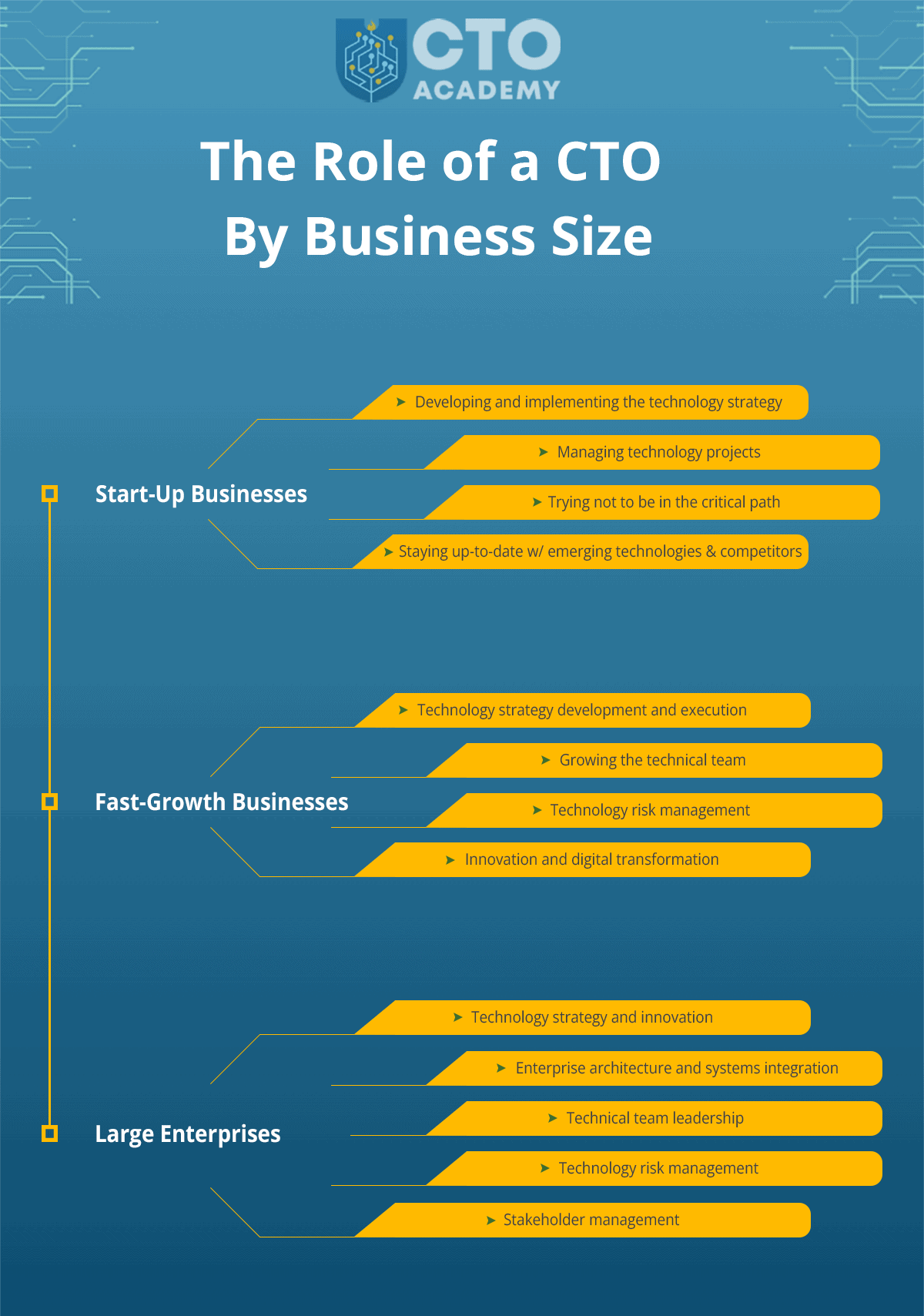
    Infographic summaries of the role of a chief technology officer by business size
    The role of a chief technology officer considering the size of a business (click to download)

    CTO job in start-up businesses

    Chief technology officer typically focuses on the strategic and technical aspects of technology. Their role involves overseeing the development and implementation of technology solutions aligned with the company’s goals. The chief technical officer is, therefore, responsible for identifying emerging technologies, managing the technology infrastructure and driving innovation within the organisation.

    That being said, in start-up businesses, the role of a CTO may vary depending on the company’s size, structure and industry. But generally speaking, their role often involves a hands-on approach. Plus, they wear multiple hats and work closely with low-level team leaders and project managers to deliver technology solutions that meet the business’s needs.

    Some of the key responsibilities in start-up businesses include:
    • Developing and implementing the technology strategy

    This implies a deep understanding of the company’s current technology landscape and future needs because CTOs should be able to develop and implement a technology roadmap that aligns with the business strategy.

    • Managing technology projects

    As the leader of the technology team, the CTO oversees the delivery of technology projects, ensuring that they are completed on time, within budget and meet quality standards.

    • Trying not to be on the critical path

    Most start-up CTOs are still hands-on with the development. They need to be careful not to be in the critical path otherwise they will not have time to oversee everything else under their remit.

    • Staying up-to-date with emerging technologies and competitors

    Start-up businesses often operate in highly competitive markets. Hence, the CTO should stay abreast of emerging technologies and assess their potential impact on the business.

    In fast-growth businesses

    Here, duties expand to include a combination of strategic and operational responsibilities. The role is significantly more complex than in start-up businesses, as the organisation’s needs and challenges rapidly evolve.

    Tech leaders are, therefore, responsible for developing and executing the technology roadmap, managing the technology development and growing infrastructure, overseeing software development and fostering innovation within the organisation. They also closely collaborate with other business units to ensure technology solutions meet the company’s needs. This, in turn, enables the company to scale and grow efficiently.

    Key responsibilities include
    • Technology strategy development and execution

    The CTO develops and executes a technology roadmap that aligns with the company’s business objectives, ensuring that technology investments support growth, productivity and profitability.

    • Growing the technical team

     A tech leader is responsible for recruiting, managing and retaining top technology talent to ensure that the company has the skills it needs to grow. In other words, leading and motivating the technology team and developing a high-performance culture that fosters creativity, collaboration, and continuous learning.

    • Technology risk management

    In fast-growth businesses, CTOs have to ensure that technology investments are scalable with the growing demands of the business. So one part of their job is to develop more structured plans to mitigate technology-related risks and ensure business continuity.

    • Innovation and digital transformation

    The CTO identifies new opportunities and innovative solutions that can transform the business and keep it ahead of the competition. This may involve developing new products or services, implementing new technologies or processes, or leveraging data and analytics to improve decision-making.

    Finally, in large enterprises

    In large enterprises, the chief technology officer plays a crucial role in shaping the organization’s technology strategy, managing large-scale technology initiatives and ensuring that technology investments support business objectives. As you can imagine, the role is complex and challenging, as they are responsible for managing multiple technology teams and navigating complex business and regulatory environments.

    Key responsibilities:
    • Technology strategy and innovation

    CTOs develop and implement a comprehensive technology strategy that aligns with the organization’s overall business objectives. This includes identifying emerging technologies and innovation opportunities that can drive growth and competitive advantage on a much greater scale than is the case with small and fast-growth businesses.

    • Enterprise architecture and systems integration

    The CTO oversees the design and implementation of the enterprise architecture, ensuring that systems and applications are integrated and optimized for performance and scalability.

    • Technical team leadership

    Unlike small and fast-growth companies where a tech leader is leading a team, in large enterprises, the CTO is managing and motivating multiple technology teams, ensuring that they have the resources and support they need to deliver on strategic objectives. They must also develop talent management strategies to attract, develop and retain top technology talent.

    • Technology risk management

    Here, we discuss cybersecurity threats, regulatory compliance, and data privacy. That implies the development and implementation of risk management plans to mitigate potential threats and ensure business continuity.

    • Stakeholder management

    As a CTO in a large enterprise, you work closely with senior executives, business leaders and technology vendors to ensure that technology investments support the organization’s overall business objectives.

    CTO plays a critical role in large enterprises, leading technology strategy, managing complex initiatives and ensuring that technology investments support business growth and profitability.

    Aspiring CTOs should, therefore, focus on developing strong technical and leadership skills, business acumen and the ability to navigate complex business environments.

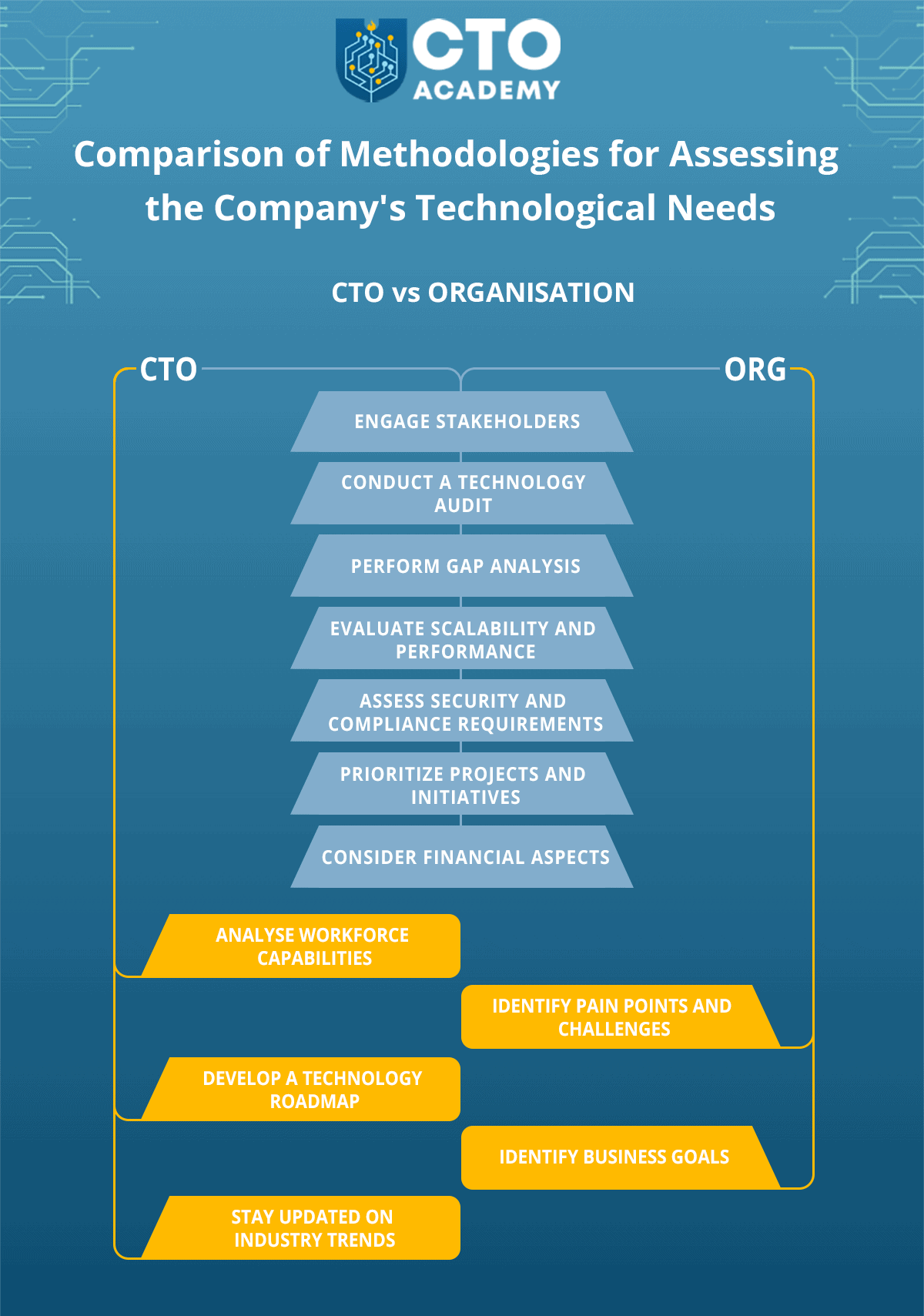
    How CTOs and organisations assess technology needs?

    Comparison of methodologies for assessing the company's technological needs
    Some methodologies are common while some are individual (click to download)

    Summary

    When we consider everything we’ve talked about so far, we come down to 10 common tasks regardless of the size of the organisation or its structure:

    1. Strategic technology planning
    2. Communication of tech vision
    3. Innovation and research
    4. Managing development processes
    5. Infrastructure management
    6. Growth risk management
    7. Talent acquisition and development
    8. Stakeholder collaboration
    9. Vendor and partnership management
    10. Monitoring industry and market trends

    It’s clear then that aspiring tech leaders who are currently working as software developers, product managers, or low-level team leaders should focus on developing their technical skills and leadership abilities. They should also develop an understanding of business strategy and operations, as well as the ability to navigate complex regulatory environments.

    It is, after all, a challenge to manage large-scale technology initiatives, balance technical and business priorities and adapt to rapidly changing technologies and business environments.

    Conclusion

    Considering the job outlook with a steady 16% upward trend until 2031, it is vital for aspiring tech leaders to further improve their management skills. The job market today requires sharp CTO skills that go beyond mere product development and low-level team leading.

    The role of a chief technology officer expands with every new technology we introduce to the market. That’s the reason why employers are searching for an array of backgrounds to cover the growing needs.

    Hence, to remain competitive in the job market over the next five years, consider these few universal requirements:

    6 universal requirements of a CTO role

    • A strong educational foundation; i.e., a bachelor’s or master’s degree in computer science, engineering, or a related field.
    • Tendencies for continuous learning and staying up-to-date with the latest technological advancements proven by certifications and courses.
    • A demonstration of strong leadership and strategic thinking abilities; in other words, excellent communication and interpersonal skills to effectively collaborate with cross-functional teams, executives, and stakeholders.
    • Experience in managing technology teams and driving innovation.
    • An in-depth understanding of emerging technologies such as artificial intelligence, cloud computing, cybersecurity, and data analytics. Ideally, you should be able to present a proven track record of successfully implementing transformative technology initiatives, driving digital transformation, and mitigating technology-related risks.
    • Staying attuned to industry trends, networking with peers, and actively participating in professional communities.

    So, by demonstrating adaptability, agility and a forward-thinking mindset and by combining a strong technical foundation, leadership skills and a commitment to continuous learning, you can position yourself competitively in the job market today and in the near future.

    And we as a community of technology leaders are here to help you on that journey. The first thing we would like to recommend is that you download our free e-book, “90 Things You Need to Know to Become an Effective CTO” as the initial step.

    Alternatively, you might want to use our Tech Leadership Assessment tool to benchmark your strengths and weaknesses against the hundreds of global tech leaders. 

  • Tech Leadership In So Many Words … #16 Health

    Tech Leadership In So Many Words … #16 Health

    ‘As long as you’ve got your health, you’ve got everything’

    A mantra that’s easy to say,
    but when you’re in deep as a senior leader,
    not always easy to follow.

    We become so hyper focused on managing the demands incumbent with leadership,
    alongside our own expectations and ambitions,
    that sometimes we fail to focus on the fundamentals of looking after ourselves.

    Before you know it ….

    Bad habits become ingrained and your wellbeing, physical and mental, starts to suffer with an impact on your ability to be fully effective at work and present at home. 

    And it’s those around you who will often spot the signs first.

    But you probably know all this, right?
    You’re aware of feeling overworked and overstressed. 
    Caught in the hamster wheel that’s become your normality.

    So what to do about it?

    How to manage others you see falling into the same cycle because we don’t need studies to tell us that people who feel mentally and physically healthy, are going to be more productive at work and supportive of each other.

    Those leaders who prioritise and accommodate team wellbeing are not only showing the basic humanity needed in those roles but are likely creating a competitive advantage at the same time.

    The Power of Marginal Gains

    The power of marginal gains was popularised in a sporting context by Dave Brailsford, former performance director of British Cycling.

    Brailsford believed that if you make a 1% improvement in a range of tiny areas then the long term benefits can be extraordinary.

    He looked at improving often overlooked aspects to build a cumulative edge against competitors;

    • He had the training room floor painted pristine white so they could spot any dust that might impair performance
    • Seats were redesigned for extra comfort and stability
    • Massage gels were tested for better muscle recovery 
    • They found better pillows for improved sleep
      And the list goes on

    So the question to ask yourself and your team,
    particularly if you see no obvious way to ease up the pressure of your day job ….

    What small steps and marginal gains can you implement today,
    That will create a significant cumulative impact around improved health tomorrow?

    • Walk the stairs rather than catch the lift
    • Use a fitness tracker (targeting a certain number of steps per day)
    • Listen to a meditation app at the end of each day (get some perspective)
    • Schedule more regular calls with the friends who make you laugh
    • Commit to building better sleep patterns into your lifestyle
      And the list goes on

    Remember also, that you are not alone if feeling overwhelmed at work.

    Many of us are or have been.

    So make sure that you’re maintaining a sense of perspective around you.
    I keep good friends close and regularly tune in and tune out with my favourite comedians.

    Help yourself by cultivating a team culture where vulnerabilities can be discussed
    and where laughter and humour pervade.

    Nothing is that serious, or at least nothing should be that serious.

    Tons of advice out there how to improve in these areas – a few of the ones we like …

    1. The philosophy of sans ecran …”without a screen”. Go tech-free for 24 hours during the weekend.
    2. Create one day per week that is free of meetings for people to catch up, reflect and learn
    3. Enable flexible working that works for the individual, as well as the organisation
    4. Get to properly know each other and bring a different social topic to regular meetings
    5. If working within a remote team, encourage separation of private vs working time, not being available outside that persons standard hours i.e. add an email signature that explicitly states your timezone/working schedule

    And the list goes on but the bottom line is this …

    Keep an eye on your health and start making those marginal gains today.

    ‘The first wealth is health’ — Ralph Waldo Emerson

    Want to find out more about CTO Academy and our Technology Leadership Courses, including lectures that look at time management and mental health at work?

    Visit the CTO Academy Website and in particular our executive leadership course, The Digital MBA for Technology Leaders that is winning rave reviews from global technology leaders

  • Tech Leadership In So Many Words… #15 Humility

    Tech Leadership In So Many Words… #15 Humility

    Life is a long lesson in humility”

    J M Barrie

    Having reached a senior tech leadership role, you have the right to feel a sense of pride in your achievements.

    But leadership requires many things from you, not least a quality that’s the opposite of pride – humility.

    Humility requires you to leave your ego at the door, something your team will appreciate enormously because we’ve all experienced the top-down, transactional boss who leads by a mixture of job title and ego, normally of the inflated variety.

    So here’s a leading question for those of you on this leadership journey from a technical background…

    Is it more challenging to leave that ego in check when you’ve always been a star of the show?

    Does that perfectionist in you manifest itself into a struggle to delegate, trust and ditch that aforementioned ego?

    You may be coming from a background where acknowledging there are things you don’t know is a sign of weakness, not strength.

    But always needing to win an argument and being right does not make for great leadership. They will almost always become pyrrhic victories where your short-term sense of importance equals an attritional long-term impact on those around you. 

    Humility is critical to effective leadership

    tech leadership humility

    It means not trying to bluff your way out of difficult situations you’re facing for the first time, but honestly admitting a deficit in your knowledge, and that despite your seniority you remain eager to learn and grow.

    It’s OK to ask for help, from peers, mentors or coaches. To lean on the expertise of others when you need it. 

    A smart leader will be failure-tolerant and will shape a team culture with a similar approach. The team will discuss vulnerabilities without fear.

    Where psychological safety is a prominent element of the organization and not just something that’s nice to have.

    You should be comfortable putting your hand up as a leader and admitting any stumbles rather than covering them up or shifting the blame, thus potentially encouraging the same approach from your team. 

    Recognising your own fallibility allows you to accept colleagues’ mistakes with empathy and create an environment where failure is not fatal but another part of the journey to ultimate success. 

    What’s often worse is when the egotistical and insecure leader needs to claim credit for the achievements of others.

    Those others will quickly jump ship.

    Humbly acknowledging colleagues’ triumphs, and praising generously and sincerely will strengthen team relationships. It will also inspire members to take initiative and responsibility.

    By practising humility, you will have even more to be proud of.

    Want to learn more about CTO Academy and our Technology Leadership Courses, including lectures and discussions on Humility in Leadership?

    1. Explore the resources on our website.

    2. Take a look at our executive leadership course, The Digital MBA for Technology Leaders. It is continuously winning rave reviews from technology leaders around the world. And with a good reason too.

  • What is the Future of Leadership in the Technology Sector?

    What is the Future of Leadership in the Technology Sector?

    Unprecedented advances and transformative trends are reshaping leadership in technology sector. As the rapid pace of technological innovation continues, the tech industry faces unique challenges and opportunities. The intersection of artificial intelligence, automation and data-driven insights demands visionaries who can effectively navigate this complex landscape.

    Resilient, agile and future-focusing executives will be instrumental in driving digital transformation, fostering innovation and harnessing the potential of emerging technologies. As organizations strive to remain competitive, leaders must possess a deep understanding of the evolving technological landscape coupled with strategic thinking and adaptability.

    Furthermore, ethical considerations, diversity and inclusion and the ability to effectively manage and inspire teams in a remote and globalized work environment are becoming increasingly crucial.

    In this report, we discuss the most significant drivers of the change while providing actionable steps that will help steer you through this rapidly evolving environment.

    Emerging technologies and their impact on tech leadership

    The evolution of AI

    Artificial intelligence, blockchain, the Internet of Things, and augmented reality are disrupting industries, revolutionizing processes, and redefining business models. The ability of technology leadership to understand and harness the power of these technologies will be critical for success.

    To thrive in this dynamic environment, chief technology officers can take several steps:

    1. Stay informed: In other words, stay updated on the latest trends and advances in emerging technologies through industry publications, conferences and online resources.
    2. Embrace lifelong learning: Develop a growth mindset and actively seek opportunities to acquire new skills and knowledge related to emerging technologies.
    3. Foster collaboration: That is, build networks and collaborate with experts and peers in the technology field to exchange ideas, share insights and stay at the forefront of emerging technology developments.
    4. Experiment and innovate: Encourage creative problem-solving to explore the potential applications of emerging technologies.
    5. Develop adaptability: Being adaptive and flexible enables a quick response to the evolving landscape and the ability to embrace new opportunities as they arise.

    Adaptive leadership in the era of technological advancements

    3 key elements of adaptive leadership

    Adaptive leadership is, effectively, the ability to anticipate, embrace, and respond effectively to changes brought about by technology.

    This is achieved by cultivating a mindset that values learning and embraces challenges. In a nutshell, that means that you see setbacks as opportunities for growth and seek feedback to continuously improve your skills and knowledge.

    The opportunities mostly arise as a result of fostering a culture of innovation. In other words, encourage experimentation, creativity and open exchange of ideas within your team or organization. Most importantly, create a safe space for taking calculated risks and motivate your engineers to really think outside the box.

    You should also make every effort to develop cross-functional expertise. Expand your knowledge beyond your specific domain by developing a broad understanding of various technologies, industry trends and market dynamics. This interdisciplinary approach will enable you to adapt more effectively to new challenges and identify opportunities.

    Years of free money and an almost frantic pursuit of growth are now over. VCs and Wall Street are now focusing on profitability and sustainability which, for those fresh in their leadership roles, means playing a whole new type of game. Being a cross-disciplinary expert will help steer you through this new environment.

    AI and automation: reshaping the role of leadership in technology sector

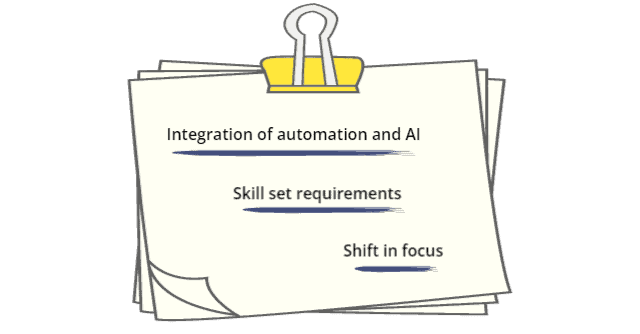
    AI and automation have been catalysts for the change, fundamentally altering the way organizations operate and transforming traditional leadership responsibilities. Several factors have contributed to this:

    3 factors reshaping the role of leadership in technology sector

    Increasing integration of automation and AI lately

    This integration has enabled organizations to automate repetitive tasks, improve operational efficiency, and enhance decision-making processes. Consequently, it is forcing CTOs to understand and leverage these technologies effectively.

    Evolving skill set requirements

    We are talking about a deep understanding of AI algorithms, data analysis, machine learning, and emerging technologies to drive innovation and make strategic decisions.

    Shift in focus

    Chief technology officers are now shifting their focus from overseeing manual processes to leading and managing AI and automation initiatives. This includes identifying opportunities for implementation, ensuring the ethical use of AI, and fostering a culture of innovation.

    Significant consequences of this reshaping

    Tech leaders who fail to adapt may risk becoming obsolete or face challenges in effectively leading their teams. On the other hand, embracing the reshaped role can yield benefits such as improved operational efficiency, enhanced decision-making, and increased innovation.

    Increasing integration of automation and AI

    This integration has enabled organizations to automate repetitive tasks, improve operational efficiency and enhance decision-making processes. Consequently, it is forcing CTOs to understand and leverage these technologies effectively.

    Evolving skill set requirements

    We are talking about a deep understanding of AI algorithms, data analysis, machine learning and emerging technologies to drive innovation and make strategic decisions.

    Shift in focus

    Chief technology officers are now shifting their focus from overseeing manual processes to leading and managing AI and automation initiatives. This includes identifying opportunities for implementation, ensuring the ethical use of AI and fostering a culture of innovation.

    Significant consequences of this reshaping

    Tech leaders who fail to adapt may risk becoming obsolete or face challenges in effectively leading their teams. On the other hand, embracing the reshaped role can yield benefits such as improved operational efficiency, enhanced decision-making and increased innovation.

    To adjust, consider these steps:

    1. Invest in continuous learning to stay updated and develop a deep understanding of these technologies and their potential impact on the organisation.
    2. Encourage cross-functional collaboration between tech teams, data scientists and business units to drive innovation and leverage AI and automation effectively.
    3. Cultivate adaptability and experimentation as two keys in navigating the evolving technology landscape.
    4. Develop ethical awareness to a) understand the ethical implications of AI and automation, and b) ensure that the use of these technologies aligns with ethical standards. In short, prioritize transparency, fairness and accountability in decision-making processes.

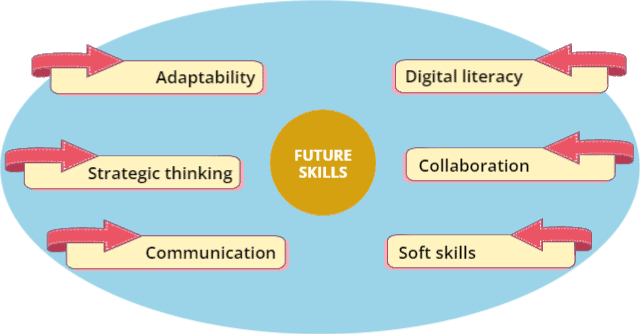
    Future skills that enable navigation through disruptive innovation

    6 key skills of future technology leaders

    These skills encompass a range of competencies, including:

    1. Adaptability: i.e. embracing change, quickly learning new technologies, and adapting strategies to navigate disruptive innovation effectively.
    2. Digital literacy to develop a deep understanding of emerging technologies such as artificial intelligence, blockchain, and data analytics. This, in turn, will enable you to make informed decisions and drive innovation.
    3. Strategic thinking or the capacity to envision long-term goals, identify opportunities for growth and competitive advantage and develop strategies to capitalize on disruptive trends.
    4. Collaboration and Communication to enhance cross-functional teamwork, bridge gaps between technical and non-technical stakeholders and facilitate innovation.
    5. Emotional intelligence and other important soft leadership skills to understand and manage emotions, build strong relationships and motivate teams, fostering a positive and inclusive work environment.

    To speed up the acquisition of these vital skills, you can employ several strategies:

    • Continuous learning: Engage in self-study, online courses, workshops, and industry events to stay updated on the latest technologies and trends.
    • Mentoring and networking: Seek guidance from experienced tech leaders and build a strong professional network to gain insights and learn from their experiences.
    • Hands-on experience: Engage in practical projects and initiatives, experimenting with emerging technologies to gain first-hand experience and develop problem-solving skills.
    • Industry collaboration: Collaborate with industry partners, start-ups, and academic institutions to gain exposure to real-world challenges and innovative practices.
    • Personal development: Enhance communication, leadership and emotional intelligence skills through coaching, personal development programs and self-reflection.

    Equipped with these competencies, you can lead your team and organization to embrace emerging technologies, seize opportunities and drive sustainable growth in the dynamic technology landscape.

    Digital transformation and the evolution of tech leadership

    One of the primary challenges is the need to balance traditional IT responsibilities with driving innovation and strategic decision-making. CTOs must shift their focus from purely technical expertise to understanding the broader business implications of digital transformation. In other words, you need to align technology initiatives with organizational goals, collaborate with cross-functional teams and drive cultural change.

    It is, basically, a shift from a purely technical role to that of a strategic business partner. You, therefore, must understand emerging technologies, data analytics, customer-centricity and digital trends.

    The fastest way for you to adjust to this evolution involves:

    • Pursuing relevant certifications
    • Attending industry conferences and workshops
    • Engaging in continuous professional development
    • Collaboration with other business units
    • Seeking mentorship or guidance from experienced chief technology officers who can provide valuable insights and support during the adjustment process

    This way, you are becoming instrumental in driving digital transformation initiatives, guiding your organisation through technological disruptions and positioning yourself as a strategic leader who can effectively leverage technology to achieve business objectives.

    Ethical considerations in leading AI and data-driven technologies

    Several capital risks arise in this domain:

    Privacy and data security

    The collection and use of vast amounts of personal data can pose privacy and security risks. Solutions include:

    • Implementing robust encryption measures
    • Anonymizing data whenever possible
    • Ensuring compliance with data protection regulations

    Bias and fairness

    Addressing this risk involves:

    • Regularly auditing AI systems for bias
    • Diversifying data sources
    • Incorporating fairness metrics into the development process

    Accountability and transparency

    The opacity of AI systems can make it difficult to understand and explain their decisions. You can mitigate this risk by:

    • Adopting explainable AI techniques
    • Maintaining transparency in data usage policies
    • Establishing clear lines of responsibility and accountability

    Job displacement and workforce impact

    The automation enabled by AI can lead to job displacement and social implications. To prevent negative impacts:

    • Invest in retraining programs
    • Promote a culture of lifelong learning
    • Foster collaboration between humans and AI because we are becoming increasingly addicted to tech-facilitated human interaction

    Ethical decision-making

    The three biggest challenges in leading AI and data-driven technologies right now are:

    1. Ensuring ethical governance (i.e. establishing ethical guidelines and frameworks to govern the development and deployment of AI systems)
    2. Ethical use of data (i.e. addressing concerns related to data privacy, consent, and responsible data sharing)
    3. Addressing algorithmic bias (i.e. mitigating bias in AI algorithms to ensure fairness and prevent discrimination)

    The question is, how do you address these three challenges in an optimal way?

    There are four initiatives that you can employ almost immediately:

    1. Develop ethical AI policies: In other words, establish clear guidelines and principles that outline ethical expectations and considerations in AI development and deployment.
    2. Encourage diversity and inclusion: Diverse teams have a range of perspectives that, when approached analytically, effectively mitigate biases and promote fairness.
    3. Promote ethical awareness and education: That is, provide training and resources to educate employees and stakeholders about ethical considerations and responsible AI practices.
    4. Engage in public dialogue: This implies active participation in discussions and collaboration with stakeholders, policymakers and the public to address concerns and shape responsible AI policies and regulations.

    Building resilient tech executives for an uncertain future

    Technological advancements, market conditions and business landscapes are constantly changing, making it challenging to predict outcomes and plan with certainty.

    Consequently, a CTO must adapt, persevere and lead effectively in the face of ambiguity and change.

    Therefore, to best prepare for uncertainty, consider taking the following steps:

    • Embrace a proactive mindset to regard change as an opportunity rather than a threat, remaining agile and adaptable.
    • Foster scenario planning to explore possible outcomes and develop strategies to respond to each possibility.
    • Encourage continuous learning to stay updated on emerging technologies, industry trends and market dynamics and, thus, make informed decisions and identify new opportunities.
    • Cultivate a culture of innovation that encourages creativity, experimentation and the exploration of new ideas. This mindset helps tech executives and their teams to stay ahead of the curve and adapt to emerging trends.
    • Develop strategic partnerships. That is to say, collaborate with external partners, start-ups, and industry experts to gain insights, share knowledge and leverage collective intelligence.

    When we observe this challenge from the perspective of the technology industry as a whole, the process of building resilient tech leaders implies:

    1. Cultivating a culture that encourages continuous learning, experimentation, and embracing failures as opportunities for growth.
    2. Developing emotional intelligence which equips tech executives with the skills to understand and manage their own emotions, as well as effectively navigate interpersonal dynamics (i.e. building strong relationships, motivating teams and handling stressful situations with resilience).
    3. Encouraging collaboration and networking on a global scale. The key outcome is resilience through shared experiences and collective problem-solving.
    4. Providing targeted leadership development programs.
    5. Promoting well-being and work-life balance.
    6. Arming leaders with change management skills (i.e. providing training in change management methodologies and encouraging a flexible and agile mindset).

    Now, while it may not be possible to turn the unknown into the known completely, technology leaders can reduce uncertainty by engaging in market research, customer feedback and industry analysis. Cumulatively, this approach provides valuable insights to inform strategic planning and reduce uncertainty to an acceptable degree.

    Conclusion

    Leadership in technology sector is evolving rapidly, driven by factors such as emerging technologies, digital transformation and the need for ethical considerations. To thrive in this dynamic landscape, future leaders must adapt and develop the necessary skills and mindset.

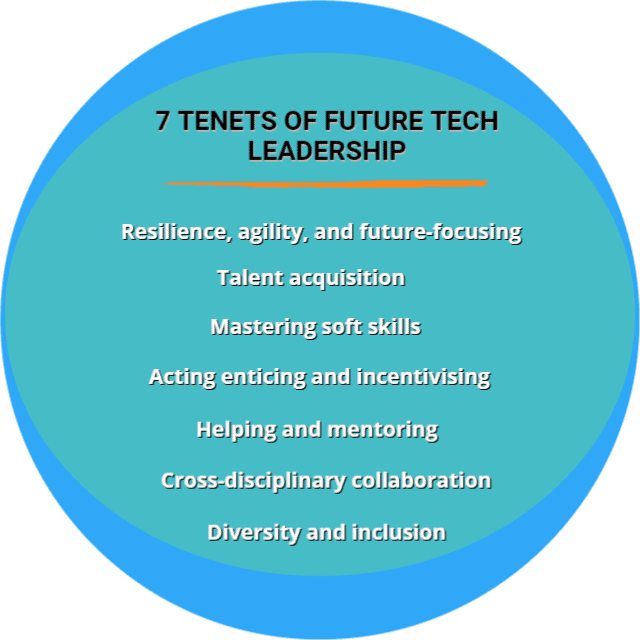
    In a nutshell, there are 7 tenets — the 7 key takeaways — of future leadership in the tech industry:

    7 tenets of future leadership in technology sector

    1. Resilience, agility, and future-focusing (i.e. data-driven cognitive leadership that employs analytical tools, AI and ERP; system thinking; operational functioning and innovation through actionable data)
    2. Talent acquisition
    3. Mastering soft skills (e.g. interpersonal leadership, conflict resolution, networking, etc)
    4. Acting enticing and incentivising (to empower autonomy!)
    5. Helping and mentoring (to align the right people with the right tools!)
    6. Cross-disciplinary collaboration
    7. Making diversity and inclusion the way of life

    By adopting these seven tenets, aspiring and current tech leaders can position themselves as effective leaders in the tech sector. They will be well-equipped to navigate disruptive innovations, foster innovation and lead their teams and organizations towards success in an ever-changing landscape.

  • Tech Leadership In So Many Words … #14 Motivation

    Tech Leadership In So Many Words … #14 Motivation

    When you’re a leader, motivation is a two-sided coin.

    One side is Personal Motivation and what’s driving you.
    The other is Team Motivation and what’s driving them.
    The two being inextricably linked means we need to start with self. 

    What is your reason for doing what you’re doing?

    Are you being driven by an intrinsic motivation where your actions are spurred by internal rather than superficial rewards?

    Or are you drifting on an autopilot that is impacting (and not in a positive way) your performance and your leadership?

    Being honest with yourself about these questions will inform much of what’s going on around you …

    Your personal impact and achievements
    Your ability to lead and bring people with you
    Your overall contentment with the world

    Here is my truth.

    I was once employed and handsomely rewarded in a senior leadership role.
    Great colleagues, easy lifestyle, relatively few worries.
    Bored as hell.

    I hadn’t aligned any of my core values with my day job.
    I had zero intrinsic motivation and it was beginning to show.
    One day I woke up and had that honest discussion with myself.
    I quit.

    The most effective leaders are those whose career motivation is aligned with their core values.

    Leadership comes more naturally when the individual finds a flow between their role and their values.

    But how do you know what those core values are?
    Few people ever drill down deep enough to discover the principles that matter most to them. 

    It requires careful reflection, objective analysis via coach or close friend, and some of that aforementioned honest questioning.

    And of course it’s not just about the job or the company.
    It’s about whether your career is on the right trajectory.

    We work with global tech leaders to build their leadership skills but sometimes, it’s just not the right fit. Leadership is not something they fit. Tough decisions need to be made.

    If you’re at the start of the journey then one essential question you need to ask … why do you want to become a leader?

    Ideally the answer should be that you have no choice.
    You simply cannot not be a leader.

    Your instinct to lead is so strong that it’s part of who you are.
    To lead, inspire, change, motivate and impact on others and the surroundings around you.
    If you don’t feel you have that instinct, your other motivations may not matter. 

    But of course being a leader also means that you now have to take into account and understand the motivation and ambition of others particularly those working closest to you, your team.

    You will be highly fortunate and unusual if these always align with your own.

    So a critical element of leadership is to understand and have the capacity to learn about what drives your colleagues and from there, to provide them with the opportunities to progress in their own careers — giving individuals the autonomy and training to thrive.

    No room for fixed mindset and/or defensive leadership in 2023.

    Support of this kind will increase employees’ motivation to work towards that common goal and have a significant impact on your ability to inspire and retain.

    Your ability to listen, willingness to encourage discussion and capacity to display sincere interest and enthusiasm, will create an environment and culture that allows your team, with all its different motivations, to operate at its full potential.

    And remember — however strong your desire to succeed in your career, it is important not to be overwhelmed by it. The same goes for individuals in your team.

    Ambition should always be balanced with a wider and holistic approach to a quality of life. 

    The core value of life and relationships outside work should never be forgotten.

    Want to find out more about CTO Academy and our Technology Leadership Courses, including lectures and discussions that look at Motivation and …. How To Discover Those Core Values

    Visit the CTO Academy Website and in particular our executive leadership course, The Digital MBA for Technology Leaders winning rave reviews from technology leaders around the world.

  • What is a Fractional CTO and How Do You Become One?

    What is a Fractional CTO and How Do You Become One?

    A Fractional CTO is a chief technology officer who provides on-demand services to a company or organization. In other words, it is a freelance contract that implies working for a fraction of the time and cost and just on the part of the project as opposed to full- or part-time CTO positions.

    This role can be performed remotely or on-site, depending on the company’s needs. Lately, however, a growing number of professionals are seeking remote positions exclusively because they enable greater flexibility that radically improves the work-life balance. (Scroll down a bit to download the new Fractional CTO Playbook.)

    TL;DR

    A Fractional CTO is a senior technology leader who supports a company part-time/on-demand—often remotely—to deliver executive-level outcomes without the cost and commitment of a full-time hire.

    Fractional CTOs typically help with:

    • Technology strategy + direction (what to build, why now, what to stop).
    • Delivery systems (process, CI/CD, testing, operational hygiene).
    • Product + engineering execution (roadmaps, resourcing, tradeoffs).
    • Team building (hiring, onboarding/offboarding, structure, leadership).
    • Scaling (platform readiness, org/process scaling, reliability).

    Companies hire fractional CTOs because they need fast, credible leadership—often in a transition, growth moment, or leadership gap—while staying cost-effective (e.g., 15–20 hours/week instead of full-time).

    To become one, you need a clear positioning (who you help + what outcomes you deliver), a repeatable engagement model (diagnose → plan → execute), and a pipeline (network, communities, targeted outreach, and the right job boards).

    [Last updated: February 17, 2026]

    Update (Feb 2026) includes: Added “owns/doesn’t own,” engagement models, red flags, success metrics, expanded FAQ, and refreshed US/UK rate benchmarks.

    Table of Contents

    Fractional CTO Playbook by CTO Academy- PDF Cover

    Get the Fractional CTO Playbook (Free PDF)

    If you’re exploring fractional work (or already doing it), this playbook gives you the operating system: positioning, offer design, delivery plays, and the “don’t-learn-this-the-hard-way” pitfalls.
    Skim it once. Then reuse the checklists every time you onboard a client or reset scope.

    Downloading the ebook does not automatically subscribe you to our bi-weekly Technology Leadership Newsletter.

    What is the typical role and job description of a Fractional CTO?

    In short, FCTOs are responsible for overseeing the organization’s tech strategy, direction, and operations. They help companies with tech-related tasks such as:

    • Developing and implementing strategies
    • Managing IT operations
    • Overseeing product development
    • Managing vendor relationships
    • Evaluating and implementing new technologies
    • Providing leadership and mentorship
    Digital MBA for Technology Leaders - Tech MBA by CTO Academy

    As an FCTO, you are bringing your expertise and experience to help companies:

    1. Align their technological initiatives with their business goals and objectives
    2. Optimize investments
    3. Drive innovation

    Scope clarity prevents disappointment on both sides. So it’s important to understand what fractional CTOs own and what not.

    What a fractional CTO owns

    • Technology direction: a clear, opinionated strategy tied to business goals (and a plan to execute it).
    • Execution system: operating cadence, decision rights, priorities, and the mechanisms that make delivery predictable.
    • Architecture guardrails: standards and tradeoffs that prevent expensive rewrites and keep scaling sane.
    • Engineering leadership leverage: team structure, hiring bar, coaching, and accountability across tech delivery.
    • Risk management: security, reliability, and technical debt triage, focused on what can actually hurt the business.

    What a fractional CTO does not own

    • Being your full-time CTO in disguise: if you need daily executive presence, you need a full-time leader.
    • “Fix everything” with no authority: no decision rights = no accountability. Fractional leadership requires a sponsor who can commit and prioritize.
    • Being the part-time senior engineer: occasional hands-on spikes are fine; permanent “hero coding” is not the model.
    • Unbounded vendor/IT admin: tooling, procurement, device support, and helpdesk need clear ownership (unless explicitly scoped).
    • Results without participation: the strategy only works when leadership and the team adopt the cadence, make tradeoffs, and follow through.

    Common assignments of a Fractional CTO in day-to-day operations

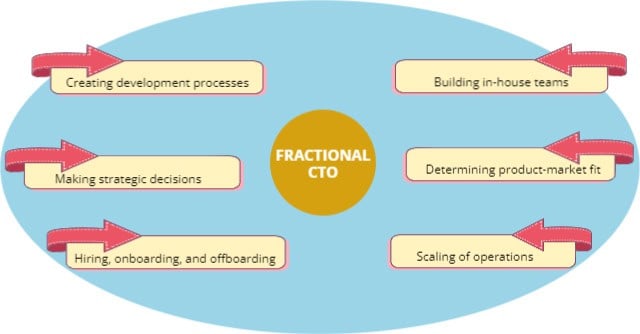
    6 job duties commonly expected of a fractional CTO
    6 job duties commonly expected of a fractional CTO

    In our talks with tech leaders from all over the world these past few years, we have discovered that there are a few universal expectations from an FCTO:

    1. Creating development processes (i.e., CI/CD implementation, testing, etc.)
    2. Making strategic decisions
    3. Developing and supervising hiring, onboarding, and offboarding processes
    4. Building in-house teams during the company’s transition from the outsourcing model (common for startups)
    5. Discovering reliable and recurring revenue streams by determining product-market fit
    6. Enabling scaling of operations relevant to products and feature development

    Observed from the outcome-first perspective, the list of assignments looks like this:

    • Outcome: predictable delivery (less chaos, fewer surprises).
      How: install an operating cadence, tighten planning, define “done,” introduce lightweight QA gates, and remove the top 1–2 bottlenecks slowing releases.
    • Outcome: faster decisions (less debate, more momentum).
      How: clarify decision rights, set architecture guardrails, create a simple tradeoff framework, and align Product + Engineering on what matters this quarter.
    • Outcome: safer scaling (performance and reliability don’t collapse under growth).
      How: stabilize the platform, add observability, harden incident response, reduce single points of failure, and prioritize technical debt that directly impacts uptime or velocity.
    • Outcome: a team that can execute without heroics.
      How: reset roles and expectations, improve hiring loops, coach engineering leadership, fix incentives, and establish clear ownership across systems and domains.
    • Outcome: investor readiness (confidence during diligence).
      How: produce a credible roadmap, quantify key risks, document architecture and security posture, define metrics, and create a technical narrative that leadership can defend.
    • Outcome: cost control without slowing down.
      How: remove waste (unused tools, duplicated systems, inefficient workflows), right-size vendors, improve build vs buy decisions, and focus spend on the few bets that move outcomes.

    Engagement models (how fractional CTOs typically work)

    Most fractional CTO engagements fall into one of these three patterns:

    • Assessment sprint (1–3 weeks)
      A rapid diagnosis of the current reality: delivery health, team structure, architecture, risk, and priorities, all ending with a clear action plan and success metrics.
    • Operating retainer (monthly)
      Ongoing executive leadership through a repeatable cadence: weekly sponsor sync, roadmap and delivery rhythm, decision-making guardrails, and continuous risk reduction.
    • Time-boxed execution (4–12+ weeks)
      A focused mandate with a clear end state (e.g., stabilize releases, prepare for diligence, rebuild the team, modernize a critical system), often paired with hands-on workshops and heavier availability.

    Rule of thumb:

    Assessment → Retainer is the cleanest default. Use time-boxed execution when there’s a specific milestone or urgency driving the work.

    Success metrics (what “good” looks like)

    • Delivery becomes predictable: roadmap commitments start matching what actually ships.
    • Lead time drops: work moves from idea → production faster, with less waiting and rework.
    • Quality improves: fewer production incidents, fewer hotfixes, and cleaner release cycles.
    • Decision-making speeds up: fewer stalled debates, clearer ownership, and better tradeoffs.
    • Team health rises: lower burnout, clearer roles, stronger hiring signal, and better retention.
    • Risk is under control: security and reliability gaps are visible, prioritized, and steadily reduced.

    The two main external drivers of high demand for Fractional CTOs

    Cost-effectiveness

    Experienced chief technology officers may present a heavy burden on the usually limited startup budget. Additionally, the company may not yet have the need for a full-time CTO role.

    Fractional CTOs present a cost-effective way for companies to get a senior-level technology leadership
    Fractional CTOs present a cost-effective way for companies to get a senior-level technology leadership

    In these circumstances, hiring someone to work only 15-20 hours a week can be a win-win situation for both parties. On the one hand, you can charge more per hour than possible in a permanent contract. On the other hand, the total cost for the company is less than it would be for a traditional position.

    The remote and hybrid working trend

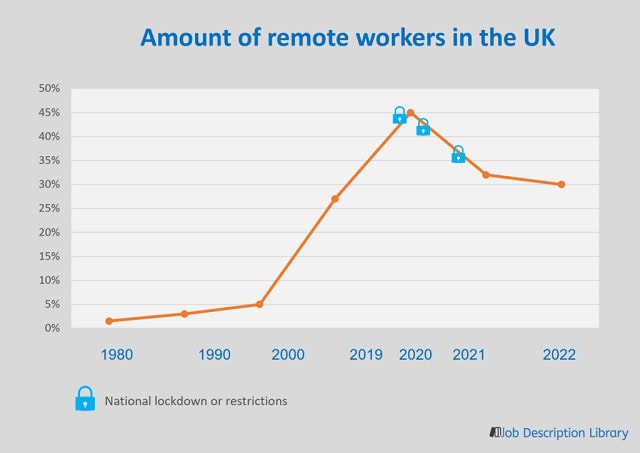
    The paradigm has changed. Work is not necessarily where we go anymore, but what we do. That’s one of the reasons why remote/hybrid working is quickly becoming the model of choice for not only a growing number of companies of all sizes but also seasoned professionals.

    Remote working trends in the UK from 1980 to 2022.
    Chart by StandOutCV. Shows the remote work trends in the UK, 1980-2022.

    In such a scenario, organizations are removing geographical barriers and hiring talent from around the world at competitive prices. This, in turn, is allowing them to slice large projects into chunks and hire multiple fractional tech leaders to develop, oversee, and manage individual road maps.

    Top reasons why companies are looking for fractional CTO services

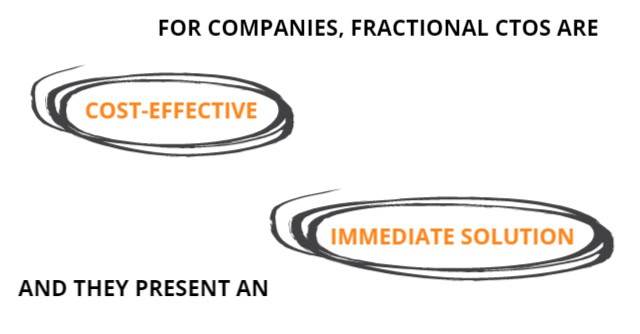
    To put it bluntly, fractional CTOs are a) cost-effective, and b) represent immediate solutions for companies that require high-level tech management without the commitment and cost of an in-house employee.

    2 main reasons why companies are hiring fractional CTOs

    This, basically, means that FCTOs are primarily engaged by SMBs that do not have the resources or need for a more permanent role but still require strategic technology leadership and guidance. Lately, however, we have also seen large companies offering this specific position.

    Reasons companies opt for fractional CTOs

    • The company is operating with a low budget and can’t afford to pay, for instance, a $250K/year salary.
    • Time is of the essence, and they can’t afford to bother with the lengthy process of onboarding a full-time CTO; therefore, they are looking for someone who can start immediately.
    • They are looking to hire more than one tech leader for any number of reasons; most commonly due to the sudden expansion after a successful funding round.
    • They have the vision of a product but lack the practical knowledge to build such a technology. In such a scenario, you work closely with other C-suite executives to bring the product and tech strategy to life.
    • They have serious issues with the technology team, either due to the unplanned departure of the previous leader or the team’s inefficiency caused, for example, by quiet quitting.
    • They are changing the outsourcing model in favor of an in-house team of engineers.
    • They need technical leadership to aid with raising funds from VCs, in which case, an FCTO is hired to review the architecture, development processes, disaster recovery, compliance policies, certifications, and other relevant parts of the operations and, ultimately, to ensure business continuity.

    The difference between an Interim CTO and a Fractional CTO

    An Interim CTO is a temporary or transitional tech leader. For example, one can be appointed when the current tech leader is on leave or when a role suddenly becomes vacant. Another instance would be a crisis or significant change.

    ICTOs are typically engaged for a defined period. They are responsible for managing the following:

    • The technology strategy
    • Operations
    • Team

    The significant difference between the two is that an ICTO controls the helm while a fractional CTO is responsible for just one segment of navigation.

    Additionally, an FCTO may operate on an ongoing basis while an ICTO is hired for a specific and relatively short period.

    The average Fractional CTO rates and salary (refreshed for 2026)

    “Fractional” pricing isn’t just a smaller version of a full-time CTO salary. It’s a premium for concentrated senior judgment—typically packaged as a monthly retainer (operating cadence + decision-making) and sometimes topped up with short, high-intensity bursts (assessment, turnaround, fundraising prep).

    Below are the current market benchmarks for the US and the UK.

    How to use these numbers (without getting misled)

    • Use full-time salary to anchor “what dedicated ownership costs.”
    • Use fractional rates to price “high-intensity leverage” (fast decisions, fewer mistakes, less risk).
    • For most companies, a fractional CTO is best bought on a cadence + outcomes basis, not as “hours.”
    MarketFull-time CTO salary benchmarkFractional pricing proxy
    US~$309k average (Salary.com, Jan 1, 2026)~$200–$500/hr and ~$10k–$25k/mo retainers (market guides)
    UK~£116.7k average (Glassdoor UK, Feb 2026)~£800/day median contractor rate (ITJobsWatch, 6 months to Feb 16, 2026)

    United States fCTO rates (US)

    Full-time CTO salary (benchmark)

    Think of this as the reference point for what “dedicated executive ownership” costs:

    Fractional CTO rates (what companies typically pay)

    You’ll see two dominant patterns:

    • Hourly (for diagnostics/architecture/due diligence): commonly $200–$500/hr, with premiums for urgent turnarounds, security/regulatory work, or “hands-on executive operator” mandates. Fractional CTOs in our community report an average of $300/hr.
    • Retainers (for ongoing leadership): commonly mid-four to low-five figures per month, depending on scope, availability, and decision load.

    What’s changing (2025 → 2026)

    Buyers are getting sharper: they’ll pay for a fractional CTO who can install operating rhythm, reduce delivery risk, and make priorities stick, but they’re less interested in “advice-only” arrangements.

    United Kingdom fCTO rates (UK)

    Full-time CTO salary (benchmark)

    UK CTO pay is highly sensitive to what the title actually means (true exec vs senior engineering lead), but current benchmarks cluster here:

    Fractional/contract pricing (best UK proxy)

    The UK market often expresses “fractional CTO” as a contract day rate:

    What’s changing (2025 → 2026)

    Budgets are tighter for generic leadership, but the market still pays for fractional CTOs who can stabilize delivery, de-risk security, and get the company investor-ready on a clear timeline.

    What drives variance (and why “average” can mislead)

    Fractional CTO pricing moves fast based on:

    • Stage + urgency: turnaround, missed deliveries, or funding deadlines cost more.
    • Scope + decision rights: “advisor” is cheaper than “operator accountable for outcomes.”
    • Risk profile: security, compliance, reliability, and platform scale add a premium.
    • Hands-on depth: occasional spikes are normal; becoming the de facto lead engineer changes the model.
    • Time commitment + availability: 5–10 hours/month ≠ 1–2 days/week.

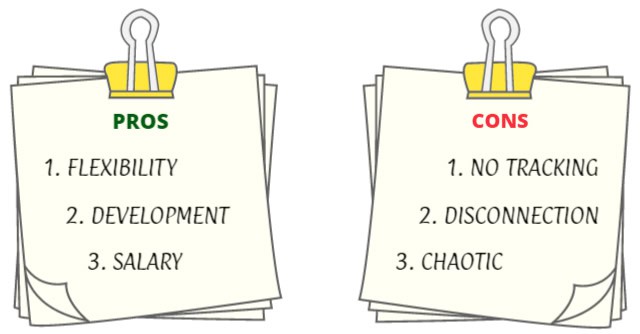
    PROs and CONs of the fractional tech leadership

    As with every other contract type, there are advantages but also downsides to working as a fractional CTO.

    Pros and Cons of working as a fractional CTO
    Pros and Cons of working as a fractional CTO

    Pros

    1. Flexibility in terms of location and time.
    2. Working in different industries and sectors, thus, developing professionally at a much faster pace.
    3. Compensation can be much higher than in full-year positions.

    Cons

    1. It’s hard to track the successes and end results of your work.
    2. Feeling disconnected from the company’s culture (i.e., a lone wolf syndrome).
    3. The pains of bringing order into chaos which is a common scenario in startups.

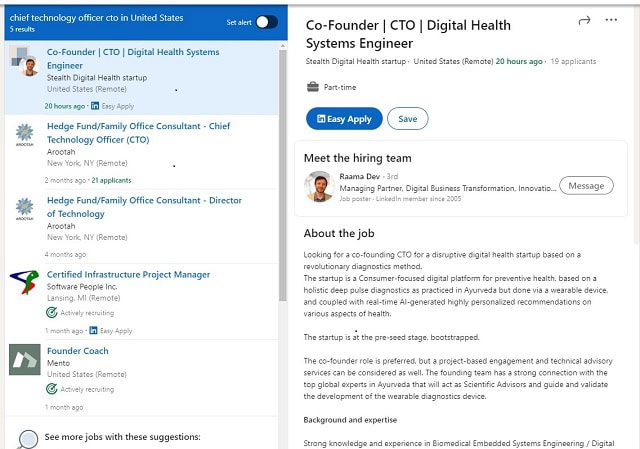
    Where to find job opportunities

    For those without a network, the quickest way to find fractional CTO jobs is through job boards like:

    LinkedIn job board with available fractional and full-time CTO jobs
    LinkedIn job board with available fractional and full-time CTO jobs

    It is also wise to join CTO groups like ours here at the Academy and attend specialized events where you can participate in discussions and establish long-lasting relationships with your peers. In our experience, there is no better way to get a timely tip for a new job opening.

    How to get hired

    How to Become a Fractional CTO (a simple 3-step path)

    1) Positioning: pick a lane

    You don’t need to be “CTO for everyone.” You need to be the obvious choice for a specific situation.

    • Choose who you help (stage, domain, team size, constraints).
    • Choose what outcome you reliably deliver (stabilize delivery, scale platform, rebuild team, investor readiness).
    • Build proof: 2–3 short case stories with measurable before/after signals.

    2) Offer: make it easy to buy

    Fractional leadership sells faster when it’s packaged as a repeatable engagement, not open-ended availability.

    • Start with an assessment (rapid diagnosis + priority map).
    • Turn that into a plan (tradeoffs, sequencing, ownership, success metrics).
    • Run an operating cadence (weekly exec sync + delivery rhythm + decision log) that makes progress inevitable.

    3) Pipeline: build a predictable deal flow

    Most fractional CTO work is won through trust, not applications.

    • Referrals and warm intros (founders, operators, investors, agencies).
    • Community presence (where founders already ask for help).
    • Proof in public (writing, talks, teardown posts, short frameworks).
    • Partnerships (fractional CFO/COO, product leaders, dev shops) that route leads your way.

    To sum up: Pick a lane → package an offer → build a trust-based pipeline.

    How to get hired as a fractional CTO (what actually works)

    Fractional CTO work is won through trust + proof + clarity.

    • Lead with outcomes, not a title.
      Say what you do in plain English: “I help Series A SaaS teams turn chaotic delivery into predictable shipping within 60–90 days.”
    • Package a repeatable starting point.
      Make it easy to buy: an assessment sprint that turns into a prioritized plan and an operating cadence. Ambiguity kills deals.
    • Show proof that reduces perceived risk.
      Bring 2–3 short case stories with measurable signals (release frequency, lead time, incident rate, hiring throughput, cost-to-ship). Add references when possible.
    • Build your pipeline where founders already trust people.
      Referrals, operator communities, investor networks, alumni groups, and partnerships (fractional CFO/COO, product leaders, agencies) outperform job boards for exec-level fractional work.
    • Use content as a credibility engine (not as “marketing”).
      Publish frameworks, teardowns, and decision guides—the kind of writing that sounds like you’ve been in the room when things were on fire.

    Competing on tenders

    Having an industry-recognized CTO certification makes the hiring part a whole lot easier; all you have to do is send a cover letter to compete for a tender.

    Remember, you are not alone, and the only way to get that interview is to send an attention-grabbing cover letter.

    How to write a winning cover letter

    The first rule of cover letters is that it is not about you per se, but about the job and the company you are applying to. In other words, you want to explain in less than 250 words how your experience and expertise solve their problems. That’s the only thing they want to hear.

    A cover letter for a fractional CTO job
    Writing a cover letter for a fractional CTO job. Photo by Glenn Carstens-Peters on Unsplash.

    You should clearly demonstrate:

    1. Complete understanding of the employer’s needs and the project’s specific requests.
    2. Necessary experience and expertise to ultimately deliver what’s expected of you.

    Here are a few additional cover letter tips:

    • Mention your most recent experience with similar projects early on (i.e., in the opening paragraph because that’s what most platforms show to employers in snippets).
    • Showcase the accomplishments of that particular job next (i.e., how did your engagement there help that employer achieve desired goals).
    • Point out certain risks that only an experienced tech leader would be aware of to prove your expertise.
    • Refrain from bragging and self-glorification, and focus on the job’s requirements.
    • Briefly cite your experience in the very last paragraph.

    Red Flags When Hiring a Fractional CTO

    • No real sponsor. If nobody can make decisions and set priorities, the engagement turns into advice with no outcomes.
    • “Fix everything” scope. Vague mandates create endless work, constant escalation, and disappointment on both sides.
    • No decision rights, but full accountability. If you can’t influence priorities, staffing, or technical direction, you can’t own results.
    • A culture that won’t prioritize. If every request is “urgent,” nothing ships predictably. Fractional leadership won’t fix a leadership problem.
    • They’re hiring a hero, not a system. If the expectation is “come in and save us,” the company is buying dependency instead of building capability.

    Key Takeaways

    • A fractional CTO gives you CTO-level outcomes without a full-time hire, but only if scope and decision rights are clear.
    • The role works best when it’s bought as cadence + accountability, not as “a few hours of advice.”
    • Strong fractional CTOs focus on predictable delivery, faster decisions, and risk reduction. Then they build systems so the team can sustain it.
    • Pricing varies widely because it reflects urgency, risk, and ownership, not just time spent.
    • The best engagements end with the company stronger without the fractional CTO: better leaders, better cadence, better execution.

    Conclusion

    If you are favoring the flexibility of remote working, then offering your experience and expertise as a fractional CTO should be your top priority. The trends are showing that demand for this particular contract type is steady. And, with such a high number of emerging tech startups, it shouldn’t be too hard to land your next job.

    Finally, if peer advisory could be beneficial to you in any way, book a free orientation call with our Senior Team. It is an opportunity to discuss the most optimal future steps in your career.

    Frequently Asked Questions (FAQ)

    What is a fractional CTO, really?

    fCTO is a senior technology leader who works on a fraction of a project for a fraction of time and delivers CTO-level outcomes part-time—strategy, execution systems, team leadership, risk reduction—without the cost/commitment of a full-time hire.

    What’s the difference between a fractional CTO, an interim CTO, and an “advisor”?

    Interim fills a full-time gap temporarily. Fractional drives outcomes with limited hours via cadence and leverage. Advisor gives guidance, but typically doesn’t own execution systems or operating rhythm.

    As a fractional CTO, what size organizations do you engage with, and what challenges are you helping them solve?

    Most commonly: startups and SMBs that need senior leadership now, but not full-time. Problems: delivery chaos, roadmap misalignment, scaling pain, technical debt, hiring, architecture decisions, security/compliance gaps, vendor/platform choices.

    When should a company hire a fractional CTO (vs a VP of Eng, consultant, or full-time CTO)?

    Hire a fractional CTO when you need executive-level judgment and operating rhythm to stabilize/scale before you can justify or successfully recruit the full-time role. If you mainly need delivery management, a strong VP of Eng may be the better first move.

    What should a company expect in the first 30 days?

    A fast diagnosis, clear priorities, decision rights, operating cadence, and a pragmatic plan, plus a few visible fixes that reduce risk and restore momentum.

    Do you actively code in FCTO roles?

    Sometimes, but it’s optional. The job is leveraging: priorities, systems, architecture, leadership, and decision-making. Coding is useful for short spikes, unblocking, or providing direction, but if you become the part-time “principal engineer,” you cap impact and create dependency.

    Do FCTOs contract on an hourly basis or based on deliverables/projects?

    Most fractional CTO work is best as a retainer or day rate, often preceded by a fixed-scope assessment. Pure hourly invites micromanagement; pure deliverables can be dangerous if the environment is unknown (hidden debt, unclear ownership, weak execution capability).

    What has proven to be the most effective way to get new clients?

    Referrals and reputation loops (writing, speaking, operator networks). The multiplier is a crisp positioning: who you help + the outcome you reliably deliver + the first step to start.

    How much should a fractional CTO cost?

    It varies by market, stage, and mandate. The right framing isn’t “hours × rate,” It’s risk removed + speed gained + mistakes avoided. Pricing should reflect outcomes and decision load, not keystrokes.

    How much equity can one expect in each company they’re a fractional CTO in?

    Often none. Equity tends to appear when you’re operating like foundational leadership (early-stage, meaningful time, long runway, real accountability). Treat equity as upside unless you’re prepared to accept venture-level risk.

    If the FCTO accepts equity to work in a startup, what prior verifications should they do? Should the equity contract be reviewed by a lawyer?

    Yes, use a startup-savvy lawyer. Verify: cap table basics, grant type (options vs RSUs), vesting/cliff, exercise rules, acceleration, repurchase rights, IP terms, dilution expectations, board approvals, and the company’s runway/funding reality.

    How much value do investors place on an “fCTO” on a seed-stage board deck vs a W2 “CTO”?

    Investors value execution certainty. A W2 CTO signals commitment, but a fractional CTO can carry weight if they have visible accountability, a credible operating cadence, and evidence they can ship and scale with the current team.

    As a fractional CTO, do you report to the CEO/CFO/COO?

    Typically CEO. Sometimes COO for execution-heavy mandates. CFO-only oversight can be a red flag unless the CEO is still clearly sponsoring priorities and decisions.

    What is a remote/in-office ratio for fractional CTOs: remote, in-house, or hybrid?

    Usually remote or hybrid. A common pattern: remote weekly cadence + occasional on-sites for strategy workshops, leadership alignment, and high-trust moments.

    If you have multiple clients at the same time, how do you balance your mindshare between different companies?

    You don’t “balance,” you design constraints: limit concurrency, standardize cadence, document decisions, protect deep-work blocks, and avoid clients who demand reactive availability.

    Was the transition from CTO to fractional CTO difficult? What pitfalls show up in the first roles?

    The shift is from “own everything” to “create leverage with limited time.” Early pitfalls: unclear scope, no decision rights, constant firefighting, underpricing, weak sponsor alignment, and becoming the glue that prevents the org from maturing.

    Is going fractional usually a first choice, or something people do when full CTO roles aren’t available? Do you enjoy it more?

    Both happen. The sustainable version is intentional: autonomy, variety, and high-leverage work, paired with tight positioning, boundaries, and pipeline discipline.

    How long has been the longest contract you’ve had as a fractional CTO? If you get a full-time job offer mid-contract, what do you do?

    Long contracts are common when you become part of the operating rhythm. If a full-time offer appears, manage it like an executive: communicate early, propose a transition plan, and protect your reputation.

    As an outsider/hired gun, how do you build culture and be accepted as the person to deliver it?

    Don’t “declare culture.” Model behaviors, install operating principles (decision-making, quality bars, accountability), and produce early wins that prove you’re there to enable, not to judge.

    Do you find yourself playing the role of a full-time CTO in smaller organizations?

    It can happen. Prevent it with explicit boundaries: what you own vs IT/ops/vendors, what “CTO outcomes” mean, and what is out of scope.

    What does “success” look like for a fractional CTO engagement?

    Faster decisions, stable delivery, predictable planning, improved quality, lower operational risk, better hiring, clearer architecture direction, and leadership alignment without constant escalation.

    What are common engagement models (how do you start)?

    Most effective: Assessment → Plan → Operating cadence. The assessment surfaces reality fast; the plan sets priorities; cadence makes it stick (weekly exec sync, product/engineering rhythm, metrics).

    What are the top red flags when a company wants a fractional CTO?

    No real sponsor, refusal to prioritize, “fix everything” mandate, hidden politics, unrealistic timelines, outsourcing blame, or expecting you to be both CTO and full-time senior engineer.

    How do you prevent becoming a permanent firefighter?

    Establish decision rights, install a weekly operating cadence, insist on prioritization, and measure progress via outcomes. If you can’t control priorities, you can’t own results.

    What should be in the contract (minimum)?

    Scope/outcomes, time commitment, availability expectations, decision rights, confidentiality/IP, termination terms, payment terms, and explicit out-of-scope clauses.

    How do you handle confidentiality and conflicts of interest across clients?

    Clear conflict policy, no overlapping competitors, strict information boundaries, and transparent disclosure when something is adjacent.

    What should a founder prepare before hiring a fractional CTO?

    Access to stakeholders, current roadmap, architecture overview, key metrics, delivery history, team structure, and the real list of “known issues” (including uncomfortable ones).

    When should a company graduate from a fractional CTO to full-time?

    When the business needs daily executive ownership of technology, continuous org design, and deep internal context, and when the cost of part-time leadership exceeds the risk of not having full-time leadership.

  • “The Digital MBA for Technology Leaders” Receives Professional Development Certification

    “The Digital MBA for Technology Leaders” Receives Professional Development Certification

    The Digital MBA for Technology Leaders is an executive leadership course delivered by CTO Academy for technology leaders around the world.

    We are pleased to announce that the course has now been formally recognized and certified by the Continuing Professional Development Certification Service (CPDUK) as “conforming to continuing professional development principles”, recognizing both the high standard of professional training and exceptional value being delivered by this course to technology leaders seeking to advance their careers.

    This course is a comprehensive program designed to provide technology leaders with the critical business skills and knowledge needed to thrive in today’s digital economy. It covers a range of topics, including leadership, team building, strategic planning, personal development, information management, digital trends and many more all tailored specifically to the needs of technical leaders.

    Since the course was launched in January 2022 hundreds of tech leaders have signed up with >4,000 lecture ratings subsequently posted at an average of 4.8*

    We are thrilled to receive this certification from the CPDUK,” said Andrew Weaver, CEO of CTO Academy. “Our mission is to deliver practical and accessible insight to ambitious technologists wanting to bridge any skills gaps they have between the technology and the business. This recognition is testament to the quality of our program and the impact it’s having on the careers of our global participants“.

    CPDUK certification is widely recognized as a mark of excellence in the field of professional development. It assures learners that the course they are taking meets rigorous standards for quality and relevance, and that they will receive recognized credits for their participation.

    The Digital MBA for Technology Leaders is available online and is a blended learning experience that combines high impact micro lectures with live debate sessions and a global community of peers.

    At the conclusion of this course participants receive a certificate of completion with CPDUK accreditation that can be used to earn continuing professional development (CPD) credits.

    We know from the personal feedback received, the reviews being posted and our growing number of graduates that this course is a game-changer for the professional development of technical professionals and the impact it’s having for the individuals taking the course, and the organisations they work for” added Jason Noble, CTO of CTO Academy. “Certification from CPDUK just reinforces the benefits of joining CTO Academy with our commitment to providing high quality, high impact and practical leadership support for participants to achieve their goals.

    Find out more by visiting The Digital MBA for Technology Leaders and check out the reviews being added by recent graduates.

    CTO Academy is so much more ….

    CTO Academy is a leading provider of professional development and leadership courses for technical professionals.

    We help technologists to bridge any skills gap between the technology and the business but also to provide them with the support, insight and best practice as they negotiate ever changing demands on their role.

    Because our wider mission is to provide a professional growth ecosystem that helps them achieve the career impact they want, and the strategic competitive advantage their organisations need.

    Contact:
    Andrew Weaver
    [email protected]

  • Tech Leadership In So Many Words … #13 Change

    Tech Leadership In So Many Words … #13 Change

    If there’s one constant in our lives, it’s change.

    That much is stating the obvious.

    So let’s move on and take a helicopter view of three key areas of change you will have to negotiate in your journey as a technology leader

    Personal

    There is no c-suite career path that requires a sharper handbrake turn of skills than that of the CTO.

    Whereas the CEO, CMO, CFO will be on a compounding skills trajectory throughout their career to the top, the CTO must make the fundamental transition from a technical background into the more hybrid, business-fluent skill set needed in modern organizations.

    It’s why those who achieve this transition are in such high demand.

    But it involves some fundamental and often challenging changes in mindset as you switch your focus away from the technical and across to the people.

    People

    So here’s a dichotomy…

    The world of technology tends to attract people comfortable with innovation. But we remain creatures of habit who like our comfort zones and are not always prepared to follow significant change in other areas, particularly if the benefits are not clear to us.

    As a technology leader you’ll be making decisions and changes that directly affect the people around you.

    So you need to be the owner and agent of that change, capable of bringing people with you and inspiring them to move outside their own comfort zones, whether related to working procedures, roles or targets.

    But resistance to change is a common response so you need to build an understanding of how to encourage team buy-in;

    1. Communicate clearly about the changes being made and why they’re needed 

    2. Establish a clear timeline for how change is going to be implemented

    3. Put training and support in place for the employees affected

    4. Continue the support, and seek feedback to keep everyone on board once change has been made

    Technology

    The most obvious element of change affecting us all is the ever-increasing pace of technological advance … anyone heard about this game-changer they call ChatGPT?

    To keep on top of this dynamic world, you must create a breathing space by stepping back from the day-to-day tasks.

    You need to learn to delegate.
    You have to learn to trust.

    If not, you won’t have time to understand how the changes taking place might affect your organization, nor will you gain the insight and knowledge to judge what is hype vs likely reality.

    And it’s this “value add” your organization is relying on you to provide.

    “To improve is to change; to be perfect is to change often” — Winston Churchill

    Want to find out more about CTO Academy and our Technology Leadership Courses, including lectures and discussions that look at the role of Change in your Professional Growth?

    Visit the CTO Academy Website and in particular our accredited executive leadership course, The Digital MBA for Technology Leaders that is winning rave reviews from technology leaders around the world.

  • Tech Leadership In So Many Words … #12 Politics

    Tech Leadership In So Many Words … #12 Politics

    Julian Costley is a highly experienced CEO, entrepreneur, investor and publisher based in the UK, but with a CV that includes working in and with corporates around the world.

    He’s also one of the most popular lecturers on our executive leadership course, The Digital MBA for Technology Leaders.

    However …. there is one section in his CTO Academy lecture on “How to be effective at executive level” which provokes as much debate as any other within the entirety of this extensive course.

    In this lecture he warns that once you reach the senior level in any organisation of size ….

    “Politics and the managerial time and energy it soaks up, becomes a fact of life”

    and that and depending on the size and culture of a particular organisation,

    it can take up to 20% of your time to manage”.

    So as you climb into senior leadership roles a key task will be negotiating the political waters within your organisation and just as importantly, protecting your team and allowing them to do their jobs.

    It’s therefore important to understand the ecosystems operating around you and how they interact (or don’t) with each other. Your task as a manager and a leader is to become adept at both recognising and interpreting the nuances of those dynamics. 

    Ask yourself, what department feeds off what, where are the major players, who are the hawks and doves within an organisation?

    And once you’ve acquired sufficient insight to identify the politics happening around you, how should you respond?

    No less a figure than Albert Einstein recommended that if you are playing a game, you must learn the rules, “and then you have to play better than anyone else”.

    This is rarely easy, particularly for those of us not always interested in and/or good at politics.

    I remember when completing my own MBA that I found myself for the first time in my life alongside future captains of industry, for whom the politics was part of the fun and some of them were clearly naturals.

    But to be pre-warned is to be pre-armed and it certainly makes your senior role more challenging if you try and play at politics badly — that’s a sure fire way to lose friends and alienate people.

    If you can, the key is to be aware but avoid playing the game altogether and focus instead on building strong relationships that can withstand political manoeuvrings.

    Prioritise creating a culture based on honesty and trust in your interactions with c-suite colleagues, your team and with other departments within the company.

    This will lead the way to the kind of frank and open communication that is, as much as anything can be, politics-proof.

    “In weak companies, politics win. In strong companies, the best ideas do” — Steve Jobs

    Want to find out more about CTO Academy and our Technology Leadership Courses, including lectures and discussions that look at Corporate Politics?

    Visit the CTO Academy Website and in particular our executive leadership course, The Digital MBA for Technology Leaders that is winning rave reviews from global technology leaders