
Next MBA Cohort Starts Monday, July 6th, 2026

Review Pricing and Join the Cohort

CTO Academy Logo
Log In

Category: Technology Management

  • What is a Chief Technology Officer (CTO) of a Company?

    What is a Chief Technology Officer (CTO) of a Company?

    In a general sense, a chief technology officer is a technical leadership role involving many variables: business goals, corporate strategy, team management, technical vision, enterprise systems, and related tasks. But what is a CTO in a nutshell? What is the key responsibility?

    Without a doubt, a primary responsibility is delivering a technical strategy that is aligned with wider business goals.

    The effective CTO is in high demand as companies of all sizes have major tech functions and are becoming increasingly digitalized.

    So, what it’s really like up there at the CTO summit? What fundamental changes occur when you move from the technical to the managerial? What issues cross the desk of a tech leader on any typical day?

    Maybe you’re aspiring to become a CTO but unsure about the realities of life at the top. Maybe you’re already there but want to dig deeper into the role.

    Wherever you are, let us lead you through (almost) everything you wanted to know about being a CTO.

    Chief technology officer job description, roles and responsibilities

    • Technical strategy and strategic thinking
    • Advising on technology trends
    • Building and managing development teams
    • Providing technical leadership
    • Operational management
    • Customer relations, often acting as a middleman while delivering technical services to the target market
    • Representing the tech team in the C-suite
    • Working closely with the marketing and sales teams while being in direct communication with the CEO
    • Understanding the technological needs to drive company growth
    • Technology management

    What is a CTO of a company?

    Chief technology officer surveys his office

    A chief technology officer could be described as the poster boy or girl for the technology side of a business.

    Now, you may be wondering about that statement and where the CIO fits in.

    CTO vs CIO

    The very simplistic definition of their respective roles is that the CIO tends to be internally facing and the CTO tends to be externally focused with executive responsibility for the technology, team, and product.

    The CTO’s job is to be the in-house futurologist with an understanding of technology trends and how they might impact the wider business strategy.

    A deep understanding of tech is a given for any CTO, but traditionally that might have been the only expectation. Yet in recent times the role has become much more customer-focused and involves a significant broadening of the skill set.

    Coming out from behind the keyboard requires parking some of technical skills. Or, at the very least, placing them on an equal footing with the leadership and management skills you will need to become an effective tech leader. And that’s not always an easy move for technologists who are experts at coding but may not always have a natural aptitude for the managerial.

    So, what are the key new skills you will need?

    Successful tech leaders are able to master a range of softer skills such as empathy (absolutely vital according to the tech leaders we interview), emotional intelligence, continuous reasoning, and a coaching mindset.

    You also need to become an influential people manager and understand that ‘other people’s problems’ are no longer ‘other people’s problems’. If the people are your team, their problems are now your problems too — and you need to manage them.

    Communication is crucial and a failure to communicate effectively is often cited as the reason why some tech leaders fail to achieve the impact they want.

    In particular, the ability to communicate with clarity and precision to non-technologist stakeholders, be they colleagues, investors, customers or even the CEO, has become key to success.

    What are the common traits of a successful CTO?

    As we said, CTOs have to master an array of softer skills that will enable them to bridge the gap between the technical and the non-technical, between the tech team and the market.

    What is a CTO’s responsibility in stakeholder relations?

    Chief technology officers and the tech team are increasingly expected (and if they’re a half-decent team, they should be demanding) to speak directly to the customer and to liaise with the customer’s own technical team.

    They have to be open-minded or, in other words, willing to learn about and try new ideas and certainly not be fixed on one particular technology. A good tech leader, therefore, must create space to learn and predict market developments and absorb input from team members.

    The CTO needs to mould the team into a customer-centric operation, prioritising what the market wants ahead of what they think is cool and fun to build. Ultimately, the customer remains the most important stakeholder. Product development should be driven by a validated, lean, start-up learning process and not by the tech leader or what the star performers want to create.

    We get that Steve Jobs could build without validation, but, hey, that’s not the norm because, as a leader, you must be focused on customer-driven product development.

    Of the many skills Jobs mastered, one of the most notable was communication — at least his external comms were pretty effective. Alas, many CTOs struggle to master or even recognize the importance of clear communication.

    Another familiar tripwire is delegation

    The ability to delegate is essential to help the team grow and learn. But it’s critical for the leader to create sufficient free time to read, understand and focus. We are talking about focusing on the high-value areas of the business that have an impact and make a difference.

    Strategy, team building and tech planning become the priority, away from the weeds that the tech leader might instinctively be more comfortable with.

    Delegation is one of the core leadership skills, required to:

    • Create sufficient headspace.
    • Avoid that sinking feeling of trying to cope with too much, too often.

    An average day in the life of a Chief Technology Officer

    The obvious answer here… ‘there’s no average day’, particularly when working within a fast-moving environment.

    There is also a vast difference between the CTO role in a start-up vs a large organisation. The former is often bogged down with fire-fighting while the latter has to deal with stakeholders and corporate politics.

    So we asked CTO Academy Co-Founder Jason Noble to give us some insight into what an average day might look like from his recent experience leading fast-growing start-ups.

    Here’s his daily routine:

    1. Hop on the train into central London and alongside my fellow start-up techies, open up the latest copy of ‘Wired’. OK, to be honest, I’m not that hip and don’t view that as a priority. Usually, I’m catching up on relevant tech articles I’ve forwarded to the Kindle!

    2. Once in the office the day generally starts with catching up with the operations team, checking up with systems, and making sure everything is ticking over OK.

    Next up, find out if any releases are due today and if there are any problems which need the input of the chief technology officer.

    3. Liaise with customer services. This is a really important element of the modern CTO schedule. Customers are the number one priority — even for the tech team — so it’s important for the chief technology officer to keep an ear to the ground for market feedback.

    4. Meet with the CEO. You want a close relationship with the boss — it will make your life a lot easier. Most days will feature some contact with the CEO and being pulled into occasional meetings where your technology insight is needed.

    With more complicated technologies and/or high-value sales, there could be close liaison with the sales team and you might even be brought into the sales process itself.

    An average day for the CTO can involve interactions with many of the other departments and executives. Alongside this, you need to create sufficient slack to deal with the curve balls that often emerge, particularly in early-stage companies.

    The CEO is often as much of a challenge as the customer. Changes in specification, strategy and timeline are also regular spanners that can impact that nice tidy schedule you started the day with.

    5. At some point in each day I try to create some space for thinking time. The CTO role involves decision-making and strategy, both of which need detailed consideration, research and argument. Good time management is, therefore, critical for any successful CTO and carving out some me-time is vital.

    Bags of other stuff emerge, but these have been the key elements in my recent CTO roles.

    A chief technology officer’s relationship with the CEO

    We’ve already alluded to the fact that your most important relationship as CTO will often be with your CEO. It can also be the most fraught as CEOs and CTOs are typically very different types of characters and have followed very different career paths.

    Of course, it’s not entirely right to categorize any CEO as typical because they are by their nature supremely individual, but you’ll often find that they are very creative and visionary. They are also quite often unrealistic. We’re not talking Steve Jobs here, but most CEOs will want things done yesterday and will probably not have a strong technology background.

    It’s therefore an essential relationship for the chief technology officer to understand and manage. In other words, you need to comprehend the character to decipher the message. For instance, if last-minute curveballs are thrown at you, then it’s important to establish a turnaround compromise.

    Always build in elasticity so you can take on eleventh-hour issues and absorb the CEO’s idiosyncratic tendencies!

    The key issues that cross a CTO’s radar
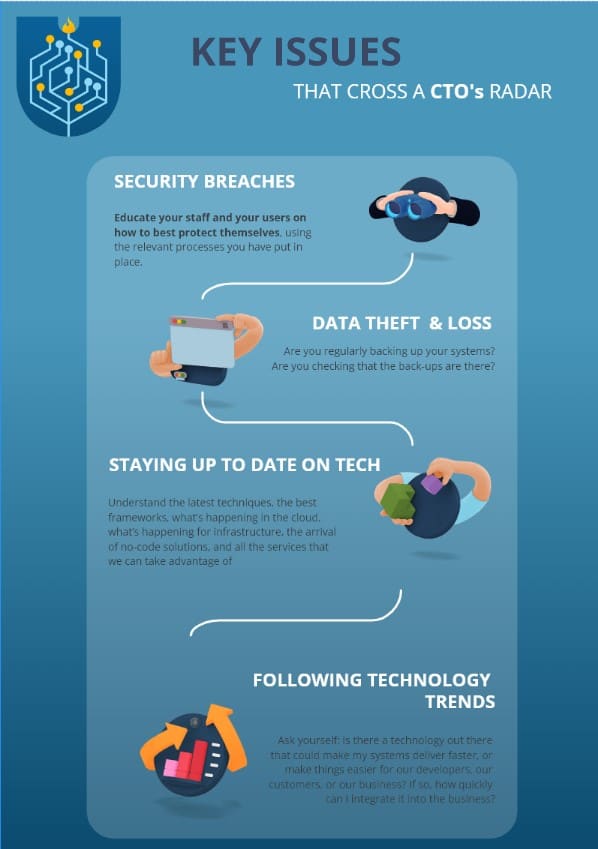
    Key issues that impact a chief technology officer
    4 key issues of every CTO

    Ten years ago cyber security was some way down the list of CTO priorities, but increasingly, today it’s amongst the most prominent. Security breaches, whether internal or external, are a constant threat. As a CTO, you must make sure you have processes in place to deal with them.

    Security breaches

    That said, it’s virtually impossible to stop a breach because of the movement of technology. What makes it even harder is that a lot of breaches are made through social engineering.

    Your priority should be to educate your staff and your users on how to best protect themselves, using the relevant processes you have put in place.

    A recent case I personally experienced was where a developer accidentally leaked an API key that gave users unauthorized access to systems. The security measures we had installed immediately picked up the problem and shut it down.

    All the API keys were changed and we quickly confirmed that nobody had used that particular API key whilst it was in the wild for a few minutes. There was no panic because processes were in place.

    Data theft and loss

    Another issue that might cross your radar is data theft. This can be malicious, with somebody hacking in a security breach. Or it could be something as innocent as a user with an API key that knows how to breach the limitation and get more information. Having tracking mechanisms and automatic stops in place will prevent that.

    Data loss is another important issue so do ask yourself occasionally:

    • Are you regularly backing up your systems?
    • Are you checking that the backups are there?

    It’s something that very few people actually do, though they often say they do.

    Staying up to date on the tech

    Even though I’ve got a few years under my belt as a CTO (maybe because I have a few years under my belt) I always want to be up to date on tech, both generally and within my immediate area of expertise. I need to understand what’s going on.

    I also need to understand:

    • The latest techniques
    • The best frameworks
    • What’s happening in the cloud
    • What’s happening to infrastructure
    • The arrival of no-code solutions and all the services that we can take advantage of to make our product faster, smoother and better for customers.

    This leads me to consider on a regular basis whether I’m using the right tech. In other words, am I building a system on the correct frameworks and languages to meet the requirements of the customer? Quite often I come across projects where they’ve built a generic web system, let’s say in PHP, that falls short of what the user needs.

    Staying abreast of technology trends

    One of the reasons you need to delegate is to create a sufficient amount of time for you to understand longer-term strategies and technological innovation.

    If you’re behind the laptop and micromanaging your team, you will struggle to create the headspace to gain insights into technology around the corner and how it may impact your company and sector. You must be up to date with the latest technology and avoid being too internal. That’s for the CIO when your company gets big enough to have both positions!

    The CTO has to constantly ask, is there a technology out there that could make my systems deliver faster, or make things easier for our developers, our customers or our business? If so, how quickly can I integrate it into the business?

    You need to set aside some time to identify the latest trends in technology and differentiate between hype and reality. This enables you to make an educated decision on whether to incorporate new technologies, rather than jumping on a headline or bandwagon.

    Are you using the right technology?

    The CTO must ensure that the company is using the right frameworks and back-end servers to support it.

    For example, as a database grows, you may find that relational databases aren’t the right architecture to use. Hence, you may move up to a data warehouse, or maybe an OLAP cube or Elasticsearch.

    There are always too many options and countless choices. You may not be an expert in a particular piece of tech, but you need the space to understand what benefits it could provide.

    In addition, maintain your professional development in terms of your leadership and management skills. Here at CTO Academy, we recommend carving out time for short online courses and 1:1 coaching… well, we would say that wouldn’t we!

    Missing deadlines

    Another common issue is missing deadlines, even though they can happen for a myriad of other reasons.

    The causes for delays can be:

    • Incomplete specifications
    • Not fully understanding as a business what is required from a build.
    • The people needed in the development process may not be available when you want them.

    You must communicate — very clearly — the deadlines that you believe you can achieve. This should provide the basis for the decisions made by the rest of the business. It will also ensure that the sales and marketing team aren’t over-promising on specifications and timelines.

    It’s especially the case if you use third-party suppliers. They may be suppliers who are reliant on your software or who give you software. For those suppliers that provide you with software, you need to understand their development processes and their reliability.

    I’ve had dealings with suppliers where the quality of their data was subjective at best. And, which is far worse, their delivery was intermittent.

    Being flexible

    Another area that causes significant conflict is sales team deadlines.

    These are often driven by challenging targets and attached bonuses. It’s not uncommon for salespeople to make promises to clients that are unattainable or put a significant strain on the technology team.

    The sales team wants to close the deal. So they might say that certain functionality is going to be available immediately or ahead of what is realistic. That’s why you, as a chief technology officer, must have regular conversations with the sales team. You want to ensure they’re not over-committing your team and, thus, prevent disappointing the customer.

    But you also don’t want to be the person who always says, ‘No, it can’t be done’. So, stay flexible and try to accommodate the needs of the salespeople. Because it’s them who help bring in the customers the business needs.

    Over-reliance on individuals

    A very common problem for CTOs in businesses large and small is a reliance on one or two individuals who dominate stand-ups and retain critical elements of knowledge about the software.

    Because of this imbalance of power, those individuals might also become difficult and disruptive. However, you can’t just get rid of them because they have the knowledge you depend on.

    This is one of the trickier management tasks you can face, so you need to employ the right preventative strategy.

    The best plan is to double up. In other words, ensure:

    a) knowledge sharing, and

    b) that nobody becomes too important and has too much power or influence.

    The way you manage disruptive team members will define your success as CTO.

    What is a CTO salary?

    A recent report by Reed provides insight into the expected earnings for London-based tech leaders in 2023.

    According to the report, those working in companies with fewer than 1,000 employees should earn £96,080 per annum plus a 12% bonus in the private sector. In the public sector, on the other hand,we are talking about £75,950 with a 27.90% pension addition.

    However, in the United States, the figures are somewhat different. For instance, heads of tech roles in US-based companies of a similar size are likely to earn an average salary of $170,000 in 2023 or $74.00 per hour.

    For more detailed information, use our salary calculator to see the averages across major world cities.

    What is a CTO job outlook?

    Trends and estimates are showing clear increase in demand for all types of contracts (eg fractional CTO jobs, full- and part-time, interim). Don’t forget that there are still a relatively large number of organizations that are undergoing digital transformation. Additionally, new tech start-ups are emerging on daily basis.

    They are all, eventually, looking for CTOs —the role that is quickly becoming crucial to success.

    Conclusion

    Becoming an effective chief technology officer is probably the number one target for most CTO Academy members. And it doesn’t matter if you’re en route to the top or already there.

    We’ve created a slightly light-hearted look at CTO life but tried to focus on the key changes that take place when arriving in a senior role and what should and shouldn’t be part of your workload.

    It’s often a high-pressure role and the technology almost always stops with the CTO — a level of responsibility that some thrive on while others prefer to keep a lower profile.

    What is crucial is that you understand the leadership skills needed to be effective, work towards improving those skills and discard or outsource the rest.


  • Early Adopters – Wonderful but Dangerous

    Early Adopters – Wonderful but Dangerous

    Early adopters are magnificent people. Just don’t bet your house on them.  

    With the constant pressure around innovation and product development, you will often be in a position of having to ship out that product or launch that start up, before it’s perfect – anathema to many.

    But if you don’t get it out and test market reaction, you could be building something no-one wants and so the validated learning process, popularised with The Lean Start Up methodology, is a necessary hazard en route to getting it right.

    But as Reid Hoffman (founder of Linkedin and host of Masters of Scale) says “If you are not embarrassed by the first version of your product, you’ve launched too late.” 

    So the product gets shipped into the hands of the innovators and the early adopters, as defined by this famous innovation bell curve. 

    The innovators are the true pioneers, handling your early stage, minimum feature produce, perhaps as early as the prototype or MVP that helps you understand and address any obvious issues with the UX or functionality et al.

    Next wave are the early adopters, defined as “people who start using the product or technology as soon as it becomes available.  In theory, they help to spread the word and move your product towards that ‘kerching’ moment of hitting the mass market.

    They are wonderful for helping to drive innovation and change and traction and confidence.  Products generally don’t exist without them and they become central to your next stage marketing strategy and influencing the early majority, the people who want complete solutions and convenience, to buy.

    Early adopters are less price sensitive, less worried about bugs or an unpolished onboarding process (warm thanks to all those CTO Academy innovators who put up with our own ‘unpolished onboarding’).

    There is however, risk with early adopters. You can get very excited about their arrival but they should come with a health warning. Inhale too deeply and you’re at risk of heading towards the start up critical care unit because they can be too kind, too supportive and too forgiving of issues that could fail at scale. 

    They can give you a false sense of confidence with conversion rates and churn, data your CEO will be using to extrapolate into forecasting future growth but it’s data at risk of being corrupted by an early adopters more forgiving attitude to new products. The mass market will be much less forgiving.

    You might have designed something that works well at pilot but stumbles when migrated into a whole product solution based primarily on that early adopter feedback.

    You need early adopters to kick start a product but you should have mitigation measures in place to avoid over reliance and building products with flaws embedded that disable your ability to scale.

    This Forbes article suggests the solution is with Knowledge Workers the author Brad Sousa saying ….

    “As a CTO who focuses on collaboration and communication, I’ve learned that successful production rollouts depend on pervasive adoption. To accomplish this, the solution we provide must be easily consumed by knowledge workers who care more about completing their tasks than learning a new technology”

    Some further thoughts that might help you navigate the early adoption stage;

    1. Understand the difference between early adopters and the majority;

    2. Consider early adopters as a stepping stone but in need of further checks and balances;

    3. Measure everything. Then question the measurements. Then measure against earlier measurements;

    4. Avoid complacency and challenge every step of what you believe is a product:market fit. Can it deliver value at scale? Where are the potential pinch points with mass adoption?

    Recommended Further Reading

    That famous bell curve diagram comes from an iconic book, Diffusion of Innovations.

    The diffusion process consists of a few individuals who first adopt an innovation, then spread the word among their circle of acquaintances—a process which typically took months or years (certainly in the days when that book was first written) but which, with the internet and online connectivity, can spread far more rapidly today.  

    We’re writing this in the middle of Pandemic 2020 and about to start a Zoom call. Zoom is perhaps the classic example of how quickly modern products can break into that early majority. 

  • 5 Management Challenges For New Tech Leaders  & Where Mentoring Helps

    5 Management Challenges For New Tech Leaders & Where Mentoring Helps

    “as a new CTO I struggled with the jump from dev to management, especially at a time of growth and change at my company. It wasn’t always clear what that change needed to look like”

    These comments from one of our mentees is not untypical of the challenges faced, particularly by newly appointed CTOs and what we term Accidental CTOs.

    For many new and not so new tech leaders, this transition into leadership is riddled with many often unseen challenges so we’ve put together an article based around some of the most common issues faced by mentees, with some mentoring tips thrown in for free …

    1.Building High-Performance Teams

    You might have been part of high performing teams but now you’re in a position of having to build one, a daunting prospect for many.

    There is an assumption (and sometimes a reality) that tech leaders and managers aren’t the best at or indeed, are uninterested in people management. One of the key blockages for companies finding effective tech leaders is the lack of soft skills and in particular skills relating to people management, that missing human element.

    There is in the modern workforce the added element of managing remote teams. Our team here at CTO Academy is remote and whilst we are firm believers in the value and impact of remote teams, it brings with it different management challenges in particular how to create a cohesive unit, pulling in the same direction, when you don’t have that regular human contact?

    Tech is made by humans for humans – if those responsible for crafting these technologies don’t perform well as a team, long-term success is less likely and if responsiveness and innovation are core values of the tech industry, they’re less likely to be achieved without highly engaged and empowered teams.

    Mentoring tip: Don’t hire people only for their skill and talent. Be mindful about culture fit and include your team within the interview process. There’s sufficient empirical evidence to show that if team members are not working well with each other, the impact is directly felt by that piece of tech they’re working on together!

    2. Moving From Team Player to Tech Leader

    If you’re the new CEO of a tech company, chances are you have gained that place rightfully because of your performance and skill. However, as a leader, the focus shifts from what you can produce to what you can inspire others to produce. You move from the technical to the managerial and if you’re a new tech leader struggling to inspire your employees, you’re not alone. A staggering 93% of tech leaders admit they require management coaching.

    Mentoring tip: Learn to delegate. You can’t sit behind the keyboard anymore, you have to relinquish some/all of the technical and focus on being a manager. Expand your awareness about yourself and your team members. Just as you understand your strengths and weaknesses, dive deeper into the skills, challenges, and traits of your employees. This helps you personalise your management according to each person’s personality.

    3. Effective Communication

    Communication, that old chestnut. If there’s one issue that recurs within our courses and mentoring, it’s communication.

    If you can’t clearly and effectively communicate to your team members what needs to be done, you could be losing out on big wins.

    And we’re not talking here about your ability to public speak or hold a room, an argument, a stand up. It’s about authenticity, judgment, clarity, consistency and listening. So much of good communication is wrapped up in good listening.

    Strong communication skills are also super important when communicating with your executive team and CEO, many of whom might be non-technologists. You need to reduce tech speak and tech team acronyms to find a vocabulary and clarity that avoids misunderstandings and skewed expectations at board level.

    Mentoring tip: Learn to listen, allow others to voice their opinions and make them feel heard. If they know their opinions are considered, they will be more willing to support a decision even if they were initially against it. Speak with clarity and consistency across the business.

    4. Stress Management

    If you want to avoid bouts of stress and anxiety, then a tech leadership role might not be for you but you will need to manage those moments and if necessary, take your foot off the gas.

    You need to be able to spot signs and have an outlet, if the burdens of leadership start to overwhelm you. It happens to the biggest and the best, there should be no embarrassment or shame in putting your hand up for help.

    Because stress can quickly build up and not only affect your productivity, performance and decision-making skills but very quickly impact on other personal areas of your life.

    In addition as leader, you need to have strong guidance in place for employees on how to manage their stress.

    Burnout is a formidable enemy of the tech industry, with the relentless pace, tight timelines and short project cycles putting intense pressure on tech teams and leaders.

    Mentoring tip: Understand the factors that trigger stress and anxiety, for you and for others, and actively work to eliminate them. Train your employees to practice mindfulness – among other techniques – to mitigate the physical and mental effects of stress and emotional exhaustion. Make sure you have checks and measures for yourself and by extension for your team.

    5. Process & Systems

    We’ve left this to last but it’s perhaps the number one issue our new CTO mentees face. Without the right processes and systems in place, they can be easily overwhelmed by the sheer weight of the tasks in front of them.

    An absolute key element of any CTO role is to oversee the development and correct operation of information systems from the point of view of execution, though in some larger companies there is crossover here with the CIO role.

    Generally though the CTO is responsible for the technical teams, the process and implementing new strategies to improve the final product. The Start Up CTO or Accidental CTO will often have to create these systems and processes from scratch and if the team/business is experiencing rapid growth, that’s a super daunting task.

    Mentoring tip: This is probably the area our mentees, particularly at early stage companies, need more help with. Understanding what is important, what can be left for now, what can wait for tomorrow. Understanding how everything fits together and the why, where and how of prioritising.

    Mentoring is not just for senior executives

    Some might think that mentoring is only for large companies and senior executives but CTOs at all levels feel vulnerable with the weight of decision making and a sense of vulnerability at the top.

    Most senior executive roles crossover where incumbents often run ideas and brainwaves past colleagues but for many CTOs, particularly if the board is full of non-technologists, that outlet doesn’t exist and they can often feel isolated.

    Mentoring provides you with an experienced, objective and reassuring outlet for your day to day pressures. We know the impact it can have on the operational day to day for CTOs, particularly early stage and inexperienced CTOs.

    For some of the challenges listed above and many more that will cross your desk, mentors can be a powerful ally.

    If you’d like to find out more about how CTO Academy mentors can help, visit the mentoring page on our website.

  • The Simple Guide To Saying No

    The Simple Guide To Saying No

    “When you say yes to others, make sure you are not saying no to yourself” – Paolo Coelho

    Why, despite a mountain of work and deadlines, despite knowing you have to leave at 6pm to watch the Avengers movie with your pals and despite dropping very large hints like “I’m under quite a bit of pressure at the moment, kind line manager”… is it still sometimes difficult to say no?

    Instead of the word ‘sorry’, Elton John should instead have sung “No seems to be the hardest word”, because that’s the truth for many, particularly at work and particularly when trying to get on.

    But if you want to transition from team player to tech leader then you have to build a thick skin as the pressure on your time only intensifies as you rise into those senior roles.

    So how can we deliver a positive “no”?

    Why We Struggle To Say No

    Because sometimes it’s a lot easier to say yes, there might be an imbalance of power within the request being made and fundamentally, people are quite nice to each other and the instinctive reaction is often to say “yes”.

    Saying “no” instinctively feels like a negative, a barrier being put up and with the risk of a particular relationship being tarnished.

    We also struggle to say “no” for fear of being misunderstood, of hurting others.

    Big thing for start-ups and entrepreneurs is that the fear of saying “no” is linked to the fear of missing out on an opportunity or hedging your bets on more than horse.

    And for some people, whilst being sure that “no”is the right word to use, become anxious about to deliver it and in what tone.

    Losing The Fear Of “No”

    No matter what the reason you’re worried about saying “no,” it’s fundamentally rooted in worrying about what’s going to happen when you make the denial.

    Will people still like you?
    Will you miss an important opportunity?
    Will you appear lazy, carefree, or incompetent?
    Will you tarnish an important working relationship?

    Being assertive about what “you” need is not a negative, indeed a confidence about your boundaries and a focus on what you have to deliver, will be recognised and should be applauded.

    To say “No” is not a form of expression of superiority; it should form part of a professional and honest working relationship, one cemented by mutual respect and understanding.

    The Art Of Saying “No”

    Like everything else in life, the way we talk can be far more important than what we talk about. Basic social skills tell you that an abrupt and hostile “No” is unlikely to win you many friends.

    So here’s your quickfire guide for saying “no”;

    1. Say “no” without saying “no”

    Learn the art of diplomacy. Offer sympathy for the request and perhaps offer to help another time but now, you have to focus, you have to finish, you have to leave. Leave “no” at home.

    2. Be honest, it’s much easier long term

    The more you say yes, the more likely you’ll end up in a situation of complete overload.
    The art of saying “no” is often down to the respect you build up within your team. If you’re recognised as a valuable member of the team who is able to deliver on a realistic workload, then honesty and a gentle response is a winner.

    3. Understand what’s within your capabilities

    Either in terms of time or expertise. It’s a risk to keep piling up tasks. Even more daunting if it’s not really in your key skill set.

    4. Whatever happens, never apologise.

    Oh no, you’ve been there. “I’m really sorry but ….”
    Truth is you’re rarely going to be sorry turning away that request for some late night data input.
    Firm but fair. That’s our motto for delivering the “no”.

    5. What about the boss?

    Surely my boss is going to receive preferential treatment when it comes to the “yes” or “no” question?
    Well, yes and no (see what we did there?).
    Clearly your line manager needs to be handled delicately but ultimately they should be your key supporters and if they’re a half decent manager (we know some of them are not) then he or she will recognise and expect you to be honest about it.

    6. Being pro-active 

    If you find a pattern starts to emerge about people or situations where extra demands are made of you, pre-empt and head them off as best you can. Post clear signals about your capacity – within a positive feedback environment. 

    7. Be humble and see if you can create space another time 

    Much of this comes down to your ability to communicate, with care and respect for others. Those seeking your help might be under severe pressure themselves and rather than being overt, are shouting out for assistance. Very rare you can’t find some common ground to help. Team dynamics and success is built around how you work with each other and very much, how you communicate positive and negative news.

    8. Create the right culture, Work for the right company

     If everyone is aligned and communicating clearly then this article is fairly moot. Managing high performance teams is not without its challenges but as a core principle you should expect “No” to become as much a part of that winning dynamic as “Yes” as the team storms, forms and norms its behaviours and expectations. You need to be working and/or leading a team who don’t have to overtly worry about issues like this. When moving into tech leadership roles, from scrum master to team lead to CTO, it’s your responsibility to build a culture of honesty and respect.

    We started with a Paolo Coelho quote that was about you being true to yourself and your instincts.  For the individual, the art of saying “no” is often bound together with the art of understanding yourself, who you are and where you should be.  

    The wonderful Brene Brown … “true belonging doesn’t require you to change who you are, it requires you to be able to be who you are”.

    Be who you are, work with the right team, around great people and you will have created a natural mechanism to deal with the “yes” and “no” question.

    Further Reading : The Art Of Saying NO: How To Stand Your Ground, Reclaim Your Time And Energy, And Refuse To Be Taken For Granted (Without Feeling Guilty)

    Find out more here about joining CTO Academy

    “They are very compact courses, with a lot of useful information and end of course tests that makes you pay attention to every word.  I really enjoyed them and plan to continue working with CTO Academy to build my own knowledge in these areas”

    Ratko Petrovic, Software Program Manager

  • What a CTO Needs to Consider When Choosing a Technology Stack

    What a CTO Needs to Consider When Choosing a Technology Stack

    When I was a developer, I was always drawn to the latest languages and frameworks. Even if they came with quirks, the excitement of working with something new made the challenges worth it. I’d spend hours setting things up—installing components, writing a simple app, deploying it with the click of a button—only to end up troubleshooting in the backend for hours.

    That excitement often landed me roles as the go-to expert, but in reality, I became more of a first-line support person.

    As a CTO, it’s critical to stay on top of trends, but jumping into the latest tech without caution can be costly. Is it worth losing man-days while your team gets familiar with a shiny new tool? Sure, they might enjoy exploring it, but at the end of the day, productivity is what counts, and that directly affects your budget.

    Key Considerations When Evaluating a New Framework

    When evaluating a new framework as a CTO, you need to balance technical excitement with practical reality. It’s not just about whether the technology is cool; it’s about whether it serves the business. Here are some key things to keep in mind:

    1. Developer Availability: If only a few developers know this framework, building and expanding your team will be a challenge. It’s not just about finding talent—it’s about finding affordable talent.
    2. Cost of Developers: Niche frameworks can lead to inflated salaries. If the framework requires high technical skill, expect to pay more. That might make sense for cutting-edge projects but could strain your budget in the long run.
    3. Framework Cost: Open source isn’t always free when you factor in support and integration. If the framework isn’t open source, look out for rising costs, especially if initial discounts for startups disappear once you grow.
    4. Setup Time: How long will it take for developers to get this running on their machines and set up for continuous integration? The time cost here is often underestimated, and the longer the setup, the longer until your team becomes productive.
    5. Deployment Complexity: Even though deployment processes have improved, certain frameworks still come with component compatibility issues. Hours lost troubleshooting deployment bugs can add up quickly, eating into project timelines.
    6. Fit for Purpose: Does the framework align with your company’s vision and long-term goals? It may be perfect now, but can it scale with you as the company grows?
    7. Scalability for Teams: When your team grows, you’ll want a framework that allows new developers to come up to speed quickly. Is the codebase structured in a way that makes this possible?
    8. Active Support: Even with open-source projects, active community support is crucial. You don’t want your developers spending more time fixing framework issues than working on your product.
    9. Security: Depending on your application, security concerns will vary. Ensure that the framework’s security components are robust and well-documented. You want to minimise vulnerabilities from the outset.

    Share Knowledge to Avoid Duplicating Efforts

    When introducing a new framework to the technology stack, one critical aspect to consider is how knowledge is distributed across your development teams. You don’t want multiple teams independently evaluating or learning the same new technology at different times. This can lead to inefficiencies, as teams repeat the same mistakes, face the same challenges, and burn unnecessary time and resources.

    To avoid this, establish a clear process for knowledge sharing:

    • Designate Early Adopters: Assign one team or a small group of developers to act as the early adopters. Let them take the lead in evaluating the framework, building prototypes, and working through initial challenges.
    • Document and Share Learnings: As the early adopters explore the framework, have them document their findings in detail. Encourage them to share not just successes but also pain points, setup procedures, and best practices they’ve discovered.
    • Internal Knowledge Sessions: Once the framework has been validated, hold internal knowledge-sharing sessions where the early adopters can pass on their expertise to other teams. This avoids each team going through the same learning curve and allows for a smoother transition.
    • Create Centralised Resources: Ensure all key insights, setup instructions and troubleshooting tips are centralised in a repository accessible by all teams. This repository should be kept up-to-date as the framework evolves.

    By fostering this culture of knowledge sharing, you not only reduce the time spent evaluating new technologies but also ensure that your teams can move faster and more efficiently. It also helps you avoid fragmented implementations, where different teams might handle the same framework in inconsistent ways.

    Conclusion

    If you’re starting a new project, it’s essential to have a shortlist of frameworks that align with both your technical and business needs. Evaluate each one with a clear focus on the considerations outlined above.

    Ideally, if you’re looking to introduce a new framework into your existing technology stack, start small: have one developer or a small team build a simple prototype. This way, you can validate the framework’s suitability before fully committing to it.

    Finally, a word of caution: don’t just choose a framework because it’s your favourite or the one you’re most familiar with. Familiarity can lead to bias, and what worked in the past might not be the best option for your current or future needs. Thorough evaluation, based on both technical fit and cost-effectiveness, is critical.

    Choosing the right technology stack is one of the most important responsibilities of a CTO. It’s a decision that affects not just your technical roadmap but your company’s overall success. By balancing innovation with practicality, you’ll ensure your team is set up for long-term success—both technically and financially.