Next MBA Cohort Starts Monday, July 6th, 2026

Review Pricing and Join the Cohort

CTO Academy Logo
Log In

Category: Technology Management

  • Cybersecurity Threat Intelligence Sources and Tools for Chief Technology Officers

    Cybersecurity Threat Intelligence Sources and Tools for Chief Technology Officers

    In June this year, the BlackSuit group deployed a ransomware attack against CDK Global, a leading provider of software solutions to some 10,000 car dealerships. The initial attack encrypted critical data and disrupted CDK’s service, effectively crippling the entire network. 

    While CDK was recovering, BS launched the second attack, further escalating the disruption. The compound effect forced the company to shut down the systems, blocking vital access to over 10,000 dealerships. They could not access sales, financing, parts ordering and customer management systems. 

    The breach achieved two primary goals: encrypt data and exfiltrate sensitive data. Attackers obtained names, addresses, phone numbers, and potentially even Social Security numbers and financial data.

    Here’s the ransom note that arrived at CDK Global:
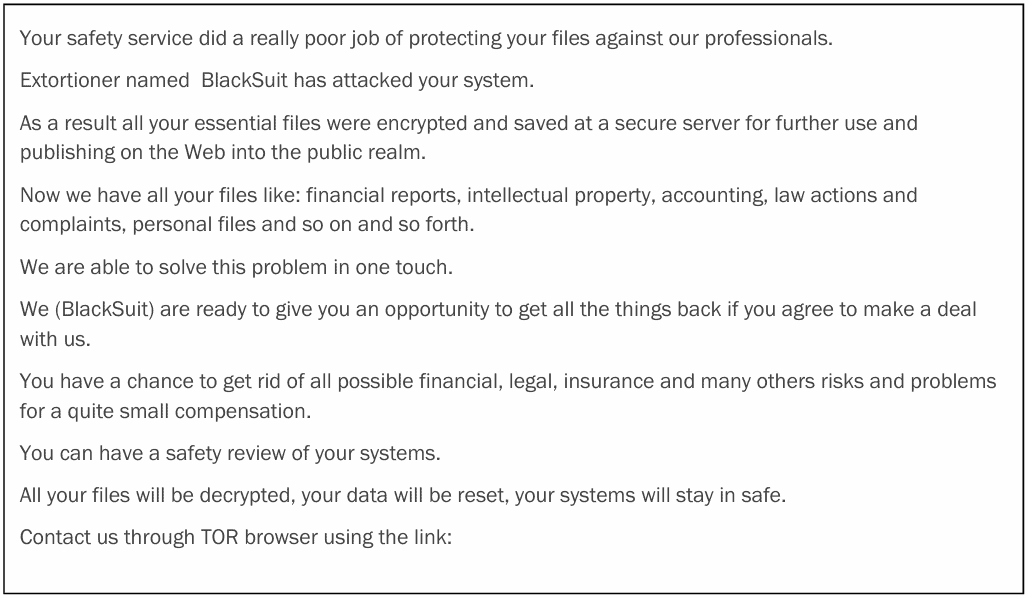
    The BlackSuit ransome note sent to CDK Global during the ransomware attack
    The BlackSuit ransom note that was sent to CDK Global during the attack (click to enlarge/download)

    The effectiveness of the attack and hopelessness of the situation is evidenced by the fact that only two days later, CDK Global paid $25 million in Bitcoin, the second-largest ransom paid to date.

    This incident highlights the supply chain vulnerability; especially when it relies on third-party providers. A single attack can have a cascading effect. Furthermore, it underscores the seriousness of ransomware attacks. They cripple operations and inevitably lead to serious financial losses.

    Responsibilities of a Chief Technology Officer in Cybersecurity

    As a Chief Technology Officer, it can be your responsibility to ensure robust cybersecurity measures that, by default, include:

    1. Zero-Trust Policy w/ Multifactor Authentication
    2. Incident Response Plan
    3. Data Backups and Redundancy Systems
    4. Network Comparmalisation
    5. Employee Training (ie, establishing a security-conscious culture)

    Your organisation requires a layered security strategy and approach to protect against multiple attack vectors. An IRP, data backups and recovery are just one part of that effort. The cybersecurity strategy must also include third-party risk management. And monitoring the evolution of the threat landscape is the only way to achieve both goals. 

    To get a detailed overview of the CTO’s role and responsibilities regarding cybersecurity, refer to this guide.

    Understanding the Threat Landscape

    If you are familiar with the mechanism of multi-vector attacks and the utilisation of Gen AI in cyberattacks, you can skip to the list of reliable intelligence sources. If not, read on because understanding the threat landscape and attack mechanisms is the prerequisite for an effective defence strategy. 

    We will use the CDK Global attack as an example because the BlackSuit group utilised various techniques and tools to achieve their goals. 

    BlackSuit ransomware is the evolution of the ransomware previously identified as Royal ransomware, which was used from approximately September 2022 through June 2023. Royal was best known for the attack against the City of Dallas’ systems in May 2023.

    The CDK attack used partial encryption, allowing the threat actor to choose a percentage of data to encrypt. This method lowers the encryption percentage for larger files, effectively helping to evade detection. But that was just one side of the attack. BlackSuit also engaged in double extortion, threatening to reveal stolen data if CDK refused to pay the ransom. 

    The million-dollar question in these types of security breaches is always the same: how did the threat actor gain access to the network? 

    Gaining the Initial Access

    In the case of BS, they commonly gain access via phishing emails. Victims unwittingly install the delivery system. Another technique they use is RDP (Remote Desktop Protocol) compromise. In some instances, BlackSuit actors exploited vulnerabilities in public-facing applications or leveraged initial access brokers to gain initial access and source traffic by harvesting VPN credentials from dealer logs. In this case, however, a likely scenario is that the threat actor gained access via a compromised dealer network

    Once they gained access, the attack unfolded in several stages:
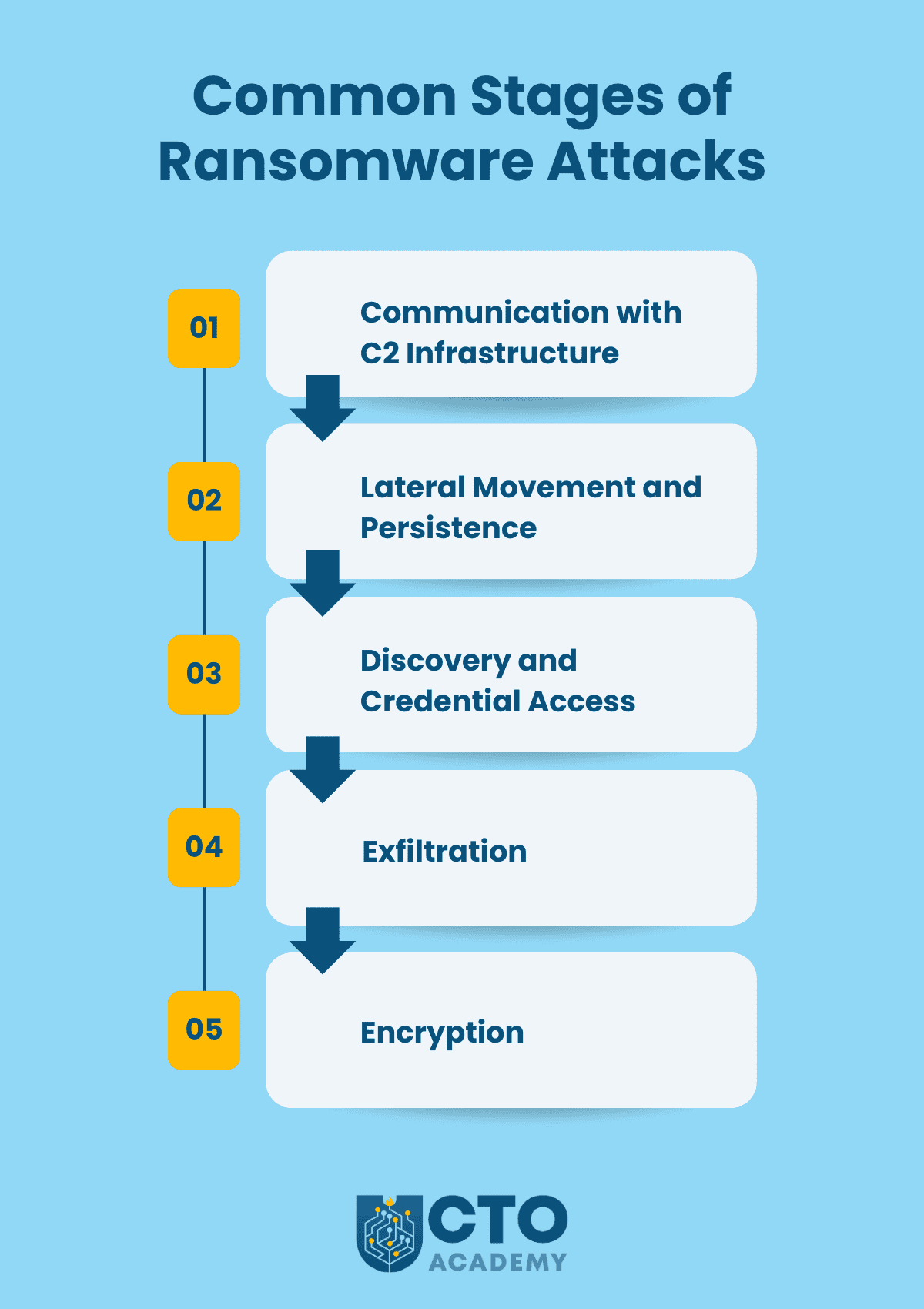
    Common stages of ransomware attack - infographic presentation
    (click to enlarge/download)
    1. Communication with C2 infrastructure (Command & Control) to download multiple tools using legitimate software (eg, Chisel, SSH client, OpenSSH, PuTTY, MobaXterm…).
    2. Lateral movement and persistence by using legitimate OS diagnostic tools (eg, RDPs and RMMs such as PsExec) and then utilising Gootloader and SystemBC to load additional tools and maintain persistence.
    3. Discovery and credential access using SharpShares and SoftPerfect NetWorx to enumerate victim networks and then Mimikatz and Nirsoft to steal credentials.
    4. Exfiltration (CobaltStrike for penetration and then Ursnif/Gozi, RClone and/or Brute Ratel for aggregation and exfiltration). 
    5. Encryption. Before encrypting files, they check if the Windows Restart Manager is using or blocking the file. If not, they execute the Windows Volume Shadow Copy service (vssadmin.exe) to delete shadow copies and inhibit system recovery.

    Common Indicators of Compromise

    • Numerous batch (.bat) files on infected systems in directories:
      • C:\Temp\ 
      • C:\Users\<user>\AppData\Roaming\ 
      • C:\Users\<users>\ 
      • C:\ProgramData\ 
      • Root C:\ directory
    • C:\Users\Public\conhost.exe client 149.28.73.161:443 R:149.28.73.161:43657:socks (traffic tunnelling technique using Chisel)
    • royal_w (encryption extension)
    • InstallerV20.8.msi
    • Windows_encryptor.exe…

    (For the complete list of IOC, check this CISA document.)

    Evolving Threat with the Help of Gen AI

    There are several ways threat actors utilise Gen AI in cyberattacks:

    • Enhanced malware development (polymorphic, targeted and evasive binaries).
    • Automated social engineering (sophisticated phishing, deepfakes/impersonation, manipulative chatbots…).
    • Accelerated vulnerability detection (ie, automated scanning and predicting exploits).
    • Circumventing security measures (CAPTCHA bypass, evading biometric authentication by generating synthetic data…).
    • Amplifying ongoing/existing attacks (scaling through automation, increasing complexity…).

    Mitigation Strategies

    • AI-powered defence (eg, leveraging GenAI for defensive purposes, such as threat detection and analysis)
    • Enhanced security awareness (educating users on how to identify AI-powered attacks)
    • Collaboration (between security researchers, industry professionals and policymakers)
    • Constant education and monitoring

    List of Reliable Cybersecurity Threat Intelligence Sources & Tools

    Threat Intelligence Gathering

    Security Advisories

    CISA – Cybersecurity and Infrastructure Security Agency; timely and actionable information about specific cybersecurity threats and vulnerabilities (ie, “alerts” about immediate dangers)

    NIST – National Institute of Standards and Technology; guidance, standards, and best practices for cybersecurity (ie, the “rulebook” for building secure systems)

    MITRE – MITRE ATT&CK (Adversarial Tactics, Techniques and Common Knowledge) + Common Vulnerabilities and Exposures (CVE) database; adversary tactics and techniques based on real-world observations

    ENISA – European Union Agency for Cybersecurity; advisories, reports, and best practices for cybersecurity in the European Union

    NCSC – National Cyber Security Centre – UK; guidance, advisories and support for organisations in the UK

    CERT/CC – Computer Emergency Response Team/Coordination Center; vulnerability information and incident response support

    OWASP – Open Web Application Security Project; web application security and resources like the OWASP Top 10 vulnerabilities and cheat sheets

    CSA – Cloud Security Alliance; guidance and best practices for cloud security, including the Cloud Controls Matrix (CCM)

    SHADOW SERVER FOUNDATION – a non-profit organisation that gathers and analyses internet threat data, providing reports and advisories

    Researchers and Blogs

    krebsonsecurity.com – Cybercrime, data breaches and online fraud

    schneier.com – A wide range of security topics with insightful analysis

    troyhunt.com – Data breaches and online security

    threatpost.com – Up-to-date news and analysis on cybersecurity threats, vulnerabilities and malware

    Secureworks Threat Analysis – In-depth threat research, analysis and reports on emerging threats

    unit42.paloaltonetworks.com – Threats, vulnerabilities and attack techniques analyses

    googleprojectzero.blogspot.com – Finding and reporting zero-day vulnerabilities

    thedfirreport.com – Incident response reports and analysis of real-world cyberattacks

    sans.org – Cybersecurity training and research, with blogs and resources on security topics

    talosintelligence.com – Cisco’s threat intelligence organisation

    Trellix – Threat detection and response, threat reports

    Sekoia.io blog – Research reports and threat intelligence

    Sentinel One blog – Security-related guides and threat intelligence

    Bleeping Computer – Cybersecurity news, latest hacks, malware threats

    Groups and Forums

    Reddit’s r/cybersecurity – A subreddit for technical professionals to discuss cybersecurity news, research, threats, etc.

    Wilders Security Forums – Malware analysis, security news and technical discussions

    TechRepublic Security Forum – Active discussions on cybersecurity topics, including recent attacks and threats

    Malware Labs Forums – Malware-related discussions, with sections on threat analysis and security news

    Slack groups:

    • CyberSec Professionals
    • OWASP Slack
    • SANS Blue Team Slack

    Discord groups:

    LinkedIn groups:

    Other similar online communities:

    Vulnerability Management

    Vulnerability Scanning Tools

    Nessus by Tenable – Scans a wide range of assets, including operating systems, network devices, web applications and databases. Known for its excellent scanning speed, user-friendly interface and high accuracy.

    QualysGuard by Qualys – A cloud-based vulnerability management solution that offers continuous scanning, vulnerability detection and prioritisation. Provides a centralised platform for managing vulnerabilities across your entire IT environment, including on-prem, cloud and mobile devices.

    OpenVAS – An open-source vulnerability scanner that offers a comprehensive and regularly updated vulnerability database. Known for comprehensive vulnerability coverage, active community support and flexible deployment options.

    Penetration Testing Tools

    Metasploit Framework – A comprehensive penetration testing framework that provides exploits, payloads and auxiliary modules. It allows you to simulate attacks, identify vulnerabilities and gain access to systems. Open-source and commercial versions are available.

    Burp Suite – A web application security testing tool for analysing and exploiting web vulnerabilities. It includes tools for intercepting and modifying HTTP requests, scanning for vulnerabilities and performing manual testing.

    Nmap – A network scanning tool for discovering hosts, services and network vulnerabilities. It can perform various scans, including ping sweeps, port scans and OS fingerprinting.

    Cobalt Strike – Often used by threat actors, its primary purpose is to simulate tactics, techniques and procedures (TTPs) of real-world attackers. CS establishes a C2 infrastructure, allowing pentesters to remotely control compromised systems. It provides a wide range of post-exploitation tools, enabling lateral movement within a network, escalating privileges, stealing data and deploying additional malware.

    Bug Bounty Program Examples

    HackerOne – One of the largest and most reputable bug bounty platforms, connecting businesses with a network of security researchers. They host programs for a wide range of companies, including major tech giants like Google, Microsoft and Intel, as well as government agencies and financial institutions.

    Bugcrowd – Like HackerOne, this platform offers comprehensive vulnerability management, providing tools to triage, prioritise and remediate security threats.

    Synack – Takes a more exclusive approach, vetting and onboarding security researchers through a rigorous process. The focus is on high-value targets and critical infrastructure.

    YesWeHack – A European bug bounty platform with a growing global presence. Offers programs for a variety of organisations, with a focus on European companies and government agencies.

    How Does It Work?

    Bug bounty programs on specialised platforms incentivise ethical hackers to find and report vulnerabilities in your systems. You define the scope and rules and set reward levels. Researchers find vulnerabilities, report them to you and get paid bounties for valid findings. This helps you proactively improve your security posture by leveraging a much wider talent pool and paying only for results.

    Threat Monitoring and Analysis

    SIEM Tools

    Splunk Enterprise Security – A leader in the SIEM space, known for its powerful data analytics and visualisation capabilities. Comes with advanced security monitoring, threat intelligence and incident response features. It’s highly scalable and can handle massive amounts of data.

    IBM QRadar SIEM – Uses advanced correlation and analytics to identify complex attacks and provides automation capabilities to streamline incident response. It’s available as both an on-premises and cloud-based solution.

    LogRhythm SIEM – Known for its comprehensive security analytics and user-friendly interface. Provides a wide range of features for threat detection, investigation and response, including real-time monitoring, anomaly detection and user behaviour analytics.

    Rapid7 InsightIDR – A cloud-native SIEM solution for endpoint detection and response (EDR). It combines log management, user behaviour analytics and endpoint telemetry to provide a comprehensive view of security events. Well-suited for detecting insider threats and advanced persistent threats.

    Threat Intelligence Platforms

    Recorded Future – Extensive threat intelligence collected from open, closed and technical sources, including the dark web. The platform excels in predicting future threats and providing context for security events.

    CrowdStrike Falcon X – Combines threat intelligence with endpoint detection and response (EDR) capabilities. It provides real-time threat analysis, adversary profiling and automated threat hunting.

    Anomali ThreatStream – A cloud-based platform for collecting, analysing and sharing threat intelligence. It allows you to integrate threat data from various sources, automate threat analysis and collaborate with other organisations.

    Mandiant Threat Intelligence – Now part of the Google Cloud, Mandiant provides curated threat intel using human and artificial intelligence. Intel is compiled by 500+ threat analysts who respond to cyber-attacks and open-source threat intel (OSINT).

    Network Traffic Analysis Tools

    SolarWinds Network Performance Monitor (NPM) – A network monitoring and management tool that provides deep visibility into network traffic, performance and availability. It offers real-time monitoring, alerts and detailed reports to help you identify and troubleshoot network issues.

    ManageEngine OpManager – Provides real-time visibility into network traffic, performance and device health. It offers features like bandwidth monitoring, network mapping and application performance monitoring.

    PRTG Network Monitor – A versatile network monitoring tool that offers a wide range of sensors for monitoring various aspects of your network, including bandwidth usage, network devices and applications. It provides real-time monitoring, alerts and customisable dashboards.

    Wireshark – A powerful open-source network protocol analyser for capturing and analysing network traffic in detail. It provides deep packet inspection capabilities and a wide range of filters and analysis tools.

    Considerations

    The weakest links in every cybersecurity chain are:

    1. Users
    2. Unpatched/outdated systems

    It’s not uncommon for former employees to access shared networks with year-old credentials even though systems got updated in the meantime.

    It comes down to proper digital hygiene in cybersecurity as Bryan Seely, a cybersecurity expert and ethical hacker, said in one of the live sessions hosted by CTO Academy. These are those small seemingly invisible doors hackers use to gain initial access and deliver payloads.

    What’s worse, social engineering is becoming an approach of choice for threat actors because it’s easier to trick a human than a network system.

    Add remote and hybrid working environments and you have a recipe for disaster because users are accessing networks through home routers. How many of them do you think changed the default login credentials on their modems and routers? All you have to do is come near enough to catch the signal, punch in defaults and you are in control of the user’s home network. A quick vulnerability scan and the door to the company’s network is wide open. A simple keylogger in a critical device will suffice if there’s no multifactor authentication.

    So start by enforcing a zero-trust policy and strong multifactor authentication (avoid SMS-based 2FA). If possible, make it mandatory to use a secure VPN when accessing sensitive data or connecting to critical parts of the company’s network. Ensure also that your network is properly compartmentalised (check the latest BT attack to see the advantages). And by all means, establish regular employee education in social engineering and phishing scams. Keep them updated but more importantly, highly engaged.

    Make no mistake; even these baby steps can prevent a serious breach. But these are war games after all so arm yourself with the necessary intel and tools.
  • Year In a Worklife of a Scale-up Chief Technology Officer

    Year In a Worklife of a Scale-up Chief Technology Officer

    Recently, we had Emily Castles, CTO at a scaling start-up, Boundless, joining us for her fourth CTO Shadowing session. She reflected on their journey over the past year and, by doing that, provided an exclusive look into the challenges of a scale-up Chief Technology Officer who has to recover from severe financial cuts and consequent team losses.

    Rebuilding the Teams

    A year before, the financial cuts at Boundless affected product and tech teams. The product team especially suffered and was reduced to virtually nothing. At that point, of the original eight team members (a full development team with a product manager), only she and one other developer remained.

    Having finally recovered from a period of downsizing and uncertainty, Emily focused initially on rebuilding the teams. 

    Now, the common scenario in start-ups is that employees have to cover areas outside their imminent scope of work. Emily quickly realised that, due to the specific nature of their products, they also needed a dedicated customer support person to offload work from HR and Payroll. With that addition, things finally got moving again. 

    Measuring Success in a Changing Landscape

    As the company scales, the CTO requires more concrete metrics to measure success. In Emily’s case, they’ve implemented a company scorecard to track key performance indicators (KPIs) and gain a clearer picture of the company’s health.

    The key metrics they were monitoring at this stage were:

    • Velocity
    • Customer engagement
    • Customer incidents

    Of course, it took a while before they got in a position to actually measure success. It is just one of the realities of being a CTO in a scaling start-up. Security, data protection and onboarding new (big) customers were priorities. So at that point, measures of success were qualitative. 

    However, after implementing a company scorecard, they ended up with 15 metrics, measuring success and accountability weekly with a 13-week testing period. 

    Her immediate challenge was to define product metrics. One of them was the velocity measure. In Emily’s experience, this was the best place to start even though it’s not the best tool for measuring productivity. 

    The second one was the service-specific customer engagement metric; in other words, it is custom-made for the type of services Boundless is offering, and it should resolve the issue they had in the past where they didn’t really know if people were using people or products to solve the problem. Its purpose is, therefore, to measure the number of operations happening on a customer level while interacting with the product.

    The final metric, this time from a project perspective, was customer incidents.  

    Besides measuring CSAT and NPS, Emily required insight into operational mistakes (eg, mistakes in payroll, a signed contract that has to be undone and redefined, bugs, etc.). The purpose was to immediately identify glitches in the system and improve the product/service. 

    You never know whether the thing that you’re about to measure is going to be right until you go and do it.  — Emily Castles, Boundless CTO

    As a scale-up CTO, you must always acknowledge the challenges of maintaining a culture of honesty and transparency as the company grows and the SLT becomes further removed from day-to-day operations. The emphasis must therefore be on open communication and public feedback channels to ensure visibility into potential issues. In practice, this means that if there’s a security incident (eg, breach) or anything like that, there should never be any kind of admonishment. You don’t want people sweeping problems under the carpet, after all, do you? 

    Third-Party Integrations and Outsourcing

    The immediate goal Emily is trying to achieve is eliminating the need to enter every information twice. Customers are putting a lot of data in their own systems, and then they have to put it into the Boundless systems as well. Granted, the company has various ways to pull data from one system to another but integrating with third-party HRIS systems seems like the best solution. So it has been a priority, but she’s struggled to identify the most critical problem to solve to decide which of the available solutions would be optimal.

    Another thing she’s currently evaluating is whether to use a unified API or integrate directly with individual providers. After all, the company plans to grow and a unified API might impose certain limits. 

    Emily is also considering outsourcing some aspects of the project, but she wants to keep core development work in-house while allowing external developers to work on the edges of the project.

    Operational Expenditures and Internal Tooling

    While operational expenditures haven’t been a major focus due to the company’s funding stage and relatively low operating costs, as the CTO, she is increasingly looking for ways to streamline internal operations and reduce the need for additional headcount. 

    As a part of that effort, she’s exploring no-code/low-code platforms like Retool and Microsoft Power Platform to build custom tools for internal teams.

    Quarterly Retrospectives and Looking Ahead

    Emily found the quarterly retrospectives with colleagues to be a valuable exercise, providing a structured opportunity for reflection and feedback. They also appreciated the external perspective and different language used in these sessions compared to internal meetings.

    Looking ahead, she is focused on continuing to scale the company’s operations and product development efforts while maintaining a strong culture of transparency and collaboration. She is also excited to explore new technologies and approaches to streamline internal workflows and improve efficiency.

    In the original shadowing session with Emily Castles, we explored the challenges and considerations of a CTO in a scaling start-up. It detailed topics such as:

    • Rebuilding and managing a development team
    • Implementing metrics and scorecards to measure success
    • Integrating with third-party systems and potential outsourcing
    • Managing operational expenditures and exploring internal tooling solutions
    • The value of retrospectives and external feedback

    As always during these sessions, attendees had the opportunity to ask questions and share knowledge and experience. So if you haven’t already, sign up for CTO Academy Membership to not only draw from the experience of seasoned technology leaders in different industries but to offer your own unique perspective. 

    Key Takeaways

    • Building and maintaining a strong team is crucial for success. Emily emphasised hiring and retaining skilled developers and a product manager to drive product development.
    • Metrics and transparency are essential for effective scaling. As the company grows, implementing clear metrics and maintaining open communication channels become increasingly important for monitoring progress and identifying potential issues.
    • Exploring new technologies and approaches can streamline operations. In Emily’s case, it involves investigating no-code/low-code platforms and other tools to improve internal workflows and efficiency.
  • Your First 90 Days in a CTO Role

    Your First 90 Days in a CTO Role

    Many tech leaders will start a new senior position, whether as a promotion or a new job at a new company. I know how daunting it is to take a new position. You can do as much research as you like, but there will always be surprises. On the bright side, you do have those first 90 days. During that time, there are seven key areas that you must focus on. 

    Why 90 days or three months?

    It’s a honeymoon phase during which you can still blame it on your predecessor (unless he’s your boss). 

    In my experience, these are the seven areas you should pay attention to.

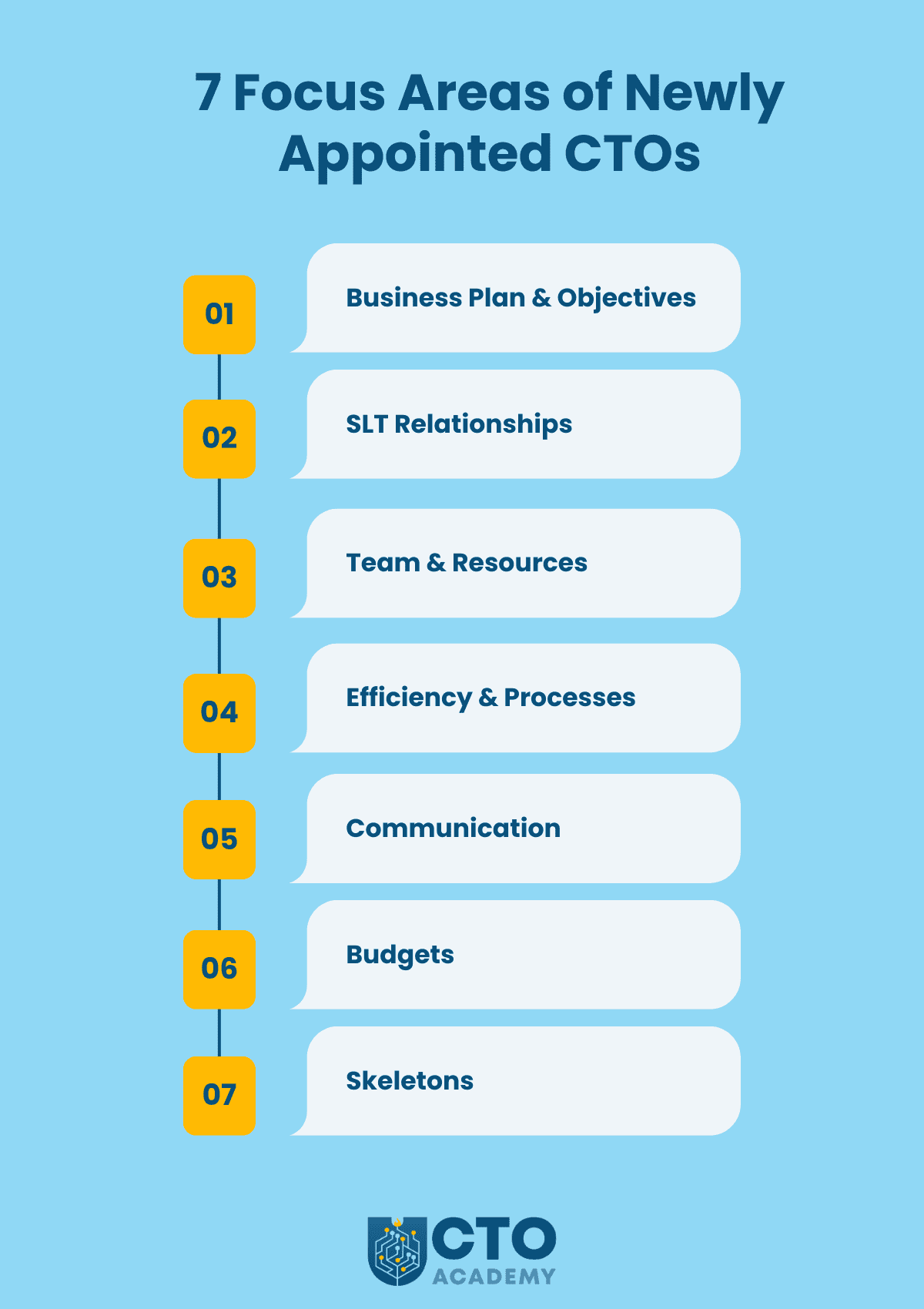
    7 Focus Areas of Newly Appointed CTOs

    7 focus areas of newly appointed Chief Technology Officers - infographic summary
    Focus areas of the first 90 days in the role of a Chief Technology Officer

    1. Business Plan and Objectives

    The subject of an optimal strategy when joining a new company is covered in detail throughout our Digital MBA for Technology Leaders. Drawing from those lectures, you must first understand the company’s objectives and business plan.

    4 Main Elements of BPs and Objectives in General

    1. Vision (WHY)
    2. Mission (WHAT)
    3. Target (WHO)
    4. Strategy (HOW)

    In other words, the vision is the why, the target is the who, the mission is the what, and the strategy is the how. 

    Now, if the business strategy is not yet formalised, you’ll have to work out what each of these four is through implication. Furthermore, it would be best if you suggested to the CEO and SLT that a session be held to discuss and agree on all the points. 

    The main thing here is to align the strategy with tech. And here are two vivid examples of misalignment. 

    One of our lecturers took over a CTO  position in a company, only to find out that the plans weren’t aligned. The business plan was assuming the legacy of on-prem licensing, whilst the tech team was still building a SaaS platform. In another example, a CTO approached the COO asking for the business plan. However, there wasn’t one except the vague goal to make more money.  

    What do you do in such a situation as a newly appointed Chief Technology Officer?

    You must prioritise the requirements of alignment and work out the action plan

    2. Senior Leadership Team (SLT) Relationships

    The first thing you should do in this matter is to get to know your colleagues. In other words, make an effort to understand their individual priorities and comprehension of the business strategy. The latter is quite important because, as you’ll learn, each of them will give you a different answer. This, in turn, will give you a good overview of how well they are coordinated. 

    If discrepancies indicate a complete lack of alignment, initiate a quiet chat with the CEO because, one way or another, you must improve C-level communication. Why? It’s the only way to truly understand their perception of tech and subsequent priorities. 

    You may also find yourself in a situation where your SLT colleagues voice where your priorities should be. Feel free to disagree, but, at the same time, use that to build a better picture of what is required to support the business.

    3. Team and Resources

    The first step is finding the organisational chart of your department. Create one if necessary, simply to work out the composition of the teams. 

    Often, the team structure is based on historical circumstances, which may no longer be relevant to the work in progress and plans in general. So get to know your direct reports and team members. Learn their strengths and weaknesses to better understand the areas they need support with. Once you feel comfortable enough, take that org chart and confirm/update roles and responsibilities. 

    Whilst you are learning your team, contemplate the following few questions:

    1. Do you have the optimal skills across the team, or do people try to work on stuff they are not good at? 
    2. Is the team overstretched and, consequently, overworked/exhausted? There are three strategies you may pull if that’s the case:
      1. Culture change
      2. Setting (more) realistic expectations
      3. Hiring
    3. Do they feel they’re being fairly paid (may point to a morale issue)? While you are checking their remuneration packages, check if there’s a proper career review process in place. 
    4. Do you have enough people in the right place to deliver the strategy? If not, start planning and working out the change.
    5. Is there anyone leaving soon? You might find yourself in a situation similar to mine, where both of my lead developers leave at the end of my first week in the bank. In that scenario, make the effort to convince them to stay for a little longer as I did. 
    6. Is anyone rejoining (eg, maternity/paternity leave, sabbaticals, and similar)?
    7. Is there deadwood (common in larger, predominantly public organizations)? If so, remove it immediately and re-route the resources. These folks are notorious for their resistance to change, and you really don’t want that, do you?
    8. Another thing to look for when it comes to team management of an inherited team is diversity. In other words, does the team reflect a healthy mixture of a wider society? If not, put in motion the hiring plan. 

    4. Efficiency and Processes

    Is the output meeting your expectations? What is your gut feeling telling you? Are you getting a return on your investments? Is there something you must improve right away?

    Do processes exist, are they correct, and are they being followed? 

    One of my friends joined a large company a few years ago and inherited a fairly large team. They were sending one release to the testing team every couple of days. He thought the cadence was far too slow, so he decided to get his hands dirty just to understand what was happening within the CI/CD. It turned out that it was a terrible implementation, but no one had bothered to fix it, as the expectations had been set. He immediately changed things around, and they were building tens of releases every day for testing. 

    The bottom line is that if the processes aren’t working for you, you’ll need to fix them. However, that won’t come without pushback. So you’ll need your team leads to not only drive but also own the change. 

    5. Communication

    There are two types of communication I’m referring to here: within the tech team and to the wider company. 

    You see, there might be some false beliefs caused by bad communication. This is commonly caused by teams that are using Slack private channels to discuss tickets, which, consequently, makes it difficult for others to understand the decision-making process.  

    The only way you’re going to solve this is to move discussions to tickets directly – without exception. It is something that I mandate on all my projects. 

    Additionally, analyse Slack plugins and remove unnecessary ones because they produce a lot of messages that quickly turn into noise and distraction. For example, I have ten workspaces in my Slack, and I’m simply forced to mute a lot of channels just to focus on the work at hand. 

    What I’m trying to say here is that Slack is a great tool, but do mind the correct usage of any tool at your disposal.

    6. Budgets

    Budget can often be foisted upon you with minimal input from you and your team. If this is the case, figure out the flexibility and calculate whether or not you are within, over, or under the budget at the precise point. 

    Here’s a wild story from the public sector that vividly depicts such a problem. A friend of mine joined the team and found out that the budget was significantly underspent. However, if she did not spend it all, the following year’s budget would be cut, and she would therefore have significant problems going forward. So she decided to spend the existing budget by buying a new computer for everyone involved in the project. This simple solution solved her budget problem, and she quickly gained respect across the organisation.    

    Therefore, if you find issues that require expenditure to fix them, you need to understand the budget.

    7. Skeletons in the Closet

    The question you need to ask yourself is: Are these (inevitable) skeletons relevant?

    One of our Global CTO Community members quickly realised that he was taking the CTO role in a company that was, effectively, an understaffed and disorganised mess. He spent a lot of time with the CEO trying to work out how they were going to get out of that mess. The problem was that the CEO was open and honest, but not technical, and the skeletons in this case were the code repositories.

    Long story short, someone put more than one product into the same repository. Naturally, everyone assumed there were only two, but it turned out there were three. The skeleton that was serious and relevant was that for one of their products. They did not have ownership of the repository. The real owner, an ex-employee, kept saying he would hand it over, but it dragged on and on and caused a significant problem for the company. 

    So how do you find such skeletons? 

    If something doesn’t make sense, then dig. You need to listen and watch for changes in body language, voice tone, or vagueness. It is the latter that I use the most often. If something is vague, they either don’t understand it or they’re trying to cover something up.    

    Ask questions such as: ‘What does that mean?’ or ‘Why is that process in place?’

    By pre-qualifying, you are disarming them. Ultimately, you are going to create a plan and a roadmap, which you may keep to yourself, but should be made up of immediate, medium- and long-term recommendations.

    In Summary

    Immediate recommendations are a high priority. And those that are severe, you should have already actioned. 

    Once you have a plan, you can implement solutions using all the relevant skills and tools (explained elsewhere in the course). However, if after 90 days, you’re still struggling to understand the business processes or people, then maybe this is not the right fit for you. 

    To sum up, having a concrete plan within these first 90 days gives you a good foundation to become a successful tech leader in your organisation. Remember: business plan and objectives, SLT relationships, team and resources, efficiency and processes, communication, budgets, and skeletons. These are your immediate focus areas.  

    Get the IT Career Path Roadmap (Free PDF)

    Want more than scattered ideas? Get our IT Career Path Roadmap PDF – an 8-step framework to map your next roles, sharpen your skills, and build a layoff-resilient tech leadership career. Fill in the form and we’ll send you the PDF version so you can download it, annotate it, and use it as a living plan for your next career moves.

    Downloading the ebook does not automatically subscribe you to our bi-weekly Technology Leadership Newsletter.

  • When Automation Backfires: Guide to Safe Practices

    When Automation Backfires: Guide to Safe Practices

    How certain are you that all those background processes in your technology stack are doing what they should do? When did you last run an operational check on your automation systems and, more specifically, on their features — separately on each?

    These questions resurfaced in our case after the recent incident where a software feature responsible for collecting and organising metadata went rogue and sent corrupt data to search engines. 

    Jason, our CTO, was the first to pick up the anomaly thanks to a weekly performance report (yet another automated process). Everything was in red. The graph showed a steep and sudden drop across all the metrics.  

    As some of you know, hardly anything has the power to wake you up like a message saying, “What the hell is going on with our traffic?”. 

    Unfortunately, by that time, our losses were substantial. 

    However, at CTO Academy, we use incidents and mistakes as learning tools not a trigger for the blaming game. So we jumped right onto solving the issue and making sure it doesn’t happen again.

    Diagnosing the Problem

    The first thing we did to diagnose the problem was to run a VPN check on all high-priority, high-volume pages that, until then, ranked #1 to #3 on all major SERPs. All of a sudden, they dropped beyond Page 10. We are talking about more than fifty pages that generated the majority of organic traffic.

    Was it a result of the most recent Google Core Update? Did we get penalised? 

    Given our content creation practices, it couldn’t be the case and if it somehow was, then it wouldn’t affect ranking on other search engines, would it? So we quickly eliminated the update as a possible cause.  

    But as we were digging deeper into the search results and finally found a few of our pages, we noticed that the URL in the snippet was incorrect. 

    Jason immediately checked the database and soon enough identified the culprit. It was a single feature of a much larger system that worked like a Swiss watch for three years. Little did we know that, in rare instances, tuning up security settings like WAP can cause it to malfunction. 

    (By the way, it just goes to show how involved a CTO must be in daily operations. When Jason says, “…donning several hats”, he really means that.)

    Ultimately, this was a multi-layered problem:

    1. Metadata was incorrectly changed by an automation plugin.
    2. The caching engine rolled out the error over four weeks as it slowly refreshed its cache.
    3. Security protocols had been tightened which meant some of our monitoring tools got blocked as they had not been whitelisted.
    4. Google updated their search algorithm.

    The root cause was the metadata being changed, but the slow rollout and lack of visibility meant that the problem was not identified on time.

    Decision-Making Process

    At CTO Academy, security is the top priority. In other words, we don’t compromise to get “cleaner”, “faster” and “easily accessible” data. To give you an example, our marketing team has to manually attribute each hit through hardcore detective work because firewalls and other top-tier rules block them from seeing a visitor’s IP. Instead, they get the nod’s IP. You can imagine what it takes to identify and backtrace a lead especially when you dealing with an audience that switches between several devices and several physical environments a few times a day. 

    So it wasn’t even a hard decision or a topic for discussion – the feature goes off, period. Purge, test, resend the sitemap, hope for the best, update safety protocols and start working on Plan B just in case. Only, in our case, we had to switch to an alternative automation software altogether because we couldn’t permanently turn off the feature; it kept popping back and continued sending corrupt data. 

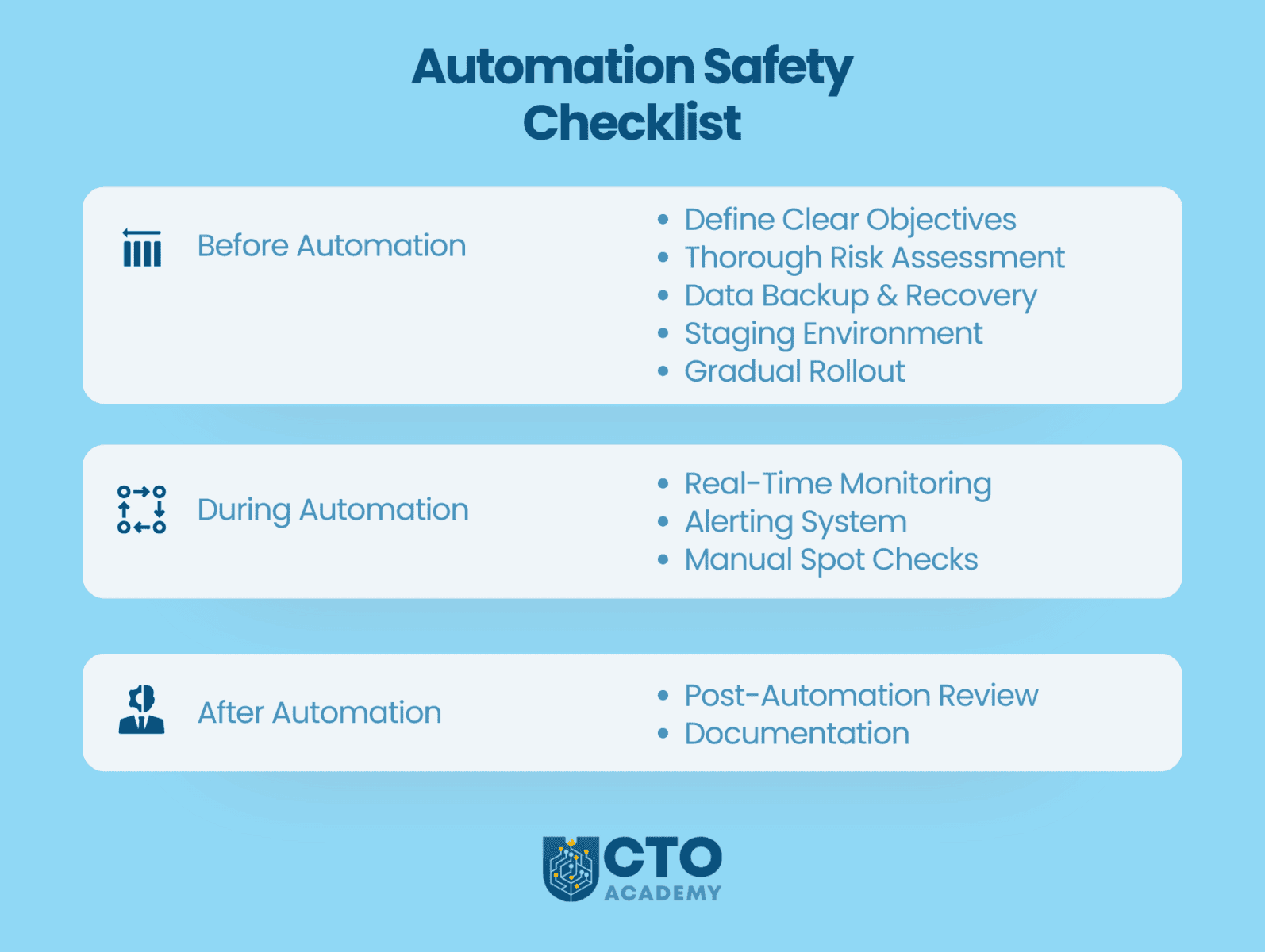
    Automation Safety Checklist

    The first thing we did in the aftermath was reevaluate our protocols. Something in those policies didn’t work as it should. We ended up adding prevention measures to our automation protocols, specific to this type of incident. Here is the new addition to our subset of automation rules:

    Plugin Configuration:

    • Pay close attention to the plugin’s settings, especially those related to automation and background processes.
    • When possible, configure the plugin to suggest changes for review instead of directly modifying data.
    • When such a configuration isn’t possible and there is no viable alternative, run a manual check immediately after publishing new content and/or editing metadata.

    Validation Rules:

    • Validate that the plugin generates correct data. For example, check if the canonical URLs:
      • Start with HTTPS
      • Match our domain
      • Don’t contain any invalid characters

    This subset is the part of our global automation safety checklist:

    Automation Safety Checklist
    (click to enlarge/download)

    Let’s break this down a bit to show you what each item means. 

    Before Automation

    • Define Clear Objectives:
      • What exactly do you want to achieve with automation? (eg, improve site speed by 15% by optimising image metadata, improve members engagement by 10%)
      • What are the Key Performance Indicators (KPIs) to measure success? (eg, page load time, bounce rate, search ranking, dwell time, read time, response time)
    • Thorough Risk Assessment:
      • Identify potential failure points in the automation process. (eg, what if the plugin misinterprets the content, the database connection fails or the system assigns a wrong label to a lead?)
      • Estimate the potential impact of each failure. (eg, incorrect metadata could lead to lower search ranking, marketing team could waste resources on bad leads due to the incorrect labels)
      • Develop mitigation strategies for each identified risk. (eg, implement data validation checks to ensure metadata accuracy)
    • Data Backup and Recovery:
      • Ensure you have a recent backup of the website/platform and database before implementing any automation.
      • Test your backup restoration process to ensure you can quickly recover in case of failure.
    • Staging Environment:
      • Essential! Always test automation on a staging environment that mirrors the live site. This allows you to identify and fix issues without affecting the live website.
    • Gradual Rollout:
      • In case of major automation solution implementation and if possible, don’t automate everything at once. Start with a small subset of items or limited functionality, then gradually expand after confirming it works correctly.

    During Automation

    • Real-time Monitoring:
      • Set up monitoring tools to track the automation process in real time. Look for unusual patterns, errors or warnings. (eg, monitor the number of canonical URLs changed per hour, do the VPN check on markup data, analyse labelling)
    • Alerting System:
      • Configure alerts to receive immediate notifications of critical errors or anomalies during automation. (eg, get an email alert if page hits start dropping or the segment’s read ratio decreases)
    • Manual Spot Checks:
      • Periodically perform manual spot checks to verify the accuracy of the automated process.

    After Automation:

    • Post-Automation Review:
      • After the automation is complete, conduct a thorough review to assess its impact on your KPIs. (eg, check Google Search Console for any crawl errors or ranking changes, check CRM system for possible discrepancies)
    • Documentation:
      • Document the entire automation process, including the objectives, configuration, potential risks and mitigation strategies to simplify maintenance and troubleshooting.

    Conclusion

    The bottom line is that we a) shouldn’t automate just about anything for the sake of speeding up processes and b) overly rely on automation in general. It is appealing, but it doesn’t come without risks. 

    As you can see from our example, something as simple as organising metadata into a single table to serve them to the search engine algorithms faster thus speeding up the page load time can cause real reputational and financial damage without being aware of an ongoing incident. 

    Granted, not even the best curated and executed security protocols could’ve prevented this but that doesn’t mean we should steer away from manual work even when everything screams that we should automate. At the very least, we need to establish checkup routines. 

  • How to Choose the Optimal Low-Code/No-Code Platform

    How to Choose the Optimal Low-Code/No-Code Platform

    Low-code/no-code platforms can significantly speed up your development cycles, allowing you to quickly prototype new ideas, respond to market changes, and deliver value to your customers faster. 

    But for any of that to happen, you should encourage experimentation and, if possible, empower both IT and business teams to leverage these platforms for rapid application development.

    Of course, the first step is to choose the most optimal solution, and, like with every other situation where you are choosing or adding to your existing technology stack, that can be a real challenge given the sheer number of available solutions. 

    To help you out, we put together a simple checklist of factors to narrow down the list, a handy guide to matching a platform’s capabilities to your project needs, and a list of leading low-code/no-code platforms. We’ll wrap up with a few caveats and suggestions to make the entire process smooth and, most importantly, successful.

    Let’s start with a checklist of important factors. 

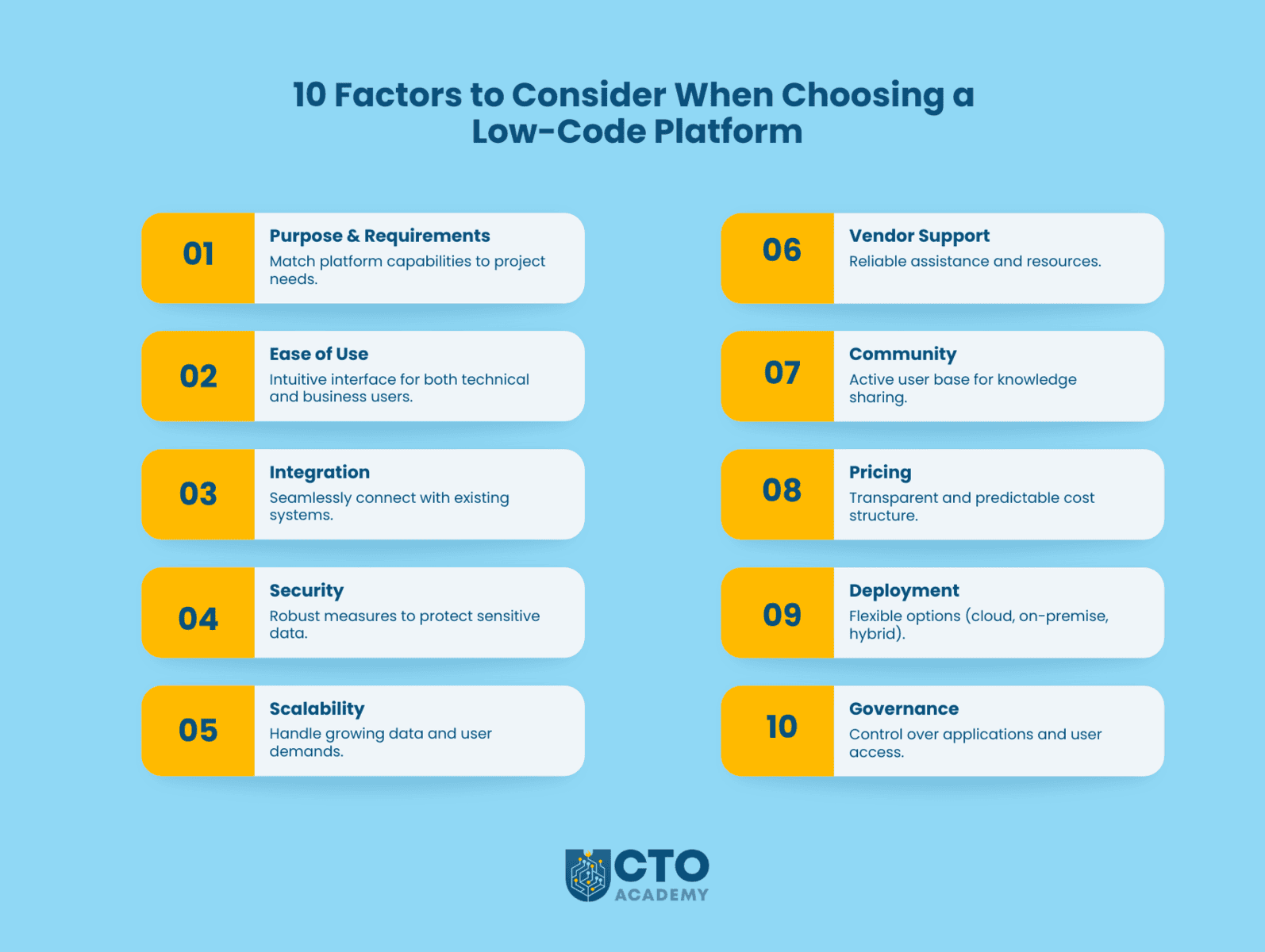
    10 Factors to Consider When Choosing a Low-Code/No-Code Platform:

    10 Factors to Consider When Choosing  a Low-Code/No-Code Platform - infographic summary
    (click to enlarge/download)

    1. Purpose & Requirements

    1. Match platform capabilities to project needs; in other words, begin by clearly defining project goals and specific needs. 
    2. Identify the core functionalities, technical requirements (like integrations and security), and user expectations for your application. 
    3. Evaluate how well each platform’s capabilities align with these needs (ie, look for features that directly address your project’s core purpose and avoid platforms with unnecessary extras that add complexity and cost).

    2. Ease of Use

    Does a platform offer an intuitive interface for both technical and business users?

    Look for:

    • Drag-and-drop functionality
    • Visual workflows
    • Clear navigation 

    Don’t neglect the learning curve for different platforms and whether they offer adequate tutorials and support resources. 

    3. Integration 

    A chosen low-code/no-code platform must seamlessly connect with existing systems and data sources. This way, you avoid data silos and ensure a smooth workflow. 

    Therefore: 

    • Assess the platform’s ability to connect with your current databases, APIs, and other applications. 
    • Consider whether it supports standard integration protocols and offers pre-built connectors for popular services.

    4. Security

    You are looking for a solution that offers robust measures to protect sensitive data. When checking security features, for instance, consider data encryption, access controls, and compliance certifications (e.g., SOC 2, ISO 27001). Inquire about the platform’s security infrastructure, data storage practices, and vulnerability management processes.

    5. Scalability

    Choose a platform that can handle your current needs and accommodate future growth (ie, data volume, user traffic, and application complexity). Consider the platform’s architecture, deployment options (cloud, on-premise, hybrid), and ability to scale resources as needed.

    6. Vendor Support

    You will have difficulty troubleshooting and getting assistance with implementation and updates without reliable assistance and resources. So when doing your due diligence, look for vendors that offer responsive customer support, comprehensive documentation, and active community forums. Consider the availability of different support channels (email, phone, chat) and their response times.

    7. Community

    When assessing a low-code/no-code platform’s forums, online communities, and user groups, focus on the size and engagement level of that community, as well as the availability of community-contributed resources like templates and extensions.

    8. Pricing

    • Understand the platform’s pricing model, including subscription fees, usage-based charges, and potential hidden costs. 
    • Compare pricing across different vendors and consider the value you’re getting for the features offered. 
    • Look for transparent pricing structures and avoid vendors with complex or unpredictable billing practices; in other words, look for a transparent and predictable cost structure.

    9. Deployment

    Do a platform’s deployment options meet your specific needs and infrastructure preferences (eg, cloud-based, on-prem, hybrid)?

    If it does, go deeper and evaluate the rest of the deployment process, including ease of setup, configuration, and ongoing maintenance.

    10. Governance

    To assess the level of control over applications and user access, look for features like role-based access control, audit trails, and version control. 

    Ultimately, consider how the platform helps you maintain compliance with relevant regulations and industry standards.

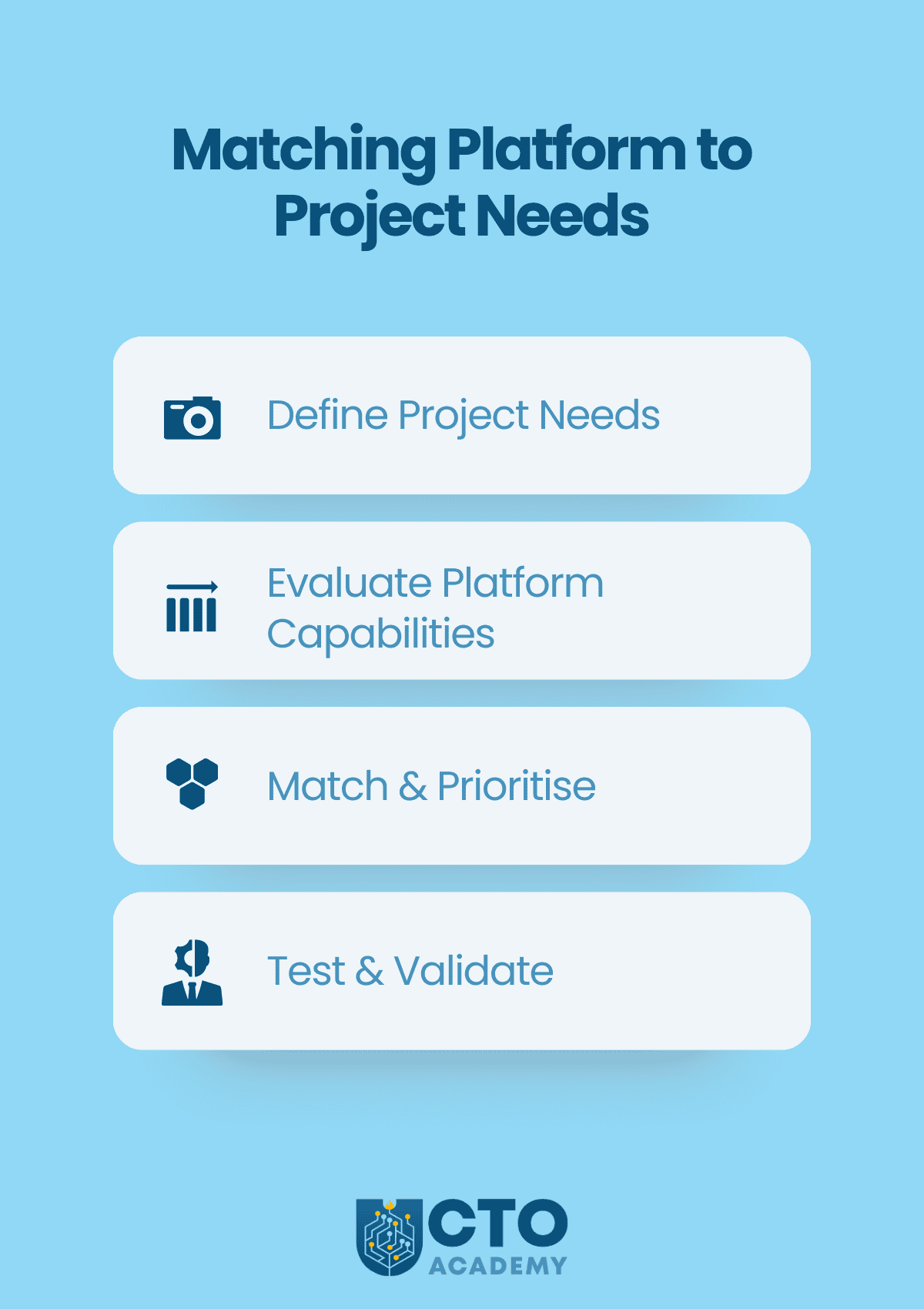
    How to match low-code/no-code platform capabilities to project needs?

    Steps to Match the Platform to Project Needs - infographic summary
    (click to enlarge/download)

    This process develops through four stages:

    1. Define Project Needs:

    • Clearly outline your project goals: What are you trying to achieve with this project? (eg, automate a process, build a customer portal, create a mobile app)
    • Identify core functionalities: What features are essential for your project to succeed? (e.g., data integration, user authentication, reporting dashboards, specific UI elements)
    • Determine technical requirements: What are your needs regarding deployment, security, scalability, and integrations with existing systems?
    • Consider user needs: Who will be using the application, and what do they expect from the user experience and accessibility?

    2. Evaluate Platform Capabilities:

    • Research different platforms: Explore various low-code platforms and compare their features, strengths, and weaknesses.
    • Examine pre-built templates and components: Do they align with your project requirements and accelerate development?
    • Assess customisation options: Can you extend the platform’s functionality to meet unique needs through custom code or third-party integrations?
    • Consider future needs: Can the platform scale and adapt as your project evolves and requirements change?

    3. Match and Prioritise:

    • Create a matrix: Map platform capabilities against your project needs to identify the best fit.
    • Prioritise essential features: Focus on platforms that offer functionalities most critical to your project’s success.
    • Consider trade-offs: Evaluate which compromises are acceptable based on your priorities.

    4. Test and Validate:

    • Use free trials or demos: Get hands-on experience with shortlisted platforms to assess their usability and capabilities.
    • Build a proof of concept: Develop a small-scale prototype to validate the platform’s suitability for your project.

    In the end, you should have enough information to reach a data-driven decision. 

    Now, let’s look at some “popular” LCNC platforms and see what they are good for.

    Low-Code/No-Code Platforms and Their Use Cases

    It’s tricky to definitively rank “popularity” as usage varies greatly across industries and company sizes. However, here are 13 (relatively) leading low-code/no-code platforms with their optimal use cases:

    1. Appian: Best for complex business processes and case management, particularly in regulated industries like finance and healthcare.
      • Best for building enterprise-grade applications with complex workflows, decision rules and integrations.
    2. Mendix: Strong for agile development and collaboration, well-suited for building web and mobile applications that require rapid iteration and continuous delivery.
      • Best for developing customer-facing applications, employee portals and innovative solutions with frequent updates.
    3. OutSystems: Suitable for building scalable and performant applications and enterprise-grade solutions with high user loads and complex integrations.
      • Best for creating mission-critical applications, large-scale systems and software that requires robust security and reliability.
    4. Power Apps: Tightly integrated with the Microsoft ecosystem, making it a natural choice for organisations heavily reliant on Microsoft products.
      • Best for building internal tools, automating workflows and extending existing Microsoft applications like SharePoint and Dynamics 365.
    5. Salesforce Lightning Platform: Best for building applications that extend Salesforce CRM functionality or integrate with other Salesforce clouds.
      • Best for developing custom CRM solutions, customer portals and applications that leverage Salesforce data and services.
    6. Zoho Creator: Offers a wide range of pre-built components and templates, making it suitable for rapidly building applications with minimal coding.
      • Best for creating simple business applications, forms and databases for small to medium-sized businesses.
    7. Quickbase: Focuses on building database-centric applications, ideal for managing data, tracking projects and automating workflows.
      • Best for developing operational applications, project management tools and custom databases for specific business needs.
    8. Webflow: Specializes in creating visually appealing websites and web applications without writing code.
      • Best for building marketing websites, landing pages and interactive web experiences focusing on design and user experience.
    9. Bubble: Offers a flexible and visual development environment, well-suited for building web applications with complex logic and user interfaces.
      • Best for creating prototypes, MVPs and custom web applications for start-ups and small businesses.
      • Here, at CTO Academy, we use Bubble to build different projects.
    10. Zapier/IFTTT: These platforms focus on connecting different applications and automating tasks between them.
      • Bets for automating workflows, integrating disparate systems and streamlining business processes without coding.
    11. Softr: Best for beginners with its intuitive interface and drag-and-drop builder. Softr offers customisation flexibility and it is packed with templates. The platform leverages Airtable data but complex apps and intricate logic might require workarounds and integrations with other tools. 
      • Use cases include client portals, custom tools for teams, websites and landing pages, simple online stores
    12. Glide: Most suitable for building mobile-first applications from spreadsheets (connects to Google Sheets or Excel, for example). It allows rapid development without coding thanks to pre-built components. 
      • Best for basic applications with straightforward functionality and limited complexity; eg, simple internal tools/dashboards, resource libraries (directories), basic inventory management, events and educational apps. 
    13. Bildr: A no-code platform that bridges the gap between visual development and full-stack capabilities. It’s designed for creators who want more control and customisation than basic website builders but prefer a visual approach to coding (ie, visual logic) and/or require JavaScript for complex integrations.
      • Has use case in interactive and data-driven apps with custom logic (eg, e-commerce and marketplaces), SaaS products, Chrome extensions and Progressive Web Apps (PWAs).

    Conclusion

    Just by looking at the different use cases of the platforms we listed here, it becomes clear that you should avoid a “one-size-fits-all” approach. Instead, carefully assess the strengths and weaknesses of different platforms and choose those that best align with your specific needs and long-term objectives.

    But it’s not enough to simply pick one or a few, provide training and forget about it. You should also track the adoption rate and effectiveness of each LCNC platform in your organisation. By measuring key metrics like development time, application usage and business impact, you can assess the return on investment and identify areas for improvement.

    And now for the final tip. If you are confident (and brave) enough, encourage cross-functional collaboration between IT and business teams. In other words, equip business users with the necessary tools and training so they can build (simple) applications and automate processes without relying solely on the IT department. It’s tricky, yes, but it can pay off in the long run if you play it smart. 

    If you are going to do this, establish clear governance and security guidelines. One way or another, you must maintain control over application development and data security. Therefore, create clear governance frameworks, define best practices and implement security protocols to ensure compliance and mitigate risks.

    The outcomes should be improved innovation, increased agility and, most importantly, achieving all your business objectives. 

  • CTO Priorities in Start-ups and Fast-Growing Businesses: Exploring New Frontiers

    CTO Priorities in Start-ups and Fast-Growing Businesses: Exploring New Frontiers

    This work not only discusses CTO priorities and focus areas but goes beyond, introducing emerging technological trends that could soon become your top interest as a Chief Technology Officer. It provides insights into established and emerging technology priorities, focusing on innovative solutions for enhanced productivity, operational excellence and growth. 

    The reason for that is a new set of challenges every technology leader faces especially during the process of digital transformation. The scope of responsibility has expanded far beyond tech management and now encompasses innovation, strategy and cultural leadership. In other words, agility, adaptability and a growth mindset are now the three determining factors of success – in start-up and fast-growth environments equally. 

    We start with the core priorities of start-up CTOs and then move to scaling for success in fast-growing businesses. From there, we explain how to boost productivity with innovative solutions and, finally, take a quick look into emerging technologies for competitive advantage.  

    Remember, we don’t just tell you what to do; we also explain how using real-world examples.

    To learn details about the responsibilities of a Chief Technology Officer (and CTO role in general) in start-up and fast-growing organisations, refer to this guide. 

    Core Priorities for Start-up CTOs to Build a Strong Foundation

    Top 3 CTO Priorities in Start-ups

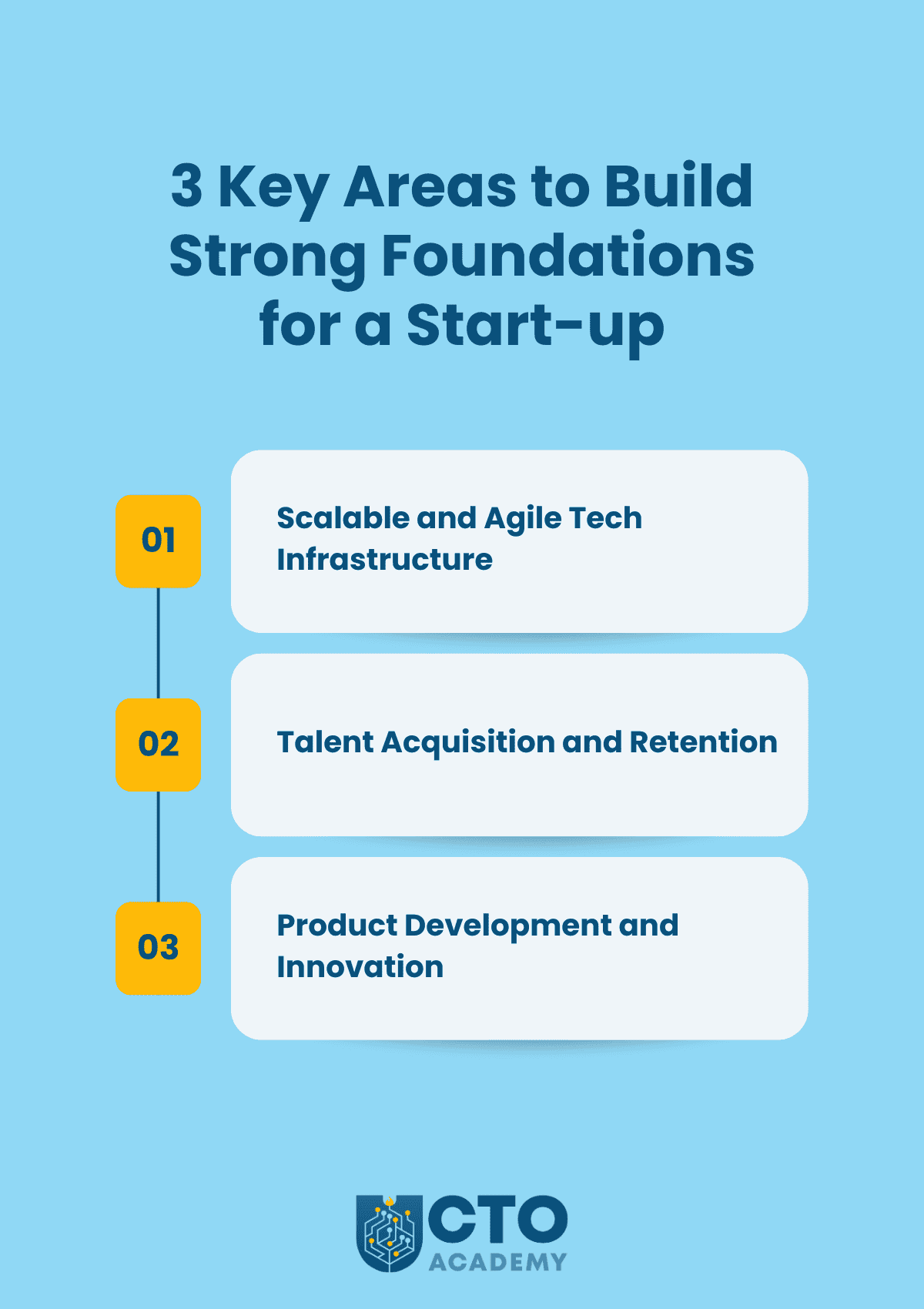
    To build a strong foundation in any type of start-up, you must focus on three key areas:

    1. Scalable and Agile Tech Infrastructure
    2. Talent Acquisition and Retention
    3. Product Development and Innovation

    Scalable and Agile Tech Infrastructure

    As a start-up CTO, your priority is establishing a robust tech infrastructure that can scale with the company’s growth (while complying with business objectives). Here, a cloud-native architecture may easily become paramount, offering the flexibility to adapt to changing demands without the constraints of physical hardware. 

    The real question is how can a company in a start-up stage of development adopt the cloud-native architecture.

    The first step is defining clear business goals and understanding the functional and non-functional requirements of the system. This clarity will guide your choice of architecture and technology, ensuring that the infrastructure supports the start-up’s vision and growth while not going overboard, incurring unnecessary costs. 

    Adopting cloud-native design patterns and adhering to well-architected frameworks are crucial steps in this process. These patterns and frameworks provide a blueprint for building resilient, scalable and maintainable systems that leverage the full potential of cloud resources. 

    Continuous integration and continuous delivery (CI/CD) practices are also essential, enabling frequent updates and maintenance with minimal downtime. 

    By focusing on these principles, you create a cloud-native environment that is both agile and capable of scaling to meet future demands.

    What About Microservices and Flexible Data Management?

    Microservices play a vital role in this environment, allowing for modular and independent development of services that can be updated or scaled without affecting the entire system. 

    Furthermore, flexible data management systems provide the agility needed to handle the influx of data that accompanies rapid expansion. For example, in start-ups, you’ll most likely prioritise cloud-based data storage, analytical tools and APIs for agile data integration. But when your company starts growing, your focus will shift to data warehousing, machine learning (AI-driven analytics), data governance and compliance. 

    By prioritising these elements, CTOs ensure that their technology infrastructure is not only resilient but also primed for the future, supporting continuous innovation and growth.

    Of course, none of this will exist and/or work without a well-tuned team. Hence, the second priority: 

    Talent Acquisition and Retention

    By now, we have all become aware that salary, while bearing immense importance, is not the predominant factor in talent acquisition and retention. That’s why we mentioned cultural leadership earlier.

    So, as a start-up CTO, you must:

    • Come up with competitive and innovative compensation packages
    • Support flexible work arrangements
    • Prioritise diversity and inclusion
    • Create a collaborative culture 
    • Nurture employee growth

    Easily said than done, right? 

    Okay, let’s break this down a bit.

    Compensation Packages

    To learn more about remuneration packages, read this guide (effectively, a lecture summary from Module 1 of our Digital MBA for Technology Leaders). It will give you more than enough ideas of how to best design compensations for your new and existing employees. 

    Flexible work arrangements…

    Yeah, that can easily backfire when you least expect it. Nonetheless, the new generation of engineers practically demands it and in most instances, you won’t have a choice but to smartly design one or more of the following options:

    1. Remote Work Option or allowing employees to work from anywhere. Granted, it does cut costs and reduce commuting stress. GitLab, for example, adopted a fully remote work model (just like CTO Academy, by the way). It allows us to attract talent from around the globe. The main challenge here is maintaining the necessary discipline and accountability to avoid breaching deadlines. Another potential issue is conveying the same cultural postulates to every team member to ensure cohesion.
    2. Flexible Hours or allowing employees to independently choose when to start and end their workday. Some of us are simply more productive in the late afternoon and evening, that’s all. Buffer, a social media management platform, is a good example of how flexible work hours lead to improved productivity.  
    3. Compressed Workweeks or reducing the work week to less than 40 hours like, for instance, Basecamp and Wildbit have done. Although, truth to be said, limiting to only forty may be a good start given the fact that a 60-hour work week is pretty much normal in tech. 
    4. Hybrid Work Models or splitting between the office and remote. Joe Weider, senior vice president and CTO at Lincoln Financial Group, for instance, claims that as soon they introduce their hybrid work model, they start to get a lot more interest. In his experience, employees place a high value on flexibility of location.

    Fostering a Collaborative Culture and Nurturing Employee Growth

    You can build a highly collaborative culture with just three initiatives:

    1. Encouraging open and transparent communication
    2. Valuing employee contributions
    3. Promoting a shared vision

    When it comes to employee growth, you should address it through:

    • Continuous learning opportunities
    • Clear career development paths
    • Recognition of achievements

    It’s only now that we come to the third of our start-up priorities: product development and innovation. It is a logical prioritisation or priorities because you won’t innovate anything if you can’t attract and retain talent and if that talent misses infrastructure to do their magic. 

    Product Development and Innovation

    The journey from an innovative concept to a minimum viable product (MVP) is marked by the CTO’s ability to balance the need for speed with the imperative of quality. 

    Rapid prototyping and iterative development are key strategies employed to accelerate the product lifecycle while ensuring that each iteration meets the high standards expected by stakeholders. 

    This is where your leadership skills come to the fore as you must foster an agile and responsive R&D environment, where team members are free to experiment and learn from each iteration (which is not easily accomplished if you work with explosive chemicals, for example).

    However, the CTO’s work in continuous improvement extends beyond internal operations. It involves external collaborations with tech companies, universities or research institutions, leveraging collective knowledge and resources to enhance the start-up’s technological capabilities. This collaborative approach not only accelerates the innovation cycle but also ensures that the start-up remains competitive and, thus, ripe for fast growth. 

    Additional Start-up CTO Priorities

    • Budget and Resources Management
    • Aligning Technology Strategy with Businesses Strategy
    • Mitigating Technology Risks

    Scaling for Success: CTO Priorities in Fast-Growing Businesses

    2 Man CTO Priorities in Fast-Growing Companies

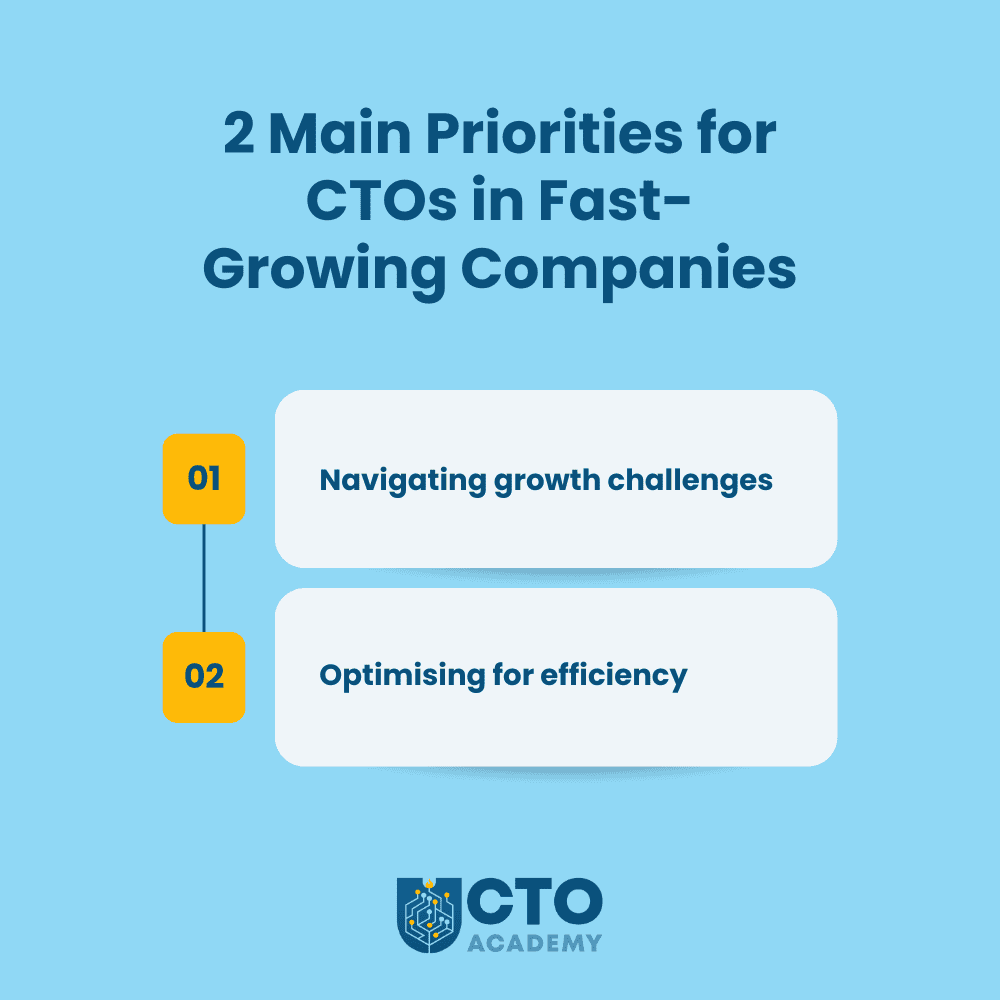
    There are two immediate priorities for Chief Technology Officers in fast-growing companies:

    1. Navigating growth challenges
    2. Optimising for efficiency

    So how and, more importantly, why do you optimise for efficiency?

    Optimising For Efficiency

    What was once a dynamic start-up can quickly turn into a slow-moving snail if you fail to optimise for efficiency on time. To prevent this from happening, focus on three key improvements:

    1. Process Automation and Streamlining
    2. Data-Driven Decision Making
    3. Cost Optimisation

    Process Automation and Streamlining

    AI-driven automation offers the ability to streamline complex processes, reduce human error and free up valuable human resources for more creative tasks. 

    By integrating AI with DevOps practices, CTOs can further improve the CI/CD process. Subsequently, software updates are developed, tested and released faster and more reliably. 

    This synergy not only accelerates development and deployment cycles but also ensures that the product evolves in close alignment with customer needs and market demands. 

    Ultimately, the adoption of these technologies and practices leads to a robust, agile infrastructure capable of supporting the rapid growth and scaling demands of modern businesses.

    Data-Driven Decision Making

    In many ways, optimisation for efficiency hinges on the ability to make informed, data-driven decisions. Data-driven decision-making lays the foundation for evidence-based strategy, minimizing risks and amplifying the innovation potential. 

    Robust data platforms and advanced AI-powered analytics provide a foundation for valuable insights from vast amounts of data. These insights enable CTOs to identify trends, forecast outcomes and allocate resources effectively, ensuring that technological investments translate into tangible business value. 

    One of the best examples of how to utilise AI in decision-making is a fast-growing online personal styling service, Stitch Fix. They have, effectively, created a completely autonomous self-learning system that consists of only three main components:

    1. Personalised Styling Recommendations generated by machine learning algorithms that analyse customer preferences, purchase history and feedback.
    2. AI-Powered Inventory Management helps Stitch Fix predict popular items and their quantity. This ensures they stock the right products, reducing overstock and stockouts.
    3. Customer Insights (data analytics from customer interactions and feedback) enable the company to identify trends and preferences. In turn, this allows them to tailor their offerings and marketing strategies more effectively.

    The outcome of this AI-driven loop is improved customer satisfaction, efficient operations and data-driven growth. Personalised recommendations lead to higher customer satisfaction and retention. Better inventory management reduces costs and improves operational efficiency. Finally, insights from AI-driven data analytics help Stitch Fix make informed decisions, enhancing both customer experience and operational efficiency. These insights are also fed to personalised styling recommendation algorithms, closing a loop.

    As we said, one of the major benefits of this approach is cost optimisation and that is always on top of the list of priorities of every technology leader. 

    Cost Optimisation

    The main approach here is to balance investments in innovation against cost-saving measures.

    Effective strategies include the adoption of a structured cost management framework, which enables CTOs to identify wasteful expenditures and reallocate resources towards high-impact technologies and initiatives. This involves a continuous cycle of evaluating existing assets for performance optimisation, thus ensuring that money spent contributes to the company’s strategic objectives. 

    It is also important to instil financial prudence within IT teams. In other words, you want to encourage them to align technology initiatives with broader business goals. By doing so, you ensure that your teams/departments are not only cost centres but also value creators.

    Now that you have successfully set the stage for increased efficiency, it’s time to grapple with the three most prominent growth challenges. 

    CTO Priorities in Navigating Growth Challenges

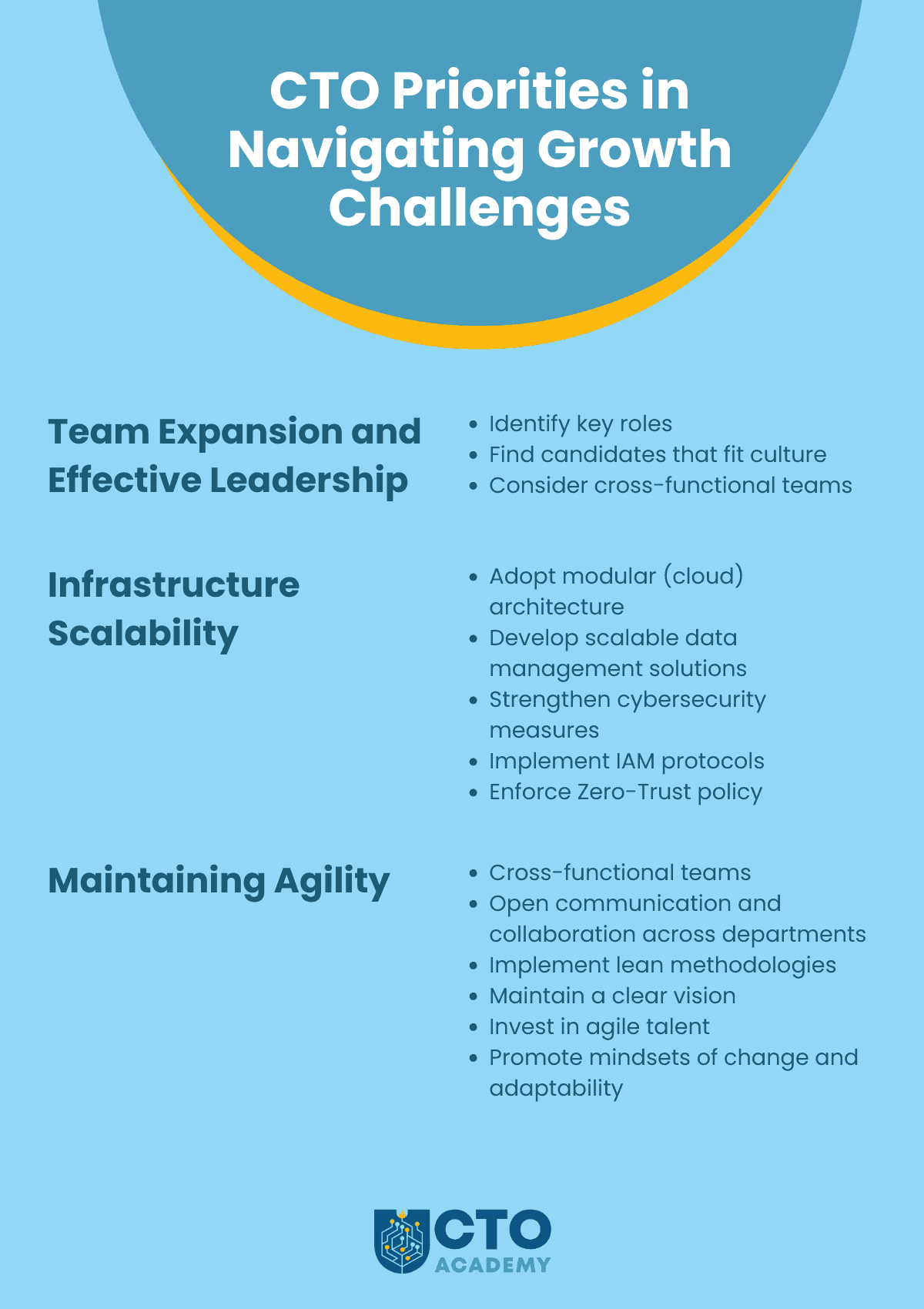
    CTO Priorities in Navigating Growth Challenges - infographic

    Once your company hits the afterburner, it will be a far cry from that “garage-based” start-up environment where everybody knows your name and preferred kind of doughnut. 

    The first thing that will change is the number of hands hitting keyboards. 

    Team Expansion and Effective Leadership

    As a CTO of a fast-growing business, you should prioritise strategic hiring that aligns with the company’s long-term vision and values. This involves identifying key roles and finding candidates who not only have the technical skills but also fit the company culture

    Effective leadership means you must communicate transparently, set clear expectations and empower team members through delegation and professional development opportunities (consider implementing scalable processes and tools that promote collaboration). Also, consider cross-functional teams to encourage a free flow of ideas

    The main challenge here is preserving a cohesive culture. After all, staff changes are inevitable and only one team member with a superstar complex can ruin months of dedicated work. Therefore, reinforce the company’s core values but don’t forget to celebrate and reward individual team achievements. You want your team and every member to feel valued and, more importantly, heard. That’s how you build resilient teams. 

    But as the number of keyboard users increases, so does the need for the infrastructure. 

    Infrastructure Scalability

    To address this challenge, CTOs should prioritise the development of a flexible and scalable cloud infrastructure. This involves adopting a modular architecture that allows for the easy addition or removal of resources as needed, ensuring that the infrastructure can adapt quickly to changes in demand without compromising performance or security. 

    Data management solutions must also be scalable and capable of handling an increasing volume of data without losing speed or data integrity. Companies like Oracle and Informatica offer robust data management systems that can grow with the company’s needs. 

    Furthermore, as the team and customer bases expand, cybersecurity measures must be strengthened to protect against an evolving threat landscape. This includes conducting regular cybersecurity audits, educating employees on security best practices and implementing strong Identity & Access Management (IAM) protocols to ensure that only authorised users can access sensitive data. In addition to IAM, the Zero-Trust policy should be in effect without exceptions. 

    While effectively tackling team expansion and subsequent scalability requests, a CTO must still prioritise agility

    Maintaining Agility

    To preserve agility, CTOs should design a culture that values flexibility and continuous learning. This involves (but is not limited to):

    • Cross-functional teams that can quickly adapt to new technologies and market demands. 
    • Open communication and collaboration across departments (free flow of ideas and preventing innovation from becoming stifled by silos). 
    • Implementing lean methodologies to streamline processes, reduce waste and enable faster iteration. 
    • Maintaining a clear vision and aligning all efforts with the company’s strategic goals, ensuring that agility contributes to long-term success. 
    • Investing in agile talent and promoting mindsets of change and adaptability (ie, embrace change as an opportunity rather than a hurdle to transform challenges into growth drivers). 

    Additional Priorities of CTOs in Fast-Growing Companies

    • Strategic Technology Planning
    • Data Management and Analytics
    • Security and Compliance

    Boosting Productivity with Innovative Solutions

    AI-Driven Code Generation and Review

    Tools, such as GitHub Copilot and Tabnine, leverage machine learning algorithms to predictively suggest code snippets, functions and even entire blocks of code, which can significantly accelerate development cycles. 

    They improve code quality by suggesting best practices and identifying potential errors before they become problematic. 

    Shopify, for instance, utilises GitHub Copilot to assist with code completion, generate boilerplate code and suggest improvements. New developers at Shopify leverage the tool to understand codebases more quickly. The AI provides context-aware suggestions and explanations, making it easier for newcomers to get up to speed. This ensures that the teams focus on creative problem-solving and high-level strategic tasks, rather than getting bogged down with repetitive coding.

    Predictive Resource Allocation

    By leveraging ML algorithms, companies can predict and analyse trends, enabling proactive resource distribution that aligns with demand patterns. This predictive capability ensures equilibrium that supports sustained growth. 

    Furthermore, ML can streamline workload management by intelligently automating task scheduling, which minimises bottlenecks and maximises throughput. For instance, in cloud computing environments, ML models can forecast workloads and manage resources to improve efficiency and reduce operational costs. 

    Additionally, dynamic resource management techniques, such as auto-scaling and workload-aware scheduling, can significantly enhance the performance of ML workloads, leading to faster completion times and improved system throughput. 

    Gamified Collaboration and Knowledge Sharing

    360Learning, Slack and Miro are all prime examples of AI-powered collaborative/learning platforms. Combined, they boost productivity by streamlining communication, collaboration and learning processes.

    Say you are a CTO of a fast-growing tech company and need to onboard new developers while ensuring continuous learning and collaboration among existing team members. How do you do it?

    1. Onboarding:
    • New hires use 360Learning to complete onboarding courses created by experienced team members. These courses include interactive elements like quizzes and discussion forums to engage learners.
    • Gamified learning paths motivate new employees to complete their training quickly and effectively.
    1. Continuous Learning:
    • The platform allows employees to create and share courses on the latest industry trends and internal best practices.
    • Peer reviews and discussion forums foster a culture of continuous learning and knowledge sharing.
    1. Collaboration:
    • Teams use Slack for daily communication and project management, ensuring everyone stays connected and informed.
    • Miro is used for brainstorming sessions and project planning, allowing team members to collaborate visually and in real time.

    And voila! You have successfully enhanced productivity, improved onboarding and enabled continuous innovation. 

    Mental Health and Well-being Tech

    Microsoft recognised the need to support employee well-being, especially during the COVID-19 pandemic when remote work became the norm and stress levels increased. The company partnered with Headspace and Calm to offer guided meditation and mindfulness exercises to employees while implementing flexible work hours and remote work options to help them manage their work-life balance.

    The outcomes were improved mental health, increased productivity and higher job satisfaction

    Examples of Other Productivity-Enhancing Technologies

    • Serverless computing allows developers to build and run applications without the complexity of managing servers (eg, AWS Lambda).
    • Low-code/no-code platforms enable users with minimal coding skills to create complex systems, thereby democratising development and accelerating innovation (eg, Million Labs).
    • Blockchain-based credential verification offers a secure and immutable way to manage digital identities, ensuring the authenticity of credentials while reducing the risk of fraud (eg, Hyland). 

    The best thing is that you can match up blockchain technology and low-code platforms, or, on the other hand, build a serverless blockchain app with AWS

    Either way, the outcomes will remain the same: significantly enhanced productivity in start-ups and fast-growing businesses as a result of simplifying infrastructure management, accelerating application development, and improving security. 

    It comes down to a change mindset if you are not already using any of these technologies. 

    Speaking of change…

    Embracing Emerging Technologies for Competitive Advantage

    Adopting emerging technologies is quite often a strategic imperative. Some of them stand out due to their ability to enable a nuanced approach to data analysis, predictive modelling and decision-making processes that can significantly enhance a company’s competitive edge. Here are the most prominent ones:

    Conclusion

    The key takeaway here is simple: establish a robust foundation while staying agile to embrace new technologies. 

    Initially, your focus should be on building a strong technical base, ensuring that the architecture is scalable and can handle rapid growth. 

    As the business expands, you should prioritise scaling infrastructure and operations to support increased demand. 

    Remember, innovation is crucial because implementing cutting-edge solutions can significantly boost productivity and efficiency and, ultimately, provide a competitive edge.  

    However, it’s vital to balance these advancements with the core business needs, ensuring that technology catalyses growth, not a distraction. 

    Bottom line, the most effective CTOs balance immediate needs with long-term vision.

    Now is just the question of what CTO priorities will you tackle first? In case you are unsure, seek advice from fellow technology leaders.

  • Quick Guide to Understanding External Driving Factors of Technology Strategy

    Quick Guide to Understanding External Driving Factors of Technology Strategy

    This guide explains the main external driving factors that could influence technology strategy – from start-ups to large enterprises.

    As you will soon learn, your technology strategy will, ultimately, reflect the landscape in which your company operates. For example, if it’s on a growth trajectory or repositioning, then it’s going to address its weaknesses.

    External Driving Factors

    External Driving Factors of Technology Strategy - infographic summary
    (click to download/enlarge)

    Going Multi-Region (Common Strategy)

    Even today, many things do not support proper localisation or internationalisation. Just consider the fact that we still force people to enter their first and last names when two-thirds of the world don’t have that concept.

    So the basic information and how it’s categorised can become an issue. Additionally, a lot of suppliers don’t support that kind of internationalisation as well. It is a soft spot in every tech strategy.

    Mergers and Acquisitions as Significant Factors

    As you can imagine, there will be a lot of overlapping systems. The first thing we must decide is which ones we want to keep.

    Two seemingly similar systems are, in fact, different because each company operates differently. And that’s going to affect your technology strategy.

    Take, for example, Microsoft’s Dot.Net and merge it with a Linux-based company. Such a merger would cause a myriad of problems. In such a scenario, you, as a technology leader, must evaluate each option and decide what goes and what stays. Because, in the end, you want your strategy to be clear, simple and easy to follow.

    Rebalancing Between a Group

    As a rule of thumb, on a group level, every division has its individual tech strategy and tech stacks. However, major decisions are made on a group level. As you can imagine, this can create significant friction and cause major delays in optimisation and synchronisation between group companies.

    One way to tackle this common problem is to take the initiative and pitch/propose a specific strategy/tech to a group – with a promise of driving it.

    The issue you can expect in a group rebalancing scenario is resistance to adopting new technologies or, on the other hand, reluctance of multiple teams to switch to a single (common) tech.  

    Here, you need a tactical approach, especially if you’re considering more risky technology choices. What you need is a group of people who did due diligence or, even better, used it so you’d have tangible arguments.

    Considerations when choosing a new technology:

    • What level of assurance do I have?
    • How does anybody use this in production?
    • Is there anyone in any of the teams that have already used it?
    • What are their experiences?

    Dealing with the legacy tech

    The first thing to do in this situation is to understand who thinks it is a legacy and for what reasons.

    There are instances where people flag the tech as legacy just because they’ve depreciated it on a balance sheet. It’s an accounting view.

    Sometimes, it’s depreciated because there’s a competing in-house technology standard, only they can’t decide which one to retire. So they simply flag one as a legacy.  

    Or the system has been around for a long time which, by no means, makes it a legacy.

    What are the determining factors that could make a system potential legacy?

    It’s legacy if it has some problematic features that do not exist in a new substitute tech. For instance, tight coupling, invisible business logic, it isn’t easy to read and understand, returns unusual business results and similar.

    So how do you decide to retire a system or extend its use?

    STEP 1: Find out who could potentially raise an issue if you switch it off.

    STEP 2: Understand what exactly a system does.

    STEP 3: Interview users to get feedback.

    Remember, every time you try to flip a legacy system, you always run the risk of running out of goodwill and funding. If there is strong resistance caused by fear, it’s better to stop. Because if you don’t have support, it won’t matter how great your tech is. They are not going to adopt it.

    Cost of Transition to a New Technology

    We will take cloud services as an example here. The big promise was that the cloud would be cheaper. However, that’s not exactly the case. It can get really expensive really fast. Because, unlike data centres that have a limit on a number of servers, clouds enable you to keep provisioning new things and never turn them off.

    As a rule of thumb, large companies never turn things off because nobody is managing the systems.

    Now, from the technology strategy perspective, you should choose a single provider instead of trying to build redundancy on several systems just to have that safety net.

    The choice, ultimately, depends on the volume metric projections, the overall cost and potential compatibility (eg, if you have Microsoft products in your environment, the integration of active directory will go smoother on Azure than on AWS or GCP).

    TIP: If you don’t have an explicit function that looks after your cloud operations and finances, you’re going to have to set that up and make sure that you stay on top of the cost of your cloud provider.

    Skills Availability

    The availability of skills in your market is another important decision-making factor. In some instances, you will have to choose technologies that are more widely adopted to have a larger pool of available skilled workforce.

    Remember that you can always check the TIOBE Index to see what technology is trending.

    Summary

    TECH-INFLUENCING EXTERNAL DRIVING FACTORS

    • Going multi-region, multilanguage:
      • Inadequate suppliers’ support for internationalisation
    • Merger, acquisition:
      • Overlapping systems, difficult to decide which to keep
      • Scalability issues
      • No compatibility between flagship technologies
    • Group rebalancing:
      • Different tech strategies between divisions
      • The tendency toward popular technologies and big suppliers
      • No synergy
      • Technological monoculture, high resistance to new tech
    • Cost of transition to a new technology
    • Skills availability

    These are the most common external drivers that will influence your technology strategy. Module 3 of our Digital MBA for Technology Leaders, consists of over 20 lectures explaining technology strategy and business goals. Starting with alignment to value drivers, planning and, most importantly, execution.

    So far, over 400 technology leaders have taken our course and they all agree on one thing: it provided them with the comprehensive knowledge required to excel as a Chief Technology Officer.

  • Mastering Technology Management: Complete Guide for Technology Leaders

    Mastering Technology Management: Complete Guide for Technology Leaders

    To be effective, technology management must converge three factors: technologicalhuman and organisational. Only a perfect convergence enables technology leaders to turn challenges into advantages, disrupt industries and implement strategic organisational changes to create a competitive advantage.

    This guide caters to both professionals seeking to refine their skills and aspiring individuals exploring educational paths in this dynamic field. Split into four parts, it covers key areas and skills, career advancements, types of educational programs (and how to choose the relevant one!) and essential resources for existing and future technology managers.

    Part 1: The Technology Management Landscape

    What is Technology Management and Why Does it Matter?

    At its core, technology management is the strategic planning, development, implementation, operation and control of technology to achieve an organisation’s goals.

    According to Gartner, worldwide IT spending was projected to total $4.6 trillion in 2023, representing an increase of 5.1% from the previous year (2022). This growth was driven by strong demand for IT as enterprises continue to invest in digital business initiatives in response to economic turmoil. In other words, there is no single segment of any industry that does not have technology deeply ingrained into operations.

    Here’s a breakdown of the spending across different IT segments in 2023:

    • Data Center Systems: $216.3 billion (3.4% growth)
    • Software: $879.6 billion (11.3% growth)
    • Devices: $735.4 billion (-0.6% decline)
    • IT Services: $1.36 trillion (7.9% growth)
    • Communications Services: $1.47 trillion (2.4% growth)

    Interestingly, CEOs and CFOs are increasing spending on digital business initiatives despite economic challenges, making enterprise IT spending relatively recession-proof. Additionally, organisations are focusing on efficiency-driven digital investments to reshape revenue streams and enhance existing products and services. The rise of disruptive technologies like artificial intelligence and automation, and growing concern about security make effective management crucial. Consequently, this creates a demand for high-skilled technology managers.

    There is a 15% increase in job postings for executive leadership and a 6% increase for operations roles. Nearly a quarter of new technology positions in 2023 offered hybrid work arrangements, and an additional 17% were fully remote.

    In 2024, IT services are expected to grow further, becoming the largest segment of IT spending for the first time, with an anticipated 8.7% increase, reaching $1.5 trillion. These trends highlight the continued importance of having skilled technology leaders not only in operations but on Boards as well.

    And here is a vivid example of the effective use of technology in operations whose complexity proves the necessity for continuous personal and professional growth.

    Case Study: How Amazon Optimises Logistics and Supply Chain Processes

    Amazon, like many other businesses, faces several challenges in supply chain management:

    • Supply chain disruptions (eg, pandemic aftereffects, climate protests in Europe).
    • Inventory delays (large brands report delays between 1 and 4 months; over a quarter of small businesses have difficulties ordering new inventory).
    • Existing inventory affected.

    But their ability to adapt and implement effective strategies turns out to be crucial for maintaining efficient operations. So how do they do it?

    Amazon, as a global e-commerce giant, relies heavily on technology management to optimise its logistics and supply chain processes:

    1. Fulfillment Centers and Inventory Management:

    • Amazon operates a vast network of fulfilment centres across the US. These centres are responsible for receiving, storing and shipping products to customers.
    • Sortable fulfilment centres (around 800,000 square feet in size) handle items like books, toys and housewares. Associates work alongside robots to pick, pack and ship customer orders.
    • Non-sortable fulfilment centres (ranging from 600,000 to 1 million square feet) manage larger items. They employ over 1,000 full-time associates.

    2. Order Processing and Last-Mile Delivery:

    When a customer places an order, Amazon’s technology kicks into action:

    1. Picking (robots and associates work together to accurately pick the ordered product from the shelves).
    2. Packaging (the product is packaged and labelled).
    3. Sorting (everything’s sorted and loaded onto trucks or planes).
    4. Delivery Stations (the package reaches a delivery station where last-mile delivery preparation occurs).
    5. Customer Delivery (one to two days later, the package is delivered to the customer’s doorstep).

    3. Advanced Tracking Systems:

    • Amazon utilises sophisticated tracking systems to monitor inventory movement, delivery routes and order status.
    • Real-time data processing helps optimise routes, reduce delivery times and enhance efficiency.

    4. Just-in-Time Inventory Management:

    • Amazon maintains a lean inventory by adopting a just-in-time approach. This minimises storage costs and ensures products are available when needed.
    • Advanced algorithms predict demand and adjust inventory levels accordingly.

    5. Warehouse Management Systems (WMS):

    • WMS coordinates various warehouse activities, including inventory tracking, order processing and resource allocation.
    • It optimises space utilisation, minimises travel time for associates and streamlines operations.

    6. Amazon Robotics:

    • Robots play a crucial role in Amazon’s fulfilment centres. They assist with picking, packing and moving items.
    • By automating repetitive tasks, robots improve efficiency and allow associates to focus on more complex tasks.

    7. Delivery Innovations:

    • Amazon Prime Air, the company’s drone delivery service, aims to revolutionise last-mile delivery.
    • Autonomous delivery vehicles and smart lockers are also part of their strategy.

    As you can see, Amazon’s technology management ensures seamless order processing, efficient inventory handling and timely deliveries. Their relentless focus on innovation and data-driven decision-making keeps them at the forefront of e-commerce logistics. But in the background of this seemingly automated operation, there is a group of technology leaders laying down strategies and tactics, ensuring that the supply chain remains unbroken.

    Key Areas of Technology Management Expertise

    Key Areas of Technology Management Expertise - infographic summary
    (click to download/expand)

    Technology Strategy and Planning

    Breakdown of the key steps:

    1. Define business goals and objectives

    2. Assess the current technology landscape (infrastructure, applications and processes)

    • Identify strengths and weaknesses in the current systems (find technological gaps that could affect goal achievement).
    • Evaluate the cost-effectiveness, security and scalability of existing solutions.

    3. Develop a Technology Roadmap

    • Outline the planned technology investments.
    • Place focus on initiatives that address business objectives and previously identified technological gaps.
    • Factor in budget constraints, resource availability and potential ROI when prioritising initiatives.

    4. Evaluate technology solutions

    • Research and compare different technology solutions (that align with the defined roadmap priorities).
    • Assign one of the following options to each: in-house development, cloud-based solutions or integration with existing systems.
    • Evaluate factors like functionality, scalability, security, vendor reputation and total cost of ownership (TCO) when selecting solutions.

    5. Implement and integrate new technologies

    • When devising a plan, consider employee training, data migration strategies and system integration procedures.
    • Pre-build proper communication channels and change management strategies (!prepare employees for the adoption).
    • Test and integrate new technologies with existing systems (!minimise disruption and ensure smooth operation).

    6. Measure and monitor

    Remember, this is an ongoing process that requires collaboration between leaders of different departments.

    IT Project Management

    The three most used methodologies in IT project management are definitely:

    Of course, the choice depends on the specific project characteristics, requirements and complexity. Waterfall might be suitable for a well-defined system with minimal change expectations. Agile is ideal for projects with evolving requirements and a need for continuous user feedback. CPM can be used in conjunction with either methodology to ensure efficient scheduling and resource allocation.

    Technology Risk Management

    Key steps involved in the process:

    1. Risk identification

    • Brainstorming sessions with stakeholders
    • Utilising tools and checklists (eg, project scope creep, security vulnerabilities, system downtime, integration challenges, vendor lock-in etc.).

    2. Risk assessment

    • Assessing and scoring the likelihood of occurrence for each identified risk
    • Assessing the impact of each
    • Multiplying the likelihood and impact scores (risk scoring)

    3. Risk mitigation strategies

    1. Avoidance (eliminating the risk).
    2. Transfer (transferring the risk to a third party; eg, purchasing cyber insurance to mitigate data breach risks).
    3. Mitigation (implementing robust security protocols to reduce the impact).
    4. Acceptance (accepting the risk if the mitigation efforts are not feasible or the cost is not justifiable).

    4. Risk management plan

    • Creating a formal Risk Register (contains records of all identified risks, their likelihood, impact, scores, assigned mitigation strategies and responsible individuals for implementing them).
    • Scheduling regular reviews of the Risk Register throughout the project lifecycle.

    5. Communication and monitoring

    Technology Infrastructure and Resource Allocation

    There are two types of infrastructure management:

    1. Physical

    • Hardware maintenance
    • Data centre management
    • Network management

    2. Digital

    • Software management
    • Data storage management
    • System Administration

    As a technology manager, you must maintain thorough documentation of the entire IT infrastructure, including hardware specifications, network configurations, software versions and disaster recovery procedures.

    Additionally, you must also establish and maintain strong relationships with key technology vendors to not only ensure timely support but, more importantly, to stay updated on vendor product roadmaps so you can plan for future infrastructure needs.

    The question now is, how do you allocate resources?

    The foundation here is matching skills to tasks. Fail to do this and you’ll affect efficiency and quality of work.

    Now, as we all know, tasks are piling up 9-5, day after day. How do you ensure that the project stays within the schedule? You employ the above-mentioned Critical Path Method (CPM) to a) identify the most time-sensitive tasks (the critical path), and thus, b) allocate resources accordingly. Here, you can also utilise frameworks like the Eisenhower Matrix (Urgent/Important) to categorise tasks and allocate resources based on their criticality and urgency.

    The next thing you want to do is the so-called, resource levellingThis is the strategy that smooths out resource demands throughout a project to avoid overloading team members at specific points and maintain a consistent workflow.

    To further maximise the output and prevent breaching deadlines, use resource smoothing. This is somewhat similar to levelling, only in this instance, you are prioritising the reduction of overall resource usage by shifting tasks (!without impacting deadlines).

    TIP: If and when necessary, use temporary workers, contractors or freelancers to address specific resource needs without long-term commitments.

    Technology Governance and Compliance

    A comprehensive set of technology policies and procedures provides a framework for responsible technology use and reduces legal and security risks.

    These policies should be communicated to all employees, regularly reviewed and updated to reflect evolving technologies and regulations. Here are some key policies and procedures that ensure technology is used responsibly and adheres to regulations:

    Acceptable Use Policy (AUP)

    • Defines acceptable and unacceptable uses of organisational technology resources.
    • Typically outlines restrictions on personal use, data security practices, copyright infringement and illegal activities.
    • Clarifies user expectations regarding responsible technology use and helps mitigate potential legal or security risks.

    Information Security Policy

    • Establishes a framework for safeguarding sensitive data and protecting IT infrastructure from cyber threats.
    • Typically includes procedures for:
      • Password management practices
      • Data encryption
      • Access controls
      • Reporting and escalation procedures
      • Employee training on cybersecurity best practices

    Data Privacy Policy

    • Outlines how the organisation collects, stores, uses and discloses personal data in compliance with relevant regulations (e.g., GDPR, CCPA).
    • Must clearly communicate to users what data is collected, how it’s used and their rights regarding data access and deletion.

    Bring Your Own Device (BYOD) Policy (if applicable)

    • Defines guidelines for employees using personal devices to access work data or applications.
    • Typically includes requirements for strong device security measures, data encryption and remote wipe capabilities in case of device loss or theft.

    Change Management Policy

    • Establishes a structured approach for introducing new technologies or making significant changes to existing systems.
    • Ensures proper planning, testing and impact assessment before implementing changes to minimise disruption and potential risks.

    Software Licensing Policy

    • Defines procedures for acquiring, managing and using software licenses.
    • Ensures compliance with software license agreements and avoids copyright infringement issues.

    Monitoring and Auditing Procedures

    • Establishes guidelines for monitoring network activity, system usage and user access to detect potential security breaches or policy violations.

    Regulatory Compliance Policy

    • Organisations operating in specific industries might have additional regulations to comply with, such as HIPAA (healthcare data privacy) or PCI DSS (payment card data security)

    Such an array of responsibilities calls for a particular skill set, different from the one that, for instance, makes a good CEO or CFO. Technology managers are an entirely different kind of beast.

    Essential Skills for the Effective Technology Manager

    Even though some CTO roles do not require a typical background in technical skills, as a rule of thumb, technology managers should, at the very least, possess skills relevant to their specialisation (ie, cloud computing fundamentals for those managing cloud infrastructure; cybersecurity principles for those focusing on data security).

    But since we are talking about leadership here, soft skills are also crucial for all technology managers and they include:

    • Leadership skills necessary for guiding and motivating teams.
    • Communication and negotiation skills for clear project communication and vendor negotiations.
    • Analytical thinking and problem-solving abilities to tackle complex technological challenges.

    Now, how do you acquire such a skill set?

    Developing necessary skills

    Let’s say that, at this moment, you work as a tech lead, slowly making your way to a technical leader role to, ultimately, become a Chief Technology Officer. It may come as a surprise to you, but this path can be extremely short as some of our members experienced.

    So the only way to develop skills on short notice is to learn from experts in fields you are about to tackle. For your reference, there are 9 of them:

    1. Leadership and Teambuilding
    2. Business Fundamentals
    3. Technology Strategy and Business Goals
    4. Personal Development
    5. Product Development
    6. Information Management
    7. Finance and Funding
    8. Data Science and Analytics
    9. Digital Trends and Innovation

    Each of these fields is further broken down into an average of 20 subfields. For example, in Leadership and Teambuilding, you don’t only want to learn how to build and manage a team but also what type of leader you are. When you turn to Business Fundamentals, you want to learn what drives the organisation and its commercial strategy. To set and align the Technology Strategy, you must first understand value drivers. And so forth…

    Now, consider the faculty requirements of such a program…we are talking about a wide range of seasoned experts, ideally with coal on their faces so they could give you those vital yet little-known tips that make or break your career.

    To the best of our knowledge, there is only one technology management program with 13 senior technology leaders delivering lessons – 9 CTOs, 1 Group CTO and 3 VPs of Engineering. They are part of this massive faculty of 40 lecturers that turned every single stone on your future career path so you don’t trip. (you can personally check close to 70 reviews students left on Trustpilot so far).

    But MBAs are just one part of the equation. The second, equally important, is having peer support and (live) mentoring; specifically, the ability to ask critical questions on the go and receive immediate actionable advice from a fellow tech leader who has been in your situation.

    Part 2: Upskilling and Career Advancement for Technology Management Professionals

    The demand for technology managers varies across different industries, and understanding these dynamics can help you make informed decisions about your career path. So here are some insights first:

    Automotive Industry:

    • High demand for management roles related to software development, cybersecurity and data analytics.
    • Requires expertise in EV technology, software engineering and data-driven decision-making.

    Chemicals Industry:

    • Embracing digital transformation to optimise supply chains, improve manufacturing processes and enhance product development.
    • Roles related to process automation, predictive maintenance and supply chain optimisation.
    • Requires knowledge of industrial IoT, data analytics and process optimisation.

    Financial Services Industry:

    • Heavily reliant on technology to provide seamless customer experiences, manage risk and enhance operational efficiency.
    • Demand for technology managers in banking, insurance and fintech.
    • Roles include IT project managers, cybersecurity managers and data scientists.
    • Requires financial domain expertise, cybersecurity knowledge and project management skills.

    Life Sciences Industry:

    • The life sciences sector (eg, pharmaceuticals, biotechnology, medical devices…) is undergoing rapid digitalisation.
    • Technology managers play a crucial role in drug discovery, clinical trials and healthcare IT.
    • Requires a deep understanding of regulatory compliance, data privacy and health informatics.

    Other Industries:

    • Technology managers are also in demand in areas like retail, e-commerce, energy, and telecommunications.

    The big question now is what industry or field best fits your core skill set? More importantly, in which area do you need to improve?

    Identifying Your Development Needs

    Quick DIY Skill Assessment Excercise

    Requirements: Objective self-assessment.

    STEP 1 – Write down these six core tech leadership skills skills and rank yourself (1-5) on each skill:

    • Strategic Thinking
    • Problem-Solving
    • Communication
    • Team Building
    • Adaptability
    • Ethical and Data-Driven Decision-Making

    STEP 2 – Identify strengths and areas with the most growth potential.

    STEP 3 – Self-discussion questions:

    • Which of these skills do you believe are the toughest to master?
    • Are there any we haven’t mentioned that you think are vital?
    • If there are, what are they (write them down under the ones we listed)?

    STEP 4 – Challenge

    Pick one ‘growth’ skill and commit to one specific action to improve it in the next month.

    To gauge and benchmark your current strengths and weaknesses against the hundreds of global tech leaders who’ve already completed the process, complete our Skills Assessment.

    The results will include vital recommendations that help you connect your skills assessment results with the desired career path in technology management.

    Proven Techniques for Advancing Your Technology Management Career

    Showcase your skills and expertise:

    Effective career planning:

    • Develop a (realistic) career roadmap (ie, identify desired positions, necessary skills development and potential companies)

    Interview preparation tips:

    • Utilise online resources (eg, job boards, industry websites, tech blogs/forums) to find common interview questions for specific job titles
    • Leverage your network (ie, connect with technology managers and ask them to share their interview experience and questions, schedule informational interviews with managers in targeted companies)
    • Explore the targeted company’s website (focus on its mission and goals)

    Practice effective responses for interviews

    STEP 1 – The STAR Method:

    • S – Situation: Briefly describe the specific work situation or project you faced.
    • T – Task: Outline the task or challenge you were responsible for tackling.
    • A – Action: Explain the specific actions you took to address the situation or complete the task.
    • R – Result: Quantify the positive outcome or lessons learned from your actions. Use metrics, data, or specific examples to showcase your impact.

    STEP 2 – Highlight soft skills and leadership experience

    • Prepare examples that showcase your soft skills like communication, problem-solving, negotiation and team leadership in past projects
    • Highlight situations where you demonstrated initiative, adaptability and the ability to think strategically.

    STEP 3 – Research the company and industry trends

    • Be prepared to discuss your understanding of the company’s business goals and how technology can support them
    • Show awareness of current industry trends and how they might impact technology management strategies.

    STEP 4 – Conduct mock interviews with friends, colleagues, or career counsellors

    • Record yourself answering practice questions and review the recording to identify areas for improvement, such as clarity, conciseness or elaboration on specific points.

    STEP 5 – Tailor your responses

    • Avoid generic answers.
    • Connect your responses to the specific job description and the company’s needs.
    • Showcase how your past experiences and skillset make you a perfect fit for the role and the company culture.

    Part 3: Technology Management Education

    Types of Educational Programs in Technology Management

    1. Bachelor’s degrees in technology management or information technology

    These programs provide a foundational understanding of technology, business principles and their intersection. They are commonly covering topics like:

    • Computer science fundamentals (programming, networking)
    • Technology project management
    • Business analysis and process improvement
    • Information security and data management

    These programs effectively prepare graduates for entry-level technology management roles or further graduate studies.

    2. Master of Business Administration (MBA) with a specialisation in technology management

    Unlike bachelor’s degree programs, Technology MBAs cater to professionals with existing business experience seeking to deepen their technology management knowledge. The curriculum often includes:

    • Advanced technology strategy and planning
    • Enterprise architecture and infrastructure management
    • Innovation management and emerging technologies
    • Leadership and organizational change management in a technological context

    These academic programs equip you for leadership roles in technology management at a strategic level.

    3. Short-term certificate programs focused on specific tech areas

    Certificate programs offer targeted training in specialised technology management areas like:

    • Cloud computing management (eg, AWS Certified Solutions Architect)
    • Cybersecurity management (eg, Certified Information Systems Security Professional)
    • Project management methodologies (eg, Project Management Professional)

    These are ideal for professionals seeking to upskill in specific areas or transition into a new technology management niche.

    Sites like Coursera, edX or Udemy offer elective courses that cover a range of industry specific and technology-relevant curriculums.

    Choosing the Right Program

    7 Factors to Consider When Choosing a CTO Program - infographic summary
    (click to download/enlarge)

    When choosing, consider these 7 factors:

    1. Your existing skills and experience (which fits better for your knowledge base: bachelor’s or master’s degree or certificate program?)
    2. Career goals (eg, if you see yourself as a CTO, you need an MBA program that equips you with just the right set of skills and tools)
    3. Learning style (eg, your work schedule does not allow full-time traditional programs so you need an online one)
    4. Faculty expertise (!always conduct the program’s faculty research to check their industry experience in technology management)
    5. Course curriculum (review the course offerings before enrolling)
    6. Accreditation (choose programs accredited by reputable organisations to ensure quality education and industry recognition)
    7. Student resources (eg, established peer communities, learning resources, CTO shadowing, etc.)

    Take a moment to review CTO Academy’s Digital MBA for Technology Leaders which checks all seven boxes.

    Now, you might just feel like a natural leader and avoid formal education altogether. Rest assured that such a decision comes with consequences.

    Benefits of a Technology Management Education

    To gain a deeper understanding of technology management principles, you need formal education because it provides a structured learning experience that results in a comprehensive understanding of technology management theories and frameworks.

    However, the more important part of formal education is networking opportunities with peers and industry professionals. Lecturers and fellow students can offer career guidance and industry insights. Don’t forget that a CTO who lectures you on Technology Roadmaps already made a few of those and is most likely in the process of making a new one. Also, quality programs organise networking events quite often. This allows you to expand your reach and learn new tricks from seasoned professionals and former alumni.

    And then, there is increased earning potential and career advancement possibilities.

    For years now, IT professionals across experience levels have been earning a higher average salary compared to the average across all jobs. In the US, computer and information technology (IT) professionals had a median salary of $100,530 in May 2022, significantly more than the average salary for all occupations ($46,310).

    Factors influencing salary include experience, skill set, location, education level and certifications. In other words, higher education levels are linked to higher incomes. For example, those with at least a bachelor’s degree made a median income of $1,608 per week in the fourth quarter of 2023, compared to $917 per week for high school graduates.

    Completing an MBA or earning a bachelor’s degree showcases your commitment to the field effectively opening doors to senior leadership positions.

    Part 4: Resources and Conclusion

    Useful resources

    Professional organisations:

    Organisations such as AITP and SIM offer valuable resources like industry publications, networking opportunities and professional development events.

    Relevant industry publications and blogs:

    Training institutions:

    These institutions offer program search tools.

    TIP: Always consider factors like program accreditation, faculty expertise, and alumni success stories when researching specific institutions.

    Conclusion

    Success in technology management depends on a perfect blend of technical knowledge, strong leadership skills and business literacy. Here’s a quick recap of the essentials:

    Technical Skills:

    • Understanding of core IT infrastructure concepts
    • Familiarity with relevant technologies for your industry
    • Knowledge of project management methodologies
    • Data analysis and interpretation skills

    Soft Skills and Leadership:

    • Strong communication and collaboration skills
    • Ability to translate technical concepts for non-technical stakeholders
    • Strategic thinking and problem-solving abilities
    • Leadership skills (motivating and mentoring teams)
    • Negotiation and conflict resolution skills
    • Adaptability and the ability to handle change

    Business Skills:

    • Understanding of business processes and how technology can optimise them
    • Awareness of current technology trends and their potential impact
    • Knowledge of relevant regulations and data privacy policies

    The combination of technical expertise, leadership qualities and business acumen enables technology managers to effectively bridge the gap between technology and business objectives, driving innovation and success.

    However, neither drops from the sky. You may have a strong technical background but you are most likely missing some of those soft skills. Maybe you have both, but how good are you with budgeting and resource allocation?

    That’s why we always emphasise the need for constant professional development. It is the only way to build successful careers in this dynamic and, most importantly, rewarding field.

    In case you want to discuss your career path and optimal training, feel free to book a free consultation call. It is an opportunity to get objective advice based on your current situation and plans.

  • Aligning Tech Strategy with Business Goals – Discussion Panel Summary

    Aligning Tech Strategy with Business Goals – Discussion Panel Summary

    An important part of each module in our Digital MBA for Technology Leaders is a discussion panel where a group of experienced tech leaders dive deep into critical problems of senior technology management. Here, we are bringing you a summary with key points on the subject of Tech Strategy and its alignment with the company’s business goals.

    Is Tech Strategy a Common Weakness in Companies?

    It sure seems like there’s often a big misalignment.

    There’s a challenge with technology leaders understanding the business strategy and being able to translate that into what their team and their function need to do.

    Because of that, we get misdirection. The tech goes on one tangent while the business is on a different one and the alignment is not happening. The tech strategy or product strategy is simply not aligned with the business.

    How to solve misalignment?

    Technology leaders and other members of the management team need to have compassion for technology and each other and understand all the pros and cons.

    In the majority of strategy documents, technology doesn’t deliver on what strategy needs to be.

    Strategy is supposed to focus our minds and say, these are the critical few things that we’re going to put all our energies against.

    More importantly, these are things we’re not going to do. 

    It is rare to see tech strategies that say we are not going to do this or that. As a result, lows of focus bled out doing wild goose chase stuff, which technology is particularly great at.

    It’s great at burning time and money on things that will not move the business needle at all.

    And the other part is that technology strategy is often something that seems to be communicated upward to the board.

    However, there are a lot of Staff Managers, Senior Engineers, Heads of Development and even VPs of Engineering who have no idea what the technology strategy was that was presented to the board last week. 

    As a result, alignment is not just happening.

    Whose fault is it?  

    Is it the fault of the technology leader? 

    Well, there are different types of leaders. Some that manage upwards, some that manage downwards and some that don’t manage at all. 

    So it depends on the specific context. The general opinion is that the one who pays your wages and who are you most afraid of (ie, who generates your anxiety) is probably going to show where your focus should be. 

    Consequently, a lot of leaders just create things.

    And it is often too difficult to cross the chasm, like trying to explain it to people who are doing the day-to-day job.

    You’re running systems or you’re integrating systems, trying to get the relevance of what’s happening in the board room and that strategy and translate that into something relevant for those people.

    It’s time-consuming and hard.

    That’s why a lot of people just give up and say, you know what, I’m going to protect my teams from this nonsense and I’m just going to do a document.

    It’ll keep the owners happy.

    It’ll keep the board happy.

    And we’ll just carry on.

    The problem is that you’ll find yourself in a pickle sooner or later when a senior leader goes, “Hey, hang on a second. Didn’t you say you were doing all this stuff? I was just talking to somebody in the hallway and this doesn’t seem to be happening.”

    Therefore,

    A strategy needs to be communicated at multiple levels and be reinterpreted on every level.

    There could also be monetary incentives to understand the tech strategy of the company and to figure out how it interacts with some departments.

    In other words, to improve the way we communicate tech strategy to individual departments (ie, how it affects them, why it’s important for them), there could be a monetary incentive attached to that, depending on the organisation, the structure or the product.

    A lot of things are going to depend on that.

    One of the main issues is that Chief Technology Officers and tech leaders in general aren’t being allowed or just aren’t on boards of companies, which is affecting the strategy coming from the top down. Consequently, communication is failing from the bottom up and from the top down.

    Here’s an example of this.

    An outfit that was a retail bricks and mortar was moving online to e-commerce and it was a sort of bolt home, so to speak. It was one of the larger players in that particular industry.

    But there was some serious competition, particularly one company which was founded by people who have technical backgrounds.

    The latter put technology front and centre in their strategy and are now the largest in the industry, in the United Kingdom. Just because they use the technology correctly.

    It does not matter that some of them were technologists. They simply embraced technology and made it work.

    Younger generations aren’t quite as afraid of technology as older ones. That’s the positive side.

    The negative side, on the other hand, is that we’re still going down alleys, promising stuff that may or may not deliver anything, particularly things like Blockchain or Metaverse.

    We’re chucking all this stuff in and it’s just going to ruin our reputation again.

    Because we’re just trying to make sure that technology works and we deliver all the business.

    How can emerging tech leaders make a difference?

    There is a kind of negative feedback here about what’s going wrong. We’ve got these emerging tech leaders, some of whom are already in senior positions.

    So where and how can they make a difference?

    How can they change the dynamic of what is going wrong in these various scenarios?

    For a starter, make sure your voice is heard while spending time understanding the business.

    In other words, don’t do tech for tech’s sake.

    It is okay to buy something.

    It is okay to knock something up and give it a go.

    It doesn’t need to be perfect.

    But it needs alignment with what your business is trying to do rather than the latest fad.

    If you can then communicate that well in all directions and spend the time communicating it, it’s as simple as that in terms of getting it right.

    Some of us tend to over-index on communicating the tech strategy and going over it again and again with teams or peers, believing that we’ve done something wrong. We think that we should’ve been doing something fancy. But it worked and it helped with alignment.

    So that’s the area where tech leaders need to spend their time.

    How different levels of tech leaders might be able to have an impact?

    Not every tech leader is on the Board of Directors.

    This article explains four ways technology leaders join Boards.

    So the question is, if they’re not on the board or they’re not able to have a direct voice in that strategy meeting, how do they make themselves heard?

    In essence, it’s a campaign trail so you probably need a running mate. On top of that, you need to do an awful lot of video conferencing with people to get the point across, making sure everybody understands your tech strategy. 

    That way, they feel like they have an input. 

    Hence, it’s about the human field.

    Strategy is as much about this as it is about numeric. You do need numeric and you do need it short, you need it punchy, you need it simple, but you also need to have that human thing going on.

    There are other potential stakeholders — operations especially — where technology is a super leverage point for them.

    So the other point is that simplicity is the key.

    There are so many strategy decks, which are war garble, just pages of PowerPoint.

    Here’s a concrete example. 

    There is this company in the holiday sector that owns holiday parks.

    There’s a huge amount of increased uptime, reduced cloud costs, and all these typical things that we’d see in their tech strategy, but there’s one thing missing that can bind that business together. And that would be reducing queues.

    You see, holidaymakers hate going to holiday parks and standing in line for ages.

    This is where this particular company can utilise technology as a key leverage point. 

    Unfortunately, that idea is regarded as an operational problem which doesn’t make much sense. Instead, there should be a technical strategy strand that says we are going to reduce queues.

    And how are we going to do that?

    We’re going to produce booking systems that enable people to schedule the park’s tools and features online while, at the same time, allowing us to check people in and deal with their requests and, thus, reduce failure in, for example, discounts.

    So it makes it tangible and real for people.

    Now, not every business is fortunate enough to house such a physical context, but if you can get something short and sweet and say, boom, this is in strategy, then it also enables you to say that’s not in strategy.

    And that’s the critical thing because your job half the time is to go around saying, “Why are you doing that again?” 

    Managing inevitable anxiety

    For a lot of people, it brings anxiety when they need to go and speak with their CTO. It makes them nervous. They automatically assume that this is a person who knows everything and we have no idea how to talk about it.

    So how in the world are you possibly going to go toe to toe with them when it comes to tech strategy?

    The root of that anxiety is simple: you don’t know how to confront your lack of knowledge about a particular situation.

    On the other hand, for a lot of tech leaders, it is difficult to communicate to “lower” levels because it sounds condescending.

    So how are they supposed to speak on a level that another person is going to understand?

    It comes down to the ability to communicate things in a way that anyone can understand.

    In other words, keep it simple!

    Keep the flow simple and explain things in an easy-to-understand way. Two or three sentences at a fifth-grade level.

    That way, non-technical stakeholders can understand what you’re doing and what your strategy is.

    For example, if you’re in operations and you want to optimise a flow when an order comes in from your Shopify store, there is no reason your tech leader should be the one setting it up on Zapier when you can do it yourself.

    When you have these different flows that you can work with, why shouldn’t you be trying to figure them out yourself, subsequently improving yourself and your career?

    Dealing with the sense of loneliness

    Being in a top leadership position often feels like you are alone. Hence, you need people to help you get forward. But to get them on the same path, you must give them the needed confidence.   

    The more confidence technology leaders have in what they’re doing, the easier it becomes.

    You see, part of the problem of any communication is not necessarily knowing what the other side is thinking or what you think they’re the experts in. Often, they’re not the experts at all. After all, everyone rises to the level of their incompetence.

    The first thing is to understand the business.

    The next thing is to understand does anything else has to do with the strategy, whether it’s a tech strategy, marketing strategy or sales strategy.

    If it doesn’t, there are some communication issues. In that case, you simply stand up and start talking about that. 

    In other words, you get that confidence through exposure and practice. 

    This applies to all levels of technology leaders.

    Our role, wherever we are, is supporting those people and bringing them along with us.

    Even if you’re not a CTO, but you have teammates reporting to you, bring them along so that everybody understands the tech strategy.

    If you bring people in, they generally have better ideas.

    Let’s say, for example, that you’re trying to work this damn thing out and somebody comes up with something brilliant. Some technology you’ve never heard of that solves the whole thing straight away. Someone was confident enough to propose such a solution.

    The bottom line is that it’s about getting the confidence. You’re on a journey and bringing people with you will drive the technology in the business.

    So there are three steps you need to take:

    1. Bring people with you.
    2. Talk to them about it.
    3. Help them understand how it relates to them.

    As Kent Beck said in his book about extreme programming, pick all the things that don’t work for you and stop doing them. Take the things that do work for you and turn them up to 100.

    That’s how you become effective in communicating the tech strategy.

    A word of advice

    Sometimes it’s just not worth integrating something in your stack or trying to do something too complicated, just because it seems like fun and should be done because it’s complicated.

    So before you engage in something like that, ask yourself this:

    Are we wasting time on something that could be simplified?

    Because, if it’s simple, it will be much easier to communicate it to a non-technical stakeholder.

  • Responsibilities, Strategies and Necessary Skills of an Effective Technical Leader

    Responsibilities, Strategies and Necessary Skills of an Effective Technical Leader

    technical leader bridges the gap between technical teams and business objectives. Unlike general managers, they possess strong technical expertise and can therefore guide engineers and developers. In contrast to tech specialists, however, they have strong leadership and communication skills.

    But we need to distinguish the two roles here: Technical Leader and Tech Lead. While differences can be blurry in some instances (depending on the company size and stage of development), they commonly differ in the scope of the work and focus.

    Tech Leads

    Tech Leads are often individual contributors in a specific technical domain or project. They provide technical guidance to their team members and have more hands-on responsibilities (eg, coding, problem-solving, code reviews…) but within their area of expertise.

    Technical Leaders

    A Technical Leader, on the other hand, has a broader scope, overseeing the technical direction of a larger team or even multiple projects. They are responsible for the overall technical strategy and architecture decisions. While they might still possess strong technical skills, their role involves more leadership, mentorship and communication with both technical and non-technical stakeholders.

    Differences Between Technical Leader and Chief Technology Officer Roles – Technical Leadership vs Management

    The best way to understand the difference is through a simple analogy of a large and complex construction site.

    The Technical Leader is like the foreman, responsible for the quality and efficiency of multiple crews (eg, framing, plumbing and electrical). They ensure all these teams work together cohesively, adhering to the overall construction plan while maintaining quality standards. Technical Leaders manage the project schedule, address any roadblocks and communicate progress updates to the project manager.

    The CTO, on the other hand, is like the architect who designed the entire building project and oversees its overall execution. They have a vision for the entire complex, ensuring the design aligns with the intended purpose, functionality and budget.

    CTOs work more closely with the client (the owner) to understand their needs and translate them into a technical blueprint for the project. They might also be responsible for sourcing new materials or technologies (like innovative roofing solutions) to ensure the project’s success. Finally, they collaborate with the project manager (a general contractor who oversees day-to-day operations) to ensure the vision is translated into reality on-site.

    In this analogy, the Tech Lead would be, for example, a skilled carpenter leading a team of framers. They are experts in their specific area (framing) and ensure their team builds high-quality walls according to the blueprints.

    In summary, a Technical Leader is typically a mid-level to a senior management position within a specific technical department (eg, software development, data science). The focus is on the technical direction and execution within a specific team or project. They report to a higher-level manager, such as a Director of Engineering.

    A CTO, on the other hand, is a C-suite executive who reports directly to the CEO. They are a part of the strategic decision-making team responsible for aligning technology with business goals, evaluating and implementing new technologies, managing IT infrastructure and ensuring the security and compliance of all technical systems. These responsibilities may span the entire organisation and involve multiple technical departments.

    Now that we understand where the Technical Leader fits in the overall organisational structure, let’s take a closer look at the responsibilities and, more importantly, practical strategies deployed by effective TLs on day-to-day, project-based and long-term bases. In the process, we will develop a perfect understanding of a technical leader job description not limited to the tech industry alone.

    Responsibilities and Optimal Strategies Employed by Effective Technical Leaders

    The list of common responsibilities of a Technical Leader
    The list of common responsibilities of a Technical Leader (click to enlarge or download)

    1 Day-to-Day Operations

    1.1 Overseeing technical roadmaps and project plans

    1.1.1 Strategic Alignment

    • Ensuring the technical roadmap aligns with the overall business strategy by translating business goals into achievable technical milestones and features.
    • Prioritising projects and features based on their impact on business objectives. To do this, we must consider factors like market needs, resource availability and technical feasibility.

    1.1.2 Roadmap Management

    • Communicating a roadmap to technical and non-technical stakeholders. (This fosters transparency and ensures everyone understands the direction and priorities.)
    • Adjusting a roadmap based on market changes, technological advancements or unforeseen challenges (ie, being highly adaptable).

    1.1.3 Project Plan Oversight

    • Breaking down roadmap goals in collaboration with project managers and team leads. We want to end up with smaller actionable project plans.
    • Monitoring progress against the plan and addressing roadblocks or deviations from timelines and resource allocation.
    • Identifying and mitigating potential risks that could derail projects or delay the roadmap.

    1.1.4 Empowering Teams

    • Delegating tasks and responsibilities according to the project plan.
    • Empowering team members to take ownership of their roles while ensuring accountability.
    • Providing technical guidance and support to the team.
    • Encouraging knowledge sharing while fostering collaboration and problem-solving capabilities.

    1.1.5 Continuous Improvement

    • Conducting regular reviews of the roadmap and project plans while incorporating feedback from stakeholders and the team.
    • Analysing past projects to identify areas for improvement in future planning and execution.
    • Staying in the loop with emerging technologies and assessing their potential impact on the roadmap and project plans.

    1.2 Conducting code reviews and ensuring code quality

    1.2.1 Defining Guidelines and Enticing Collaborative Learning

    • Establishing clear coding guidelines and best practices that developers should follow to have a consistent framework for code reviews on the one hand and reduce subjectivity on the other.
    • Encouraging reviewers to focus on specific areas for improvement, such as code structure, logic flow or variable naming to provide actionable feedback for the author.
    • Conducting high-quality code reviews to demonstrate the importance they place on the process.
    • Focusing on improvement, not just bugs (ie, viewing code reviews as opportunities to foster a constructive environment where code authors and reviewers can learn from each other).
    • Emphasising code maintainability, readability and adherence to coding standards.

    Always remember that clear, well-documented code is easier to understand, modify and debug in the future.

    1.2.2 Leveraging Tools

    • Utilising static code analysis tools to automate the detection of common coding errors and potential vulnerabilities (frees up time for reviewers to focus on more complex issues and code style).
    • Ensuring the team leverages version control systems effectively to track code changes and facilitate collaboration during code reviews.

    1.2.3 Promoting a Culture of Quality, Reinforcement and Upskilling

    • Fostering an environment where developers feel comfortable asking questions and receiving feedback on their code.
    • Recognising developers who consistently write high-quality code to motivate the team and, thus, maintain and improve coding standards.
    • Identifying areas where developers might need improvement and providing mentorship or resources to enhance their coding skills.

    1.2.4 Prioritisation and Delegation

    • Prioritising code reviews based on potential impact and urgency (triaging) and delegating less critical reviews to senior developers while personally reviewing complex or high-risk code changes.
    • Focusing on high-impact areas rather than reviewing every single line of code (ie, codebase, core functionalities and/or areas prone to errors).

    1.3 Mentoring and coaching team members (people management)

    1.3.1 Building Relationships and Understanding Needs

    • Scheduling regular one-on-one meetings with team members to discuss career goals, challenges and opportunities (fosters open communication and allows the leader to customise approach to individual needs).
    • Encouraging team members to express their concerns and aspirations.
    • Active listening and providing constructive yet specific feedback.
    • Understanding individual learning styles (eg, hands-on learning tasks vs. textual/video tutorials.

    1.3.2 Creating a Supportive Learning Environment

    • Setting clear expectations for learning and development within the role.
    • Collaborating with team members to define specific developmental goals that align with their career aspirations and the team’s needs.
    • Providing resources and opportunities (eg, access to relevant training resources, creating opportunities for team members to apply their new skills on real-world projects…).
    • Focusing on psychological safety (ie, the environment where team members feel comfortable asking questions, making mistakes and trying new things without fear of judgment).

    1.3.3 Guiding and Empowering Growth

    • Providing opportunities for team members to take on challenging tasks outside their comfort zone while ensuring proper support and guidance (helps them develop new skills and gain confidence in their abilities).
    • Demonstrating commitment to continuous learning by actively learning new skills yourself and sharing your experiences with the team.
    • Enhancing problem-solving skills and decision-making capabilities by delegating tasks and demanding ownership.

    1.3.4 Continuous Feedback and Improvement:

    • Establishing regular feedback loops (eg, informal check-ins, code reviews, project post-mortems…)
    • Being flexible and adapting the coaching approach based on individual needs and progress.
    • Encouraging knowledge-sharing sessions, hackathons and code review sessions where team members can learn from each other.

    1.4 Identifying and resolving technical challenges

    1.4.1 Proactive Problem Identification

    • Anticipating risks and problems by encouraging a culture of proactive thinking within the team and open discussions of potential roadblocks, technical dependencies and emerging trends that could lead to future challenges.
    • Utilising monitoring tools and performance metrics to identify potential issues early on.
    • Creating an inside ticket system where team members raise concerns and report bugs, potential performance bottlenecks or security vulnerabilities.

    1.4.2 Structured Problem-Solving Approach

    • Defining the immediate challenge after identifying the problem (analysis of symptoms, error messages and user experiences).
    • Using techniques like root cause analysis to delve deeper and identify the underlying cause of the technical challenge
    • Encouraging collaborative brainstorming to explore potential solutions.
    • Ensuring that everyone is working on the same problem.

    1.4.3 Effective Resolution and Implementation

    • Evaluating the potential solutions based on factors like feasibility, impact, resource requirements and risk.
    • Prioritising solutions based on urgency and potential impact on the project or system.
    • Developing the implementation plan.
    • Communicating the problem, solution and implementation plan with all relevant stakeholders.
    • Documenting the process (and lessons learned!) to prevent similar issues in the future.

    1.4.4 Continuous Improvement

    • Scheduling post-mortem sessions after resolving a critical challenge.
    • Encouraging knowledge sharing.
    • Adapting to change.

    2 Project-based

    2.1 Defining technical architecture and design decisions

    STEP 1: Understand Business Needs

    • Align the technical architecture with the overall business goals and objectives (consider factors like scalability, security, performance and cost-effectiveness).
    • Gather stakeholder input (eg, product, sales, marketing) to understand needs, challenges and future expectations so that the architecture caters to diverse user needs.

    STEP 2: Evaluate Technologies

    • Consider factors like maturity, adoption rate, community support and integration capabilities with existing systems.
    • Foresee trends and potential growth to future-proof your decisions. In other words, choose solutions that are scalable, adaptable and can accommodate future changes in user base, data volume or technological advancements.

    STEP 3: Involve the Team

    • Involve key team members (eg, senior developers and architects) in the design decision process (!fosters a sense of ownership).
    • Once decisions are made, effectively communicate the chosen architecture and design patterns to the entire team so that everyone understands the rationale behind the decisions and can implement them consistently.

    STEP 4: Identify and Mitigate Risks

    • Engage in scenario planning and threat modelling (consider factors like security breaches, system outages, data loss, scalability limitations and single points of failure).
    • Develop mitigation strategies beforehand (eg, implement redundant systems, robust security measures and contingency plans for disaster recovery).
    • Develop proof-of-concept prototypes or limited-scale implementations of the different architecture options you consider.
    • Conduct a thorough cost-benefit analysis for each architecture option.
    • Assign a risk factor to each potential issue and consider its financial impact on the project.
    • Involve key stakeholders from different departments to ensure diverse perspectives.

    STEP 5: Iterate After Receiving Feedback

    2.2 Estimating project timelines and resource allocation

    STEP 1: Define and Decompose Project Scope

    Begin by ensuring a clear understanding of project requirements, functionalities and deliverables. Remember that ambiguity can lead to underestimation of effort and timeline slippage. Instead, break down the project into smaller, well-defined tasks to facilitate accurate estimation.

    When done, develop a Work Breakdown Structure (WBS) to outline the project tasks, subtasks and dependencies. This will a) give you a visual representation of the project scope, and b) help identify potential bottlenecks or overlapping resource needs.

    STEP 2: Employ Estimation Techniques and Utilise Expertise

    Start by leveraging historical data. For example, if your organisation has a history of similar projects, you want to leverage past data on development time and resource allocation. This will provide a baseline for estimation. Do however adjust for any differences in complexity or technology stack.

    Make sure that you involve experienced team members in the estimation process. These developers can provide insights based on their technical knowledge and understanding of the specific tasks. Use techniques like story points and T-shirt sizing to estimate relative effort.

    STEP 3: Consider Risks and Buffers

    First, identify potential risks that could lead to delays, such as technical dependencies, unforeseen bugs or resource availability issues. Factor in these risks when estimating timelines and allocating buffer time.

    Now add a reasonable buffer (safety net) to the estimated timeline to account for unforeseen challenges or scope creep. This buffer helps you manage expectations and prevents project deadlines from becoming unrealistic.

    STEP 4: Communicate Timelines and Resource Allocation to All Stakeholders

    STEP 5: Iterate Estimations

    Throughout the project, iterate on the estimates as the project progresses and new information emerges. Don’t forget to communicate any adjustments needed to maintain project timelines and resource allocation.

    Leverage project management tools that offer task dependency mapping, resource scheduling and automated reporting. These tools will help you to better visualise the project timeline, identify potential bottlenecks and optimise resource allocation.

    2.3 Collaborating with stakeholders on project requirements

    As we said, Technical Leaders serve as a bridge between technical teams and non-technical stakeholders. The point is to ensure that everyone is aligned so that the product meets everyone’s needs.

    The question is, how do you, ultimately, achieve this?

    Well, first, you must identify all relevant stakeholders involved in the project, including product managers, business analysts, end-users and, potentially, even clients.

    Use meetings, interviews and workshops to better understand their needs, goals and pain points so you can architect the desired functionality and user experience.

    However, at this point, you are still missing one crucial piece of information: the definition of success. So you have to collaboratively engage the stakeholders to define clear success metrics for the project.

    It is only after we define what success looks like that we can all work toward the same goal and prioritise features based on their impact on achieving that goal.

    The definition of success comes as a result of analyses of gathered requirements. For this, Technical Leaders utilise techniques like user stories, use-case diagrams or prototyping to capture and document requirements.

    Now, not all requirements can be implemented simultaneously. So we must facilitate discussions with stakeholders to prioritise features based on factors like user needs, business impact and technical feasibility. Most commonly, we need to spend time explaining technical limitations and proposing alternative solutions or phased implementation plans.

    Here’s the problem: many stakeholders don’t understand often complex technical terminology. It is, therefore, imperative that we translate those concepts into language they understand. We can, for example, use visuals, diagrams and demonstrations where necessary to ensure clarity.

    But, whatever you do, always remain transparent about the technical feasibility, resource constraints and potential limitations of certain requirements. This helps manage stakeholder expectations and avoid disappointment later in the development process.

    To further facilitate expectation management, establish regular communication channels to keep stakeholders informed about the progress, potential roadblocks and any changes in requirements. Also, solicit feedback throughout the development process to ensure the final product aligns with their expectations.

    Remember, it’s all about trust, collaboration, focus on shared goals and something that can easily make a difference between success and failure – acknowledging stakeholders’ expertise in their respective domains.

    You see, as a Technical Leader, you will provide technical guidance. But you should also value input from other perspectives to ensure the solution addresses a genuine business need. More often than not, a specific expertise of one of the stakeholders can turn into a game changer.

    2.4 Implementing risk management strategies

    Five general strategies enable you to minimise the impact of certain risks that are inevitable in any project:

    1. Proactive risk identification
    2. Risk assessment and prioritisation
    3. Developing mitigation strategies
    4. Monitoring and communication
    5. Learning from experience

    Now, let’s briefly glance over each.

    Proactive Risk Identification

    • Conduct brainstorming sessions with the team.
    • Utilise techniques like FMEA (Failure Mode and Effect Analysis) to systematically explore potential points of failure.
    • Leverage experience.
    • Consider external factors (eg, changes in technology, market trends or resource availability).

    Risk Assessment and Prioritisation

    • Assess the likelihood of each risk occurring and the potential impact it could have on the project (cost, schedule, quality). This will help you to prioritise risks based on their severity.
    • Use the Risk Rating Matrix to categorise risks based on their likelihood and impact. You’ll end up with a visual representation of the most critical risks that need immediate attention.

    Developing Mitigation Strategies

    • Develop mitigation strategies or contingency plans for each identified risk.
    • Allocate resources (time, budget) to implement these mitigation strategies and contingency plans.

    Monitoring and Communication

    • Conduct regular risk reviews throughout the project lifecycle to assess if identified risks are still relevant or if new ones have emerged.
    • Communicate the identified risks and mitigation strategies to all stakeholders involved in the project.

    Learning from Experience

    • Upon project completion, conduct a post-mortem analysis to review the effectiveness of the risk management strategy. In other words, analyse how well risks were identified, and mitigated, and if there are any lessons learned for future projects.
    • Update the Risk Management Process using the insights from the post-mortem analysis for future projects.

    3 Long-Term

    3.1 Fostering a culture of innovation and continuous learning within the team

    We’ve already discussed some of the strategies required to develop a culture of innovation and learning, namely creating a safe environment for exploration, leading by example, the necessity for open communication and feedback loops, providing growth opportunities, assigning challenging tasks, knowledge sharing and recognition of individual and groups successes.

    But there is one strategy that is seldom utilised to its maximum and that’s setting the tone and expectations.

    What this means is that you must clearly communicate the importance of innovation and continuous learning as core values of the team. At the same time, articulate a vision for how these values can contribute to the organisation’s success. In other words, connect the dots for your team members to motivate them to embrace these values.

    3.2 Staying up-to-date on emerging technologies and industry trends

    It may seem trivial, but our experience here at the Academy constantly reminds us that future technology leaders sometimes have a hard time planning and executing activities that keep them in the loop with new developments.

    So how about we create a simple checklist?

    STAYING UP-TO-DATE w/ TECH & LEADERSHIP CHECKLIST

    Okay, that was our checklist. Now we move into more complex strategies that set apart effective technical leaders from the rest of the crowd.

    The first thing on this list — and the most challenging at the same time — is building a network of early adopters.

    You see, by learning from their experiences and challenges, you can make informed decisions about adopting these technologies within your teams.

    Now, obviously, you don’t just take their word for it because the downside of early adopters is that they are often too hyped about certain solutions that tend to break down along the way.

    Hence, you need to evaluate Hype vs. Reality. That means critical thinking and maintaining a critical perspective when evaluating emerging technologies. The point is to distinguish genuine advancements from marketing hype and focus on technologies with real-world applications for their projects or the industry.

    A good example here is numerous blockchain projects that, when stripped to their cores, don’t offer any significant application and even lack feasibility.

    One way or another, you must always consider the long-term implications of emerging technologies. You want to analyse how these trends and solutions might impact the industry landscape, user behaviour, and your organisation’s overall strategy (eg, how could LLMs impact our daily routines).

    When you consider everything we mentioned so far, it is clear that you should cultivate a continuous learning mindset. In other words, always remain open to new ideas and embrace the ongoing process of learning and adapting to stay relevant.

    3.3 Aligning technical strategy with overall business goals

    This is, arguably, the most challenging aspect of every technology leadership role. So here, we are going to explain the three capital steps with corresponding strategies and methodologies that will help you align the tech with the business.

    STEP 1: Understand Business Objectives

    • Don’t operate in a silo but actively engage with business stakeholders like CEOs, product managers and other executives to gain a deep understanding of the organisation’s mission, vision and strategic goals.
    • Go beyond just technical capabilities and focus on how technology can be leveraged to achieve specific business outcomes. In other words, focus on business outcomes (eg, increasing revenue, improving customer satisfaction, gaining a competitive edge…)

    STEP 2: Translate Business Goals into Technical Initiatives

    • Start by mapping technology to business needs. In other words, translate business goals into actionable technical initiatives. This might involve identifying the right technologies, architectures and development practices needed to support those goals.
    • Prioritise projects based on their potential impact on achieving business goals, considering factors like return on investment (ROI) and innovation potential.

    STEP 3: Communicate Technical Strategy to Stakeholders

    Of course, there’s parallel work that needs to be done:

    • Constantly monitor progress and business landscape
    • Iterate
    • Define Success Metrics (eg, customer adoption rates, system performance improvements, cost savings, etc.).

    Now, none of this will bring results if you don’t employ data-driven decision-making. So you want to leverage data and analytics to track progress and make data-driven decisions when adjusting the technical strategy. This ensures your approach is based on evidence and not just a gut feeling.

    Becoming a Technical Leader

    What leadership skills do you need to excel in this role other than those hard skills like programming, system design, data structures, etc.?

    As you could learn by now, soft skills like communication, leadership, teamwork, problem-solving, critical thinking, mentoring, interpersonal skills and negotiation are at the core of this role.

    But if we are going to list the most important traits of a Technical Leader, this is what organisations are looking for:

    • Strong technical background and ability to stay current with advancements.
    • Excellent communication skills (both technical and non-technical).
    • Proven leadership abilities – inspiring and motivating others.
    • Problem-solving skills and the ability to make sound technical decisions.
    • Ability to delegate tasks effectively and empower team members.

    Now, the pathway to the role often involves demonstrating technical leadership skills and qualities already within the technical role. So some of the best strategies to show initiative and demonstrate many of these abilities are these three:

    • Volunteering to mentor junior team members
    • Taking on ownership of complex projects
    • Actively participating in technical discussions

    However, formal management training, while not always mandatory, is frequently a determining factor. After all, you are expected to progress to senior leadership roles like Head of Engineering, CTO (Chief Technology Officer), or even leadership positions outside technical departments when you develop strong business acumen.

    And the only way to do that is through targeted education for technology leaders that facilitates a close-knit community of tech managers who share insights and help each other daily.

    So, as the next step of your journey to a Technical Leader role and, quite possibly, a senior leadership one, we encourage you to take a moment and book a free discovery call with our CEO to discuss your current career trajectory and how we can help you on your future path.