Integrating AI into software development and testing is now standard practice, offering significant gains in speed, efficiency, and quality. For technology leaders, the challenge is not whether to use AI, but how to control and manage its adoption to ensure responsible, effective, and secure outcomes.
In this article, we address the key strategies and best practices that enable tech leaders to control the process and prevent risks associated with Shadow AI.
TL;DR
Shadow AI happens when engineers use AI tools and personal API keys outside company-approved platforms (often for convenience or better features), which creates blind spots in privacy, security, compliance, and cost control.
The goal isn’t to “ban AI,” but to balance autonomy and innovation with guardrails.
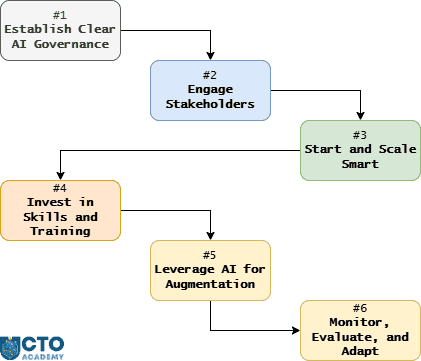
Start with six fundamentals: clear AI governance, stakeholder alignment (often via an AI committee), small responsible pilots that scale, training for teams and leaders, using AI for augmentation (with human accountability), and continuous monitoring/evaluation (ideally via sandboxed environments).
In practice, many orgs reduce risk by centralizing access (e.g., internal proxy + identity provider) so engineers can use multiple providers while the business retains oversight, logging, and budget control.
Pair this with explicit policies (approved tools, data-handling rules, access requests), active monitoring/audits to detect shadow usage, and ongoing education so teams understand why controls exist.
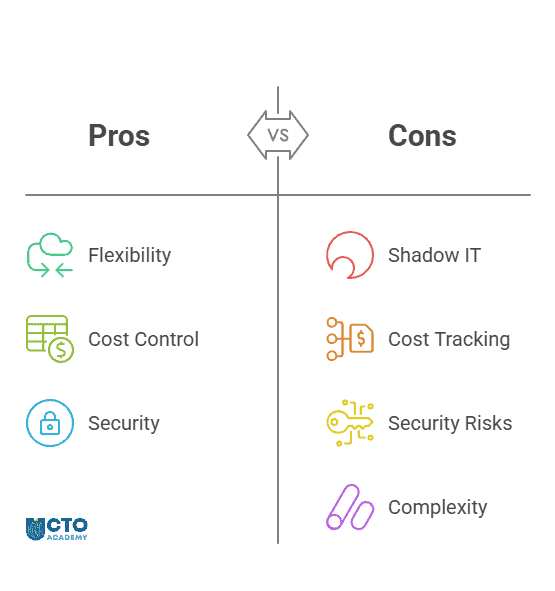
Done well, you keep flexibility and speed while protecting IP, customer data, and spend; done poorly, you get shadow IT, fragmented cost tracking, exposed keys, and operational overhead.
Download the AI Integration Blueprint
Move beyond pilots and integrate Gen AI into core systems, without losing control of cost, security, or compliance. Get the practical roadmap tech leaders use to modernize infrastructure, prioritize the right use cases, and set governance that scales.
You start by getting a team licence on, say, OpenAI. Immediately after, your engineers start using an API key in the IDE. Initially, that seems like a good way to manage costs, but also to control your data.
However, you soon realize that engineers are using their personal keys on other AI platforms—the ones they prefer, are just experimenting with, or simply have features that OpenAI does not.
Now, you don’t have to discourage this necessarily, but it does raise concerns about control and privacy issues, doesn’t it?
So, how do you, as a technology leader, manage this? What are the pros and cons? Are there any potential pitfalls and traps that you must address immediately?
(FYI, this was the genuine question asked by a member of our community, a Group CTO of a major international corporation who faced this challenge most recently. When we took a deeper look, we found this is a repeating scenario that many tech leaders struggle with.)
General Mitigation and Control Strategies
Generally, there are 6 strategies you should implement at the very beginning of the process:
Establish Clear AI Governance (i.e., policies, ethical standards, etc.).
Engage Stakeholders by forming AI committees (for mid-sized to large organizations) and maintaining transparent communication.
Start and Scale Smart (Responsibly):
STEP 1: Identify repetitive, high-friction tasks in the software development lifecycle (SDLC) that can benefit most from AI.
STEP 2: Begin with small, well-defined pilots
STEP 3: Gather feedback
STEP 4: Refine your approach before scaling to broader use cases.
Invest in Skills and Training by upskilling both teams and leaders.
Leverage AI for Augmentation, not Replacement, by enhancing human roles and maintaining human oversight. In other words, use AI to automate routine tasks like test case generation, bug triage, and performance monitoring, so your teams can focus on creative problem-solving, strategy, and innovation. At the same time, make team members accountable for critical decisions, test strategy, and interpreting AI-generated insights, especially for nuanced or high-stakes scenarios.
Monitor, Evaluate, and Adapt.
TIP: Use sandboxes where possible to test AI deployments in controlled environments to identify and mitigate risks before full-scale rollout.
The scenario we mentioned earlier mirrors a common challenge faced by technology leaders as AI tools proliferate:
How to balance innovation and autonomy with the need for control, privacy, and cost management?
Here’s how others in the industry are addressing similar issues.
How Tech Leaders Are Managing Multi-Platform AI Usage
Tools like Eden AI offer multi-API key management, letting teams organize, monitor, and switch between keys for different projects or providers from a single interface. This approach enables granular usage tracking, cost optimization, and better security.
Policy and Governance
Clear internal policies about which AI platforms and keys are permitted for use in development and testing are necessary. This includes specifying approved providers, outlining data handling requirements, and establishing processes for requesting access to new tools.
Some organizations allow experimentation with new platforms but require engineers to register external API usage with IT or security, ensuring transparency and risk assessment.
But there are also some more rigorous practices, as some of our members noted. There is an example of a highly sensitive organization that monitors prompts sent to ChatGPT and flags any potentially sensitive personal data leaving their networks. However, even in this instance, they encourage the use of dev tools.
Another example is a company that deployed its own internal chatbot (leveraging AWS Bedrock) while banning egress of any IP or data outside of its network. This included the use of Cursor and Copilot tools (as source code would inevitably exit the proprietary network).
Some organizations use customized and adjusted MDM policies to control apps installed on proprietary mobile devices. However, this implies that external (personal) devices are strictly prohibited. Fortunately, there are IDEs now with enterprise features (JetBrains, NXP eIQ® AI) that allow at least some form of use of BYOD models.
But overall, as one of our members concluded, increased organizational control leads to a more expensive and less convenient system. That tradeoff must be considered before laying down the general policy.
Tech leaders must educate their teams about the privacy, security, and compliance implications of using personal or external AI tools while encouraging responsible experimentation within defined boundaries.
In summary, by combining centralized controls with clear policies and ongoing education, you provide innovation freedom while maintaining the oversight necessary to protect your organization’s data, privacy, and budget.
Frequently Asked Questions (FAQ)
What is “Shadow AI”?
It’s AI usage (tools, platforms, API keys, workflows) that happens outside the organization’s approved, monitored, and governed environment. It often happens via personal accounts/keys or unregistered tools.
Why does Shadow AI show up even when we buy an enterprise license for one provider?
Because developers optimize for speed and ergonomics. They’ll try other tools for specific features, better IDE integration, different model performance, or experimentation, especially when it’s frictionless to use a personal key.
What are the biggest risks?
Common risks include shadow IT, data/privacy leakage (sensitive prompts leaving your network), fragmented cost tracking, security exposure through leaked/mishandled API keys, and higher operational complexity as provider sprawl grows.
Do we need to ban non-approved AI tools to be safe?
Not necessarily. The article’s direction is to balance innovation with controls: allow responsible experimentation within boundaries, while making usage visible and auditable through governance, policy, and monitoring.
What are the first controls to implement (before things sprawl)?
Start with: (1) AI governance, (2) stakeholder engagement (often an AI committee), (3) small pilots that scale responsibly, (4) training/upskilling, (5) “augmentation not replacement” with human accountability, and (6) ongoing monitoring/evaluation (use sandboxes where possible).
How do teams manage multi-platform AI usage without losing control?
A common approach is centralized API key management; e.g., an internal proxy that authenticates via your identity provider, hides real keys, consolidates usage, and enables tracking and budget controls even across multiple AI vendors.
What should an internal AI policy actually specify?
At minimum: approved providers/tools, rules for what data can/can’t be sent, requirements for registering or requesting new tools, and expectations for secure key handling and logging/monitoring.
What does “monitoring and auditing” look like in practice?
Regular reviews of API usage and access patterns to spot unapproved tools/keys (“shadow IT”) and identify privacy or governance gaps, especially where personal keys bypass organizational controls.
How do we handle highly sensitive environments?
Some orgs monitor prompts for sensitive data and/or prohibit egress of IP/data outside their network, sometimes deploying an internal chatbot (e.g., via a managed enterprise platform) and restricting external IDE copilots where source code would leave the environment.
Can MDM (mobile device management) solve Shadow AI?
It can help by controlling installed apps on corporate devices, but it may force strict rules on personal devices and can reduce convenience, often increasing cost and friction.
What are the “pros” of allowing decentralized AI usage (with guardrails)?
If managed well, you can preserve flexibility and innovation; with centralized controls, you can also improve cost control and maintain stronger security/privacy.
What are the key recommendations to implement this sustainably?
Centralize API key management (internal proxy or third-party), define clear tool/key policies, educate teams on privacy/security responsibilities, and run regular audits to detect and correct shadow usage.
This tutorial provides a comprehensive look at how AI and ML can be leveraged for predictive threat detection, balanced with realistic considerations such as budgets, talent constraints, regulatory compliance, and scalability. For startup and scaleup technology leaders, these are not merely considerations but also obstacles they face every time they set out to improve the security posture of their organizations.
Download the AI Integration Blueprint
Move beyond pilots and integrate Gen AI into core systems, without losing control of cost, security, or compliance. Get the practical roadmap tech leaders use to modernize infrastructure, prioritize the right use cases, and set governance that scales.
Over the past decade, cybercriminals have increasingly shifted from sporadic, low-effort attacks to more targeted, automated, and sophisticated operations. Several factors have contributed to this change, including access to more advanced hacking tools, the emergence of organized cybercrime syndicates, and the wide availability of exploit kits. Smaller or rapidly growing companies—which often lack the robust security resources and mature processes of larger enterprises—have become prime targets.
Our security team here at CTO Academy, for instance, must constantly pivot the settings and policies of multilayered defense protocols to counter AI-powered attacks. Still, the two greatest challenges remain: employee cybersecurity hygiene — especially since we have a distributed team in a remote work environment — and DoS/DDoS attacks. The former comes down to regular education and maintaining a high level of cybersecurity awareness, but the latter requires immediate response, consequently demanding 24/7 vigilance.
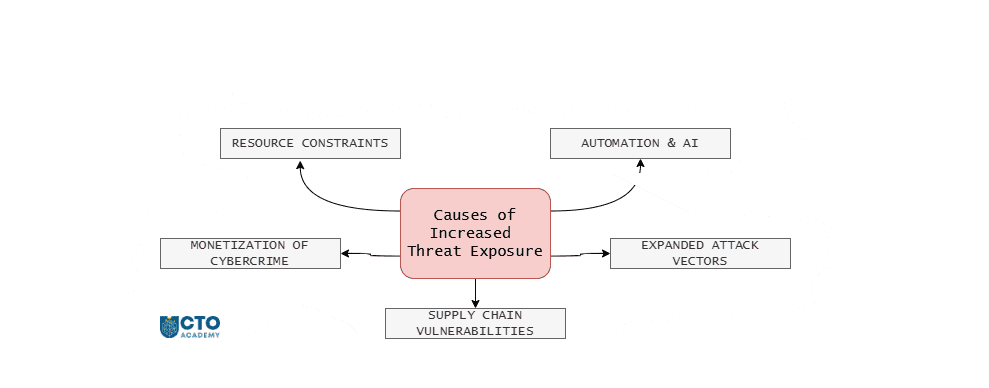
Key elements driving the threats
Automation and AI use by attackers (use of agentic AI and sophisticated AI-driven workflows)
Expanded attack vectors (more endpoints to ping)
Supply chain vulnerabilities (threat actors target third-party vendors or partners to compromise a larger network).
Monetization of cybercrime (a business-like approach resembling organized crime syndicates)
Resource constraints at smaller organizations (exploiting the paradigm of the “path of least resistance” that iscommon for startups).
In such an environment, smaller or fast-growing businesses need to adopt proactive strategies—like AI-driven predictive threat detection—to stay ahead of attackers. By recognizing the drivers behind increasingly sophisticated cyberattacks and understanding how these attackers operate, technology leaders can better allocate security resources and minimize risk.
Factors That Make Startups and Scaleups So Vulnerable
Startups and fast-growing companies tend to operate in that all-too-familiar dynamic, high-pressure environment that emphasizes rapid iteration and growth. While this helps them innovate quickly, it also exposes them to heightened security risks that may not be fully addressed in the rush to bring products and services to market.
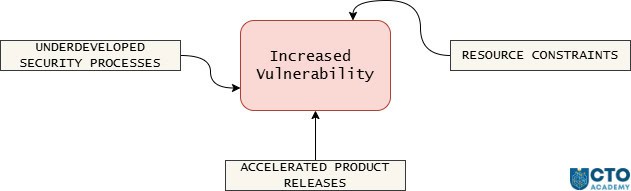
Three main categories of underlying factors make them susceptible to breaches and exploits: resource constraints, accelerated product releases, and underdeveloped security processes.
Resource Constraints
Early-stage companies must allocate limited funds strategically. In such a situation, security investments often compete with core product development, marketing, and hiring. Unfortunately, they rarely win.
Even if companies hire a dedicated security professional, the team is likely small. This can make it difficult to cover all aspects of cybersecurity, from threat detection to incident response. To counter the deficit of security talent, technology leaders resort to the education of in-house employees who don’t necessarily have a background in security. They do, however, have at least some knowledge of those most basic safety principles and have demonstrated the ability to use more advanced tools and dashboards. After all, it’s not that uncommon for startup staff to wear multiple hats.
A good example is having a content manager/curator with extensive experience in tech-related subjects who can easily be trained to also operate as a sys admin and quickly become a member of an incident response team.
Accelerated Product Releases
Frequent release cycles can introduce bugs or oversights that attackers exploit. Security checks may be skipped or rushed to meet deadlines. The reason for these errors is simple: product features and market traction often outrank security on the priority list. As a result, security best practices—like code reviews, penetration testing, and threat modeling—may not be thoroughly enforced.
These issues directly connect to the last factor:
Underdeveloped Security Processes
Startups often lag in establishing standardized internal security policies (e.g., password management, least-privilege access controls, or incident handling procedures). So instead of having a proactive defense, tech leaders are often forced to react to a developing situation.
The situation worsens once the company starts scaling. At this stage, it’s common to adopt tools or platforms ad-hoc, leading to a fragmented infrastructure that is difficult to secure cohesively.
Scaling translates to rapid hiring and onboarding that can introduce new endpoints and access needs without a corresponding increase in security oversight, making it easier for attackers to find entry points.
When combined, these factors significantly raise the potential for vulnerabilities. The only way to significantly reduce the exposure is by:
Acknowledging and addressing resource limitations
Building security into development cycles, and
Establishing robust processes early on.
Competitive Advantage Through Early Adoption of AI/ML
Leveraging artificial intelligence and machine learning for predictive threat detection can become a pivotal selling point for startups and scaleups, not just an internal safeguard. The AI/ML technology can transform security into a core component of the organization’s value proposition.
Now, while these technologies might seem resource-intensive, the fact is that even smaller organizations can capitalize on their benefits to differentiate themselves in competitive markets.
The question is, how exactly do AI and ML make this possible for startups and fast-growing companies?
1. Building Customer Trust and Confidence
Demonstrate proactive security to show customers, partners, and investors that security is taken seriously from day one. This is especially important in sensitive sectors (e.g., fintech, healthcare), where data breaches can be catastrophic.
Strengthen brand reputation by positioning the organization as one that invests in cutting-edge security. This can set you apart from competitors who may only be relying on conventional, reactive measures.
2. Enhancing Product Reliability
When leveraged correctly, AI-powered threat detection reduces downtime (service disruptions).
Users are more likely to engage with and trust a product that is robustly protected, translating to higher retention and positive word-of-mouth.
3. Demonstrating Maturity to Enterprise Clients
Larger customers often require security assurances, including proof of proactive threat detection capabilities. Early adoption of AI-driven security helps you meet those rigorous standards.
At the same time, having automated, real-time threat detection in place can simplify compliance checks and speed up the onboarding of big-ticket clients – the holy grail of every startup.
4. Leveraging Accessible AI/ML Tools and Services
Rather than building in-house from scratch, startups should opt for cloud solutions that provide AI-driven threat analysis. This lowers upfront costs and maintenance overhead.
Another option to consider is open-source frameworks that a) are mature enough, and b) can be seamlessly integrated into the stack.
5. Scalable, Future-Proof Security
As your user base expands and attacks become more complex, AI/ML models can continuously evolve with new data inputs—ensuring long-term protection that adapts without constant manual oversight. This is arguably the greatest advantage AI provides: the ability to process vast volumes of data in a short timeframe, recognize and categorize patterns, and, ultimately, adapt the response. This adaptive capability directly translates to minimizing the trade-off between speed and security.
That same ability enables us to keep pace with rapid release cycles. In other words, security strategy is no longer a fixed set of policies but an evolving entity that follows growth while requiring minimal manual optimization. In simple words, as long as you feed the machine with new data and occasionally check its work, you are more or less hands-free when it comes to threat detection and response.
A good example is Auth0, a fast-growing company (now merged with Okta) that initially operated with a relatively small engineering team. Auth0 provides identity and access management solutions to other startups and enterprises. As they scaled, they needed a more proactive way to protect user accounts from unauthorized access. Rather than relying purely on static rules or manual reviews, they implemented an ML-based anomaly detection system.
Understanding the Role of AI and ML in Threat Detection
Core Concepts
The challenge for startup and scaleup technology leaders is to adopt an approach that aligns with available resources and infrastructure. That’s exactly what we are going to do now – scale down the otherwise enterprise-level solutions to place them within the realistic reach of organizations with limited resources.
First, let’s briefly introduce the core concepts of AI-powered threat detection.
Supervised vs. Unsupervised Learning
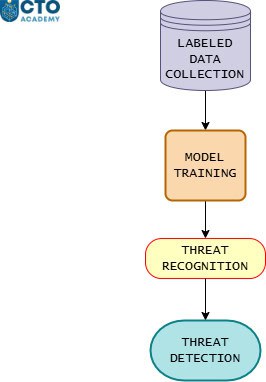
Supervised Learning
SL is commonly used for signature-based threat detection (e.g., phishing email classification). A model is trained on known malicious and benign examples to recognize suspicious behaviors or files.Algorithms learn from labeled data, meaning each example is tagged with the correct output.
Here’s the challenge for startup CTOs: They must consider the requirement of a clean, labeled dataset, which can be a barrier if you lack historical attack data. To bridge that gap, you can use publicly available datasets (e.g., for spam detection) and collaborative (open-source) industry data.
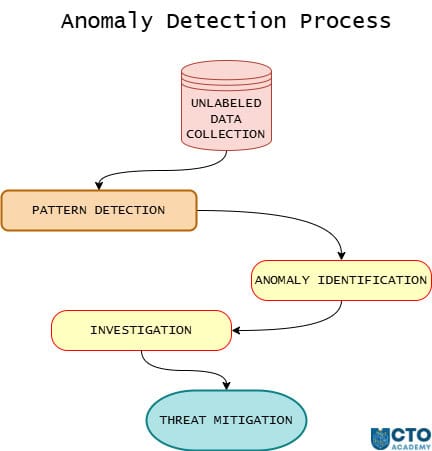
Unsupervised Learning
UL is useful for spotting zero-day attacks or insider threats where no prior labels exist. The model flags unusual activity, which is then investigated. Algorithms detect patterns in unlabeled data, identifying abnormalities or deviations from typical behavior. This is useful in detecting consistent attack techniques, common vectors, or repeated malicious IP addresses because it allows security teams to preemptively block known patterns and respond faster to incidents.
The good thing is that pattern recognition can be layered on top of existing log analysis and SIEM (Security Information and Event Management) systems to enhance detection without needing to overhaul your entire security setup.
But do consider this: while unsupervised learning might seem easier to start with since you don’t need labeled data, it can produce more false positives. Therefore, careful tuning and a good understanding of “normal” behavior in your environment are crucial.
(BACKDROP) Even a straightforward anomaly detection solution can provide significant value if you have a clear sense of what “normal” looks like—something smaller teams can define quickly.
Deep Learning
As a subfield of machine learning that uses multi-layer neural networks to model complex patterns in data, deep learning can improve threat detection accuracy in areas like image recognition (e.g., detecting malicious logos or screenshots), text analysis (phishing emails), and network traffic analysis.
The obstacle DL presents for many startups and fast-growing organizations is the demand for more computational power and substantial amounts of data. However, cloud-based solutions and pre-trained models (e.g., from open-source libraries) can reduce the time and cost required to implement.
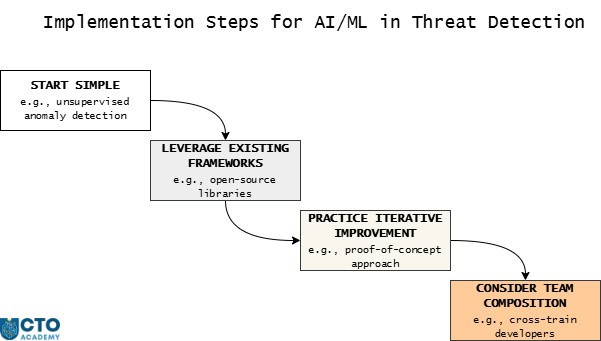
Realistic 4-step Approach for Startups
Step 1:Start Simple
Rather than building advanced deep learning solutions from scratch, begin with more accessible methods (like unsupervised anomaly detection) or consider off-the-shelf solutions with ML features.
Step 2: Leverage Existing Frameworks
Open-source libraries (e.g., TensorFlow, PyTorch, scikit-learn) and community-driven security tools can accelerate development.
Step 3: Iterative Improvement
A proof of concept (PoC) approach—detecting a single type of threat—helps validate value quickly. Scale up to more complex models as you gain confidence and resources.
Step 4: Team Composition
If you can’t get a dedicated data scientist or ML engineer, you can cross-train capable developers or outsource specific tasks to external experts.
Data-Driven Security
6 Rules of Quality Datasets
Prioritize building processes that ensure reliable data collection and storage from day one.
When using supervised learning, label data based on both malicious and benign examples—complete with relevant context.
Always monitor in real-time to timely catch an anomaly and reduce the threat actor’s “dwell time.”
A single snapshot of data won’t suffice. Only continuous data collection keeps your models updated with the latest attack patterns.
Keep retraining and fine-tuning ML models as more data streams in to refine accuracy and reduce false positives.
Your data pipeline must remain continuous for security measures to complement growth.
Cloud providers often offer built-in ML capabilities (e.g., AWS, Azure, GCP) that you can integrate with your security data, minimizing the need for extensive hardware investments.
ML-Enabled Insight vs. Traditional Security Measures
Traditional security solutions often rely on static, rules-based systems. They look for known signatures, patterns, or behaviors explicitly defined by security professionals. In contrast, ML-driven security focuses on continuous learning and adaptation.
Discovery of Novel Threats (e.g., Zero-Day Exploit)
Here’s how it works on the most fundamental level:
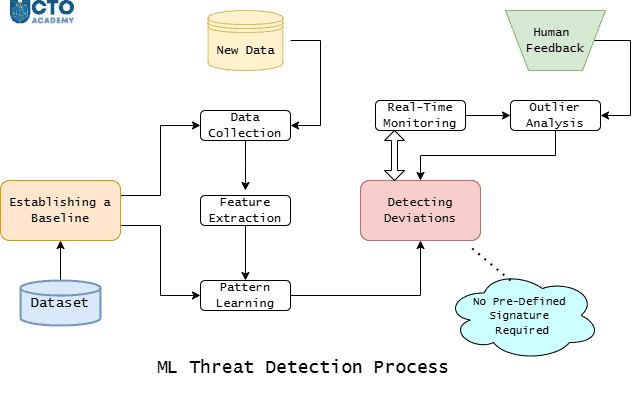
Machine learning (ML) models can detect unusual behavior—or anomalies—by learning the “normal” patterns of a system or user baseline, rather than relying on predefined rules.
They start by establishing a baseline using a historical dataset. The data must reflect typical system usage, network traffic, or user interactions. As part of training, the model identifies important characteristics—like the frequency of specific actions, average data transfer sizes, login times, etc. The model then learns the statistical distributions, clusters, or relationships among these features that define “normal” behavior.
Once the model establishes the baseline, it can detect deviations through real-time monitoring. When new events (e.g., user logins, network connections) occur, they are fed into the trained model. The model checks if these events fit within the established “normal” range it has learned (outlier analysis). Events that significantly deviate from expected patterns are flagged as potential anomalies.
(BACKDROP) Note that the model doesn’t need a human-defined rule or signature to recognize an anomaly; it automatically infers normal vs. abnormal behavior from the data itself.
Here is where the major difference between traditional measures and machine learning insights lies: instead of a fixed set of rules that rely on known attack vectors, ML relies on continuous adaptation and feedback. In other words, as new data flows in, the model can be retrained or refined, improving its ability to distinguish false alarms from genuine threats.
To validate detected flagged anomalies, security analysts may review them, providing feedback that helps the model refine its notion of what constitutes “normal” behavior vs. a legitimate threat.
Because ML identifies subtle patterns and correlations that aren’t always obvious to humans—or captured by static rules—it’s particularly effective at detecting previously unknown (zero-day) attacks and other sophisticated threats.
Practical Implementation Strategies
Startups and fast-growing organizations can choose between ready-made platforms or building proprietary systems in-house. The decision largely depends on budget, technical expertise, time-to-market, and the specific security requirements of your organization. However, we can safely assume that the majority of smaller organizations will opt for off-the-shelf tools rather than building their own solutions.
(In case you are wondering what it takes to build a proprietary AI-driven threat detection system, how much would something like that cost, and what would it require, read past the conclusion for the breakdown.)
Off-the-Shelf AI-Driven Security Tools
Amazon GuardDuty: A managed threat detection service that continuously monitors for malicious activity and unauthorized behavior in Amazon Web Services (AWS) environments.
Microsoft Azure Sentinel: A scalable cloud-based SIEM (Security Information and Event Management) and SOAR (Security Orchestration Automated Response) solution. It uses built-in AI to swiftly analyze large volumes of data across hybrid cloud environments.
CrowdStrike Falcon: Offers endpoint security with ML-based detection, real-time threat analysis, and automated response capabilities.
Splunk Enterprise Security: Provides advanced analytics for security events, including AI-driven anomaly detection and correlation across various data sources.
Pros and Cons
Pros:
Quick deployment (minimal setup and configuration).
Regular updates (vendors frequently update detection signatures and ML models to keep pace with emerging threats).
Reduced maintenance (infrastructure managed by the service provider).
Cons:
Limited customization control.
Ongoing costs (subscription fees can add up, especially as your data volume grows).
Vendor lock-in.
Now, building a proprietary AI-driven threat detection system would eliminate these cons. It would give you full control over models, fit seamlessly into your workflows and tech stack, and perhaps evolve into a product if security is your core service or product. However, a project like that requires a hefty initial investment. Data scientists, ML engineers, security experts, maintenance – all of that would most certainly amount to substantial costs. Not to mention the longer time to market since you have to design, test, and fine-tune custom models.
Hybrid Approach as the Most Viable Solution
Startups usually begin with a ready-made solution to quickly establish a baseline of security. Over time, they either build complementary tools or transition to a fully custom system. They focus their in-house efforts on areas that need deeper customization (e.g., specialized anomaly detection for proprietary applications like in Auth0’s case) while leveraging off-the-shelf solutions for broader coverage.
Some, like already mentioned Auth0, managed to build proprietary systems relying on open-source solutions.
Open-Source Solutions
TensorFlow: Supports various machine learning tasks, particularly deep learning and neural networks, and can run on multiple platforms including mobile devices, desktops, and servers.
scikit-learn: An open-source machine learning library for Python that provides a comprehensive set of tools for data analysis and predictive modeling.
TensorFlow and scikit-learn can be effectively integrated to build a proprietary AI-driven threat detection system because they complement each other well in cybersecurity applications. You can use scikit-learn for preprocessing, feature engineering, and traditional machine learning algorithms while leveraging TensorFlow for building complex neural networks and deep learning components. This creates a unified machine-learning pipeline that maximizes efficiency and performance, streamlining the development process between different stages of your workflow.
For threat detection specifically, scikit-learn can handle anomaly detection and feature selection while TensorFlow processes real-time data and builds predictive models.
Practical Implementation Example
In a proprietary threat detection system, you might:
Use scikit-learn’s Isolation Forest for initial anomaly detection in network traffic.
Create a pipeline where scikit-learn handles data preprocessing and TensorFlow manages the complex modeling aspects.
For example, in a manufacturing context with IoT sensors, scikit-learn can assist with feature engineering and anomaly detection while TensorFlow handles real-time data processing and predictive analytics to identify potential security breaches.
Such an integration is particularly valuable for proprietary threat detection because:
By combining these tools, you can build a more robust and versatile proprietary threat detection system than would be possible with either library alone.
All you need now is relevant metrics to detect accuracy, response times, reduction in attack surface, etc.
Key Performance Indicators (KPIs)
Detection Accuracy
True Positive Rate (TPR)
False Positive Rate (FPR)
Overall Precision and Recall Balance
Mean Time to Detect (MTTD)
Mean Time to Respond (MTTR)
Reduction in Attack Surface
Vulnerability Management (tracking the number of known vulnerabilities or misconfigurations identified and resolved over time)
Exposure Metrics (measuring external-facing assets to ensure the system is effectively shrinking the overall footprint attackers can exploit)
Alert Volumes and Prioritization
Alert-to-Signal Ratio (the number of alerts that correspond to genuine threats versus “noise” where a high signal-to-noise ratio indicates better model calibration)
Analyst Workload
Compliance and Audit
Regulatory Adherence
Audit Reduction
User Feedback and Satisfaction
Prioritize the KPIs that closely align with your business objectives, resource constraints, and compliance needs.
Conclusion
For most startups and fast-growth organizations, starting with an off-the-shelf AI-driven security platform provides immediate robust foundational protection with minimal complexity.
As your organization matures and specific security needs become clearer, selectively integrating custom ML models or developing a proprietary system can help you optimize for cost, performance, and unique use cases.
This balanced approach allows you to stay agile, control expenses, and still benefit from advanced AI capabilities.
Building a Proprietary AI-driven Security System From Scratch: Investment Breakdown
Building a proprietary AI-driven security system involves more than just code—it requires strategic planning, specialized skills, and a substantial (though variable) financial investment. While exact figures differ based on scope and regional cost variations, here is a realistic overview of the kinds of resources and commitments typically involved:
1. Financial Investment
Staffing Costs
Data Scientists and Machine Learning Engineers: Salaries can range from mid-five-figure to low six-figure amounts annually per individual, depending on location and experience level.
Security Specialists: Expertise in threat intelligence, incident response, and pentesting is essential. These roles also command competitive salaries, often on par with advanced developer roles.
Software Engineers and DevOps/MLOps: You’ll need professionals to integrate the AI models into your existing systems, maintain the infrastructure, and automate updates.
Total Team Costs: A small, dedicated team of five to eight professionals might cost $500,000–$1M+ per year in salaries and benefits, even more in high-cost tech hubs.
Infrastructure and Tools
Computing Resources: GPU-enabled cloud servers for training, plus storage solutions for large datasets. Expect monthly cloud bills in the range of hundreds to tens of thousands of dollars, depending on workload and scale.
Licensing and Software: While open-source frameworks (e.g., TensorFlow, PyTorch) are free, additional enterprise-grade monitoring or automation tools could add extra costs.
Data Acquisition and Labeling
Dataset Curation: If you need specialized or proprietary data, acquiring it might involve purchasing threat intelligence feeds, investing in data collection tools, or partnering with other organizations.
Labeling Efforts: In supervised learning scenarios, creating high-quality labeled data (e.g., identifying malicious vs. benign samples) can be time-consuming and expensive. Outsourced labeling services or in-house data annotation teams can cost tens or hundreds of thousands of dollars annually, depending on volume.
Ongoing Maintenance
Continuous Model Training: Threat landscapes evolve quickly, so you’ll need budget and staff hours for regular retraining and model updates.
Security Updates and Audits: Regular penetration testing, security audits, and compliance checks ensure the system remains robust.
2. Required Skill Sets and Team Composition
Data Science & Machine Learning
Algorithm Development: Understanding statistical modeling, anomaly detection, deep learning architectures, etc.
Feature Engineering and Data Pipeline Creation: Ensuring data is relevant, high quality, and in a usable format for training.
Cybersecurity Expertise
Threat Intelligence and Analysis: Identifying the tactics, techniques, and procedures (TTPs) used by malicious actors.
Incident Response & Forensics: Ensuring you have the right processes and tools to react when threats are detected.
DevOps/MLOps & Software Engineering
Scalable Infrastructure: Building cloud-native solutions that can handle large data volumes and real-time processing.
Automation & CI/CD Pipelines: Streamlining model deployment and updates to keep pace with rapid changes.
Project Management and Compliance
Product Ownership: Someone who can articulate requirements, align development goals with business objectives, and handle prioritization.
Regulatory Knowledge: Familiarity with industry-specific regulations (e.g., GDPR, HIPAA) to maintain compliance with data security and privacy laws.
3. Requests and Prerequisites
Well-Defined Scope and Use Cases
Threat Profiles: Outline the types of threats you need to detect—e.g., phishing, insider threats, ransomware, zero-day exploits.
KPIs and Success Criteria: Metrics to gauge detection accuracy, false positives, and mean time to detect/resolve incidents.
Data Collection Strategy
Logging and Telemetry: Ensure you are collecting logs from endpoints, servers, cloud services, and network devices in a structured and centralized way.
Storage and Access Policies: Have clear data governance rules to manage data securely and comply with privacy regulations.
Iterative Implementation Plan
Proof of Concept (PoC): Start with a limited scope (e.g., a single attack vector) to validate the approach and demonstrate ROI.
Phased Rollout: Expand gradually, updating the model and infrastructure after each iteration to handle new data sources and threat categories.
Sustained Commitment
Training and Education: Ongoing learning for staff to keep up with the latest ML techniques and threat tactics.
Operational Maturity: Building a robust process for alerts, investigations, and model performance reviews—often requiring a dedicated security operations team or managed services support.
Summary
Building your own AI-driven threat detection system can be a significant investment—both financially and in terms of organizational focus. However, if your organization operates in high-risk industries or aims to differentiate through security innovation, this path can deliver long-term competitive advantages.
By thoughtfully planning the budget, carefully assembling the right skill sets, and methodically rolling out the system, you can create a proprietary security solution that evolves alongside your company’s growth and threat landscape. But you will require far more than just a budget to see it through.
This article provides the most comprehensive, up-to-date list of essential CTO tools, categorising them based on their functionality and use cases. It also provides insights into the key factors for choosing and measuring their return on investment (ROI) while answering frequently asked questions about the tools and frameworks.
For Chief Technology Officers (CTOs) in start-up and fast-growing companies, selecting the right tools is a strategic decision influencing product development, team efficiency and business growth.
Unlike traditional IT tools, which primarily support infrastructure and maintenance, CTO tools focus on innovation, agility and automation -especially today, with the rapid evolution of Agentic AI and generative AI-powered tools in general.
Table of Contents
Essential Tools for a CTO (2025 and beyond)
CTO tools can be categorised into several key areas based on their functionalities and use cases:
1. Strategic Planning & Vision
Technology Strategy Frameworks:
COBIT (Control Objectives for Information and Related Technologies) – IT governance and management-focused, for aligning IT strategies with business objectives while ensuring effective risk management and regulatory compliance.
Technology Radar – a visual framework that categorises technologies into quadrants (eg, Adopt, Trial, Assess, Hold) based on their relevance to the company’s goals.
Business-Technology Alignment:
Balanced Scorecard – a planning tool that ensures technology strategy aligns with business objectives across multiple dimensions.
Domo Time Series Forecasting – integrates with business data to deliver real-time insights and allows users to create complex forecasting charts.
Market & Competitive Analysis:
Crayon – a competitive intelligence platform that automatically captures and analyses competitive intelligence from hundreds of millions of sources.
Mautic – an open-source marketing automation platform that enables businesses to manage email campaigns, lead nurturing, customer segmentation and analytics. (op.ed., a bit difficult to install and update but extremely useful, not to mention the fact that you own the data).
Buzzsumo, Semrush and SpyFu for the website intelligence (eg, keywords, content strategy, backlinks, CPC…)
Innovation Management:
ITONICS – an innovation management software that offers a modular innovation operating system for trend, technology, idea and innovation project management.
Miro Innovation Workspace – an AI-powered platform specifically designed to facilitate the entire innovation process from discovery to delivery.
Miro Intellinget Canvas – an AI-powered collaborative workspace that enhances brainstorming, diagramming, and workflow automation with smart features and real-time team collaboration.
Platforms for Tracking & Managing Innovation Pipelines:
(ITONICS)
Planview – a comprehensive work and resource management software platform that enables organisations to plan, prioritise and manage projects, portfolios and resources effectively.
Ezassi – an innovation solutions company offering software and services for idea management, technology scouting and pipeline management to accelerate product development and market delivery.
Qmarkets – an enterprise innovation management software provider offering solutions like Q-impact, a tool designed to track and measure the value delivered by innovation portfolios over time.
Planbox – an agile innovation platform for ideas, projects and tasks management and bringing new products and services to market.
Wazoku – an innovation management platform for capturing, developing, and scaling ideas across an innovation ecosystem with AI-powered solutions and a global crowd.
Three Horizons Framework – a strategic model for managing short-term, mid-term and long-term innovation initiatives by balancing core business optimisation with emerging opportunities and future growth potential.
Collaboration Frameworks for Innovation & Partnerships:
HYPE Innovation Partner Management Software – enables systematic scouting, evaluation and management of innovation partners to accelerate value-creation and maintain competitiveness.
Agorize Innovation Ecosystem Platform – connects organisations with a global community of over 10 million start-ups, students and developers to accelerate idea generation and collaboration.
ZINFI’s Unified Partner Management (UPM) Solutions – streamline partner lifecycle management by integrating partner recruitment, onboarding, training, marketing, sales and incentives into a unified system, enhancing collaboration and efficiency.
EVPA’s Cross-Sector Collaboration Framework – a methodology that helps facilitate effective partnerships among public, private and social sectors, aiming to achieve improved social outcomes through shared objectives and resource pooling.
The Intersector Toolkit – a guide designed to help diagnose, design, implement and assess successful cross-sector collaborations.
2. Project & Operational Management
Agile Project Management:
Jira – a project management and issue-tracking software developed by Atlassian, designed for agile teams to plan, track, and manage software development projects efficiently.
Jira with Machine Learning – an integration that enhances Jira’s functionalities by leveraging artificial intelligence to improve search capabilities, automate issue assignments, and provide predictive analytics, thereby streamlining project management and boosting team productivity.
Easy Redmine – a project management software that enhances the functionalities of Redmine by offering advanced features such as resource management, Gantt charts, Agile tools, finance management and AI-powered assistants, enabling teams to manage projects more effectively.
Trello – a visual project management tool that uses boards, lists and cards to help teams organise tasks and workflows flexibly and collaboratively.
Asana – a work management platform designed to help teams coordinate tasks, track progress and streamline workflows for efficient project execution.
Nifty – a comprehensive project management platform that centralises tasks, timelines, documents and communications to streamline team collaboration and enhance productivity. (op.ed, this is the tool we can definitely recommend).
SmartSuite – a work management platform that enables teams to plan, track and manage workflows, projects and tasks across various business processes.
Forecast – an AI-powered project and resource management platform that integrates project planning, resource allocation and financial tracking to enhance efficiency and predictability in both traditional and agile project management methodologies.
Dart – an AI-driven project management tool that automates routine tasks such as task assignment, subtask creation and report generation and enhances efficiency and collaboration in both traditional and agile project management environments.
Cloud Cost Optimisation:
CloudZero – a cloud cost intelligence platform that provides contextual insights by breaking down costs to show the where, when, and how of cloud spend without manual tagging.
AWS Cost Explorer – provides interactive charts, reports, and filters for detailed visibility into AWS spending.
Finout – an enterprise-grade FinOps solution that provides complete visibility and context for cloud costs across entire infrastructures without adding code or agents.
Apptio Cloudability – offers budgeting, forecasting, and rightsizing capabilities along with reserved instance planning, container cost management, and anomaly detection.
Kubecost – focuses specifically on Kubernetes environments, providing real-time cost visibility into workloads running on Kubernetes clusters.
Densify – uses machine learning and deep analytics to automate instance type selection and right-sizing for Kubernetes optimisation.
Amnic – provides 360-degree observability into cloud costs at network, billing and resource levels. Its Cost Analyzer feature helps dissect cloud expenses, while its anomaly detection monitors spending patterns.
IT Infrastructure & Resource Planning:
Datadog – Cloud Monitoring as a Service platform; provides monitoring of servers, databases, tools and services with analytics capabilities.
Nagios – IT infrastructure monitoring through dashboards and monitoring wizards.
Puppet – an open-source tool that centralises and automates configuration management processes with software deployment capabilities.
Chef – an automation platform that transforms infrastructure into code, enabling efficient and scalable management across networks.
AWS CloudWatch – monitoring and management for AWS resources and applications with automated actions based on alarms, logs and events data.
Azure Monitor – full-stack monitoring with advanced analytics and machine learning capabilities for cloud and on-premise environments.
Float – a resource management tool that helps employees set individual work hours, track time for scheduled tasks and schedule personal time off.
Resource Guru – a resource scheduling tool that helps schedule people, equipment and other resources with a unique “clash management system” to prevent over-bookings.
Mosaic – an AI-powered workforce management software that optimises resources around priorities and suggests projects for team members with available time.
ActivityTimeline – uses colours to indicate workload levels and offers an availability indicator that highlights remaining hours for efficient resource allocation.
Terraform – enables organisations to provision and manage infrastructure using declarative configuration language (HCL) with support for multiple cloud providers.
Workflow Automation:
Yoroflow – a no-code workflow automation tool with an intuitive drag-and-drop interface that enables users to create tailored workflows without coding expertise.
Zapier – connects thousands of apps to automate workflows seamlessly across platforms, making it excellent for cross-application automation.
ClickUp – combines project management with process automation, featuring an AI automation builder that turns user prompts into custom automation with editable triggers and actions.
Flokzu – cloud-based workflow automation with a G2 rating of 4.9, making it one of the highest-rated options available.
Pipefy – business process automation with a no-code interface, particularly excelling at Kanban-style workflow management.
FlowForma – a no-code digital process automation platform that now features FlowForma Copilot, which builds processes based on text, voice, or diagram prompts using agentic AI.
Nintex – a platform for workflow automation, process management, and robotic process automation.
3. DevOps & Continuous Delivery
CI/CD Pipelines:
Jenkins – an open-source automation server for CI/CD with plugins expanding its capabilities. It features pipeline-as-code functionality, master/worker architecture for distributed builds and an easy installation process on major operating systems.
GitHub Actions – automates tasks within the software development lifecycle.
GitLab CI/CD – features Auto DevOps to automate application lifecycle processes and a CI/CD catalogue (introduced in GitLab 17.0) that lets teams discover and share pre-built pipeline components.
CircleCI – a cloud-native CI/CD tool for automation that supports containerised builds. Its key features include workflows for orchestrating job executions, orbs (pre-packaged configuration templates) and the ability to speed up builds with cache dependencies, artifacts and Docker layers.
Azure Pipelines – provides multi-platform support for building and deploying applications in languages like .NET, Java, Node.js, and Python on various operating systems.
Infrastructure as Code:
Terraform – allows defining both cloud and on-premises resources in human-readable configuration files.
Pulumi – an open-source IaC tool that allows developers to define infrastructure using familiar programming languages like Python, JavaScript, Go, and Java.
Automated Testing & Deployment:
Spinnaker – an open-source, multi-cloud continuous delivery platform that automates software deployments, integrates with CI/CD pipelines and enables safe, scalable application releases.
Selenium – an open-source tool for web application testing.
Cypress – used for testing modern JavaScript-based applications, especially single-page apps (SPAs); operates directly within the browser.
Containerisation & Orchestration:
Docker – a platform for developing, shipping, and running applications in lightweight, portable containers, enabling consistent environments across development, testing, and production.
Kubernetes – an open-source container orchestration system that automates the deployment, scaling and management of containerised applications across clusters of machines.
Development Environments for Cloud-Native Applications:
AWS Elastic Beanstalk – provides an environment for cloud application development with automated scaling capabilities and built-in monitoring.
Microsoft Azure – offers a comprehensive cloud platform with services ranging from virtual machines to serverless computing.
Heroku – simplifies application development by allowing developers to build, run, and operate applications entirely in the cloud.
Micronaut – a modern full-stack framework for building microservices and serverless applications with built-in cloud support.
Quarkus – a Kubernetes-native Java framework tailored for GraalVM and HotSpot.
Vert.x – a toolkit that supports cloud-native development, used for building reactive applications on the JVM using an asynchronous and non-blocking execution model.
AWS Amplify and AWS CDK help maximize agility and accelerate the development of cloud-native applications.
4. Software Development & Modernisation CTO Tools
Code Editors & IDEs:
Visual Studio Code – evolved into a complete AI development environment while maintaining its familiarity and extensibility.
JetBrains IntelliJ IDEA – designed primarily for Java programming but offers excellent support for web development languages.
GitHub Copilot – now supports multiple AI models including Claude 3.5 Sonnet, o1 and GPT-4o.
Cline – bridges the gap between editor and terminal.
AWS Cloud9 – a cloud-based IDE with native AWS service integrations, particularly well-suited for developers heavily invested in AWS, serverless or container-based workflows.
GitHub Codespaces – provides a cloud-based environment integrated with GitHub, ideal for teams requiring instant, remote development setups with native GitHub repository integration.
Postman – a testing platform for creating and sending API requests across different HTTP methods.
JMeter – performance testing for APIs; simulates heavy loads on servers by creating multiple virtual users.
Swagger.io – helps teams design, document and test APIs through its OpenAPI specification tools, including SwaggerHub for API design and Swagger Inspector for testing.
GitHub, GitLab, Trello and Jira – for collaboration and project management.
Confluence and Figma – for documentation.
Loom and Slack – for communication and collaboration.
Proliferating Frontend & Backend Frameworks for Complex Web Interactions:
React, Angular, Vue.js, Svelte, Solid.js, Qwik and Astro – for frontend.
Node.js, Jango, Laravel, Springboot, Express.js, Phoenix, Fast API, Nest.js – for backend
AI-Assisted Code Generation & Review: GitHub Copilot, ChatGPT for Developers
Legacy Modernization:
GenAI-powered tools for understanding and transforming legacy code:
Swimm – helps accelerate mainframe migration by streamlining the process of documenting and understanding legacy systems.
CAST Highlight – provides advanced code analysis to identify technical debt, evaluate code quality and assess cloud-readiness.
Sorald – an AI-powered tool that automatically repairs issues detected by SonarQube, saving developers hours of manual work.
Microservices conversion platforms:
vFunction – an architectural observability platform that automates and simplifies the decomposition of monoliths into microservices.
Carbonite Migrate – a structured process for migration that reduces downtime and prevents data loss, allowing users to migrate across environments between physical, virtual and cloud-based applications.
Turbonomic – uses AI to optimise and monitor workloads, making it particularly effective for complex hybrid cloud migrations.
Technical debt assessment and management solutions:
SonarQube – a static code analysis tool that helps identify code smells, complexity and duplicity. It provides measurable and graphical results to help measure and prioritise technical debt and fix problems before they worsen.
Ardoq – a data-driven approach to technical debt management with visualisation tools to communicate impact and progress.
Stepsize – a tech debt tool that allows engineers to track technical debt issues directly from their code editor.
Databricks – a unified, open analytics platform designed for building, deploying and maintaining enterprise-grade data, analytics and AI solutions at scale.
Domo – combines data integration, visualisation, app creation, governance and security into one comprehensive cloud-based platform.
Data Visualization & BI: Tableau, Power BI
MLOps Platforms for Model Deployment & Management:
Kubeflow – machine learning model deployment on Kubernetes.
MLflow – an open-source platform for managing the complete machine learning lifecycle.
BentoML – a Python-first tool designed to make deploying and maintaining ML APIs in production faster and easier.
Seldon – focuses on deploying machine learning models at scale with greater accuracy.
DataRobot MLOps – automates model deployment, monitoring and governance. It’s designed for users looking to monitor existing models and manage their production AI lifecycle.
Generative AI Development Environments for content and code creation: GitHub Copilot, Cursor (VS Code), Zencoder, GitHub Spark.
Agentic AI Systems:
Microsoft AutoGen enables multi-agent conversations and collaboration, making it ideal for complex, multi-step processes.
n8n – offers an AI Agent node that provides six different LangChain agent options, including Tools Agent, Conversational Agent, OpenAI Functions Agent, Plan and Execute Agent, ReAct Agent and SQL Agent.
AgentGPT – an autonomous AI platform enabling users to create and deploy customisable AI agents directly from a web browser.
Kore.ai Agent Platform – serves as an AI operating system combining sophisticated agentic capabilities, enterprise-grade no-code development tools, comprehensive data services and industrial-strength core platform services.
Swarm (OpenAI) – features a minimalist design with two primary core functionalities—agents and handoffs.
CrewAI – designed for coordinating role-playing AI bots, allowing developers to assemble an AI “crew” with distinct roles and responsibilities to collaborate on complex projects.
How Do CTO Tools Differ from Traditional IT Tools?
Traditional IT tools are designed for stability, security and maintenance, while CTO tools enable rapid iteration, scalability and innovation. The key differences include:
Focus on Software Development – CTO tools prioritise DevOps, continuous integration/continuous deployment (CI/CD) and agile methodologies.
Scalability – they support fast-growing businesses, handling increasing loads and adapting to new requirements.
Integration with AI and Analytics – many modern CTO tools leverage artificial intelligence (AI) and data analytics to improve decision-making.
Cloud-Native Approach – unlike traditional IT solutions, CTO tools are often cloud-based, offering flexibility and cost efficiency.
What Are the Considerations When Choosing CTO Tools for a Start-up?
As a start-up CTO, you need to balance cost, scalability and long-term impact. You, therefore, must consider:
Budget Constraints – optimising costs without compromising on essential features.
Ease of Integration – the tool should fit seamlessly into the existing tech stack.
Automation Capabilities.
Security and Compliance – data protection and regulatory compliance are crucial for handling sensitive customer data.
Scalability – tools should support future growth without frequent replacements.
What Are the Key Features to Look for in CTO Tools?
Collaboration Features to enhance teamwork across distributed development tech teams.
AI-powered Data Analytics to obtain actionable insights and improve decision-making.
Integration Capabilities.
Automation & AI Tools to reduce manual tasks, speed up deployment and improve code quality.
Built-in Security & Compliance features.
Performance Monitoring capabilities.
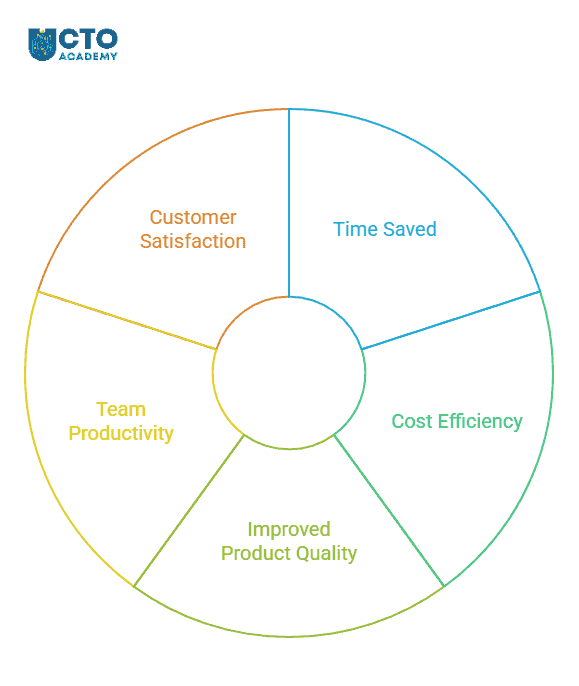
What Are the Criteria for Measuring the ROI of CTO Tools?
So, evaluate ROI based on:
Time Saved – Reduction in development cycles and manual work.
Cost Efficiency – Lower operational costs due to automation and cloud optimisation.
Improved Product Quality – Reduction in bugs, enhanced security and better performance.
Team Productivity – Enhanced collaboration and streamlined workflows.
Customer Satisfaction – Faster product releases and improved user experience.
How Can CTO Tools Streamline Project Management Processes?
Effective project management tools:
Improve task tracking and progress monitoring.
Enable seamless team collaboration.
Automate workflows to reduce bottlenecks.
Provide real-time insights for decision-making.
How Do CTO Tools Support DevOps and CI/CD?
CTO tools facilitate:
Automated testing to reduce bugs before deployment.
Continuous integration to merge code frequently.
Automated deployments for faster releases.
Infrastructure as Code (IaC) using tools like Terraform.
How Can CTO Tools Improve Collaboration Among Development Teams?
Collaboration tools:
Provide real-time communication (Slack, Microsoft Teams).
CTO tools differ from traditional IT tools by prioritising scalability, automation and AI-driven analytics.
Selecting the right CTO tools requires balancing budget, security and integration capabilities.
Essential CTO tools fall into categories like project management, DevOps, software development, data analytics and security.
Measuring the ROI of CTO tools involves analysing cost savings, time efficiency and improved product quality.
Successful implementation requires team buy-in, interoperability and ongoing performance monitoring.
The most significant trend across categories is the emergence of agentic AI, revolutionising how CTOs approach automation, decision-making and strategic planning.
By leveraging the right CTO tools, technology leaders can drive innovation, improve operational efficiency and scale their companies effectively.
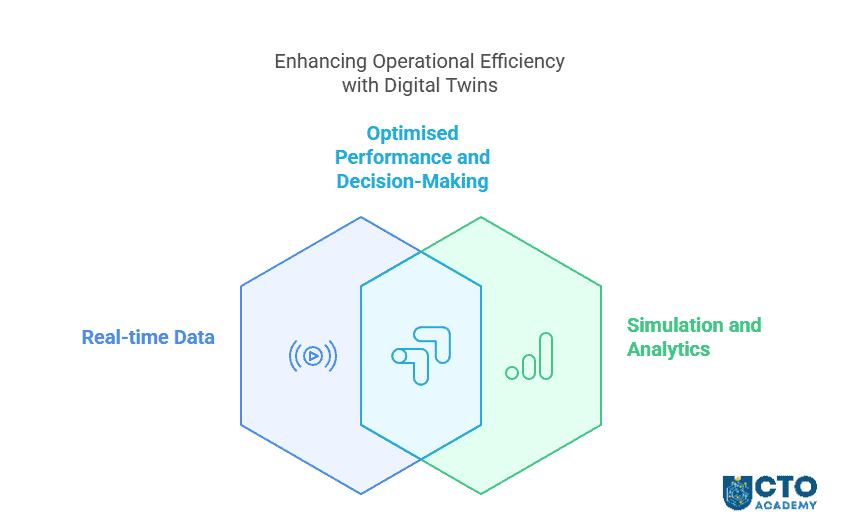
Digital twins bridge the gap between physical and virtual worlds by providing real-time data insights, predictive analytics and simulation capabilities. This, in turn, enables organisations (and even cities) to optimise performance, reduce downtime and improve decision-making.
Building upon a lecture from our Digital MBA for Technology Leaders, this article explores the functionality of digital twin technology, its applications in predictive maintenance, remote troubleshooting and product development, as well as the implementation challenges within complex systems. Through real-world case studies, it highlights practical applications and solutions technology managers can leverage to drive operational efficiency.
First things first…
What is a Digital Twin?
A digital twin is a virtual representation of a physical asset, system or process that uses real-time data, simulation and analytics to mirror its real-world counterpart. By utilising twins, organisations optimise performance, predict failures and improve decision-making across various industries.
How To Create Digital Twins For Physical Assets?
Creating a digital twin involves integrating multiple data sources, including sensors, IoT devices and historical records, to generate a detailed model of the physical asset. The process typically follows these steps:
Data Collection: Sensors capture real-time data on temperature, pressure, movement and other operational parameters.
Modelling and Simulation: Engineers use computational models to simulate behaviour and interactions under different conditions.
Integration with Analytics: Machine learning and data analytics tools process digital twin data, providing insights into performance and potential issues.
Continuous Updating: The twin is continuously updated with live data, ensuring an accurate and dynamic representation of the physical system.
How Do Digital Twins Help in Predictive Maintenance?
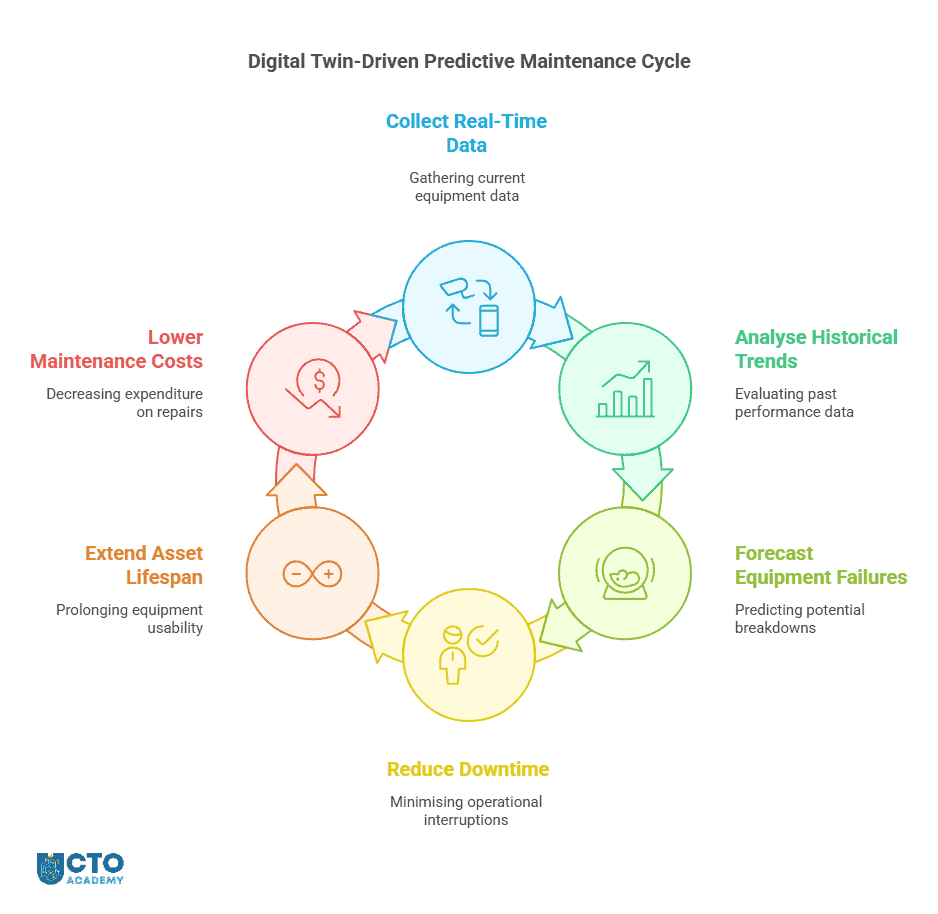
Predictive maintenance relies on digital twin technology to forecast equipment failures before they occur. By leveraging real-time data and historical trends, digital twins help businesses reduce downtime, extend asset lifespan, and lower maintenance costs.
Shanghai Automobile Gear Works implemented a digital twin in their assembly lines. By analysing sensor data and running digital twin simulations, the company detected early signs of equipment wear and prevented failures. As a result, they reduced maintenance costs by 25% and improved operational efficiency across multiple production sites.
Siemens’ Insights Hub (previously MindSphere), for instance, is an industrial IoT-as-a-service solution that collects and analyses sensor data in real-time, facilitating predictive maintenance strategies.
How Do Digital Twins Facilitate Remote Troubleshooting and Diagnostics?
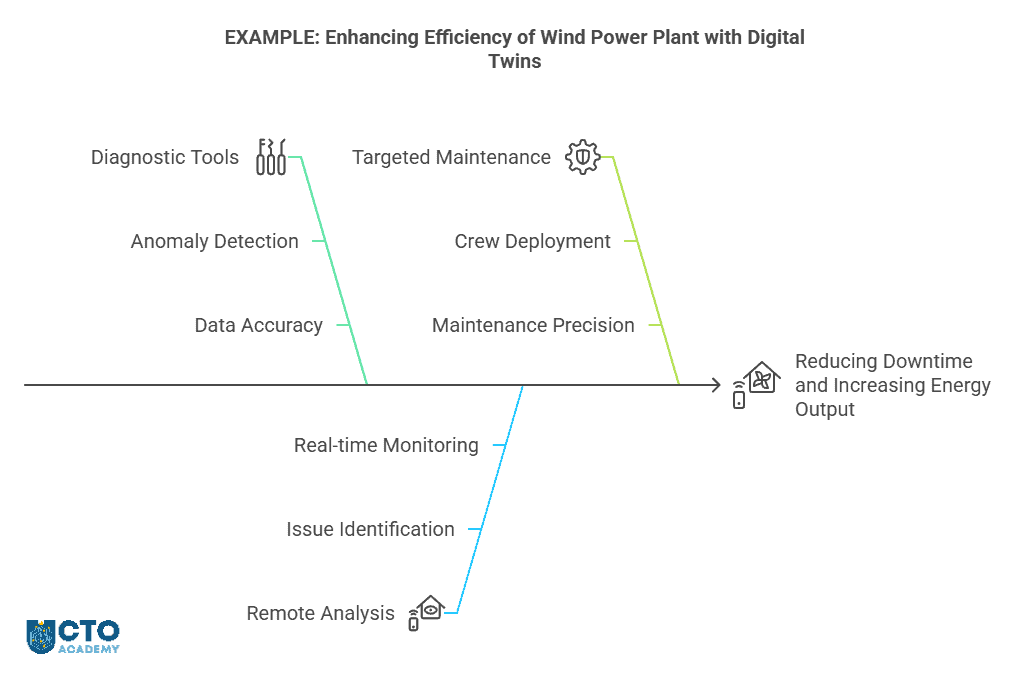
With digital twins, companies can diagnose problems remotely, reducing the need for on-site inspections and interventions. This capability is particularly useful in industries where equipment is located in remote or hazardous environments; for example, wind farms.
A wind farm operator can use, for instance, Akselos’ digital twin technology to detect an anomaly. Engineers can analyse the twin remotely, pinpoint the issue and deploy targeted maintenance crews to fix the problem. This approach reduces the downtime and, subsequently, increases the energy output.
How Do Digital Twins Improve Product Development Processes?
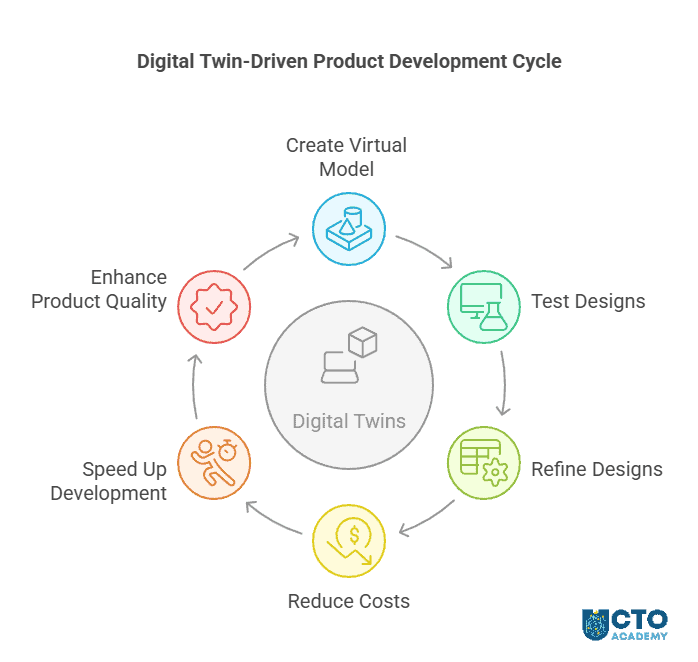
Digital twins streamline product development by allowing engineers to test and refine designs in a virtual environment before physical prototyping. This reduces costs, speeds up development cycles and enhances product quality, positively impacting the product lifecycle.
Companies use digital twins for scenario planning, simulating disruptions to assess risk and develop contingency strategies. This helps identify bottlenecks early and improve decision-making. Inventory optimisation ensures balanced stock levels, reducing holding costs and minimising stockouts.
What Are the Challenges of Implementing Digital Twins in Complex Systems?
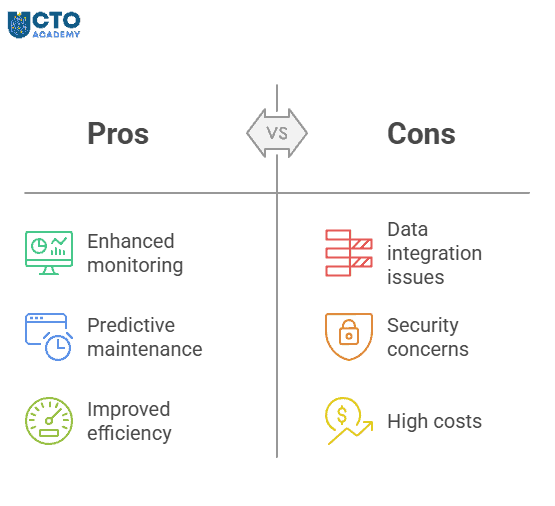
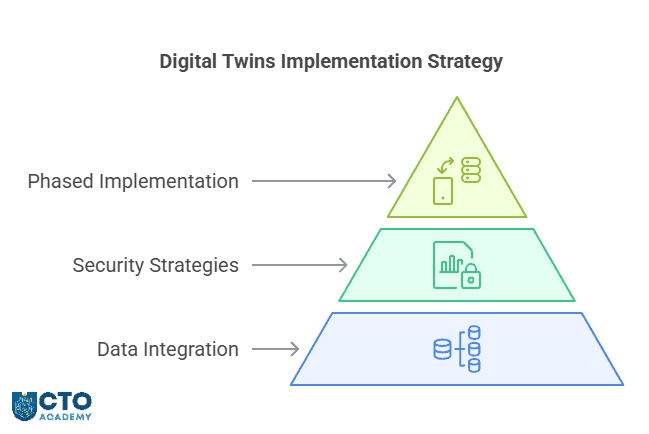
Despite their benefits, digital twins present several challenges, including data integration, security concerns and high implementation costs.
1. Data Integration Issues
Integrating data from various sources, especially in legacy systems, is often a struggle. However, by implementing a unified data platform that consolidates informationfrom IoT devices, cloud storage and enterprise systems, companies can simplify integration.
2. Cybersecurity Risks
Digital twins rely on vast amounts of real-time data, making them attractive targets for cyber threats. Technology managers need to employrobust encryption, access control mechanisms and continuous monitoring to mitigate security risks.
This is where the aforementioned Akselos solution helps. It emphasises security in its digital twin solutions, incorporating advanced protection measures.
3. High Implementation Costs
Developing and maintaining a digital twin requires significant investment in hardware, software and expertise. The solution is the incremental design. That is, start with small-scale pilot projects to demonstrate ROI before expanding to your own twin technology initiative.
In 2014, Singapore implemented digital twin technology for urban planning, integrating traffic data, infrastructure models and environmental analytics through two phases. Initially, the project faced challenges with data integration across multiple departments. There was also a security risk because the implementation process included sensitive and private data.
However, by adopting a centralised data platform, implementing cybersecurity measures and addressing data privacy regulations, the city successfully optimised traffic flow, reduced emissions, improved public services and even facilitated disaster management.
Summary
Digital twins enhance predictive maintenance, streamline remote troubleshooting and improve product development in several critical areas which, ultimately, lead to better-optimised business models.
However, the implementation process isn’t without its challenges. To address them, technology managers should ensure:
Focusing on the definition and critical components of digital twins, Arno examines their ability to mirror objects, systems, processes or combinations of these entities. Through practical examples and critical insights, he showcases real-world use cases and outlines steps for creating a digital twin. Learn more about our Technology Leadership Program here.
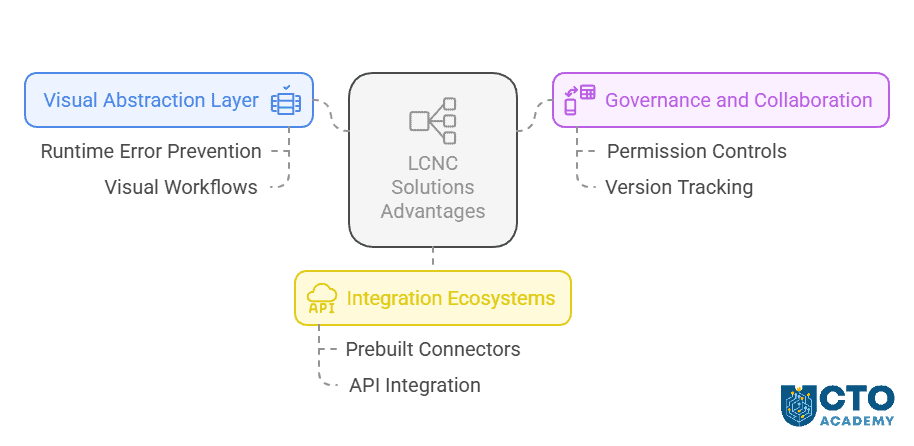
The shadow of LLMs looms over every low-code/no-code initiative. We are witnessing ongoing debates about the future of software development paradigms, particularly the viability of low-code/no-code (LCNC) platforms. Major issues like:
It’s no wonder then that some argue LLMs will render LCNC obsolete. However, some evidence suggests that a more nuanced relationship is possible. This report synthesises findings from academic research, industry predictions, and developer communities to analyse the trajectory of the potential transformation and its impact on existing LCNC providers.
Download the AI Integration Blueprint
Move beyond pilots and integrate Gen AI into core systems, without losing control of cost, security, or compliance. Get the practical roadmap tech leaders use to modernize infrastructure, prioritize the right use cases, and set governance that scales.
However, limitations persist. Proprietary architectures in tools like Bubble.io create vendor lock-in, while complex logic implementation often requires JavaScript extensions.
LLMs’ Capabilities in Reshaping Development Workflows
When you take a step back and look at the bigger picture, you can clearly see convergence potential. Let’s see if that is a viable scenario and what has to happen for it to materialise.
Coexistence Through Integration and Mutual Evolution
Businesses should select LCNC solutions with built-in LLM integration or a roadmap for future adoption. Additionally, business users (ie, non-technical staff) should be trained in prompt engineering to maximize the potential of AI-enhanced tools.
However, businesses must modernise their governance frameworks to ensure quality and compliance. This can be done through the implementation of AI review boards that assess the accuracy, security and ethical implications of an AI-generated code.
When it comes to professionals, they should not only be proficient in LCNC platforms but also understand how to fine-tune LLMs for industry-specific applications. In addition, developers should consider:
Mastering system architecture design to be able to design scalable and efficient integration patterns.
Learning how to validate and refine LLM outputs to ensure reliable high-performing AI-driven applications.
Assuming that all of the aforementioned is realised, we can project the possible convergence path.
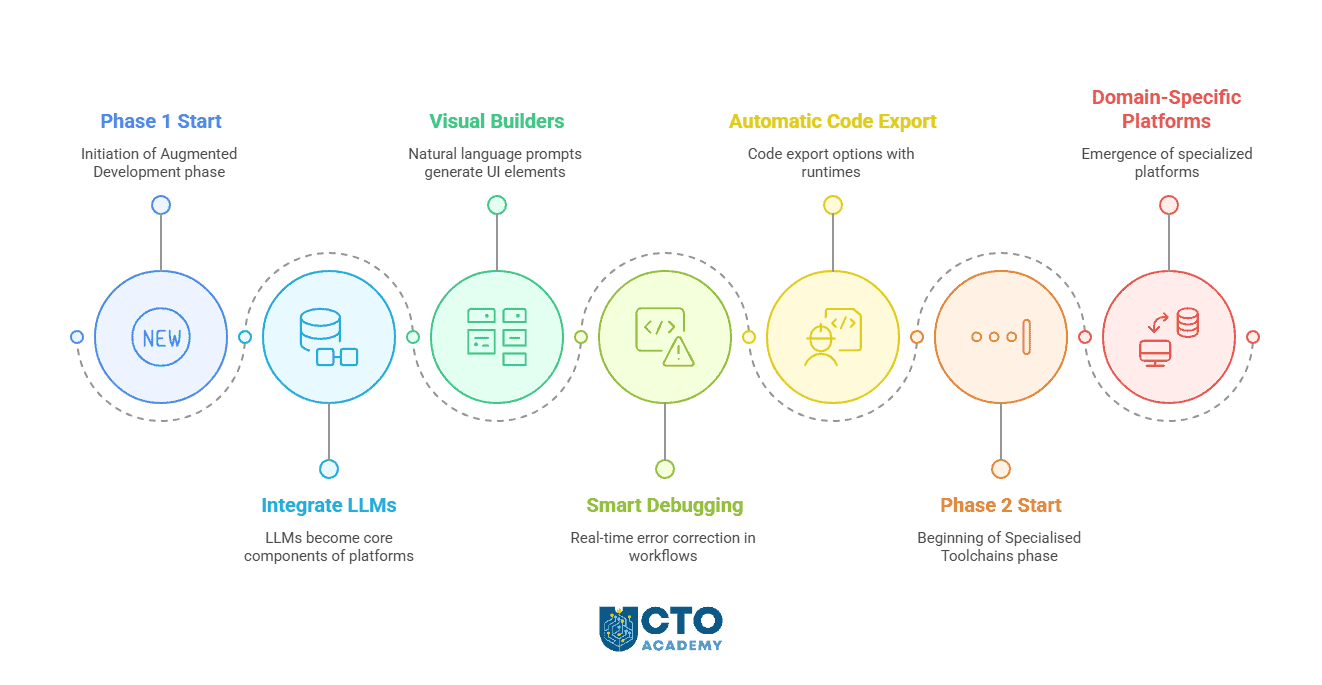
The Estimated Convergence Outlook (2025-2030)
Phase 1: Augmented Development (2025-2027)
LCNC platforms should integrate LLMs as first-class components, namely:
Visual builders that accept natural language prompts to generate custom UI elements and therefore enable AI-assisted component generation.
Smart debugging through real-time error correction within workflow designers.
In our view — and mind you, this is only an extrapolation based on current trends and general industry knowledge — we can expect the emergence of domain-specific platforms such as:
HIPAA-compliant LCNC environments with embedded LLMs trained on FHIR standards in the healthcare industry.
IIoT-focused tools that combine visual PLC programming with AI-generated optimisation code in manufacturing.
Audit-trailed AI builders for regulatory-approved algorithm development in fintech.
So, rather than serving as generic automation tools, these next-generation platforms should and could act as intelligent co-developers, embedding regulatory, operational and domain expertise into their core functionalities.
Conclusion
So the capital questions are:
Will the rapid development of Large Language Models mark the demise of the Low-Code/No-Code industry?
Who will — and how — survive the onslaught?
Is there an unforeseen threat to already established LCNC providers?
The one thing that LLMs don’t possess is visual builders or interfaces and dashboards suitable for software development and deployment (eg, drag & drop functionalities). It is on the top of the list for the so-called, citizen developers or utilisation by non-technical users. So the answer to the first question is most likely, no. Convergence is the more likely scenario.
However, that doesn’t mean that LCNC SMBs should sleep easy now. Their problem stems from initiatives of industrial behemoths like Microsoft. Its Power Platform which already converges LCNC and LLM engines is the real threat. Even companies like Lucidworks, Pegasystems and Flowise that have already launched similar solutions have low odds of success in competition against Microsoft. The only way they’ll survive is either through a merger or going niche while enabling commercially available tiers for start-ups. It’s highly unlikely that Microsoft will scale below enterprise-level use.
What about pure LCNC providers such as Bubble, Glide or Appy Pie?
The window for successful transformation is narrowing. The odds are that LCNC companies that fail to become LLM-convergent by 2027 face a high probability of acquisition or obsolescence by 2030.
The future belongs to platforms that can hybridise LCNC’s structural governance with LLM’s cognitive fluidity, creating what we might as well term “Liquid Development Architectures.”
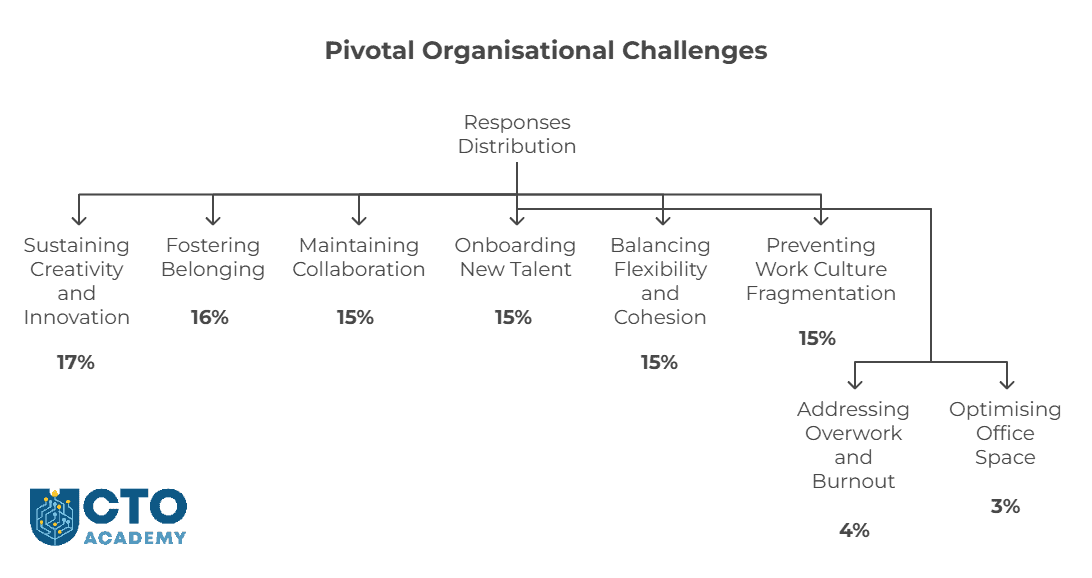
Recently, we surveyed technology leaders and engineers to explore the key difficulties organisations face regarding contemporary work arrangements. The study presented participants with a list of potential challenges and recorded the frequency with which each was identified.
As you can see, sustaining creativity and innovation was most frequently selected, closely followed by fostering a sense of belonging.
Maintaining effective collaboration, onboarding new talent, balancing flexibility with cohesion and preventing work culture fragmentation are also high up in the focus.
In contrast, addressing overwork and optimising office space were noted far less often. Nonetheless, to some, they are pivotal.
This article provides immediately applicable solutions to these challenges, offering technology leaders the practical tools to navigate workplace complexities effectively.
1. Sustaining Creativity and Innovation
Challenge: In a hybrid or remote environment, fostering creativity and innovation can be difficult due to reduced spontaneous interactions and isolated workflows.
In 1968, Dr. Spencer Silver, a chemist at 3M, was attempting to create a super-strong adhesive for use in aircraft construction. Instead, he accidentally created a weak, pressure-sensitive adhesive that could be peeled away easily without leaving a residue. At first, this invention seemed like a failure – after all, who would want a glue that doesn’t stick properly?
It wasn’t until 1974 that his colleague, Art Fry, came up with the idea of using the adhesive to create bookmarks that wouldn’t fall out of his hymnal. This spark of creativity led to the development of the Post-it Note.
Would Fry even find out about Silver’s invention if they worked remotely and had isolated workflows?
Yes, the first action step is to synchronise workflows. In-house, hybrid or fully remote; it doesn’t matter as long as the workflows are synced.
But there’s another problem – it’s not always people’s fault they are not creative and innovative.
Get ready to face the hard truth about your leadership style and/or organisation’s culture in general.
Only 24% of employees reported feeling curious in their jobs regularly.
Approximately 70% said they face barriers to asking more questions at work.
In other words, leaders might believe they allow creativity and entice curiosity, but their team members certainly don’t feel that way.
This leads us to the most interesting thing in the study and that’s the list of 3 key innovation/creativity blockers:
Leaders often believe that encouraging curiosity will lead to a costly mess and make the company harder to manage.
There’s a concern that allowing employees to explore their interests would lead to more disagreements and slow down decision-making processes.
Despite listing creativity as a goal, people frequently reject creative ideas when actually presented with them.
Hence, the
Immediate Solutions
There are a few important takeaways from this study and general practice that should mitigate the problem of lack of creativity and innovation:
Create an environment where employees feel safe to ask questions, explore and share new ideas without fear of ridicule or punishment.
Understand that exploration doesn’t always produce immediately useful information but often yields better long-term solutions that require many mini-solutions in between to work.
While some structure is necessary, allow for flexibility in exploring new ideas and approaches.
Implement recognition systems that reward not just successful outcomes, but also the process of exploration and learning.
However, not all people are creative (and innovative) by default. In fact, only a handful are. So what is the simplest method to entice creativity in otherwise uncreative individuals?
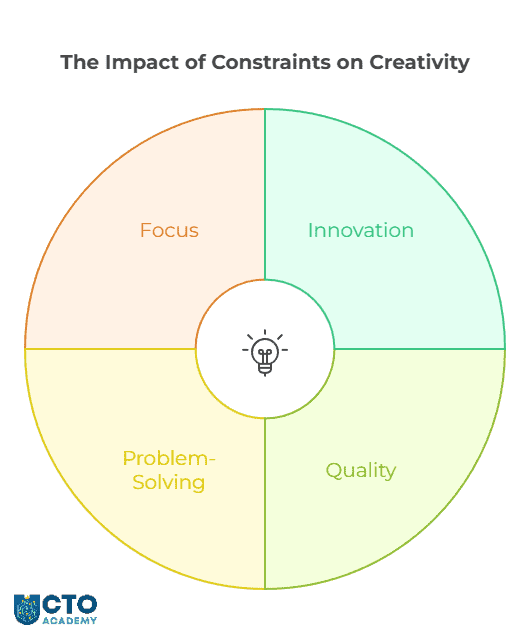
This may sound counterintuitive, but setting strict limits can be your ace in the hole.
Constraints, when approached with the right mindset, can be a catalyst for creativity rather than an obstacle.
In 1960, Bennett Cerf, the founder of Random House, bet the famous Dr. Seuss $50 that he couldn’t write an entertaining children’s book using only 50 unique words. This challenge came after Dr. Seuss had already successfully written “The Cat in the Hat” using a limited vocabulary of 236 words from a list of 348 words that first-graders should know.
The result?
Dr. Seuss accepted the challenge and produced “Green Eggs and Ham,” which became:
His best-selling book
The fourth best-selling children’s hardcover book of all time
A book that has sold over 200 million copies worldwide
Creativity thrives under limitations: Rather than stifling creativity, the 50-word constraint forced Dr. Seuss to be more innovative in his storytelling.
Quality over quantity: Despite the limited vocabulary, the book became a masterpiece of children’s literature.
Problem-solving skills: The constraint required Dr. Seuss to approach the writing process differently, enhancing his problem-solving abilities.
Focus and efficiency: The word limit forced Dr. Seuss to be concise and focused in his storytelling.
In business, limited resources often lead to innovative solutions while time constraints can increase productivity and focus.
2. Fostering a Strong Sense of Belonging
Challenge: Employees, especially those working remotely, often struggle with feeling disconnected from the company culture and their colleagues.
Take it from someone who’s been working remotely for the last 11 years – this is a tough nugget to break. It will take a hard personal investment to create a sense of belonging. Nonetheless, it is achievable.
Now, the widely used solutions are:
Virtual Team-building Activities
Regular Check-ins
Weekly Team Meetings
Monthly Team Meetings
Recognition Programs
Company-wide Rituals
Make no mistake; all of them work, but only if you a) give a team member a true sense of purpose and b) hold them accountable.
Consider a complex, interconnected machine – a sophisticated network of gears, levers and circuits. This machine, let’s call it “Synergy”, represents a tech organisation operating in a remote environment. Its smooth functioning depends entirely on the coordinated effort of its individual components – the remote tech teams or members.
The organisation’s leaders, the “Master Engineers”, understand that simply providing the blueprints isn’t enough. They need to instil a sense of purpose and accountability within each team, each member, each cog in the Synergy machine. It is an eight-step process.
Step 1: Ensuring Seamless Operation
To cultivate purpose, the Master Engineers ensure every team member understands their critical role in the machine’s overall operation. They explain how even the smallest line of code contributes to the larger function, and how each bug fix prevents a catastrophic system failure.
Step 2: Directing Personal Growth into Synergy’s Progress
They also work with each team to set “precision-engineered” goals – targets that align not only with Synergy’s overall performance metrics but also with individual career trajectories. A junior developer might aim to master a new coding language, while a senior architect might focus on designing a more efficient data flow.
Step 3: Reinforcing the Significance of Individual Contributions
Regularly, the Master Engineers showcase the impact of each team’s work – how a new feature improved user experience and how a security patch prevented a data breach. In other words, they demonstrate real-world consequences.
Step 4: Laying the Groundwork for Responsibility
To enhance accountability, the Master Engineers establish clear “performance parameters” – specific, measurable outcomes for each team and project. These defined expectations might include code quality metrics, sprint completion rates or client satisfaction scores.
Step 5: Encouraging Self-regulation and Peer Oversight
Synergy is equipped with a sophisticated “monitoring system” – a suite of project management tools and performance dashboards that provide real-time visibility into the machine’s operation.
Step 6: Ensuring Alignment
The Master Engineers also conduct regular “calibration sessions” – one-on-one and team meetings to discuss progress, address challenges and performance deviations and refine goals.
Step 7: Fostering a Culture of Ownership
They empower team members to take initiative in problem-solving and decision-making.
(QUOTE)When individuals feel responsible for their part of the machine, they’re more likely to hold themselves accountable for the results.
Step 8: Reinforcing the Value of Accountability
Finally, the Master Engineers recognise and reward exceptional performance – publicly acknowledging teams and members that consistently exceed expectations and demonstrate strong ownership.
The outcome?
An environment where each team member feels deeply connected to their purpose and takes genuine ownership of their responsibilities. Such a combination not only drives performance but also ensures long-term stability and success.
3. Maintaining Effective Collaboration
Challenge: Coordinating efforts across distributed teams can result in inefficiencies, miscommunications and delays.
The problem is that managers stick to the paradigm of the office environment, completely ignoring the fact that their teams operate from living rooms, bedrooms and basements of their homes. And homes have an opposite paradigm.
Traditional office environments are structured for face-to-face interactions, spontaneous conversations and immediate feedback. Homes, on the other hand, are designed for personal life and privacy, creating a fundamental paradigm shift.
Moreover, office environments rely heavily on non-verbal cues, body language and spontaneous exchanges, which are largely absent in remote settings.
Immediate Solutions:
When using collab platforms like Nifty, enforce ‘tasking’ instead of messaging for even the smallest and simplest of tasks – without exceptions. In other words, the “Can you check that update” message transforms into the “Check the XYZ Update” task.
Ensure clarity in task ownership and deadlines.
Create and enforce the use of priority tags in tasks (eg, High Priority, Medium Priority, Low Priority)
Maintain an immutable team meeting schedule (to create a sense of expectation and, eventually, a loop of habit).
Set clear agendas and outcomes for every type of meeting.
During meetings, entice transparency and proactive updates to avoid misunderstandings.
Create a centralised knowledge base by developing and maintaining a repository of processes, procedures and frequently used resources.
Whenever possible, use visual project roadmaps that detail timelines, milestones and responsibilities.
4. Onboarding and Developing New Talent
Challenge: Remote and hybrid setups make it harder for new employees to integrate quickly and build meaningful workplace relationships.
If you can put together an extremely precise onboarding program, even better.
That’s basically all you can do besides providing access to the centralised knowledge base and training programs. If it sticks, fine. If not, repost the job ad. Some people are simply not a team material and there’s nothing you can do about it.
Here’s the thing. Onboarding and developing a new talent is directly related to and dependent on a sense of belonging. So by focusing on #2 (Fostering a Sense of Belonging), you will effectively address #4 (Onboarding).
Belonging is a key factor because a sense of belonging is crucial for new employees to feel engaged, confident and committed to their organisation.
5. Balancing Flexibility with Organisational Cohesion
Challenge: The push for flexible work arrangements can sometimes undermine organisational unity and alignment with company goals.
We are back to the shifting paradigm where an employee constantly changes between home and office. The first thing you need to do is to create a shared digital workspace – and use it. It doesn’t matter if a part of the team is in the office; they still must use that workspace as long as even a single member is remote.
What happens is that team members who work from the office, tend to disregard the fact that some of them are missing. In their minds, that person is on leave or has a day off. It’s simply part of that common office paradigm we mentioned earlier.
Additional Solutions:
Define clear policies (guidelines) that balance autonomy with necessary in-office collaboration.
Establish overlapping work hours for synchronous communication.
If in any way possible, schedule physical meet-ups to reinforce team spirit.
Create an internal knowledge base to ensure consistency in workflows and processes.
Prioritise accountability by all means.
If you manage distributed teams, involve all team members in defining and refining the team’s vision and goals.
6. Preventing Fragmentation of Work Culture
Challenge: A dispersed workforce can lead to fragmented cultures, where different teams develop disconnected subcultures.
Immediate Solutions
Several experienced leaders have successfully addressed this issue through innovative approaches and strategic initiatives:
Automatic Created a Unified Digital Culture
Automattic, the parent company of WordPress.com, provides an efficient example of maintaining a cohesive culture in a fully distributed workforce. Their leadership team adopted a “write early, write often” strategy to foster transparency and collaboration.
By encouraging team members to share updates and feedback in shared documents, they created a virtual environment that mimics the organic interactions of a physical office.
IBM’s leadership team faced similar challenges when shifting to a remote-first strategy in 2020. Initially, they observed a major decrease in employee engagement compared to in-person work. To combat this, IBM’s leaders implemented three innovative solutions:
Regular virtual town halls to maintain open communication.
Social hours to foster informal connections.
Integration of virtual reality (VR) in leadership training programs.
Tariq, a young leader in a global firm, successfully addressed cultural fragmentation in his 68-person division spanning 27 countries and 18 languages. His approach included:
Introducing a unifying team motto: “We are different yet one”.
Creating opportunities for employees to share their cultures.
Implementing a zero-tolerance policy for cultural insensitivity.
These initiatives helped bridge cultural divides and rebuild team cohesion, demonstrating the importance of acknowledging and celebrating diversity while fostering unity.
We Emphasise Shared Purpose
CTO Academy leaders consistently remind team members of their common purpose and how their work contributes to overall company goals. During weekly team calls, for instance, a CEO reviews the group’s performance relative to company objectives. This practice helps maintain focus and unity, especially when team members are geographically dispersed like we are.
Personal Connection and Recognition
A manager based in Dallas, Texas, inherited a large team in India following an acquisition. To prevent cultural fragmentation, he:
Involved remote employees in important decisions.
Maintained frequent contact to discuss ongoing projects.
Personally called team members to give them their birthdays off.
Leverage technology to improve communication and capitalise on diversity while emphasising unity.
Maintain personal connections across geographical boundaries.
7. Addressing Employee Overwork and Burnout
Challenge: The blurred boundaries between work and home life in remote and hybrid setups have led to increased burnout rates.
If this is the prevalent issue in your organisation, you need to take a big step back and reorganise your processes. There is something in your operations that disturbs the balance.
Immediate Solutions:
1. Set Boundaries on After-hours Communication
In Germany, for example, contacting employees after hours is generally prohibited, with exceptions for emergencies and specific roles. The aim of this measure is to:
Actively promoting and tracking employee vacations to ensure they take breaks can be somewhat challenging when managing distributed teams. In our experience, the best approach is to utilise your central digital workspace.
Our COO, for instance, has implemented a time-off calendar where team members easily schedule their time off in Nifty after manager approval. This provides immediate visibility for the entire team, showing who’s out and for how long. It simplifies tracking and helps with processes because a team member can’t receive a task with a deadline that doesn’t take the time off into account.
3. Implement No-meeting Days
These are basically dedicated days for deep work without interruptions.
4. Provide Mental Health Resources
In a fast-paced environment, burnout is inevitable. One approach is to provide comprehensive mental health resources such as counselling services, webinars or self-help materials. They should be:
Easily accessible
Encouraged
Utilised
Confidential
This will enable you to identify and manage stress and burnout early on.
8. Optimising and Adapting Office Space
Challenge: With hybrid work models, many companies struggle to justify office expenses while ensuring the space remains functional.
Real-time desk and room booking systems to prevent scheduling conflicts and maximize space usage.
Occupancy sensors to provide data on space utilisation, helping manage office density and optimise layouts.
All-in-one platforms like Microsoft Places and Gable for comprehensive workspace management, offering features such as AI-driven work schedule optimisation and access to flexible workspaces.
The point is to rethink the organisation of the office space because clearly something is off. Maybe you have collaboration hubs but no quiet thinking bunkers where an employee can retreat to contemplate the problem without distractions. Perhaps it’s overcrowded or oversaturated with unnecessary equipment and simple re-arrangement could go a long way.
This is where technology or a good old professional interior designer helps.
Now, you may have also heard of ‘hot desking’ otherwise known as ‘hoteling’. If you are thinking about implementing such an option, consider these factors:
Loss of personalisation
Psychological discomfort
Reduced productivity
Weakened social structures
Decreased job satisfaction
Sense of belonging
That’s the less discussed outcome of booking desks and spaces practice. As a species, we are wired to grow attached to our personal spaces and the office desk is no exception. Drop us anywhere and we’ll transform a hole in a rock into a cosy and warm place with a personal signature.
Just for fun, imagine a bunch of kids storming into a room filled with cool toys – day after day.
Conclusion
So to sum up:
Creativity and innovation can be fostered through synchronised workflows, a safe environment for exploration and perhaps setting strict limits to encourage creative problem-solving.
Giving team members a true sense of purpose and holding them accountable can help them feel strongly connected.
Effective collaboration can be maintained by enforcing tasking instead of messaging, ensuring clarity in task ownership and deadlines and creating a centralised knowledge base.
Onboarding and developing new talent can be effectively addressed by focusing on fostering a sense of belonging.
Balancing flexibility with organisational cohesion requires creating a shared digital workspace, defining clear policies and establishing overlapping work hours for synchronous communication.
Leveraging technology, maintaining personal connections across geographical boundaries, and emphasising shared purpose can prevent the fragmentation of work culture.
Addressing employee overwork and burnout requires setting boundaries on after-hours communication, encouraging time off, implementing no-meeting days and providing mental health resources.
Finally, optimising and adapting office space can be done by using smart space management systems and rethinking the organisation of the office space.
In early 2024, Arup Group Limited, a British multinational professional services firm headquartered in London, lost $25 million due to a deepfake video call in which fraudsters presented synthetic impersonations of the company’s CFO and other employees. The attackers used deepfake technology to fabricate convincing likenesses and voices of the executives, effectively misleading a company’s Hong Kong-based financial worker to execute 15 consecutive transactions.
Now, in larger organisations, it’s usually a CISO that directly oversees disinformation security, but if the organisation does not have the technical capabilities to counter threats, it’s in vain.
In start-ups and fast-growth companies, especially those dealing with digital platforms, media, cybersecurity or public communications, the entire weight of cybersecurity often falls on the back of a Chief Technology Officer or Head of IT. Preventing AI-generated deepfakes, misinformation attacks on brands (executed by the closest competitors), supply chain frauds, fabricated invoices, social engineering and every other form of illicit manipulation is the direct responsibility of a technology leader.
Table of Contents
Technology Leaders’ Responsibilities in Disinformation Security
Technology Strategy and Infrastructure
Overseeing the development and implementation of technological solutions that can detect and mitigate disinformation (eg, AI-driven content moderation, automated fact-checking and bot-detection algorithms).
Platform Integrity and Content Moderation
Developing policies and tools to identify and remove disinformation.
Working with data scientists and AI teams to refine algorithms that flag misleading content.
Cybersecurity and Threat Intelligence
Collaborating with security teams to implement defences against disinformation campaigns.
Incident Response and Crisis Management
Working with PR, security and legal teams to implement rapid response strategies in case of a major disinformation attack.
Collaboration with CISO and Compliance Teams
Ensuring that technological frameworks align with regulatory requirements on disinformation, such as the EU’s Digital Services Act (DSA) or the US AI Act.
Emerging Tech and AI Risks
Evaluating and implementing defences against AI-driven misinformation campaigns (eg, tools for detecting manipulated content and watermarking authentic media).
An automated web-based fact-checking tool that uses NLP and supervised learning.
Monitors live streams, websites and social media to catch factual claims, detect matches with a curated repository of fact-checks and deliver the matches instantly to viewers.
Able to scan large amounts of text and identify statements that require fact-checking.
Ranks claims by checkworthiness and suggests highly ranked new claims to fact-checkers.
Methods and Architectures for Detecting Deepfake Images and Videos
The premise here is simple: instead of detecting fake content after it spreads, verify authenticity at the source.
Since blockchain is decentralised and immutable, it enables:
Content provenance and authenticity verification through cryptographically signing and timestamping content on a blockchain (eg, New York Times’ News Provenance Project).
Blockchain-based voting to crowdsource fact-checking (eg, smart contract-based Po.et or Augur)
Digital Watermarking and Media Provenance Solutions
In February 2021, Microsoft, Adobe, BBC, Intel and Truepic introduced C2PA (Coalition for Content Provenance and Authenticity). Its purpose was to address the spread of disinformation and online content fraud by developing technical standards for certifying the source and history of media content.
C2PA essentially creates tamper-proof digital signatures for media files, allowing anyone to verify:
Who created it
When it was created
If it has been modified
For a creator, it is a 3-step process:
Embedding metadata at creation
Logging edits and changes
Verifying content on a blockchain or cloud-based service
Arguably, the most important use case of C2PA and similar frameworks is protecting intellectual property, such as proprietary code.
Real-Time Threat Intelligence and Behavioural Analysis
Darktrace Antigena Email
Darktrace uses NLP and behavioural AI to analyse email metadata, content and sender patterns and protect against phishing, spear phishing and CEO fraud.
It seems easy to forge such an email; however, if an email mimics an executive’s writing style but originates from an unusual location or IP address, the AI immediately quarantines or flags it.
AI models learn normal communication patterns (who employees talk to, writing style, response time). So when an email deviates from expected behaviour, such as a CEO “urgently” requesting a wire transfer, AI flags it as suspicious.
Had Arup’s overseeing technology manager implemented such a solution, it would have likely raised an early warning by flagging the communication. This would have made it less likely for an already sceptical employee to fall victim to the scam.
Vectra AI
Go to your dashboard and check active users. How do you know that a logged-in user is really an employee and not a threat actor? Even with MFA in place, you still cannot be absolutely sure who exactly walks through your databases, can you?
Vectra AI is an anomaly detection system designed to spot suspicious login attempts or abnormal data access in real-time, preventing compromised credentials from being exploited in fraud schemes.
It monitors employee behaviour across networks, endpoints and cloud apps and learns. So if an employee suddenly logs in from an unknown device, downloads unusual files or attempts unauthorised access, AI triggers an alert.
This is another tool that could have prevented Arup’s scam. It analyses vocal patterns, tone and biometric markers to detect synthetic voices.
In 2019, a UK-based energy company was targeted by a deepfake audio scam, where attackers impersonated the parent company’s CEO’s voice over the phone and requested an urgent wire transfer of €220,000. According to Rüdiger Kirsch of Euler Hermes Group SA, the firm’s insurance company, “The CEO not only recognised the subtle German accent in his boss’s voice but also claimed it carried the man’s “melody”.
The Critical Flaw in Security of Multinational Organisations
The reason we used these two cases is because they point to the critical flaw in the security of multinational companies that has been heavily exploited.
For voice recognition, the equivalent concept is difficulty in detecting small accent variations in unfamiliar languages. The UK-based energy company’s executive (an Englishman) failed to detect an AI-generated German accent, likely due to a perceptual phenomenon where non-native listeners perceive foreign accents as “blurry” versions of their own language. In other words, people tend to “map” unfamiliar sounds onto their closest native equivalents, making it harder to detect subtle accent discrepancies.
AI-driven tools, rigorously trained on large datasets, do not succumb to either of these phenomena, making them our best defence against these types of deepfake frauds.
But what to do if you are dealing with an insider or someone who has access to your systems?
This is another case where tools such as Darktrace, Microsoft Purview Insider Risk Management, Forcepoint Insider Threat and Splunk UEBA could have prevented the leak if they had been implemented. They are far superior at spotting unusual data modifications, access or movements, as well as identifying suspicious communication patterns and behavioural biometrics.
For example, AI can track who accesses which files and systems. So if a marketing employee suddenly downloads thousands of confidential R&D files, AI detects it as a risk. In the same fashion, AI detects how employees type, click and navigate systems. Therefore, if an account behaves differently (eg, unusual typing speed, access locations), it may indicate a compromised insider.
Let’s say that one of our finance employees suddenly changes supplier payment details to either coerce money or fabricate an invoice. Since AI learned the normal behaviour of employees (eg, who accesses what, when and how), any action that would unexpectedly modify financial data, legal documents or code repositories, would raise an alert.
Automated Response Actions to Contain Insider Threats
However, real-time detection isn’t enough. You must automate response actions tocontain insider threats before damage occurs. For example:
Auto-block employees from transferring files to personal emails.
Lock accounts if AI detects login attempts from an unusual location.
Alert security teams when sensitive data is accessed abnormally.
The tools frequently used for response automation in these types of threats are Microsoft SentinelandCrowdStrike Falcon. Sentinel can revoke a user’s access while the incident is investigated. Falcon, on the other hand, can identify potentially compromised devices and trigger automated containment processes either through the console or API call.
Note that Microsoft Sentinel should be integrated with Microsoft Purview Insider Risk Management for the most optimal protection.
3 Important Considerations
Watch for scalability issues since AI models require vast training datasets.
There is an increased risk of over-moderation and censorship when managing false positives and ethical dilemmas.
Balance cost vs. ROI.
Conclusion
Trust as a vital asset must be reinforced through continuous monitoring and rapid response because, in the digital age, trust is not a given—it’s engineered.
That’s why the tech leader’s role evolves and enters the realm of defining organisational trust strategies. They are now directly responsible for building tech-driven infrastructures that prevent risks and enhance the detection of fraudulent behaviours.
No pressure, but keep in mind that employees and customers are more likely to have confidence in the company when they know a comprehensive tech-driven trust strategy is actively in place to protect them.
So here is a simple action plan to fulfil your role in disinformation security:
Assess organisational vulnerabilities to disinformation
Build a relevant security framework
Invest in AI-powered detection tools
Implement behavioural analytics
Educate employees on risks
The final step is critical because, without proper personal cybersecurity hygiene, your efforts will never be truly effective—AI or no AI. Think about how often you’ve seen someone leave a device unattended or unknowingly expose sensitive information by accessing systems in public. That’s a clear example of a lack of cybersecurity awareness. Are your employees any different?
Artificial Intelligence is evolving beyond narrow, task-specific applications into agentic AI—systems capable of making autonomous decisions, adapting to dynamic environments and taking independent actions to achieve goals. This paradigm shift presents unprecedented opportunities for automation, efficiency and innovation. However, as organisations move toward deploying AI agents in critical operations, technology leaders must address several fundamental concerns.
For CTOs and tech executives in general, the question is no longer whether to implement agentic AI but how to do so responsibly and securely. The risks of unchecked autonomy, biased decision-making and unpredictable behaviour demand a structured approach to AI governance, validation and human oversight.
This article explores the core challenges of agentic AI, backed by real-world case studies, and outlines the best mitigation strategies to ensure safe, accountable and effective AI deployment.
When users share data with AI chatbots, it is stored on the servers of companies like OpenAI, Microsoft and Google—often without a straightforward way to access or delete it. This raises concerns about sensitive information being shared with chatbots like ChatGPT that could unintentionally become accessible to other users.
By default, ChatGPT saves chat history and uses conversations to improve its models. While users can manually disable this feature, it’s unclear whether the setting applies to past conversations retroactively or if it’s working at all because it is virtually impossible to audit data that OpenAI and other providers use to train their models.
Technology leaders face a dilemma here: We either act in good faith and use products or ban the use of Gen AI tools as Samsung did. If we do use those products, we must accept three possibilities:
Employees may input confidential information into AI without realising it could be stored or used for future model training.
Even with data governance policies in place to prevent sensitive data from being shared with external AI services, history taught us that providers often ignore those rules because data is a commodity.
Due to a lack of visibility and access control, a company’s secrets could be exposed without a clear way to delete or retract them.
This is what we can do to at least minimise exposure:
Use role-based access controls (RBAC) to limit data access to only necessary personnel or AI modules.
Implement access controls and encryption at all levels to prevent AI from having unrestricted access to sensitive data.
Instead of centralising all user data, AI can learn from noise-injected distributed datasets without exposing raw information. This prevents raw data exposure but does not affect AI capabilities.
Train AI models in secure environments with masked or anonymised data (synthetic data instead of real user information w/ Zero Trust architectures).
Ensure that AI-driven data processing aligns with compliance requirements (requires AI explainability functionality).
That’s, unfortunately, the reality because we have limited control over data protection when using a third-party SaaS. But what can we do to prevent Agentic AI systems from acting erratically?
2. Loss of Control
Agentic AI systems and AI in general could act unpredictably. Often, this refers to pursuing objectives misaligned with our intentions. This concern is even more emphasised in high-stakes scenarios because we entrust a complex code with the “black box” feature to make decisions on our behalf.
The malfunctioning can cause an array of implications. For example:
Risk of harmful outcomes.
Inability to intervene effectively.
Potential cascading failures.
On March 18, 2018, an Uber self-driving test vehicle in Tempe, Arizona, struck and killed a pedestrian, Elaine Herzberg. This was the first recorded fatality involving a fully autonomous vehicle, raising serious concerns about loss of control in AI-driven systems. The vehicle’s onboard AI was designed to detect and react to obstacles autonomously, but a failure in decision-making and override mechanisms led to a tragic accident.
The AI incorrectly classified the pedestrian as an unknown object rather than a human, delaying its response. To make things worse, Uber had disabled the vehicle’s built-in emergency braking system, relying entirely on AI-driven decision-making. However, the system was tuned to reduce false positives, meaning it hesitated before deciding to stop which turned out to be a fatal miscalculation.
A human safety driver was present but not paying attention at the critical moment, as AI was expected to handle the situation. The software did eventually order the car to brake 1.3 seconds before the collision but it was too late.
This incident just goes to show that blind reliance on Agentic AI — programmed by humans — can have devastating outcomes.
Mitigation Strategies for Loss of Control in Agentic AI
1. Goal Alignment and Robust Objective Design
Ensure AI systems have clearly defined objectives that align with human values and intentions.
Use techniques such as reward modelling to guide the system’s behaviour toward desired outcomes.
Regularly test the system in diverse scenarios to ensure its objectives remain aligned.
A good example is OpenAI’s approach with reinforcement learning from human feedback (RLHF). This method uses active human guidance to shape the system’s behaviour, ensuring that its autonomous decisions align with human intentions.
2. Control Mechanisms and Fail-Safes
Build robust mechanisms for human oversight, such as kill switches, manual overrides or adjustable autonomy levels.
Ensure that all systems have multiple layers of control to ensure humans can intervene and regain control if the AI behaves unexpectedly.
As much as it can be difficult sometimes, following industry standards and regulatory frameworks ensures the safe development and deployment of agentic AI. That said, both developers and end users should continuously work with policymakers and standards organisations to enforce safety protocols and regular audits.
And the prerequisite for that is monitoring and updating; in other words, deploying systems with continuous monitoring capabilities to detect and address deviations from expected behaviour. For example, AWS and Azure allow developers to update and retrain deployed models to maintain performance and control.
3. Ethical and Moral Challenges
Agentic AI systems face ethical dilemmas, such as deciding whose safety to prioritise or whether to follow instructions that conflict with moral principles. Decisions may not align with societal values, leading to public backlash or regulatory scrutiny.
To mitigate this, Facebook implemented fact-checking partnerships with third-party organisations to address misinformation and started conducting regular ethical reviews to identify and mitigate unintended harms. Additional tools were developed to prioritise high-quality information and limit the spread of harmful content.
Mitigation Strategies
1. Embedding Ethical Frameworks
Google’s AI Principles explicitly prohibit building AI systems that cause harm or reinforce bias, ensuring ethical guardrails. They collaborated with ethicists, domain experts and diverse stakeholders to define moral principles and embed them into the AI’s decision-making algorithms.
2. Value Alignment through Human-Centric Design
As we already said, OpenAI employed RLHF for ChatGPT, which involves training the model to align its responses with user-defined ethical standards. It is a proven approach to ensure AI systems reflect human values. It is done through regular feedback from diverse groups of users because it’s imperative to have an AI system that reflects a broad range of perspectives.
3. Ethical Audits and Impact Assessments
Microsoft’s AI, Ethics, and Effects in Engineering and Research (Aether) committee regularly reviews the company’s AI projects for ethical risks. The committee conducts regular ethical audits andAI impact assessments (AIIAs) to evaluate the social, environmental and moral implications of AI deployments. This is the practice that can be utilised by every organisation simply by establishing independent review boards to assess ethical risks and provide actionable recommendations.
4. Bias Mitigation
Already mentioned IBM’s Watson Health faced criticism for recommending different cancer treatments based on biased training data. The company addressed this by revising datasets and involving clinicians in the training process.In other words, to eliminate bias from the algorithms:
Autonomous vehicle companies like Waymo conduct ethical scenario testing to evaluate how their systems handle life-critical situations, that is, whom to prioritise in a potential collision. They do that in simulated environments to explore how they respond to ethical dilemmas before deployment. These simulations mimic real-world ethical conflicts and analyse the system’s decision-making process.
4. Security Risks
Agentic AI systems can be manipulated, hacked or even weaponised, with autonomous decision-making amplifying their destructive potential. We all saw that ChatGPT-powered gun on YouTube, didn’t we?
In 2020, the SolarWinds cyberattack demonstrated the risks associated with compromised AI supply chains. Malicious actors injected malware into the Orion software platform, impacting thousands of clients, including government agencies.
This case demonstrated a serious lack of robust monitoring in the software update process and insufficient measures to detect and prevent supply chain attacks. To mitigate this and reestablish trust, the company had to implement code-signing practices and enhanced monitoring tools while partnering with security agencies and third-party audits.
Mitigation Strategies for Security Risks in Agentic AI
OpenAI adopted secure development practices to minimise risks in GPT-based models, including API rate-limiting to prevent misuse. They employ techniques such as differential privacy and secure multiparty computation to protect sensitive data used in AI training and deployment.
3. Adversarial Testing
Tesla tests its autonomous vehicle systems against adversarial inputs, such as altered road signs, to ensure the AI behaves correctly in manipulated environments. They use adversarial examples to evaluate how the system reacts to maliciously crafted inputs. These simulations of real-world attacks have two goals:
Test the AI system’s resilience.
Identify vulnerabilities.
4. Continuous Monitoring and Incident Response
By default, AI systems should integrate robust monitoring and alert mechanisms, enabling swift responses to potential security threats. They detect anomalies and security breaches that are sent to dedicated incident response teams that utilise protocols to address security incidents as they occur.
5. Multi-Factor Authentication (MFA) and Access Controls
Back to basic cybersecurity – limit access to AI systems and their underlying infrastructure using strong authentication methods and role-based access controls. Zero-trust policies are still the best first line of defence.
The additional mitigation strategies are:
Encryption and Data Protection
Collaboration with Security Experts
Regulatory Compliance
5. Accountability and Transparency
It’s often difficult to understand or explain the decisions made by complex AI systems, creating a “black box” problem. This causes challenges in assigning responsibility for errors or harm and complicates regulatory compliance and legal proceedings.
Judges and lawyers could not understand how COMPAS reached its conclusions.
The AI disproportionately predicted higher recidivism rates for Black defendants.
The system operated as a “black box,” with no independent review.
Based on this case, AI models in legal decision-making now require:
Transparent documentation,
AI tools used in courts must pass fairness assessments before deployment and
Most importantly, many jurisdictions banned fully automated risk assessments without human review.
So by implementing explainability, auditing, human oversight, regulatory compliance and stakeholder engagement, AI systems can become more accountable and transparent.
Recommended Tools, Techniques, Practices and Frameworks for Improved Accountability and Transparency of Agentic AI Solutions
Use model-agnostic techniques like LIME (Local Interpretable Model-Agnostic Explanations) or SHAP (Shapley Additive Explanations) to provide insights into AI decisions.
Publish transparency reports about how AI models impact users.
6. Dependence and Over-Reliance
Tesla’s Autopilot system, an advanced driver-assistance AI, has been involved in multiple fatal accidents where drivers over-relied on AI and disengaged from driving responsibilities. Despite the manufacturer’s warning, drivers believed the system was fully autonomous and even ignored alerts prompting them to keep their hands on the wheel.
The problem was that the Autopilot did not always escalate warnings forcefully in the events when drivers became unresponsive.
To solve this issue, Tesla now requires drivers to periodically touch the steering wheel to ensure engagement. The system was also updated to activate more aggressive visual and auditory warnings if the driver fails to take control.
But there is another underlying problem. Over-reliance on agentic AI can lead to the erosion of critical human skills caused by blind trust in automated systems. This can easily lead to system-wide failures when AI malfunctions that can even turn deadly.
AI should assist rather than replace human decision-makers, especially in high-risk sectors. Human operators must maintain their expertise and should not entirely rely on or become dependent on AI. For example, after the Air France Flight 447 crash in 2009, where pilots failed to react properly when autopilot disengaged, airlines introduced mandatory manual flying hours to prevent skill degradation. The same thing could happen to software development and software evolution if we fail to timely address this problem.
To sum up, to prevent dependence and over-reliance on agentic AI, organisations should:
Maintain human oversight and decision authority.
Train workers to retain manual skills.
Implement AI uncertainty indicators.
Create manual override and fail-safe systems.
Use hybrid human-AI decision-making models.
Ensure AI explainability and transparency.
Follow regulatory best practices.
7. Reliability and Accuracy
(click to enlarge/download)
Agentic AI systems may fail to make consistent, accurate decisions in dynamic, uncertain or adversarial environments. Consequently, they may cause catastrophic errors in critical domains.
Regardless, AI-powered chatbots are increasingly used for medical symptom analysis for example. However, AI lacks real-world clinical experience, hallucinates, can fail to identify rare conditions and has no self-checking mechanism. In other words, most LLMs we use daily do not verify their own answers before outputting query results.
Let’s use case studies and real-world examples to see how to improve accuracy so we can rely more on Agentic AI.
Google’s Med-PaLM 2, for instance, initially struggled with accuracy due to biased training data. The company was forced to improve reliability by training on diverse multi-institutional datasets.
Uber’s self-driving car fatally struck a pedestrian in 2018 due to poor real-world validation. Waymo, by contrast, conducted millions of real-world and simulated test miles, reducing failure rates before public deployment. Waymo proved that AI models must undergo rigorous validation and real-world scenario testing before deployment.
IBM Watson for Oncology initially provided incorrect treatment recommendations due to limited training data. The company introduced real-time physician feedback loops, allowing the model to improve through expert corrections. AI could now detect errors and self-correct in real time thanks to feedback loops and improved confidence scoring.
Another way to improve the decision accuracy of Agentic AI is to use multiple AI models. It’s called ensemble learning where multiple models provide independent predictions and vote on final decisions while using backup rule-based systems for high-risk decisions. The best example is NASA’s Mars Rover AI Navigation which uses redundant AI models to cross-validate terrain analysis before making navigation decisions. This prevents mission-critical failures caused by single-model inaccuracies.
Arguably the best approach to developing a reliable and accurate Agentic AI is to force the AI to explain its decisions and flag uncertain predictions for human review. This can be done by incorporating XAI techniques and implementing confidence thresholds that trigger human intervention for low-confidence results. For example, Healthcare AI (DeepMind’s Kidney Disease Prediction) flagged high-risk cases with explainability reports, allowing doctors to verify predictions before acting.
The bottom line is that AI should never operate autonomously in critical situations. In other words, deploy AI as decision support rather than an autonomous agent and mandate manual approval for AI-generated recommendations in high-risk industries. It brings us back to the Boeing 737 MAX MCAS incident where a faulty AI-driven flight stabilisation system overrode pilot inputs, leading to fatal crashes.
The Key Takeaways
To improve reliability and accuracy, organisations should:
Train AI on high-quality unbiased datasets.
Conduct real-world testing and validation.
Implement real-time error detection and self-correction.
Use redundancy (multi-model AI systems) to cross-verify decisions.
Apply explainability techniques (XAI) to flag uncertain predictions.
Ensure regulatory compliance and third-party auditing.
Require human oversight in critical decision-making.
Conclusion
Agentic AI presents immense opportunities but also introduces critical risks such as:
Loss of control
Ethical dilemmas
Security threats
Lack of transparency
Over-reliance
Accuracy failures.
To mitigate these, technology leaders must prioritise human oversight, robust security measures and explainability while enforcing strict governance frameworks.
AI should be an assistive tool, not an autonomous decision-maker in high-risk domains. In other words, human expertise remains central.
Success in deploying agentic AI hinges on continuous validation, adversarial testing, regulatory alignment and adaptive learning models. Organisations that proactively address these challenges will drive trustworthy, resilient and high-impact AI adoption, positioning themselves as industry leaders in safe and scalable AI innovation.
Start-ups and scale-ups often prioritise quick decisions to maintain their competitive edge, which can lead to shortcuts in data analysis or overreliance on intuition. The impact is often immediate because hasty decisions based on incomplete or improperly analysed data can result in missed opportunities or strategic missteps.
This is particularly true when data is fragmented across silos. Teams simply cannot access or integrate information efficiently. This forces tech leaders to either wait for data consolidation (slowing down the process) or make quick decisions based on incomplete data, sacrificing rigour (accuracy).
This article will address these two primary challenges and offer actionable solutions while solving the other three capital problems in data-driven decision-making. However, this is not our normal day at work. In this case, things just cannot be worse. We are operating in a high-pressure scenario where the company is on the brink of financial ruin and you, as a technology leader, inherited a chaotic environment with poor data processes. The goal is to quickly induce enough order to enable survival, even if perfection is impossible.
5 Biggest Challenges for Start-up and Scale-up Tech Leaders in Data-Driven Decision-Making
In any given scenario, the challenges are the same:
Data Silos and Integration
Data Quality and Accuracy
Scalability of Data Infrastructure
Talent Shortages and Skill Gaps
Balancing Speed with Rigour
But, in our situation, we can’t use the familiar approach and/or deploy common strategies. We need to step up our game.
1. Data Silos and Integration
Start-ups and scale-ups often adopt multiple tools and platforms quickly, leading to fragmented data spread across various systems (CRM, ERP, marketing tools, etc.). Integrating this data into a cohesive system is complex and resource-intensive. This is especially true if you fail to a) invest in data integration platforms, and/or b) develop a unified data architecture early on.
In all honesty, a tech leader’s hands are often tied either due to budgetary restraints or late arrival. Consequently, disconnected data sources hinder holistic insights and create inefficiencies in decision-making and you can’t exactly “correct” what’s been done wrong right from the start on short notice.
How to solve this problem?
When traditional mitigation strategies are not viable, you can still take alternative, resource-efficient steps. These approaches focus on leveraging existing resources, prioritising immediate needs and adopting creative low-cost solutions.
1.1. Manual Integration with Pragmatic Prioritisation
Identify the most critical data silos that impact decision-making and prioritise integrating those first. Use lightweight manual processes or scripting (eg, Python, Google Sheets) to consolidate data where automation tools are unavailable.
From that point onward, do the following:
Conduct a quick audit to map critical data flows and prioritise based on business impact.
Use basic automation tools like Zapier, Make (formerly Integromat) or built-in export/import features of existing platforms.
Focus on incremental improvements—address key bottlenecks rather than aiming for perfection.
The outcome of these measures should be partial but impactful data integration for essential use cases without significant resource investments.
1.2. Leverage Existing Tools and Free/Open-Source Options
Maximise the utility of existing platforms and adopt free or open-source tools for basic data integration. Your sequence of actions should be like this:
Explore native integrations provided by current software (eg, APIs, built-in connectors).
Encourage teams to utilise data exports, shared dashboards or reports from existing tools.
This should result in cost-effective integration with tools already in your tech stack.
1.3. Empower “Data Stewards” Within Teams
If you are in a larger organisation, identify key individuals within departments who can take ownership of their team’s data. These people should act as intermediaries to share and consolidate information.
Now, to make this process as smooth as possible, take the following steps:
Designate a “data steward” in each team to document, clean and standardise departmental data.
Create simple workflows or templates for data-sharing (eg, shared Excel sheets or cloud folders).
Facilitate regular meetings where data stewards align on metrics and share insights.
What you are looking to achieve with this is not only improved communication but also understanding of data across departments without requiring centralised systems. It is a longer walk around, no doubt, but on the bright side, it will create a data processing singularity in the long run.
1.4. Adopt a “Federated Data Governance” Model
At first glance, this solution seems like it might lead to a pinball effect, with you bouncing from one office to another in a desperate search for that final document. Be that as it may, if you allow teams to maintain control over their own data while introducing light governance structures, it will a) reduce silos, and b) result in shared standards and definitions. However, it won’t happen on its own so to achieve those results, follow this strategy:
Define a small set of core metrics or KPIs that all teams must report consistently.
Provide teams with guidelines for data structure, format and reporting (eg, a standard CSV template).
Finally, use simple collaboration tools (eg, Slack, Notion) for sharing updates and insights.
And there you have it – a fully decentralised yet coordinated approach to data management that minimises silos. Because sometimes, even the government’s bureaucracy turns out efficient.
1.5. Pilot Low-Cost Data Lake
If — and this is a big if — resources allow for at least minimal investment, pilot a low-cost, pay-as-you-go cloud data lake solution. You want a focused, incremental approach to centralisation without incurring large up-front costs.
Gradually migrate the most critical data into the data lake while leaving less critical silos untouched.
Later, during a fast-growth stage, when you get your hands on more resources, this can easily evolve into a full-stack cloud data storage and processing.
1.6. Create a Cross-Functional Data Task Force
As you can assume, this strategy perhaps better fits the onset of the fast-growth stage, but it could also be just what you need in your start-up. This is how it works:
First, you start by forming a small task force with representatives from key teams to collaborate on solving integration challenges (not a full data team).
Then, you task the team with regularly consolidating reports or insights and aligning metrics.
Finally, they share consolidated data via basic tools (eg, Google Drive, Notion, shared dashboards).
It is an agile team effort that minimises dependencies on expensive tools or specialists.
The core philosophy here is: start small, build incrementally.
In other words, when constrained by budget or timing, focus on solving the highest-impact problems first. Admit to yourself that perfect integration may not be possible, but incremental improvements can still provide meaningful value. By being a bit creative and by maximising existing resources, technology leaders can mitigate the impact of silos without requiring substantial investments.
2. Data Quality and Accuracy
Your most immediate challenge is the all too familiar consequence of rapid growth and that’s a lack of consistent data governance. As you know, this inevitably leads to poor data quality (inaccuracies, duplicates or incomplete data).
The impact can turn out devastating because low-quality data undermines the reliability of insights, leading to poor strategic decisions. Imagine a marketing team missing an entire segment of the target audience or misaligning the core message. Sooner than later, all fingers will point at you.
On a normal day, you would mitigate by:
Implementing data validation and cleansing processes.
Establishing data governance frameworks.
Regularly auditing and updating data sets to ensure accuracy.
But remember, this is not your normal day. More often than not, technology leaders inherit a chaotic environment with poor processes and must react instead of being proactive.
Here’s what you can do in such a situation:
2.1. Triage the Data Chaos
Your immediate priority is to identify the most critical areas where poor data quality immediately impacts the company’s survival. Take the following steps:
Conduct a rapid audit of key data pipelines and processes.
Focus on revenue-critical systems (eg, billing, sales forecasting, customer data).
Prioritise data that directly affect regulatory compliance, financial reporting or mission-critical KPIs.
In the end, you will understand where to focus efforts for maximum impact in the shortest time.
2.2. Deliver a Few Quick Wins to Build Credibility
In other words, identify and solve one or two highly visible data issues to demonstrate progress and build trust. Simply fix a problem that has frustrated key stakeholders (eg, cleaning up sales pipeline data or resolving overdue billing errors) and then publicise the success with tangible results (eg, “Resolved 300 duplicate records, improving invoice accuracy by 20%”).
And now you have improved stakeholder confidence and momentum for broader changes.
2.3. Implement a “Minimum Viable Governance”
Quickly enforce lightweight rules to address the most damaging data quality issues without overengineering. This is achieved by:
Defining non-negotiable standards for critical data fields (eg, customer IDs, transaction amounts, dates).
Creating simple validation scripts to flag obvious errors (eg, missing fields, incorrect formats).
Using tools already in place (eg, Excel, SQL, lightweight automation tools like Zapier) for basic cleaning and validation.
If you do everything right, you should end up with an immediate reduction in errors, enabling more reliable decision-making.
2.4. Mobilise a Data “SWAT Team”
This strategy is more appropriate for larger organisations, but it can be scaled down to fit the purpose of a start-up.
In essence, you assemble a cross-functional, small team with representatives from critical departments to act as a task force. To succeed, this is what you should do:
Identify power users or, as some call them, “data champions”, from key teams like finance, operations and marketing.
Assign clear roles: one focuses on cleaning sales data, another on financials, etc.
Empower them to fix data in real-time and escalate issues to you directly.
The outcome is rapid, team-based problem-solving that restores operational functionality.
2.5. Apply a “Spot-Fix and Lock” Strategy
In other words, fix the most critical data issues in high-priority areas and immediately lock processes to prevent further degradation.
Start by identifying high-impact errors (eg, duplicates in customer records, incorrect pricing). Once you identified the set(s), correct these errors manually or via scripts. Finally, implement basic process locks, such as requiring specific fields to be filled before records are saved or restricting edits to validated data.
You end up with stabilised data quality in key areas, reducing downstream chaos.
Once the immediate chaos is controlled, start laying the groundwork for systematic improvements and building a foundation for sustainable data management. For instance, create a roadmap for addressing root causes (eg, better governance, new necessary tools). But whatever you do, don’t forget to document lessons learned from the crisis to guide future processes.
The key principle here is: stabilise, not perfect.
Remember, your goal is to bring enough order to stabilise operations and decision-making, even by using imperfect solutions. Once the immediate crisis is averted, you can gradually transition to proactive long-term strategies.
3. Scalability of Data Infrastructure
Let’s see what we can do with infrastructure bottlenecks caused by over-relying on basic tools that now can’t handle the exponential growth of data as the organisation scales. Instead of smooth operations, we have slow analytics processes, delayed insights and increased costs because systems struggle to keep up.
Again, on a normal day, you would simply:
Adopt cloud-based, scalable data storage and processing solutions.
Use modular systems that can grow with the organisation.
Plan for scalability when designing data architectures.
But that simply isn’t the case. Your predecessors (if any), didn’t quite do the job right and now you have a serious problem – unscalable data in a fast-growing company.
When faced with such an infrastructure in a rapidly growing organisation without the resources to invest in modern solutions, you must focus on triage, optimisation and tactical solutions. The goal is to stabilise the infrastructure to support growth in the short term while preparing for future scalability once resources are available.
3.1. Triage the Infrastructure Bottlenecks
Your priority is identifying the most critical bottlenecks in the current infrastructure that directly impact operations or decision-making. That is, perform a rapid audit of the existing infrastructure to identify pain points (eg, slow query response times, system outages, capacity issues).
Once identified, prioritise fixing the systems that handle mission-critical data (eg, sales, billing, customer support).
This should give you a clearer understanding of where to focus limited resources for maximum impact.
3.2. Optimise Existing Resources
While you are already dealing with bottlenecks, activate the afterburner by squeezing the maximum performance out of the existing infrastructure with targeted optimisations.
For example:
Database Tuning:
Optimise query performance by indexing critical columns, rewriting inefficient queries and archiving old data.
Partition large tables if possible to improve performance.
Storage Management:
Compress data to reduce storage requirements.
Move cold or historical data to cheaper, offline storage (eg, local hard drives or NAS).
Batch Processing:
Shift non-urgent data processing tasks (eg, report generation) to off-peak hours.
If done correctly, you should see immediate performance improvements without requiring new infrastructure.
3.3. Implement Stopgap Solutions
The play here is to introduce temporary fixes to alleviate pressure while preparing for longer-term improvements.
Here’s what you can do to achieve this:
Use local servers or existing hardware more efficiently (eg, repurpose underutilised machines as temporary data nodes).
Set up lightweight, open-source tools for specific needs (eg, Apache Kafka for message queuing, PostgreSQL for database expansion).
Leverage basic automation tools to reduce manual intervention in data handling.
These solutions may appear trivial but keep in mind what we are trying to achieve here and under which circumstances. We ultimately want stabilised infrastructure to support ongoing growth, even if suboptimal.
3.4. Segment and Prioritise Data Loads
Data don’t need to be processed or stored at the same priority level. Therefore, segregate data workloads based on their importance and urgency. For example:
Categorise data into tiers (critical, operational, historical).
Allocate the best resources to the most critical data sets.
Limit real-time processing to essential data and defer non-critical processing.
The cumulative effect is reduced strain on the infrastructure without sacrificing business-critical operations.
3.5. Leverage Community and Open-Source Resources
Sometimes, you don’t have any other choice but to enter the dark ally of open-source tools and use them to address specific pain points in the data infrastructure.
Use open-source tools like MySQL, PostgreSQL or SQLite for additional database capacity and implement lightweight ETL solutions like Apache NiFi or Singer for data integration. Finally, make sure to monitor system health with, for example, Zabbix or Prometheus.
None of us prefer open-source solutions, but they are cost-effective and scalable enhancements. For instance, we are utilising Mautic as our central nervous system and a single source of truth. Our CTO, Jason Noble, spent a lot of sleepless nights getting that open-source beast to life and keeping it updated. However, it was worth it. We don’t spend thousands on monthly subscriptions and we alone own all data. Would it be the same if we had chosen HubSpot, for example, that’s highly questionable.
3.6. Build Manual Processes as Interim Solutions
When automation or scaling proves impractical for any number of reasons, use manual processes to handle critical data workflows.
You simply assign dedicated teams or individuals to manage data flows that the current infrastructure cannot handle (eg, manually consolidating reports or transferring data between systems). Just remember to use templates or scripts to streamline repetitive tasks.
It’s not exactly practical and can cause delays, but these short-term solutions keep the business running without overwhelming the infrastructure.
The key principle here is: survival first, perfection later.
In this critical phase, focus on stabilising the infrastructure and ensuring business continuity. While the current environment may remain suboptimal, these actions will buy you time to secure the resources and strategic alignment necessary for sustainable, long-term growth.
And remember, no matter the situation, begin laying the groundwork for scalable solutions even if resources are tight. Begin consolidating fragmented systems into a single source of truth wherever feasible. Also, document the current infrastructure and create a lightweight plan for migration to a scalable architecture once resources become available. And in that little spare time you get around lunch, try to identify low-cost, incremental investments that could ease scalability bottlenecks.
4. Talent Shortages and Skill Gaps
Start-ups often struggle to attract and retain skilled data professionals due to competition from larger organisations. That lack of expertise can result in underutilised data assets and suboptimal decision-making.
Commonly, a CTO would deploy these three strategies:
Upskilling existing team members in data literacy and analytics.
Partnering with external consultants or leveraging outsourcing for specialised needs.
Cultivating an attractive work culture to retain data talent.
Now imagine the scenario in which none of the proposed mitigation strategies works, at least not in the long run because the small team of only a few simply can’t find additional time to upskill in data literacy and analytics (they are software engineers). Partnering with external consultants or some extensive outsourcing is out of the question and the work atmosphere is so grim that it is impossible to create and cultivate an attractive work culture to retain data talent. But the paycheck on the other hand is so big that you don’t want to quit and search for something else. What can you do?
Here is the list of the most realistic strategies:
Identify the smallest set of tasks that deliver the most significant results and focus only on those.
Empower non-technical staff to handle basic data-related tasks with user-friendly tools.
Accept that the data infrastructure and processes won’t be perfect and focus on “good enough” solutions.
Create opportunities for your team to learn informally and in small increments, without requiring extensive upskilling efforts.
Collaborate with other departments to share responsibilities or gain access to additional skills.
Improve communication about current constraints and challenges to align expectations.
If possible, bring in limited short-term help from freelancers or contractors for specific tasks.
Implement changes that yield long-term benefits without requiring ongoing maintenance.
Even in a grim atmosphere, recognise and reward your team’s efforts to boost morale.
As you can see, the guiding principle here is: stabilise to survive. In other words, if you are in a highly stressful and negative environment with limited resources and a small overburdened team, just focus on stabilising the situation and delivering “good enough” results.
Therefore, prioritise ruthlessly, automate strategically and leverage creatively to ensure the team survives the current challenges while laying the groundwork for future improvements.
5. Balancing Speed with Rigour
As we said early on, start-ups and fast-growing organisations are often forced to make quick decisions to maintain their competitive edge. This leads to shortcuts in data analysis or overreliance on intuition.
Normally, a technology leader would implement these three strategies to balance speed with rigour:
Create streamlined yet robust processes for data validation and analysis.
Foster a balance between agility and thoroughness in decision-making.
Encourage cross-functional collaboration to validate insights before acting.
But what happens when data silos hinder speed and rigour while pressure for speed amplifies silos?
Let’s use case studies to better understand this causal relationship:
Scenario 1: A start-up rushes to launch a new product. Sales and marketing teams use different platforms to track leads and engagement. Decisions about the product’s target audience are made based on siloed data, leading to misaligned messaging and wasted resources.
Scenario 2: A scale-up prioritises speed in reporting but lacks a unified data warehouse. Analysts spend time manually consolidating data, delaying insights and increasing the risk of errors, which undermines rigour.
How to break this vicious cycle?
In ideal circumstances, organisations would employ the following strategies:
Adopt centralised data platforms or warehouses early on to enable seamless access across teams.
Encourage teams to adopt scalable systems even if they take longer to implement initially.
Establish cross-functional practices by facilitating data sharing and strategic alignment between teams.
Only, we are not that lucky. There are no warehouses, teams still work on legacy (read: rigid and fixed-capacity) systems and nobody shares anything. It even seems that teams pursue different strategic goals. That’s the situation we met after accepting the role.
What we need now is a phased, tactical approach that delivers quick wins while laying the groundwork for broader transformation. It is essentially a five-step strategy:
Step 1: Triage and Stabilisation
In this step, our priority is to identify critical interdependencies so we can get some clarity on immediate priorities to stabilise the situation.
To find out, we can conduct a rapid assessment of the most critical pain points. For example:
Which decisions are being delayed or compromised due to silos?
What strategic misalignments are most damaging to the company?
Then, we need to focus on cross-functional bottlenecks where silos directly affect speed and rigour. This requires the creation of a temporary “Data Task Force” or a small agile cross-functional group that will address critical silos by accessing and consolidating data needed for immediate priorities. The good practice here is to assign members from key teams (eg, product, finance, operations) to represent diverse perspectives.
Eventually, all these efforts should create a temporary workaround that will enable collaboration and quick fixes.
Step 2: Quick Wins to Build Momentum
Start by creating a “Minimum Viable Integration” to achieve basic data sharing without major resource investments. That is, use lightweight solutions to connect siloed systems, focus on critical data flows and automate repetitive processes.
Next, establish a “Single Source of Truth” for critical metrics to enable shared visibility into business performance, fostering alignment.
Finally, pilot cross-functional decision reviews for high-stakes decisions to create a foundation for a gradual cultural shift toward collaboration and shared accountability.
Step 3: Establishing a Foundation for Change
To reduce strategic misalignment and increase clarity, teams must unify under the same goal framework. To get there, team leads need to be aligned on well-defined company-wide strategic goals. These goals must then be broken into measurable objectives tied to specific team deliverables.
It’s only now that you can start prioritising tactical investments in scalability by implementing high-impact, low-cost upgrades to legacy systems (eg, replacing outdated software with lightweight cloud-based tools).
You can easily justify these investments by linking them to business outcomes like faster time-to-market or improved customer satisfaction. Just remember to start small to fit within resource constraints.
The outcome is gradual modernisation without overwhelming the organisation.
Step 4: Cultural and Process Transformation
You want to achieve three goals here:
Incentivise data sharing to reduce resistance to collaboration and improve data flow.
Simplify and streamline processes to improve operational efficiency without introducing unnecessary complexity.
Drive a mindset shift (lead by example).
Step 5: Measure and Adjust
What to track and measure?
Well, track key indicators such as decision turnaround times, collaboration frequency and strategic goal alignment. Use these metrics to gauge the effectiveness of your interventions. Just remember to regularly share progress updates with leadership and the broader team.
How to adapt for scaling?
Build on early successes to expand collaboration and data-sharing practices.
Gradually phase out legacy systems, reinvesting savings into more scalable solutions.
Adjust priorities based on the evolving needs of the organisation.
The result is sustained momentum and long-term scalability.
Conclusion
In challenging environments, maintaining data integrity for strategic planning requires a balance between stabilising immediate risks and building a scalable foundation for the future. Quick wins, collaboration and adaptability are essential to breaking the cycle of dysfunction and driving sustained organisational success.
The key takeaways:
Understand and prioritise immediate risks.
Establish quick, practical solutions.
Promote collaboration and alignment.
Balance speed with rigour.
Leverage existing resources creatively.
Drive cultural transformation.
Measure progress and adapt.
Through four weeks and sixteen lectures in Module 8 of our Digital MBA for Technology Leaders, the faculty of senior executives responsible for data management in their organisations, teach this and other subjects in much more detail, using years-long experience. You will learn how to adjust to an array of different circumstances to, ultimately, maintain data integrity even in worst-case scenarios.
In this guide, we explain the essential and most relevant cybersecurity frameworks and standards – separately for start-ups and fast-growing companies. We use practical scenarios and case studies to show you how to best use each framework to protect your company’s critical infrastructure.
We assume that you are a CTO, a CISO or a cybersecurity expert managing a tech start-up’s security team. The question you have is:
Which cybersecurity frameworks and standards should you and your team utilise to keep the systems safe?
Cybersecurity Frameworks and Standards for Start-ups
(click to enlarge/download)
You should utilise a combination of frameworks and standards such as NIST, ISO 27001/27002, SOC 2, CIS controls and MITRE ATT&CK to ensure comprehensive protection. That said, let’s dig a bit deeper into each of these frameworks to understand their roles, starting with the most complex and most used: NIST Cybersecurity Framework or CSF.
1. NIST Cybersecurity Framework (CSF)
NIST Cybersecurity Framework provides a flexible and risk-based approach to cybersecurity, helping to identify, protect, detect, respond and recover from cyber threats. Its flexibility and adaptability allow start-ups to tailor it to their specific needs and resources.
Now NIST offers a range of frameworks, but only some are relevant for start-ups.
In start-ups, you want to use the framework’s core functions (Identify, Protect, Detect, Respond, Recover) to organise and prioritise cybersecurity activities. This includes:
Conducting risk assessments
Implementing security controls
Establishing incident response plans
Developing recovery strategies
How it works?
NIST Implementation Tiers
Implementation tiers are essentially a way to measure how thoroughly your organisation has adopted the CSF and integrated it into its cybersecurity practices. Think of them as levels of sophistication or maturity.
There are four levels (tiers) overall:
Partial (Tier 1):
Cybersecurity is reactive and ad hoc.
Limited awareness of cybersecurity risks and their impact on the organisation.
Processes are informal and inconsistent.
Example: A start-up that just started implementing basic security measures like antivirus software and firewalls, but doesn’t have a formal cybersecurity policy or risk management process.
Risk-Informed (Tier 2):
The organisation is aware of cybersecurity risks but lacks a formal risk management process.
Cybersecurity practices are implemented inconsistently across different departments.
External threats are recognised but not fully understood.
Example: A scaling start-up that conducts occasional risk assessments and has some security policies in place, but doesn’t have a comprehensive cybersecurity program.
Repeatable (Tier 3):
Cybersecurity practices are formalised and documented.
Risk management processes are consistent across the organisation.
The organisation regularly updates its cybersecurity practices based on lessons learned and threat intelligence.
Example: A mature organisation with a dedicated cybersecurity team, a well-defined incident response plan and a continuous monitoring program.
Adaptive (Tier 4):
Cybersecurity is fully integrated into the organisation’s culture and operations.
The organisation proactively adapts its cybersecurity practices based on real-time threat intelligence and predictive analysis.
Cybersecurity is seen as a competitive advantage.
Example: A leading-edge organisation that uses advanced technologies like AI and machine learning to detect and respond to threats, and actively shares threat intelligence with other organisations.
It’s important to understand that these tiers are not a maturity model. In other words, it’s not about being “better” than another tier, but about aligning your cybersecurity practices with your business needs and risk tolerance. Your organisation can progress through the tiers over time as it improves its cybersecurity posture. That’s why the tiers are designed to be flexible and adaptable to different organisations and industries and different development stages.
NIST Profiles
Profiles are a way to capture and document an organisation’s unique cybersecurity posture within the context of the CSF. Think of them as customised views of how the CSF is being applied in your company. They are most useful for prioritisation, measurement, communication and accountability.
Profiles have 4 primary functions:
Baseline or a snapshot of the organisation’s current cybersecurity risk management activities, including:
Prioritised CSF categories and subcategories.
The current implementation level (Tier) for each category.
Any gaps or areas for improvement.
Target or the definition of the desired cybersecurity outcome, outlining where the organisation wants to be regarding its cybersecurity posture. This includes:
The desired implementation level for each CSF category.
Specific cybersecurity goals and objectives.
Gap Analysis. By comparing the Baseline with the Target, you can identify gaps and, therefore, prioritise areas for improvement.
Here’s a helpful analogy. Imagine taking a picture of a building. The picture captures the building’s current state at that moment in time. Similarly, a CSF Profile captures an organisation’s cybersecurity state at a specific point in time. This gives you a clearer understanding of the cybersecurity posture and enables you to track progress so you can make informed decisions about cybersecurity investments.
Case Study
A small e-commerce start-up uses CSF to build its security program from scratch. They start with the “Identify” function, taking inventory of their IT assets and data. Then, they move to “Protect”, implementing basic security controls like firewalls and multi-factor authentication. As they grow, they use the framework to guide their investments in more advanced security measures, like intrusion detection systems and security awareness training.
2. NIST Privacy Framework
Privacy framework helps organisations manage privacy risks by providing a flexible and adaptable structure for identifying and managing those risks. The core functions for building a comprehensive privacy program are:
Identify
Govern
Control
Communicate
Protect
Case Study
A social media start-up uses the NIST Privacy Framework to build trust with its users. They start by identifying the personal data they collect and the privacy risks associated with it. Then, they implement controls to protect this data, such as data minimisation and de-identification techniques. They also communicate their privacy practices clearly to their users, building transparency and trust.
3. NIST Special Publication 800-171 (Protecting Controlled Unclassified Information in Nonfederal Systems and Organizations)
While not specifically designed for start-ups, this publication provides guidelines for protecting sensitive government information. This is crucial if your company works or plans to engage with government agencies and/or handles controlled unclassified information (CUI).
The framework covers 14 families of security controls, including access control, identification and authentication and incident response.
Case Study
A health tech start-up developing a mobile app for veterans needs to comply with government regulations for protecting veterans’ health information. They use NIST SP 800-171 to implement security controls like encryption, access control and audit logging to ensure the confidentiality and integrity of this sensitive data.
Summary
NIST resources are widely recognised and, more importantly, publicly accessible, making them cost-effective for start-ups. The frameworks can be adapted to fit the specific needs and resources. Ultimately, they help start-ups prioritise their security efforts based on their unique risk profile.
2. ISO 27001/27002
This internationally recognised standard provides a framework for establishing, implementing, maintaining and continually improving an information security management system (ISMS).
The best use case is the implementation of a systematic approach to managing sensitive information such as:
Defining security policies
Conducting risk assessments
Implementing security controls
Monitoring and reviewing the ISMS
3. CIS Controls
CIS Controls provide a prioritised set of actions for cyber defence; in other words, specific and actionable ways to mitigate the most prevalent attacks.
What CIS Controls to use?
Implement the top 18 CIS Controls, which address the most critical security areas, such as inventory and control of hardware assets, continuous vulnerability management and data recovery capabilities.
4. SOC 2
This standard focuses on security, availability, processing integrity, confidentiality and privacy. It’s particularly relevant for start-ups that handle customer data.
To achieve SOC 2 compliance, your organisation must undergo an audit by an independent third party to assess your controls against the SOC 2 criteria. This, in turn, will demonstrate your commitment to data security and privacy.
MITRE ATT&CK provides a framework for understanding how attackers operate and what techniques they use.
So the primary use case of the MITRE ATT&CK framework is to map observed threats to known tactics and techniques. You can then utilise ATT&CK to identify gaps in your security posture and develop better defences and detection capabilities. It also helps with threat intelligence analysis and sharing information about attacker tactics and techniques. Ultimately, ATT&CK can be used to guide incident response efforts and identify the attacker’s methods.
Key benefits of MITRE ATT&CK
Common languages for describing and sharing information about cyberattacks.
It’s based on real-world observations of attacker behaviour.
It provides actionable information that organisations can use to improve their security.
It is constantly updated to reflect the latest threats and techniques.
Additional Considerations for Start-ups:
Industry-Specific Regulations
Depending on the industry your start-up operates in, you should also incorporate relevant regulations, such as HIPAA for healthcare or PCI DSS for payment card processing.
Let’s now raise the bar higher and focus on a fast-growing tech company’s security. What cybersecurity frameworks and standards should your team utilise to keep everything safe from intrusion?
Cybersecurity Frameworks and Standards for Fast-Growing Organisations
(click to enlarge/download)
Make no mistake; scaling up changes the game. Your approach to cybersecurity frameworks and standards should therefore evolve in this fashion:
1. Prioritising Speed and Agility
During the start-up stage, you’ve leaned on more agile frameworks like CSF and CIS Controls. You should, therefore, continue expanding them; for example, adapt NIST’s Tiers 3 (Repeatable) and 4 (Adaptive) for fast growth.
Monitor and evaluate the effectiveness of security controls and adapt them as needed.
Track key security metrics and report on them regularly to measure progress and identify areas for improvement.
Case Study
A fintech start-up experiencing rapid user growth uses the CSF to guide its security strategy. They begin with a basic “Identify” and “Protect” implementation, focusing on securing customer data and financial transactions. As they scale, their attack surface expands so they use the framework to prioritise investments in more advanced security measures, like threat intelligence and incident response planning.
2. NIST SP 800-160 (Systems Security Engineering)
This framework emphasises building security into systems from the ground up. It should, therefore, be immediately adopted by start-ups that are expecting rapid development and deployment of new technologies.
In such a scenario, security should be integrated throughout the entire system lifecycle, from requirements analysis to disposal. The systems must be designed to withstand and recover from attacks, reducing disruptions to operations during rapid growth.
Case Study
A SaaS company scaling its cloud infrastructure uses NIST SP 800-160 to guide the development of its new platform. By incorporating security considerations into the design phase, they ensure that security is baked into the foundation of their system, reducing vulnerabilities and ensuring resilience as their user base expands and their infrastructure grows more complex.
3. NIST SP 800-53 (Security and Privacy Controls for Federal Information Systems and Organizations):
While primarily focused on federal systems, NIST SP 800-53 is also highly relevant for non-federal subjects. The framework offers a comprehensive catalogue of security controls that can be adapted by any organisation.
Should you choose to implement it, start with a subset of controls. Prioritise those most relevant to your organisation’s specific risks and industry regulations.
TIP: Don’t try to implement everything at once. Focus on the most critical controls first and gradually expand coverage as the organisation matures.
Case Study
A fast-growing healthcare start-up handling sensitive patient data uses NIST SP 800-53 as a guide to implementing a robust security program. They prioritise controls related to access control, data encryption and audit logging to ensure compliance with HIPAA regulations and protect patient privacy. As they scale, they gradually implement additional controls to address evolving threats and maintain a strong security posture.
Essential CIS Controls for Fast Growth
1. Automation
Inventory and Control of Hardware/Software Assets (Controls 1 & 2).
Continuous Vulnerability Management (Control 6).
Data Recovery Capabilities (Control 14).
2. Cloud Security
Secure Configuration of Enterprise Assets and Software (Control 4).
Account Management (Control 5).
Data Protection (Control 3).
3. Emerging Threats
Email and Web Browser Protections (Control 12).
Malware Defenses (Control 8).
Security Awareness Training (Control 17).
4. Scaling Security Operations
Incident Response Management (Control 15).
Penetration Testing (Control 16).
Security Monitoring and Logs (Controls 7 & 13).
CIS Controls require continuous monitoring and improvement. However, focus on those controls that are most relevant to the organisation’s specific risks and industry regulations. If possible, embed the CIS Controls into the core business processes to ensure they are sustainable and scalable.
OWASP Top 10 (addresses common web application vulnerabilities)
SOC 2 (initially focused on essential controls; now grows towards full SOC 2 compliance as the company matures).
ISO 27001
2. Focusing on Cloud Security
Given the likelihood of heavy cloud reliance, you should adopt cloud-specific frameworks like the Cloud Security Alliance’s Cloud Controls Matrix (CCM) and the Center for Internet Security’s (CIS) Benchmarks for cloud providers (AWS, Azure, GCP).
Additionally, you should integrate security into the development lifecycle (DevSecOps). This ensures that security is baked into every stage of software development, reducing vulnerabilities and accelerating secure deployments.
3. Emphasising Data Security and Privacy
Ensure compliance with data protection regulations like GDPR and CCPA by implementing robust data governance policies, data loss prevention (DLP) tools and encryption.
Enforce Zero Trust (no user or device is inherently trustworthy; all require verification at every access point).
4. Proactive Threat Hunting
Invest in threat intelligence platforms to stay ahead of emerging threats and proactively hunt for potential vulnerabilities.
Practice regular penetration testing and red team exercises to identify weaknesses in defences and simulate real-world attack scenarios.
Key Takeaway for Fast-Growing Organisations
For a fast-growing tech company, cybersecurity needs to be agile, scalable and deeply integrated into the company’s culture and operations. By combining the right frameworks, standards and technologies, you can build a robust security posture that protects the company while enabling its rapid growth.
Cybersecurity Prime Directive (Key Takeaway)
There is one thing you need to build right away and that’s a security-conscious culture; otherwise, your systems will stay exposed to breaches no matter how many security frameworks you use.
The first step in achieving this is security awareness training for all employees. This should be a regular event because it not only fosters a security-first culture but, more importantly, prevents or, at the very least, seriously reduces human error. And human error is the number one threat to every system.
And the second thing to do is to create a well-defined and regularly tested incident response plan. An IRP is essential to minimise damage and ensure business continuity in case of a security breach.
Ultimately, the top priority, the top security standard if you will, whether you run a start-up or a fast-growing tech company, is personal hygiene. Without it, cybersecurity frameworks and standards will have a limited impact.
Module 6 of our Digital MBA for Technology Leaders goes into the operational details of cybersecurity. 22 lectures cover a range of topics in subjects of information, security, employee education and systems management. It is the single best resource for technology leaders and security experts because lecturers are C-level executives who base their lessons on practice and experience. In other words, everything you learn is immediately applicable to your daily operations.