We’re in the middle of delivering a 12-month leadership programme for a European client involving 250 participants, drawn from executive leadership and senior management across every part of the business.
That’s not the interesting part.
The interesting part is the premise.
The organisation isn’t trying to turn hundreds of managers into technologists.
Nor is it simply teaching everyone how to use the latest AI tools.
It’s recognising something much more fundamental:
You cannot deliver technology-enabled transformation if understanding of that transformation is concentrated inside the technology function.
The capability has to exist across the organisation.
How CTO Academy Arrived Here
When we launched CTO Academy, we initially focused on helping technology leaders develop the broader skills they needed to succeed at senior level.
The challenge seemed clear.
As technologists move into leadership roles, technical expertise alone is no longer enough. If they want greater influence at executive and board level, they need a much broader commercial and leadership skill set.
Strategy. Finance. Customers. People. Change. Commercial decisions.
Often described as the “soft skills”, though for many they’re viewed as the “hard skills”.
And they’re increasingly important because an effective CTO is no longer just the technologist in the room.
They’re the business leader who brings technology expertise into the decisions that matter.
But the gap we identified between technology and business was not, and never was, exclusively one-sided.
The more we worked with organisations, the more obvious that became.
This works both ways.
Modern technology leaders need to understand the business.
High-impact business leaders need to understand technology and the technologists around them — and enable others across the organisation to do the same.
Because in 2026, the distinction between business and technology increasingly makes little sense.
Technology is the business.
How Can Technology Not Be at the Table?
So if technology is the business, how can technology not be at the table then?
Look at some of the biggest questions facing organisations today.
Where should we invest?
Where can AI create value?
Does AI generate any ROI?
How do we improve productivity?
How do we transform customer experience?
How should we redesign our operating model?
Try answering those questions without technology at the centre of the conversation.
Of course you can’t.
And yet some organisations make major strategic decisions without technology expertise sufficiently close to that conversation.
Technology — particularly with the extraordinary acceleration of AI — cannot be something that gets introduced after the business has decided what it wants to do.
“Here’s our shiny new AI strategy. Now tell the technology team to go and deliver it.”
That model belongs to another era.
Technology doesn’t enable the strategy.
It needs to determine what that strategy should be.
Why Would an Ambitious Technologist Stay on the Sidelines?
The challenge works in the opposite direction too.
If technology is fundamental to almost every important business decision, why wouldn’t an ambitious technologist want to influence those decisions?
But earning that influence requires more than technical credibility.
If you want to influence strategy, understand strategy.
If you want investment, understand finance.
If you want to transform an organisation, understand people, culture and change.
And if you want the board to see technology as a driver of value rather than simply a cost, learn to articulate that value in their language.
This isn’t about becoming less technical.
Quite the opposite.
It’s about technology leaders becoming more influential business leaders because of what their technology expertise enables them to bring to the table.
The Same Problem Looks Different From Different Seats
You Have a Capability Gap - article featured image
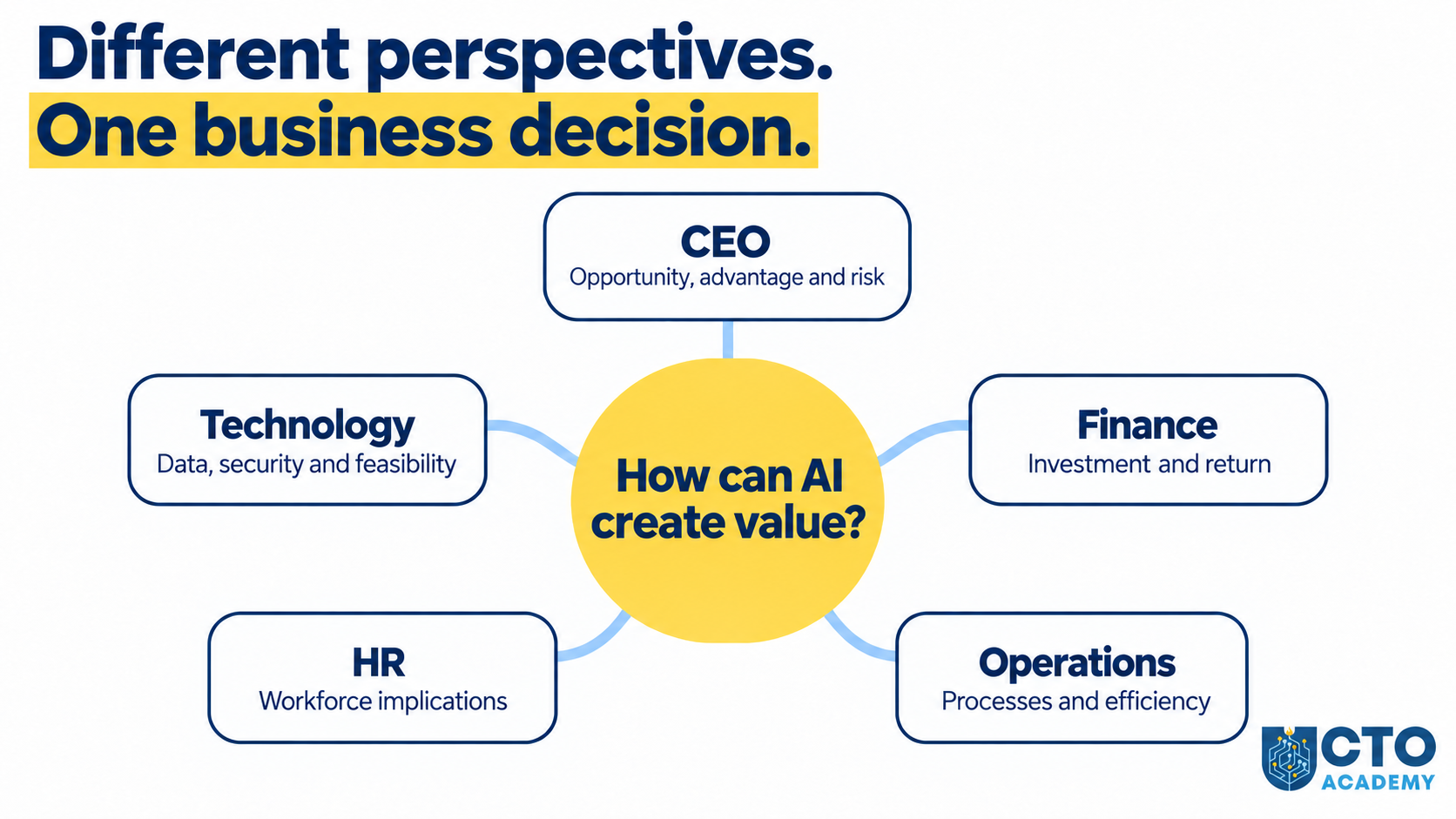
Take AI.
A technology leader might naturally think about architecture, data, security and technical feasibility.
A CFO sees investment, productivity and return.
HR sees workforce implications.
Operations sees process and efficiency.
The CEO sees competitive advantage, opportunity and risk.
These aren’t separate issues.
They’re different perspectives on the same business decision.
The real capability is bringing those perspectives together.
What are we trying to achieve?
Where does the value come from?
What does the technology make possible?
What needs to change?
What happens to our people?
What are the risks?
That’s not technology leadership.
It’s not business leadership either.
It’s leadership.
Common Language Matters
Not everybody needs the same depth of knowledge.
A board member doesn’t need to understand technology like a CTO.
A commercial director doesn’t need to become an AI engineer.
And a technologist doesn’t need to become an accountant.
But they do need enough shared language and understanding to have high-impact conversations with one another.
Technology leaders need to understand value, investment and organisational priorities.
Business leaders need enough understanding of technology, data and AI to challenge assumptions, ask better questions and make informed decisions.
And this becomes particularly important when organisations are attempting significant transformation.
Transformation isn’t something the technology function does to the rest of the organisation.
Nor is technology simply the delivery mechanism for decisions made elsewhere.
Real transformation requires leaders across the organisation to understand what they’re trying to achieve, what technology makes possible and what needs to change as a result.
That’s where shared capability starts to matter.
Bridging the Capability Gap
Alongside our work developing technology leaders around the world, we’re increasingly being asked by CEOs, L&D teams and members of our CTO community a broader question:
What capabilities does an organisation need across its leadership population to thrive in a world shaped by technology and AI?
That question has made me reconsider a phrase we’ve all used for years:
“Bridging the gap between business and technology.”
I’ve used it myself.
Now I think we need to stop.
A bridge assumes there are two separate sides.
But where exactly is that dividing line today?
Technology shapes products, customers, operations, people, investment, risk and strategy.
Business priorities determine where technology should be applied and what value it needs to create.
Technology is business.
Business is technology.
So the organisations that thrive won’t simply be those with the best technology or the smartest business strategy.
They’ll be those that build leaders across the organisation who understand how the two work together — and who develop that understanding faster than their competitors.
Which brings me back to the programme we’re delivering today.
The ambition isn’t to create 250 technologists.
It’s to create greater shared capability across 250 leaders.
Because perhaps we’ve been defining the problem incorrectly.
You don’t have a technology gap.
You have a capability gap.