
A Chief Technology Officer is the senior technology leader responsible for connecting technical capability with business direction.
In some organizations, the CTO owns product architecture, engineering strategy, platform decisions, and innovation. In others, the role is focused on technology transformation, data, infrastructure, security, or AI adoption. The exact shape depends on the organization’s size, stage, and business model.
What has changed is the level of visibility.
The CTO is no longer judged only on technical depth or delivery performance. The role now carries broader responsibility for how technology creates value, manages risk, supports growth, and shapes the organization’s future capability.
AI has made that responsibility more urgent
Executive teams are asking where AI can improve productivity, where it can create new products or services, where it introduces risk, and how it should be governed. Those questions require strategic judgment, commercial awareness, leadership confidence, and the ability to explain complex trade-offs clearly.
This guide explains what a Chief Technology Officer does, how the role compares with CIO, VP of Engineering, and Head of Engineering, how AI is changing CTO responsibilities, and what skills modern technology leaders need to build CTO readiness.
TL;DR
- The CTO role now sits closer to business strategy than traditional technical management.
- A modern CTO connects architecture, engineering capability, product direction, security, data, AI, and commercial priorities.
- The difference between CTO, CIO, VP of Engineering, and Head of Engineering usually comes down to scope: future direction, internal systems, execution, and team delivery.
- AI has increased the pressure on CTOs to guide adoption, manage risk, set guardrails, and turn experimentation into useful outcomes.
- CTO readiness requires strategic judgment, executive communication, commercial awareness, governance, and leadership range.
- The next step for many current and aspiring CTOs is to identify their capability gaps and build a deliberate development path.
Table of Contents
What is a Chief Technology Officer?
A Chief Technology Officer, or CTO, is the senior leader responsible for shaping how an organization uses technology to achieve its goals.
The role sits at the intersection of technology, business strategy, product direction, and organizational capability. As a CTO, you are expected to understand the technical landscape deeply enough to make sound decisions, but the role is not limited to technical expertise. The CTO must also decide which technology investments matter, which risks need attention, and how technical choices affect customers, teams, revenue, resilience, and long-term competitiveness.
The CTO role varies from one organization to another
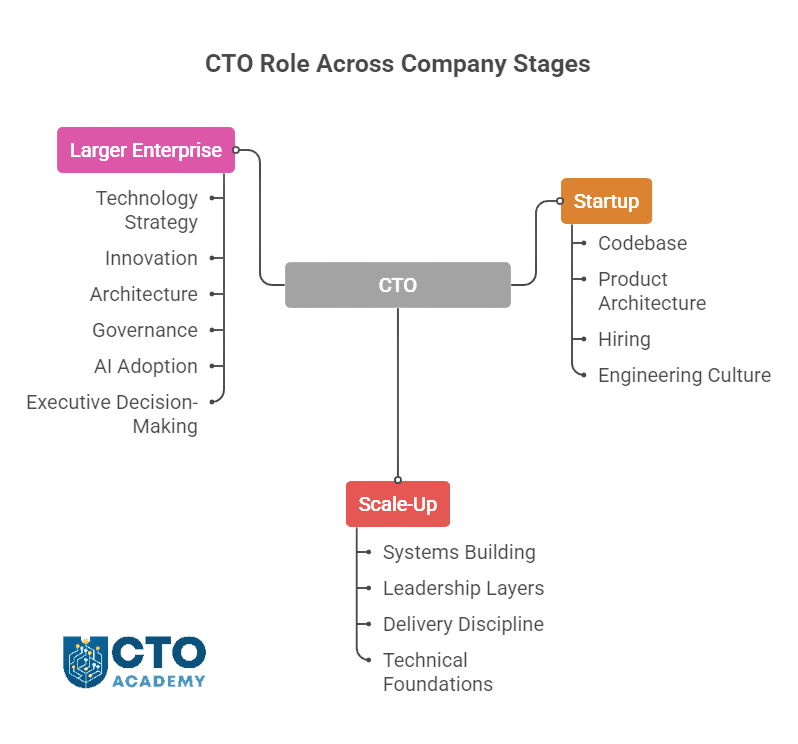
In a startup, the CTO may still be close to the codebase, product architecture, hiring, and early engineering culture.
In a scale-up, the role often shifts toward building systems, leadership layers, delivery discipline, and technical foundations that can support growth.
In a larger enterprise, the CTO may focus more on technology strategy, innovation, architecture, governance, AI adoption, and executive-level decision-making.
The common thread is accountability for technology direction
A CTO helps the organization answer questions such as:
- What technology capabilities do we need to build?
- Which systems should we modernize, replace, or protect?
- How should engineering, product, data, security, and operations work together?
- Where can emerging technologies such as AI create practical value?
- What technical risks could limit growth or damage trust?
- How do we turn business priorities into realistic technology decisions?
In other words, they help technical teams understand business priorities, and executive teams understand the consequences of technology choices.
In the AI era, CTOs are expected to explain what AI can and cannot do, where it belongs in the organization, how it should be governed, and what capabilities teams need to use it responsibly.
What Does a CTO Actually Own?
First and foremost, there has to be clear senior accountability for the technology decisions that shape the org’s future capability.
A CTO may own any or all of the following areas directly or strongly influence them through collaboration.
Table 1: CTO ownership
| CTO responsibility | In practice |
| Technology strategy | Defining how technology supports business goals, growth priorities, operational needs, and long-term competitiveness. |
| Architecture and technical direction | Making decisions about systems, platforms, scalability, interoperability, technical debt, and future flexibility. |
| Engineering capability | Building the structures, standards, leadership habits, and technical culture that help teams deliver reliably. |
| Product and platform decisions | Working with product and business leaders to decide what should be built, bought, integrated, improved, or retired. |
| AI adoption and integration | Identifying practical AI use cases, assessing risks, choosing tools, and integrating AI into workflows, products, and systems. |
| Data and infrastructure readiness | Ensuring the organization has the data foundations, infrastructure, cloud capability, and operational maturity needed to support modern technology priorities. |
| Security and resilience | Making sure systems are reliable, secure, compliant, observable, recoverable, and trusted by customers and stakeholders. |
| Vendor and build-versus-buy decisions | Deciding when to build internally, when to buy, when to partner, and how to manage dependency on external platforms or suppliers. |
| Executive communication | Translating technical choices into business consequences so CEOs, boards, investors, and senior teams can make informed decisions. |
| Innovation and experimentation | Evaluating emerging technologies, deciding where to experiment, and turning useful learning into practical adoption. |
| Technology risk and governance | Creating decision-making frameworks for technology investment, AI use, security, compliance, resilience, and operational risk. |
This is how it works in practice
In smaller organizations, one CTO may cover most of these responsibilities directly. In larger ones, many of them will be shared with CIOs, CISOs, product leaders, data leaders, enterprise architects, and engineering executives.
The CTO’s value lies in connecting those moving parts into a coherent technology direction.
CTO vs CIO vs VP of Engineering vs Head of Engineering
The simplest way to understand the difference is to look at the primary focus of each role.
The CTO owns future-facing technology direction, the CIO owns internal technology operations, the VP of Engineering owns engineering execution, and the Head of Engineering usually owns day-to-day team delivery.
Table 2: Primary focus and responsibilities of different roles
| Role | Primary focus | Typical responsibilities |
| CTO | Technology strategy and future capability | Architecture, innovation, AI strategy, technical direction, product-facing technology, and executive advice. |
| CIO | Internal technology and enterprise systems | IT operations, enterprise software, data systems, compliance, service delivery, and corporate technology services. |
| VP of Engineering | Engineering execution | Delivery, team structure, engineering processes, quality, hiring, performance, and engineering management. |
| Head of Engineering | Engineering leadership and management | Team performance, sprint delivery, technical standards, people management, and day-to-day delivery discipline. |
By default, the CTO is the role most closely associated with future-facing technology decisions. That can include:
- Product architecture
- Platform strategy
- Emerging technology evaluation
- AI adoption
- Technical risk
- The explanation of technology choices to the board or executive team
CIO vs CTO
Recently, the CIO and CTO roles have been coming closer together and sharing a lot of similar responsibilities. But as a rule of thumb, the CIO is typically more focused on the internal technology estate. This may include enterprise systems, workplace technology, IT operations, data platforms, procurement, compliance, and service management.
In larger enterprises, the CTO and CIO work closely together: the CIO ensures the org runs reliably, while the CTO helps decide how technology should evolve.
VP of Engineering vs CTO
The VP of Engineering is usually responsible for turning technical direction into delivery. This role often owns engineering structure, hiring plans, delivery processes, quality standards, team performance, and execution rhythm. A strong VP of Engineering helps ensure the organization can build and ship reliably.
Head of Engineering vs CTO
The Head of Engineering role is usually more delivery and team-management focused, although the title varies widely. In smaller companies, the Head of Engineering may be the most senior engineering leader. In larger ones, the role may sit below a VP of Engineering and focus on a specific product area, platform, function, or team group.
Donning several hats at once
In early-stage companies, one person may cover several of these responsibilities. A founder CTO might act as CTO, VP of Engineering, architect, hiring lead, and product partner at the same time.
CTO Academy is a great example of that. Jason Noble, the co-founder and CTO, was even engaged as the COO at one point. The reason was simple: he designed the systems and most of the operations, so to maintain the momentum and stay agile, it was simpler to assume that role also than to train somebody else during those early stages.
Unlike startups, in larger organizations, the boundaries are usually clearer, though the CTO still needs to collaborate closely with CIO, product, security, data, and commercial leaders.
For leaders comparing their next development step, this distinction matters. Moving from Head of Engineering or VP of Engineering toward CTO usually requires a shift from delivery leadership into broader strategic judgment, executive communication, commercial awareness, and technology leadership at the organizational level. This is where structured development through specialized CTO Programs can help clarify the path.
How the CTO Role Has Changed
In the past, many CTOs were judged mainly on technical oversight: keeping systems running, guiding architecture, supporting delivery, and ensuring engineering teams had the tools and standards they needed. While those responsibilities still matter, they are no longer enough.
Modern CTOs are expected to connect technology decisions to business outcomes.
They need to understand how platforms, data, security, AI, engineering capability, and operating models affect growth, resilience, customer experience, and competitive position.
Table 3: Traditional vs modern CTO role
| Traditional CTO emphasis | Modern CTO emphasis |
| Systems and infrastructure | Platforms, data, AI, security, and scalability. |
| Technical delivery | Business-aligned technology strategy. |
| Tool selection | Operating model and capability building. |
| Architecture decisions | Decisions about speed, resilience, cost, integration, and future flexibility. |
| Engineering supervision | Cross-functional executive leadership. |
| Innovation experiments | Measurable transformation and adoption. |
| Technical reporting | Board-level risk and opportunity communication. |
| Generic digital transformation | AI-enabled change linked to practical business outcomes. |
This shift has changed how CTOs spend their time
The role is less about being the final technical authority on every decision and more about creating the conditions for better decisions across the organization.
A modern CTO:
- Helps teams move quickly without creating uncontrolled risk.
- Supports innovation without encouraging disconnected experiments.
- Modernizes systems without breaking operational reliability.
- Explains technical trade-offs in language that boards, CEOs, investors, and commercial leaders can act on.
AI has radically accelerated this change. It has made technology leadership more visible because AI decisions affect product strategy, data quality, security, customer trust, workforce capability, and business performance. That’s why the CTO is increasingly expected to help separate useful adoption from noise and turn emerging technology into governed, measurable progress.
For many existing and aspiring technology leaders, this is the point where the next stage of development becomes less about adding more technical depth and more about building executive range: strategy, communication, commercial judgment, organizational design, and leadership under uncertainty.
Why AI Has Made the CTO Role More Visible
AI has pushed technology leadership closer to the center of business strategy.
Boards and executive teams are pushing for AI adoption. Their questions rarely have purely technical answers, but they do require technical judgment. That is why the CTO has become more visible.
AI is not just a tooling decision. It affects data, workflows, security, governance, teams, customer experience, productivity, and business models. A poorly chosen AI tool can create risk without creating value. A promising AI use case can fail because the data is not ready, the workflow is unclear, or the organization has not decided who is accountable. A useful pilot can remain stuck as an experiment if it is never integrated into core systems or measured against business outcomes.
The CTO’s role is to help move beyond AI enthusiasm and into practical adoption
That means asking:
- Where can AI create measurable value for customers, teams, or operations?
- Which use cases are worth testing now, and which should wait?
- What data, infrastructure, security, and integration work is needed first?
- Which AI tools should be bought, built, customized, or avoided?
- What guardrails are needed around privacy, compliance, accuracy, bias, and human oversight?
- How should teams be trained to use AI responsibly?
- How will success be measured beyond novelty or short-term productivity gains?
This is where the CTO becomes a translator between ambition and execution.
The CEO may want speed. The board may want assurance. Product teams may want experimentation. Engineering teams may worry about complexity, reliability, and technical debt. Legal, security, and compliance teams may see new forms of exposure. The CTO needs to connect those perspectives into a clear path forward. They help to decide where AI should be embedded, where it should be controlled, and, more importantly, where it should not be used at all.
This is also why AI leadership has become a development priority for technology leaders. Technical fluency matters, but it is not enough. CTOs need the executive range to assess risk, prioritize investment, influence stakeholders, govern adoption, and explain trade-offs in business terms.
It is a practical guide for integrating AI into core systems without compromising security, control, or leadership accountability.
What Skills Should the Modern CTO Possess
While technical judgment remains essential, it now sits inside a wider leadership skill set. This is one of the biggest shifts for senior technology leaders because many reach the point where technical knowledge is no longer the main constraint. The harder challenge is deciding what matters, influencing people who do not think like engineers, and making technology choices that support the business without creating avoidable risk.
Table 4: Modern CTO skill stack
| Skill area | Purpose |
| Technical judgment | Understanding trade-offs, architecture, scalability, reliability, technical debt, and technical risk. |
| Systems thinking | Knowing how platforms, teams, workflows, data, security, vendors, and customer experience affect one another. |
| Strategic thinking | Technology choices need to support business priorities, not just technical preferences. |
| Product and customer awareness | Understanding how technology decisions affect users, customers, product direction, and market position. |
| AI fluency | Understanding AI capabilities, limitations, risks, integration demands, and realistic use cases. |
| Commercial awareness | Investment decisions need to connect to value, cost, growth, efficiency, and competitive advantage. |
| Security and risk awareness | Recognizing where technology creates operational, reputational, compliance, or customer trust risks. |
| Communication | Explaining technical complexity to non-technical stakeholders without oversimplifying the consequences. |
| Executive influence | Shaping decisions with CEOs, boards, investors, product leaders, finance teams, and commercial stakeholders. |
| Team leadership | Building confidence, alignment, standards, and capability across engineering and technology teams. |
| Change leadership | Leading transformation across systems, teams, behaviors, workflows, and operating models. |
| Strategic prioritization | Deciding what to pursue, what to delay, what to stop, and what risks the organization is willing to accept. |
| Governance | AI, security, data, architecture, vendor, and platform decisions need clear accountability and decision-making discipline. |
The balance of these skills changes as the role becomes more senior. Earlier in a technology career, credibility often comes from technical depth and delivery. At the CTO level, credibility comes from judgment: knowing which technical issues matter most, how they affect the business, and how to bring people with different priorities into a shared decision.
AI has made that skill stack more demanding
CTOs now need enough technical fluency to challenge hype, enough commercial understanding to prioritize valuable use cases, enough governance discipline to manage risk, and enough leadership range to help teams change how they work.
For aspiring CTOs, this can be a useful way to assess readiness. The question is not simply “Am I technical enough?” It is also “Can I influence strategy, communicate trade-offs, lead through uncertainty, and connect technology decisions to business value?”
The best way to assess where you are right now is to benchmark your skill set against those who were in your shoes until most recently.
Use it to identify your strengths, gaps, and development priorities as a current or aspiring technology leader.
AI Leadership Responsibilities for Chief Technology Officers
CTO must decide where AI fits, how it should be used, what risks need to be controlled, and how adoption will create measurable value.
That responsibility usually falls across five connected areas: strategy, integration, governance, risk, and adoption.
AI Strategy
The CTO should help define how AI supports the organization’s business goals.
This means moving beyond general enthusiasm and identifying where AI can improve products, customer experience, operational efficiency, decision-making, engineering productivity, or internal workflows.
The CTO does not need to own every business case, but they should help test whether proposed AI initiatives are technically realistic, commercially useful, and aligned with the priorities.
Useful questions include:
- Which AI use cases are most likely to create measurable value?
- Which opportunities depend on better data, systems, or process maturity?
- Which experiments are worth running now?
- Which ideas are interesting, but not yet ready for investment?
- How will AI priorities connect to product, operations, customer, and revenue goals?
Without this strategic filter, AI activity can become scattered. Teams may experiment in different directions, vendors may shape the agenda, and the organization may confuse visible activity with real progress.
AI Integration
The CTO is responsible for making sure AI can work inside the orgs’ existing technology environment.
AI tools rarely create value in isolation. They need to connect with data, workflows, platforms, APIs, security controls, customer journeys, and operational processes. A promising AI use case can easily fail if it cannot access reliable data, fit into existing systems, or support the way teams actually work.
The CTO needs to consider the following factors:
- Where AI should sit in the architecture
- How models and tools will connect to existing systems
- What data is required, and whether it is trustworthy
- How outputs will be checked, monitored, or reviewed
- How AI-enabled workflows will affect teams and customers
- What technical debt or infrastructure constraints need to be addressed
This is where AI moves from experiment to implementation. The CTO’s job is to avoid isolated pilots and build the technical foundations needed for repeatable adoption.
Learn how to reconcile innovation, infrastructure, and security.
AI Governance
AI decisions need clear accountability.
The CTO must establish how AI use cases are approved, reviewed, monitored, and controlled. This is done by ensuring that the organization knows who is responsible for decisions that affect data, security, customer experience, employees, compliance, and brand trust.
Good AI governance should, therefore, make the following points very clear:
- Who can approve AI tools and use cases
- What data can and cannot be used
- When human review is required
- How AI outputs should be tested
- How vendors are assessed
- How risks are escalated
- How performance and unintended consequences are monitored
Governance is especially important as AI adoption spreads across departments. Without clear guardrails, different teams may adopt tools independently, expose sensitive data, duplicate costs, or create inconsistent customer and employee experiences.
AI Risk
AI creates new forms of technology and business risk. The CTO ensures that the organization understands those risks without unnecessary lag in useful progress.
Key areas include security, privacy, compliance, bias, reliability, explainability, intellectual property, vendor dependency, and operational resilience.
Some risks are purely technical. Others, on the other hand, are organizational. However, many sit between technology, legal, security, HR, product, and customer-facing teams.
The CTO should answer questions such as:
- What happens if an AI system produces inaccurate or misleading output?
- What data is being shared, stored, or used for model training?
- Which AI decisions need human oversight?
- How do we prevent sensitive information from being exposed?
- What happens if a vendor changes pricing, access, performance, or terms?
- How do we test AI systems before they affect customers or critical processes?
The goal is not to block AI adoption but to make adoption safe, clear, and controlled enough to be trusted.
AI Adoption
AI leadership also requires preparing people to work differently.
The CTO has a mandate to help teams understand how AI should be used, where it can support their work, and where judgment still matters. This includes engineering teams, product teams, operations, customer support, data teams, and senior leadership.
Adoption depends on far more than just tool access. Teams need guidance, examples, training, workflows, and confidence, especially non-tech teams. They also need to understand the limits of AI, including when outputs need to be checked and when automation is inappropriate.
The CTO should help create the conditions for responsible adoption by:
- Supporting practical training
- Encouraging useful experimentation
- Sharing/controlling approved tools and patterns
- Defining acceptable use
- Building feedback loops
- Measuring impact
- Helping managers adapt workflows
- Reinforcing where human judgment remains essential
Effective CTOs treat AI adoption as an organizational capability, not a one-off project.
A playbook for turning AI ambition into secure, governed, and commercially useful implementation and moving from assistants to autonomous workflows.
Common Types of CTO Roles
There is no single version of the CTO role. The title can mean different things depending on the orgs’ size, stage, sector, product model, and leadership structure.
This is why two CTOs can have the same title but very different working weeks, as we often hear during weekly expert sessions and inside the Community discussions. One may be close to product architecture and engineering delivery. Another may spend most of their time with the board, regulators, enterprise customers, or transformation teams. Another may focus almost entirely on AI, data, platforms, and operating model change.
The most useful way to understand the variation is to look at the type of CTO role the organization needs.
Table 5: Types of CTOs w/ typical focus
| CTO type | Typical focus |
| Startup CTO | Building the first technical foundation, product architecture, and engineering team. |
| Scale-up CTO | Creating systems, processes, leadership capacity, and technical foundations that can support growth. |
| Enterprise CTO | Aligning complex technology estates with business strategy, governance, security, and long-term transformation. May also be a Group CTO, managing several verticals. |
| Product-led CTO (CPTO) | Connecting product direction, customer needs, architecture, engineering delivery, and technical differentiation. |
| Platform or infrastructure CTO | Owning infrastructure, platforms, reliability, scalability, cloud strategy, and developer productivity. |
| Transformation CTO | Leading modernization, cloud migration, data strategy, AI adoption, or operating model change. |
| Fractional CTO | Providing senior technology leadership on a fraction of a project/scope for a fraction of the time. |
| AI-focused CTO | Leading AI strategy, integration, governance, platform choices, and organizational capability building. |
These types are by no means fixed categories. In practice, CTO roles often combine several of them. A scale-up CTO may also be product-led. An enterprise CTO may also be responsible for transformation. A fractional CTO may be brought in specifically to support AI adoption, architecture decisions, or technical due diligence.
If you are interested in learning more about different types of CTO contracts, go here.
The important point is context
A strong CTO in one environment may not be the right fit for another. The skills needed to build a technical team from scratch are not identical to the skills needed to modernize a legacy enterprise estate, govern AI adoption, or advise a board on technology risk.
For aspiring CTOs, this distinction is useful because it helps clarify the type of role you are preparing for. For organizations, it helps define what kind of technology leadership is actually needed. A hiring brief that simply says “CTO” is rarely enough. The better question is: what technology challenge does this CTO need to lead?
Leaders comparing different development routes can use resources such as IT Career Path Mapping, CTO Programs Reviews, or explore the Fractional CTO route to think more clearly about which capabilities they need to strengthen next.
First 90 Days as a CTO
The first 90 days are not just about proving technical authority. They are about understanding the organization, building trust, identifying constraints, and deciding where technology leadership can create the most immediate value.
A new CTO needs to learn before they prescribe. That means getting close to the business context, not just the technology estate:
- What is the organization trying to achieve?
- Where is growth being blocked?
- Which systems are fragile?
- Where are teams moving too slowly?
- What risks are already visible?
- What expectations does the CEO, board, or executive team have for the role?
In the first 90 days, a CTO should, therefore, focus on:
- Understanding the business model, strategic priorities, and commercial pressures
- Assessing people, systems, architecture, delivery performance, and technology risk
- Building relationships with executive peers, product leaders, engineering teams, data, security, finance, and operations
- Identifying technical debt, delivery constraints, capability gaps, and organizational bottlenecks
- Clarifying expectations with the CEO, board, founder, or executive sponsor
- Finding early credibility-building wins without rushing into cosmetic change
- Creating a realistic technology leadership agenda for the next stage
The biggest mistake is to arrive with a fixed answer before understanding the context.
A CTO who moves too quickly can damage trust, misread the organization, or solve the wrong problem. A CTO who moves too slowly can lose momentum and allow existing risks to deepen.
The goal is to build enough understanding to make better decisions
By the end of the first 90 days, the CTO should be able to explain where technology is supporting the business, where it is constraining progress, which risks require attention, and what priorities should shape the next phase of leadership.
How to Build CTO Readiness
Technical problems often have boundaries. Executive leadership problems rarely do. A CTO may need to make decisions with incomplete information, balance competing priorities, defend investment choices, manage risk, and explain why the best technical answer is not always the best organizational answer.
Table 6: The list of connected capabilities that assess CTO readiness
| Readiness area | Practical impact |
| Strategic thinking | Understanding how technology choices support growth, resilience, customer value, and competitive position. |
| Business and finance understanding | Reading commercial context, investment trade-offs, budgets, margins, cost structures, and value creation. |
| AI and technology fluency | Knowing where emerging technologies can create value, where they introduce risk, and what foundations are needed for adoption. |
| Executive communication | Explaining technical trade-offs clearly to CEOs, boards, investors, and non-technical stakeholders. |
| Decision-making under uncertainty | Making informed choices when the data is incomplete, the risks are uneven, and the answer is not obvious. |
| Stakeholder management | Building trust across product, engineering, data, security, finance, operations, commercial teams, and executive leadership. |
| Team leadership | Creating the standards, structures, culture, and leadership capacity that help teams perform. |
| Governance and risk | Establishing clear decision-making around architecture, AI, security, data, vendors, compliance, and operational resilience. |
| Personal leadership maturity | Developing self-awareness, resilience, confidence, and the ability to lead through pressure and ambiguity. |
The CTO has to move between levels: deep enough to understand consequences, broad enough to guide direction.
For aspiring CTOs, the development path often starts by identifying which gaps matter most. Some leaders need stronger commercial confidence. Some need more experience influencing senior stakeholders. Others need to improve strategic prioritization, AI governance, or organizational leadership. The answer often depends on the role they want, the organization they serve, and the risks they are expected to manage.
This is where structured development helps because the CTO role is not learned through technical experience alone. It requires exposure to strategy, finance, leadership, innovation, communication, and decision-making in complex environments.
Identify your strengths, gaps, and development priorities before deciding your next step.
Related Resources for Current and Aspiring CTOs
The CTO role changes with context. A new CTO, an aspiring CTO, an engineering leader preparing for executive responsibility, and an experienced technology leader responding to AI will not all need the same next step.
Use these resources to continue from the area most relevant to your current challenge.
Table 7: The list of relevant resources for CTOs
| Resource | Who it is for | Next step |
| First 90 Days as CTO | For new CTOs who need to establish credibility, assess the organization, and set clear leadership priorities. | Read the guide |
| AI Integration Playbook | For technology leaders responsible for turning AI ambition into practical, secure, and governed implementation. | Read the playbook |
| CTO Skills Assessment | For aspiring and current CTOs who want to identify strengths, gaps, and development priorities. | Assess your readiness |
| Digital MBA for Technology Leaders | For technology leaders who want structured development across strategy, leadership, business, and AI-era decision-making. | Explore the program |
| CTO Programs Reviews | For leaders comparing CTO courses, technology leadership programs, and executive education options. | Compare CTO programs |
Frequently Asked Questions (FAQ)
What does CTO stand for?
CTO stands for Chief Technology Officer. It is a senior leadership role responsible for technology direction, technical capability, and the connection between technology decisions and business goals.
What does a Chief Technology Officer do?
A Chief Technology Officer leads technology strategy and helps align technical decisions with business priorities. Depending on the organization, a CTO may be responsible for architecture, engineering capability, product technology, AI adoption, innovation, security, governance, vendor decisions, and executive communication.
Is a CTO higher than a VP of Engineering?
Usually, yes. A CTO is typically more strategic and executive-facing, while a VP of Engineering is usually more focused on engineering execution, delivery, team performance, process, and quality.
In smaller companies, however, the distinction can be less formal. One person may cover both roles, or the VP of Engineering may operate with responsibilities that look similar to a CTO role.
What is the difference between a CTO and a CIO?
A CTO usually focuses on technology strategy, product technology, innovation, architecture, future capability, and emerging technologies such as AI.
A CIO usually focuses on internal technology systems, enterprise applications, IT operations, data infrastructure, compliance, service delivery, and corporate technology services.
The two roles often work closely together, especially in larger organizations where technology strategy and internal systems need to be aligned.
What skills does a CTO need?
A CTO needs technical judgment, strategic thinking, business awareness, communication, leadership, AI fluency, security awareness, and the ability to manage trade-offs.
As the role becomes more senior, the CTO also needs stronger executive influence, commercial understanding, governance discipline, team leadership, and decision-making under uncertainty.
How has AI changed the CTO role?
AI has made the CTO role more visible because organizations need senior technology leadership to assess use cases, manage risk, integrate tools, govern data, and explain AI’s business impact.
AI is not only a technical issue. It affects workflows, products, customer experience, security, privacy, compliance, workforce capability, and operating models. The CTO helps the organization decide where AI can create value and how it should be adopted responsibly.
How do you become a CTO?
Most CTOs build experience across engineering, architecture, product, leadership, strategy, and executive communication.
The path often starts with technical credibility, then expands into team leadership, delivery ownership, stakeholder management, business understanding, and strategic decision-making. Structured leadership development can help technical leaders prepare for the broader responsibilities of the role.
Key Takeaways
The CTO role is no longer defined by technical seniority alone, but by the quality of judgment a leader brings to business-critical technology decisions.
AI has raised the stakes because technology choices now affect more than systems and delivery. They shape how organizations compete, manage risk, build capability, and earn trust.
So, for current and aspiring CTOs, the real question is not simply whether they understand the technology. It is whether they can turn technical understanding into strategy, influence, governance, and measurable business value.
That shift rarely happens by accident. Even if it does, the gaps it creates are too large to overcome. The optimal path requires deliberate development across leadership, commercial thinking, communication, AI readiness, and executive decision-making.
The practical next step is to identify which capability gap is limiting your progress now: commercial confidence, AI governance, executive communication, strategic prioritization, or leadership range.