
AI integration is now a business imperative that puts technology leaders under immense pressure because we are not talking about a few AI-powered secondary systems. The request is to fully integrate Gen AI into the ecosystem.
However, this push for AI adoption brings significant challenges:
- Existing IT infrastructures often lack the flexibility and scalability to support AI workloads
- There are heightened risks related to data security, regulatory compliance, and ethical use of AI.
- The complexity grows as leaders must define clear use cases, ensure secure deployment (often requiring private or sovereign cloud solutions), and balance innovation with the need for robust governance and cost control.
This advanced guide provides a strategic and technical roadmap to complex AI integration, covering everything from infrastructure and security to use cases and governance. In other words, it is a comprehensive resource for building an AI-ready enterprise that balances innovation with resilience.
TL;DR
- Why this matters: Integrating generative AI is now a top-line business mandate, not a side project, but most enterprises lack the elastic, secure infrastructure and governance to do it safely and cost-effectively.
- Five pressing hurdles: (1) modernising compute, storage, and networking; (2) securing data in trusted/sovereign clouds; (3) choosing use-cases that serve real business goals; (4) putting transparent, cross-functional AI governance in place; (5) funding rapid innovation while controlling spend and risk.
- Infrastructure playbook: Audit current capacity → upgrade to GPU-centric hybrid clusters, tiered storage, and 100 GbE networks → automate with Kubernetes/Kubeflow and continuous cost-/utilisation monitoring. Done well, this cuts infrastructure cost by 35-40 % and doubles or triples model iteration speed.
- Secure & compliant by design: Encrypt everything, run sensitive workloads in confidential-computing enclaves, enforce zero-trust RBAC and micro-segmentation, and adopt sovereign-cloud options to keep data residency regulators happy.
- Operate responsibly: Align AI projects with strategic objectives via a scored use-case matrix, govern them with recognised frameworks (e.g., NIST AI RMF), embed FinOps and continuous risk assessment, and foster a “responsible innovation” culture that balances speed with accountability.
Immediate Challenges of AI Integration
Technology leaders face five immediate challenges:
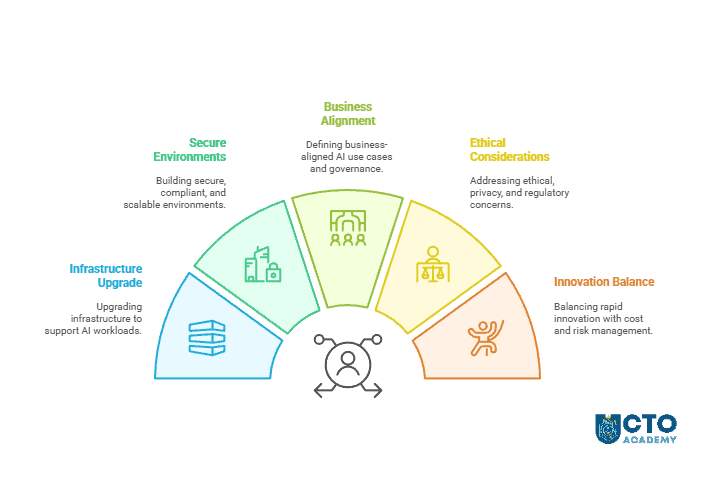
- Assessing and upgrading infrastructure for AI workloads.
- Building secure, compliant, and scalable environments (e.g., trusted or sovereign cloud).
- Defining business-aligned AI use cases and governance frameworks.
- Addressing ethical, privacy, and regulatory considerations.
- Balancing rapid innovation with cost and risk management.
1. Assessment and Upgrade
To architect an AI-ready enterprise, you must adopt a structured approach to infrastructure assessment and modernization. Below is a strategic framework compiled from industry best practices and real-world implementation insights.
Leaders who adopt this approach typically reduce AI infrastructure costs by 35-40% while achieving 2- 3x faster model iteration cycles.
The key is treating AI infrastructure as a dynamic asset requiring continuous optimization rather than a one-time investment.
1.1. Infrastructure Assessment: Identifying AI Readiness Gaps
Begin with a granular evaluation of existing systems using this four-step process:
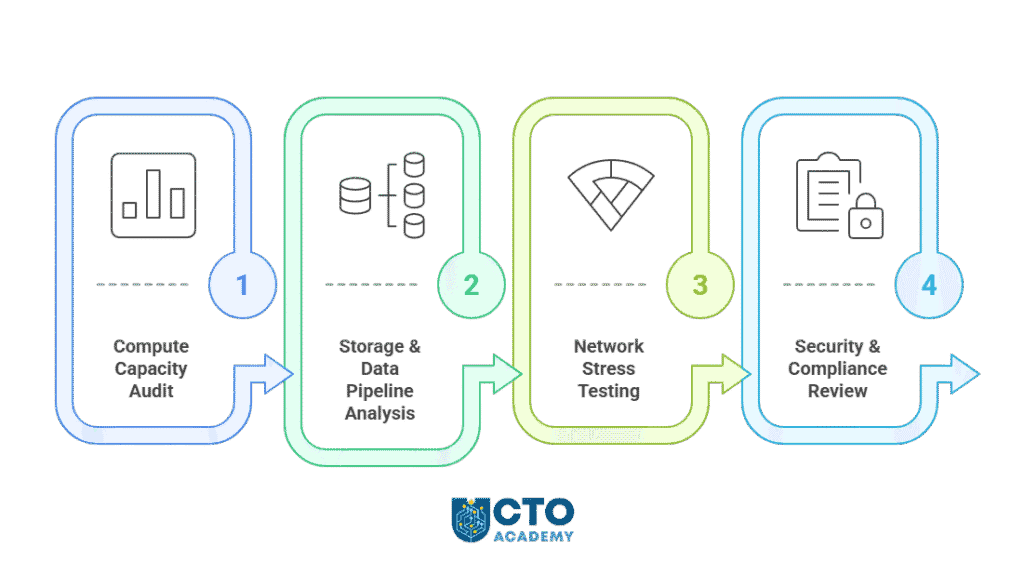
STEP 1: Compute Capacity Audit
- Benchmark current CPU/GPU/TPU capabilities against AI workload demands (e.g., model training times, inference latency).
- Identify underpowered systems struggling with parallel processing tasks like neural network training.
STEP 2: Storage & Data Pipeline Analysis
- Measure storage throughput (IOPS) and latency for large datasets.
- Map data flows to identify bottlenecks in ingestion/preprocessing pipelines.
STEP 3: Network Stress Testing
- Conduct load simulations to assess bandwidth sufficiency for distributed training and real-time inference.
- Measure latency between compute nodes and storage systems.
STEP 4: Security & Compliance Review
- Audit encryption standards for data at rest/in transit.
- Verify that access controls align with AI model/data sensitivity levels.
1.2. Infrastructure Upgrades
STEP 1: Compute Modernization
- Switch from general-purpose CPUs to hybrid CPU/GPU clusters to achieve 8-10x faster training for vision/NLP models.
- Migrate from legacy hardware to cloud burst capabilities (e.g., AWS/Azure/GCP) to get elastic scaling for peak workloads.
STEP 2: Storage Optimization
- Deploy parallel file systems (e.g., Lustre, GPFS) for high-throughput model training.
- Implement tiered storage: Hot (NVMe), Warm (SSD), Cold (Object Storage).
STEP 3: Network Enhancements
- Upgrade to 100GbE/InfiniBand for distributed training clusters.
- Implement microsegmentation to isolate AI workloads from general traffic.
STEP 4: Security Hardening
- Deploy confidential computing environments for sensitive models.
- Establish AI-specific IAM policies with granular model/data access controls.
1.3. Operational Best Practices
Resource Orchestration
- Use Kubernetes with GPU-aware scheduling (Kubeflow, NVIDIA DGX).
- Implement spot instances/preemptible VMs for cost-sensitive batch jobs.
Monitoring & Optimization
- Track GPU utilization rates and memory bottlenecks with tools like DCGM.
- Automate scaling policies based on real-time workload demands.
Future-Proofing Strategies
- Reserve 20-30% overhead capacity for emerging techniques like 3D neural networks.
- Standardize on containerized AI pipelines for framework agility (TensorFlow ↔ PyTorch).
1.4. Implementation Roadmap
- Phase 1 (0-3 months): Critical gap remediation (security patches, urgent hardware upgrades).
- Phase 2 (3-6 months): Hybrid cloud deployment with burst capabilities.
- Phase 3 (6-12 months): Full automation of resource provisioning/model deployment.
1.5. Additional Learning Resources
- https://spot.io/resources/ai-infrastructure/ai-infrastructure-5-key-components-challenges-and-best-practices/
- https://www.puttingdatatowork.com/post/how-to-build-an-ai-strategy-part-three-building-the-ai-infrastructure
- https://des3tech.com/blog/upgrading-your-it-infrastructure-for-ai-what-you-need-to-know/
- https://www.ibm.com/think/topics/optimize-ai-workloads
- https://learn.microsoft.com/en-us/azure/cloud-adoption-framework/scenarios/ai/infrastructure/well-architected
- https://networkright.com/ai-readiness-assessment/
2. Building Secure, Compliant, and Scalable Environments
This is a tactical framework that balances regulatory requirements, infrastructure flexibility, and robust security. It reduces breach risks by 40-50% while maintaining 99.9% uptime for AI workloads.
The key here is treating compliance and scalability as interconnected pillars rather than isolated initiatives.
2.1. Optimal Architecture of Sovereign/Trusted Clouds
Core Requirements:
- Data residency
- Provider selection
- Modular design
Ensure all data (including metadata) remains within jurisdictional boundaries to comply with GDPR, CCPA, or industry-specific mandates (e.g., HIPAA for healthcare).
When choosing cloud providers, focus on those offering sovereign cloud solutions (e.g., AWS Sovereign Cloud, Microsoft Azure Sovereign, or regional providers like OVHcloud).
Finally, decouple compute, storage, and networking to enable independent scaling of components (e.g., elastic GPU clusters + fixed on-prem storage):
- COMPUTE:
- Hybrid clusters (on-prem + burst to sovereign cloud)
- KEY BENEFIT: compliance + cost optimization
- STORAGE:
- Tiered encrypted storage with local redundancy zones
- KEY BENEFIT: Low latency + regulatory adherence
- NETWORKING:
- Private WAN links to sovereign cloud endpoints
- KEY BENEFIT: Reduced exposure to public internet risks2. Security Hardening
2.2. Implementation Steps
STEP 1: Data Protection
- Encryption: Apply AES-256 encryption for data at rest and TLS 1.3 or later for in-transit data, with keys managed via Hardware Security Modules (HSMs).
- Confidential Computing: Use secure enclaves (e.g., Intel SGX, AWS Nitro) to process sensitive data in isolated environments.
STEP 2: Access Controls
- Zero-Trust Model: Enforce strict RBAC (Role-Based Access Control) with MFA for AI pipelines and model repositories.
- Microsegmentation: Isolate AI workloads from general IT traffic to limit lateral movement during breaches.
STEP 3: Threat Monitoring
- Deploy AI-specific SIEM tools to detect anomalies in training data or model behavior.
- Conduct red-team exercises simulating adversarial attacks on AI systems.
2.3. Compliance Frameworks
Regulatory Alignment:
- Map AI workflows to compliance standards (e.g., ISO 27001 for security, NIST AI Risk Management Framework).
- Implement automated audit trails for data lineage and model decision-making processes.
Sovereign Cloud Best Practices:
- Partner with local legal teams to validate data sovereignty requirements.
- Conduct quarterly DPIA (Data Protection Impact Assessments) for high-risk AI use cases.
2.4. Scalability Strategies w/ Implementation Steps
STEP 1: Distributed Computing
- Use Kubernetes with GPU-aware orchestration (e.g., Kubeflow, NVIDIA DGX) to parallelize training across nodes.
- Leverage spot instances for non-critical batch jobs, reducing costs by 60-70%.
STEP 2: Auto-Scaling Infrastructure
- Deploy predictive scaling policies using ML-driven tools (e.g., AWS Auto Scaling, Azure Autoscale) to anticipate workload spikes.
- Adopt serverless architectures (e.g., AWS Lambda for inference) to eliminate idle resource costs.
STEP 3: Implement Observability
- Monitor GPU utilization, memory leaks, and model drift with tools like Prometheus + Grafana.
- Set thresholds for automated rollbacks during performance degradation.
2.5. Implementation Roadmap
- Phase 1 (0-3 months): Pilot a sovereign cloud environment for non-critical AI workloads; implement base encryption and RBAC.
- Phase 2 (3-6 months): Integrate hybrid scaling (on-prem + cloud) and deploy confidential computing for sensitive models.
- Phase 3 (6-12 months): Achieve full observability with AIOps tools and automated compliance reporting.
2.6. Additional Learning Resources
- https://intervision.com/blog-cloud-ai-platforms-and-their-competitive-edge-comparing-cloud-ai-providers/
- https://blog.3ds.com/industries/aerospace-defense/what-is-the-sovereign-cloud
- https://clear.ml/blog/from-complexity-to-control-overcoming-devops-and-it-leaders-biggest-ai-infrastructure-challenges
- https://www.redapt.com/blog/how-to-scale-ai-systems-without-compromising-security
3. Defining Business-Aligned AI Use Cases
3.1. Strategies & Implementation Steps
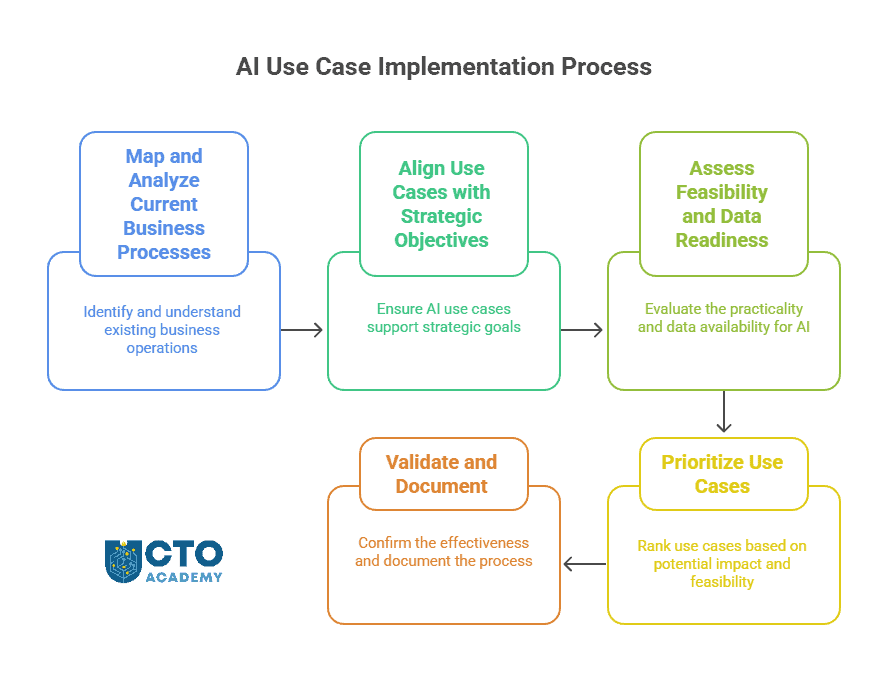
STEP 1: Map and Analyze Current Business Processes
- Begin by thoroughly mapping out your organization’s key processes to identify pain points, inefficiencies, or opportunities for innovation.
- Engage with stakeholders across departments (IT, operations, marketing, HR, etc.) to gather diverse perspectives on where AI could add value.
STEP 2: Align Use Cases with Strategic Objectives
- Ensure every potential AI use case directly supports strategic business goals, such as cost reduction, customer satisfaction, or new revenue streams.
- Avoid following industry hype; instead, focus on how AI can solve real business challenges unique to your organization.
STEP 3: Assess Feasibility and Data Readiness
- Evaluate the technical feasibility of each use case, considering available data quality and quantity, technical expertise, and integration complexity.
- Prioritize use cases where high-quality, relevant data exists, as data is critical to AI success.
STEP 4: Prioritize Use Cases
- Use a scoring matrix to rank use cases based on business impact, implementation complexity, strategic alignment, data readiness, and resource availability.
- Start with “quick win” projects—low-complexity, high-impact use cases—to demonstrate early value and build momentum.
STEP 5: Validate and Document
- Clearly define and document each use case: its purpose, expected outcomes, required data, and ethical/legal considerations.
- Ensure documentation is accessible for transparency and future audits.
3.2. Additional Learning Materials
- https://www.fisherphillips.com/en/news-insights/ai-governance-101-10-steps-your-business-should-take.html
- https://www.moveworks.com/us/en/resources/blog/creating-an-ai-strategy-for-enterprises
- https://www.multimodal.dev/post/how-to-identify-ai-use-cases-for-your-business
- https://www.n-ix.com/enterprise-ai-governance/
- https://www.edvantis.com/blog/select-ai-use-cases/
- https://www.pmi.org/blog/ai-data-governance-best-practices
- https://www.wavestone.com/en/insight/ai-use-cases/
- https://amazingworkplaces.co/best-practices-for-integrating-ai-effectively-in-the-workplace/
4. Establishing an Effective AI Governance Framework
4.1. Effective Strategies w/ Implementation Steps
STEP 1: Form a Cross-Functional Governance Committee
- Assemble a team with representatives from technology, legal, compliance, risk, and business units to oversee AI initiatives.
- Assign clear roles and responsibilities, such as executive oversight (e.g., Chief AI Officer), ethics/compliance committees, and technical leads.
STEP 2: Adopt Recognized Governance Principles and Frameworks
- Base your governance on established principles: transparency, fairness, accountability, privacy, and safety.
- Reference frameworks like the NIST AI Risk Management Framework, OECD AI Principles, and sector-specific guidelines for structure and best practices.
STEP 3: Implement Policies and Controls
- Develop policies for data governance, model development, deployment, monitoring, and ethical use.
- Include measures for bias detection, explainability, data minimization, and privacy impact assessments.
- Set up regular audits and monitoring systems to track AI performance, bias, and compliance.
STEP 4: Continuous Training and Stakeholder Engagement
- Provide ongoing education for staff on AI ethics, compliance, and responsible use.
- Foster a culture of responsible AI by engaging all levels of the organization and establishing clear reporting mechanisms for concerns or incidents.
STEP 5: Continuous Improvement and Communication
- Regularly review and update governance policies in response to new risks, regulations, or business changes.
- Communicate governance principles and updates across the organization to ensure buy-in and adherence.
By following this structured approach, you will ensure that AI initiatives are:
- Tightly aligned with business priorities.
- Feasible and ethical.
- Governed by transparent, accountable, and adaptable frameworks, maximizing both value and trust.
4.2. Additional Learning Resources
- https://www.4mation.com.au/blog/identify-best-ai-use-cases-for-business/
- https://www.wavestone.com/en/insight/ai-use-cases/
- https://www.moveworks.com/us/en/resources/blog/creating-an-ai-strategy-for-enterprises
- https://www.datacamp.com/blog/ai-governance
- https://bigid.com/blog/what-is-ai-governance/
- https://www.diligent.com/resources/blog/ai-governance
- https://amazingworkplaces.co/best-practices-for-integrating-ai-effectively-in-the-workplace/
- https://transcend.io/blog/enterprise-ai-governance
- https://www.pmi.org/blog/ai-data-governance-best-practices
- https://www.fisherphillips.com/en/news-insights/ai-governance-101-10-steps-your-business-should-take.html
- https://casebase.ai/en/best-practices-identify-use-cases/
- https://www.ibm.com/think/topics/ai-governance
- https://www.n-ix.com/enterprise-ai-governance/
- https://cdn.openai.com/business-guides-and-resources/identifying-and-scaling-ai-use-cases.pdf
- https://www.forvismazars.us/forsights/2025/01/ai-in-business-aligning-best-practices
- https://www.imd.org/beta-ibyimd/artificial-intelligence/four-imperatives-to-help-demystify-ai-use-cases/
- https://2021.ai/news/ai-governance-a-5-step-framework-for-implementing-responsible-and-compliant-ai
- https://ai-governance.eu
5. Balancing Rapid AI Innovation with Cost and Risk Management
When building an AI-ready enterprise, you aim for two outcomes:
- It must be innovative.
- It has to be resilient.
The most effective approach combines financial discipline, robust governance, and a culture of continuous optimization.
5.1. The Four Strategies Framework
S1: Establish Cross-Functional Oversight
Form an Operations Oversight Group (OOG) by bringing together stakeholders from IT, finance, security, and business units. The group’s task is to oversee AI investments, monitor spending, and align projects with business goals.
But this won’t work if you fail to define performance and cost milestones for each AI initiative. After all, as a tech leader, you want to ensure projects deliver value and stay within budget.
S2: Implement FinOps and Cost Management Practices
- Integrate financial operations (FinOps) into AI project management to provide transparency, optimize resource allocation, and control cloud costs.
- Leverage cloud-native tools (e.g., Azure Cost Management, AWS Cost Explorer) to predict expenses, set budgets, and monitor trends in real time.
- Optimize resource utilization through regular reviews and optimization of compute, storage, and network usage. Ensure that outdated models are decommissioned. Also, when automating scaling, make sure it matches workload demands.
- Measure visible and latent outcomes. In other words, track not only direct ROI but also intangible benefits like brand recognition and process efficiency. This will help you to either justify AI investments or retire initiatives.
S3: Embed Risk Management into Innovation
Here, we are talking about four good practices:
- Continuous risk assessment
- Governance
- Scenario planning
- Stress testing
Let’s briefly touch on each of these initiatives.
What goes into risk assessment besides real-time identification, assessment, and mitigation?
You must also include security threats, compliance gaps, and something that many neglect, technical debt.
With governance, things are a bit different than with your legacy tech stack. When integrating AI into systems across the domain, you need to include model explainability and ethical AI use. This implies regular audits for bias, privacy, and regulatory compliance.
Now, where to start with all of this?
It’s where scenario planning and stress testing come into play. You want to simulate adverse events (e.g., data breaches, model failures) to test resilience and refine response strategies. In the beginning, simulations provide foundations for Risk Assessment and Governance policies. As you move along the line, they are used to make necessary corrections, deliver improvements, and enable smoother pivoting.
S4: Build and Maintain a Culture of Responsible Innovation
What is “Responsible Innovation” from the perspective of a technology leader?
For a CTO, responsible innovation means driving AI initiatives only when every stage—strategy, data sourcing, model design, deployment, and continuous monitoring—can undoubtedly:
- Advance business
- Enhance customer value
- Uphold trust
It blends experimentation with governance:
- Cross-functional ethical, security, compliance, and sustainability guardrails.
- Transparent metrics and explainability.
- Diverse human oversight.
- Rapid feedback loops to correct drift or harm.
In essence, it is innovation that is auditable, accountable, and aligned (AAA) with both organisational goals and the broader public good.
How to accomplish the Triple A?
- Encourage experimentation, but with guardrails. In other words, allow teams to innovate rapidly within defined risk and cost boundaries. The good practice is to use “innovation sandboxes” for safe(r) experimentation.
- Build a continuous training culture by investing in ongoing education for staff on cost optimization, risk management, and responsible AI practices.
- Enforce transparent communication. You want teams to share cost, risk, and performance metrics. It will drive accountability and enable informed decision-making.
5.2. Key Takeaways
- Balance is achieved through transparency, collaboration, and continuous optimization.
- Align AI initiatives with business strategy and risk appetite.
- Use FinOps and governance frameworks to ensure innovation is both cost-effective and secure.
- Measure success holistically, considering both financial and strategic outcomes.
- Your main responsibility is to ensure AI serves as a sustainable driver of growth rather than a source of unchecked cost or risk.
5.3. Additional Learning Resources
- https://bestofai.com/article/finops-for-ai-balance-innovation-with-cost-management
- https://www.devoteam.com/lu/expert-view/balancing-ai-innovation-and-cloud-costs-the-ai-finops-perspective/
- https://azure.github.io/AI-in-Production-Guide/chapters/chapter_09_managing_expedition_cost_management_optimization
- https://www.metricstream.com/learn/ai-risk-management.html
- https://www.purestorage.com/resources/balancing-innovation-and-risk-in-the-ai-age.html
- https://www.forbes.com/councils/forbestechcouncil/2025/01/28/finops-for-ai-balance-innovation-with-cost-management/
- https://www.youtube.com/watch?v=Pmr4AZQOtNg
- https://www.flexera.com/blog/perspectives/balancing-innovation-costs-and-ethics-in-a-cloud-driven-world/
- https://theenterpriseworld.com/ai-risk-management-framework/
- https://www.emma.ms/blog/ai-innovation-through-cost-control
Key Takeaways
- AI is no longer optional. Generative AI must be woven into core products and workflows, which forces tech leaders to rethink infrastructure, security, and governance from the ground up.
- Expect five immediate hurdles:
- Modernising compute, storage, and networking
- Building secure, compliant (often sovereign-cloud) environments
- Selecting use cases that advance clear business goals
- Establishing cross-functional AI governance
- Controlling spend and risk while still innovating fast
- Modernise early to win later. Organisations that shift to GPU-centric hybrid clusters, tiered storage, and 100 GbE networks typically cut AI infrastructure costs by 35-40 % and speed model iteration 2-3×.
- Secure & compliant by design. Encrypt data at rest/in transit, run sensitive workloads in confidential-computing enclaves, enforce zero-trust RBAC and micro-segmentation, and keep sensitive data inside sovereign-cloud boundaries to satisfy residency rules.
- Governance is the safety net. Anchor programmes to recognised frameworks (e.g., NIST AI RMF) and embed policies for bias detection, explainability, and continuous oversight so AI remains transparent, fair, and accountable.
- Balance innovation with FinOps discipline. Integrate FinOps into every AI project to track real-time costs, optimise resource use, and measure both ROI and intangible benefits—preventing AI from becoming a runaway expense or risk.
Quick Access to AI Guides for Technology Leaders