AI has secured its place on the board agenda. Across organisations, the evidence of action is everywhere: pilots are being launched, Copilots deployed, governance committees established, AI specialists recruited and executives sent on AI courses.
There is certainly no shortage of activity.
But activity is not capability.
The more pressing question is whether all this investment is making the organisation measurably better at something that matters.
Is it improving productivity? Reducing operating costs? Accelerating decisions? Improving customer experience? Creating revenue? Managing risk? Strengthening competitive advantage?
And can the organisation explain who is accountable for making those things happen?
Increasingly, that is where the problem lies.
AI activity is accelerating faster than organisational capability.
TL;DR
- AI activity is not the same as AI capability. Pilots, tools, committees and training only matter if they improve something the business actually values.
- The starting point for AI should be a business problem or opportunity, not a search for places to deploy the technology.
- AI responsibility will inevitably be distributed across the organisation. Accountability for direction, investment and outcomes cannot be ambiguous.
- AI literacy is necessary, but leadership capability is something different: the ability to make sound decisions about where, why and under what conditions AI should be used.
- L&D cannot solve an undefined leadership problem with training. Before commissioning programmes, organisations need to identify who must become capable of doing what differently.
- Boards do not need to become AI specialists. They need enough fluency to challenge assumptions, scrutinise investment and distinguish meaningful progress from visible activity.
The AI Activity Trap
Board attention to AI has increased dramatically. Deloitte’s 2025 survey of almost 700 board directors and executives across 56 countries found that the proportion saying AI was absent from their board agenda had fallen from 45% to 31%.
But two-thirds still described their boards as having limited or no AI knowledge or experience, while 31% said their organisations were not ready to deploy AI.
Research from the National Association of Corporate Directors tells a similar story.
More than 62% of directors surveyed said their boards had set aside agenda time for full-board AI discussions. Yet only around 23% had reevaluated corporate strategy to incorporate AI’s impact. Just 6% had established metrics for management reporting on AI.
So the problem is not necessarily a lack of AI activity.
It is the gap between doing AI and knowing what all that activity is supposed to achieve.
Visible activity can actually disguise this problem because it creates reassurance.
A pilot is running, so progress appears to be happening.
An AI steering committee exists, so governance appears to be covered.
Employees have access to AI tools, so adoption appears to be underway.
Executives have attended an AI workshop, so leadership capability appears to have improved.
But each raises another question.
| What the organisation sees | What it actually needs to know |
|---|---|
| Multiple AI pilots | Which deserve further investment, and which should stop? |
| AI tools deployed to employees | What measurable business value are they creating? |
| An AI steering committee | Who ultimately resolves competing priorities and risks? |
| Executive AI training | Are leaders now making materially better decisions? |
| A Chief AI Officer | Which responsibilities still belong to existing leaders? |
| Regular board reporting | Is the board seeing business outcomes or a catalogue of activity? |
None of those initiatives is inherently wrong.
The danger is confusing their existence with organisational capability.
AI isn’t valuable because your organisation becomes better at AI. It’s valuable because your organisation becomes better at something that matters.
Start With the Business, Not AI
This sounds obvious, but in practice, the urgency surrounding AI can make organisations reverse the logic.
They start with:
Where could we use AI?
However, a far better starting point is:
What are we trying to improve?
That distinction matters. A useful AI initiative starts with a properly defined business problem, not a tool, model or proposed solution.
Perhaps the objective is reducing the cost of serving customers.
Perhaps managers are spending too much time on low-value administrative work.
Perhaps knowledge is trapped in systems that employees struggle to access.
Perhaps the organisation needs to shorten a product-development cycle, respond to changing customer expectations or improve decisions in an area where time and information matter.
Only then does AI become part of the conversation.
This matters because technology creates value through changes in work, decisions, behaviour and operating models — not simply through deployment.
A technically successful pilot can therefore still be a poor business investment.
Before progressing a significant AI initiative, leaders should be able to explain:
- Business problem: What specific issue is being addressed?
- Expected outcomes: What does success look like?
- Ownership: Who ultimately owns that outcome?
- Measurement: How will improvement be measured?
- Justification: What metrics justify further investment?
- Scalability: What risks or constraints could prevent scaling?
- Exit strategy: What evidence would cause the organisation to stop?
Without those answers, experimentation risks becoming theatre.
A pilot becomes performative when its visibility matters more than what the organisation expects to learn from it.
AI Is a Leadership Problem Before It Is a Training Problem
One response to uncertainty is to find somebody who understands the technology better.
Hence the growth of AI leadership roles, specialist teams and advisory functions.
Specialist expertise is valuable.
However, specialist accountability is different.
A Chief AI Officer can coordinate activity, build expertise and help accelerate an organisation’s response.
But that individual cannot decide alone which business outcomes matter most, how much capital should be committed, what degree of commercial or reputational risk is acceptable, which processes should change or what trade-offs the organisation is prepared to make.
Those are leadership decisions.
AI therefore needs distributed responsibility without ambiguous accountability.
That distinction matters because AI reaches well beyond the technology function.
| Organisational role | What it must remain accountable for |
|---|---|
| Board | Challenging strategic relevance, testing management assumptions and overseeing material opportunity and risk |
| CEO and executive team | Setting organisational direction, allocating accountability and resolving conflicts between value, cost, speed and risk |
| CIO, CTO and technology leadership | Assessing feasibility, architecture, integration, scalability and operational consequences |
| Data, security, legal and risk leaders | Establishing constraints, controls and assurance requirements |
| Business leaders | Owning use cases, workflow changes, adoption and resulting business outcomes |
| HR and L&D | Identifying capability gaps and developing interventions aligned with the organisation’s direction |
| Managers and employees | Applying AI within defined boundaries and remaining accountable for how its outputs inform their work |
The aim isn’t to turn every leader into an AI specialist.
It is to make sure the organisation has enough shared digital and AI understanding across the executive team to make good decisions together.
Without that shared understanding, the familiar gap between business and technology becomes even more visible.
The business discusses ambition, customers, performance and value.
Technology and risk functions discuss feasibility, architecture, data, controls and constraints.
Both perspectives are necessary.
Neither can govern AI alone.
AI Literacy Is Necessary, But It Isn’t Enough
This distinction becomes particularly important when organisations turn towards training.
Executive AI education can be extremely valuable.
A well-designed programme can establish common language, expose misconceptions and help leaders understand issues including data, security, hallucination, automation, governance and rapidly changing AI capabilities.
Here’s the problem: while a workshop can start capability building, it cannot complete it.
Capability becomes visible only when leaders have to apply what they have learned.
What happens when a potentially valuable AI use case conflicts with the organisation’s risk appetite?
What happens when a successful pilot requires significant process redesign before it can scale?
What happens when two divisions compete for investment using completely different claims about value?
Or when a vendor promises substantial productivity improvements without credible evidence?
What happens when automation changes where human accountability should sit?
And what happens when a politically popular AI initiative should simply be stopped?
These aren’t tests of AI vocabulary.
They are tests of judgement.
AI literacy is understanding what the technology can do.
AI leadership capability is deciding where, why and under what conditions your organisation should use it.
Microsoft’s 2026 Work Trend Index reinforces the importance of that distinction.
Only 26% of AI users surveyed said their leadership was clearly and consistently aligned on AI.
The same research points to a broader problem: individuals may be developing AI skills while the organisational systems around them — management practices, expectations, incentives and ways of working — make those skills difficult to apply effectively.
Individual knowledge matters.
But organisational capability depends on what surrounds it.
The Learning Trap: “We Need AI Training”
This creates an important problem for learning leaders.
A request usually arrives from the board or executive team:
We need to improve AI literacy.
Perhaps across 30 executives.
Perhaps 300 managers.
Perhaps 3,000 employees.
But “deliver AI training” is not yet a capability requirement.
Before designing the learning intervention, somebody needs to ask:
Who needs to become capable of doing what differently?
Boards need enough fluency to challenge assumptions and oversee material opportunity and risk.
Executives need to make strategic choices, allocate investment and resolve competing priorities.
Business leaders need to identify valuable use cases and own their outcomes.
Managers need to redesign work, establish expectations and support adoption.
Technical and specialist teams need deeper expertise to enable safe, scalable implementation.
Employees need the practical confidence and boundaries required to apply AI appropriately within their work.
Treating all of these audiences as a single “AI literacy” problem may produce excellent participation numbers while doing very little to improve organisational capability.
And that puts L&D in an impossible position.
If leadership hasn’t defined what better AI capability looks like, L&D has been given an impossible training brief.
The role of L&D is not to determine the organisation’s AI strategy.
It is to translate that strategy into the knowledge, judgement and behaviours required across different roles — and then design interventions that help those capabilities stick.
But making those capabilities stick raises another challenge: how do you turn a learning programme into lasting changes in behaviour?
Different Organisations Require Different AI Capability Models
There is no universal AI capability programme.
In our own work with large organisations, we’re increasingly seeing similar pressures expressed through very different capability requirements.
One organisation may need hundreds of senior managers to develop a common language around digital and AI transformation.
Another may need a much smaller leadership population to connect technology decisions more closely to commercial priorities.
Another may need AI capability developed across thousands of employees, with very different expectations for executives, managers, specialists and general users.
And another may need to develop a relatively small group of technically strong professionals who now need greater commercial, product and leadership understanding.
The interventions should be different because the capability problems are different.
The starting point should therefore not be the course catalogue.
It should be the organisation.
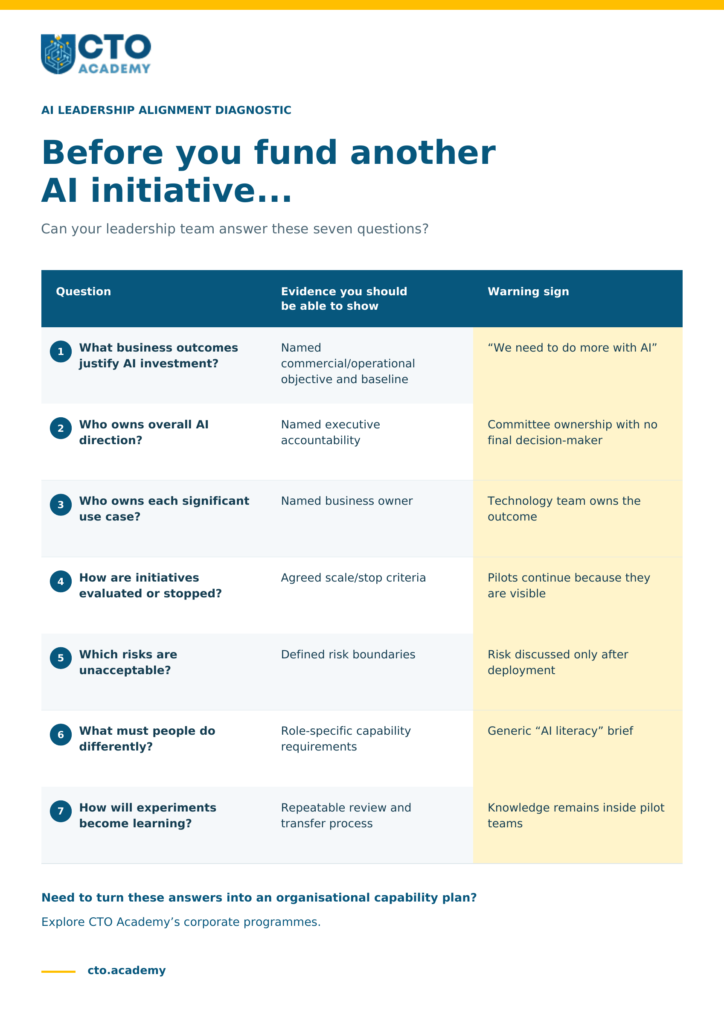
7 Questions to Ask Before Buying More AI Training
Before commissioning another programme, workshop or large-scale AI initiative, leadership and L&D teams should be able to answer seven questions:
- What business outcomes are important enough to justify AI investment?
- Who is accountable for the organisation’s overall AI direction?
- Who owns the business outcome of each significant use case?
- How will initiatives be selected, evaluated, scaled — or stopped?
- Which risks and trade-offs are unacceptable?
- What must different groups of leaders and employees become capable of doing differently?
- How will the organisation turn experimentation into repeatable learning?
If these questions are difficult to answer, buying more technology or more training may simply create more activity.
The more important task is to establish the capability system around it.
What Organisational AI Capability Actually Looks Like
A capable organisation doesn’t need everybody to become an AI expert. Instead, it needs:
- A clear connection between AI investment and business priorities
- Named accountability for enterprise direction and individual outcomes
- Shared criteria for value, readiness and acceptable risk
The Signs That the Organisation Is AI-capable
- Its leaders can interrogate both commercial and technical assumptions rather than delegating one side of the conversation
- Its managers can redesign work and support adoption
- Specialist expertise is integrated into business decisions rather than isolated from them
- There is a functioning route from AI experimentation to governed production, supported by an operating model that makes ownership, decision rights and scaling explicit.
- Board reporting focuses on decisions, exposure, learning and value rather than the volume of activity taking place.
That is a much higher bar than completing an AI course or launching another pilot.
But it is also where sustainable value is created.
Stop Asking How Much AI You’re Doing
The organisations that succeed with AI won’t necessarily be those that deploy it fastest or generate the largest number of experiments.
They will be those that become better at deciding where AI matters, what value it should create and what their people need to become capable of doing differently.
That requires technology expertise.
But technology expertise on its own is not enough.
It also requires commercial judgement, leadership alignment, organisational learning and clarity of accountability.
Which is why your organisation’s biggest AI problem may not actually be AI.
It may be whether your leaders are sufficiently aligned and capable to make good decisions about it.
Frequently Asked Questions
Who should own AI strategy in an organisation?
The CEO and executive team remain accountable for the organisation’s overall direction.
Execution will inevitably be distributed across business, technology, data, security, legal, risk and people functions. That makes clarity more important, not less.
Each significant AI use case should also have a named owner for the business outcome. Specialist expertise can inform the decision, but it should not become somewhere leadership accountability disappears.
How much should board members understand about AI?
Board members do not need the same technical depth as the specialists responsible for implementation.
They do need enough understanding to assess strategic relevance, challenge management’s assumptions, scrutinise significant investment, oversee material risks and recognise when AI activity is being mistaken for progress.
The objective is informed oversight, not technical mastery.
Does every organisation need a Chief AI Officer?
No.
The appropriate structure depends on the organisation’s size, operating model, sector, ambition and existing leadership capability.
Where a Chief AI Officer is appointed, the role can coordinate expertise, accelerate development and improve the quality of decision-making.
It should not absorb responsibilities that properly belong to the CEO, executive team or business leaders.
Is AI literacy training enough for senior executives?
No.
AI literacy is an important foundation. It helps senior executives understand the technology, its limitations, relevant risks and the language required to participate meaningfully in AI-related decisions.
Leadership capability goes further.
Executives must be able to apply that understanding to investment choices, governance questions, operating-model changes, organisational priorities and real trade-offs between value, speed and risk.
What is the difference between AI literacy and AI leadership capability?
AI literacy is understanding what AI can do, how it works at a useful level and where its limitations and risks lie.
AI leadership capability is the ability to make responsible organisational decisions about where AI should be used, what value it should create, which risks are acceptable and how accountability should operate.
An executive can therefore be AI literate without the organisation itself being particularly capable.
How should a board evaluate an AI pilot?
The board’s involvement should be proportionate to the initiative’s materiality, but management should be able to explain the business problem, expected outcome, accountable owner, strategic relevance, success criteria, significant risks and resources required if the pilot succeeds.
There should also be a clear explanation of what the organisation expects to learn.
A pilot should not become successful merely because the technology worked.
The real question is whether the evidence justifies the next business decision.
What role should L&D play in an organisation’s AI strategy?
L&D should translate organisational requirements into appropriate capability development.
That means identifying what different populations need to know, judge and do differently, then choosing the learning interventions most likely to produce those changes.
L&D can build shared understanding, strengthen decision capability and support adoption.
It should not be expected to determine the organisation’s AI priorities or resolve unclear executive accountability.
What should organisations measure when evaluating AI capability?
Tool adoption and course completion can be useful operational measures, but neither demonstrates business capability on its own.
Organisations should look for evidence that leaders are making better investment and governance decisions, use cases are connected to measurable business outcomes, managers can redesign work effectively, risks are being handled consistently and successful experimentation can move into governed production.
The appropriate measures will vary according to the capability problem the organisation is trying to solve.
Build the Capability Behind Better AI Decisions
The answer is not simply more AI.
It is a leadership system capable of making better decisions about AI.
A capable organisation can explain what AI is expected to achieve, who is accountable, how investment decisions are made, what risks are being governed and what its people need to become capable of doing differently.
That gives boards something more useful than a catalogue of pilots.
It gives them a basis for challenge, oversight and informed investment.
CTO Academy works with organisations around the world to build technology, digital and AI capability across leadership teams — connecting understanding with the decisions, behaviours and organisational realities that turn technology investment into business value.
Explore how CTO Academy builds technology and AI leadership capability across organisations.