
FACT: Most AI projects fail before the first prompt.
In a recent Expert Session hosted by CTO Academy, Umbar Shakir, a Partner and EMEA Lead for AI at Gartner Consulting, made a point that stuck with us: The number one reason AI initiatives fail is the problem statement. Not the model, prompt, vendor, or the team's enthusiasm. It is the problem statement.
That may sound oversimplified, but it explains a lot.
In practice, AI initiatives begin with a rush toward action:
“We need an AI assistant.”
“We should automate this process.”
“Can we use ChatGPT for customer support?”
“Let’s build an internal copilot.”
“Can we add AI to the product?”
These are not bad ideas. However, they are not problem statements. They are just proposed solutions looking for a problem.
And once that happens, everything downstream becomes weaker: the prompt, the model choice, the data requirement, the workflow design, the success metric, the vendor brief, the governance model.
In other words, a weak problem statement is often the first failure. Everything after that inherits the weakness.
This guide surfaces hidden dangers, shows what not to do, and provides a simple, high-impact AI (business) problem statement template.
TL;DR
- AI initiatives often fail before the model, prompt, or vendor is chosen because the problem statement is too vague.
- “We need an AI assistant” or “we should automate this” are not problem statements. They are proposed solutions looking for a problem.
- Before approving an AI pilot, leaders should define who has the problem, what friction exists today, why it matters, what better looks like, how success will be measured, and what constraints the solution must respect.
- A strong AI problem statement turns vague ambition into a testable business initiative.
- Without this clarity, teams risk building impressive demos with little operational value.
- With it, leaders can assess whether AI is appropriate, whether the data exists, which risks matter, and whether the initiative warrants investment.
AI Makes It Dangerously Easy to Move Faster Than We Should
You can open a tool, write a prompt, generate an output, build a prototype, and show something impressive in a meeting before anyone has properly defined what is being solved.
While that speed feels productive, in leadership terms, it can create false momentum.
When the same pattern occurs across multiple pilots, teams and business units, the issue becomes larger than problem framing. It can indicate an organisational gap between AI activity, accountability and leadership alignment.
The team may be moving quickly, but toward an unclear outcome. The pilot may look impressive, but solve a marginal problem. The prompt may be clever, but built on a vague assumption. The tool may work, but not fit the workflow where value is actually created.
This is why the first leadership discipline is not prompt engineering.
It is problem framing.
Read also
AI Operating Model: The Missing Layer Between Pilots and Production
AI Feature Readiness Check: Knowing When to Integrate an AI Capability
Tech Leaders Guide to AI Integration: Reconciling Innovation, Infrastructure, and Security
So, before you ask, “What can AI do here?” ask:
“What problem are we solving, for whom, and what changes if we solve it well?”
Or, as Umbar elegantly put it:
- To what end?
- For what benefit?
- At what cost?
Bad AI Problem Statements Examples
Here are a few examples that look reasonable at first glance:
- “We need to use AI to improve productivity.”
- “We want an AI tool to help our support team.”
- “We should automate reporting.”
- “We need a chatbot for internal knowledge.”
- “We want to use AI to reduce manual work.”
Each of these may point toward a real opportunity, but, at the same time, none of them is clear enough to guide an AI initiative.
Why?
Because they do not:
- Identify the specific user.
- Describe the current friction.
- Explain the business cost.
- Define what better looks like.
- Create a measurable test of success.
And if the problem is that vague, the team is forced to guess. That is when AI work becomes theatre: demos, dashboards, prompts, prototypes, and workshops with little to no operational value.
The Most Optimal Method to Define the Problem
Use this simple structure before you approve an AI pilot, brief a vendor, or ask a team to start prompting.
The AI Problem Statement Template
For [specific user/team], the problem is [specific friction], caused by [current constraint, workflow breakdown, or decision bottleneck], resulting in [measurable cost, delay, risk, or missed opportunity].
A successful AI-enabled solution would [desired outcome], measured by [success metric], within [data, workflow, compliance, security, or customer constraints].
That's it.
Simple enough to use in a meeting.
Specific enough to expose weak thinking.
Practical enough to guide the next decision.
Example: Weak vs Strong
Weak:
“We need an AI tool to help customer success teams work faster.”
This sounds useful, but it doesn't tell us:
- Which customer success teams?
- What work is slow?
- Why is it slow?
- How much time is being lost?
- What would improvement look like?
- Where would the AI output be used?
- What risks or constraints matter?
Now compare that with this example.
Strong:
“For enterprise customer success managers managing more than 40 active accounts, the problem is that renewal preparation requires manually reviewing CRM notes, support tickets, call transcripts, and product usage reports. This creates several hours of preparation work each week and increases the risk of missing important customer signals before renewal conversations.
A successful AI-enabled solution would generate a reliable renewal briefing in under five minutes, measured by reduced preparation time, manager trust in the summary, and improved renewal meeting quality, within existing CRM, privacy, and customer data constraints.”
Now the team has something tangible to work with. They can:
- Ask whether the data exists.
- Decide whether AI is appropriate.
- Test the output.
- Define acceptable risk.
- Compare this against other use cases.
- Decide whether the initiative deserves funding.
- The AI work now has a real shape.
5 Questions Every AI Problem Statement Must Answer
1. Who exactly has the problem?
Avoid “the business,” “the team,” or “users” here. Be specific:
- Are they enterprise account managers?
- Finance analysts closing month-end?
- Engineers triaging incidents?
- Support agents handling technical tickets?
- Product managers synthesizing customer feedback?
- Security analysts reviewing alerts?
Remember, AI initiatives become much clearer when the user is named precisely.
2. What is the current friction?
Describe the work as it happens today:
- What is manual?
- What is repetitive?
- What is slow?
- What is error-prone?
- What requires judgment?
- What depends on scattered information?
- What creates a delay between decision and action?
This step stops teams from applying AI to a vague sense of inefficiency since it doesn't describe the usual suspects: the dream state, the tool you want, or the current reality.
3. What is the cost of the problem?
If there is no cost, there is no priority. However, cost does not always mean direct financial loss. It may be:
- Time lost
- Customer delay
- Decision latency
- Operational risk
- Compliance exposure
- Rework
- Poor quality
- Missed revenue
- Employee frustration
- Leadership blind spots
- The point is to make the pain visible.
4. What would better look like?
Do not define success as “we launched AI,” because that is activity, not value. Instead, define the improved state. For example:
“Reduce renewal preparation from 3 hours to 15 minutes.”
“Classify incoming support tickets with 90% sampled accuracy before routing.”
“Give managers a weekly risk summary they trust enough to use in planning.”
“Reduce manual report preparation by half without increasing errors.”
“Identify high-risk incidents faster while keeping a human approval step for escalation.”
This is where an AI idea becomes a testable business initiative.
5. What constraints must the solution respect?
A usable problem statement should name the constraints early. For example:
- Customer data must remain inside approved systems.
- Outputs must be explainable to a manager.
- A human must approve high-risk actions.
- The solution must work inside the existing CRM.
- The cost per completed task must stay below a defined threshold.
- The system must not use sensitive data in prompts.
- The output must be auditable.
Remember:
Constraints do not slow the initiative down. They stop the team from discovering obvious blockers too late.
Download the AI Integration Playbook for Tech Leaders
A phase-based blueprint for integrating AI into core systems without compromising security, governance, or control.
Use This Before the First Prompt
Let’s reiterate. The next time someone says, “Can we use AI for this?”, do not start with the prompt. Start with this:
“For [specific user/team], the problem is [specific friction], caused by [current constraint or workflow breakdown], resulting in [measurable cost, delay, risk, or missed opportunity].
A successful AI-enabled solution would [desired outcome], measured by [success metric], within [data, workflow, compliance, security, or customer constraints].”
Rule of Thumb:
If the team cannot complete this, they are not ready to build.
They may still be ready to explore, research, or investigate, though. But they are not ready to choose a model, approve a vendor, design a workflow, or judge whether a prompt is good.
Because a prompt is only good in relation to a problem.
A Leadership Rule of Thumb
Before funding or approving an AI initiative, ask for a one-page problem statement.
This should not be mistaken for a slide deck, a demo, a list of tools, or a claim that “AI can do this.”
The one page should tell you (in this precise order):
- Who has the problem
- What is broken or slow today
- Why it matters
- What better looks like
- How success will be measured
- What constraints must be respected
If that one page is clear, the AI conversation becomes much more useful. If it is not clear, the team is probably about to automate ambiguity. And, as you know, ambiguity scales badly.
To Sum Up
AI can accelerate work. But it also accelerates weak thinking. And this is the result:
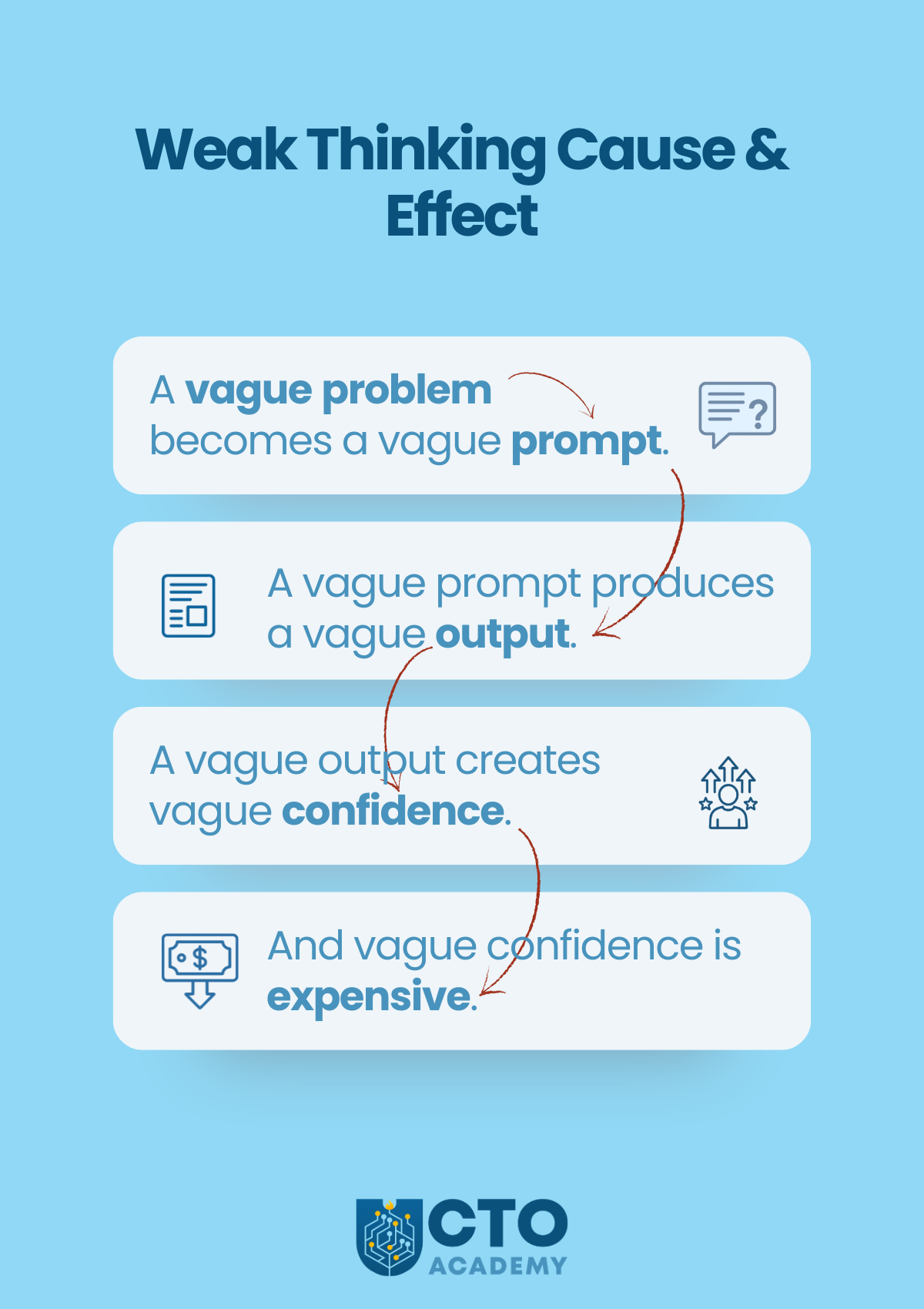
The sequence of consequences when AI initiatives are forced without a proper use case definition and problem statement.
A vague problem becomes a vague prompt.
A vague prompt produces a vague output.
A vague output creates vague confidence.
And vague confidence is expensive.
Bottom line, the organizations that get value from AI will not be the ones that simply move fastest. They will be the ones that define the problem clearly enough for speed to matter.
Frequently Asked Questions (FAQ)
What is an AI problem statement?
An AI problem statement is a clear description of the business problem an AI initiative is meant to solve. It should define who has the problem, what friction they experience today, why that friction matters, what improvement would look like, and how success will be measured. Without this clarity, teams risk starting with a tool or prompt instead of a real business need.
How is an AI use case different from an AI idea?
An AI idea often sounds like “we need a chatbot” or “we should automate reporting.” An AI use case is more specific. It connects a defined user, workflow, pain point, desired outcome, success metric, and set of constraints. The difference matters because AI ideas can generate activity, while well-defined use cases create something the business can test, fund, and improve.
What should a strong AI problem statement include?
A strong AI problem statement should name the specific user or team, describe the current friction, explain the cause of that friction, identify the measurable cost or risk, define the desired outcome, state the success metric, and name any data, workflow, security, privacy, compliance, or customer constraints.
Why should leaders define the problem before choosing a model, vendor, or prompt?
Because the model, prompt, vendor brief, data requirement, workflow design, governance model, and success metric all depend on the problem being solved. If the problem is vague, every downstream decision becomes weaker. A clear problem statement gives the AI work a real shape before time and budget are committed.
How do you know whether an AI problem statement is too vague?
It is probably too vague if it uses broad phrases like “improve productivity,” “help the team,” “reduce manual work,” or “use AI for customer support” without explaining who is affected, what work is slow or broken, what the cost is, what better looks like, or how success will be measured. If the team cannot complete the problem statement clearly, they may be ready to explore, but they are not ready to build.
What makes an AI use case worth pursuing?
A use case becomes worth pursuing when the problem is specific, painful enough to matter, measurable, and constrained enough to test safely. Leaders should be able to see who benefits, what business value is created, whether the right data exists, what risks must be managed, and whether the expected improvement justifies investment.
How should teams prioritize multiple AI use cases?
Start by separating promising ideas from use cases that are actually ready for investment. A strong use case should have a clear business problem, measurable value, workflow fit, data readiness, manageable risk, named ownership, and a realistic path to production. If several ideas are competing for attention, use these criteria to decide what should scale, what should pause, and what needs redesign before more budget goes in. For a practical framework, read our guide to building an AI operating model.
How do you decide whether AI is actually the right solution?
AI should not be the default answer. Before building, ask what user behavior needs to change, what metric should improve, and what you would ship if AI were not available. If a simpler rule, workflow change, automation, or reporting improvement can solve the problem, start there. AI becomes worth considering when the problem is specific, measurable, data-supported, and difficult to solve well with simpler approaches. For a deeper decision check, read our AI feature readiness guide.
What data readiness questions should be asked before approving an AI use case?
Ask whether the required data exists, who owns it, whether it is accessible, whether it is lawful to use, whether it is fresh enough, and whether teams can trust it inside the workflow. Data that is technically available but poorly governed, hard to access, or disconnected from production reality can weaken even a well-framed AI use case. For a broader roadmap on trusted, accessible data for AI, read our guide to data democratization.