Here’s the uncomfortable truth about your IT career path up front: the old way of “working hard, getting promoted every few years, and eventually landing a senior title” no longer works in tech.
Over the last few years — and especially in 2025 — we’ve watched wave after wave of layoffs, hiring freezes, and quiet org reshuffles. Whole teams disappear after a re-org. Middle management layers get squeezed. Gen AI turns from a curiosity into a serious force in how software is built and how many people you “need” to create it. At the same time, there are still plenty of roles out there… just not for everyone or every profile.
So the real question isn’t “Is there still an IT career path?”
It’s “How do I design my IT career path that actually survives this?”
This guide is written for precisely that purpose. Not to give you yet another list of job titles and salaries, but to help you map a path that stays relevant and valuable as the market keeps shifting. It covers the way from individual contributor to senior leadership.
We’ll look at how layoffs, Gen AI, and the “Great Flattening” are changing the shape of careers, and then we’ll build a practical roadmap around three pillars:
- Business-visible impact, making sure your work shows up in revenue, cost, risk, or speed.
- Scarce, evolving skills, especially around systems, data, security, teams, stakeholders, and AI.
- Role mobility & networks, so you can move up, sideways, or across companies when you need to.
If you’re serious about reaching senior leadership — and staying employable on the way there — this is your starting point.
TL;DR
- The old “work hard, get promoted every few years” pattern is broken. Layoffs, Gen AI, and flatter orgs mean neither junior ICs nor average managers are safe by default.
- The careers that survive and progress are built on three pillars:
- (1) business-visible impact
- (2) scarce, evolving skills (systems, data, security, AI)
- (3) role mobility and networks.
- Pick a primary lane (IC or leadership), then map 2–3 roles ahead and deliberately build the skills and proof you need at each step.
- Aim for one business-visible outcome per year and document it properly – this becomes your “anti-layoff” portfolio for promotions, reviews, and job searches.
- Use AI as a force multiplier, not a threat: automate toil, improve quality, and show measurable gains for your team, especially as you move into senior IC and leadership roles.
- Design mobility through smart rotations (product, infra, data, security) so you’re not locked into a single narrow niche or company type.
- Build a small bench of sponsors, not just mentors – people with influence who know your work and will put your name on the list when roles and projects are being discussed.
- If you’re 2–7 years in and want to lead your first team (or become a real tech lead, not just “senior who organises stand-up”), the Future Leaders Courseis the best next step.
- If you’re already leading teams or managers and need to think and operate like a VP/CTO in the AI era, the Digital MBA for Technology Leaders is where you build that executive toolkit.
The New Reality for IT Career Paths (Layoffs, GenAI, Flattening)
If your career has felt a bit, well, unstable lately, it’s not your imagination.
Over the last couple of years, the numbers have swung hard:
- In the US alone, announced job cuts have climbed back over the million-per-year mark, with some months seeing more than double the cuts of the same month a year before.
- Tech is consistently near the top of that list, with close to 200,000 tech roles cut in a single year, on top of the 2022–23 wave.
- In the UK, digital jobs have shrunk, even as overall employment nudged up.
AI grabs the headlines, but it’s only part of the story. Most of these decisions still come down to a familiar trio:
- Post-pandemic correction – companies hired aggressively in 2020–2022 and are now unwinding that growth.
- Cost discipline – higher interest rates and slower growth mean CFOs are trimming anything that doesn’t clearly show a return.
- Restructuring for AI and efficiency – org charts being redesigned around platforms, data, and automation.
In other words, it’s a mix of “we over-hired”, “we need to save money”, and “we’re changing how we work,” with GenAI woven into the last two.
Who’s Actually Getting Hit?
The pattern hasn’t been random.
Early waves went after “peripheral” functions:
- Recruiting and HR teams that ballooned during the hiring boom.
- Contractors and support roles.
Later waves cut closer to the core:
- Software engineers, QA, data folks, and other low-level practitioners started appearing more often on redundancy lists.
- Some teams were removed entirely after products were cancelled or merged.
At the same time, another trend has become hard to ignore: the “Great Flattening.”
- Whole layers of middle management are being removed or compressed.
- Senior leaders talk about “fewer layers,” “more direct ownership,” and “no more managers managing managers.”
- New job postings for traditional mid-level manager roles have dropped sharply in many markets.
So if you’re:
- A junior or mid-level IC: you’re competing in a tighter market with fewer entry points.
- A tech lead or engineering manager: you’re in the band that is most exposed when companies decide the org chart is “too thick in the middle.”
What this actually means for you
The uncomfortable bit: neither junior ICs nor “average managers” are safe by default anymore.
The good news: there is a pattern in who tends to keep their seat, land on their feet quickly, or even get promoted during all this.
Layoff-resilience tends to flow to people who:
- Move the P&L (Profit & Loss)
You can show how your work affects revenue, margin, cost, risk, and speed, and others in the business would back that up. - Run critical systems or platforms
You’re not just building features; you’re responsible for infrastructure, platforms, data, or security that the rest of the organization depends on. - Lead AI-augmented teams and bigger spans
You know how to plug GenAI and automation into workflows safely, and you can manage more people or more scope with them, not fewer.
That’s the new bar.
So the real challenge becomes:
How do you design an IT career path that is not only successful on paper, but stays resilient under these conditions?
That’s what we’ll tackle next, starting with the three pillars your career needs to stand on.
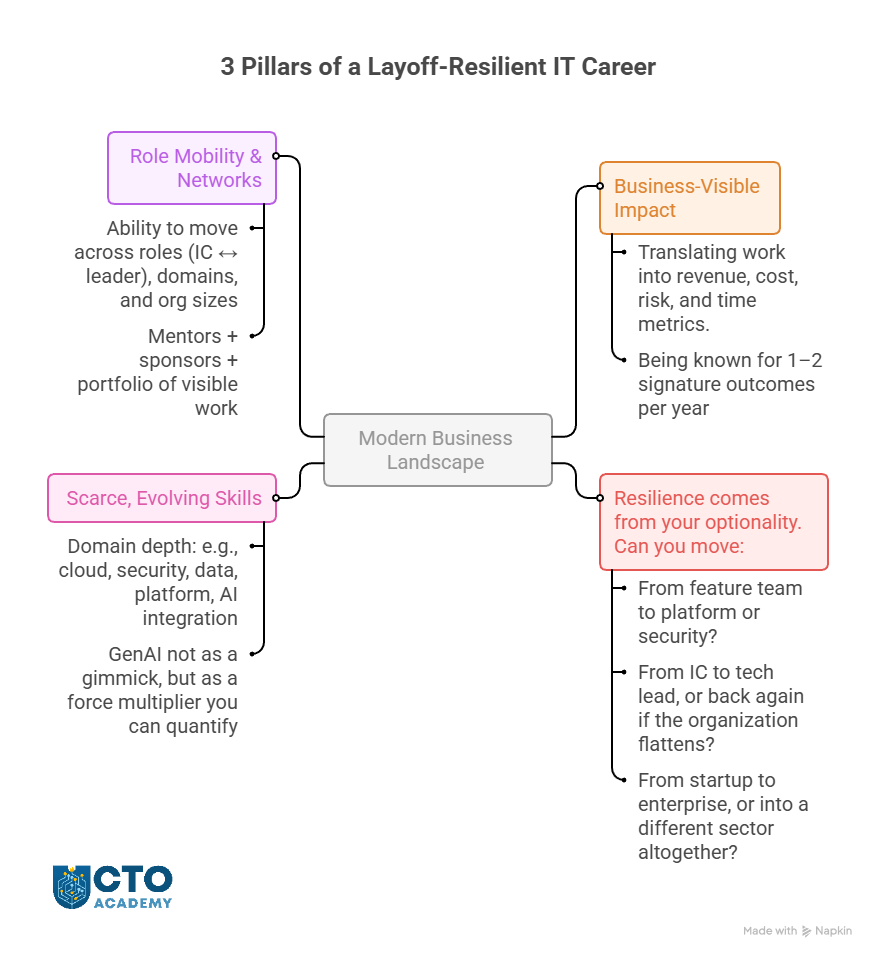
The Three Pillars of a Layoff-Resilient IT Career
Job titles come and go. Tech stacks change. Even entire layers of management can vanish after a re-org.
What actually keeps you employed and progressing isn’t your title or the logo on your LinkedIn profile, but the shape of the value you create.
In this new environment, that value rests on three pillars.
1. Business-visible impact
Being “smart” or “busy” is no longer enough. The people who keep their seat – and get the interesting opportunities – are the ones whose work shows up in the numbers.
That means you can point to things like:
- Revenue: “We increased trial-to-paid conversion by 8%.”
- Cost: “We cut cloud spend by 15% without hurting performance.”
- Risk: “We reduced critical incidents by 40% and tightened our security posture.”
- Speed: “We brought release cycle time down from monthly to weekly.”
As you move toward senior leadership, this shifts from “my feature shipped” to “my decisions materially moved a KPI the business cares about.”
2. Scarce, evolving skills
The second pillar is what you know and can do, especially in areas that are harder to automate and harder to hire for.
Think along three lines:
- Systems & platforms – architecture, reliability, observability, internal platforms.
- Security & data – governance, privacy, compliance, data quality.
- Gen AI & automation – not just “I use a coding assistant,” but “I can safely weave AI into products and internal workflows.”
Tools will change. What matters is that you keep moving towards higher-leverage, harder-to-replace skills.
3. Role mobility & networks
Finally, resilience comes from your optionality.
Can you move:
- From a feature team to a platform or security team?
- From startup to enterprise, or into a different sector altogether?
- From IC to tech lead, or back again if the organization flattens?
That kind of mobility is powered by relationships (mentors, sponsors, peers) and a portfolio of work people can vouch for.
(click to enlarge/download)
8 Steps to a Layoff-Resilient IT Career
Rather than giving you a random list of tips, this guide is structured as a sequence of 8 steps you can actually work through.
Here’s the roadmap at a glance:
- Understand the new reality
Get clear on how layoffs, Gen AI, and flatter orgs are changing the rules for IT careers. - Choose your primary lane
Decide whether you’re optimising for the IC track or the leadership track (for now), so you can stop drifting and start aiming. - Build a layoff-resilient skill stack
Map 2–3 roles ahead and design the mix of technical, business, and AI skills you’ll need to get there. - Make your impact visible
Create an “anti-layoff” portfolio by driving at least one clear, business-visible outcome each year and telling that story well. - Design role mobility
Use rotations and domain switches (product, infra, data, security, different org types) to keep your career portable. - Build your sponsor bench and network
Move beyond “I know some people” to having sponsors who will put your name on the list when roles and projects are decided. - Turn AI into an advantage at your level
Use AI differently as a junior, senior IC, manager, or exec – always to raise your leverage, not replace yourself. - Select your next step and support path
Translate all of this into concrete actions: the next two roles you’re aiming for, the pillar you’ll strengthen first, and whether you’re ready for structured help via Future Leaders Course or the Digital MBA for Technology Leaders.
The rest of the article walks through each of these steps in detail, so you can turn “I hope my career survives this” into “I know what I’m building and why.”
Now, let's turn the three pillars into a concrete career map, so you’re not just hoping your role survives the next change; you’re deliberately building a profile that companies fight to keep.
Step 1: Choose Your Lane and Destination (IC vs Leadership, in an AI World)
Before you can map a career path, you need to decide which lane you’re primarily driving in.
You don’t have to lock yourself in forever. People switch lanes. But being fuzzy here is one of the quickest ways to drift from promotion cycle to promotion cycle without a clear direction.
Two Main Ladders: IC and Leadership
Most tech organisations now recognise two parallel ladders.
The IC ladder
This is the path where you stay “hands-on” for most of your career, but your scope gets much bigger:
- Mid Engineer → Senior Engineer
- Staff Engineer → Principal Engineer → Distinguished/Architect
At the top of this ladder, you’re not just shipping tickets. You’re:
- Owning systems and platforms that other teams depend on
- Shaping architecture and technical strategy
- Influencing decisions across product, security, data, and operations
It’s a highly resilient path when you:
- Deliver business-visible impact (pillar 1) through your systems
- Invest in scarce skills like reliability, security, data, and AI integration (pillar 2)
- Maintain mobility across teams, domains, and industries (pillar 3)
The Leadership ladder
This is the path where you’re ultimately responsible for people, delivery, and outcomes:
- Tech Lead/Team Lead
- Engineering Manager
- Head of Engineering/Director
- VP Engineering/CTO/CIO
Here, your day-to-day work is less about writing code and more about:
- Setting direction and priorities
- Building and coaching teams
- Managing stakeholders, budgets, and risk
It’s a resilient path when you:
- Own P&L-relevant outcomes (pillar 1)
- Develop AI-era leadership skills – strategy, change, communication, governance (pillar 2)
- Can move between types of organizations and structures (pillar 3)
Both ladders can take you to senior levels. The question is which kind of work energizes you more and where you can most naturally build those three pillars.
How Layoffs + Gen AI Change the Choice
If you’d asked this question ten years ago, the advice would have been more straightforward: “Pick what you enjoy.”
You still need that, but the environment has changed.
On the IC lane
GenAI is steadily eating away at routine coding work:
- Boilerplate
- Simple integrations
- Tests and documentation
That doesn’t make ICs obsolete. It just moves the value:
- Up into architecture and system design
- Sideways into integration, reliability, observability, and governance
- Outwards into data, security, and AI-enabled products
If you’re staying on the IC track, the safe ground is to become the person who:
- Designs the systems others build on
- Keeps critical platforms healthy, secure, and cost-effective
- Knows how to use AI tools safely and effectively, and can help others do the same
On the Leadership lane
Flattening has made it very clear what’s not needed: low-impact, middle-layer managers who mostly shuffle work around.
The leaders who remain are expected to:
- Manage bigger spans of control.
- Run clear operating systems (cadence, metrics, decision-making).
- Use AI and automation to make their teams faster and more effective, not just “busy.”
So if you’re on the leadership track, your resilience comes from being able to:
- Show that your group is moving key business metrics.
- Handle complexity across multiple teams and stakeholders.
- Steer how AI and automation are adopted in your area, rather than being surprised by them.
So the lane choice isn’t “hands-on vs people person” anymore. It’s:
“Where can I build the strongest combination of impact, scarce skills, and mobility in an AI-shaped, flatter organization?”
Quick Self-Test: Which Lane Are You Leaning Toward?
There’s no correct answer here, but there are strong hints. Answer these with a simple yes/no, and notice which side gets more “yes.”
You might be leaning toward the IC lane if:
- I get genuine energy from deep technical problems, debugging, and system design.
- I’d rather spend most days creating or improving systems than being in back-to-back people meetings.
- I enjoy mentoring, but I don’t feel a strong pull to be responsible for someone’s performance review and career.
- I like the idea of being the “go-to person” for a critical platform, domain, or technical decision.
You might be leaning toward the Leadership lane if:
- I get energy from helping other people perform better, not just from doing the work myself.
- I naturally think about the bigger picture; i.e., business goals, trade-offs, customers, costs.
- I’m comfortable making decisions with incomplete information and taking responsibility when things go wrong.
- I’m curious about budgets, headcount, hiring, and team organization.
- I’m already informally coordinating people or projects, even without the title.
If you found yourself nodding along with both sets, that’s normal. Early in your career, many people sit in the overlap. The goal isn’t to make a perfect, irreversible decision; it’s to choose a primary direction for the next few years so you can build momentum instead of drifting.
And if you’re leaning toward leadership but haven’t officially led a team yet, this is the moment to get deliberate.
Remember, the step from senior IC to first-time manager is where many careers stall or derail.
That’s exactly the gap the Future Leaders Course is designed to fill – helping you learn how to run people and delivery like a business, not just write more code under a new title.
Step 2: Build a Layoff-Resilient Skill Stack (Technical, Business, AI)
Once you’ve picked a lane, the next question is: what are you actually building toward?
“Be better at my job” is not a plan. “Become a Staff Engineer” or “run an engineering org” is. This is where you get specific about 2–3 roles ahead and the skills you’ll need to be the obvious candidate when those opportunities appear.
Map 2–3 Roles Ahead for Your Chosen Lane
Start with where you are today and write down the next two or three roles you can realistically grow into in your lane.
Then, for each step, capture:
- The core skills you’ll need
- The proof you can show (projects, metrics, responsibilities)
A simple way to structure it:
| Current role | Target role(s) (2–3 steps ahead) | Key skills to build | Proof you’ll need |
|---|---|---|---|
| Mid/Senior Engineer | Staff Engineer → Principal Engineer | System design, platform ownership, reliability, AI-assisted dev, mentoring | Successfully led a team or project end-to-end; demonstrated measurable impact (cost, speed, revenue); handled performance and feedback well |
| Senior Engineer/Tech Lead | Engineering Manager → Head of Engineering | People leadership, delivery management, stakeholder comms, basic finance, AI-in-team workflows | Org design, portfolio thinking, budgeting, influencing up, and AI strategy |
| Engineering Manager | Head of Eng → Director | Org design, portfolio thinking, budgeting, influencing up, AI strategy | Manage multiple teams; own a budget; run a multi-team initiative; show how your area contributed to company goals |
You don’t need a perfect plan. You need enough clarity that you can ask:
“Given the role I want in 12–36 months, what am I missing and how do I start closing that gap now?”
Technical & Gen AI Skills That Age Well
Technology stacks come and go. Some skills, however, keep paying off because they sit closer to the core of how systems and organizations work.
On the technical side, aim to grow into work that touches:
- Systems & platforms
- Architecture and design
- Internal platforms and shared services
- Observability, monitoring, and performance
- Security & data
- Access control, privacy, compliance basics
- Data modelling and data quality
- Understanding how data flows through the business
- Reliability
- Incident response and post-mortems
- Capacity planning
- Designing for failure and graceful degradation
On the AI side, you want more than “I use ChatGPT sometimes”:
- AI-assisted development and testing
- Using tools to scaffold code, generate tests, and refactor safely
- Combining AI output with sound engineering judgement
- Understanding limitations, evaluation, and risk
- Knowing where not to use GenAI (security, privacy, regulatory constraints)
- Basic prompt design and evaluation
- Awareness of bias, hallucinations, and failure modes
At the junior level, the goal is to get out of pure “ticket taker” mode as fast as you can:
- Don’t just close Jira tickets.
- Volunteer to own a small service, feature area, or internal tool end-to-end.
- Learn how that piece fits into the wider system and what metrics it affects.
At mid to senior level, look for chances to:
- Take responsibility for a platform or critical subsystem.
- Lead improvements that increase engineers' productivity (CI pipelines, test automation, dev tooling, AI integrations).
Those are the kinds of skills and responsibilities that make you harder to replace and easier to promote.
Business Skills for Every Technologist
Whether you stay on the IC side or go deep into leadership, business literacy is now part of the job.
At a minimum, you should be comfortable with:
- Impact metrics
- Understanding the KPIs your team affects (revenue, costs, risk, time-to-market).
- Being able to explain your work in those terms.
- Basic finance
- The difference between OPEX and CAPEX.
- What “margin,” “runway,” “payback period,” and “ROI” actually mean in your context.
- Stakeholder management
- Communicating clearly with non-technical counterparts.
- Managing expectations, trade-offs, and scope without drama.
- Prioritization
- Choosing between good options based on business value, not just technical elegance.
- Saying “no” or “not now” with a clear rationale.
If you’re on (or moving toward) the leadership track, add another layer:
- Portfolio thinking
- Seeing your teams and projects as a portfolio of bets with different risk/return profiles.
- Deciding where to invest more, where to cut, and where to experiment.
- Budgeting and resource planning
- Understanding how headcount, tools, and infrastructure translate into costs.
- Being able to argue for (or against) spending with numbers.
- Roadmap economics
- Evaluating the business impact of roadmap items.
- Sequencing work to deliver value early and often, not just “big bang” launches.
These skills are what turn “good at tech” into “trusted to lead and allocate resources,” and they matter just as much in a Staff Engineer role as they do in a Head of Engineering role.
Bridge the gap between tech and leadership.

Designed exclusively for ambitious technology leaders, the Digital MBA equips you with the tools, mentors, and network to scale your impact and transform from an experienced technologist into a confident, strategic leader.
If you’re reading this and thinking, “I’m comfortable technically, but I’m guessing on the business side,” that’s a signal. The sooner you close that gap, the more options you’ll have.
And if you’re leaning toward leadership but haven’t yet had structured support on things like influence, communication, and the business basics, that’s precisely where the Future Leaders Course comes in. It helps you move from “senior engineer who sometimes leads” to someone who can talk credibly with the business and run a team without losing yourself in the process.
Step 3: Make Your Impact Visible (Your “Anti-Layoff” Portfolio)
At this point, you’re building the right skills. But skills on their own don’t keep you safe.
What really matters when companies are deciding who to keep, who to promote, and who to let go is simple:
Can anyone clearly see the value you create?
That’s what your “anti-layoff” portfolio is for.
One Business-visible Outcome per Year
A practical rule of thumb: aim for one clearly business-visible outcome every year.
Not “I worked really hard,” but something you can describe in terms of:
- Reduced cost – infra spend, tooling, support overhead
- Increased revenue – conversion, upsell, expansion, usage
- Reduced risk – security, compliance, incidents, outages
- Faster delivery – cycle time, lead time, time-to-market
A few simple examples:
- Reduced cost
“We redesigned our data pipeline and storage strategy. Cloud spend on that workload dropped by 18%, while query latency improved by 25%.” - Increased revenue
“I led the implementation of a new onboarding flow. Trial-to-paid conversion went from 21% to 27% over three months, adding roughly $X/month in recurring revenue.” - Reduced risk
“We introduced a new incident response playbook and alerting. Critical incidents went from 10 per quarter to 4, and average time to recovery dropped by 40%.” - Faster delivery
“I drove the rollout of trunk-based development and better CI. Our median lead time from merge to production went from 3 days to under 1 day.”
You don’t need a miracle every year. But you do need one thing you can point to and say:
“That wouldn’t have happened the same way without me, and here’s how we measured it.”
Storytelling: How You Document and Communicate Impact
Collecting these wins isn’t enough. You also need to tell the story well.
A light-weight structure that works:
- Situation: What was going wrong or holding us back?
- Task: What were we trying to achieve?
- Action: What did you do?
- Result: What changed, in numbers and in outcomes?
You don’t have to write a novel. Two or three tight sentences per story are enough:
“Our release cycle was stuck at monthly, and stakeholders were constantly frustrated. I proposed and led a shift to trunk-based development with better automated testing (Action). Within four months, we were shipping weekly (Result), and incidents per release dropped by 30% (Result).”
And this is where this kind of narrative really matters:
- Performance reviews
Don’t rely on your manager to remember everything. Bring your own impact doc. - Promotion packets
Promotion panels want to see patterns: scope, outcomes, consistency. Your stories are the raw material. - Job searches (especially after layoffs)
When you’re competing against dozens of other CVs, “I was responsible for X” is weak. “Here’s what I changed and how we measured it” is strong.
Make it a habit:
- Keep a simple “brag document” or impact log.
- Update it monthly with bullet points and rough numbers.
- When review or promotion time comes, you’re not staring at a blank page.
AI as Leverage, Not Threat
Gen AI and automation show up in layoff narratives, which makes them feel scary. But from a career perspective, they’re also a great way to quickly build proof of impact.
Think in terms of AI as a multiplier, not a competitor.
Concrete examples:
- Testing
- You introduce AI-assisted test generation for a legacy service.
- Regression test coverage doubles in a quarter, and regression-related incidents drop by 30%.
- Your story: “I used GenAI to expand test coverage and reduce escaped bugs.”
- Documentation
- You use AI to generate and clean up internal docs, API references, or runbooks.
- New joiners ramp up faster; onboarding time for engineers drops from 6 weeks to 4.
- Your story: “I systematized our documentation using AI tools, cutting onboarding time by a third.”
- Internal tooling & workflows
- You build a small internal tool with an AI component (e.g., a log summarizer, a query assistant, or a support-response helper).
- Support or on-call workload drops, or time-to-diagnose issues improves significantly.
- Your story: “I built an AI-backed internal tool that reduced average investigation time from 2 hours to 45 minutes.”
The key is that you are the one:
- Spotting where AI can safely help
- Designing how it fits into the workflow
- Measuring what changed
That’s the difference between “someone told us to use AI” and “I led an AI-driven improvement that made us measurably better.”
Over a few years, an anti-layoff portfolio might look like:
- 2023 – “Cut infra costs on X by 20%.”
- 2024 – “Introduced AI-assisted tests, reduced incidents.”
- 2025 – “Led a cross-team project that improved conversion by 6%.”
Those stories, repeated and refined, do a lot of quiet work for you when the organization is deciding who’s essential, and, maybe even more importantly, when you’re ready to move to your next role.
Step 4: Design Role Mobility (Rotations, Domain Switches, Org Types)
Even if you love your current role, it’s risky to build a career that only works in one particular niche.
Layoffs and re-orgs don’t ask whether you’re happy. They ask whether your skills and experience are portable.
That’s where role mobility comes in. It is the ability to move up, sideways, or across when you need to.
How Does Mobility Protect You in Downturns
Mobility gives you options when your current role on the org chart no longer exists.
If your only story is “I’ve done this one thing in this one type of company,” you’re much more exposed than someone who can credibly say:
- “I’ve worked in both product companies and internal IT.”
- “I’ve moved between infra/platform and product teams, and I understand both.”
- “I’ve delivered in different industries – say, fintech, health, SaaS – and I know how to adapt.”
A few examples of how this plays out:
- Your B2C SaaS startup gets acquired, and the product is retired. If you’ve only ever worked on consumer apps, moving into an internal platform team or a B2B product is much easier when you’ve already done one rotation that looks like that.
- Your internal IT department outsources a chunk of work. If you’ve already spent time on customer-facing product teams or in a different sector, you can pitch yourself for roles that rely on your domain understanding, not just your current job title.
- A heavily regulated industry tightens budgets. If you’ve had a rotation in less regulated, faster-moving environments, you can point to examples of times when you adapted and still delivered safely.
Mobility is not random job-hopping. It’s deliberate exposure to different types of work, so you’re not tied to one narrow pattern of “I only know how to do X in Y context.”
High-Leverage Rotations by Level
You don’t need a dozen rotations. One or two well-chosen moves can change your career trajectory.
Here are some high-leverage options:
At the junior level
You want to break out of the generic “developer #47 on feature team #6” territory and into roles that give you more system understanding.
Good moves include:
- Support → backend → platform
- Start in support or customer engineering, then move into backend, and finally into internal platforms or tooling.
- You learn how users actually struggle, then how systems behave, then how to make developers more productive.
- Infra → SRE
- If you’re in infra or ops, rotating into Site Reliability Engineering gives you exposure to reliability, automation, and cross-team collaboration.
- These skills travel well across companies and industries.
- Data-adjacent rotations
- Spend time working closely with data pipelines, analytics, or BI.
- Understanding how data is produced, cleaned, and used in decisions makes you more valuable almost everywhere.
At the senior IC level
Now you’re optimizing for scope and influence, not just a different codebase.
High-leverage moves:
- Cross-functional project lead
- Take on a project that spans engineering, product, design, maybe even marketing or operations.
- This builds your ability to coordinate across disciplines, which is critical for Staff+ and future leaders.
- Platform owner
- Volunteer to own a platform or internal product (e.g., CI/CD, feature flags, developer portal).
- You become the person who makes other teams work faster and more safely, which is hard to cut.
- Principal-style work
- Even without the title, look for chances to set standards, lead migrations, or steward a technical strategy across teams.
- These experiences are exactly what senior hiring managers look for when filling Staff or Director-adjacent roles.
At the manager level
Mobility at this stage is about handling a broader scope and more ambiguity.
Good rotation targets:
- Multi-team programs
- Take responsibility for an initiative spanning several squads or domains (e.g., a reliability push, security remediation, or large migration).
- You learn how to orchestrate many moving parts under a single goal.
- Cross-org programs
- Work on something that touches multiple departments; for example, a billing overhaul with finance, or a data program with marketing and compliance.
- This gives you the language and relationships you need for Director/VP-level roles.
In each case, the pattern is the same: you’re looking for rotations that expand the number of places where your experience is obviously relevant.
How to pitch and land a rotation without burning bridges?
Rotations work best when they’re a win for you, your manager, and the business. The quickest way to make them contentious is to frame them as “I’m bored; get me out of here.”
A better approach:
- Start from a business need
- Identify a problem the company cares about: reliability, platform cost, developer productivity, a new product line, or compliance.
- Show how a rotation would put you closer to solving that problem.
- Time it with the work, not your mood
- Aim for natural transition points: project completions, planning cycles, org restructures.
- This makes it easier for your current team to adjust.
- Come up with a succession plan
- Be explicit about how your current responsibilities will be covered.
- Suggest people who could take over and how you’ll help them ramp.
- Frame it as growth that benefits the org
- “If I spend 6–12 months in platform/security/data, I can bring that knowledge back into our product area and help us move faster and safer.”
- For managers: “Leading this cross-team initiative will make me more effective when I come back to own a larger part of the org.”
- Ask for a clear timeframe and expectations
- Agree on duration (e.g., 6–12 months) and what “success” looks like.
- This reassures your current manager you’re not disappearing forever, and gives everyone a point to review.
Handled well, a rotation is not “abandoning your team;” it’s investing in skills and context that make you more valuable to your current company and any future one.
When the market turns, or your org changes shape, those extra dimensions in your experience are often the difference between “I’m stuck” and “I have three realistic options I can take next.”
Step 5: Build Your Sponsor Bench and Network
Skills and impact matter, but when things get messy – re-orgs, layoffs, surprise opportunities – who knows you can matter just as much as what you can do.
That’s where mentors, sponsors, and your wider network come in.
Mentors vs Sponsors (and why sponsors matter more in layoffs)
We often blur these two, but they play very different roles.
Mentors:
- Give you advice and perspective
- Help you think through decisions
- Share their own experience and mistakes
Sure, they’re essential for growth, but in a layoff, a mentor might say, “I’m so sorry, let me know how I can help.”
Sponsors are different:
- They put your name forward for roles, projects, and promotions
- They vouch for you when you’re not in the room
- They can sometimes pull you into a new role when your old one disappears
In a restructuring or layoff scenario, a sponsor is more likely to say:
“We need to make sure we keep Alex. If this team goes away, I want Alex over here with me.”
You don’t need dozens of sponsors. Two or three people with real influence who know your work and trust you can change the trajectory of your career.
How to Become “Sponsor-Worthy”
You can’t just walk up to someone senior and ask, “Will you sponsor me?” Sponsorship is usually the result of how you show up, not a formal arrangement.
Ways to make yourself sponsor-worthy:
- Deliver visible wins that make them look good
- Ask yourself: “What does this person care about? What are they on the hook for?”
- Then look for ways your work can help them hit those goals.
- When you deliver, make sure they’re clearly connected to the success (they backed you, gave you the chance, cleared the path).
- Show reliability in high-stakes situations
- Take the gnarly project that really matters, not just the shiny one.
- Communicate early and often when things go wrong. Just don’t go silent.
- Be the person who stays calm, organized, and constructive when everyone else is stressed.
- Be easy to advocate for
- Keep your “anti-layoff” portfolio up to date so sponsors have concrete stories and metrics to use when talking about you.
- Be clear about what you want next (“I’m aiming for Staff” or “I’d like to lead a team”) so they know which doors to open.
Sponsorship tends to follow people who consistently make leaders’ lives easier and results better. If you focus on that, the support often grows naturally.
Network Design for Resilience
Finally, think of your network as career infrastructure: you want both redundancy and reach.
Internal networks
Aim to know – and be known by – people beyond your immediate team:
- Product managers and designers
- Folks in data, security, and platform/infrastructure
- Finance or operations partners you collaborate with
This helps you:
- Spot opportunities for rotations and new roles earlier
- Get context on what the business actually cares about
- Have more people willing to vouch for your impact if things get bumpy
External networks
When your company hits turbulence, it really helps if your world doesn’t end at your corporate email address.
Proper places to invest:
- Meetups and local tech communities – especially ones aligned to your lane (engineering leadership, SRE, data, security, etc.).
- CTO/tech leadership communities – online groups, Slack communities, invite-only forums.
- Alumni networks – previous companies, universities, bootcamps. Stay in loose touch; they’re often hiring before the job ad goes public.
Even light-touch connections – a quarterly message, an occasional coffee, sharing something helpful – can make you the person they think of when a role opens up. It is a repeating story we hear in our community.
Over time, you want your network to span:
- Multiple companies
- Multiple industries
- A mix of ICs, managers, and senior leaders
That way, when you need to move, you’re not starting from zero.
And suppose you’re looking for a place where future leaders and current CTOs actually hang out. In that case, that’s exactly the gap the CTO Academy community is designed to fill – a space to learn, compare notes, and build the kind of relationships that make the next move easier when the market shifts.
Step 6: Gen AI and Your Next 5 Years (By Level)
You can’t talk about tech careers in 2025 without talking about GenAI. It’s in every board deck, every strategy memo, every “do more with less” conversation. But the picture on the ground is more nuanced than “AI will take all the jobs” or “AI is just hype.”
The question you actually need to answer is: “How do I use this wave to become more valuable over the next 5 years, not less?”
What’s Actually Happening Now
A few realities to anchor on:
- Gen AI is excellent at bounded, language-heavy tasks
Writing boilerplate code, tests, docs, emails, fundamental analysis, summaries, etc. The right tools and prompts (specs) can speed that up dramatically. - It is not (yet) replacing whole teams overnight
Most organizations are in a mix of “experiments,” “pilot projects,” and “some teams using it heavily, some barely touching it.” There are more headlines than well-run, scaled implementations. - AI shows up in layoff stories, but rarely alone
When you read the details, AI is usually part of a broader push:
“We’re overstaffed after the pandemic; we need to cut costs, and we’re also restructuring around AI and automation.”
So the risk isn’t just “the AI replaces me”. It’s:
“Teams that know how to use AI well will run leaner and faster. The people who don’t adapt will be the easiest to cut or bypass.”
The flip side is that, used well, AI is one of the fastest ways to build a track record of impact in a short period of time.
What to Do at Each Level
Let’s make this concrete.
Junior: turn AI into your amplifier, not your crutch
Your priorities:
- Master AI assistants for coding and docs
- Use them daily for scaffolding, tests, refactors, docs, and learning.
- Always read and understand the output; don’t become a paste-bot.
- Build breadth in “career-safe” foundations
- Get comfortable with at least one cloud platform.
- Learn the basics of data flows, APIs, and security hygiene.
- Understand how your team’s system fits together, not just your ticket.
- Own at least one measurable “I reduced toil” story
Examples:- “I used an AI tool to generate and improve our tests; flakiness dropped, and we caught more bugs earlier.”
- “I automated a boring internal task with a small script + AI, saving the team a few hours every sprint.”
These early stories show you’re not just a consumer of AI but someone who makes the team more effective with it.
Mid/Senior IC: drive AI adoption for your team
You’re now in a position to shape how the people around you work. So your job now is to move from “I use AI” to “I helped the team use AI effectively and safely.”
- Drive team-level AI adoption
- Evaluate and propose tools that actually help (coding assistants, test generators, doc tools).
- Set some light-weight patterns and guardrails: what’s OK, what isn’t, and how to keep quality high.
- Run small experiments and share results.
- Own a platform or system that multiplies the work of other engineers
- Internal tooling, CI/CD, observability, feature flags, data pipelines…
- Add AI where it makes sense – log summarization, automatic documentation, test suggestion – and show the difference in throughput or reliability.
This is how you start to look like Staff/Principal material: you’re not only technically strong, you change how entire teams deliver.
Tech Lead/EM/Manager of Managers: make AI part of how your teams operate
At this level, your job isn’t to write the prompts. It’s to ensure AI improves outcomes, not just produces more noise.
- Use AI to raise throughput and quality
- Encourage teams to identify where AI could reduce cycle time, improve test coverage, or reduce repetitive work.
- Support experiments: “For this sprint, we’ll try X and measure Y.”
- Run experiments, collect data
- Ask: “What did the team do differently? How many hours did we save? What changed in our metrics?”
- Capture before/after so this doesn’t stay hand-wavy.
- Tie AI initiatives directly to P&L metrics
- Faster delivery → faster revenue.
- Fewer incidents → lower cost, higher customer satisfaction.
- Less manual toil → same output with fewer people or more output with the same people.
When you can say, “We used AI to cut lead time by 30% and reduce incident rates by 20%,” you’re not in the “nice to have” bucket. You’re in the “we need this person shaping our org” bucket.
Director/VP/CTO path: own the AI agenda, not just react to it
At senior levels, Gen AI is less about tools and more about strategy, governance, and economics.
Your responsibilities start to look like:
- Own AI strategy, governance, and portfolio
- Where do we invest: internal tools, customer-facing products, both?
- What are our principles and guardrails around data, privacy, compliance, and quality?
- How do we avoid dozens of disconnected AI experiments that never scale?
- Manage vendor risk and economics
- Understand the total cost of ownership for the AI stack.
- Decide when to build, buy, or partner.
- Track usage, ROI, and the risk of vendor dependency.
- Communicate AI’s impact to the C-suite and board
- Translate “we’re using AI” into clear, non-hyped language:
- What have we shipped?
- What changed in revenue, cost, risk, and speed?
- What are the next bets, and what could go wrong?
- Translate “we’re using AI” into clear, non-hyped language:
This is where AI becomes part of the overall technology and business strategy, not a side project.
And if you’re operating at that multi-team or org level – or aiming to – you also need another language: the language of boards, investors, and non-technical executives. How to talk about AI, risk, and investment in a way that lands.
That’s the level our Digital MBA for Technology Leaders is built for: giving you the strategic, financial, and communication toolkit to lead AI-era portfolios confidently, not just survive the next round of buzzwords.
Step 7: Two Layoff-Resilient IT Career Roadmaps
Let’s see all of this in practice.
Bear in mind that these two roadmaps aren’t prescriptions. They show how you might build the three pillars (impact, scarce skills, mobility) over time, and how AI fits in naturally rather than as a bolt-on.
Roadmap A — IC to Engineering Manager (≈3–5 years)
Stage 1: Mid IC → Senior IC
Focus: grow from “good engineer” to “business-aware problem solver.”
- Business metrics you start to influence
- Delivery speed on your team (cycle time, lead time).
- Defect/incident rates for the services you touch.
- Gen AI responsibilities
- Use AI assistants for your own coding, tests, and docs.
- Run small experiments (e.g., AI-generated tests) and share results with the team.
- Visibility & network changes
- Your manager and tech lead see you as someone who reliably closes the loop.
- You start to be invited into slightly earlier stages of planning and design.
Stage 2: Senior IC → Tech Lead
Focus: shift from “I deliver my work” to “I help the team deliver.”
- Business metrics you influence
- Team throughput (how much gets done, how often).
- Quality metrics (incidents, escaped bugs).
- Stakeholder satisfaction in your team’s area.
- Gen AI responsibilities
- Help the team adopt AI-assisted workflows safely (coding, testing, docs).
- Identify at least one AI-driven improvement that moves a team metric.
- Visibility & network changes
- Product managers and other teams know you as the go-to person.
- You spend more time in cross-functional meetings (product/design/ops).
- You start to build relationships with adjacent teams and their leaders.
Stage 3: Tech Lead → Engineering Manager
Focus: you step into owning people, delivery, and outcomes.
- Business metrics you influence
- Team-level OKRs (features shipped, customer outcomes, reliability targets).
- Hiring, retention, and performance in your team.
- Contribution to revenue/cost/risk targets for your area.
- Gen AI responsibilities
- Make sure AI isn’t just a toy; your team uses it to improve real KPIs.
- Decide where AI is safe, where it’s not, and how to maintain quality.
- Start to quantify the benefits (time saved, quality improved, incidents reduced).
- Visibility & network changes
- You’re now visible to your manager’s peers and other EMs/HoEs.
- You’re involved in headcount discussions, roadmap trade-offs, and planning cycles.
- People outside engineering start to see you as a go-to person.
Roadmap B — EM to Director/VP/CTO (≈5–7+ years)
Stage 1: EM → Senior EM / Head of Engineering
Focus: move from owning one team to owning several.
- Scope & business ownership
- 2–4 teams or a complete product area/platform.
- Shared responsibility for a meaningful chunk of revenue, cost, or risk.
- AI/automation portfolio
- Ensure each team has a sensible AI/automation plan.
- Start standardising tools, patterns, and guardrails across teams.
- When leadership education starts to matter
- This is where ad-hoc “learning on the job” starts to break down.
- You benefit a lot from structured frameworks for org design, performance, and stakeholder management.
Stage 2: Head of Engineering/Senior EM → Director
Focus: step into org-level leadership.
- Scope & business ownership
- Multiple groups or a whole engineering function for a product line or region.
- Accountable for delivery, quality, and people's health across that scope.
- P&L conversations become normal; you’re part of annual planning and budgeting.
- AI/automation portfolio
- Shape a coherent view: where AI investment goes, what gets automated, and how you measure ROI.
- Work closely with product, data, and security on AI-related initiatives.
- When formal leadership education becomes critical
- At this point, you’re expected to think like an executive, not just a senior manager.
- You need comfort with strategy, finance, and communication with senior non-technical stakeholders.
Stage 3: Director → VP/CTO
Focus: become one of the people setting the tech and business direction, not just executing it.
- Scope & business ownership
- Entire engineering/org or a major segment of it.
- Deep involvement in company strategy, investment decisions, and risk management.
- Representing technology in front of the board, investors, or regulators.
- AI/automation portfolio
- Own the organization’s AI strategy and governance.
- Decide what bets to make, how much to invest, and what to stop doing.
- Balance innovation with compliance, security, and brand risk.
- When leadership education is non-negotiable
- You’re expected to speak the language of boards and investors; i.e., margins, runway, portfolio risk, strategic moats.
- This is exactly where structured programs in technology leadership, strategy, and finance pay off, because you’re shaping decisions that affect hundreds or thousands of people.
In the next section, we’ll turn this into a decision point, helping you pick the next concrete step and, if it makes sense, the kind of structured support you might want along the way.
Step 8: Choose Your Next Step (and Program Path)
By this point, you should have a rough sense of:
- Which lane are you in (IC or leadership)
- Where you sit on the roadmaps
- Which pillar (impact, skills, mobility) needs attention next
Now it’s decision time: what do you do with that insight?
For most, the next move falls into one of two buckets.
Path A: “I’m 2–7 years into my career; I want to lead my first team or be a stronger tech lead.”
You’re a mid/senior engineer or early tech lead. People already come to you with questions. You might be doing half the job of a manager without the title, or you’re about to make that jump and don’t want to wing it.
Your challenges sound like:
- “I’ve never been taught how to run 1:1s, give feedback, or handle performance issues.”
- “I need to talk to product and the business in a way that actually lands.”
- “I’m worried about becoming ‘just another middle manager’ in a flattening org.”
For you, the focus should be on foundational leadership:
- Leading humans, not just tickets.
- Communicating clearly up, down, and sideways.
- Understanding the basics of finance and business trade-offs.
- Running a team with absolute ownership in a world that expects more impact from fewer layers.
That’s exactly the gap the Future Leaders Course is built to fill – giving you the leadership, communication, and business basics to step into your first formal leadership roles with confidence, instead of hoping you’ll magically figure it out on the job.
Path B: “I already lead teams or managers; I need to think like an executive.”
You’re an Engineering Manager, Head of Engineering, Director, or similar. You’re already responsible for people and outcomes. The question isn’t “Can I lead a team?” anymore; it’s:
- “How do I operate at the Director/VP/CTO level?”
- “How do I make smart calls on AI, architecture, and investment, not just delivery?”
- “How do I talk to the C-suite and board in their language?”
Your next edge comes from thinking and operating like an executive:
- Strategy and portfolio design in the AI era.
- Finance and economics – margins, runway, unit economics, investment decisions.
- Governance and risk – especially around data and AI.
- Organizational design – how to structure teams and spans in a flatter world.
- Board-level communication – clear, concise, credible.
That’s where the Digital MBA for Technology Leaders comes in – a structured way to build the strategic, financial, and organizational toolkit that sits on top of your existing tech and people skills so that you can lead whole portfolios and organizations, not just teams.
Look back at where you are on the roadmaps, be honest about your current challenges, and then pick one:
- Future Leaders, if you’re preparing to lead people and deliver for the first time (or want to feel solid in that seat finally). Learn more about the course here.
- Digital MBA for Technology Leaders if you’re already running teams or managers and want to step into the kind of leadership that still matters when org charts flatten, and AI reshapes how work gets done. Learn more about the program here.
FAQs (Layoffs, GenAI, and Path Choices)
Are today’s tech layoffs mainly because of AI?
No. AI appears in some announcements, but most layoffs are still driven by a mix of post-COVID overhiring, cost-cutting, and restructuring. AI is usually part of a wider “do more with less” story, not the sole reason people are let go.
Is the IC track or the management track safer now?
Neither track is automatically safe. Middle management layers are being squeezed, and low-impact IC roles are easy to cut, too. The safer place is wherever you can clearly show business impact, own critical systems, or lead AI-augmented teams that the company genuinely relies on.
How do I stay layoff-resilient as a junior developer?
Stop thinking of yourself as “ticket taker #27” as fast as possible. Use AI tools to work faster and learn faster, build breadth (cloud, data, security basics), and take ownership of a small system or internal tool. Aim for at least one clear “I reduced toil/improved a metric” story each year.
How do I use Gen AI at work without becoming replaceable?
Use Gen AI to remove low-value work, not to switch your brain off. Focus on automating boilerplate, tests, docs, and repetitive tasks, then use the time you gain to work on architecture, reliability, alignment with business goals, and helping others use AI safely. People who can design and govern AI-driven workflows are much harder to replace than people who just paste model output into the codebase.
How long does it realistically take to become a CTO?
There’s no single timeline, but for most people it’s a 10–15-year journey from first engineering role to credible CTO in a serious organization. Some get there faster in startups, some take longer. What matters more than years is the scope you’ve owned (teams, products, P&L), the problems you’ve solved, and how well you can operate with executives, boards, and investors.
Can I still switch into IT now, or is it “too late” because of AI?
It’s not too late, but it is more selective. Entry-level roles are tighter than they were a few years ago, and AI has raised the bar on what “junior” looks like. If you’re switching in, aim straight for in-demand areas (cloud, data, security, platform) and show that you can use AI productively, not that you expect it to do your job for you.
Tools & Resources for Designing Your IT Career Map
You don’t have to design this in a blank Notion page.
Here are a few CTO Academy resources you can plug straight into what you’ve just read:
- Skills Assessment – find your current gap profile
Get a clear view of where you’re strong, where you’re light, and how that maps to the next roles on your roadmap. Use it to prioritise which pillar to work on first: impact, skills, or mobility. Start your skills assessment. - “90 Practical Tips for Tech Leaders” – your playbook for next steps
Short, practical ideas you can actually try in the next sprint, quarter, or performance cycle. Ideal if you want to turn this article into specific habits rather than a nice theory you forget next week. Get your free copy here. - CTO Salary Calculator & compensation content – reality-check by level
Sense-check what people at your level (and the next rung up) are earning in different regions and company types. Useful both for negotiating where you are and for picking the kind of roles that actually move the needle. Compare salaries here. - Key articles for aspiring and current technology leaders
- What does a CTO actually do? – to sanity-check whether that’s really the destination you want.
- Types of CTO roles – product, platform, transformational, hybrid, and what each one demands.
- CTO interview questions & preparation – to turn your anti-layoff portfolio into a compelling exec story.
- CTO network/community pieces – to understand how other leaders are navigating the same market shifts.
Pick one tool to start with – assessment, eBook, salary check, or a deep-dive article – and use it to firm up your map into something you can act on over the next 3–12 months.
Conclusion
Your Career Path Is a Design Problem, Not a Lottery
You can’t control interest rates, market cycles, or whether your company decides to flatten another layer of management.
What you can control is how well-designed your career is.
Designed careers have three things in common:
- They’re relevant to the business
It’s obvious how you make or save money, reduce risk, or speed things up. - They’re hard to replace
You sit at the intersection of scarce skills – systems, data, security, AI, leadership – not just “generic engineer #47.” - They’re able to move
You’ve built enough breadth and network that you can pivot between teams, domains, and companies when you need to.
That’s what you’re really aiming for: not just a nicer job title, but a profile that companies fight to keep.
So before this just becomes another article you scroll past, pick one concrete step for this week:
- Map your next two roles – based on your lane, write down the next 2–3 realistic titles and what they actually require.
- Choose one pillar to strengthen first – impact, skills, or mobility. Don’t try to fix everything at once.
- If you’re ready for structured support, pick your path:
- Future Leaders Course if you’re 2–7 years in and gearing up to lead people and delivery for the first time. Learn more
- Digital MBA for Technology Leaders if you’re already leading teams or managers and want to operate like a VP/CTO in the AI era. Learn more
The market will keep changing. The question is whether you let it throw you around, or use it as the backdrop for a career you’ve actually designed.