For many organisations we work with at CTO Academy, technology is still seen as something owned by the CTO.
But that model no longer holds.
With every modern company — now essentially a technology company — technology and AI have to sit at the centre of almost every strategic decision:
- Growth initiatives.
- Customer experience.
- Operational efficiency.
- Risk.
- Competitive advantage.
And yet, for many executive teams, confidence around technology remains uneven.
Some leaders are deeply engaged.
Others rely on translation, summaries, or second-hand interpretation.
This creates a subtle but important gap.
Not a lack of intelligence or capability—
But a lack of shared understanding.
Decisions become harder.
Conversations take longer.
Which means that business-critical opportunities are delayed—or not fully realised.
Not because the organisation lacks talent—
But because the leadership team is operating with different levels of confidence and fluency around technology.
This is not about turning non-technical leaders into technologists.
It’s about the need to build digital fluency across the executive team.
It’s about the ability to:
- Engage confidently in technology-driven discussions.
- Understand the implications of AI and digital change.
- Ask better questions.
- Align more quickly with technical leaders.
Without this, organisations become dependent on translation.
And translation slows everything down.
So the distance between business and technology is not just a structural issue.
It’s a leadership and capability issue across the organisation, and yet this is where the opportunity now sits for L&D teams and those involved in mapping out high-impact technology programmes.
Because it’s no longer just about developing your technology leaders—
It’s about enabling the wider executive team to engage more effectively with technology and AI.
That puts a different responsibility on L&D: turning shared understanding into lasting changes in how leaders decide and act.
That becomes particularly important with AI, where shared executive understanding is inseparable from clear accountability and better organisational decision-making.
When that happens:
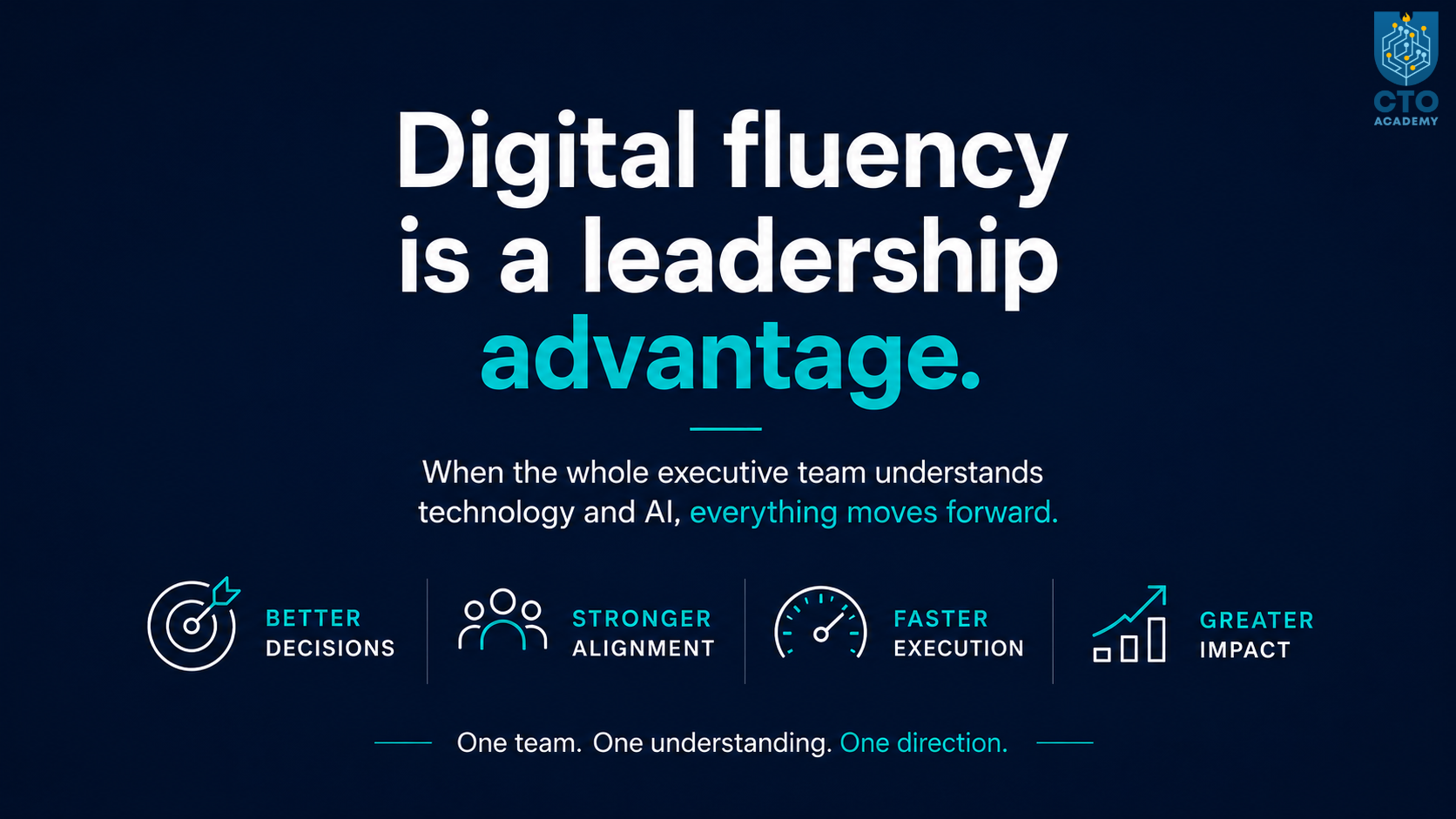
- Decisions improve.
- Alignment strengthens.
- Execution accelerates.
And the organisation moves with greater confidence, clarity, and speed.