How can you, a newly appointed CTO, stand out among the senior leadership team? In other words, how can you prove your worth at the senior executive level?
Updated: August 2026.
Based on Julian Costley’s lecture from CTO Academy’s Digital MBA for Technology Leaders and several live sessions with our alumni, this article unpacks practical strategies and, more importantly, key traits of an effective Chief Technology Officer.
TL;DR
An effective CTO turns technical judgement into business impact. Technical expertise remains important, but executive effectiveness increasingly depends on how well you communicate decisions, build trust, remove organisational friction and connect technology to wider company priorities.
- Communicate from the decision or business consequence downward, keeping technical detail available when it is needed.
- Document important decisions and make risks, trade-offs and ownership visible.
- Build strong working relationships across the senior leadership team rather than operating technology as an isolated function.
- Increase your value by understanding customers, commercial priorities and the pressures facing other parts of the organisation.
- Protect the capacity of both yourself and your team so that urgency does not become the normal operating model.
The seven principles below translate these behaviours into practical habits an existing or newly appointed CTO can apply in day-to-day leadership.
Now, before we dive into the subject, take a moment and picture your first week in the role: the CEO is asking how you’ll shave 15% off cloud spend, engineering wants clarity on a crumbling monolith, and the board expects a growth roadmap by next quarter.
That moment, when every stakeholder looks to you for a decisive, technical-yet-commercial answer, is where effective CTOs differentiate themselves. The seven principles that follow distil what the most successful leaders do next.
Table of Contents
7 Principles of Modern Technology Leadership
The first thing to understand:
1 – It’s Not About Being Loud or Flashy
It’s about behavioural sharpness, operational precision, and leadership that stretches beyond your designated role.
You see, CTOs possess the unique ability to turn the tide in strategic organisational growth, but doing so means mastering both technical and leadership dynamics.
Jason Noble, CTO at CTO Academy, has seen firsthand how tough this transition can be: “I recently spoke with a CEO who was frustrated that every technologist they approached jumped straight to building solutions—without first understanding the organisation’s needs or the daily friction points that would slow delivery. Their website refresh was already eight months behind schedule. Together, we reframed the approach so stakeholders could engage more easily and the CEO could feel confident that the deliverables were realistic.”
The fact is, a modern CTO isn’t confined to a tech cubicle. Along with executing your objectives, the modern requests of the role demand a mindset transformation. It comes down to these three subprinciples:
- Leading with intent.
- Contributing to cross-company strategies.
- Creating a meaningful impact rather than just noise.
Having learned that influence isn’t measured in decibels, but in deliberate presence, the next step is to turn that quiet authority into consistently constructive behaviour—the focus of our next principle, Mastering Behavioural Effectiveness.
2 – Master Behavioural Effectiveness
An effective Chief Technology Officer doesn’t cause headaches for their fellow executives. In fact, it’s quite the opposite. They appear calm, logical and steady.
Think of it like blending into an executive group photo: you don’t have to push to the front to make your contributions seen.
Being behaviorally effective boils down to this:
- Keep it actionable. In other words, provide information that others can act upon, but don’t overwhelm them with irrelevant data.
- Layer communication by using levels of information, ranging from key reporting at the top to in-depth analytics only when asked.
- Build trust. That is, don’t hide problems; instead, take calculated risks that you openly discuss and address.
Behavioural effectiveness is not just about your outward demeanour, but also fostering environments where honesty, precision, and proactivity thrive.
A polished demeanour alone won’t move the business unless your ideas are conveyed with crystal clarity, which is why we now structure every message through the Information Pyramid.
3 – Communicate Using the Information Pyramid
Imagine all the trends, data points, and statistics you deal with as an information pyramid, as shown in the image below:
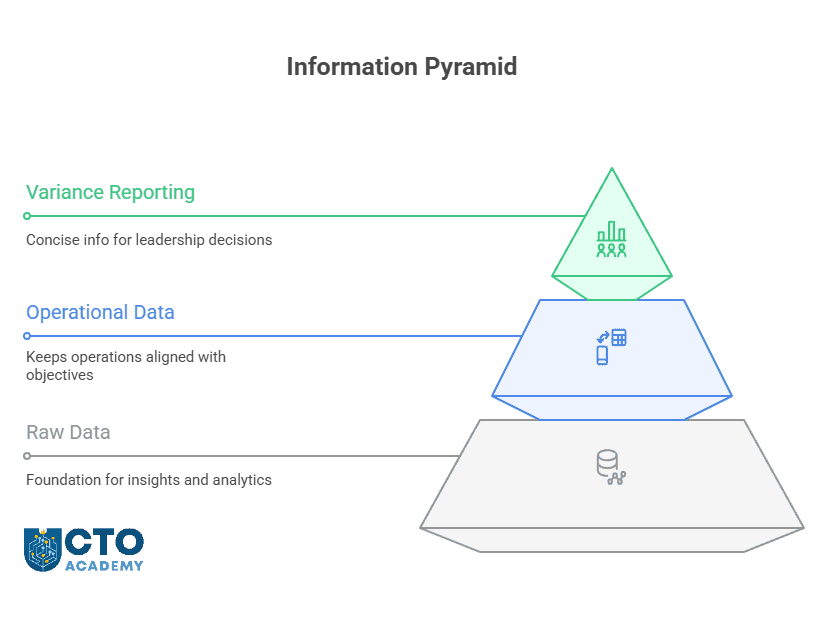
At the top is leadership’s go-to: concise variance reporting. This is what they need to know to make informed and effective decisions. In the middle lies operational data, which helps you stay functional and aligned with team objectives. Finally, the base level holds raw data and analytics, the foundation for insights.
Here’s how to think and communicate effectively with this pyramid in mind:
- Be clear. Resist the urge to overwhelm your team or SLT with an avalanche of stats. Instead, focus on actionable insights.
- Always have the details within immediate reach. While you provide top-level clarity, layer information so that deeper data is available upon request.
- Think like the Board. Bridge your technical skills with business-focused delivery of insights.
Once insight is transmitted cleanly, the real test is converting it into flawless execution—enter Operational Mastery, where communication meets action.
4 – Build Operational Mastery
Possessing a skilful team, ample resources, and clearly outlined objectives might feel like a formula destined for success. But there’s a catch—it’s called organisational friction.
Many accidental CTOs overlook how easily operational effectiveness can go off track. Inefficiencies—competing priorities and unclear ownership—from misaligned colleagues can quickly derail their progress.
“Every project will have a tough problem to solve—whether it’s cleaning messy data, developing a new algorithm, or scaling a prototype without running into excessive live production costs. If these issues aren’t addressed promptly, they become ‘if-by-magic’ steps that everyone assumes someone else will handle. In some organisations, it takes real courage to raise these concerns early on,” says Jason Noble.
To safeguard against such challenges, execute these countermeasures:
- Document Everything
Write down agreements, keep meeting notes, and maintain a record of important decisions.
For instance, implement Architecture Decision Records (ADRs) to capture architecturally significant technology decisions, the context behind them and their consequences. Keep the format lightweight and store relevant ADRs alongside the code.
In a three-month action-research study at a Swedish engineering and consulting company, introducing ADRs increased participants’ average satisfaction with how architectural decisions were documented from 2.5 to 3.1 on a four-point scale. The researchers also observed improvements in documentation culture and knowledge transfer.
- Form Partnerships
Build and maintain a strong, collaborative relationship with your manager and SLT in general. Always keep in mind that open communication increases trust and limits misunderstandings.
- Make Technical Debt Measurable
Technical debt becomes easier to prioritise when you connect it to delivery performance rather than presenting it as a general engineering concern. Track measures such as cycle time, work in progress, incident frequency or the engineering capacity consumed by recurring problems, then make targeted improvements and compare the results.
One software team documented a roughly 66% reduction in cycle time and a 50% reduction in work in progress over six weeks. Importantly, the team did not stop normal delivery for a dedicated cleanup sprint; it introduced a series of smaller process improvements while continuing to work.
- Navigate Office Politics
Allocate a necessary percentage of your focus to assess and protect your standing within the company. It is an investment with an extremely high ROI.
One practical approach is a regular cloud cost review with Finance, where technology leaders translate infrastructure spend into business impact, identify unusual movements, and agree on ownership for optimisation.
Ouribank well demonstrates the broader FinOps principle. In a case study published by its implementation partner e-Core, the bank reported a 60% reduction in cloud costs and an 18% increase in availability and processing capacity after introducing a dedicated FinOps capability, substantially expanding resource tagging and implementing continuous budget monitoring.
With a friction-resistant delivery engine humming inside engineering, the natural progression is to project that capability across the organisation, exactly what the next principle delivers.
5 – Boost Your Value Outside the Immediate Role
It’s tempting but misleading to believe that being the best at your core technical functions is enough.
Efficient CTOs don’t just stay in their lane. Your ability to adopt new roles, share insights into marketing or sales strategies, and provide fresh cross-departmental viewpoints boosts your executive presence.
Here are three simple practices that help you think outside the box, literally and figuratively:
- Contribute to ideas that stretch beyond your department, fostering respect from leaders across the organisation.
For example, expose engineers to customer-facing work periodically: let them observe important demos, sales-engineering conversations or customer problem reviews so that product and engineering decisions are informed by real user friction.
There are other ways to extend technical expertise beyond the technology function. BlackLine, for example, used automated DemoBoards to scale the expertise of its Solutions Consulting team across the sales process. Consensus reports that deals in which a DemoBoard was shared had a 54% higher win rate, while the number of live demos fell by 29% over the 12 months. - Maintain visibility by actively briefing other teams and board members on your work.
- Find growth opportunities by attending board meetings as an observer and preparing ahead of potential questions.
And never underestimate the power of a proactive appearance. Whenever possible, bring potential solutions to problems before they emerge on your boss’s radar.
Now, here’s the problem: expanding your sphere of influence can stretch even the best leaders thin. That’s why the next principle turns inward, protecting the leader behind the results through well-being.
6 – Protect Your Well-Being While Doing All the Above
Long hours, high stakes, and the weight of expectations are nearly inseparable from the CTO experience. As much as you advance the organisation, you also need to anchor yourself. Personal health, both mental and physical, is the foundation.
Therefore:
- Don’t bank on a perfect work-life balance, but aim for routines that keep you resilient.
- Maintain mental clarity to handle unexpected challenges and maintain your status as a “go-to” leader.
Alert load is also an operational health issue. Google’s SRE guidance recommends keeping paging actionable and reducing noisy or duplicate alerts because excessive operational load contributes to alert fatigue and burnout.
PagerDuty reported that early-access customers using its AIOps product reduced alert noise by an average of 87% and deployed automated incident-response automation nine times faster than with existing solutions.
Exercise: audit your own alert volume this week. If an alert does not require timely human action, question whether it should be a page.
Safeguarding health provides staying power, but maintaining an edge demands perpetual growth; hence, the final principle: Learn While Leading.
7 – Learn While Leading
Growing as a technology leader means deliberately looking beyond the familiarity of your own organisation and industry.
When Ameesh Kapoor, then Head of Engineering at Food Rescue Hero, joined Amazon’s Now Go Build CTO Fellowship in 2024, he had already helped expand the platform to more than 50,000 volunteers across 20 North American regions. He described the fellowship as an opportunity to learn from challenges faced by other innovative organisations and strengthen his effectiveness as a technology leader.
The important point is not the fellowship itself. Seniority does not remove the need to learn; it increases the value of exposing your judgement to perspectives outside your immediate environment.
Try this week:
Block a single 60-minute “learning hour” in your calendar right now. During that slot:
- Pull one fresh idea from outside your bubble—a peer-sprint note, podcast nugget, or conference deck.
- Prototype it immediately (feature flag, shell script, or process tweak) and ship to a low-risk environment before the hour ends.
- Log the outcome in a one-page “Learning Log” and demo your findings in Friday’s stand-up.
The wider evidence supports making learning part of the operating environment rather than treating it as an occasional extra. DORA’s research links a strong learning culture with increased deployment frequency, reduced lead time for changes, faster service restoration and lower change failure rates. Its 2023 State of DevOps research also found that organisations with a generative culture reported 30% higher organisational performance than those without one.
You see, knowledge expansion, outside the narrow scope of your current frame, shapes you into a sharper, more rounded leader.
The question is, how do you expand your knowledge beyond the most imminent domain and role?
It’s a rather simple formula: networking + curiosity.
- Build connections outside your organisation by attending conferences, joining industry boards, or cultivating informal mentorships.
- Read beyond tech. Explore finance, psychology, and management subjects that inspire creative lateral thinking.
These practices help align your technological capabilities with broader business strategies, providing exceptional value not just in operational settings but also within senior management.
Key Takeaway
Aim Higher and Broader
Succeeding as a CTO isn’t pure technical wizardry. It’s being the steady strategist, skilful communicator and inspiring leader who truly influences company growth. Therefore, think big and speak up. And never stop identifying how you can contribute more than before.
Every tech leader has the potential to be indispensable. Navigate to that peak with intentional effort by implementing these seven principles.
Jason Noble, CTO
Frequently Asked Questions
What makes a CTO effective at executive level?
An effective CTO turns technical complexity into decisions the wider business can understand and act upon.
That requires technical judgement, but also an ability to explain trade-offs, connect technology choices to business priorities, make risks visible and contribute constructively to decisions outside the technology function.
At executive level, credibility comes increasingly from the quality of your judgement rather than from being the person with the deepest technical knowledge in every conversation.
How should a CTO communicate with the CEO and board?
Start with what matters to the decision-maker: the outcome, material change, risk, required decision or business consequence.
Then make progressively deeper operational and technical information available if it is required.
This is the logic behind the Information Pyramid discussed earlier in this article. A board usually does not need raw engineering data first. It needs to understand what has changed, why it matters and whether action is required.
How technical should a CTO remain?
Technical enough to challenge assumptions, understand architectural and security trade-offs, recognise weak reasoning and retain the confidence of the technology organisation.
How hands-on that needs to be depends heavily on the size and stage of the company. A start-up CTO may still contribute directly to architecture or code. In a larger organisation, spending too much time doing work that capable specialists should own can turn the CTO into a bottleneck.
The objective is not to stop being technical. It is to apply technical expertise at the level where it creates the greatest organisational value.
How should a CTO make the business case for addressing technical debt?
Translate the debt into consequences the business can evaluate.
Show whether it is slowing delivery, increasing incidents, creating security exposure, raising infrastructure costs, restricting product changes or consuming engineering capacity. Then compare the cost of addressing it with the likely cost of leaving it unresolved.
Where dedicated work is justified, define the scope and measure the position before and afterwards. “We need time to clean up the code” is difficult to defend. “This constraint adds approximately two days to every release and affects this revenue-critical roadmap” creates a business conversation.
What’s the ideal length for an Architecture Decision Record?
There is no mandatory length. The more useful principle is one significant decision per ADR, documented concisely.
A one-page format often works well. Capture the context, the decision, the important alternatives or trade-offs, the consequences and any relevant reviewers or status information.
The objective is to preserve why the decision was made without creating documentation so cumbersome that teams stop maintaining it.
How much of the cloud budget should go to FinOps tooling?
There is no universal percentage that every organisation should target.
Deloitte notes that FinOps tooling can cost around 3–5% of the cloud bill at the high end. That should be treated as a reason to examine the economics carefully, not as a recommended spending target.
Start with the cloud costs and problems you are trying to control. Native provider tooling, better tagging, accountability and governance may solve part of the problem before additional tooling is required.
How can a CTO build influence outside the technology function?
Learn enough about the priorities of Product, Finance, Sales, Operations and other functions to contribute to their problems without trying to take ownership of them.
Join strategic conversations early, explain where technology creates opportunities or constraints and make your work visible in business terms.
Influence grows when colleagues begin involving the CTO because their judgement improves the decision, not simply because a technology question has appeared.
How can a CTO keep learning while already carrying an executive workload?
Treat learning as part of the role rather than something postponed until work becomes quieter.
Protect recurring time for it, but keep the scope practical: investigate a problem you currently face, learn from someone outside your immediate environment, test a useful idea and record what happened.
Peer networks are particularly valuable at CTO level because many leadership problems are contextual. Seeing how another experienced technology leader handled a similar decision can be more useful than consuming another large volume of generic content.
Closing the Loop: From Principles to Practice
The seven principles above can be applied independently. But becoming consistently effective at CTO level requires development across a much wider range of responsibilities: leadership, strategy, commercial decision-making, finance, product, data, risk, innovation and the ability to operate credibly with senior stakeholders.
That is the capability gap the Digital MBA for Technology Leaders is designed to address.
The programme currently includes:
- 9 executive-level modules covering the wider scope of technology leadership.
- 200+ bite-sized, practitioner-led video lectures supported by lecture summaries and additional learning resources.
- AI integrated across the curriculum as a leadership capability, including its business application, risk and governance.
- Live expert sessions, peer reflection and regular opportunities to learn with other experienced technology leaders.
- A personal course manager and 12 months of CTO Academy Community access.
There is no cohort or fixed intake. You can enrol and begin immediately, then progress around your professional responsibilities and complete the programme within 12 months for certification.
Afterwards, Alumni Membership can be renewed if you want to retain access to core programme materials and Community benefits.
Your Next Move
If the challenges in this article feel familiar, explore the Digital MBA and see how the wider curriculum approaches the transition from technical expertise to senior technology leadership.