If you’ve raised a teenager, you’ll probably recognise this sequence of events…
You explain why something needs to happen.
You provide what you consider to be an entirely compelling argument.
You throw in a rational, sensible explanation about why it matters to you.
And then…
They stare back at you with a mixture of scepticism and indifference
as the speech bubble appears above their head… “Yeah. But what’s in it for me?”
Anyone leading organisational change may recognise the same conversational roadblock.
We explain why something matters to us and assume that gives the person receiving the message a reason to care.
With a teenager, there may be any number of reasons why your beautifully constructed argument has failed to land.
In organisational change, the problem can be much simpler.
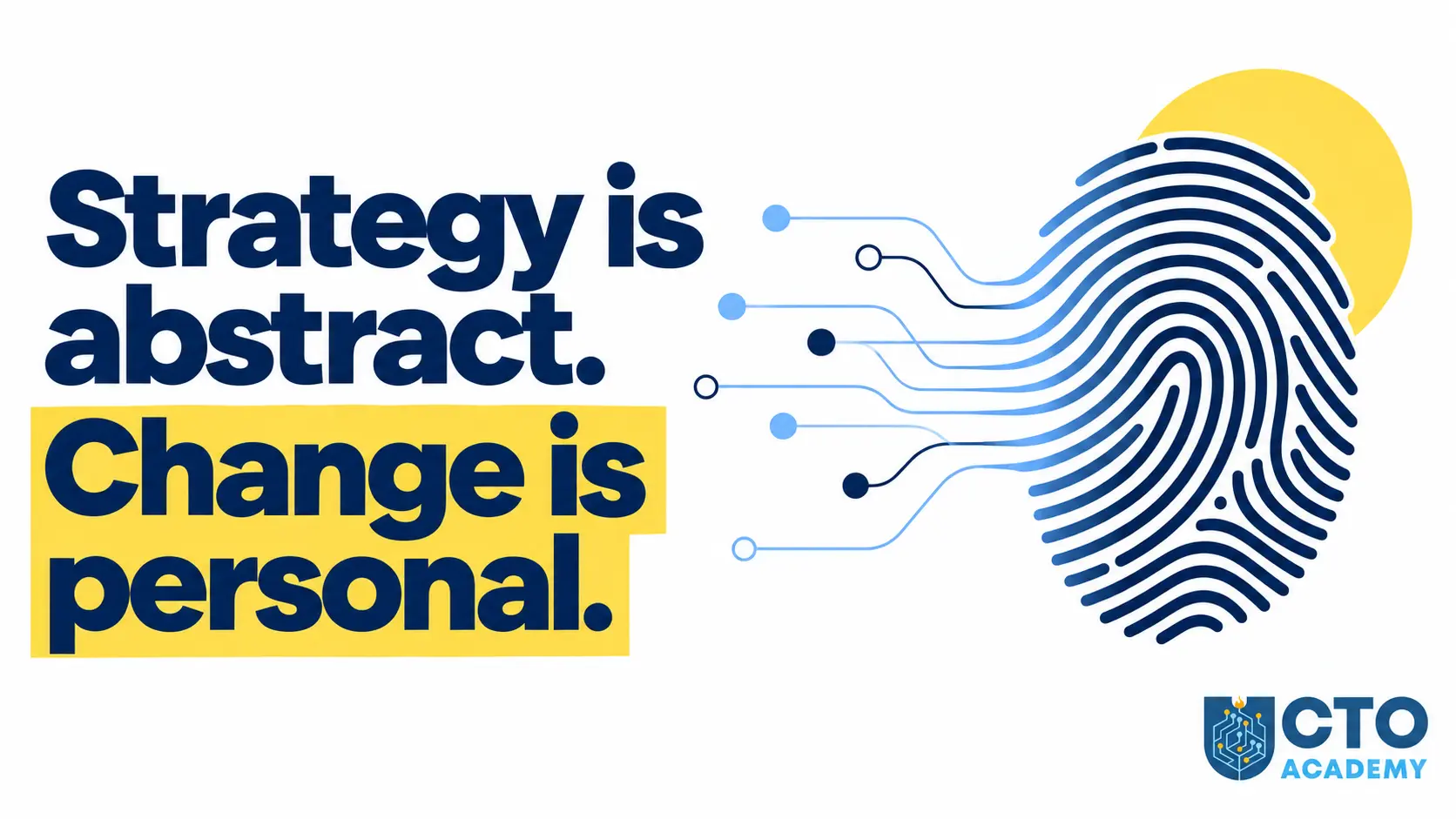
Strategy is abstract.
Change is personal.
The view from the other side of the room
So imagine another familiar conversation.
“We’re embarking on an exciting AI-enabled transformation that will improve productivity, enhance customer experience and create significant opportunities across the organisation.”
The leadership team hears ambition.
The CFO hears productivity.
The CTO hears technology and data.
HR hears skills and workforce transformation.
But what does the employee hear?
More likely:
Will my job still exist?
Am I expected to do more with fewer people?
Are the skills I’ve spent 15 years developing becoming less valuable?
What am I going to have to learn?
And what exactly is in this for me?
Those aren’t unreasonable questions.
Microsoft and LinkedIn found that 45% of professionals were worried AI would replace their job. In the same research, 46% said they were considering quitting in the year ahead.
So when leadership enthusiastically announces the productivity opportunity from AI, don’t assume everyone in the room hears the same message.
Organisational change happens individually
And this isn’t just a communication issue.
It’s fundamental to how change works.
Prosci’s widely used ADKAR model is built around the principle that organisational change ultimately happens one person at a time.
Awareness of why something is changing isn’t enough.
People also need the desire to participate, the knowledge to know what to do and the ability to actually do it.
We’re seeing this play out in our own client work.
We deliver transformation leadership programmes across organisations, from executive leadership through different layers of senior management, where a similar lesson will often emerge.
You can’t simply communicate transformation from the top and delegate implementation downwards.
People need to understand it, question it, challenge it and — crucially — interpret what it means in the context of their world.
We’re seeing the same issue while helping a multinational organisation develop its AI capability.
An executive needs to understand the strategic implications of AI.
A manager needs to understand how it could reshape their team and processes.
Someone closer to the customer needs to understand how it changes what they actually do.
One AI strategy.
With very different personal implications.
Give people a stake in the change
There’s strong evidence for the crucial role of involving people rather than simply broadcasting change at them.
McKinsey’s research into organisational transformations found substantially higher reported success where frontline employees felt ownership of the change.
Its analysis also found that successful transformations were more likely to involve broader groups in shaping initiatives rather than leaving transformation planning to a small group at the centre.
PwC’s 2025 global workforce research, covering nearly 50,000 workers, found employees who felt strongly aligned with leadership goals were 78% more motivated than those reporting the least alignment.
So perhaps the question for leaders isn’t simply: “Have we explained the strategy clearly enough?”
It’s: “Have we helped people understand their place within it?”
For L&D teams, that understanding is the starting point. The harder challenge is making it last beyond the programme.
Before your next town hall, AI programme or transformation announcement, try the teenager test.
Imagine the pushback:
“What’s in it for me?”
You won’t always have perfect answers.
Particularly with AI some answers simply don’t exist yet.
But understanding that people at different levels of your organisation will experience the same change very differently is crucial to building alignment — and ultimately to giving the transformation a better chance of succeeding.
Boards approve strategies.
Leadership teams launch transformations.
Organisations invest in technology.
But people experience the consequences.
Strategy might be organisational.
Change is always personal.