
Every time you wake up in the middle of the night in the dark forest and leave your tent, you feel slight discomfort, no matter how experienced a camper you are. But it's not the dark forest that causes it. It's the unknown that triggers the sympathetic response. You simply don't know if some threat is lurking in that darkness.
The paradox is that, no matter how evolved and advanced we are as a species, the cause and effect of the fight-or-flight response remains unchanged. There is no disambiguation between different levels of threat. If it's unknown, our sympathetic nervous system kicks in. Cortisol levels increase, triggering the chain of chemical reactions that knock down all secondary systems, including our operating memory.
In professional life, that means living in a constant state of stress and anxiety, with impaired working memory. Not exactly a recipe for success, is it?
In change management, specifically, the root cause is the T-Shape Dissonance.
T-Shape Dissonance in Change Management
Anette Jacobs, one of the recent guests in CTO Academy's Expert Q&A sessions, published an insightful post on LinkedIn on this subject. In her own words, it is „a reflection on how lack of clarity and unspoken shifts in decisions can create a hidden emotional and cognitive load in relationships and workplaces, and how attempts to restore understanding can sometimes deepen disconnection instead of easing it.“
Whenever we talk about change management, this exact problem surfaces.
The reason it causes friction in organizations is that leaders, used to sudden pivots, automatically assume that the same applies to their direct reports. However, such a mindset isn't universal. For many, a sudden change without a clear context triggers a sympathetic response.
The solution seems simple enough: Remove the "unknown" (dissonance) from the equation, and you restore the resonance. While that is undoubtedly the fact, the more immediate question is not the What or How, but When.
You see, the problem is that, by the time you start explaining the Why, the shift is already underway. In other words, you've been reactive instead of proactive.
To make things more difficult, in some instances, people who absorb ambiguity and, therefore, pivot with ease often struggle to convey the Why in an understandable manner, which just adds to the problem instead of solving it.
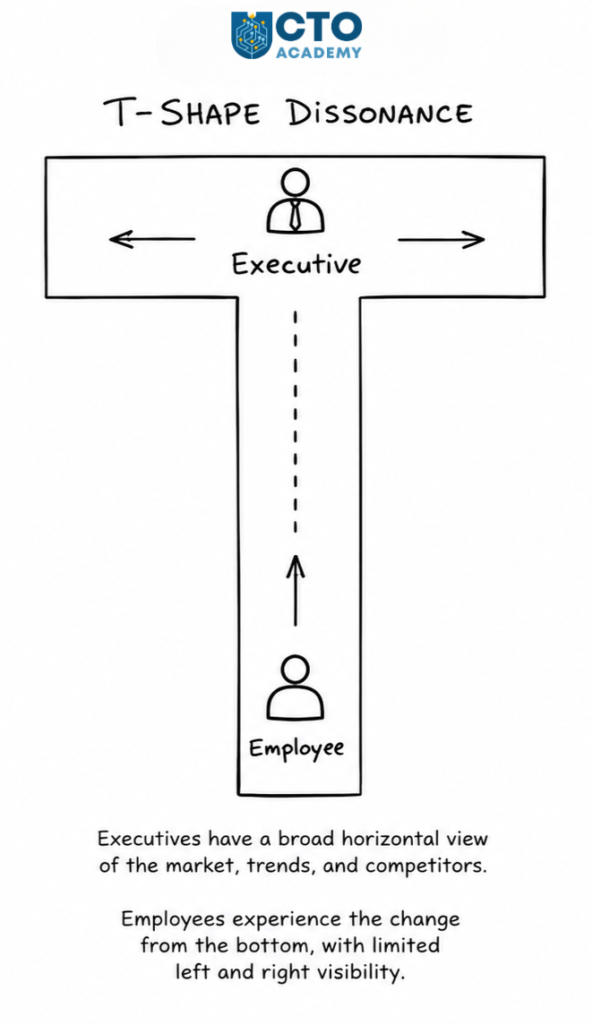
At the core of this problem are different perspectives and expectations. You can observe it as a T-Shape Dissonance. Top-level executives, standing at the top of the vertical, look left and right while setting the stage for the change. They expect people to simply follow their lead. However, employees experience that same change from the bottom of the vertical, with left and right views often blocked or, at the very least, seriously limited.
The Solution is Timing
You'll often hear people mention the military way of leadership as the most effective. It's quick, simple, and straightforward, with no need for additional explanation. A unit can move left, right, front, and back in an instant, no questions asked. That’s the definition of agility, something we all strive for.
The reason for that lies in basic training, when soldiers prepare for different scenarios. So before they hit the battlefield, their brains are programmed to expect sudden pivots. At the same time, they know Why they need to execute a certain maneuver or tactic.
Recall any of your personal onboarding processes and early stages of your career. Have you ever even heard about change management at that career stage? Did anyone organize thematic workshops? Did anyone train you for different scenarios or specific courses of action, in case of sudden pivots or a fundamental change in a strategy?
Most likely, no one.
And there's your solution. Train your reports in change management early on – before it happens.
Conclusion
As a leader, you must never forget your roots; the place from which you emerged to the leadership role. It is that exact bottom of the vertical with left and right views blocked or limited.
Good leaders remember that feeling. Bad leaders choose to ignore it.