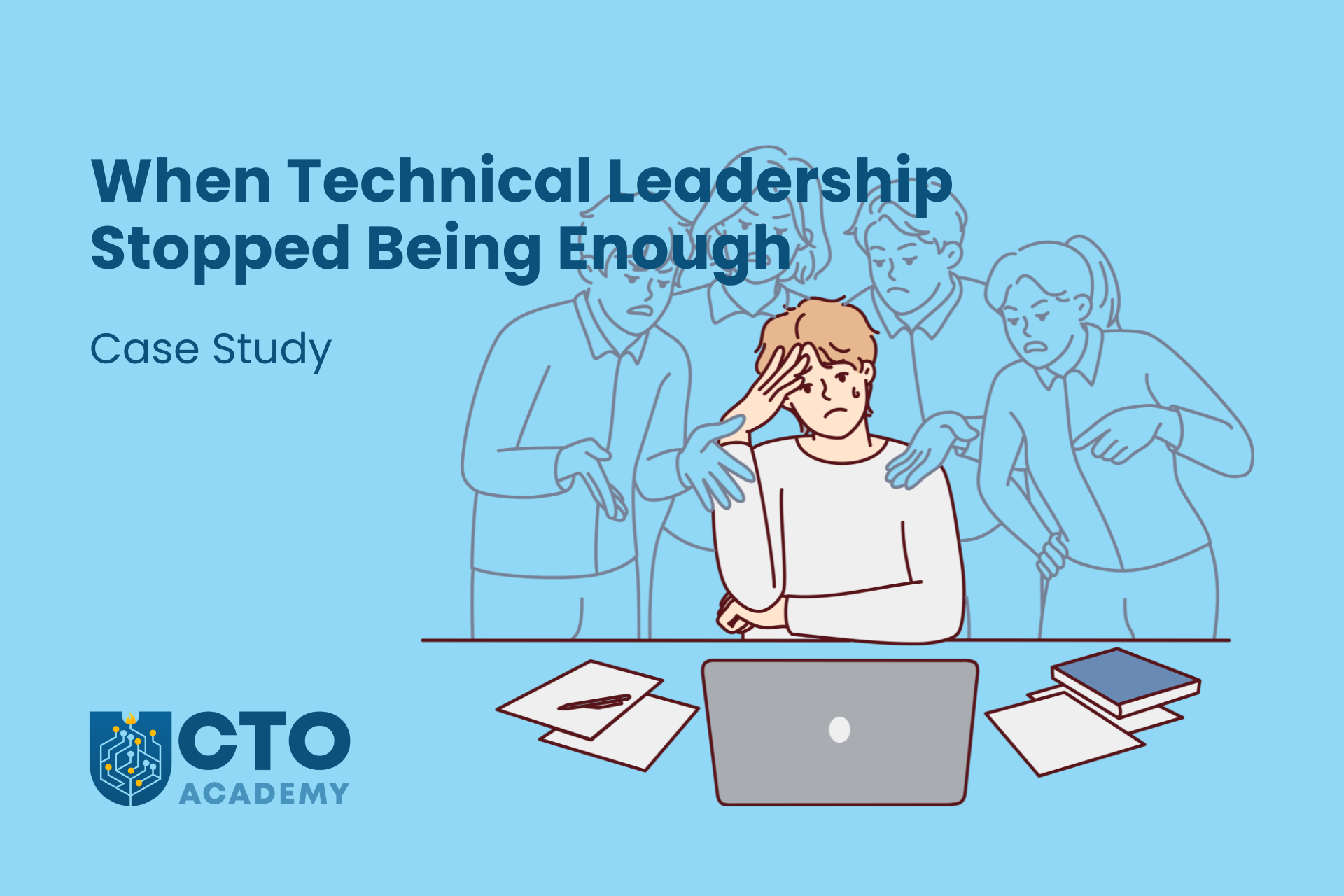
From the outside, nothing was obviously wrong.
The title, responsibility, years of experience…everything was there. On paper, this was already a successful technology leader: someone trusted to make decisions, lead teams, solve difficult problems, and carry the weight that comes with seniority. There was no dramatic failure, no public collapse of confidence, no single moment where everything stopped making sense.
But somewhere along the way, the role had changed.
Or maybe it is more accurate to say that the role had expanded. What once felt primarily technical had become something broader, heavier, and less easy to define. The conversations were no longer just about architecture, delivery, tooling, or performance. More and more, they were about trade-offs. About influence, business value…priorities that were not purely technical, but still landed in technology leadership’s hands. About speaking to executives, product leaders, boards, peers, and stakeholders who were not interested in the technical elegance of a solution unless it could be translated into impact.
That was the point at which a quiet discomfort began to set in for many of the graduates of CTO Academy’s Digital MBA for Technology Leaders. Not because they were failing. Quite the opposite. They were already doing the job. But the next level of leadership was beginning to demand something more than technical judgment alone, and they could feel it.
"It’s rarely about tech."
Bianca Glasner, Head of Engineering, Austria
Again and again, in the graduate reflections, what emerges is not a story of deficiency but a story of range: a growing awareness that technical competence, on its own, was no longer enough for the kind of leader they wanted to become.
Bianca Glasner, a Head of Engineering and Firmware Lead from Austria, captures that tension in one line that stayed with her: “It’s rarely about tech.” What caught her attention was that the program did not treat technology leadership as pure engineering or as generic leadership training, but as a whole role with many interlocking parts. It reinforces what Manasa Kotha, an Engineering Manager from the US, said, "The program teaches you what leaders are supposed to do in certain situations and how to facilitate or help others in reaching their own potential while you discover yourself."
That matters, because by the time someone becomes a CTO, a Head of Engineering, or a senior technology leader on the path toward those roles, the challenge is rarely a lack of knowledge in the narrow sense. More often, it is that the job has outgrown the boundaries of their earlier training. Nobody teaches you, at the start of a technical career, how to think across the full shape of the role later on. Nobody sits you down and explains how to move from being the person with answers in one domain to being the person who has to hold ambiguity across many. Nobody really tells you how much leadership at that level is about reading context, shaping conversations, creating clarity, helping others perform better, and making decisions that are as much human and commercial as they are technical.
So the tension does not announce itself loudly. It shows up more quietly than that.
It shows up in meetings where you realize you understand the technical dimension perfectly well, but wish you had a stronger grasp of the business conversation unfolding around it. It shows up in moments when you know what should happen, but feel you could be more effective in how you frame it to executives or non-technical peers. It shows up in the distance between being a strong operational leader and becoming a more complete strategic one. It shows up when the next stage of your career begins to depend less on how well you can solve technical problems yourself and more on how well you can guide a business through them.
For graduates, that was often the real reason for enrolling. Not to gather another certificate. Not to decorate a CV. And definitely not to pursue ambition for its own sake. They enrolled because something had become impossible to ignore: staying the same, even while remaining competent, no longer felt enough.
Byron Rode, a CTO from South Africa, describes the effect of the program in a way that reveals the problem it solved. He says he likely would have reached the same endpoint eventually, even without the course, but it would have taken much longer, with more failure and error along the way. The Digital MBA helped him get where he is in his career faster, especially in areas where he had historically struggled: delegation, cross-departmental work, and the crucial skill of speaking non-tech to non-technical people.
That idea of acceleration is important. It suggests that the program did not give people an entirely new personality or hand them a transformation they had not earned. It did something more credible than that. It shortened the distance between the leader they were becoming and the leader they needed to be.
The question, then, was why this route, and not another one.
Because there were other routes. There are always other routes. Traditional MBAs, short leadership courses, scattered books, podcasts, online classes, frameworks picked up over time, advice from peers, trial and error inside the role itself. Senior technology leaders are not short of information. What they are often short of is something else: a learning environment that feels genuinely designed for the complexity of their work.
That is one of the clearest themes in the graduate reflections. The appeal of CTO Academy was not simply that it offered content. It was that it seemed to understand the reality of the person consuming it.
“It is crafted for working professionals, blending business with technology.”
Matthew Miller, IT Manager, Canada
Matthew Miller, an IT Manager from Canada, points first to the structure of the program: a curriculum crafted for working professionals, blending business with technology, flexible across time zones, and built around community.
Others talk about lectures that are easily digestible rather than overwhelming, practical modules that reflect real life, and the ability to apply what they are learning directly in their day-to-day roles. Rather than abstract leadership talk, the course seemed to offer something more grounded: insight that could be used immediately, then revisited later as needed.
That distinction matters more than it first appears to. At this level of leadership, it is not enough for learning to be interesting. It has to be usable. It has to survive contact with a calendar already filled by other people. And more importantly, it has to fit around a job that does not pause politely so personal development can happen in isolation. The graduates frequently mention bite-sized, 100% online lectures that can be taken between meetings or during lunch, not because convenience is the whole story, but because practicality is inseparable from credibility. Senior leaders do not need to be persuaded that learning is good. They need to believe that the learning will fit inside real life rather than asking them to step outside it. Even the humor in Kasey McCurdy’s remark points to that sense of genuine engagement: “I always hated when those pesky meetings got in the way of me joining a CTO Academy expert session.”
But convenience alone does not create meaning. What gave the experience its weight was what began happening once the course was underway.
This is where the story becomes more interesting, because the shift described by graduates was not immediate and not theatrical. It did not sound like a single revelation. It sounded like a series of internal adjustments that, over time, became impossible to miss.
At first, the program seems to have given people language for things they were already doing instinctively, without always knowing how to name them. Kevin Golding, a UK-based Field Technologist, describes that dynamic with unusual clarity, “As a leader,” he says, “You are often doing things without fully knowing that you are doing them, or without understanding why you are doing them at all. The course helped put those actions in perspective: what to do, when to do it, why it matters, and what else should be added to the plan to make leadership more effective.”
There is a deep relief in that kind of recognition. Not because it flatters the leader, but because it turns instinct into awareness. It takes things that were half-formed and makes them more deliberate.
Then something broader begins to happen. The role itself starts to look different.
Leadership stops feeling like a string of urgent reactions and starts coming into focus as a system. Decisions are no longer just about immediate execution but about what kind of organization you are shaping, what kind of conversations you are enabling, what signals you are sending, what habits you are reinforcing, and how technology actually participates in the direction of the business. A module here sharpens one area. Another challenges an assumption. Another expands the frame. Gradually, a fuller picture forms.
The most interesting part of the graduate reflections is that they do not merely talk about learning topics. They talk about becoming different in how they reason. That is subtler, and more powerful. They describe changes in how they speak to executives, how they work across departments, how they delegate, how they understand their own value, how they approach leadership dilemmas, and how they carry themselves in more senior spaces. This is not the language of “I picked up a few useful tools.” It is the language of identity slowly reorganizing itself around a larger role.
“The course helped me recognize further value in what I do and what I bring to the table.”
Stephen Morris, Fractional CTO, UK
Stephen Morris, a Fractional CTO based in the UK, puts it beautifully. The course, he says, helped him recognize further value in what he brings to the table, while also allowing him to identify his weak areas. More than that, it gave him the perspective of a whole role that nobody had told him about at the beginning. That matters because once you understand the whole shape of a role, you stop feeling like you have wandered into spaces you do not belong in. You start to feel, in his words, more confident as a board member or aspiring board member, because now you know the answers. And even if you knew them before, you are more able to recognize your own value and be trusted in that recognition.
That is not a small change. It is one of the hardest things to acquire in leadership: not just skill, but self-possession. Not just the ability to do the work, but the internal authority to stand in rooms that once felt slightly beyond reach and know that you belong there.
Kasey McCurdy, Head of Engineering in the US, describes another side of that development. The course changed the way he spoke to product teams and to the executives he reported to. It helped him take on more of the executive functions and really own them.
“The course and the entire experience changed the way I speak to product and executives I report to.”
Kasey McCurdy, Head of Engineering, USA
That phrase is worth lingering on: really own them. Not imitate them, not observe them from the outside, not perform them uncertainly, but own them. Because there is a difference between being adjacent to executive responsibility and feeling capable of inhabiting it fully.
This is the real middle of the story. Not the modules themselves, but the accumulation of internal upgrades they triggered.
A broader lens.
A clearer vocabulary.
Better judgment.
More confidence in ambiguity.
A stronger ability to translate.
A more natural executive posture.
A less fragmented understanding of what the role asks of you.
And all of this happened while the leaders were still inside their jobs, still facing their normal pressures, still carrying the same responsibilities. Which may be why the learning seems to have landed so deeply. It was not taking place in an abstract future. It was colliding, week by week, with the real situations these people already had to navigate.
Running alongside this intellectual and professional change was something else that graduates repeatedly return to: community.
“It’s more than just a great course. It’s also about being a part of a network.”
Byron Rode, CTO, South Africa
This might sound secondary from the outside, but in the graduate reflections, it clearly is not. Again and again, what emerges is how isolating senior leadership can feel, and how meaningful it is to find a network that understands the role from the inside.
Byron Rode says that, as a CTO, you rely on a network or community, especially if you are outside your usual realm, as in the case of an accidental CTO. Stephen Morris describes the community as a different type of support network: a place where you can reach out with specific technical questions or with leadership challenges, and where the people around you understand the peculiar difficulties of what you do. Matt Miller emphasizes that the curriculum itself is built around and for the community. And Kasey McCurdy perhaps captures the emotional truth of it most directly: when he faces a dilemma, he knows there are others in the world dealing with the same thing, and many of them are part of this community — some going through it now, others already through to the other side and eager to help.
That completely changes the feel of the experience. It means the leader is not just studying alone. They are being accompanied. Their questions are not signs of weakness but part of a shared professional reality. Their dilemmas are not private failures but familiar patterns others can recognize and help untangle — whether that is working through a board-level disagreement, or finding a way to move a legacy team past resistance to change. For people in senior roles, that kind of support is not ornamental. It is often the difference between learning something intellectually and having the confidence to live it out.
By the end of the experience, the outcomes graduates describe are striking precisely because they are not exaggerated.
They do not read like miracle stories. They read like something more convincing: a noticeable shift in pace, confidence, and scope.
For some, the main difference was speed. They arrived at stronger decisions faster, with less wasted motion. For others, the biggest change was language — being able to speak more effectively to product leaders, executives, boards, and non-technical stakeholders. For others still, the shift was more personal: recognizing their value more clearly, understanding where they were weak without shame, and feeling more grounded in the full role they were stepping into.
Across the reflections, the pattern is consistent. These leaders did not emerge as entirely different people. They emerged as more complete versions of themselves: faster where they had been hesitant, broader where they had been narrowed, more confident where they had once felt slightly unsteady, more able to translate, align, influence, and lead across the business rather than only within technology.
That is why this story lands where it does.
Not in the territory of obvious reinvention, and not in the flat language of professional development. It lands somewhere truer than that. In the recognition that there comes a point in a leadership career when experience alone is no longer enough to unlock the next stage. When what is needed is not more hustle, not more technical depth, not another handful of fragmented ideas, but a more coherent way of seeing the role. A more integrated kind of growth. A structure for becoming the leader the job has already started asking you to be.
For the graduates, that appears to be what the program provided. Not an escape from the work, but a better way to meet it. Not a dramatic identity transplant, but a steady strengthening of judgment, confidence, and range. Not a promise that everything would change overnight, but something perhaps more valuable than that: the feeling that they were no longer trying to grow into the next version of themselves by instinct alone.
And perhaps that is the most persuasive thing in all of this. These were not people looking to become someone else. They were already accomplished. Already trusted. Already carrying real weight.
They simply reached the point where technical leadership, on its own, was no longer enough.
And they decided to grow into the full shape of the role.
Hear the stories in their own words.