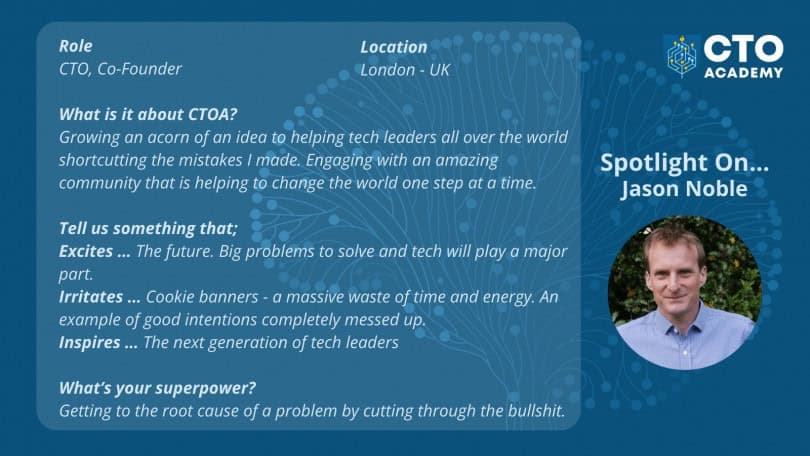
🙌 Helping us keep everything on track is our man from Brazil, celebrating 12 months with CTO Academy …
Here’s a spotlight on Marco Aurélio Zimmermann

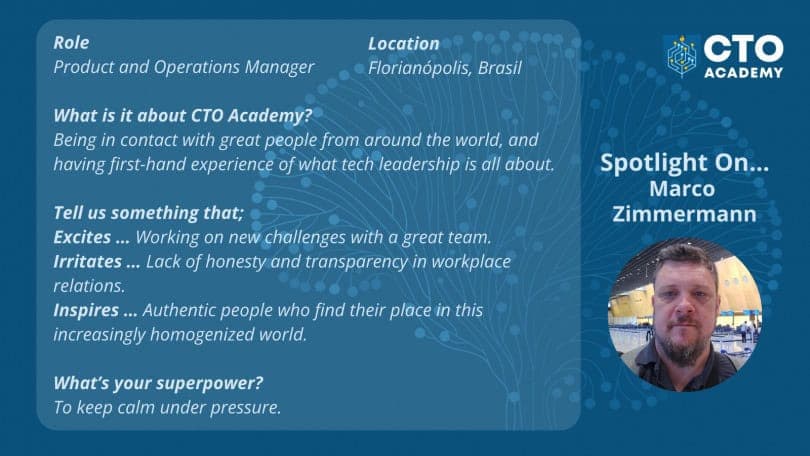
🙌 Helping us keep everything on track is our man from Brazil, celebrating 12 months with CTO Academy …
Here’s a spotlight on Marco Aurélio Zimmermann
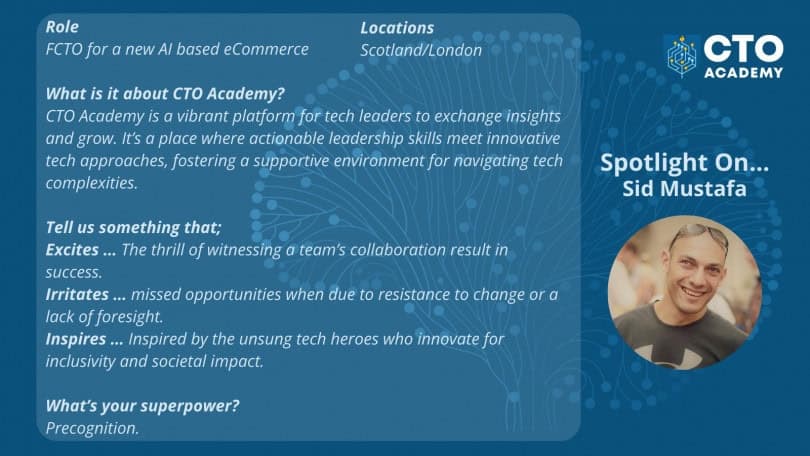
This week one of our favourite community voices here at CTO Academy … spotlight on Serdar Mustafa 🙌

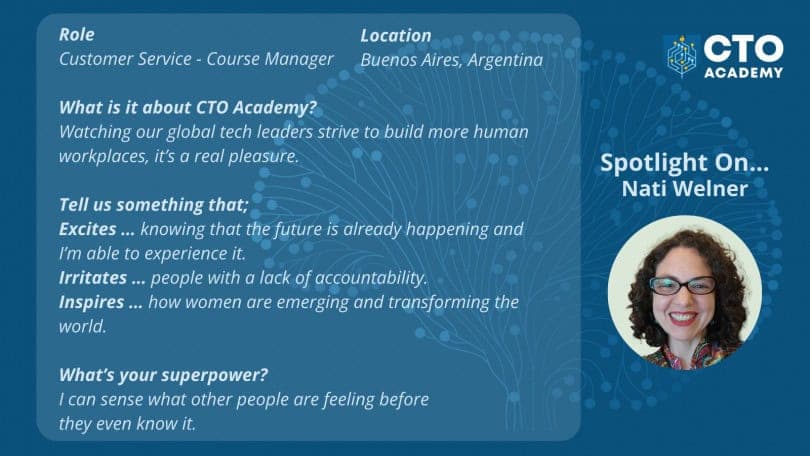
It’s time to celebrate one of our unsung heroes … a spotlight on our MBA Course Manager, Natalia Welner

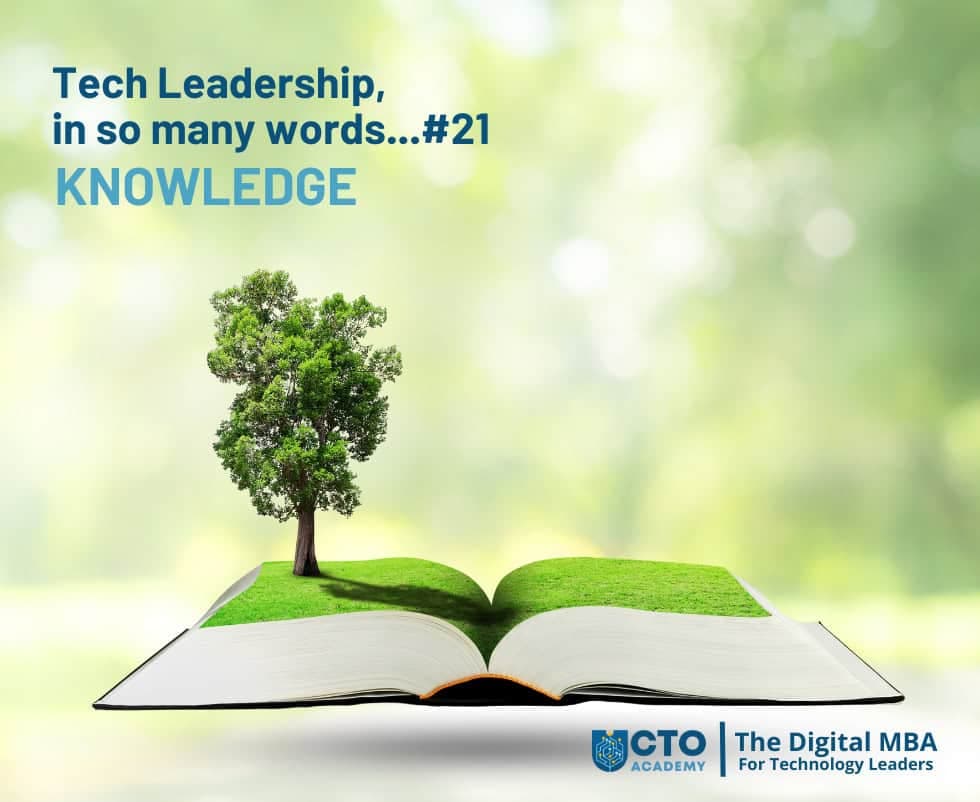
For the modern CTO, knowledge generally comes wrapped in three forms …
This is often about building a T-shaped skill set, with a general awareness of different technologies, alongside a deep understanding of at least one.
This helps you to sharpen your BS antenna about what does and doesn’t “feel” right.
An understanding of the business and the space, particularly around how it makes money. Things can go wrong without it.
Forgetting the customer, failing to spot a changing business landscape and/or not understanding business processes and relationships have been the end of many senior executives (and their businesses).
Core to the success of any CTO is an understanding of and comfort with the soft skills you need to motivate, negotiate and thrive as a senior executive.
Weakness in any of these three areas of knowledge will make your journey to becoming an effective technology leader just that little bit harder.
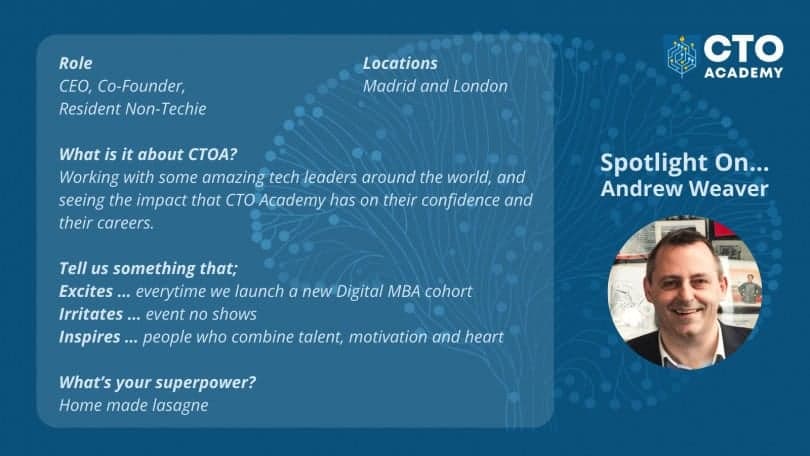
🙌 During the next few weeks we’ll be introducing you to members of our team and global community.
We thought we better start with our CEO and Co-founder as #1.
Spotlight on… Andrew Weaver


This week we launched our new Membership Package which like any and every launch, came packaged with a mixture of expectation and anxiety …
Was it going to work?
Did flow make sense?
Will it add value to the customer experience?
Well … so far, so good as we’ve already seen 100+ global tech leaders sign up and start to enjoy some of the leadership resources and weekly live sessions available via the Membership platform.
But how did we arrive here?
What led us to the launch?
This feels like a good time to give you some of the backstory.
CTO Academy was born out of an idea and a conversation.
The idea came from Jason Noble.
The conversation was with me, on the banks of the River Thames in 2018.
“When building my career towards CTO I wish there had been an ecosystem to help me avoid the obvious mistakes and lean into a support network of peers when I most needed help” was essentially the opening gambit from Jason when pitching CTO Academy.
I was intrigued rather than sold on the concept.
Being the archetypal non-techie, I wasn’t close to the career machinations and challenges faced by those climbing into senior technology roles but I had seen first-hand the struggle for some to achieve the impact they deserved.
We thought there was an idea worth pursuing and whilst unsure about the size or direction of the market opportunity, we made a tentative start by initially launching a short leadership course, pushed by a low budget adwords campaign.
To our delight and surprise …. the course started to immediately sell and importantly, it started to sell around the world.
Of our first 5 customers, only the first was from the UK (thank you Arron Mortimer) so this was clearly a generic and a global issue that we were looking to address.
From there the growth was organic with our original lecture material evolving into a Leadership Foundation Course (now updated into a Future Leaders Course) followed by the launch of 1:1 coaching, group coaching and the product we launched in 2022 which has really caught fire, our executive leadership course The Digital MBA for Technology Leaders.
But we also realised that (a) not everyone is interested in and/or ready to take on our exec leadership course and (b) what happens to those who graduate but want to retain access to the community, Peer-to-Peer sessions and the wider learning experience?
Welcome to CTO Academy Membership.
Built to run alongside and beyond The Digital MBA, it’s an extension of our mission to provide global technology leaders with the leadership insight, ammunition and network to achieve the career impact they want and deserve.
And v1 of the platform is just the beginning.
We have ambitious plans for how the membership offer will evolve and how we can support our global community through the next stages of their professional development and career growth.
What’s more, the CTO Academy journey has been focused on staying close to our customers and adapting our offer to make sure it’s delivering the best and most cost-effective impact.
It’s this direct customer feedback and occasional pushback that’s been at the core of our success and will continue to build both the course and the membership platform.
If you’re not already a CTO Academy member – what’s stopping you?
Get in touch with answers and questions
Andrew Weaver
CEO and Co-Founder at CTO Academy
[email protected]
More information below;
The Digital MBA for Technology Leaders
CTO Academy Membership Package
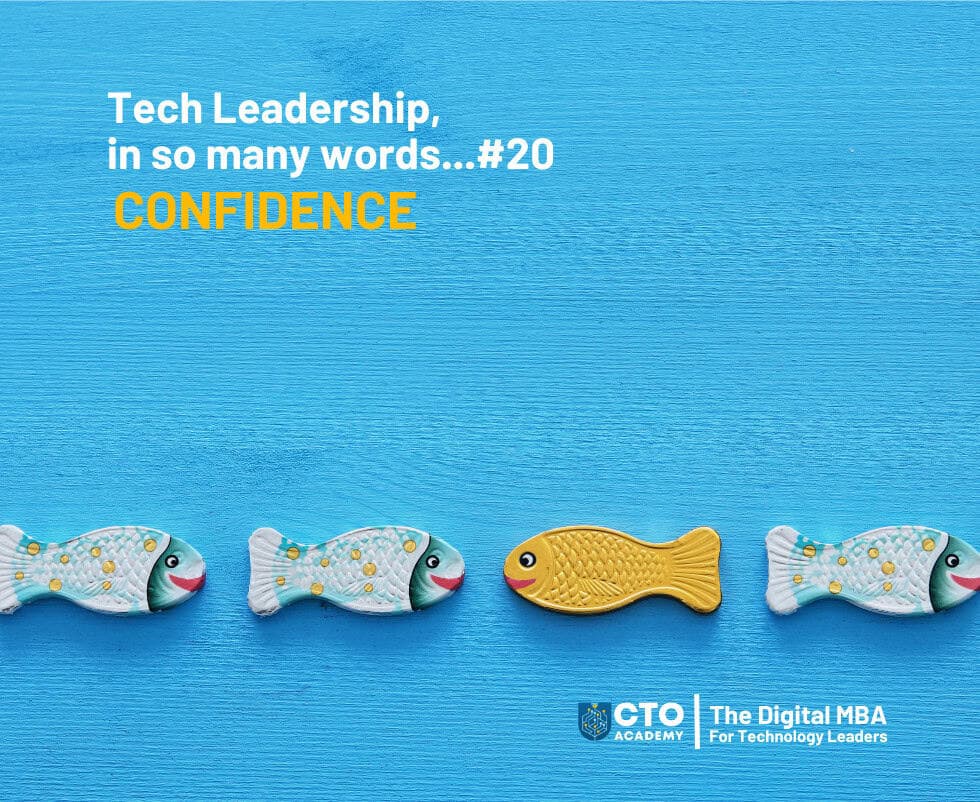
I’ve been asked to write a short piece on the impact of confidence in leadership.
1st, how do I keep it short?
2nd, which angle do I start with for this many tentacled topic?
Because whether we talk about true confidence, projection, self-doubt and/or the ever present Imposter syndrome, how we deal with these issues will likely have a greater impact on what we achieve in our career, business, sport, life as most other factors.
And one of the key challenges we all have to face is building our own sense of self-confidence while managing what we perceive as the confidence and swagger of others, much of which we know is BS.
For we live in an era where Confident incompetence is en vogue and the ability to project confidence, however unmerited, often supersedes other basic qualifications for some very serious jobs, often with disastrous consequences.
It stalks the corridors of political power, blocks talent in large-scale organisations and permeates a start-up world where the projection of confidence attracts investment while covering up a multitude of sins.
The “fake it ’till you make it” job description requires you to express supreme confidence (whatever the background truth) in …
… your product
… your numbers
… yourself
… your incompetence
Some make a virtue of a certain kind of narcissism where the “hustle” gets them to the top whilst the rest of us have to wrestle with imposter syndrome and natural self-doubt.
By contrast, true confidence has a look all of its own and has been the subject of detailed research, particularly within business and sport. The impact of gender differences and stereotyping is a whole field on its own. But stripping it all back to basics, I lean on my old friend Socrates.
He believed that we should find confidence in our own beliefs and not be too swayed by others.
That thinking logically about your life directly correlates to becoming more assured and independent while less conformist and less hamstrung by what others think.
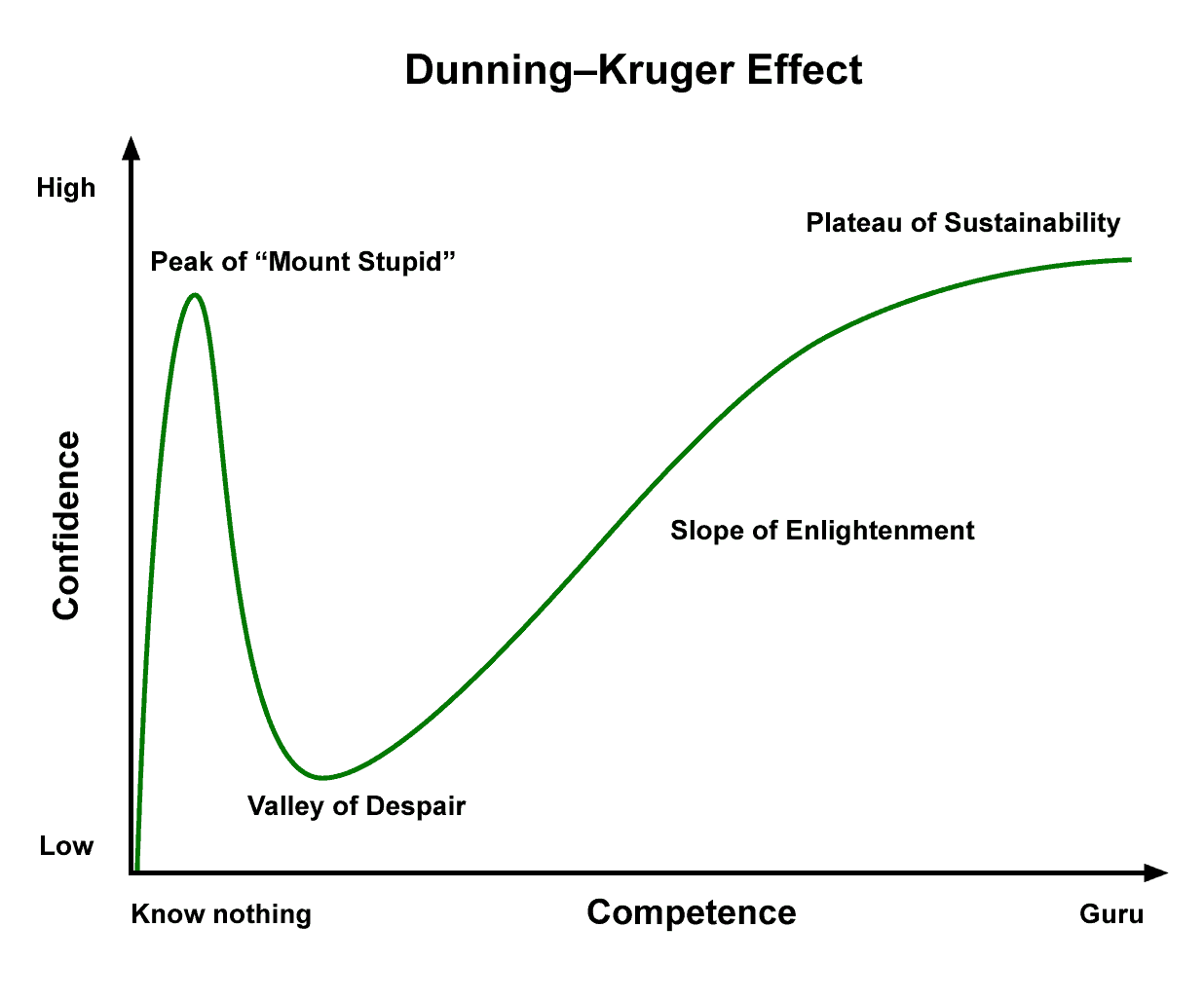
To be a confident leader and one who can bring others with you, you don’t need to know everything or even project that you know everything.
You need to get your happiness from within and lead from that core principle.
From there the rest flows…
You gain confidence and judgment about when to say yes, and when to say no.
You understand the importance of listening more than you speak.
You’re not afraid to admit you’re wrong or celebrate other people when they are right.
You build the courage to take risks and importantly the respect to bring others with you.
And importantly, you’ll be able to spot and comfortably negotiate the confident incompetents.

My biggest flaw as an entrepreneur was a lack of judgment about when to say yes (a natural inclination) and when to say no (suffering from FOMO).
The uncertainty of start-up life meant that I wanted to keep all options open as long as possible which of course, proved completely counter productive as it diluted the narrow focus I needed for any kind of success.
The importance of judging how and when to say no is equally important in managerial and leadership roles because a key challenge we have as developing leaders is how to manage the people-pleaser element that doesn’t want to upset others or let them down, alongside that fear of missing out.
NO might be the smallest word we use, but it’s often the most important one to master.
As you grow into a strategic role within your organisation, the importance of time management, delegation and learning when to say no increases exponentially.
Often, it’s as simple as not knowing how to do it.
What’s the best way to tell people you don’t have the time, or it’s not a good idea or frankly, you just don’t want to do it?
One key consideration is not just saying no, but to explain why you’re saying no — what is the context behind your decision.
It helps if you’re working in a psychologically safe environment where mutual trust allows the team to feel comfortable about stating their capacity and ring-fencing their priorities.
Another key area is managing the iterative feedback loop with stakeholders where you’re under pressure to say yes but at the risk of trying to be all things to all people, an anxiety compounded by the power dynamic of a paying client?
The key is taking time to digest what you’re being asked and avoid rushing into a yes.
I leave you with six bullet points:
1. Learn how to say no politely. Be direct and stick to facts in your answer.
2. If an opportunity or meeting presents itself, before saying yes, ask yourself how much time it will require and whether the potential outcome is worth it.
3. Manage your energy. Understand the rhythms of your day; block out time when you’re most productive and protect it.
4. Prioritise, Prioritise, Prioritise… damn those “to-do” lists, but they are essential.
5. Protect your team. Say no on their behalf to ensure they’re not working over capacity.
6. Provide a role model that empowers others in the team to learn the art of saying no.
“When you say ‘yes’ to others, make sure you are not saying ‘no’ to yourself”
Paolo Coelho
There’s a reason why the shelves of your local bookstore are heaving under the weight of so many management books.
It’s because managing people is tough and would be a lot easier if it wasn’t for the people.
But clearly it’s a prerequisite for anyone with leadership ambitions so the question is this:
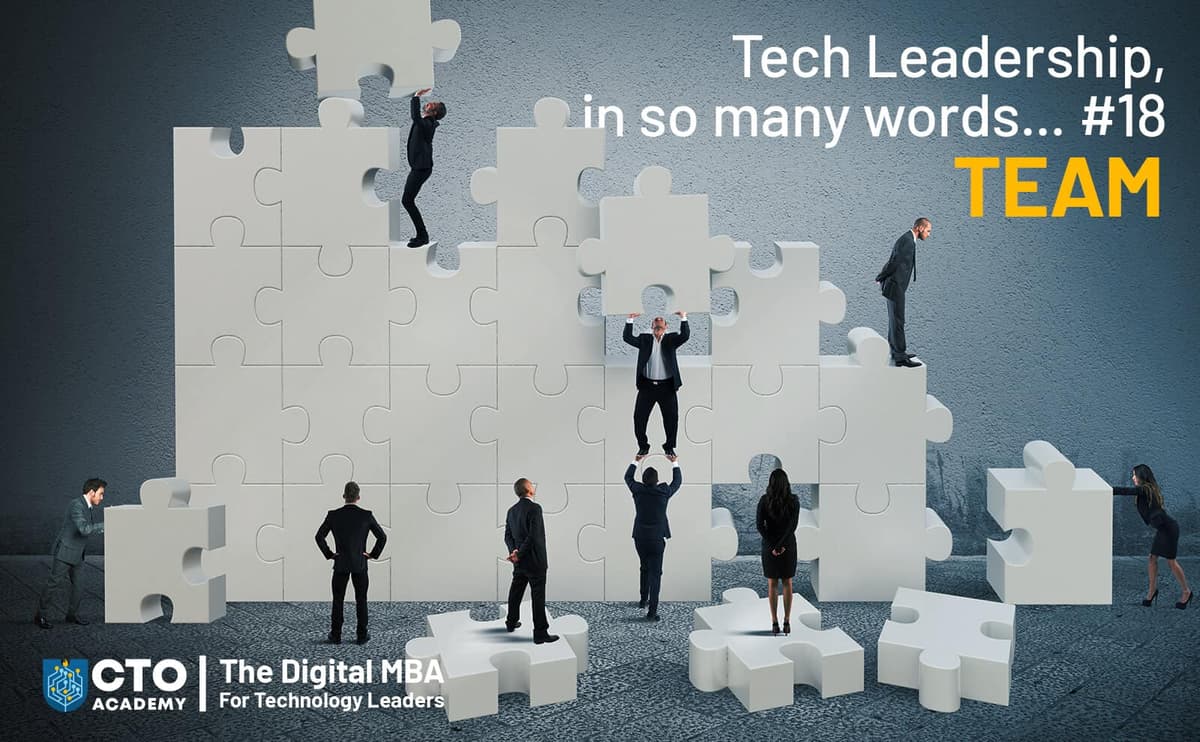
How to most effectively transform a disparate group of individuals into a high-performance team capable of achieving a common goal?
Every management guru has to create their unique perspective but most tend to agree on the following;
It’s about culture and that culture often depends on you.
Hire for fit as well as expertise.
Do they bring the right energy, commitment, values to the team?
And follow the hiring maxim …”If there’s any doubt, there is no doubt”
Create an environment of psychological safety and creative empowerment.
Be supportive and accessible — your door should always be open.
And before we close, an article on management would be incomplete without at least one motivational cliche so here goes…. ‘There’s No i In Team‘.
Individual egos shouldn’t be allowed to dominate the conversation, including yours and beware the superstar who has become more disruptive than irreplaceable.
Finally… the simplest but most overlooked management technique of them all. Learn to say “thank you” more often.
I’m talking specifically to you because I know that you can do this more.
We all can.
Gratitude goes a long way to making people feel valued and it costs you nothing.
‘I’m not the smartest fellow in the world, but I sure can pick smart colleagues”
– Franklin D Roosevelt
BTW, here’s a smattering of those management books you might already have or should think about acquiring;
Want to find out more about CTO Academy and our Technology Leadership Courses, including lectures and discussions focused around Team Building, Dynamics and Culture?
Visit the CTO Academy Website and in particular our executive leadership course, The Digital MBA for Technology Leaders winning rave reviews from technology leaders around the world.