Next MBA Cohort Starts Monday, July 6th, 2026

Review Pricing and Join the Cohort

CTO Academy Logo
Log In

Category: CTO Salary

  • Salary Expectations for Technology Leadership Programs Graduates

    Salary Expectations for Technology Leadership Programs Graduates

    Advancing from a software engineering role to a leadership position in technology significantly boosts your earning potential. While pursuing a master’s degree from a technology leadership program isn’t mandatory for the transition to a management role, the lack of technology leadership education can add years to achieving such career goals.

    By contrast, obtaining a Tech MBA certificate is a strategic move that facilitates and, subsequently, speeds up the transition.

    This article examines the current salary landscape, comparing net salaries on three levels of engagement: software developer, tech lead and Chief Technology Officer (CTO). It also compares the average period to progress to a leadership role with and without the TLP certificate.

    Current Salary Landscape

    United States

    In the United States, the average salary for a software engineer is approximately $123,049 per year, with a reported cash bonus of $5,000 annually. However, salaries can vary based on experience, location and specific skill sets. For instance, software engineers in San Francisco, CA, often command higher salaries, averaging $158,847 per year, due to the city’s higher cost of living and demand for tech professionals. Conversely, regions outside major tech hubs may offer lower salaries.

    In contrast, Chief Technology Officers (CTOs) in the United States have an average base salary of $223,259 per year, with additional cash compensation averaging $55,026, leading to a total average compensation of $278,285. This substantial increase reflects the elevated responsibilities and strategic influence associated with leadership roles.​

    United Kingdom

    In the United Kingdom, the average salary for a software engineer is approximately £67,500 per year. And just like in the US, salaries can vary due to the same influencing factors. For instance, software engineers in London often command higher salaries (£93,972 median) because of the city’s higher cost of living and demand for tech professionals. Regions outside London, on the other hand, may offer lower salaries.​

    At the same time, Chief Technology Officers (CTOs) in the UK have an average salary of £107,945 per year

    Let’s now see the more detailed breakdown of salaries for different role levels in the UK and the US.

    Salary Comparison: UK and US Tech Roles

    UK Tech Salaries

    • Software Engineers – Median annual salary: £67,500 (as of March 2025)
    • Tech Leads/Technical Leaders – Median annual salary: £80,000
    • Lead Software Engineers – Median annual salary: £90,000
    • Chief Technology Officers (CTOs) – Median annual salary: £125,000

    US Tech Salaries

    • Software Developer – Average annual salary: $80,004
    • Tech Leads – Average annual salary: $101,381
    • Chief Technology Officers (CTOs) – Average annual salary: $177,330 to $347,400 (aggregated data from Payscale and Salary.com) with start-up CTOs earning $157,000 on average

    Note the extreme salary range as you move through the roles: around $80K for junior software developers to almost $350K for a CTO role, the highest-paying technology-related position.

    Key Observations

    • In both countries, salaries are significantly higher in tech hubs (London in the UK; San Francisco, New York in the US).
    • US salaries are consistently higher across all positions when converted to the same currency.
    • Software Engineer salaries in the UK have increased by approximately 12.5% year-on-year, while CTO salaries have increased by 8.7%.
    • Larger companies typically offer higher compensation, especially in the US where the difference can be substantial.
    • The jump from Software Developer to Tech Lead to CTO represents approximately a 33% increase at each level in both countries.

    The Impact of a Technology Degree on Career Progression

    A technology leadership education such as a tech MBA certification bridges the gap between technical roles and leadership positions. These programs cover leadership development, strategic management and business acumen, equipping professionals with the skills needed to navigate complex organisational landscapes.​

    Graduates of such programs often find themselves well-positioned for roles that require both technical expertise and leadership capabilities — if they learn from faculties with real C-level leadership experience and not just academic background. This combination is highly sought after, as it enables individuals to effectively lead tech teams, drive innovation and align technological initiatives with business objectives.​

    Common Career Pathway From Developer to Tech Leader

    Common Career Pathway From Developer to Tech Leader - mind map of career stages and roles

    The typical progression from a developer to a tech leader involves several stages:​

    1. Junior Developer: Focuses on coding and learning the fundamentals of software development.​
    2. Senior Developer: Takes on more complex projects, mentors junior developers and begins to influence technical decisions.​
    3. Technical Lead: Oversees development teams, ensures project alignment with business goals and starts engaging in strategic planning.​
    4. Chief Technology Officer (CTO): Sets the overall technological vision, aligns tech strategies with business objectives and leads innovation efforts.​

    Enrolling in a technology leadership program can accelerate this progression by providing the necessary skills and credentials to move into leadership roles more swiftly.​

    The Average Period to Progress to a Leadership Role

    Without a Tech MBA Certificate

    For those without specialised leadership education:

    With an MBA or Technology Leadership Program Certificate

    Key Factors Affecting Progression Speed

    • Individual performance and initiative in seeking leadership opportunities.
    • Company culture and available advancement opportunities.
    • Development of soft skills alongside technical expertise.
    • Willingness to mentor junior developers and take on additional responsibilities.
    • Strategic company switching (2-3 times early in a career) can broaden experience and potentially accelerate advancement.

    The progression is not strictly time-based. Some organisations use time as an arbitrary metric while others focus on demonstrated capabilities.

    Return on Investment

    As you can see, investing in a technology leadership program can yield substantial returns. The salary increase from a software developer and entry-level team leader to a CTO can be significant, often exceeding $100,000 per year in the United States and £50,000 per year in the United Kingdom. Over a typical career span, this can translate into a considerable financial gain, justifying the initial investment in further education.​

    But it’s not just about the money. 

    The only true asset each of us has that we cannot earn more of or save some is – time

    It’s not the same to progress to a leadership role and start earning relative to your potential in 8 years or in under 4 years. 

    Remember the basic rule of income: You will be paid proportionally to the value you are bringing to the market and not the penny more or less. 

    Brian Tracy best explained this rule by stating: “Your financial success is directly related to the size of the problem you solve for other people. That is to say, you will always be paid in direct proportion to the work you do, how well you do it and the difficulty of replacing you”.

    Translated, that means that a software developer or engineer — a tech team member — delivers only a fraction of the solution while the technology leader (CTO) delivers the whole product.

    Conclusion

    For technology professionals aiming to enhance their earning potential and assume leadership roles, enrolling in a technology leadership program or obtaining a tech MBA offers a clear pathway. 

    The advanced skills and strategic insights gained from these programs not only open doors to higher-paying positions but also empower professionals to drive change and, potentially, emerge as market disruptors.

  • CTO Bonus Structure Overview w/ Influencing Factors

    CTO Bonus Structure Overview w/ Influencing Factors

    The CTO bonus structure varies significantly depending on the company size, industry and overall compensation philosophy. However, several common elements and factors typically influence it.

    Influencing factors

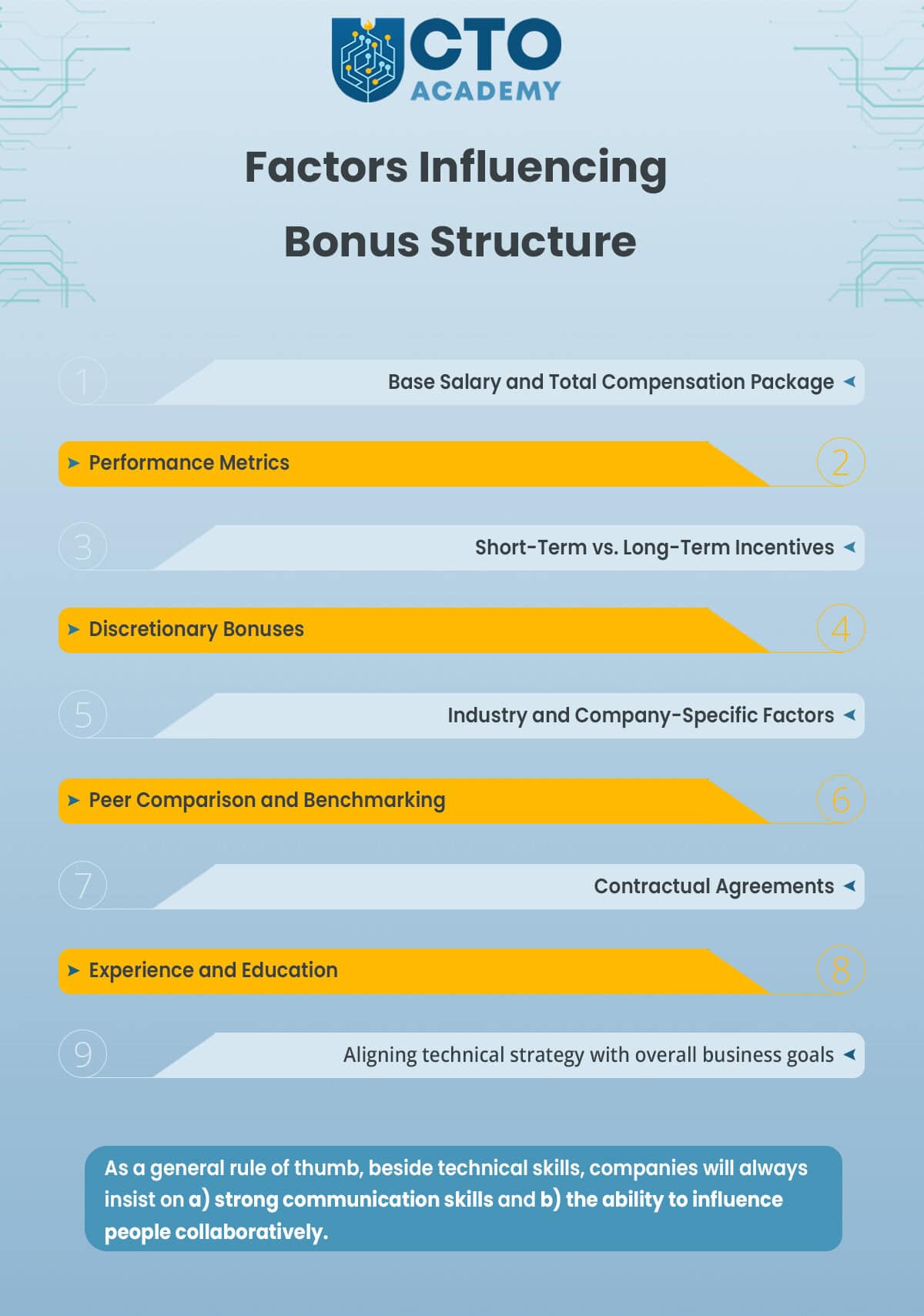
    Factors that influence a CTO bonus structure - infographic summary
    click to download/enlarge

    1. Base Salary and Total Compensation Package

    Read more about the Salary vs. Equity vs. Time aka ‘The Start-Up Conundrum’

    2. Performance Metrics

    A performance bonus is often tied to specific performance metrics, which can be both quantitative and qualitative. Common performance metrics include:

    • Revenue growth
    • Profitability
    • Technology milestones
    • Innovation
    • Cost management
    • Team performance
    • Customer satisfaction

    3. Short-Term vs. Long-Term Incentives

    • Short-Term Incentives (STIs)– Most commonly, annual bonuses based on the mentioned performance metrics.
    • Long-Term Incentives (LTIs) – Stock options, RSUs or other equity-based compensation that vest over several years, aligning the CTO’s interests with long-term company performance.

    4. Discretionary Bonuses

    In some cases, part of the CTO’s bonus might be discretionary, based on the board’s or CEO’s assessment of their overall contribution to the company.

    5. Industry and Company-Specific Factors

    • Start-ups Lower base salaries but higher equity stakes.
    • Large Corporations – Higher base salaries and more structured bonus plans.
    • Industry – The technology sector, for example, might offer different incentives than other industries like healthcare, finance or manufacturing.

    6. Peer Comparison and Benchmarking

    Companies often benchmark their CTO compensation packages against industry standards to remain competitive and attract top talent. They use surveys and reports from compensation consulting firms to get insights into typical CTO bonus structures in similar roles.

    7. Contractual Agreements

    The specific details of a bonus structure are often outlined in their employment contract, including clauses on bonus eligibility, performance reviews and other conditions.

    8. Experience and Education

    Let’s use one of the recently published jobs for the role of Chief Technology Officer to see what requirements companies usually have. In this case, we are talking about a fast-growing business with further expansion plans. However, to expand, they first need to invest in IT infrastructure and technology.

    In their own words, “The company needs a refresh of the technology stack and build a fit-for-purpose IT function that enables the growth of the business with the ability to leverage the overhead base.”

    This is how this company envisions the future CTO:

    TECHNICAL & BUSINESS SKILLS:

    • Experienced technology leader with proven ERP/Technology implementation capabilities and strong project management skills.
    • Candidate should have experience implementing a range of systems as well as field service software experience.
    • Proven integration capability when multiple software solutions are chosen
    • Experience in the development of the long-term technology strategy.
    • Track record in building a fit-for-purpose technology.

    MANAGEMENT (SOFT) SKILLS:

    • Strong communication skills and ability to influence people collaboratively.
    • Ability to work with the business to mentor and coach relevant individuals.

    This is where the right CTO program makes all the difference.

    Example of a CTO Bonus Structure

    • Base Salary: Ł100,000
    • Annual Bonus: 20% of base salary (ie, Ł20,000), based on achieving set performance targets.
    • Equity Compensation: Stock options worth Ł100,000, vesting over four years.
    • Performance Metrics: Revenue growth, successful delivery of technology milestones, exceptional team performance, improved customer satisfaction…

    Common Types of CTO Bonuses

    Performance-based bonuses

    Performance-based bonuses are usually paid annually. They tie the pay to specific metrics (eg, revenue growth, product development milestones, successful technological implementations…)

    This bonus can add 2.5 to 7.5% to the base salary. A Chief Technology Officer in a Fortune 500 company with a base salary of $500,000 could expect to receive a performance-based bonus of $12,500 to $37,500. If, however, the CTO’s performance is exceptional, they could receive a bonus of up to $50,000.

    Equity-based bonuses

    An equity-based bonus is, effectively, an ownership stake in the company. It is common in start-ups and private companies. The incentive lies in future growth because with growth comes an increase in the company’s valuation which turns the equity into a source of wealth.

    An example we also mentioned in the article comparing CTO salaries in the US and UK is Andy Bechtolsheim, a co-founder and former CTO of Sun Microsystems. Just two years after the IPO, the company reached $1 billion in sales. Since Bechtolsheim had an equity-based bonus, he immediately capitalised on the company’s increasing value.

    Retention Bonuses

    A retention bonus encourages a Chief Technology Officer to stay with the company for a certain period. You can expect this type of bonus if a company is undergoing a transition or facing challenges.

    Examples of conditions:

    • If the CTO stays with the company for a defined period (eg, 3 or 5 years).
    • If they meet certain performance goals (eg, increasing the company’s market capitalisation or revenue).
    • If the Chief Technology Officer helps the company to acquire or retain a key customer or partner.
    • If the Chief Technology Officer helps develop or launch a new product or service.
    • If the CTO helps to improve security or compliance posture.

    Conclusion

    The bonus structure should always be designed to reward performance, incentivise innovation and align a CTO’s goals with the company’s strategic objectives.

    But, in the end, each company tailors the structure to fit its specific needs and industry standards.

    Finally, it depends on the stage and financial capabilities of the business.

    Nonetheless, you should always keep in mind the following:

    The more management and soft skills you add to your technical capabilities, the higher your value is in the market.

  • CTO Salary Range in the US and UK: A Comparative Analysis

    CTO Salary Range in the US and UK: A Comparative Analysis

    In this blog post, we explore the CTO salary range; separately for the United States and the United Kingdom. We are examining variations and influencing factors across public and private companies as well as start-ups, fast-growth firms and large enterprises. Additionally, we’ll look into the most common bonus structures of a Chief Technology Officer position.

    And, don’t worry; we’re going to keep this short and straightforward.

    NOTE: All the figures are based on the reports of the people who reportedly are or have been working as Chief Technology Officers. We are, however, talking about hundreds of reports after all so they must be close to the real numbers.

    CTO Salary Range in the US Public and Private Companies

    United States

    Let’s start with analysing the highest-paying sectors this year. This could easily influence your decision if you are looking for a Chief Technology Officer job.

    The highest-paying sectors (averages)

    • Telecommunication: $183,468 (Salary.com)
    • Finance: $181,902 (Salary.com)
    • Consulting: $179,349 (Salary.com)
    • Technology: $178,725 (Salary.com)
    • Healthcare: $174,983 (Salary.com)
    • Media: $174,858 (ZipRecruiter)
    • Software: $174,503 (Indeed)
    • Professional: $174,343 (Salary.com)
    • Education: $173,938 (Salary.com)
    • Government: $173,668 (Salary.com)
    • Manufacturing: $173,543 (Salary.com)
    • Retail: $172,843 (Salary.com)
    • Real Estate: $171,843 (ZipRecruiter)
    • Logistics: $171,658 (Indeed)

    Now, let’s check the averages separately for private and public companies in the US.

    Private companies

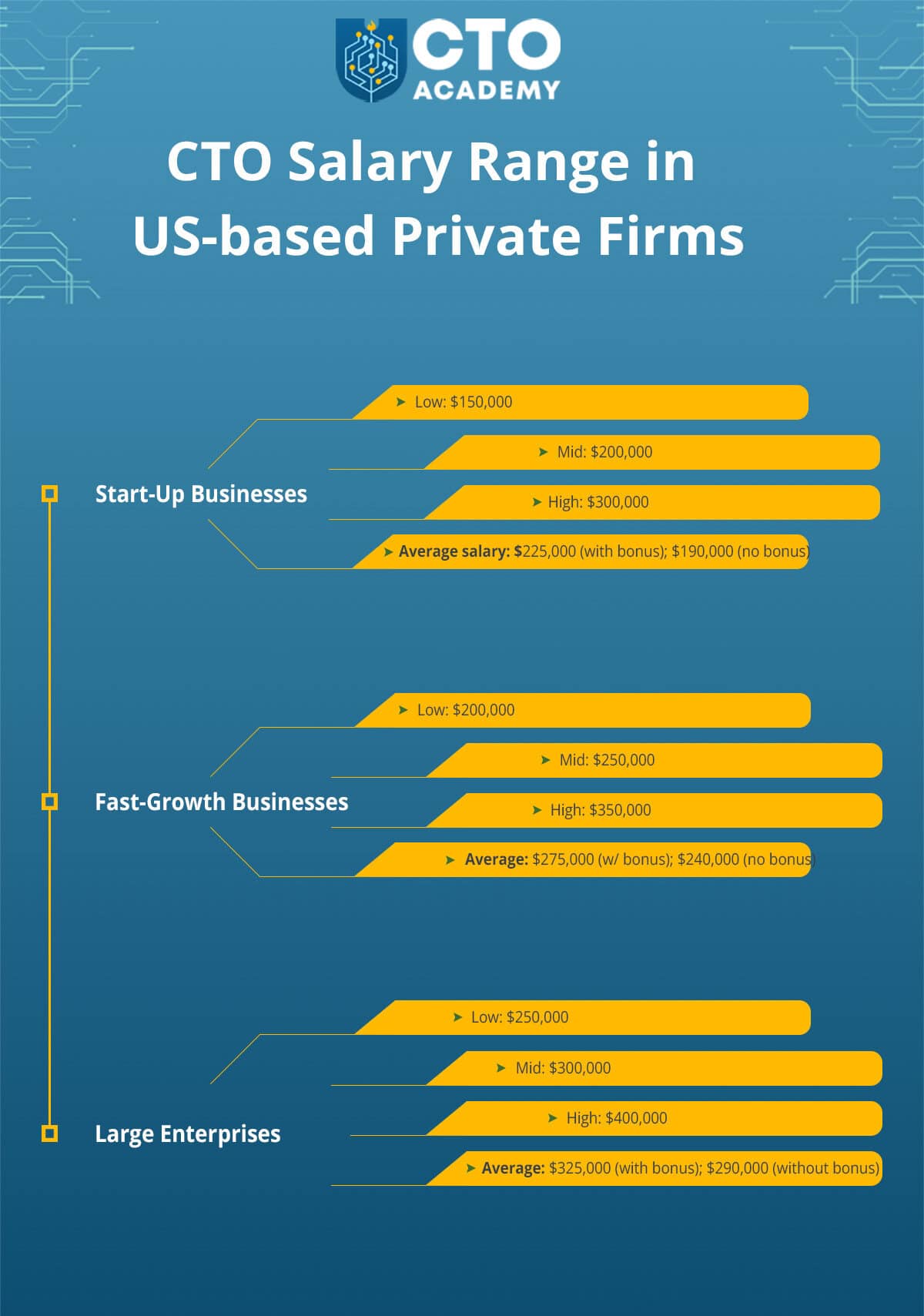
    CTO salary range in US-based private companies - low, mid, high, averages summary
    (click to enlarge/download)

    Start-ups

    • Low: $150,000
    • Mid: $200,000
    • High: $300,000

    Average salary: $225,000 (with bonus); $190,000 (without bonus)

    Fast-growth companies

    • Low: $200,000
    • Mid: $250,000
    • High: $350,000

    Average: $275,000 (with bonus); $240,000 (without bonus)

    Large enterprises

    • Low: $250,000
    • Mid: $300,000
    • High: $400,000

    Average: $325,000 (with bonus); $290,000 (without bonus)

    Public Companies

    Start-ups

    • Low: $150,000
    • Mid: $200,000
    • High: $300,000

    Average: $225,000 (with bonus); $190,000 (without bonus)

    Fast-growth companies

    • Low: $200,000
    • Mid: $250,000
    • High: $350,000

    Average: $275,000 (with bonus); $240,000 (without bonus)

    Large enterprises

    • Low: $250,000
    • Mid: $300,000
    • High: $400,000

    Average: $325,000 (with bonus); $290,000 (without bonus)

    Sources: Salary.com, Payscale, Indeed

    United Kingdom

    The highest-paying sectors

    The highest-paying sector for Chief Technology Officers (CTOs) in the UK is software, with an average salary of £174,503. The lowest-paying industry is retail, with an average of £172,843.

    According to Glassdoor, these are the highest payers:

    1. Software: £174,503
    2. Financial services: £174,407
    3. Professional: £174,343
    4. Consulting: £174,133
    5. Education: £173,938
    6. Technology: £173,827
    7. Media: £173,742
    8. Government: £173,668
    9. Manufacturing: £173,543
    10. Retail: £172,843

    Differences are almost insignificant. Let’s now break down these averages to private and public businesses and government institutions.

    Private Companies

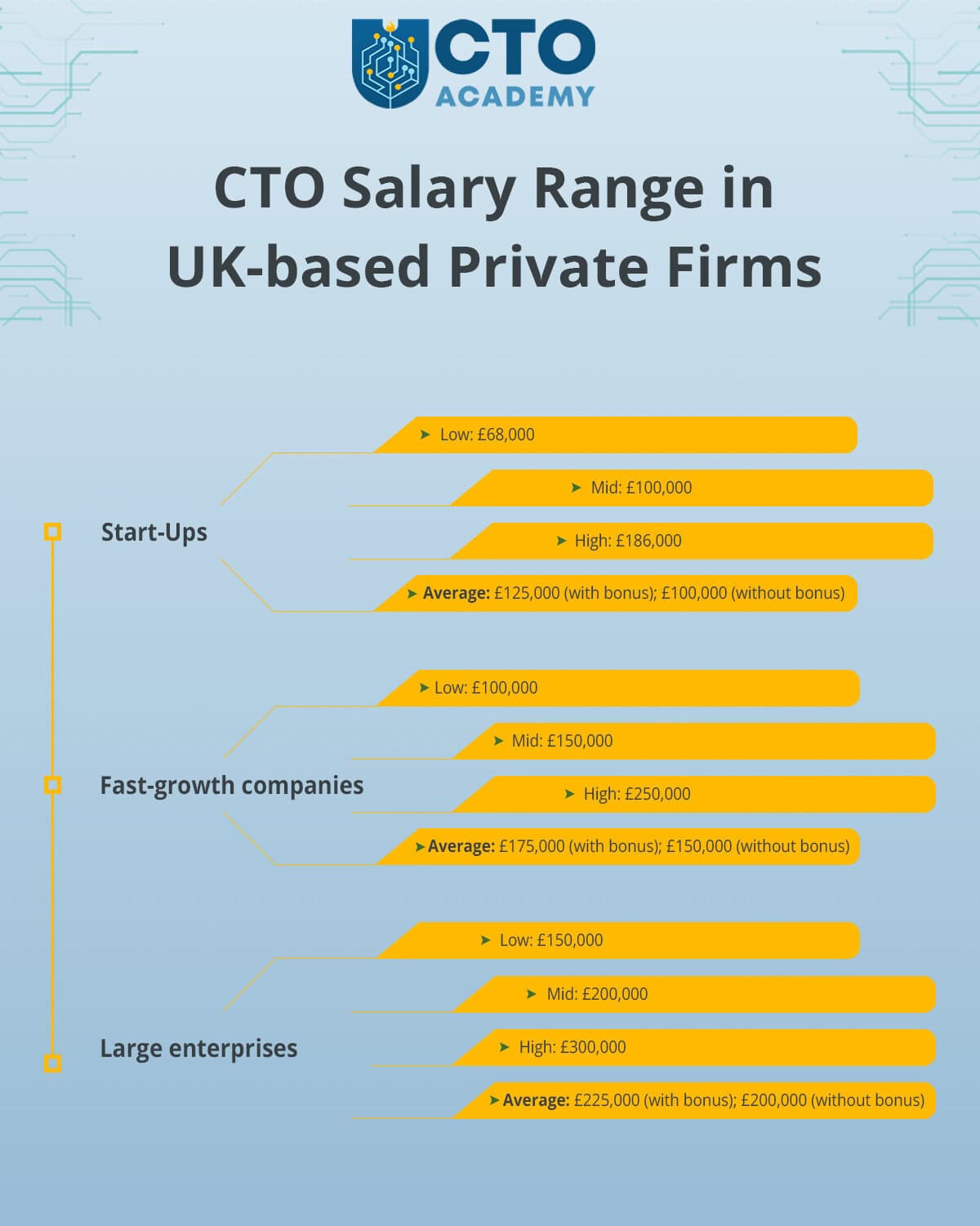
    CTO salary range in UK-based private companies - low, mid, high, averages summary
    (click to enlarge/download)

    Start-ups

    • Low: £68,000
    • Mid: £100,000
    • High: £186,000

    Average: £125,000 (with bonus); £100,000 (without bonus)

    Fast-growth companies

    • Low: £100,000
    • Mid: £150,000
    • High: £250,000

    Average: £175,000 (with bonus); £150,000 (without bonus)

    Large enterprises

    • Low: £150,000
    • Mid: £200,000
    • High: £300,000

    Average: £225,000 (with bonus); £200,000 (without bonus)

    If we now compare public companies, we will see the same ranges – just like it’s the case with US companies.

    Public Companies

    Start-ups

    • Low: £68,000
    • Mid: £100,000
    • High: £186,000

    Average: £125,000 (with bonus); £100,000 (without bonus)

    Fast-growth companies

    • Low: £100,000
    • Mid: £150,000
    • High: £250,000

    Average: £175,000 (with bonus); £150,000 (without bonus)

    Large enterprises

    • Low: £150,000
    • Mid: £200,000
    • High: £300,000

    Average: £225,000 (with bonus); £200,000 (without bonus)

    Sources: Salary.com, Payscale, Indeed, Glassdoor CTO salary

    And in case you’ve been wondering…

    The Average CTO Salary in Fortune 500 Companies

    Salary.com cites $512,800 while the query on Glassdoor returns $465,109. Somewhere within the mid-range are Payscale and Indeed with $492,276 and $487,514 respectively.

    Looking for more? Okay, here it comes…

    The average CTO Salary at Google

    The salary of a Chief Technology Officer at Google varies depending on the experience, skills and location. According to Glassdoor, the average base salary is $350,000. However, the total package can be much higher, in some instances reaching well over $500K by some estimates.

    What about those bonuses that can double the salary? What types are most commonly available to Chief Technology Officers?

    Common CTO Bonus Structures

    Bonuses play a crucial role in remuneration, reflecting performance, achievements and contributions. They come in several forms:

    Performance-based bonuses

    Performance-based bonuses, typically paid annually, tie the CTO’s pay to specific metrics, such as revenue growth, product development milestones or successful technological implementations.

    On average this bonus can add to the base salary up to 2.5-7.5%. It can, however, go as high as 15% in some instances. For example, a Chief Technology Officer in a Fortune 500 company with a base salary of $500,000 could expect to receive a performance-based bonus of $12,500 to $37,500. If the CTO’s performance is exceptional, they could receive a bonus of up to $50,000.

    Equity-based bonuses

    An equity-based bonus, often seen in start-ups and private companies, grants a Chief Technology Officer ownership stake in the company. As the company grows and its valuation increases, the CTO’s equity can become a substantial source of wealth.

    A good example is Andy Bechtolsheim, a co-founder of Sun Microsystems and a former CTO of the company. From the IPO in 1986, the company reached $1 billion in sales by 1988. Along with the base salary, Bechtolsheim also had an equity-based bonus. After the IPO, as the company’s value was increasing, so was Bechtolsheim’s equity value.

    Retention Bonuses

    A retention bonus encourages a Chief Technology Officer to stay with the company for a certain period. These bonuses are particularly prevalent in situations where a company is undergoing a transition or facing challenges.

    Here’s a couple of examples of conditions attached to retention bonuses:

    • If the CTO stays with the company for a certain period; eg, 3 or 5 years.
    • If the Chief Technology Officer meets certain performance goals, such as increasing the company’s market capitalisation or revenue.
    • If the Chief Technology Officer helps the company to acquire or retain a key customer or partner.
    • If the Chief Technology Officer helps the company to develop or launch a new product or service.
    • If the CTO helps the company to improve its security or compliance posture.

    Factors Influencing the CTO Salary Range

    Several factors influence the salary ranges for CTOs. Some, like the size of a company, industry and geographic location we already saw. But there are also two additional ones that can affect the pay regardless of these three. They are:

    • Technical expertise and experience
    • Market demand

    In other words, an experienced Chief Technology Officer working in a company that has a product with high market demand can make more regardless of the company’s size and location.

    Conclusion

    These salary insights help you understand the factors that influence remuneration and the intricacies of common bonus structures. You should now be able to add missing elements to your decision-making process and, ultimately, decide where you see yourself in the future. This is particularly important if you’re stepping into the CTO shoes from a software engineering position. Now you know the difference between your median pay as a software engineer and what you can expect in the executive role.

    CTO Academy is here to help you better understand how to become a CTO who enjoys all the financial benefits of this top executive role. After all, the salary is primarily determined by your efficacy and not that much by the location or the size of the company. If nothing else, highly skilled CTOs can always search for something better.

  • What is the Average CTO Salary in India?

    What is the Average CTO Salary in India?


    With so many uncertainties in the world, it is difficult to predict the future, but one doesn’t need a crystal ball to see that India is primed to become the powerhouse of the global economy. It is, therefore, reasonable to assume that the CTO salary in India will keep increasing.

    With macro-economic stability, infrastructure-led economic growth opportunities, financial sector reforms, and positioning as a strong player in global supply chains, India is set for exciting times, at the centre of which are the innovation and tech hubs emerging across the country.

    At the heart of these clusters are the tech leaders charged with making the magic happen.

    What is a CTO?

    The Chief Technology Officer (CTO) is generally regarded as an organisation’s top expert in information technology.

    Their job description is to oversee the technology strategy and make sure it aligns with business goals.

    There can be an overlap with the Chief Information Office (CIO) but the best way to define the difference between the roles is that the CIO tends to focus internally on technology for the business, whilst the CTO is more outward-facing with a focus on technology for the market.

    What are the qualities of a good CTO?

    A good CTO must have sound knowledge of IT systems and business management skills and possess highly effective leadership qualities.

    CTOs are expected to be technically competent so the difference between a good and great CTO is almost always down to their leadership, aka soft skills.

    They should be able to think critically and creatively, have strong communication skills, be well organised, have people and time management skills, and be results-oriented. They should also have effective emotional intelligence attributes that enable them to truly understand how to lead.

    Chief Technology Officer career path

    There is no typical career path — the enterprise tech leader is likely to have started working at smaller organisations as a software engineer and team leader first to gain experience before moving to larger companies. Their learning development process has been steady, gradual and often highly focused on careers.

    The start-up CTO might have been thrown in at the deep end and ahead of the career schedule. The learning curve from software development (e.g., web development) to an executive function is extremely steep and the immediate challenges are many and varied. Often, it’s about putting out constant fires and how to drive traction and engagement for product and business. It’s all about process, hiring and product.

    How much money does a CTO earn in India?

    Now, this is not an easy question to answer for two reasons.

    1. Different websites say different things about the base salary.

    2. CTO salaries are usually linked to performance, stock options etc, so the highest salary with one company might not be as attractive as elsewhere, but the overall package is highly incentivised towards the success of that business.

    But we have to start somewhere…

    This is the average CTO salary in India
    Photo by rupixen.com on Unsplash

    The average CTO salary in India

    According to India’s franchise of Talent.com, the CTO salary in India is about ₹ 2,500,000 per year or ₹ 1,002 per hour. In the top tier, we are talking about ₹ 4,050,100 per year and ₹ 1,500,000 at entry level. These averages are based on 162 reported salaries.

    Glassdoor suggests that the average chief technology officer salary per month is lower at ₹2,677,059 ($37,000).

    However, we thought it would be interesting to research the differences between Indian cities.

    What is the average salary in different Indian cities?

    Our research indicates significantly higher base salaries if you work in the major tech centres. For example, the highest-paying CTO job at this moment is in Bangalore, where a CTO can make up to ₹84,84,527 per year.

    However, in smaller cities or regions with lower concentration of tech companies like Kochi or Jaipur, a CTO salary starts at ₹1,150,000 a year.

    Remember again that many of these salaries will be attached to bonuses and profit sharing so treat the headline figures with caution. But it shows a relative disparity between what these sites claim is the overall average:

    • Mumbai ₹5,665,000 ($68,253)
    • Bangalore ₹5,500,000 ($66,265)
    • Hyderabad ₹5,450,000 ($65,663)
    • Kolkata/Chennai ₹5,400,000 ($65,060)
    • Kochi ₹5,080,000 ($61,205)
    • Agra ₹5,080,000 ($61,205)

    There is, however, one additional factor you must consider because it directly impacts your monthly earnings.

    What’s Your Market Value?

    The talent emerging from India is phenomenal and will only get stronger.

    Whilst it’s good to know market rates, what’s more important is to understand and grow your market value.

    There is a huge demand for high-impact CTOs and technology leaders and your route to exceeding these average salaries is to enhance your leadership skills, so the negotiating balance of power is in your hands.

    CTO Academy provides technology leadership courses, coaching and career development to help you achieve your optimal career performance and reward.

  • What is the Average CTO Salary in the UK?

    What is the Average CTO Salary in the UK?

    The very best tech leaders are certainly in demand lately, but what is the median CTO salary in UK and what does it involve? In this post, we are examining the median salaries of chief technology officers in the United Kingdom with and without compensation packages, and comparing the national average with a few selected cities that pay the highest.

    Historically, a chief technology officer was the least defined C-suite executive role. However, with such rapid technological change, it has now become one of the most important. To make things more challenging, a software engineer can become an executive officer overnight and, thus, must be ready to cope with a brand-new job description.

    It’s also the role that most of our customers hold or aspire to achieve and when they ask us for assistance, it generally revolves around the following key outcomes:

    • How to enhance their leadership skills and confidence to become more effective at their current job.
    • How to do the same but in order to achieve a new job?
    • How to increase their salary, with the follow-up question, ‘How much can I expect to earn?’

    What does a UK-based chief technology officer compensation package entail?

    As a rule of thumb, companies’ reward for senior roles is wrapped up in compensation packages where the low market-rate salary of today can be offset by attractive stock and equity options for tomorrow. In other words, the base salary may seem puny but add the rest from the package and you end up with decent money each month.

    What Is the Average CTO Salary in the UK?

    The UK-based technology officer salary range varies depending on factors such as education, experience, sector, and location.

    According to Payscale, the average UK salary for a CTO is now (on Oct. 21, 2024) £99,993, while Indeed sets it at £90,437 (based on 404 salary reports).

    Entry-level CTOs, however, can expect to make £73,697 per year on average.

    However, Payscale also indicates that total packages, including base, bonus and profit share can range from £51,000 up to £175,000. So, knowing the average is interesting, but barely scratches the surface.

    It is no great surprise that the average salary increases precipitously with experience. People with over 10 years of experience can earn up to 50 per cent more than someone with less than four years in the job.

    Additionally, location makes a massive difference in the UK, with chief technology officer positions based in London unsurprisingly attracting the highest averages.

    Trends in CTO salary in UK

    What is the average CTO salary in London vs. the national level?

    Sites like Morgan McKinley, Payscale, Indeed and Salary Expert arrive at slightly different outcomes in their analysis of an average London CTO salary.

    The average figures range from £98,192 (Glassdoor) to £103,645 (Salary Expert) and £106,963 (Payscale). The packages vary according to the additions included.

    The differences between entry-level CTO positions and the most senior levels range between:

    • Glassdoor: £39,000-£186,000
    • Salary Expert: £71,805-£129,059
    • PayScale: £65,000-£168,000

    According to Indeed, if you’re based outside London you want to be living in Leeds or Southampton because average salaries there don’t appear to be far short of the capital (though I’d like to see the dataset used because the figures don’t chime with what we see on the ground)

    1. London (£104,447)
    2. Leeds (£102,826)
    3. Southampton (£101,727)
    4. Edinburgh (£85,503)
    5. Manchester (£83,061)
    6. Birmingham (£74,330)
    7. Glasgow (£72,761)
    8. Cambridge (£66,785)

    We view the Cambridge average salary in particular with a little scepticism.

    It’s recorded very differently by Payscale at £92,500 and anecdotal evidence from that vibrant region (packed with hi-tech, fast-growth companies) suggests that any company offering less than £70k for a chief technology officer will either be moribund or stacking the offer with very attractive benefits and stock options.

    What is the average startup CTO Salary in the United Kingdom?

    Determining the reward structure at start-ups is even trickier because the chief technology officer and senior team are often paid below (sometimes well below) market rate based on work today, jam tomorrow.

    You also need to consider what stage the company is at with fundraising.

    If the company is looking for seed funding, then the tech founder/leader is likely to be getting paid half or worse than their market rate.

    Additional factors determining the earnings are the overall health of cash flow and the direct impact the chief technology officer brings to business growth. Everything is negotiable but never more so at the early stages of a company set-up, particularly if much of early success relies on the technical direction and execution provided by the CTO.

    Generally speaking, for an early-stage company with a Series A round, you’d expect the CTO salary to be about £80,000-£90,000 per year with stock options and other perks helping to soften that reduction in the standard market rate.

    What about other senior tech roles?

    Reed is a great source for data on median salaries across all roles and levels.

    In their 2022 technology salary guide they detail a wide range of roles including data on the following non-CTO leadership positions in the United Kingdom:

    CIO salary

    • £130,000 (0-50 direct reports)
    • £245,000 (200+)

    IT Director

    • £100,000 (0-20)
    • £147,000 (100+)

    Head of IT

    • £71,000 (0-10)
    • £145,000 (100+)

    Additional considerations regarding the CTO market

    The tech field remains frustratingly male-dominated.

    According to 205 survey responses on a PayScale survey, there are 96 men for every four women.

    This needs to change because diversity is great for any business and sorely needed in tech.

    This is why we’re delighted to support organisations like the School of Code which promotes greater diversity in tech. Judging by its last cohort with a 50/50 split, it’s practising what it preaches.

    CTO Academy‘s View on How to Boost Your Market Value

    The problem with anything average, is, who wants to be average?

    We work with UK-based CTOs attracting significantly more than the salaries indicated above, though, as mentioned, many of the truly breath-taking packages are wrapped up in the wider success of the particular company.

    So, reward comes down to two key factors.

    1. Enhancing your market value so you dictate terms, rather than accept the average;

    2. Finding a company with sufficient ambition to realize your full potential.

    And you enhance your market value by the impact you’re able to make in a senior role, which will be driven by leadership rather than technical skills.

  • Salary vs. Equity vs. Time aka ‘The Start Up Conundrum’

    Salary vs. Equity vs. Time aka ‘The Start Up Conundrum’

    Why do we turn up for work?  Why do we burn that midnight hour trying to breath life into an invisible start up?

    Altruism, the craic or just those (soon to be restricted) free beers from the We Work fridge?

    Maybe for you it’s some or none of the above but, what it should be is a project that is a mixture of challenging, intellectually stimulating and ultimately, rewarding.

    Ah, yes, the filthy lucre which let’s face it (despite all those who say “I’m in it to change the world”) is normally the driving force as you seek a handsome reward after, to offset the financial pain during.

    (more…)
  • What is the CTO Salary in the USA in 2023?

    What is the CTO Salary in the USA in 2023?

    Do you know why some chief technology officers can drive very attractive salary and equity packages while others can’t? This post looks at the average CTO salary in the USA in 2023 across cities, states and organizations, examining the determining factors that affect the bottom line for tech leaders working in US companies.

    Just to give you a clue, the average base salary of a Washington-based chief technology officer is $220,239 while one working in Alabama will earn 41% below the national average which is (a still decent) $113.837.

    The size of the paycheck is, of course, influenced not only by location but also by company size and market share.

    Other factors that affect CTO salary

    A chief technology officer is an integral part of the decision-making team in an organization and generally oversees the technological developments and requirements, leading, managing and sometimes coercing high performance from the technical team.

    The CTO not only evaluates short- and long-term technology goals for the business but may also be responsible for finding optimal ways to invest capital and for developing policies that use technology to enhance the customer experience (ie. product-market fit).

    It’s a role that demands strategic thinking, problem-solving, management and role-specific leadership skills — whether focused on infrastructure, team building, planning, or customers. There’s also a fair amount of pressure, as with most executive-level roles.

    The salary negotiation will include all these variables. What we can do here is provide an approximation of the averages you might expect — though, alas, there are no guarantees.

    Also note that these averages do not include equities companies often use to entice top-quality staff, offering them as long-term rewards to offset short-term salaries below the market rate. These packages are particularly common in the start-up environment, which makes accurate analysis of senior management salaries quite tricky.

    What is the average CTO salary in the USA?

    The average annual salary for a US-based chief technology officer is $194,006. This is the median number derived from 562 reported salaries in April 2023 collected by Indeed.com.

    As a rule of thumb, along with a salary comes a CTO compensation package which commonly includes:

    • Dental insurance
    • Health insurance
    • Paid time off

    What are the CTO salary ranges in the US?

    The highest-paying US city is Seattle, Washington, where CTOs average $264,532 (based on 15 reported salaries).

    At the same time, and, perhaps, contrary to general belief, a tech leader working in Los Angeles will bring home far less, $170,605.

    On the national level, however, the highest CTO salary according to Glassdoor is $311,540 while the lowest is around $100,161.

    If we cross-check the US states/cities/big companies, Google’s chief technology officers get $216.172 plus up to $400K in equities. It seems that it still pays off to work in Silicon Valley, doesn’t it? But the last reported CTO salary at Google is just above $190,000 including bonuses, so keep that in mind when contemplating the aggregates you find online.

    Interestingly enough, an Idaho-based software development company, Corporate Tools, pays a whopping $400,000 to CTOs if we are to believe 8 salary reports submitted to Indeed.com.

    From San Francisco to New York, the United States of America still pays the highest rates to chief technology officers compared to the rest of the world.

    What is the average start-up CTO salary in the US for 2023?

    Wellfound reports that a software start-up CTO will make approximately $95,1K in 2024.

    However, determining the expected median salary of a chief executive officer in a start-up is difficult. For instance, the founders of a company often take salary reductions as the equity they hold in the company will be much higher than any other employee. Thus, they take pain today but stand to gain significant reward in the event of a potentially successful exit tomorrow. And they offer the same to a candidate for a CTO role.

    Read more about the Salary vs. Equity vs. Time aka ‘The Start-Up Conundrum’

    Additionally, if the company is still looking for seed funding, the CTO salary range will be significantly lower than the average as investors will rarely tolerate big salaries at such an early stage. As the company becomes more stable, raises more money and starts to show decent profitability, market-rate salaries become more acceptable and, frankly, the senior team should start demanding them. Remember, You should only underpay yourself in extreme circumstances.

    Finally, the average salary of a chief technology officer in a US start-up may depend on answers to any or all of these questions:

    • Is the company healthy?
    • What kind of tactical or strategic decisions are you making?
    • What is the revenue model?
    • What does your equity package look like?
    • How impressive is your resume?

    We advise that you consider these before moving into a high-reward, high-risk start-up.

    The average CTO salary in the USA in 2023

    Conclusion

    Chief technology officers are highly sought after in the global market, with demand outstripping supply of good quality CTOs with broad management skills.

    The US market is no exception.

    In early 2019, the Bureau of Labor Statistics predicted that job openings for CTOs in the US are likely to continue increasing over the next few years with the exponential growth of businesses based on information systems.

    Demand for software engineering positions and tech leaders will increase as the companies and teams grow and branch.

    Growth in the internet and mobile usage, increasing emphasis on business solutions, the growing importance of IoT (Internet of Things) and big data in business operations are other significant factors driving the demand for high-quality technology leaders.

    Several factors will determine your final CTO salary package. That is to say, the more management and soft skills you add to your technical capabilities, the higher your value is in the market.

    Therefore, first, arm yourself with a wide range of skills and expertise that makes you a desirable leader, and only then negotiate the salary package you deserve. Make no mistake; do it right and your employer will be prepared to pay generously.

  • Some of the realities, About start up salaries

    Some of the realities, About start up salaries

    As a rock star developer, what are your career (remuneration) options?

    • An above average salary at investment bank or hedge fund, but with long hours and little control
    • Public body where, you earn less, but the hours and benefits (particularly those juicy pensions) are better and more comforting
    • Large company where you benefit from the corporate perks but, suffer from the politics and risk being lost in mediocrity or …
    • The crazy, unpredictable world of start ups and fast growth companies where you have few corporate perks, lots of ping pong, too many potential downsides but, boy oh boy you will have control, direct input, bags of fun (at least during the growth phase) and for sure, you’ll be guaranteed the sharpest of learning curves.
    (more…)