Next MBA Cohort Starts Monday, July 6th, 2026

Review Pricing and Join the Cohort

CTO Academy Logo
Log In

Category: CTO Roles

  • Chief Technology Officer in the AI Era: Role, Responsibilities, Skills, and Leadership Priorities

    Chief Technology Officer in the AI Era: Role, Responsibilities, Skills, and Leadership Priorities

    A Chief Technology Officer is the senior technology leader responsible for connecting technical capability with business direction.

    In some organizations, the CTO owns product architecture, engineering strategy, platform decisions, and innovation. In others, the role is focused on technology transformation, data, infrastructure, security, or AI adoption. The exact shape depends on the organization’s size, stage, and business model.

    What has changed is the level of visibility.

    The CTO is no longer judged only on technical depth or delivery performance. The role now carries broader responsibility for how technology creates value, manages risk, supports growth, and shapes the organization’s future capability.

    AI has made that responsibility more urgent

    Executive teams are asking where AI can improve productivity, where it can create new products or services, where it introduces risk, and how it should be governed. Those questions require strategic judgment, commercial awareness, leadership confidence, and the ability to explain complex trade-offs clearly.

    This guide explains what a Chief Technology Officer does, how the role compares with CIO, VP of Engineering, and Head of Engineering, how AI is changing CTO responsibilities, and what skills modern technology leaders need to build CTO readiness.

    TL;DR

    • The CTO role now sits closer to business strategy than traditional technical management.
    • A modern CTO connects architecture, engineering capability, product direction, security, data, AI, and commercial priorities.
    • The difference between CTO, CIO, VP of Engineering, and Head of Engineering usually comes down to scope: future direction, internal systems, execution, and team delivery.
    • AI has increased the pressure on CTOs to guide adoption, manage risk, set guardrails, and turn experimentation into useful outcomes.
    • CTO readiness requires strategic judgment, executive communication, commercial awareness, governance, and leadership range.
    • The next step for many current and aspiring CTOs is to identify their capability gaps and build a deliberate development path.

    What is a Chief Technology Officer?

    A Chief Technology Officer, or CTO, is the senior leader responsible for shaping how an organization uses technology to achieve its goals.

    The role sits at the intersection of technology, business strategy, product direction, and organizational capability. As a CTO, you are expected to understand the technical landscape deeply enough to make sound decisions, but the role is not limited to technical expertise. The CTO must also decide which technology investments matter, which risks need attention, and how technical choices affect customers, teams, revenue, resilience, and long-term competitiveness.

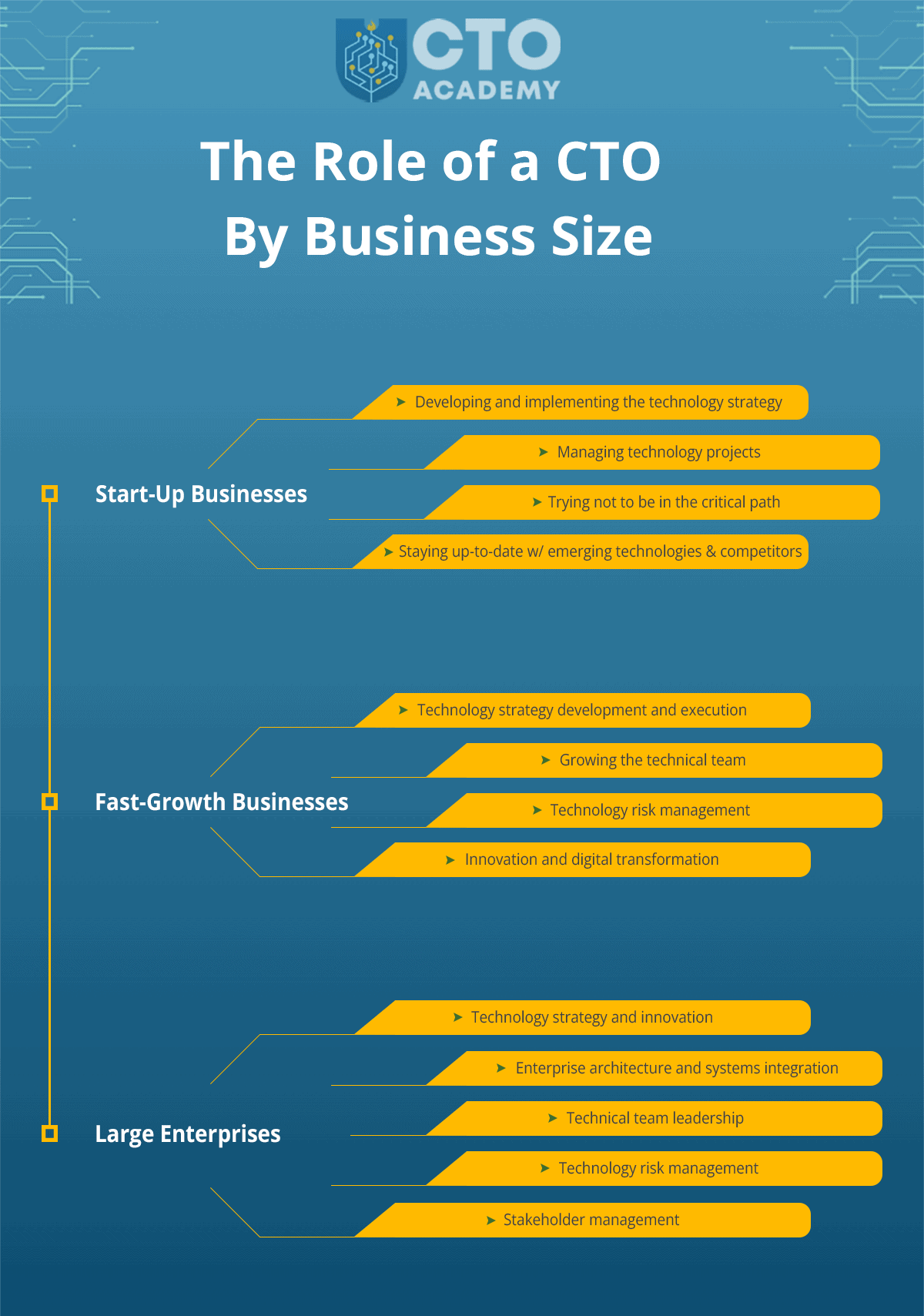
    The CTO role varies from one organization to another
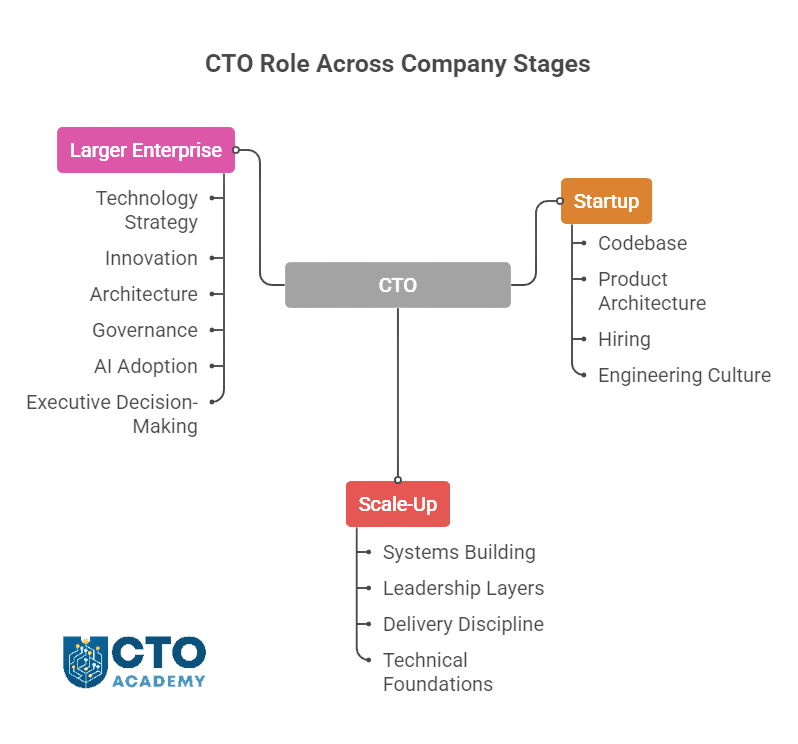
    The Chief Technology Officer role varies from one organization to another - visual presentation of different responsibilities across different growth stages.png
    As the organization matures and expands, so does the scope of the Chief Technology Officer role

    In a startup, the CTO may still be close to the codebase, product architecture, hiring, and early engineering culture.

    In a scale-up, the role often shifts toward building systems, leadership layers, delivery discipline, and technical foundations that can support growth.

    In a larger enterprise, the CTO may focus more on technology strategy, innovation, architecture, governance, AI adoption, and executive-level decision-making.

    Learn more about the differences in the scope of responsibilities depending on the size of the business

    The common thread is accountability for technology direction

    A CTO helps the organization answer questions such as:

    • What technology capabilities do we need to build?
    • Which systems should we modernize, replace, or protect?
    • How should engineering, product, data, security, and operations work together?
    • Where can emerging technologies such as AI create practical value?
    • What technical risks could limit growth or damage trust?
    • How do we turn business priorities into realistic technology decisions?

    In other words, they help technical teams understand business priorities, and executive teams understand the consequences of technology choices.

    In the AI era, CTOs are expected to explain what AI can and cannot do, where it belongs in the organization, how it should be governed, and what capabilities teams need to use it responsibly.

    What Does a CTO Actually Own?

    First and foremost, there has to be clear senior accountability for the technology decisions that shape the org’s future capability.

    A CTO may own any or all of the following areas directly or strongly influence them through collaboration.

    Table 1: CTO ownership

    CTO responsibilityIn practice
    Technology strategyDefining how technology supports business goals, growth priorities, operational needs, and long-term competitiveness.
    Architecture and technical directionMaking decisions about systems, platforms, scalability, interoperability, technical debt, and future flexibility.
    Engineering capabilityBuilding the structures, standards, leadership habits, and technical culture that help teams deliver reliably.
    Product and platform decisionsWorking with product and business leaders to decide what should be built, bought, integrated, improved, or retired.
    AI adoption and integrationIdentifying practical AI use cases, assessing risks, choosing tools, and integrating AI into workflows, products, and systems.
    Data and infrastructure readinessEnsuring the organization has the data foundations, infrastructure, cloud capability, and operational maturity needed to support modern technology priorities.
    Security and resilienceMaking sure systems are reliable, secure, compliant, observable, recoverable, and trusted by customers and stakeholders.
    Vendor and build-versus-buy decisionsDeciding when to build internally, when to buy, when to partner, and how to manage dependency on external platforms or suppliers.
    Executive communicationTranslating technical choices into business consequences so CEOs, boards, investors, and senior teams can make informed decisions.
    Innovation and experimentationEvaluating emerging technologies, deciding where to experiment, and turning useful learning into practical adoption.
    Technology risk and governanceCreating decision-making frameworks for technology investment, AI use, security, compliance, resilience, and operational risk.

    This is how it works in practice

    In smaller organizations, one CTO may cover most of these responsibilities directly. In larger ones, many of them will be shared with CIOs, CISOs, product leaders, data leaders, enterprise architects, and engineering executives.

    The CTO’s value lies in connecting those moving parts into a coherent technology direction.

    CTO vs CIO vs VP of Engineering vs Head of Engineering

    The simplest way to understand the difference is to look at the primary focus of each role.

    The CTO owns future-facing technology direction, the CIO owns internal technology operations, the VP of Engineering owns engineering execution, and the Head of Engineering usually owns day-to-day team delivery.

    Table 2: Primary focus and responsibilities of different roles

    RolePrimary focusTypical responsibilities
    CTOTechnology strategy and future capabilityArchitecture, innovation, AI strategy, technical direction, product-facing technology, and executive advice.
    CIOInternal technology and enterprise systemsIT operations, enterprise software, data systems, compliance, service delivery, and corporate technology services.
    VP of EngineeringEngineering executionDelivery, team structure, engineering processes, quality, hiring, performance, and engineering management.
    Head of EngineeringEngineering leadership and managementTeam performance, sprint delivery, technical standards, people management, and day-to-day delivery discipline.

    By default, the CTO is the role most closely associated with future-facing technology decisions. That can include:

    • Product architecture
    • Platform strategy
    • Emerging technology evaluation
    • AI adoption
    • Technical risk
    • The explanation of technology choices to the board or executive team

    CIO vs CTO

    Recently, the CIO and CTO roles have been coming closer together and sharing a lot of similar responsibilities. But as a rule of thumb, the CIO is typically more focused on the internal technology estate. This may include enterprise systems, workplace technology, IT operations, data platforms, procurement, compliance, and service management.

    In larger enterprises, the CTO and CIO work closely together: the CIO ensures the org runs reliably, while the CTO helps decide how technology should evolve.

    VP of Engineering vs CTO

    The VP of Engineering is usually responsible for turning technical direction into delivery. This role often owns engineering structure, hiring plans, delivery processes, quality standards, team performance, and execution rhythm. A strong VP of Engineering helps ensure the organization can build and ship reliably.

    Head of Engineering vs CTO

    The Head of Engineering role is usually more delivery and team-management focused, although the title varies widely. In smaller companies, the Head of Engineering may be the most senior engineering leader. In larger ones, the role may sit below a VP of Engineering and focus on a specific product area, platform, function, or team group.

    Donning several hats at once

    In early-stage companies, one person may cover several of these responsibilities. A founder CTO might act as CTO, VP of Engineering, architect, hiring lead, and product partner at the same time.

    CTO Academy is a great example of that. Jason Noble, the co-founder and CTO, was even engaged as the COO at one point. The reason was simple: he designed the systems and most of the operations, so to maintain the momentum and stay agile, it was simpler to assume that role also than to train somebody else during those early stages.

    Unlike startups, in larger organizations, the boundaries are usually clearer, though the CTO still needs to collaborate closely with CIO, product, security, data, and commercial leaders.

    For leaders comparing their next development step, this distinction matters. Moving from Head of Engineering or VP of Engineering toward CTO usually requires a shift from delivery leadership into broader strategic judgment, executive communication, commercial awareness, and technology leadership at the organizational level. This is where structured development through specialized CTO Programs can help clarify the path.

    How the CTO Role Has Changed

    In the past, many CTOs were judged mainly on technical oversight: keeping systems running, guiding architecture, supporting delivery, and ensuring engineering teams had the tools and standards they needed. While those responsibilities still matter, they are no longer enough.

    Modern CTOs are expected to connect technology decisions to business outcomes.

    They need to understand how platforms, data, security, AI, engineering capability, and operating models affect growth, resilience, customer experience, and competitive position.

    Table 3: Traditional vs modern CTO role

    Traditional CTO emphasisModern CTO emphasis
    Systems and infrastructurePlatforms, data, AI, security, and scalability.
    Technical deliveryBusiness-aligned technology strategy.
    Tool selectionOperating model and capability building.
    Architecture decisionsDecisions about speed, resilience, cost, integration, and future flexibility.
    Engineering supervisionCross-functional executive leadership.
    Innovation experimentsMeasurable transformation and adoption.
    Technical reportingBoard-level risk and opportunity communication.
    Generic digital transformationAI-enabled change linked to practical business outcomes.

    This shift has changed how CTOs spend their time

    The role is less about being the final technical authority on every decision and more about creating the conditions for better decisions across the organization.

    A modern CTO:

    1. Helps teams move quickly without creating uncontrolled risk.
    2. Supports innovation without encouraging disconnected experiments.
    3. Modernizes systems without breaking operational reliability.
    4. Explains technical trade-offs in language that boards, CEOs, investors, and commercial leaders can act on.

    AI has radically accelerated this change. It has made technology leadership more visible because AI decisions affect product strategy, data quality, security, customer trust, workforce capability, and business performance. That’s why the CTO is increasingly expected to help separate useful adoption from noise and turn emerging technology into governed, measurable progress.

    For many existing and aspiring technology leaders, this is the point where the next stage of development becomes less about adding more technical depth and more about building executive range: strategy, communication, commercial judgment, organizational design, and leadership under uncertainty.

    Why AI Has Made the CTO Role More Visible

    AI has pushed technology leadership closer to the center of business strategy.

    Boards and executive teams are pushing for AI adoption. Their questions rarely have purely technical answers, but they do require technical judgment. That is why the CTO has become more visible.

    AI is not just a tooling decision. It affects data, workflows, security, governance, teams, customer experience, productivity, and business models. A poorly chosen AI tool can create risk without creating value. A promising AI use case can fail because the data is not ready, the workflow is unclear, or the organization has not decided who is accountable. A useful pilot can remain stuck as an experiment if it is never integrated into core systems or measured against business outcomes.

    The CTO’s role is to help move beyond AI enthusiasm and into practical adoption

    That means asking:

    • Where can AI create measurable value for customers, teams, or operations?
    • Which use cases are worth testing now, and which should wait?
    • What data, infrastructure, security, and integration work is needed first?
    • Which AI tools should be bought, built, customized, or avoided?
    • What guardrails are needed around privacy, compliance, accuracy, bias, and human oversight?
    • How should teams be trained to use AI responsibly?
    • How will success be measured beyond novelty or short-term productivity gains?

    This is where the CTO becomes a translator between ambition and execution.

    The CEO may want speed. The board may want assurance. Product teams may want experimentation. Engineering teams may worry about complexity, reliability, and technical debt. Legal, security, and compliance teams may see new forms of exposure. The CTO needs to connect those perspectives into a clear path forward. They help to decide where AI should be embedded, where it should be controlled, and, more importantly, where it should not be used at all.

    This is also why AI leadership has become a development priority for technology leaders. Technical fluency matters, but it is not enough. CTOs need the executive range to assess risk, prioritize investment, influence stakeholders, govern adoption, and explain trade-offs in business terms.

    It is a practical guide for integrating AI into core systems without compromising security, control, or leadership accountability.

    What Skills Should the Modern CTO Possess

    While technical judgment remains essential, it now sits inside a wider leadership skill set. This is one of the biggest shifts for senior technology leaders because many reach the point where technical knowledge is no longer the main constraint. The harder challenge is deciding what matters, influencing people who do not think like engineers, and making technology choices that support the business without creating avoidable risk.

    Table 4: Modern CTO skill stack

    Skill areaPurpose
    Technical judgmentUnderstanding trade-offs, architecture, scalability, reliability, technical debt, and technical risk.
    Systems thinkingKnowing how platforms, teams, workflows, data, security, vendors, and customer experience affect one another.
    Strategic thinkingTechnology choices need to support business priorities, not just technical preferences.
    Product and customer awarenessUnderstanding how technology decisions affect users, customers, product direction, and market position.
    AI fluencyUnderstanding AI capabilities, limitations, risks, integration demands, and realistic use cases.
    Commercial awarenessInvestment decisions need to connect to value, cost, growth, efficiency, and competitive advantage.
    Security and risk awarenessRecognizing where technology creates operational, reputational, compliance, or customer trust risks.
    CommunicationExplaining technical complexity to non-technical stakeholders without oversimplifying the consequences.
    Executive influenceShaping decisions with CEOs, boards, investors, product leaders, finance teams, and commercial stakeholders.
    Team leadershipBuilding confidence, alignment, standards, and capability across engineering and technology teams.
    Change leadershipLeading transformation across systems, teams, behaviors, workflows, and operating models.
    Strategic prioritizationDeciding what to pursue, what to delay, what to stop, and what risks the organization is willing to accept.
    GovernanceAI, security, data, architecture, vendor, and platform decisions need clear accountability and decision-making discipline.

    The balance of these skills changes as the role becomes more senior. Earlier in a technology career, credibility often comes from technical depth and delivery. At the CTO level, credibility comes from judgment: knowing which technical issues matter most, how they affect the business, and how to bring people with different priorities into a shared decision.

    AI has made that skill stack more demanding

    CTOs now need enough technical fluency to challenge hype, enough commercial understanding to prioritize valuable use cases, enough governance discipline to manage risk, and enough leadership range to help teams change how they work.

    For aspiring CTOs, this can be a useful way to assess readiness. The question is not simply “Am I technical enough?” It is also “Can I influence strategy, communicate trade-offs, lead through uncertainty, and connect technology decisions to business value?”

    The best way to assess where you are right now is to benchmark your skill set against those who were in your shoes until most recently.

    Use it to identify your strengths, gaps, and development priorities as a current or aspiring technology leader.

    AI Leadership Responsibilities for Chief Technology Officers

    CTO must decide where AI fits, how it should be used, what risks need to be controlled, and how adoption will create measurable value.

    That responsibility usually falls across five connected areas: strategy, integration, governance, risk, and adoption.

    AI Strategy

    The CTO should help define how AI supports the organization’s business goals.

    This means moving beyond general enthusiasm and identifying where AI can improve products, customer experience, operational efficiency, decision-making, engineering productivity, or internal workflows.

    The CTO does not need to own every business case, but they should help test whether proposed AI initiatives are technically realistic, commercially useful, and aligned with the priorities.

    Useful questions include:

    • Which AI use cases are most likely to create measurable value?
    • Which opportunities depend on better data, systems, or process maturity?
    • Which experiments are worth running now?
    • Which ideas are interesting, but not yet ready for investment?
    • How will AI priorities connect to product, operations, customer, and revenue goals?

    Without this strategic filter, AI activity can become scattered. Teams may experiment in different directions, vendors may shape the agenda, and the organization may confuse visible activity with real progress.

    AI Integration

    The CTO is responsible for making sure AI can work inside the orgs’ existing technology environment.

    AI tools rarely create value in isolation. They need to connect with data, workflows, platforms, APIs, security controls, customer journeys, and operational processes. A promising AI use case can easily fail if it cannot access reliable data, fit into existing systems, or support the way teams actually work.

    The CTO needs to consider the following factors:

    • Where AI should sit in the architecture
    • How models and tools will connect to existing systems
    • What data is required, and whether it is trustworthy
    • How outputs will be checked, monitored, or reviewed
    • How AI-enabled workflows will affect teams and customers
    • What technical debt or infrastructure constraints need to be addressed

    This is where AI moves from experiment to implementation. The CTO’s job is to avoid isolated pilots and build the technical foundations needed for repeatable adoption.

    For a detailed context, go to Tech Leaders Guide to AI Integration

    Learn how to reconcile innovation, infrastructure, and security.

    AI Governance

    AI decisions need clear accountability.

    The CTO must establish how AI use cases are approved, reviewed, monitored, and controlled. This is done by ensuring that the organization knows who is responsible for decisions that affect data, security, customer experience, employees, compliance, and brand trust.

    Good AI governance should, therefore, make the following points very clear:

    • Who can approve AI tools and use cases
    • What data can and cannot be used
    • When human review is required
    • How AI outputs should be tested
    • How vendors are assessed
    • How risks are escalated
    • How performance and unintended consequences are monitored

    Governance is especially important as AI adoption spreads across departments. Without clear guardrails, different teams may adopt tools independently, expose sensitive data, duplicate costs, or create inconsistent customer and employee experiences.

    AI Risk

    AI creates new forms of technology and business risk. The CTO ensures that the organization understands those risks without unnecessary lag in useful progress.

    Key areas include security, privacy, compliance, bias, reliability, explainability, intellectual property, vendor dependency, and operational resilience.

    Some risks are purely technical. Others, on the other hand, are organizational. However, many sit between technology, legal, security, HR, product, and customer-facing teams.

    The CTO should answer questions such as:

    • What happens if an AI system produces inaccurate or misleading output?
    • What data is being shared, stored, or used for model training?
    • Which AI decisions need human oversight?
    • How do we prevent sensitive information from being exposed?
    • What happens if a vendor changes pricing, access, performance, or terms?
    • How do we test AI systems before they affect customers or critical processes?

    The goal is not to block AI adoption but to make adoption safe, clear, and controlled enough to be trusted.

    AI Adoption

    AI leadership also requires preparing people to work differently.

    The CTO has a mandate to help teams understand how AI should be used, where it can support their work, and where judgment still matters. This includes engineering teams, product teams, operations, customer support, data teams, and senior leadership.

    Adoption depends on far more than just tool access. Teams need guidance, examples, training, workflows, and confidence, especially non-tech teams. They also need to understand the limits of AI, including when outputs need to be checked and when automation is inappropriate.

    The CTO should help create the conditions for responsible adoption by:

    • Supporting practical training
    • Encouraging useful experimentation
    • Sharing/controlling approved tools and patterns
    • Defining acceptable use
    • Building feedback loops
    • Measuring impact
    • Helping managers adapt workflows
    • Reinforcing where human judgment remains essential

    Effective CTOs treat AI adoption as an organizational capability, not a one-off project.

    Learn how to redesign your organization for human-AI collaboration.

    A playbook for turning AI ambition into secure, governed, and commercially useful implementation and moving from assistants to autonomous workflows.

    Common Types of CTO Roles

    There is no single version of the CTO role. The title can mean different things depending on the orgs’ size, stage, sector, product model, and leadership structure.

    This is why two CTOs can have the same title but very different working weeks, as we often hear during weekly expert sessions and inside the Community discussions. One may be close to product architecture and engineering delivery. Another may spend most of their time with the board, regulators, enterprise customers, or transformation teams. Another may focus almost entirely on AI, data, platforms, and operating model change.

    The most useful way to understand the variation is to look at the type of CTO role the organization needs.

    Table 5: Types of CTOs w/ typical focus

    CTO typeTypical focus
    Startup CTOBuilding the first technical foundation, product architecture, and engineering team.
    Scale-up CTOCreating systems, processes, leadership capacity, and technical foundations that can support growth.
    Enterprise CTOAligning complex technology estates with business strategy, governance, security, and long-term transformation. May also be a Group CTO, managing several verticals.
    Product-led CTO (CPTO)Connecting product direction, customer needs, architecture, engineering delivery, and technical differentiation.
    Platform or infrastructure CTOOwning infrastructure, platforms, reliability, scalability, cloud strategy, and developer productivity.
    Transformation CTOLeading modernization, cloud migration, data strategy, AI adoption, or operating model change.
    Fractional CTOProviding senior technology leadership on a fraction of a project/scope for a fraction of the time.
    AI-focused CTOLeading AI strategy, integration, governance, platform choices, and organizational capability building.

    These types are by no means fixed categories. In practice, CTO roles often combine several of them. A scale-up CTO may also be product-led. An enterprise CTO may also be responsible for transformation. A fractional CTO may be brought in specifically to support AI adoption, architecture decisions, or technical due diligence.

    If you are interested in learning more about different types of CTO contracts, go here.

    The important point is context

    A strong CTO in one environment may not be the right fit for another. The skills needed to build a technical team from scratch are not identical to the skills needed to modernize a legacy enterprise estate, govern AI adoption, or advise a board on technology risk.

    For aspiring CTOs, this distinction is useful because it helps clarify the type of role you are preparing for. For organizations, it helps define what kind of technology leadership is actually needed. A hiring brief that simply says “CTO” is rarely enough. The better question is: what technology challenge does this CTO need to lead?

    Leaders comparing different development routes can use resources such as IT Career Path Mapping, CTO Programs Reviews, or explore the Fractional CTO route to think more clearly about which capabilities they need to strengthen next.

    First 90 Days as a CTO

    The first 90 days are not just about proving technical authority. They are about understanding the organization, building trust, identifying constraints, and deciding where technology leadership can create the most immediate value.

    A new CTO needs to learn before they prescribe. That means getting close to the business context, not just the technology estate:

    • What is the organization trying to achieve?
    • Where is growth being blocked?
    • Which systems are fragile?
    • Where are teams moving too slowly?
    • What risks are already visible?
    • What expectations does the CEO, board, or executive team have for the role?

    In the first 90 days, a CTO should, therefore, focus on:

    • Understanding the business model, strategic priorities, and commercial pressures
    • Assessing people, systems, architecture, delivery performance, and technology risk
    • Building relationships with executive peers, product leaders, engineering teams, data, security, finance, and operations
    • Identifying technical debt, delivery constraints, capability gaps, and organizational bottlenecks
    • Clarifying expectations with the CEO, board, founder, or executive sponsor
    • Finding early credibility-building wins without rushing into cosmetic change
    • Creating a realistic technology leadership agenda for the next stage

    The biggest mistake is to arrive with a fixed answer before understanding the context.

    A CTO who moves too quickly can damage trust, misread the organization, or solve the wrong problem. A CTO who moves too slowly can lose momentum and allow existing risks to deepen.

    The goal is to build enough understanding to make better decisions

    By the end of the first 90 days, the CTO should be able to explain where technology is supporting the business, where it is constraining progress, which risks require attention, and what priorities should shape the next phase of leadership.

    How to Build CTO Readiness

    Technical problems often have boundaries. Executive leadership problems rarely do. A CTO may need to make decisions with incomplete information, balance competing priorities, defend investment choices, manage risk, and explain why the best technical answer is not always the best organizational answer.

    Table 6: The list of connected capabilities that assess CTO readiness

    Readiness areaPractical impact
    Strategic thinkingUnderstanding how technology choices support growth, resilience, customer value, and competitive position.
    Business and finance understandingReading commercial context, investment trade-offs, budgets, margins, cost structures, and value creation.
    AI and technology fluencyKnowing where emerging technologies can create value, where they introduce risk, and what foundations are needed for adoption.
    Executive communicationExplaining technical trade-offs clearly to CEOs, boards, investors, and non-technical stakeholders.
    Decision-making under uncertaintyMaking informed choices when the data is incomplete, the risks are uneven, and the answer is not obvious.
    Stakeholder managementBuilding trust across product, engineering, data, security, finance, operations, commercial teams, and executive leadership.
    Team leadershipCreating the standards, structures, culture, and leadership capacity that help teams perform.
    Governance and riskEstablishing clear decision-making around architecture, AI, security, data, vendors, compliance, and operational resilience.
    Personal leadership maturityDeveloping self-awareness, resilience, confidence, and the ability to lead through pressure and ambiguity.

    The CTO has to move between levels: deep enough to understand consequences, broad enough to guide direction.

    For aspiring CTOs, the development path often starts by identifying which gaps matter most. Some leaders need stronger commercial confidence. Some need more experience influencing senior stakeholders. Others need to improve strategic prioritization, AI governance, or organizational leadership. The answer often depends on the role they want, the organization they serve, and the risks they are expected to manage.

    This is where structured development helps because the CTO role is not learned through technical experience alone. It requires exposure to strategy, finance, leadership, innovation, communication, and decision-making in complex environments.

    Identify your strengths, gaps, and development priorities before deciding your next step.

    The CTO role changes with context. A new CTO, an aspiring CTO, an engineering leader preparing for executive responsibility, and an experienced technology leader responding to AI will not all need the same next step.

    Use these resources to continue from the area most relevant to your current challenge.

    Table 7: The list of relevant resources for CTOs

    ResourceWho it is forNext step
    First 90 Days as CTOFor new CTOs who need to establish credibility, assess the organization, and set clear leadership priorities.Read the guide
    AI Integration PlaybookFor technology leaders responsible for turning AI ambition into practical, secure, and governed implementation.Read the playbook
    CTO Skills AssessmentFor aspiring and current CTOs who want to identify strengths, gaps, and development priorities.Assess your readiness
    Digital MBA for Technology LeadersFor technology leaders who want structured development across strategy, leadership, business, and AI-era decision-making.Explore the program
    CTO Programs ReviewsFor leaders comparing CTO courses, technology leadership programs, and executive education options.Compare CTO programs

    Frequently Asked Questions (FAQ)

    What does CTO stand for?

    CTO stands for Chief Technology Officer. It is a senior leadership role responsible for technology direction, technical capability, and the connection between technology decisions and business goals.

    What does a Chief Technology Officer do?

    A Chief Technology Officer leads technology strategy and helps align technical decisions with business priorities. Depending on the organization, a CTO may be responsible for architecture, engineering capability, product technology, AI adoption, innovation, security, governance, vendor decisions, and executive communication.

    Is a CTO higher than a VP of Engineering?

    Usually, yes. A CTO is typically more strategic and executive-facing, while a VP of Engineering is usually more focused on engineering execution, delivery, team performance, process, and quality.
    In smaller companies, however, the distinction can be less formal. One person may cover both roles, or the VP of Engineering may operate with responsibilities that look similar to a CTO role.

    What is the difference between a CTO and a CIO?

    A CTO usually focuses on technology strategy, product technology, innovation, architecture, future capability, and emerging technologies such as AI.
    A CIO usually focuses on internal technology systems, enterprise applications, IT operations, data infrastructure, compliance, service delivery, and corporate technology services.
    The two roles often work closely together, especially in larger organizations where technology strategy and internal systems need to be aligned.

    What skills does a CTO need?

    A CTO needs technical judgment, strategic thinking, business awareness, communication, leadership, AI fluency, security awareness, and the ability to manage trade-offs.
    As the role becomes more senior, the CTO also needs stronger executive influence, commercial understanding, governance discipline, team leadership, and decision-making under uncertainty.

    How has AI changed the CTO role?

    AI has made the CTO role more visible because organizations need senior technology leadership to assess use cases, manage risk, integrate tools, govern data, and explain AI’s business impact.
    AI is not only a technical issue. It affects workflows, products, customer experience, security, privacy, compliance, workforce capability, and operating models. The CTO helps the organization decide where AI can create value and how it should be adopted responsibly.

    How do you become a CTO?

    Most CTOs build experience across engineering, architecture, product, leadership, strategy, and executive communication.
    The path often starts with technical credibility, then expands into team leadership, delivery ownership, stakeholder management, business understanding, and strategic decision-making. Structured leadership development can help technical leaders prepare for the broader responsibilities of the role.

    Key Takeaways

    The CTO role is no longer defined by technical seniority alone, but by the quality of judgment a leader brings to business-critical technology decisions.

    AI has raised the stakes because technology choices now affect more than systems and delivery. They shape how organizations compete, manage risk, build capability, and earn trust.

    So, for current and aspiring CTOs, the real question is not simply whether they understand the technology. It is whether they can turn technical understanding into strategy, influence, governance, and measurable business value.

    That shift rarely happens by accident. Even if it does, the gaps it creates are too large to overcome. The optimal path requires deliberate development across leadership, commercial thinking, communication, AI readiness, and executive decision-making.

    The practical next step is to identify which capability gap is limiting your progress now: commercial confidence, AI governance, executive communication, strategic prioritization, or leadership range.

  • Chief Product & Technology Officer (CPTO) Role and Responsibilities

    Chief Product & Technology Officer (CPTO) Role and Responsibilities

    What if a product team and its CPO advocate one technology stack, but the engineering team and its CTO another? What if the lines between product and technology are completely blurred, like in organizations that offer purely tech-based products? The solution to both predicaments is often a new breed of leader: the Chief Product and Technology Officer (CPTO).

    The CPTO role responds to the growing need for seamless integration between product vision and technological execution. It is at the intersection of strategy, innovation, technology, and leadership and has a single goal: to ensure that technology investments fuel the product roadmap and business goals.

    TL;DR

    • CPTO = one exec accountable for both product outcomes and technology execution (roadmap + architecture + delivery).
    • Best fit when product and tech decisions are inseparable (SaaS/AI platforms) or when you need faster alignment (startups, transformations).
    • If you’re deciding between roles, use the CPTO vs CTO vs CPO comparison plus the “who owns what” decision-rights table (roadmap, architecture, reliability, security, etc.).
    • To make the role work in practice, implement the CPTO operating system: weekly tradeoffs, shared cadences, a decision log, and explicit delegation/guardrails.
    • Measure success with a single CPTO scorecard balancing product outcomes, delivery performance, reliability, security, and cost efficiency.
    • Watch for common failure modes (bottlenecking, feature-factory output, misaligned clocks, underinvesting in security) and apply the fixes early.

    [Article last updated on February 25, 2026. Updates include: two comparison tables (CPTO vs CTO vs CPO, plus decision ownership), expanded practical sections on organizational design, operating cadence, decision rights, and a CPTO KPI scorecard. It now also includes a clear list of common failure modes with fixes, so you can diagnose issues and apply improvements immediately.]

    Table of Contents

    Currently, over a dozen CPTO Jobs are posted on the JobLeads platform alone, with an average salary of $220,000. Additional Chief Product & Technology Officer jobs are also posted on Indeed.com

    This article explains the CPTO role: meaning, job description, responsibilities, required skills, challenges, and potential impact on your career trajectory. It also examines when this combined role makes sense for an organization.

    Get the IT Career Path Roadmap (Free PDF)

    Want more than scattered ideas? Get our IT Career Path Roadmap PDF – an 8-step framework to map your next roles, sharpen your skills, and build a layoff-resilient tech leadership career. Fill in the form and we’ll send you the PDF version so you can download it, annotate it, and use it as a living plan for your next career moves.

    Downloading the ebook does not automatically subscribe you to our bi-weekly Technology Leadership Newsletter.

    CPTO Job Description, Responsibilities, Required Skills, and Impact

    As we said, a CPTO is a technology leader who blends technical expertise with an understanding of product strategy and market needs. They lead cross-functional teams, including engineers, product managers, and designers, to create innovative and successful products. 

    We can see how this process unravels just by looking into the responsibilities of a Chief Product Technology Officer. 

    Responsibilities

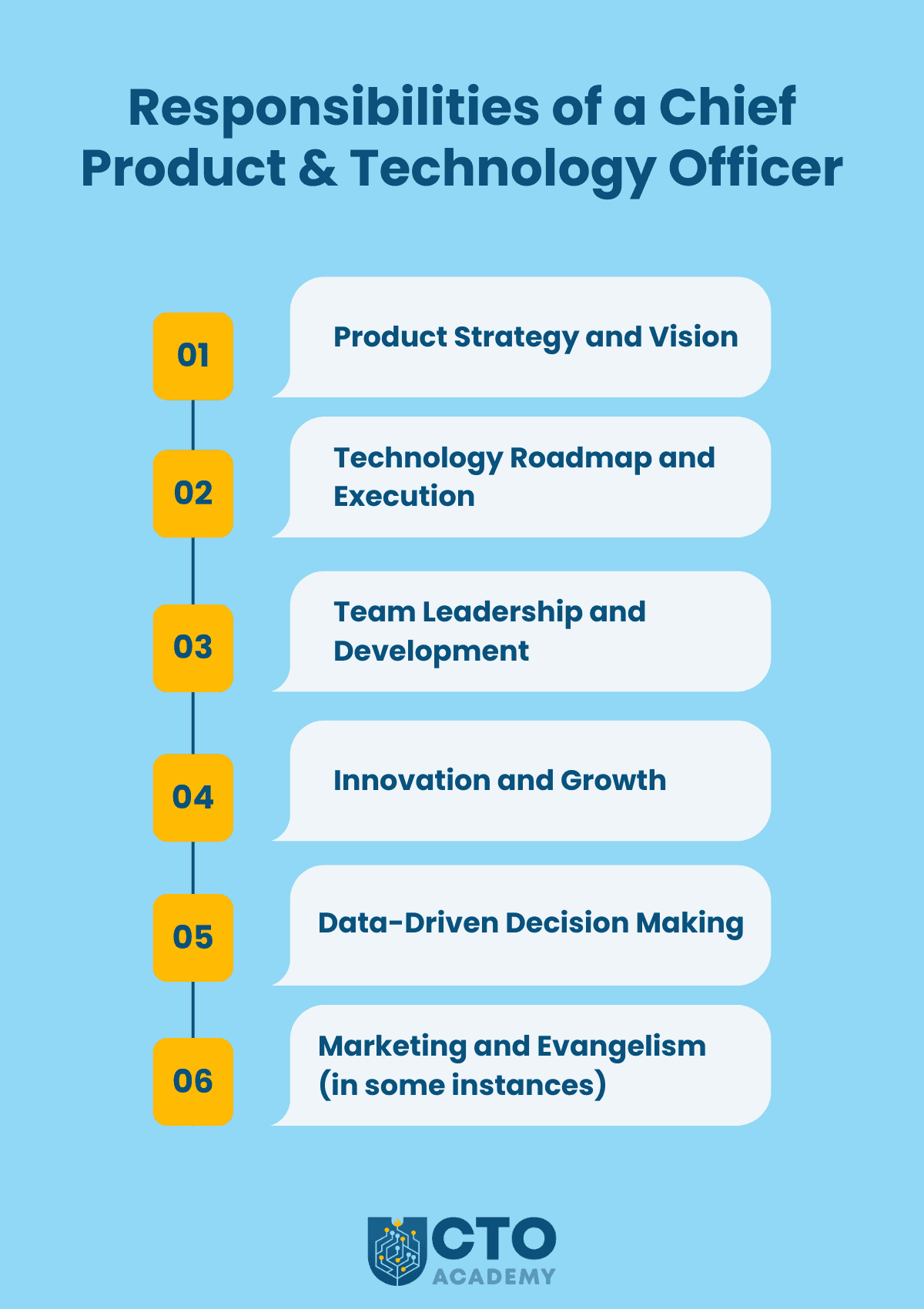
    List of responsibilities of a CPTO - infographic presentation
    Universal responsibilities of a CPTO (Chief Product & Technology Officer)

    1. Product Strategy and Vision

    • Defines the overall product strategy
    • Ensures the strategy aligns with the company’s business goals and market opportunities. 
    • Owns the product roadmap
    • Prioritises features
    • Guides the product development lifecycle.

    2. Technology Roadmap and Execution

    • Leads the development and execution of the technology roadmap
    • Ensures the roadmap a) supports the product strategy and b) enables efficient product development (eg, technology selection, architecture design, and infrastructure management).

    3. Team Leadership and Development

    • Leads and mentors cross-functional teams of engineers, product managers, designers, and data scientists.
    • Builds and fosters a collaborative and high-performing culture.

    4. Innovation and Growth

    • Drives innovation by exploring new technologies, identifying emerging trends, and fostering a culture of experimentation. 
    • Leads new product ideas and guides their development from concept to launch.

    5. Data-Driven Decision Making

    • Leverages data and analytics to inform product and technology decisions, track progress, and measure success. 
    • Promotes a data-driven culture across the organization.

    6. Marketing and Evangelism (in some instances)

    In SaaS-based companies, for example, the CPTO often acts as the head of the Product department; therefore, playing a lead role in marketing the product. In that capacity, the CPTO becomes the lead evangelist for the product. The role then also involves meeting and interacting directly with current and prospective consumers to relay the value and benefits while getting feedback and assessing their reception and experience with the product, much like the Field CTO role.

    Skills and Expertise

    • Technical Proficiency
    • Product Management Expertise (end-to-end, including delivery and customer support)
    • Leadership and Communication
    • Business Acumen
    • Data Analysis and Interpretation

    Organisational Impact

    1. Improved alignment between product and technology teams.
    2. Enhanced decision-making through joint product and technology perspectives.
    3. Faster innovation cycles.
    4. Increased collaboration.

    When It Makes Sense to Have CPTO Instead of the Traditional Tech Leadership Duo

    Distinguishing Responsibilities

    The CTO (Chief Technology Officer) primarily focuses on the technical side of the business (ie, infrastructure, security, architecture, and the engineering team’s execution). In other words, the CTO’s job is to ensure the technology stack is robust, scalable, and aligned with industry best practices.

    The CPO (Chief Product Officer), on the other hand, converges the customer and the product vision. The CPO understands user needs, market trends, and the competitive landscape. Based on these factors, the CPO defines the product roadmap, prioritises features, and ensures the product delivers value to users while achieving business goals.

    [For more in-depth disambiguation between CTO and CPO roles, read our primer on CTO/CPO differences, friction, and transformative collaboration.]

    But in some instances, these two roles merge into a CPTO (Chief Product and Technology Officer) who bridges the gap between product vision and technological execution. However, this is only possible if the CPTO possesses a strong understanding of both domains because the underlying purpose of the role is to achieve a perfect alignment between the product roadmap and the technology strategy.

    TABLE 1: CPTO-CTO-CPO comparison table

    DimensionCPTO (Chief Product & Technology Officer)CTO (Chief Technology Officer)CPO (Chief Product Officer)
    Primary accountabilityOne throat to choke for both product outcomes and technology executionTechnology strategy + engineering execution (how the product is built and run)Product strategy + outcomes (what to build and why)
    Core mandateAlign product bets with tech realities; optimize for value and feasibilityBuild scalable, secure, reliable tech capabilities that enable the businessMaximize customer value and business impact through product direction
    Typical decisions ownedPrioritization tradeoffs across discovery/delivery; sequencing across product + platform; build vs buy; architecture direction aligned to roadmapArchitecture, platform choices, engineering org model, delivery systems, reliability/security postureProblem selection, roadmap themes, positioning, packaging inputs, experimentation strategy
    KPI focusBalanced scorecard: growth/retention + delivery speed + quality/reliability + costDelivery performance, system reliability, security, tech productivity, platform healthAdoption, activation, retention, NPS/CSAT, revenue expansion, roadmap impact
    What “success” looks likeFaster, cleaner decisions; fewer handoffs; roadmap that ships and scalesPredictable delivery with high quality; resilient systems; strong engineering cultureClear product strategy; evidence-based prioritization; measurable customer and business outcomes
    Main internal interfacesCEO, COO/CRO, Sales/CS, Eng, Product, Design, Data/AICEO/COO, Eng, Security, IT/Infra, Data/AICEO/CRO, Sales/Marketing, CS, Product, Design, Research
    Typical scope of orgProduct + Engineering (often Design and Data depending on org)Engineering + Platform/Infra + Security (sometimes Data/AI)Product + Design + Research (sometimes Data/Analytics)
    Where the role spends timePortfolio tradeoffs, roadmap + architecture alignment, org design/cadences, stakeholder alignmentTechnical direction, engineering systems, platform investment, risk & resilienceCustomer discovery, product strategy, roadmap, GTM alignment, outcome measurement
    Common failure modeBecomes a bottleneck or over-weights one side (tech or product)Builds tech excellence disconnected from market/customer prioritiesDrives roadmap without feasibility/operational constraints → delivery friction
    Best fit contextsProduct-tech coupling is high; need speed/alignment; single product/platform focusComplex tech stack, reliability/security needs, scale demandsCompetitive product strategy needed; multi-segment markets; strong GTM/product motion
    “Split roles” triggerMultiple product lines, heavy compliance, large org scale → separate CPO + CTOIf product strategy is unclear or weak → need stronger product leadershipProduct + Engineering (often Design and Data, depending on org)

    A faster way to think about it is decision ownership.

    TABLE 2: Who owns what

    AreaCPTOCTOCPO
    RoadmapOwnsCo-ownsOwns
    ArchitectureCo-ownsOwnsInfluences
    Reliability (SLOs/uptime)Co-ownsOwnsInfluences
    Pricing & PackagingInfluencesInfluencesCo-owns
    Data/AI (strategy + platform + product use)Co-ownsCo-ownsCo-owns
    SecurityCo-ownsOwnsInfluences
    • Ownership varies by company size and maturity; this shows the most common pattern.
    • Co-owns = accountable through shared KPIs/decision rights, even if execution is delegated.

    When a CPTO Role Makes Sense?

    Resource-Constrained Environments 

    We are primarily referring to start-ups and smaller companies that require streamlined decision-making and reduced friction between product and technology teams. 

    A good example is our own CTO, Jason Noble, who, for all intents and purposes, acted (and partially still acts) as the Chief Product & Technology Officer even though it wasn’t his formal role. But during the start-up phase and some time afterwards, his involvement checked all the boxes of the CPTO role. 

    Product-Led Organisations 

    That is, companies where technology is inseparable from the product (e.g., SaaS, gaming, AI-driven platforms…). As our next example demonstrates, these companies largely benefit from CPTO’s holistic approach to product development.

    DataCamp leverages Gen AI to help engineers move forward when they hit a snag, but that’s also the origin of a contentious choice. The DataCamp engineering team preferred to use the newest LLMs available from OpenAI. The product team, on the other hand, wanted to wait until the models became available from Azure. 

    Eduardo Oliveira, DataCamp’s Chief Product and Technology Officer, made a decision: The smaller clients could use the faster, newer models, while the bigger companies had the default options of Azure and Microsoft, with an option to use a newer model from OpenAI.

    Now imagine a common scenario with CTO and CPO backing their teams. It would take a while before these two find a common ground. This way, however, the decision was instant and, more importantly, flexible and based on mutual satisfaction.   

    Digital Transformations

    When companies are undergoing significant digital shifts, a CPTO can lead the way by ensuring technology serves the evolving product strategy.

    Agile Environments

    Companies that prioritise agility and rapid iteration often benefit from a CPTO’s ability to quickly align product and technology decisions.

    When Separate Roles Make More Sense

    • Complex organisational structures.
    • Diverse product portfolios.
    • Highly specialised technology.
    • In instances where the product and technology roadmaps have limited overlap or require very different skill sets.
    • Organizations operating in heavily regulated industries (eg, finance, healthcare, or any other that requires high levels of compliance and security).

    Organizational Design: Who Reports to a CPTO (and when to split the role again)

    A CPTO works best when product and technology are tightly coupled, and the organization benefits from a single prioritization and execution system. To make the role sustainable, define reporting lines, shared interfaces, and “split triggers” early, before scale turns alignment into overload.

    Typical reporting lines to a CPTO

    In many companies, the CPTO owns an integrated “build organization” that includes:

    • Product Management (PMs, Group PMs, Product Ops, where applicable)
    • Engineering (Engineering Managers, Tech Leads, QA/Quality Engineering)
    • Design (Product Design, UX Research, sometimes via a Design Director)
    • Data/AI (varies by company):
      • If data/AI is core to the product: Data Engineering/ML Platform/Applied ML often sits under CPTO or is co-led with a Head of Data/AI.
      • If data is enterprise-wide, it may sit under COO/CIO with strong dotted-line alignment to CPTO.

    Common dotted-line partners (usually not direct reports):

    • Security (CISO/Head of Security)
    • IT/Corporate systems
    • Revenue org leaders (CRO, Sales, Customer Success) for roadmap alignment and customer feedback loops

    Remember:

    The goal isn’t “CPTO owns everything.” The goal is one decision system for product bets, technical feasibility, and delivery capacity.

    Two practical patterns that work well

    Pattern A: Integrated Product + Engineering (most common)

    • Product and Engineering report directly to CPTO.
    • Design and Data/AI either report to CPTO or are tightly partnered with clear shared metrics.

    Pattern B: Platform + Product Lines

    • CPTO oversees Product + Engineering, with an explicit split between:
      • Product-line teams (customer-facing outcomes).
      • Platform teams (reliability, developer experience, shared services).
    • This pattern reduces roadmap friction and prevents platform work from being perpetually deprioritized.

    “Split triggers”: when it’s time to separate CPO and CTO again

    Even if the CPTO model works initially, scaling can create a natural need to split roles. Consider separating CPO and CTO when you see one or more of the following:

    • Multiple product lines/markets with conflicting strategies and GTM needs.
    • High regulatory burden (finance, health, critical infrastructure), where security/risk leadership becomes a full-time executive focus.
    • Rapid headcount growth (coordination cost rises; leadership bandwidth becomes the constraint).
    • Deep technical specialization required (e.g., heavy infra/platform, complex AI/ML, embedded/hardware).
    • Reliability is existential (availability, latency, safety, compliance) and requires dedicated executive attention.
    • M&A or multi-platform integration where architecture complexity dominates.

    Rule of thumb:

    If the CPTO is spending most weeks making either product strategy calls or technology risk calls—and the other area is consistently under-served—it’s time to split.

    If you keep the CPTO role at scale, reduce overload with explicit structure

    • Appoint strong “second-in-command” leaders: VP Product and VP Engineering (or equivalents).
    • Make platform/reliability/security investment non-negotiable via capacity allocation.
    • Keep a single scorecard, but assign clear owners per metric category.
    • Protect focus time: fewer meetings, more decision clarity, more delegation.

    Operating Model: How a CPTO Runs the Organization

    A CPTO’s job is to turn strategy into a repeatable decision-and-delivery system—where product bets, technical direction, and execution capacity stay aligned week after week (not just at quarterly planning).

    The CPTO Operating System (the “minimum viable” version)

    Most high-performing CPTOs rely on a small set of cadences + artifacts + decision rights:

    Cadences

    • Weekly: Prioritization & tradeoffs (60–90 min)
      One meeting to resolve the hard calls: what ships, what slips, what gets staffed, and what is blocked by dependencies.
    • Weekly or biweekly: Product discovery review (45–60 min)
      Validate problem selection, experiment design, and learning velocity (not feature status).
    • Biweekly: Delivery/execution review (45–60 min)
      Focus on flow: blockers, scope creep, cross-team dependencies, and time-to-value.
    • Monthly: Architecture & platform review (60–90 min)
      A lightweight forum to prevent “architecture by Slack” and align platform investment with roadmap needs.
    • Quarterly: Planning + capacity allocation (half-day to 2 days)
      Agree on themes, measurable outcomes, and an explicit capacity split (e.g., product bets vs platform vs risk reduction).

    Core artifacts (keep these simple and public)

    • Outcome roadmap (themes + measurable outcomes, not just features).
    • Tech roadmap (platform investments tied to business outcomes).
    • Decision log (what we decided, why, and what we’ll revisit).
    • Capacity model (who is working on what and what gets deprioritized).
    • Scorecard (a small set of KPIs spanning product outcomes + delivery health + reliability/security).

    Decision Rights: What the CPTO Decides vs Delegates

    The CPTO should own the decision framework, but avoid becoming the bottleneck.

    CPTO should personally own:

    • Portfolio-level prioritization (product bets vs platform vs risk work).
    • Roadmap sequencing when tech constraints and customer value collide.
    • Build vs buy tradeoffs with clear evaluation criteria.
    • Cross-org dependencies and “who decides” conflicts.
    • Hiring/structure decisions for Product + Engineering leadership.

    CPTO should delegate (but stay accountable through metrics):

    • Technical implementation details (to engineering leadership).
    • Day-to-day delivery execution (to EMs/TPMs).
    • Specific domain roadmaps (to PMs/Group PMs and tech leads).

    If everything requires CPTO approval, the org will slow down. A strong CPTO builds a system where teams can decide quickly inside clear guardrails.

    A Practical Template for Fast Alignment (use this in every meeting)

    When tradeoffs appear, resolve them with the same set of questions:

    1. What outcome are we optimizing for? (customer value + business impact)
    2. What’s the constraint? (reliability, security, time, cost, dependencies)
    3. What’s the smallest bet that proves/disproves the hypothesis?
    4. What are we explicitly NOT doing this cycle? (make deprioritization visible)

    If unsure how to create it, use this decision-making framework template.

    First 30 Days: What a New CPTO Should Implement

    • Publish a single shared roadmap view (outcomes + delivery milestones).
    • Establish a weekly tradeoff cadence and a decision log.
    • Define capacity allocation (what % goes to roadmap vs platform vs risk).
    • Align on scorecard metrics across Product + Engineering.
    • Clarify decision rights (who owns what, what escalates).

    CPTO KPIs

    A CPTO is accountable for results (product impact) and the system that produces results (delivery capability, reliability, security, and cost).

    The simplest way to manage that tension is a single scorecard that Product and Engineering review together. But the scorecard must balance product outcomes and engineering health.

    1) Product outcomes (are we creating value?)

    • Adoption & activation: % of users reaching “aha” moments, onboarding completion, and feature adoption.
    • Retention & engagement: churn/retention, DAU/MAU (or equivalent engagement signals).
    • Customer value: NPS/CSAT, support ticket trends, and time-to-value.
    • Business impact: revenue growth/expansion (where relevant), conversion rate, and ARPA/ARR impact per initiative.

    2) Delivery performance (can we ship predictably?)

    • Lead time: idea → shipped (or PR → production, depending on level).
    • Throughput: meaningful releases per period (avoid vanity “number of tickets”).
    • Predictability: planned vs delivered (variance), roadmap stability.
    • Quality: escaped defects, rollback rate, and incident rate linked to recent changes.

    3) Reliability & operational excellence (can customers trust it?)

    • SLO attainment: uptime, latency, error rate, and availability by critical user journey.
    • MTTR: mean time to restore (how fast you recover).
    • Change failure rate: how often deployments cause incidents.
    • Operational load: on-call burden, toil percentage.

    4) Security & risk (are we reducing exposure?)

    • Critical vulnerabilities: time-to-patch, open critical/high findings.
    • Security posture: compliance controls coverage, audit outcomes (where relevant).
    • Access hygiene: privileged access reviews, MFA coverage, secrets rotation cadence.
    • Data risk: incidents, data classification coverage, model/data governance maturity (if AI).

    5) Cost & efficiency (is the platform sustainable?)

    • Infrastructure cost per customer/per transaction.
    • Cloud spend variance: forecast vs actual; unit economics trends.
    • Engineering efficiency: % time in feature work vs toil; rework rate.
    • Platform leverage: reuse rate, internal developer satisfaction (DX), build times.

    How to Use the Scorecard (without turning it into bureaucracy)

    • Review Product outcomes + Delivery + Reliability weekly/biweekly (keep it short).
    • Review Security + Cost at least monthly, or whenever risk/spend spikes.
    • Tie the major initiatives to one primary outcome metric and one guardrail metric (e.g., activation ↑ while error rate stays within SLO).

    The CPTO’s job isn’t to maximize every metric. It’s to make tradeoffs explicit and keep the organization aligned on what matters this quarter.

    Quick-starter Set of metrics (if you want the minimum viable version)

    If you need to start simple, pick 8–10 metrics total:

    • Activation, retention, NPS/CSAT (or support volume trend).
    • Lead time, predictability variance, and escaped defects.
    • SLO attainment and MTTR.
    • Critical vulnerability time-to-patch.
    • Infra cost per customer/transaction.

    Charting a Career Roadmap

    The CPTO role is a relatively new addition to the tech leadership landscape, and the path to this position may not be as clearly defined as traditional roles like CTO or CPO. However, with the right blend of skills, experience, and strategic planning, you can successfully navigate your way to this position. Let’s see what you need to do if you are a CTO, CPO, or Tech Lead.

    CTO-to-CPTO

    • Expand your focus beyond technology to encompass product strategy, user experience, and market analysis. 
    • Seek opportunities to collaborate closely with product teams.
    • Contribute to product roadmaps.
    • Develop a deeper understanding of the customer.

    CPO-to-CPTO

    • Strengthen your technical foundation by immersing yourself in the technology that powers your products. 
    • Gain a solid understanding of software development principles, architectural patterns, and emerging technologies. 
    • Collaborate closely with engineering teams and actively participate in technical discussions.

    Senior Engineers/Tech Leads-to-CPTO

    • Develop your leadership skills by taking on larger projects, mentoring junior engineers, and actively contributing to strategic decisions. 
    • Seek opportunities to lead cross-functional initiatives.
    • Demonstrate your ability to bridge the gap between technology and product.

    Developing Essential Skills

    How to Answer the Challenges of the Role?

    The CPTO role requires a broad understanding of both product and technology. Therefore, focus on developing a strong foundation in both areas while leveraging your team’s expertise for deeper dives.

    Another challenge is aligning product and technology teams. This requires strong communication, collaboration, and leadership, but above all, a culture of shared ownership and accountability

    Speaking of team alignment, what about conflicting priorities? 

    We all know that balancing the demands of product development with the complexities of technology management can be really challenging, don’t we? 

    To solve this problem, you must establish a very clear and adaptable decision-making framework. In other words, base all decisions on a strong framework that provides consistent guidance while allowing for flexibility when needed. (get the decision-making framework template here)

    However, even that won’t help if you fail to develop strong prioritisation skills. Perfecting your prioritisation skills plays a pretty much pivotal role because, as a CPTO, you are constantly balancing between product development and technology initiatives. That’s why our Digital MBA for Technology Leaders involves different aspects of prioritisation within their broader topics, offering insights that help technology leaders improve their prioritisation skills.

    Let’s now briefly explain the most common failure modes so you can better understand the challenges of the role.

    Digital MBA for Technology Leaders by CTO Academy - leaderboard banner

    Common CPTO Failure Modes (and how to fix them)

    Combining Product and Technology leadership creates speed and alignment, but it also creates predictable failure modes. Use the list below as a diagnostic: if you recognize the symptom, apply the fix immediately.

    1) The CPTO becomes the bottleneck

    Symptom: Everything requires CPTO approval. Decisions queue up. Teams wait, momentum slows, and “alignment” turns into paralysis.

    Fix:

    • Define decision rights and guardrails.
    • Push decisions down with clear escalation rules (e.g., “Only cross-team tradeoffs, major spend, or security exceptions escalate”).
    • Create a lightweight decision log so teams learn how decisions are made.

    Quick test: If you’re in more than one meeting where you’re approving the same type of decision, that decision should be delegated.

    2) Over-indexing on technology excellence at the expense of customer value

    Symptom: Beautiful architecture, slow impact. Platform work crowds out outcomes, and customers don’t feel progress.

    Fix:

    • Tie platform investments to explicit product outcomes and pick one primary outcome metric + one guardrail per initiative.
    • Use a capacity split (e.g., bets vs platform vs risk reduction), so tradeoffs are transparent.

    3) Over-indexing on product demand at the expense of feasibility and reliability

    Symptom: Roadmaps churn, teams thrash, reliability declines, and delivery becomes reactive.

    Fix:

    • Make feasibility a first-class input: enforce “definition of ready” for bets (dependencies, risk, security, performance).
    • Reserve capacity for reliability and tech debt.
    • Protect SLOs as non-negotiable guardrails.

    4) Feature factory mode (shipping output, not learning)

    Symptom: Lots of activity, unclear impact. Roadmaps are feature lists; experiments are rare; success is “we shipped it.”

    Fix:

    • Switch the roadmap to outcomes + hypotheses.
    • Require evidence checkpoints: problem validation, experiment plan, and post-launch measurement.
    • Reward teams for learning velocity and measurable impact.

    5) Product and Engineering run on different clocks

    Symptom: Discovery moves fast, delivery moves slow (or the reverse). Plans don’t sync; handoffs cause rework.

    Fix:

    • Implement a shared operating cadence: weekly tradeoffs, biweekly discovery review, execution review, and a monthly architecture/platform review.
    • Align on the same scorecard and define shared definitions of “done.”

    6) “Shadow priorities” from stakeholders

    Symptom: Sales escalations and exec asks continuously override plans; teams constantly pivot.

    Fix:

    • Create a single intake and prioritization process with visible tradeoffs.
    • Use a simple rule: “If it’s urgent, we decide what it displaces.”
    • Make deprioritization public.

    7) Under-investing in security and risk until it becomes a crisis

    Symptom: Security is treated as a checklist; vulnerabilities pile up; incidents surprise the org.

    Fix:

    • Put security on the scorecard (time-to-patch, critical findings, control coverage).
    • Establish clear exception handling (who can accept risk, for how long, with what compensating controls).

    Conclusion

    The role is in demand, with many open positions and competitive salaries. However, it does require a specific blend of technical proficiency, product management expertise, leadership, communication, business acumen, prioritization, and data analysis skills.

    On the other hand, if you successfully bridge the almost inevitable gap between product vision and technology execution, it will most certainly lead to improved alignment between product strategy and technology investments, enhanced decision-making, faster innovation, and increased collaboration within an organisation.

    Therefore, whether you’re a CTO seeking to expand your influence, a CPO looking to deepen your technical expertise, or a senior engineer with aspirations of leading at a higher level, the CPTO path presents a compelling opportunity in technology and product development.

    Frequently Asked Questions (FAQ)

    What is a CPTO (Chief Product & Technology Officer)?

    A CPTO is an executive who owns both product outcomes and technology execution. The role exists to ensure product strategy, roadmap priorities, architecture decisions, and delivery capacity are aligned under one decision-making system, reducing friction and improving speed.

    What does a CPTO do day to day?

    A CPTO runs the operating system that keeps product bets and execution aligned: setting priorities, resolving tradeoffs, removing dependencies, and keeping teams focused on measurable outcomes. Practically, that means maintaining a shared roadmap view, reviewing discovery and delivery flow, and ensuring platform, reliability, and security work don’t get deprioritized.

    How is a CPTO different from a CTO?

    A CTO primarily owns technology strategy and engineering execution: architecture, platform choices, reliability, security posture, and how engineering operates.
    A CPTO owns those responsibilities and product outcomes, meaning they also lead product strategy/roadmap decisions and balance customer value against technical feasibility, risk, and cost.

    How is a CPTO different from a CPO?

    A CPO primarily owns product strategy and outcomes: customer needs, market fit, roadmap themes, prioritization, and product impact metrics.
    A CPTO owns those responsibilities and technology execution, ensuring roadmaps can ship predictably and scale sustainably.

    When does it make sense to have a CPTO instead of separate CTO + CPO roles?

    A CPTO model works best when product and technology decisions are inseparable (common in SaaS, gaming, and AI-driven platforms), when speed and alignment are critical, and when an organization benefits from a single leader resolving tradeoffs across product bets, platform investment, reliability, and security.

    When is combining the roles a bad idea?

    It’s often a poor fit in complex organizational structures, diverse product portfolios, highly specialized technology environments, or heavily regulated industries where security, compliance, and risk require dedicated executive focus. It can also fail when leadership bandwidth becomes the constraint as the organization scales.

    What does a CPTO typically “own,” vs “co-own,” vs “influence”?

    Most commonly: CPTO owns the roadmap alongside the CPO’s domain ownership, co-owns architecture, reliability, data/AI strategy, and security outcomes with the CTO (or equivalent leaders), and influences pricing/packaging decisions with commercial and product leaders. In practice, “co-own” means shared KPIs and explicit decision rights.

    What teams usually report to a CPTO?

    In many organizations, Product and Engineering report to the CPTO, and sometimes Design and Data/AI (especially when AI is core to the product). Security and IT often remain separate executive functions but partner through dotted-line alignment and shared metrics.

    What are the most important KPIs for a CPTO?

    A CPTO scorecard should balance product outcomes (adoption, retention, customer value, business impact) with delivery performance (lead time, predictability, quality), reliability (SLO attainment, MTTR, change failure rate), security/risk (time-to-patch, critical findings, posture), and cost efficiency (unit economics like infra cost per customer/transaction).

    What are the most common CPTO failure modes?

    The big ones are becoming a bottleneck, over-indexing on technology excellence at the expense of customer value, over-indexing on product demand at the expense of feasibility/reliability, drifting into “feature factory” output, running product and engineering on different cadences, allowing stakeholder “shadow priorities,” and under-investing in security until it becomes a crisis.

    What should a new CPTO do in the first 30–90 days?

    Start by establishing one shared roadmap view (outcomes + milestones), a weekly tradeoff cadence, and a lightweight decision log. Then define capacity allocation (roadmap vs platform vs risk), align Product and Engineering on a single scorecard, and clarify decision rights so teams can move fast without escalating everything.

    What background makes the best CPTO (CTO vs CPO vs engineering leader)?

    Strong CPTOs can come from either side, but they must develop credibility in both. CTOs moving into CPTO typically need to deepen customer and product strategy skills; CPOs moving into CPTO need a stronger technical foundation and comfort with architecture, reliability, and security tradeoffs; senior engineering leaders need broader product strategy exposure and cross-functional leadership experience.

  • Field CTO Job Description w/ Salary Breakdown & Career Prospects

    Field CTO Job Description w/ Salary Breakdown & Career Prospects

    In this post, we explain the relatively new Field CTO role and how it differs from a more traditional Chief Technology Officer role. We will see how a Field CTO job description determines the type of person suitable for the job. We will take a look at the job prospects and, of course, the average salary.

    First things first…

    What is a Field CTO?

    A Field CTO is a high-ranking executive role that is becoming ever more popular in tech companies (IT, software or telecommunications industries). Their primary responsibility is bridging the gap between technology and business strategy while also engaging directly with customers and partners. In other words, the focus is on developing an innovative approach to dealing with customers’ problems. This is not something a traditional CTO usually does, at least not to such an extent.

    In fact, Confluent’s FCTO, Kai Waehner, claims that there is less than 10% overlap between FCTOs and the more traditional technical leaders in day-to-day tasks. He also defines the Field CTO as a trusted and well-known advisor for the product and technology that the employer sells to make customers successful around the world. Translated, that means frequent communication with customers, which, by itself, can be challenging for most existing and soon-to-be technical leaders. Because, as you will learn, FCTOs are becoming the public spokespersons of choice for their companies.

    Key Aspects of the Field CTO Role

    The FCTO must possess business acumen and a deep understanding of the market. The reason is simple: the primary focus is on customers’ problems and innovation. As an FCTO, you want to map all the challenges into the vendor’s product portfolio.

    Forward-operating aspects of the role

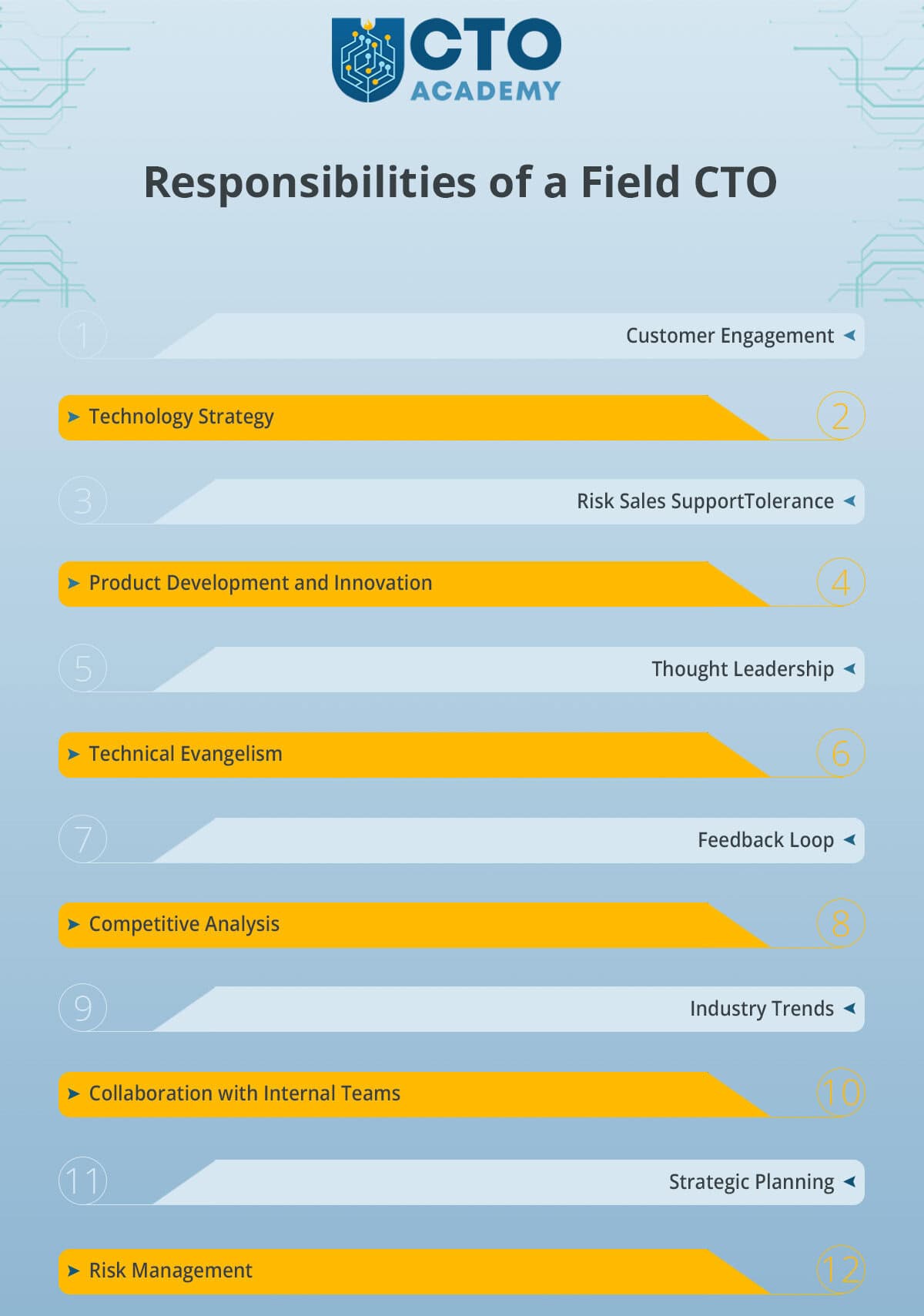
    Another element that largely differs from the traditional role is technical evangelism. You will be directly responsible for (actively) promoting your company’s technology solutions. To put it bluntly, you will evangelise them to customers, partners and the broader industry. This involves articulating the value and benefits of the company’s offerings. Not exactly an ideal job for someone who’s struggling with open communication, is it?

    So, unlike our traditional CTO who is mostly inside-oriented, an FCTO frequently engages with customers to a) better understand their technology needs, and b) identify opportunities. It is the only way to perfectly align the company’s products or services with customer requirements. Naturally, this often involves building and maintaining strong relationships with key customers and partners.

    Inside-oriented roles

    With such a deep understanding of customers’ needs, FCTOs often collaborate with the sales and marketing teams to help them understand the technical aspects of the company’s products or services. They may even participate in sales meetings, provide technical expertise during customer presentations and assist in closing deals. That involvement, however, doesn’t extend to active selling.

    FCTOs of technology companies, due to the nature of their involvement, hold an important role in merger and acquisition processes.

    Since they act as a bridge between the engineering and business teams, FCTOs work closely with in-house CTOs and engineering teams on product development. They are there to provide valuable input into the development of new products or services. Additionally, they help prioritise development efforts. This, in turn, ensures that products align with market needs and technological trends.

    What makes the FCTO such a valuable addition to the development process is the feedback loop they gather from customers in the field. That Information and data is relayed to the internal teams responsible for product development and improvements. This helps the company to stay responsive to market demands.

    Many Field CTOs are seen as industry thought leaders. They may write articles, speak at conferences and represent their company in public forums to showcase their expertise and vision in the technology domain.

    It’s clear that a Field Chief Technology Officer plays a pivotal role in aligning technology with business goals, fostering customer relationships and driving innovation. However, we must note that the specific responsibilities and influence of an FCTO can vary depending on the company’s size, industry and strategic objectives.

    Get the IT Career Path Roadmap (Free PDF)

    Want more than scattered ideas? Get our IT Career Path Roadmap PDF – an 8-step framework to map your next roles, sharpen your skills, and build a layoff-resilient tech leadership career. Fill in the form and we’ll send you the PDF version so you can download it, annotate it, and use it as a living plan for your next career moves.

    Downloading the ebook does not automatically subscribe you to our bi-weekly Technology Leadership Newsletter.

    What is the Difference Between a Field CTO and a Part-Time or In-House CTO?

    The roles differ primarily in terms of responsibilities, level of engagement and the nature of their employment. Here are some key distinctions:

    Field Chief Technology Officer (Field CTO)

    Engagement Level: FCTOs often have a broader role that involves customer engagement, technology strategy, market evangelism and thought leadership.

    Customer Interaction: They actively engage with customers, partners and the broader industry to understand market needs, build relationships and represent the company’s technology vision.

    Responsibilities: FCTOs are less involved in the day-to-day technical operations of the company. They are, however, instrumental in aligning technology with business goals, shaping the technology strategy and ensuring that the company’s offerings really do meet market demands.

    Full-time position: They may hold a full-time position in the company but may spend a significant amount of time externally, interacting with customers and industry stakeholders. In fact, some jobs can involve remote working.

    Part-Time CTO

    Engagement Level: Part-time CTOs have a reduced level of engagement compared to full-time CTOs. They are typically engaged on a part-time or consulting basis.

    Responsibilities: These may include providing technical guidance, reviewing technical decisions and offering strategic input. However, they may not be deeply involved in day-to-day operations or product development.

    Flexibility: Part-time CTOs are often hired for their expertise on specific projects or to address particular technical challenges. Their engagement can be flexible and tailored to the company’s needs.

    In-House, Full-Time CTO

    Engagement Level: In-house, full-time CTOs are deeply embedded within the company and are responsible for the overall technology direction and management.

    Responsibilities: They have a wide range of responsibilities, including overseeing technical teams, product development, infrastructure management, budgeting and developing technical strategy.

    Commitment: In-house CTOs are committed to the company on a full-time basis and are responsible for the day-to-day technical operations. They are often part of the senior executive team. However, in start-ups and smaller organisations, they have a more hands-on role.

    In summary, the key differences revolve around the level of engagement, the scope of responsibilities, and the nature of the employment arrangement. Field CTOs are more externally focused, part-time CTOs offer flexibility for specific needs, and in-house, full-time CTOs are deeply involved in the company’s technical operations and strategy. The choice between these roles depends on the company’s size, goals and resource availability.

    What are the responsibilities of a Field CTO?

    Responsibilities of a Field CTO - infographic summary
    (click to enlarge/download)

    The responsibilities of an FCTO vary depending on the organisation and its specific needs. However, the role generally encompasses a combination of the following responsibilities (this is, effectively, a summary of everything we discussed so far and, quite often, from the job requirements on job boards):

    1. Customer Engagement

    • Build and maintain strong relationships with key customers and partners.
    • Act as a trusted advisor to customers, understanding their technology needs and providing solutions.

    2. Technology Strategy

    • Define and execute the company’s technology strategy in alignment with business goals.
    • Identify emerging technologies and assess their potential impact on the business.

    3. Sales Support

    • Collaborate with the sales and marketing teams to provide technical expertise during customer presentations and assist in closing deals.
    • Help sales teams understand and communicate the technical aspects of the company’s products or services.

    4. Product Development and Innovation

    • Provide input into the development of new products or services to ensure they align with market needs and technological trends.
    • Serve as a bridge between the engineering and business teams, helping prioritise development efforts.

    5. Thought Leadership

    • Act as an industry thought leader by writing articles, giving presentations and representing the company in public forums.
    • Showcase expertise and vision in the technology domain to enhance the company’s reputation.

    6. Technical Evangelism

    • Promote the company’s technology solutions to customers, partners and the broader industry.
    • Articulate the value and benefits of the company’s offerings.

    7. Feedback Loop

    • Gather feedback from customers and the field, and relay this information to internal teams responsible for product development and improvement.
    • Ensure that the company stays responsive to market demands and customer feedback.

    8. Competitive Analysis

    • Monitor the competitive landscape, assess the strengths and weaknesses of rival companies’ technology offerings and provide insights to inform the company’s strategy.

    9. Industry Trends

    • Stay up-to-date with industry trends and technological advancements, and assess their potential impact on the business.

    10. Collaboration with Internal Teams

    • Work closely with various internal departments, including engineering, product management and executive leadership, to align technology initiatives with overall company goals.

    11. Strategic Planning

    • Contribute to the development of long-term technology and innovation strategies for the company.
    • Ensure that technology investments align with the company’s growth and profitability objectives.

    12. Risk Management

    • Assess and mitigate technical risks associated with the company’s products or services.
    • Ensure compliance with industry regulations and best practices.

    As you can see, some of the responsibilities are universal; that is, closely similar to those of a traditional CTO. The specific responsibilities, however, extend beyond technical matters to encompass business strategy and customer relationships. In fact, some Field CTOs aren’t even coding-savvy. But they do know how to best navigate code developers to get exactly what the market demands.

    What skills and experience are required to be a Field CTO?

    In a nutshell, the role requires a combination of technical expertise, leadership skills, business acumen and a deep understanding of the industry, just like every other CTO. But there are the skills and experience particularly required for this role:

    Education and Skill Set Qualifications

    • Bachelor’s Degree in Computer Science, Management Information Systems and/or Business Administration (ideally custom-tailored for technology leaders) or ~10+ years of IT sales or solution architecture experience.
    • 5-10 years of industry-related experience and 5+ years of experience in a role similar to CTO, CIO, VP/Dir of Engineering, Operations or Product Development.
    • 10+ years of architecture experience building, consulting or implementing technology for the relevant industry.
    • Knowledgeable in the challenges impacting the relevant industry and the application of industry-specific use cases.
    • A broad range of experience with technical and design direction that may also include large-scale database and/or data warehouse technology, ETL, analytics and public cloud technologies.
    • Familiarity with data providers and data aggregators.
    • Understanding of industry-specific concepts and applications.
    • The ability to travel to customer sites, industry events and other related events as required (in some instances, over 30% of time FCTOs spend travelling or working outside of the company’s premises!)

    Required Experience

    • Demonstrated ability to conduct conversations and quickly establish credibility with C-level individuals and other business executives where selling solutions are the focus (ie, outstanding presentation skills to both technical and executive audiences).
    • Work experience in a client environment, ideally in a leadership capacity.
    • Strong interpersonal and presentation skills including consulting skills.
    • Strong oral and written communication skills.

    As always, it is important to note that the specific requirements for an FCTO can vary depending on the company, its industry and its strategic goals. In some cases, soft skills and industry-specific knowledge may be just as important as technical expertise. Successful Field CTOs are well-rounded individuals who can bridge the gap between technology and business, providing valuable leadership and insights to drive the company’s success.

    What are the career prospects for Field CTOs?

    We know that FCTOs play a crucial role in the technological needs of an organisation. Consequently, the number of Field CTO jobs has slowly increased over the last few quarters.

    For instance, Honeycomb, a company that offers a software debugging tool as a service, appointed an FCTO only a year ago. As Field CTO, Liz Fong-Jones will work with the executive teams on the company’s strategic customers while continuing to bring cutting-edge technologies into the Honeycomb fold.

    Just like a traditional role, the FCTO position provides substantial benefits. We are talking about:

    • Top salary possibilities
    • Equity or shareholder offerings
    • Leadership opportunities
    • Reputation development
    • Recognition and enterprise-level goal achievement.

    In terms of career progression, FCTOs can look forward to roles in higher executive management or opportunities in consulting or entrepreneurship. They can also transition into specialised roles within the tech industry depending on their areas of expertise. It’s important to note that the specifics can vary based on individual career goals and market trends.

    What is the salary range for Field CTOs?

    The average Field CTO salary is $189,711 per year. However, this can vary based on factors such as location, company size and individual experience.

    For example, Snowflake offers an estimated base salary between $150,000 – $234,600, plus entry into Snowflake’s bonus and equity plan.

    The successful candidate’s starting salary is usually determined by skills, experience and location. FCTOs are frequently offered competitive benefits packages, which commonly include:

    • Medical, dental, vision, life, and disability insurance along with a 401(k) retirement plan
    • Flexible spending and health savings account
    • Paid holidays and time off
    • Parental leave, etc.

    What are some of the biggest challenges and opportunities facing Field CTOs today?

    Challenges:

    • Technological Changes (ie, the rapid pace of technological evolution that requires high levels of adaptability).
    • A shortage of IT Professionals (creates a challenge in managing day-to-day operations).
    • Strategic Role (requires balancing the strategic role and daily operations).

    Opportunities:

    • Operational Possibilities (technology is now much more embedded in day-to-day life, thus providing more business opportunities which, in turn, creates a wider array of operational possibilities for FCTOs).
    • Digital Transformation (still a dominant force, with its growth predicted to reach $3.4 trillion by 2026).
    • Technical Vision (ie, the opportunity to architect a technical strategy that seamlessly aligns with business objectives).

    Conclusion

    The future for any type of technology leader is becoming increasingly challenging as we have explained in our recent post about what lies ahead for leadership in the technology sector.

    Field CTOs, as a relatively new role in the world of technology leadership, have yet to discover what bumps may be awaiting them down the road.

    That’s why here at CTO Academy, we are continuously working to identify both challenges and opportunities and to educate and inform our members. Our Global Community of Tech Leaders is actively involved in daily discussions and problem-solving, helping each other in their day-to-day operations. All members have a unique opportunity to shadow seasoned CTOs and learn from them during live sessions and Expert Q&As.

    A long time ago, we became aware that the only way to successfully overcome the hurdles is a peer-powered trust of brains and cumulative experience. Existing and future Field CTOs can greatly benefit from such a community because it removes much of the unknown from the equation. Because if you don’t know that the obstacle exists, you will inevitably trip over.

  • Role of a Chief Technology Officer in Different Business Sizes

    Role of a Chief Technology Officer in Different Business Sizes

    Generally speaking, the role of a chief technology officer involves strategic management and execution of technology initiatives within an organization. It is, therefore, pivotal in shaping and implementing the technology roadmap while aligning it with the company’s overall goals and vision.

    What enables tech leaders to drive innovation, oversee development and infrastructure, ensure data security and foster a culture of technological advancement is not only a deep understanding of emerging technologies and their potential impact but also the people they lead.

    (To see what a day in the life of a CTO looks like, check this post.)

    Infographic summary of 10 tasks of any CTO role
    10 tasks that are common for any CTO role (click to download)

    4 main CTO roles

    Technology Strategy

    This role involves formulating and executing a company’s technology strategy to support its overall business objectives by:

    • Developing and implementing strategic plans for technology development, adoption and application.
    • Identifying emerging technologies and assessing their potential impact on the business.
    • Establishing technology standards and guidelines to ensure consistency and compatibility across systems.
    • Fostering collaboration between technology and business teams to align technology initiatives with organisational goals.
    • Evaluating and prioritising technology investments based on their potential value and return on investment.

    Innovation Management

    As a rule of thumb, the chief technology officer oversees the management of innovation within the company, driving the exploration and adoption of new technologies and practices.

    However, success depends on the effectiveness of these five activities:

    1. Identifying opportunities for innovation and technological advancements within the organization.
    2. Fostering a culture of creativity and continuous improvement.
    3. Collaborating with research and development teams to identify and implement new technologies.
    4. Facilitating cross-functional collaboration and knowledge sharing to encourage innovative ideas.
    5. Evaluating and implementing innovation management processes to streamline idea generation and implementation.

    Development Oversight

    This CTO role focuses on managing the company’s technology development and infrastructure. The job is to ensure that it meets business requirements along with reliability, scalability and security.

    To achieve this, chief technology officers:

    • Develop and maintain technology strategy and roadmap.
    • Oversee the design, deployment and maintenance of the development.
    • Implement robust development processes.
    • Stay informed about industry best practices and emerging technologies.

    Talent Acquisition & Leadership

    As we are waging a full-blown war for talent, chief technology officers are now also responsible for:

    • Recruiting and hiring skilled technology professionals aligned with the company’s needs.
    • Providing mentorship and professional development opportunities for technology teams.
    • Fostering a positive and inclusive work environment that encourages collaboration and innovation.
    • Identifying and addressing skills gaps through training and development initiatives.
    • Establishing career progression frameworks and performance evaluation processes for technology teams. (see https://sfia-online.org/en)

    What is the role of a chief technology officer considering the size of a company?

    Job description, average salary and responsibilities certainly differ depending on the company’s size. So let’s take a quick view of some of these basic differences.

    Infographic summaries of the role of a chief technology officer by business size
    The role of a chief technology officer considering the size of a business (click to download)

    CTO job in start-up businesses

    Chief technology officer typically focuses on the strategic and technical aspects of technology. Their role involves overseeing the development and implementation of technology solutions aligned with the company’s goals. The chief technical officer is, therefore, responsible for identifying emerging technologies, managing the technology infrastructure and driving innovation within the organisation.

    That being said, in start-up businesses, the role of a CTO may vary depending on the company’s size, structure and industry. But generally speaking, their role often involves a hands-on approach. Plus, they wear multiple hats and work closely with low-level team leaders and project managers to deliver technology solutions that meet the business’s needs.

    Some of the key responsibilities in start-up businesses include:
    • Developing and implementing the technology strategy

    This implies a deep understanding of the company’s current technology landscape and future needs because CTOs should be able to develop and implement a technology roadmap that aligns with the business strategy.

    • Managing technology projects

    As the leader of the technology team, the CTO oversees the delivery of technology projects, ensuring that they are completed on time, within budget and meet quality standards.

    • Trying not to be on the critical path

    Most start-up CTOs are still hands-on with the development. They need to be careful not to be in the critical path otherwise they will not have time to oversee everything else under their remit.

    • Staying up-to-date with emerging technologies and competitors

    Start-up businesses often operate in highly competitive markets. Hence, the CTO should stay abreast of emerging technologies and assess their potential impact on the business.

    In fast-growth businesses

    Here, duties expand to include a combination of strategic and operational responsibilities. The role is significantly more complex than in start-up businesses, as the organisation’s needs and challenges rapidly evolve.

    Tech leaders are, therefore, responsible for developing and executing the technology roadmap, managing the technology development and growing infrastructure, overseeing software development and fostering innovation within the organisation. They also closely collaborate with other business units to ensure technology solutions meet the company’s needs. This, in turn, enables the company to scale and grow efficiently.

    Key responsibilities include
    • Technology strategy development and execution

    The CTO develops and executes a technology roadmap that aligns with the company’s business objectives, ensuring that technology investments support growth, productivity and profitability.

    • Growing the technical team

     A tech leader is responsible for recruiting, managing and retaining top technology talent to ensure that the company has the skills it needs to grow. In other words, leading and motivating the technology team and developing a high-performance culture that fosters creativity, collaboration, and continuous learning.

    • Technology risk management

    In fast-growth businesses, CTOs have to ensure that technology investments are scalable with the growing demands of the business. So one part of their job is to develop more structured plans to mitigate technology-related risks and ensure business continuity.

    • Innovation and digital transformation

    The CTO identifies new opportunities and innovative solutions that can transform the business and keep it ahead of the competition. This may involve developing new products or services, implementing new technologies or processes, or leveraging data and analytics to improve decision-making.

    Finally, in large enterprises

    In large enterprises, the chief technology officer plays a crucial role in shaping the organization’s technology strategy, managing large-scale technology initiatives and ensuring that technology investments support business objectives. As you can imagine, the role is complex and challenging, as they are responsible for managing multiple technology teams and navigating complex business and regulatory environments.

    Key responsibilities:
    • Technology strategy and innovation

    CTOs develop and implement a comprehensive technology strategy that aligns with the organization’s overall business objectives. This includes identifying emerging technologies and innovation opportunities that can drive growth and competitive advantage on a much greater scale than is the case with small and fast-growth businesses.

    • Enterprise architecture and systems integration

    The CTO oversees the design and implementation of the enterprise architecture, ensuring that systems and applications are integrated and optimized for performance and scalability.

    • Technical team leadership

    Unlike small and fast-growth companies where a tech leader is leading a team, in large enterprises, the CTO is managing and motivating multiple technology teams, ensuring that they have the resources and support they need to deliver on strategic objectives. They must also develop talent management strategies to attract, develop and retain top technology talent.

    • Technology risk management

    Here, we discuss cybersecurity threats, regulatory compliance, and data privacy. That implies the development and implementation of risk management plans to mitigate potential threats and ensure business continuity.

    • Stakeholder management

    As a CTO in a large enterprise, you work closely with senior executives, business leaders and technology vendors to ensure that technology investments support the organization’s overall business objectives.

    CTO plays a critical role in large enterprises, leading technology strategy, managing complex initiatives and ensuring that technology investments support business growth and profitability.

    Aspiring CTOs should, therefore, focus on developing strong technical and leadership skills, business acumen and the ability to navigate complex business environments.

    How CTOs and organisations assess technology needs?

    Comparison of methodologies for assessing the company's technological needs
    Some methodologies are common while some are individual (click to download)

    Summary

    When we consider everything we’ve talked about so far, we come down to 10 common tasks regardless of the size of the organisation or its structure:

    1. Strategic technology planning
    2. Communication of tech vision
    3. Innovation and research
    4. Managing development processes
    5. Infrastructure management
    6. Growth risk management
    7. Talent acquisition and development
    8. Stakeholder collaboration
    9. Vendor and partnership management
    10. Monitoring industry and market trends

    It’s clear then that aspiring tech leaders who are currently working as software developers, product managers, or low-level team leaders should focus on developing their technical skills and leadership abilities. They should also develop an understanding of business strategy and operations, as well as the ability to navigate complex regulatory environments.

    It is, after all, a challenge to manage large-scale technology initiatives, balance technical and business priorities and adapt to rapidly changing technologies and business environments.

    Conclusion

    Considering the job outlook with a steady 16% upward trend until 2031, it is vital for aspiring tech leaders to further improve their management skills. The job market today requires sharp CTO skills that go beyond mere product development and low-level team leading.

    The role of a chief technology officer expands with every new technology we introduce to the market. That’s the reason why employers are searching for an array of backgrounds to cover the growing needs.

    Hence, to remain competitive in the job market over the next five years, consider these few universal requirements:

    6 universal requirements of a CTO role

    • A strong educational foundation; i.e., a bachelor’s or master’s degree in computer science, engineering, or a related field.
    • Tendencies for continuous learning and staying up-to-date with the latest technological advancements proven by certifications and courses.
    • A demonstration of strong leadership and strategic thinking abilities; in other words, excellent communication and interpersonal skills to effectively collaborate with cross-functional teams, executives, and stakeholders.
    • Experience in managing technology teams and driving innovation.
    • An in-depth understanding of emerging technologies such as artificial intelligence, cloud computing, cybersecurity, and data analytics. Ideally, you should be able to present a proven track record of successfully implementing transformative technology initiatives, driving digital transformation, and mitigating technology-related risks.
    • Staying attuned to industry trends, networking with peers, and actively participating in professional communities.

    So, by demonstrating adaptability, agility and a forward-thinking mindset and by combining a strong technical foundation, leadership skills and a commitment to continuous learning, you can position yourself competitively in the job market today and in the near future.

    And we as a community of technology leaders are here to help you on that journey. The first thing we would like to recommend is that you download our free e-book, “90 Things You Need to Know to Become an Effective CTO” as the initial step.

    Alternatively, you might want to use our Tech Leadership Assessment tool to benchmark your strengths and weaknesses against the hundreds of global tech leaders.