It’s a question answered by CTO Academy leadership coach Owen Evans – though please note before reading, this article is written from the perspective of a software product company, it’s also applicable to hardware but could be wrong for other types of CTO roles.
What a CTO does is often ill defined and sometimes misunderstood, we can be lots of different things to lots of different people.
Add early stage into that mix and you have a nebulous, ever changing role at a nebulous, ever changing organisation. It’s enough to get to the most seasoned of us as the questions mount up.
What am I supposed to achieve?
What am I supposed to do?
What should my goals be?
Unfortunately most answers to these questions are “it depends” but let’s look at some key pillars to being a great startup CTO.
Startup CTOs are highly unlikely to be career CTO’s, few of them have done an MBA and come from another corporate environment.
They usually fall into one of the following categories;
Founder: they were the founder of the group who knew some code and built the first version of the product, they’ve started hiring the team and they generally come from a background of individual contributor jobs where they’ve been cutting code
Early stage hire: much like the above, but often someone who was in a management or leadership role at another organisation, as the team was getting started there was an identified need for someone to manage a team of engineers and
Seasoned CTO/Exec: Much more unusual and if you’re in this category, apologies but this article isn’t really aimed at you ….
By far the most normal route into the Startup CTO role is from an engineering (software/hardware) and is usually the person who developed most of version 1 of the product.
It’s what you make it
Startups are companies that change all the time, the rapid rate of experimentation, delivery and change are what make them such an amazingly exciting, rewarding and downright frustrating place to work.
Just when you think you’ve got a handle on your work everything shifts or grows or changes and you have to battle to learn to swim again in what has suddenly become your new normal.
Leadership roles at startups are therefore more nebulous than in other companies with the truth being that often these roles are a hybrid between contributor and manager. You’re resource poor (usually) and time poor (definitely) so the most strategic thing is often to write the prototype for feature x or maintain the project for y, but this is by a large distance the least important part of your role now.
First and foremost you’re a leader of part of the organisation and as such your core goal is to lead people to row in the right direction.
Vision and Direction
One of the hardest things around startups is the uncertainty of everything or in the words of Eric Reis from The Lean Start Up … “A startup is a human institution designed to deliver a new product or service under conditions of extreme uncertainty”
You’re confident you have a good idea/product/vision but you can’t be certain, you’re still finding your product-market-fit and working hard to prove out the viability of the company. This fills teams with a baseline level of angst.
Your role as a Startup CTO is to translate the vision and mission of the company to the technical members of your organisation. You need to make sure the strategy of what they’re working on is clear.
They need to know the why for what they’re working on. It’s a crucial element of keeping people motivated to stay the course, identify pitfalls of the current approach, find novel and pragmatic solutions to customer and technical problems and to be committed to building a culture that works for you and your company.
This is one of the hardest things for heads down types (as a lot of engineers are) to get a handle on.
It requires constant communication, constant rallying and a strong connection to the business outcome and vision.
You need to get a handle on the company as a whole, you can’t ignore customers/sales/finances/operations as they’re all reflections that allow you to convey a strong mission to your team.
You have to build scalable talent pipelines, you have to think about the longer game and beyond when you can just attract the friends of friends.
Hiring people who you can learn from will make you better at your job and founders who struggle with this concept, face bigger challenges than those who embrace it.
It’s part of the startup CTO to be a hiring brand ambassador and set the hiring guard rails for your company to grow and thrive.
Good hiring brands take years to build and so you want to start early on talking about what you’re creating, the culture and environment you want and speak to people outside of your own company a lot.
Making decisions
If you’ve succeeded on the hiring pipeline you’re probably filling the org with very good people, who are capable of solving problems and thinking up creative solutions.
The other thing that tends to grow is the number of decisions where there are more than one viable option, where none of the options is obviously worse than the other.
Some of the strongest value of the CTO role is to be able to take accountability for a decision and just make it.
You’re unlikely to regret the decision more than you regret the time wasted thinking on the decision. You can also free your team from the angst of having to make a call with incomplete information, or just with no clear best option.
Accountability and Autonomy
Despite the power of being a decision maker you should use it wisely.
One of your core roles is to make sure you’re building a scalable organisation, and growing talent within the organisation to take accountability but also have autonomy to make their own decisions. You don’t want every decision to have to be made at the top level, you want to empower the great people you hired to get the most out of their role.
That means you need to set clear boundaries of where their remit starts and ends, you need to set clear guidance of what good looks like, you need to be clear on objectives (which comes back to the vision and mission so it’s all reinforcing)
Delivery and measurement
A product startup that’s not shipping features isn’t really learning from their market/customer and as such is probably not progressing as well as it should.
Everything is about learning and proof so a core part of everyone’s role at a startup is to help deliver, experiments and full features need to ship fast, you need to make pragmatic calls to make sure you’re not over baking the technology solutions before you’ve really learned how customers will actually use them.
You also need to be thinking about measuring everything that gets shipped to be able to answer those questions. In this way a startups CTO is heavily product focused too.
Strategic Planning
Strategic planning is lastly on the list for a reason, it’s not the thing you’ll spend a lot of your day doing (well actually it’ll be infused into everything) but your role is to align technology strategy to the goals of the business.
In this way your strategic planning is more around “what are we not going to solve yet” and being clear on the risks you’ve opted to take on as the technology leader.
“Oh we won’t need to scale that for a few years, so lets just build it into the monolith, it’ll be fine for now” vs “Oh that will open up a massive security vulnerability tomorrow so we should fix it now”
These key things are all part of the CTO remit, it’ll be up to you how much focus you put on any of them over others.
A few things that aren’t listed here are:
Know all the technology: you have a team use them
Spend all your day writing code: you’re not an individual contributor anymore
But I’m not doing anything!
The biggest struggles I’ve seen Startup CTOs cope with is the move from the technical to the managerial. For them to acknowledge and adjust to the fact their job is no longer about writing code, pushing release, shipping code to production.
You’re not getting the endorphin hit of a pull request to guide you that you’re doing valuable work.
Your feedback loops are elongated to weeks or months rather than hours as your work takes a longer term and more strategic view.
It can be tough to deal with, it can make you question your value to the organisation.
But believe me because I know from personal experience and from those I coach, if you nail most of the issues above then you’re helping to build a strong performing organisation and at the same time, learning at such a rate that you’re becoming a highly effective and highly valuable CTO.
In a general sense, a chief technology officer is a technical leadership role involving many variables: business goals, corporate strategy, team management, technical vision, enterprise systems, and related tasks. But what is a CTO in a nutshell? What is the key responsibility?
Without a doubt, a primary responsibility is delivering a technical strategy that is aligned with wider business goals.
The effective CTO is in high demand as companies of all sizes have major tech functions and are becoming increasingly digitalized.
Maybe you’re aspiring to become a CTO but unsure about the realities of life at the top. Maybe you’re already there but want to dig deeper into the role.
Wherever you are, let us lead you through (almost) everything you wanted to know about being a CTO.
Chief technology officer job description, roles and responsibilities
Technical strategy and strategic thinking
Advising on technology trends
Building and managing development teams
Providing technical leadership
Operational management
Customer relations, often acting as a middleman while delivering technical services to the target market
Representing the tech team in the C-suite
Working closely with the marketing and sales teams while being in direct communication with the CEO
Understanding the technological needs to drive company growth
Technology management
What is a CTO of a company?
A chief technology officer could be described as the poster boy or girl for the technology side of a business.
Now, you may be wondering about that statement and where the CIO fits in.
CTO vs CIO
The very simplistic definition of their respective roles is that the CIO tends to be internally facing and the CTO tends to be externally focused with executive responsibility for the technology, team, and product.
The CTO’s job is to be the in-house futurologist with an understanding of technology trends and how they might impact the wider business strategy.
A deep understanding of tech is a given for any CTO, but traditionally that might have been the only expectation. Yet in recent times the role has become much more customer-focused and involves a significant broadening of the skill set.
Coming out from behind the keyboard requires parking some of technical skills. Or, at the very least, placing them on an equal footing with the leadership and management skills you will need to become an effective tech leader. And that’s not always an easy move for technologists who are experts at coding but may not always have a natural aptitude for the managerial.
So, what are the key new skills you will need?
Successful tech leaders are able to master a range of softer skills such as empathy (absolutely vital according to the tech leaders we interview), emotional intelligence, continuous reasoning, and a coaching mindset.
You also need to become an influential people manager and understand that ‘other people’s problems’ are no longer ‘other people’s problems’. If the people are your team, their problems are now your problems too — and you need to manage them.
Communication is crucial and a failure to communicate effectively is often cited as the reason why some tech leaders fail to achieve the impact they want.
In particular, the ability to communicate with clarity and precision to non-technologist stakeholders, be they colleagues, investors, customers or even the CEO, has become key to success.
What are the common traits of a successful CTO?
As we said, CTOs have to master an array of softer skills that will enable them to bridge the gap between the technical and the non-technical, between the tech team and the market.
What is a CTO’s responsibility in stakeholder relations?
Chief technology officers and the tech team are increasingly expected (and if they’re a half-decent team, they should be demanding) to speak directly to the customer and to liaise with the customer’s own technical team.
They have to be open-minded or, in other words, willing to learn about and try new ideas and certainly not be fixed on one particular technology. A good tech leader, therefore, must create space to learn and predict market developments and absorb input from team members.
The CTO needs to mould the team into a customer-centric operation, prioritising what the market wants ahead of what they think is cool and fun to build. Ultimately, the customer remains the most important stakeholder. Product development should be driven by a validated, lean, start-up learning process and not by the tech leader or what the star performers want to create.
We get that Steve Jobs could build without validation, but, hey, that’s not the norm because, as a leader, you must be focused on customer-driven product development.
Of the many skills Jobs mastered, one of the most notable was communication — at least his external comms were pretty effective. Alas, many CTOs struggle to master or even recognize the importance of clear communication.
Another familiar tripwire is delegation
The ability to delegate is essential to help the team grow and learn. But it’s critical for the leader to create sufficient free time to read, understand and focus. We are talking about focusing on the high-value areas of the business that have an impact and make a difference.
Strategy, team building and tech planning become the priority, away from the weeds that the tech leader might instinctively be more comfortable with.
Delegation is one of the core leadership skills, required to:
Create sufficient headspace.
Avoid that sinking feeling of trying to cope with too much, too often.
An average day in the life of a Chief Technology Officer
The obvious answer here… ‘there’s no average day’, particularly when working within a fast-moving environment.
There is also a vast difference between the CTO role in a start-up vs a large organisation. The former is often bogged down with fire-fighting while the latter has to deal with stakeholders and corporate politics.
So we asked CTO Academy Co-Founder Jason Noble to give us some insight into what an average day might look like from his recent experience leading fast-growing start-ups.
Here’s his daily routine:
1. Hop on the train into central London and alongside my fellow start-up techies, open up the latest copy of ‘Wired’. OK, to be honest, I’m not that hip and don’t view that as a priority. Usually, I’m catching up on relevant tech articles I’ve forwarded to the Kindle!
2. Once in the office the day generally starts with catching up with the operations team, checking up with systems, and making sure everything is ticking over OK.
Next up, find out if any releases are due today and if there are any problems which need the input of the chief technology officer.
3. Liaise with customer services. This is a really important element of the modern CTO schedule. Customers are the number one priority — even for the tech team — so it’s important for the chief technology officer to keep an ear to the ground for market feedback.
4. Meet with the CEO. You want a close relationship with the boss — it will make your life a lot easier. Most days will feature some contact with the CEO and being pulled into occasional meetings where your technology insight is needed.
With more complicated technologies and/or high-value sales, there could be close liaison with the sales team and you might even be brought into the sales process itself.
An average day for the CTO can involve interactions with many of the other departments and executives. Alongside this, you need to create sufficient slack to deal with the curve balls that often emerge, particularly in early-stage companies.
The CEO is often as much of a challenge as the customer. Changes in specification, strategy and timeline are also regular spanners that can impact that nice tidy schedule you started the day with.
5. At some point in each day I try to create some space for thinking time. The CTO role involves decision-making and strategy, both of which need detailed consideration, research and argument. Good time management is, therefore, critical for any successful CTO and carving out some me-time is vital.
Bags of other stuff emerge, but these have been the key elements in my recent CTO roles.
A chief technology officer’s relationship with the CEO
We’ve already alluded to the fact that your most important relationship as CTO will often be with your CEO. It can also be the most fraught as CEOs and CTOs are typically very different types of characters and have followed very different career paths.
Of course, it’s not entirely right to categorize any CEO as typical because they are by their nature supremely individual, but you’ll often find that they are very creative and visionary. They are also quite often unrealistic. We’re not talking Steve Jobs here, but most CEOs will want things done yesterday and will probably not have a strong technology background.
It’s therefore an essential relationship for the chief technology officer to understand and manage. In other words, you need to comprehend the character to decipher the message. For instance, if last-minute curveballs are thrown at you, then it’s important to establish a turnaround compromise.
Always build in elasticity so you can take on eleventh-hour issues and absorb the CEO’s idiosyncratic tendencies!
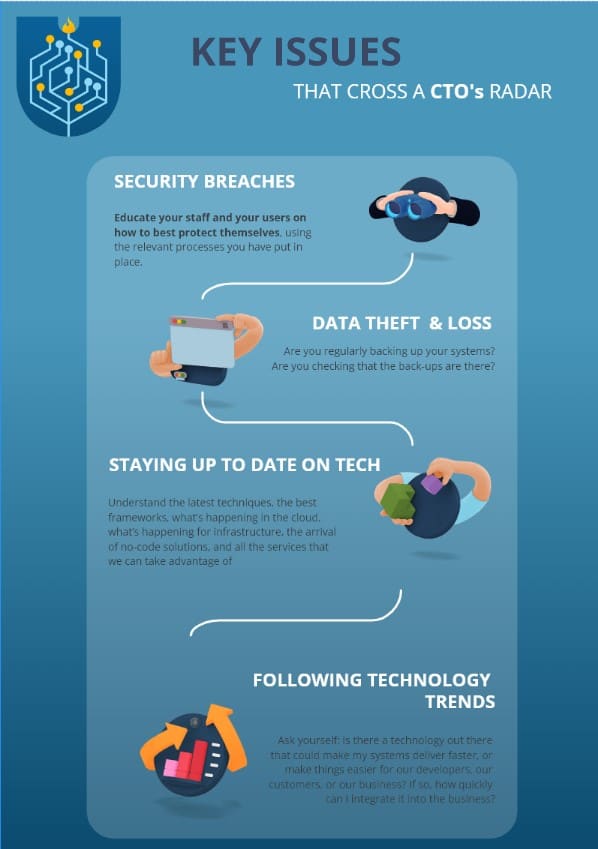
The key issues that cross a CTO’s radar
4 key issues of every CTO
Ten years ago cyber security was some way down the list of CTO priorities, but increasingly, today it’s amongst the most prominent. Security breaches, whether internal or external, are a constant threat. As a CTO, you must make sure you have processes in place to deal with them.
Security breaches
That said, it’s virtually impossible to stop a breach because of the movement of technology. What makes it even harder is that a lot of breaches are made through social engineering.
Your priority should be to educate your staff and your users on how to best protect themselves, using the relevant processes you have put in place.
A recent case I personally experienced was where a developer accidentally leaked an API key that gave users unauthorized access to systems. The security measures we had installed immediately picked up the problem and shut it down.
All the API keys were changed and we quickly confirmed that nobody had used that particular API key whilst it was in the wild for a few minutes. There was no panic because processes were in place.
Data theft and loss
Another issue that might cross your radar is data theft. This can be malicious, with somebody hacking in a security breach. Or it could be something as innocent as a user with an API key that knows how to breach the limitation and get more information. Having tracking mechanisms and automatic stops in place will prevent that.
Data loss is another important issue so do ask yourself occasionally:
Are you regularly backing up your systems?
Are you checking that the backups are there?
It’s something that very few people actually do, though they often say they do.
Staying up to date on the tech
Even though I’ve got a few years under my belt as a CTO (maybe because I have a few years under my belt) I always want to be up to date on tech, both generally and within my immediate area of expertise. I need to understand what’s going on.
I also need to understand:
The latest techniques
The best frameworks
What’s happening in the cloud
What’s happening to infrastructure
The arrival of no-code solutions and all the services that we can take advantage of to make our product faster, smoother and better for customers.
This leads me to consider on a regular basis whether I’m using the right tech. In other words, am I building a system on the correct frameworks and languages to meet the requirements of the customer? Quite often I come across projects where they’ve built a generic web system, let’s say in PHP, that falls short of what the user needs.
Staying abreast of technology trends
One of the reasons you need to delegate is to create a sufficient amount of time for you to understand longer-term strategies and technological innovation.
If you’re behind the laptop and micromanaging your team, you will struggle to create the headspace to gain insights into technology around the corner and how it may impact your company and sector. You must be up to date with the latest technology and avoid being too internal. That’s for the CIO when your company gets big enough to have both positions!
The CTO has to constantly ask, is there a technology out there that could make my systems deliver faster, or make things easier for our developers, our customers or our business? If so, how quickly can I integrate it into the business?
You need to set aside some time to identify the latest trends in technology and differentiate between hype and reality. This enables you to make an educated decision on whether to incorporate new technologies, rather than jumping on a headline or bandwagon.
Are you using the right technology?
The CTO must ensure that the company is using the right frameworks and back-end servers to support it.
For example, as a database grows, you may find that relational databases aren’t the right architecture to use. Hence, you may move up to a data warehouse, or maybe an OLAP cube or Elasticsearch.
There are always too many options and countless choices. You may not be an expert in a particular piece of tech, but you need the space to understand what benefits it could provide.
In addition, maintain your professional development in terms of your leadership and management skills. Here at CTO Academy, we recommend carving out time for short online courses and 1:1 coaching… well, we would say that wouldn’t we!
Missing deadlines
Another common issue is missing deadlines, even though they can happen for a myriad of other reasons.
The causes for delays can be:
Incomplete specifications
Not fully understanding as a business what is required from a build.
The people needed in the development process may not be available when you want them.
You must communicate — very clearly — the deadlines that you believe you can achieve. This should provide the basis for the decisions made by the rest of the business. It will also ensure that the sales and marketing team aren’t over-promising on specifications and timelines.
It’s especially the case if you use third-party suppliers. They may be suppliers who are reliant on your software or who give you software. For those suppliers that provide you with software, you need to understand their development processes and their reliability.
I’ve had dealings with suppliers where the quality of their data was subjective at best. And, which is far worse, their delivery was intermittent.
Being flexible
Another area that causes significant conflict is sales team deadlines.
These are often driven by challenging targets and attached bonuses. It’s not uncommon for salespeople to make promises to clients that are unattainable or put a significant strain on the technology team.
The sales team wants to close the deal. So they might say that certain functionality is going to be available immediately or ahead of what is realistic. That’s why you, as a chief technology officer, must have regular conversations with the sales team. You want to ensure they’re not over-committing your team and, thus, prevent disappointing the customer.
But you also don’t want to be the person who always says, ‘No, it can’t be done’. So, stay flexible and try to accommodate the needs of the salespeople. Because it’s them who help bring in the customers the business needs.
Over-reliance on individuals
A very common problem for CTOs in businesses large and small is a reliance on one or two individuals who dominate stand-ups and retain critical elements of knowledge about the software.
Because of this imbalance of power, those individuals might also become difficult and disruptive. However, you can’t just get rid of them because they have the knowledge you depend on.
This is one of the trickier management tasks you can face, so you need to employ the right preventative strategy.
The best plan is to double up. In other words, ensure:
a) knowledge sharing, and
b) that nobody becomes too important and has too much power or influence.
The way you manage disruptive team members will define your success as CTO.
What is a CTO salary?
A recent report by Reed provides insight into the expected earnings for London-based tech leaders in 2023.
According to the report, those working in companies with fewer than 1,000 employees should earn £96,080 per annum plus a 12% bonus in the private sector. In the public sector, on the other hand,we are talking about £75,950 with a 27.90% pension addition.
For more detailed information, use our salary calculator to see the averages across major world cities.
What is a CTO job outlook?
Trends and estimates are showing clear increase in demand for all types of contracts (eg fractional CTO jobs, full- and part-time, interim). Don’t forget that there are still a relatively large number of organizations that are undergoing digital transformation. Additionally, new tech start-ups are emerging on daily basis.
They are all, eventually, looking for CTOs —the role that is quickly becoming crucial to success.
Conclusion
Becoming an effective chief technology officer is probably the number one target for most CTO Academy members. And it doesn’t matter if you’re en route to the top or already there.
We’ve created a slightly light-hearted look at CTO life but tried to focus on the key changes that take place when arriving in a senior role and what should and shouldn’t be part of your workload.
It’s often a high-pressure role and the technology almost always stops with the CTO — a level of responsibility that some thrive on while others prefer to keep a lower profile.
What is crucial is that you understand the leadership skills needed to be effective, work towards improving those skills and discard or outsource the rest.
You might think the established CTO wouldn’t need any support but the truth is that operating at a very senior level making key and business critical decisions on a regular basis can be extremely challenging and isolating.
What makes that responsibility even more challenging is they’re often operating with non-technical c-suite colleagues which can lead to a sense of isolation.
In addition to which the world of technology moves at such a fast pace that what you knew five years ago could be near obsolete today so no matter how established and experienced, possibly because you’re so established and experienced, the need for a growth mindset and continuous learning philosophy is what shapes the most effective tech leaders.
Here at CTO Academy we work with experienced CTOs from around the world to help them remain become highly effective within their organisations.
We know that it can get lonely at the top, so we’re here for ongoing learning and management support. Find out more by visiting our website.
We are delighted to announce that CTO Academy have just closed a seed funding round.
What does this mean? Well, it’s all guns blazing as we roll out an exciting and expansive range of products, courses and support to our growing global tribe of developers, scrum masters, team leaders, CTOs and CIOs.
As companies strive to stay ahead of the curve and embrace innovation, the CTO plays a pivotal role in shaping the technological direction of the organization.
But what is that role? What does a CTO do on a day-to-day basis?
To explain, we will delve into a typical day in the life of a CTO, shedding light on their responsibilities, challenges, and contributions. We will be moving from overseeing the development of cutting-edge technologies to formulating long-term technology strategies.
Ensure that the technology infrastructure and tech strategy aligns with the company’s goals
Combine their technical expertise with a strategic and technical vision to propel the organisation forward
That’s a chief technology officer in a nutshell. Join me now as I explore the dynamic and diverse world of a CTO role to gain insights into a daily routine and the impact that job title has on technology and operational management.
What does a CTO do in a company?
As you will see, besides purely technical skills, technology leaders must also arm themselves with soft skills. This non-technical side radically improves team management whether we are talking about startup CTOs or enterprise leaders. In other words, it comes down to management skills and communication as much as strategic thinking.
A day in the life of a chief technology officer
Let’s start with the obvious.
There is no typical day for a chief technology officer, just as there are no typical CTO roles.
So I’ve focused this article on some of the daily issues that commonly emerge in this key leadership role, particularly for a CTO dealing with the business goals and technological needs of an early-stage tech startup and fast-growth company.
If you’re in a similar role, some of this may chime with you.
If not, I hope it’s an interesting and informative peek at life at the CTO coalface.
First thing on my daily to-do list: check no disasters have happened overnight. In order of priority:
No security breaches.
No systems gone down.
No one in the team has quit [early-stage companies are always at risk of this one!]
No angry emails from customer(s) [ditto]
No angry email from the chief executive
Breakfast [don’t forget to eat]
Then it’s off to the proverbial water cooler (online these days) for some of the valuable small talk that oils the wheels within a team. It enables me to get more of an understanding of colleagues, even though it doesn’t always feel like a natural part of my job description.
Here at CTO Academy HQ, our recent small talk generally circulates around reports from our distributed team, knee problems (we’re of a certain age) and the latest crazy marketing idea emerging from the chief executive. Working in a startup is very, very different to large companies, where everyone is close to the action.
If the team is small then I’m the scrum master and leading the meeting.
PRO TIP: Remember to engage all members of the team, allowing them to get their views across. Confirm goals for the day; leave longer conversations until later.
If the team is larger, then let the scrum master run the meeting. You may choose not to attend all meetings, but I find it useful to attend at least one a week. As an observer, I try to keep my mouth shut unless I need to correct any major issues or talk about wider strategy.
Onto the CEO and a relaxed chat over a leisurely coffee…
Doh, that rarely happens.
Both of us are busy and it’s more likely to be a couple of words whilst making the coffee. Generally, this provides an opportunity to update with salient facts and anything that is crucial to the CEO and their current priorities. Really important to keep them abreast of any major technical and/or strategic changes emerging on the horizon.
Getting this relationship right is crucial, but the time available is always limited.
Remember, also, that your happiness and success as CTO will often be heavily dependent on how functional your relationship is with the CEO. To be blunt, you’re likely to be very different personalities so it often needs work.
Right, we’ve done a disaster check, water cooler catch-up, stand-up meeting and CEO update. Next, I like to check in with customer support.
What does a CTO do in customer relations?
Customer-facing tasks have dramatically changed for the CTO over recent years.
In them olden days, it was rare for the tech leader and/or the team to get their hands dirty with those pesky customers. Now it’s increasingly common that the team gets direct market feedback on the problems they are tackling and the kit they are building.
I was once at a company where we analysed the support calls and it turned out that 40 per cent were password resets. The user password reset was not working but the admin side was. No ticket had been reported. We fixed it quickly and suddenly support had nothing to do!
Moving on to the sales department…
Next, and with something of a heavy heart, it’s across to sales to find out what mythical version of the software they have promised to customers today.
It always amazes me that their one-dimensional brains come up with such imaginative ideas for products, particularly when you realise they are still trying to remember their passwords. (For any sales director stumbling across this article, the password is normally your eldest child’s name and their year of birth.)
And then quickly to a board meeting.
After messing with the sales team’s heads, it’s on to a board meeting. If the investor director is attending, then we can look forward to decent coffee and Chocolate Hobnobs. Red carpet stuff.
All members have read my report, digested and understood it, come up with some thoughtful questions and congratulated me for my hard work.
Either that, or more likely I’m confronted by a gaggle of non-technologists, gurning their way through my notes and struggling to understand how our products actually work.
For a bit of fun, I might highlight that the sales numbers fail to add up and the marketing metrics provide no actionable insight whatsoever, but that’s only if I’m feeling bored. In truth, effective teams will often be competitive with each other, but in a collaborative spirit that drives a sum that is greater than the parts.
After the board, I rush to the conference room downstairs to meet a prospect who has concerns about our technology, security and processes. There are the usual questions which are relatively easy to answer but I must remember to raise ISO 27001 at the next board meeting now that we are at a reasonable size to make this sort of meeting or the long forms(!) redundant.
Pop into marketing and, TBH, it’s sometimes like the Mary Celeste in there
A sign on the door used to say “creative away day”, when we all worked together!
Tongue in cheek here — there’s always a bit of friendly tension with the marketing business unit.
They’re probably off on some team bonding yoga session or being massaged by goldfish. All of which will soon result in the release of version 2.61 (from 2.60) being promoted as a fundamental paradigm shift as we become the Uber of X. You see, I work with but sometimes struggle to understand the marketing team. Technology development is so much more tangible.
Lunch is generally a sandwich, whilst catching up with Slack and email messages.
And then, finally…
Some proper CTO work!
Analysis of our competitors by the product manager and a list of new functionality that we could do with. Priorities are based on user needs and our ability to implement them on time.
Lots of robust conversations about whether we absolutely need to have the functionality or not. I’m always cautious to avoid us turning our beautiful product into a user mess. Very common over time. MoSCoW strategy is a good starting place.
DevOps contact us in the meeting to state that a data supplier API has fallen over so we automatically switch to a cached version whilst it is down. Time to call the supplier and get an explanation, emphasising that it cannot happen again.
Two interviews with senior Java Developers, both of high calibre who have passed the relevant technical tests and team interviews (crucial to stress-test fit). All part of a strict employment process which means we have a higher retention rate. Everyone has gone through the process, so the team knows that a new starter is up to scratch.
Interviews with me are generally to rubber stamp as well as look at their potential in the business, beyond the posts they have applied for.
Before I leave for the day, I check that all went well with today’s schedule release.
Hopefully no issues and there shouldn’t be, as we put in a lot of effort on deployment and DevOps at the start of the product’s life.
Production releases happen on Wednesday, so we have time to roll back during the release if anything crops up. Never release on Friday. For the same reason, never have a major hospital operation on a Friday afternoon.
A day goes smoothly when the processes are working and the CEO is happy.
Home time is catching up on various articles I sent to my Kindle.
Now, I can only hope that I’ve managed to boost your understanding of (almost) everything you need to know about being a CTO and what a CTO does in a company. It also illustrates the strange contradiction of senior tech management — that your day can often be full of people and meetings and yet key decisions are often yours alone. It can be lonely at the top. Important therefore to recruit a strong team, expand your support network and create sufficient me-time for learning and reflection.
BTW: I love sales & marketing really. They play a crucial role in getting our salaries paid!